Ethical Theories
Rosalind Hursthouse's Comparison
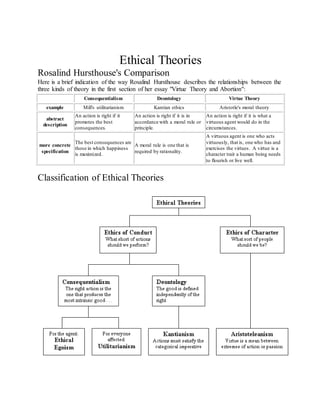
Here is a brief indication of the way Rosalind Hursthouse describes the relationships between the
three kinds of theory in the first section of her essay "Virtue Theory and Abortion":
Consequentialism Deontology Virtue Theory
example Mill's utilitarianism Kantian ethics Aristotle's moral theory
abstract
description
An action is right if it
promotes the best
consequences.
An action is right if it is in
accordance with a moral rule or
principle.
An action is right if it is what a
virtuous agent would do in the
circumstances.
more concrete
specification
The best consequences are
those in which happiness
is maximized.
A moral rule is one that is
required by rationality.
A virtuous agent is one who acts
virtuously, that is, one who has and
exercises the virtues. A virtue is a
character trait a human being needs
to flourish or live well.
Classification of Ethical Theories
A More Detailed (But Very Tentative) Comparison
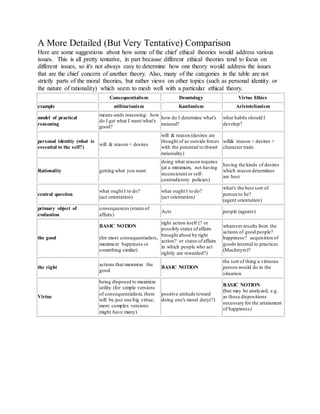
Here are some suggestions about how some of the chief ethical theories would address various
issues. This is all pretty tentative, in part because different ethical theories tend to focus on
different issues, so it's not always easy to determine how one theory would address the issues
that are the chief concern of another theory. Also, many of the categories in the table are not
strictly parts of the moral theories, but rather views on other topics (such as personal identity or
the nature of rationality) which seem to mesh well with a particular ethical theory.
Consequentialism Deontology Virtue Ethics
example utilitarianism Kantianism Aristotelianism
model of practical
reasoning
means-ends reasoning: how
do I get what I want/what's
good?
how do I determine what's
rational?
what habits should I
develop?
personal identity (what is
essential to the self?)
will & reason + desires
will & reason (desires are
thought of as outside forces
with the potential to thwart
rationality)
will& reason + desires +
character traits
Rationality getting what you want
doing what reason requires
(at a minimum, not having
inconsistent or self-
contradictory policies)
having the kinds of desires
which reason determines
are best
central question
what ought I to do?
(act orientation)
what ought I to do?
(act orientation)
what's the best sort of
person to be?
(agent orientation)
primary object of
evaluation
consequences (states of
affairs)
Acts people (agents)
the good
BASIC NOTION
(for most consequentialists,
maximum happiness or
something similar)
right action itself (? or
possibly states ofaffairs
brought about by right
action? or states ofaffairs
in which people who act
rightly are rewarded?)
whatever results from the
actions of good people?
happiness? acquisition of
goods internal to practices
(MacIntyre)?
the right
actions that maximize the
good
BASIC NOTION
the sort of thing a virtuous
person would do in the
situation
Virtue
being disposed to maximize
utility (for simple versions
of consequentialism, there
will be just one big virtue;
more complex versions
might have many)
positive attitude toward
doing one's moral duty(?)
BASIC NOTION
(but may be analyzed, e.g.
as those dispositions
necessary for the attainment
of happiness)

Ethical theories

  • 1.
    Ethical Theories Rosalind Hursthouse'sComparison Here is a brief indication of the way Rosalind Hursthouse describes the relationships between the three kinds of theory in the first section of her essay "Virtue Theory and Abortion": Consequentialism Deontology Virtue Theory example Mill's utilitarianism Kantian ethics Aristotle's moral theory abstract description An action is right if it promotes the best consequences. An action is right if it is in accordance with a moral rule or principle. An action is right if it is what a virtuous agent would do in the circumstances. more concrete specification The best consequences are those in which happiness is maximized. A moral rule is one that is required by rationality. A virtuous agent is one who acts virtuously, that is, one who has and exercises the virtues. A virtue is a character trait a human being needs to flourish or live well. Classification of Ethical Theories
  • 2.
    A More Detailed(But Very Tentative) Comparison Here are some suggestions about how some of the chief ethical theories would address various issues. This is all pretty tentative, in part because different ethical theories tend to focus on different issues, so it's not always easy to determine how one theory would address the issues that are the chief concern of another theory. Also, many of the categories in the table are not strictly parts of the moral theories, but rather views on other topics (such as personal identity or the nature of rationality) which seem to mesh well with a particular ethical theory. Consequentialism Deontology Virtue Ethics example utilitarianism Kantianism Aristotelianism model of practical reasoning means-ends reasoning: how do I get what I want/what's good? how do I determine what's rational? what habits should I develop? personal identity (what is essential to the self?) will & reason + desires will & reason (desires are thought of as outside forces with the potential to thwart rationality) will& reason + desires + character traits Rationality getting what you want doing what reason requires (at a minimum, not having inconsistent or self- contradictory policies) having the kinds of desires which reason determines are best central question what ought I to do? (act orientation) what ought I to do? (act orientation) what's the best sort of person to be? (agent orientation) primary object of evaluation consequences (states of affairs) Acts people (agents) the good BASIC NOTION (for most consequentialists, maximum happiness or something similar) right action itself (? or possibly states ofaffairs brought about by right action? or states ofaffairs in which people who act rightly are rewarded?) whatever results from the actions of good people? happiness? acquisition of goods internal to practices (MacIntyre)? the right actions that maximize the good BASIC NOTION the sort of thing a virtuous person would do in the situation Virtue being disposed to maximize utility (for simple versions of consequentialism, there will be just one big virtue; more complex versions might have many) positive attitude toward doing one's moral duty(?) BASIC NOTION (but may be analyzed, e.g. as those dispositions necessary for the attainment of happiness)