IMPLICATIONS OF
ETHICAL TRADITIONS
FOR BUSINESS
Lesson 7
TELEOGICAL AND DEONTOLOGICAL THEORIES
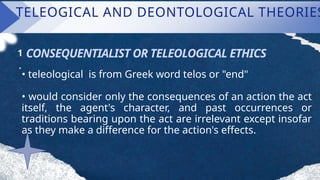
CONSEQUENTIALIST OR TELEOLOGICAL ETHICS
1
.
• teleological is from Greek word telos or "end"
• would consider only the consequences of an action the act
itself, the agent's character, and past occurrences or
traditions bearing upon the act are irrelevant except insofar
as they make a difference for the action's effects.
TELEOGICAL AND DEONTOLOGICAL THEORIES
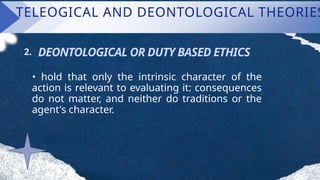
DEONTOLOGICAL OR DUTY BASED ETHICS
2.
• hold that only the intrinsic character of the
action is relevant to evaluating it: consequences
do not matter, and neither do traditions or the
agent's character.
TELEOGICAL AND DEONTOLOGICAL THEORIES
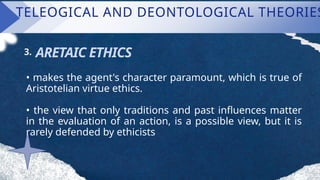
ARETAIC ETHICS
3.
• makes the agent's character paramount, which is true of
Aristotelian virtue ethics.
• the view that only traditions and past influences matter
in the evaluation of an action, is a possible view, but it is
rarely defended by ethicists
RIGHTS AND JUSTICE THEORIES
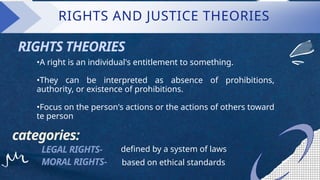
RIGHTS THEORIES
•A right is an individual's entitlement to something.
•They can be interpreted as absence of prohibitions,
authority, or existence of prohibitions.
•Focus on the person's actions or the actions of others toward
te person
categories:
LEGAL RIGHTS-
MORAL RIGHTS- based on ethical standards
defined by a system of laws
RIGHTS AND JUSTICE THEORIES
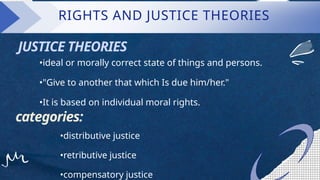
•ideal or morally correct state of things and persons.
•"Give to another that which Is due him/her."
•It is based on individual moral rights.
categories:
•distributive justice
•retributive justice
•compensatory justice
JUSTICE THEORIES
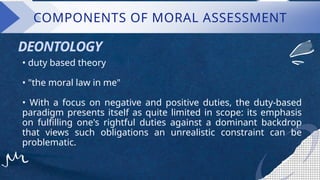
COMPONENTS OF MORAL ASSESSMENT
• duty based theory
• "the moral law in me"
• With a focus on negative and positive duties, the duty-based
paradigm presents itself as quite limited in scope: its emphasis
on fulfilling one's rightful duties against a dominant backdrop
that views such obligations an unrealistic constraint can be
problematic.
DEONTOLOGY
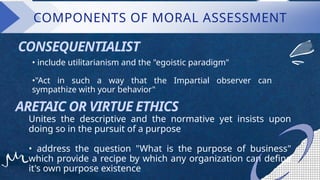
• include utilitarianism and the "egoistic paradigm"
•"Act in such a way that the Impartial observer can
sympathize with your behavior"
CONSEQUENTIALIST
ARETAIC OR VIRTUE ETHICS
Unites the descriptive and the normative yet insists upon
doing so in the pursuit of a purpose
• address the question "What is the purpose of business"
which provide a recipe by which any organization can define
it's own purpose existence
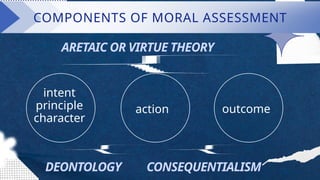
COMPONENTS OF MORAL ASSESSMENT
intent
principle
character
outcome
action
ARETAIC OR VIRTUE THEORY
DEONTOLOGY CONSEQUENTIALISM
COMPONENTS OF MORAL ASSESSMENT
VIRTUE ETHICS
• Emphasizes people's character an ethic of virtues and vices,
focuses on the process of personal moral character development
• Virtue ethics overcomes "moral schizophrena" or the need to
step out of one's role and wear the hat if the agents prefers to
solve the moral dilemma from a different perspective
• Ethics is an objective, rather than a constraint
• It allows us to discuss the strengths or weaknesses of the
character of the individual
• Virtue ethics is a broad term for theories that emphasize the
role of character and virtue in moral philosophy rather than
either doing one's duty or acting in order to bring about good
consequences.
• Virtue ethics which takes the concept of character to be
central to the idea of being a good person in business---keeps
at bay the threat of situational determinism.
• Virtues like other moral states or properties, typically play a
causal role in creating human well-being, not only that of the
one who is virtuous (Solomon, 2003; Hartman, 1998)
VIRTUE ETHICS
• Turns out to be the most promising representative of the pre-
modern category of moral theory, primarily because of his
references to and determined investigation of purpose or end.
• Virtue ethics overcomes "moral schizophrenia" or the need to
step out of one's role and wear, say.
• Virtue ethics involves the individual pursuing moral excellence
as a goal in and of itself, ethics becomes an objective rather
than a constraint.
ARISTOTLE 'S VIRTUE THEORY
VIRTUE ETHICS
VIRTUES OF VIRTUE ETHICS
1. It is personal.
2. It focuses on the motivations of the actor and the sources of action,
bringing a dynamic to ethical understanding.
3. It is contextual, highlighting the importance of understanding the
environment as it affects both actor and his or her acts.
4. It complements other disciplines addressing human behavior.
5. It focuses on the conformity between right thinking and desire.
(DOBSON, 1997; WHETSTONE, 2001; KOEHN,1995)
VIRTUES OF VIRTUE ETHICS
6. It treats virtue as a manifest, perceptible feature of action.
7. It conceives of human activity as continuous.
8. It stresses the importance of individuals being able to make contributions
of value to a society or communal enterprise.
9. It preserves a role for excellence and helps counter the leveling tendency
of deontological ethics.
10. It stresses that people become what they are within a community.
(DOBSON, 1997; WHETSTONE, 2001; KOEHN,1995)
VIRTUE ETHICS: HISTORICAL BACKGROUND
•In Plato's Republic, the four cardinal virtues are wisdom, temperance,
courage and justice. These reflect the nature of the soul
•The soul has three parts.
1. Our reason thinks; when it does this well, it has wisdom.
2. Our appetite desires; when it does this well, it has temperance (self-
control, soberness).
3. Our "high spirit" shows emotions (fear, anger, respect, etc.); when it
does this well, it has courage.
•Justice consists of the proper interplay of the three parts of the soul. In
the just person, reason controls the "high spirit" -- and both control the
appetite.
VIRTUE ETHICS: HISTORICAL BACKGROUND
•Charmides which was about temperance; Laches was about courage, and the Euthypro was
about piety.
•The first philosopher to give such list of four main virtues, although the label itself, "cardinal
virtues, was not coined until the second half of the 4th century AD by Ambrose of Milan
•Aristotle's Nicomachean Ethics is widely viewed as the most influential early work on virtue
ethics
•Aristotle's Ethics is the first systematic treatment of ethics in Western civilization.
•People must be one that is self-sufficient, final and attainable; he maintained that happiness
is the goal that meets these requirements.
•EUDAIMONIA which means happiness or human flourishing through moral excellence
(Dobson, 19997)
•His definition of happiness contains two vital concepts: "Activity of the soul, which means the
exercise of reason, and this is "in accordance with virtue," which describes the quality of the
performance
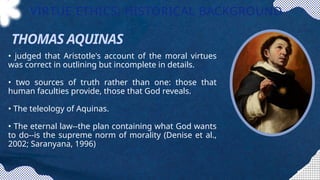
• judged that Aristotle's account of the moral virtues
was correct in outlining but incomplete in details.
• two sources of truth rather than one: those that
human faculties provide, those that God reveals.
• The teleology of Aquinas.
• The eternal law--the plan containing what God wants
to do--is the supreme norm of morality (Denise et al.,
2002; Saranyana, 1996)
VIRTUE ETHICS: HISTORICAL BACKGROUND
THOMAS AQUINAS
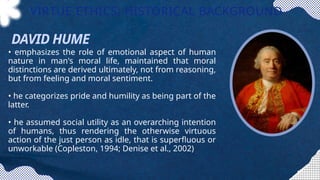
• emphasizes the role of emotional aspect of human
nature in man's moral life, maintained that moral
distinctions are derived ultimately, not from reasoning,
but from feeling and moral sentiment.
• he categorizes pride and humility as being part of the
latter.
• he assumed social utility as an overarching intention
of humans, thus rendering the otherwise virtuous
action of the just person as idle, that is superfluous or
unworkable (Copleston, 1994; Denise et al., 2002)
VIRTUE ETHICS: HISTORICAL BACKGROUND
DAVID HUME
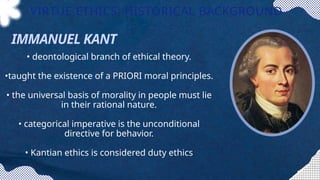
• deontological branch of ethical theory.
•taught the existence of a PRIORI moral principles.
• the universal basis of morality in people must lie
in their rational nature.
• categorical imperative is the unconditional
directive for behavior.
• Kantian ethics is considered duty ethics
VIRTUE ETHICS: HISTORICAL BACKGROUND
IMMANUEL KANT
- Modern Moral Philosophy
- After Virtue
- The Book of Virtues
CONTEMPORARY SCHOLARS OF
VIRTUE ETHICS
• ELIZABETH ANSCOMBE
• ALASDAIR MACINTYRE
• WILLIAM J. BENNETT
• Managing in ethical ways is not merely about avoiding bad outcomes.
• Personal happiness flowed from being virtuous and not merely from comfort or
observance.
• The theory of virtue addresses the question "What is the purpose of business?" It
provides a recipe by which organization can define its own purposeful existence.
• A virtuous agent is involved in a continual quest to find balance in decision-making.
• The virtue approach to ethics emphasizes people's character, an ethic of virtues focuses
on the process of personal moral character development.
• It has been proposed that managers add an attention to virtues and vices of human
character as a full compelement to moral reasoning according to a deontological focus
on obligations to act and a teleological focus on consequences (Dawson and
Bartholomew, 2003; Whetstone 2001).
WHY VIRTUES SHOULD MATTER IN MANAGEMENT AND
FINANCE

Ethics and its implication to Business presentation

  • 1.
  • 2.
    TELEOGICAL AND DEONTOLOGICALTHEORIES CONSEQUENTIALIST OR TELEOLOGICAL ETHICS 1 . • teleological is from Greek word telos or "end" • would consider only the consequences of an action the act itself, the agent's character, and past occurrences or traditions bearing upon the act are irrelevant except insofar as they make a difference for the action's effects.
  • 3.
    TELEOGICAL AND DEONTOLOGICALTHEORIES DEONTOLOGICAL OR DUTY BASED ETHICS 2. • hold that only the intrinsic character of the action is relevant to evaluating it: consequences do not matter, and neither do traditions or the agent's character.
  • 4.
    TELEOGICAL AND DEONTOLOGICALTHEORIES ARETAIC ETHICS 3. • makes the agent's character paramount, which is true of Aristotelian virtue ethics. • the view that only traditions and past influences matter in the evaluation of an action, is a possible view, but it is rarely defended by ethicists
  • 5.
    RIGHTS AND JUSTICETHEORIES RIGHTS THEORIES •A right is an individual's entitlement to something. •They can be interpreted as absence of prohibitions, authority, or existence of prohibitions. •Focus on the person's actions or the actions of others toward te person categories: LEGAL RIGHTS- MORAL RIGHTS- based on ethical standards defined by a system of laws
  • 6.
    RIGHTS AND JUSTICETHEORIES •ideal or morally correct state of things and persons. •"Give to another that which Is due him/her." •It is based on individual moral rights. categories: •distributive justice •retributive justice •compensatory justice JUSTICE THEORIES
  • 7.
    COMPONENTS OF MORALASSESSMENT • duty based theory • "the moral law in me" • With a focus on negative and positive duties, the duty-based paradigm presents itself as quite limited in scope: its emphasis on fulfilling one's rightful duties against a dominant backdrop that views such obligations an unrealistic constraint can be problematic. DEONTOLOGY
  • 8.
    • include utilitarianismand the "egoistic paradigm" •"Act in such a way that the Impartial observer can sympathize with your behavior" CONSEQUENTIALIST ARETAIC OR VIRTUE ETHICS Unites the descriptive and the normative yet insists upon doing so in the pursuit of a purpose • address the question "What is the purpose of business" which provide a recipe by which any organization can define it's own purpose existence COMPONENTS OF MORAL ASSESSMENT
  • 9.
    intent principle character outcome action ARETAIC OR VIRTUETHEORY DEONTOLOGY CONSEQUENTIALISM COMPONENTS OF MORAL ASSESSMENT
  • 10.
    VIRTUE ETHICS • Emphasizespeople's character an ethic of virtues and vices, focuses on the process of personal moral character development • Virtue ethics overcomes "moral schizophrena" or the need to step out of one's role and wear the hat if the agents prefers to solve the moral dilemma from a different perspective • Ethics is an objective, rather than a constraint • It allows us to discuss the strengths or weaknesses of the character of the individual
  • 11.
    • Virtue ethicsis a broad term for theories that emphasize the role of character and virtue in moral philosophy rather than either doing one's duty or acting in order to bring about good consequences. • Virtue ethics which takes the concept of character to be central to the idea of being a good person in business---keeps at bay the threat of situational determinism. • Virtues like other moral states or properties, typically play a causal role in creating human well-being, not only that of the one who is virtuous (Solomon, 2003; Hartman, 1998) VIRTUE ETHICS
  • 12.
    • Turns outto be the most promising representative of the pre- modern category of moral theory, primarily because of his references to and determined investigation of purpose or end. • Virtue ethics overcomes "moral schizophrenia" or the need to step out of one's role and wear, say. • Virtue ethics involves the individual pursuing moral excellence as a goal in and of itself, ethics becomes an objective rather than a constraint. ARISTOTLE 'S VIRTUE THEORY VIRTUE ETHICS
  • 13.
    VIRTUES OF VIRTUEETHICS 1. It is personal. 2. It focuses on the motivations of the actor and the sources of action, bringing a dynamic to ethical understanding. 3. It is contextual, highlighting the importance of understanding the environment as it affects both actor and his or her acts. 4. It complements other disciplines addressing human behavior. 5. It focuses on the conformity between right thinking and desire. (DOBSON, 1997; WHETSTONE, 2001; KOEHN,1995)
  • 14.
    VIRTUES OF VIRTUEETHICS 6. It treats virtue as a manifest, perceptible feature of action. 7. It conceives of human activity as continuous. 8. It stresses the importance of individuals being able to make contributions of value to a society or communal enterprise. 9. It preserves a role for excellence and helps counter the leveling tendency of deontological ethics. 10. It stresses that people become what they are within a community. (DOBSON, 1997; WHETSTONE, 2001; KOEHN,1995)
  • 15.
    VIRTUE ETHICS: HISTORICALBACKGROUND •In Plato's Republic, the four cardinal virtues are wisdom, temperance, courage and justice. These reflect the nature of the soul •The soul has three parts. 1. Our reason thinks; when it does this well, it has wisdom. 2. Our appetite desires; when it does this well, it has temperance (self- control, soberness). 3. Our "high spirit" shows emotions (fear, anger, respect, etc.); when it does this well, it has courage. •Justice consists of the proper interplay of the three parts of the soul. In the just person, reason controls the "high spirit" -- and both control the appetite.
  • 16.
    VIRTUE ETHICS: HISTORICALBACKGROUND •Charmides which was about temperance; Laches was about courage, and the Euthypro was about piety. •The first philosopher to give such list of four main virtues, although the label itself, "cardinal virtues, was not coined until the second half of the 4th century AD by Ambrose of Milan •Aristotle's Nicomachean Ethics is widely viewed as the most influential early work on virtue ethics •Aristotle's Ethics is the first systematic treatment of ethics in Western civilization. •People must be one that is self-sufficient, final and attainable; he maintained that happiness is the goal that meets these requirements. •EUDAIMONIA which means happiness or human flourishing through moral excellence (Dobson, 19997) •His definition of happiness contains two vital concepts: "Activity of the soul, which means the exercise of reason, and this is "in accordance with virtue," which describes the quality of the performance
  • 17.
    • judged thatAristotle's account of the moral virtues was correct in outlining but incomplete in details. • two sources of truth rather than one: those that human faculties provide, those that God reveals. • The teleology of Aquinas. • The eternal law--the plan containing what God wants to do--is the supreme norm of morality (Denise et al., 2002; Saranyana, 1996) VIRTUE ETHICS: HISTORICAL BACKGROUND THOMAS AQUINAS
  • 18.
    • emphasizes therole of emotional aspect of human nature in man's moral life, maintained that moral distinctions are derived ultimately, not from reasoning, but from feeling and moral sentiment. • he categorizes pride and humility as being part of the latter. • he assumed social utility as an overarching intention of humans, thus rendering the otherwise virtuous action of the just person as idle, that is superfluous or unworkable (Copleston, 1994; Denise et al., 2002) VIRTUE ETHICS: HISTORICAL BACKGROUND DAVID HUME
  • 19.
    • deontological branchof ethical theory. •taught the existence of a PRIORI moral principles. • the universal basis of morality in people must lie in their rational nature. • categorical imperative is the unconditional directive for behavior. • Kantian ethics is considered duty ethics VIRTUE ETHICS: HISTORICAL BACKGROUND IMMANUEL KANT
  • 20.
    - Modern MoralPhilosophy - After Virtue - The Book of Virtues CONTEMPORARY SCHOLARS OF VIRTUE ETHICS • ELIZABETH ANSCOMBE • ALASDAIR MACINTYRE • WILLIAM J. BENNETT
  • 21.
    • Managing inethical ways is not merely about avoiding bad outcomes. • Personal happiness flowed from being virtuous and not merely from comfort or observance. • The theory of virtue addresses the question "What is the purpose of business?" It provides a recipe by which organization can define its own purposeful existence. • A virtuous agent is involved in a continual quest to find balance in decision-making. • The virtue approach to ethics emphasizes people's character, an ethic of virtues focuses on the process of personal moral character development. • It has been proposed that managers add an attention to virtues and vices of human character as a full compelement to moral reasoning according to a deontological focus on obligations to act and a teleological focus on consequences (Dawson and Bartholomew, 2003; Whetstone 2001). WHY VIRTUES SHOULD MATTER IN MANAGEMENT AND FINANCE