ETHICAL ISSUES IN THE
EDUCATION SYSTEM
Navigating the Path to Ethical Excellence
BY
NEHAVARTHINI KAVIN
UDHAYAKUMAR THARUN
YOGESHWAR VIGNESH RAJ
PRASANNA
Ethical issues in the Education system © 2023
by Nehavarthini, Udhayakumar, Kasi raj kavin,
Prasanna, Tharun, Vignesh Raj, Yogeshwar is
licensed under CC BY-NC-SA 4.0
Introduction
Students and teachers both are often
associated very closely with such ethical
issues in schools. Some of these are
because of their direct involvement,
while others may be a consequence of
how the education system is laid out. It
is essential to talk about ethical issues
related to the teaching profession so that
a solution might be found.
SocialInequity
.
One of the biggest ethical issues that schools face is social
inequity.
• Education institutions often fail to address the problems that
arise thanks to the inequalities between different children
because of their economic, ethnic, and other family
backgrounds.
• A child from a poorer background, who may not have enough
food or enough time to be an active kid at home, will likely
have a much more difficult time in school than someone from
the opposing end of the spectrum.
• School administrators often punish these children for having
bad academic performance instead of being offered assistance
in an alternative fashion.
CHEATING
Cheating has been a prominent historical issue in every
school.While it is challenging to tackle this problem
thoroughly, there are things schools can do to minimize it.
• For example, using a respectable plagiarism checker can
allow a teacher to assess student work before grading it.
• Assisted cheating is now becoming more popular
and one of the most significant ethical concerns
education providers face. This relates to a teacher
helping a struggling child to boost a classroom’s
overall performance and secure more funding.
bullying
• It is also believed that a child who
is constantly bullied or hurt is
more likely to inflict harm on
themselves or on others.
• That is one reason why there
needs to be a deep understanding
of this issue among people and
both private schools and public
schools should have a zero-
tolerance policy when it comes to
cases of bullying
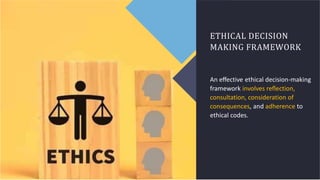
ETHICAL DECISION
MAKING FRAMEWORK
An effective ethical decision-making
framework involves reflection,
consultation, consideration of
consequences, and adherence to
ethical codes.
ISSUE OF DISCIPLINE
• The notion of zero tolerance policy against the give-them-another chance policy
cannot work across the board. Some quarters, especially parents and guardians
might be against the zero tolerance policy for reasons best known to them, others
support the idea. Both concepts can be applied simultaneously in all educational
institutes.
• While the zero tolerance policy is used for aggressive and anti-social and
behavioural in-disciplinary actions like carrying firearms in the school and
bullying, the second chance policy can be used for the encouragement of better
academic performance.
• The second chance policy does not necessarily mean one should spare the rod and
spoil the child.
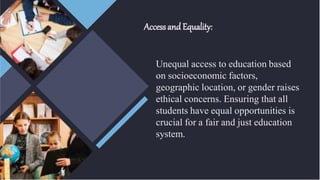
Accessand Equality:
Unequal access to education based
on socioeconomic factors,
geographic location, or gender raises
ethical concerns. Ensuring that all
students have equal opportunities is
crucial for a fair and just education
system.
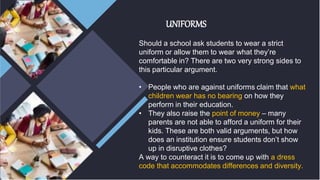
UNIFORMS
Should a school ask students to wear a strict
uniform or allow them to wear what they’re
comfortable in? There are two very strong sides to
this particular argument.
• People who are against uniforms claim that what
children wear has no bearing on how they
perform in their education.
• They also raise the point of money – many
parents are not able to afford a uniform for their
kids. These are both valid arguments, but how
does an institution ensure students don’t show
up in disruptive clothes?
A way to counteract it is to come up with a dress
code that accommodates differences and diversity.
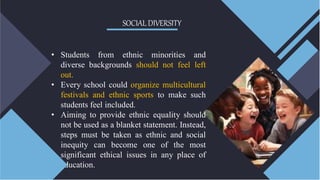
SOCIALDIVERSITY
• Students from ethnic minorities and
diverse backgrounds should not feel left
out.
• Every school could organize multicultural
festivals and ethnic sports to make such
students feel included.
• Aiming to provide ethnic equality should
not be used as a blanket statement. Instead,
steps must be taken as ethnic and social
inequity can become one of the most
significant ethical issues in any place of
education.
SPECIAL TREATMENT
Whether because of something as simple as
personal preference or something as problematic as
racial inequality, special treatment for some is one of
the prime ethics-related obstacles students face.
• When it comes to employing a zero-tolerance or
second-chance policy, things can get a little
complicated. Neither of these can be utilized in every
situation. A teacher may be empowered to use one or
the other depending on the situation.
• A zero-tolerance policy can be useful when it comes to
issues like bullying or racial issues in schools whereas
the second chance policy can be used to help students
improve their academic performance.
GRADINGEXAMS
As schools move forward, it is important to reassess
how student learning is assessed. Exams and tests
are not necessarily a good way to do so, as many
young people can face issues when sitting in
exams.
• To assess the quality of education provided
to a student in private and public schools,
there needs to be a change in teaching
strategies, curriculum development,
assessments, and more
• It has often been argued that examinations are not a true test of knowledge, as
some students suffer from what is sometimes referred to as “examination fever”,
where even a brilliant student finds it difficult to pass the simplest examination.
• On the other hand, who takes the blame for the failure of the student(s) – the
rather incompetent teacher or the lazy student.
• In addition to the ethical issues affecting learning mentioned above, other issues
worth noting include flexibility in the curriculum development, teaching strategy,
continuous assessments, knowledge transfer and best practices cross the board.
• Each of the issues mentioned requires deep understanding and careful scrutiny to
proffer effective solutions and enhance the educational system.
Addressing Student Welfare
Ensuring student welfare
involves balancing
academic rigor with
emotional support,
safeguarding against
discrimination, and
fostering a safe learning
environment
Conclusion
• Every teacher needs to be aware of such issues so that
they are able to tackle them in their classes.
• Treating children from diverse backgrounds in an equal
fashion, employing a second chance policy where
applicable, and grading work fairly are all things that need
to be done to tackle some of these ethical dilemmas in
education.
Whether we talk about public or private education centers,
ethical issues like these and more need to be tackled.
Thanks!
Ethical issues in the Education system © 2023
by Nehavarthini, Udhayakumar, Kasi raj kavin,
Prasanna, Tharun, Vignesh Raj, Yogeshwar is
licensed under CC BY-NC-SA 4.0

Ethical issues in the Education system

  • 1.
    ETHICAL ISSUES INTHE EDUCATION SYSTEM Navigating the Path to Ethical Excellence BY NEHAVARTHINI KAVIN UDHAYAKUMAR THARUN YOGESHWAR VIGNESH RAJ PRASANNA Ethical issues in the Education system © 2023 by Nehavarthini, Udhayakumar, Kasi raj kavin, Prasanna, Tharun, Vignesh Raj, Yogeshwar is licensed under CC BY-NC-SA 4.0
  • 2.
    Introduction Students and teachersboth are often associated very closely with such ethical issues in schools. Some of these are because of their direct involvement, while others may be a consequence of how the education system is laid out. It is essential to talk about ethical issues related to the teaching profession so that a solution might be found.
  • 3.
    SocialInequity . One of thebiggest ethical issues that schools face is social inequity. • Education institutions often fail to address the problems that arise thanks to the inequalities between different children because of their economic, ethnic, and other family backgrounds. • A child from a poorer background, who may not have enough food or enough time to be an active kid at home, will likely have a much more difficult time in school than someone from the opposing end of the spectrum. • School administrators often punish these children for having bad academic performance instead of being offered assistance in an alternative fashion.
  • 4.
    CHEATING Cheating has beena prominent historical issue in every school.While it is challenging to tackle this problem thoroughly, there are things schools can do to minimize it. • For example, using a respectable plagiarism checker can allow a teacher to assess student work before grading it. • Assisted cheating is now becoming more popular and one of the most significant ethical concerns education providers face. This relates to a teacher helping a struggling child to boost a classroom’s overall performance and secure more funding.
  • 5.
    bullying • It isalso believed that a child who is constantly bullied or hurt is more likely to inflict harm on themselves or on others. • That is one reason why there needs to be a deep understanding of this issue among people and both private schools and public schools should have a zero- tolerance policy when it comes to cases of bullying
  • 6.
    ETHICAL DECISION MAKING FRAMEWORK Aneffective ethical decision-making framework involves reflection, consultation, consideration of consequences, and adherence to ethical codes.
  • 7.
    ISSUE OF DISCIPLINE •The notion of zero tolerance policy against the give-them-another chance policy cannot work across the board. Some quarters, especially parents and guardians might be against the zero tolerance policy for reasons best known to them, others support the idea. Both concepts can be applied simultaneously in all educational institutes. • While the zero tolerance policy is used for aggressive and anti-social and behavioural in-disciplinary actions like carrying firearms in the school and bullying, the second chance policy can be used for the encouragement of better academic performance. • The second chance policy does not necessarily mean one should spare the rod and spoil the child.
  • 8.
    Accessand Equality: Unequal accessto education based on socioeconomic factors, geographic location, or gender raises ethical concerns. Ensuring that all students have equal opportunities is crucial for a fair and just education system.
  • 9.
    UNIFORMS Should a schoolask students to wear a strict uniform or allow them to wear what they’re comfortable in? There are two very strong sides to this particular argument. • People who are against uniforms claim that what children wear has no bearing on how they perform in their education. • They also raise the point of money – many parents are not able to afford a uniform for their kids. These are both valid arguments, but how does an institution ensure students don’t show up in disruptive clothes? A way to counteract it is to come up with a dress code that accommodates differences and diversity.
  • 10.
    SOCIALDIVERSITY • Students fromethnic minorities and diverse backgrounds should not feel left out. • Every school could organize multicultural festivals and ethnic sports to make such students feel included. • Aiming to provide ethnic equality should not be used as a blanket statement. Instead, steps must be taken as ethnic and social inequity can become one of the most significant ethical issues in any place of education.
  • 11.
    SPECIAL TREATMENT Whether becauseof something as simple as personal preference or something as problematic as racial inequality, special treatment for some is one of the prime ethics-related obstacles students face. • When it comes to employing a zero-tolerance or second-chance policy, things can get a little complicated. Neither of these can be utilized in every situation. A teacher may be empowered to use one or the other depending on the situation. • A zero-tolerance policy can be useful when it comes to issues like bullying or racial issues in schools whereas the second chance policy can be used to help students improve their academic performance.
  • 12.
    GRADINGEXAMS As schools moveforward, it is important to reassess how student learning is assessed. Exams and tests are not necessarily a good way to do so, as many young people can face issues when sitting in exams. • To assess the quality of education provided to a student in private and public schools, there needs to be a change in teaching strategies, curriculum development, assessments, and more
  • 13.
    • It hasoften been argued that examinations are not a true test of knowledge, as some students suffer from what is sometimes referred to as “examination fever”, where even a brilliant student finds it difficult to pass the simplest examination. • On the other hand, who takes the blame for the failure of the student(s) – the rather incompetent teacher or the lazy student. • In addition to the ethical issues affecting learning mentioned above, other issues worth noting include flexibility in the curriculum development, teaching strategy, continuous assessments, knowledge transfer and best practices cross the board. • Each of the issues mentioned requires deep understanding and careful scrutiny to proffer effective solutions and enhance the educational system.
  • 14.
    Addressing Student Welfare Ensuringstudent welfare involves balancing academic rigor with emotional support, safeguarding against discrimination, and fostering a safe learning environment
  • 15.
    Conclusion • Every teacherneeds to be aware of such issues so that they are able to tackle them in their classes. • Treating children from diverse backgrounds in an equal fashion, employing a second chance policy where applicable, and grading work fairly are all things that need to be done to tackle some of these ethical dilemmas in education. Whether we talk about public or private education centers, ethical issues like these and more need to be tackled.
  • 16.
    Thanks! Ethical issues inthe Education system © 2023 by Nehavarthini, Udhayakumar, Kasi raj kavin, Prasanna, Tharun, Vignesh Raj, Yogeshwar is licensed under CC BY-NC-SA 4.0