Essay
ESSAY
An essay is a short non-fiction,
non-imaginary work about a subject.
It may be classified by tone and style
as formal or informal.
It has many purposes depending
on what the writer wants to write
about and how he/she wants to affect
the readers.
Three Main Parts
• Introduction
It is the opening part of the write-
up that shows the topic sentence of
the essay or the thesis statement. It
prepares the readers on the essay.
Therefore, it should be effective so
that the readers are encourage/
motivate to continue reading.
Effective introduction should
• Catch the reader’s attention, which
can be done, for example, by using a
direct announcement, a quotation, a
question, a definition, an unusual
comparison, or a controversial
position/opinion;
• Introduce the topic of the essay, (in
other words, inform the reader of and
provide a context for the topic being
discussed);
• Introduce the main idea (otherwise
known as the thesis or claim) of the
essay;
• Introduce the purpose of the essay
(will it inform, argue, persuade,
describe, narrate, classify, etc.?).
An effective body
paragraphs should
• Explain, illustrate, discuss, or provide
evidence to support the main idea
(thesis or claim) of the essay;
• Discuss only one aspect of the main
idea (whenever you move on to a
new supporting point, start a new
body paragraph);
• Body
An essay includes body
paragraphs, which develop the main
idea (thesis or claim) of the essay.
• Work together with the other body
paragraphs to support your essay’s
main idea;
• Work together with the other body
paragraphs to create a clear,
cohesive paper (clarity and
coherence can be achieved through
the use of transitions)
Conclusion
An essay ends with a brief
conclusion, which brings the essay to
a logical end. An effective conclusion
should:
brief;
predicting an outcome to the
main idea
giving an opinion
quotations
• Remind readers of the primary focus
of the essay, which can be done by
restating the main idea in different
words;
• Avoid introducing new ideas;
• Avoid apologies.
TYPES OF AN ESSAY
FORMAL ESSAY
This is known as impersonal
essay. The content is
informative and scientific in
nature. The writer uses the
“aesthetic” approach in
language and style.
It is called familiar or personal
essay. It expresses personal
experiences or observation on
human nature. Its purpose is to
entertain rather than to inform.
INFORMAL ESSAY
FORMS OF ESSAY
• DESCRIPTIVE ESSAY
It is an essay that illustrates by
using sensory words in order to
bring to the reader’s imagination what
is being talked about.
• NARRATIVE ESSAY
It is an essay that tells a story of
the writer or other’s story. It is usually
found in the feature writing sections
of newspaper or magazine
• EXPOSITORY ESSAY
It is an essay that explains
something so that reader can
understand.
• PERSUASIVE ESSAY
It is an essay that convinces
the reader to think in a certain way.
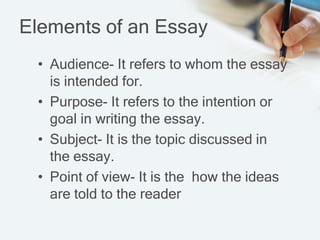
Elements of an Essay
• Audience- It refers to whom the essay
is intended for.
• Purpose- It refers to the intention or
goal in writing the essay.
• Subject- It is the topic discussed in
the essay.
• Point of view- It is the how the ideas
are told to the reader
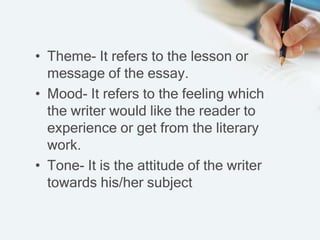
• Theme- It refers to the lesson or
message of the essay.
• Mood- It refers to the feeling which
the writer would like the reader to
experience or get from the literary
work.
• Tone- It is the attitude of the writer
towards his/her subject
• Style- This is the special way in
which the ideas of the essay are
developed.

Essay 140117084924-phpapp01

  • 1.
  • 2.
    ESSAY An essay isa short non-fiction, non-imaginary work about a subject. It may be classified by tone and style as formal or informal. It has many purposes depending on what the writer wants to write about and how he/she wants to affect the readers.
  • 3.
    Three Main Parts •Introduction It is the opening part of the write- up that shows the topic sentence of the essay or the thesis statement. It prepares the readers on the essay. Therefore, it should be effective so that the readers are encourage/ motivate to continue reading.
  • 4.
    Effective introduction should •Catch the reader’s attention, which can be done, for example, by using a direct announcement, a quotation, a question, a definition, an unusual comparison, or a controversial position/opinion; • Introduce the topic of the essay, (in other words, inform the reader of and provide a context for the topic being discussed);
  • 5.
    • Introduce themain idea (otherwise known as the thesis or claim) of the essay; • Introduce the purpose of the essay (will it inform, argue, persuade, describe, narrate, classify, etc.?).
  • 6.
    An effective body paragraphsshould • Explain, illustrate, discuss, or provide evidence to support the main idea (thesis or claim) of the essay; • Discuss only one aspect of the main idea (whenever you move on to a new supporting point, start a new body paragraph);
  • 7.
    • Body An essayincludes body paragraphs, which develop the main idea (thesis or claim) of the essay.
  • 8.
    • Work togetherwith the other body paragraphs to support your essay’s main idea; • Work together with the other body paragraphs to create a clear, cohesive paper (clarity and coherence can be achieved through the use of transitions)
  • 9.
    Conclusion An essay endswith a brief conclusion, which brings the essay to a logical end. An effective conclusion should:
  • 10.
    brief; predicting an outcometo the main idea giving an opinion quotations
  • 11.
    • Remind readersof the primary focus of the essay, which can be done by restating the main idea in different words; • Avoid introducing new ideas; • Avoid apologies.
  • 12.
  • 13.
    FORMAL ESSAY This isknown as impersonal essay. The content is informative and scientific in nature. The writer uses the “aesthetic” approach in language and style.
  • 14.
    It is calledfamiliar or personal essay. It expresses personal experiences or observation on human nature. Its purpose is to entertain rather than to inform. INFORMAL ESSAY
  • 15.
  • 16.
    • DESCRIPTIVE ESSAY Itis an essay that illustrates by using sensory words in order to bring to the reader’s imagination what is being talked about.
  • 17.
    • NARRATIVE ESSAY Itis an essay that tells a story of the writer or other’s story. It is usually found in the feature writing sections of newspaper or magazine
  • 18.
    • EXPOSITORY ESSAY Itis an essay that explains something so that reader can understand.
  • 19.
    • PERSUASIVE ESSAY Itis an essay that convinces the reader to think in a certain way.
  • 20.
    Elements of anEssay • Audience- It refers to whom the essay is intended for. • Purpose- It refers to the intention or goal in writing the essay. • Subject- It is the topic discussed in the essay. • Point of view- It is the how the ideas are told to the reader
  • 21.
    • Theme- Itrefers to the lesson or message of the essay. • Mood- It refers to the feeling which the writer would like the reader to experience or get from the literary work. • Tone- It is the attitude of the writer towards his/her subject
  • 22.
    • Style- Thisis the special way in which the ideas of the essay are developed.