Want to make your research OA* so where do you publish?
Make DOAJ your starting point for finding quality peer-
reviewed OA journals
Webinar for OA week 2016 on openaccessIndia.org
Presented by Leena Shah, DOAJ Ambassador for India
27th
October 2016
*OA- Open Access
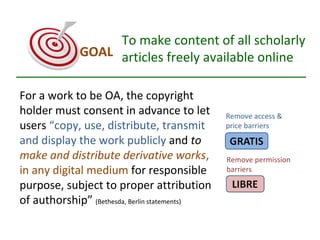
Remove access &
price barriers
Remove permission
barriers
To make content of all scholarly
articles freely available onlineGOAL
For a work to be OA, the copyright
holder must consent in advance to let
users “copy, use, distribute, transmit
and display the work publicly and to
make and distribute derivative works,
in any digital medium for responsible
purpose, subject to proper attribution
of authorship” (Bethesda, Berlin statements)
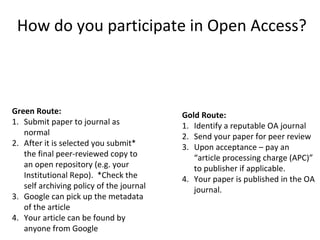
How do you participate in Open Access?
Green Route:
1. Submit paper to journal as
normal
2. After it is selected you submit*
the final peer-reviewed copy to
an open repository (e.g. your
Institutional Repo). *Check the
self archiving policy of the journal
3. Google can pick up the metadata
of the article
4. Your article can be found by
anyone from Google
Gold Route:
1. Identify a reputable OA journal
2. Send your paper for peer review
3. Upon acceptance – pay an
“article processing charge (APC)”
to publisher if applicable.
4. Your paper is published in the OA
journal.
Taking the Gold Route
Find a reputable OA journal
Directory of OA
Journals
[doaj.org]
subject
specific
peer
reviewed
open
access
APC or
not?
journal
license
country
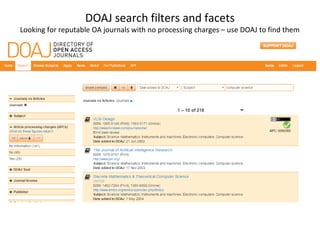
DOAJ search filters and facets
Looking for reputable OA journals with no processing charges – use DOAJ to find them
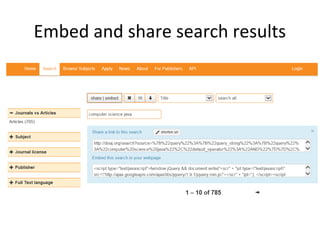
Embed and share search results
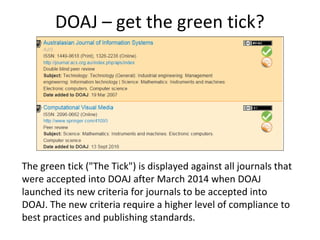
DOAJ – get the green tick?
The green tick ("The Tick") is displayed against all journals that
were accepted into DOAJ after March 2014 when DOAJ
launched its new criteria for journals to be accepted into
DOAJ. The new criteria require a higher level of compliance to
best practices and publishing standards.
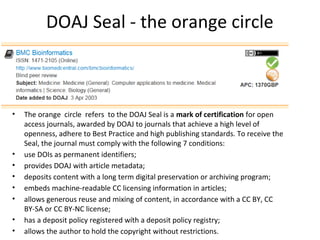
DOAJ Seal - the orange circle
• The orange circle refers to the DOAJ Seal is a mark of certification for open
access journals, awarded by DOAJ to journals that achieve a high level of
openness, adhere to Best Practice and high publishing standards. To receive the
Seal, the journal must comply with the following 7 conditions:
• use DOIs as permanent identifiers;
• provides DOAJ with article metadata;
• deposits content with a long term digital preservation or archiving program;
• embeds machine-readable CC licensing information in articles;
• allows generous reuse and mixing of content, in accordance with a CC BY, CC
BY-SA or CC BY-NC license;
• has a deposit policy registered wíth a deposit policy registry;
• allows the author to hold the copyright without restrictions.
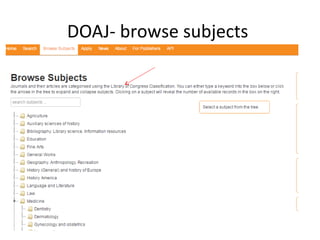
DOAJ- browse subjects
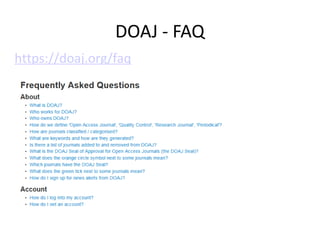
DOAJ - FAQ
https://doaj.org/faq
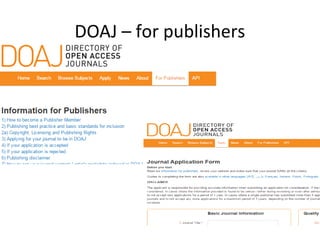
DOAJ – for publishers
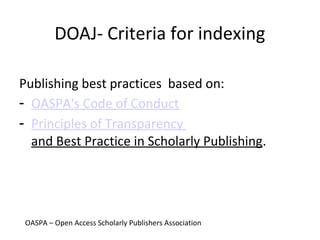
DOAJ- Criteria for indexing
Publishing best practices based on:
- OASPA's Code of Conduct
- Principles of Transparency
and Best Practice in Scholarly Publishing.
OASPA – Open Access Scholarly Publishers Association
Basic requirements for entry into
DOAJ
• The full text of ALL content must be available
for free and be Open Access without delay (i.e.
no embargo period).
• A journal has its own dedicated website. No
other service or product should be present
under that URL
• A journal must have at least one ISSN
(International Standard Serial Number)
registered at issn.org.
• Journal webpage must have clear navigation
Evaluate OA journals
Sharing research results with the world is key to the progress of your
discipline and career. But with so many publications, how can you be sure you
can trust a particular journal? Follow this check list to make sure you choose
trusted journals for your research. http://thinkchecksubmit.org/
Reference this list for your chosen journal to check if it is trusted.
•Do you or your colleagues know the journal?
– Have you read any articles in the journal before?
– Is it easy to discover the latest papers in the journal?
•Can you easily identify and contact the publisher?
– Is the publisher name clearly displayed on the journal website?
– Can you contact the publisher by telephone, email, and post?
•Is the journal clear about the type of peer review it uses?
•Are articles indexed in services that you use?
•Is it clear what fees will be charged?
– Does the journal site explain what these fees are for and when they will be
charged?
•Do you recognise the editorial board?
– Have you heard of the editorial board members?
– Do the editorial board mention the journal on their own websites?
•Is the publisher a member of a recognized industry initiative?
– Do they belong to the  ?
– If the journal is open access, is it listed in the 
 ?
– If the journal is open access, does the publisher belong to the 
 ?
Directories – OA and Free Journals
• DOAJ (Directory of OA journals)
https://doaj.org/
• OpenDOAR (Directory of OA Repositories)
www.opendoar.org
• DOAB (Directory of OA books)
http://doabooks.org/
Disciplinary Archives
• arXiv http://arxiv.org/
• SSRN http://ssrn.com/en/
• bioRxiv http://biorxiv.org/
• ChemRxiv - announcement by ACS in Aug ‘16
Publishers & distributors
• BioMed Central
http://www.biomedcentral.com/home/
• Public Library of Science (PLoS)
http://www.publiclibraryofscience.org/
Some popular OA resources
• PubMed Central (PMC)
• SciELO
• Wiley OA journals
• HighWire Press
• PeerJ
• SAGE Open
Databases and networks
ScienceOpen
Digital Commons Network
Source:
1. Open Access Resources. Libguides at University of St. Andres
2. Open Access Webliography. Adrian Ho and Charles Bailey.
References
• FC Choy (2015). Why is Open Access important to researchers?
[PowerPoint Slides]. Presented at Academic Publishing 2015, NTU
Libraries, Singapore.
This is not the end ..
What are your questions on Open Access or DOAJ?
Email: leena@doaj.org

Where do you publish? Make DOAJ your starting point.

  • 1.
    Want to makeyour research OA* so where do you publish? Make DOAJ your starting point for finding quality peer- reviewed OA journals Webinar for OA week 2016 on openaccessIndia.org Presented by Leena Shah, DOAJ Ambassador for India 27th October 2016 *OA- Open Access
  • 2.
    Remove access & pricebarriers Remove permission barriers To make content of all scholarly articles freely available onlineGOAL For a work to be OA, the copyright holder must consent in advance to let users “copy, use, distribute, transmit and display the work publicly and to make and distribute derivative works, in any digital medium for responsible purpose, subject to proper attribution of authorship” (Bethesda, Berlin statements)
  • 3.
    How do youparticipate in Open Access? Green Route: 1. Submit paper to journal as normal 2. After it is selected you submit* the final peer-reviewed copy to an open repository (e.g. your Institutional Repo). *Check the self archiving policy of the journal 3. Google can pick up the metadata of the article 4. Your article can be found by anyone from Google Gold Route: 1. Identify a reputable OA journal 2. Send your paper for peer review 3. Upon acceptance – pay an “article processing charge (APC)” to publisher if applicable. 4. Your paper is published in the OA journal.
  • 4.
    Taking the GoldRoute Find a reputable OA journal Directory of OA Journals [doaj.org] subject specific peer reviewed open access APC or not? journal license country
  • 5.
    DOAJ search filtersand facets Looking for reputable OA journals with no processing charges – use DOAJ to find them
  • 6.
    Embed and sharesearch results
  • 7.
    DOAJ – getthe green tick? The green tick ("The Tick") is displayed against all journals that were accepted into DOAJ after March 2014 when DOAJ launched its new criteria for journals to be accepted into DOAJ. The new criteria require a higher level of compliance to best practices and publishing standards.
  • 8.
    DOAJ Seal -the orange circle • The orange circle refers to the DOAJ Seal is a mark of certification for open access journals, awarded by DOAJ to journals that achieve a high level of openness, adhere to Best Practice and high publishing standards. To receive the Seal, the journal must comply with the following 7 conditions: • use DOIs as permanent identifiers; • provides DOAJ with article metadata; • deposits content with a long term digital preservation or archiving program; • embeds machine-readable CC licensing information in articles; • allows generous reuse and mixing of content, in accordance with a CC BY, CC BY-SA or CC BY-NC license; • has a deposit policy registered wíth a deposit policy registry; • allows the author to hold the copyright without restrictions.
  • 9.
  • 10.
  • 11.
    DOAJ – forpublishers
  • 12.
    DOAJ- Criteria forindexing Publishing best practices based on: - OASPA's Code of Conduct - Principles of Transparency and Best Practice in Scholarly Publishing. OASPA – Open Access Scholarly Publishers Association
  • 13.
    Basic requirements forentry into DOAJ • The full text of ALL content must be available for free and be Open Access without delay (i.e. no embargo period). • A journal has its own dedicated website. No other service or product should be present under that URL • A journal must have at least one ISSN (International Standard Serial Number) registered at issn.org. • Journal webpage must have clear navigation
  • 14.
    Evaluate OA journals Sharingresearch results with the world is key to the progress of your discipline and career. But with so many publications, how can you be sure you can trust a particular journal? Follow this check list to make sure you choose trusted journals for your research. http://thinkchecksubmit.org/ Reference this list for your chosen journal to check if it is trusted. •Do you or your colleagues know the journal? – Have you read any articles in the journal before? – Is it easy to discover the latest papers in the journal? •Can you easily identify and contact the publisher? – Is the publisher name clearly displayed on the journal website? – Can you contact the publisher by telephone, email, and post? •Is the journal clear about the type of peer review it uses? •Are articles indexed in services that you use? •Is it clear what fees will be charged? – Does the journal site explain what these fees are for and when they will be charged? •Do you recognise the editorial board? – Have you heard of the editorial board members? – Do the editorial board mention the journal on their own websites? •Is the publisher a member of a recognized industry initiative? – Do they belong to the  ? – If the journal is open access, is it listed in the   ? – If the journal is open access, does the publisher belong to the   ?
  • 15.
    Directories – OAand Free Journals • DOAJ (Directory of OA journals) https://doaj.org/ • OpenDOAR (Directory of OA Repositories) www.opendoar.org • DOAB (Directory of OA books) http://doabooks.org/ Disciplinary Archives • arXiv http://arxiv.org/ • SSRN http://ssrn.com/en/ • bioRxiv http://biorxiv.org/ • ChemRxiv - announcement by ACS in Aug ‘16 Publishers & distributors • BioMed Central http://www.biomedcentral.com/home/ • Public Library of Science (PLoS) http://www.publiclibraryofscience.org/ Some popular OA resources • PubMed Central (PMC) • SciELO • Wiley OA journals • HighWire Press • PeerJ • SAGE Open Databases and networks ScienceOpen Digital Commons Network Source: 1. Open Access Resources. Libguides at University of St. Andres 2. Open Access Webliography. Adrian Ho and Charles Bailey.
  • 16.
    References • FC Choy(2015). Why is Open Access important to researchers? [PowerPoint Slides]. Presented at Academic Publishing 2015, NTU Libraries, Singapore.
  • 17.
    This is notthe end .. What are your questions on Open Access or DOAJ? Email: leena@doaj.org

Editor's Notes

  • #3 Open access publishing allows free distribution of and access to published articles. The author retains copyright of their work with a Creative Commons attribution licence, so all articles are made freely available to the widest audience possible. The benefits are: All articles are free to read, copy, distribute, and use (with attribution) Author retains copyright - not the publisher Complies with self-archiving mandates
  • #8 Journals that do not have The Tick are in the process of reapplying under the new criteria.
  • #9 If a journal indexed in DOAJ does not carry the DOAJ seal – these are still reputable OA journals but they do not fulfil all/some of the 7 criteria listed here.
  • #16 arXiv - Pre-print articles in Physics, Mathematics, Computer Science, Quantitative Biology, Quantitative Finance and Statistics. OpenDOAR is an authoritative directory of academic open access repositories. Each OpenDOAR repository has been visited by project staff to check the information that is recorded here. Biomed Central : 220 open access, online, peer-reviewed journals. PLoS : A non-profit publisher of peer-reviewed journals including PLOS ONE and PLOS Biology. Wiley Open Access journals12 OA journals across biological, chemical and health sciences, including Ecology and Evolution. PeerJ OA journal for Biology and Medicine using a new model of author membership Digital Commons NetworkThe Digital Commons Network brings together free, full-text scholarly articles from hundreds of universities and colleges worldwide. This portal provides access to to content produced and stored using bepress’s widely used Digital Commons publishing and institutional repository platform. the interface allows you to explore by subject area. SAGE OpenOA articles in social sciences.