ANATOMY AND PHYSIOLOGY OF
ESOPHAGUS AND IT’S CONGENITAL
DISORDERS
-DR.ESHA DASARI (PG1)
MODERATOR- DR.MOHIUDDIN
(ASST.PROF)
ANATOMY
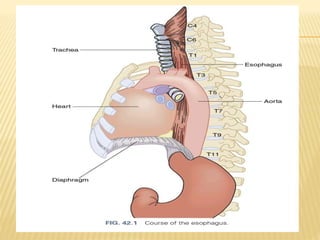
 Esophagus is a two layered muscular tube
passing between base of pharynx in the neck
and the stomach in the abdomen and
measures about 30cm.
 It begins at the inferior border of cricoid
cartilage at the level of C6 and ends at the
cardiac opening of the stomach at the level of
T11.
 It descends on the anterior aspect of the
bodies of the vertebrae in the midline as it
moves through the thorax.
 As it approaches the diaphragm, it moves
anteriorly and to the left, crossing from the right
side of the thoracic aorta to eventually anterior
to it.
 It then passes through the esophageal hiatus,
an opening in the muscular part of diaphragm
at the level of T10
 It has two distinct high pressure zones, the
upper esophageal sphincter and the lower
esophageal sphincter
 After passing through the UES, the esophagus
can be divided into four segments: pharyngeal,
cervical, thoracic, abdominal esophagus.
 The LES is the outlet.
 Abdominal esophagus represents the short
distal part of the esophagus located in the
abdominal cavity.
 It emerges through the right crus of the
diaphragm at the level of T10.
RELATIONSHIP TO STRUCTURES IN POSTERIOR
MEDIASTINUM
 On the right- mediastinal part of parietal pleura.
 Posteriorly- thoracic duct. It is on the right,
inferiorly but crosses to the left more superiorly.
Also, hemiazygous vein, Right posterior
intercostal vessels
 Anteriorly- below the tracheal bifurcation, right
pulmonary artery and left main bronchus.
Superiorly, left atrium
LAYERS
LAYERS
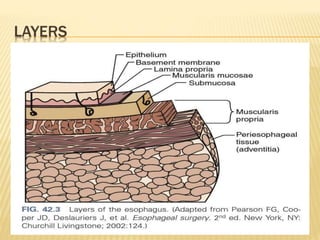
 Esophagus is comprised of two proper layers,
the mucosa and muscularis propria.
 Mucosa consists of squamous epithelium
except for the distal 1-2cm where esophageal
mucosa transitions to cardiac mucosa known
as Z-line, where it is columnar epithelium.
 Mucosa consists of four distinct layers:
epithelium, basement membrane, lamina
propria and muscularis mucosae.
 Deep to the muscularis mucosae is the
submucosa. It contains network of lymphatic
and vascular structures, mucous glands and
meissner neural plexus.
 Muscularis propria is composed of inner
circular and outer longitudinal muscle bundles.
In the upper 1/3rd they are striated whereas in
the lower 2/3rd they are smooth.
 .
 Between the layers is a thin septum comprising
of connective tissue, blood vessels and
interconnected network of ganglia known as
Auerbach plexus
 The collar of helvetius marks the transition of
the circular muscles of esophagus to oblique
muscles of stomach at the cardiac notch.
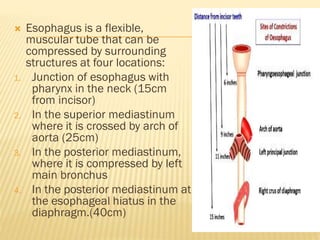
 Esophagus is a flexible,
muscular tube that can be
compressed by surrounding
structures at four locations:
1. Junction of esophagus with
pharynx in the neck (15cm
from incisor)
2. In the superior mediastinum
where it is crossed by arch of
aorta (25cm)
3. In the posterior mediastinum,
where it is compressed by left
main bronchus
4. In the posterior mediastinum at
the esophageal hiatus in the
diaphragm.(40cm)
CLINICAL SIGNIFICANCE
 A swallowed object is most likely to lodge in a
constricted area.
 An ingested corrosive substance would move
more slowly through a narrowed region, causing
more damage at this site.
 Constrictions present problems during passage
of instruments.
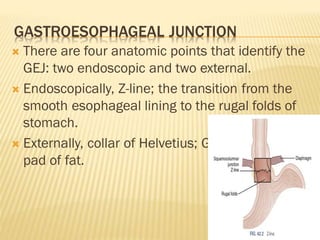
GASTROESOPHAGEAL JUNCTION
 There are four anatomic points that identify the
GEJ: two endoscopic and two external.
 Endoscopically, Z-line; the transition from the
smooth esophageal lining to the rugal folds of
stomach.
 Externally, collar of Helvetius; Gastroesophagel
pad of fat.
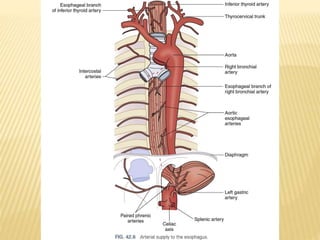
ARTERIAL SUPPLY
 Cervical- inferior thyroid arteries
 Thoracic- esophageal arteries from aorta, right
and left bronchial arteries, descending branch
from inferior thyroid artery, ascending br. from
inferior phrenic arteries.
 Abdominal- left gastric artery and inferior
phrenic arteries.
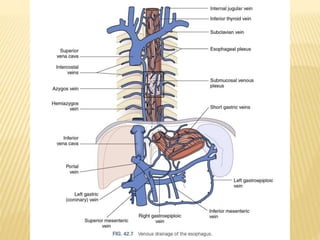
VENOUS DRAINAGE
 Cervical- submucosal venous plexus drains into
inferior thyroid veins.
 Thoracic- join the superficial esophageal
venous plexus which inturn drain into azygous
and hemi-azygous.
 Abdominal- into left and right phrenic veins; left
gastric vein; short gastric veins.
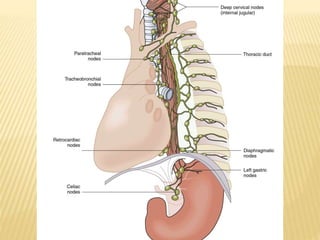
LYMPHATIC DRAINAGE
 Cervical- paratracheal, deep lateral cervical,
internal jugular LN
 In the posterior mediastinum returns to the
posterior mediastinal LN
 Abdominal- left gastric nodes.
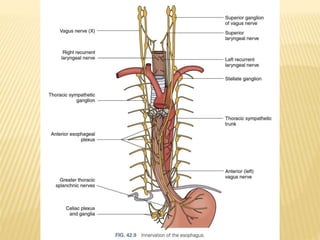
INNERVATION
 Esophageal branches arising from vagus nerve
and sympathetic trunks.
 Striated muscle fibers in the superior portion of
the esophagus originate from brachial arches and
are innervated by brachial efferents from the
vagus nerves.
 Smooth muscle fibers are innervated by
components of parasympathetic part of autonomic
division of PNS, visceral efferents from vagus
nerves.
 Sensory innervation is by vagus nerve,
sympathetic trunks and splanchnic nerves.
 Esophageal plexus: as the right and left vagus
nerves approach the esophagus, each nerve
divides into several branches that spread over
the esophagus forming esophageal plexus. Just
above the diaphragm the plexus converge to
form two trunks: anterior and posterior vagal
trunks.
 Anterior vagal trunk: mainly from fibers
originally in the left vagus nerve.
 Posterior vagal trunk: mainly from right vagus
nerve.
PHYSIOLOGY
 The primary function of esophagus is to
transport material from the pharynx to the
stomach.
 Secondarily, the esophagus needs to constrain
the amount of air that is swallowed and the
amount of material that is refluxed.
 The UES which is about 4-5cm in length,
remains in a constant state of tone (a mean of
60mmHg) preventing a steady flow of air into
the esophagus, whereas the tone in LES (mean
of 24mmHg) remains elevated just enough to
prevent excessive material from refluxing back
up into the esophagus.
SWALLOWING
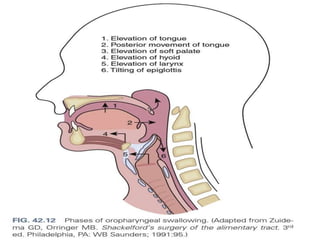
Three phases: oral, pharyngeal and esophageal.
 Oropharyngeal: rapid series of 6 events lasting
for about 1.5 seconds. Once initiated, are
completely reflexive.
1. Elevation of tongue. Food is mixed with saliva
to prepare a soft bolus. The tongue pushes
the bolus into posterior oropharynx.
2. Posterior movement of tongue. Tongue moves
posteriorly and thrusts the food bolus into
hypopharynx.
3. Elevation of soft palate occurs simultaneously
to close off the passage into the nasopharynx.
4. Elevation of hyoid. To help bring the epiglottis
under the tongue, the hyoid bone moves
anteriorly and upwards.
5. Elevation of larynx. The change in position of
the hyoid elevates the larynx and opens the
retrolaryngeal space, further facilitating the
movement of epiglottis under the tongue.
6. Tilting of epiglottis. Epiglottis tilts back,
covering the opening of larynx to prevent
aspiraton.
 Esophageal phase:
1. UES: To allow passage of food bolus, the UES
relaxes and the peristaltic constrictions of the
posterior pharyngeal constrictors propel the
bolus into the esophagus. After initiation of
swallowing, UES reaches 90mm Hg and
prevents reflux of bolus back into pharynx.
Pressure returns back to 60mmHg as the
wave travels into the mid-esophagus.
2. Peristalisis: there are three types of
esophageal contractions: primary, secondary,
tertiary.
 Primary peristalitis contractions are
progressive and moves down the esophagus
at a rate of 2-4cm/sec and reach the LES
about 9seconds after the initiation of
swallowing.
 They generate an intraluminal pressure from
40 to 80mmHg.
 Secondary peristaltic contractions are also
progressive but are generated from distention
or irritation of the esophagus rather than
voluntary swallowing.
 They can occur as an independent local reflex
to clear the esophagus of material that was left
behind after the progression of primary
peristaltic wave
 Tertiary contractions are nonprogressive, non-
peristaltic, monophasic or multiphasic,
simultaneous waves that can occur after
voluntary swallowing or spontaneously between
swallows throughout the esophagus.
 They represent uncoordinated contractions of
the smooth muscle that are responsible for
esophageal spasm.
CONGENITAL ANOMALIES
ESOPHAGEAL ATRESIA AND
TREACHEOESOPHAGEAL FISTULA
 Associated with polyhydramnios and low birth
weight.
 More common in males than females
 Associated genetic mutations: n-myc, SOX2,
CDH7
 Associated with VACTERL group of birth defects.
 V- vertebral anomalies(hemi/absent vertebra)
 A- anorectal malformation
 C- crdiac anomalies
 T
 E- TEF and EA
 R- renal anomalies
 L- limb defects
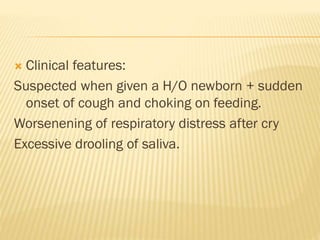
 Clinical features:
Suspected when given a H/O newborn + sudden
onset of cough and choking on feeding.
Worsenening of respiratory distress after cry
Excessive drooling of saliva.
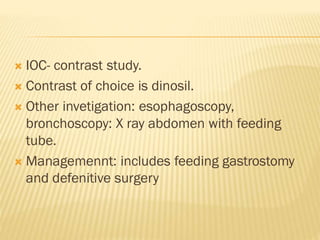
 IOC- contrast study.
 Contrast of choice is dinosil.
 Other invetigation: esophagoscopy,
bronchoscopy: X ray abdomen with feeding
tube.
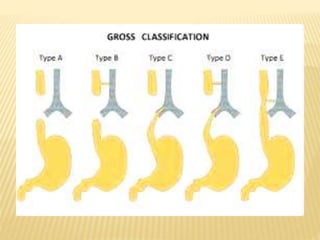
 Managemennt: includes feeding gastrostomy
and defenitive surgery
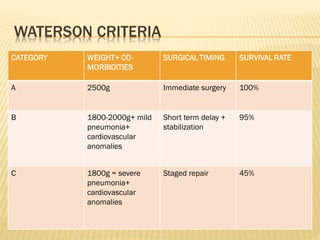
WATERSON CRITERIA
CATEGORY WEIGHT+ CO-
MORBIDITIES
SURGICAL TIMING SURVIVAL RATE
A 2500g Immediate surgery 100%
B 1800-2000g+ mild
pneumonia+
cardiovascular
anomalies
Short term delay +
stabilization
95%
C 1800g = severe
pneumonia+
cardiovascular
anomalies
Staged repair 45%
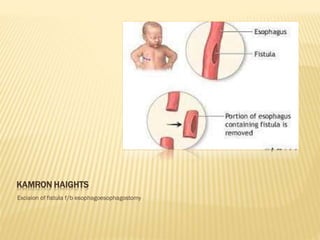
KAMRON HAIGHTS
Exciaion of fistula f/b esophagoesophagostomy
THANK YOU

esophagus.pdf

  • 1.
    ANATOMY AND PHYSIOLOGYOF ESOPHAGUS AND IT’S CONGENITAL DISORDERS -DR.ESHA DASARI (PG1) MODERATOR- DR.MOHIUDDIN (ASST.PROF)
  • 2.
  • 3.
     Esophagus isa two layered muscular tube passing between base of pharynx in the neck and the stomach in the abdomen and measures about 30cm.  It begins at the inferior border of cricoid cartilage at the level of C6 and ends at the cardiac opening of the stomach at the level of T11.
  • 5.
     It descendson the anterior aspect of the bodies of the vertebrae in the midline as it moves through the thorax.  As it approaches the diaphragm, it moves anteriorly and to the left, crossing from the right side of the thoracic aorta to eventually anterior to it.  It then passes through the esophageal hiatus, an opening in the muscular part of diaphragm at the level of T10
  • 6.
     It hastwo distinct high pressure zones, the upper esophageal sphincter and the lower esophageal sphincter  After passing through the UES, the esophagus can be divided into four segments: pharyngeal, cervical, thoracic, abdominal esophagus.  The LES is the outlet.
  • 7.
     Abdominal esophagusrepresents the short distal part of the esophagus located in the abdominal cavity.  It emerges through the right crus of the diaphragm at the level of T10.
  • 8.
    RELATIONSHIP TO STRUCTURESIN POSTERIOR MEDIASTINUM  On the right- mediastinal part of parietal pleura.  Posteriorly- thoracic duct. It is on the right, inferiorly but crosses to the left more superiorly. Also, hemiazygous vein, Right posterior intercostal vessels  Anteriorly- below the tracheal bifurcation, right pulmonary artery and left main bronchus. Superiorly, left atrium
  • 9.
  • 10.
    LAYERS  Esophagus iscomprised of two proper layers, the mucosa and muscularis propria.  Mucosa consists of squamous epithelium except for the distal 1-2cm where esophageal mucosa transitions to cardiac mucosa known as Z-line, where it is columnar epithelium.  Mucosa consists of four distinct layers: epithelium, basement membrane, lamina propria and muscularis mucosae.
  • 11.
     Deep tothe muscularis mucosae is the submucosa. It contains network of lymphatic and vascular structures, mucous glands and meissner neural plexus.  Muscularis propria is composed of inner circular and outer longitudinal muscle bundles. In the upper 1/3rd they are striated whereas in the lower 2/3rd they are smooth.  .
  • 12.
     Between thelayers is a thin septum comprising of connective tissue, blood vessels and interconnected network of ganglia known as Auerbach plexus  The collar of helvetius marks the transition of the circular muscles of esophagus to oblique muscles of stomach at the cardiac notch.
  • 13.
     Esophagus isa flexible, muscular tube that can be compressed by surrounding structures at four locations: 1. Junction of esophagus with pharynx in the neck (15cm from incisor) 2. In the superior mediastinum where it is crossed by arch of aorta (25cm) 3. In the posterior mediastinum, where it is compressed by left main bronchus 4. In the posterior mediastinum at the esophageal hiatus in the diaphragm.(40cm)
  • 14.
    CLINICAL SIGNIFICANCE  Aswallowed object is most likely to lodge in a constricted area.  An ingested corrosive substance would move more slowly through a narrowed region, causing more damage at this site.  Constrictions present problems during passage of instruments.
  • 15.
    GASTROESOPHAGEAL JUNCTION  Thereare four anatomic points that identify the GEJ: two endoscopic and two external.  Endoscopically, Z-line; the transition from the smooth esophageal lining to the rugal folds of stomach.  Externally, collar of Helvetius; Gastroesophagel pad of fat.
  • 16.
    ARTERIAL SUPPLY  Cervical-inferior thyroid arteries  Thoracic- esophageal arteries from aorta, right and left bronchial arteries, descending branch from inferior thyroid artery, ascending br. from inferior phrenic arteries.  Abdominal- left gastric artery and inferior phrenic arteries.
  • 18.
    VENOUS DRAINAGE  Cervical-submucosal venous plexus drains into inferior thyroid veins.  Thoracic- join the superficial esophageal venous plexus which inturn drain into azygous and hemi-azygous.  Abdominal- into left and right phrenic veins; left gastric vein; short gastric veins.
  • 20.
    LYMPHATIC DRAINAGE  Cervical-paratracheal, deep lateral cervical, internal jugular LN  In the posterior mediastinum returns to the posterior mediastinal LN  Abdominal- left gastric nodes.
  • 22.
    INNERVATION  Esophageal branchesarising from vagus nerve and sympathetic trunks.  Striated muscle fibers in the superior portion of the esophagus originate from brachial arches and are innervated by brachial efferents from the vagus nerves.  Smooth muscle fibers are innervated by components of parasympathetic part of autonomic division of PNS, visceral efferents from vagus nerves.
  • 23.
     Sensory innervationis by vagus nerve, sympathetic trunks and splanchnic nerves.
  • 24.
     Esophageal plexus:as the right and left vagus nerves approach the esophagus, each nerve divides into several branches that spread over the esophagus forming esophageal plexus. Just above the diaphragm the plexus converge to form two trunks: anterior and posterior vagal trunks.
  • 25.
     Anterior vagaltrunk: mainly from fibers originally in the left vagus nerve.  Posterior vagal trunk: mainly from right vagus nerve.
  • 27.
  • 28.
     The primaryfunction of esophagus is to transport material from the pharynx to the stomach.  Secondarily, the esophagus needs to constrain the amount of air that is swallowed and the amount of material that is refluxed.
  • 29.
     The UESwhich is about 4-5cm in length, remains in a constant state of tone (a mean of 60mmHg) preventing a steady flow of air into the esophagus, whereas the tone in LES (mean of 24mmHg) remains elevated just enough to prevent excessive material from refluxing back up into the esophagus.
  • 30.
    SWALLOWING Three phases: oral,pharyngeal and esophageal.  Oropharyngeal: rapid series of 6 events lasting for about 1.5 seconds. Once initiated, are completely reflexive. 1. Elevation of tongue. Food is mixed with saliva to prepare a soft bolus. The tongue pushes the bolus into posterior oropharynx.
  • 31.
    2. Posterior movementof tongue. Tongue moves posteriorly and thrusts the food bolus into hypopharynx. 3. Elevation of soft palate occurs simultaneously to close off the passage into the nasopharynx. 4. Elevation of hyoid. To help bring the epiglottis under the tongue, the hyoid bone moves anteriorly and upwards.
  • 32.
    5. Elevation oflarynx. The change in position of the hyoid elevates the larynx and opens the retrolaryngeal space, further facilitating the movement of epiglottis under the tongue. 6. Tilting of epiglottis. Epiglottis tilts back, covering the opening of larynx to prevent aspiraton.
  • 34.
     Esophageal phase: 1.UES: To allow passage of food bolus, the UES relaxes and the peristaltic constrictions of the posterior pharyngeal constrictors propel the bolus into the esophagus. After initiation of swallowing, UES reaches 90mm Hg and prevents reflux of bolus back into pharynx. Pressure returns back to 60mmHg as the wave travels into the mid-esophagus.
  • 35.
    2. Peristalisis: thereare three types of esophageal contractions: primary, secondary, tertiary.  Primary peristalitis contractions are progressive and moves down the esophagus at a rate of 2-4cm/sec and reach the LES about 9seconds after the initiation of swallowing.
  • 36.
     They generatean intraluminal pressure from 40 to 80mmHg.  Secondary peristaltic contractions are also progressive but are generated from distention or irritation of the esophagus rather than voluntary swallowing.  They can occur as an independent local reflex to clear the esophagus of material that was left behind after the progression of primary peristaltic wave
  • 37.
     Tertiary contractionsare nonprogressive, non- peristaltic, monophasic or multiphasic, simultaneous waves that can occur after voluntary swallowing or spontaneously between swallows throughout the esophagus.  They represent uncoordinated contractions of the smooth muscle that are responsible for esophageal spasm.
  • 38.
  • 39.
    ESOPHAGEAL ATRESIA AND TREACHEOESOPHAGEALFISTULA  Associated with polyhydramnios and low birth weight.  More common in males than females  Associated genetic mutations: n-myc, SOX2, CDH7  Associated with VACTERL group of birth defects.
  • 40.
     V- vertebralanomalies(hemi/absent vertebra)  A- anorectal malformation  C- crdiac anomalies  T  E- TEF and EA  R- renal anomalies  L- limb defects
  • 42.
     Clinical features: Suspectedwhen given a H/O newborn + sudden onset of cough and choking on feeding. Worsenening of respiratory distress after cry Excessive drooling of saliva.
  • 43.
     IOC- contraststudy.  Contrast of choice is dinosil.  Other invetigation: esophagoscopy, bronchoscopy: X ray abdomen with feeding tube.  Managemennt: includes feeding gastrostomy and defenitive surgery
  • 44.
    WATERSON CRITERIA CATEGORY WEIGHT+CO- MORBIDITIES SURGICAL TIMING SURVIVAL RATE A 2500g Immediate surgery 100% B 1800-2000g+ mild pneumonia+ cardiovascular anomalies Short term delay + stabilization 95% C 1800g = severe pneumonia+ cardiovascular anomalies Staged repair 45%
  • 45.
    KAMRON HAIGHTS Exciaion offistula f/b esophagoesophagostomy
  • 46.