Esomeprazole
Madhuka Perrera
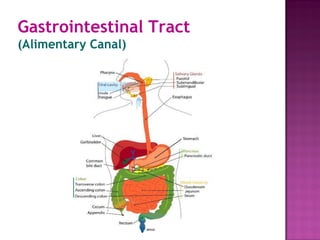
Gastrointestinal Tract
(Alimentary Canal)
 Organs of the digestive system
1. Gastrointestinal tract
 Mouth
 Pharynx
 Esophagus
 Small intestine
 Large intestine
 Anus
2. Accessory digestive organs
 Salivary glands
 Pancreas
 Liver
 Gallbladder
 Teeth
Gastrointestinal Tract
(Alimentary Canal)
Accessory Digestive Organs
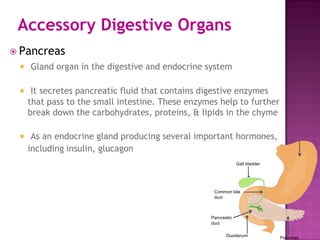
 Pancreas
 Gland organ in the digestive and endocrine system
 It secretes pancreatic fluid that contains digestive enzymes
that pass to the small intestine. These enzymes help to further
break down the carbohydrates, proteins, & lipids in the chyme

 As an endocrine gland producing several important hormones,
including insulin, glucagon
Accessory Digestive Organs
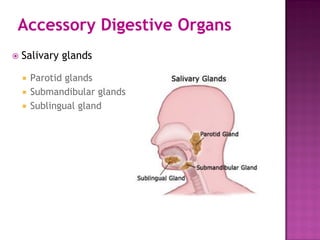
 Salivary glands
 Parotid glands
 Submandibular glands
 Sublingual gland
 Liver
 Largest gland in the body
 Connected to the gall bladder
 Produce bile
 Gall bladder
 Stored bile form liver
 Bile introduced into the duodenum in the
presence of fatty food
Accessory Digestive Organs
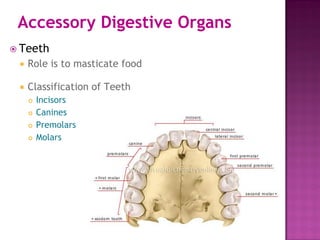
 Teeth
 Role is to masticate food
 Classification of Teeth
 Incisors
 Canines
 Premolars
 Molars
Mouth (Oral Cavity)
 Processes of the mouth
 Mastication (chewing ) of food
 Mixing masticated food with saliva
 Initiation of swallowing by the tongue
 Allowing for the sense of taste
Mouth can absorb Simple carbohydrate , glucose
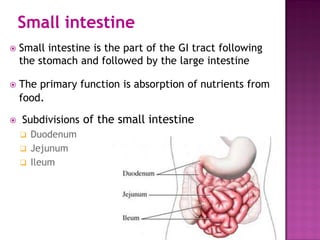
Small intestine
 Small intestine is the part of the GI tract following
the stomach and followed by the large intestine
 The primary function is absorption of nutrients from
food.
 Subdivisions of the small intestine
 Duodenum
 Jejunum
 Ileum
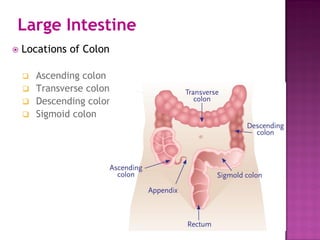
Large Intestine
 Locations of Colon
 Ascending colon
 Transverse colon
 Descending colon
 Sigmoid colon
Large Intestine
 Functions
 Absorptions of Water
 Eliminate indigestible food from the body as feces
 Does not participate in digestions of food
 Structures of the Large Intestine
 Cecum : First part of the large intestine
 Appendix : Hand form the cecum (sometime inflamed , appendicitis)
 Colon : Ascending , Traverse , Descending , Sigmoid
 Rectum
 Anus : external body opening
Goblet cells produce mucus to act as a lubricant
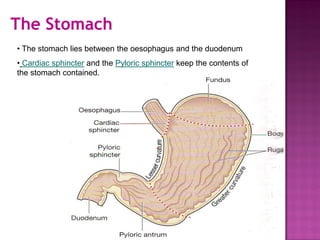
The Stomach
• The stomach lies between the oesophagus and the duodenum
• Cardiac sphincter and the Pyloric sphincter keep the contents of
the stomach contained.
The Stomach
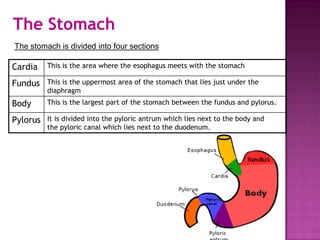
The stomach is divided into four sections
Cardia This is the area where the esophagus meets with the stomach
Fundus This is the uppermost area of the stomach that lies just under the
diaphragm
Body This is the largest part of the stomach between the fundus and pylorus.
Pylorus It is divided into the pyloric antrum which lies next to the body and
the pyloric canal which lies next to the duodenum.
The Stomach
 Functions
 Acts as storage tank for food
 Breaking down the food into a liquidly mixture called chyme
 Mixing enzymes which is are chemicals that break down
food.
 Delivers chyme to the small intestine
The stomach uses pepsin and peptidase to break down
proteins in your food
Glands of the Stomach
 Cardiac
 Pyloric
 Gastric*
* The cells of the gastric gland are the
largest in number and of primary
importance when discussing acid control
 Parietal cells
 Produce and secrete HCl
Primary site of action for many acid-controller drugs
 Chief cells
 Secrete pepsinogen,
Pepsinogen becomes pepsin when exposure to acid
Pepsin breaks down proteins
 Mucoid cells
 Mucus-secreting cells (surface epithelial cells)
 Provide a protective mucous coat
 Protect against self-digestion by HCl
Cells of the Gastric Gland
Three faces of Gastric Secretion
 Cephalic face
 by the taste or smell of food tactile sensation in the
mouth secrete HCL & pepsin in the stomach
 Gastric face
 Food has entered to the stomach continue secretion
of HCL & pepsin
 Intestinal face
 Chyme has entered to duodenum, so gastric secretion
no longer needed , decrease gastric secretion
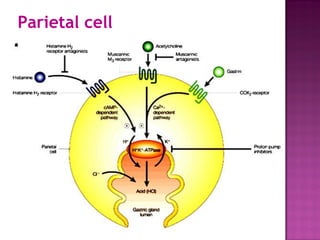
Parietal cell (Oxyntic cells)
 Parietal cells, are the stomach epithelium cells that
secrete gastric acid
 The parietal cell contains receptors for gastrin ,
histamine (H2), & acetylcholine (M3) ,
When acetylcholine, histamine or gastrin (released from G
cells into the blood) bind to the parietal cell receptors,
that stimulate acid secretion from a H+,K+ ATPase
(the proton pump) on the canalicular surface.
Parietal cell
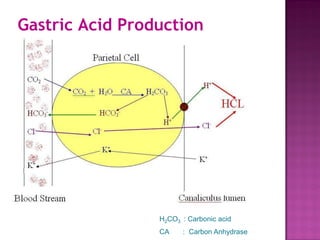
Gastric Acid Production
H2CO3 : Carbonic acid
CA : Carbon Anhydrase
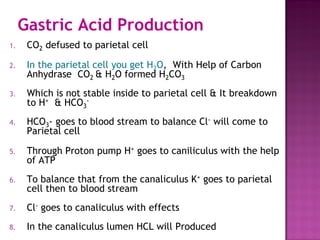
Gastric Acid Production
1. CO2 defused to parietal cell
2. In the parietal cell you get H2O, With Help of Carbon
Anhydrase CO2 & H2O formed H2CO3
3. Which is not stable inside to parietal cell & It breakdown
to H+ & HCO3
-
4. HCO3- goes to blood stream to balance Cl- will come to
Parietal cell
5. Through Proton pump H+ goes to caniliculus with the help
of ATP
6. To balance that from the canaliculus K+ goes to parietal
cell then to blood stream
7. Cl- goes to canaliculus with effects
8. In the canaliculus lumen HCL will Produced
Types of
Acid-Controlling Agents
 Antacids
 H2 antagonists
 Proton pump inhibitors
Antacids : Mechanism of Action
 Promote gastric mucosal defense mechanisms
 DO NOT prevent the over-production of acid
 DO neutralize the acid once it’s in the stomach
 Aluminum Salts (carbonate, hydroxide)
 Magnesium Salts (carbonate, hydroxide)
 Calcium Salts (carbonate)
Side Effects
 Aluminum and calcium : Constipation
 Magnesium : Diarrhea
 Calcium carbonate : Produces gas and belching
Histamine Type 2 (H2) Antagonists
 Cimetidine
 Famotidine
 Ranitidine
 Mechanism of Action
Block histamine (H2) at the receptors of parietal cells
thereby production of H+ is reduced, resulting in
decreased production of HCl
Proton Pump Inhibitors
 Mechanism of Action
 Irreversibly bind to H+/K+ ATPase enzyme
 Result: ALL gastric acid secretion is blocked
 Lansoprazole
 Omeprazole
 Rabeprazole
 Pantoprazole
 Esomeprazole
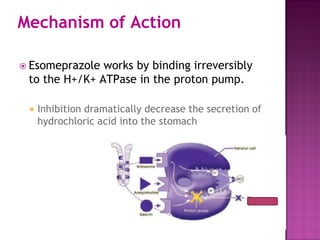
Mechanism of Action
 Esomeprazole works by binding irreversibly
to the H+/K+ ATPase in the proton pump.
 Inhibition dramatically decrease the secretion of
hydrochloric acid into the stomach
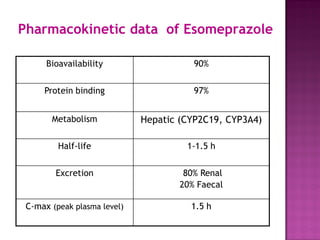
Pharmacokinetic data of Esomeprazole
Bioavailability 90%
Protein binding 97%
Metabolism Hepatic (CYP2C19, CYP3A4)
Half-life 1-1.5 h
Excretion 80% Renal
20% Faecal
C-max (peak plasma level) 1.5 h
Esomeprazole
 Esomeprazole is the S-isomer of omeprazole
 Esome capsules are formulated as a "multiple
unit pellet system" the capsule consists o
small enteric-coated granules (pellets) of the
esomeprazole formulation inside an outer
shell.
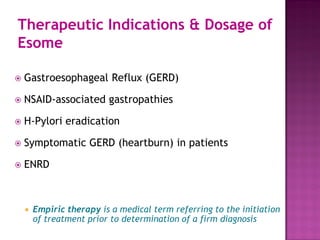
Therapeutic Indications & Dosage of
Esome
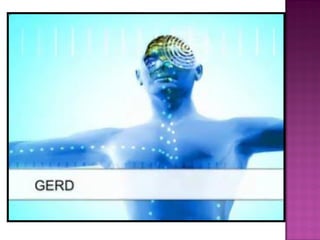
 Gastroesophageal Reflux (GERD)
 NSAID-associated gastropathies
 H-Pylori eradication
 Symptomatic GERD (heartburn) in patients
 ENRD
 Empiric therapy is a medical term referring to the initiation
of treatment prior to determination of a firm diagnosis
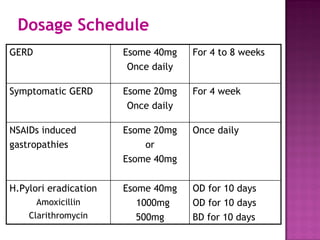
Dosage Schedule
GERD Esome 40mg
Once daily
For 4 to 8 weeks
Symptomatic GERD Esome 20mg
Once daily
For 4 week
NSAIDs induced
gastropathies
Esome 20mg
or
Esome 40mg
Once daily
H.Pylori eradication
Amoxicillin
Clarithromycin
Esome 40mg
1000mg
500mg
OD for 10 days
OD for 10 days
BD for 10 days
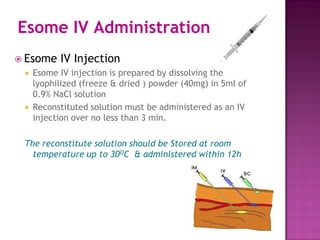
Esome IV Administration
 Esome IV Injection
 Esome IV injection is prepared by dissolving the
lyophilized (freeze & dried ) powder (40mg) in 5ml of
0.9% NaCl solution
 Reconstituted solution must be administered as an IV
injection over no less than 3 min.
The reconstitute solution should be Stored at room
temperature up to 30OC & administered within 12h
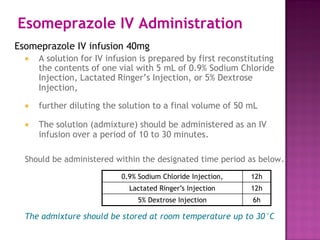
Esomeprazole IV Administration
Esomeprazole IV infusion 40mg
 A solution for IV infusion is prepared by first reconstituting
the contents of one vial with 5 mL of 0.9% Sodium Chloride
Injection, Lactated Ringer’s Injection, or 5% Dextrose
Injection,
 further diluting the solution to a final volume of 50 mL
 The solution (admixture) should be administered as an IV
infusion over a period of 10 to 30 minutes.
Should be administered within the designated time period as below.
The admixture should be stored at room temperature up to 30°C
0.9% Sodium Chloride Injection, 12h
Lactated Ringer’s Injection 12h
5% Dextrose Injection 6h
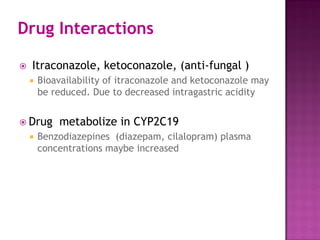
 Itraconazole, ketoconazole, (anti-fungal )
 Bioavailability of itraconazole and ketoconazole may
be reduced. Due to decreased intragastric acidity
 Drug metabolize in CYP2C19
 Benzodiazepines (diazepam, cilalopram) plasma
concentrations maybe increased
Drug Interactions
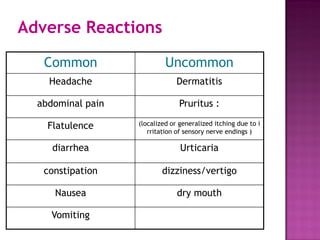
Adverse Reactions
Common Uncommon
Headache Dermatitis
abdominal pain Pruritus :
Flatulence (localized or generalized itching due to i
rritation of sensory nerve endings )
diarrhea Urticaria
constipation dizziness/vertigo
Nausea dry mouth
Vomiting
Contraindication
 Known hypersensitivity to esomeprazole,
any ingredient in the formulation, or other
substituted benzimidazoles
(e.g. lansoprazole, omeprazole, pantoprazole,
rabeprazole).
 Pediatric : below 18 yrs not established
 Hepatic insufficiency
mild/ moderate : no dose adjustment required
Severe : 20mg once daily should not exceed
 Renal insufficiency
Pharmacokinetics of esomeprazole in patient with renal
impairments are not expected to be altered relatively
to healthy volunteers. Less than 1% excrete in
unchanged in urine
Special Population
Esomeprazole

Esomeprazole

  • 1.
  • 2.
  • 3.
     Organs ofthe digestive system 1. Gastrointestinal tract  Mouth  Pharynx  Esophagus  Small intestine  Large intestine  Anus 2. Accessory digestive organs  Salivary glands  Pancreas  Liver  Gallbladder  Teeth Gastrointestinal Tract (Alimentary Canal)
  • 4.
    Accessory Digestive Organs Pancreas  Gland organ in the digestive and endocrine system  It secretes pancreatic fluid that contains digestive enzymes that pass to the small intestine. These enzymes help to further break down the carbohydrates, proteins, & lipids in the chyme  As an endocrine gland producing several important hormones, including insulin, glucagon
  • 5.
    Accessory Digestive Organs Salivary glands  Parotid glands  Submandibular glands  Sublingual gland
  • 6.
     Liver  Largestgland in the body  Connected to the gall bladder  Produce bile  Gall bladder  Stored bile form liver  Bile introduced into the duodenum in the presence of fatty food Accessory Digestive Organs
  • 7.
    Accessory Digestive Organs Teeth  Role is to masticate food  Classification of Teeth  Incisors  Canines  Premolars  Molars
  • 8.
    Mouth (Oral Cavity) Processes of the mouth  Mastication (chewing ) of food  Mixing masticated food with saliva  Initiation of swallowing by the tongue  Allowing for the sense of taste Mouth can absorb Simple carbohydrate , glucose
  • 9.
    Small intestine  Smallintestine is the part of the GI tract following the stomach and followed by the large intestine  The primary function is absorption of nutrients from food.  Subdivisions of the small intestine  Duodenum  Jejunum  Ileum
  • 10.
    Large Intestine  Locationsof Colon  Ascending colon  Transverse colon  Descending colon  Sigmoid colon
  • 11.
    Large Intestine  Functions Absorptions of Water  Eliminate indigestible food from the body as feces  Does not participate in digestions of food  Structures of the Large Intestine  Cecum : First part of the large intestine  Appendix : Hand form the cecum (sometime inflamed , appendicitis)  Colon : Ascending , Traverse , Descending , Sigmoid  Rectum  Anus : external body opening Goblet cells produce mucus to act as a lubricant
  • 12.
    The Stomach • Thestomach lies between the oesophagus and the duodenum • Cardiac sphincter and the Pyloric sphincter keep the contents of the stomach contained.
  • 13.
    The Stomach The stomachis divided into four sections Cardia This is the area where the esophagus meets with the stomach Fundus This is the uppermost area of the stomach that lies just under the diaphragm Body This is the largest part of the stomach between the fundus and pylorus. Pylorus It is divided into the pyloric antrum which lies next to the body and the pyloric canal which lies next to the duodenum.
  • 14.
    The Stomach  Functions Acts as storage tank for food  Breaking down the food into a liquidly mixture called chyme  Mixing enzymes which is are chemicals that break down food.  Delivers chyme to the small intestine The stomach uses pepsin and peptidase to break down proteins in your food
  • 15.
    Glands of theStomach  Cardiac  Pyloric  Gastric* * The cells of the gastric gland are the largest in number and of primary importance when discussing acid control
  • 16.
     Parietal cells Produce and secrete HCl Primary site of action for many acid-controller drugs  Chief cells  Secrete pepsinogen, Pepsinogen becomes pepsin when exposure to acid Pepsin breaks down proteins  Mucoid cells  Mucus-secreting cells (surface epithelial cells)  Provide a protective mucous coat  Protect against self-digestion by HCl Cells of the Gastric Gland
  • 17.
    Three faces ofGastric Secretion  Cephalic face  by the taste or smell of food tactile sensation in the mouth secrete HCL & pepsin in the stomach  Gastric face  Food has entered to the stomach continue secretion of HCL & pepsin  Intestinal face  Chyme has entered to duodenum, so gastric secretion no longer needed , decrease gastric secretion
  • 18.
    Parietal cell (Oxynticcells)  Parietal cells, are the stomach epithelium cells that secrete gastric acid  The parietal cell contains receptors for gastrin , histamine (H2), & acetylcholine (M3) , When acetylcholine, histamine or gastrin (released from G cells into the blood) bind to the parietal cell receptors, that stimulate acid secretion from a H+,K+ ATPase (the proton pump) on the canalicular surface.
  • 19.
  • 20.
    Gastric Acid Production H2CO3: Carbonic acid CA : Carbon Anhydrase
  • 21.
    Gastric Acid Production 1.CO2 defused to parietal cell 2. In the parietal cell you get H2O, With Help of Carbon Anhydrase CO2 & H2O formed H2CO3 3. Which is not stable inside to parietal cell & It breakdown to H+ & HCO3 - 4. HCO3- goes to blood stream to balance Cl- will come to Parietal cell 5. Through Proton pump H+ goes to caniliculus with the help of ATP 6. To balance that from the canaliculus K+ goes to parietal cell then to blood stream 7. Cl- goes to canaliculus with effects 8. In the canaliculus lumen HCL will Produced
  • 22.
    Types of Acid-Controlling Agents Antacids  H2 antagonists  Proton pump inhibitors
  • 23.
    Antacids : Mechanismof Action  Promote gastric mucosal defense mechanisms  DO NOT prevent the over-production of acid  DO neutralize the acid once it’s in the stomach  Aluminum Salts (carbonate, hydroxide)  Magnesium Salts (carbonate, hydroxide)  Calcium Salts (carbonate) Side Effects  Aluminum and calcium : Constipation  Magnesium : Diarrhea  Calcium carbonate : Produces gas and belching
  • 24.
    Histamine Type 2(H2) Antagonists  Cimetidine  Famotidine  Ranitidine  Mechanism of Action Block histamine (H2) at the receptors of parietal cells thereby production of H+ is reduced, resulting in decreased production of HCl
  • 25.
    Proton Pump Inhibitors Mechanism of Action  Irreversibly bind to H+/K+ ATPase enzyme  Result: ALL gastric acid secretion is blocked  Lansoprazole  Omeprazole  Rabeprazole  Pantoprazole  Esomeprazole
  • 26.
    Mechanism of Action Esomeprazole works by binding irreversibly to the H+/K+ ATPase in the proton pump.  Inhibition dramatically decrease the secretion of hydrochloric acid into the stomach
  • 27.
    Pharmacokinetic data ofEsomeprazole Bioavailability 90% Protein binding 97% Metabolism Hepatic (CYP2C19, CYP3A4) Half-life 1-1.5 h Excretion 80% Renal 20% Faecal C-max (peak plasma level) 1.5 h
  • 28.
    Esomeprazole  Esomeprazole isthe S-isomer of omeprazole  Esome capsules are formulated as a "multiple unit pellet system" the capsule consists o small enteric-coated granules (pellets) of the esomeprazole formulation inside an outer shell.
  • 29.
    Therapeutic Indications &Dosage of Esome  Gastroesophageal Reflux (GERD)  NSAID-associated gastropathies  H-Pylori eradication  Symptomatic GERD (heartburn) in patients  ENRD  Empiric therapy is a medical term referring to the initiation of treatment prior to determination of a firm diagnosis
  • 31.
    Dosage Schedule GERD Esome40mg Once daily For 4 to 8 weeks Symptomatic GERD Esome 20mg Once daily For 4 week NSAIDs induced gastropathies Esome 20mg or Esome 40mg Once daily H.Pylori eradication Amoxicillin Clarithromycin Esome 40mg 1000mg 500mg OD for 10 days OD for 10 days BD for 10 days
  • 32.
    Esome IV Administration Esome IV Injection  Esome IV injection is prepared by dissolving the lyophilized (freeze & dried ) powder (40mg) in 5ml of 0.9% NaCl solution  Reconstituted solution must be administered as an IV injection over no less than 3 min. The reconstitute solution should be Stored at room temperature up to 30OC & administered within 12h
  • 33.
    Esomeprazole IV Administration EsomeprazoleIV infusion 40mg  A solution for IV infusion is prepared by first reconstituting the contents of one vial with 5 mL of 0.9% Sodium Chloride Injection, Lactated Ringer’s Injection, or 5% Dextrose Injection,  further diluting the solution to a final volume of 50 mL  The solution (admixture) should be administered as an IV infusion over a period of 10 to 30 minutes. Should be administered within the designated time period as below. The admixture should be stored at room temperature up to 30°C 0.9% Sodium Chloride Injection, 12h Lactated Ringer’s Injection 12h 5% Dextrose Injection 6h
  • 34.
     Itraconazole, ketoconazole,(anti-fungal )  Bioavailability of itraconazole and ketoconazole may be reduced. Due to decreased intragastric acidity  Drug metabolize in CYP2C19  Benzodiazepines (diazepam, cilalopram) plasma concentrations maybe increased Drug Interactions
  • 35.
    Adverse Reactions Common Uncommon HeadacheDermatitis abdominal pain Pruritus : Flatulence (localized or generalized itching due to i rritation of sensory nerve endings ) diarrhea Urticaria constipation dizziness/vertigo Nausea dry mouth Vomiting
  • 36.
    Contraindication  Known hypersensitivityto esomeprazole, any ingredient in the formulation, or other substituted benzimidazoles (e.g. lansoprazole, omeprazole, pantoprazole, rabeprazole).
  • 37.
     Pediatric :below 18 yrs not established  Hepatic insufficiency mild/ moderate : no dose adjustment required Severe : 20mg once daily should not exceed  Renal insufficiency Pharmacokinetics of esomeprazole in patient with renal impairments are not expected to be altered relatively to healthy volunteers. Less than 1% excrete in unchanged in urine Special Population