

Esomeprazole®
The most advanced PPI for acid regulation


                               IDA
Agenda
  Main GIT disorders
  Disorders causes and symptoms.
  Treatment pathways (probe for attendees)
  Why PPI
  Why Esomeprazole (vs. others PPI)
  Indication , side effects and DDI
  Dosage and price
Main GIT disorders
• Dyspepsia
• Gastroesophageal reflux
 disease (GERD)
• Peptic ulcer disease (PUD)
• gastritis
Causes and Symptoms
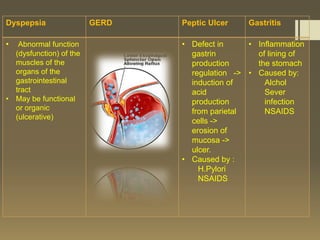
Dyspepsia                GERD   Peptic Ulcer    Gastritis

•  Abnormal function            • Defect in     • Inflammation
  (dysfunction) of the            gastrin         of lining of
  muscles of the                  production      the stomach
  organs of the                   regulation -> • Caused by:
  gastrointestinal                induction of      Alchol
  tract                           acid              Sever
• May be functional               production        infection
  or organic                      from parietal     NSAIDS
  (ulcerative)
                                  cells ->
                                  erosion of
                                  mucosa ->
                                  ulcer.
                                • Caused by :
                                    H.Pylori
                                    NSAIDS
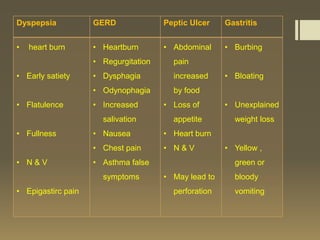
Dyspepsia           GERD              Peptic Ulcer    Gastritis


•   heart burn      • Heartburn       • Abdominal     • Burbing
                    • Regurgitation     pain
• Early satiety     • Dysphagia         increased     • Bloating
                    • Odynophagia       by food
• Flatulence        • Increased       • Loss of       • Unexplained
                      salivation        appetite        weight loss
• Fullness          • Nausea          • Heart burn
                    • Chest pain      • N&V           • Yellow ,
• N&V               • Asthma false                      green or
                      symptoms        • May lead to     bloody
• Epigastirc pain                       perforation     vomiting
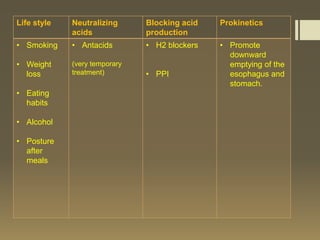
How you deal with that ?
Life style   Neutralizing      Blocking acid   Prokinetics
             acids             production
• Smoking    • Antacids        • H2 blockers   • Promote
                                                 downward
• Weight     (very temporary                     emptying of the
  loss       treatment)        • PPI             esophagus and
                                                 stomach.
• Eating
  habits

• Alcohol

• Posture
  after
  meals
Why PPI ?
Recent PPI’s:

Lansoprazole
Pantoprazole
Rabeprazole
Omeprazole
Esomeprazole
Why Esomeprazole?
Esomeprazole vs. Omeprazole
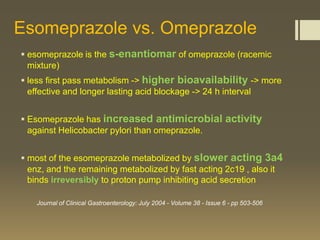
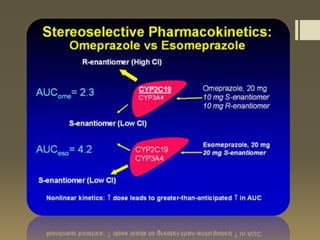
 esomeprazole is the s-enantiomar of omeprazole (racemic
  mixture)
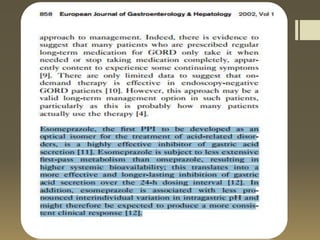
 less first pass metabolism -> higher bioavailability -> more
  effective and longer lasting acid blockage -> 24 h interval


 Esomeprazole has increased antimicrobial activity
  against Helicobacter pylori than omeprazole.


 most of the esomeprazole metabolized by slower acting 3a4
  enz, and the remaining metabolized by fast acting 2c19 , also it
  binds irreversibly to proton pump inhibiting acid secretion

    Journal of Clinical Gastroenterology: July 2004 - Volume 38 - Issue 6 - pp 503-506
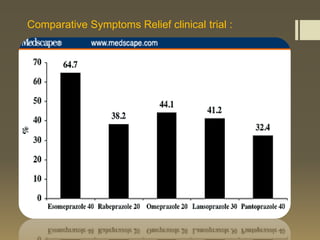
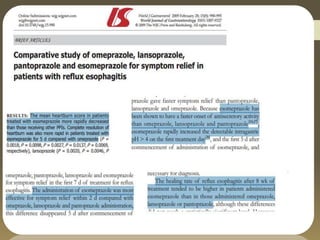
Comparative Symptoms Relief clinical trial :
Indication

• Treatment GERD
• Dyspepsia
• H.Pylori (in combination with clarithromycin or amoxicillin)
• Healing and maintenance of Erosive esophagitis
• Peptic ulcer especially NSAIDS-associated
• Pathological hyper secretory condition e.g. :
    Zollinger-Ellison
Side effects

  diarrhea,
  Nausea & vomiting
  headaches
  rash and dizziness
  Nervousness
  abnormal heartbeat
  muscle pain, weakness and leg cramps
  water retention :infrequently.
Drug – drug interaction:

 Increase blood concentration of:
   Diazepam : decrease its hepatic elimination
   Digoxin : increase its gastric absorption


 Decrease concentration of:
   Ketoconazole : decrease its gastric absorption
Dosage:
  For GERD:
   20 or 40 mg of esomeprazole once daily for 4-8 weeks
  For H. pylori:
   40 mg once daily + amoxicillin and clarithromycin for 10
   days.
  The dose for preventing NSAID-induced ulcers :
    20 to 40 mg daily for 6 months.
  Zollinger-Ellison syndrome:
   40 mg twice daily.
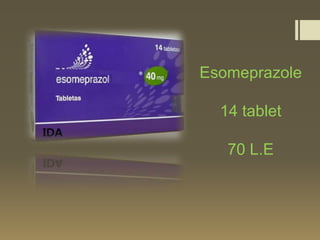
Esomeprazole

  14 tablet

   70 L.E
THANK YOU !

Esomeprazole medical knowledge

  • 1.
    Esomeprazole® The most advancedPPI for acid regulation IDA
  • 2.
    Agenda  MainGIT disorders  Disorders causes and symptoms.  Treatment pathways (probe for attendees)  Why PPI  Why Esomeprazole (vs. others PPI)  Indication , side effects and DDI  Dosage and price
  • 3.
  • 4.
    • Dyspepsia • Gastroesophagealreflux disease (GERD) • Peptic ulcer disease (PUD) • gastritis
  • 5.
  • 6.
    Dyspepsia GERD Peptic Ulcer Gastritis • Abnormal function • Defect in • Inflammation (dysfunction) of the gastrin of lining of muscles of the production the stomach organs of the regulation -> • Caused by: gastrointestinal induction of Alchol tract acid Sever • May be functional production infection or organic from parietal NSAIDS (ulcerative) cells -> erosion of mucosa -> ulcer. • Caused by : H.Pylori NSAIDS
  • 7.
    Dyspepsia GERD Peptic Ulcer Gastritis • heart burn • Heartburn • Abdominal • Burbing • Regurgitation pain • Early satiety • Dysphagia increased • Bloating • Odynophagia by food • Flatulence • Increased • Loss of • Unexplained salivation appetite weight loss • Fullness • Nausea • Heart burn • Chest pain • N&V • Yellow , • N&V • Asthma false green or symptoms • May lead to bloody • Epigastirc pain perforation vomiting
  • 8.
    How you dealwith that ?
  • 9.
    Life style Neutralizing Blocking acid Prokinetics acids production • Smoking • Antacids • H2 blockers • Promote downward • Weight (very temporary emptying of the loss treatment) • PPI esophagus and stomach. • Eating habits • Alcohol • Posture after meals
  • 10.
  • 12.
  • 13.
  • 14.
    Esomeprazole vs. Omeprazole esomeprazole is the s-enantiomar of omeprazole (racemic mixture)  less first pass metabolism -> higher bioavailability -> more effective and longer lasting acid blockage -> 24 h interval  Esomeprazole has increased antimicrobial activity against Helicobacter pylori than omeprazole.  most of the esomeprazole metabolized by slower acting 3a4 enz, and the remaining metabolized by fast acting 2c19 , also it binds irreversibly to proton pump inhibiting acid secretion Journal of Clinical Gastroenterology: July 2004 - Volume 38 - Issue 6 - pp 503-506
  • 16.
  • 19.
    Indication • Treatment GERD •Dyspepsia • H.Pylori (in combination with clarithromycin or amoxicillin) • Healing and maintenance of Erosive esophagitis • Peptic ulcer especially NSAIDS-associated • Pathological hyper secretory condition e.g. : Zollinger-Ellison
  • 20.
    Side effects diarrhea,  Nausea & vomiting  headaches  rash and dizziness  Nervousness  abnormal heartbeat  muscle pain, weakness and leg cramps  water retention :infrequently.
  • 21.
    Drug – druginteraction: Increase blood concentration of:  Diazepam : decrease its hepatic elimination  Digoxin : increase its gastric absorption Decrease concentration of:  Ketoconazole : decrease its gastric absorption
  • 22.
    Dosage:  ForGERD: 20 or 40 mg of esomeprazole once daily for 4-8 weeks  For H. pylori: 40 mg once daily + amoxicillin and clarithromycin for 10 days.  The dose for preventing NSAID-induced ulcers : 20 to 40 mg daily for 6 months.  Zollinger-Ellison syndrome: 40 mg twice daily.
  • 23.
    Esomeprazole 14tablet 70 L.E
  • 24.