1 | P a g e 
SCHOOL OF ARCHITECTURE, BUILDING AND DESIGN 
Research Unit for Architecture Studies in Southeast Asia (MASSA) 
Bachelor of Science (Honours) (Architecture) 
ENVIRONMENTAL SUSTAINABLE DESIGN [ARC 1413/1412] _________________________________________________________________________________ 
Project 1: My community My Commitment 
(Exploring the sense of environmental and community engagement as future designer) 
Assessment 
Assessment Type 
LO 
Presentation 
Submission 
Assessment % 
Continuous assessment 
40% 
Project :My community My commitment 
Group:20% 
Individual: 20% 
(-peer and tutor assessment) 
2,3.5,6 
_ 
14 November 
A4Report +Multimedia Presentation 
40 
Introduction 
Though, the concept of environmental-community service is not very new its importance has developed in the past few years. There are thousands of organizations all over the world that engage and hold millions of young people all through the world. People of all age groups, with a maximum number of youth are involved in the process of community service. Environmental-community-based organizations include; social service organizations, nonprofit providers and associations that engage both young people as well adults as volunteers; youth development organizations, after-school programs, and faith-based organizations. The process is beneficial both for the individuals as well as the society. Environmental-Community service can be defined as a service that is performed for the benefit of the public. Environmental-Community service is a commitment. Basically, community service is a way for a person to give back to a community in which they live. There are many ways of giving back to the community; it can include mural painting on school wall, cleaning and painting of orphanages, building a small bench for students in school, collecting items for charity, or just simply cleaning up a park. One of the main benefits of environmental -community service is that it builds a person’s character. It helps you to work on skills of being able to communicate with people, being able to work on a team, and being able to take on leadership role. Applying what is taught in the classroom to real life problems not only helps the members of the community, it also increases students’ knowledge and skills while helping them find their place as engaged citizens of the world http://www.oas.org/dsd/publications/Unit/oea37e/ch05.htm
2 | P a g e 
Objectives of Project 
The objectives of this assignment are as follows: 
1. To increase awareness of current environmental issues locally 
2. To induce creativity in attempting to explore the current environmental circumstances 
3. To allow students to explore the opportunity to work with the community and for the community 
4. To create awareness of the importance of creating and environmentally sustainable product/design/services 
5. To be able to understand and explain the principles of sustainability from environmental and social perspective 
Learning Outcomes of this Project 
Explore the concept of environmental and ecological sustainability 
1. Produce a complete documentation of the entire project from proposal up to completion 
2. Produce a multi media presentation on the issue and process taken to resolve the issue 
3. To be able to demonstrate problem-solving skills 
4. Recognise role and responsibility of an architect towards environment and society. 
5. Exemplify creativity in attempting to explore the current environmental circumstances 
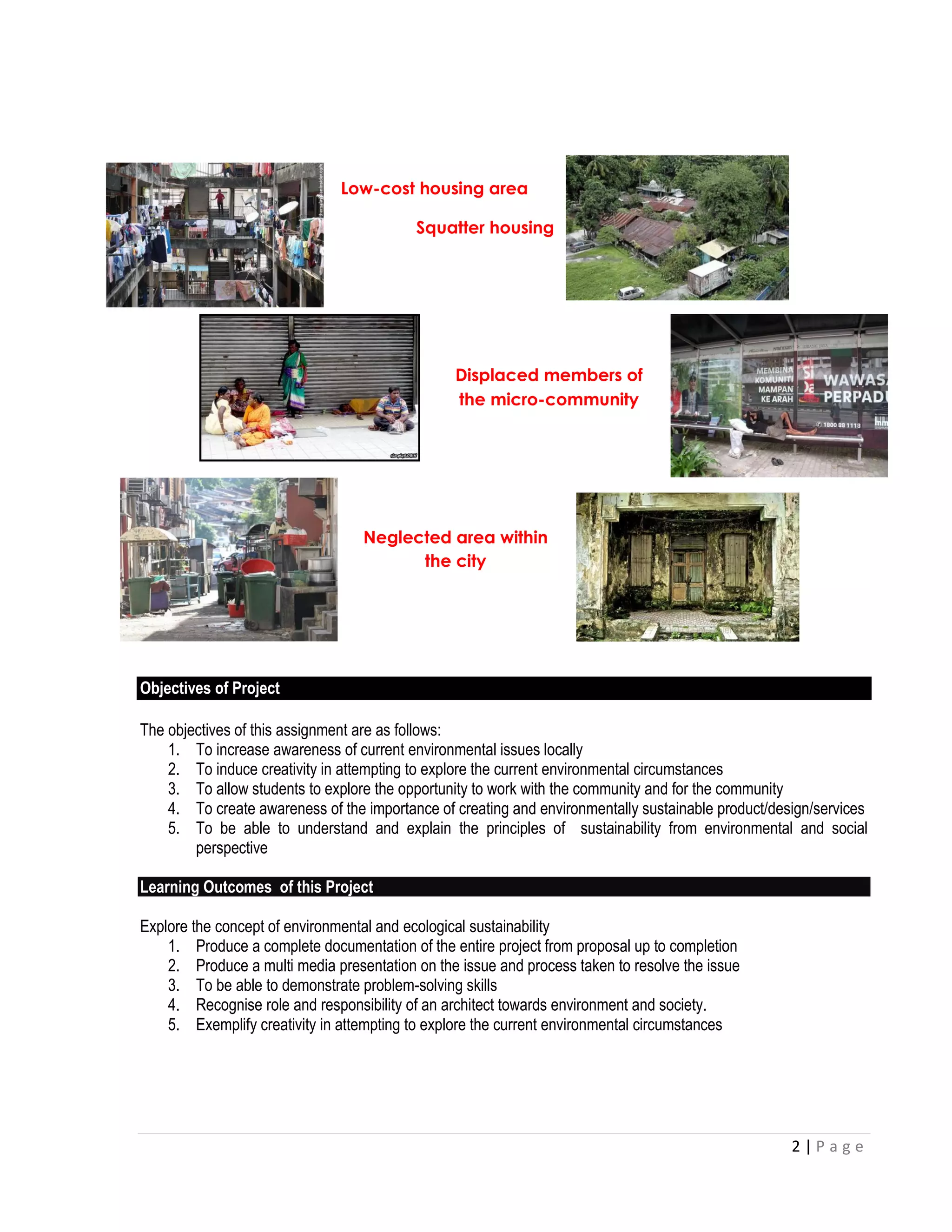
Low-cost housing area 
Squatter housing 
Displaced members of the micro-community 
Neglected area within the city
3 | P a g e 
Tasks - Methodology 
There are many ways in which designers experience a community. The purpose of this project is to further develop these community skills. By working in teams you are given the opportunity to deepen your team work abilities. You create and adapt strategies that allow you to benefit from the knowledge of your team and contribute to that knowledge. These skills are crucial in your ability to develop good professional design practice in the future. Therefore, in participating in this project you are asked not only to engage with the theme, but also to embrace, examine and reflect on the notions of community as its active member.Through interactive and dynamic exercises, you will gain a deeper understanding of environment and your responsibility to community, practice solving real-world challenges using creative ideas. 
Task: 
Your task is to identify an environmental-community related issue in your local community. The issues have to be genuine and any solution provided by your team must have an impact to the environment and community. You will need to visit your project site more then once to collect a variety of observation before making suggestions or proposals. 
Your observations should also include what is the main environmental-community related issue, who are affected, any particular organization directly related to the issue, what the people or community needs and etc. Your record of the observation can be in the form of written, video or visual. 
When you make your observations they can be: 
* in form of sketches of the place or people 
* things you have collected from the site 
* video 
* photographs of the site and issue by you or others (if possible). 
The key here is to immerse yourselves in the experiences of the environment- community. 
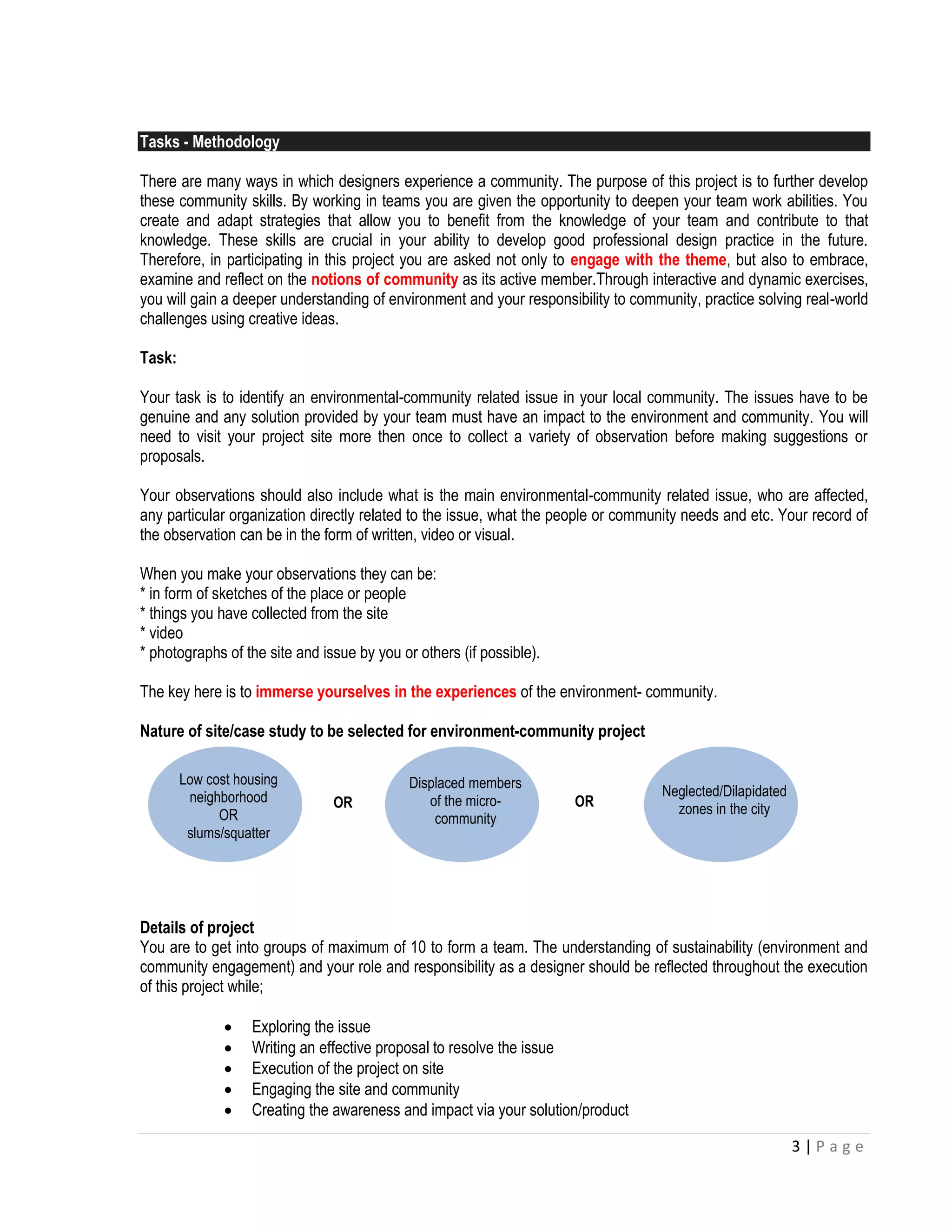
Nature of site/case study to be selected for environment-community project 
Details of project 
You are to get into groups of maximum of 10 to form a team. The understanding of sustainability (environment and community engagement) and your role and responsibility as a designer should be reflected throughout the execution of this project while; 
 Exploring the issue 
 Writing an effective proposal to resolve the issue 
 Execution of the project on site 
 Engaging the site and community 
 Creating the awareness and impact via your solution/product 
Low cost housing neighborhood 
OR 
slums/squatter 
Displaced members of the micro- community 
Neglected/Dilapidated zones in the city 
OR 
OR
4 | P a g e 
This project is done in there (3) stages; 
Stage 1 
Proposal Submission and approval 
Identify issues and proposal (refer to proposal form) 
 Clear identification of issue 
 Proposal 
 Justification on solution-why, who, what, when and how 
 Costing 
 Estimation of duration (to be within the given time 8weeks) 
Stage 2 
 Upon approval of your project proposal/project 
 Ensure you get the case study/client’s approval for your project 
 Provide details of your project (graphics, design, layout etc depending on your issue and proposal) 
 Finalize your project proposal with your tutor 
 Provide schedule of work planning on site (timeline/bar chart) 
 Execute work on site 
 Keep records of work progress (pictures, video and written) 
 Update your tutors on your project during tutorial sessions (videos, pictures and records) 
Stage 3 
 Completion of work on site 
 Produce complete documentation on your project (issue, solution, process and final product) 
Examples of environmental-community service: 
Mural painting in school 
Addressing physical need of low cost housing area (amenities, social outlet-children, eldery, community spaces) 
Recycling activities for certain community 
Building of small sustainable shelter for homeless 
Improving neglected parts of the city (back alleys = wasted space, not safe,) 
Submission Requirement 
The project asks for two outcomes 
o A4 hardcopy report of the project + A2 research poster summarizing the project 
o Multimedia presentation of the entire project from proposal to completion 
Other general requirements 
 Digital copies. 
 Visuals / Photos used in the submission must be clear and well communicated. 
 DO NOT PLAGIARISE- copy design from anywhere 
 Referencing (MUST) for information and sources
5 | P a g e 
Marking criteria 
Marks shall be distributed as follows: 
Project 2: Paying It Forward 
Marking Criteria 
Marks % 
Acquired TGC 
FAIL 
POOR 
SATISFACTORY 
GOOD 
EXCELLENT 
Proposal 
- Identification of environmental-community issue 
- Appropriates of issue 
- Current and practical 
- Appropriate solution 
- Measurable product and Impact 
10 
1.3, 2.1 
Execute work on site 
- Understanding what is environmental /community 
- The project / design 
- Tools used to measure environmental impact 
- Completion of project to the satisfaction of the organization. 
30 
5.1, 7.2 
Final report 
- Finalised proposal 
- Documenting proposal and execution of work on site 
- Research poster 
20 
3.1, 1.3 
Multimedia presentation 
- Documentation of the entire process: works on site, community engagement 
- Creative presentation 
- Video should be able to create Impact on viewers on environmental and community awareness 
30 
3.1, 8.1 
Referencing 
10

Esd project mcmc august 2014

  • 1.
    1 | Pa g e SCHOOL OF ARCHITECTURE, BUILDING AND DESIGN Research Unit for Architecture Studies in Southeast Asia (MASSA) Bachelor of Science (Honours) (Architecture) ENVIRONMENTAL SUSTAINABLE DESIGN [ARC 1413/1412] _________________________________________________________________________________ Project 1: My community My Commitment (Exploring the sense of environmental and community engagement as future designer) Assessment Assessment Type LO Presentation Submission Assessment % Continuous assessment 40% Project :My community My commitment Group:20% Individual: 20% (-peer and tutor assessment) 2,3.5,6 _ 14 November A4Report +Multimedia Presentation 40 Introduction Though, the concept of environmental-community service is not very new its importance has developed in the past few years. There are thousands of organizations all over the world that engage and hold millions of young people all through the world. People of all age groups, with a maximum number of youth are involved in the process of community service. Environmental-community-based organizations include; social service organizations, nonprofit providers and associations that engage both young people as well adults as volunteers; youth development organizations, after-school programs, and faith-based organizations. The process is beneficial both for the individuals as well as the society. Environmental-Community service can be defined as a service that is performed for the benefit of the public. Environmental-Community service is a commitment. Basically, community service is a way for a person to give back to a community in which they live. There are many ways of giving back to the community; it can include mural painting on school wall, cleaning and painting of orphanages, building a small bench for students in school, collecting items for charity, or just simply cleaning up a park. One of the main benefits of environmental -community service is that it builds a person’s character. It helps you to work on skills of being able to communicate with people, being able to work on a team, and being able to take on leadership role. Applying what is taught in the classroom to real life problems not only helps the members of the community, it also increases students’ knowledge and skills while helping them find their place as engaged citizens of the world http://www.oas.org/dsd/publications/Unit/oea37e/ch05.htm
  • 2.
    2 | Pa g e Objectives of Project The objectives of this assignment are as follows: 1. To increase awareness of current environmental issues locally 2. To induce creativity in attempting to explore the current environmental circumstances 3. To allow students to explore the opportunity to work with the community and for the community 4. To create awareness of the importance of creating and environmentally sustainable product/design/services 5. To be able to understand and explain the principles of sustainability from environmental and social perspective Learning Outcomes of this Project Explore the concept of environmental and ecological sustainability 1. Produce a complete documentation of the entire project from proposal up to completion 2. Produce a multi media presentation on the issue and process taken to resolve the issue 3. To be able to demonstrate problem-solving skills 4. Recognise role and responsibility of an architect towards environment and society. 5. Exemplify creativity in attempting to explore the current environmental circumstances Low-cost housing area Squatter housing Displaced members of the micro-community Neglected area within the city
  • 3.
    3 | Pa g e Tasks - Methodology There are many ways in which designers experience a community. The purpose of this project is to further develop these community skills. By working in teams you are given the opportunity to deepen your team work abilities. You create and adapt strategies that allow you to benefit from the knowledge of your team and contribute to that knowledge. These skills are crucial in your ability to develop good professional design practice in the future. Therefore, in participating in this project you are asked not only to engage with the theme, but also to embrace, examine and reflect on the notions of community as its active member.Through interactive and dynamic exercises, you will gain a deeper understanding of environment and your responsibility to community, practice solving real-world challenges using creative ideas. Task: Your task is to identify an environmental-community related issue in your local community. The issues have to be genuine and any solution provided by your team must have an impact to the environment and community. You will need to visit your project site more then once to collect a variety of observation before making suggestions or proposals. Your observations should also include what is the main environmental-community related issue, who are affected, any particular organization directly related to the issue, what the people or community needs and etc. Your record of the observation can be in the form of written, video or visual. When you make your observations they can be: * in form of sketches of the place or people * things you have collected from the site * video * photographs of the site and issue by you or others (if possible). The key here is to immerse yourselves in the experiences of the environment- community. Nature of site/case study to be selected for environment-community project Details of project You are to get into groups of maximum of 10 to form a team. The understanding of sustainability (environment and community engagement) and your role and responsibility as a designer should be reflected throughout the execution of this project while;  Exploring the issue  Writing an effective proposal to resolve the issue  Execution of the project on site  Engaging the site and community  Creating the awareness and impact via your solution/product Low cost housing neighborhood OR slums/squatter Displaced members of the micro- community Neglected/Dilapidated zones in the city OR OR
  • 4.
    4 | Pa g e This project is done in there (3) stages; Stage 1 Proposal Submission and approval Identify issues and proposal (refer to proposal form)  Clear identification of issue  Proposal  Justification on solution-why, who, what, when and how  Costing  Estimation of duration (to be within the given time 8weeks) Stage 2  Upon approval of your project proposal/project  Ensure you get the case study/client’s approval for your project  Provide details of your project (graphics, design, layout etc depending on your issue and proposal)  Finalize your project proposal with your tutor  Provide schedule of work planning on site (timeline/bar chart)  Execute work on site  Keep records of work progress (pictures, video and written)  Update your tutors on your project during tutorial sessions (videos, pictures and records) Stage 3  Completion of work on site  Produce complete documentation on your project (issue, solution, process and final product) Examples of environmental-community service: Mural painting in school Addressing physical need of low cost housing area (amenities, social outlet-children, eldery, community spaces) Recycling activities for certain community Building of small sustainable shelter for homeless Improving neglected parts of the city (back alleys = wasted space, not safe,) Submission Requirement The project asks for two outcomes o A4 hardcopy report of the project + A2 research poster summarizing the project o Multimedia presentation of the entire project from proposal to completion Other general requirements  Digital copies.  Visuals / Photos used in the submission must be clear and well communicated.  DO NOT PLAGIARISE- copy design from anywhere  Referencing (MUST) for information and sources
  • 5.
    5 | Pa g e Marking criteria Marks shall be distributed as follows: Project 2: Paying It Forward Marking Criteria Marks % Acquired TGC FAIL POOR SATISFACTORY GOOD EXCELLENT Proposal - Identification of environmental-community issue - Appropriates of issue - Current and practical - Appropriate solution - Measurable product and Impact 10 1.3, 2.1 Execute work on site - Understanding what is environmental /community - The project / design - Tools used to measure environmental impact - Completion of project to the satisfaction of the organization. 30 5.1, 7.2 Final report - Finalised proposal - Documenting proposal and execution of work on site - Research poster 20 3.1, 1.3 Multimedia presentation - Documentation of the entire process: works on site, community engagement - Creative presentation - Video should be able to create Impact on viewers on environmental and community awareness 30 3.1, 8.1 Referencing 10