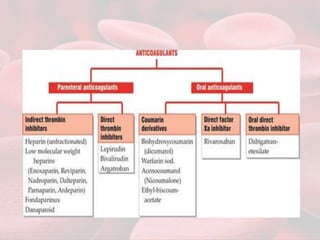
ANTICOAGULANTS,
ANTIPLATELET
AND
ANESTHESIA
MODERATOR : DR.PRIYANKA
PRESENTER : DR.POOJA RAO
.
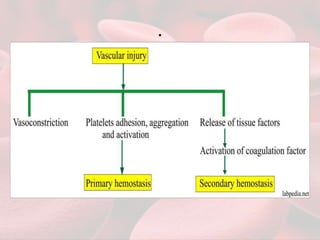
PRIMAY HEMOSTASIS
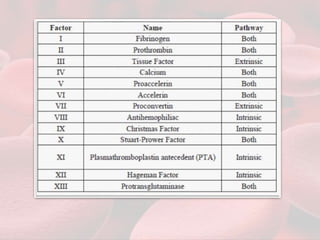
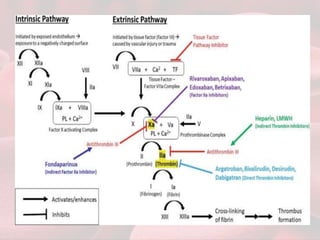
COAGULATION CASCADE
.
TESTS FOR PRIMARY HEMOSTASIS
Platelet count
• NORMAL 1.5lakh – 4.5lakh CELLS/MM3
• < 1.5 lakhcells/cumm Thrombocytopenia
• >4.5lakh cells/cumm thrombocytosis
BLEEDING TIME
 Normal : 2-9mins
 Evaluates time necessary for platelet plug to form
following vascular injury
 Prolongation :
• Thrombocytopenia
• Platelet dysfunction
• Ehler danlos syndrome
Platelet function
analyser
Platelet
aggregometry
CLOTTING TIME
• Time taken from puncture of
blood vessel to formation of
fibrin thread.
• Capillary glass tube method :
time noted to form fibrin
threads by breaking tube
every 30 seconds .
• Normal : 3-8mins
LAB EVALUATION OF COAGULATION
PROTHROMBIN TIME :
• Indicates extrinsic and
common pathway
• It measures the time to
strand formation via a short
sequence of reactions
involving TF
,VII,X,V,II(prothrombin) & I
(fibrinogen)
• Normal : 10-12 sec
• It is most sensitive to
decrease in factor 7 .
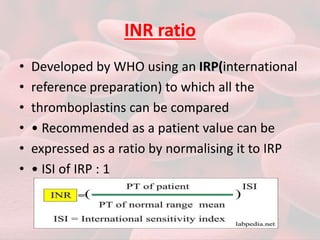
INR ratio
• Developed by WHO using an IRP(international
• reference preparation) to which all the
• thromboplastins can be compared
• • Recommended as a patient value can be
• expressed as a ratio by normalising it to IRP
• • ISI of IRP : 1
Partial thromboplastin time
• Reflects the time to fibrin strand
formation via the classical intrinsic
pathway of coagulation
• A contact activator is added ,hence
the name aptt
• Normal : 25-35 sec
• most sensitive to factor VIII & IX
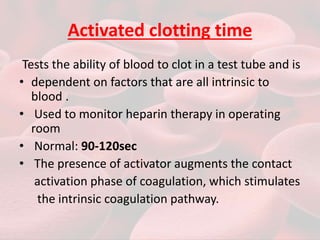
Activated clotting time
Tests the ability of blood to clot in a test tube and is
• dependent on factors that are all intrinsic to
blood .
• Used to monitor heparin therapy in operating
room
• Normal: 90-120sec
• The presence of activator augments the contact
activation phase of coagulation, which stimulates
the intrinsic coagulation pathway.
…
• .
THROMBIN TIME :
• Ability of thrombin to convert fibrinogen to
fibrin
Prolongation :
• inadequate fibrinogen
• Dysfibrinogenemia
• Thrombin inhibitors
• Normal <30seconds.
• Monitors hirudin , bivalarudin and LMWH
Regional anaesthesia in the patient receiving
antithrombotic or thrombolytic therapy
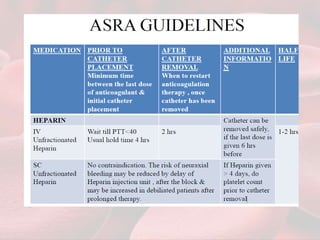
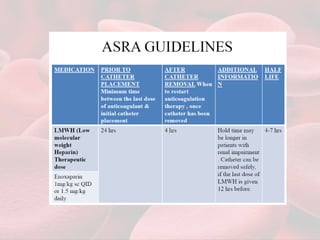
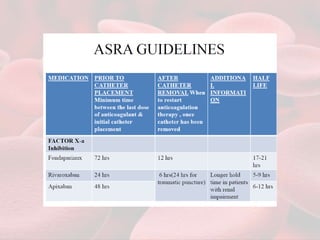
• American society of regional anaesthesia and
pain medicine
• Evidence based guidelines (fourth edition )
• As published in regional anaesthesia and pain
medicine , volume 43, number3 , April 2018
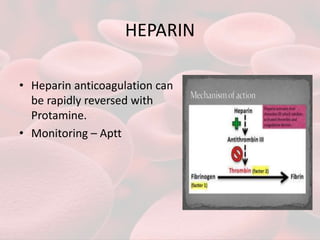
HEPARIN
• Heparin anticoagulation can
be rapidly reversed with
Protamine.
• Monitoring – Aptt
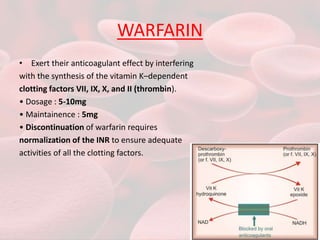
WARFARIN
• Exert their anticoagulant effect by interfering
with the synthesis of the vitamin K–dependent
clotting factors VII, IX, X, and II (thrombin).
• Dosage : 5-10mg
• Maintainence : 5mg
• Discontinuation of warfarin requires
normalization of the INR to ensure adequate
activities of all the clotting factors.
PERIOPERATIVE MANAGEMENT OF PATIENTS ON
WARFARIN
Preoperative
• Discontinue warfarin at least 5 days before
elective procedure
• Assess INR 1–2 d prior to surgery, if >1.5, consider
1–2 mg oral vitamin K
• Reversal for urgent surgery/procedure, consider
2.5–5 mg oral or IV vitamin K;
• For immediate reversal, consider PCCs, fresh
frozen plasma
.
• Patients at high risk of thromboembolism
○ Bridge with therapeutic SC LMWH (preferred) or
IV UFH
○ Last dose of preoperative LMWH administered 24
h before surgery, administer half of the daily dose
○ Intravenous heparin discontinued 4–6 h before
surgery
• No bridging necessary for patients at low risk of
thromboembolism
Post operative
 Patients at low risk of thromboembolism
○ Resume warfarin on POD
 Patients at high risk of thromboembolism (who
received preoperative bridging therapy)
○ Minor surgical procedure—resume therapeutic
LMWH 24 h postoperatively
○ Major surgical procedure—resume therapeutic
LMWH 48–72h postoperatively or administer low-
dose LMWH
.
.
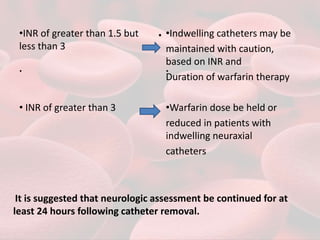
•INR of greater than 1.5 but
less than 3
• INR of greater than 3
.
•Indwelling catheters may be
maintained with caution,
based on INR and
Duration of warfarin therapy
•Warfarin dose be held or
reduced in patients with
indwelling neuraxial
catheters
It is suggested that neurologic assessment be continued for at
least 24 hours following catheter removal.
.
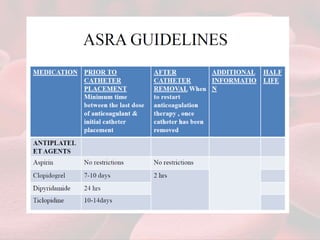
ANTIPLATELET AGENTS
• NSAID’S
• Thienopyridine derivatives :
Ticlopidine,Clopidogrel,Prasugrel
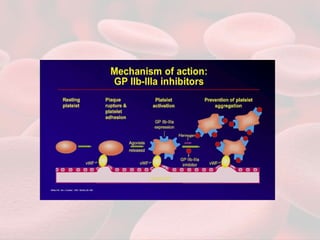
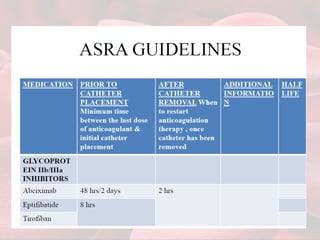
• Platelet glycoprotein 2b/3a receptor
antagonists – Abciximab,Eptifibatide,Tirofiban
• Platelet P2Y12 receptor antagonist : Ticagrelor
• Platelet phosphodiesterase 3a inhibitor :
Cilostazol
Perioperative Management of Patients on
Antiplatelet Therapy
Patients with coronary stents
• Elective surgery postponed for the following
durations if aspirin and thienopyridine (eg,
clopidogrel or prasugrel) therapy must be
discontinued
○ Bare metal stents: 6 wk
○ Drug-eluting stents: 6 months
• If surgery cannot be postponed, continue dual
antiplatelet therapy throughout perioperative
period
.
Patients at high risk of cardiac events
(exclusive of coronary stents)
• Continue aspirin throughout the perioperative
period
• Discontinue clopidogrel/prasugrel 5 d prior to
surgery
• Resume thienopyridine 24 h postoperatively
.
• Patients at low risk of cardiac events
• Discontinue dual antiplatelet therapy 7–10 d
prior to surgery
• Resume antiplatelet therapy 24 h
postoperatively
SPINAL HEMATOMA
.
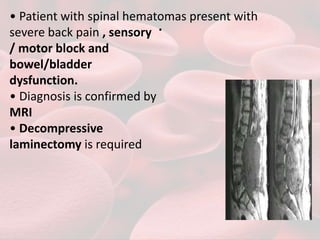
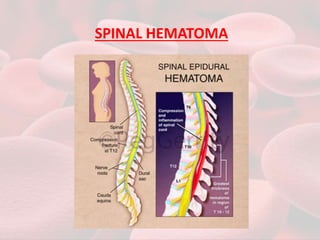
• Patient with spinal hematomas present with
severe back pain , sensory
/ motor block and
bowel/bladder
dysfunction.
• Diagnosis is confirmed by
MRI
• Decompressive
laminectomy is required
• Regional Anesthesia in the Patient Receiving
Antithrombotic or Thrombolytic Therapy
American Society of Regional Anesthesia and Pain
Medicine
Evidence-Based Guidelines (Fourth Edition)
(Regional Anesth Pain Med 2018;43: 263–309)
• Miller’s anesthesia
• Stoeltings pharmacology and physiology in anesthesia
practice
5th edition
• clinical anaesthesia : Paul G Barash
.
THANK YOU

AIIMS ANTICOAGULATION PPT.pptx

  • 1.
  • 2.
  • 3.
  • 4.
  • 5.
  • 6.
    TESTS FOR PRIMARYHEMOSTASIS Platelet count • NORMAL 1.5lakh – 4.5lakh CELLS/MM3 • < 1.5 lakhcells/cumm Thrombocytopenia • >4.5lakh cells/cumm thrombocytosis
  • 7.
    BLEEDING TIME  Normal: 2-9mins  Evaluates time necessary for platelet plug to form following vascular injury  Prolongation : • Thrombocytopenia • Platelet dysfunction • Ehler danlos syndrome
  • 8.
  • 9.
    CLOTTING TIME • Timetaken from puncture of blood vessel to formation of fibrin thread. • Capillary glass tube method : time noted to form fibrin threads by breaking tube every 30 seconds . • Normal : 3-8mins
  • 10.
    LAB EVALUATION OFCOAGULATION PROTHROMBIN TIME : • Indicates extrinsic and common pathway • It measures the time to strand formation via a short sequence of reactions involving TF ,VII,X,V,II(prothrombin) & I (fibrinogen) • Normal : 10-12 sec • It is most sensitive to decrease in factor 7 .
  • 11.
    INR ratio • Developedby WHO using an IRP(international • reference preparation) to which all the • thromboplastins can be compared • • Recommended as a patient value can be • expressed as a ratio by normalising it to IRP • • ISI of IRP : 1
  • 12.
    Partial thromboplastin time •Reflects the time to fibrin strand formation via the classical intrinsic pathway of coagulation • A contact activator is added ,hence the name aptt • Normal : 25-35 sec • most sensitive to factor VIII & IX
  • 13.
    Activated clotting time Teststhe ability of blood to clot in a test tube and is • dependent on factors that are all intrinsic to blood . • Used to monitor heparin therapy in operating room • Normal: 90-120sec • The presence of activator augments the contact activation phase of coagulation, which stimulates the intrinsic coagulation pathway.
  • 14.
  • 15.
    THROMBIN TIME : •Ability of thrombin to convert fibrinogen to fibrin Prolongation : • inadequate fibrinogen • Dysfibrinogenemia • Thrombin inhibitors • Normal <30seconds. • Monitors hirudin , bivalarudin and LMWH
  • 16.
    Regional anaesthesia inthe patient receiving antithrombotic or thrombolytic therapy • American society of regional anaesthesia and pain medicine • Evidence based guidelines (fourth edition ) • As published in regional anaesthesia and pain medicine , volume 43, number3 , April 2018
  • 18.
    HEPARIN • Heparin anticoagulationcan be rapidly reversed with Protamine. • Monitoring – Aptt
  • 22.
    WARFARIN • Exert theiranticoagulant effect by interfering with the synthesis of the vitamin K–dependent clotting factors VII, IX, X, and II (thrombin). • Dosage : 5-10mg • Maintainence : 5mg • Discontinuation of warfarin requires normalization of the INR to ensure adequate activities of all the clotting factors.
  • 23.
    PERIOPERATIVE MANAGEMENT OFPATIENTS ON WARFARIN Preoperative • Discontinue warfarin at least 5 days before elective procedure • Assess INR 1–2 d prior to surgery, if >1.5, consider 1–2 mg oral vitamin K • Reversal for urgent surgery/procedure, consider 2.5–5 mg oral or IV vitamin K; • For immediate reversal, consider PCCs, fresh frozen plasma
  • 24.
    . • Patients athigh risk of thromboembolism ○ Bridge with therapeutic SC LMWH (preferred) or IV UFH ○ Last dose of preoperative LMWH administered 24 h before surgery, administer half of the daily dose ○ Intravenous heparin discontinued 4–6 h before surgery • No bridging necessary for patients at low risk of thromboembolism
  • 25.
    Post operative  Patientsat low risk of thromboembolism ○ Resume warfarin on POD  Patients at high risk of thromboembolism (who received preoperative bridging therapy) ○ Minor surgical procedure—resume therapeutic LMWH 24 h postoperatively ○ Major surgical procedure—resume therapeutic LMWH 48–72h postoperatively or administer low- dose LMWH
  • 26.
    . . •INR of greaterthan 1.5 but less than 3 • INR of greater than 3 . •Indwelling catheters may be maintained with caution, based on INR and Duration of warfarin therapy •Warfarin dose be held or reduced in patients with indwelling neuraxial catheters It is suggested that neurologic assessment be continued for at least 24 hours following catheter removal.
  • 28.
  • 31.
    ANTIPLATELET AGENTS • NSAID’S •Thienopyridine derivatives : Ticlopidine,Clopidogrel,Prasugrel • Platelet glycoprotein 2b/3a receptor antagonists – Abciximab,Eptifibatide,Tirofiban • Platelet P2Y12 receptor antagonist : Ticagrelor • Platelet phosphodiesterase 3a inhibitor : Cilostazol
  • 32.
    Perioperative Management ofPatients on Antiplatelet Therapy Patients with coronary stents • Elective surgery postponed for the following durations if aspirin and thienopyridine (eg, clopidogrel or prasugrel) therapy must be discontinued ○ Bare metal stents: 6 wk ○ Drug-eluting stents: 6 months • If surgery cannot be postponed, continue dual antiplatelet therapy throughout perioperative period
  • 33.
    . Patients at highrisk of cardiac events (exclusive of coronary stents) • Continue aspirin throughout the perioperative period • Discontinue clopidogrel/prasugrel 5 d prior to surgery • Resume thienopyridine 24 h postoperatively
  • 34.
    . • Patients atlow risk of cardiac events • Discontinue dual antiplatelet therapy 7–10 d prior to surgery • Resume antiplatelet therapy 24 h postoperatively
  • 39.
  • 40.
    . • Patient withspinal hematomas present with severe back pain , sensory / motor block and bowel/bladder dysfunction. • Diagnosis is confirmed by MRI • Decompressive laminectomy is required
  • 41.
    • Regional Anesthesiain the Patient Receiving Antithrombotic or Thrombolytic Therapy American Society of Regional Anesthesia and Pain Medicine Evidence-Based Guidelines (Fourth Edition) (Regional Anesth Pain Med 2018;43: 263–309) • Miller’s anesthesia • Stoeltings pharmacology and physiology in anesthesia practice 5th edition • clinical anaesthesia : Paul G Barash
  • 42.

Editor's Notes

  • #15 The normal ACT value is 90-120sec and increases in a linear fashion with increasing heparin concentration. • Haemodilution and hypothermia routinely occur while on CPB and also prolong the ACT. • For these reasons, once CPB is established, the ACT ceases to correlate well with heparin concentration or measures of heparin anticoagulation effect such as anti-Xa activity.