KISHLAY, ECSE-8D (RBIEBT), TRAINEE @OIT(PHP),MOHALI Page 1
ACKNOWLEDGEMENT
It is my great pleasure to present this report on the project named ―ENTERPRISE
RESOURCE PLANNING‖ undertaken by me as part of my B. Tech (Electronics &
Computer Science Engineering) curriculum.
I am thankful to One Infonet Technologies, Mohali and RBIEBT, Mohali for offering me
such a wonderful challenging opportunity and I express my deepest thanks to all
coordinators, of OIT (Mohali) for providing all the possible help and assistance and their
constant encouragement.
It is a pleasure that I find myself penning down these lines to express my sincere thanks
to the people who helped me along the way in completing my project. I find inadequate
words to express my sincere gratitude towards them.
First and foremost i would like to express my gratitude towards our training guide Mr.
Sunny Kumar for placing complete faith and confidence in our ability to carry out this
project and for providing me his time, inspiration, encouragement, help, valuable
guidance, constructive criticism and constant interest. He took personal interest in spite of
numerous commitments and busy schedule to help me complete this project. Without the
sincere and honest guidance of my respective project guide i would have not been to
reach the present stage.
KISHLAY, ECSE-8D (RBIEBT), TRAINEE @OIT(PHP),MOHALI Page 2
ABSTRACT
This is a project report on ―ENTERPRISE RESOURCE PLANNING‖. During the
making/developing of this project I explored new ideas and functionality behind the
working of a notepad.
This project is the output of our planning, schedule, programming skill and the hard work,
and this report reflects our steps taken at various levels of programming skill, planning
and schedule.
I have learnt a lot during this project and liked the improvement in my testing skills and
deep concept related to these kinds of projects.
My project is a web based application which helps people to control of many activities in
business or organization including administration, user data, sales, marketing, delivery,
billing, production, inventory management, quality management and human resource
management. It is useful in the way that it makes an easier way to improve their
Integration among different functional areas to ensure proper communication,
productivity and efficiency.
In this project i have basically 4 modules. The module includes the Design module.
 First module is academic module which deals with the Admission, registration
Research & management part.
 Second module is IT module which deals with the Document management,
University portal, Business intelligence part.
 Third module is Administrative module which deals with the Accounts payables &
receivables, Cash management, Costing & budgeting, Inventory & Warehouse
management, Maintenance management, Payroll part.
 Fourth module is Support service module which deals with the Office and Housing
Services, Medical, Food, Safety and Security, Transportation Services, Book store
part.
But before going to above mentioned modules one (User) have to access through our user
module. Unregistered user can’t able to access. Only the registered member can view
details of his/her account. That account will show their profile, details, records & many
important other data. Which they can use whenever they need.
KISHLAY, ECSE-8D (RBIEBT), TRAINEE @OIT(PHP),MOHALI Page 3
PERFACE
Learning comes from doing. To learn something one has to go through Practical
conditions. Recognizing this fact, the Punjab technical University has made it essential
for ―ELECTRONICS & COMPUTER SCIENCE ENGINEERING‖ students to
undergo Industrial Training for six weeks. During this period, the student learns about the
functioning of the organization and the actual business environment. Also this training
helps the student how to implement the theoretical knowledge into practical life, in our
day to day life. This project report was prepared during the training period in the month
of Jan – June, 2015.
During this period, an effort was made to Design an online Game and to finish the project
work assigned to us. This report lays special emphasis on the operational work, tasks and
projects carried out during the training period.
KISHLAY, ECSE-8D (RBIEBT), TRAINEE @OIT(PHP),MOHALI Page 4
ORGANIZATION OVERVIEW
One Infonet technology is a project & outsourcing based organization. OIT develop
Softwares & new generation applications as well as training firm. OIT is a world of
innovations & it was followed by series of products with artificial intelligent
forecasting tools. OIT is an IT learning Solutions and is known for its pioneering
work in the field of IT education and training in the region.OIT entered the world of
IT Services Outsourcing in January 2010 and in just Nine months, company has
joined the club of Top Programmers on various platforms with more than 100%
client satisfaction. Our trainers provide a comprehensive education environment to
individuals, offerings training that is customized to the varied needs of industries
with diverse backgrounds.
DEPARTMENT ALLOCATED:
It provides industrial training on live projects. With the subject wise practical
information to Engineering students, in-depth knowledge of Languages and
Database handling is provided.
RESPONSIBILITIES & FACILITIES DURING TRAINING:
 Regularity during training session.
 Being on time for and actively engaged in all learning sessions including
discussions, problem-solving exercises.
 Team projects & skill practice sessions.
 Asking questions about the course content as it relates to our specific course.
 Complete the assigned work within given period.
 Design projects & Help the department in managing Public Relations.
 High speed Internet Secured FTP Sites for Data Interchange
 Our own secure dedicated servers
 Fax and email at all locations
 Firewall security, User level internet access control system, Locations fully
equipped with latest software and hardware, Video and audio conferencing
capabilities.
KISHLAY, ECSE-8D (RBIEBT), TRAINEE @OIT(PHP),MOHALI Page 5
ABOUT ERP
Introduction to ERP The initials ERP originated as an extension of MRP (material
requirements planning; later manufacturing resource planning) and CIM (Computer
Integrated Manufacturing). It was introduced by research and analysis firm Gartner in
1990. ERP systems now attempt to cover all core functions of an enterprise, regardless of
the organization's business or charter. These systems can now be found in non-
manufacturing businesses, non-profit organizations and governments. To be considered
an ERP system, a software package must provide the function of at least two systems. For
example, a software package that provides both payroll and accounting functions could
technically be considered an ERP software package Examples of modules in an ERP
which formerly would have been stand-alone applications include: Product lifecycle
management, Supply chain management (e.g. Purchasing, Manufacturing and
Distribution), Warehouse Management, Customer Relationship Management (CRM),
Sales Order Processing, Online Sales, Financials, Human Resources, and Decision
Support System. Some organizations — typically those with sufficient in-house IT skills
to integrate multiple software products — choose to implement only portions of an ERP
system and develop an external interface to other ERP or stand-alone systems for their
other application needs. For example, one may choose to use human resource
management system from one vendor, and perform the integration between the systems
themselves. This is common to retailers, where even a mid-sized retailer will have a
discrete Point-of Sale (POS) product and financials application, then a series of
specialized applications to handle business requirements such as warehouse management,
staff roistering, merchandising and logistics. Ideally, ERP delivers a single database that
contains all data for the software modules, which would include:
 Manufacturing Engineering, bills of material, scheduling, capacity, workflow
management, quality control, cost management, manufacturing process, manufacturing
projects, manufacturing flow
 Supply chain management Order to cash, inventory, order entry, purchasing, product
configurator, supply chain planning, supplier scheduling, inspection of goods, claim
processing, commission calculation
KISHLAY, ECSE-8D (RBIEBT), TRAINEE @OIT(PHP),MOHALI Page 6
 Financials General ledger, cash management, accounts payable, accounts receivable,
fixed assets
 Project management Costing, billing, time and expense, performance units, activity
management
 Human resources Human resources, payroll, training, time and attendance, rostering,
benefits
 Customer relationship management - Sales and marketing, commissions, service,
customer contact and call center support
 Data warehouse - and various self-service interfaces for customers, suppliers, and
employees
 Access control - user privilege as per authority levels for process execution
 Customization - to meet the extension, addition, change in process flow Enterprise
resource planning is a term originally derived from manufacturing resource planning
(MRP II) that followed material requirements planning (MRP). MRP evolved into ERP
when "routings" became a major part of the software architecture and a company's
capacity planning activity also became a part of the standard software activity. ERP
systems typically handle the manufacturing, logistics, distribution, inventory, shipping,
invoicing, and accounting for a company. ERP software can aid in the control of many
business activities, including sales, marketing, delivery, billing, production, inventory
management, quality management and human resource management. ERP systems saw a
large boost in sales in the 1990s as companies faced the Y2K problem in their legacy
systems. Many companies took this opportunity to replace their legacy information
systems with ERP systems. This rapid growth in sales was followed by a slump in 1999,
at which time most companies had already implemented their Y2K solution. 4 ERPs are
often incorrectly called back office systems indicating that customers and the general
public are not directly involved. This is contrasted with front office systems like customer
relationship management (CRM) systems that deal directly with the customers, or the
eBusiness systems such as ecommerce, eGovernment, eTelecom, and eFinance, or
supplier relationship management (SRM) systems. ERPs are cross-functional and
KISHLAY, ECSE-8D (RBIEBT), TRAINEE @OIT(PHP),MOHALI Page 7
enterprise wide. All functional departments that are involved in operations or production
are integrated in one system. In addition to manufacturing, warehousing, logistics, and
information technology, this would include accounting, human resources, marketing and
strategic management. ERP II, a term coined in the early 2000's, is often used to describe
what would be the next generation of ERP software. This new generation of software is
web-based, and allowed both internal employees, and external resources such as suppliers
and customers real-time access to the data stored within the system. eg:
 Integration among different functional areas to ensure proper communication,
productivity and efficiency
 Design engineering (how to best make the product)
 Order tracking, from acceptance through fulfillment
 The revenue cycle, from invoice through cash receipt
 Managing inter-dependencies of complex processes bill of materials
 Tracking the three-way match between purchase orders (what was ordered), inventory
receipts (what arrived), and costing (what the vendor invoiced)
 The accounting for all of these tasks: tracking the revenue, cost and profit at a granular
level. ERP Systems centralize the data in one place.
Benefits of this include:
 Eliminates the problem of synchronizing changes between multiple systems
 Permits control of business processes that cross functional boundaries
 Provides top-down view of the enterprise (no "islands of information")
 Reduces the risk of loss of sensitive data by consolidating multiple permissions and
security models into a single structure. Some security features are included within an ERP
system to protect against both outsider crime, such as industrial espionage, and insider
crime, such as embezzlement. A data-tampering scenario.
KISHLAY, ECSE-8D (RBIEBT), TRAINEE @OIT(PHP),MOHALI Page 8
PROJECT DESCRIPTION:
“ENTERPRISE RESOURCE PLANNING”
Enterprise resource planning (ERP) is business management software that allows an
organization to use a system of integrated applications to manage the business.
Being Specific ERP systems are large computer systems that integrate application
programs in accounting (i.e., accounts receivable), sales (i.e., order booking),
manufacturing (i.e., product shipping) and the other functions in the firm.
This integration is accomplished through a database shared by all the application
programs.
A typical ERP system will use multiple components of computer hardware and software
to achieve the integration.
A key ingredient of most ERP systems is the use of a unified database to store data for
various system modules.
Broken down into business processes
HRM
Distribution
Financials
Manufacturing
An ERP implementation is a huge commitment from the organization, causing millions of
rupees and can take up to several years to complete. However, when it is integrated
successfully, the benefits can be enormous. A well-designed and properly integrated ERP
system allows the most updated information to be shared among various business
functions, thereby resulting in tremendous cost savings and increased efficiency. When
making the implementation decision, management must considered fundamental issues
such as the organization’s readiness for a dramatic change, the degree of integration, key
business processes to be implemented, e-business applications to be included, and
whether or not new hardware need to be acquired. In order to increase the chance of user
acceptance, employees must be consulted and be involved in all stages of the
implementation process. Providing proper education and appropriate training are also two
important strategies to increase the end user acceptance rate. To facilitate the change
process, managers are encouraged to utilize the eight-level organizational change process.
Managers can implement their ERP systems in several ways, which include the whole
integration, the franchise approach, and the single-module approach.
KISHLAY, ECSE-8D (RBIEBT), TRAINEE @OIT(PHP),MOHALI Page 9
COMPONENTS OF THE PROJECTS
 HOW TO LOGIN/SIGNUP:
If user needs to access the game one must have to enter through login or Signup
section to their related account where the prizes and cashes stored.
 HOW TO BE A MEMBER OF THE SYSTEM:
In this Sub module, the user will fill up a form. Enter their username and password
to access the related account with that user name & password. There will be
different types of users. If user is not a member yet then by pressing sign up link,
they can join the system. User has to provide some personal details asked at the
time of signup.
 HOW TO VIEW MY PROFILE OR ACCOUNT:
Any member can view their Respective Account for this they just need to login or
signup their accounts.
KISHLAY, ECSE-8D (RBIEBT), TRAINEE @OIT(PHP),MOHALI Page 10
REQUIREMENT ANALYSIS:
 HARDWARE REQUIREMENTS:
 INTEL CORE PROCESSOR
 320MB RAM (MIN.)
 SOFTWARE REQUIREMENTS:
 WINDOWS XP / 7 / 8 / 8.1
 MOZILLA FIREFOX, GOOGLE CHROME, DEFAULT BROWSERS
 PHP 5.1 / PHP 5.6.5
 DREAM WEAVER, NOTEPAD++, NOTEPAD
 IIS SERVER, WAMPSERVER / APACHE SERVER
 MySQL
 HTML/ HTML 5/ JSON/ JAVASCRIPT/ CSS
 FLASH 8
KISHLAY, ECSE-8D (RBIEBT), TRAINEE @OIT(PHP),MOHALI Page 11
ACADEMIC MODULE
 Admission & registration
 Research management
IT MODULES
 Document management
 University portal
 Business intelligence
ADMINISTRATIVE MODULES
 Accounts payables & receivables
 Cash management
 Costing & budgeting
 Inventory & Warehouse management
 Maintenance management
 Payroll
SUPPORT SERVICES
 Office and Housing Services
 Medical, Food, Safety and Security, Transportation Services
 Book store.
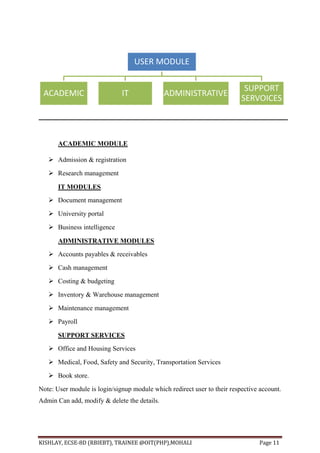
Note: User module is login/signup module which redirect user to their respective account.
Admin Can add, modify & delete the details.
USER MODULE
ACADEMIC IT ADMINISTRATIVE
SUPPORT
SERVOICES
KISHLAY, ECSE-8D (RBIEBT), TRAINEE @OIT(PHP),MOHALI Page 12
TOOLS
INTRODUCTION
Front-End: Web Pages using PHP, HTML, and JavaScript.
Back-End: MYSQL
FRONT END:
HTML:
Short for Hypertext Mark-up Language, the authoring language used to
create documents on the World Wide Web. HTML is similar to SGML, although it is not
a strict subset.HTML defines the structure and layout of a Web document by using a
variety of tags and attributes. The correct structure for an HTML document starts
with <HTML> <HEAD> (enter here what document is about)<BODY> and ends
with </BODY> </HTML>. All the information you'd like to include in your Web page
fits in between the <BODY> and </BODY> tags.
JAVASCRIPT:-
JavaScript is a dynamic computer programming language It is most commonly used as
part of web browsers, whose implementations allow client-side scripts to interact with the
user, control the browser, communicate asynchronously, and alter the document
content that is displayed. It is also used in server-side network programming with runtime
environments such as Node.js, game development and the creation of desktop and mobile
applications. With the rise of the single-page web app and JavaScript-heavy sites, it is
increasingly being used as a compile target for source-to-source compilers from both
dynamic and static languages.
PHP:-
Php is a technology that lets you mix regular, static HTML with dynamically-generated
HTML. Many Web pages that are built by CGI programs are mostly static, with the
dynamic part limited to a few small locations. But most CGI variations, including
servlets, make you generate the entire page via your program, even though most of it is
always the same. PHP is a widely used, general-purpose scripting language that was
originally designed for web development, to produce dynamic web pages. It can be
KISHLAY, ECSE-8D (RBIEBT), TRAINEE @OIT(PHP),MOHALI Page 13
embedded into HTML and generally runs on a web server, which needs to be configured
to process PHP code and create web page content from it. It can be deployed on most web
servers and on almost every operating system and platform free of charge. PHP is
installed on over 20 million websites and 1 million web servers.
PHP was originally created by Rasmus Lerdorf in 1994 and has been in continuous
development ever since. The main implementation of PHP is now produced by The PHP
Group and serves as the de facto standard for PHP as there is no formal specification.
PHP is free software released under the PHP License, which is incompatible with the
GNU General Public License (GPL) because of restrictions on the use of the term PHP.
PHP has evolved to include a command line interface capability and can also be used in
standalone graphical applications.
WHY PHP:
USAGE:
PHP is a general-purpose scripting language that is especially suited for web
development. PHP generally runs on a web server. Any PHP code in a requested file is
executed by the PHP runtime, usually to create dynamic web page content. It can also be
used for command-line scripting and client-side GUI applications. PHP can be deployed
on most web servers, many operating systems and platforms, and can be used with many
relational database management systems.
SPEED OPTIMIZATION:
As with many scripting languages, PHP scripts are normally kept as human-readable
source code, even on production web servers. In this case, PHP scripts will be compiled at
runtime by the PHP engine, which increases their execution speed. PHP scripts are able to
be compiled before runtime using PHP compilers as with other programming languages
such as C (the language PHP and its extensions are written in).
SECURITY:
The National Vulnerability Database stores all vulnerabilities found in computer
software. The overall proportion of PHP-related vulnerabilities on the database amounted
to: 20% in 2004, 28% in 2005, 43% in 2006, 36% in 2007, and 35% in 2008. Most of
KISHLAY, ECSE-8D (RBIEBT), TRAINEE @OIT(PHP),MOHALI Page 14
these PHP-related vulnerabilities can be exploited remotely: they allow hackers to steal or
destroy data from data sources linked to the webserver (such as an SQL database), send
spam or contribute to DOS attacks using malware, which itself can be installed on the
vulnerable servers.
SYNTAX:
Syntax-highlighted PHP code embedded within HTML. PHP only parses code within its
delimiters. Anything outside its delimiters is sent directly to the output and is not
processed by PHP. The most common delimiters are <?php to open and ?> to close PHP
sections. <script language="php"> and </script> delimiters are also available, as are the
shortened forms <? or <?= (which is used to echo back a string or variable) and ?> as well
as ASP-style short forms <% or <%= and %>. While short delimiters are used, they make
script files less portable as their purpose can be disabled in the PHP configuration, and so
they are discouraged. The purpose of all these delimiters is to separate PHP code from
non-PHP code, including HTML. Variables are prefixed with a dollar symbol and a type
does not need to be specified in advance. Unlike function and class names, variable
names are case sensitive. Both double-quoted ("") and heredoc strings allow the ability to
embed a variable's value into the string. PHP treats newlines as whitespace in the manner
of a free-form language (except when inside string quotes), and statements are terminated
by a semicolon. PHP has three types of comment syntax: /* */ marks block and inline
comments; // as well as # are used for one-line comments. The echo statement is one of
several facilities PHP provides to output text (e.g. to a web browser). In terms of
keywords and language syntax, PHP is similar to most high level languages that follow
the C style syntax. If conditions, for and while loops, and function returns are similar in
syntax to languages such as C, C++, Java and Perl.
DATA TYPES:-
PHP stores whole numbers in a platform-dependent range. This range is typically that of
32-bit signed integers. Unsigned integers are converted to signed values in certain
situations; this behavior is different from other programming languages. Integer variables
can be assigned using decimal (positive and negative), octal, and hexadecimal notations.
Floating point numbers are also stored in a platform-specific range. They can be specified
using floating point notation, or two forms of scientific notation. PHP has a native
KISHLAY, ECSE-8D (RBIEBT), TRAINEE @OIT(PHP),MOHALI Page 15
Boolean type that is similar to the native Boolean types in Java and C++. Using the
Boolean type conversion rules, non-zero values are interpreted as true and zero as false,
as in Perl and C++. The null data type represents a variable that has no value. The only
value in the null data type is NULL. Variables of the "resource" type represent references
to resources from external sources. These are typically created by functions from a
particular extension, and can only be processed by functions from the same extension;
examples include file, image, and database resources. Arrays can contain elements of any
type that PHP can handle, including resources, objects, and even other arrays. Order is
preserved in lists of values and in hashes with both keys and values, and the two can be
intermingled. PHP also supports strings, which can be used with single quotes, double
quotes, or heredoc syntax.
The Standard PHP Library (SPL) attempts to solve standard problems and implements
efficient data access interfaces and classes.
FUNCTIONS:-
PHP has hundreds of base functions and thousands more via extensions. These functions
are well documented on the PHP site, however, the built-in library has a wide variety of
naming conventions and inconsistencies. PHP currently has no functions for thread
programming, although it does support multiprocess programming on POSIX systems.
USE OF OBJECTS:
Basic object-oriented programming functionality was added in PHP 3 and improved in
PHP 4. Object handling was completely rewritten for PHP 5, expanding the feature set
and enhancing performance. In previous versions of PHP, objects were handled like
primitive types. The drawback of this method was that the whole object was copied when
a variable was assigned or passed as a parameter to a method. In the new approach,
objects are referenced by handle, and not by value. PHP 5 introduced private and
protected member variables and methods, along with abstract classes and final classes as
well as abstract methods and final methods.
KISHLAY, ECSE-8D (RBIEBT), TRAINEE @OIT(PHP),MOHALI Page 16
BACKEND:
MY SQL:-
It is a relational database management system (RDBMS) which has more than 6 million
installations. MySQL stands for "My Structured Query Language". The program runs as a
server providing multi-user access to a number of databases.
FEATURES:
As of April 2009, MySQL offers MySQL 5.1 in two different variants: the MySQL
Community Server and Enterprise Server. They have a common code base and include
the following features:
A broad subset of ANSI SQL 99, as well as extensions
 Cross-platform support
 Stored procedures
 Triggers
 Cursors
 Updatable Views
 True VarChar support
 Information schema
 Strict mode
X/Open XA distributed transaction processing (DTP) support; two phase commit as part
of this, using Oracle's InnoDB engine
Independent storage engines (MyISAM for read speed, InnoDB for transactions and
referential integrity, MySQL Archive for storing historical data in little space)
Transactions with the InnoDB, BDB and Cluster storage engines; savepoints with
InnoDB
 SSL support
 Query caching
 Sub-SELECTs (i.e. nested SELECTs)
KISHLAY, ECSE-8D (RBIEBT), TRAINEE @OIT(PHP),MOHALI Page 17
 Replication with one master per slave, many slaves per master, no
automatic support for multiple masters per slave.
 Full-text indexing and searching using MyISAM engine
 Embedded database library
IIS SERVER / WAMP:-
Apache is a web container, or application server developed at the Apache Software
Foundation (ASF).It adds tools for configuration and management but can also be
configured by editing configuration files that are normally XML-formatted. Apache
includes its own internal HTTP server.
RESOURCES
PHP includes free and open source libraries with the core build. PHP is a fundamentally
Internet-aware system with modules built in for accessing FTP servers, many database
servers, embedded SQL libraries such as embedded PostgreSQL, MySQL and SQLite,
LDAP servers, and others. Many functions familiar to C programmers such as those in the
stdio family are available in the standard PHP build. PHP has traditionally used features
such as "magic_quotes_gpc" and "magic_quotes_runtime" which attempt to escape
apostrophes (') and quotes (") in strings in the assumption that they will be used in
databases, to prevent SQL injection attacks. This leads to confusion over which data is
escaped and which is not, and to problems when data is not in fact used as input to a
database and when the escaping used is not completely correct.
MYSQL
MySQL is a relational database management system (RDBMS) which has more than 6
million installations. MySQL stands for "My Structured Query Language". The program
runs as a server providing multi-user access to a number of databases.
The project's source code is available under terms of the GNU General Public License, as
well as under a variety of proprietary agreements. MySQL is commonly used by free
software projects which require a full-featured database management system, such as
Word Press, PHP BB and other software built on the LAMP software stack. It is also used
in very high-scale World Wide Web products including Google and Facebook.
KISHLAY, ECSE-8D (RBIEBT), TRAINEE @OIT(PHP),MOHALI Page 18
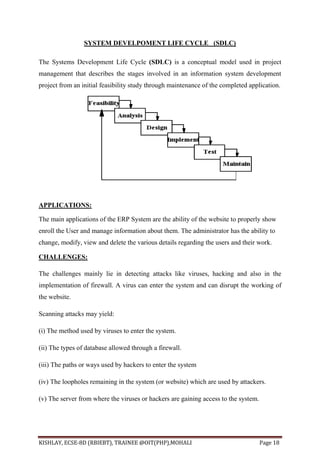
SYSTEM DEVELPOMENT LIFE CYCLE (SDLC)
The Systems Development Life Cycle (SDLC) is a conceptual model used in project
management that describes the stages involved in an information system development
project from an initial feasibility study through maintenance of the completed application.
APPLICATIONS:
The main applications of the ERP System are the ability of the website to properly show
enroll the User and manage information about them. The administrator has the ability to
change, modify, view and delete the various details regarding the users and their work.
CHALLENGES:
The challenges mainly lie in detecting attacks like viruses, hacking and also in the
implementation of firewall. A virus can enter the system and can disrupt the working of
the website.
Scanning attacks may yield:
(i) The method used by viruses to enter the system.
(ii) The types of database allowed through a firewall.
(iii) The paths or ways used by hackers to enter the system
(iv) The loopholes remaining in the system (or website) which are used by attackers.
(v) The server from where the viruses or hackers are gaining access to the system.
KISHLAY, ECSE-8D (RBIEBT), TRAINEE @OIT(PHP),MOHALI Page 19
(vi) The types of viruses able to affect the website And with the implementation of
firewall and other security mechanisms that are designed for it, the On Line Placement
System Website safe and secure.
REQUIREMENT ANALYSIS:-
The goal of our thesis is to develop a website that can be used as an enrollment website
with the features of interaction and problem solving. The whole project will be based on
PHP with MYSQL as the database with certain security constraints added to it. Our aim is
also to implement the Administrator part in to the project so that the server or
administrator himself can view, add, delete and modify.
ADMINISTRATOR:
He has to see whether the website is working properly and whether the details available in
the system are relevant and correct. He can view, add, modify, delete details.
DATABASE:
The database keeps all the records of all the users i.e. name, phone no.,dob, city,
country,etc. For creating such records it takes the help of tables which is created in the
MYSQL. The tables can have infinite entries of all the registered users as well as
administrators.
CLIENTS:
Our aim will also to provide efficient way by which client can enter to see his profile.
SECURITY CONSTRAINTS:
There need to be certain constraints which have to be implemented on the database as
well as on the administrator in order to work properly the whole system, such as declaring
the primary key, or such constraints in order to keep the database work properly.
Some of such constraints are as follows:
1. Each user has a field called username which can be used to differentiate between
different users.
2. The administrator has his own password known to no one else to access a unique page.
KISHLAY, ECSE-8D (RBIEBT), TRAINEE @OIT(PHP),MOHALI Page 20
3. Only the administrator has the right to delete, modify users and questions.
4. Administrator has to first login to get access to my account part and modify some data
available in the website.
5. A new user cannot have same username and password as of some already registered
user.
6.When user or administrator click on logout the session of the user ends and he has to
again login using his/her username and password to access the same functionality.
7. Checks are implemented so that the mandatory fields are filled by users when the user
is entering some information in the system.
8. Latest firewalls and other antivirus and anti-hacking modules are to be used with the
website so as to protect the website from external attacks.
FEASIBILTY STUDY
At the feasibility stage, it is desirable that two or three different configuration will be
pursed that satisfy the key technical requirement but which represent different level of
ambition and cost. Feasibility is the determination of whether or not a project is worth
doing. A feasibility study is carried out select a best system that mate performance
requirements.
The data collected during primary investigation examines system feasibilities that is
likelihood that the system will be beneficial to the organization. Four tests for feasibility
study are as follows:-
TECHNICAL FEASIBILITY:
This is concerned with specifying equipment and software that will successfully satisfy
the use considerably, but might include The feasibility to produce output in a given time
because system is fast enough to handle multiple users.Response time under certain
circumstances and ability to process a certain volume of transaction of a particular speed.
Feasibility to communicate data to distant location.
KISHLAY, ECSE-8D (RBIEBT), TRAINEE @OIT(PHP),MOHALI Page 21
ECONOMICAL FEASIBILITY:
Economic analysis is the most frequently used technique used for evaluating the
effectiveness of a proposed system. More commonly known as cost/benefit analysis the
procedure is to determine the benefits and savings that are expected from a proposed
system and compared them with cost. Though the cost of installing the system may
appear high, it is one time investment. The resulting benefits is that automation results in
turnaround time. The resulting cost/benefit ratio is favorable.
OPERATIONAL FEASIBILITY
It is mainly related to human organizational as social aspects. The points to be considered
are - The system interface is standard, user friendly and provides extensive help. Hence
no special training is not required.
SOCIAL FEASIBILITY: Social feasibility is determination of whether a proposed
project will be acceptable to people or not, So this project is totally Social and Feasible.
SYSTEM ANALYSIS
The analysis model must achieve three primary objectives:To describe what the customer
requires.
 To establish the basis for the enhancement of a software design.
 To define a set of requirements that can be validated once the software is
completely enhanced. The main elements of the analysis model are briefly
described below.
 The entity relation diagram depicts relationships between data objects.
 The data flow diagram provides an indication of how the data is transformed as
they move through the system.
 The state transition diagram indicates how the system behaves as a consequence of
external events.
KISHLAY, ECSE-8D (RBIEBT), TRAINEE @OIT(PHP),MOHALI Page 22
DESIGN PHASE
The design phase involves converting the informational, functional, and network
requirements identified during the initiation and planning phases into unified design
specifications that developers use to script programs during the development phase.
Program designs are constructed in various ways. Using a top-down approach, designers
first identify and link major program components and interfaces, then expand design
layouts as they identify and link smaller subsystems and connections. Using a bottom-up
approach, designers first identify and link minor program components and interfaces, then
expand design layouts as they identify and link larger systems and connections.
Contemporary design techniques often use prototyping tools that build mock-up designs
of items such as application screens, database layouts, and system architectures. End
users, designers, developers, database managers, and network administrators should
review and refine the prototyped designs in an iterative process until they agree on an
acceptable design.
Designers should carefully document completed designs. Detailed documentation
enhances a programmer’s ability to develop programs and modify them after they are
placed in production. The documentation also helps management ensure final programs
are consistent with original goals and specifications. Organizations should create initial
testing, conversion, implementation, and training plans during the design phase.
Additionally, they should draft user, operator, and maintenance manuals.
For design of the website project: First Database has to be designed which can be used to
handle all the requirements of the users. The basic structure of the website has to be
designed. The main template to be used for the website is designed.
KISHLAY, ECSE-8D (RBIEBT), TRAINEE @OIT(PHP),MOHALI Page 23
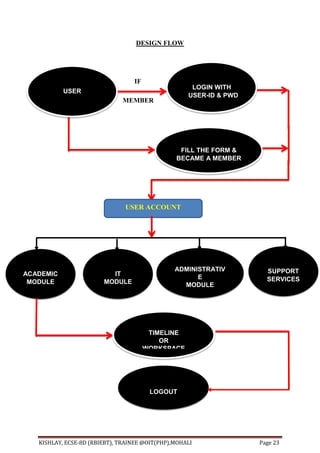
DESIGN FLOW
IF
MEMBER
TESTING:
FILL THE FORM &
BECAME A MEMBER
ACADEMIC
MODULE
USER ACCOUNT
LOGIN WITH
USER-ID & PWD
SUPPORT
SERVICES
IT
MODULE
ADMINISTRATIV
E
MODULE
USER
TIMELINE
OR
WORKSPACE
LOGOUT
KISHLAY, ECSE-8D (RBIEBT), TRAINEE @OIT(PHP),MOHALI Page 24
SOFTWARE TESTING:
Software testing is the process used to measure the quality of developed computer
software. Usually, quality is constrained to such topics as correctness, completeness,
security, but can also include more technical requirements as described under the ISO
standard ISO 9126, such as capability, reliability, efficiency, portability, maintainability,
compatibility, and usability.
WHITE BOX:
White-box testing (also known as clear box testing, glass box testing, transparent box
testing, and structural testing) is a method of testing software that tests internal structures
or workings of an application.
BLACK-BOX:
Black-box testing is a method of software testing that examines the functionality of an
application without peering into its internal structures or workings. This method of test
can be applied to virtually every level of software
testing: unit, integration, system and acceptance. It typically comprises most if not all
higher level testing, but can also dominate unit testing as well.
GREY-BOX:
Gray-box testing is a combination of white-box testing and black-box testing. The aim of
this testing is to search for the defects if any due to improper structure or improper usage
of applications.
VERIFICATION & VALIDATION:
Verification and validation are independent procedures that are used together for
checking that a product, system meets requirements And Specification and that it fulfills
its intended purpose. These are critical components of a quality management system such
as ISO 9000. The words "verification" and "validation" are sometimes preceded with
"independent", indicating that the verification and validation is to be performed by a
disinterested third party.
KISHLAY, ECSE-8D (RBIEBT), TRAINEE @OIT(PHP),MOHALI Page 25
IMPLEMENTATION PHASE
The implementation phase involves installing approved applications into production
environments. Primary tasks include announcing the implementation schedule, training
end users, and installing the product. Additionally, organizations should input and verify
data, configure and test system and security parameters, and conduct post-implementation
reviews. Management should circulate implementation schedules to all affected parties
and should notify users of any implementation responsibilities. After organizations install
a product, pre-existing data is manually input or electronically transferred to a new
system. Verifying the accuracy of the input data and security configurations is a critical
part of the implementation process. Organizations often run a new system in parallel with
an old system until they verify the accuracy and reliability of the new system.
For implementation of the website project:
 The website can be installed on a computer or a server which has PHP and
MYSQL installed in it.
 The owners of the website are to be properly trained to use all the features of the
website, giving details of each features of the website.
 To show the accuracy of the website and conformance of the website to the
requirements of the owners or users of the website.
KISHLAY, ECSE-8D (RBIEBT), TRAINEE @OIT(PHP),MOHALI Page 26
MAINTENANCE
The maintenance phase involves making changes to hardware, software, and
documentation to support its operational effectiveness. It includes making changes to
improve a system’s performance, correct problems, enhance security, or address user
requirements. To ensure modifications do not disrupt operations or degrade a system’s
performance or security, organizations should establish appropriate change management
standards and procedures. Routine changes are not as complex as major modifications
and can usually be implemented in the normal course of business. Routine change
controls should include procedures for requesting, evaluating, approving, testing,
installing, and documenting software modifications. Maintaining accurate, up-to-date
hardware and software inventories is a critical part of all change management processes.
Management should carefully document all modifications to ensure accurate system
inventories. Management should coordinate all technology related changes through an
oversight committee and assign an appropriate party responsibility for administering
software patch management programs. Quality assurance, security, audit, regulatory
compliance, network, and end-user personnel should be appropriately included in change
management processes. Risk and security review should be done whenever a system
modification is implemented to ensure controls remain in place.
For maintenance of the website:
1. The database has to be updated regularly according to new available
information.
2. Redundant and false information must be removed from the database.
3. Newer version of PHP and MYSQL can be used for up gradation of website
and to improve the overall performance of the system.
KISHLAY, ECSE-8D (RBIEBT), TRAINEE @OIT(PHP),MOHALI Page 27
FUTURE ENHANCEMENTS
The rapid consumerization of technology over the past few years has lead enterprises
to move on to cloud and new trends viz wireless technology. ERP systems will
become easier to use, while the cloud, mobile devices and social media will have an
impact on products on offer to manufacturers. The ERP of the future promises to be
simplified, more accessible and easier to use, shaped by trends that began taking hold
this year.Beginnings of major trends — cloud computing, mobility and analytics —
that will get fleshed out in the years beyond.
 Internet – continue to help organizations integrate data and process across functional
departments
 Interface – customizable employee browsers
 Wireless technology – support a mobile workforce
Global ERP
system
Role based
ERP
SaaS
Open
source ERP
Mobile
enabled ERP
and Wireless
ERP
Cloud ERP
with more
App and
module
Social
Media
Integration
KISHLAY, ECSE-8D (RBIEBT), TRAINEE @OIT(PHP),MOHALI Page 28
BIBLIOGRAPHY
1) www.google.com
2) www.w3cschools.com
3) www.phpbuddy.com
4) www.mysql.com

ERP REPORT FILE

  • 1.
    KISHLAY, ECSE-8D (RBIEBT),TRAINEE @OIT(PHP),MOHALI Page 1 ACKNOWLEDGEMENT It is my great pleasure to present this report on the project named ―ENTERPRISE RESOURCE PLANNING‖ undertaken by me as part of my B. Tech (Electronics & Computer Science Engineering) curriculum. I am thankful to One Infonet Technologies, Mohali and RBIEBT, Mohali for offering me such a wonderful challenging opportunity and I express my deepest thanks to all coordinators, of OIT (Mohali) for providing all the possible help and assistance and their constant encouragement. It is a pleasure that I find myself penning down these lines to express my sincere thanks to the people who helped me along the way in completing my project. I find inadequate words to express my sincere gratitude towards them. First and foremost i would like to express my gratitude towards our training guide Mr. Sunny Kumar for placing complete faith and confidence in our ability to carry out this project and for providing me his time, inspiration, encouragement, help, valuable guidance, constructive criticism and constant interest. He took personal interest in spite of numerous commitments and busy schedule to help me complete this project. Without the sincere and honest guidance of my respective project guide i would have not been to reach the present stage.
  • 2.
    KISHLAY, ECSE-8D (RBIEBT),TRAINEE @OIT(PHP),MOHALI Page 2 ABSTRACT This is a project report on ―ENTERPRISE RESOURCE PLANNING‖. During the making/developing of this project I explored new ideas and functionality behind the working of a notepad. This project is the output of our planning, schedule, programming skill and the hard work, and this report reflects our steps taken at various levels of programming skill, planning and schedule. I have learnt a lot during this project and liked the improvement in my testing skills and deep concept related to these kinds of projects. My project is a web based application which helps people to control of many activities in business or organization including administration, user data, sales, marketing, delivery, billing, production, inventory management, quality management and human resource management. It is useful in the way that it makes an easier way to improve their Integration among different functional areas to ensure proper communication, productivity and efficiency. In this project i have basically 4 modules. The module includes the Design module.  First module is academic module which deals with the Admission, registration Research & management part.  Second module is IT module which deals with the Document management, University portal, Business intelligence part.  Third module is Administrative module which deals with the Accounts payables & receivables, Cash management, Costing & budgeting, Inventory & Warehouse management, Maintenance management, Payroll part.  Fourth module is Support service module which deals with the Office and Housing Services, Medical, Food, Safety and Security, Transportation Services, Book store part. But before going to above mentioned modules one (User) have to access through our user module. Unregistered user can’t able to access. Only the registered member can view details of his/her account. That account will show their profile, details, records & many important other data. Which they can use whenever they need.
  • 3.
    KISHLAY, ECSE-8D (RBIEBT),TRAINEE @OIT(PHP),MOHALI Page 3 PERFACE Learning comes from doing. To learn something one has to go through Practical conditions. Recognizing this fact, the Punjab technical University has made it essential for ―ELECTRONICS & COMPUTER SCIENCE ENGINEERING‖ students to undergo Industrial Training for six weeks. During this period, the student learns about the functioning of the organization and the actual business environment. Also this training helps the student how to implement the theoretical knowledge into practical life, in our day to day life. This project report was prepared during the training period in the month of Jan – June, 2015. During this period, an effort was made to Design an online Game and to finish the project work assigned to us. This report lays special emphasis on the operational work, tasks and projects carried out during the training period.
  • 4.
    KISHLAY, ECSE-8D (RBIEBT),TRAINEE @OIT(PHP),MOHALI Page 4 ORGANIZATION OVERVIEW One Infonet technology is a project & outsourcing based organization. OIT develop Softwares & new generation applications as well as training firm. OIT is a world of innovations & it was followed by series of products with artificial intelligent forecasting tools. OIT is an IT learning Solutions and is known for its pioneering work in the field of IT education and training in the region.OIT entered the world of IT Services Outsourcing in January 2010 and in just Nine months, company has joined the club of Top Programmers on various platforms with more than 100% client satisfaction. Our trainers provide a comprehensive education environment to individuals, offerings training that is customized to the varied needs of industries with diverse backgrounds. DEPARTMENT ALLOCATED: It provides industrial training on live projects. With the subject wise practical information to Engineering students, in-depth knowledge of Languages and Database handling is provided. RESPONSIBILITIES & FACILITIES DURING TRAINING:  Regularity during training session.  Being on time for and actively engaged in all learning sessions including discussions, problem-solving exercises.  Team projects & skill practice sessions.  Asking questions about the course content as it relates to our specific course.  Complete the assigned work within given period.  Design projects & Help the department in managing Public Relations.  High speed Internet Secured FTP Sites for Data Interchange  Our own secure dedicated servers  Fax and email at all locations  Firewall security, User level internet access control system, Locations fully equipped with latest software and hardware, Video and audio conferencing capabilities.
  • 5.
    KISHLAY, ECSE-8D (RBIEBT),TRAINEE @OIT(PHP),MOHALI Page 5 ABOUT ERP Introduction to ERP The initials ERP originated as an extension of MRP (material requirements planning; later manufacturing resource planning) and CIM (Computer Integrated Manufacturing). It was introduced by research and analysis firm Gartner in 1990. ERP systems now attempt to cover all core functions of an enterprise, regardless of the organization's business or charter. These systems can now be found in non- manufacturing businesses, non-profit organizations and governments. To be considered an ERP system, a software package must provide the function of at least two systems. For example, a software package that provides both payroll and accounting functions could technically be considered an ERP software package Examples of modules in an ERP which formerly would have been stand-alone applications include: Product lifecycle management, Supply chain management (e.g. Purchasing, Manufacturing and Distribution), Warehouse Management, Customer Relationship Management (CRM), Sales Order Processing, Online Sales, Financials, Human Resources, and Decision Support System. Some organizations — typically those with sufficient in-house IT skills to integrate multiple software products — choose to implement only portions of an ERP system and develop an external interface to other ERP or stand-alone systems for their other application needs. For example, one may choose to use human resource management system from one vendor, and perform the integration between the systems themselves. This is common to retailers, where even a mid-sized retailer will have a discrete Point-of Sale (POS) product and financials application, then a series of specialized applications to handle business requirements such as warehouse management, staff roistering, merchandising and logistics. Ideally, ERP delivers a single database that contains all data for the software modules, which would include:  Manufacturing Engineering, bills of material, scheduling, capacity, workflow management, quality control, cost management, manufacturing process, manufacturing projects, manufacturing flow  Supply chain management Order to cash, inventory, order entry, purchasing, product configurator, supply chain planning, supplier scheduling, inspection of goods, claim processing, commission calculation
  • 6.
    KISHLAY, ECSE-8D (RBIEBT),TRAINEE @OIT(PHP),MOHALI Page 6  Financials General ledger, cash management, accounts payable, accounts receivable, fixed assets  Project management Costing, billing, time and expense, performance units, activity management  Human resources Human resources, payroll, training, time and attendance, rostering, benefits  Customer relationship management - Sales and marketing, commissions, service, customer contact and call center support  Data warehouse - and various self-service interfaces for customers, suppliers, and employees  Access control - user privilege as per authority levels for process execution  Customization - to meet the extension, addition, change in process flow Enterprise resource planning is a term originally derived from manufacturing resource planning (MRP II) that followed material requirements planning (MRP). MRP evolved into ERP when "routings" became a major part of the software architecture and a company's capacity planning activity also became a part of the standard software activity. ERP systems typically handle the manufacturing, logistics, distribution, inventory, shipping, invoicing, and accounting for a company. ERP software can aid in the control of many business activities, including sales, marketing, delivery, billing, production, inventory management, quality management and human resource management. ERP systems saw a large boost in sales in the 1990s as companies faced the Y2K problem in their legacy systems. Many companies took this opportunity to replace their legacy information systems with ERP systems. This rapid growth in sales was followed by a slump in 1999, at which time most companies had already implemented their Y2K solution. 4 ERPs are often incorrectly called back office systems indicating that customers and the general public are not directly involved. This is contrasted with front office systems like customer relationship management (CRM) systems that deal directly with the customers, or the eBusiness systems such as ecommerce, eGovernment, eTelecom, and eFinance, or supplier relationship management (SRM) systems. ERPs are cross-functional and
  • 7.
    KISHLAY, ECSE-8D (RBIEBT),TRAINEE @OIT(PHP),MOHALI Page 7 enterprise wide. All functional departments that are involved in operations or production are integrated in one system. In addition to manufacturing, warehousing, logistics, and information technology, this would include accounting, human resources, marketing and strategic management. ERP II, a term coined in the early 2000's, is often used to describe what would be the next generation of ERP software. This new generation of software is web-based, and allowed both internal employees, and external resources such as suppliers and customers real-time access to the data stored within the system. eg:  Integration among different functional areas to ensure proper communication, productivity and efficiency  Design engineering (how to best make the product)  Order tracking, from acceptance through fulfillment  The revenue cycle, from invoice through cash receipt  Managing inter-dependencies of complex processes bill of materials  Tracking the three-way match between purchase orders (what was ordered), inventory receipts (what arrived), and costing (what the vendor invoiced)  The accounting for all of these tasks: tracking the revenue, cost and profit at a granular level. ERP Systems centralize the data in one place. Benefits of this include:  Eliminates the problem of synchronizing changes between multiple systems  Permits control of business processes that cross functional boundaries  Provides top-down view of the enterprise (no "islands of information")  Reduces the risk of loss of sensitive data by consolidating multiple permissions and security models into a single structure. Some security features are included within an ERP system to protect against both outsider crime, such as industrial espionage, and insider crime, such as embezzlement. A data-tampering scenario.
  • 8.
    KISHLAY, ECSE-8D (RBIEBT),TRAINEE @OIT(PHP),MOHALI Page 8 PROJECT DESCRIPTION: “ENTERPRISE RESOURCE PLANNING” Enterprise resource planning (ERP) is business management software that allows an organization to use a system of integrated applications to manage the business. Being Specific ERP systems are large computer systems that integrate application programs in accounting (i.e., accounts receivable), sales (i.e., order booking), manufacturing (i.e., product shipping) and the other functions in the firm. This integration is accomplished through a database shared by all the application programs. A typical ERP system will use multiple components of computer hardware and software to achieve the integration. A key ingredient of most ERP systems is the use of a unified database to store data for various system modules. Broken down into business processes HRM Distribution Financials Manufacturing An ERP implementation is a huge commitment from the organization, causing millions of rupees and can take up to several years to complete. However, when it is integrated successfully, the benefits can be enormous. A well-designed and properly integrated ERP system allows the most updated information to be shared among various business functions, thereby resulting in tremendous cost savings and increased efficiency. When making the implementation decision, management must considered fundamental issues such as the organization’s readiness for a dramatic change, the degree of integration, key business processes to be implemented, e-business applications to be included, and whether or not new hardware need to be acquired. In order to increase the chance of user acceptance, employees must be consulted and be involved in all stages of the implementation process. Providing proper education and appropriate training are also two important strategies to increase the end user acceptance rate. To facilitate the change process, managers are encouraged to utilize the eight-level organizational change process. Managers can implement their ERP systems in several ways, which include the whole integration, the franchise approach, and the single-module approach.
  • 9.
    KISHLAY, ECSE-8D (RBIEBT),TRAINEE @OIT(PHP),MOHALI Page 9 COMPONENTS OF THE PROJECTS  HOW TO LOGIN/SIGNUP: If user needs to access the game one must have to enter through login or Signup section to their related account where the prizes and cashes stored.  HOW TO BE A MEMBER OF THE SYSTEM: In this Sub module, the user will fill up a form. Enter their username and password to access the related account with that user name & password. There will be different types of users. If user is not a member yet then by pressing sign up link, they can join the system. User has to provide some personal details asked at the time of signup.  HOW TO VIEW MY PROFILE OR ACCOUNT: Any member can view their Respective Account for this they just need to login or signup their accounts.
  • 10.
    KISHLAY, ECSE-8D (RBIEBT),TRAINEE @OIT(PHP),MOHALI Page 10 REQUIREMENT ANALYSIS:  HARDWARE REQUIREMENTS:  INTEL CORE PROCESSOR  320MB RAM (MIN.)  SOFTWARE REQUIREMENTS:  WINDOWS XP / 7 / 8 / 8.1  MOZILLA FIREFOX, GOOGLE CHROME, DEFAULT BROWSERS  PHP 5.1 / PHP 5.6.5  DREAM WEAVER, NOTEPAD++, NOTEPAD  IIS SERVER, WAMPSERVER / APACHE SERVER  MySQL  HTML/ HTML 5/ JSON/ JAVASCRIPT/ CSS  FLASH 8
  • 11.
    KISHLAY, ECSE-8D (RBIEBT),TRAINEE @OIT(PHP),MOHALI Page 11 ACADEMIC MODULE  Admission & registration  Research management IT MODULES  Document management  University portal  Business intelligence ADMINISTRATIVE MODULES  Accounts payables & receivables  Cash management  Costing & budgeting  Inventory & Warehouse management  Maintenance management  Payroll SUPPORT SERVICES  Office and Housing Services  Medical, Food, Safety and Security, Transportation Services  Book store. Note: User module is login/signup module which redirect user to their respective account. Admin Can add, modify & delete the details. USER MODULE ACADEMIC IT ADMINISTRATIVE SUPPORT SERVOICES
  • 12.
    KISHLAY, ECSE-8D (RBIEBT),TRAINEE @OIT(PHP),MOHALI Page 12 TOOLS INTRODUCTION Front-End: Web Pages using PHP, HTML, and JavaScript. Back-End: MYSQL FRONT END: HTML: Short for Hypertext Mark-up Language, the authoring language used to create documents on the World Wide Web. HTML is similar to SGML, although it is not a strict subset.HTML defines the structure and layout of a Web document by using a variety of tags and attributes. The correct structure for an HTML document starts with <HTML> <HEAD> (enter here what document is about)<BODY> and ends with </BODY> </HTML>. All the information you'd like to include in your Web page fits in between the <BODY> and </BODY> tags. JAVASCRIPT:- JavaScript is a dynamic computer programming language It is most commonly used as part of web browsers, whose implementations allow client-side scripts to interact with the user, control the browser, communicate asynchronously, and alter the document content that is displayed. It is also used in server-side network programming with runtime environments such as Node.js, game development and the creation of desktop and mobile applications. With the rise of the single-page web app and JavaScript-heavy sites, it is increasingly being used as a compile target for source-to-source compilers from both dynamic and static languages. PHP:- Php is a technology that lets you mix regular, static HTML with dynamically-generated HTML. Many Web pages that are built by CGI programs are mostly static, with the dynamic part limited to a few small locations. But most CGI variations, including servlets, make you generate the entire page via your program, even though most of it is always the same. PHP is a widely used, general-purpose scripting language that was originally designed for web development, to produce dynamic web pages. It can be
  • 13.
    KISHLAY, ECSE-8D (RBIEBT),TRAINEE @OIT(PHP),MOHALI Page 13 embedded into HTML and generally runs on a web server, which needs to be configured to process PHP code and create web page content from it. It can be deployed on most web servers and on almost every operating system and platform free of charge. PHP is installed on over 20 million websites and 1 million web servers. PHP was originally created by Rasmus Lerdorf in 1994 and has been in continuous development ever since. The main implementation of PHP is now produced by The PHP Group and serves as the de facto standard for PHP as there is no formal specification. PHP is free software released under the PHP License, which is incompatible with the GNU General Public License (GPL) because of restrictions on the use of the term PHP. PHP has evolved to include a command line interface capability and can also be used in standalone graphical applications. WHY PHP: USAGE: PHP is a general-purpose scripting language that is especially suited for web development. PHP generally runs on a web server. Any PHP code in a requested file is executed by the PHP runtime, usually to create dynamic web page content. It can also be used for command-line scripting and client-side GUI applications. PHP can be deployed on most web servers, many operating systems and platforms, and can be used with many relational database management systems. SPEED OPTIMIZATION: As with many scripting languages, PHP scripts are normally kept as human-readable source code, even on production web servers. In this case, PHP scripts will be compiled at runtime by the PHP engine, which increases their execution speed. PHP scripts are able to be compiled before runtime using PHP compilers as with other programming languages such as C (the language PHP and its extensions are written in). SECURITY: The National Vulnerability Database stores all vulnerabilities found in computer software. The overall proportion of PHP-related vulnerabilities on the database amounted to: 20% in 2004, 28% in 2005, 43% in 2006, 36% in 2007, and 35% in 2008. Most of
  • 14.
    KISHLAY, ECSE-8D (RBIEBT),TRAINEE @OIT(PHP),MOHALI Page 14 these PHP-related vulnerabilities can be exploited remotely: they allow hackers to steal or destroy data from data sources linked to the webserver (such as an SQL database), send spam or contribute to DOS attacks using malware, which itself can be installed on the vulnerable servers. SYNTAX: Syntax-highlighted PHP code embedded within HTML. PHP only parses code within its delimiters. Anything outside its delimiters is sent directly to the output and is not processed by PHP. The most common delimiters are <?php to open and ?> to close PHP sections. <script language="php"> and </script> delimiters are also available, as are the shortened forms <? or <?= (which is used to echo back a string or variable) and ?> as well as ASP-style short forms <% or <%= and %>. While short delimiters are used, they make script files less portable as their purpose can be disabled in the PHP configuration, and so they are discouraged. The purpose of all these delimiters is to separate PHP code from non-PHP code, including HTML. Variables are prefixed with a dollar symbol and a type does not need to be specified in advance. Unlike function and class names, variable names are case sensitive. Both double-quoted ("") and heredoc strings allow the ability to embed a variable's value into the string. PHP treats newlines as whitespace in the manner of a free-form language (except when inside string quotes), and statements are terminated by a semicolon. PHP has three types of comment syntax: /* */ marks block and inline comments; // as well as # are used for one-line comments. The echo statement is one of several facilities PHP provides to output text (e.g. to a web browser). In terms of keywords and language syntax, PHP is similar to most high level languages that follow the C style syntax. If conditions, for and while loops, and function returns are similar in syntax to languages such as C, C++, Java and Perl. DATA TYPES:- PHP stores whole numbers in a platform-dependent range. This range is typically that of 32-bit signed integers. Unsigned integers are converted to signed values in certain situations; this behavior is different from other programming languages. Integer variables can be assigned using decimal (positive and negative), octal, and hexadecimal notations. Floating point numbers are also stored in a platform-specific range. They can be specified using floating point notation, or two forms of scientific notation. PHP has a native
  • 15.
    KISHLAY, ECSE-8D (RBIEBT),TRAINEE @OIT(PHP),MOHALI Page 15 Boolean type that is similar to the native Boolean types in Java and C++. Using the Boolean type conversion rules, non-zero values are interpreted as true and zero as false, as in Perl and C++. The null data type represents a variable that has no value. The only value in the null data type is NULL. Variables of the "resource" type represent references to resources from external sources. These are typically created by functions from a particular extension, and can only be processed by functions from the same extension; examples include file, image, and database resources. Arrays can contain elements of any type that PHP can handle, including resources, objects, and even other arrays. Order is preserved in lists of values and in hashes with both keys and values, and the two can be intermingled. PHP also supports strings, which can be used with single quotes, double quotes, or heredoc syntax. The Standard PHP Library (SPL) attempts to solve standard problems and implements efficient data access interfaces and classes. FUNCTIONS:- PHP has hundreds of base functions and thousands more via extensions. These functions are well documented on the PHP site, however, the built-in library has a wide variety of naming conventions and inconsistencies. PHP currently has no functions for thread programming, although it does support multiprocess programming on POSIX systems. USE OF OBJECTS: Basic object-oriented programming functionality was added in PHP 3 and improved in PHP 4. Object handling was completely rewritten for PHP 5, expanding the feature set and enhancing performance. In previous versions of PHP, objects were handled like primitive types. The drawback of this method was that the whole object was copied when a variable was assigned or passed as a parameter to a method. In the new approach, objects are referenced by handle, and not by value. PHP 5 introduced private and protected member variables and methods, along with abstract classes and final classes as well as abstract methods and final methods.
  • 16.
    KISHLAY, ECSE-8D (RBIEBT),TRAINEE @OIT(PHP),MOHALI Page 16 BACKEND: MY SQL:- It is a relational database management system (RDBMS) which has more than 6 million installations. MySQL stands for "My Structured Query Language". The program runs as a server providing multi-user access to a number of databases. FEATURES: As of April 2009, MySQL offers MySQL 5.1 in two different variants: the MySQL Community Server and Enterprise Server. They have a common code base and include the following features: A broad subset of ANSI SQL 99, as well as extensions  Cross-platform support  Stored procedures  Triggers  Cursors  Updatable Views  True VarChar support  Information schema  Strict mode X/Open XA distributed transaction processing (DTP) support; two phase commit as part of this, using Oracle's InnoDB engine Independent storage engines (MyISAM for read speed, InnoDB for transactions and referential integrity, MySQL Archive for storing historical data in little space) Transactions with the InnoDB, BDB and Cluster storage engines; savepoints with InnoDB  SSL support  Query caching  Sub-SELECTs (i.e. nested SELECTs)
  • 17.
    KISHLAY, ECSE-8D (RBIEBT),TRAINEE @OIT(PHP),MOHALI Page 17  Replication with one master per slave, many slaves per master, no automatic support for multiple masters per slave.  Full-text indexing and searching using MyISAM engine  Embedded database library IIS SERVER / WAMP:- Apache is a web container, or application server developed at the Apache Software Foundation (ASF).It adds tools for configuration and management but can also be configured by editing configuration files that are normally XML-formatted. Apache includes its own internal HTTP server. RESOURCES PHP includes free and open source libraries with the core build. PHP is a fundamentally Internet-aware system with modules built in for accessing FTP servers, many database servers, embedded SQL libraries such as embedded PostgreSQL, MySQL and SQLite, LDAP servers, and others. Many functions familiar to C programmers such as those in the stdio family are available in the standard PHP build. PHP has traditionally used features such as "magic_quotes_gpc" and "magic_quotes_runtime" which attempt to escape apostrophes (') and quotes (") in strings in the assumption that they will be used in databases, to prevent SQL injection attacks. This leads to confusion over which data is escaped and which is not, and to problems when data is not in fact used as input to a database and when the escaping used is not completely correct. MYSQL MySQL is a relational database management system (RDBMS) which has more than 6 million installations. MySQL stands for "My Structured Query Language". The program runs as a server providing multi-user access to a number of databases. The project's source code is available under terms of the GNU General Public License, as well as under a variety of proprietary agreements. MySQL is commonly used by free software projects which require a full-featured database management system, such as Word Press, PHP BB and other software built on the LAMP software stack. It is also used in very high-scale World Wide Web products including Google and Facebook.
  • 18.
    KISHLAY, ECSE-8D (RBIEBT),TRAINEE @OIT(PHP),MOHALI Page 18 SYSTEM DEVELPOMENT LIFE CYCLE (SDLC) The Systems Development Life Cycle (SDLC) is a conceptual model used in project management that describes the stages involved in an information system development project from an initial feasibility study through maintenance of the completed application. APPLICATIONS: The main applications of the ERP System are the ability of the website to properly show enroll the User and manage information about them. The administrator has the ability to change, modify, view and delete the various details regarding the users and their work. CHALLENGES: The challenges mainly lie in detecting attacks like viruses, hacking and also in the implementation of firewall. A virus can enter the system and can disrupt the working of the website. Scanning attacks may yield: (i) The method used by viruses to enter the system. (ii) The types of database allowed through a firewall. (iii) The paths or ways used by hackers to enter the system (iv) The loopholes remaining in the system (or website) which are used by attackers. (v) The server from where the viruses or hackers are gaining access to the system.
  • 19.
    KISHLAY, ECSE-8D (RBIEBT),TRAINEE @OIT(PHP),MOHALI Page 19 (vi) The types of viruses able to affect the website And with the implementation of firewall and other security mechanisms that are designed for it, the On Line Placement System Website safe and secure. REQUIREMENT ANALYSIS:- The goal of our thesis is to develop a website that can be used as an enrollment website with the features of interaction and problem solving. The whole project will be based on PHP with MYSQL as the database with certain security constraints added to it. Our aim is also to implement the Administrator part in to the project so that the server or administrator himself can view, add, delete and modify. ADMINISTRATOR: He has to see whether the website is working properly and whether the details available in the system are relevant and correct. He can view, add, modify, delete details. DATABASE: The database keeps all the records of all the users i.e. name, phone no.,dob, city, country,etc. For creating such records it takes the help of tables which is created in the MYSQL. The tables can have infinite entries of all the registered users as well as administrators. CLIENTS: Our aim will also to provide efficient way by which client can enter to see his profile. SECURITY CONSTRAINTS: There need to be certain constraints which have to be implemented on the database as well as on the administrator in order to work properly the whole system, such as declaring the primary key, or such constraints in order to keep the database work properly. Some of such constraints are as follows: 1. Each user has a field called username which can be used to differentiate between different users. 2. The administrator has his own password known to no one else to access a unique page.
  • 20.
    KISHLAY, ECSE-8D (RBIEBT),TRAINEE @OIT(PHP),MOHALI Page 20 3. Only the administrator has the right to delete, modify users and questions. 4. Administrator has to first login to get access to my account part and modify some data available in the website. 5. A new user cannot have same username and password as of some already registered user. 6.When user or administrator click on logout the session of the user ends and he has to again login using his/her username and password to access the same functionality. 7. Checks are implemented so that the mandatory fields are filled by users when the user is entering some information in the system. 8. Latest firewalls and other antivirus and anti-hacking modules are to be used with the website so as to protect the website from external attacks. FEASIBILTY STUDY At the feasibility stage, it is desirable that two or three different configuration will be pursed that satisfy the key technical requirement but which represent different level of ambition and cost. Feasibility is the determination of whether or not a project is worth doing. A feasibility study is carried out select a best system that mate performance requirements. The data collected during primary investigation examines system feasibilities that is likelihood that the system will be beneficial to the organization. Four tests for feasibility study are as follows:- TECHNICAL FEASIBILITY: This is concerned with specifying equipment and software that will successfully satisfy the use considerably, but might include The feasibility to produce output in a given time because system is fast enough to handle multiple users.Response time under certain circumstances and ability to process a certain volume of transaction of a particular speed. Feasibility to communicate data to distant location.
  • 21.
    KISHLAY, ECSE-8D (RBIEBT),TRAINEE @OIT(PHP),MOHALI Page 21 ECONOMICAL FEASIBILITY: Economic analysis is the most frequently used technique used for evaluating the effectiveness of a proposed system. More commonly known as cost/benefit analysis the procedure is to determine the benefits and savings that are expected from a proposed system and compared them with cost. Though the cost of installing the system may appear high, it is one time investment. The resulting benefits is that automation results in turnaround time. The resulting cost/benefit ratio is favorable. OPERATIONAL FEASIBILITY It is mainly related to human organizational as social aspects. The points to be considered are - The system interface is standard, user friendly and provides extensive help. Hence no special training is not required. SOCIAL FEASIBILITY: Social feasibility is determination of whether a proposed project will be acceptable to people or not, So this project is totally Social and Feasible. SYSTEM ANALYSIS The analysis model must achieve three primary objectives:To describe what the customer requires.  To establish the basis for the enhancement of a software design.  To define a set of requirements that can be validated once the software is completely enhanced. The main elements of the analysis model are briefly described below.  The entity relation diagram depicts relationships between data objects.  The data flow diagram provides an indication of how the data is transformed as they move through the system.  The state transition diagram indicates how the system behaves as a consequence of external events.
  • 22.
    KISHLAY, ECSE-8D (RBIEBT),TRAINEE @OIT(PHP),MOHALI Page 22 DESIGN PHASE The design phase involves converting the informational, functional, and network requirements identified during the initiation and planning phases into unified design specifications that developers use to script programs during the development phase. Program designs are constructed in various ways. Using a top-down approach, designers first identify and link major program components and interfaces, then expand design layouts as they identify and link smaller subsystems and connections. Using a bottom-up approach, designers first identify and link minor program components and interfaces, then expand design layouts as they identify and link larger systems and connections. Contemporary design techniques often use prototyping tools that build mock-up designs of items such as application screens, database layouts, and system architectures. End users, designers, developers, database managers, and network administrators should review and refine the prototyped designs in an iterative process until they agree on an acceptable design. Designers should carefully document completed designs. Detailed documentation enhances a programmer’s ability to develop programs and modify them after they are placed in production. The documentation also helps management ensure final programs are consistent with original goals and specifications. Organizations should create initial testing, conversion, implementation, and training plans during the design phase. Additionally, they should draft user, operator, and maintenance manuals. For design of the website project: First Database has to be designed which can be used to handle all the requirements of the users. The basic structure of the website has to be designed. The main template to be used for the website is designed.
  • 23.
    KISHLAY, ECSE-8D (RBIEBT),TRAINEE @OIT(PHP),MOHALI Page 23 DESIGN FLOW IF MEMBER TESTING: FILL THE FORM & BECAME A MEMBER ACADEMIC MODULE USER ACCOUNT LOGIN WITH USER-ID & PWD SUPPORT SERVICES IT MODULE ADMINISTRATIV E MODULE USER TIMELINE OR WORKSPACE LOGOUT
  • 24.
    KISHLAY, ECSE-8D (RBIEBT),TRAINEE @OIT(PHP),MOHALI Page 24 SOFTWARE TESTING: Software testing is the process used to measure the quality of developed computer software. Usually, quality is constrained to such topics as correctness, completeness, security, but can also include more technical requirements as described under the ISO standard ISO 9126, such as capability, reliability, efficiency, portability, maintainability, compatibility, and usability. WHITE BOX: White-box testing (also known as clear box testing, glass box testing, transparent box testing, and structural testing) is a method of testing software that tests internal structures or workings of an application. BLACK-BOX: Black-box testing is a method of software testing that examines the functionality of an application without peering into its internal structures or workings. This method of test can be applied to virtually every level of software testing: unit, integration, system and acceptance. It typically comprises most if not all higher level testing, but can also dominate unit testing as well. GREY-BOX: Gray-box testing is a combination of white-box testing and black-box testing. The aim of this testing is to search for the defects if any due to improper structure or improper usage of applications. VERIFICATION & VALIDATION: Verification and validation are independent procedures that are used together for checking that a product, system meets requirements And Specification and that it fulfills its intended purpose. These are critical components of a quality management system such as ISO 9000. The words "verification" and "validation" are sometimes preceded with "independent", indicating that the verification and validation is to be performed by a disinterested third party.
  • 25.
    KISHLAY, ECSE-8D (RBIEBT),TRAINEE @OIT(PHP),MOHALI Page 25 IMPLEMENTATION PHASE The implementation phase involves installing approved applications into production environments. Primary tasks include announcing the implementation schedule, training end users, and installing the product. Additionally, organizations should input and verify data, configure and test system and security parameters, and conduct post-implementation reviews. Management should circulate implementation schedules to all affected parties and should notify users of any implementation responsibilities. After organizations install a product, pre-existing data is manually input or electronically transferred to a new system. Verifying the accuracy of the input data and security configurations is a critical part of the implementation process. Organizations often run a new system in parallel with an old system until they verify the accuracy and reliability of the new system. For implementation of the website project:  The website can be installed on a computer or a server which has PHP and MYSQL installed in it.  The owners of the website are to be properly trained to use all the features of the website, giving details of each features of the website.  To show the accuracy of the website and conformance of the website to the requirements of the owners or users of the website.
  • 26.
    KISHLAY, ECSE-8D (RBIEBT),TRAINEE @OIT(PHP),MOHALI Page 26 MAINTENANCE The maintenance phase involves making changes to hardware, software, and documentation to support its operational effectiveness. It includes making changes to improve a system’s performance, correct problems, enhance security, or address user requirements. To ensure modifications do not disrupt operations or degrade a system’s performance or security, organizations should establish appropriate change management standards and procedures. Routine changes are not as complex as major modifications and can usually be implemented in the normal course of business. Routine change controls should include procedures for requesting, evaluating, approving, testing, installing, and documenting software modifications. Maintaining accurate, up-to-date hardware and software inventories is a critical part of all change management processes. Management should carefully document all modifications to ensure accurate system inventories. Management should coordinate all technology related changes through an oversight committee and assign an appropriate party responsibility for administering software patch management programs. Quality assurance, security, audit, regulatory compliance, network, and end-user personnel should be appropriately included in change management processes. Risk and security review should be done whenever a system modification is implemented to ensure controls remain in place. For maintenance of the website: 1. The database has to be updated regularly according to new available information. 2. Redundant and false information must be removed from the database. 3. Newer version of PHP and MYSQL can be used for up gradation of website and to improve the overall performance of the system.
  • 27.
    KISHLAY, ECSE-8D (RBIEBT),TRAINEE @OIT(PHP),MOHALI Page 27 FUTURE ENHANCEMENTS The rapid consumerization of technology over the past few years has lead enterprises to move on to cloud and new trends viz wireless technology. ERP systems will become easier to use, while the cloud, mobile devices and social media will have an impact on products on offer to manufacturers. The ERP of the future promises to be simplified, more accessible and easier to use, shaped by trends that began taking hold this year.Beginnings of major trends — cloud computing, mobility and analytics — that will get fleshed out in the years beyond.  Internet – continue to help organizations integrate data and process across functional departments  Interface – customizable employee browsers  Wireless technology – support a mobile workforce Global ERP system Role based ERP SaaS Open source ERP Mobile enabled ERP and Wireless ERP Cloud ERP with more App and module Social Media Integration
  • 28.
    KISHLAY, ECSE-8D (RBIEBT),TRAINEE @OIT(PHP),MOHALI Page 28 BIBLIOGRAPHY 1) www.google.com 2) www.w3cschools.com 3) www.phpbuddy.com 4) www.mysql.com