ENTITY RELATIONSHIP MODEL
DBMS
Presented By : Shatakshi Agarwal
CONTENT
DBMS
About – ER model
Example
Components:
Entity
Attribute
Relationship
DBMS-
A database management system (DBMS) is
system software for creating and managing
databases. The DBMS provides users and
programmers with a systematic way to
create, retrieve, update and manage data
About–ER.MODEL
Entity relationship model also called e-r model and it
is a high level model.
This model is used to define the data elements and
relationship for a specified system.
It develops a conceptual design for the database. It
also develops a very simple and easy to design view of
data.
In ER modeling, the database structure is portrayed
as a diagram called an entity-relationship diagram.
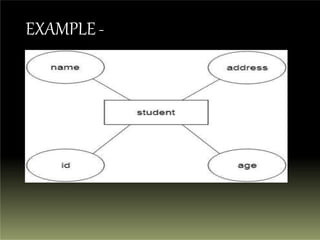
EXAMPLE-
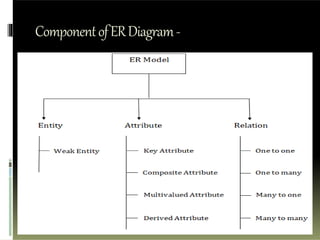
ComponentofERDiagram-
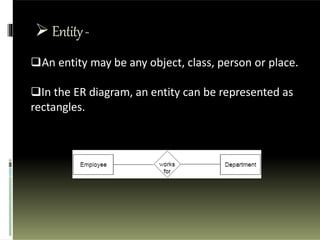
 Entity-
An entity may be any object, class, person or place.
In the ER diagram, an entity can be represented as
rectangles.
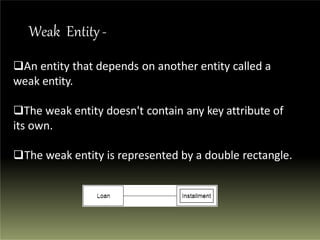
Weak Entity-
An entity that depends on another entity called a
weak entity.
The weak entity doesn't contain any key attribute of
its own.
The weak entity is represented by a double rectangle.
 Attribute-
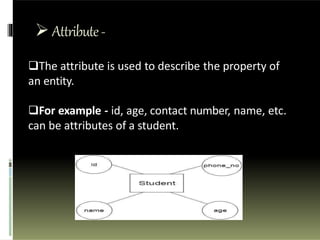
The attribute is used to describe the property of
an entity.
For example - id, age, contact number, name, etc.
can be attributes of a student.
KeyAttribute-
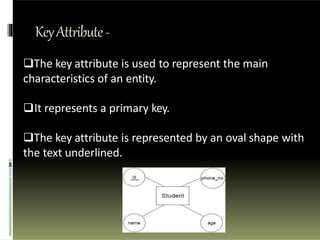
The key attribute is used to represent the main
characteristics of an entity.
It represents a primary key.
The key attribute is represented by an oval shape with
the text underlined.
CompositeAttribute-
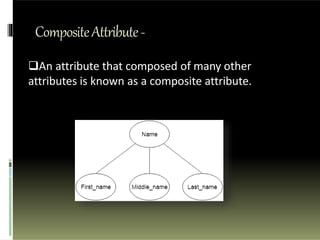
An attribute that composed of many other
attributes is known as a composite attribute.
Multivalued Attribute-
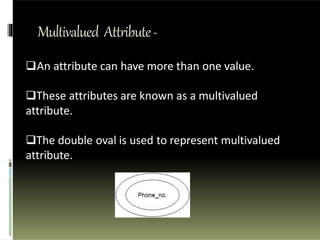
An attribute can have more than one value.
These attributes are known as a multivalued
attribute.
The double oval is used to represent multivalued
attribute.
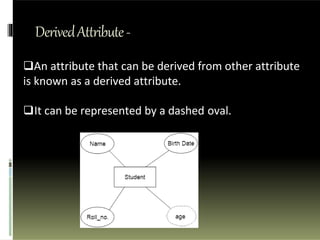
DerivedAttribute-
An attribute that can be derived from other attribute
is known as a derived attribute.
It can be represented by a dashed oval.
Relationship-
A relationship is used to describe the relation
between entities.
Diamond shape is used to represent the
relationship.
There are two types one is strong relation and
second is weak relation.
Strong relationship represented by a single diamond
where weak relationship represented by double
diamond
Typesofrelationship-
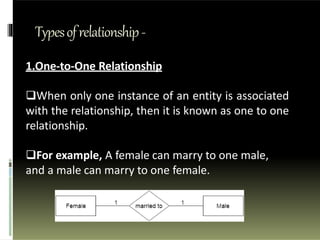
1.One-to-One Relationship
When only one instance of an entity is associated
with the relationship, then it is known as one to one
relationship.
For example, A female can marry to one male,
and a male can marry to one female.
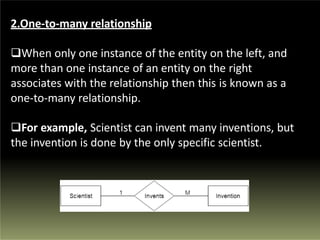
2.One-to-many relationship
When only one instance of the entity on the left, and
more than one instance of an entity on the right
associates with the relationship then this is known as a
one-to-many relationship.
For example, Scientist can invent many inventions, but
the invention is done by the only specific scientist.
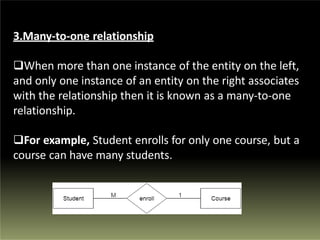
3.Many-to-one relationship
When more than one instance of the entity on the left,
and only one instance of an entity on the right associates
with the relationship then it is known as a many-to-one
relationship.
For example, Student enrolls for only one course, but a
course can have many students.
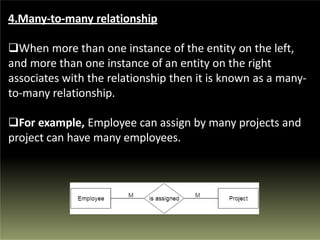
4.Many-to-many relationship
When more than one instance of the entity on the left,
and more than one instance of an entity on the right
associates with the relationship then it is known as a many-
to-many relationship.
For example, Employee can assign by many projects and
project can have many employees.
ermodelppt-181229121745.pptx

ermodelppt-181229121745.pptx

  • 1.
  • 2.
    CONTENT DBMS About – ERmodel Example Components: Entity Attribute Relationship
  • 3.
    DBMS- A database managementsystem (DBMS) is system software for creating and managing databases. The DBMS provides users and programmers with a systematic way to create, retrieve, update and manage data
  • 4.
    About–ER.MODEL Entity relationship modelalso called e-r model and it is a high level model. This model is used to define the data elements and relationship for a specified system. It develops a conceptual design for the database. It also develops a very simple and easy to design view of data. In ER modeling, the database structure is portrayed as a diagram called an entity-relationship diagram.
  • 5.
  • 6.
  • 7.
     Entity- An entitymay be any object, class, person or place. In the ER diagram, an entity can be represented as rectangles.
  • 8.
    Weak Entity- An entitythat depends on another entity called a weak entity. The weak entity doesn't contain any key attribute of its own. The weak entity is represented by a double rectangle.
  • 9.
     Attribute- The attributeis used to describe the property of an entity. For example - id, age, contact number, name, etc. can be attributes of a student.
  • 10.
    KeyAttribute- The key attributeis used to represent the main characteristics of an entity. It represents a primary key. The key attribute is represented by an oval shape with the text underlined.
  • 11.
    CompositeAttribute- An attribute thatcomposed of many other attributes is known as a composite attribute.
  • 12.
    Multivalued Attribute- An attributecan have more than one value. These attributes are known as a multivalued attribute. The double oval is used to represent multivalued attribute.
  • 13.
    DerivedAttribute- An attribute thatcan be derived from other attribute is known as a derived attribute. It can be represented by a dashed oval.
  • 14.
    Relationship- A relationship isused to describe the relation between entities. Diamond shape is used to represent the relationship. There are two types one is strong relation and second is weak relation. Strong relationship represented by a single diamond where weak relationship represented by double diamond
  • 15.
    Typesofrelationship- 1.One-to-One Relationship When onlyone instance of an entity is associated with the relationship, then it is known as one to one relationship. For example, A female can marry to one male, and a male can marry to one female.
  • 16.
    2.One-to-many relationship When onlyone instance of the entity on the left, and more than one instance of an entity on the right associates with the relationship then this is known as a one-to-many relationship. For example, Scientist can invent many inventions, but the invention is done by the only specific scientist.
  • 17.
    3.Many-to-one relationship When morethan one instance of the entity on the left, and only one instance of an entity on the right associates with the relationship then it is known as a many-to-one relationship. For example, Student enrolls for only one course, but a course can have many students.
  • 18.
    4.Many-to-many relationship When morethan one instance of the entity on the left, and more than one instance of an entity on the right associates with the relationship then it is known as a many- to-many relationship. For example, Employee can assign by many projects and project can have many employees.