
Highlighted sentences/paragraphs on the following
paper made by Remelyn Gialogo are plagiarized and
was not properly paraphrased. RemelynGialogo who’s
a 28 years old taking up Masteral in Clinical psychology
should know how to paraphrased properly to avoid
plagiarism.1 Let the world see how you cheat (I though
t u only a cheater in the relationship but as well as) in
yourpaper.1 so disappointing.
lOMoAR cPSD|16718200
DE LA SALLE UNIVERSITY – DASMARIÑAS
College of Liberal Arts and Communication
Graduate Studies
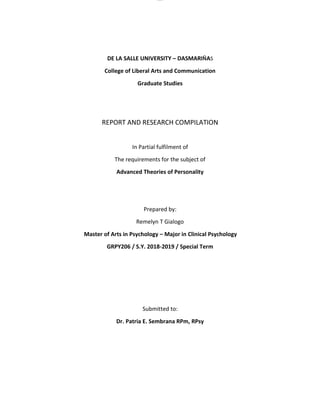
REPORT AND RESEARCH COMPILATION
In Partial fulfilment of
The requirements for the subject of
Advanced Theories of Personality
Prepared by:
Remelyn T Gialogo
Master of Arts in Psychology – Major in Clinical Psychology
GRPY206 / S.Y. 2018-2019 / Special Term
Submitted to:
Dr. Patria E. Sembrana RPm, RPsy
lOMoAR cPSD|16718200
DE LA SALLE UNIVERSITY – DASMARIÑAS
College of Liberal Arts and Communication
Graduate Studies
2
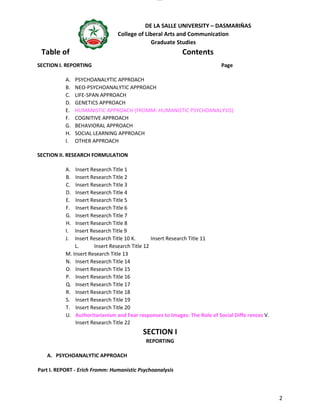
Table of Contents
SECTION I. REPORTING Page
A. PSYCHOANALYTIC APPROACH
B. NEO-PSYCHOANALYTIC APPROACH
C. LIFE-SPAN APPROACH
D. GENETICS APPROACH
E. HUMANISTIC APPROACH (FROMM: HUMANISTIC PSYCHOANALYSIS)
F. COGNITIVE APPROACH
G. BEHAVIORAL APPROACH
H. SOCIAL LEARNING APPROACH
I. OTHER APPROACH
SECTION II. RESEARCH FORMULATION
A. Insert Research Title 1
B. Insert Research Title 2
C. Insert Research Title 3
D. Insert Research Title 4
E. Insert Research Title 5
F. Insert Research Title 6
G. Insert Research Title 7
H. Insert Research Title 8
I. Insert Research Title 9
J. Insert Research Title 10 K. Insert Research Title 11
L. Insert Research Title 12
M. Insert Research Title 13
N. Insert Research Title 14
O. Insert Research Title 15
P. Insert Research Title 16
Q. Insert Research Title 17
R. Insert Research Title 18
S. Insert Research Title 19
T. Insert Research Title 20
U. Authoritarianism and Fear responses to Images: The Role of Social Diffe rences V.
Insert Research Title 22
SECTION I
REPORTING
A. PSYCHOANALYTIC APPROACH
Part I. REPORT - Erich Fromm: Humanistic Psychoanalysis
3
a. Biography
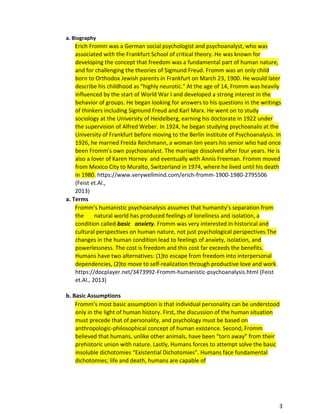
Erich Fromm was a German social psychologist and psychoanalyst, who was
associated with the Frankfurt School of critical theory. He was known for
developing the concept that freedom was a fundamental part of human nature,
and for challenging the theories of Sigmund Freud. Fromm was an only child
born to Orthodox Jewish parents in Frankfurt on March 23, 1900. He would later
describe his childhood as "highly neurotic." At the age of 14, Fromm was heavily
influenced by the start of World War I and developed a strong interest in the
behavior of groups. He began looking for answers to his questions in the writings
of thinkers including Sigmund Freud and Karl Marx. He went on to study
sociology at the University of Heidelberg, earning his doctorate in 1922 under
the supervision of Alfred Weber. In 1924, he began studying psychoanalis at the
University of Frankfurt before moving to the Berlin Institute of Psychoanalysis. In
1926, he married Freida Reichmann, a woman ten years his senior who had once
been Fromm's own psychoanalyst. The marriage dissolved after four years. He is
also a lover of Karen Horney and eventually with Annis Freeman. Fromm moved
from Mexico City to Muralto, Switzerland in 1974, where he lived until his death
in 1980. https://www.verywellmind.com/erich-fromm-1900-1980-2795506
(Feist et.Al.,
2013)
a. Terms
Fromm’s humanistic psychoanalysis assumes that humanity’s separation from
the natural world has produced feelings of loneliness and isolation, a
condition called basic anxiety. Fromm was very interested in historical and
cultural perspectives on human nature, not just psychological perspectives.The
changes in the human condition lead to feelings of anxiety, isolation, and
powerlessness. The cost is freedom and this cost far exceeds the benefits.
Humans have two alternatives: (1)to escape from freedom into interpersonal
dependencies, (2)to move to self-realization through productive love and work.
https://docplayer.net/3473992-Fromm-humanistic-psychoanalysis.html (Feist
et.Al., 2013)
b. Basic Assumptions
Fromm’s most basic assumption is that individual personality can be understood
only in the light of human history. First, the discussion of the human situation
must precede that of personality, and psychology must be based on
anthropologic-philosophical concept of human existence. Second, Fromm
believed that humans, unlike other animals, have been “torn away” from their
prehistoric union with nature. Lastly, Humans forces to attempt solve the basic
insoluble dichotomies “Existential Dichotomies”. Humans face fundamental
dichotomies; life and death, humans are capable of
lOMoAR cPSD|16718200
DE LA SALLE UNIVERSITY – DASMARIÑAS
College of Liberal Arts and Communication
Graduate Studies
4
conceptualizing the goal of complete self-realization but are also
aware that life is too short to reach that goal, and people are ultimately alone,
yet we cannot tolerate isolation.
https://sites.google.com/site/ubmichellebadillo/theories-of-personality/fromm-
humanistic-psychoanalysis-theory
c. Basic Concepts
Human Needs
Only distinctive human needs can move people toward a reunion with the
natural world.These existential needs have emerged during the evolution of
human culture, growing out of their attempts to find an answer to their
existence and to avoid becoming insane.Health individuals are better able to find
ways to reunite with the world productively solving the human needs of
Relatedness Three basic
ways
1.Submission (search for a domineering partner)
2.Power (search for a submissive partner)
3.Love (the only route to become united with the world and help the
person achieve individuality & integrity) The four basic elements of
genuine love
1.Care
4.Responsibility
5.Respect
6.Knowledge
Transcendence is the urge to rise above a passive and accidental existence and
into the “realm of purposefulness and freedom”.
Rootedness is the need to establish roots or to feel at home in the world again.
Without Rootedness, the feelings of isolation and helplessness can become
unbearable. Can be productive or unproductive as in separation from the
mother or not fixation.
A sense of identity is the capacity to be aware of ourselves as a separate entity.
Historically humans identified
more closely with their clan and did not see themselves as existing apart from the
group. Now a days, people identify at-
tachments with institutions.
A frame of orientation is being split off from nature, humans
5
need a road map to make their way through the world.
We need to put things into a framework. A road map without a goal or destination
is worthless.
The burden of freedom
The results from humans being torn from nature yet remaining in the world with
the same physical limitations as other animals. As children become more
independent from their mothers they gain more freedom to express their
individuality. However, at the same time they experience the burden of
freedom, that is, the loss of security from being with mother. This causes basic
anxiety.
Mechanisms of escape
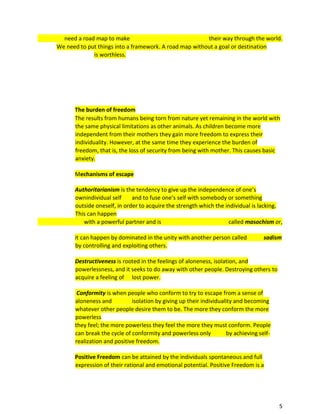
Authoritarianism is the tendency to give up the independence of one’s
ownindividual self and to fuse one’s self with somebody or something
outside oneself, in order to acquire the strength which the individual is lacking.
This can happen
with a powerful partner and is called masochism or,
it can happen by dominated in the unity with another person called sadism
by controlling and exploiting others.
Destructiveness is rooted in the feelings of aloneness, isolation, and
powerlessness, and it seeks to do away with other people. Destroying others to
acquire a feeling of lost power.
Conformity is when people who conform to try to escape from a sense of
aloneness and isolation by giving up their individuality and becoming
whatever other people desire them to be. The more they conform the more
powerless
they feel; the more powerless they feel the more they must conform. People
can break the cycle of conformity and powerless only by achieving self-
realization and positive freedom.
Positive Freedom can be attained by the individuals spontaneous and full
expression of their rational and emotional potential. Positive Freedom is a
lOMoAR cPSD|16718200
DE LA SALLE UNIVERSITY – DASMARIÑAS
College of Liberal Arts and Communication
Graduate Studies
6
successful solution to the human dilemma of being part of the
natural world and maintaining individuality.Love and work are the twin
components of positive freedom.
Character orientations
The person’s relatively permanent way of relating to people and things
“The totality of inherited and acquired psychic qualities which are characteristic
of one individual and which make the individual unique.” People relate to the
world in two ways; acquiring and using things (assimilation), relating to self and
others (socialization). These thing happen productively or nonproductively.
Nonproductive Orientations
People can acquire things through any one of four nonproductive
orientations: (1) receiving things passively, (2) exploiting, or taking things
through force, (3) hoarding
objects, and (4) marketing or exchanging things. Fromm used the term
“nonproductive” to suggest strategies that fail to move people closer to positive
freedom and self-realization. Nonproductive orientations are, however, not
entirely negative; each has both a negative and a positive aspect. Personality is
always a blend or combination of several orientations, even though one
orientation is dominant.
Receptive
Receptive characters feel that the source of all good lies outside themselves and
that the only way they can relate to the world is to receive things, including love,
knowledge, and material possessions. They are more concerned with receiving
than with giving, and they want others to shower them with love, ideas, and
gifts.The negative qualities of receptive people include passivity, submissiveness,
and lack of self-confidence. Their positive traits are loyalty, acceptance, and
trust.
Exploitative
Exploitative characters believe that the source of all good is outside themselves.
Unlike receptive people, however, they aggressively take what they desire rather
than passively receive it. In their social relationships, they are likely to use
7
cunning or force to take someone else’s spouse, ideas, or property. On the
negative side, exploitative characters are egocentric, conceited, arrogant, and
seducing. On the positive side, they are impulsive, proud, charming, and self-
confident.
Hoarding
Hoarding characters seek to save that which they have already obtained. They
hold everything inside and do not let go of anything. Negative traits of the
hoarding personality include rigidity, sterility, obstinacy, compulsivity, and lack
of creativity; positive characteristics are orderliness, cleanliness, and punctuality.
Marketing
Marketing character is an outgrowth of modern commerce in which trade is no
longer personal but carried out by large, faceless corporations. Consistent with
the demands of modern commerce, marketing characters see themselves as
commodities, with their personal value dependent on their exchange value, that
is, their ability to sell themselves. Negative traits of marketing characters are
aimless, opportunistic, inconsistent, and wasteful. Some of their positive
qualities include changeability, open-mindedness, adaptability, and generosity.
The Productive Orientation
The single productive orientation has three dimensions working, loving, and
reasoning.
Because productive people work toward positive freedom and a continuing
realization of their potential, they are the most healthy of all character types.
Healthy people value work not as an end in itself, but as a means of creative self-
expression. Productive love is characterized by the four qualities of love
discussed earlier care, responsibility, respect, and knowledge. In addition to
these four characteristics, healthy people possess biophilia: that is, a passionate
love of life and all that is alive. Biophilic people desire to further all life—the life
of people, animals, plants, ideas, and cultures.
Personality Disorders
Fromm (1981) held that psychologically disturbed people are incapable of love
and have failed to establish union with others. He discussed three severe
personality disorders— necrophilia, malignant narcissism, and incestuous
symbiosis.
lOMoAR cPSD|16718200
DE LA SALLE UNIVERSITY – DASMARIÑAS
College of Liberal Arts and Communication
Graduate Studies
8
Necrophilia
The term “necrophilia” means love of death and usually refers to a sexual
perversion in which a person desires sexual contact with a corpse. However,
Fromm (1964, 1973) used necrophilia in a more generalized sense to denote any
attraction to death. Necrophilia is an alternative character orientation to
biophilia. People naturally love life, but when social conditions stunt biophilia,
they may adopt a necrophilic orientation. Necrophilous people do not simply
behave in a destructive manner; rather, their destructive behavior is a reflection
of their basic character.
Malignant Narcissism
Just as all people display some necrophilic behavior, so too do all have some
narcissistic tendencies. Healthy people manifest a benign form of narcissism,
that is, an interest in their own body. However, in its malignant form, narcissism
impedes the perception of reality so that everything belonging to a narcissistic
person is highly valued and everything belonging to another is devalued.
Narcissistic individuals are preoccupied with themselves, but this concern is not
limited to admiring themselves in a mirror. Preoccupation with one’s body often
leads to hypochondriasis, or an obsessive attention to one’s health. Fromm
(1964) also discussed moral hypochondriasis, or a preoccupation with guilt
about previous transgressions. People who are fixated on themselves are likely
to internalize experiences and to dwell on both physical health and moral
virtues.Incestuous
Symbiosis
A third pathological orientation is incestuous symbiosis, or an extreme
dependence on the mother or mother surrogate. Incestuous symbiosis is an
exaggerated form of the more
common and more benign mother fixation. Men with a mother fixation need a
woman to care for them, dote on them, and admire them; they feel somewhat
anxious and depressed when their needs are not fulfilled. This condition is
relatively normal and does not greatly interfere with their daily life.With
incestuous symbiosis, however, people are inseparable from the host person;
their personalities are blended with the other person and their individual
identities are lost. Incestuous symbiosis originates in infancy as a natural
attachment to the mothering one.
9
Psychotherapy
He then evolved his own system of therapy, which he called humanistic
psychoanalysis. Compared with Freud, Fromm was much more concerned with
the interpersonal aspects of a therapeutic encounter. He believed that the aim
of therapy is for patients to come to know themselves. Without knowledge of
ourselves, we cannot know any other person or thing. Fromm believed that
patients come to therapy seeking satisfaction of their basic human needs—
relatedness, transcendence, rootedness, a sense of identity, and a frame of
orientation. Therefore, therapy should be built on a personal relationship
between therapist and patient. Because accurate communication is essential to
therapeutic growth, the therapist must relate “as one human being to another
with utter concentration and utter sincerity”
https://sites.google.com/site/ubmichellebadillo/theories-of-personality/fromm-
humanistic-psychoanalysis-theory
Reference:
Feist, J., Feist, G. J., & Roberts, T. (2013). Theories of Personality. Mc Graw Hill, 8th Ed.,
119-216. Even if this reference is correct/valid, why did your work can be seen on the
provided link word by word? Too lazy to make a paper, rem?
lOMoAR cPSD|16718200
DE LA SALLE UNIVERSITY – DASMARIÑAS
College of Liberal Arts and Communication
Graduate Studies
10
SECTION I
REPORTING
Part II. RELATED RESEARCH
Title: Cultural Estrangement: The Role of Personal and Societal Value Discrepancies
Article (PDF Available) in Personality and Social Psychology Bulletin 32(1):
78-92 · February 2006
DOI: 10.1177/0146167205279908
Author: Bernard MM, Gebauer JE, Maio GR.
Abstract: Study 1 examined whether cultural estrangement arises from discrepancies
between personal and societal values (e.g., freedom) rather than from
discrepancies in attitudes toward po-
litical (e.g., censorship) or mundane (e.g., pizza) objects. The relations between
different types of value discrepancies, estrangement, subjective well-being, and
need for uniqueness also were examined. Results indicated that personal-
societal discrepancies in values and political attitudes predicted estrangement,
whereas mundane attitude discrepancies were not related to estrangement. As
expected, value discrepancies were the most powerful predictor of
estrangement. Value discrepancies were not related to subjective well-being but
fulfilled a need for uniqueness. Study 2 replicated the relations between value
discrepancies, subjective well-being, and need for uniqueness while showing
that a self-report measure of participants' values and a peer-report measure of
the participants' values yielded the same pattern of value discrepancies.
Together, the studies reveal theoretical and empirical benefits of conceptualizing
cultural estrangement in terms of value discrepancies.
https://pubmed.ncbi.nlm.nih.gov/16317190/
Theoretical Framework: Erich Fromm Theory Humanistic Psychoanalysis
11
Title: A grounded theory analysis of sexual sadism in females
Accepted 10 Jun 2011, Published online: 18 Jul 2011
https://doi.org/10.1080/13552600.2011.597058
Author: Dawn Pflugradt & Bradley Allen
Abstract: Although there has been a great deal of research conducted on sex
offenders, a majority of studies have focused on male perpetrators. The general
consensus is that very little is known about female sexual perpetrators due
primarily to the
small number of identified offenders and sociocultural factors. These issues are
even more prominent for subtypes of female perpetrators such as those whose
offences involve sexual sadism. The following paper examined five incarcerated
female offenders, diagnosed with sexual sadism. Grounded theory analysis was
used to identify psychological characteristics and behavioural patterns related
to the sadistic behaviours that are not currently included in diagnostic criteria.
https://www.tandfonline.com/doi/abs/10.1080/13552600.2011.597058?needA
ccess=true word by word still? Don’t you know how to paraphrase? Did you not
go to college? Or maybe you did not do any research papers or even thesis while
in college? Ganda lang puhunan ?
Theoretical Framework: Erich Fromm Theory Humanistic Psychoanalysis
lOMoAR cPSD|16718200
DE LA SALLE UNIVERSITY – DASMARIÑAS
College of Liberal Arts and Communication
Graduate Studies
12
SECTION II
RESEARCH FORMULATION
A. Authoritarianism and Fear responses to Images: The Role of Social Differences
Authoritarianism can be defined as the covariation of authoritarian submission,
authoritarian aggression, and conventionalism (Altemeyer, 1981). All three of these tendencies
involve adherence to specific standards of behavior: standards that could be exposed to threat
and disruption. This study is an investigation of the self-reported fear of authoritarians in
response to threats. The participants is compose of 30 male and female IBM employees will be
exposed to a series of Images of potentially threatening people and situations. In general,
participants with high scores on authoritarianism were more fearful than participants with low
scores. https://pubmed.ncbi.nlm.nih.gov/23390969/
I. Research Objectives
Foundational to Fromm’s theory Is that freedom is, ironically, frightening. Individual
seek to escape freedom through mechanisms like authoritarianism, destruction, or
conformity to ease the fear of isolation. The present research aim to answer two
interrelated questions (1) if there is significant relationship between authoritarianism and
fear, (2) to identify the relationship between fear and authoritarianism. Good to know you
didn’t copy your objectives lol
II. Research Design
Quasi-experimental design will be utilised in this study. Quasi-experimental design is
most likely to be conducted in field settings in which random assignment is difficult or
impossible. https://opentextbc.ca/researchmethods/chapter/quasi-experimental-
research/
III. Research Participants
The participants is compose of 30 male and female IBM employees. The participants
must be 1 year and beyond employed in the IBM and must be in leading position.
13
IV. Research Instruments
Right-Wing Authoritarinism Scale was developed by Bob Altemeyer in 1981 as a revision
of the F-scale that improved its statistical properties. The right-wing authoritarianism scale
measures the degree to which people defer to established authorities, show aggression toward
outgroups when authorities sanction that aggression, and support traditional values endorsed
by authorities (Saunders and Ngo, 2017). Brief Fear Negative Evaluation Scale (BFNE-II)is a 12-
item revised version of the Brief Fear of Negative Evaluation scale (BFNE; Leary, 1983) used for
measuring fears of negative evaluation. Items are rated on a 5-point Likert scale ranging from 0
(not at all characteristic of me) to 4 (extremely characteristic of me). Last,Threatening people
and situation Images. https://www.researchgate.net/publication/318260321_The_Right-
Wing_Authoritarianism_Scale
V. Research Findings
In general, participants with high scores on authoritarianism were more fearful
than participants with low scores. This result was found for both social
threats and personal threats. The strongest association between authoritarianism and fear
involved cases of social differences, defined as elements of a person's appearance or behavior
that involve diversity or deviance from common social norms. Regression analyses also
indicated that variation in authoritarianism could be best predicted by fear of social differences.
Thus, these data suggest that authoritarians are relatively sensitive to threat, and particularly to
threats involving the "outsider" who does not fit authoritarian standards of uniformity and
order. The data are also consistent with recent research and theory that right-wing ideology is
at least partly motivated by threat and fear. https://pubmed.ncbi.nlm.nih.gov/23390969/
Prepared By: REMELYN GIALOGO
Lol for prepared. More like COPIED FROM THE INTERNET WORD BY WORD BY:
REMELYN GIALOGO 😂

gialogo-humanistic-psychoanalysis-fromm.pdf

  • 1.
    Highlighted sentences/paragraphs onthe following paper made by Remelyn Gialogo are plagiarized and was not properly paraphrased. RemelynGialogo who’s a 28 years old taking up Masteral in Clinical psychology should know how to paraphrased properly to avoid plagiarism.1 Let the world see how you cheat (I though t u only a cheater in the relationship but as well as) in yourpaper.1 so disappointing.
  • 3.
    lOMoAR cPSD|16718200 DE LASALLE UNIVERSITY – DASMARIÑAS College of Liberal Arts and Communication Graduate Studies REPORT AND RESEARCH COMPILATION In Partial fulfilment of The requirements for the subject of Advanced Theories of Personality Prepared by: Remelyn T Gialogo Master of Arts in Psychology – Major in Clinical Psychology GRPY206 / S.Y. 2018-2019 / Special Term Submitted to: Dr. Patria E. Sembrana RPm, RPsy
  • 4.
    lOMoAR cPSD|16718200 DE LASALLE UNIVERSITY – DASMARIÑAS College of Liberal Arts and Communication Graduate Studies 2 Table of Contents SECTION I. REPORTING Page A. PSYCHOANALYTIC APPROACH B. NEO-PSYCHOANALYTIC APPROACH C. LIFE-SPAN APPROACH D. GENETICS APPROACH E. HUMANISTIC APPROACH (FROMM: HUMANISTIC PSYCHOANALYSIS) F. COGNITIVE APPROACH G. BEHAVIORAL APPROACH H. SOCIAL LEARNING APPROACH I. OTHER APPROACH SECTION II. RESEARCH FORMULATION A. Insert Research Title 1 B. Insert Research Title 2 C. Insert Research Title 3 D. Insert Research Title 4 E. Insert Research Title 5 F. Insert Research Title 6 G. Insert Research Title 7 H. Insert Research Title 8 I. Insert Research Title 9 J. Insert Research Title 10 K. Insert Research Title 11 L. Insert Research Title 12 M. Insert Research Title 13 N. Insert Research Title 14 O. Insert Research Title 15 P. Insert Research Title 16 Q. Insert Research Title 17 R. Insert Research Title 18 S. Insert Research Title 19 T. Insert Research Title 20 U. Authoritarianism and Fear responses to Images: The Role of Social Diffe rences V. Insert Research Title 22 SECTION I REPORTING A. PSYCHOANALYTIC APPROACH Part I. REPORT - Erich Fromm: Humanistic Psychoanalysis
  • 5.
    3 a. Biography Erich Frommwas a German social psychologist and psychoanalyst, who was associated with the Frankfurt School of critical theory. He was known for developing the concept that freedom was a fundamental part of human nature, and for challenging the theories of Sigmund Freud. Fromm was an only child born to Orthodox Jewish parents in Frankfurt on March 23, 1900. He would later describe his childhood as "highly neurotic." At the age of 14, Fromm was heavily influenced by the start of World War I and developed a strong interest in the behavior of groups. He began looking for answers to his questions in the writings of thinkers including Sigmund Freud and Karl Marx. He went on to study sociology at the University of Heidelberg, earning his doctorate in 1922 under the supervision of Alfred Weber. In 1924, he began studying psychoanalis at the University of Frankfurt before moving to the Berlin Institute of Psychoanalysis. In 1926, he married Freida Reichmann, a woman ten years his senior who had once been Fromm's own psychoanalyst. The marriage dissolved after four years. He is also a lover of Karen Horney and eventually with Annis Freeman. Fromm moved from Mexico City to Muralto, Switzerland in 1974, where he lived until his death in 1980. https://www.verywellmind.com/erich-fromm-1900-1980-2795506 (Feist et.Al., 2013) a. Terms Fromm’s humanistic psychoanalysis assumes that humanity’s separation from the natural world has produced feelings of loneliness and isolation, a condition called basic anxiety. Fromm was very interested in historical and cultural perspectives on human nature, not just psychological perspectives.The changes in the human condition lead to feelings of anxiety, isolation, and powerlessness. The cost is freedom and this cost far exceeds the benefits. Humans have two alternatives: (1)to escape from freedom into interpersonal dependencies, (2)to move to self-realization through productive love and work. https://docplayer.net/3473992-Fromm-humanistic-psychoanalysis.html (Feist et.Al., 2013) b. Basic Assumptions Fromm’s most basic assumption is that individual personality can be understood only in the light of human history. First, the discussion of the human situation must precede that of personality, and psychology must be based on anthropologic-philosophical concept of human existence. Second, Fromm believed that humans, unlike other animals, have been “torn away” from their prehistoric union with nature. Lastly, Humans forces to attempt solve the basic insoluble dichotomies “Existential Dichotomies”. Humans face fundamental dichotomies; life and death, humans are capable of
  • 6.
    lOMoAR cPSD|16718200 DE LASALLE UNIVERSITY – DASMARIÑAS College of Liberal Arts and Communication Graduate Studies 4 conceptualizing the goal of complete self-realization but are also aware that life is too short to reach that goal, and people are ultimately alone, yet we cannot tolerate isolation. https://sites.google.com/site/ubmichellebadillo/theories-of-personality/fromm- humanistic-psychoanalysis-theory c. Basic Concepts Human Needs Only distinctive human needs can move people toward a reunion with the natural world.These existential needs have emerged during the evolution of human culture, growing out of their attempts to find an answer to their existence and to avoid becoming insane.Health individuals are better able to find ways to reunite with the world productively solving the human needs of Relatedness Three basic ways 1.Submission (search for a domineering partner) 2.Power (search for a submissive partner) 3.Love (the only route to become united with the world and help the person achieve individuality & integrity) The four basic elements of genuine love 1.Care 4.Responsibility 5.Respect 6.Knowledge Transcendence is the urge to rise above a passive and accidental existence and into the “realm of purposefulness and freedom”. Rootedness is the need to establish roots or to feel at home in the world again. Without Rootedness, the feelings of isolation and helplessness can become unbearable. Can be productive or unproductive as in separation from the mother or not fixation. A sense of identity is the capacity to be aware of ourselves as a separate entity. Historically humans identified more closely with their clan and did not see themselves as existing apart from the group. Now a days, people identify at- tachments with institutions. A frame of orientation is being split off from nature, humans
  • 7.
    5 need a roadmap to make their way through the world. We need to put things into a framework. A road map without a goal or destination is worthless. The burden of freedom The results from humans being torn from nature yet remaining in the world with the same physical limitations as other animals. As children become more independent from their mothers they gain more freedom to express their individuality. However, at the same time they experience the burden of freedom, that is, the loss of security from being with mother. This causes basic anxiety. Mechanisms of escape Authoritarianism is the tendency to give up the independence of one’s ownindividual self and to fuse one’s self with somebody or something outside oneself, in order to acquire the strength which the individual is lacking. This can happen with a powerful partner and is called masochism or, it can happen by dominated in the unity with another person called sadism by controlling and exploiting others. Destructiveness is rooted in the feelings of aloneness, isolation, and powerlessness, and it seeks to do away with other people. Destroying others to acquire a feeling of lost power. Conformity is when people who conform to try to escape from a sense of aloneness and isolation by giving up their individuality and becoming whatever other people desire them to be. The more they conform the more powerless they feel; the more powerless they feel the more they must conform. People can break the cycle of conformity and powerless only by achieving self- realization and positive freedom. Positive Freedom can be attained by the individuals spontaneous and full expression of their rational and emotional potential. Positive Freedom is a
  • 8.
    lOMoAR cPSD|16718200 DE LASALLE UNIVERSITY – DASMARIÑAS College of Liberal Arts and Communication Graduate Studies 6 successful solution to the human dilemma of being part of the natural world and maintaining individuality.Love and work are the twin components of positive freedom. Character orientations The person’s relatively permanent way of relating to people and things “The totality of inherited and acquired psychic qualities which are characteristic of one individual and which make the individual unique.” People relate to the world in two ways; acquiring and using things (assimilation), relating to self and others (socialization). These thing happen productively or nonproductively. Nonproductive Orientations People can acquire things through any one of four nonproductive orientations: (1) receiving things passively, (2) exploiting, or taking things through force, (3) hoarding objects, and (4) marketing or exchanging things. Fromm used the term “nonproductive” to suggest strategies that fail to move people closer to positive freedom and self-realization. Nonproductive orientations are, however, not entirely negative; each has both a negative and a positive aspect. Personality is always a blend or combination of several orientations, even though one orientation is dominant. Receptive Receptive characters feel that the source of all good lies outside themselves and that the only way they can relate to the world is to receive things, including love, knowledge, and material possessions. They are more concerned with receiving than with giving, and they want others to shower them with love, ideas, and gifts.The negative qualities of receptive people include passivity, submissiveness, and lack of self-confidence. Their positive traits are loyalty, acceptance, and trust. Exploitative Exploitative characters believe that the source of all good is outside themselves. Unlike receptive people, however, they aggressively take what they desire rather than passively receive it. In their social relationships, they are likely to use
  • 9.
    7 cunning or forceto take someone else’s spouse, ideas, or property. On the negative side, exploitative characters are egocentric, conceited, arrogant, and seducing. On the positive side, they are impulsive, proud, charming, and self- confident. Hoarding Hoarding characters seek to save that which they have already obtained. They hold everything inside and do not let go of anything. Negative traits of the hoarding personality include rigidity, sterility, obstinacy, compulsivity, and lack of creativity; positive characteristics are orderliness, cleanliness, and punctuality. Marketing Marketing character is an outgrowth of modern commerce in which trade is no longer personal but carried out by large, faceless corporations. Consistent with the demands of modern commerce, marketing characters see themselves as commodities, with their personal value dependent on their exchange value, that is, their ability to sell themselves. Negative traits of marketing characters are aimless, opportunistic, inconsistent, and wasteful. Some of their positive qualities include changeability, open-mindedness, adaptability, and generosity. The Productive Orientation The single productive orientation has three dimensions working, loving, and reasoning. Because productive people work toward positive freedom and a continuing realization of their potential, they are the most healthy of all character types. Healthy people value work not as an end in itself, but as a means of creative self- expression. Productive love is characterized by the four qualities of love discussed earlier care, responsibility, respect, and knowledge. In addition to these four characteristics, healthy people possess biophilia: that is, a passionate love of life and all that is alive. Biophilic people desire to further all life—the life of people, animals, plants, ideas, and cultures. Personality Disorders Fromm (1981) held that psychologically disturbed people are incapable of love and have failed to establish union with others. He discussed three severe personality disorders— necrophilia, malignant narcissism, and incestuous symbiosis.
  • 10.
    lOMoAR cPSD|16718200 DE LASALLE UNIVERSITY – DASMARIÑAS College of Liberal Arts and Communication Graduate Studies 8 Necrophilia The term “necrophilia” means love of death and usually refers to a sexual perversion in which a person desires sexual contact with a corpse. However, Fromm (1964, 1973) used necrophilia in a more generalized sense to denote any attraction to death. Necrophilia is an alternative character orientation to biophilia. People naturally love life, but when social conditions stunt biophilia, they may adopt a necrophilic orientation. Necrophilous people do not simply behave in a destructive manner; rather, their destructive behavior is a reflection of their basic character. Malignant Narcissism Just as all people display some necrophilic behavior, so too do all have some narcissistic tendencies. Healthy people manifest a benign form of narcissism, that is, an interest in their own body. However, in its malignant form, narcissism impedes the perception of reality so that everything belonging to a narcissistic person is highly valued and everything belonging to another is devalued. Narcissistic individuals are preoccupied with themselves, but this concern is not limited to admiring themselves in a mirror. Preoccupation with one’s body often leads to hypochondriasis, or an obsessive attention to one’s health. Fromm (1964) also discussed moral hypochondriasis, or a preoccupation with guilt about previous transgressions. People who are fixated on themselves are likely to internalize experiences and to dwell on both physical health and moral virtues.Incestuous Symbiosis A third pathological orientation is incestuous symbiosis, or an extreme dependence on the mother or mother surrogate. Incestuous symbiosis is an exaggerated form of the more common and more benign mother fixation. Men with a mother fixation need a woman to care for them, dote on them, and admire them; they feel somewhat anxious and depressed when their needs are not fulfilled. This condition is relatively normal and does not greatly interfere with their daily life.With incestuous symbiosis, however, people are inseparable from the host person; their personalities are blended with the other person and their individual identities are lost. Incestuous symbiosis originates in infancy as a natural attachment to the mothering one.
  • 11.
    9 Psychotherapy He then evolvedhis own system of therapy, which he called humanistic psychoanalysis. Compared with Freud, Fromm was much more concerned with the interpersonal aspects of a therapeutic encounter. He believed that the aim of therapy is for patients to come to know themselves. Without knowledge of ourselves, we cannot know any other person or thing. Fromm believed that patients come to therapy seeking satisfaction of their basic human needs— relatedness, transcendence, rootedness, a sense of identity, and a frame of orientation. Therefore, therapy should be built on a personal relationship between therapist and patient. Because accurate communication is essential to therapeutic growth, the therapist must relate “as one human being to another with utter concentration and utter sincerity” https://sites.google.com/site/ubmichellebadillo/theories-of-personality/fromm- humanistic-psychoanalysis-theory Reference: Feist, J., Feist, G. J., & Roberts, T. (2013). Theories of Personality. Mc Graw Hill, 8th Ed., 119-216. Even if this reference is correct/valid, why did your work can be seen on the provided link word by word? Too lazy to make a paper, rem?
  • 12.
    lOMoAR cPSD|16718200 DE LASALLE UNIVERSITY – DASMARIÑAS College of Liberal Arts and Communication Graduate Studies 10 SECTION I REPORTING Part II. RELATED RESEARCH Title: Cultural Estrangement: The Role of Personal and Societal Value Discrepancies Article (PDF Available) in Personality and Social Psychology Bulletin 32(1): 78-92 · February 2006 DOI: 10.1177/0146167205279908 Author: Bernard MM, Gebauer JE, Maio GR. Abstract: Study 1 examined whether cultural estrangement arises from discrepancies between personal and societal values (e.g., freedom) rather than from discrepancies in attitudes toward po- litical (e.g., censorship) or mundane (e.g., pizza) objects. The relations between different types of value discrepancies, estrangement, subjective well-being, and need for uniqueness also were examined. Results indicated that personal- societal discrepancies in values and political attitudes predicted estrangement, whereas mundane attitude discrepancies were not related to estrangement. As expected, value discrepancies were the most powerful predictor of estrangement. Value discrepancies were not related to subjective well-being but fulfilled a need for uniqueness. Study 2 replicated the relations between value discrepancies, subjective well-being, and need for uniqueness while showing that a self-report measure of participants' values and a peer-report measure of the participants' values yielded the same pattern of value discrepancies. Together, the studies reveal theoretical and empirical benefits of conceptualizing cultural estrangement in terms of value discrepancies. https://pubmed.ncbi.nlm.nih.gov/16317190/ Theoretical Framework: Erich Fromm Theory Humanistic Psychoanalysis
  • 13.
    11 Title: A groundedtheory analysis of sexual sadism in females Accepted 10 Jun 2011, Published online: 18 Jul 2011 https://doi.org/10.1080/13552600.2011.597058 Author: Dawn Pflugradt & Bradley Allen Abstract: Although there has been a great deal of research conducted on sex offenders, a majority of studies have focused on male perpetrators. The general consensus is that very little is known about female sexual perpetrators due primarily to the small number of identified offenders and sociocultural factors. These issues are even more prominent for subtypes of female perpetrators such as those whose offences involve sexual sadism. The following paper examined five incarcerated female offenders, diagnosed with sexual sadism. Grounded theory analysis was used to identify psychological characteristics and behavioural patterns related to the sadistic behaviours that are not currently included in diagnostic criteria. https://www.tandfonline.com/doi/abs/10.1080/13552600.2011.597058?needA ccess=true word by word still? Don’t you know how to paraphrase? Did you not go to college? Or maybe you did not do any research papers or even thesis while in college? Ganda lang puhunan ? Theoretical Framework: Erich Fromm Theory Humanistic Psychoanalysis
  • 14.
    lOMoAR cPSD|16718200 DE LASALLE UNIVERSITY – DASMARIÑAS College of Liberal Arts and Communication Graduate Studies 12 SECTION II RESEARCH FORMULATION A. Authoritarianism and Fear responses to Images: The Role of Social Differences Authoritarianism can be defined as the covariation of authoritarian submission, authoritarian aggression, and conventionalism (Altemeyer, 1981). All three of these tendencies involve adherence to specific standards of behavior: standards that could be exposed to threat and disruption. This study is an investigation of the self-reported fear of authoritarians in response to threats. The participants is compose of 30 male and female IBM employees will be exposed to a series of Images of potentially threatening people and situations. In general, participants with high scores on authoritarianism were more fearful than participants with low scores. https://pubmed.ncbi.nlm.nih.gov/23390969/ I. Research Objectives Foundational to Fromm’s theory Is that freedom is, ironically, frightening. Individual seek to escape freedom through mechanisms like authoritarianism, destruction, or conformity to ease the fear of isolation. The present research aim to answer two interrelated questions (1) if there is significant relationship between authoritarianism and fear, (2) to identify the relationship between fear and authoritarianism. Good to know you didn’t copy your objectives lol II. Research Design Quasi-experimental design will be utilised in this study. Quasi-experimental design is most likely to be conducted in field settings in which random assignment is difficult or impossible. https://opentextbc.ca/researchmethods/chapter/quasi-experimental- research/ III. Research Participants The participants is compose of 30 male and female IBM employees. The participants must be 1 year and beyond employed in the IBM and must be in leading position.
  • 15.
    13 IV. Research Instruments Right-WingAuthoritarinism Scale was developed by Bob Altemeyer in 1981 as a revision of the F-scale that improved its statistical properties. The right-wing authoritarianism scale measures the degree to which people defer to established authorities, show aggression toward outgroups when authorities sanction that aggression, and support traditional values endorsed by authorities (Saunders and Ngo, 2017). Brief Fear Negative Evaluation Scale (BFNE-II)is a 12- item revised version of the Brief Fear of Negative Evaluation scale (BFNE; Leary, 1983) used for measuring fears of negative evaluation. Items are rated on a 5-point Likert scale ranging from 0 (not at all characteristic of me) to 4 (extremely characteristic of me). Last,Threatening people and situation Images. https://www.researchgate.net/publication/318260321_The_Right- Wing_Authoritarianism_Scale V. Research Findings In general, participants with high scores on authoritarianism were more fearful than participants with low scores. This result was found for both social threats and personal threats. The strongest association between authoritarianism and fear involved cases of social differences, defined as elements of a person's appearance or behavior that involve diversity or deviance from common social norms. Regression analyses also indicated that variation in authoritarianism could be best predicted by fear of social differences. Thus, these data suggest that authoritarians are relatively sensitive to threat, and particularly to threats involving the "outsider" who does not fit authoritarian standards of uniformity and order. The data are also consistent with recent research and theory that right-wing ideology is at least partly motivated by threat and fear. https://pubmed.ncbi.nlm.nih.gov/23390969/ Prepared By: REMELYN GIALOGO Lol for prepared. More like COPIED FROM THE INTERNET WORD BY WORD BY: REMELYN GIALOGO 😂