Unmanned Aircraft Systems - UAS Enabling America’s Next Generation of Aviation Vehicles   30 th  Annual FAA Aviation Forecast Conference Washington, DC March 18, 2005
“ The trouble with the future is that it usually arrives before we’re ready for it.” Arnold H. Glasow
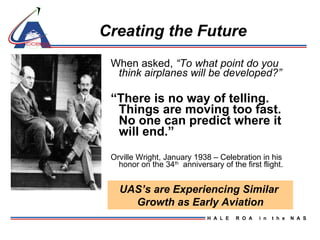
Creating the Future When asked,  “To what point do you think airplanes will be developed?” “ There is no way of telling.  Things are moving too fast.  No one can predict where it will end.” Orville Wright, January 1938 – Celebration in his honor on the 34 th   anniversary of the first flight. UAS’s are Experiencing Similar  Growth as Early Aviation
Two UAS Perspectives Viewed as a Disruptive Technology -or- A Positive Step in the Evolution of Aeronautics Radar Jet propulsion GPS ?Unmanned flight?
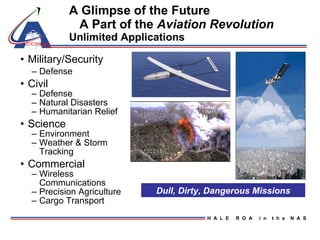
A Glimpse of the Future   A Part of the  Aviation Revolution   Unlimited Applications Military/Security Defense Civil Defense Natural Disasters Humanitarian Relief Science Environment Weather & Storm Tracking Commercial Wireless Communications Precision Agriculture Cargo Transport Dull, Dirty, Dangerous Missions
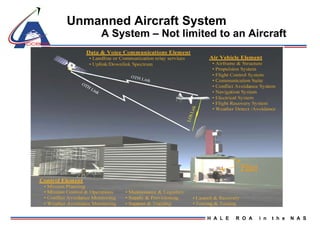
Unmanned Aircraft System A System – Not limited to an Aircraft Pilot
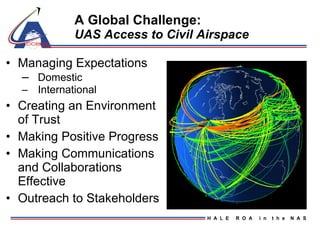
A Global Challenge: UAS Access to Civil Airspace Managing Expectations  Domestic International Creating an Environment of Trust Making Positive Progress Making Communications and Collaborations Effective Outreach to Stakeholders
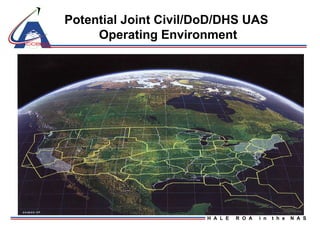
Potential Joint Civil/DoD/DHS UAS  Operating Environment
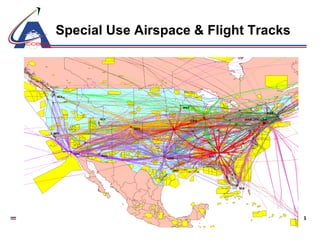
Special Use Airspace & Flight Tracks
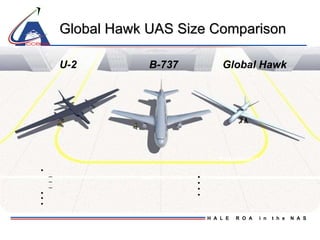
Global Hawk UAS Size Comparison Performance • – – – • • • • • • • B-737 U-2 Global Hawk
UAS Assumptions   UAVs will need access to the NAS comparable to manned aircraft.  DoD and DHS) will be first major UAS operators in the NAS. FAA must be alert to new challenges posed by small UAVs operating in increasing numbers at very low altitudes. FAA should lead discussions with foreign airspace authorities to ensure global airspace harmonization and interoperability. Source UNTF Report 10-22-04
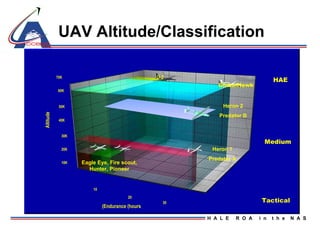
70K 60K Global  Hawk U-2 Heron 1 Predator A 50K 40K 30K 20K 10K Altitude 10 20 30 Endurance (hours) Eagle Eye, Fire scout, Hunter, Pioneer HAE Medium Tactical Heron 2 Predator B UAV Altitude/Classification
Significant Increases in UAV Operations in the National Airspace System are Inevitable Routine access into US civil managed airspace is necessary to fulfill operational and economic potential Significant increase in domestic UAS flight operations are feasible and expected UASs support societal needs, including security, defense and civil applications  Technological advances will produce less expensive UASs Increasing public awareness and acceptance of UASs Source UNTF Report 10-22-04
UAS Operations in the NAS High Altitude UAS’s will have Minimal Impact on Manned Aircraft Operations.  Medium Altitude UAS’s Will Share the Same Airspace as Most Manned Civil Transports and Military Aircraft.  Low Altitude UAS’s Will Share Airspace with Smaller Manned Aircraft, Including Helicopters.  Large Numbers of Very Low Altitude UAS’s  Source UNTF Report 10-22-04
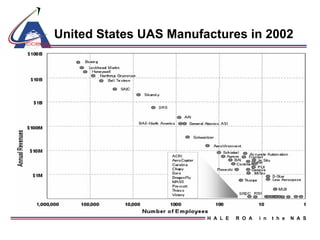
United States UAS Manufactures in 2002
Federal Aviation Act of 1958 Directs FAA as the “single manager” of the National Airspace System (NAS) to develop and operate a  common system of air traffic control and navigation for both civil and military aircraft. Control the use of navigable airspace of the US and  regulate both civil and military operations  in such airspace in the interest of the safety and efficiency of both.
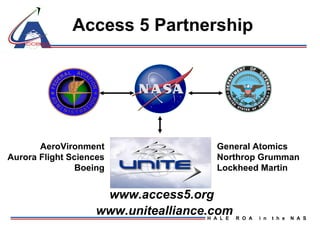
Access 5 Partnership www.unitealliance.com www.access5.org AeroVironment Aurora Flight Sciences Boeing General Atomics Northrop Grumman  Lockheed Martin
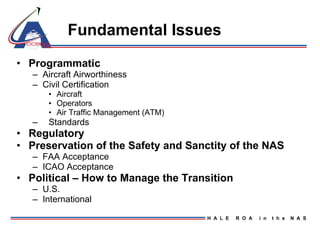
Fundamental Issues Programmatic Aircraft Airworthiness Civil Certification  Aircraft Operators Air Traffic Management (ATM) Standards Regulatory Preservation of the Safety and Sanctity of the NAS  FAA Acceptance ICAO Acceptance Political – How to Manage the Transition U.S. International
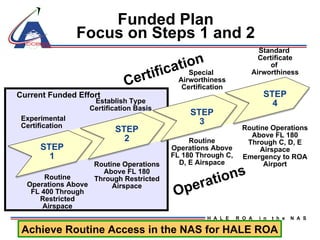
Funded Plan Focus on Steps 1 and 2 Routine Operations Above FL 400 Through Restricted Airspace Routine Operations Above FL 180 Through Restricted Airspace Routine Operations Above FL 180 Through C, D, E Airspace Routine Operations Above FL 180 Through C, D, E Airspace Emergency to ROA Airport Experimental Certification Standard  Certificate of  Airworthiness Establish Type Certification Basis Special  Airworthiness Certification STEP 1 STEP 2 STEP 3 STEP 4 Achieve Routine Access in the NAS for HALE ROA Certification Operations Current Funded Effort
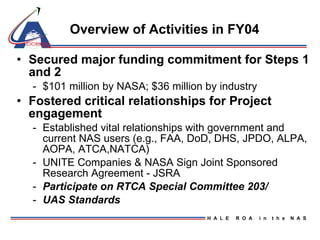
Overview of Activities in FY04 Secured major funding commitment for Steps 1 and 2 $101 million by NASA; $36 million by industry  Fostered critical relationships for Project engagement Established vital relationships with government and current NAS users (e.g., FAA, DoD, DHS, JPDO, ALPA, AOPA, ATCA,NATCA) UNITE Companies & NASA Sign Joint Sponsored Research Agreement - JSRA Participate on RTCA Special Committee 203/ UAS Standards
RTCA Special Committee 203 "RTCA has established Special Committee 203 (SC-203) at the request of the Aircraft Owners and Pilots Association and the Federal Aviation Administration.  The committee will initially focus on developing recommendations that will assure the safe operation of UAVs within the National Airspace System.” Requested by AOPA Supported by the FAA Industry/Government Participation Manufacturers, operators, agencies
RTCA SC 203 Terms of Reference The initial Terms of Reference (TOR) for SC-203 call for three initial products to be generated, as follows: Minimum Aviation System Performance Standards (MASPS) for Unmanned Aircraft Systems (UAS)  Due date -- December 2005. MASPS for Command, Control and Communication (C3) Systems for Unmanned Aircraft Systems  Due date -- June 2006.  MASPS for Sense and Avoid (SA) Systems for Unmanned Aircraft Systems Due date -- December 2007.
RTCA Special Committee 203  Goals and Objectives Support Industry’s  and Government’s desire to operate Unmanned Aircraft (UA) in the National Airspace System (NAS) Ensure Standards are developed that are useable in certifying UA systems, while maintaining safety and efficiency of the NAS. Ensure International continuity.
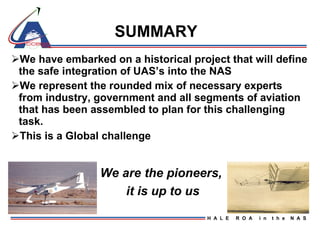
SUMMARY We have embarked on a historical project that will define the safe integration of UAS’s into the NAS We represent the rounded mix of necessary experts from industry, government and all segments of aviation that has been assembled to plan for this challenging task. This is a Global challenge We are the pioneers,  it is up to us

6 john walker

  • 1.
    Unmanned Aircraft Systems- UAS Enabling America’s Next Generation of Aviation Vehicles 30 th Annual FAA Aviation Forecast Conference Washington, DC March 18, 2005
  • 2.
    “ The troublewith the future is that it usually arrives before we’re ready for it.” Arnold H. Glasow
  • 3.
    Creating the FutureWhen asked, “To what point do you think airplanes will be developed?” “ There is no way of telling. Things are moving too fast. No one can predict where it will end.” Orville Wright, January 1938 – Celebration in his honor on the 34 th anniversary of the first flight. UAS’s are Experiencing Similar Growth as Early Aviation
  • 4.
    Two UAS PerspectivesViewed as a Disruptive Technology -or- A Positive Step in the Evolution of Aeronautics Radar Jet propulsion GPS ?Unmanned flight?
  • 5.
    A Glimpse ofthe Future A Part of the Aviation Revolution Unlimited Applications Military/Security Defense Civil Defense Natural Disasters Humanitarian Relief Science Environment Weather & Storm Tracking Commercial Wireless Communications Precision Agriculture Cargo Transport Dull, Dirty, Dangerous Missions
  • 6.
    Unmanned Aircraft SystemA System – Not limited to an Aircraft Pilot
  • 7.
    A Global Challenge:UAS Access to Civil Airspace Managing Expectations Domestic International Creating an Environment of Trust Making Positive Progress Making Communications and Collaborations Effective Outreach to Stakeholders
  • 8.
    Potential Joint Civil/DoD/DHSUAS Operating Environment
  • 9.
    Special Use Airspace& Flight Tracks
  • 10.
    Global Hawk UASSize Comparison Performance • – – – • • • • • • • B-737 U-2 Global Hawk
  • 11.
    UAS Assumptions UAVs will need access to the NAS comparable to manned aircraft. DoD and DHS) will be first major UAS operators in the NAS. FAA must be alert to new challenges posed by small UAVs operating in increasing numbers at very low altitudes. FAA should lead discussions with foreign airspace authorities to ensure global airspace harmonization and interoperability. Source UNTF Report 10-22-04
  • 12.
    70K 60K Global Hawk U-2 Heron 1 Predator A 50K 40K 30K 20K 10K Altitude 10 20 30 Endurance (hours) Eagle Eye, Fire scout, Hunter, Pioneer HAE Medium Tactical Heron 2 Predator B UAV Altitude/Classification
  • 13.
    Significant Increases inUAV Operations in the National Airspace System are Inevitable Routine access into US civil managed airspace is necessary to fulfill operational and economic potential Significant increase in domestic UAS flight operations are feasible and expected UASs support societal needs, including security, defense and civil applications Technological advances will produce less expensive UASs Increasing public awareness and acceptance of UASs Source UNTF Report 10-22-04
  • 14.
    UAS Operations inthe NAS High Altitude UAS’s will have Minimal Impact on Manned Aircraft Operations. Medium Altitude UAS’s Will Share the Same Airspace as Most Manned Civil Transports and Military Aircraft. Low Altitude UAS’s Will Share Airspace with Smaller Manned Aircraft, Including Helicopters. Large Numbers of Very Low Altitude UAS’s Source UNTF Report 10-22-04
  • 15.
    United States UASManufactures in 2002
  • 16.
    Federal Aviation Actof 1958 Directs FAA as the “single manager” of the National Airspace System (NAS) to develop and operate a common system of air traffic control and navigation for both civil and military aircraft. Control the use of navigable airspace of the US and regulate both civil and military operations in such airspace in the interest of the safety and efficiency of both.
  • 17.
    Access 5 Partnershipwww.unitealliance.com www.access5.org AeroVironment Aurora Flight Sciences Boeing General Atomics Northrop Grumman Lockheed Martin
  • 18.
    Fundamental Issues ProgrammaticAircraft Airworthiness Civil Certification Aircraft Operators Air Traffic Management (ATM) Standards Regulatory Preservation of the Safety and Sanctity of the NAS FAA Acceptance ICAO Acceptance Political – How to Manage the Transition U.S. International
  • 19.
    Funded Plan Focuson Steps 1 and 2 Routine Operations Above FL 400 Through Restricted Airspace Routine Operations Above FL 180 Through Restricted Airspace Routine Operations Above FL 180 Through C, D, E Airspace Routine Operations Above FL 180 Through C, D, E Airspace Emergency to ROA Airport Experimental Certification Standard Certificate of Airworthiness Establish Type Certification Basis Special Airworthiness Certification STEP 1 STEP 2 STEP 3 STEP 4 Achieve Routine Access in the NAS for HALE ROA Certification Operations Current Funded Effort
  • 20.
    Overview of Activitiesin FY04 Secured major funding commitment for Steps 1 and 2 $101 million by NASA; $36 million by industry Fostered critical relationships for Project engagement Established vital relationships with government and current NAS users (e.g., FAA, DoD, DHS, JPDO, ALPA, AOPA, ATCA,NATCA) UNITE Companies & NASA Sign Joint Sponsored Research Agreement - JSRA Participate on RTCA Special Committee 203/ UAS Standards
  • 21.
    RTCA Special Committee203 "RTCA has established Special Committee 203 (SC-203) at the request of the Aircraft Owners and Pilots Association and the Federal Aviation Administration. The committee will initially focus on developing recommendations that will assure the safe operation of UAVs within the National Airspace System.” Requested by AOPA Supported by the FAA Industry/Government Participation Manufacturers, operators, agencies
  • 22.
    RTCA SC 203Terms of Reference The initial Terms of Reference (TOR) for SC-203 call for three initial products to be generated, as follows: Minimum Aviation System Performance Standards (MASPS) for Unmanned Aircraft Systems (UAS) Due date -- December 2005. MASPS for Command, Control and Communication (C3) Systems for Unmanned Aircraft Systems Due date -- June 2006. MASPS for Sense and Avoid (SA) Systems for Unmanned Aircraft Systems Due date -- December 2007.
  • 23.
    RTCA Special Committee203 Goals and Objectives Support Industry’s and Government’s desire to operate Unmanned Aircraft (UA) in the National Airspace System (NAS) Ensure Standards are developed that are useable in certifying UA systems, while maintaining safety and efficiency of the NAS. Ensure International continuity.
  • 24.
    SUMMARY We haveembarked on a historical project that will define the safe integration of UAS’s into the NAS We represent the rounded mix of necessary experts from industry, government and all segments of aviation that has been assembled to plan for this challenging task. This is a Global challenge We are the pioneers, it is up to us

Editor's Notes

  • #3 1 (This side sets the “mood” to think about change)
  • #12 Ten significant initial findings were identified by the UNTF and should aid the focus of future investigations. These findings are summarized as follows: The Federal Communications Commission, Department of Commerce (DoC), and other appropriate government agencies must address radio frequency (RF) spectrum issues for all UAVs. To reduce confusion, the Federal Government (preferably the FAA), should standardize terminology for UAVs operating in the NAS. The FAA should evaluate whether or not uncontrolled airspace should be regulated for low altitude UAV operations. The FAA should determine criteria for categorizing UAVs (e.g., small, low altitude aircraft: European standard - 330 pounds and less than 400 feet; U.S. standard - 55 pounds and less than 1000 feet.)
  • #14 UAS industry believes routine access into US civil managed airspace is necessary to fulfill operational and economic potential If access achieved within five years significant increase in domestic UAS flight operations are feasible Growing demand for UASs that support societal needs, including security, defense and civil applications Technological advances that will produce more capable and less expensive UASs Increasing public awareness and acceptance of UASs The Impact of Unmanned Aerial Vehicles on the Next Generation Air Transportation System Preliminary Assessment Prepared by the Unmanned Aerial Vehicle (UAV) National Task Force (UNTF) October 22, 2004
  • #17 There are six UAV manufacturers participating in Access 5: Boeing Northrup Grummen Aurora Flight Sciences General Atomics Aeroenvironment Also have participation by DOD, DHS. FAA participates in an advisory role.