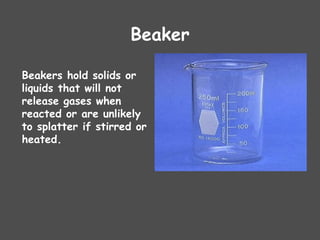
Beaker
Beakers hold solids or
liquids that will not
release gases when
reacted or are unlikely
to splatter if stirred or
heated.
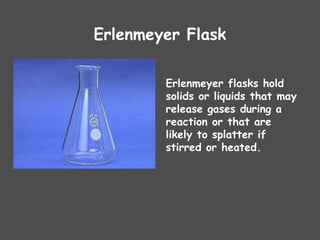
Erlenmeyer Flask
Erlenmeyer flasks hold
solids or liquids that may
release gases during a
reaction or that are
likely to splatter if
stirred or heated.
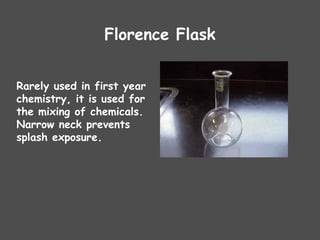
Florence Flask
Rarely used in first year
chemistry, it is used for
the mixing of chemicals.
Narrow neck prevents
splash exposure.
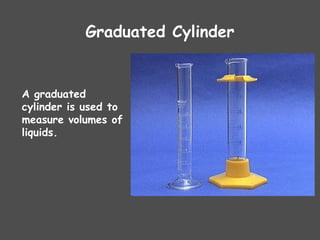
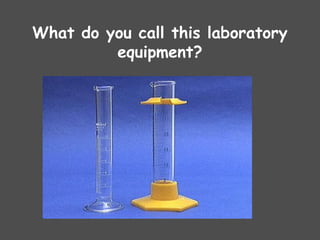
Graduated Cylinder
A graduated
cylinder is used to
measure volumes of
liquids.
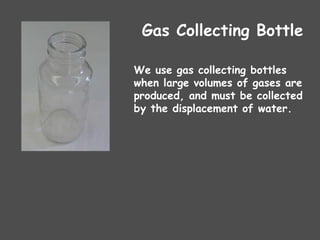
Gas Collecting Bottle
We use gas collecting bottles
when large volumes of gases are
produced, and must be collected
by the displacement of water.
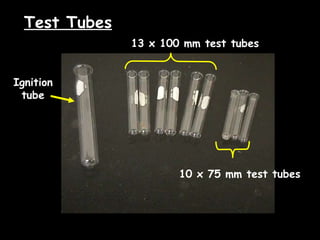
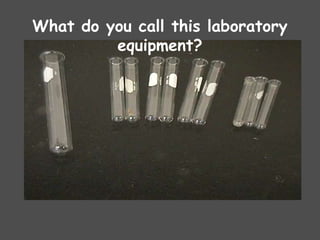
Test Tubes
13 x 100 mm test tubes
10 x 75 mm test tubes
Ignition
tube
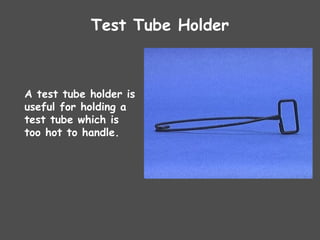
Test Tube Holder
A test tube holder is
useful for holding a
test tube which is
too hot to handle.
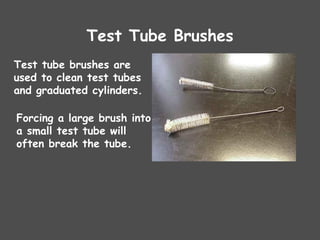
Test Tube Brushes
Test tube brushes are
used to clean test tubes
and graduated cylinders.
Forcing a large brush into
a small test tube will
often break the tube.
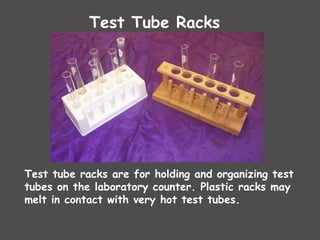
Test Tube Racks
Test tube racks are for holding and organizing test
tubes on the laboratory counter. Plastic racks may
melt in contact with very hot test tubes.
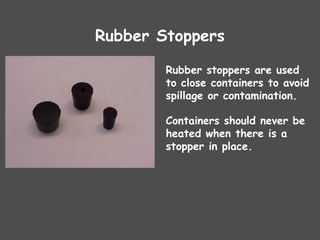
Rubber Stoppers
Rubber stoppers are used
to close containers to avoid
spillage or contamination.
Containers should never be
heated when there is a
stopper in place.
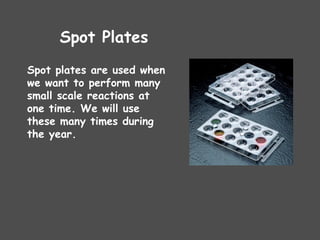
Spot Plates
Spot plates are used when
we want to perform many
small scale reactions at
one time. We will use
these many times during
the year.
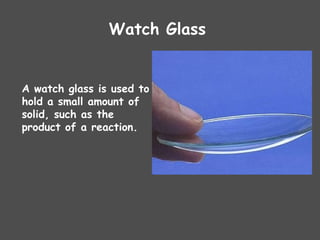
Watch Glass
A watch glass is used to
hold a small amount of
solid, such as the
product of a reaction.
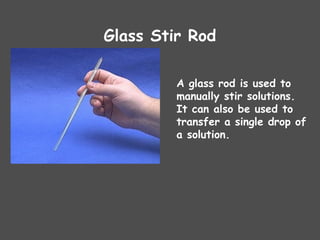
Glass Stir Rod
A glass rod is used to
manually stir solutions.
It can also be used to
transfer a single drop of
a solution.
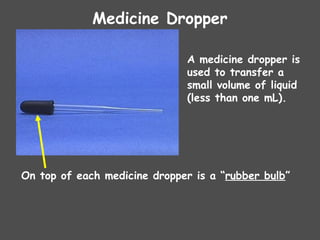
Medicine Dropper
A medicine dropper is
used to transfer a
small volume of liquid
(less than one mL).
On top of each medicine dropper is a “rubber bulb”
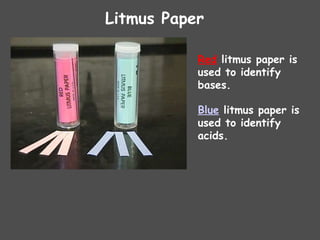
Litmus Paper
Red litmus paper is
used to identify
bases.
Blue litmus paper is
used to identify
acids.
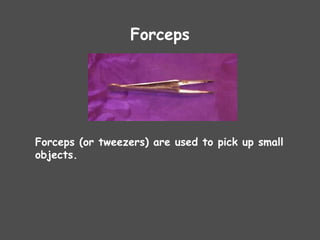
Forceps
Forceps (or tweezers) are used to pick up small
objects.
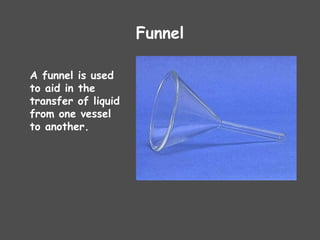
Funnel
A funnel is used
to aid in the
transfer of liquid
from one vessel
to another.
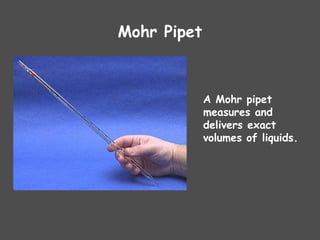
Mohr Pipet
A Mohr pipet
measures and
delivers exact
volumes of liquids.
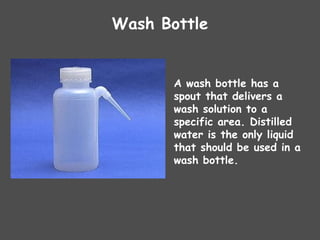
Wash Bottle
A wash bottle has a
spout that delivers a
wash solution to a
specific area. Distilled
water is the only liquid
that should be used in a
wash bottle.
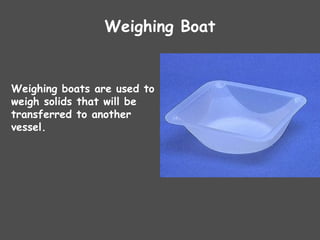
Weighing Boat
Weighing boats are used to
weigh solids that will be
transferred to another
vessel.
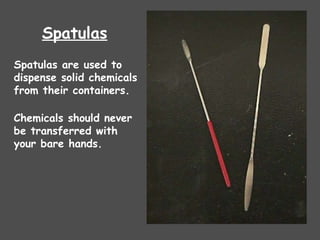
Spatulas
Spatulas are used to
dispense solid chemicals
from their containers.
Chemicals should never
be transferred with
your bare hands.
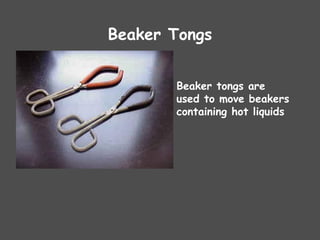
Beaker Tongs
Beaker tongs are
used to move beakers
containing hot liquids
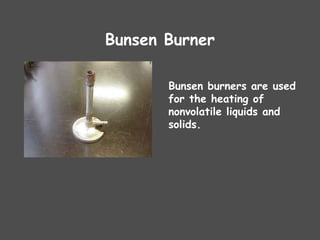
Bunsen Burner
Bunsen burners are used
for the heating of
nonvolatile liquids and
solids.
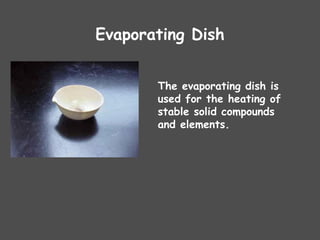
Evaporating Dish
The evaporating dish is
used for the heating of
stable solid compounds
and elements.
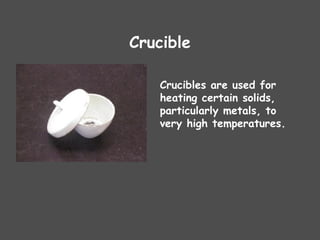
Crucible
Crucibles are used for
heating certain solids,
particularly metals, to
very high temperatures.
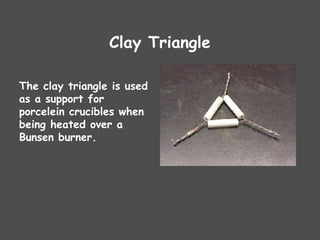
Clay Triangle
The clay triangle is used
as a support for
porcelein crucibles when
being heated over a
Bunsen burner.
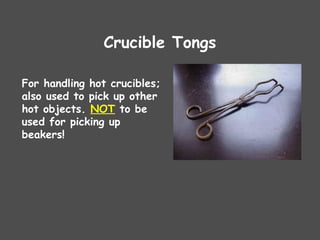
Crucible Tongs
For handling hot crucibles;
also used to pick up other
hot objects. NOT to be
used for picking up
beakers!
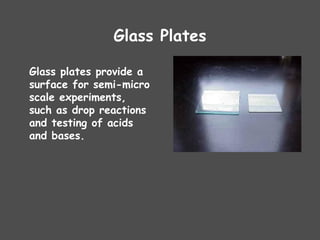
Glass Plates
Glass plates provide a
surface for semi-micro
scale experiments,
such as drop reactions
and testing of acids
and bases.
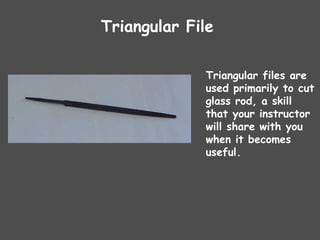
Triangular File
Triangular files are
used primarily to cut
glass rod, a skill
that your instructor
will share with you
when it becomes
useful.
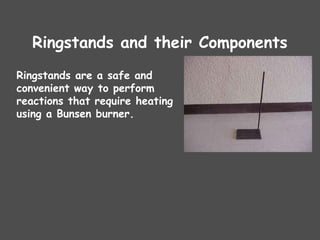
Ringstands and their Components
Ringstands are a safe and
convenient way to perform
reactions that require heating
using a Bunsen burner.
Ringstands and their Components
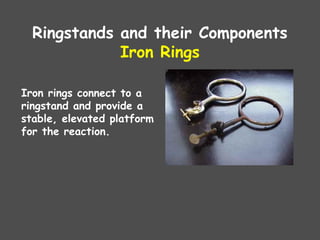
Iron Rings
Iron rings connect to a
ringstand and provide a
stable, elevated platform
for the reaction.
Ringstands and their Components
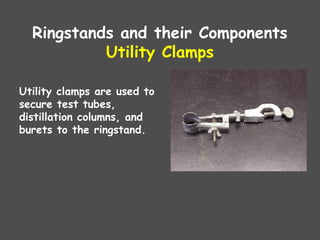
Utility Clamps
Utility clamps are used to
secure test tubes,
distillation columns, and
burets to the ringstand.
Ringstands and their Components
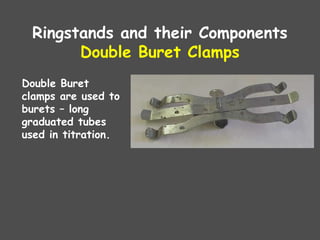
Double Buret Clamps
Double Buret
clamps are used to
burets – long
graduated tubes
used in titration.
Ringstands and their Components
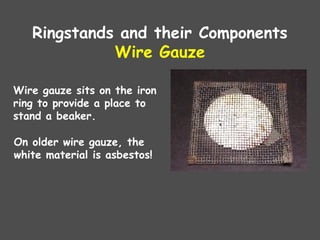
Wire Gauze
Wire gauze sits on the iron
ring to provide a place to
stand a beaker.
On older wire gauze, the
white material is asbestos!
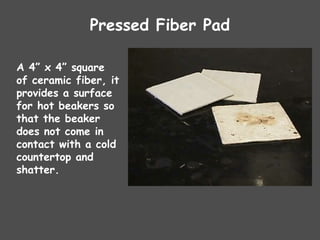
Pressed Fiber Pad
A 4” x 4” square
of ceramic fiber, it
provides a surface
for hot beakers so
that the beaker
does not come in
contact with a cold
countertop and
shatter.
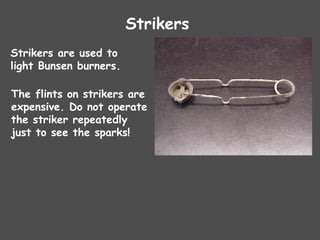
Strikers
Strikers are used to
light Bunsen burners.
The flints on strikers are
expensive. Do not operate
the striker repeatedly
just to see the sparks!
1.Which science process skill uses your five senses
to describe what is seen, heard, felt, smelled, and
tasted?
A.Inferring
B.Predicting
C.Measuring
D.Observing
2.Which science process skill involves developing
explanations of observations?
A.Inferring
B.Predicting
C.Measuring
D.Observing
3.Which science process skill uses numbers to
describe an object?
A.Inferring
B.Predicting
C.Experimenting
D.Measuring
Which science process skill involves making up
categories or grouping things?
A.Experimenting
B.Measuring
C.Classifying
D.Analyzing Data
Which science process skill uses a test under
controlled conditions?
A.Measuring
B.Experimenting
C.Collecting Information
D.Inferring
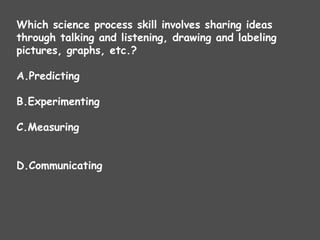
Which science process skill involves sharing ideas
through talking and listening, drawing and labeling
pictures, graphs, etc.?
A.Predicting
B.Experimenting
C.Measuring
D.Communicating
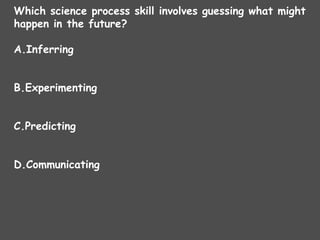
Which science process skill involves guessing what might
happen in the future?
A.Inferring
B.Experimenting
C.Predicting
D.Communicating
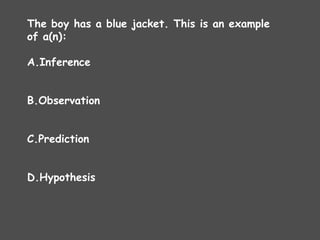
The boy has a blue jacket. This is an example
of a(n):
A.Inference
B.Observation
C.Prediction
D.Hypothesis
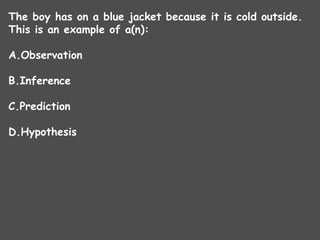
The boy has on a blue jacket because it is cold outside.
This is an example of a(n):
A.Observation
B.Inference
C.Prediction
D.Hypothesis
If it is cold outside, the boy will wear his blue
jacket. This is an example of a(n):
A.Observation
B.Inference
C.Prediction
D.Hypothesis
The boy will wear his blue jacket the next time it
is cold outside. This is an example of a(n):
A.Observation
B.Inference
C.Prediction
D.Hypothesis
The cashier counted the money in the drawer after
she ended her shift. This is an example of a(n):
A.Inference
B.Observation
C.Experiment
D.Hypothesis
The soccer player wanted to see if he would win his
game if he wore his lucky socks. This is an example of
a(n):
A.Inference
B.Observation
C.Experiment
D.Prediction
How many millimeters are in 1 centimeter?
A.1
B.10
C.100
D.1000
50 cm is equal to:
A.5 mm
B.50 mm
C.500 mm
D.5000 mm
1 cm is larger than 1 inch.
A.True
B.False
What science skill were you using in the eight-station
science lab when reading the temperature graphs?
A.Inferring
B.Predicting
C.Analyzing Data
D.Experimenting
Which of the following is NOT something you should
bring to class daily?
A.Textbook
B.Pen or pencil
C.Notebook
D.Cell phone
E.Willingness to learn
What do you call this laboratory
equipment?
What do you call this laboratory
equipment?

Equipment.ppsx science matatag grade 7 topic

  • 14.
    Beaker Beakers hold solidsor liquids that will not release gases when reacted or are unlikely to splatter if stirred or heated.
  • 15.
    Erlenmeyer Flask Erlenmeyer flaskshold solids or liquids that may release gases during a reaction or that are likely to splatter if stirred or heated.
  • 16.
    Florence Flask Rarely usedin first year chemistry, it is used for the mixing of chemicals. Narrow neck prevents splash exposure.
  • 17.
    Graduated Cylinder A graduated cylinderis used to measure volumes of liquids.
  • 18.
    Gas Collecting Bottle Weuse gas collecting bottles when large volumes of gases are produced, and must be collected by the displacement of water.
  • 19.
    Test Tubes 13 x100 mm test tubes 10 x 75 mm test tubes Ignition tube
  • 20.
    Test Tube Holder Atest tube holder is useful for holding a test tube which is too hot to handle.
  • 21.
    Test Tube Brushes Testtube brushes are used to clean test tubes and graduated cylinders. Forcing a large brush into a small test tube will often break the tube.
  • 22.
    Test Tube Racks Testtube racks are for holding and organizing test tubes on the laboratory counter. Plastic racks may melt in contact with very hot test tubes.
  • 23.
    Rubber Stoppers Rubber stoppersare used to close containers to avoid spillage or contamination. Containers should never be heated when there is a stopper in place.
  • 24.
    Spot Plates Spot platesare used when we want to perform many small scale reactions at one time. We will use these many times during the year.
  • 25.
    Watch Glass A watchglass is used to hold a small amount of solid, such as the product of a reaction.
  • 26.
    Glass Stir Rod Aglass rod is used to manually stir solutions. It can also be used to transfer a single drop of a solution.
  • 27.
    Medicine Dropper A medicinedropper is used to transfer a small volume of liquid (less than one mL). On top of each medicine dropper is a “rubber bulb”
  • 28.
    Litmus Paper Red litmuspaper is used to identify bases. Blue litmus paper is used to identify acids.
  • 29.
    Forceps Forceps (or tweezers)are used to pick up small objects.
  • 30.
    Funnel A funnel isused to aid in the transfer of liquid from one vessel to another.
  • 31.
    Mohr Pipet A Mohrpipet measures and delivers exact volumes of liquids.
  • 32.
    Wash Bottle A washbottle has a spout that delivers a wash solution to a specific area. Distilled water is the only liquid that should be used in a wash bottle.
  • 33.
    Weighing Boat Weighing boatsare used to weigh solids that will be transferred to another vessel.
  • 34.
    Spatulas Spatulas are usedto dispense solid chemicals from their containers. Chemicals should never be transferred with your bare hands.
  • 35.
    Beaker Tongs Beaker tongsare used to move beakers containing hot liquids
  • 36.
    Bunsen Burner Bunsen burnersare used for the heating of nonvolatile liquids and solids.
  • 37.
    Evaporating Dish The evaporatingdish is used for the heating of stable solid compounds and elements.
  • 38.
    Crucible Crucibles are usedfor heating certain solids, particularly metals, to very high temperatures.
  • 39.
    Clay Triangle The claytriangle is used as a support for porcelein crucibles when being heated over a Bunsen burner.
  • 40.
    Crucible Tongs For handlinghot crucibles; also used to pick up other hot objects. NOT to be used for picking up beakers!
  • 41.
    Glass Plates Glass platesprovide a surface for semi-micro scale experiments, such as drop reactions and testing of acids and bases.
  • 42.
    Triangular File Triangular filesare used primarily to cut glass rod, a skill that your instructor will share with you when it becomes useful.
  • 43.
    Ringstands and theirComponents Ringstands are a safe and convenient way to perform reactions that require heating using a Bunsen burner.
  • 44.
    Ringstands and theirComponents Iron Rings Iron rings connect to a ringstand and provide a stable, elevated platform for the reaction.
  • 45.
    Ringstands and theirComponents Utility Clamps Utility clamps are used to secure test tubes, distillation columns, and burets to the ringstand.
  • 46.
    Ringstands and theirComponents Double Buret Clamps Double Buret clamps are used to burets – long graduated tubes used in titration.
  • 47.
    Ringstands and theirComponents Wire Gauze Wire gauze sits on the iron ring to provide a place to stand a beaker. On older wire gauze, the white material is asbestos!
  • 48.
    Pressed Fiber Pad A4” x 4” square of ceramic fiber, it provides a surface for hot beakers so that the beaker does not come in contact with a cold countertop and shatter.
  • 49.
    Strikers Strikers are usedto light Bunsen burners. The flints on strikers are expensive. Do not operate the striker repeatedly just to see the sparks!
  • 50.
    1.Which science processskill uses your five senses to describe what is seen, heard, felt, smelled, and tasted? A.Inferring B.Predicting C.Measuring D.Observing
  • 51.
    2.Which science processskill involves developing explanations of observations? A.Inferring B.Predicting C.Measuring D.Observing
  • 52.
    3.Which science processskill uses numbers to describe an object? A.Inferring B.Predicting C.Experimenting D.Measuring
  • 53.
    Which science processskill involves making up categories or grouping things? A.Experimenting B.Measuring C.Classifying D.Analyzing Data
  • 54.
    Which science processskill uses a test under controlled conditions? A.Measuring B.Experimenting C.Collecting Information D.Inferring
  • 55.
    Which science processskill involves sharing ideas through talking and listening, drawing and labeling pictures, graphs, etc.? A.Predicting B.Experimenting C.Measuring D.Communicating
  • 56.
    Which science processskill involves guessing what might happen in the future? A.Inferring B.Experimenting C.Predicting D.Communicating
  • 57.
    The boy hasa blue jacket. This is an example of a(n): A.Inference B.Observation C.Prediction D.Hypothesis
  • 58.
    The boy hason a blue jacket because it is cold outside. This is an example of a(n): A.Observation B.Inference C.Prediction D.Hypothesis
  • 59.
    If it iscold outside, the boy will wear his blue jacket. This is an example of a(n): A.Observation B.Inference C.Prediction D.Hypothesis
  • 60.
    The boy willwear his blue jacket the next time it is cold outside. This is an example of a(n): A.Observation B.Inference C.Prediction D.Hypothesis
  • 61.
    The cashier countedthe money in the drawer after she ended her shift. This is an example of a(n): A.Inference B.Observation C.Experiment D.Hypothesis
  • 62.
    The soccer playerwanted to see if he would win his game if he wore his lucky socks. This is an example of a(n): A.Inference B.Observation C.Experiment D.Prediction
  • 63.
    How many millimetersare in 1 centimeter? A.1 B.10 C.100 D.1000
  • 64.
    50 cm isequal to: A.5 mm B.50 mm C.500 mm D.5000 mm
  • 65.
    1 cm islarger than 1 inch. A.True B.False
  • 66.
    What science skillwere you using in the eight-station science lab when reading the temperature graphs? A.Inferring B.Predicting C.Analyzing Data D.Experimenting
  • 67.
    Which of thefollowing is NOT something you should bring to class daily? A.Textbook B.Pen or pencil C.Notebook D.Cell phone E.Willingness to learn
  • 68.
    What do youcall this laboratory equipment?
  • 69.
    What do youcall this laboratory equipment?