The Equality Act 2010 Presentation by: Leander Neckles [CLPS Associate] June 2010 22/06/10
Presentation overview and key resources The purpose of this presentation is to: introduce and overview the Equality Act 2010; overview key changes; highlight some of the most contentious changes; comment on the Act’s implementation timetable; identify key information sources; ask what actions that CLPS should take to develop a framework for answering, and /or answer, key questions that you may have about the Act. The structure of this presentation: a – d (20 minutes); 20 minutes for discussion. Resources (on memory stick): Equality Act 2010 paper – also hard copy in your pack; a more detailed reference paper. 22/06/10
A: The Equality Act 2010 – an introduction The Act: the most fundamental overhaul of UK anti-discrimination and equality legislation ever - 2 main purposes: 1 - to harmonise discrimination law; 2 - to strengthen the law to support progress on Equality. 16 parts, 218 sections & 28 schedules; supported by 230 pages of Explanatory Notes. General comments: the Act goes a long way towards harmonisation but differences remain in how different protected characteristics are addressed (see handout 1); clearer language but still significant complexity; significant change – some new concepts, many new definitions, changes in what is and is not lawful; a steep learning curve given that key provisions are due to come into force in October 2010 (in just over 3 months). 22/06/10
A: The Equality Act 2010  - an introduction Will in due course repeal and replace: the Disability Discrimination, Act 1995 as amended; the Equality Act 2006 – but not the provisions on the role and functioning of the Commission for Equality and Human Rights (known as the Equality and Human Rights Commission or EHRC) the Race Relations Act 1976, as amended; the separate regulations on discrimination on the grounds of age, religion or belief and sexual orientation; the Sex Discrimination Act 1975, amended; a plethora of other provisions. Timetable (will be explored in more detail): Equality Bill published 27/4/09; parliamentary consideration ran from April 2009 – April 2010; became an Act on 8th April 2010; implementation from October 2010 – 2013 (?).
A: The Equality Act 2010 – overview [see the reference paper – appendix 1] Part 1:  Socio-economic inequalities. Part 2: Equality: key concepts. Part 3: Services and public functions. Part 4: Premises. Part 5: Work. Part 6: Education. Part 7: Associations. Part 8: Prohibited conduct. Part 9: Enforcement. Part 10: Contracts etc.  Part 11: Advancement of  equality. Part 12: Disabled person transport. Part 13: Disability miscellaneous. Part 14: General exceptions. Part 15: Family property. Part 16: General & miscellaneous. 22/06/10
B: The Equality Act 2010 –key changes Strengthens the law in 9 key areas (see paper Box 1, page 5). New definitions for: direct discrimination; indirect discrimination; disability discrimination (discrimination arising from disability). For key definitions (see reference paper, appendix 1). Equality strands/protected groups become protected characteristics. Protected characteristics are expanded/redefined (see paper 2.3,  page 6): disability, gender, race; age, religion or belief, sexual orientation; gender reassignment, marriage and civil partnership, pregnancy and maternity – the new characteristics; however not every protected characteristic is treated the same in relation to each protected area (for example the public sector equality duty does not cover marriage and civil partnership).
B: The Equality Act 2010 – more key changes New list of prohibited conduct  (s. 13 -27). Gender reassignment provisions: new definition (s. 7(1)); partially extended to school children. Direct discrimination (s. 13): the Act’s explanatory notes make it clear that the definition is intended to cover discrimination by association; “ This definition is broad enough to cover cases where less favourable treatment is because of a victim’s association with someone who has that characteristic (for example, is disabled).” [Explanatory. Notes para. 59 page 17] Prohibited conduct: direct discrimination; combined discrimination: dual characteristics discrimination arising from disability; gender reassignment  discrimination – work absence; pregnancy & maternity discrimination - non work; pregnancy & maternity discrimination – work; indirect discrimination; disability discrimination, duty to make reasonable adjustments; disability discrimination, failure to comply with the duty; harassment; victimisation.
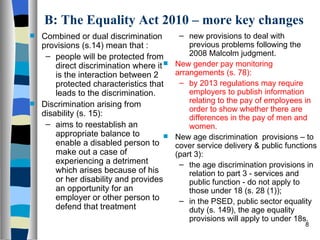
B: The Equality Act 2010 – more key changes Combined or dual discrimination provisions (s.14) mean that : people will be protected from direct discrimination where it is the interaction between 2 protected characteristics that leads to the discrimination. Discrimination arising from disability (s. 15): aims to reestablish an appropriate balance to enable a disabled person to make out a case of experiencing a detriment which arises because of his or her disability and provides an opportunity for an employer or other person to defend that treatment new provisions to deal with previous problems following the 2008 Malcolm judgment. New gender pay monitoring arrangements (s. 78): by 2013 regulations may require employers to publish information relating to the pay of employees in order to show whether there are differences in the pay of men and women. New age discrimination  provisions – to cover service delivery & public functions (part 3): the age discrimination provisions in relation to part 3 - services and public function - do not apply to those under 18 (s. 28 (1)); in the PSED, public sector equality duty (s. 149), the age equality provisions will apply to under 18s.
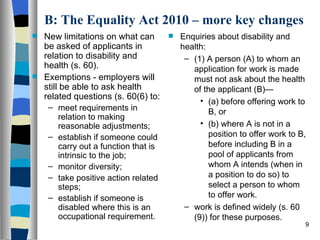
B: The Equality Act 2010 – more key changes New limitations on what can be asked of applicants in relation to disability and health (s. 60). Exemptions - employers will still be able to ask health related questions (s. 60(6) to: meet requirements in relation to making reasonable adjustments; establish if someone could carry out a function that is intrinsic to the job; monitor diversity; take positive action related steps; establish if someone is disabled where this is an occupational requirement. Enquiries about disability and health: (1) A person (A) to whom an application for work is made must not ask about the health of the applicant (B)— (a) before offering work to B, or (b) where A is not in a position to offer work to B, before including B in a pool of applicants from whom A intends (when in a position to do so) to select a person to whom to offer work. work is defined widely (s. 60 (9)) for these purposes.
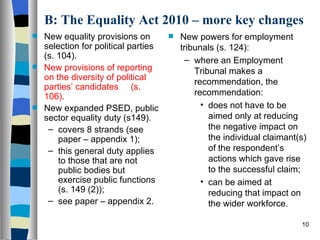
B: The Equality Act 2010 – more key changes New equality provisions on selection for political parties (s. 104). New provisions of reporting on the diversity of political parties’ candidates  (s. 106). New expanded PSED, public sector equality duty (s149). covers 8 strands (see paper – appendix 1); this general duty applies to those that are not public bodies but exercise public functions (s. 149 (2)); see paper – appendix 2. New powers for employment tribunals (s. 124): where an Employment  Tribunal makes a recommendation, the recommendation: does not have to be aimed only at reducing the negative impact on the individual claimant(s) of the respondent’s actions which gave rise to the successful claim; can be aimed at reducing that impact on the wider workforce.
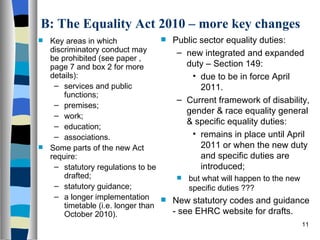
B: The Equality Act 2010 – more key changes Key areas in which discriminatory conduct may be prohibited (see paper , page 7 and box 2 for more details): services and public functions; premises; work; education; associations. Some parts of the new Act require: statutory regulations to be drafted; statutory guidance; a longer implementation timetable (i.e. longer than October 2010). Public sector equality duties: new integrated and expanded duty – Section 149: due to be in force April 2011. Current framework of disability, gender & race equality general & specific equality duties: remains in place until April 2011 or when the new duty and specific duties are introduced; but what will happen to the new specific duties ??? New statutory codes and guidance - see EHRC website for drafts.
C: The Equality Act 2010 –  highlighting areas that have already proved to be contentious Part 1:  Socio-economic inequalities (sections 1 – 3): the Conservatives & the Liberal Democrats have different and competing concerns  (paper  - page 4). Part 3: Services & public functions the new age discrimination provisions – SAGA lobbied hard  in the Lords for clarity & Gov. promised clear reg. & guidance before implementation in 2013. Part 5: Work gender pay gap info. (section 78) – see reference paper. Part 7: Associations: publishing diversity data for political parties (section 106). Part 11: Advancement of  equality: the PSED (section 149) (see Lord Lester’s comments – paper 1, page 9); failure to list the bodies to be subject to the PSED (s. 150,  s.151 & Schedule 19) new positive action recruitment & promotion provisions (section 159). 22/06/10
D: The Act’s implementation timetable Previous government’s published implementation timetable: main provisions in force by October 2010: will depend on commencement regulations/orders; April 2011: the expanded public sector equality duty (PSED); the new Socio-economic duty; the dual discrimination provisions; April 2012 – new age discrimination provisions: 2013 – private & vol.sector pay transparency regs  (if required)  implemented, political parties publishing diversity data. Key issues & questions that cannot be answered yet: Will the new Coalition’s previous,  but often different , concerns about  some of the Equality Act’s provisions be addressed by: amending any section of the new Act? delaying the implementation for any key sections? fundamentally reshaping thinking around regulations, statutory codes of practice  (EHRC) or guidance? What will happen to the specific duties & the GEO’s timetable for consulting on the regulations setting out the specific duties?
E: Potential information & advice sources – public sector Office of Public Sector Information – Act and regulations (when finalised)  - http://www.opsi.gov.uk/ Government Equalities Office (GEO). Equalities and Human Rights Commission (EHRC). See paper, part 1.5 page 4 – for website addresses. Hansard debates – for the hard core among you -  http://www.parliament.uk/business/publications/hansard/  - if you want to track down the original debates. 22/06/10
E: Other sources of information & advice VCS  co-ordinating bodies / others who worked on the Bill /Act: Centre for Local Policy Studies -  http://www.edgehill.ac.uk/clps/ BME organisations: Race on the Agenda (ROTA) – and Winning the race Coalition - http://www.rota.org.uk/pages/default.aspx; 1990 Trust and the Equality Bill Alliance. Disability Charities Consortium: DCC is formed of seven leading disability charities - Scope, Leonard Cheshire Disability, Mencap, Mind, RADAR, RNIB and RNID. Trade unions: Trades Union Congress (TUC); Unison.  22/06/10
F: Key issues & questions [15 – 20 minutes] Do you have any general questions about the presentation, the Act or associated provisions? Key issues for CLPS and others: what action is necessary? what resources are needed? what training is needed? what support is needed? who needs to do what given the phased implementation timetable for the Act: consultation around the regulations setting out the specific duties by the GEO – late summer 2010; key provisions in force Oct. 2010 (see main paper); public sector equality duty (PSED) in force April 2011; Socio-economic duty - April 2011 ??? 22/06/10

Equality Act 2010 Presentation

  • 1.
    The Equality Act2010 Presentation by: Leander Neckles [CLPS Associate] June 2010 22/06/10
  • 2.
    Presentation overview andkey resources The purpose of this presentation is to: introduce and overview the Equality Act 2010; overview key changes; highlight some of the most contentious changes; comment on the Act’s implementation timetable; identify key information sources; ask what actions that CLPS should take to develop a framework for answering, and /or answer, key questions that you may have about the Act. The structure of this presentation: a – d (20 minutes); 20 minutes for discussion. Resources (on memory stick): Equality Act 2010 paper – also hard copy in your pack; a more detailed reference paper. 22/06/10
  • 3.
    A: The EqualityAct 2010 – an introduction The Act: the most fundamental overhaul of UK anti-discrimination and equality legislation ever - 2 main purposes: 1 - to harmonise discrimination law; 2 - to strengthen the law to support progress on Equality. 16 parts, 218 sections & 28 schedules; supported by 230 pages of Explanatory Notes. General comments: the Act goes a long way towards harmonisation but differences remain in how different protected characteristics are addressed (see handout 1); clearer language but still significant complexity; significant change – some new concepts, many new definitions, changes in what is and is not lawful; a steep learning curve given that key provisions are due to come into force in October 2010 (in just over 3 months). 22/06/10
  • 4.
    A: The EqualityAct 2010 - an introduction Will in due course repeal and replace: the Disability Discrimination, Act 1995 as amended; the Equality Act 2006 – but not the provisions on the role and functioning of the Commission for Equality and Human Rights (known as the Equality and Human Rights Commission or EHRC) the Race Relations Act 1976, as amended; the separate regulations on discrimination on the grounds of age, religion or belief and sexual orientation; the Sex Discrimination Act 1975, amended; a plethora of other provisions. Timetable (will be explored in more detail): Equality Bill published 27/4/09; parliamentary consideration ran from April 2009 – April 2010; became an Act on 8th April 2010; implementation from October 2010 – 2013 (?).
  • 5.
    A: The EqualityAct 2010 – overview [see the reference paper – appendix 1] Part 1: Socio-economic inequalities. Part 2: Equality: key concepts. Part 3: Services and public functions. Part 4: Premises. Part 5: Work. Part 6: Education. Part 7: Associations. Part 8: Prohibited conduct. Part 9: Enforcement. Part 10: Contracts etc. Part 11: Advancement of equality. Part 12: Disabled person transport. Part 13: Disability miscellaneous. Part 14: General exceptions. Part 15: Family property. Part 16: General & miscellaneous. 22/06/10
  • 6.
    B: The EqualityAct 2010 –key changes Strengthens the law in 9 key areas (see paper Box 1, page 5). New definitions for: direct discrimination; indirect discrimination; disability discrimination (discrimination arising from disability). For key definitions (see reference paper, appendix 1). Equality strands/protected groups become protected characteristics. Protected characteristics are expanded/redefined (see paper 2.3, page 6): disability, gender, race; age, religion or belief, sexual orientation; gender reassignment, marriage and civil partnership, pregnancy and maternity – the new characteristics; however not every protected characteristic is treated the same in relation to each protected area (for example the public sector equality duty does not cover marriage and civil partnership).
  • 7.
    B: The EqualityAct 2010 – more key changes New list of prohibited conduct (s. 13 -27). Gender reassignment provisions: new definition (s. 7(1)); partially extended to school children. Direct discrimination (s. 13): the Act’s explanatory notes make it clear that the definition is intended to cover discrimination by association; “ This definition is broad enough to cover cases where less favourable treatment is because of a victim’s association with someone who has that characteristic (for example, is disabled).” [Explanatory. Notes para. 59 page 17] Prohibited conduct: direct discrimination; combined discrimination: dual characteristics discrimination arising from disability; gender reassignment discrimination – work absence; pregnancy & maternity discrimination - non work; pregnancy & maternity discrimination – work; indirect discrimination; disability discrimination, duty to make reasonable adjustments; disability discrimination, failure to comply with the duty; harassment; victimisation.
  • 8.
    B: The EqualityAct 2010 – more key changes Combined or dual discrimination provisions (s.14) mean that : people will be protected from direct discrimination where it is the interaction between 2 protected characteristics that leads to the discrimination. Discrimination arising from disability (s. 15): aims to reestablish an appropriate balance to enable a disabled person to make out a case of experiencing a detriment which arises because of his or her disability and provides an opportunity for an employer or other person to defend that treatment new provisions to deal with previous problems following the 2008 Malcolm judgment. New gender pay monitoring arrangements (s. 78): by 2013 regulations may require employers to publish information relating to the pay of employees in order to show whether there are differences in the pay of men and women. New age discrimination provisions – to cover service delivery & public functions (part 3): the age discrimination provisions in relation to part 3 - services and public function - do not apply to those under 18 (s. 28 (1)); in the PSED, public sector equality duty (s. 149), the age equality provisions will apply to under 18s.
  • 9.
    B: The EqualityAct 2010 – more key changes New limitations on what can be asked of applicants in relation to disability and health (s. 60). Exemptions - employers will still be able to ask health related questions (s. 60(6) to: meet requirements in relation to making reasonable adjustments; establish if someone could carry out a function that is intrinsic to the job; monitor diversity; take positive action related steps; establish if someone is disabled where this is an occupational requirement. Enquiries about disability and health: (1) A person (A) to whom an application for work is made must not ask about the health of the applicant (B)— (a) before offering work to B, or (b) where A is not in a position to offer work to B, before including B in a pool of applicants from whom A intends (when in a position to do so) to select a person to whom to offer work. work is defined widely (s. 60 (9)) for these purposes.
  • 10.
    B: The EqualityAct 2010 – more key changes New equality provisions on selection for political parties (s. 104). New provisions of reporting on the diversity of political parties’ candidates (s. 106). New expanded PSED, public sector equality duty (s149). covers 8 strands (see paper – appendix 1); this general duty applies to those that are not public bodies but exercise public functions (s. 149 (2)); see paper – appendix 2. New powers for employment tribunals (s. 124): where an Employment Tribunal makes a recommendation, the recommendation: does not have to be aimed only at reducing the negative impact on the individual claimant(s) of the respondent’s actions which gave rise to the successful claim; can be aimed at reducing that impact on the wider workforce.
  • 11.
    B: The EqualityAct 2010 – more key changes Key areas in which discriminatory conduct may be prohibited (see paper , page 7 and box 2 for more details): services and public functions; premises; work; education; associations. Some parts of the new Act require: statutory regulations to be drafted; statutory guidance; a longer implementation timetable (i.e. longer than October 2010). Public sector equality duties: new integrated and expanded duty – Section 149: due to be in force April 2011. Current framework of disability, gender & race equality general & specific equality duties: remains in place until April 2011 or when the new duty and specific duties are introduced; but what will happen to the new specific duties ??? New statutory codes and guidance - see EHRC website for drafts.
  • 12.
    C: The EqualityAct 2010 – highlighting areas that have already proved to be contentious Part 1: Socio-economic inequalities (sections 1 – 3): the Conservatives & the Liberal Democrats have different and competing concerns (paper - page 4). Part 3: Services & public functions the new age discrimination provisions – SAGA lobbied hard in the Lords for clarity & Gov. promised clear reg. & guidance before implementation in 2013. Part 5: Work gender pay gap info. (section 78) – see reference paper. Part 7: Associations: publishing diversity data for political parties (section 106). Part 11: Advancement of equality: the PSED (section 149) (see Lord Lester’s comments – paper 1, page 9); failure to list the bodies to be subject to the PSED (s. 150, s.151 & Schedule 19) new positive action recruitment & promotion provisions (section 159). 22/06/10
  • 13.
    D: The Act’simplementation timetable Previous government’s published implementation timetable: main provisions in force by October 2010: will depend on commencement regulations/orders; April 2011: the expanded public sector equality duty (PSED); the new Socio-economic duty; the dual discrimination provisions; April 2012 – new age discrimination provisions: 2013 – private & vol.sector pay transparency regs (if required) implemented, political parties publishing diversity data. Key issues & questions that cannot be answered yet: Will the new Coalition’s previous, but often different , concerns about some of the Equality Act’s provisions be addressed by: amending any section of the new Act? delaying the implementation for any key sections? fundamentally reshaping thinking around regulations, statutory codes of practice (EHRC) or guidance? What will happen to the specific duties & the GEO’s timetable for consulting on the regulations setting out the specific duties?
  • 14.
    E: Potential information& advice sources – public sector Office of Public Sector Information – Act and regulations (when finalised) - http://www.opsi.gov.uk/ Government Equalities Office (GEO). Equalities and Human Rights Commission (EHRC). See paper, part 1.5 page 4 – for website addresses. Hansard debates – for the hard core among you - http://www.parliament.uk/business/publications/hansard/ - if you want to track down the original debates. 22/06/10
  • 15.
    E: Other sourcesof information & advice VCS co-ordinating bodies / others who worked on the Bill /Act: Centre for Local Policy Studies - http://www.edgehill.ac.uk/clps/ BME organisations: Race on the Agenda (ROTA) – and Winning the race Coalition - http://www.rota.org.uk/pages/default.aspx; 1990 Trust and the Equality Bill Alliance. Disability Charities Consortium: DCC is formed of seven leading disability charities - Scope, Leonard Cheshire Disability, Mencap, Mind, RADAR, RNIB and RNID. Trade unions: Trades Union Congress (TUC); Unison. 22/06/10
  • 16.
    F: Key issues& questions [15 – 20 minutes] Do you have any general questions about the presentation, the Act or associated provisions? Key issues for CLPS and others: what action is necessary? what resources are needed? what training is needed? what support is needed? who needs to do what given the phased implementation timetable for the Act: consultation around the regulations setting out the specific duties by the GEO – late summer 2010; key provisions in force Oct. 2010 (see main paper); public sector equality duty (PSED) in force April 2011; Socio-economic duty - April 2011 ??? 22/06/10

Editor's Notes

  • #2 Seminar presentation 22/06/10 Necko Consultancy: May 2010