The Equality
Act and Your Business!
What’s New?
    Predominantly harmonising provisions
    Protects the same groups as previous
legislation
   Introduces “protected characteristics”
    Extends protection in some areas
    A review of your existing policies/procedures
is advisable
Some key changes
•   Positive action
•   Pre employment health related checks
•   More employment tribunal powers
•   Equal pay – direct discrimination
•   Pay secrecy
Equal Opportunities
Dignity at Work

  • By law, employers must take steps that are
    reasonable and practicable to prevent unlawful
    discrimination
  • EO practice applies to: recruitment, selection,
    training, terms and conditions of employment,
    benefits, facilities and services, promotion,
    transfer, grievance and disciplinary procedures
    and dismissal policies and practices
Dignity at Work
What methods do we use to promote Equal Opportunities?

• Through your Equal Opportunities policy and practices
• Give responsibility for the Equal Opportunities to all
  employees
• Publicising the policy to employees and Job Applicants
• Regularly monitoring and reviewing our policy practice
• Promoting a culture of dignity for all employees
• Providing training for supervisors and other decision makers
• Providing advice and assistance
• Taking action where standards are breached
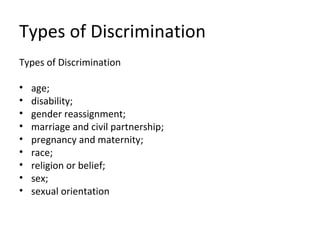
Types of Discrimination

•   age;
•   disability;
•   gender reassignment;
•   marriage and civil partnership;
•   pregnancy and maternity;
•   race;
•   religion or belief;
•   sex;
•   sexual orientation
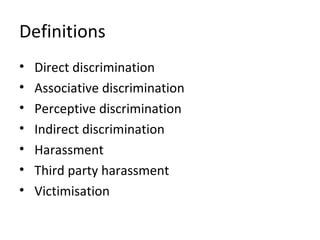
Definitions
•   Direct discrimination
•   Associative discrimination
•   Perceptive discrimination
•   Indirect discrimination
•   Harassment
•   Third party harassment
•   Victimisation
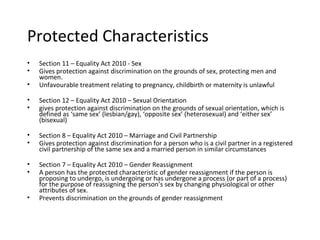
Protected Characteristics
•   Section 11 – Equality Act 2010 - Sex
•   Gives protection against discrimination on the grounds of sex, protecting men and
    women.
•   Unfavourable treatment relating to pregnancy, childbirth or maternity is unlawful

•   Section 12 – Equality Act 2010 – Sexual Orientation
•   gives protection against discrimination on the grounds of sexual orientation, which is
    defined as ‘same sex’ (lesbian/gay), ‘opposite sex’ (heterosexual) and ‘either sex’
    (bisexual)

•   Section 8 – Equality Act 2010 – Marriage and Civil Partnership
•   Gives protection against discrimination for a person who is a civil partner in a registered
    civil partnership of the same sex and a married person in similar circumstances

•   Section 7 – Equality Act 2010 – Gender Reassignment
•   A person has the protected characteristic of gender reassignment if the person is
    proposing to undergo, is undergoing or has undergone a process (or part of a process)
    for the purpose of reassigning the person’s sex by changing physiological or other
    attributes of sex.
•   Prevents discrimination on the grounds of gender reassignment
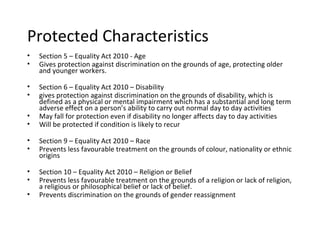
Protected Characteristics
•   Section 5 – Equality Act 2010 - Age
•   Gives protection against discrimination on the grounds of age, protecting older
    and younger workers.

•   Section 6 – Equality Act 2010 – Disability
•   gives protection against discrimination on the grounds of disability, which is
    defined as a physical or mental impairment which has a substantial and long term
    adverse effect on a person’s ability to carry out normal day to day activities
•   May fall for protection even if disability no longer affects day to day activities
•   Will be protected if condition is likely to recur

•   Section 9 – Equality Act 2010 – Race
•   Prevents less favourable treatment on the grounds of colour, nationality or ethnic
    origins

•   Section 10 – Equality Act 2010 – Religion or Belief
•   Prevents less favourable treatment on the grounds of a religion or lack of religion,
    a religious or philosophical belief or lack of belief.
•   Prevents discrimination on the grounds of gender reassignment
Other Provisions Relating to
  Age retirement below the age of 65 is prohibited unless
• Enforced
  it can be objectively justified

• Employees must be written to no less than 6 months and no
  more than 12 months informing them of their intended
  retirement date.

• Employees will then have a right to request working beyond
  retirement, which triggers a detailed procedure that must be
  followed.

• The lower and upper age limits in terms of qualifying for
  unfair dismissal and redundancy rights have been removed.
Other Provisions Relating to
 Disability
• Impairment must be expected to last for 12 months
  or more
• Individual assessment of impairment – GP reports
• Employers duty to make reasonable adjustments
• Deemed disabilities include blindness, severe
  disfigurements, multiple sclerosis, HIV and cancer
• Excluded conditions: Personality disorders, hay fever,
  Voyeurism etc
• Failing to recognise the obvious will not act as a
  defence
Direct Discrimination
•   Section 13 – Equality Act 2010
•   Covers all protected characteristics
•   “A person (A) discriminates against another (B) if, because of a protected
    characteristic, A treats B less favourably than A treats or would treat
    others”.
•   Discrimination on the grounds of age is justified if the treatment is “a
    proportionate means of achieving a legitimate aim”
•   If the protected characteristic is race, less favourable treatment includes
    segregating B from others.
•   If the protected characteristic is sex, “less favourable treatment of a
    woman includes less favourable treatment of her because she is breast-
    feeding”;
•   “in a case where B is a man, no account is to be taken of special treatment
    afforded to a woman in connection with pregnancy or childbirth”.
Indirect Discrimination
•   Section 19 – Equality Act 2010
•   Covers all protected characteristics except pregnancy and maternity
•   “A person (A) discriminates against another (B) if A applies to B a provision,
    criterion or practice which is discriminatory in relation to a relevant protected
    characteristic of B’s.
•   A provision, criterion or practice is discriminatory in relation to a relevant
    protected characteristic of B’s if—
•   (a) A applies, or would apply, it to persons with whom B does not share the
    characteristic,
•   (b) it puts, or would put, persons with whom B shares the characteristic at a
    particular disadvantage when compared with persons with whom B does not
    share it,
•   (c) it puts, or would put, B at that disadvantage, and
•   (d) A cannot show it to be a proportionate means of achieving a legitimate aim.
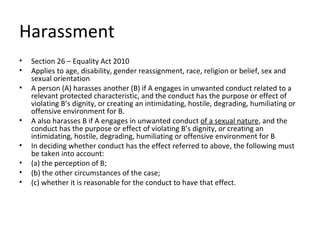
Harassment
•   Section 26 – Equality Act 2010
•   Applies to age, disability, gender reassignment, race, religion or belief, sex and
    sexual orientation
•   A person (A) harasses another (B) if A engages in unwanted conduct related to a
    relevant protected characteristic, and the conduct has the purpose or effect of
    violating B’s dignity, or creating an intimidating, hostile, degrading, humiliating or
    offensive environment for B.
•   A also harasses B if A engages in unwanted conduct of a sexual nature, and the
    conduct has the purpose or effect of violating B’s dignity, or creating an
    intimidating, hostile, degrading, humiliating or offensive environment for B
•   In deciding whether conduct has the effect referred to above, the following must
    be taken into account:
•   (a) the perception of B;
•   (b) the other circumstances of the case;
•   (c) whether it is reasonable for the conduct to have that effect.
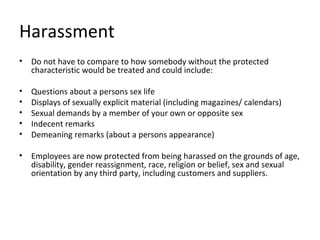
Harassment
•   Do not have to compare to how somebody without the protected
    characteristic would be treated and could include:

•   Questions about a persons sex life
•   Displays of sexually explicit material (including magazines/ calendars)
•   Sexual demands by a member of your own or opposite sex
•   Indecent remarks
•   Demeaning remarks (about a persons appearance)

•   Employees are now protected from being harassed on the grounds of age,
    disability, gender reassignment, race, religion or belief, sex and sexual
    orientation by any third party, including customers and suppliers.
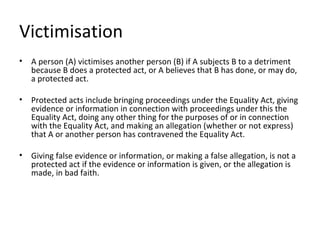
Victimisation
•   A person (A) victimises another person (B) if A subjects B to a detriment
    because B does a protected act, or A believes that B has done, or may do,
    a protected act.

•   Protected acts include bringing proceedings under the Equality Act, giving
    evidence or information in connection with proceedings under this the
    Equality Act, doing any other thing for the purposes of or in connection
    with the Equality Act, and making an allegation (whether or not express)
    that A or another person has contravened the Equality Act.

•   Giving false evidence or information, or making a false allegation, is not a
    protected act if the evidence or information is given, or the allegation is
    made, in bad faith.
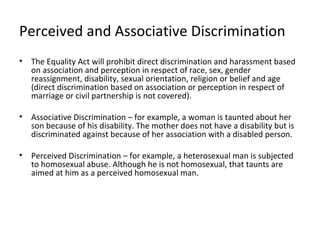
Perceived and Associative Discrimination
•   The Equality Act will prohibit direct discrimination and harassment based
    on association and perception in respect of race, sex, gender
    reassignment, disability, sexual orientation, religion or belief and age
    (direct discrimination based on association or perception in respect of
    marriage or civil partnership is not covered).

•   Associative Discrimination – for example, a woman is taunted about her
    son because of his disability. The mother does not have a disability but is
    discriminated against because of her association with a disabled person.

•   Perceived Discrimination – for example, a heterosexual man is subjected
    to homosexual abuse. Although he is not homosexual, that taunts are
    aimed at him as a perceived homosexual man.
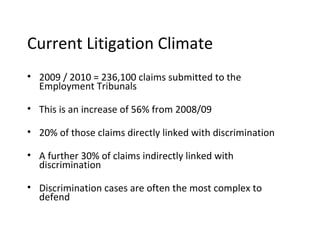
Current Litigation Climate
• 2009 / 2010 = 236,100 claims submitted to the
  Employment Tribunals

• This is an increase of 56% from 2008/09

• 20% of those claims directly linked with discrimination

• A further 30% of claims indirectly linked with
  discrimination

• Discrimination cases are often the most complex to
  defend
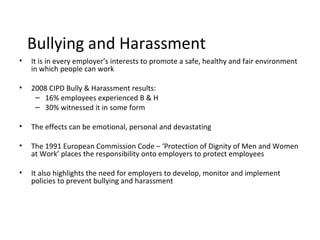
Bullying and Harassment
•   It is in every employer’s interests to promote a safe, healthy and fair environment
    in which people can work

•   2008 CIPD Bully & Harassment results:
     – 16% employees experienced B & H
     – 30% witnessed it in some form

•   The effects can be emotional, personal and devastating

•   The 1991 European Commission Code – ‘Protection of Dignity of Men and Women
    at Work’ places the responsibility onto employers to protect employees

•   It also highlights the need for employers to develop, monitor and implement
    policies to prevent bullying and harassment
Defining Bullying and
 Harassment another person(s) that is unwelcome or
• Any action against
  unwarranted, which causes a detrimental effect

• Bullying can be characterised as :
   – Offensive
   – Intimidating
   – Malicious
   – Insulting

• Bullying can be an abuse of power through means intended to
  undermine, humiliate and injure the recipient
Defining Bullying and
  Harassmentbe characterised as :
• Harassment can
                 2

• Unwanted conduct affecting the dignity of men and women in
  the workplace

• It can be related to:

• age, disability, gender reassignment, race, religion or belief,
  sex and sexual orientation

• Key: demeaning and unacceptable to the recipient
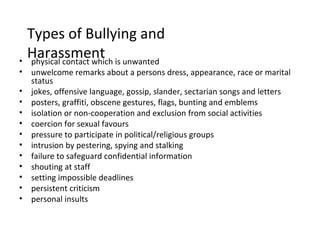
Types of Bullying and
•
    Harassment is unwanted
     physical contact which
•   unwelcome remarks about a persons dress, appearance, race or marital
    status
•   jokes, offensive language, gossip, slander, sectarian songs and letters
•   posters, graffiti, obscene gestures, flags, bunting and emblems
•   isolation or non-cooperation and exclusion from social activities
•   coercion for sexual favours
•   pressure to participate in political/religious groups
•   intrusion by pestering, spying and stalking
•   failure to safeguard confidential information
•   shouting at staff
•   setting impossible deadlines
•   persistent criticism
•   personal insults
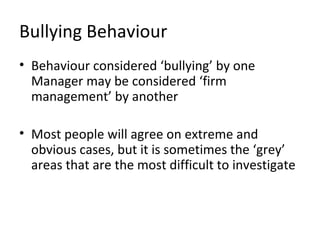
Bullying Behaviour
• Behaviour considered ‘bullying’ by one
  Manager may be considered ‘firm
  management’ by another

• Most people will agree on extreme and
  obvious cases, but it is sometimes the ‘grey’
  areas that are the most difficult to investigate
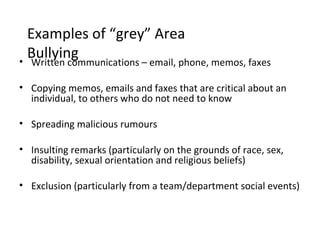
Examples of “grey” Area
  Bullying
• Written communications – email, phone, memos, faxes

• Copying memos, emails and faxes that are critical about an
  individual, to others who do not need to know

• Spreading malicious rumours

• Insulting remarks (particularly on the grounds of race, sex,
  disability, sexual orientation and religious beliefs)

• Exclusion (particularly from a team/department social events)
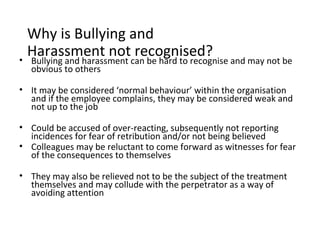
Why is Bullying and
•
  Harassment not recognised?
  Bullying and harassment can be hard to recognise and may not be
  obvious to others

• It may be considered ‘normal behaviour’ within the organisation
  and if the employee complains, they may be considered weak and
  not up to the job

• Could be accused of over-reacting, subsequently not reporting
  incidences for fear of retribution and/or not being believed
• Colleagues may be reluctant to come forward as witnesses for fear
  of the consequences to themselves

• They may also be relieved not to be the subject of the treatment
  themselves and may collude with the perpetrator as a way of
  avoiding attention
Consequences
• Any form of bullying and harassment is unacceptable on moral
  grounds, and if allowed to continue unchecked can create serious
  problems for an organisation, including:
   – Lost productivity
   – Poor performance
   – Absence
   – Staff turnover
   – Loss of respect for managers and supervisors
   – Damage to Company reputation
   – Poor morale and employee relations
   – Litigation (Tribunal and other court cases and unlimited
     compensation payments)
Taking Action
Investigate
    – Take the complaint seriously and investigate promptly – don’t put
        it off
    – Be objective and independent
    – Make a decision as to what action needs to be taken

Informal approach
     – In some cases, people are not aware of their behaviour and an
       informal discussion which makes them aware that their behaviour
       is unwelcome, can lead to greater understanding
     – Where this is the case, agreement can be reached that the
       behaviour will cease
     – Employees may choose to do this themselves and may need
       additional support from Human Resources an Employee
       Representative, Manager or Counsellor
Taking Action 2
Formal Approach
    – For serious or prolonged cases formal action may need to be taken
    – Company Disciplinary procedures
    – Potential gross misconduct / summary dismissal

Counselling
   – Counselling can play a major role in complaints about bullying and
      harassment, by providing a confidential avenue for an informal
      approach and the opportunity to resolve the complaint without
      further need for any formal action
   – Employee Assistance Programmes are provided
Topical Issues
• Absence Management
• Performance Management
• Family friendly rights and lack of management
  awareness
• Unfair dismissal – lack of procedure
• Redundancy – its status as a dismissal
• And many, many others!

Theequalityactandyourbusinessare 12959450121141-phpapp02

  • 1.
    The Equality Act andYour Business!
  • 2.
    What’s New? Predominantly harmonising provisions Protects the same groups as previous legislation Introduces “protected characteristics” Extends protection in some areas A review of your existing policies/procedures is advisable
  • 3.
    Some key changes • Positive action • Pre employment health related checks • More employment tribunal powers • Equal pay – direct discrimination • Pay secrecy
  • 4.
    Equal Opportunities Dignity atWork • By law, employers must take steps that are reasonable and practicable to prevent unlawful discrimination • EO practice applies to: recruitment, selection, training, terms and conditions of employment, benefits, facilities and services, promotion, transfer, grievance and disciplinary procedures and dismissal policies and practices
  • 5.
    Dignity at Work Whatmethods do we use to promote Equal Opportunities? • Through your Equal Opportunities policy and practices • Give responsibility for the Equal Opportunities to all employees • Publicising the policy to employees and Job Applicants • Regularly monitoring and reviewing our policy practice • Promoting a culture of dignity for all employees • Providing training for supervisors and other decision makers • Providing advice and assistance • Taking action where standards are breached
  • 6.
    Types of Discrimination Typesof Discrimination • age; • disability; • gender reassignment; • marriage and civil partnership; • pregnancy and maternity; • race; • religion or belief; • sex; • sexual orientation
  • 7.
    Definitions • Direct discrimination • Associative discrimination • Perceptive discrimination • Indirect discrimination • Harassment • Third party harassment • Victimisation
  • 8.
    Protected Characteristics • Section 11 – Equality Act 2010 - Sex • Gives protection against discrimination on the grounds of sex, protecting men and women. • Unfavourable treatment relating to pregnancy, childbirth or maternity is unlawful • Section 12 – Equality Act 2010 – Sexual Orientation • gives protection against discrimination on the grounds of sexual orientation, which is defined as ‘same sex’ (lesbian/gay), ‘opposite sex’ (heterosexual) and ‘either sex’ (bisexual) • Section 8 – Equality Act 2010 – Marriage and Civil Partnership • Gives protection against discrimination for a person who is a civil partner in a registered civil partnership of the same sex and a married person in similar circumstances • Section 7 – Equality Act 2010 – Gender Reassignment • A person has the protected characteristic of gender reassignment if the person is proposing to undergo, is undergoing or has undergone a process (or part of a process) for the purpose of reassigning the person’s sex by changing physiological or other attributes of sex. • Prevents discrimination on the grounds of gender reassignment
  • 9.
    Protected Characteristics • Section 5 – Equality Act 2010 - Age • Gives protection against discrimination on the grounds of age, protecting older and younger workers. • Section 6 – Equality Act 2010 – Disability • gives protection against discrimination on the grounds of disability, which is defined as a physical or mental impairment which has a substantial and long term adverse effect on a person’s ability to carry out normal day to day activities • May fall for protection even if disability no longer affects day to day activities • Will be protected if condition is likely to recur • Section 9 – Equality Act 2010 – Race • Prevents less favourable treatment on the grounds of colour, nationality or ethnic origins • Section 10 – Equality Act 2010 – Religion or Belief • Prevents less favourable treatment on the grounds of a religion or lack of religion, a religious or philosophical belief or lack of belief. • Prevents discrimination on the grounds of gender reassignment
  • 10.
    Other Provisions Relatingto Age retirement below the age of 65 is prohibited unless • Enforced it can be objectively justified • Employees must be written to no less than 6 months and no more than 12 months informing them of their intended retirement date. • Employees will then have a right to request working beyond retirement, which triggers a detailed procedure that must be followed. • The lower and upper age limits in terms of qualifying for unfair dismissal and redundancy rights have been removed.
  • 11.
    Other Provisions Relatingto Disability • Impairment must be expected to last for 12 months or more • Individual assessment of impairment – GP reports • Employers duty to make reasonable adjustments • Deemed disabilities include blindness, severe disfigurements, multiple sclerosis, HIV and cancer • Excluded conditions: Personality disorders, hay fever, Voyeurism etc • Failing to recognise the obvious will not act as a defence
  • 12.
    Direct Discrimination • Section 13 – Equality Act 2010 • Covers all protected characteristics • “A person (A) discriminates against another (B) if, because of a protected characteristic, A treats B less favourably than A treats or would treat others”. • Discrimination on the grounds of age is justified if the treatment is “a proportionate means of achieving a legitimate aim” • If the protected characteristic is race, less favourable treatment includes segregating B from others. • If the protected characteristic is sex, “less favourable treatment of a woman includes less favourable treatment of her because she is breast- feeding”; • “in a case where B is a man, no account is to be taken of special treatment afforded to a woman in connection with pregnancy or childbirth”.
  • 13.
    Indirect Discrimination • Section 19 – Equality Act 2010 • Covers all protected characteristics except pregnancy and maternity • “A person (A) discriminates against another (B) if A applies to B a provision, criterion or practice which is discriminatory in relation to a relevant protected characteristic of B’s. • A provision, criterion or practice is discriminatory in relation to a relevant protected characteristic of B’s if— • (a) A applies, or would apply, it to persons with whom B does not share the characteristic, • (b) it puts, or would put, persons with whom B shares the characteristic at a particular disadvantage when compared with persons with whom B does not share it, • (c) it puts, or would put, B at that disadvantage, and • (d) A cannot show it to be a proportionate means of achieving a legitimate aim.
  • 14.
    Harassment • Section 26 – Equality Act 2010 • Applies to age, disability, gender reassignment, race, religion or belief, sex and sexual orientation • A person (A) harasses another (B) if A engages in unwanted conduct related to a relevant protected characteristic, and the conduct has the purpose or effect of violating B’s dignity, or creating an intimidating, hostile, degrading, humiliating or offensive environment for B. • A also harasses B if A engages in unwanted conduct of a sexual nature, and the conduct has the purpose or effect of violating B’s dignity, or creating an intimidating, hostile, degrading, humiliating or offensive environment for B • In deciding whether conduct has the effect referred to above, the following must be taken into account: • (a) the perception of B; • (b) the other circumstances of the case; • (c) whether it is reasonable for the conduct to have that effect.
  • 15.
    Harassment • Do not have to compare to how somebody without the protected characteristic would be treated and could include: • Questions about a persons sex life • Displays of sexually explicit material (including magazines/ calendars) • Sexual demands by a member of your own or opposite sex • Indecent remarks • Demeaning remarks (about a persons appearance) • Employees are now protected from being harassed on the grounds of age, disability, gender reassignment, race, religion or belief, sex and sexual orientation by any third party, including customers and suppliers.
  • 16.
    Victimisation • A person (A) victimises another person (B) if A subjects B to a detriment because B does a protected act, or A believes that B has done, or may do, a protected act. • Protected acts include bringing proceedings under the Equality Act, giving evidence or information in connection with proceedings under this the Equality Act, doing any other thing for the purposes of or in connection with the Equality Act, and making an allegation (whether or not express) that A or another person has contravened the Equality Act. • Giving false evidence or information, or making a false allegation, is not a protected act if the evidence or information is given, or the allegation is made, in bad faith.
  • 17.
    Perceived and AssociativeDiscrimination • The Equality Act will prohibit direct discrimination and harassment based on association and perception in respect of race, sex, gender reassignment, disability, sexual orientation, religion or belief and age (direct discrimination based on association or perception in respect of marriage or civil partnership is not covered). • Associative Discrimination – for example, a woman is taunted about her son because of his disability. The mother does not have a disability but is discriminated against because of her association with a disabled person. • Perceived Discrimination – for example, a heterosexual man is subjected to homosexual abuse. Although he is not homosexual, that taunts are aimed at him as a perceived homosexual man.
  • 18.
    Current Litigation Climate •2009 / 2010 = 236,100 claims submitted to the Employment Tribunals • This is an increase of 56% from 2008/09 • 20% of those claims directly linked with discrimination • A further 30% of claims indirectly linked with discrimination • Discrimination cases are often the most complex to defend
  • 19.
    Bullying and Harassment • It is in every employer’s interests to promote a safe, healthy and fair environment in which people can work • 2008 CIPD Bully & Harassment results: – 16% employees experienced B & H – 30% witnessed it in some form • The effects can be emotional, personal and devastating • The 1991 European Commission Code – ‘Protection of Dignity of Men and Women at Work’ places the responsibility onto employers to protect employees • It also highlights the need for employers to develop, monitor and implement policies to prevent bullying and harassment
  • 20.
    Defining Bullying and Harassment another person(s) that is unwelcome or • Any action against unwarranted, which causes a detrimental effect • Bullying can be characterised as : – Offensive – Intimidating – Malicious – Insulting • Bullying can be an abuse of power through means intended to undermine, humiliate and injure the recipient
  • 21.
    Defining Bullying and Harassmentbe characterised as : • Harassment can 2 • Unwanted conduct affecting the dignity of men and women in the workplace • It can be related to: • age, disability, gender reassignment, race, religion or belief, sex and sexual orientation • Key: demeaning and unacceptable to the recipient
  • 22.
    Types of Bullyingand • Harassment is unwanted physical contact which • unwelcome remarks about a persons dress, appearance, race or marital status • jokes, offensive language, gossip, slander, sectarian songs and letters • posters, graffiti, obscene gestures, flags, bunting and emblems • isolation or non-cooperation and exclusion from social activities • coercion for sexual favours • pressure to participate in political/religious groups • intrusion by pestering, spying and stalking • failure to safeguard confidential information • shouting at staff • setting impossible deadlines • persistent criticism • personal insults
  • 23.
    Bullying Behaviour • Behaviourconsidered ‘bullying’ by one Manager may be considered ‘firm management’ by another • Most people will agree on extreme and obvious cases, but it is sometimes the ‘grey’ areas that are the most difficult to investigate
  • 24.
    Examples of “grey”Area Bullying • Written communications – email, phone, memos, faxes • Copying memos, emails and faxes that are critical about an individual, to others who do not need to know • Spreading malicious rumours • Insulting remarks (particularly on the grounds of race, sex, disability, sexual orientation and religious beliefs) • Exclusion (particularly from a team/department social events)
  • 25.
    Why is Bullyingand • Harassment not recognised? Bullying and harassment can be hard to recognise and may not be obvious to others • It may be considered ‘normal behaviour’ within the organisation and if the employee complains, they may be considered weak and not up to the job • Could be accused of over-reacting, subsequently not reporting incidences for fear of retribution and/or not being believed • Colleagues may be reluctant to come forward as witnesses for fear of the consequences to themselves • They may also be relieved not to be the subject of the treatment themselves and may collude with the perpetrator as a way of avoiding attention
  • 26.
    Consequences • Any formof bullying and harassment is unacceptable on moral grounds, and if allowed to continue unchecked can create serious problems for an organisation, including: – Lost productivity – Poor performance – Absence – Staff turnover – Loss of respect for managers and supervisors – Damage to Company reputation – Poor morale and employee relations – Litigation (Tribunal and other court cases and unlimited compensation payments)
  • 27.
    Taking Action Investigate – Take the complaint seriously and investigate promptly – don’t put it off – Be objective and independent – Make a decision as to what action needs to be taken Informal approach – In some cases, people are not aware of their behaviour and an informal discussion which makes them aware that their behaviour is unwelcome, can lead to greater understanding – Where this is the case, agreement can be reached that the behaviour will cease – Employees may choose to do this themselves and may need additional support from Human Resources an Employee Representative, Manager or Counsellor
  • 28.
    Taking Action 2 FormalApproach – For serious or prolonged cases formal action may need to be taken – Company Disciplinary procedures – Potential gross misconduct / summary dismissal Counselling – Counselling can play a major role in complaints about bullying and harassment, by providing a confidential avenue for an informal approach and the opportunity to resolve the complaint without further need for any formal action – Employee Assistance Programmes are provided
  • 29.
    Topical Issues • AbsenceManagement • Performance Management • Family friendly rights and lack of management awareness • Unfair dismissal – lack of procedure • Redundancy – its status as a dismissal • And many, many others!