auditoorne õpe vse-õpe? auditoorne õpe + e-õpe? Marge Kusmin TTÜ 8. oktoober 2008 Eesti Kunstiakadeemia
2.
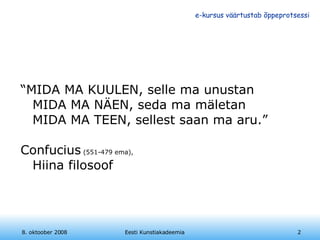
“ MIDA MAKUULEN, selle ma unustan MIDA MA NÄEN, seda ma mäletan MIDA MA TEEN, sellest saan ma aru.” Confucius (551-479 ema), Hiina filosoof 8. oktoober 2008 Eesti Kunstiakadeemia
KVALITEET Reviewed byBryan R. Warnick Smart Machines in Education: The Coming Revolution in Educational Technology is clearly a book for those curious about advances in cutting edge educational technology. The editors of the volume, Kenneth D. Forbus and Paul J. Feltovich, have brought together an illuminating collection of essays that show how research in cognitive science and artificial intelligence (AI) is shaping technological development in education. The essays reveal what the next generation of educational technology might look like, and help us grasp some of the reasons why the technology might look that way. It is also a book that can be read on different levels. Certain essays have something of a historical twist, tracing the negotiation that often occurs as educational technologies are developed, evaluated, and inserted into classroom environments. Other essays focus more on the theories of learning that undergird the technological applications; indeed, some of the essays do not mention technology at all, and instead focus on ideas about learning that might be more fully incorporated into future technological artifacts. Still other essays are of a more technical bent, relaying in some detail how their "smart machines" work. Thus, sections of this book should be of interest to a fairly broad segment of the educational research community. 8. oktoober 2008 Eesti Kunstiakadeemia
8.
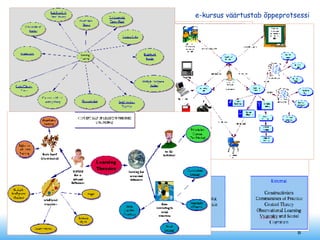
Learning Theories Groupedby Socio-Historical Context Bryan R. Warnick Late Feudalism, Monarchy Pavlov British Empiricism Early Industrial Capitalism, Liberal Democracies Freud and early psychoanalytic British Empiricism Thorndike and connectionism Gestalt Theory Late Industrial Capitalism, Liberal Democracies Late psychoanalytic Piaget Watson Skinnerian Behaviorism Post Industrial Capitalism, Liberal Democracies Piaget and Post-Piagetianism Skinnerian Behaviorism Social Learning Theory Cognitivism Sternberg's Triarchic theory Gardner's Multiple Intelligences Marxist Vygotsky KVALITEET 8. oktoober 2008 Eesti Kunstiakadeemia
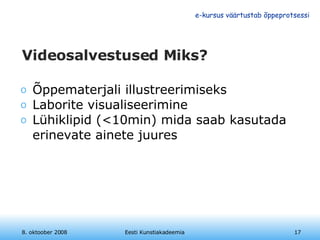
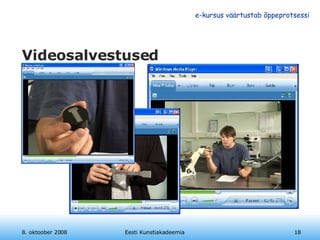
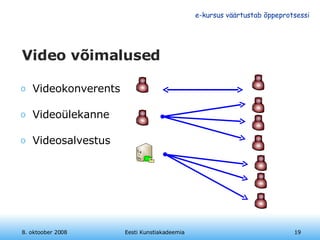
Videosalvestused Miks? Õppematerjaliillustreerimiseks Laborite visualiseerimine Lühiklipid (<10min) mida saab kasutada erinevate ainete juures 8. oktoober 2008 Eesti Kunstiakadeemia
HARIDUSTEHNOLOOGIA on pedagoogiliseuurimis- ja arendustegevuse valdkond, mille aluseks on õppimise, õpetamise ja tehnoloogia vaheliste seoste ning uute õpikeskkondade terviklik käsitlemine. 8. oktoober 2008 Eesti Kunstiakadeemia
28.
e-õppe alase tegevusekoordineerimine projektides osalemine ja uute projektide algatamine haridustehnoloogiliste konsultatsioonide pakkumine koolituste korraldamine ja läbiviimine s.h. infotunnid, teabepäevad HARIDUSTEHNOLOOGIA TALITUS/KESKUS 8. oktoober 2008 Eesti Kunstiakadeemia
29.
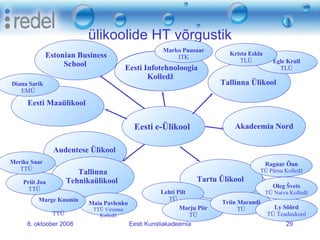
ülikoolide HT võrgustik8. oktoober 2008 Eesti Kunstiakadeemia Eesti e-Ülikool Tartu Ülikool Akadeemia Nord Eesti Infotehnoloogia Kolledž Tallinna Ülikool Tartu Ülikool Ragnar Õun TÜ Pärnu Kolled ž Lehti Pilt TÜ Marju Piir TÜ Triin Marandi TÜ Ly Sõõrd TÜ Teaduskool Oleg Švets TÜ Narva Kolled ž Akadeemia Nord Tallinna Ülikool Egle Krull TLÜ Krista Eskla TLÜ Eesti Infotehnoloogia Kolledž Estonian Business School Marko Puusaar ITK Eesti Maaülikool Audentese Ülikool Tallinna Tehnikaülikool Maia Pavlenko TTÜ Virumaa Kolledž Marge Kusmin TTÜ Priit Joa TTÜ Merike Saar TTÜ Diana Sarik E M Ü
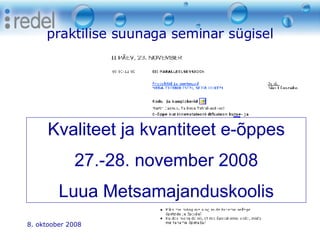
praktilise suunaga seminarsügisel 8. oktoober 2008 Eesti Kunstiakadeemia Kvaliteet ja kvantiteet e-õppes 27.-28. november 2008 Luua Metsamajanduskoolis
32.
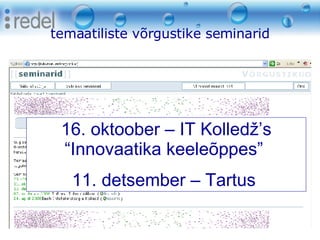
temaatiliste võrgustike seminarid8. oktoober 2008 Eesti Kunstiakadeemia 16. oktoober – IT Kolledž’s “Innovaatika keeleõppes” 11. detsember – Tartus
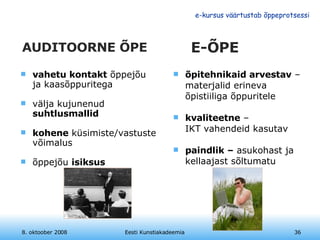
AUDITOORNE ÕPE vahetukontakt õppejõu ja kaasõppuritega välja kujunenud suhtlusmallid kohene küsimiste/vastuste võimalus õppejõu isiksus 8. oktoober 2008 Eesti Kunstiakadeemia E-ÕPE õpitehnikaid arvestav – materjalid erineva õpistiiliga õppuritele kvaliteetne – IKT vahendeid kasutav paindlik – asukohast ja kellaajast sõltumatu
37.
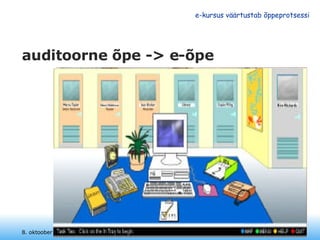
AUDITOORNE & e-ÕPE => KOMBINEERITUD ÕPE 8. oktoober 2008 Eesti Kunstiakadeemia




![Tänan! 8. oktoober 2008 Eesti Kunstiakadeemia [email_address]](https://image.slidesharecdn.com/1-1223634759873948-8/85/e-ope-vs-auditoorne-ope-e-ope-auditoorne-ope-41-320.jpg)


