TAKSHILA LEARNING PVT. LTD.


                                             Solutions


                                                  For


                                   Management Accounting –
                                   Enterprises Performance
                                        Management
                                             December 2012
                                             Syllabus 2008


                                                  by

                                          CA Vikrant Rathor
                               Faculty @ Takshila Learning Pvt. Ltd.


Patel Nagar Office (Corporate Section):                               Laxmi Nagar Office (Student Section):
4/4, East Patel Nagar,                                           1/56 B, First Floor, Lalita Park, Laxmi Nagar
New Delhi – 110 008 Ph: 99581 57000                                  New Delhi – 110 092 Ph: 97176 86000
info@takshilalearning.com                                                         www.takshilalearning.com
   https://twitter.com/#!/TakshilaLearn                         http://www.facebook.com/#!/takshilalearn
TAKSHILA LEARNING PVT. LTD.


            Answer 1 (a)

                 i.          False; Value chain concepts (porter model); Value added concepts (JIT) are
                             fundamentally different.

                ii.          True; Decisions under uncertainly are not always obvious.

               iii.          True; Life costing is a technique to establish the total cost of ownership

               iv.           False; Drum is constraint and therefore sets the pace for the drum only

                v.           True; Theory Y style of management is a highly autocratic style.

            1 (b) (i) Target cost per unit = Competitive selling price less target margin per unit

            Selling price at units demand of 20, 000

            Price elasticity = $10 reduction with double of volume;

            Hence price for 80,000 units sale is $ 100 – 10 – 10 = $ 80

            Target cost = $ 80 – 25% = $60 per unit.

            (ii) first unit time = 2

            Learning rate is x hence average of two units = 2x

            Average of first four units = 2x2

            Total time of first four units = 8x2

            Which is equal to 5.12; hence x = 0.8 hence learning rate is 80%.

            (iii) Throughput per unit = $ 75 less 30 = $ 45

            Throughput per hour = $45/10 x 60 minutes = $270 per hour.

            (iv) profit are maximum where MR = MC

            Hence $50 - $ 0.002 x = $ 20; x = 15,000 units

            At that level selling price will be = $50 - $ 0.001 x (15,000 units) = $35 per unit.

            (v) profit volume ratio = Fixed cost/Break even sales % = 40%

            Sales for profit of $50,000 = Desired contribution/PV % = $9,25,000.

            Answer 1 (c)

                     (i)         Not accepting

                     (ii)        CRP

                     (iii)       Constant


Patel Nagar Office (Corporate Section):                                                                     Laxmi Nagar Office (Student Section):
4/4, East Patel Nagar,                                                                                 1/56 B, First Floor, Lalita Park, Laxmi Nagar
New Delhi – 110 008 Ph: 99581 57000                                                                        New Delhi – 110 092 Ph: 97176 86000
info@takshilalearning.com                                                                                               www.takshilalearning.com
   https://twitter.com/#!/TakshilaLearn                                                               http://www.facebook.com/#!/takshilalearn
TAKSHILA LEARNING PVT. LTD.

                  (iv)        Degeneracy

                  (v)         S.D.

            ANSWER 1 (D)

            (ii) Quality function deployment (QFD) is a “method to transform user demands into design
            quality, to deploy the functions forming quality, and to deploy methods for achieving the design
            quality into subsystems and component parts, and ultimately to specific elements of the
            manufacturing process.

            (iii) An intranet is a computer network that uses Internet Protocol technology to share
            information, operational systems, or computing services within an organization. The term is
            used in contrast to internet, a network between organizations, and instead refers to a network
            within an organization.

            (iv) This breakdown is typically in line with the Work Breakdown Structure (WBS); indicating
            "where" cost are allocated. The breakdown can sometimes be in line with the company's Chart
            of Accounts, indicating "what" the costs are for. In theory, cost could be in line with "who" is
            spending the cost, "when" costs are being spent, etc.

            (v) A quality circle is a volunteer group composed of workers (or even students), usually under
            the leadership of their supervisor (or an elected team leader), who are trained to identify,
            analyze and solve work-related problems and present their solutions to management in order to
            improve the performance of the organization, and motivate and enrich the work of employees.

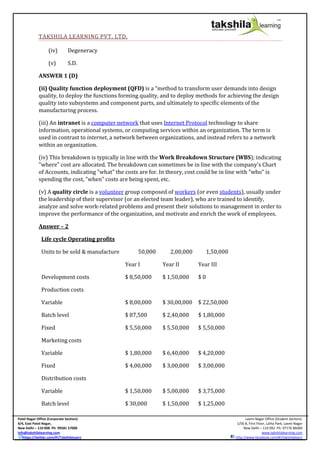
            Answer – 2

              Life cycle Operating profits

              Units to be sold & manufacture        50,000      2,00,000        1,50,000

                                               Year I        Year II       Year III

              Development costs                $ 8,50,000    $ 1,50,000    $0

              Production costs

              Variable                         $ 8,00,000    $ 30,00,000   $ 22,50,000

              Batch level                      $ 87,500      $ 2,40,000    $ 1,80,000

              Fixed                            $ 5,50,000    $ 5,50,000    $ 5,50,000

              Marketing costs

              Variable                         $ 1,80,000    $ 6,40,000    $ 4,20,000

              Fixed                            $ 4,00,000    $ 3,00,000    $ 3,00,000

              Distribution costs

              Variable                         $ 1,50,000    $ 5,00,000    $ 3,75,000

              Batch level                      $ 30,000      $ 1,50,000    $ 1,25,000

Patel Nagar Office (Corporate Section):                                                          Laxmi Nagar Office (Student Section):
4/4, East Patel Nagar,                                                                      1/56 B, First Floor, Lalita Park, Laxmi Nagar
New Delhi – 110 008 Ph: 99581 57000                                                             New Delhi – 110 092 Ph: 97176 86000
info@takshilalearning.com                                                                                    www.takshilalearning.com
   https://twitter.com/#!/TakshilaLearn                                                    http://www.facebook.com/#!/takshilalearn
TAKSHILA LEARNING PVT. LTD.

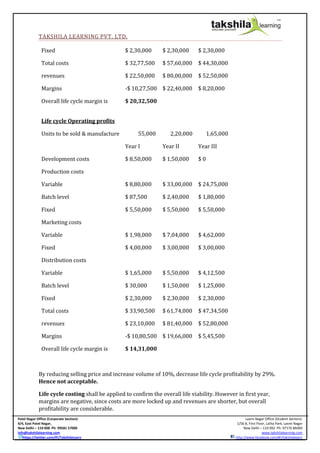
              Fixed                             $ 2,30,000      $ 2,30,000     $ 2,30,000

              Total costs                       $ 32,77,500     $ 57,60,000    $ 44,30,000

              revenues                          $ 22,50,000     $ 80,00,000    $ 52,50,000

              Margins                           -$ 10,27,500 $ 22,40,000       $ 8,20,000

              Overall life cycle margin is      $ 20,32,500


              Life cycle Operating profits

              Units to be sold & manufacture         55,000        2,20,000         1,65,000

                                                Year I          Year II        Year III

              Development costs                 $ 8,50,000      $ 1,50,000     $0

              Production costs

              Variable                          $ 8,80,000      $ 33,00,000    $ 24,75,000

              Batch level                       $ 87,500        $ 2,40,000     $ 1,80,000

              Fixed                             $ 5,50,000      $ 5,50,000     $ 5,50,000

              Marketing costs

              Variable                          $ 1,98,000      $ 7,04,000     $ 4,62,000

              Fixed                             $ 4,00,000      $ 3,00,000     $ 3,00,000

              Distribution costs

              Variable                          $ 1,65,000      $ 5,50,000     $ 4,12,500

              Batch level                       $ 30,000        $ 1,50,000     $ 1,25,000

              Fixed                             $ 2,30,000      $ 2,30,000     $ 2,30,000

              Total costs                       $ 33,90,500     $ 61,74,000    $ 47,34,500

              revenues                          $ 23,10,000     $ 81,40,000    $ 52,80,000

              Margins                           -$ 10,80,500 $ 19,66,000       $ 5,45,500

              Overall life cycle margin is      $ 14,31,000


            By reducing selling price and increase volume of 10%, decrease life cycle profitability by 29%.
            Hence not acceptable.

            Life cycle costing shall be applied to confirm the overall life viability. However in first year,
            margins are negative, since costs are more locked up and revenues are shorter, but overall
            profitability are considerable.
Patel Nagar Office (Corporate Section):                                                              Laxmi Nagar Office (Student Section):
4/4, East Patel Nagar,                                                                          1/56 B, First Floor, Lalita Park, Laxmi Nagar
New Delhi – 110 008 Ph: 99581 57000                                                                 New Delhi – 110 092 Ph: 97176 86000
info@takshilalearning.com                                                                                        www.takshilalearning.com
   https://twitter.com/#!/TakshilaLearn                                                        http://www.facebook.com/#!/takshilalearn
TAKSHILA LEARNING PVT. LTD.


            Answer 3 (a)

            There are two types of control systems namely:

                  1. Open loop control systems (non-feedback control systems)

                  2. Closed loop control systems (feedback control systems)

            Open loop control system


            If in a physical system there is no automatic correction of the variation in its output, it is called
            an open loop control system. That is, in this type of system, sensing of the actual output and
            comparing of this output (through feedback) with the desired input does not take place.

            Closed loop control system


            A closed loop control system is a system where the output has an effect upon the input quantity
            in such a manner as to maintain the desired output value.

            Answer 3 (b)

            Final price received from customer =                       $ 3,000

            Less: Assembly cost                              $1, 000

            Less: Manufacturing cost assembly M              $ 500

            Less: Extra cost under purchase                  $ 100

            Maximum what we can pay                                    $ 1400


            Answer 4 (a) decision tree is

            Decision tree learning, used in statistics, data mining and machine learning, uses a decision
            tree as a predictive model which maps observations about an item to conclusions about the
            item's target value. More descriptive names for such tree models are classification
            trees or regression trees. In these tree structures, leaves represent class labels and branches
            represent conjunctions of features that lead to those class labels.

            In decision analysis, a decision tree can be used to visually and explicitly represent decisions
            and decision making. In data mining, a decision tree describes data but not decisions; rather the
            resulting classification tree can be an input for decision making. This page deals with decision
            trees in data mining.


            Answer 4 (b)

                                          Profit   with outflow Profit           jp   Exp Profit

Patel Nagar Office (Corporate Section):                                                              Laxmi Nagar Office (Student Section):
4/4, East Patel Nagar,                                                                          1/56 B, First Floor, Lalita Park, Laxmi Nagar
New Delhi – 110 008 Ph: 99581 57000                                                                 New Delhi – 110 092 Ph: 97176 86000
info@takshilalearning.com                                                                                        www.takshilalearning.com
   https://twitter.com/#!/TakshilaLearn                                                        http://www.facebook.com/#!/takshilalearn
TAKSHILA LEARNING PVT. LTD.
              SALES
                          High            0.4 1000000 300000        700000       0.24 168000

                          medium 0.3 600000             300000      300000       0.18 54000

                          Low             0.2 200000    300000      -100000 0.12 -12000

                          zero            0.1 -500000   300000      -800000 0.06 -48000

                                                        With OT     Profit       jp   162000
              SALES


                          High            0.4 1000000 100000        900000       0.16 144000

                          medium 0.3 600000             100000      500000       0.12 60000

                          low             0.2 200000    100000      100000       0.08 8000

                          zero            0.1 -500000   100000      -600000 0.04 -24000

                                                                                      188000

            Hence overtime is more beneficial.


            Answer 5(a) ERP is effective because

            Many people say that ERP is the future, that it is completely necessary nowadays. Through these
            lines we are going to explain several topics regarding why it is so important to use an ERP in
            order to get organizational efficiency.

            With or Without ERP

            An enterprise that has no ERP according to its needs can find many kinds of software that do not
            allow interaction, and that cannot be customized. For that matter they are not able to optimize
            the organizational business activities. The engineering design of the software will be needed in
            order to improve the product, and to follow the client’s behaviour and choices since the first
            contact is quite important. Administration of the different receipts interdependence will be very
            complex, such as invoices regarding materials purchases, general expenditures or salaries.

            All of these things change when you implement ERP. Information flows constantly and allows
            you to follow a client’s processes at any moment, no matter which part of the process they are
            going through. Purchases and expenditures are registered in a centralized database which
            allows you to have close control over these activities. In this regard ERP helps you to prevent
            possible abuse.


            Answer 5 (b)

              Selling price Range V.C.                    Range   Sales volume        Range

              $ 14                   00-34   $2           00-29   30000               00-24

              $ 15                   35-84   $3           30-79   40000               25-64


Patel Nagar Office (Corporate Section):                                                              Laxmi Nagar Office (Student Section):
4/4, East Patel Nagar,                                                                          1/56 B, First Floor, Lalita Park, Laxmi Nagar
New Delhi – 110 008 Ph: 99581 57000                                                                 New Delhi – 110 092 Ph: 97176 86000
info@takshilalearning.com                                                                                        www.takshilalearning.com
   https://twitter.com/#!/TakshilaLearn                                                        http://www.facebook.com/#!/takshilalearn
TAKSHILA LEARNING PVT. LTD.

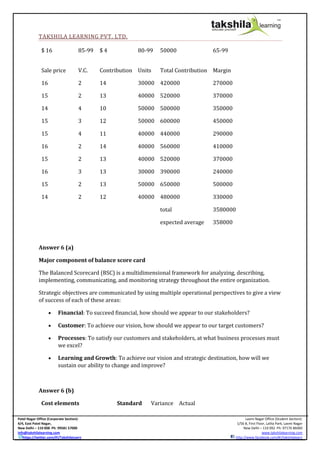
              $ 16                   85-99   $4           80-99   50000              65-99


              Sale price             V.C.    Contribution Units   Total Contribution Margin

              16                     2       14           30000 420000               270000

              15                     2       13           40000 520000               370000

              14                     4       10           50000 500000               350000

              15                     3       12           50000 600000               450000

              15                     4       11           40000 440000               290000

              16                     2       14           40000 560000               410000

              15                     2       13           40000 520000               370000

              16                     3       13           30000 390000               240000

              15                     2       13           50000 650000               500000

              14                     2       12           40000 480000               330000

                                                                  total              3580000

                                                                  expected average   358000


            Answer 6 (a)

            Major component of balance score card

            The Balanced Scorecard (BSC) is a multidimensional framework for analyzing, describing,
            implementing, communicating, and monitoring strategy throughout the entire organization.

            Strategic objectives are communicated by using multiple operational perspectives to give a view
            of success of each of these areas:

                       Financial: To succeed financial, how should we appear to our stakeholders?

                       Customer: To achieve our vision, how should we appear to our target customers?

                       Processes: To satisfy our customers and stakeholders, at what business processes must
                        we excel?

                       Learning and Growth: To achieve our vision and strategic destination, how will we
                        sustain our ability to change and improve?


            Answer 6 (b)

              Cost elements                        Standard   Variance Actual

Patel Nagar Office (Corporate Section):                                                              Laxmi Nagar Office (Student Section):
4/4, East Patel Nagar,                                                                          1/56 B, First Floor, Lalita Park, Laxmi Nagar
New Delhi – 110 008 Ph: 99581 57000                                                                 New Delhi – 110 092 Ph: 97176 86000
info@takshilalearning.com                                                                                        www.takshilalearning.com
   https://twitter.com/#!/TakshilaLearn                                                        http://www.facebook.com/#!/takshilalearn
TAKSHILA LEARNING PVT. LTD.

              material                     $ 1,29,600 6400 A       $ 1,36,000

              Wages                        $ 86,400     1600 A     $ 88,000

              Direct Expenses              $ 14,400     Nil        $ 14,400

              Variable factory overheads   $ 7,200      800 F      $ 6,400

              Fixed factory overheads      $ 8,640      2560 A     $ 11,200

              Administrative overheads     $ 8,640      4160 A     $ 12,800

              Total costs                  $ 2,54,880              $ 2,68,800

              Sales                        $ 2,88,000              $ 2,88,000

              Margin actual                $ 33,120                $ 19,200

                                           Units        Rate       Amount

              Budgeted margin              20000        $ 2.30     $ 46,000

              Less: Volume variance        -5600        $ 2.30     -$ 12,880

              Standard margin              14400                   $ 33,120

              Material variance                                    -$ 6,400

              Wages variance                                       -$ 1,600

              Factory overheads variance                           -$ 1,760

              Administrative overheads                             -$ 4,160

              Actual margin                                        $ 19,200


            Answer 7 (a) – supply chain management is:-

            Supply Chain Strategies are the critical backbone to Business Organizations today. Effective
            Market coverage, Availability of Products at locations which hold the key to revenue recognition
            depends upon the effectiveness of Supply Chain Strategy rolled out. Very simply stated, when a
            product is introduced in the market and advertised, the entire market in the country and all the
            sales counters need to have the product where the customer is able to buy and take delivery.

            Supply chain management (SCM) is the management of a network of interconnected
            businesses involved in the provision of product and service packages required by the end
            customers in a supply chain.

            Answer 7 (b):- linear programming is:-

            Mathematical technique used in computer modeling (simulation) to find the best
            possible solution in allocating limited
            resources (energy, machines, materials, money, personnel, space, time, etc.)
            to achieve maximum profit or minimum cost. However, it is applicable only where
Patel Nagar Office (Corporate Section):                                                         Laxmi Nagar Office (Student Section):
4/4, East Patel Nagar,                                                                     1/56 B, First Floor, Lalita Park, Laxmi Nagar
New Delhi – 110 008 Ph: 99581 57000                                                            New Delhi – 110 092 Ph: 97176 86000
info@takshilalearning.com                                                                                   www.takshilalearning.com
   https://twitter.com/#!/TakshilaLearn                                                   http://www.facebook.com/#!/takshilalearn
TAKSHILA LEARNING PVT. LTD.

            all relationships are linear(see linear relationship), and can accommodate only
            a limited class of cost functions.

            Answer 7 (c):- quality is :-

            "Quality itself has been defined as fundamentally relational: 'Quality is the ongoing process of
            building and sustaining relationships by assessing, anticipating, and fulfilling stated and implied
            needs.' In process improvement efforts, quality costs or cost of quality is a means to quantify
            the total cost of quality-related efforts and deficiencies.

               (1)      Costs of control (Costs of conformance)

               (2)      Costs of failure of control (Costs of non-conformance)

            Answer 7 (d):- Total quality management is:-

            Total Quality Management (TQM) is a comprehensive and structured approach to
            organizational management that seeks to improve the quality of products and services through
            ongoing refinements in response to continuous feedback. TQM requirements may be defined
            separately for a particular organization or may be in adherence to established standards, such
            as the International Organization for Standardization's ISO 9000 series.

            Answer 7 (e):- Kai- Zen is:-

            "change for the better" refers to philosophy or practices that focus upon continuous
            improvement of processes in manufacturing, engineering, and business management. It has
            been applied in healthcare,[1] psychotherapy,[2] life-coaching, government, banking, and other
            industries.

            While kaizen (at Toyota) usually delivers small improvements, the culture of continual aligned
            small improvements and standardization yields large results in the form of compound
            productivity improvement.


            PS – Please feel free to write to us on info@takshilalearning.com for any queries related to the
            question paper, mentioning EPM in the subject line.


Patel Nagar Office (Corporate Section):                                                           Laxmi Nagar Office (Student Section):
4/4, East Patel Nagar,                                                                       1/56 B, First Floor, Lalita Park, Laxmi Nagar
New Delhi – 110 008 Ph: 99581 57000                                                              New Delhi – 110 092 Ph: 97176 86000
info@takshilalearning.com                                                                                     www.takshilalearning.com
   https://twitter.com/#!/TakshilaLearn                                                     http://www.facebook.com/#!/takshilalearn

CWA Final EPM - Solutions - Dec12

  • 1.
    TAKSHILA LEARNING PVT.LTD. Solutions For Management Accounting – Enterprises Performance Management December 2012 Syllabus 2008 by CA Vikrant Rathor Faculty @ Takshila Learning Pvt. Ltd. Patel Nagar Office (Corporate Section): Laxmi Nagar Office (Student Section): 4/4, East Patel Nagar, 1/56 B, First Floor, Lalita Park, Laxmi Nagar New Delhi – 110 008 Ph: 99581 57000 New Delhi – 110 092 Ph: 97176 86000 info@takshilalearning.com www.takshilalearning.com https://twitter.com/#!/TakshilaLearn http://www.facebook.com/#!/takshilalearn
  • 2.
    TAKSHILA LEARNING PVT.LTD. Answer 1 (a) i. False; Value chain concepts (porter model); Value added concepts (JIT) are fundamentally different. ii. True; Decisions under uncertainly are not always obvious. iii. True; Life costing is a technique to establish the total cost of ownership iv. False; Drum is constraint and therefore sets the pace for the drum only v. True; Theory Y style of management is a highly autocratic style. 1 (b) (i) Target cost per unit = Competitive selling price less target margin per unit Selling price at units demand of 20, 000 Price elasticity = $10 reduction with double of volume; Hence price for 80,000 units sale is $ 100 – 10 – 10 = $ 80 Target cost = $ 80 – 25% = $60 per unit. (ii) first unit time = 2 Learning rate is x hence average of two units = 2x Average of first four units = 2x2 Total time of first four units = 8x2 Which is equal to 5.12; hence x = 0.8 hence learning rate is 80%. (iii) Throughput per unit = $ 75 less 30 = $ 45 Throughput per hour = $45/10 x 60 minutes = $270 per hour. (iv) profit are maximum where MR = MC Hence $50 - $ 0.002 x = $ 20; x = 15,000 units At that level selling price will be = $50 - $ 0.001 x (15,000 units) = $35 per unit. (v) profit volume ratio = Fixed cost/Break even sales % = 40% Sales for profit of $50,000 = Desired contribution/PV % = $9,25,000. Answer 1 (c) (i) Not accepting (ii) CRP (iii) Constant Patel Nagar Office (Corporate Section): Laxmi Nagar Office (Student Section): 4/4, East Patel Nagar, 1/56 B, First Floor, Lalita Park, Laxmi Nagar New Delhi – 110 008 Ph: 99581 57000 New Delhi – 110 092 Ph: 97176 86000 info@takshilalearning.com www.takshilalearning.com https://twitter.com/#!/TakshilaLearn http://www.facebook.com/#!/takshilalearn
  • 3.
    TAKSHILA LEARNING PVT.LTD. (iv) Degeneracy (v) S.D. ANSWER 1 (D) (ii) Quality function deployment (QFD) is a “method to transform user demands into design quality, to deploy the functions forming quality, and to deploy methods for achieving the design quality into subsystems and component parts, and ultimately to specific elements of the manufacturing process. (iii) An intranet is a computer network that uses Internet Protocol technology to share information, operational systems, or computing services within an organization. The term is used in contrast to internet, a network between organizations, and instead refers to a network within an organization. (iv) This breakdown is typically in line with the Work Breakdown Structure (WBS); indicating "where" cost are allocated. The breakdown can sometimes be in line with the company's Chart of Accounts, indicating "what" the costs are for. In theory, cost could be in line with "who" is spending the cost, "when" costs are being spent, etc. (v) A quality circle is a volunteer group composed of workers (or even students), usually under the leadership of their supervisor (or an elected team leader), who are trained to identify, analyze and solve work-related problems and present their solutions to management in order to improve the performance of the organization, and motivate and enrich the work of employees. Answer – 2 Life cycle Operating profits Units to be sold & manufacture 50,000 2,00,000 1,50,000 Year I Year II Year III Development costs $ 8,50,000 $ 1,50,000 $0 Production costs Variable $ 8,00,000 $ 30,00,000 $ 22,50,000 Batch level $ 87,500 $ 2,40,000 $ 1,80,000 Fixed $ 5,50,000 $ 5,50,000 $ 5,50,000 Marketing costs Variable $ 1,80,000 $ 6,40,000 $ 4,20,000 Fixed $ 4,00,000 $ 3,00,000 $ 3,00,000 Distribution costs Variable $ 1,50,000 $ 5,00,000 $ 3,75,000 Batch level $ 30,000 $ 1,50,000 $ 1,25,000 Patel Nagar Office (Corporate Section): Laxmi Nagar Office (Student Section): 4/4, East Patel Nagar, 1/56 B, First Floor, Lalita Park, Laxmi Nagar New Delhi – 110 008 Ph: 99581 57000 New Delhi – 110 092 Ph: 97176 86000 info@takshilalearning.com www.takshilalearning.com https://twitter.com/#!/TakshilaLearn http://www.facebook.com/#!/takshilalearn
  • 4.
    TAKSHILA LEARNING PVT.LTD. Fixed $ 2,30,000 $ 2,30,000 $ 2,30,000 Total costs $ 32,77,500 $ 57,60,000 $ 44,30,000 revenues $ 22,50,000 $ 80,00,000 $ 52,50,000 Margins -$ 10,27,500 $ 22,40,000 $ 8,20,000 Overall life cycle margin is $ 20,32,500 Life cycle Operating profits Units to be sold & manufacture 55,000 2,20,000 1,65,000 Year I Year II Year III Development costs $ 8,50,000 $ 1,50,000 $0 Production costs Variable $ 8,80,000 $ 33,00,000 $ 24,75,000 Batch level $ 87,500 $ 2,40,000 $ 1,80,000 Fixed $ 5,50,000 $ 5,50,000 $ 5,50,000 Marketing costs Variable $ 1,98,000 $ 7,04,000 $ 4,62,000 Fixed $ 4,00,000 $ 3,00,000 $ 3,00,000 Distribution costs Variable $ 1,65,000 $ 5,50,000 $ 4,12,500 Batch level $ 30,000 $ 1,50,000 $ 1,25,000 Fixed $ 2,30,000 $ 2,30,000 $ 2,30,000 Total costs $ 33,90,500 $ 61,74,000 $ 47,34,500 revenues $ 23,10,000 $ 81,40,000 $ 52,80,000 Margins -$ 10,80,500 $ 19,66,000 $ 5,45,500 Overall life cycle margin is $ 14,31,000 By reducing selling price and increase volume of 10%, decrease life cycle profitability by 29%. Hence not acceptable. Life cycle costing shall be applied to confirm the overall life viability. However in first year, margins are negative, since costs are more locked up and revenues are shorter, but overall profitability are considerable. Patel Nagar Office (Corporate Section): Laxmi Nagar Office (Student Section): 4/4, East Patel Nagar, 1/56 B, First Floor, Lalita Park, Laxmi Nagar New Delhi – 110 008 Ph: 99581 57000 New Delhi – 110 092 Ph: 97176 86000 info@takshilalearning.com www.takshilalearning.com https://twitter.com/#!/TakshilaLearn http://www.facebook.com/#!/takshilalearn
  • 5.
    TAKSHILA LEARNING PVT.LTD. Answer 3 (a) There are two types of control systems namely: 1. Open loop control systems (non-feedback control systems) 2. Closed loop control systems (feedback control systems) Open loop control system If in a physical system there is no automatic correction of the variation in its output, it is called an open loop control system. That is, in this type of system, sensing of the actual output and comparing of this output (through feedback) with the desired input does not take place. Closed loop control system A closed loop control system is a system where the output has an effect upon the input quantity in such a manner as to maintain the desired output value. Answer 3 (b) Final price received from customer = $ 3,000 Less: Assembly cost $1, 000 Less: Manufacturing cost assembly M $ 500 Less: Extra cost under purchase $ 100 Maximum what we can pay $ 1400 Answer 4 (a) decision tree is Decision tree learning, used in statistics, data mining and machine learning, uses a decision tree as a predictive model which maps observations about an item to conclusions about the item's target value. More descriptive names for such tree models are classification trees or regression trees. In these tree structures, leaves represent class labels and branches represent conjunctions of features that lead to those class labels. In decision analysis, a decision tree can be used to visually and explicitly represent decisions and decision making. In data mining, a decision tree describes data but not decisions; rather the resulting classification tree can be an input for decision making. This page deals with decision trees in data mining. Answer 4 (b) Profit with outflow Profit jp Exp Profit Patel Nagar Office (Corporate Section): Laxmi Nagar Office (Student Section): 4/4, East Patel Nagar, 1/56 B, First Floor, Lalita Park, Laxmi Nagar New Delhi – 110 008 Ph: 99581 57000 New Delhi – 110 092 Ph: 97176 86000 info@takshilalearning.com www.takshilalearning.com https://twitter.com/#!/TakshilaLearn http://www.facebook.com/#!/takshilalearn
  • 6.
    TAKSHILA LEARNING PVT.LTD. SALES High 0.4 1000000 300000 700000 0.24 168000 medium 0.3 600000 300000 300000 0.18 54000 Low 0.2 200000 300000 -100000 0.12 -12000 zero 0.1 -500000 300000 -800000 0.06 -48000 With OT Profit jp 162000 SALES High 0.4 1000000 100000 900000 0.16 144000 medium 0.3 600000 100000 500000 0.12 60000 low 0.2 200000 100000 100000 0.08 8000 zero 0.1 -500000 100000 -600000 0.04 -24000 188000 Hence overtime is more beneficial. Answer 5(a) ERP is effective because Many people say that ERP is the future, that it is completely necessary nowadays. Through these lines we are going to explain several topics regarding why it is so important to use an ERP in order to get organizational efficiency. With or Without ERP An enterprise that has no ERP according to its needs can find many kinds of software that do not allow interaction, and that cannot be customized. For that matter they are not able to optimize the organizational business activities. The engineering design of the software will be needed in order to improve the product, and to follow the client’s behaviour and choices since the first contact is quite important. Administration of the different receipts interdependence will be very complex, such as invoices regarding materials purchases, general expenditures or salaries. All of these things change when you implement ERP. Information flows constantly and allows you to follow a client’s processes at any moment, no matter which part of the process they are going through. Purchases and expenditures are registered in a centralized database which allows you to have close control over these activities. In this regard ERP helps you to prevent possible abuse. Answer 5 (b) Selling price Range V.C. Range Sales volume Range $ 14 00-34 $2 00-29 30000 00-24 $ 15 35-84 $3 30-79 40000 25-64 Patel Nagar Office (Corporate Section): Laxmi Nagar Office (Student Section): 4/4, East Patel Nagar, 1/56 B, First Floor, Lalita Park, Laxmi Nagar New Delhi – 110 008 Ph: 99581 57000 New Delhi – 110 092 Ph: 97176 86000 info@takshilalearning.com www.takshilalearning.com https://twitter.com/#!/TakshilaLearn http://www.facebook.com/#!/takshilalearn
  • 7.
    TAKSHILA LEARNING PVT.LTD. $ 16 85-99 $4 80-99 50000 65-99 Sale price V.C. Contribution Units Total Contribution Margin 16 2 14 30000 420000 270000 15 2 13 40000 520000 370000 14 4 10 50000 500000 350000 15 3 12 50000 600000 450000 15 4 11 40000 440000 290000 16 2 14 40000 560000 410000 15 2 13 40000 520000 370000 16 3 13 30000 390000 240000 15 2 13 50000 650000 500000 14 2 12 40000 480000 330000 total 3580000 expected average 358000 Answer 6 (a) Major component of balance score card The Balanced Scorecard (BSC) is a multidimensional framework for analyzing, describing, implementing, communicating, and monitoring strategy throughout the entire organization. Strategic objectives are communicated by using multiple operational perspectives to give a view of success of each of these areas:  Financial: To succeed financial, how should we appear to our stakeholders?  Customer: To achieve our vision, how should we appear to our target customers?  Processes: To satisfy our customers and stakeholders, at what business processes must we excel?  Learning and Growth: To achieve our vision and strategic destination, how will we sustain our ability to change and improve? Answer 6 (b) Cost elements Standard Variance Actual Patel Nagar Office (Corporate Section): Laxmi Nagar Office (Student Section): 4/4, East Patel Nagar, 1/56 B, First Floor, Lalita Park, Laxmi Nagar New Delhi – 110 008 Ph: 99581 57000 New Delhi – 110 092 Ph: 97176 86000 info@takshilalearning.com www.takshilalearning.com https://twitter.com/#!/TakshilaLearn http://www.facebook.com/#!/takshilalearn
  • 8.
    TAKSHILA LEARNING PVT.LTD. material $ 1,29,600 6400 A $ 1,36,000 Wages $ 86,400 1600 A $ 88,000 Direct Expenses $ 14,400 Nil $ 14,400 Variable factory overheads $ 7,200 800 F $ 6,400 Fixed factory overheads $ 8,640 2560 A $ 11,200 Administrative overheads $ 8,640 4160 A $ 12,800 Total costs $ 2,54,880 $ 2,68,800 Sales $ 2,88,000 $ 2,88,000 Margin actual $ 33,120 $ 19,200 Units Rate Amount Budgeted margin 20000 $ 2.30 $ 46,000 Less: Volume variance -5600 $ 2.30 -$ 12,880 Standard margin 14400 $ 33,120 Material variance -$ 6,400 Wages variance -$ 1,600 Factory overheads variance -$ 1,760 Administrative overheads -$ 4,160 Actual margin $ 19,200 Answer 7 (a) – supply chain management is:- Supply Chain Strategies are the critical backbone to Business Organizations today. Effective Market coverage, Availability of Products at locations which hold the key to revenue recognition depends upon the effectiveness of Supply Chain Strategy rolled out. Very simply stated, when a product is introduced in the market and advertised, the entire market in the country and all the sales counters need to have the product where the customer is able to buy and take delivery. Supply chain management (SCM) is the management of a network of interconnected businesses involved in the provision of product and service packages required by the end customers in a supply chain. Answer 7 (b):- linear programming is:- Mathematical technique used in computer modeling (simulation) to find the best possible solution in allocating limited resources (energy, machines, materials, money, personnel, space, time, etc.) to achieve maximum profit or minimum cost. However, it is applicable only where Patel Nagar Office (Corporate Section): Laxmi Nagar Office (Student Section): 4/4, East Patel Nagar, 1/56 B, First Floor, Lalita Park, Laxmi Nagar New Delhi – 110 008 Ph: 99581 57000 New Delhi – 110 092 Ph: 97176 86000 info@takshilalearning.com www.takshilalearning.com https://twitter.com/#!/TakshilaLearn http://www.facebook.com/#!/takshilalearn
  • 9.
    TAKSHILA LEARNING PVT.LTD. all relationships are linear(see linear relationship), and can accommodate only a limited class of cost functions. Answer 7 (c):- quality is :- "Quality itself has been defined as fundamentally relational: 'Quality is the ongoing process of building and sustaining relationships by assessing, anticipating, and fulfilling stated and implied needs.' In process improvement efforts, quality costs or cost of quality is a means to quantify the total cost of quality-related efforts and deficiencies. (1) Costs of control (Costs of conformance) (2) Costs of failure of control (Costs of non-conformance) Answer 7 (d):- Total quality management is:- Total Quality Management (TQM) is a comprehensive and structured approach to organizational management that seeks to improve the quality of products and services through ongoing refinements in response to continuous feedback. TQM requirements may be defined separately for a particular organization or may be in adherence to established standards, such as the International Organization for Standardization's ISO 9000 series. Answer 7 (e):- Kai- Zen is:- "change for the better" refers to philosophy or practices that focus upon continuous improvement of processes in manufacturing, engineering, and business management. It has been applied in healthcare,[1] psychotherapy,[2] life-coaching, government, banking, and other industries. While kaizen (at Toyota) usually delivers small improvements, the culture of continual aligned small improvements and standardization yields large results in the form of compound productivity improvement. PS – Please feel free to write to us on info@takshilalearning.com for any queries related to the question paper, mentioning EPM in the subject line. Patel Nagar Office (Corporate Section): Laxmi Nagar Office (Student Section): 4/4, East Patel Nagar, 1/56 B, First Floor, Lalita Park, Laxmi Nagar New Delhi – 110 008 Ph: 99581 57000 New Delhi – 110 092 Ph: 97176 86000 info@takshilalearning.com www.takshilalearning.com https://twitter.com/#!/TakshilaLearn http://www.facebook.com/#!/takshilalearn