Running head: EMERGENCY OPERATIONS CENTER EFFECTIVENESS 1
Emergency Operations Center (EOC): Function, Structure, and Effectiveness in Largo, FL
Joseph A. Pennino III
Largo Fire Rescue, Largo, Florida
Publisher and date: Emmitsburg, MD: National Fire Academy, 2018.
URL: https://nfa.usfa.fema.gov/pdf/efop/efo245070.pdf
EMERGENCY OPERATIONS CENTER EFFECTIVENESS 2
Certification Statement
I hereby certify that this paper constitutes my own product, that where the language of others is
set forth, quotation marks so indicate, and that the appropriate credit is given where I have used
the language, ideas, expressions, or writings of another.
Signed: __________________________________
EMERGENCY OPERATIONS CENTER EFFECTIVENESS 3
Abstract
Local governments can have a difficult time organizing the personnel and resources needed to
respond to disasters. The problem was that the City of Largo had not developed effective
standard procedures for the use of its emergency operations center (EOC) which resulted in
inefficient processes and frustration amongst EOC staff. The purpose of this applied research
was to use the descriptive research method to identify industry best practices for EOC operations
to include activation, deactivation, and the appropriate personnel assignments in order to develop
effective standard procedures for the use of Largo’s EOC. The procedures for this research
consisted of a focused literature review followed by the assemblage of data using various sources
including city policy, information from city personnel who served in the City of Largo EOC
during Hurricane Irma, and personal observations. The data were then analyzed to determine (a)
What are the shortcomings of the City of Largo’s EOC operating procedures? (b) What
standards and best practices exist regarding the operation of EOCs? (c) What physical layout is
the most efficacious for EOCs? (d) What roles and responsibilities are necessary to staff the City
of Largo’s EOC? The results highlighted areas within the City of Largo's EOC procedures,
physical layout, and staffing that warrant improvement. Following the analysis,
recommendations were made concerning the development of policy to address EOC activation
and deactivation. Additional suggestions included the formation of project teams to assess the
EOC’s physical layout and to evaluate and refine EOC staffing assignments.
EMERGENCY OPERATIONS CENTER EFFECTIVENESS 4
Table of Contents
Page
Certification Statement ....................................................................................................................2
Abstract............................................................................................................................................3
Table of Contents............................................................................................................................ 4
Introduction..................................................................................................................................... 5
Background and Significance ......................................................................................................... 6
Literature Review.......................................................................................................................... 10
Procedure ...................................................................................................................................... 18
Results........................................................................................................................................... 21
Discussion..................................................................................................................................... 27
Recommendations......................................................................................................................... 35
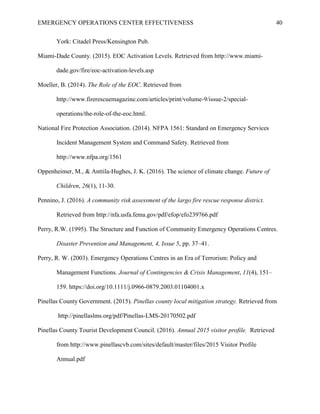
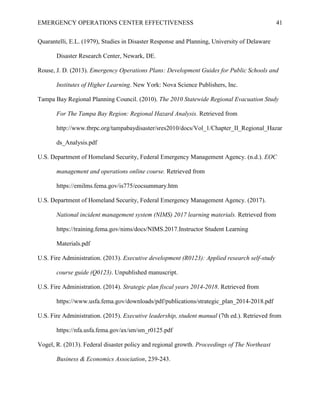
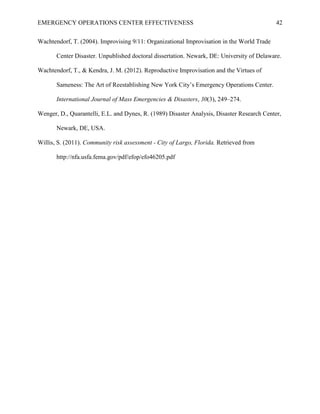
Reference List ............................................................................................................................... 39
Appendices
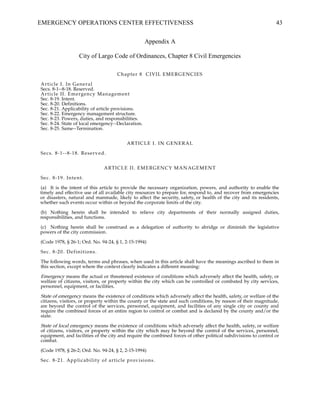
Appendix A. City of Largo Code of Ordinances, Chapter 8 Civil Emergencies..................... 43
Appendix B. City of Largo Administrative Policy EM-17-01, Facility Closures ................... 47
Appendix C. City of Largo EOC Feedback Request Combined Responses............................ 50
List of Figures
Figure 1. Largo Fire Rescue Service Area Map ........................................................................ 7
Figure 2. Radar image of Hurricane Irma.................................................................................. 9
Figure 3. Ways to Facilitate the Training of EOC Staff. ......................................................... 15
Figure 4. The City of Largo’s EOC at Shift Change During Hurricane Irma ......................... 24
EMERGENCY OPERATIONS CENTER EFFECTIVENESS 5
Emergency Operations Center (EOC): Function, Structure, and Effectiveness in Largo, FL
General George S. Patton once said, “Prepare for the unknown by studying how others in
the past have coped with the unforeseeable and the unpredictable” (Lung & Prowant,
2010). Every significant event presents a unique and valuable opportunity for growth and
learning. Concerning the field of emergency management, such events are occurring more and
more frequently. Climate change and global warming have and are anticipated to continue to
make weather-based disasters such as wildfires, hurricanes, landslides, extreme rainfalls, and
flooding more common (Oppenheimer & Anttila-Hughes, 2016). During these disasters, many
local and state governments utilize Emergency Operations Centers (EOCs) as a centralized
headquarters from which to mitigate these events. EOCs can be anything from commandeered
churches that are capable of holding a handful of people to dedicated, purpose-built, hurricane-
rated buildings designed to house dozens of people for weeks at a time.
The National Fire Protection Association defines an EOC as “The physical location at
which the coordination of information and resources to support incident management (on-scene
operations) activities normally takes place” (2014, p. 10). EOCs are a vital component of any
government’s resiliency plan. They are not merely a building, but a place where all essential
government and even private sector personnel come together to lead a business, city, county, or
state through a disaster. However, for an EOC to operate efficiently, it must be organized
correctly and have the necessary equipment and technology. Additionally, the governing body
must have sufficient policies regarding the activation, operation, and deactivation of its EOC.
Perhaps most importantly, for an EOC to function well, it must contain the proper people, who
have received adequate training, and who are serving in the appropriate roles.
The problem was that the City of Largo had not developed effective standard procedures
EMERGENCY OPERATIONS CENTER EFFECTIVENESS 6
for the use of its emergency operations center which has resulted in inefficient processes and
frustration amongst EOC staff. The purpose of this applied research was to use the descriptive
research method to identify industry best practices for EOC operations to include activation,
deactivation, and the appropriate personnel assignments in order to develop effective standard
procedures for the use of Largo’s EOC. The research questions were (a) What are the
shortcomings of the City of Largo’s EOC operating procedures? (b) What standards and best
practices exist regarding the operation of EOCs? (c) What physical layout is the most
efficacious for EOCs? (d) What roles and responsibilities are necessary to staff the City of
Largo’s EOC?
Background and Significance
Incorporated in 1905, the City of Largo is located in central Pinellas County on the west
coast of Florida. It is home to roughly 7,000 businesses and approximately 83,000 people. In
addition to being a popular retirement and seasonal destination, it is the third-largest city in
Pinellas County. Pinellas County’s population is nearly one million, making the county the 6th
most populated as well as the densest county in Florida, with almost 3,500 people per square
mile (Florida Legislature, 2017). Pinellas County’s economy relies heavily on tourism, which
generates more than $9 billion in revenue annually (Pinellas County Tourist Development
Council, 2016).
Largo Fire Rescue was founded in the early 1900s as an all-volunteer department. The
department became fully career-staffed in 1970. Today, the department provides fire protection
and prevention, community education, emergency medical services (EMS), technical rescue and
hazardous materials response, and conducts disaster planning for more than 110,000 residents in
a service area of approximately 30.5 square miles (Largo Fire Rescue, 2017). It maintains an
EMERGENCY OPERATIONS CENTER EFFECTIVENESS 7
Insurance Services Office (ISO) rating of one, employs 142 sworn firefighters, and ten civilian
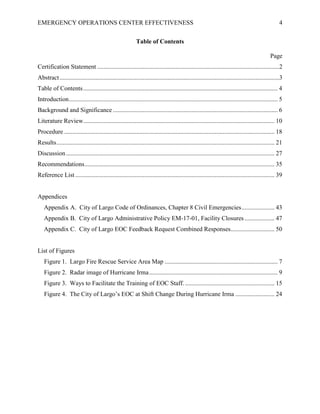
employees. The department’s response district includes the City of Largo, the Highpoint
Community, the Town of Belleair, unincorporated portions of Pinellas County, and the City of
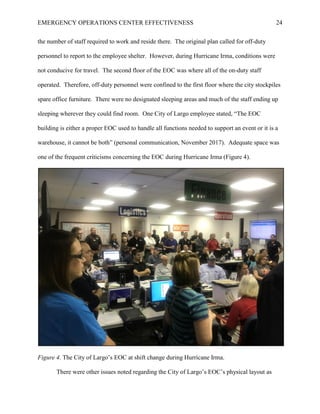
Belleair Bluffs (Figure 1).
Figure 1. Largo Fire Rescue Service Area.
As is ordinarily the case, the fire chief manages the department and directly oversees the
deputy chief. In turn, the deputy chief supervises four division chiefs and serves as the
emergency management coordinator for the city. Additionally, the deputy chief chairs the City
of Largo Disaster Management Group (DMG). The four division chiefs manage fire prevention,
operations, professional standards, and logistics. Combined, these division chiefs direct four
EMERGENCY OPERATIONS CENTER EFFECTIVENESS 8
assistant chiefs and six shift commanders who collectively manage emergency response, special
operations, training, EMS, and fire prevention. Largo Fire Rescue uses a combination of five
advanced life support (ALS) engines, two ALS squads, one ALS truck, three ALS rescues, and
one basic life support (BLS) aerial platform to respond to an excess of 29,000 calls for service
annually. In conjunction with the department’s two shift commanders, these vehicles respond
out of six fire stations. Additionally, Largo Fire Rescue takes part in a multi-hazard automatic
aid program that incorporates the 18 municipal fire departments and independent special fire
districts within Pinellas County. The department is also an active member of both Pinellas
County's Technical Rescue and Hazardous Materials Response Teams.
Largo Fire Rescue’s response district exists within the peninsula of Pinellas County,
which is positioned on the greater peninsula that is the State Florida. Consequently, “The
population, demographics, and geographical location of the Largo Fire Rescue response district
make it susceptible to a variety of different natural and man-made risks” (Pennino, 2016, p. 22).
Some of the inherent natural hazards confronting the City of Largo include floods, tropical
storms and hurricanes, thunderstorms and tornadoes, wildfire, lightning, extreme heat, winter
storms, sinkholes, and disease outbreak (Pinellas County Government, 2015).
Disasters, whether human-made or natural, can devastate a community and cause an
extensive and costly recovery process (Willis, 2011). The abundance of low-income and
retirement mobile home communities that would not be able to withstand hurricane-force winds
further complicates the situation. The City of Largo and the service areas it is contracted to serve
depend on the city’s EOC and the staff who operate it to manage disaster successfully. The lack
of adequate standard procedures outlining the use of the City of Largo’s emergency operations
center has resulted in inefficient processes and frustration amongst EOC staff.
EMERGENCY OPERATIONS CENTER EFFECTIVENESS 9
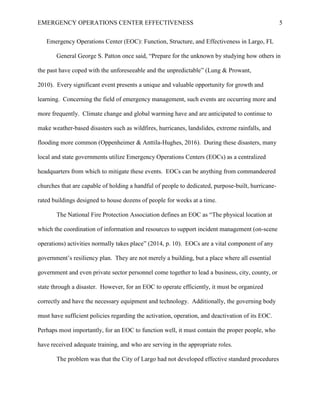
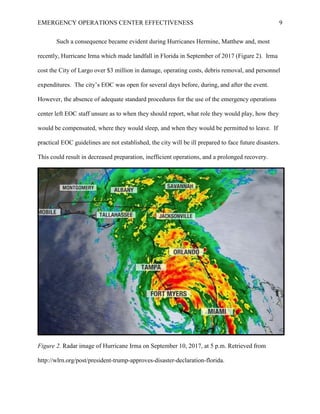
Such a consequence became evident during Hurricanes Hermine, Matthew and, most
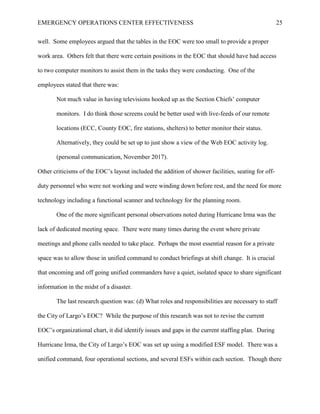
recently, Hurricane Irma which made landfall in Florida in September of 2017 (Figure 2). Irma
cost the City of Largo over $3 million in damage, operating costs, debris removal, and personnel
expenditures. The city’s EOC was open for several days before, during, and after the event.
However, the absence of adequate standard procedures for the use of the emergency operations
center left EOC staff unsure as to when they should report, what role they would play, how they
would be compensated, where they would sleep, and when they would be permitted to leave. If
practical EOC guidelines are not established, the city will be ill prepared to face future disasters.
This could result in decreased preparation, inefficient operations, and a prolonged recovery.
Figure 2. Radar image of Hurricane Irma on September 10, 2017, at 5 p.m. Retrieved from
http://wlrn.org/post/president-trump-approves-disaster-declaration-florida.
EMERGENCY OPERATIONS CENTER EFFECTIVENESS 10
The United States Fire Administration outlines five operational goals in its strategic plan.
This purpose of this research was to particularly accomplish goals one through three, which
include:
1. Reduce Fire and Life Safety Risk Through Preparedness, Prevention and Mitigation
2. Promote Response, Local Planning and Preparedness for All Hazards
3. Enhance the Fire and Emergency Services’ Capability for Response to and Recovery
from All Hazards. (United States Fire Administration, 2014, p. 1).
Additionally, this research directly correlates with the Executive Fire Officer Program’s
Executive Leadership course. One of the goals of the course was for students to learn how to
think systematically as a way to deal with adaptive challenges. Additionally, the course outlined
the need for the Executive Fire Officer (EFO) to acquire the ability to analyze and then
operationalize the fundamental processes and interpersonal skills used by effective executive-
level managers (United States Fire Administration, 2015, p. 458). Finally, this research aligns
with Largo Fire Rescue’s mission statement which asserts, “Largo Fire Rescue is dedicated to
providing education, prevention, and emergency services to safeguard the lives and property of
our community” (Largo Fire Rescue, 2017, p.1).
Literature Review
It is imperative that public servants and elected officials address their organization’s
ability to manage disasters (Tampa Bay Regional Planning Council, 2010). However, before
evaluating the City of Largo's own current EOC practices, policies, and procedures, the findings
of others were reviewed. The literature review for this study was focused on ascertaining
industry best practices for EOC operations to include activation, deactivation, and appropriate
staff assignments. The information gathered aided in determining the weaknesses of the City of
EMERGENCY OPERATIONS CENTER EFFECTIVENESS 11
Largo’s EOC operating procedures, the most effective physical arrangement for EOCs, and the
various roles and responsibilities that might be necessary to staff the City of Largo’s EOC during
times of disaster.
For EOCs to be effective, local governments must have policies in place ahead of time
that address operations and staff functions for before, during and, post-disaster. Wachtendorf
and Kendra stress that “disaster plans are a principal tool for mapping allocation of resources to
problems” (2012, p. 250). An organization will either improvise or follow existing plans
depending on whether or not the plans are suitable and whether personnel are capable of
executing the plans as designed (Wachtendorf, 2004). Lindel, Prater, and Perry acknowledge
that time is usually limited in emergencies and they stress that improvisation consumes more
time than executing preplanned actions (2006).
Worldwide, EOC use and planning still has a long way to go. Wenger, Quarantelli, and
Dynes maintain that the use of EOCs, particularly in smaller organizations, is still sporadic,
occasionally improvisational, and insufficiently understood (1989). Perry attributes this to the
infrequency of largescale incidents, emergency managers’ failure to consider the political aspect
of these emergencies and the public’s need for information, and some emergency managers’
inability to understand the functions of an EOC (2003). Berke and Campanella are advocates of
placing a greater focus on resiliency planning, such as ensuring EOC functionality and
addressing barriers impeding post-disaster resiliency planning (2006).
According to Vogel, local governments often pay too little attention to policies to limit
vulnerability (2013). These policies could relate to anything from emergency management
training, to mitigation strategies, to EOC operations. In fact, Burby suggests that local and
federal governments should focus more energy and resources on emergency preparedness
EMERGENCY OPERATIONS CENTER EFFECTIVENESS 12
planning and routinely update policies as needed (2006). Pinellas County does have a Local
Mitigation Strategy (LMS) to “establish an ongoing process that will make hazard mitigation
part of the daily functioning of the entire community, including both public and private sectors
and our residents themselves” (2015, p. 1).
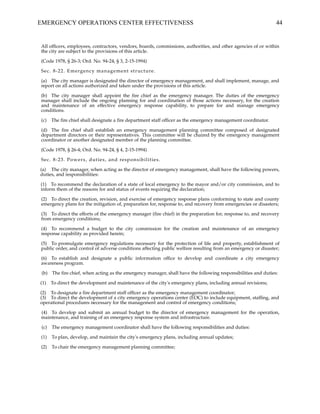
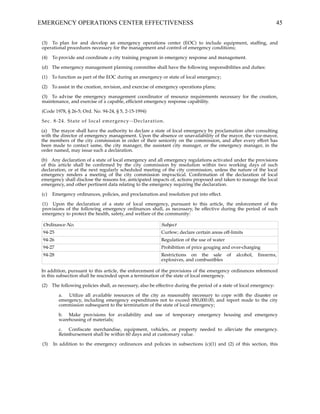
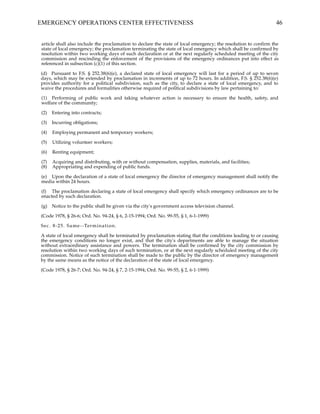
In addition to the DMG and LMS, the city’s code of ordinances references emergency
management responsibilities and disaster procedures (Appendix A). According to the City of
Largo’s Code of Ordinances (Code 1978, § 26-4; Ord. No. 94-24, § 4, 2-15-1994) Sec. 8-23, the
fire chief, when acting as the emergency manager, shall have the following responsibilities and
duties:
1. To direct the development and maintenance of the city's emergency plans, including
annual revisions;
2. To designate a fire department staff officer as the emergency management coordinator;
3. To direct the development of a city emergency operations center (EOC) to include
equipment, staffing, and operational procedures necessary for the management and
control of emergency conditions;
4. To develop and submit an annual budget to the director of emergency management for
the operation, maintenance, and training of an emergency response system and
infrastructure.
The emergency management coordinator (currently the deputy fire chief) shall have the
following responsibilities and duties:
1. To plan, develop, and maintain the city's emergency plans, including annual updates;
2. To chair the emergency management planning committee;
3. To plan for and develop an emergency operations center (EOC) to include equipment,
EMERGENCY OPERATIONS CENTER EFFECTIVENESS 13
staffing, and operational procedures necessary for the management and control of
emergency conditions;
4. To provide and coordinate a city training program in emergency response and
management.
The emergency management planning committee (also known as the DMG) shall have the
following responsibilities and duties:
1. To function as part of the EOC during an emergency or state of local emergency;
2. To assist in the creation, revision, and exercise of emergency operations plans;
3. To advise the emergency management coordinator of resource requirements necessary for
the creation, maintenance, and exercise of a capable, efficient emergency response
capability. (City of Largo, 2008, p. 116).
However, before an organization can even begin to establish or revise specific EOC plans,
policies, or procedures, several essential factors must be considered. According to Rouse, it is
imperative that EOC policy and procedures have support from stakeholders, they must take into
considerations the specific structure of the EOC building, and the plans should be comprehensive
enough to consider a wide variety of hazards (2013).
According to the Department of Homeland Security, an EOC is utilized to support on-
scene mitigation efforts through the prioritization of activities and available resources, not as an
on-scene incident command post focused on specific tactics (n.d.). Furthermore, Quarantelli
believes that an EOC should be able to accomplish six primary functions including coordination,
policy making, operations, information gathering, public information, and visitor hosting (1979).
There are numerous different models for structuring EOCs, most of which are based on
specific agency representation (Perry, 1995). The objective for arranging an EOC is that it will
EMERGENCY OPERATIONS CENTER EFFECTIVENESS 14
ultimately follow, supplement, and espouse the Incident Management System and on-scene
operations (Brunacini, 2002). For example, the Jefferson Transit Authority in Port Townsend,
Washington has a maintenance/facilities officer in their EOC. This individual is responsible for
coordinating the chaining of buses and for the removal of snow at Jefferson Transit Facilities,
shelters, and Park and Ride Lots during winter storm events (Jefferson Transit Authority, 2017).
Agencies in warmer climates, including the City of Largo, would not need these representatives
in their EOC, but may need other specialized positions filled. Primarily, the EOC’s role and
structure are designed to coordinate and integrate multiple agencies to provide a unified response
during an event (Moeller, 2014).
According to the Federal Emergency Management Agency (FEMA), there are typically
four ways to structure an EOC. Emergency operations centers can be organized by significant
management activities, around the Incident Command System (ICS), by Emergency Support
Functions (ESFs), or as a Multiagency Coordination System (MAC) Group (FEMA, n.d.). When
organizing by major activity, the EOC will be comprised of a policy group, a resource group, an
operations group, and a coordination group. Though this configuration is relatively easy to
understand, it does not always pair well with the on-scene ICS structure. Conversely, while
structuring the EOC around the incident command system may provide an easily recognizable
compliment to on-scene operations, it can also lead to confusion regarding who possesses
command authority. Organizing an EOC by ESFs can also allow proper coordination with the
on-scene ICS system. However, this configuration necessitates a substantial amount of training,
and local ESFs do not always parallel state and federal ESFs. Finally, structuring the EOC as a
MAC group can be beneficial when coordination is needed with other MAC entities or when
multi-agency decision-making and coordination is necessary. The downside to this method of
EMERGENCY OPERATIONS CENTER EFFECTIVENESS 15
organizing is that its structure is poorly defined, making it hard to use as a self-sufficient EOC.
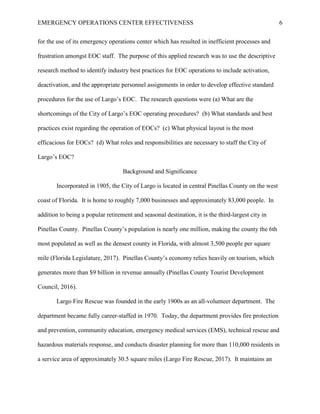
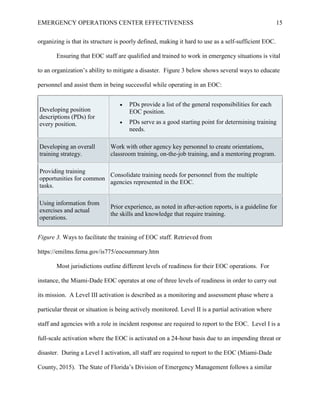
Ensuring that EOC staff are qualified and trained to work in emergency situations is vital
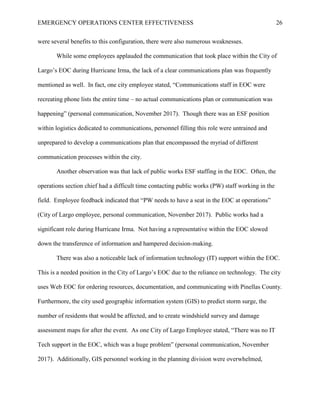
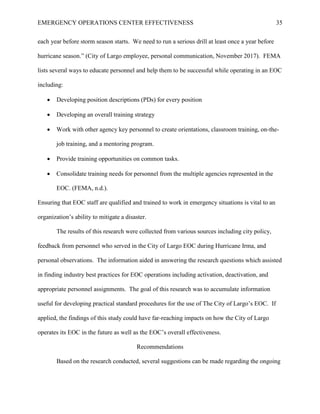
to an organization’s ability to mitigate a disaster. Figure 3 below shows several ways to educate
personnel and assist them in being successful while operating in an EOC:
Developing position
descriptions (PDs) for
every position.
• PDs provide a list of the general responsibilities for each
EOC position.
• PDs serve as a good starting point for determining training
needs.
Developing an overall
training strategy.
Work with other agency key personnel to create orientations,
classroom training, on-the-job training, and a mentoring program.
Providing training
opportunities for common
tasks.
Consolidate training needs for personnel from the multiple
agencies represented in the EOC.
Using information from
exercises and actual
operations.
Prior experience, as noted in after-action reports, is a guideline for
the skills and knowledge that require training.
Figure 3. Ways to facilitate the training of EOC staff. Retrieved from
https://emilms.fema.gov/is775/eocsummary.htm
Most jurisdictions outline different levels of readiness for their EOC operations. For
instance, the Miami-Dade EOC operates at one of three levels of readiness in order to carry out
its mission. A Level III activation is described as a monitoring and assessment phase where a
particular threat or situation is being actively monitored. Level II is a partial activation where
staff and agencies with a role in incident response are required to report to the EOC. Level I is a
full-scale activation where the EOC is activated on a 24-hour basis due to an impending threat or
disaster. During a Level I activation, all staff are required to report to the EOC (Miami-Dade
County, 2015). The State of Florida’s Division of Emergency Management follows a similar
EMERGENCY OPERATIONS CENTER EFFECTIVENESS 16
outline for their EOC activation levels (Florida Division of Emergency Management, 2016).
Additionally, the City of Largo utilizes an equivalent three-level activation scale (City of Largo,
2012)
Determining when to activate the EOC is an essential milestone in the course of an
emergency. According to FEMA’s Emergency Management Institute, “EOCs are activated for
various reasons based on the needs of a jurisdiction, organization, or Incident Commander; the
context of a threat; the anticipation of events; or in response to an incident” (2017). While some
agencies give their emergency manager, city manager, or elected officials discretion as to when
to open the EOC, other organizations follow objective guidelines or trigger points. FEMA’s
Emergency Management Institute positions that, though each jurisdiction’s policy determines
when their EOC may be mobilized, several possible circumstances could elicit an EOC
activation including:
• A Unified Command or Area Command is established.
• More than one jurisdiction becomes involved in a response.
• The Incident Commander indicates an incident could expand rapidly or involve cascading
events.
• A similar incident in the past required EOC activation.
• The Chief Executive Officer (CEO) directs that the EOC should be activated.
• An emergency is imminent… hurricane warnings, slow river flooding, predictions of
hazardous weather, elevated threat levels.
• Threshold events described in the Emergency Operations Plan (EOP) occur. (FEMA,
n.d., para. 2).
The City of Largo’s Comprehensive Emergency Management Plan (CEMP) dictates that the city
EMERGENCY OPERATIONS CENTER EFFECTIVENESS 17
manager, assistant city manager, fire chief, police chief or public works director may order the
activation of the EOC to whatever level may be necessary to support a specific disaster or event
(2012). However, the document does not provide specific instances when the EOC should be
activated, such as the issuance of a hurricane warning or a mass casualty incident.
The design and physical layout of an EOC are crucial to its success. FEMA lists the six
main factors involved in designing an EOC as:
• Accessibility
• Safety
• Size
• Systems Capability
• Survivability
• Versatility (FEMA, n.d.).
The EOC must be accessible to both staff and suppliers. Therefore, care should be taken to
establish EOCs in areas that are protected from as many threats as possible. In Pinellas County,
this would exclude areas that are prone to storm surge. EOCs should be safe for staff, comply
with the Americans with Disabilities Act (ADA), and comply with local building codes (FEMA,
n.d.). Furthermore, the EOC should be able to accommodate the number of people required to
manage large-scale incidents. Space should exist for private planning meetings, and its
configurations must allow for efficient operations, communication, and access to needed
technology.
In addition to accessibility, safety, and size, EOCs must be capable of supporting
extended operations and surviving both natural and manmade disaster. Therefore, they should
possess adequate climate control systems, redundant water supplies, emergency generators
EMERGENCY OPERATIONS CENTER EFFECTIVENESS 18
capable of providing an uninterrupted power supply, and backup communications systems
(FEMA, n.d.). According to FEMA, EOCs can be hot, warm, or cold. Hot EOCs are maintained
in a constant state of readiness but are the most expensive to maintain. Warm facilities have only
critical infrastructure in place, items like computers and utilities may need to be added ahead of
its activation. Cold facilities are the cheapest to maintain but require a significant amount of
work before they can become operational during a disaster (FEMA, n.d.).
The exploration of relevant literature was instrumental in understanding industry best
practices for EOC operations including activation, deactivation, and appropriate staff
assignments. The information gathered aided in determining the shortcomings of the City of
Largo’s EOC operating procedures, the most effective physical arrangement for EOCs, and the
various roles and responsibilities that might be necessary to staff the City of Largo’s EOC during
times of disaster. Without analyzing the conclusions, conceptions, and observances of others,
the research would not have been as concentrated and deliberate.
Procedures
The descriptive research method was employed to ascertain the shortcomings in the
utilization of the City of Largo’s EOC and to determine industry best practices to assist in the
development of effective standard operating procedures. This approach involved gathering
information from city employees who have served in the City of Largo’s EOC during Hurricane
Irma. Additionally, personal observations during Hurricane Irma, during which the City of
Largo’s EOC was activated, were utilized. Finally, the City of Largo's current procedures and
policies regarding EOC operations were analyzed and compared to industry best practices. This
combination of techniques was utilized in order to strengthen the results. It is understood that
gathering data in several ways allows the researcher to add scope and breadth to the research and
EMERGENCY OPERATIONS CENTER EFFECTIVENESS 19
to seek convergence of the results (U.S. Fire Administration, 2013).
The procedures for carrying out this research were concentrated on satisfying the
following four questions: (a) What are the shortcomings of the City of Largo’s EOC operating
procedures? (b) What standards and best practices exist regarding the operation of EOCs? (c)
What physical layout is the most efficacious for EOCs? (d) What roles and responsibilities are
necessary to staff the City of Largo’s EOC? Preliminary research began with a broad
investigation of EOC-related published material. This information was accumulated through
conducting internet searches using Google’s search engine, Google Scholar, and Georgia Library
Learning Online (GALILEO) Scholar, a virtual library available through the University System
of Georgia. City of Largo policies, procedures, and ordinances were also consulted and
evaluated.
Additional information regarding EOC best practices, policies, and procedures was
gleaned from the National Fire Academy in Emmitsburg, Maryland throughout the March 2017
Executive Analysis of Fire Service Operations in Emergency Management and the November
2017 Executive Leadership courses. Edification and literature were received outlining, among
other things, the process for policy evaluation and implementation, how to achieve cooperation
from stakeholders and elected officials, and how to organize and manage an EOC. Additionally,
multiple group activities were undertaken so that students could better comprehend fire
department functions relating to emergency management and the typical functions needed in an
EOC.
Personal observations were accomplished during Hurricane Irma in September of 2017.
Serving as the City of Largo’s emergency management coordinator and as a member of unified
command, it was possible to participate in and study the city’s response before, during, and after
EMERGENCY OPERATIONS CENTER EFFECTIVENESS 20
the storm. It was understood that personal observations can be especially vulnerable to observer
bias and that steps should be taken to guard against partiality. Measures that were implemented
include the maintenance of strict objectivity, reporting all observations (not just those which
were favorable to the research outcomes), not allowing initial impressions to influence
subsequent observations, and being as discreet as possible (U.S. Fire Administration, 2013).
Finally, information was requested from the more than 50 city employees who served in
the City of Largo’s EOC during Hurricane Irma. Members of this group included city
management, department directors and assistant directors, operational managers, and members of
the city’s DMG. These personnel served in various EOC assignments including unified
command, as section chiefs, and various ESFs. The questions developed related to needed
resources and equipment, areas and processes to improve, as well as the areas and processes that
worked well. The questions were emailed to participants, and their responses were kept
anonymous to encourage honesty and to increase participation. These responses are summarized
in Appendix C.
The procedures outlined above aided in establishing the shortcomings in the City of
Largo’s EOC’s performance and in determining industry best practices. These procedures will
assist in the future development of effective standard operating procedures. The most
noteworthy limitation of the study involved the personal observations that took place during
Hurricane Irma. Records and commentary were transcribed for each operational period.
However, the storm was a significant event for the City of Largo and disaster mitigation often
took precedence over documentation. Another limitation included the pursuance of industry best
practices. Though there are many recommendations for EOC configuration, when to activate,
staffing, and the like, it must be acknowledged that each community, city, county, and
EMERGENCY OPERATIONS CENTER EFFECTIVENESS 21
jurisdiction is unique. There is no universal or one-size-fits-all approach to EOC practices,
policies, or procedures.
Results
The research results were derived from information gleaned from those who served in the
City of Largo’s EOC, personal observations during Hurricane Irma, and through the evaluation
of various resources. The first research question was: (a) What are the shortcomings of the City
of Largo’s EOC operating procedures? Perhaps one of the most frequently noted shortcomings
of the City of Largo’s EOC during Hurricane Irma concerned food. It was noted in the employee
feedback that coordination was lacking both at the EOC and at the employee and family shelters.
It was suggested that there should have been a centralized food service unit in the logistics
section. Additionally, city personnel went to the store for food and water the week leading up to
the event. Employee feedback also recommended that the city should “stock up on emergency
supplies seasonally, not just before the storm,” and that “having to make food/water runs right
before a storm takes people away from other duties at a critical time” (City of Largo employee,
personal communication, November 2017).
Another deficiency of the City of Largo’s EOC operating procedures included the
frequency and design of ongoing training. For the past several years, the city’s emergency
management coordinator has developed and executed EOC activation drills. However, many
employees were critical and questioned the extent to which these drills prepared them for an
actual event. Employee feedback included requests for more practical training and the
suggestion that there should be at least one full-blown hurricane drill each year before the start of
storm season (City of Largo employee, personal communication, November 2017). Other
opinions relating to training involved the completion of the various ICS forms. Several
EMERGENCY OPERATIONS CENTER EFFECTIVENESS 22
employees mentioned that, in general, the ICS forms were incomplete and additional education is
needed on how to fill them out correctly. In fact, the city’s assistant finance director spent
several weeks reviewing stacks of ICS forms after the event and sent hundreds back to the
various city departments for correction.
The second research question was: (b) What standards and best practices exist regarding
the operation of EOCs? The first observation related to this question involved the most
appropriate time to activate and deactivate the EOC. Current city policy dictates opening the
EOC when a hurricane warning is issued for the area. However, this may be too late. During
Hurricane Irma, it was noted that the EOC both activated too late and deactivated too early. This
created difficulties when trying to organize tasks and resources. The week leading up to
Hurricane Irma’s landfall, city administration decided to begin holding daily Executive
Leadership Team (ELT) meetings. These meetings consisted of city administration and the
various city department directors. The meetings migrated into planning meetings where the fire
chief would update city staff on storm events, forecasts, and updates from Pinellas County’s
EOC. While the expectation was that department staff would return and disseminate the
information, this was not the case. In hindsight, the City of Largo should have activated its EOC
as soon as Pinellas County was forecasted within the cone of uncertainty. One city employee
stated, “There were Executive Leadership Team (ELT) meetings leading up to the event.
Instead, the EOC should have been opened sooner, and unified command should have been used
during the planning phase” (City of Largo employee, personal communication, November 2017).
The City of Largo closed its EOC the day after Hurricane Irma impacted the city. Many
employees had been detained for several days and were anxious to go home, while city officials
were restless to have the city to resume normal services. However, the decision to close the
EMERGENCY OPERATIONS CENTER EFFECTIVENESS 23
EOC may have been made in haste. Though the winds died down and the rain stopped, the lull
in calls for service was not an indicator of things to come. Over the next 24 to 48 hours, the fire
department responded to three-times the number of incidents it was accustomed to. Most of the
incidents were related to power surges, arching power lines, and fires caused by the restoration
of power. Fire department employees later recommended to “Continue to staff storm units for a
couple of days after the event. There was a significant call load on the days following that were
of the low priority nature” personal communication, November 2017).
Not only was the city inundated with low-priority fire and emergency medical services
calls following the storm, but it was also bombarded with requests from the Pinellas County
EOC. Dozens of Largo residents were transported to shelters located in public schools before the
storm. Many of these residents lived in mobile homes which were especially susceptible to
hurricane-force winds. Some of these residents could not evacuate on their own and were reliant
on power to run their medical devices or home oxygen systems. After the storm, the school
board wanted to prepare the schools to open and needed the evacuees out. However, before
these residents could return home, city staff had to ensure their homes were tenable. Each day,
the fire department received a list of addresses from the county’s EOC that it was required to
check and report back on. Also, people were calling from out of state asking about family
members that lived in the City of Largo whom they had not heard from. Since the city had
already closed its EOC, this workload could not easily be coordinated and distributed.
Therefore, all of these operations were run out of the City of Largo’s fire administration offices.
Collectively, this increased workload added a tremendous strain on the fire department.
The third research question was: (c) What physical layout is the most efficacious for
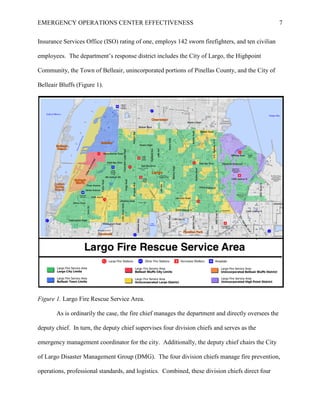
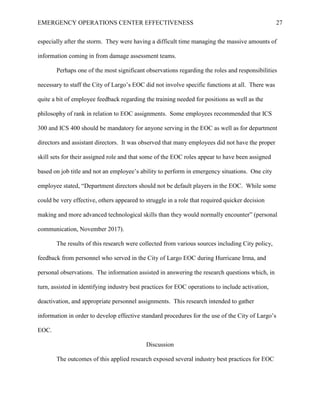
EOCs? The City of Largo’s EOC building itself was also often criticized for being too small for
EMERGENCY OPERATIONS CENTER EFFECTIVENESS 24
the number of staff required to work and reside there. The original plan called for off-duty
personnel to report to the employee shelter. However, during Hurricane Irma, conditions were
not conducive for travel. The second floor of the EOC was where all of the on-duty staff
operated. Therefore, off-duty personnel were confined to the first floor where the city stockpiles
spare office furniture. There were no designated sleeping areas and much of the staff ending up
sleeping wherever they could find room. One City of Largo employee stated, “The EOC
building is either a proper EOC used to handle all functions needed to support an event or it is a
warehouse, it cannot be both” (personal communication, November 2017). Adequate space was
one of the frequent criticisms concerning the EOC during Hurricane Irma (Figure 4).
Figure 4. The City of Largo’s EOC at shift change during Hurricane Irma.
There were other issues noted regarding the City of Largo’s EOC’s physical layout as
EMERGENCY OPERATIONS CENTER EFFECTIVENESS 25
well. Some employees argued that the tables in the EOC were too small to provide a proper
work area. Others felt that there were certain positions in the EOC that should have had access
to two computer monitors to assist them in the tasks they were conducting. One of the
employees stated that there was:
Not much value in having televisions hooked up as the Section Chiefs’ computer
monitors. I do think those screens could be better used with live-feeds of our remote
locations (ECC, County EOC, fire stations, shelters) to better monitor their status.
Alternatively, they could be set up to just show a view of the Web EOC activity log.
(personal communication, November 2017).
Other criticisms of the EOC’s layout included the addition of shower facilities, seating for off-
duty personnel who were not working and were winding down before rest, and the need for more
technology including a functional scanner and technology for the planning room.
One of the more significant personal observations noted during Hurricane Irma was the
lack of dedicated meeting space. There were many times during the event where private
meetings and phone calls needed to take place. Perhaps the most essential reason for a private
space was to allow those in unified command to conduct briefings at shift change. It is crucial
that oncoming and off going unified commanders have a quiet, isolated space to share significant
information in the midst of a disaster.
The last research question was: (d) What roles and responsibilities are necessary to staff
the City of Largo’s EOC? While the purpose of this research was not to revise the current
EOC’s organizational chart, it did identify issues and gaps in the current staffing plan. During
Hurricane Irma, the City of Largo’s EOC was set up using a modified ESF model. There was a
unified command, four operational sections, and several ESFs within each section. Though there
EMERGENCY OPERATIONS CENTER EFFECTIVENESS 26
were several benefits to this configuration, there were also numerous weaknesses.
While some employees applauded the communication that took place within the City of
Largo’s EOC during Hurricane Irma, the lack of a clear communications plan was frequently
mentioned as well. In fact, one city employee stated, “Communications staff in EOC were
recreating phone lists the entire time – no actual communications plan or communication was
happening” (personal communication, November 2017). Though there was an ESF position
within logistics dedicated to communications, personnel filling this role were untrained and
unprepared to develop a communications plan that encompassed the myriad of different
communication processes within the city.
Another observation was that lack of public works ESF staffing in the EOC. Often, the
operations section chief had a difficult time contacting public works (PW) staff working in the
field. Employee feedback indicated that “PW needs to have a seat in the EOC at operations”
(City of Largo employee, personal communication, November 2017). Public works had a
significant role during Hurricane Irma. Not having a representative within the EOC slowed
down the transference of information and hampered decision-making.
There was also a noticeable lack of information technology (IT) support within the EOC.
This is a needed position in the City of Largo’s EOC due to the reliance on technology. The city
uses Web EOC for ordering resources, documentation, and communicating with Pinellas County.
Furthermore, the city used geographic information system (GIS) to predict storm surge, the
number of residents that would be affected, and to create windshield survey and damage
assessment maps for after the event. As one City of Largo Employee stated, “There was no IT
Tech support in the EOC, which was a huge problem” (personal communication, November
2017). Additionally, GIS personnel working in the planning division were overwhelmed,
EMERGENCY OPERATIONS CENTER EFFECTIVENESS 27
especially after the storm. They were having a difficult time managing the massive amounts of
information coming in from damage assessment teams.
Perhaps one of the most significant observations regarding the roles and responsibilities
necessary to staff the City of Largo’s EOC did not involve specific functions at all. There was
quite a bit of employee feedback regarding the training needed for positions as well as the
philosophy of rank in relation to EOC assignments. Some employees recommended that ICS
300 and ICS 400 should be mandatory for anyone serving in the EOC as well as for department
directors and assistant directors. It was observed that many employees did not have the proper
skill sets for their assigned role and that some of the EOC roles appear to have been assigned
based on job title and not an employee’s ability to perform in emergency situations. One city
employee stated, “Department directors should not be default players in the EOC. While some
could be very effective, others appeared to struggle in a role that required quicker decision
making and more advanced technological skills than they would normally encounter” (personal
communication, November 2017).
The results of this research were collected from various sources including City policy,
feedback from personnel who served in the City of Largo EOC during Hurricane Irma, and
personal observations. The information assisted in answering the research questions which, in
turn, assisted in identifying industry best practices for EOC operations to include activation,
deactivation, and appropriate personnel assignments. This research intended to gather
information in order to develop effective standard procedures for the use of the City of Largo’s
EOC.
Discussion
The outcomes of this applied research exposed several industry best practices for EOC
EMERGENCY OPERATIONS CENTER EFFECTIVENESS 28
operations. Procedures that relate, not only to the activation and deactivation triggers for EOCs,
but also to the appropriate personnel assignments needed. It is imperative that governments have
plans in place beforehand that outline operations and staff functions for prior, during and, post-
disaster. According to Wachtendorf and Kendra “disaster plans are a principal tool for mapping
allocation of resources to problems” (2012, p. 250). If plans are well thought out, and staff are
trained to execute them, they will be followed. Otherwise, personnel are likely to improvise
(Wachtendorf, 2004). Improvisation is costly and can devour precious time, which is usually in
short supply during times of emergency (Lindel, Prater, & Perry, 2006).
According to Vogel, local governments often pay too little attention to policies to limit
vulnerability (2013). Burby suggests that local and federal governments should focus more
energy and resources on emergency preparedness planning and routinely update policies as
needed (2006). Berke and Campanella are advocates of placing a greater focus on resiliency
planning, such as ensuring EOC functionality and addressing barriers impeding post-disaster
resiliency planning (2006). The City of Largo accomplishes this by maintaining a Disaster
Mitigation Group (DMG). This emergency management planning committee is chaired by
Deputy Fire Chief Joseph Pennino and meets monthly concerning emergency preparedness and
certain EOC related operations. Additionally, City of Largo personnel have and continue to
participate in the development of Pinellas County’s Local Mitigation Strategy (LMS).
According to Pinellas County, “The purpose of the Local Mitigation Strategy is to establish an
ongoing process that will make hazard mitigation part of the daily functioning of the entire
community, including both public and private sectors and our residents themselves” (2015, p. 1).
According to Rouse, it is imperative that EOC policy and procedures have support from
stakeholders. Moreover, plans must take into considerations the specific structure of the EOC
EMERGENCY OPERATIONS CENTER EFFECTIVENESS 29
building and should be extensive enough to encompass a wide array of hazards (2013). During
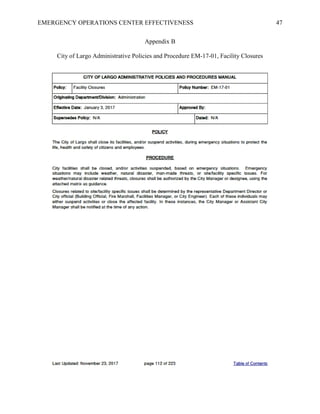
Hurricane Irma, the City of Largo followed several of its pre-existing written plans. One of these
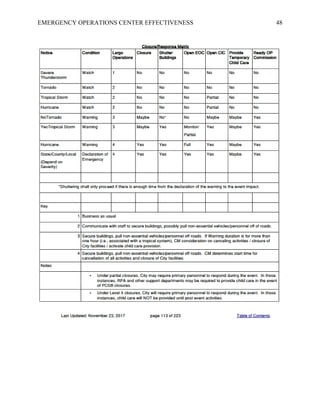
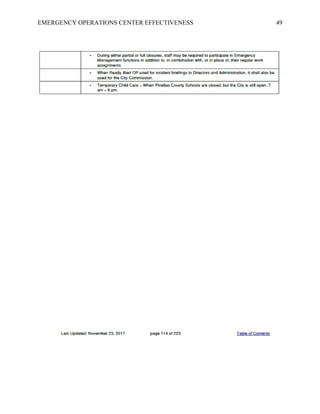
plans included when certain facilities were closed and shuttered (Appendix B). For instance,
during a hurricane warning, city buildings should be secured, and all non-essential vehicles and
personnel should be taken off the roads (City of Largo, 2017). Other plans, such as where off-
duty EOC personnel would sleep, did not exist. Therefore, off-duty EOC staff had to improvise,
sleeping wherever they could find space.
According to Wenger, Quarantelli, and Dynes, the use of EOCs, particularly in smaller
organizations, is still not standardized (1989). This could be partially attributed to the rarity of
large-scale incidents and some emergency managers’ failure to understand the full purpose of an
EOC (Perry, 2003). FEMA’s Emergency Management Institute states, “EOCs are activated for
various reasons based on the needs of a jurisdiction, organization, or Incident Commander; the
context of a threat; the anticipation of events; or in response to an incident” (2017). Although it
is probable that each jurisdiction has their own policy as to when their EOC may be mobilized,
there are several possible conditions that FEMA suggests would provoke an EOC activation
including:
• A Unified Command or Area Command is established.
• More than one jurisdiction becomes involved in a response.
• The Incident Commander indicates an incident could expand rapidly or involve cascading
events.
• A similar incident in the past required EOC activation.
• The Chief Executive Officer (CEO) directs that the EOC should be activated.
• An emergency is imminent… hurricane warnings, slow river flooding, predictions of
EMERGENCY OPERATIONS CENTER EFFECTIVENESS 30
hazardous weather, elevated threat levels.
• Threshold events described in the Emergency Operations Plan (EOP) occur. (FEMA,
n.d., para. 2).
The City of Largo’s Comprehensive Emergency Management Plan (CEMP) dictates that the city
manager, assistant city manager, fire chief, police chief or public works director may order the
activation of the EOC to whatever level may be necessary to support a specific disaster or event
(2012). However, the document does not provide specific circumstances when the EOC should
be activated.
During Hurricane Irma, it was noted that the City of Largo’s EOC appeared to remain
open for as short of time as possible. City staff stated, “There were Executive Leadership Team
(ELT) meetings leading up to the event. Instead, the EOC should have been opened sooner, and
unified command should have been used during the planning phase” (City of Largo employee,
personal communication, November 2017). Furthermore, after the storm passed, the fire
department was besieged with calls for services and saddled with additional storm-related
responsibilities for several days. City employee feedback included, “Continue to staff storm
units for a couple of days after the event. There was a significant call load on the days following
that were of the low priority nature” (personal communication, November 2017). Research and
prior experience suggest that it would be wise to at least partially open the EOC as soon as the
local area is forecasted within the cone of uncertainty and to delay closing it until city
departments completely resume normal operations.
Personal observation and employee feedback exposed several shortcomings of the City of
Largo’s EOC during Hurricane Irma. Employees suggested that there should have been a
centralized food service unit in the logistics section which is congruent with FEMA’s
EMERGENCY OPERATIONS CENTER EFFECTIVENESS 31
recommendation for EOCs (FEMA, n.d.). This would have prevented the EOC and remote city
locations from having to deal with food supplies separately. City personnel went to the store for
food and water immediately before the event. It was suggested that the city should “stock up on
emergency supplies seasonally, not just before the storm,” and that “having to make food/water
runs right before a storm takes people away from other duties at a critical time” (City of Largo
employee, personal communication, November 2017).
The design and physical layout of an EOC are also crucial to its success. EOC’s must be
accessible to both staff and suppliers. Therefore, it is imperative they are established in areas
that are protected from as many threats as possible. EOCs should be safe for staff, comply with
the Americans with Disabilities Act (ADA), and comply with local building codes (FEMA, n.d.).
Furthermore, the EOC should be able to accommodate the number of people required to manage
large-scale incidents. Lastly, space should exist to accommodate private planning meetings, and
its configurations must allow for efficient operations, communication, and access to needed
technology.
In addition to accessibility, safety, and size, EOCs must be capable of supporting
extended operations and surviving both natural and manmade disaster. Therefore, they should
possess adequate climate control systems, redundant water supplies, emergency generators
capable of providing an uninterrupted power supply, and backup communications systems
(FEMA, n.d.). The City of Largo’s EOC building itself was often criticized for being too small
for the number of staff required to work and reside there. The original plan called for off-duty
personnel to report to the employee shelter. However, during Hurricane Irma, conditions were
not conducive for travel. The second floor of the EOC is where all of the on-duty staff were
operating. Therefore, off-duty personnel were confined to the first floor where the city
EMERGENCY OPERATIONS CENTER EFFECTIVENESS 32
stockpiles spare office furniture. There were no assigned sleeping areas so personnel ending up
sleeping wherever they could find room. One City of Largo employee stated, “The EOC
building is either a proper EOC used to handle all functions needed to support an event, or it is a
warehouse, it cannot be both” (personal communication, November 2017).
Also regarding the EOC’s physical layout, some employees contended that the tables
were not big enough to provide adequate working space and that some positions should have had
access to dual computer monitors. One of the employees stated that there was:
Not much value in having televisions hooked up as the Section Chiefs’ computer
monitors. I do think those screens could be better used with live-feeds of our remote
locations (ECC, County EOC, fire stations, shelters) to better monitor their status.
Alternatively, they could be set up to just show a view of the Web EOC activity log.
(personal communication, November 2017).
Other recommendations for the EOC’s layout included the addition of shower facilities, seating
for off-duty personnel who are not working and winding down before rest, and the need for more
technology including a functional scanner and technology for the planning room.
Additional isolated meeting space was one of the more noteworthy personal observations
noted during Hurricane Irma. Without such space, it is very difficult to hold private meetings or
to make confidential phone calls. Possibly the most important reason for adequate private
meeting space was to allow those in unified command to conduct briefings at shift change.
Members of oncoming and off going unified command need a calm, secluded space to share
significant information during shift change.
The applied research also exposed problems with the present City of Largo EOC staffing
plan and the roles and responsibilities that are needed. According to FEMA, there are typically
EMERGENCY OPERATIONS CENTER EFFECTIVENESS 33
four ways to structure an EOC. They can be organized by major management activities, around
the Incident Command System (ICS), by Emergency Support Functions (ESFs), or as a
Multiagency Coordination System (MAC) Group (FEMA, n.d.). During Hurricane Irma, the
City of Largo’s EOC was set up using a modified ESF model. It included a unified command
made up of the city manager/assistant city manager, fire chief/deputy fire chief, police
chief/deputy police chief, and public works director/assistant public works director.
Additionally, EOC staffing included section chiefs for planning, operations, finance, and
logistics. There was also a safety officer and a liaison to Pinellas County who reported to the
county EOC once it was activated.
While some employees commended the interaction that took place within the City of
Largo’s EOC during Hurricane Irma, others condemned the lack of a clear communication and
the inexistence of a clear communications plan. One city employee wrote, “Communications
staff in EOC were recreating phone lists the entire time – no actual communications plan or
communication was happening” (personal communication, November 2017). There was an ESF
position within the logistics section dedicated to communications. However, the specific staff
who filled this role were unprepared to develop the complicated communications plan that was
required to include all of the city’s different communication methods.
Another observation was that lack of public works ESF staffing in the EOC. Often, the
operations section chief had a difficult time contacting PW staff working in the field. Employee
feedback indicated that “PW needs to have a seat in the EOC at operations” (City of Largo
employee, personal communication, November 2017). During a hurricane, public works has a
significant role before, during, and after the storm. It is imperative that staff be available at the
EOC to participate in planning, decision-making, and operations. The EOC’s primary role and,
EMERGENCY OPERATIONS CENTER EFFECTIVENESS 34
the driving force behind its structure, is to coordinate and integrate multiple agencies to provide a
unified response (Moeller, 2014). Having representatives offsite delays the dissemination of
information and puts unified command at a disadvantage.
There was also a noticeable lack of information technology (IT) support within the EOC.
The lack of IT technical support in the EOC was a problem (personal communication, November
2017). This is a needed position in the City of Largo’s EOC due to the city’s reliance on
technology. Furthermore, GIS personnel were inundated after the storm with information
coming in from the damage assessment teams. Relating to shortages in specific EOC positions
Perry explains that, although there are several different ways to structure an EOC, care must be
taken to determine what specific agency representation is required (1995).
The principles involving how EOCs are staffed and what training staff members receive
vary from one organization to the next. Some of the feedback received from City of Largo
employees suggested that department directors, assistant directors, and anyone serving in the
EOC should be required to have ICS 300 and ICS 400. It was apparent during Hurricane Irma
that many employees’ strengths were not aligned with their assigned role in the EOC.
Additionally, some of the EOC positions were appointed based on job title as opposed to
individual ability. As one city employee stated, “Department directors should not be default
players in the EOC. While some could be very effective, others appeared to struggle in a role
that required quicker decision making and more advanced technological skills than they would
normally encounter” (personal communication, November 2017).
Though training is conducted annually by the city’s emergency management coordinator,
many employees felt it had not prepared them for an actual event. Employee feedback included
“More practical training is needed. Should be running at least one full-blown hurricane drill
EMERGENCY OPERATIONS CENTER EFFECTIVENESS 35
each year before storm season starts. We need to run a serious drill at least once a year before
hurricane season.” (City of Largo employee, personal communication, November 2017). FEMA
lists several ways to educate personnel and help them to be successful while operating in an EOC
including:
• Developing position descriptions (PDs) for every position
• Developing an overall training strategy
• Work with other agency key personnel to create orientations, classroom training, on-the-
job training, and a mentoring program.
• Provide training opportunities on common tasks.
• Consolidate training needs for personnel from the multiple agencies represented in the
EOC. (FEMA, n.d.).
Ensuring that EOC staff are qualified and trained to work in emergency situations is vital to an
organization’s ability to mitigate a disaster.
The results of this research were collected from various sources including city policy,
feedback from personnel who served in the City of Largo EOC during Hurricane Irma, and
personal observations. The information aided in answering the research questions which assisted
in finding industry best practices for EOC operations including activation, deactivation, and
appropriate personnel assignments. The goal of this research was to accumulate information
useful for developing practical standard procedures for the use of The City of Largo’s EOC. If
applied, the findings of this study could have far-reaching impacts on how the City of Largo
operates its EOC in the future as well as the EOC’s overall effectiveness.
Recommendations
Based on the research conducted, several suggestions can be made regarding the ongoing
EMERGENCY OPERATIONS CENTER EFFECTIVENESS 36
analysis of the City of Largo’s EOC policies and procedures as well as prudent next steps. In the
short-term, the City of Largo should continue to adopt a philosophy of citywide emergency
preparedness. Historically, as exemplified in the city’s code of ordinances, the fire department
has taken on the lion’s share of emergency management. This is not only dangerous, but it is
unrealistic. Though fire departments are typically well-trained in the National Incident
Management System and tend to work well under pressure, most do not have the resources to
expand their operations to cover all of the citywide emergency management functions required
during an EOC activation.
The City of Largo’s current policy regarding EOC operations is lacking. Clear and
objective measures should be adopted as to when the EOC should be activated and to what level.
Current city culture places a heavy emphasis on keeping city operations functioning as normal.
Though it is desirable to have recreation centers open to the public and allow businesses to apply
for permits the week leading up to a hurricane’s landfall, perhaps the more judicious course of
action would be to halt routine operations and transition into a mode of citywide planning and
preparation as soon as a threat is recognized. Policy should also include who reports to the EOC
during each level of activation and who is responsible for communicating both intra and inter-
departmentally. The City of Largo’s disaster management group should develop several
subcommittees to work on developing this policy.
Having an EOC that this capable of supporting long-term operations is crucial to a city’s
ability to mitigate disaster. The City of Largo’s current EOC is too small for the number of staff
required to work and reside there and lacks the physical layout necessary to support efficient
operations. The ground floor of the building is currently being used for storage leaving no room
for off-duty personnel to congregate, eat, or sleep. Additionally, several technological needs
EMERGENCY OPERATIONS CENTER EFFECTIVENESS 37
were identified during Hurricane Irma and in the employee feedback provided afterward. The
current EOC configuration lacks shower facilities, adequate kitchen and dining areas, and private
meeting space. The City of Largo’s city administration, emergency management staff, and
facilities personnel should work collectively to clean out the current EOC and rearrange it so that
it can support long-term emergency operations.
The final recommendation involves the City of Largo’s EOC staffing. Observations and
feedback from Hurricane Irma indicate that there are several positions in the City of Largo’s
EOC that are either not needed, understaffed, or staffed with the wrong people. Moving forward,
the city’s emergency management staff should meet with unified command, city administration,
and all of the section chiefs to complete an in-depth evaluation of each position within the EOC
and whether it fits the needs of the city. Some positions may need to be added, while others can
be discontinued or moved to other sections to make them more productive. Additionally, this
group will need to have the courage and support to evaluate the people serving in the EOC and
make changes to better align individual strengths with specific position requirements. Once
these assignments are made, city administration must assist emergency management staff in
mandating that personnel assigned to the EOC attend outside training. Pinellas County offers a
tremendous amount of relevant free courses at their emergency services complex in the City of
Largo. Additionally, section chiefs, elected officials, and city management would benefit
significantly by attending FEMA’s Emergency Management Institute (EMI).
The development of effective standard procedures for the use of its emergency operations
center will not happen overnight. Clearing out the City of Largo’s EOC and rearranging it to be
more efficient will take time and money. Furthermore, there is no easy way to train all city staff
to become, and to remain, well-versed in emergency operations. However, the City of Largo can
EMERGENCY OPERATIONS CENTER EFFECTIVENESS 38
adopt a culture of preparedness when it comes to emergency management. If elected officials,
city administration, and department directors are dedicated resiliency, the rest will likely follow.
Readers wishing to conduct similar research should keep in mind that even the best laid plans are
often found to be imperfect when exercised. For those who have not participated in an actual
EOC activation, it is highly encouraged that you reach out to someone who has. For it is at the
intersection of arduous research and actual EOC experience where policy, plans, and procedures
can best be cultivated.
EMERGENCY OPERATIONS CENTER EFFECTIVENESS 39
References
Berke, P. R. and T. J. Campanella. (2006). Planning for postdisaster resiliency. Annals of the
American Academy of Political and Social Science, 604, 192-207.
Brunacini, A. (2002). Fire Command Second Edition, National Fire Protection Association,
Quincy, MA.
Burby, R. J. (2006). Hurricane Katrina and the paradoxes of government disaster policy:
Bringing about wise governmental decisions for hazardous areas. Annals of the American
Academy of Political and Social Science, 604, 171- 191.
City of Largo. (2008). Code of ordinances. Retrieved from
http://www.largo.com/egov/documents/1491422728_51674.pdf
City of Largo. (2012). Comprehensive emergency management plan. Unpublished manuscript.
City of Largo. (2017). Administrative policies and procedures manual, updated November 23,
2017. Retrieved from http://www.largo.com/egov/documents/1511878936_486.pdf
Department of Homeland Security. (n.d.). Incident Management. Retrieved from
https://www.ready.gov/business/implementation/incident
Florida Division of Emergency Management. (2016). State Emergency Operations Center
Activation Levels. Retrieved from https://www.floridadisaster.org/eoc/eoclevel.htm
Jefferson Transit Authority. (2017). 2017-18 Emergency Operations Plan. Retrieved from
https://jeffersontransit.com/wp-content/uploads/2017/12/2017-Emergency-Operations-
Plan.pdf
Largo Fire Rescue. (2017). 2016 annual report. Retrieved from
http://www.largo.com/egov/documents/1492618783_98004.pdf
Lung, H., & Prowant, C. B. (2010). Mind warrior: strategies for total mental domination. New
EMERGENCY OPERATIONS CENTER EFFECTIVENESS 40
York: Citadel Press/Kensington Pub.
Miami-Dade County. (2015). EOC Activation Levels. Retrieved from http://www.miami-
dade.gov/fire/eoc-activation-levels.asp
Moeller, B. (2014). The Role of the EOC. Retrieved from
http://www.firerescuemagazine.com/articles/print/volume-9/issue-2/special-
operations/the-role-of-the-eoc.html.
National Fire Protection Association. (2014). NFPA 1561: Standard on Emergency Services
Incident Management System and Command Safety. Retrieved from
http://www.nfpa.org/1561
Oppenheimer, M., & Anttila-Hughes, J. K. (2016). The science of climate change. Future of
Children, 26(1), 11-30.
Pennino, J. (2016). A community risk assessment of the largo fire rescue response district.
Retrieved from http://nfa.usfa.fema.gov/pdf/efop/efo239766.pdf
Perry, R.W. (1995). The Structure and Function of Community Emergency Operations Centres.
Disaster Prevention and Management, 4, Issue 5, pp. 37–41.
Perry, R. W. (2003). Emergency Operations Centres in an Era of Terrorism: Policy and
Management Functions. Journal of Contingencies & Crisis Management, 11(4), 151–
159. https://doi.org/10.1111/j.0966-0879.2003.01104001.x
Pinellas County Government. (2015). Pinellas county local mitigation strategy. Retrieved from
http://pinellaslms.org/pdf/Pinellas-LMS-20170502.pdf
Pinellas County Tourist Development Council. (2016). Annual 2015 visitor profile. Retrieved
from http://www.pinellascvb.com/sites/default/master/files/2015 Visitor Profile
Annual.pdf
EMERGENCY OPERATIONS CENTER EFFECTIVENESS 41
Quarantelli, E.L. (1979), Studies in Disaster Response and Planning, University of Delaware
Disaster Research Center, Newark, DE.
Rouse, J. D. (2013). Emergency Operations Plans: Development Guides for Public Schools and
Institutes of Higher Learning. New York: Nova Science Publishers, Inc.
Tampa Bay Regional Planning Council. (2010). The 2010 Statewide Regional Evacuation Study
For The Tampa Bay Region: Regional Hazard Analysis. Retrieved from
http://www.tbrpc.org/tampabaydisaster/sres2010/docs/Vol_1/Chapter_II_Regional_Hazar
ds_Analysis.pdf
U.S. Department of Homeland Security, Federal Emergency Management Agency. (n.d.). EOC
management and operations online course. Retrieved from
https://emilms.fema.gov/is775/eocsummary.htm
U.S. Department of Homeland Security, Federal Emergency Management Agency. (2017).
National incident management system (NIMS) 2017 learning materials. Retrieved from
https://training.fema.gov/nims/docs/NIMS.2017.Instructor Student Learning
Materials.pdf
U.S. Fire Administration. (2013). Executive development (R0123): Applied research self-study
course guide (Q0123). Unpublished manuscript.
U.S. Fire Administration. (2014). Strategic plan fiscal years 2014-2018. Retrieved from
https://www.usfa.fema.gov/downloads/pdf/publications/strategic_plan_2014-2018.pdf
U.S. Fire Administration. (2015). Executive leadership, student manual (7th ed.). Retrieved from
https://nfa.usfa.fema.gov/ax/sm/sm_r0125.pdf
Vogel, R. (2013). Federal disaster policy and regional growth. Proceedings of The Northeast
Business & Economics Association, 239-243.
EMERGENCY OPERATIONS CENTER EFFECTIVENESS 42
Wachtendorf, T. (2004). Improvising 9/11: Organizational Improvisation in the World Trade
Center Disaster. Unpublished doctoral dissertation. Newark, DE: University of Delaware.
Wachtendorf, T., & Kendra, J. M. (2012). Reproductive Improvisation and the Virtues of
Sameness: The Art of Reestablishing New York City’s Emergency Operations Center.
International Journal of Mass Emergencies & Disasters, 30(3), 249–274.
Wenger, D., Quarantelli, E.L. and Dynes, R. (1989) Disaster Analysis, Disaster Research Center,
Newark, DE, USA.
Willis, S. (2011). Community risk assessment - City of Largo, Florida. Retrieved from
http://nfa.usfa.fema.gov/pdf/efop/efo46205.pdf
EMERGENCY OPERATIONS CENTER EFFECTIVENESS 43
Appendix A
City of Largo Code of Ordinances, Chapter 8 Civil Emergencies
EMERGENCY OPERATIONS CENTER EFFECTIVENESS 44
EMERGENCY OPERATIONS CENTER EFFECTIVENESS 45
EMERGENCY OPERATIONS CENTER EFFECTIVENESS 46
EMERGENCY OPERATIONS CENTER EFFECTIVENESS 47
Appendix B
City of Largo Administrative Policies and Procedure EM-17-01, Facility Closures
EMERGENCY OPERATIONS CENTER EFFECTIVENESS 48
EMERGENCY OPERATIONS CENTER EFFECTIVENESS 49
EMERGENCY OPERATIONS CENTER EFFECTIVENESS 50
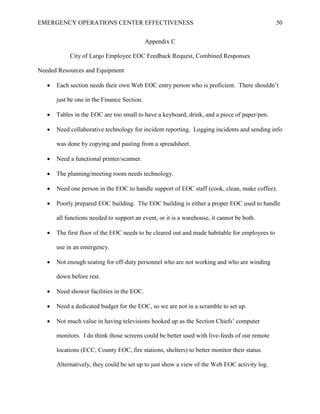
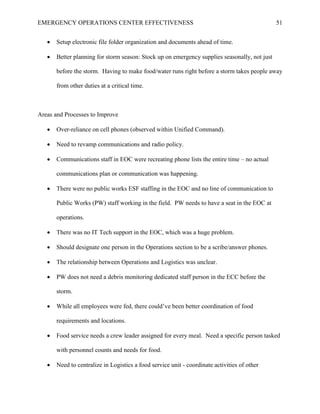
Appendix C
City of Largo Employee EOC Feedback Request, Combined Responses
Needed Resources and Equipment
• Each section needs their own Web EOC entry person who is proficient. There shouldn’t
just be one in the Finance Section.
• Tables in the EOC are too small to have a keyboard, drink, and a piece of paper/pen.
• Need collaborative technology for incident reporting. Logging incidents and sending info
was done by copying and pasting from a spreadsheet.
• Need a functional printer/scanner.
• The planning/meeting room needs technology.
• Need one person in the EOC to handle support of EOC staff (cook, clean, make coffee).
• Poorly prepared EOC building. The EOC building is either a proper EOC used to handle
all functions needed to support an event, or it is a warehouse, it cannot be both.
• The first floor of the EOC needs to be cleared out and made habitable for employees to
use in an emergency.
• Not enough seating for off-duty personnel who are not working and who are winding
down before rest.
• Need shower facilities in the EOC.
• Need a dedicated budget for the EOC, so we are not in a scramble to set up.
• Not much value in having televisions hooked up as the Section Chiefs’ computer
monitors. I do think those screens could be better used with live-feeds of our remote
locations (ECC, County EOC, fire stations, shelters) to better monitor their status.
Alternatively, they could be set up to just show a view of the Web EOC activity log.
EMERGENCY OPERATIONS CENTER EFFECTIVENESS 51
• Setup electronic file folder organization and documents ahead of time.
• Better planning for storm season: Stock up on emergency supplies seasonally, not just
before the storm. Having to make food/water runs right before a storm takes people away
from other duties at a critical time.
Areas and Processes to Improve
• Over-reliance on cell phones (observed within Unified Command).
• Need to revamp communications and radio policy.
• Communications staff in EOC were recreating phone lists the entire time – no actual
communications plan or communication was happening.
• There were no public works ESF staffing in the EOC and no line of communication to
Public Works (PW) staff working in the field. PW needs to have a seat in the EOC at
operations.
• There was no IT Tech support in the EOC, which was a huge problem.
• Should designate one person in the Operations section to be a scribe/answer phones.
• The relationship between Operations and Logistics was unclear.
• PW does not need a debris monitoring dedicated staff person in the ECC before the
storm.
• While all employees were fed, there could’ve been better coordination of food
requirements and locations.
• Food service needs a crew leader assigned for every meal. Need a specific person tasked
with personnel counts and needs for food.
• Need to centralize in Logistics a food service unit - coordinate activities of other
EMERGENCY OPERATIONS CENTER EFFECTIVENESS 52
locations to have efficient preparation, consolidated plan across city enterprise.
• It should be clearly outlined who is responsible for food and water in remote
locations/shelters.
• Need the site coordinator to give direction to all staff assigned to shelters.
• Clarify pay and benefits information ahead of time for emergency operations staff.
• Unclear roles for many staff – too many staff in EOC.
• Many employees did not have the proper skill set for the assigned role.
• Many EOC roles appear to have been assigned based on job title and less on need or
ability in emergency operations.
• Department directors should not be default players in the EOC. While some could be
very effective, others appeared to struggle in a role that required quicker decision making
and more advanced technological skills than they would normally encounter.
• Roles in the EOC are very different than in normal operations and require a knowledge
and understanding of the entire city structure that many executive management and even
operational management staff lack.
• Even on a good day, the City is still very silted, and those cracks showed during the
storm as people struggled to know whom to call for what issues.
• Need more bench strength for longer incidents, availability was only one person deep for
some positions. Secession planning for ICS positions.
• Planning section needs the ability to have/scale up to Situation Unit and Resource Unit.
• Recommend using the ICS structure, not modified ESF.
• May not necessarily need to have entire staff available during the event. Figure out how
to transport them in after the storm, make everybody happier and more comfortable
EMERGENCY OPERATIONS CENTER EFFECTIVENESS 53
before and during by not crowding in with nothing to do.
• Need to evaluate how we scale up/down staff in the EOC.
• Need to reevaluate the standard EOC roles and if they are necessary for Largo.
• Finance section not necessary in the EOC – can be done remotely with air cards. Can
bring in staff after the storm – not before or during. Use space to house PW and
environmental services (ES) staff.
• Evaluate information flows within, into, and out of EOC. Evaluate how information
comes in from field operations, PW and ES to Operations, Logistics, and Planning.
• The once a year tabletop exercise is insufficient to address all required topics.
• Previous training exercises were not meaningful/not serious.
• There were Executive Leadership Team (ELT) meetings leading up to event. Instead, the
EOC should have been opened sooner and Unified Command should have been used
during the planning phase.
• Another suggestion was to continue to staff storm units for a couple of days after the
event. There was a significant call load on the days following that were of the low
priority nature.
• ICS Forms were filled out poorly. City staff need more training on how to fill them out.
• Forms were difficult to understand and related more to firefighters who work true shift
work. Need a meaningful electronic way of filling out forms.
• Staff needs to complete ICS training. This would help clarify the chain of command
since the city’s organizational chart changes dramatically during an emergency event.
• More practical training is needed. Should be running at least one full-blown hurricane
drill each year before storm season starts.
EMERGENCY OPERATIONS CENTER EFFECTIVENESS 54
• Need to have staff have ICS 300/400 training and position specialty training. Mandatory
for those with EOC role and Department Directors/Assistant Directors
• Everyone needs to be trained on Resource Request form, and those answering phones
need to capture information required on the form to fill the request.
• Need a better process for special needs evacuation calls. Pre-set team to make calls with
appropriate information to answer questions from evacuees.
• Post-storm - we need more GIS staffing. GIS efforts were redundant with the County's.
Work with Pinellas County to find out what we, as a municipality, need to map and what
the county is mapping. Then perhaps we can publish our map layer to them instead of
duplicating efforts, or vice versa.
• Use one product (device) not multiple brands, i.e., Windows, Android or iPad, or be
efficient in the use of one device and be assigned that particular device.
Areas and Processes that Worked Well
• The second floor of the EOC set up went well and it was easy to communicate with all
sections.
• Communication was excellent, not too much, not too little.
• The Operations section stated all my tasks clearly at the beginning of each operational
period as well as provided updates when necessary during each period.
• The entire EOC updates were helpful as well, to know what was going on around us in
the fire room so we could better anticipate the needs of all involved.
• Emails were sent about storm updates, county updates, plus shelter, and community
updates.
EMERGENCY OPERATIONS CENTER EFFECTIVENESS 55
• The communication flow made it much simpler to be prepared for when the fire room got
bombarded with work, as we mostly sat around waiting. But when it did hit (and boy did
it), we were prepared and weathered the storm appropriately.
• Ready Op, the city’s communications software, worked well when used appropriately.
• Having a set of primary damage assessment teams that were sheltered and ready after the
storm, and then a secondary set of damage assessment teams that could be activated when
we needed to give the primary teams a rest day was very effective.
• Having planning staff help review the grids for missed areas was very helpful, as they
were able to use their land-use maps and determine which areas were non-residential and
which were residential.
• Areas were mapped for each team ahead of time, but we had the flexibility to send more
than one team to harder hit areas.
• The Collector damage assessment software was straightforward to use.
• It was effective to have the damage assessment vehicles in a protected facility during the
storm.
• Having a separate room at the EOC for the damage assessment team worked well.

Emergency Operations Center (EOC) Function, Structure, and Effectiveness in Largo, FL

  • 1.
    Running head: EMERGENCYOPERATIONS CENTER EFFECTIVENESS 1 Emergency Operations Center (EOC): Function, Structure, and Effectiveness in Largo, FL Joseph A. Pennino III Largo Fire Rescue, Largo, Florida Publisher and date: Emmitsburg, MD: National Fire Academy, 2018. URL: https://nfa.usfa.fema.gov/pdf/efop/efo245070.pdf
  • 2.
    EMERGENCY OPERATIONS CENTEREFFECTIVENESS 2 Certification Statement I hereby certify that this paper constitutes my own product, that where the language of others is set forth, quotation marks so indicate, and that the appropriate credit is given where I have used the language, ideas, expressions, or writings of another. Signed: __________________________________
  • 3.
    EMERGENCY OPERATIONS CENTEREFFECTIVENESS 3 Abstract Local governments can have a difficult time organizing the personnel and resources needed to respond to disasters. The problem was that the City of Largo had not developed effective standard procedures for the use of its emergency operations center (EOC) which resulted in inefficient processes and frustration amongst EOC staff. The purpose of this applied research was to use the descriptive research method to identify industry best practices for EOC operations to include activation, deactivation, and the appropriate personnel assignments in order to develop effective standard procedures for the use of Largo’s EOC. The procedures for this research consisted of a focused literature review followed by the assemblage of data using various sources including city policy, information from city personnel who served in the City of Largo EOC during Hurricane Irma, and personal observations. The data were then analyzed to determine (a) What are the shortcomings of the City of Largo’s EOC operating procedures? (b) What standards and best practices exist regarding the operation of EOCs? (c) What physical layout is the most efficacious for EOCs? (d) What roles and responsibilities are necessary to staff the City of Largo’s EOC? The results highlighted areas within the City of Largo's EOC procedures, physical layout, and staffing that warrant improvement. Following the analysis, recommendations were made concerning the development of policy to address EOC activation and deactivation. Additional suggestions included the formation of project teams to assess the EOC’s physical layout and to evaluate and refine EOC staffing assignments.
  • 4.
    EMERGENCY OPERATIONS CENTEREFFECTIVENESS 4 Table of Contents Page Certification Statement ....................................................................................................................2 Abstract............................................................................................................................................3 Table of Contents............................................................................................................................ 4 Introduction..................................................................................................................................... 5 Background and Significance ......................................................................................................... 6 Literature Review.......................................................................................................................... 10 Procedure ...................................................................................................................................... 18 Results........................................................................................................................................... 21 Discussion..................................................................................................................................... 27 Recommendations......................................................................................................................... 35 Reference List ............................................................................................................................... 39 Appendices Appendix A. City of Largo Code of Ordinances, Chapter 8 Civil Emergencies..................... 43 Appendix B. City of Largo Administrative Policy EM-17-01, Facility Closures ................... 47 Appendix C. City of Largo EOC Feedback Request Combined Responses............................ 50 List of Figures Figure 1. Largo Fire Rescue Service Area Map ........................................................................ 7 Figure 2. Radar image of Hurricane Irma.................................................................................. 9 Figure 3. Ways to Facilitate the Training of EOC Staff. ......................................................... 15 Figure 4. The City of Largo’s EOC at Shift Change During Hurricane Irma ......................... 24
  • 5.
    EMERGENCY OPERATIONS CENTEREFFECTIVENESS 5 Emergency Operations Center (EOC): Function, Structure, and Effectiveness in Largo, FL General George S. Patton once said, “Prepare for the unknown by studying how others in the past have coped with the unforeseeable and the unpredictable” (Lung & Prowant, 2010). Every significant event presents a unique and valuable opportunity for growth and learning. Concerning the field of emergency management, such events are occurring more and more frequently. Climate change and global warming have and are anticipated to continue to make weather-based disasters such as wildfires, hurricanes, landslides, extreme rainfalls, and flooding more common (Oppenheimer & Anttila-Hughes, 2016). During these disasters, many local and state governments utilize Emergency Operations Centers (EOCs) as a centralized headquarters from which to mitigate these events. EOCs can be anything from commandeered churches that are capable of holding a handful of people to dedicated, purpose-built, hurricane- rated buildings designed to house dozens of people for weeks at a time. The National Fire Protection Association defines an EOC as “The physical location at which the coordination of information and resources to support incident management (on-scene operations) activities normally takes place” (2014, p. 10). EOCs are a vital component of any government’s resiliency plan. They are not merely a building, but a place where all essential government and even private sector personnel come together to lead a business, city, county, or state through a disaster. However, for an EOC to operate efficiently, it must be organized correctly and have the necessary equipment and technology. Additionally, the governing body must have sufficient policies regarding the activation, operation, and deactivation of its EOC. Perhaps most importantly, for an EOC to function well, it must contain the proper people, who have received adequate training, and who are serving in the appropriate roles. The problem was that the City of Largo had not developed effective standard procedures
  • 6.
    EMERGENCY OPERATIONS CENTEREFFECTIVENESS 6 for the use of its emergency operations center which has resulted in inefficient processes and frustration amongst EOC staff. The purpose of this applied research was to use the descriptive research method to identify industry best practices for EOC operations to include activation, deactivation, and the appropriate personnel assignments in order to develop effective standard procedures for the use of Largo’s EOC. The research questions were (a) What are the shortcomings of the City of Largo’s EOC operating procedures? (b) What standards and best practices exist regarding the operation of EOCs? (c) What physical layout is the most efficacious for EOCs? (d) What roles and responsibilities are necessary to staff the City of Largo’s EOC? Background and Significance Incorporated in 1905, the City of Largo is located in central Pinellas County on the west coast of Florida. It is home to roughly 7,000 businesses and approximately 83,000 people. In addition to being a popular retirement and seasonal destination, it is the third-largest city in Pinellas County. Pinellas County’s population is nearly one million, making the county the 6th most populated as well as the densest county in Florida, with almost 3,500 people per square mile (Florida Legislature, 2017). Pinellas County’s economy relies heavily on tourism, which generates more than $9 billion in revenue annually (Pinellas County Tourist Development Council, 2016). Largo Fire Rescue was founded in the early 1900s as an all-volunteer department. The department became fully career-staffed in 1970. Today, the department provides fire protection and prevention, community education, emergency medical services (EMS), technical rescue and hazardous materials response, and conducts disaster planning for more than 110,000 residents in a service area of approximately 30.5 square miles (Largo Fire Rescue, 2017). It maintains an
  • 7.
    EMERGENCY OPERATIONS CENTEREFFECTIVENESS 7 Insurance Services Office (ISO) rating of one, employs 142 sworn firefighters, and ten civilian employees. The department’s response district includes the City of Largo, the Highpoint Community, the Town of Belleair, unincorporated portions of Pinellas County, and the City of Belleair Bluffs (Figure 1). Figure 1. Largo Fire Rescue Service Area. As is ordinarily the case, the fire chief manages the department and directly oversees the deputy chief. In turn, the deputy chief supervises four division chiefs and serves as the emergency management coordinator for the city. Additionally, the deputy chief chairs the City of Largo Disaster Management Group (DMG). The four division chiefs manage fire prevention, operations, professional standards, and logistics. Combined, these division chiefs direct four
  • 8.
    EMERGENCY OPERATIONS CENTEREFFECTIVENESS 8 assistant chiefs and six shift commanders who collectively manage emergency response, special operations, training, EMS, and fire prevention. Largo Fire Rescue uses a combination of five advanced life support (ALS) engines, two ALS squads, one ALS truck, three ALS rescues, and one basic life support (BLS) aerial platform to respond to an excess of 29,000 calls for service annually. In conjunction with the department’s two shift commanders, these vehicles respond out of six fire stations. Additionally, Largo Fire Rescue takes part in a multi-hazard automatic aid program that incorporates the 18 municipal fire departments and independent special fire districts within Pinellas County. The department is also an active member of both Pinellas County's Technical Rescue and Hazardous Materials Response Teams. Largo Fire Rescue’s response district exists within the peninsula of Pinellas County, which is positioned on the greater peninsula that is the State Florida. Consequently, “The population, demographics, and geographical location of the Largo Fire Rescue response district make it susceptible to a variety of different natural and man-made risks” (Pennino, 2016, p. 22). Some of the inherent natural hazards confronting the City of Largo include floods, tropical storms and hurricanes, thunderstorms and tornadoes, wildfire, lightning, extreme heat, winter storms, sinkholes, and disease outbreak (Pinellas County Government, 2015). Disasters, whether human-made or natural, can devastate a community and cause an extensive and costly recovery process (Willis, 2011). The abundance of low-income and retirement mobile home communities that would not be able to withstand hurricane-force winds further complicates the situation. The City of Largo and the service areas it is contracted to serve depend on the city’s EOC and the staff who operate it to manage disaster successfully. The lack of adequate standard procedures outlining the use of the City of Largo’s emergency operations center has resulted in inefficient processes and frustration amongst EOC staff.
  • 9.
    EMERGENCY OPERATIONS CENTEREFFECTIVENESS 9 Such a consequence became evident during Hurricanes Hermine, Matthew and, most recently, Hurricane Irma which made landfall in Florida in September of 2017 (Figure 2). Irma cost the City of Largo over $3 million in damage, operating costs, debris removal, and personnel expenditures. The city’s EOC was open for several days before, during, and after the event. However, the absence of adequate standard procedures for the use of the emergency operations center left EOC staff unsure as to when they should report, what role they would play, how they would be compensated, where they would sleep, and when they would be permitted to leave. If practical EOC guidelines are not established, the city will be ill prepared to face future disasters. This could result in decreased preparation, inefficient operations, and a prolonged recovery. Figure 2. Radar image of Hurricane Irma on September 10, 2017, at 5 p.m. Retrieved from http://wlrn.org/post/president-trump-approves-disaster-declaration-florida.
  • 10.
    EMERGENCY OPERATIONS CENTEREFFECTIVENESS 10 The United States Fire Administration outlines five operational goals in its strategic plan. This purpose of this research was to particularly accomplish goals one through three, which include: 1. Reduce Fire and Life Safety Risk Through Preparedness, Prevention and Mitigation 2. Promote Response, Local Planning and Preparedness for All Hazards 3. Enhance the Fire and Emergency Services’ Capability for Response to and Recovery from All Hazards. (United States Fire Administration, 2014, p. 1). Additionally, this research directly correlates with the Executive Fire Officer Program’s Executive Leadership course. One of the goals of the course was for students to learn how to think systematically as a way to deal with adaptive challenges. Additionally, the course outlined the need for the Executive Fire Officer (EFO) to acquire the ability to analyze and then operationalize the fundamental processes and interpersonal skills used by effective executive- level managers (United States Fire Administration, 2015, p. 458). Finally, this research aligns with Largo Fire Rescue’s mission statement which asserts, “Largo Fire Rescue is dedicated to providing education, prevention, and emergency services to safeguard the lives and property of our community” (Largo Fire Rescue, 2017, p.1). Literature Review It is imperative that public servants and elected officials address their organization’s ability to manage disasters (Tampa Bay Regional Planning Council, 2010). However, before evaluating the City of Largo's own current EOC practices, policies, and procedures, the findings of others were reviewed. The literature review for this study was focused on ascertaining industry best practices for EOC operations to include activation, deactivation, and appropriate staff assignments. The information gathered aided in determining the weaknesses of the City of
  • 11.
    EMERGENCY OPERATIONS CENTEREFFECTIVENESS 11 Largo’s EOC operating procedures, the most effective physical arrangement for EOCs, and the various roles and responsibilities that might be necessary to staff the City of Largo’s EOC during times of disaster. For EOCs to be effective, local governments must have policies in place ahead of time that address operations and staff functions for before, during and, post-disaster. Wachtendorf and Kendra stress that “disaster plans are a principal tool for mapping allocation of resources to problems” (2012, p. 250). An organization will either improvise or follow existing plans depending on whether or not the plans are suitable and whether personnel are capable of executing the plans as designed (Wachtendorf, 2004). Lindel, Prater, and Perry acknowledge that time is usually limited in emergencies and they stress that improvisation consumes more time than executing preplanned actions (2006). Worldwide, EOC use and planning still has a long way to go. Wenger, Quarantelli, and Dynes maintain that the use of EOCs, particularly in smaller organizations, is still sporadic, occasionally improvisational, and insufficiently understood (1989). Perry attributes this to the infrequency of largescale incidents, emergency managers’ failure to consider the political aspect of these emergencies and the public’s need for information, and some emergency managers’ inability to understand the functions of an EOC (2003). Berke and Campanella are advocates of placing a greater focus on resiliency planning, such as ensuring EOC functionality and addressing barriers impeding post-disaster resiliency planning (2006). According to Vogel, local governments often pay too little attention to policies to limit vulnerability (2013). These policies could relate to anything from emergency management training, to mitigation strategies, to EOC operations. In fact, Burby suggests that local and federal governments should focus more energy and resources on emergency preparedness
  • 12.
    EMERGENCY OPERATIONS CENTEREFFECTIVENESS 12 planning and routinely update policies as needed (2006). Pinellas County does have a Local Mitigation Strategy (LMS) to “establish an ongoing process that will make hazard mitigation part of the daily functioning of the entire community, including both public and private sectors and our residents themselves” (2015, p. 1). In addition to the DMG and LMS, the city’s code of ordinances references emergency management responsibilities and disaster procedures (Appendix A). According to the City of Largo’s Code of Ordinances (Code 1978, § 26-4; Ord. No. 94-24, § 4, 2-15-1994) Sec. 8-23, the fire chief, when acting as the emergency manager, shall have the following responsibilities and duties: 1. To direct the development and maintenance of the city's emergency plans, including annual revisions; 2. To designate a fire department staff officer as the emergency management coordinator; 3. To direct the development of a city emergency operations center (EOC) to include equipment, staffing, and operational procedures necessary for the management and control of emergency conditions; 4. To develop and submit an annual budget to the director of emergency management for the operation, maintenance, and training of an emergency response system and infrastructure. The emergency management coordinator (currently the deputy fire chief) shall have the following responsibilities and duties: 1. To plan, develop, and maintain the city's emergency plans, including annual updates; 2. To chair the emergency management planning committee; 3. To plan for and develop an emergency operations center (EOC) to include equipment,
  • 13.
    EMERGENCY OPERATIONS CENTEREFFECTIVENESS 13 staffing, and operational procedures necessary for the management and control of emergency conditions; 4. To provide and coordinate a city training program in emergency response and management. The emergency management planning committee (also known as the DMG) shall have the following responsibilities and duties: 1. To function as part of the EOC during an emergency or state of local emergency; 2. To assist in the creation, revision, and exercise of emergency operations plans; 3. To advise the emergency management coordinator of resource requirements necessary for the creation, maintenance, and exercise of a capable, efficient emergency response capability. (City of Largo, 2008, p. 116). However, before an organization can even begin to establish or revise specific EOC plans, policies, or procedures, several essential factors must be considered. According to Rouse, it is imperative that EOC policy and procedures have support from stakeholders, they must take into considerations the specific structure of the EOC building, and the plans should be comprehensive enough to consider a wide variety of hazards (2013). According to the Department of Homeland Security, an EOC is utilized to support on- scene mitigation efforts through the prioritization of activities and available resources, not as an on-scene incident command post focused on specific tactics (n.d.). Furthermore, Quarantelli believes that an EOC should be able to accomplish six primary functions including coordination, policy making, operations, information gathering, public information, and visitor hosting (1979). There are numerous different models for structuring EOCs, most of which are based on specific agency representation (Perry, 1995). The objective for arranging an EOC is that it will
  • 14.
    EMERGENCY OPERATIONS CENTEREFFECTIVENESS 14 ultimately follow, supplement, and espouse the Incident Management System and on-scene operations (Brunacini, 2002). For example, the Jefferson Transit Authority in Port Townsend, Washington has a maintenance/facilities officer in their EOC. This individual is responsible for coordinating the chaining of buses and for the removal of snow at Jefferson Transit Facilities, shelters, and Park and Ride Lots during winter storm events (Jefferson Transit Authority, 2017). Agencies in warmer climates, including the City of Largo, would not need these representatives in their EOC, but may need other specialized positions filled. Primarily, the EOC’s role and structure are designed to coordinate and integrate multiple agencies to provide a unified response during an event (Moeller, 2014). According to the Federal Emergency Management Agency (FEMA), there are typically four ways to structure an EOC. Emergency operations centers can be organized by significant management activities, around the Incident Command System (ICS), by Emergency Support Functions (ESFs), or as a Multiagency Coordination System (MAC) Group (FEMA, n.d.). When organizing by major activity, the EOC will be comprised of a policy group, a resource group, an operations group, and a coordination group. Though this configuration is relatively easy to understand, it does not always pair well with the on-scene ICS structure. Conversely, while structuring the EOC around the incident command system may provide an easily recognizable compliment to on-scene operations, it can also lead to confusion regarding who possesses command authority. Organizing an EOC by ESFs can also allow proper coordination with the on-scene ICS system. However, this configuration necessitates a substantial amount of training, and local ESFs do not always parallel state and federal ESFs. Finally, structuring the EOC as a MAC group can be beneficial when coordination is needed with other MAC entities or when multi-agency decision-making and coordination is necessary. The downside to this method of
  • 15.
    EMERGENCY OPERATIONS CENTEREFFECTIVENESS 15 organizing is that its structure is poorly defined, making it hard to use as a self-sufficient EOC. Ensuring that EOC staff are qualified and trained to work in emergency situations is vital to an organization’s ability to mitigate a disaster. Figure 3 below shows several ways to educate personnel and assist them in being successful while operating in an EOC: Developing position descriptions (PDs) for every position. • PDs provide a list of the general responsibilities for each EOC position. • PDs serve as a good starting point for determining training needs. Developing an overall training strategy. Work with other agency key personnel to create orientations, classroom training, on-the-job training, and a mentoring program. Providing training opportunities for common tasks. Consolidate training needs for personnel from the multiple agencies represented in the EOC. Using information from exercises and actual operations. Prior experience, as noted in after-action reports, is a guideline for the skills and knowledge that require training. Figure 3. Ways to facilitate the training of EOC staff. Retrieved from https://emilms.fema.gov/is775/eocsummary.htm Most jurisdictions outline different levels of readiness for their EOC operations. For instance, the Miami-Dade EOC operates at one of three levels of readiness in order to carry out its mission. A Level III activation is described as a monitoring and assessment phase where a particular threat or situation is being actively monitored. Level II is a partial activation where staff and agencies with a role in incident response are required to report to the EOC. Level I is a full-scale activation where the EOC is activated on a 24-hour basis due to an impending threat or disaster. During a Level I activation, all staff are required to report to the EOC (Miami-Dade County, 2015). The State of Florida’s Division of Emergency Management follows a similar
  • 16.
    EMERGENCY OPERATIONS CENTEREFFECTIVENESS 16 outline for their EOC activation levels (Florida Division of Emergency Management, 2016). Additionally, the City of Largo utilizes an equivalent three-level activation scale (City of Largo, 2012) Determining when to activate the EOC is an essential milestone in the course of an emergency. According to FEMA’s Emergency Management Institute, “EOCs are activated for various reasons based on the needs of a jurisdiction, organization, or Incident Commander; the context of a threat; the anticipation of events; or in response to an incident” (2017). While some agencies give their emergency manager, city manager, or elected officials discretion as to when to open the EOC, other organizations follow objective guidelines or trigger points. FEMA’s Emergency Management Institute positions that, though each jurisdiction’s policy determines when their EOC may be mobilized, several possible circumstances could elicit an EOC activation including: • A Unified Command or Area Command is established. • More than one jurisdiction becomes involved in a response. • The Incident Commander indicates an incident could expand rapidly or involve cascading events. • A similar incident in the past required EOC activation. • The Chief Executive Officer (CEO) directs that the EOC should be activated. • An emergency is imminent… hurricane warnings, slow river flooding, predictions of hazardous weather, elevated threat levels. • Threshold events described in the Emergency Operations Plan (EOP) occur. (FEMA, n.d., para. 2). The City of Largo’s Comprehensive Emergency Management Plan (CEMP) dictates that the city
  • 17.
    EMERGENCY OPERATIONS CENTEREFFECTIVENESS 17 manager, assistant city manager, fire chief, police chief or public works director may order the activation of the EOC to whatever level may be necessary to support a specific disaster or event (2012). However, the document does not provide specific instances when the EOC should be activated, such as the issuance of a hurricane warning or a mass casualty incident. The design and physical layout of an EOC are crucial to its success. FEMA lists the six main factors involved in designing an EOC as: • Accessibility • Safety • Size • Systems Capability • Survivability • Versatility (FEMA, n.d.). The EOC must be accessible to both staff and suppliers. Therefore, care should be taken to establish EOCs in areas that are protected from as many threats as possible. In Pinellas County, this would exclude areas that are prone to storm surge. EOCs should be safe for staff, comply with the Americans with Disabilities Act (ADA), and comply with local building codes (FEMA, n.d.). Furthermore, the EOC should be able to accommodate the number of people required to manage large-scale incidents. Space should exist for private planning meetings, and its configurations must allow for efficient operations, communication, and access to needed technology. In addition to accessibility, safety, and size, EOCs must be capable of supporting extended operations and surviving both natural and manmade disaster. Therefore, they should possess adequate climate control systems, redundant water supplies, emergency generators
  • 18.
    EMERGENCY OPERATIONS CENTEREFFECTIVENESS 18 capable of providing an uninterrupted power supply, and backup communications systems (FEMA, n.d.). According to FEMA, EOCs can be hot, warm, or cold. Hot EOCs are maintained in a constant state of readiness but are the most expensive to maintain. Warm facilities have only critical infrastructure in place, items like computers and utilities may need to be added ahead of its activation. Cold facilities are the cheapest to maintain but require a significant amount of work before they can become operational during a disaster (FEMA, n.d.). The exploration of relevant literature was instrumental in understanding industry best practices for EOC operations including activation, deactivation, and appropriate staff assignments. The information gathered aided in determining the shortcomings of the City of Largo’s EOC operating procedures, the most effective physical arrangement for EOCs, and the various roles and responsibilities that might be necessary to staff the City of Largo’s EOC during times of disaster. Without analyzing the conclusions, conceptions, and observances of others, the research would not have been as concentrated and deliberate. Procedures The descriptive research method was employed to ascertain the shortcomings in the utilization of the City of Largo’s EOC and to determine industry best practices to assist in the development of effective standard operating procedures. This approach involved gathering information from city employees who have served in the City of Largo’s EOC during Hurricane Irma. Additionally, personal observations during Hurricane Irma, during which the City of Largo’s EOC was activated, were utilized. Finally, the City of Largo's current procedures and policies regarding EOC operations were analyzed and compared to industry best practices. This combination of techniques was utilized in order to strengthen the results. It is understood that gathering data in several ways allows the researcher to add scope and breadth to the research and
  • 19.
    EMERGENCY OPERATIONS CENTEREFFECTIVENESS 19 to seek convergence of the results (U.S. Fire Administration, 2013). The procedures for carrying out this research were concentrated on satisfying the following four questions: (a) What are the shortcomings of the City of Largo’s EOC operating procedures? (b) What standards and best practices exist regarding the operation of EOCs? (c) What physical layout is the most efficacious for EOCs? (d) What roles and responsibilities are necessary to staff the City of Largo’s EOC? Preliminary research began with a broad investigation of EOC-related published material. This information was accumulated through conducting internet searches using Google’s search engine, Google Scholar, and Georgia Library Learning Online (GALILEO) Scholar, a virtual library available through the University System of Georgia. City of Largo policies, procedures, and ordinances were also consulted and evaluated. Additional information regarding EOC best practices, policies, and procedures was gleaned from the National Fire Academy in Emmitsburg, Maryland throughout the March 2017 Executive Analysis of Fire Service Operations in Emergency Management and the November 2017 Executive Leadership courses. Edification and literature were received outlining, among other things, the process for policy evaluation and implementation, how to achieve cooperation from stakeholders and elected officials, and how to organize and manage an EOC. Additionally, multiple group activities were undertaken so that students could better comprehend fire department functions relating to emergency management and the typical functions needed in an EOC. Personal observations were accomplished during Hurricane Irma in September of 2017. Serving as the City of Largo’s emergency management coordinator and as a member of unified command, it was possible to participate in and study the city’s response before, during, and after
  • 20.
    EMERGENCY OPERATIONS CENTEREFFECTIVENESS 20 the storm. It was understood that personal observations can be especially vulnerable to observer bias and that steps should be taken to guard against partiality. Measures that were implemented include the maintenance of strict objectivity, reporting all observations (not just those which were favorable to the research outcomes), not allowing initial impressions to influence subsequent observations, and being as discreet as possible (U.S. Fire Administration, 2013). Finally, information was requested from the more than 50 city employees who served in the City of Largo’s EOC during Hurricane Irma. Members of this group included city management, department directors and assistant directors, operational managers, and members of the city’s DMG. These personnel served in various EOC assignments including unified command, as section chiefs, and various ESFs. The questions developed related to needed resources and equipment, areas and processes to improve, as well as the areas and processes that worked well. The questions were emailed to participants, and their responses were kept anonymous to encourage honesty and to increase participation. These responses are summarized in Appendix C. The procedures outlined above aided in establishing the shortcomings in the City of Largo’s EOC’s performance and in determining industry best practices. These procedures will assist in the future development of effective standard operating procedures. The most noteworthy limitation of the study involved the personal observations that took place during Hurricane Irma. Records and commentary were transcribed for each operational period. However, the storm was a significant event for the City of Largo and disaster mitigation often took precedence over documentation. Another limitation included the pursuance of industry best practices. Though there are many recommendations for EOC configuration, when to activate, staffing, and the like, it must be acknowledged that each community, city, county, and
  • 21.
    EMERGENCY OPERATIONS CENTEREFFECTIVENESS 21 jurisdiction is unique. There is no universal or one-size-fits-all approach to EOC practices, policies, or procedures. Results The research results were derived from information gleaned from those who served in the City of Largo’s EOC, personal observations during Hurricane Irma, and through the evaluation of various resources. The first research question was: (a) What are the shortcomings of the City of Largo’s EOC operating procedures? Perhaps one of the most frequently noted shortcomings of the City of Largo’s EOC during Hurricane Irma concerned food. It was noted in the employee feedback that coordination was lacking both at the EOC and at the employee and family shelters. It was suggested that there should have been a centralized food service unit in the logistics section. Additionally, city personnel went to the store for food and water the week leading up to the event. Employee feedback also recommended that the city should “stock up on emergency supplies seasonally, not just before the storm,” and that “having to make food/water runs right before a storm takes people away from other duties at a critical time” (City of Largo employee, personal communication, November 2017). Another deficiency of the City of Largo’s EOC operating procedures included the frequency and design of ongoing training. For the past several years, the city’s emergency management coordinator has developed and executed EOC activation drills. However, many employees were critical and questioned the extent to which these drills prepared them for an actual event. Employee feedback included requests for more practical training and the suggestion that there should be at least one full-blown hurricane drill each year before the start of storm season (City of Largo employee, personal communication, November 2017). Other opinions relating to training involved the completion of the various ICS forms. Several
  • 22.
    EMERGENCY OPERATIONS CENTEREFFECTIVENESS 22 employees mentioned that, in general, the ICS forms were incomplete and additional education is needed on how to fill them out correctly. In fact, the city’s assistant finance director spent several weeks reviewing stacks of ICS forms after the event and sent hundreds back to the various city departments for correction. The second research question was: (b) What standards and best practices exist regarding the operation of EOCs? The first observation related to this question involved the most appropriate time to activate and deactivate the EOC. Current city policy dictates opening the EOC when a hurricane warning is issued for the area. However, this may be too late. During Hurricane Irma, it was noted that the EOC both activated too late and deactivated too early. This created difficulties when trying to organize tasks and resources. The week leading up to Hurricane Irma’s landfall, city administration decided to begin holding daily Executive Leadership Team (ELT) meetings. These meetings consisted of city administration and the various city department directors. The meetings migrated into planning meetings where the fire chief would update city staff on storm events, forecasts, and updates from Pinellas County’s EOC. While the expectation was that department staff would return and disseminate the information, this was not the case. In hindsight, the City of Largo should have activated its EOC as soon as Pinellas County was forecasted within the cone of uncertainty. One city employee stated, “There were Executive Leadership Team (ELT) meetings leading up to the event. Instead, the EOC should have been opened sooner, and unified command should have been used during the planning phase” (City of Largo employee, personal communication, November 2017). The City of Largo closed its EOC the day after Hurricane Irma impacted the city. Many employees had been detained for several days and were anxious to go home, while city officials were restless to have the city to resume normal services. However, the decision to close the
  • 23.
    EMERGENCY OPERATIONS CENTEREFFECTIVENESS 23 EOC may have been made in haste. Though the winds died down and the rain stopped, the lull in calls for service was not an indicator of things to come. Over the next 24 to 48 hours, the fire department responded to three-times the number of incidents it was accustomed to. Most of the incidents were related to power surges, arching power lines, and fires caused by the restoration of power. Fire department employees later recommended to “Continue to staff storm units for a couple of days after the event. There was a significant call load on the days following that were of the low priority nature” personal communication, November 2017). Not only was the city inundated with low-priority fire and emergency medical services calls following the storm, but it was also bombarded with requests from the Pinellas County EOC. Dozens of Largo residents were transported to shelters located in public schools before the storm. Many of these residents lived in mobile homes which were especially susceptible to hurricane-force winds. Some of these residents could not evacuate on their own and were reliant on power to run their medical devices or home oxygen systems. After the storm, the school board wanted to prepare the schools to open and needed the evacuees out. However, before these residents could return home, city staff had to ensure their homes were tenable. Each day, the fire department received a list of addresses from the county’s EOC that it was required to check and report back on. Also, people were calling from out of state asking about family members that lived in the City of Largo whom they had not heard from. Since the city had already closed its EOC, this workload could not easily be coordinated and distributed. Therefore, all of these operations were run out of the City of Largo’s fire administration offices. Collectively, this increased workload added a tremendous strain on the fire department. The third research question was: (c) What physical layout is the most efficacious for EOCs? The City of Largo’s EOC building itself was also often criticized for being too small for
  • 24.
    EMERGENCY OPERATIONS CENTEREFFECTIVENESS 24 the number of staff required to work and reside there. The original plan called for off-duty personnel to report to the employee shelter. However, during Hurricane Irma, conditions were not conducive for travel. The second floor of the EOC was where all of the on-duty staff operated. Therefore, off-duty personnel were confined to the first floor where the city stockpiles spare office furniture. There were no designated sleeping areas and much of the staff ending up sleeping wherever they could find room. One City of Largo employee stated, “The EOC building is either a proper EOC used to handle all functions needed to support an event or it is a warehouse, it cannot be both” (personal communication, November 2017). Adequate space was one of the frequent criticisms concerning the EOC during Hurricane Irma (Figure 4). Figure 4. The City of Largo’s EOC at shift change during Hurricane Irma. There were other issues noted regarding the City of Largo’s EOC’s physical layout as
  • 25.
    EMERGENCY OPERATIONS CENTEREFFECTIVENESS 25 well. Some employees argued that the tables in the EOC were too small to provide a proper work area. Others felt that there were certain positions in the EOC that should have had access to two computer monitors to assist them in the tasks they were conducting. One of the employees stated that there was: Not much value in having televisions hooked up as the Section Chiefs’ computer monitors. I do think those screens could be better used with live-feeds of our remote locations (ECC, County EOC, fire stations, shelters) to better monitor their status. Alternatively, they could be set up to just show a view of the Web EOC activity log. (personal communication, November 2017). Other criticisms of the EOC’s layout included the addition of shower facilities, seating for off- duty personnel who were not working and were winding down before rest, and the need for more technology including a functional scanner and technology for the planning room. One of the more significant personal observations noted during Hurricane Irma was the lack of dedicated meeting space. There were many times during the event where private meetings and phone calls needed to take place. Perhaps the most essential reason for a private space was to allow those in unified command to conduct briefings at shift change. It is crucial that oncoming and off going unified commanders have a quiet, isolated space to share significant information in the midst of a disaster. The last research question was: (d) What roles and responsibilities are necessary to staff the City of Largo’s EOC? While the purpose of this research was not to revise the current EOC’s organizational chart, it did identify issues and gaps in the current staffing plan. During Hurricane Irma, the City of Largo’s EOC was set up using a modified ESF model. There was a unified command, four operational sections, and several ESFs within each section. Though there
  • 26.
    EMERGENCY OPERATIONS CENTEREFFECTIVENESS 26 were several benefits to this configuration, there were also numerous weaknesses. While some employees applauded the communication that took place within the City of Largo’s EOC during Hurricane Irma, the lack of a clear communications plan was frequently mentioned as well. In fact, one city employee stated, “Communications staff in EOC were recreating phone lists the entire time – no actual communications plan or communication was happening” (personal communication, November 2017). Though there was an ESF position within logistics dedicated to communications, personnel filling this role were untrained and unprepared to develop a communications plan that encompassed the myriad of different communication processes within the city. Another observation was that lack of public works ESF staffing in the EOC. Often, the operations section chief had a difficult time contacting public works (PW) staff working in the field. Employee feedback indicated that “PW needs to have a seat in the EOC at operations” (City of Largo employee, personal communication, November 2017). Public works had a significant role during Hurricane Irma. Not having a representative within the EOC slowed down the transference of information and hampered decision-making. There was also a noticeable lack of information technology (IT) support within the EOC. This is a needed position in the City of Largo’s EOC due to the reliance on technology. The city uses Web EOC for ordering resources, documentation, and communicating with Pinellas County. Furthermore, the city used geographic information system (GIS) to predict storm surge, the number of residents that would be affected, and to create windshield survey and damage assessment maps for after the event. As one City of Largo Employee stated, “There was no IT Tech support in the EOC, which was a huge problem” (personal communication, November 2017). Additionally, GIS personnel working in the planning division were overwhelmed,
  • 27.
    EMERGENCY OPERATIONS CENTEREFFECTIVENESS 27 especially after the storm. They were having a difficult time managing the massive amounts of information coming in from damage assessment teams. Perhaps one of the most significant observations regarding the roles and responsibilities necessary to staff the City of Largo’s EOC did not involve specific functions at all. There was quite a bit of employee feedback regarding the training needed for positions as well as the philosophy of rank in relation to EOC assignments. Some employees recommended that ICS 300 and ICS 400 should be mandatory for anyone serving in the EOC as well as for department directors and assistant directors. It was observed that many employees did not have the proper skill sets for their assigned role and that some of the EOC roles appear to have been assigned based on job title and not an employee’s ability to perform in emergency situations. One city employee stated, “Department directors should not be default players in the EOC. While some could be very effective, others appeared to struggle in a role that required quicker decision making and more advanced technological skills than they would normally encounter” (personal communication, November 2017). The results of this research were collected from various sources including City policy, feedback from personnel who served in the City of Largo EOC during Hurricane Irma, and personal observations. The information assisted in answering the research questions which, in turn, assisted in identifying industry best practices for EOC operations to include activation, deactivation, and appropriate personnel assignments. This research intended to gather information in order to develop effective standard procedures for the use of the City of Largo’s EOC. Discussion The outcomes of this applied research exposed several industry best practices for EOC
  • 28.
    EMERGENCY OPERATIONS CENTEREFFECTIVENESS 28 operations. Procedures that relate, not only to the activation and deactivation triggers for EOCs, but also to the appropriate personnel assignments needed. It is imperative that governments have plans in place beforehand that outline operations and staff functions for prior, during and, post- disaster. According to Wachtendorf and Kendra “disaster plans are a principal tool for mapping allocation of resources to problems” (2012, p. 250). If plans are well thought out, and staff are trained to execute them, they will be followed. Otherwise, personnel are likely to improvise (Wachtendorf, 2004). Improvisation is costly and can devour precious time, which is usually in short supply during times of emergency (Lindel, Prater, & Perry, 2006). According to Vogel, local governments often pay too little attention to policies to limit vulnerability (2013). Burby suggests that local and federal governments should focus more energy and resources on emergency preparedness planning and routinely update policies as needed (2006). Berke and Campanella are advocates of placing a greater focus on resiliency planning, such as ensuring EOC functionality and addressing barriers impeding post-disaster resiliency planning (2006). The City of Largo accomplishes this by maintaining a Disaster Mitigation Group (DMG). This emergency management planning committee is chaired by Deputy Fire Chief Joseph Pennino and meets monthly concerning emergency preparedness and certain EOC related operations. Additionally, City of Largo personnel have and continue to participate in the development of Pinellas County’s Local Mitigation Strategy (LMS). According to Pinellas County, “The purpose of the Local Mitigation Strategy is to establish an ongoing process that will make hazard mitigation part of the daily functioning of the entire community, including both public and private sectors and our residents themselves” (2015, p. 1). According to Rouse, it is imperative that EOC policy and procedures have support from stakeholders. Moreover, plans must take into considerations the specific structure of the EOC
  • 29.
    EMERGENCY OPERATIONS CENTEREFFECTIVENESS 29 building and should be extensive enough to encompass a wide array of hazards (2013). During Hurricane Irma, the City of Largo followed several of its pre-existing written plans. One of these plans included when certain facilities were closed and shuttered (Appendix B). For instance, during a hurricane warning, city buildings should be secured, and all non-essential vehicles and personnel should be taken off the roads (City of Largo, 2017). Other plans, such as where off- duty EOC personnel would sleep, did not exist. Therefore, off-duty EOC staff had to improvise, sleeping wherever they could find space. According to Wenger, Quarantelli, and Dynes, the use of EOCs, particularly in smaller organizations, is still not standardized (1989). This could be partially attributed to the rarity of large-scale incidents and some emergency managers’ failure to understand the full purpose of an EOC (Perry, 2003). FEMA’s Emergency Management Institute states, “EOCs are activated for various reasons based on the needs of a jurisdiction, organization, or Incident Commander; the context of a threat; the anticipation of events; or in response to an incident” (2017). Although it is probable that each jurisdiction has their own policy as to when their EOC may be mobilized, there are several possible conditions that FEMA suggests would provoke an EOC activation including: • A Unified Command or Area Command is established. • More than one jurisdiction becomes involved in a response. • The Incident Commander indicates an incident could expand rapidly or involve cascading events. • A similar incident in the past required EOC activation. • The Chief Executive Officer (CEO) directs that the EOC should be activated. • An emergency is imminent… hurricane warnings, slow river flooding, predictions of
  • 30.
    EMERGENCY OPERATIONS CENTEREFFECTIVENESS 30 hazardous weather, elevated threat levels. • Threshold events described in the Emergency Operations Plan (EOP) occur. (FEMA, n.d., para. 2). The City of Largo’s Comprehensive Emergency Management Plan (CEMP) dictates that the city manager, assistant city manager, fire chief, police chief or public works director may order the activation of the EOC to whatever level may be necessary to support a specific disaster or event (2012). However, the document does not provide specific circumstances when the EOC should be activated. During Hurricane Irma, it was noted that the City of Largo’s EOC appeared to remain open for as short of time as possible. City staff stated, “There were Executive Leadership Team (ELT) meetings leading up to the event. Instead, the EOC should have been opened sooner, and unified command should have been used during the planning phase” (City of Largo employee, personal communication, November 2017). Furthermore, after the storm passed, the fire department was besieged with calls for services and saddled with additional storm-related responsibilities for several days. City employee feedback included, “Continue to staff storm units for a couple of days after the event. There was a significant call load on the days following that were of the low priority nature” (personal communication, November 2017). Research and prior experience suggest that it would be wise to at least partially open the EOC as soon as the local area is forecasted within the cone of uncertainty and to delay closing it until city departments completely resume normal operations. Personal observation and employee feedback exposed several shortcomings of the City of Largo’s EOC during Hurricane Irma. Employees suggested that there should have been a centralized food service unit in the logistics section which is congruent with FEMA’s
  • 31.
    EMERGENCY OPERATIONS CENTEREFFECTIVENESS 31 recommendation for EOCs (FEMA, n.d.). This would have prevented the EOC and remote city locations from having to deal with food supplies separately. City personnel went to the store for food and water immediately before the event. It was suggested that the city should “stock up on emergency supplies seasonally, not just before the storm,” and that “having to make food/water runs right before a storm takes people away from other duties at a critical time” (City of Largo employee, personal communication, November 2017). The design and physical layout of an EOC are also crucial to its success. EOC’s must be accessible to both staff and suppliers. Therefore, it is imperative they are established in areas that are protected from as many threats as possible. EOCs should be safe for staff, comply with the Americans with Disabilities Act (ADA), and comply with local building codes (FEMA, n.d.). Furthermore, the EOC should be able to accommodate the number of people required to manage large-scale incidents. Lastly, space should exist to accommodate private planning meetings, and its configurations must allow for efficient operations, communication, and access to needed technology. In addition to accessibility, safety, and size, EOCs must be capable of supporting extended operations and surviving both natural and manmade disaster. Therefore, they should possess adequate climate control systems, redundant water supplies, emergency generators capable of providing an uninterrupted power supply, and backup communications systems (FEMA, n.d.). The City of Largo’s EOC building itself was often criticized for being too small for the number of staff required to work and reside there. The original plan called for off-duty personnel to report to the employee shelter. However, during Hurricane Irma, conditions were not conducive for travel. The second floor of the EOC is where all of the on-duty staff were operating. Therefore, off-duty personnel were confined to the first floor where the city
  • 32.
    EMERGENCY OPERATIONS CENTEREFFECTIVENESS 32 stockpiles spare office furniture. There were no assigned sleeping areas so personnel ending up sleeping wherever they could find room. One City of Largo employee stated, “The EOC building is either a proper EOC used to handle all functions needed to support an event, or it is a warehouse, it cannot be both” (personal communication, November 2017). Also regarding the EOC’s physical layout, some employees contended that the tables were not big enough to provide adequate working space and that some positions should have had access to dual computer monitors. One of the employees stated that there was: Not much value in having televisions hooked up as the Section Chiefs’ computer monitors. I do think those screens could be better used with live-feeds of our remote locations (ECC, County EOC, fire stations, shelters) to better monitor their status. Alternatively, they could be set up to just show a view of the Web EOC activity log. (personal communication, November 2017). Other recommendations for the EOC’s layout included the addition of shower facilities, seating for off-duty personnel who are not working and winding down before rest, and the need for more technology including a functional scanner and technology for the planning room. Additional isolated meeting space was one of the more noteworthy personal observations noted during Hurricane Irma. Without such space, it is very difficult to hold private meetings or to make confidential phone calls. Possibly the most important reason for adequate private meeting space was to allow those in unified command to conduct briefings at shift change. Members of oncoming and off going unified command need a calm, secluded space to share significant information during shift change. The applied research also exposed problems with the present City of Largo EOC staffing plan and the roles and responsibilities that are needed. According to FEMA, there are typically
  • 33.
    EMERGENCY OPERATIONS CENTEREFFECTIVENESS 33 four ways to structure an EOC. They can be organized by major management activities, around the Incident Command System (ICS), by Emergency Support Functions (ESFs), or as a Multiagency Coordination System (MAC) Group (FEMA, n.d.). During Hurricane Irma, the City of Largo’s EOC was set up using a modified ESF model. It included a unified command made up of the city manager/assistant city manager, fire chief/deputy fire chief, police chief/deputy police chief, and public works director/assistant public works director. Additionally, EOC staffing included section chiefs for planning, operations, finance, and logistics. There was also a safety officer and a liaison to Pinellas County who reported to the county EOC once it was activated. While some employees commended the interaction that took place within the City of Largo’s EOC during Hurricane Irma, others condemned the lack of a clear communication and the inexistence of a clear communications plan. One city employee wrote, “Communications staff in EOC were recreating phone lists the entire time – no actual communications plan or communication was happening” (personal communication, November 2017). There was an ESF position within the logistics section dedicated to communications. However, the specific staff who filled this role were unprepared to develop the complicated communications plan that was required to include all of the city’s different communication methods. Another observation was that lack of public works ESF staffing in the EOC. Often, the operations section chief had a difficult time contacting PW staff working in the field. Employee feedback indicated that “PW needs to have a seat in the EOC at operations” (City of Largo employee, personal communication, November 2017). During a hurricane, public works has a significant role before, during, and after the storm. It is imperative that staff be available at the EOC to participate in planning, decision-making, and operations. The EOC’s primary role and,
  • 34.
    EMERGENCY OPERATIONS CENTEREFFECTIVENESS 34 the driving force behind its structure, is to coordinate and integrate multiple agencies to provide a unified response (Moeller, 2014). Having representatives offsite delays the dissemination of information and puts unified command at a disadvantage. There was also a noticeable lack of information technology (IT) support within the EOC. The lack of IT technical support in the EOC was a problem (personal communication, November 2017). This is a needed position in the City of Largo’s EOC due to the city’s reliance on technology. Furthermore, GIS personnel were inundated after the storm with information coming in from the damage assessment teams. Relating to shortages in specific EOC positions Perry explains that, although there are several different ways to structure an EOC, care must be taken to determine what specific agency representation is required (1995). The principles involving how EOCs are staffed and what training staff members receive vary from one organization to the next. Some of the feedback received from City of Largo employees suggested that department directors, assistant directors, and anyone serving in the EOC should be required to have ICS 300 and ICS 400. It was apparent during Hurricane Irma that many employees’ strengths were not aligned with their assigned role in the EOC. Additionally, some of the EOC positions were appointed based on job title as opposed to individual ability. As one city employee stated, “Department directors should not be default players in the EOC. While some could be very effective, others appeared to struggle in a role that required quicker decision making and more advanced technological skills than they would normally encounter” (personal communication, November 2017). Though training is conducted annually by the city’s emergency management coordinator, many employees felt it had not prepared them for an actual event. Employee feedback included “More practical training is needed. Should be running at least one full-blown hurricane drill
  • 35.
    EMERGENCY OPERATIONS CENTEREFFECTIVENESS 35 each year before storm season starts. We need to run a serious drill at least once a year before hurricane season.” (City of Largo employee, personal communication, November 2017). FEMA lists several ways to educate personnel and help them to be successful while operating in an EOC including: • Developing position descriptions (PDs) for every position • Developing an overall training strategy • Work with other agency key personnel to create orientations, classroom training, on-the- job training, and a mentoring program. • Provide training opportunities on common tasks. • Consolidate training needs for personnel from the multiple agencies represented in the EOC. (FEMA, n.d.). Ensuring that EOC staff are qualified and trained to work in emergency situations is vital to an organization’s ability to mitigate a disaster. The results of this research were collected from various sources including city policy, feedback from personnel who served in the City of Largo EOC during Hurricane Irma, and personal observations. The information aided in answering the research questions which assisted in finding industry best practices for EOC operations including activation, deactivation, and appropriate personnel assignments. The goal of this research was to accumulate information useful for developing practical standard procedures for the use of The City of Largo’s EOC. If applied, the findings of this study could have far-reaching impacts on how the City of Largo operates its EOC in the future as well as the EOC’s overall effectiveness. Recommendations Based on the research conducted, several suggestions can be made regarding the ongoing
  • 36.
    EMERGENCY OPERATIONS CENTEREFFECTIVENESS 36 analysis of the City of Largo’s EOC policies and procedures as well as prudent next steps. In the short-term, the City of Largo should continue to adopt a philosophy of citywide emergency preparedness. Historically, as exemplified in the city’s code of ordinances, the fire department has taken on the lion’s share of emergency management. This is not only dangerous, but it is unrealistic. Though fire departments are typically well-trained in the National Incident Management System and tend to work well under pressure, most do not have the resources to expand their operations to cover all of the citywide emergency management functions required during an EOC activation. The City of Largo’s current policy regarding EOC operations is lacking. Clear and objective measures should be adopted as to when the EOC should be activated and to what level. Current city culture places a heavy emphasis on keeping city operations functioning as normal. Though it is desirable to have recreation centers open to the public and allow businesses to apply for permits the week leading up to a hurricane’s landfall, perhaps the more judicious course of action would be to halt routine operations and transition into a mode of citywide planning and preparation as soon as a threat is recognized. Policy should also include who reports to the EOC during each level of activation and who is responsible for communicating both intra and inter- departmentally. The City of Largo’s disaster management group should develop several subcommittees to work on developing this policy. Having an EOC that this capable of supporting long-term operations is crucial to a city’s ability to mitigate disaster. The City of Largo’s current EOC is too small for the number of staff required to work and reside there and lacks the physical layout necessary to support efficient operations. The ground floor of the building is currently being used for storage leaving no room for off-duty personnel to congregate, eat, or sleep. Additionally, several technological needs
  • 37.
    EMERGENCY OPERATIONS CENTEREFFECTIVENESS 37 were identified during Hurricane Irma and in the employee feedback provided afterward. The current EOC configuration lacks shower facilities, adequate kitchen and dining areas, and private meeting space. The City of Largo’s city administration, emergency management staff, and facilities personnel should work collectively to clean out the current EOC and rearrange it so that it can support long-term emergency operations. The final recommendation involves the City of Largo’s EOC staffing. Observations and feedback from Hurricane Irma indicate that there are several positions in the City of Largo’s EOC that are either not needed, understaffed, or staffed with the wrong people. Moving forward, the city’s emergency management staff should meet with unified command, city administration, and all of the section chiefs to complete an in-depth evaluation of each position within the EOC and whether it fits the needs of the city. Some positions may need to be added, while others can be discontinued or moved to other sections to make them more productive. Additionally, this group will need to have the courage and support to evaluate the people serving in the EOC and make changes to better align individual strengths with specific position requirements. Once these assignments are made, city administration must assist emergency management staff in mandating that personnel assigned to the EOC attend outside training. Pinellas County offers a tremendous amount of relevant free courses at their emergency services complex in the City of Largo. Additionally, section chiefs, elected officials, and city management would benefit significantly by attending FEMA’s Emergency Management Institute (EMI). The development of effective standard procedures for the use of its emergency operations center will not happen overnight. Clearing out the City of Largo’s EOC and rearranging it to be more efficient will take time and money. Furthermore, there is no easy way to train all city staff to become, and to remain, well-versed in emergency operations. However, the City of Largo can
  • 38.
    EMERGENCY OPERATIONS CENTEREFFECTIVENESS 38 adopt a culture of preparedness when it comes to emergency management. If elected officials, city administration, and department directors are dedicated resiliency, the rest will likely follow. Readers wishing to conduct similar research should keep in mind that even the best laid plans are often found to be imperfect when exercised. For those who have not participated in an actual EOC activation, it is highly encouraged that you reach out to someone who has. For it is at the intersection of arduous research and actual EOC experience where policy, plans, and procedures can best be cultivated.
  • 39.
    EMERGENCY OPERATIONS CENTEREFFECTIVENESS 39 References Berke, P. R. and T. J. Campanella. (2006). Planning for postdisaster resiliency. Annals of the American Academy of Political and Social Science, 604, 192-207. Brunacini, A. (2002). Fire Command Second Edition, National Fire Protection Association, Quincy, MA. Burby, R. J. (2006). Hurricane Katrina and the paradoxes of government disaster policy: Bringing about wise governmental decisions for hazardous areas. Annals of the American Academy of Political and Social Science, 604, 171- 191. City of Largo. (2008). Code of ordinances. Retrieved from http://www.largo.com/egov/documents/1491422728_51674.pdf City of Largo. (2012). Comprehensive emergency management plan. Unpublished manuscript. City of Largo. (2017). Administrative policies and procedures manual, updated November 23, 2017. Retrieved from http://www.largo.com/egov/documents/1511878936_486.pdf Department of Homeland Security. (n.d.). Incident Management. Retrieved from https://www.ready.gov/business/implementation/incident Florida Division of Emergency Management. (2016). State Emergency Operations Center Activation Levels. Retrieved from https://www.floridadisaster.org/eoc/eoclevel.htm Jefferson Transit Authority. (2017). 2017-18 Emergency Operations Plan. Retrieved from https://jeffersontransit.com/wp-content/uploads/2017/12/2017-Emergency-Operations- Plan.pdf Largo Fire Rescue. (2017). 2016 annual report. Retrieved from http://www.largo.com/egov/documents/1492618783_98004.pdf Lung, H., & Prowant, C. B. (2010). Mind warrior: strategies for total mental domination. New
  • 40.
    EMERGENCY OPERATIONS CENTEREFFECTIVENESS 40 York: Citadel Press/Kensington Pub. Miami-Dade County. (2015). EOC Activation Levels. Retrieved from http://www.miami- dade.gov/fire/eoc-activation-levels.asp Moeller, B. (2014). The Role of the EOC. Retrieved from http://www.firerescuemagazine.com/articles/print/volume-9/issue-2/special- operations/the-role-of-the-eoc.html. National Fire Protection Association. (2014). NFPA 1561: Standard on Emergency Services Incident Management System and Command Safety. Retrieved from http://www.nfpa.org/1561 Oppenheimer, M., & Anttila-Hughes, J. K. (2016). The science of climate change. Future of Children, 26(1), 11-30. Pennino, J. (2016). A community risk assessment of the largo fire rescue response district. Retrieved from http://nfa.usfa.fema.gov/pdf/efop/efo239766.pdf Perry, R.W. (1995). The Structure and Function of Community Emergency Operations Centres. Disaster Prevention and Management, 4, Issue 5, pp. 37–41. Perry, R. W. (2003). Emergency Operations Centres in an Era of Terrorism: Policy and Management Functions. Journal of Contingencies & Crisis Management, 11(4), 151– 159. https://doi.org/10.1111/j.0966-0879.2003.01104001.x Pinellas County Government. (2015). Pinellas county local mitigation strategy. Retrieved from http://pinellaslms.org/pdf/Pinellas-LMS-20170502.pdf Pinellas County Tourist Development Council. (2016). Annual 2015 visitor profile. Retrieved from http://www.pinellascvb.com/sites/default/master/files/2015 Visitor Profile Annual.pdf
  • 41.
    EMERGENCY OPERATIONS CENTEREFFECTIVENESS 41 Quarantelli, E.L. (1979), Studies in Disaster Response and Planning, University of Delaware Disaster Research Center, Newark, DE. Rouse, J. D. (2013). Emergency Operations Plans: Development Guides for Public Schools and Institutes of Higher Learning. New York: Nova Science Publishers, Inc. Tampa Bay Regional Planning Council. (2010). The 2010 Statewide Regional Evacuation Study For The Tampa Bay Region: Regional Hazard Analysis. Retrieved from http://www.tbrpc.org/tampabaydisaster/sres2010/docs/Vol_1/Chapter_II_Regional_Hazar ds_Analysis.pdf U.S. Department of Homeland Security, Federal Emergency Management Agency. (n.d.). EOC management and operations online course. Retrieved from https://emilms.fema.gov/is775/eocsummary.htm U.S. Department of Homeland Security, Federal Emergency Management Agency. (2017). National incident management system (NIMS) 2017 learning materials. Retrieved from https://training.fema.gov/nims/docs/NIMS.2017.Instructor Student Learning Materials.pdf U.S. Fire Administration. (2013). Executive development (R0123): Applied research self-study course guide (Q0123). Unpublished manuscript. U.S. Fire Administration. (2014). Strategic plan fiscal years 2014-2018. Retrieved from https://www.usfa.fema.gov/downloads/pdf/publications/strategic_plan_2014-2018.pdf U.S. Fire Administration. (2015). Executive leadership, student manual (7th ed.). Retrieved from https://nfa.usfa.fema.gov/ax/sm/sm_r0125.pdf Vogel, R. (2013). Federal disaster policy and regional growth. Proceedings of The Northeast Business & Economics Association, 239-243.
  • 42.
    EMERGENCY OPERATIONS CENTEREFFECTIVENESS 42 Wachtendorf, T. (2004). Improvising 9/11: Organizational Improvisation in the World Trade Center Disaster. Unpublished doctoral dissertation. Newark, DE: University of Delaware. Wachtendorf, T., & Kendra, J. M. (2012). Reproductive Improvisation and the Virtues of Sameness: The Art of Reestablishing New York City’s Emergency Operations Center. International Journal of Mass Emergencies & Disasters, 30(3), 249–274. Wenger, D., Quarantelli, E.L. and Dynes, R. (1989) Disaster Analysis, Disaster Research Center, Newark, DE, USA. Willis, S. (2011). Community risk assessment - City of Largo, Florida. Retrieved from http://nfa.usfa.fema.gov/pdf/efop/efo46205.pdf
  • 43.
    EMERGENCY OPERATIONS CENTEREFFECTIVENESS 43 Appendix A City of Largo Code of Ordinances, Chapter 8 Civil Emergencies
  • 44.
  • 45.
  • 46.
  • 47.
    EMERGENCY OPERATIONS CENTEREFFECTIVENESS 47 Appendix B City of Largo Administrative Policies and Procedure EM-17-01, Facility Closures
  • 48.
  • 49.
  • 50.
    EMERGENCY OPERATIONS CENTEREFFECTIVENESS 50 Appendix C City of Largo Employee EOC Feedback Request, Combined Responses Needed Resources and Equipment • Each section needs their own Web EOC entry person who is proficient. There shouldn’t just be one in the Finance Section. • Tables in the EOC are too small to have a keyboard, drink, and a piece of paper/pen. • Need collaborative technology for incident reporting. Logging incidents and sending info was done by copying and pasting from a spreadsheet. • Need a functional printer/scanner. • The planning/meeting room needs technology. • Need one person in the EOC to handle support of EOC staff (cook, clean, make coffee). • Poorly prepared EOC building. The EOC building is either a proper EOC used to handle all functions needed to support an event, or it is a warehouse, it cannot be both. • The first floor of the EOC needs to be cleared out and made habitable for employees to use in an emergency. • Not enough seating for off-duty personnel who are not working and who are winding down before rest. • Need shower facilities in the EOC. • Need a dedicated budget for the EOC, so we are not in a scramble to set up. • Not much value in having televisions hooked up as the Section Chiefs’ computer monitors. I do think those screens could be better used with live-feeds of our remote locations (ECC, County EOC, fire stations, shelters) to better monitor their status. Alternatively, they could be set up to just show a view of the Web EOC activity log.
  • 51.
    EMERGENCY OPERATIONS CENTEREFFECTIVENESS 51 • Setup electronic file folder organization and documents ahead of time. • Better planning for storm season: Stock up on emergency supplies seasonally, not just before the storm. Having to make food/water runs right before a storm takes people away from other duties at a critical time. Areas and Processes to Improve • Over-reliance on cell phones (observed within Unified Command). • Need to revamp communications and radio policy. • Communications staff in EOC were recreating phone lists the entire time – no actual communications plan or communication was happening. • There were no public works ESF staffing in the EOC and no line of communication to Public Works (PW) staff working in the field. PW needs to have a seat in the EOC at operations. • There was no IT Tech support in the EOC, which was a huge problem. • Should designate one person in the Operations section to be a scribe/answer phones. • The relationship between Operations and Logistics was unclear. • PW does not need a debris monitoring dedicated staff person in the ECC before the storm. • While all employees were fed, there could’ve been better coordination of food requirements and locations. • Food service needs a crew leader assigned for every meal. Need a specific person tasked with personnel counts and needs for food. • Need to centralize in Logistics a food service unit - coordinate activities of other
  • 52.
    EMERGENCY OPERATIONS CENTEREFFECTIVENESS 52 locations to have efficient preparation, consolidated plan across city enterprise. • It should be clearly outlined who is responsible for food and water in remote locations/shelters. • Need the site coordinator to give direction to all staff assigned to shelters. • Clarify pay and benefits information ahead of time for emergency operations staff. • Unclear roles for many staff – too many staff in EOC. • Many employees did not have the proper skill set for the assigned role. • Many EOC roles appear to have been assigned based on job title and less on need or ability in emergency operations. • Department directors should not be default players in the EOC. While some could be very effective, others appeared to struggle in a role that required quicker decision making and more advanced technological skills than they would normally encounter. • Roles in the EOC are very different than in normal operations and require a knowledge and understanding of the entire city structure that many executive management and even operational management staff lack. • Even on a good day, the City is still very silted, and those cracks showed during the storm as people struggled to know whom to call for what issues. • Need more bench strength for longer incidents, availability was only one person deep for some positions. Secession planning for ICS positions. • Planning section needs the ability to have/scale up to Situation Unit and Resource Unit. • Recommend using the ICS structure, not modified ESF. • May not necessarily need to have entire staff available during the event. Figure out how to transport them in after the storm, make everybody happier and more comfortable
  • 53.
    EMERGENCY OPERATIONS CENTEREFFECTIVENESS 53 before and during by not crowding in with nothing to do. • Need to evaluate how we scale up/down staff in the EOC. • Need to reevaluate the standard EOC roles and if they are necessary for Largo. • Finance section not necessary in the EOC – can be done remotely with air cards. Can bring in staff after the storm – not before or during. Use space to house PW and environmental services (ES) staff. • Evaluate information flows within, into, and out of EOC. Evaluate how information comes in from field operations, PW and ES to Operations, Logistics, and Planning. • The once a year tabletop exercise is insufficient to address all required topics. • Previous training exercises were not meaningful/not serious. • There were Executive Leadership Team (ELT) meetings leading up to event. Instead, the EOC should have been opened sooner and Unified Command should have been used during the planning phase. • Another suggestion was to continue to staff storm units for a couple of days after the event. There was a significant call load on the days following that were of the low priority nature. • ICS Forms were filled out poorly. City staff need more training on how to fill them out. • Forms were difficult to understand and related more to firefighters who work true shift work. Need a meaningful electronic way of filling out forms. • Staff needs to complete ICS training. This would help clarify the chain of command since the city’s organizational chart changes dramatically during an emergency event. • More practical training is needed. Should be running at least one full-blown hurricane drill each year before storm season starts.
  • 54.
    EMERGENCY OPERATIONS CENTEREFFECTIVENESS 54 • Need to have staff have ICS 300/400 training and position specialty training. Mandatory for those with EOC role and Department Directors/Assistant Directors • Everyone needs to be trained on Resource Request form, and those answering phones need to capture information required on the form to fill the request. • Need a better process for special needs evacuation calls. Pre-set team to make calls with appropriate information to answer questions from evacuees. • Post-storm - we need more GIS staffing. GIS efforts were redundant with the County's. Work with Pinellas County to find out what we, as a municipality, need to map and what the county is mapping. Then perhaps we can publish our map layer to them instead of duplicating efforts, or vice versa. • Use one product (device) not multiple brands, i.e., Windows, Android or iPad, or be efficient in the use of one device and be assigned that particular device. Areas and Processes that Worked Well • The second floor of the EOC set up went well and it was easy to communicate with all sections. • Communication was excellent, not too much, not too little. • The Operations section stated all my tasks clearly at the beginning of each operational period as well as provided updates when necessary during each period. • The entire EOC updates were helpful as well, to know what was going on around us in the fire room so we could better anticipate the needs of all involved. • Emails were sent about storm updates, county updates, plus shelter, and community updates.
  • 55.
    EMERGENCY OPERATIONS CENTEREFFECTIVENESS 55 • The communication flow made it much simpler to be prepared for when the fire room got bombarded with work, as we mostly sat around waiting. But when it did hit (and boy did it), we were prepared and weathered the storm appropriately. • Ready Op, the city’s communications software, worked well when used appropriately. • Having a set of primary damage assessment teams that were sheltered and ready after the storm, and then a secondary set of damage assessment teams that could be activated when we needed to give the primary teams a rest day was very effective. • Having planning staff help review the grids for missed areas was very helpful, as they were able to use their land-use maps and determine which areas were non-residential and which were residential. • Areas were mapped for each team ahead of time, but we had the flexibility to send more than one team to harder hit areas. • The Collector damage assessment software was straightforward to use. • It was effective to have the damage assessment vehicles in a protected facility during the storm. • Having a separate room at the EOC for the damage assessment team worked well.