ENZYMES and METABOLIC
REACTIONS
ENZYMES and METABOLIC REACTIONS
• How do reactions occur in cells?
– Molecules are in constant motion
– Collisions between molecules allow
reactions to occur
ENZYMES and METABOLIC REACTIONS
• How do reactions occur in cells?
– Molecules are in constant motion
– Collisions between molecules allow
reactions to occur
• How do we speed up reactions in cells?
ENZYMES and METABOLIC REACTIONS
• Enzymes
– Are protein catalysts that allow chemical
reactions to take place in our body without
increasing the temperature
– End with the suffix ‘-ase’
ENZYMES and METABOLIC REACTIONS
• Enzymes
– Are protein catalysts that allow chemical
reactions to take place in our body without
increasing the temperature
– End with the suffix ‘-ase’
– Examples: urease, amylase, sucrase
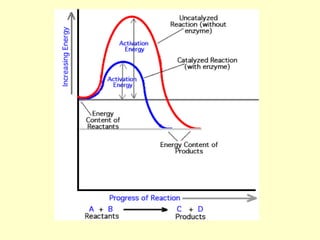
Catalysts
• Control the speed of reactions without
changing the products formed
– By reducing the activation energy
Catalysts
• Control the speed of reactions without
changing the products formed
– By reducing the activation energy
– Tunnel vs. Climbing a mountain
• Remain unchanged and can be used
over and over
• Often only needed in small amounts
Enzymes…
• Work on molecules called the substrate
– Can be anything
Enzymes…
• Work on molecules called the substrate
– Can be anything
• Are substrate-specific
Enzymes…
• Work on molecules called the substrate
– Can be anything
• Are substrate-specific
• Alter the substrate in some way
• Examples:
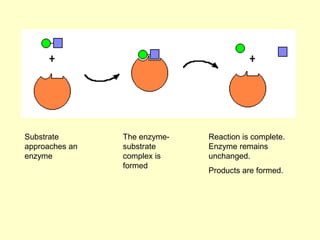
Substrate
approaches an
enzyme
The enzyme-
substrate
complex is
formed
Reaction is complete.
Enzyme remains
unchanged.
Products are formed.
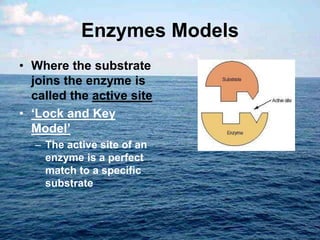
Enzymes Models
• Where the substrate
joins the enzyme is
called the active site
• ‘Lock and Key
Model’
– The active site of an
enzyme is a perfect
match to a specific
substrate
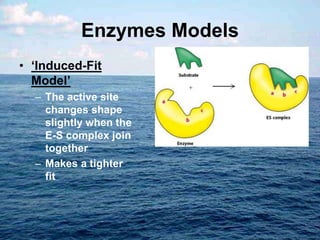
Enzymes Models
• ‘Induced-Fit
Model’
– The active site
changes shape
slightly when the
E-S complex join
together
– Makes a tighter
fit
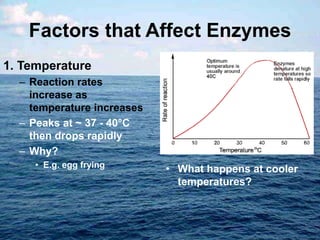
Factors that Affect Enzymes
• What happens at cooler
temperatures?
1. Temperature
– Reaction rates
increase as
temperature increases
– Peaks at ~ 37 - 40°C
then drops rapidly
– Why?
• E.g. egg frying
Factors that Affect Enzymes
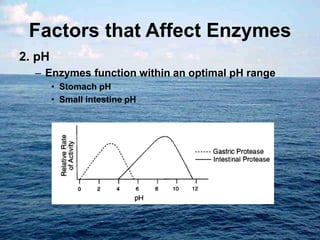
2. pH
– Enzymes function within an optimal pH range
• Stomach pH
• Small intestine pH
Factors that Affect Enzymes
3. Concentration of Substrate Molecules
– Reaction rate increases as the substrate
concentration increases up to a point
– Animation link
– The limiting factor in the reaction may be
the amount of substrate or the amount of
enzyme available
Factors that Affect Enzymes
4. Inhibitor molecules
– Molecules that attach to the enzyme and
reduce its ability to bind substrate
– There are two types of inhibitors:
a. Competitive inhibitors
b. Non-competitive inhibitors
4. Inhibitor molecules
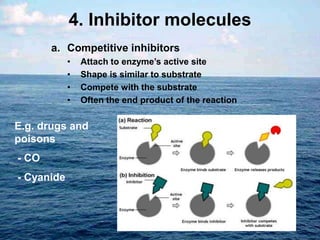
a. Competitive inhibitors
• Attach to enzyme’s active site
• Shape is similar to substrate
• Compete with the substrate
• Often the end product of the reaction
E.g. drugs and
poisons
- CO
- Cyanide
4. Inhibitor molecules
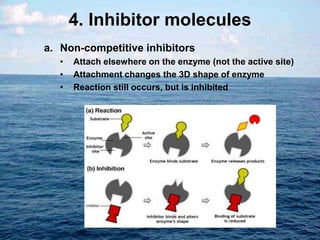
a. Non-competitive inhibitors
• Attach elsewhere on the enzyme (not the active site)
• Attachment changes the 3D shape of enzyme
• Reaction still occurs, but is inhibited
Regulation of Enzyme Activity
• Feedback Inhibition
– Animation
– Turns the path ‘off’
– Prevents accumulation of products
– Final product of pathway interferes with an
enzyme by binding with allosteric
(regulatory) site and altering the active site
Regulation of Enzyme Activity
• Precursor Activity
– Animation
– Turns the path ‘on’
– A substrate binds with the last enzyme in a
path improving the fit of the E-S complex
– Binds to the allosteric site
– Speeds up the final product formation
Regulation of Enzyme Activity
• Both feedback inhibition and precursor
activity are called allosteric activity
• Handout

ENZYMES REACTIONs ppt..ppt

  • 1.
  • 2.
    ENZYMES and METABOLICREACTIONS • How do reactions occur in cells? – Molecules are in constant motion – Collisions between molecules allow reactions to occur
  • 3.
    ENZYMES and METABOLICREACTIONS • How do reactions occur in cells? – Molecules are in constant motion – Collisions between molecules allow reactions to occur • How do we speed up reactions in cells?
  • 4.
    ENZYMES and METABOLICREACTIONS • Enzymes – Are protein catalysts that allow chemical reactions to take place in our body without increasing the temperature – End with the suffix ‘-ase’
  • 5.
    ENZYMES and METABOLICREACTIONS • Enzymes – Are protein catalysts that allow chemical reactions to take place in our body without increasing the temperature – End with the suffix ‘-ase’ – Examples: urease, amylase, sucrase
  • 6.
    Catalysts • Control thespeed of reactions without changing the products formed – By reducing the activation energy
  • 8.
    Catalysts • Control thespeed of reactions without changing the products formed – By reducing the activation energy – Tunnel vs. Climbing a mountain • Remain unchanged and can be used over and over • Often only needed in small amounts
  • 11.
    Enzymes… • Work onmolecules called the substrate – Can be anything
  • 12.
    Enzymes… • Work onmolecules called the substrate – Can be anything • Are substrate-specific
  • 13.
    Enzymes… • Work onmolecules called the substrate – Can be anything • Are substrate-specific • Alter the substrate in some way • Examples:
  • 14.
    Substrate approaches an enzyme The enzyme- substrate complexis formed Reaction is complete. Enzyme remains unchanged. Products are formed.
  • 15.
    Enzymes Models • Wherethe substrate joins the enzyme is called the active site • ‘Lock and Key Model’ – The active site of an enzyme is a perfect match to a specific substrate
  • 16.
    Enzymes Models • ‘Induced-Fit Model’ –The active site changes shape slightly when the E-S complex join together – Makes a tighter fit
  • 17.
    Factors that AffectEnzymes • What happens at cooler temperatures? 1. Temperature – Reaction rates increase as temperature increases – Peaks at ~ 37 - 40°C then drops rapidly – Why? • E.g. egg frying
  • 18.
    Factors that AffectEnzymes 2. pH – Enzymes function within an optimal pH range • Stomach pH • Small intestine pH
  • 19.
    Factors that AffectEnzymes 3. Concentration of Substrate Molecules – Reaction rate increases as the substrate concentration increases up to a point – Animation link – The limiting factor in the reaction may be the amount of substrate or the amount of enzyme available
  • 20.
    Factors that AffectEnzymes 4. Inhibitor molecules – Molecules that attach to the enzyme and reduce its ability to bind substrate – There are two types of inhibitors: a. Competitive inhibitors b. Non-competitive inhibitors
  • 21.
    4. Inhibitor molecules a.Competitive inhibitors • Attach to enzyme’s active site • Shape is similar to substrate • Compete with the substrate • Often the end product of the reaction E.g. drugs and poisons - CO - Cyanide
  • 22.
    4. Inhibitor molecules a.Non-competitive inhibitors • Attach elsewhere on the enzyme (not the active site) • Attachment changes the 3D shape of enzyme • Reaction still occurs, but is inhibited
  • 23.
    Regulation of EnzymeActivity • Feedback Inhibition – Animation – Turns the path ‘off’ – Prevents accumulation of products – Final product of pathway interferes with an enzyme by binding with allosteric (regulatory) site and altering the active site
  • 24.
    Regulation of EnzymeActivity • Precursor Activity – Animation – Turns the path ‘on’ – A substrate binds with the last enzyme in a path improving the fit of the E-S complex – Binds to the allosteric site – Speeds up the final product formation
  • 25.
    Regulation of EnzymeActivity • Both feedback inhibition and precursor activity are called allosteric activity • Handout