ENZYMOLOGY (BBC 205)
SRISHTI
S.Id-2019008455
ROLL NO-1907143010
BSc. Hons BIOCHEMISTRY (TERM-04)
SBSR, SHARDA UNIVERSITY
ENZYME INHIBITORS
Enzyme Inhibitor
An enzyme inhibitor is a compound that decreases or
diminishes the rate or velocity of an enzyme-catalysed
reaction by influencing the binding of S &/or its turnover
number.
• The inhibitor may be organic or inorganic in nature
• Inhibitors - drugs, antibiotics ,toxins and antimetabolite or
natural products of enzyme reaction.
Types of Enzyme Inhibitors
Reversible Inhibition
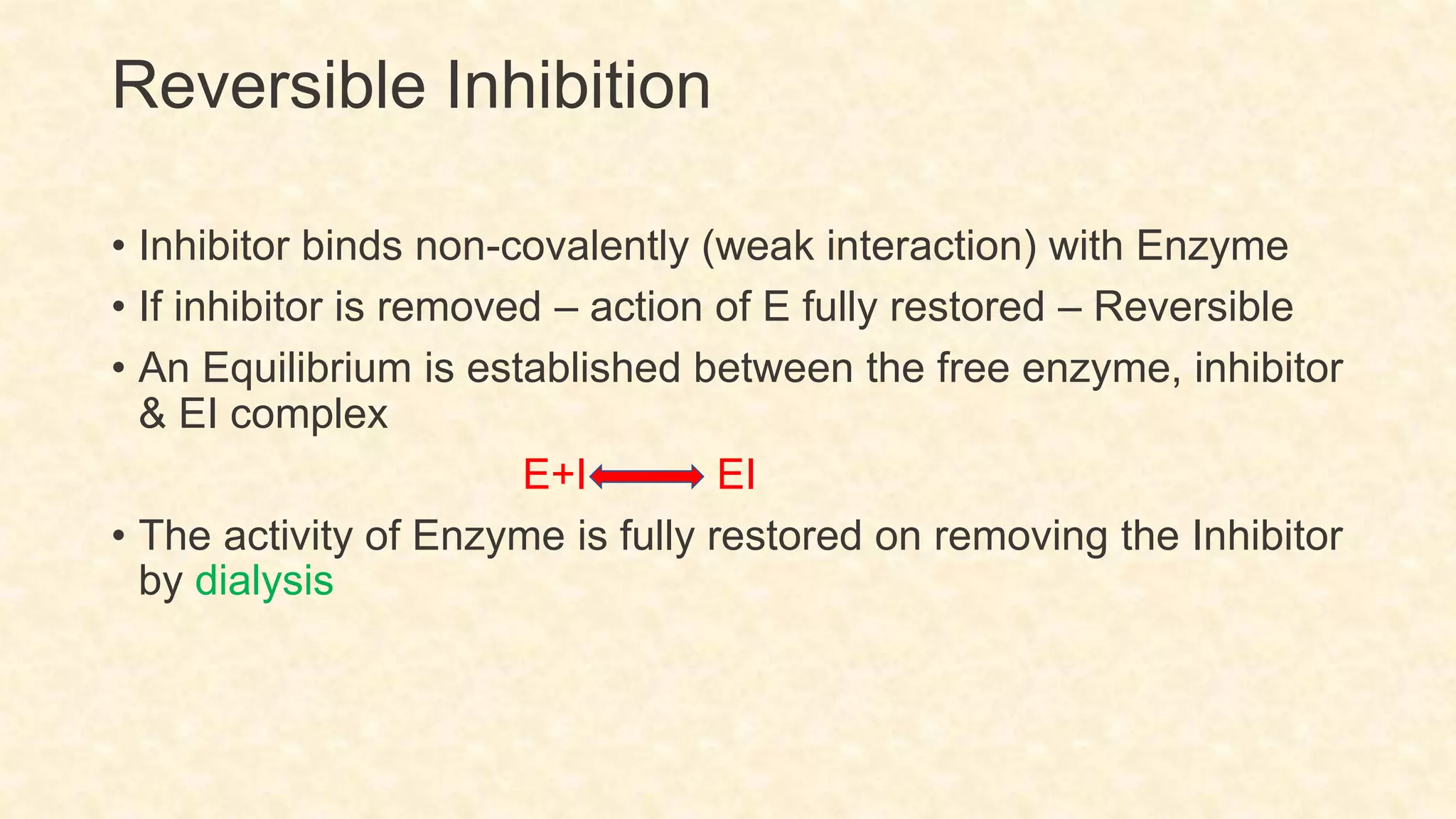
• Inhibitor binds non-covalently (weak interaction) with Enzyme
• If inhibitor is removed – action of E fully restored – Reversible
• An Equilibrium is established between the free enzyme, inhibitor
& EI complex
E+I EI
• The activity of Enzyme is fully restored on removing the Inhibitor
by dialysis
1. Competitive Inhibition
• Inhibitor binds reversibly to the same site that the substrate
binds i.e , competes with the S for binding.
• Substrate analogue – I closely resembles the S
• Inhibition can be reversed by increasing the conc. of S –
reversible
• Degree of inhibition - depends on the conc. of S & I and on the
relative affinities of the enzyme for S & I
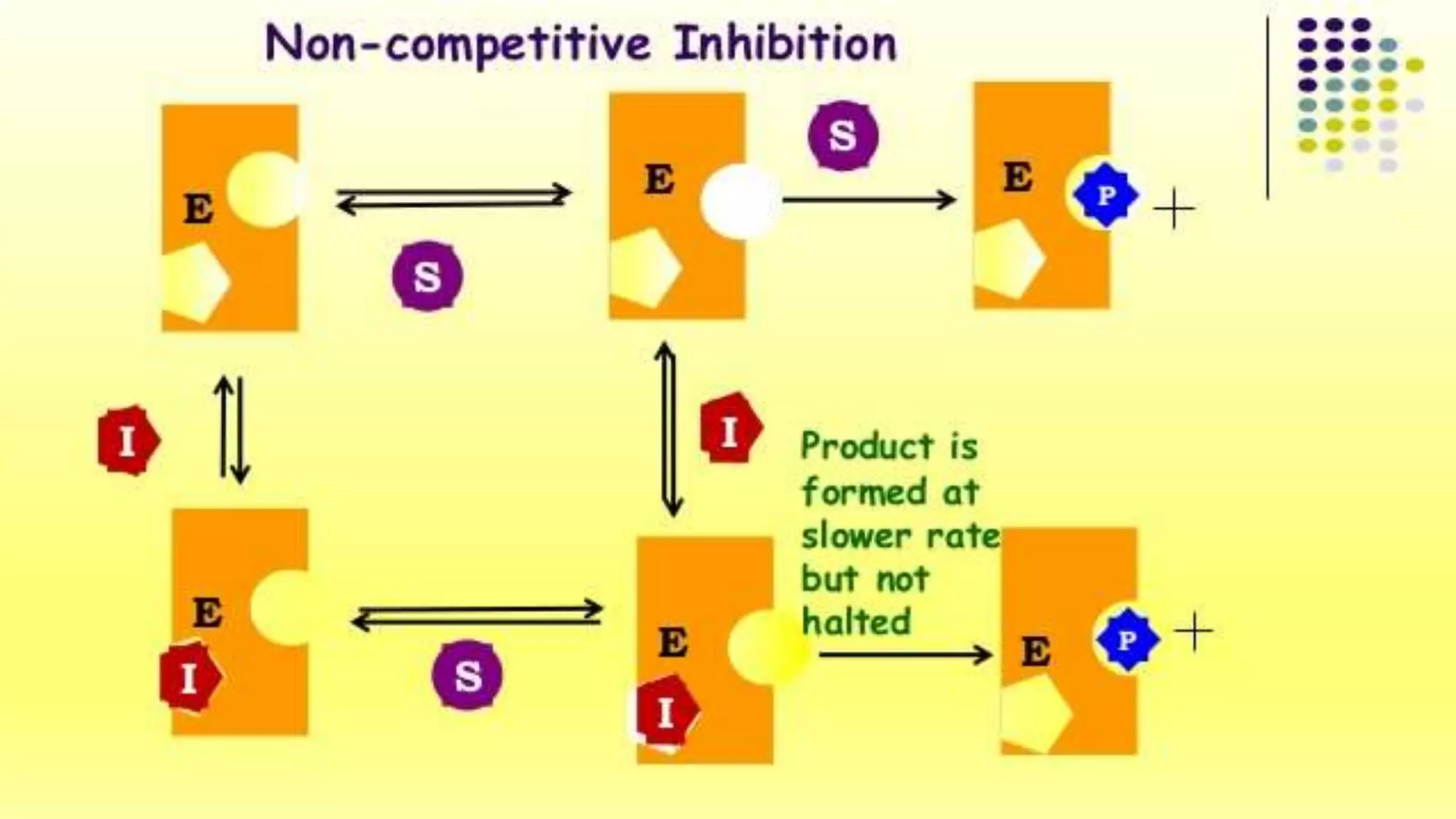
Non-competitive Inhibition
• Inhibitor binds at a site other than the active site of the enzyme
• I has no structural resemblance to the S – No competition for
binding
• Increase in the S conc. does not relieve this I
• I & S bind at different sites – formation of both EI and EIS
complexes is possible.
• EIS – forms product at a slower rate than ES
• Reaction is slowed down but not halted.
Uncompetitive Inhibition
• I binds only to the ES complex , not to free E
• I - causes structural distortion of the active site - E catalytically
inactive
• I can’t be reversed by increasing the [S] since I doesn't compete
with S for the same binding site
Irreversible Inhibition
• Inhibitor binds covalently (strong) with the enzyme irreversibly
,so it can’t dissociate from the enzyme
• Inhibitor cause conformation change at active site of the E-
destroying their capacity to function as catalysts.
• Enzyme activity is not regained on dialysis / by increasing the
conc. of S
• A variety of poisons, and oxidizing agents act as irreversible
inhibition.
Suicide Inhibition
• Specialized form of Irreversible inhibition
• Also known as Mechanism based inactivation
• I makes use of the enzyme's own reaction mechanism to
inactivate it
• Inhibitor (structural analogue) is converted to a more effective
inhibitor with the help of the E to be inhibited
• E literally commits suicide – they utilize normal E reaction
mechanism to inactivate the E.
Allosteric Inhibition
• Some E possess additional site other than the Active site called
as Allosteric sites, E – Allosteric E.
• They are unique site on protein molecule
• Allosteric Effectors– substances bind at Allosteric site &
regulate E activity
• Positive Allosteric effectors – E activity is increased
• Negative Allosteric effectors – E activity is decreased
Importance of Enzyme Inhibition
• Controlling Metabolism
• Enzyme Inhibitors Used As Drugs To Treat Diseases
• Antibiotics
• Identification of the catalytic / functional groups at the active
site of E
• Provide information about substrate specificity of the enzyme
• Useful to study the mechanism of catalytic activity
• Natural Poisons
• Pesticides And Herbicides
Enzyme Inhibitors

Enzyme Inhibitors

  • 1.
    ENZYMOLOGY (BBC 205) SRISHTI S.Id-2019008455 ROLLNO-1907143010 BSc. Hons BIOCHEMISTRY (TERM-04) SBSR, SHARDA UNIVERSITY ENZYME INHIBITORS
  • 2.
    Enzyme Inhibitor An enzymeinhibitor is a compound that decreases or diminishes the rate or velocity of an enzyme-catalysed reaction by influencing the binding of S &/or its turnover number. • The inhibitor may be organic or inorganic in nature • Inhibitors - drugs, antibiotics ,toxins and antimetabolite or natural products of enzyme reaction.
  • 3.
    Types of EnzymeInhibitors
  • 4.
    Reversible Inhibition • Inhibitorbinds non-covalently (weak interaction) with Enzyme • If inhibitor is removed – action of E fully restored – Reversible • An Equilibrium is established between the free enzyme, inhibitor & EI complex E+I EI • The activity of Enzyme is fully restored on removing the Inhibitor by dialysis
  • 5.
    1. Competitive Inhibition •Inhibitor binds reversibly to the same site that the substrate binds i.e , competes with the S for binding. • Substrate analogue – I closely resembles the S • Inhibition can be reversed by increasing the conc. of S – reversible • Degree of inhibition - depends on the conc. of S & I and on the relative affinities of the enzyme for S & I
  • 8.
    Non-competitive Inhibition • Inhibitorbinds at a site other than the active site of the enzyme • I has no structural resemblance to the S – No competition for binding • Increase in the S conc. does not relieve this I • I & S bind at different sites – formation of both EI and EIS complexes is possible. • EIS – forms product at a slower rate than ES • Reaction is slowed down but not halted.
  • 10.
    Uncompetitive Inhibition • Ibinds only to the ES complex , not to free E • I - causes structural distortion of the active site - E catalytically inactive • I can’t be reversed by increasing the [S] since I doesn't compete with S for the same binding site
  • 11.
    Irreversible Inhibition • Inhibitorbinds covalently (strong) with the enzyme irreversibly ,so it can’t dissociate from the enzyme • Inhibitor cause conformation change at active site of the E- destroying their capacity to function as catalysts. • Enzyme activity is not regained on dialysis / by increasing the conc. of S • A variety of poisons, and oxidizing agents act as irreversible inhibition.
  • 13.
    Suicide Inhibition • Specializedform of Irreversible inhibition • Also known as Mechanism based inactivation • I makes use of the enzyme's own reaction mechanism to inactivate it • Inhibitor (structural analogue) is converted to a more effective inhibitor with the help of the E to be inhibited • E literally commits suicide – they utilize normal E reaction mechanism to inactivate the E.
  • 14.
    Allosteric Inhibition • SomeE possess additional site other than the Active site called as Allosteric sites, E – Allosteric E. • They are unique site on protein molecule • Allosteric Effectors– substances bind at Allosteric site & regulate E activity • Positive Allosteric effectors – E activity is increased • Negative Allosteric effectors – E activity is decreased
  • 16.
    Importance of EnzymeInhibition • Controlling Metabolism • Enzyme Inhibitors Used As Drugs To Treat Diseases • Antibiotics • Identification of the catalytic / functional groups at the active site of E • Provide information about substrate specificity of the enzyme • Useful to study the mechanism of catalytic activity • Natural Poisons • Pesticides And Herbicides