TREATMENT OF MUNICIPAL
WASTE AND INDUSTRIES
EFFLUENTS
INTRODUCTION:
 Typical wastes might include unconsumed inorganic and organic media components, microbial cells, and
other suspended solids, filter aids, waste wash water from cleansing operations, cooling water, water
containing traces of solvents, acids, alkalis, human sewage, etc.
 Dispose of wastes directly to a convenient area of land or into a nearby watercourse. This cheap and
simple method of disposal is now very rarely possible, nor is it environmentally desirable.
 Water authorities and similar bodies have become more active in combating pollution caused by domestic
and industrial wastes.
 With liquid wastes, it may be possible to dispose of untreated effluents to a municipal sewage treatment
works (STW). They much will depend on the composition, strength and volumetric flow rate of the
effluent. STWs are planned to operate with an effluent of a reasonably constant composition at a steady
flow rate. Thus, if the discharge from an industrial process is large in volume and intermittently produced
it may be necessary to install storage tanks on site to regulate the effluent flow.
 Different aquatic species have varying tolerances to depleted oxygen levels, and as a consequence some
species will die off in specific stretches of the receiving water, and in other regions a different population
capable of growth at lower oxygen levels will develop.
 Municipal Wastewater Treatment is the process of ejecting the harmful pollutants from wastewater. The
main source of pollutants is the domestic use. The pollutants are treated by various methods like Physical,
Chemical, and Biological process. The practice of municipal wastewater treatment is best encouraged
these days. This treated resource is best for utilizing in raising the crops.
Importance of municipal wastewater treatment
 –>There is a pattern of conventional Municipal wastewater treatment. The three patterns are
Preliminary, Primary and secondary. Municipal wastewater is dismissed to external surface
water. It may be reused water or before evacuated to surface water. Some other may be needed
before reuse the filth from wastewater treatment process are treated eventually and then biased to
reuse in crop productions.
 –>There was a time when there was a natural treatment process in lakes and rivers was sufficient
for our basic needs but due to increase in populations and the pollutants, unnatural innovations
are being implemented to solve the basic crisis.
 –>The fundamental process of the wastewater treatment plant is to boost up the natural
phenomenon of by which it can refine water.
 –>Industrial wastewater may contain contaminations, which cannot be ejected by
customary sewage treatment. It needs more advanced methods to filter the impurities.
 –>Primary treatment of municipal wastewater treatment can be followed by the first stage is
the deposition stage. The excrement is streamed through the large tanks; later these tanks are used
to skimming off the grease and oils from the sludge which are settled in the tanks. The refined
filths are collected at the base of the tank where it is pumped to filth treatment facilities.
 –>The secondary treatment of municipal wastewater treatment is plotted to reduce the
biological pollutants which are executed by human’s waste, food, detergents, and soaps. The
municipal plants treat the filth liquid by the aerobic biological process.
 –>The capacity of municipal wastewater filths are produced by the humans and may be affecting
as per the environmental aspects. The process in a waste water treatment plants is patterned to
copy the natural process.
 –>If the environment is overburdened with consumption of organic contaminants, then it can
reduce the levels of oxygen in the water.
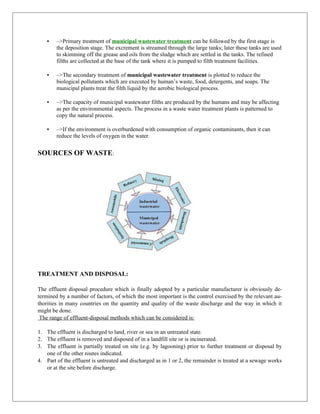
SOURCES OF WASTE:
TREATMENT AND DISPOSAL:
The effluent disposal procedure which is finally adopted by a particular manufacturer is obviously de-
termined by a number of factors, of which the most important is the control exercised by the relevant au-
thorities in many countries on the quantity and quality of the waste discharge and the way in which it
might be done.
The range of effluent-disposal methods which can be considered is:
1. The effluent is discharged to land, river or sea in an untreated state.
2. The effluent is removed and disposed of in a landfill site or is incinerated.
3. The effluent is partially treated on site (e.g. by lagooning) prior to further treatment or disposal by
one of the other routes indicated.
4. Part of the effluent is untreated and discharged as in 1 or 2, the remainder is treated at a sewage works
or at the site before discharge.
5. All of the effluent is sent to the sewage works for treatment, although there might be reluctance by
the sewage works to accept it, possibly resulting in some preliminary on-site treatment being
required, and discharge rates and effluent composition defined.
6. All the effluent is treated at the factory before discharge.
DISPOSAL:
1. Seas and rivers
The simplest way of disposal will be on a sea coast or in a large estuary where the effluent is
discharged through a pipeline (installed by the factory or local authorities) extending below the
low-water mark. In such a case there may be little preliminary treatment and one relies solely on
the degree of dilution in the sea water.
2. Lagoons (oxidation ponds)
Lagoons, holding ponds, oxidation ponds, etc., may be used by a number of industries if land is
available at a reasonable cost. It is a method often used in seasonal industries where capital
investment in effluent plant is difficult to justify. The lagoon normally consists of a volume of
shallow water enclosed by watertight bankments. Oxidation ponds are typically 1-2 m deep.
3. Spray irrigation
Liquid wastes can be applied directly to land as r irrigation water and fertilizer when they are claimed
to have a number of beneficial effects on the soil and plants.
These wastes were initially chlorinated to lower the BOD and reduce unpleasant odors and then
sprayed on to land until the equivalent of 38 mm of rainfall was reached. This process was repeated at
monthly intervals and improved plant growth.
4. Well disposal
Disused wells, boreholes or mine shafts may provide an ideal, cheap method for disposal when the
volume of waste is limited, the underground strata are suitable and the chances of contamination of
water supplies utilized by water authorities are negligible.
5. Landfilling
Landfilling is a disposal method for municipal solid waste (MSW) and industrial waste. It utilizes
natural or manmade voids (e.g. disused clay pits) into which the waste is deposited. Both solid and
liquid wastes can be deposited depending on restrictions imposed by the site licence. Strict controls
exist on the amount of liquid and toxic materials which can be accepted because of the threat of
groundwater pollution if leachate (a liquid having BOD levels up to 30,000 mg dm³) escapes from the
site.
6. Disposal of effluents to sewers
Municipal authorities and water treatment companies which accept trade effluents into their sewage
systems will want to be sure that:
1. The sewage works has the capacity to cope with the estimated volume of effluent.
2. The effluent will not interfere with the treatment processes used at the sewage works.
3. There are no compounds present in the effluent which will pass through the sewage works un-
changed and then cause problems when discharged into a watercourse.
TREATMENT PROCESSES
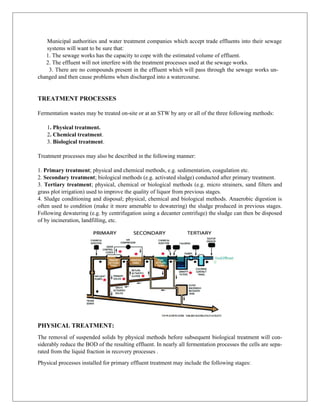
Fermentation wastes may be treated on-site or at an STW by any or all of the three following methods:
1. Physical treatment.
2. Chemical treatment.
3. Biological treatment.
Treatment processes may also be described in the following manner:
1. Primary treatment; physical and chemical methods, e.g. sedimentation, coagulation etc.
2. Secondary treatment; biological methods (e.g. activated sludge) conducted after primary treatment.
3. Tertiary treatment; physical, chemical or biological methods (e.g. micro strainers, sand filters and
grass plot irrigation) used to improve the quality of liquor from previous stages.
4. Sludge conditioning and disposal; physical, chemical and biological methods. Anaerobic digestion is
often used to condition (make it more amenable to dewatering) the sludge produced in previous stages.
Following dewatering (e.g. by centrifugation using a decanter centrifuge) the sludge can then be disposed
of by incineration, landfilling, etc.
PHYSICAL TREATMENT:
The removal of suspended solids by physical methods before subsequent biological treatment will con-
siderably reduce the BOD of the resulting effluent. In nearly all fermentation processes the cells are sepa-
rated from the liquid fraction in recovery processes .
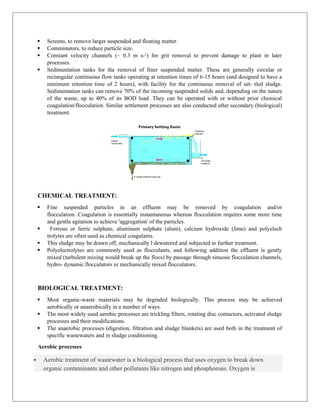
Physical processes installed for primary effluent treatment may include the following stages:
 Screens, to remove larger suspended and floating matter.
 Comminutors, to reduce particle size.
 Constant velocity channels (~ 0.3 m s-¹) for grit removal to prevent damage to plant in later
processes.
 Sedimentation tanks for the removal of finer suspended matter. These are generally circular or
rectangular continuous flow tanks operating at retention times of 6-15 hours (and designed to have a
minimum retention time of 2 hours), with facility for the continuous removal of set- tled sludge.
Sedimentation tanks can remove 70% of the incoming suspended solids and, depending on the nature
of the waste, up to 40% of its BOD load .They can be operated with or without prior chemical
coagulation/flocculation. Similar settlement processes are also conducted after secondary (biological)
treatment.
CHEMICAL TREATMENT:
 Fine suspended particles in an effluent may be removed by coagulation and/or
flocculation .Coagulation is essentially instantaneous whereas flocculation requires some more time
and gentle agitation to achieve 'aggregation' of the particles.
 Ferrous or ferric sulphate, aluminum sulphate (alum), calcium hydroxide (lime) and polyelech
trolytes are often used as chemical coagulants.
 This sludge may be drawn off, mechanically l dewatered and subjected to further treatment.
 Polyelectrolytes are commonly used as flocculants, and following addition the effluent is gently
mixed (turbulent mixing would break up the flocs) by passage through sinuous flocculation channels,
hydro- dynamic flocculators or mechanically mixed flocculators.
BIOLOGICAL TREATMENT:
 Most organic-waste materials may be degraded biologically. This process may be achieved
aerobically or anaerobically in a number of ways.
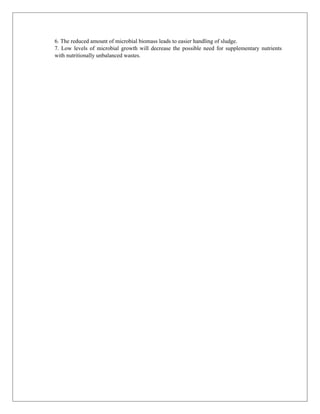
 The most widely used aerobic processes are trickling filters, rotating disc contactors, activated sludge
processes and their modifications.
 The anaerobic processes (digestion, filtration and sludge blankets) are used both in the treatment of
specific wastewaters and in sludge conditioning.
Aerobic processes
 Aerobic treatment of wastewater is a biological process that uses oxygen to break down
organic contaminants and other pollutants like nitrogen and phosphorous. Oxygen is
continuously mixed into the wastewater or sewage by a mechanical aeration device, such as an
air blower or compressor. Aerobic microorganisms then feed on the wastewater’s organic
matter, converting it into carbon dioxide and biomass which can be removed.
 Aerobic treatment is usually used to polish industrial wastewater pre-treated by anaerobic
processes. This ensures the wastewater is fully degraded and can be safely discharged in
accordance with strict environmental regulations. Aerobic treatment processes are suitable for
a range of industries such as food & beverage, chemical and municipal.
 There are several different technologies for the aerobic treatment of wastewater and sewage.
These include:
 Conventional activated sludge: organic matter is broken down by aerobic microorganisms in an
aeration tank. This forms biological flocs (sludge) which are then separated from the treated
water in a sedimentation tank.
 Moving bed biofilm reactor (MBBR): biofilm grows on plastic carriers suspended and
circulated in an aeration tank. These are kept in the tank by retention sieves.
 Membrane bioreactor (MBR): advanced technology combining the activated sludge process
with membrane filtration.
The benefits of aerobic wastewater treatment systems:
Aerobic treatment of wastewater is a stable, simple and efficient process that produces high-
quality secondary effluent. The resulting sludge is odour-free and can be sold as excellent
agricultural fertilizer.
When combined with anaerobic treatment, aerobic treatment systems ensure complete
contaminant and nutrient removal. This means your wastewater can be safely discharged without
breaching stringent environmental regulations.
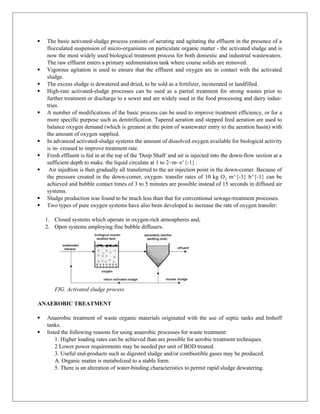
ACTIVATED SLUDGE PROCESSES
 The basic activated-sludge process consists of aerating and agitating the effluent in the presence of a
flocculated suspension of micro-organisms on particulate organic matter - the activated sludge and is
now the most widely used biological treatment process for both domestic and industrial wastewaters.
The raw effluent enters a primary sedimentation tank where course solids are removed.
 Vigorous agitation is used to ensure that the effluent and oxygen are in contact with the activated
sludge.
 The excess sludge is dewatered and dried, to be sold as a fertilizer, incinerated or landfilled.
 High-rate activated-sludge processes can be used as a partial treatment for strong wastes prior to
further treatment or discharge to a sewer and are widely used in the food processing and dairy indus-
tries.
 A number of modifications of the basic process can be used to improve treatment efficiency, or for a
more specific purpose such as denitrification. Tapered aeration and stepped feed aeration are used to
balance oxygen demand (which is greatest at the point of wastewater entry to the aeration basin) with
the amount of oxygen supplied.
 In advanced activated-sludge systems the amount of dissolved oxygen available for biological activity
is in- creased to improve treatment rate.
 Fresh effluent is fed in at the top of the 'Deep Shaft' and air is injected into the down-flow section at a
sufficient depth to make. the liquid circulate at 1 to 2~m~s^{-1} .
 Air injedtion is then gradually all transferred to the air injection point in the down-comer. Because of
the pressure created in the down-comer, oxygen- transfer rates of 10 kg O m^{-3} h^{-1} can be
₂
achieved and bubble contact times of 3 to 5 minutes are possible instead of 15 seconds in diffused air
systems.
 Sludge production was found to be much less than that for conventional sewage-treatment processes.
 Two types of pure oxygen systems have also been developed to increase the rate of oxygen transfer:
1. Closed systems which operate in oxygen-rich atmospheres and,
2. Open systems employing fine bubble diffusers.
FIG. Activated sludge process
ANAEROBIC TREATMENT
 Anaerobic treatment of waste organic materials originated with the use of septic tanks and Imhoff
tanks.
 listed the following reasons for using anaerobic processes for waste treatment:
1. Higher loading rates can be achieved than are possible for aerobic treatment techniques.
2 Lower power requirements may be needed per unit of BOD treated.
3. Useful end-products such as digested sludge and/or combustible gases may be produced.
A. Organic matter is metabolized to a stable form.
5. There is an alteration of water-binding characteristics to permit rapid sludge dewatering.
6. The reduced amount of microbial biomass leads to easier handling of sludge.
7. Low levels of microbial growth will decrease the possible need for supplementary nutrients
with nutritionally unbalanced wastes.

EFFLUENT TREATMENT by himanshi (23).docx

  • 1.
    TREATMENT OF MUNICIPAL WASTEAND INDUSTRIES EFFLUENTS INTRODUCTION:  Typical wastes might include unconsumed inorganic and organic media components, microbial cells, and other suspended solids, filter aids, waste wash water from cleansing operations, cooling water, water containing traces of solvents, acids, alkalis, human sewage, etc.  Dispose of wastes directly to a convenient area of land or into a nearby watercourse. This cheap and simple method of disposal is now very rarely possible, nor is it environmentally desirable.  Water authorities and similar bodies have become more active in combating pollution caused by domestic and industrial wastes.  With liquid wastes, it may be possible to dispose of untreated effluents to a municipal sewage treatment works (STW). They much will depend on the composition, strength and volumetric flow rate of the effluent. STWs are planned to operate with an effluent of a reasonably constant composition at a steady flow rate. Thus, if the discharge from an industrial process is large in volume and intermittently produced it may be necessary to install storage tanks on site to regulate the effluent flow.  Different aquatic species have varying tolerances to depleted oxygen levels, and as a consequence some species will die off in specific stretches of the receiving water, and in other regions a different population capable of growth at lower oxygen levels will develop.  Municipal Wastewater Treatment is the process of ejecting the harmful pollutants from wastewater. The main source of pollutants is the domestic use. The pollutants are treated by various methods like Physical, Chemical, and Biological process. The practice of municipal wastewater treatment is best encouraged these days. This treated resource is best for utilizing in raising the crops. Importance of municipal wastewater treatment  –>There is a pattern of conventional Municipal wastewater treatment. The three patterns are Preliminary, Primary and secondary. Municipal wastewater is dismissed to external surface water. It may be reused water or before evacuated to surface water. Some other may be needed before reuse the filth from wastewater treatment process are treated eventually and then biased to reuse in crop productions.  –>There was a time when there was a natural treatment process in lakes and rivers was sufficient for our basic needs but due to increase in populations and the pollutants, unnatural innovations are being implemented to solve the basic crisis.  –>The fundamental process of the wastewater treatment plant is to boost up the natural phenomenon of by which it can refine water.  –>Industrial wastewater may contain contaminations, which cannot be ejected by customary sewage treatment. It needs more advanced methods to filter the impurities.
  • 2.
     –>Primary treatmentof municipal wastewater treatment can be followed by the first stage is the deposition stage. The excrement is streamed through the large tanks; later these tanks are used to skimming off the grease and oils from the sludge which are settled in the tanks. The refined filths are collected at the base of the tank where it is pumped to filth treatment facilities.  –>The secondary treatment of municipal wastewater treatment is plotted to reduce the biological pollutants which are executed by human’s waste, food, detergents, and soaps. The municipal plants treat the filth liquid by the aerobic biological process.  –>The capacity of municipal wastewater filths are produced by the humans and may be affecting as per the environmental aspects. The process in a waste water treatment plants is patterned to copy the natural process.  –>If the environment is overburdened with consumption of organic contaminants, then it can reduce the levels of oxygen in the water. SOURCES OF WASTE: TREATMENT AND DISPOSAL: The effluent disposal procedure which is finally adopted by a particular manufacturer is obviously de- termined by a number of factors, of which the most important is the control exercised by the relevant au- thorities in many countries on the quantity and quality of the waste discharge and the way in which it might be done. The range of effluent-disposal methods which can be considered is: 1. The effluent is discharged to land, river or sea in an untreated state. 2. The effluent is removed and disposed of in a landfill site or is incinerated. 3. The effluent is partially treated on site (e.g. by lagooning) prior to further treatment or disposal by one of the other routes indicated. 4. Part of the effluent is untreated and discharged as in 1 or 2, the remainder is treated at a sewage works or at the site before discharge.
  • 3.
    5. All ofthe effluent is sent to the sewage works for treatment, although there might be reluctance by the sewage works to accept it, possibly resulting in some preliminary on-site treatment being required, and discharge rates and effluent composition defined. 6. All the effluent is treated at the factory before discharge. DISPOSAL: 1. Seas and rivers The simplest way of disposal will be on a sea coast or in a large estuary where the effluent is discharged through a pipeline (installed by the factory or local authorities) extending below the low-water mark. In such a case there may be little preliminary treatment and one relies solely on the degree of dilution in the sea water. 2. Lagoons (oxidation ponds) Lagoons, holding ponds, oxidation ponds, etc., may be used by a number of industries if land is available at a reasonable cost. It is a method often used in seasonal industries where capital investment in effluent plant is difficult to justify. The lagoon normally consists of a volume of shallow water enclosed by watertight bankments. Oxidation ponds are typically 1-2 m deep. 3. Spray irrigation Liquid wastes can be applied directly to land as r irrigation water and fertilizer when they are claimed to have a number of beneficial effects on the soil and plants. These wastes were initially chlorinated to lower the BOD and reduce unpleasant odors and then sprayed on to land until the equivalent of 38 mm of rainfall was reached. This process was repeated at monthly intervals and improved plant growth. 4. Well disposal Disused wells, boreholes or mine shafts may provide an ideal, cheap method for disposal when the volume of waste is limited, the underground strata are suitable and the chances of contamination of water supplies utilized by water authorities are negligible. 5. Landfilling Landfilling is a disposal method for municipal solid waste (MSW) and industrial waste. It utilizes natural or manmade voids (e.g. disused clay pits) into which the waste is deposited. Both solid and liquid wastes can be deposited depending on restrictions imposed by the site licence. Strict controls exist on the amount of liquid and toxic materials which can be accepted because of the threat of groundwater pollution if leachate (a liquid having BOD levels up to 30,000 mg dm³) escapes from the site. 6. Disposal of effluents to sewers
  • 4.
    Municipal authorities andwater treatment companies which accept trade effluents into their sewage systems will want to be sure that: 1. The sewage works has the capacity to cope with the estimated volume of effluent. 2. The effluent will not interfere with the treatment processes used at the sewage works. 3. There are no compounds present in the effluent which will pass through the sewage works un- changed and then cause problems when discharged into a watercourse. TREATMENT PROCESSES Fermentation wastes may be treated on-site or at an STW by any or all of the three following methods: 1. Physical treatment. 2. Chemical treatment. 3. Biological treatment. Treatment processes may also be described in the following manner: 1. Primary treatment; physical and chemical methods, e.g. sedimentation, coagulation etc. 2. Secondary treatment; biological methods (e.g. activated sludge) conducted after primary treatment. 3. Tertiary treatment; physical, chemical or biological methods (e.g. micro strainers, sand filters and grass plot irrigation) used to improve the quality of liquor from previous stages. 4. Sludge conditioning and disposal; physical, chemical and biological methods. Anaerobic digestion is often used to condition (make it more amenable to dewatering) the sludge produced in previous stages. Following dewatering (e.g. by centrifugation using a decanter centrifuge) the sludge can then be disposed of by incineration, landfilling, etc. PHYSICAL TREATMENT: The removal of suspended solids by physical methods before subsequent biological treatment will con- siderably reduce the BOD of the resulting effluent. In nearly all fermentation processes the cells are sepa- rated from the liquid fraction in recovery processes . Physical processes installed for primary effluent treatment may include the following stages:
  • 5.
     Screens, toremove larger suspended and floating matter.  Comminutors, to reduce particle size.  Constant velocity channels (~ 0.3 m s-¹) for grit removal to prevent damage to plant in later processes.  Sedimentation tanks for the removal of finer suspended matter. These are generally circular or rectangular continuous flow tanks operating at retention times of 6-15 hours (and designed to have a minimum retention time of 2 hours), with facility for the continuous removal of set- tled sludge. Sedimentation tanks can remove 70% of the incoming suspended solids and, depending on the nature of the waste, up to 40% of its BOD load .They can be operated with or without prior chemical coagulation/flocculation. Similar settlement processes are also conducted after secondary (biological) treatment. CHEMICAL TREATMENT:  Fine suspended particles in an effluent may be removed by coagulation and/or flocculation .Coagulation is essentially instantaneous whereas flocculation requires some more time and gentle agitation to achieve 'aggregation' of the particles.  Ferrous or ferric sulphate, aluminum sulphate (alum), calcium hydroxide (lime) and polyelech trolytes are often used as chemical coagulants.  This sludge may be drawn off, mechanically l dewatered and subjected to further treatment.  Polyelectrolytes are commonly used as flocculants, and following addition the effluent is gently mixed (turbulent mixing would break up the flocs) by passage through sinuous flocculation channels, hydro- dynamic flocculators or mechanically mixed flocculators. BIOLOGICAL TREATMENT:  Most organic-waste materials may be degraded biologically. This process may be achieved aerobically or anaerobically in a number of ways.  The most widely used aerobic processes are trickling filters, rotating disc contactors, activated sludge processes and their modifications.  The anaerobic processes (digestion, filtration and sludge blankets) are used both in the treatment of specific wastewaters and in sludge conditioning. Aerobic processes  Aerobic treatment of wastewater is a biological process that uses oxygen to break down organic contaminants and other pollutants like nitrogen and phosphorous. Oxygen is
  • 6.
    continuously mixed intothe wastewater or sewage by a mechanical aeration device, such as an air blower or compressor. Aerobic microorganisms then feed on the wastewater’s organic matter, converting it into carbon dioxide and biomass which can be removed.  Aerobic treatment is usually used to polish industrial wastewater pre-treated by anaerobic processes. This ensures the wastewater is fully degraded and can be safely discharged in accordance with strict environmental regulations. Aerobic treatment processes are suitable for a range of industries such as food & beverage, chemical and municipal.  There are several different technologies for the aerobic treatment of wastewater and sewage. These include:  Conventional activated sludge: organic matter is broken down by aerobic microorganisms in an aeration tank. This forms biological flocs (sludge) which are then separated from the treated water in a sedimentation tank.  Moving bed biofilm reactor (MBBR): biofilm grows on plastic carriers suspended and circulated in an aeration tank. These are kept in the tank by retention sieves.  Membrane bioreactor (MBR): advanced technology combining the activated sludge process with membrane filtration. The benefits of aerobic wastewater treatment systems: Aerobic treatment of wastewater is a stable, simple and efficient process that produces high- quality secondary effluent. The resulting sludge is odour-free and can be sold as excellent agricultural fertilizer. When combined with anaerobic treatment, aerobic treatment systems ensure complete contaminant and nutrient removal. This means your wastewater can be safely discharged without breaching stringent environmental regulations. ACTIVATED SLUDGE PROCESSES
  • 7.
     The basicactivated-sludge process consists of aerating and agitating the effluent in the presence of a flocculated suspension of micro-organisms on particulate organic matter - the activated sludge and is now the most widely used biological treatment process for both domestic and industrial wastewaters. The raw effluent enters a primary sedimentation tank where course solids are removed.  Vigorous agitation is used to ensure that the effluent and oxygen are in contact with the activated sludge.  The excess sludge is dewatered and dried, to be sold as a fertilizer, incinerated or landfilled.  High-rate activated-sludge processes can be used as a partial treatment for strong wastes prior to further treatment or discharge to a sewer and are widely used in the food processing and dairy indus- tries.  A number of modifications of the basic process can be used to improve treatment efficiency, or for a more specific purpose such as denitrification. Tapered aeration and stepped feed aeration are used to balance oxygen demand (which is greatest at the point of wastewater entry to the aeration basin) with the amount of oxygen supplied.  In advanced activated-sludge systems the amount of dissolved oxygen available for biological activity is in- creased to improve treatment rate.  Fresh effluent is fed in at the top of the 'Deep Shaft' and air is injected into the down-flow section at a sufficient depth to make. the liquid circulate at 1 to 2~m~s^{-1} .  Air injedtion is then gradually all transferred to the air injection point in the down-comer. Because of the pressure created in the down-comer, oxygen- transfer rates of 10 kg O m^{-3} h^{-1} can be ₂ achieved and bubble contact times of 3 to 5 minutes are possible instead of 15 seconds in diffused air systems.  Sludge production was found to be much less than that for conventional sewage-treatment processes.  Two types of pure oxygen systems have also been developed to increase the rate of oxygen transfer: 1. Closed systems which operate in oxygen-rich atmospheres and, 2. Open systems employing fine bubble diffusers. FIG. Activated sludge process ANAEROBIC TREATMENT  Anaerobic treatment of waste organic materials originated with the use of septic tanks and Imhoff tanks.  listed the following reasons for using anaerobic processes for waste treatment: 1. Higher loading rates can be achieved than are possible for aerobic treatment techniques. 2 Lower power requirements may be needed per unit of BOD treated. 3. Useful end-products such as digested sludge and/or combustible gases may be produced. A. Organic matter is metabolized to a stable form. 5. There is an alteration of water-binding characteristics to permit rapid sludge dewatering.
  • 8.
    6. The reducedamount of microbial biomass leads to easier handling of sludge. 7. Low levels of microbial growth will decrease the possible need for supplementary nutrients with nutritionally unbalanced wastes.