Malthouse Engineering Roy Taylor Managing Director
The largest independent flame cutter in the UK set up in 1947 The Malthouse Group is spread over 5 sites All dedicated to sustainability and improving the environment About Malthouse
ISO 14001 Trees planted to reduce noise pollution Rainwater harvesting Recycle all waste products Low level reflective lighting  Our activities
Came via employee suggestion scheme Cost only £650 payback estimated to be 1 – 2 years. The rain runs off the roof and is channelled through filters in to intermediate bulk containers (IBC) When needed, it is bombarded with Ultra Violet light to remove all bacteria and has a metal working fluid added to create an emulsion which is distributed to all 11 Lumsden Grinding machines.  Rainwater Harvesting
RAINWATER   HARVESTING The initiative for a water-saving scheme came via the Company’s Suggestion Scheme using an Employee’s idea of gathering rain from part of the roof and using the water to provide us with the considerable amount of Metal Working Fluid we use daily.
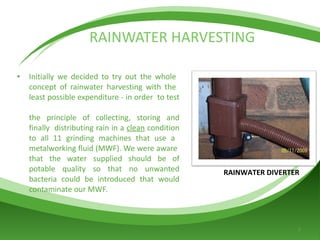
RAINWATER HARVESTING Initially we decided to try out the whole  concept of rainwater harvesting with the  least possible expenditure - in order  to test  the principle of collecting, storing and finally  distributing rain in a  clean  condition to all 11 grinding machines that use a  metalworking fluid (MWF). We were aware  that the water supplied should be of potable quality so that no unwanted bacteria could be introduced that would contaminate our MWF. RAINWATER DIVERTER
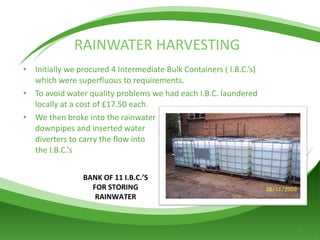
RAINWATER HARVESTING Initially we procured 4 Intermediate Bulk Containers ( I.B.C.’s) which were superfluous to requirements. To avoid water quality problems we had each I.B.C. laundered locally at a cost of £17.50 each. We then broke into the rainwater  downpipes and inserted water  diverters to carry the flow into  the I.B.C.’s BANK OF 11 I.B.C.’S FOR STORING RAINWATER
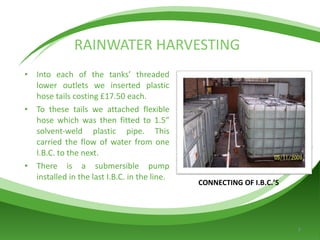
RAINWATER HARVESTING Into each of the tanks’ threaded lower outlets we inserted plastic hose tails costing £17.50 each. To these tails we attached flexible hose which was then fitted to 1.5” solvent-weld plastic pipe. This carried the flow of water from one I.B.C. to the next. There is a submersible pump installed in the last I.B.C. in the line. CONNECTING OF I.B.C.’S
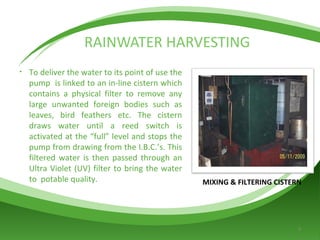
RAINWATER HARVESTING MIXING & FILTERING CISTERN To deliver the water to its point of use the pump  is linked to an in-line cistern which contains a physical filter to remove any large unwanted foreign bodies such as leaves, bird feathers etc. The cistern draws water until a reed switch is activated at the “full” level and stops the pump from drawing from the I.B.C.’s. This filtered water is then passed through an Ultra Violet (UV) filter to bring the water to  potable quality.
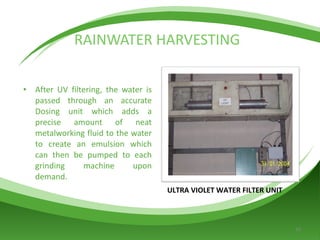
RAINWATER HARVESTING After UV filtering, the water is passed through an accurate Dosing unit which adds a precise amount of neat metalworking fluid to the water to create an emulsion which can then be pumped to each grinding machine upon demand. ULTRA VIOLET WATER FILTER UNIT
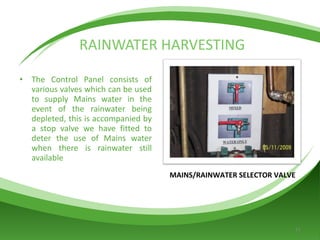
The Control Panel consists of various valves which can be used to supply Mains water in the event of the rainwater being depleted, this is accompanied by a stop valve we have fitted to deter the use of Mains water when there is rainwater still available RAINWATER HARVESTING MAINS/RAINWATER SELECTOR VALVE
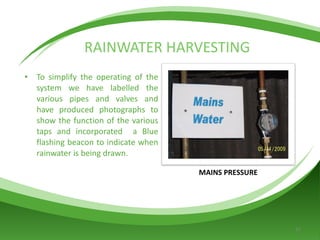
RAINWATER HARVESTING To simplify the operating of the system we have labelled the various pipes and valves and have produced photographs to show the function of the various taps and incorporated  a Blue flashing beacon to indicate when rainwater is being drawn. MAINS PRESSURE
Sources of some components & services: I.B.C. laundering   Drumcare, Tipton Rainwater diverters  B&Q Plastic piping  B&Q Hose tails  ActionSealTite, Didcot Pump  Machine Mart UV Filter  EastMidlandsWater RAINWATER HARVESTING
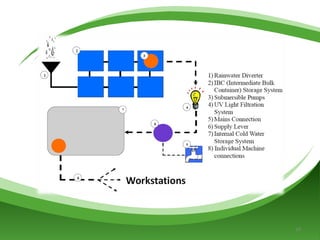
Workstations 1 2 32 4 5 2 6 7 ) Rainwater Diverter ) IBC (Intermediate Bulk Container) Storage System ) Submersible Pumps ) UV Light Filtration  System ) Mains Connection ) Variable Supply Lever ) Internal Cold Water  Storage System 8) Individual Machine  connections 8
RAINWATER HARVESTING Summary The system has been running for several months during which time we have experienced, as with many other companies, a reduction in the amount of work that has passed through the department. This coupled with periods of very low rainfall made it difficult to measure the amount of rainwater we were using. To overcome the measuring aspect we have installed a water meter into the line and can now see exactly what rainwater has been used in the process.
RAINWATER HARVESTING ESTIMATED SAVINGS We record the daily usage of rainwater passing through the water meter so that we can accurately evaluate the accrued and on average savings that we are making with the system, we currently recycle one cubic metre per day. At current charges levied by South Staffs Water for incoming water and by Severn Trent for its “disposal” we are saving 87.16 pence daily for incoming water and 84.39 pence daily for its disposal.
RAINWATER HARVESTING ESTIMED SAVINGS Cont. Based on set-up costs of £650 and assuming that we receive rain in the increasing volumes predicted by the Meteorological Office we are looking for payback within the first 1 – 2 years. We are currently sourcing a single, large capacity water container to replace the I.B.C.’s.
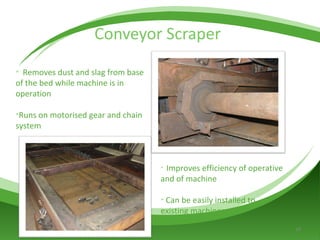
Continual improvement programme The Company is committed to its  continual   improvement programme   and are proud to be nearing completion of the final stages in the development of their latest commercial venture: a Conveyor to remove both slag and components from the machine bed  during  production and not having to stop the machine subsequently to clear it.  Prior to the introduction of the conveyors, removal of slag & components necessitated stopping the machines thus curtailing production.
Conveyor Scraper  Removes dust and slag from base of the bed while machine is in operation Runs on motorised gear and chain system  Improves efficiency of operative and of machine Can be easily installed to existing machines
Continual improvement programme The Company, mindful of its responsibility to keep its premises tidy, designed and manufactured an outdoor structure which was closed to the elements by a PVC curtain. Stored inside are oils on drip trays, waste metalworking fluid and used lead-acid batteries awaiting controlled disposal. The structure is large enough to also house a Spill Kit in close proximity to the area where its use  may  be needed.
Reflective Lighting Reflective wall materials being trialled in factory Reflects natural and man made light into dark areas Increases visibility and reduced need for additional lighting Also reflects heat
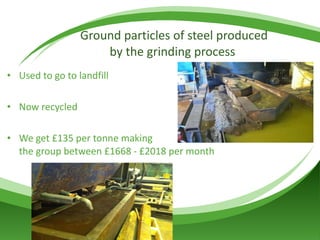
Ground particles of steel produced  by the grinding process  Used to go to landfill  Now recycled  We get £135 per tonne making  the group between £1668 - £2018 per month
Hot Water Heater on Shop Floor Current Boiler New Boiler Power (kW) 2 Hours Used per Month = 480 kWh @5p per Kilowatt £48 per Month Boiler heats water back up to 100 Degrees every hours, how long does it take to boil 2.5 L, assuming the boiler is 95% efficient and runs at 2kW, assume the water returns to room temperature (20 Degrees) after each hour. Specific Heat of Water = 4.186 Joule per gram per °C Heat Difference by (100 - 20) = 80 Degrees Grams in 2.5 Litres = 2500 Grams Energy Needed for each Boil= 4.186 X 80 X 2500 (/1000 to make into KJ's) 837.2 NB: 1 Watt = 1 Joule per Second Thus it would take 837.2 KJ / 2 KW seconds, which equals 418.6 Seconds (or around 7 minutes) 7 minutes each hour, at 24 hours a day is... 168 minutes (Or 2 hours 48 minutes a day) Per Month = 2 hours 48 X 30 Days.... 84 Hours a month Kwh = 168 @5p per Kilowatt = 8.4 £8.40 a month SAVING OVERALL OF £39.60 per Month COST OF UNIT IS £351 PAYBACK PERIOD ROUGHLY 9 MONTHS
Other Projects External racking for off cuts Recycling railway sleepers for the drive (no necessity for waiting for concrete to “go off” Roller shutters installed in wall to encourage air movement in the summer removing the need for electric operated fans Dropbox saves printing management reports and we also send test certificates electronically  Video conferencing saving travel costs and emissions Cundey Systems Limited
Cundey Systems Ltd. Was formed on the 3 rd  September through an acquisition of the assets from Technorton Ltd. Moved into Worcester factory  Nigel Tonks has started as General Manager Attended the APF show last week and got 20 enquiries Looking to members as primary suppliers
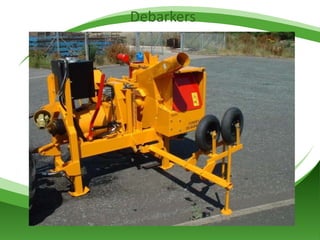
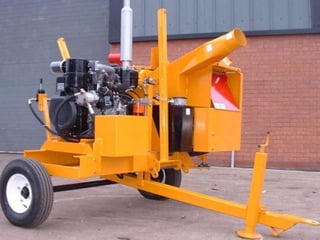
Debarkers
 
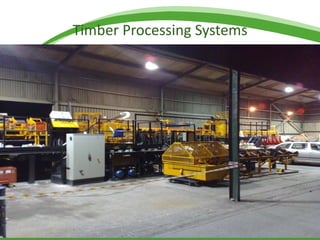
Timber Processing Systems
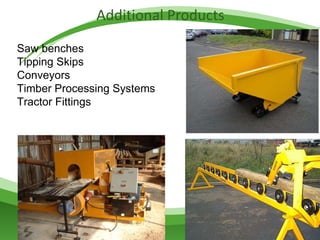
Additional Products Saw benches Tipping Skips Conveyors Timber Processing Systems Tractor Fittings
The Future Automating current products to reduce required labour Looking at developing a range of log splitters with a innovation voucher and the University of Wolverhampton Expansion in to EU Move towards biomass and renewable energy machinery using waste material from processes For the members – further supply opportunities and greater investment prospects
Questions For more information go to  www.MalthouseEngineering.com

Environmental presentation from malthouse engineering

  • 1.
    Malthouse Engineering RoyTaylor Managing Director
  • 2.
    The largest independentflame cutter in the UK set up in 1947 The Malthouse Group is spread over 5 sites All dedicated to sustainability and improving the environment About Malthouse
  • 3.
    ISO 14001 Treesplanted to reduce noise pollution Rainwater harvesting Recycle all waste products Low level reflective lighting Our activities
  • 4.
    Came via employeesuggestion scheme Cost only £650 payback estimated to be 1 – 2 years. The rain runs off the roof and is channelled through filters in to intermediate bulk containers (IBC) When needed, it is bombarded with Ultra Violet light to remove all bacteria and has a metal working fluid added to create an emulsion which is distributed to all 11 Lumsden Grinding machines. Rainwater Harvesting
  • 5.
    RAINWATER HARVESTING The initiative for a water-saving scheme came via the Company’s Suggestion Scheme using an Employee’s idea of gathering rain from part of the roof and using the water to provide us with the considerable amount of Metal Working Fluid we use daily.
  • 6.
    RAINWATER HARVESTING Initiallywe decided to try out the whole concept of rainwater harvesting with the least possible expenditure - in order to test the principle of collecting, storing and finally distributing rain in a clean condition to all 11 grinding machines that use a metalworking fluid (MWF). We were aware that the water supplied should be of potable quality so that no unwanted bacteria could be introduced that would contaminate our MWF. RAINWATER DIVERTER
  • 7.
    RAINWATER HARVESTING Initiallywe procured 4 Intermediate Bulk Containers ( I.B.C.’s) which were superfluous to requirements. To avoid water quality problems we had each I.B.C. laundered locally at a cost of £17.50 each. We then broke into the rainwater downpipes and inserted water diverters to carry the flow into the I.B.C.’s BANK OF 11 I.B.C.’S FOR STORING RAINWATER
  • 8.
    RAINWATER HARVESTING Intoeach of the tanks’ threaded lower outlets we inserted plastic hose tails costing £17.50 each. To these tails we attached flexible hose which was then fitted to 1.5” solvent-weld plastic pipe. This carried the flow of water from one I.B.C. to the next. There is a submersible pump installed in the last I.B.C. in the line. CONNECTING OF I.B.C.’S
  • 9.
    RAINWATER HARVESTING MIXING& FILTERING CISTERN To deliver the water to its point of use the pump is linked to an in-line cistern which contains a physical filter to remove any large unwanted foreign bodies such as leaves, bird feathers etc. The cistern draws water until a reed switch is activated at the “full” level and stops the pump from drawing from the I.B.C.’s. This filtered water is then passed through an Ultra Violet (UV) filter to bring the water to potable quality.
  • 10.
    RAINWATER HARVESTING AfterUV filtering, the water is passed through an accurate Dosing unit which adds a precise amount of neat metalworking fluid to the water to create an emulsion which can then be pumped to each grinding machine upon demand. ULTRA VIOLET WATER FILTER UNIT
  • 11.
    The Control Panelconsists of various valves which can be used to supply Mains water in the event of the rainwater being depleted, this is accompanied by a stop valve we have fitted to deter the use of Mains water when there is rainwater still available RAINWATER HARVESTING MAINS/RAINWATER SELECTOR VALVE
  • 12.
    RAINWATER HARVESTING Tosimplify the operating of the system we have labelled the various pipes and valves and have produced photographs to show the function of the various taps and incorporated a Blue flashing beacon to indicate when rainwater is being drawn. MAINS PRESSURE
  • 13.
    Sources of somecomponents & services: I.B.C. laundering Drumcare, Tipton Rainwater diverters B&Q Plastic piping B&Q Hose tails ActionSealTite, Didcot Pump Machine Mart UV Filter EastMidlandsWater RAINWATER HARVESTING
  • 14.
    Workstations 1 232 4 5 2 6 7 ) Rainwater Diverter ) IBC (Intermediate Bulk Container) Storage System ) Submersible Pumps ) UV Light Filtration System ) Mains Connection ) Variable Supply Lever ) Internal Cold Water Storage System 8) Individual Machine connections 8
  • 15.
    RAINWATER HARVESTING SummaryThe system has been running for several months during which time we have experienced, as with many other companies, a reduction in the amount of work that has passed through the department. This coupled with periods of very low rainfall made it difficult to measure the amount of rainwater we were using. To overcome the measuring aspect we have installed a water meter into the line and can now see exactly what rainwater has been used in the process.
  • 16.
    RAINWATER HARVESTING ESTIMATEDSAVINGS We record the daily usage of rainwater passing through the water meter so that we can accurately evaluate the accrued and on average savings that we are making with the system, we currently recycle one cubic metre per day. At current charges levied by South Staffs Water for incoming water and by Severn Trent for its “disposal” we are saving 87.16 pence daily for incoming water and 84.39 pence daily for its disposal.
  • 17.
    RAINWATER HARVESTING ESTIMEDSAVINGS Cont. Based on set-up costs of £650 and assuming that we receive rain in the increasing volumes predicted by the Meteorological Office we are looking for payback within the first 1 – 2 years. We are currently sourcing a single, large capacity water container to replace the I.B.C.’s.
  • 18.
    Continual improvement programmeThe Company is committed to its continual improvement programme and are proud to be nearing completion of the final stages in the development of their latest commercial venture: a Conveyor to remove both slag and components from the machine bed during production and not having to stop the machine subsequently to clear it. Prior to the introduction of the conveyors, removal of slag & components necessitated stopping the machines thus curtailing production.
  • 19.
    Conveyor Scraper Removes dust and slag from base of the bed while machine is in operation Runs on motorised gear and chain system Improves efficiency of operative and of machine Can be easily installed to existing machines
  • 20.
    Continual improvement programmeThe Company, mindful of its responsibility to keep its premises tidy, designed and manufactured an outdoor structure which was closed to the elements by a PVC curtain. Stored inside are oils on drip trays, waste metalworking fluid and used lead-acid batteries awaiting controlled disposal. The structure is large enough to also house a Spill Kit in close proximity to the area where its use may be needed.
  • 21.
    Reflective Lighting Reflectivewall materials being trialled in factory Reflects natural and man made light into dark areas Increases visibility and reduced need for additional lighting Also reflects heat
  • 22.
    Ground particles ofsteel produced by the grinding process Used to go to landfill Now recycled We get £135 per tonne making the group between £1668 - £2018 per month
  • 23.
    Hot Water Heateron Shop Floor Current Boiler New Boiler Power (kW) 2 Hours Used per Month = 480 kWh @5p per Kilowatt £48 per Month Boiler heats water back up to 100 Degrees every hours, how long does it take to boil 2.5 L, assuming the boiler is 95% efficient and runs at 2kW, assume the water returns to room temperature (20 Degrees) after each hour. Specific Heat of Water = 4.186 Joule per gram per °C Heat Difference by (100 - 20) = 80 Degrees Grams in 2.5 Litres = 2500 Grams Energy Needed for each Boil= 4.186 X 80 X 2500 (/1000 to make into KJ's) 837.2 NB: 1 Watt = 1 Joule per Second Thus it would take 837.2 KJ / 2 KW seconds, which equals 418.6 Seconds (or around 7 minutes) 7 minutes each hour, at 24 hours a day is... 168 minutes (Or 2 hours 48 minutes a day) Per Month = 2 hours 48 X 30 Days.... 84 Hours a month Kwh = 168 @5p per Kilowatt = 8.4 £8.40 a month SAVING OVERALL OF £39.60 per Month COST OF UNIT IS £351 PAYBACK PERIOD ROUGHLY 9 MONTHS
  • 24.
    Other Projects Externalracking for off cuts Recycling railway sleepers for the drive (no necessity for waiting for concrete to “go off” Roller shutters installed in wall to encourage air movement in the summer removing the need for electric operated fans Dropbox saves printing management reports and we also send test certificates electronically Video conferencing saving travel costs and emissions Cundey Systems Limited
  • 25.
    Cundey Systems Ltd.Was formed on the 3 rd September through an acquisition of the assets from Technorton Ltd. Moved into Worcester factory Nigel Tonks has started as General Manager Attended the APF show last week and got 20 enquiries Looking to members as primary suppliers
  • 26.
  • 27.
  • 28.
  • 29.
    Additional Products Sawbenches Tipping Skips Conveyors Timber Processing Systems Tractor Fittings
  • 30.
    The Future Automatingcurrent products to reduce required labour Looking at developing a range of log splitters with a innovation voucher and the University of Wolverhampton Expansion in to EU Move towards biomass and renewable energy machinery using waste material from processes For the members – further supply opportunities and greater investment prospects
  • 31.
    Questions For moreinformation go to www.MalthouseEngineering.com