• Basically the English world environment is derived
from the French word Environner i.e to encircle or
surround.
•It is strange feeling when we realizes that earth is a very
small in the universe alone has the required environment
for life.
•The Indian environment is as much affected as the rest of
the world.
•The mandate that each country should have 33% of its
land in forest India has only 22%.
 The expression pollute means " to get spoil or to make
unclean, impure and unhealthy.
 The word pollution is derived from the Latin word
polutus which means ' defiled or to make dirty or to
pollute'.
 The expression denotes ' the presence of wrong matter
in wrong quantity and at wrong place.'
DEFINITION OF ENVIRONMENT
 Environment includes water air land and the
interrelationship which exist ' among and between
water, air, land and human beings other living
creatures , plants, micro organism and property.
 DEFINITION OF ENVIRONMENTAL POLLUTANT
 According to sec 2(b) of the Environment Protection
Act 1986, Environmental pollutant means ' any solid,
liquid or gaseous substances present in such
concentration as may be or tend to be injurious to
environment.
 According to sec 2(c) of the Environment Protection
Act 1986, Environmental pollution means the presence
in the environment of any environmental pollutants.
 Every substances existing in the environment has
definite composition when foreign body is introduced
into it then the substance loses its original character
and qualities.
 Air is the basic need of human being without which we
cannot survive for a few minutes.
 Tremendous growth of population, urbanisation,
expansion of industries ventilated the gravity of the
effect of air pollution.
 Air pollution is mainly caused by smoke and gases
released from the factories and vehicle.
 50% of the air pollution caused by automobiles.
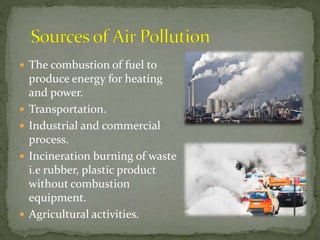
 The combustion of fuel to
produce energy for heating
and power.
 Transportation.
 Industrial and commercial
process.
 Incineration burning of waste
i.e rubber, plastic product
without combustion
equipment.
 Agricultural activities.
 Air pollution has an adverse
effect on the environmental and
climatic condition, human
health and safety, plants and
animals and other socio
economic condition.
 Water is essentially required by all kinds of life.
 Not only the human being but each and every living
creature is dependent on water.
 However as water being the best solvent, it is also true
that it may create nuisance when comes in the contact
of pollutant and remains untreated.
 when untreated waste water passes through the
industries,agricultural land it get spoiled and becomes
harmful to plants animals and mens.
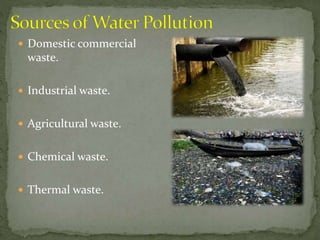
 Domestic commercial
waste.
 Industrial waste.
 Agricultural waste.
 Chemical waste.
 Thermal waste.
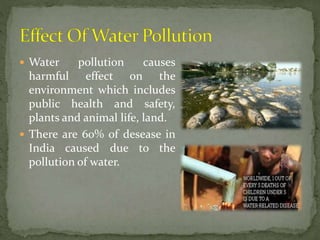
 Water pollution causes
harmful effect on the
environment which includes
public health and safety,
plants and animal life, land.
 There are 60% of desease in
India caused due to the
pollution of water.
 The word soil is derived from the latin word ' Solum'
which means earthly material in which plants, bushes
and grass grows.
 A small portion of soil mass consists a live organism
such as insects, worms,plants, millions of micro
organism.
 Soil being a integral part of land any detrioration in its
quality mass or volume is also a detrioration of land.
 India is lossing about
6000 million tons of top
soil per annum through
water errosion this being
a major nutrient for plant
life to survive.
 It require thousand year
to mother earth to
generate half an inch of
top soil on its surface.
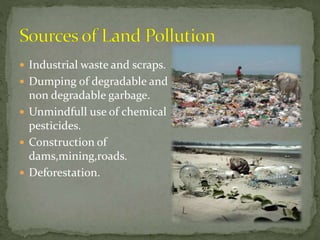
 Industrial waste and scraps.
 Dumping of degradable and
non degradable garbage.
 Unmindfull use of chemical
pesticides.
 Construction of
dams,mining,roads.
 Deforestation.
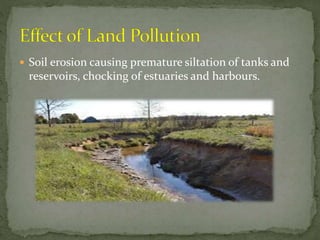
 Soil erosion causing premature siltation of tanks and
reservoirs, chocking of estuaries and harbours.
 Noise means unwanted sound.
 What is pleasant to some ears may be extremely
unpleasant to other depending on a number of
psychological factors.
 Most of the people do not consider noise as pollution
but as a part of routine life.
 To curb the noise pollution people should realise the
danger of noise pollution.
 Natural sources of noise
pollution i.e air,noise, valcanos,
seas,rivers, exchanging voice of
living organ including man and
mammals.
 Man made noise pollution are
machine and modern
equipment of various types,
automobiles, trains,aeroplans &
use of explosives.
 Hearing Problems: Any unwanted sound that our ears have
not been built to filter can cause problems within the body.
 Health Issues: aggressive behavior, disturbance of sleep,
constant stress, fatigue and hypertension can be linked to
excessive noise levels.
 Sleeping Disorders
 Cardiovascular Issues: Blood pressure levels, cardio-
vascular disease and stress related heart problems are on
the rise.
 Trouble Communicating: High decibel noise can put
trouble and may not allow two people to communicate
freely
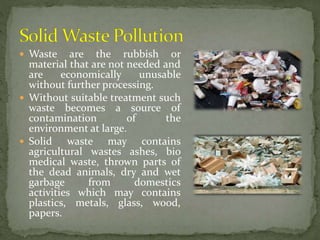
 Waste are the rubbish or
material that are not needed and
are economically unusable
without further processing.
 Without suitable treatment such
waste becomes a source of
contamination of the
environment at large.
 Solid waste may contains
agricultural wastes ashes, bio
medical waste, thrown parts of
the dead animals, dry and wet
garbage from domestics
activities which may contains
plastics, metals, glass, wood,
papers.
 All living being requires food to
obtain energy from which they carry
on their activities.
 The pollution of food begins by use
of chemical, frtilizers and various
pesticides at different stages of
plant growth starting from its
germination and plantation upto
the stages when it gets flowers and
fruits.
 These chemicals directly and
indirectly affect the quality of food
and affects the health of the
consumers.
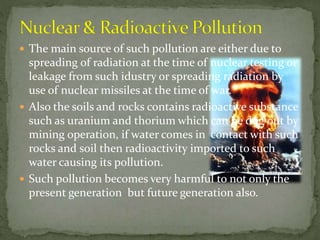
 The main source of such pollution are either due to
spreading of radiation at the time of nuclear testing or
leakage from such idustry or spreading radiation by
use of nuclear missiles at the time of war.
 Also the soils and rocks contains radioactive substance
such as uranium and thorium which can be dug out by
mining operation, if water comes in contact with such
rocks and soil then radioactivity imported to such
water causing its pollution.
 Such pollution becomes very harmful to not only the
present generation but future generation also.
 Acute damage: Sudden
death, death after duration of
week, loss of hair, widespred
ulcers, inability to deal with
ever minor infections.
 Chronic damage: Disease of
blood like anaemia, blood
cancer, cancer of skin ane
other organs.
 Genetic damage: Hairless
child, retarded child,
defective senses.
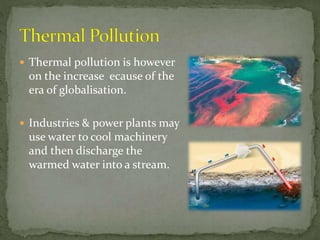
 Thermal pollution is however
on the increase ecause of the
era of globalisation.
 Industries & power plants may
use water to cool machinery
and then discharge the
warmed water into a stream.
 Chemical pharmaceutical industries.
 Paper and pulp industries.
 Petroleum products & Plastic industries.
 Deforestation on shoreline which increase soil erosion.
 Sudden change in temprature due to hot waste water
can harm the life of fisheries.
Assistant Professor
Shri Shivaji Law College, Parbhani
Maharashtra

Environmental pollution and its types.

  • 2.
    • Basically theEnglish world environment is derived from the French word Environner i.e to encircle or surround. •It is strange feeling when we realizes that earth is a very small in the universe alone has the required environment for life. •The Indian environment is as much affected as the rest of the world. •The mandate that each country should have 33% of its land in forest India has only 22%.
  • 3.
     The expressionpollute means " to get spoil or to make unclean, impure and unhealthy.  The word pollution is derived from the Latin word polutus which means ' defiled or to make dirty or to pollute'.  The expression denotes ' the presence of wrong matter in wrong quantity and at wrong place.'
  • 4.
    DEFINITION OF ENVIRONMENT Environment includes water air land and the interrelationship which exist ' among and between water, air, land and human beings other living creatures , plants, micro organism and property.  DEFINITION OF ENVIRONMENTAL POLLUTANT  According to sec 2(b) of the Environment Protection Act 1986, Environmental pollutant means ' any solid, liquid or gaseous substances present in such concentration as may be or tend to be injurious to environment.
  • 5.
     According tosec 2(c) of the Environment Protection Act 1986, Environmental pollution means the presence in the environment of any environmental pollutants.  Every substances existing in the environment has definite composition when foreign body is introduced into it then the substance loses its original character and qualities.
  • 6.
     Air isthe basic need of human being without which we cannot survive for a few minutes.  Tremendous growth of population, urbanisation, expansion of industries ventilated the gravity of the effect of air pollution.  Air pollution is mainly caused by smoke and gases released from the factories and vehicle.  50% of the air pollution caused by automobiles.
  • 7.
     The combustionof fuel to produce energy for heating and power.  Transportation.  Industrial and commercial process.  Incineration burning of waste i.e rubber, plastic product without combustion equipment.  Agricultural activities.
  • 8.
     Air pollutionhas an adverse effect on the environmental and climatic condition, human health and safety, plants and animals and other socio economic condition.
  • 9.
     Water isessentially required by all kinds of life.  Not only the human being but each and every living creature is dependent on water.  However as water being the best solvent, it is also true that it may create nuisance when comes in the contact of pollutant and remains untreated.  when untreated waste water passes through the industries,agricultural land it get spoiled and becomes harmful to plants animals and mens.
  • 10.
     Domestic commercial waste. Industrial waste.  Agricultural waste.  Chemical waste.  Thermal waste.
  • 11.
     Water pollutioncauses harmful effect on the environment which includes public health and safety, plants and animal life, land.  There are 60% of desease in India caused due to the pollution of water.
  • 12.
     The wordsoil is derived from the latin word ' Solum' which means earthly material in which plants, bushes and grass grows.  A small portion of soil mass consists a live organism such as insects, worms,plants, millions of micro organism.  Soil being a integral part of land any detrioration in its quality mass or volume is also a detrioration of land.
  • 13.
     India islossing about 6000 million tons of top soil per annum through water errosion this being a major nutrient for plant life to survive.  It require thousand year to mother earth to generate half an inch of top soil on its surface.
  • 14.
     Industrial wasteand scraps.  Dumping of degradable and non degradable garbage.  Unmindfull use of chemical pesticides.  Construction of dams,mining,roads.  Deforestation.
  • 15.
     Soil erosioncausing premature siltation of tanks and reservoirs, chocking of estuaries and harbours.
  • 16.
     Noise meansunwanted sound.  What is pleasant to some ears may be extremely unpleasant to other depending on a number of psychological factors.  Most of the people do not consider noise as pollution but as a part of routine life.  To curb the noise pollution people should realise the danger of noise pollution.
  • 17.
     Natural sourcesof noise pollution i.e air,noise, valcanos, seas,rivers, exchanging voice of living organ including man and mammals.  Man made noise pollution are machine and modern equipment of various types, automobiles, trains,aeroplans & use of explosives.
  • 18.
     Hearing Problems:Any unwanted sound that our ears have not been built to filter can cause problems within the body.  Health Issues: aggressive behavior, disturbance of sleep, constant stress, fatigue and hypertension can be linked to excessive noise levels.  Sleeping Disorders  Cardiovascular Issues: Blood pressure levels, cardio- vascular disease and stress related heart problems are on the rise.  Trouble Communicating: High decibel noise can put trouble and may not allow two people to communicate freely
  • 19.
     Waste arethe rubbish or material that are not needed and are economically unusable without further processing.  Without suitable treatment such waste becomes a source of contamination of the environment at large.  Solid waste may contains agricultural wastes ashes, bio medical waste, thrown parts of the dead animals, dry and wet garbage from domestics activities which may contains plastics, metals, glass, wood, papers.
  • 20.
     All livingbeing requires food to obtain energy from which they carry on their activities.  The pollution of food begins by use of chemical, frtilizers and various pesticides at different stages of plant growth starting from its germination and plantation upto the stages when it gets flowers and fruits.  These chemicals directly and indirectly affect the quality of food and affects the health of the consumers.
  • 21.
     The mainsource of such pollution are either due to spreading of radiation at the time of nuclear testing or leakage from such idustry or spreading radiation by use of nuclear missiles at the time of war.  Also the soils and rocks contains radioactive substance such as uranium and thorium which can be dug out by mining operation, if water comes in contact with such rocks and soil then radioactivity imported to such water causing its pollution.  Such pollution becomes very harmful to not only the present generation but future generation also.
  • 22.
     Acute damage:Sudden death, death after duration of week, loss of hair, widespred ulcers, inability to deal with ever minor infections.  Chronic damage: Disease of blood like anaemia, blood cancer, cancer of skin ane other organs.  Genetic damage: Hairless child, retarded child, defective senses.
  • 23.
     Thermal pollutionis however on the increase ecause of the era of globalisation.  Industries & power plants may use water to cool machinery and then discharge the warmed water into a stream.
  • 24.
     Chemical pharmaceuticalindustries.  Paper and pulp industries.  Petroleum products & Plastic industries.  Deforestation on shoreline which increase soil erosion.  Sudden change in temprature due to hot waste water can harm the life of fisheries.
  • 25.
    Assistant Professor Shri ShivajiLaw College, Parbhani Maharashtra