ENVIRONMENTAL IMPACTS OF FOOD TECHNOLOGY
PRESENTED BY – RADHIKA YADAV
SOCIAL ISSUES AND THE
ENVIRONMENT
CONTENTS
• PUBLIC AWARENESS
• POPULATION GROWTH
• FAMILY WELFARE PROGRAMS
ENVIRONMENT
 It is well recognized now that rich nations of the world
consume resources, especially non-renewable natural
resources like coal and oil at a break-neck pace.
 The consequence of this resource use is the promotion of
unfettered consumption and greed which, in turn, has begun
to create global energy shortages, pollution, global warming,
among other myriad problems.
Social Issues
 Urban problems related to Energy
 Water Conservation
 Resettlement and Rehabilitation issues
 Environmental ethics
 Climate Chang
 E-Global Warming
 Acid Rain and Ozone layer Depletion
 Nuclear Accidents and Holocaust
 Wasteland Reclamation
 Consumerism and waste products
Public Awareness
 After the scientific and industrial revolution in the recent
past, there has been immense impact of man on the
environment and on the balance of the ecosystem as a
whole.
 Industrialization, urbanization, deforestation, use of
insecticides, pesticides, improper use of fertilizers and
chemicals in environment are some contributing factors
which challenged the life of man, animals specially birds
and other organisms.
 Human activities are causing many kinds of environmental
pollutions for which public awareness is necessary.
 The Active co-operation of every one, at every level of social
organizations is needed for issues concerning environment.
 It is only possible only when is public aware about the
ecological and environmental issues. For example banning
the littering of polythene cannot be successful until the
public understands the environmental implications of the
same.
 Public should understand about the fact that if we are
degrading our environment, we are harming ourselves. This
is the duty of educated people to educate the others about
the adverse effect on environment.
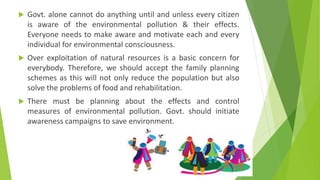
 Govt. alone cannot do anything until and unless every citizen
is aware of the environmental pollution & their effects.
Everyone needs to make aware and motivate each and every
individual for environmental consciousness.
 Over exploitation of natural resources is a basic concern for
everybody. Therefore, we should accept the family planning
schemes as this will not only reduce the population but also
solve the problems of food and rehabilitation.
 There must be planning about the effects and control
measures of environmental pollution. Govt. should initiate
awareness campaigns to save environment.
 There should be an integral part of our educational
programmes like –
1. We should discourage to use fuel vehicles, until it is not
necessary
2. Over use of water, for cleaning and other purposes
should be decreased.
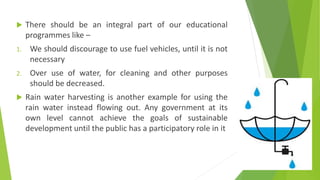
 Rain water harvesting is another example for using the
rain water instead flowing out. Any government at its
own level cannot achieve the goals of sustainable
development until the public has a participatory role in it
Population Growth
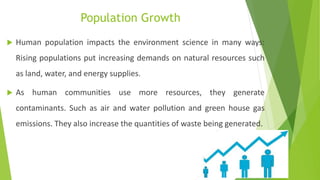
 Human population impacts the environment science in many ways:
Rising populations put increasing demands on natural resources such
as land, water, and energy supplies.
 As human communities use more resources, they generate
contaminants. Such as air and water pollution and green house gas
emissions. They also increase the quantities of waste being generated.
Population growth rate
 Birth and death rates are the most important determinants of
population growth: in some countries, net migration is also
important in this regard.
 To calculate population growth rates, demographers take the
difference between births and deaths in a given time period,
add the net number of migrants (which for the world as a
whole is 0), and divide that number by the total population.
 For example, there are now about 136 million births and 58
million deaths worldwide annually, adding a net of 78 million
new inhabitants to a global population of 6.7 billion, a growth
rate of nearly 1.2%
Population Growth & the Environment
 Technology is sub divided into two factors -
1. Resource-intensity (how much used to produce each unit of
consumption)
2. Waste-intensity (how much waste generated for each unit of
consumption)
 Environmental impacts take two major forms –
 First, we consume resources such as land, food, water, soil, and
services from healthy ecosystems. Such as water filtration through
wetlands. 0ver consumption uses up or severely depletes supplies
of non-renewable resources, such as fossil fuels, and depletes
renewable resources such as fisheries and forests.
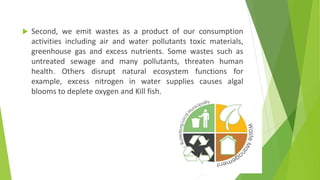
 Second, we emit wastes as a product of our consumption
activities including air and water pollutants toxic materials,
greenhouse gas and excess nutrients. Some wastes such as
untreated sewage and many pollutants, threaten human
health. Others disrupt natural ecosystem functions for
example, excess nitrogen in water supplies causes algal
blooms to deplete oxygen and Kill fish.
Family welfare programmes
 Rising population spurred worries that developing countries
could deplete their food supplies. Starting with India, dozens
of countries launched family planning programs with support
from international organizations and government.
 These program convince the people that saving large numbers
of children was bad for the nation and for individual families.
Generally they focused on educating married couples about
birth control and distributing contraceptives, but some
programs took more coercive approaches.
 China imposed a limit of one child per family in some parts
of China - the one child policy reportedly has been enforced
through methods including forced abortions and
sterilizations.
 Forced sterilizations also occurred in India in the 1970s
 These policies have spurred some Indian and Chinese
families to practice selective abortion and infanticide of
female babies, since boys are more valued culturally and as
workers.
 Population sex ratios in both countries are skewed as a
result.
 Large societies consume more resources than small ones, but
consumption patterns and technology choices may account
for more environmental harms than sheer numbers of people.
 The U.S. population is about one fourth as large as that of
China or India, but the United States currently uses far more
energy because Americans are more affluent and use their
wealth to buy energy intensive products like cars and
electronics.
 But China and India are growing and becoming more affluent,
so their environmental impacts will increase. For example, in
2006 China surpassed the United States as the world's largest
emitter of carbondioxide (CO2), the main greenhouse gas
produced as a result of human activities.
Environmental Impacts and Social Issues

Environmental Impacts and Social Issues

  • 1.
    ENVIRONMENTAL IMPACTS OFFOOD TECHNOLOGY PRESENTED BY – RADHIKA YADAV
  • 2.
    SOCIAL ISSUES ANDTHE ENVIRONMENT
  • 3.
    CONTENTS • PUBLIC AWARENESS •POPULATION GROWTH • FAMILY WELFARE PROGRAMS
  • 4.
    ENVIRONMENT  It iswell recognized now that rich nations of the world consume resources, especially non-renewable natural resources like coal and oil at a break-neck pace.  The consequence of this resource use is the promotion of unfettered consumption and greed which, in turn, has begun to create global energy shortages, pollution, global warming, among other myriad problems.
  • 5.
    Social Issues  Urbanproblems related to Energy  Water Conservation  Resettlement and Rehabilitation issues  Environmental ethics  Climate Chang  E-Global Warming  Acid Rain and Ozone layer Depletion  Nuclear Accidents and Holocaust  Wasteland Reclamation  Consumerism and waste products
  • 6.
    Public Awareness  Afterthe scientific and industrial revolution in the recent past, there has been immense impact of man on the environment and on the balance of the ecosystem as a whole.  Industrialization, urbanization, deforestation, use of insecticides, pesticides, improper use of fertilizers and chemicals in environment are some contributing factors which challenged the life of man, animals specially birds and other organisms.
  • 7.
     Human activitiesare causing many kinds of environmental pollutions for which public awareness is necessary.  The Active co-operation of every one, at every level of social organizations is needed for issues concerning environment.  It is only possible only when is public aware about the ecological and environmental issues. For example banning the littering of polythene cannot be successful until the public understands the environmental implications of the same.  Public should understand about the fact that if we are degrading our environment, we are harming ourselves. This is the duty of educated people to educate the others about the adverse effect on environment.
  • 8.
     Govt. alonecannot do anything until and unless every citizen is aware of the environmental pollution & their effects. Everyone needs to make aware and motivate each and every individual for environmental consciousness.  Over exploitation of natural resources is a basic concern for everybody. Therefore, we should accept the family planning schemes as this will not only reduce the population but also solve the problems of food and rehabilitation.  There must be planning about the effects and control measures of environmental pollution. Govt. should initiate awareness campaigns to save environment.
  • 9.
     There shouldbe an integral part of our educational programmes like – 1. We should discourage to use fuel vehicles, until it is not necessary 2. Over use of water, for cleaning and other purposes should be decreased.  Rain water harvesting is another example for using the rain water instead flowing out. Any government at its own level cannot achieve the goals of sustainable development until the public has a participatory role in it
  • 10.
    Population Growth  Humanpopulation impacts the environment science in many ways: Rising populations put increasing demands on natural resources such as land, water, and energy supplies.  As human communities use more resources, they generate contaminants. Such as air and water pollution and green house gas emissions. They also increase the quantities of waste being generated.
  • 11.
    Population growth rate Birth and death rates are the most important determinants of population growth: in some countries, net migration is also important in this regard.  To calculate population growth rates, demographers take the difference between births and deaths in a given time period, add the net number of migrants (which for the world as a whole is 0), and divide that number by the total population.  For example, there are now about 136 million births and 58 million deaths worldwide annually, adding a net of 78 million new inhabitants to a global population of 6.7 billion, a growth rate of nearly 1.2%
  • 12.
    Population Growth &the Environment  Technology is sub divided into two factors - 1. Resource-intensity (how much used to produce each unit of consumption) 2. Waste-intensity (how much waste generated for each unit of consumption)  Environmental impacts take two major forms –  First, we consume resources such as land, food, water, soil, and services from healthy ecosystems. Such as water filtration through wetlands. 0ver consumption uses up or severely depletes supplies of non-renewable resources, such as fossil fuels, and depletes renewable resources such as fisheries and forests.
  • 13.
     Second, weemit wastes as a product of our consumption activities including air and water pollutants toxic materials, greenhouse gas and excess nutrients. Some wastes such as untreated sewage and many pollutants, threaten human health. Others disrupt natural ecosystem functions for example, excess nitrogen in water supplies causes algal blooms to deplete oxygen and Kill fish.
  • 14.
    Family welfare programmes Rising population spurred worries that developing countries could deplete their food supplies. Starting with India, dozens of countries launched family planning programs with support from international organizations and government.  These program convince the people that saving large numbers of children was bad for the nation and for individual families. Generally they focused on educating married couples about birth control and distributing contraceptives, but some programs took more coercive approaches.
  • 15.
     China imposeda limit of one child per family in some parts of China - the one child policy reportedly has been enforced through methods including forced abortions and sterilizations.  Forced sterilizations also occurred in India in the 1970s  These policies have spurred some Indian and Chinese families to practice selective abortion and infanticide of female babies, since boys are more valued culturally and as workers.  Population sex ratios in both countries are skewed as a result.
  • 16.
     Large societiesconsume more resources than small ones, but consumption patterns and technology choices may account for more environmental harms than sheer numbers of people.  The U.S. population is about one fourth as large as that of China or India, but the United States currently uses far more energy because Americans are more affluent and use their wealth to buy energy intensive products like cars and electronics.  But China and India are growing and becoming more affluent, so their environmental impacts will increase. For example, in 2006 China surpassed the United States as the world's largest emitter of carbondioxide (CO2), the main greenhouse gas produced as a result of human activities.