ENVIRONMENTAL
GEOGRAPHY
• By: Consolacion jelly & Egan
Mariella
2
WHAT IS ENVONMENTAL
GEOGRAPHY?
Is a branch of geography that
studies the relationship
between humans and natural
environment.
It fucoses on how human
activities affect nature and how
natural environment influence
human life.
It combines physical
geography, human geography,
and environmental studies.
3
WHAT IS GEOGRAPHY?
GEOGRAPHY derives from two
Greek words
GEO= earth,+
GRAPHY= description
So, Geography means “The
description of the earth”
But GEOGRAPHY
Is all about
EVERYTHING
HOW MANY
BRANCHES OF
GEOGRAPHY?
 TWO MAIN BRANCHES:
1. PHYSICAL GEOGRAPHY
2. HUMAN GEOGRAPHY
But there are others fields too.
PHYSICAL GEOGRAPHY
• Is the study of the world’s physical features.
• It’s LANDFORMS, BODIES OF WATER, CLIMATES, SOILS, AND
PLANTS.
HOW MANY
BRANCHES OF
GEOGRAPHY?
HUMAN GEOGRAPHY
• Is the study of humans and their ideas, and
• The impact of human ideas and actions on the earth.
• Includes settlements and economic activities.
Human Geography ask…..
o What jobs do they have?
o What crops will grow there?
o What makes people move from place to place?
o What type of houses do they build?
 SCOPE OF ENVIRONMENTAL GEOGRAPHY
o Environmental system
o Man-environment relationship in geography
o Environment policy, Laws & Rules
o Global environmental issues
o Environment-Man-Society
o Environmental management
 CORE CONCEPTS OF ENVIRONMENTAL GEOGRAPHY
o The main concepts:
1. Human-environment relationship
2. Ecosystem concept
3. Resource use and management
4. Environmental balance
5. Sustainability
6. Environmental problems and conservation
6
 MEANING OF ENVIRONMENTAL GEOGRAPHY
o Environmental geography helps us understand:
• How people use land, water, air, and natural resources
• How environmental problems are created by human
activity
• How human can protect and manage the environment
sustainability
 NATURE OF ENVIRONMENTAL GEOGRAPHY
o Environmental Geography is:
• Interdisciplinary- connected with Science, Economics,
Sociology, and Politics
• Dynamic- changes as environment and society change
• Applied- helps solve real-world environmental problems
• Balanced- studies both human needs and
environmental protection
7
 Humans and the environment are closely connected.
• Human depend on the environment for food, water,
shelter, and energy.
• Human activities like deforestation, mining, and
urbanization affect nature.
• Environmental changes like floods, droughts, and climate
changes affect humans.
 This relationship can be positive or negative.
1. HUMAN-ENVIRONMENT
RELATIONSHIP
 An ecosystem is a system where living organism(plants,
animals, humans) interact with non-living elements (air,
water, soil).
• Everything in nature is interconnected
• Damage to one part affects the whole system
• Human are the part of ecosystem, not separate from it
2. ECOSYSTEM CONCEPT
 Natural resources include:
• Water
• Forests
• Minerals
• Soils
• Energy resources
 Environmental geography studies:
• How resources are used
• How overused causes environmental degradation
• How resources can be managed wisely
 Proper management ensures resources for future
generations.
3. RESOURCE USE AND MANAGEMENT
 Environmental balance means:
• Maintaining harmony between human activity and nature
• Avoiding activities that cause pollution and destruction
 Examples of imbalance:
• Excessive pollution
• Overpopulation
• Deforestation
Balanced environment= healthy planet and healthy people
4. ENVIRONMENTAL BALANCE
 Means:
• Using resources in a way that meets present needs
• Without harming the ability of future generations to
meet their needs
• Key idea:
“Use but do not abuse the environment.”
 Environmental geography promotes sustainable
development.
4. SUSTAINABILITY
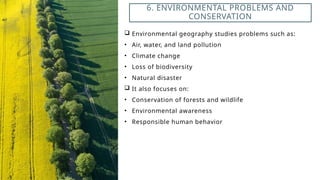
 Environmental geography studies problems such as:
• Air, water, and land pollution
• Climate change
• Loss of biodiversity
• Natural disaster
 It also focuses on:
• Conservation of forests and wildlife
• Environmental awareness
• Responsible human behavior
6. ENVIRONMENTAL PROBLEMS AND
CONSERVATION
WHY SHOULD STUDY
ENVIRONMENTAL
GEOGRAPHY IN
ENVIRONMENTAL SCIENCE?
14
15
It helps to understand the aerial
distribution of phenomena.
To understand the spatial patterns
and spatial organization.
Location analysis, Regional
analysis, Ecological studies.
To understand the man-
environment relationship.
Find solution to manage ecological
problems.
Make people aware to protect
environment.
Proper use of natural resources
Sustainable development and
biovariety conservation.
THANK YOU
Mirjam Nilsson​
​
206-555-0146​
mirjam@contoso.com​
www.contoso.com​

Environmental-geography.powerpointpresentation

  • 1.
  • 2.
    2 WHAT IS ENVONMENTAL GEOGRAPHY? Isa branch of geography that studies the relationship between humans and natural environment. It fucoses on how human activities affect nature and how natural environment influence human life. It combines physical geography, human geography, and environmental studies.
  • 3.
    3 WHAT IS GEOGRAPHY? GEOGRAPHYderives from two Greek words GEO= earth,+ GRAPHY= description So, Geography means “The description of the earth” But GEOGRAPHY Is all about EVERYTHING
  • 4.
    HOW MANY BRANCHES OF GEOGRAPHY? TWO MAIN BRANCHES: 1. PHYSICAL GEOGRAPHY 2. HUMAN GEOGRAPHY But there are others fields too. PHYSICAL GEOGRAPHY • Is the study of the world’s physical features. • It’s LANDFORMS, BODIES OF WATER, CLIMATES, SOILS, AND PLANTS.
  • 5.
    HOW MANY BRANCHES OF GEOGRAPHY? HUMANGEOGRAPHY • Is the study of humans and their ideas, and • The impact of human ideas and actions on the earth. • Includes settlements and economic activities. Human Geography ask….. o What jobs do they have? o What crops will grow there? o What makes people move from place to place? o What type of houses do they build?
  • 6.
     SCOPE OFENVIRONMENTAL GEOGRAPHY o Environmental system o Man-environment relationship in geography o Environment policy, Laws & Rules o Global environmental issues o Environment-Man-Society o Environmental management  CORE CONCEPTS OF ENVIRONMENTAL GEOGRAPHY o The main concepts: 1. Human-environment relationship 2. Ecosystem concept 3. Resource use and management 4. Environmental balance 5. Sustainability 6. Environmental problems and conservation 6
  • 7.
     MEANING OFENVIRONMENTAL GEOGRAPHY o Environmental geography helps us understand: • How people use land, water, air, and natural resources • How environmental problems are created by human activity • How human can protect and manage the environment sustainability  NATURE OF ENVIRONMENTAL GEOGRAPHY o Environmental Geography is: • Interdisciplinary- connected with Science, Economics, Sociology, and Politics • Dynamic- changes as environment and society change • Applied- helps solve real-world environmental problems • Balanced- studies both human needs and environmental protection 7
  • 8.
     Humans andthe environment are closely connected. • Human depend on the environment for food, water, shelter, and energy. • Human activities like deforestation, mining, and urbanization affect nature. • Environmental changes like floods, droughts, and climate changes affect humans.  This relationship can be positive or negative. 1. HUMAN-ENVIRONMENT RELATIONSHIP
  • 9.
     An ecosystemis a system where living organism(plants, animals, humans) interact with non-living elements (air, water, soil). • Everything in nature is interconnected • Damage to one part affects the whole system • Human are the part of ecosystem, not separate from it 2. ECOSYSTEM CONCEPT
  • 10.
     Natural resourcesinclude: • Water • Forests • Minerals • Soils • Energy resources  Environmental geography studies: • How resources are used • How overused causes environmental degradation • How resources can be managed wisely  Proper management ensures resources for future generations. 3. RESOURCE USE AND MANAGEMENT
  • 11.
     Environmental balancemeans: • Maintaining harmony between human activity and nature • Avoiding activities that cause pollution and destruction  Examples of imbalance: • Excessive pollution • Overpopulation • Deforestation Balanced environment= healthy planet and healthy people 4. ENVIRONMENTAL BALANCE
  • 12.
     Means: • Usingresources in a way that meets present needs • Without harming the ability of future generations to meet their needs • Key idea: “Use but do not abuse the environment.”  Environmental geography promotes sustainable development. 4. SUSTAINABILITY
  • 13.
     Environmental geographystudies problems such as: • Air, water, and land pollution • Climate change • Loss of biodiversity • Natural disaster  It also focuses on: • Conservation of forests and wildlife • Environmental awareness • Responsible human behavior 6. ENVIRONMENTAL PROBLEMS AND CONSERVATION
  • 14.
    WHY SHOULD STUDY ENVIRONMENTAL GEOGRAPHYIN ENVIRONMENTAL SCIENCE? 14
  • 15.
    15 It helps tounderstand the aerial distribution of phenomena. To understand the spatial patterns and spatial organization. Location analysis, Regional analysis, Ecological studies. To understand the man- environment relationship. Find solution to manage ecological problems. Make people aware to protect environment. Proper use of natural resources Sustainable development and biovariety conservation.
  • 16.