OD MBA 253T
ENTREPRENEURIALDEVELOPMENT AND MSMEs
Topics to be Covered: L-8, unit –IV
Environmental Assessment: Macro and Micro View
Project Management Concept.
Generation and Screening of project Ideas
Prepared by: Amandeep
Assistant Professor
https://www.linkedin.com/in/amandeep-thakur-7a81942a
2.
Environmental assessment
Environmental assessmentin entrepreneurship involves a
thorough analysis of both the external (macro) and internal
(micro) factors that can influence a new venture's success and
sustainability. This comprehensive view helps entrepreneurs
identify opportunities, mitigate risks, and make informed
decisions.
3.
Macro Environmental Assessment
Themacro environment encompasses the broad external forces that can affect all businesses
within an economy, although the degree of impact can vary. Entrepreneurs must understand these
factors to anticipate changes and adapt their strategies accordingly. A common framework for
analyzing the macro environment is PESTEL.
•Political Factors: These relate to government policies, regulations, political stability, trade
agreements, tax laws, and the overall political climate. For an entrepreneur in Ludhiana, Punjab,
this could involve understanding local industrial policies, state government incentives for new
businesses, potential impacts of national political decisions on trade and commerce, and
regulations related to specific industries (e.g., manufacturing, agriculture).
•Economic Factors: These include macroeconomic conditions such as economic growth rates
(GDP), inflation, interest rates, exchange rates, unemployment levels, consumer spending
patterns, income distribution, and the overall health of the economy. An entrepreneur in Ludhiana
needs to consider the prevailing economic conditions in Punjab and India. For instance, the
disposable income of the local population will influence their purchasing power, interest rates will
affect borrowing costs for the business, and inflation will impact pricing strategies and operational
expenses.
4.
Macro Environmental Assessment
•Socio-culturalFactors: These encompass the values, beliefs, attitudes, lifestyles, demographics, cultural norms,
social trends, education levels, and population growth rates within a society. For a Ludhiana-based entrepreneur,
understanding local customs, language preferences, dietary habits, family structures, and evolving social trends (e.g.,
increasing health consciousness, adoption of digital technologies) is crucial for tailoring products, services, and
marketing efforts.
•Technological Factors: These involve advancements in technology, automation, research and development,
innovation rates, technological infrastructure, access to technology, and the impact of emerging technologies.
Entrepreneurs need to stay abreast of relevant technological developments that can create new opportunities or pose
threats to their business model. This could include adopting digital marketing strategies, utilizing new manufacturing
processes, leveraging e-commerce platforms, or adapting to technological disruptions in their industry.
•Environmental Factors: With increasing global awareness about sustainability, ecological and environmental factors
are becoming critical. These include climate change, resource scarcity, pollution regulations, waste management,
renewable energy adoption, and consumer preferences for eco-friendly products and practices. An entrepreneur in
Ludhiana should consider the environmental impact of their operations, potential regulations related to pollution control,
opportunities in the green economy, and the growing demand for sustainable products.
•Legal Factors: These pertain to the legal and regulatory framework within which businesses operate, including laws
related to employment, consumer protection, intellectual property, health and safety, environmental regulations, and
industry-specific legislation. Entrepreneurs must ensure their ventures comply with all applicable laws and understand
potential changes in the legal landscape that could affect their business
5.
Micro Environmental Assessment
Themicro environment consists of the factors that have a direct and immediate impact on a
specific business. Understanding these elements is vital for an entrepreneur to build competitive
advantages and manage day-to-day operations effectively.
•Customers: These are the individuals or entities who purchase the products or services offered by
the entrepreneur. Understanding their needs, preferences, buying behavior, demographics, and price
sensitivity is paramount for success. A Ludhiana-based entrepreneur needs to identify their target
customer segments, understand their specific requirements, and build strong customer
relationships.
•Suppliers: These are the businesses or individuals who provide the resources (raw materials,
components, services) that the entrepreneur needs to operate. The reliability, cost, quality, and
terms offered by suppliers can significantly impact the entrepreneur's profitability and operational
efficiency. Building strong relationships with key suppliers in and around Ludhiana is crucial for a
smooth supply chain.
6.
Micro Environmental Assessment
•Competitors:These are other businesses operating in the same market or offering similar
products or services to the same customer base. Analyzing competitors' strengths, weaknesses,
strategies, pricing, and market share helps the entrepreneur identify opportunities for
differentiation and gain a competitive edge. Understanding both direct and indirect competitors
in the Ludhiana market is essential.
•Intermediaries: These are entities that help the entrepreneur distribute and sell their products or
services to the end customers. They can include wholesalers, retailers, distributors, agents, and
online platforms. Selecting the right intermediaries and managing these relationships effectively
is crucial for market reach and sales performance.
•Publics: These are any groups or individuals who have an actual or potential interest in or
impact on the organization's ability to achieve its objectives. This can include the local
community, media, government agencies, special interest groups, and financial institutions.
Maintaining a positive image and managing relationships with various publics is important for
long-term sustainability
7.
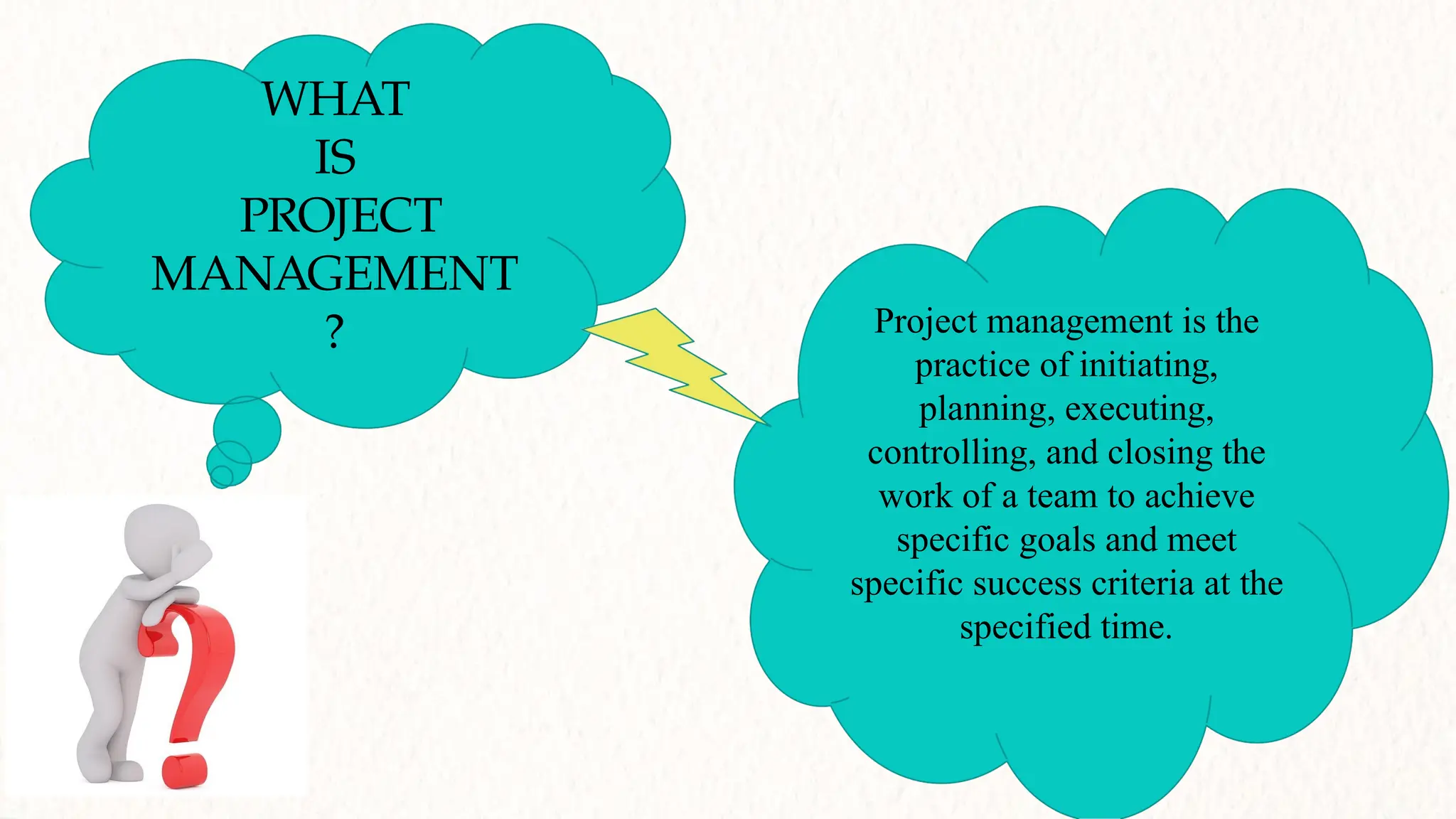
WHAT
IS
PROJECT
MANAGEMENT
? Project managementis the
practice of initiating,
planning, executing,
controlling, and closing the
work of a team to achieve
specific goals and meet
specific success criteria at the
specified time.
8.
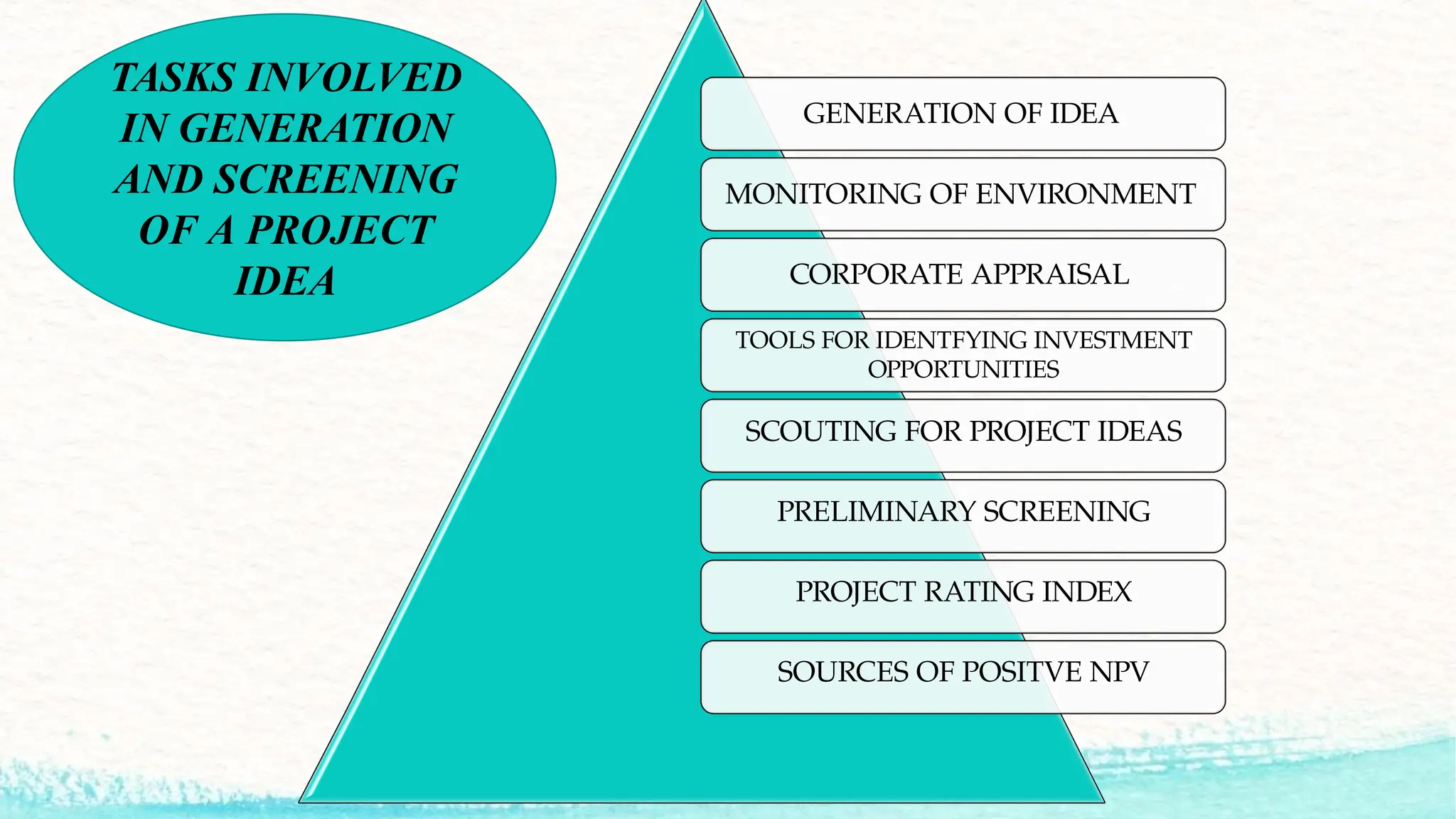
GENERATION OF IDEA
MONITORINGOF ENVIRONMENT
CORPORATE APPRAISAL
TOOLS FOR IDENTFYING INVESTMENT
OPPORTUNITIES
SCOUTING FOR PROJECT IDEAS
PRELIMINARY SCREENING
PROJECT RATING INDEX
SOURCES OF POSITVE NPV
TASKS INVOLVED
IN GENERATION
AND SCREENING
OF A PROJECT
IDEA
9.
1. GENERATION OFIDEA
Most of the project idea involve combining existing field
of technology or offering variants of present product & services.
A panel is formed for the purpose of identifying
investment opportunities. It involves the following tasks which
must be carried out in order to come up with a creative idea –
(a) SWOT analysis
(b) Determination of objectives
(c) Creating Good environment
10.
2. MONITORING OF
ENVIRONMENT
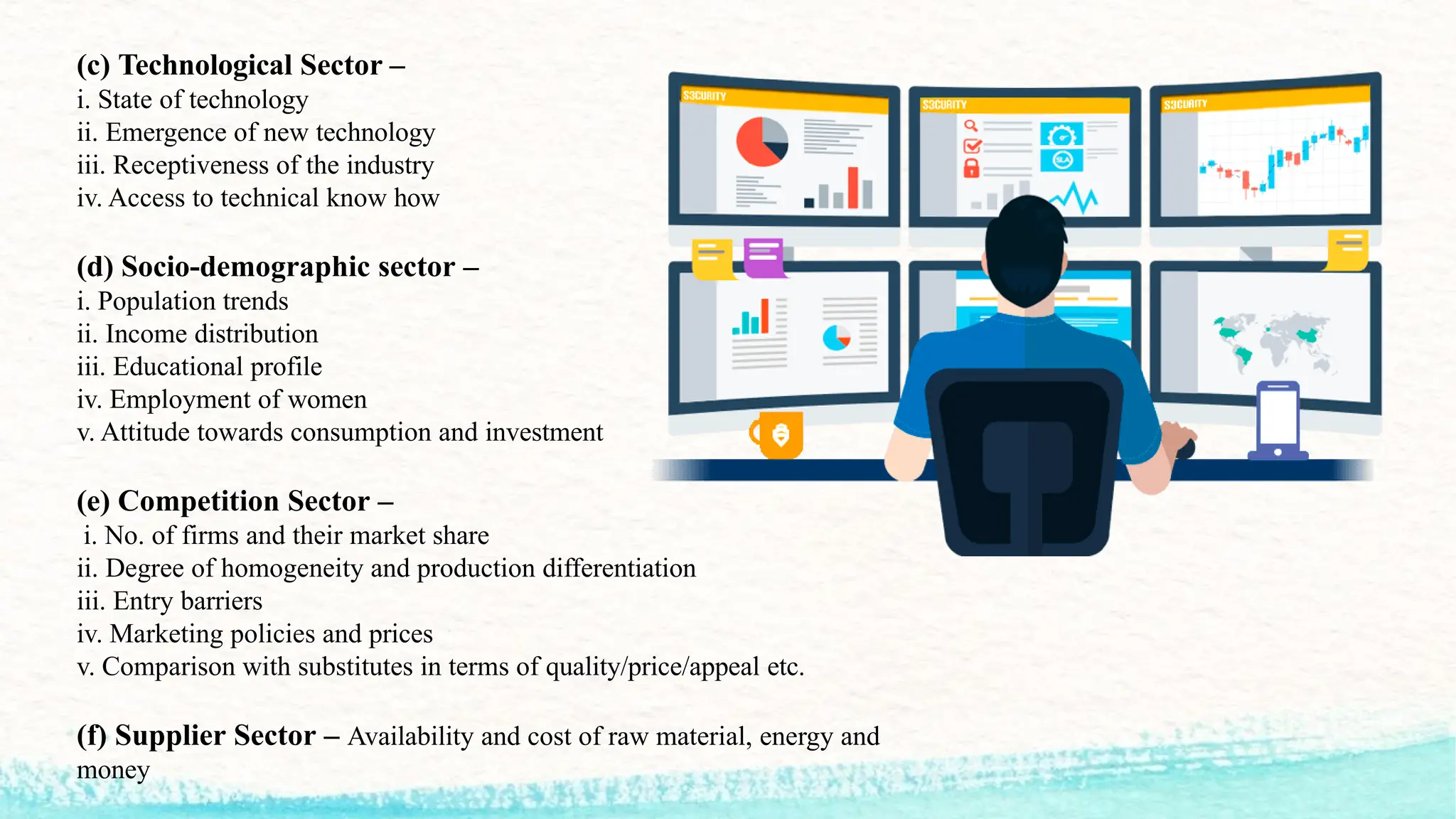
AnOrganization should systematically monitor the environment and assess its competitive abilities in
order to profitably exploit opportunities present in the environment. The key sectors of the environment
that are to be studied are :-
(a) Economic Sector –
i. State of economy
ii. Overall rate of Growth
iii. Growth of primary, secondary and tertiary sectors
iv. Inflation rate
v. Linkage with world economy
vii. Trade Surplus/Deficit
(b) Government Sector –
i. Industrial policy
ii. Government programmes and projects
iii. Tax framework
iv. Subsidies, incentives, concessions
v. Import and export policies
11.
(c) Technological Sector–
i. State of technology
ii. Emergence of new technology
iii. Receptiveness of the industry
iv. Access to technical know how
(d) Socio-demographic sector –
i. Population trends
ii. Income distribution
iii. Educational profile
iv. Employment of women
v. Attitude towards consumption and investment
(e) Competition Sector –
i. No. of firms and their market share
ii. Degree of homogeneity and production differentiation
iii. Entry barriers
iv. Marketing policies and prices
v. Comparison with substitutes in terms of quality/price/appeal etc.
(f) Supplier Sector – Availability and cost of raw material, energy and
money
12.
3. CORPORATE
APPRAISAL –
Itinvolves identification of corporate strengths and weaknesses. The important aspects that are to be considered
are:-
(a) Market and Distribution –
i. Market Image & Market share.
ii. Product line
iii. Marketing and Distribution cost
iv. Distribution Network
(b) Production and Operations –
i. Condition and capacity of plant and machinery
ii. Availability of raw materials and power
iii. Degree of vertical integration
iv. Location advantage
v. Cost structure – Fixed and Variable costs
(c) Research and Development –
i. Research capabilities of a firm
ii. Track record of new product developments
iii. Laboratories and testing facilities
iv. Coordination between research and other departments of the organization
13.
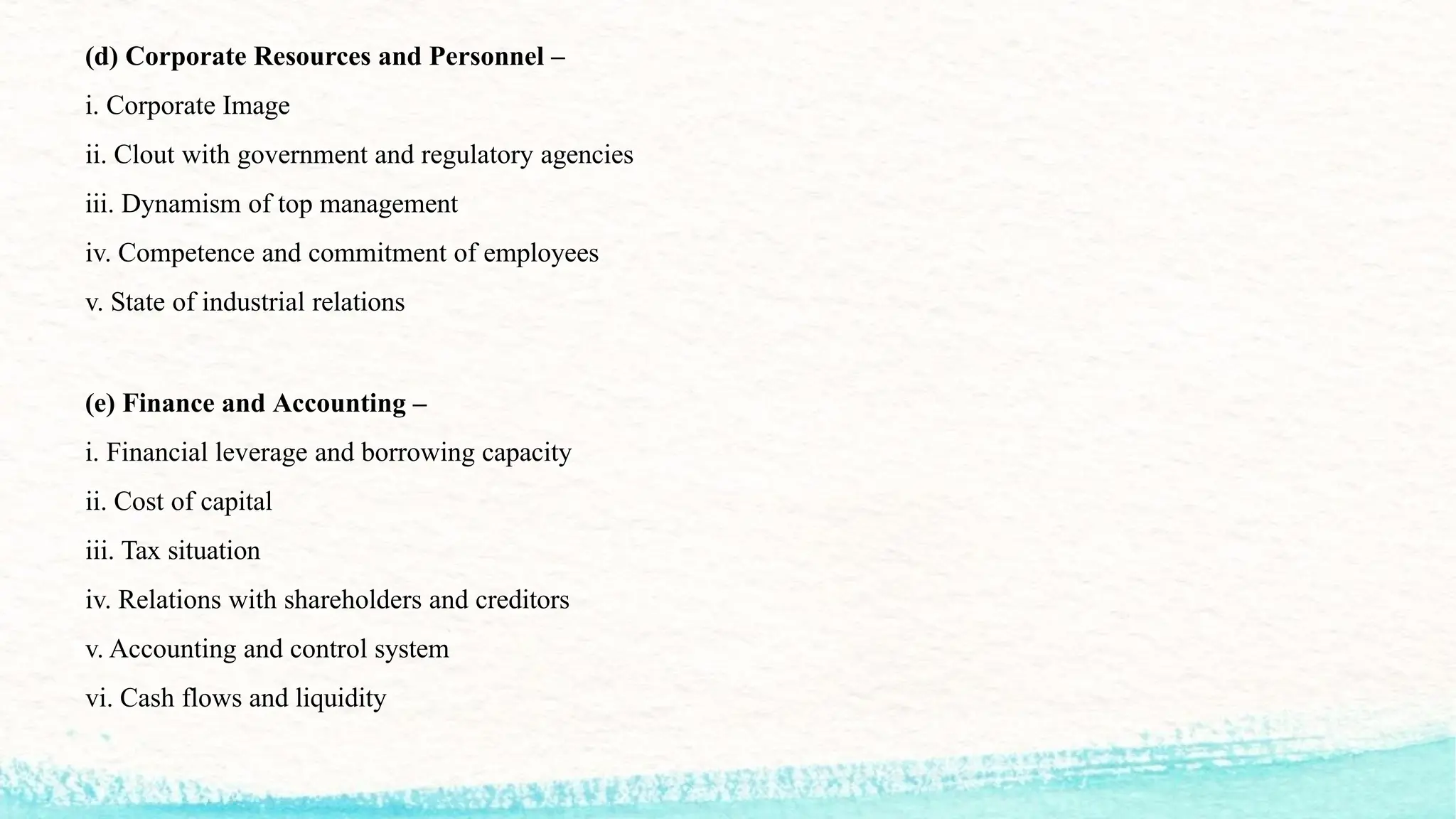
(d) Corporate Resourcesand Personnel –
i. Corporate Image
ii. Clout with government and regulatory agencies
iii. Dynamism of top management
iv. Competence and commitment of employees
v. State of industrial relations
(e) Finance and Accounting –
i. Financial leverage and borrowing capacity
ii. Cost of capital
iii. Tax situation
iv. Relations with shareholders and creditors
v. Accounting and control system
vi. Cash flows and liquidity
14.
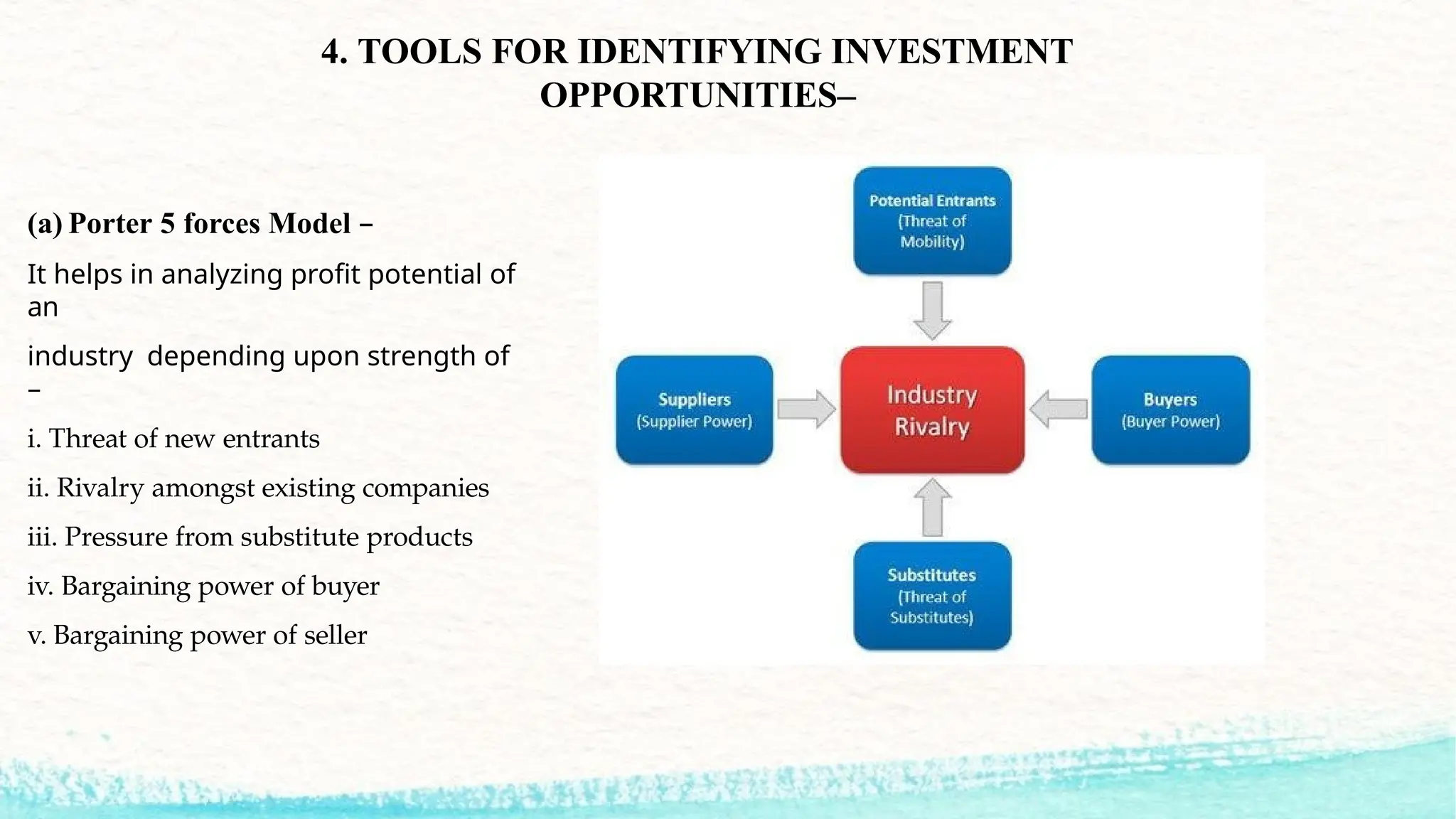
(a) Porter 5forces Model –
It helps in analyzing profit potential of
an
industry depending upon strength of
–
i. Threat of new entrants
ii. Rivalry amongst existing companies
iii. Pressure from substitute products
iv. Bargaining power of buyer
v. Bargaining power of seller
4. TOOLS FOR IDENTIFYING INVESTMENT
OPPORTUNITIES–
15.
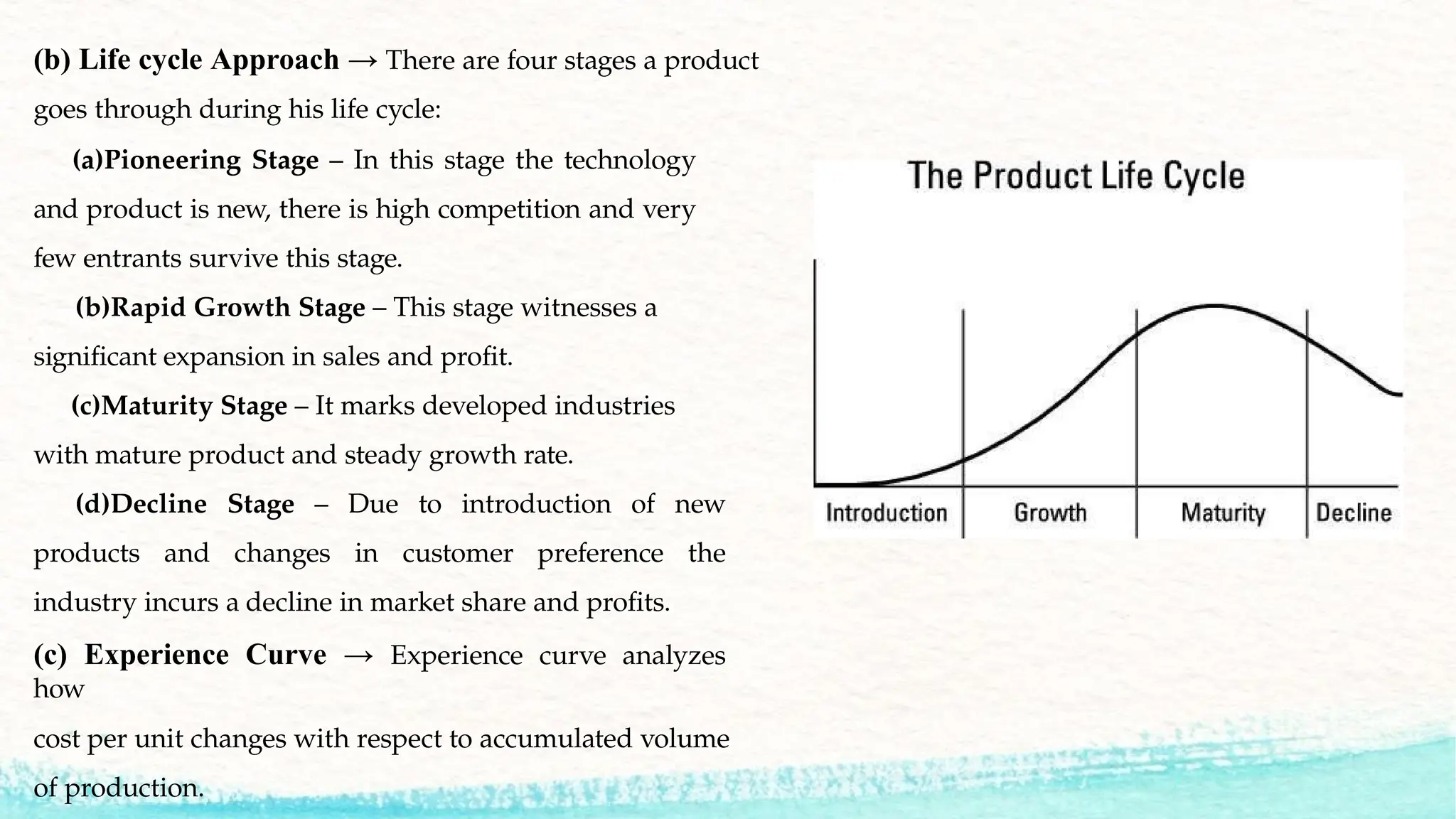
(b) Life cycleApproach → There are four stages a product
goes through during his life cycle:
(a)Pioneering Stage – In this stage the technology
and product is new, there is high competition and very
few entrants survive this stage.
(b)Rapid Growth Stage – This stage witnesses a
significant expansion in sales and profit.
(c)Maturity Stage – It marks developed industries
with mature product and steady growth rate.
(d)Decline Stage – Due to introduction of new
products and changes in customer preference the
industry incurs a decline in market share and profits.
(c) Experience Curve → Experience curve analyzes
how
cost per unit changes with respect to accumulated volume
of production.
16.
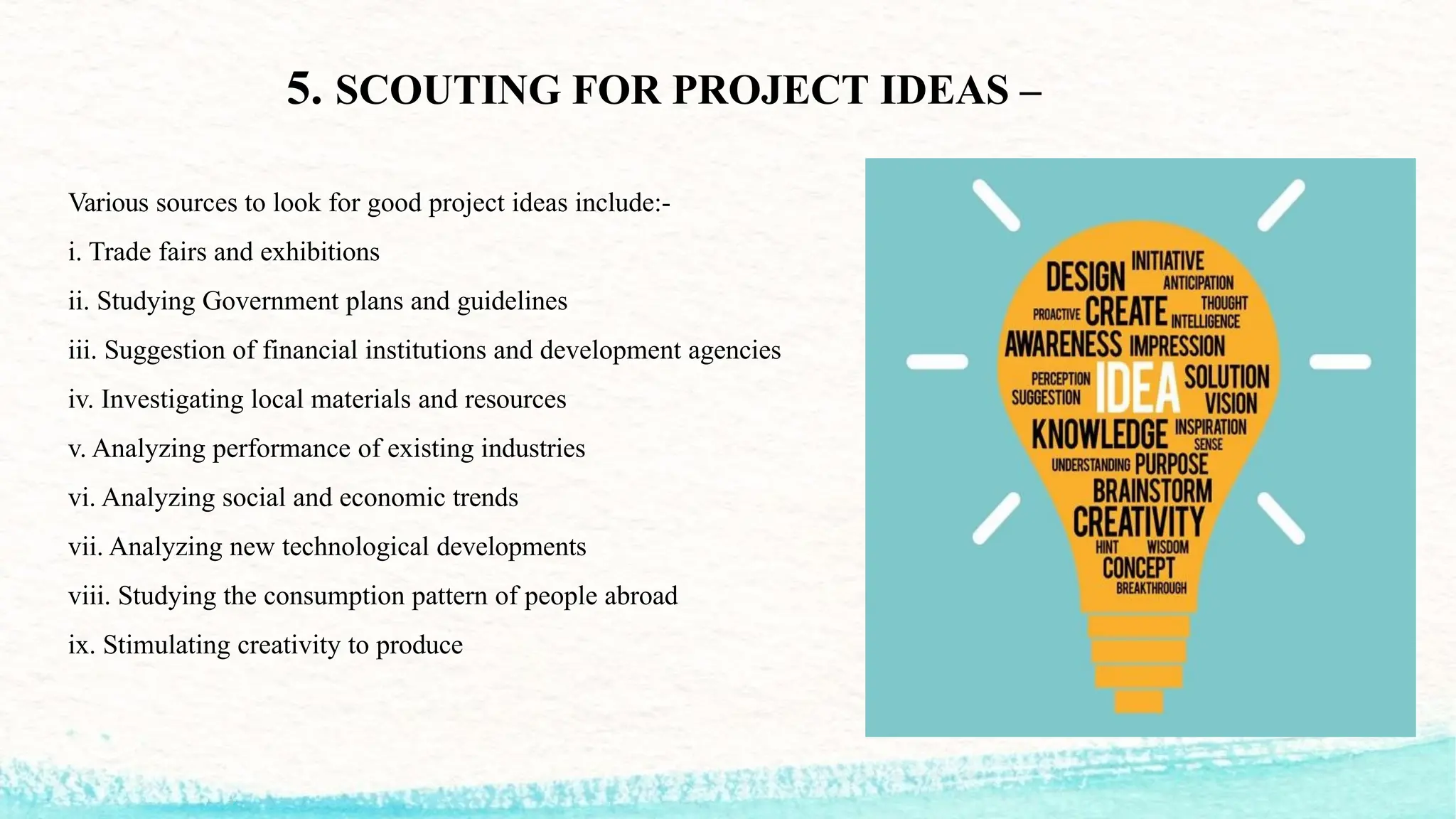
5. SCOUTING FORPROJECT IDEAS –
Various sources to look for good project ideas include:-
i. Trade fairs and exhibitions
ii. Studying Government plans and guidelines
iii. Suggestion of financial institutions and development agencies
iv. Investigating local materials and resources
v. Analyzing performance of existing industries
vi. Analyzing social and economic trends
vii. Analyzing new technological developments
viii. Studying the consumption pattern of people abroad
ix. Stimulating creativity to produce
17.
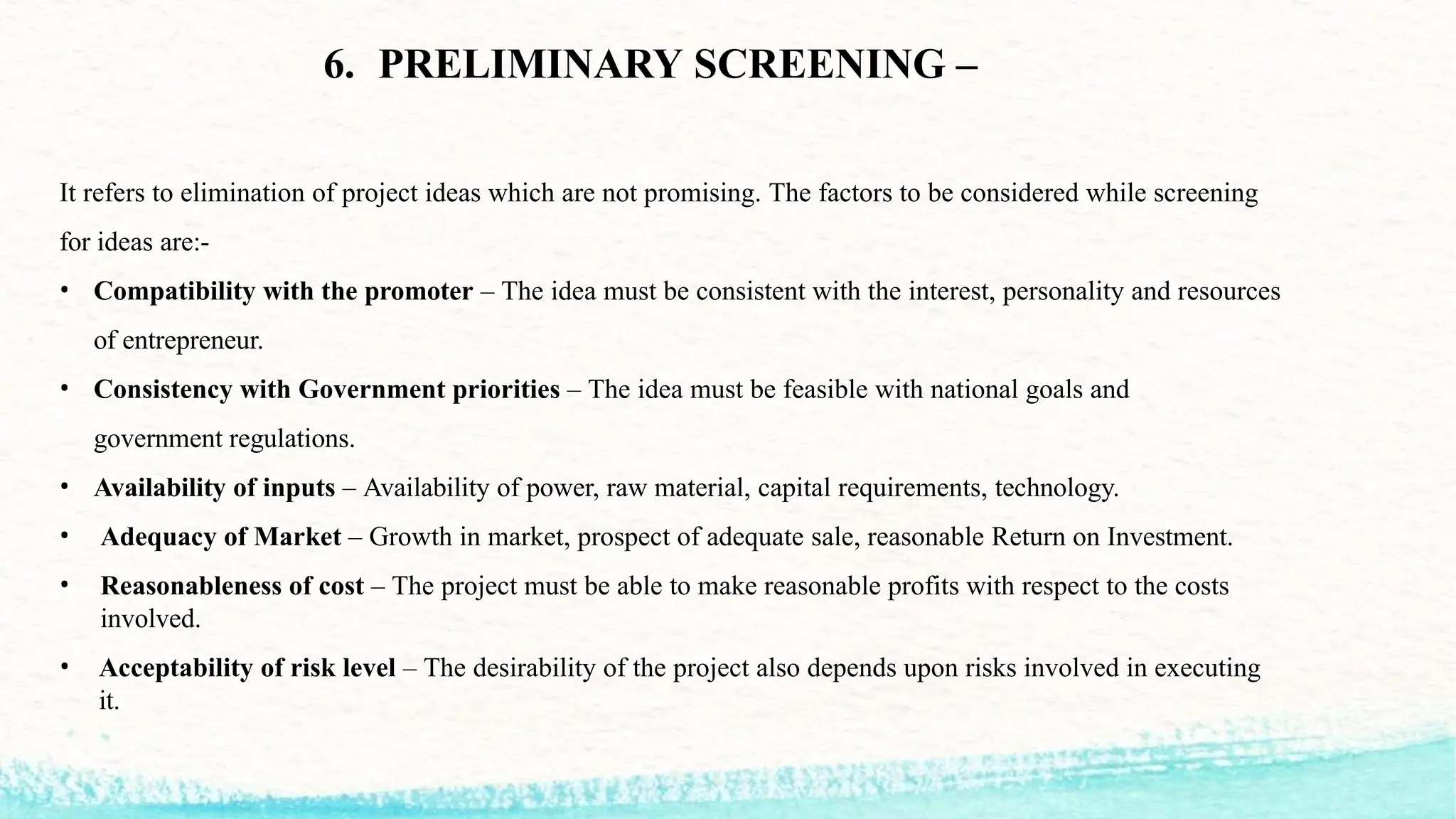
It refers toelimination of project ideas which are not promising. The factors to be considered while screening
for ideas are:-
• Compatibility with the promoter – The idea must be consistent with the interest, personality and resources
of entrepreneur.
• Consistency with Government priorities – The idea must be feasible with national goals and
government regulations.
• Availability of inputs – Availability of power, raw material, capital requirements, technology.
• Adequacy of Market – Growth in market, prospect of adequate sale, reasonable Return on Investment.
• Reasonableness of cost – The project must be able to make reasonable profits with respect to the costs
involved.
• Acceptability of risk level – The desirability of the project also depends upon risks involved in executing
it.
6. PRELIMINARY SCREENING –
18.
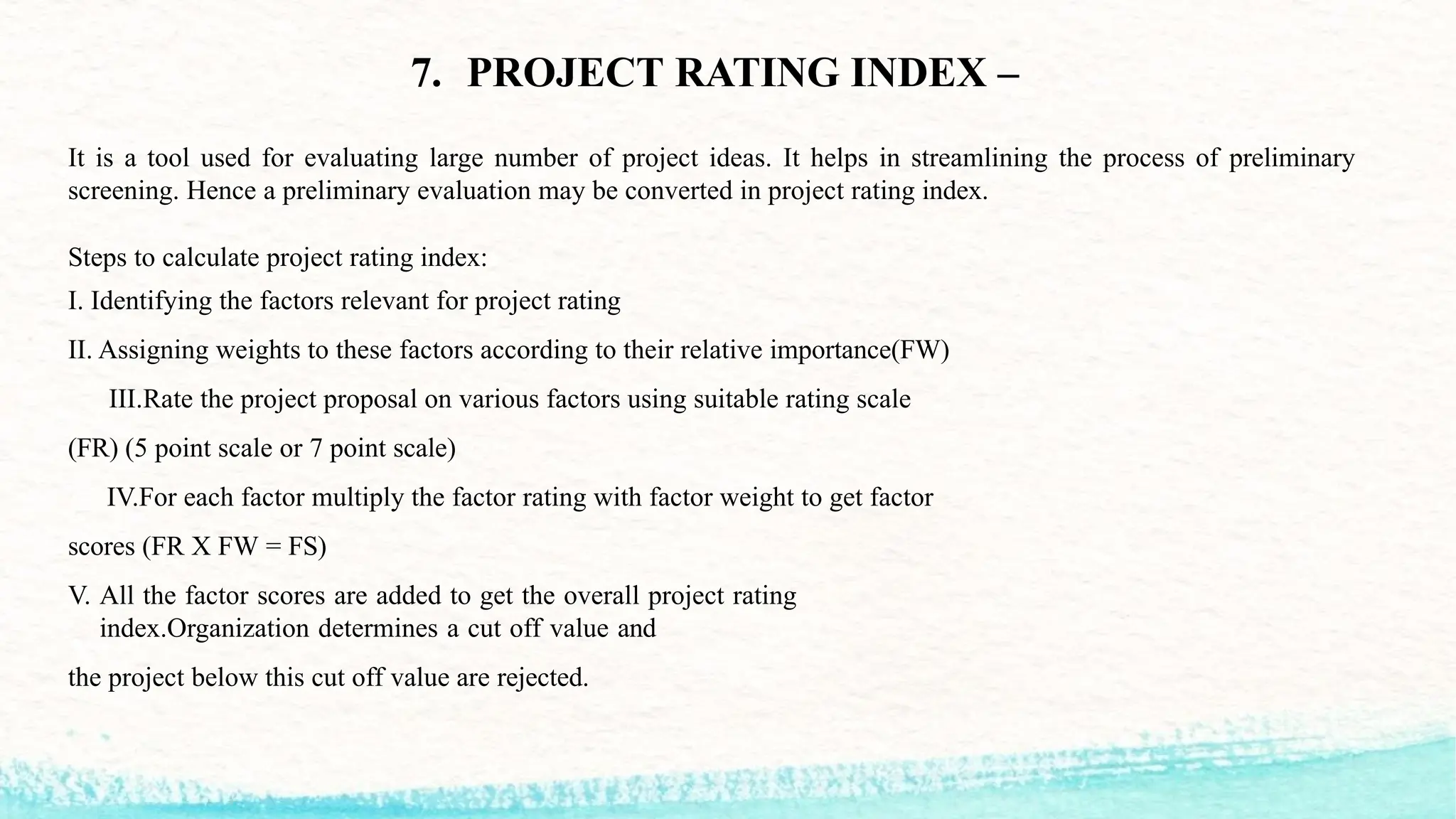
7. PROJECT RATINGINDEX –
It is a tool used for evaluating large number of project ideas. It helps in streamlining the process of preliminary
screening. Hence a preliminary evaluation may be converted in project rating index.
Steps to calculate project rating index:
I. Identifying the factors relevant for project rating
II. Assigning weights to these factors according to their relative importance(FW)
III.Rate the project proposal on various factors using suitable rating scale
(FR) (5 point scale or 7 point scale)
IV.For each factor multiply the factor rating with factor weight to get factor
scores (FR X FW = FS)
V. All the factor scores are added to get the overall project rating
index.Organization determines a cut off value and
the project below this cut off value are rejected.
19.
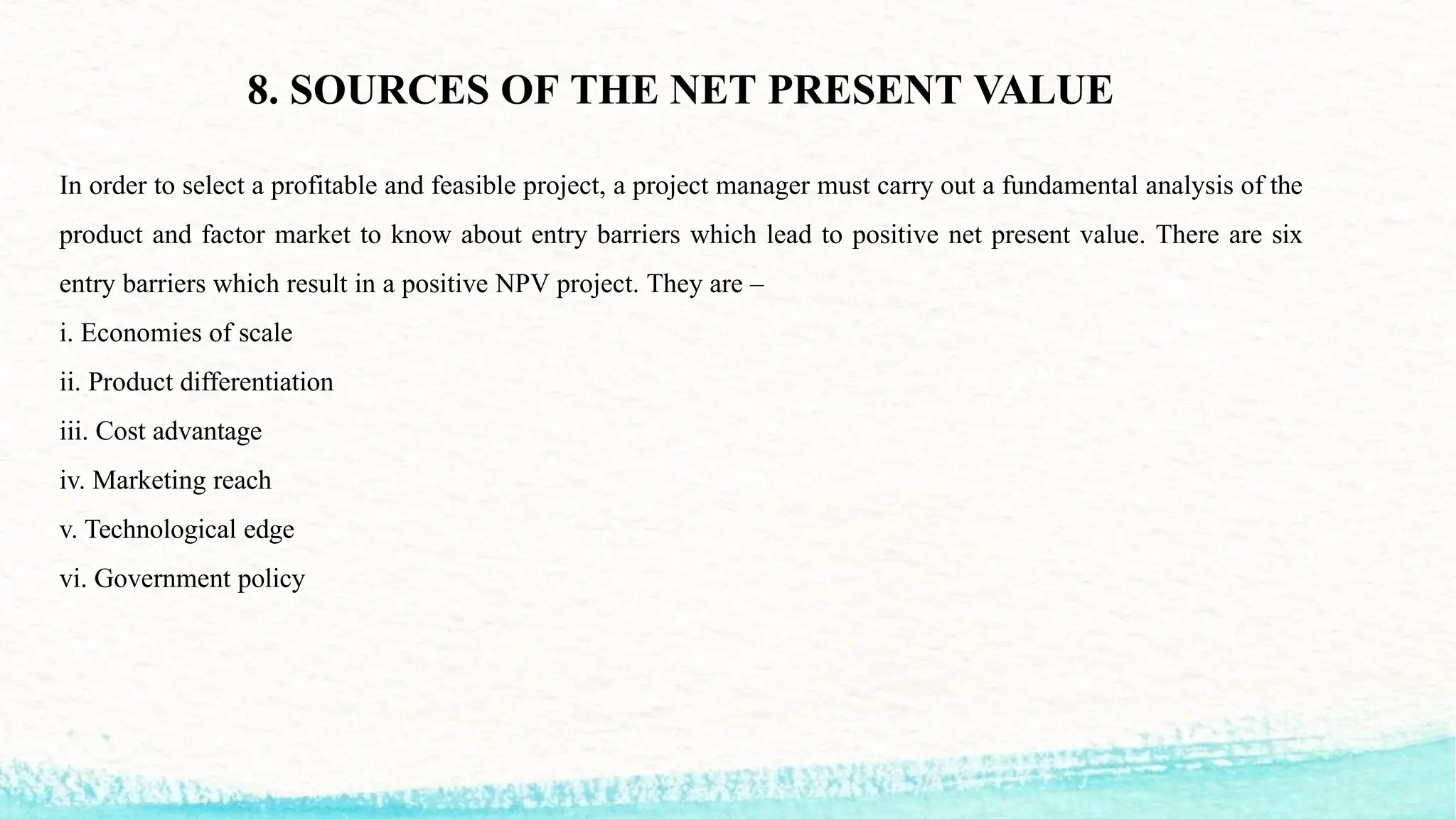
8. SOURCES OFTHE NET PRESENT VALUE
In order to select a profitable and feasible project, a project manager must carry out a fundamental analysis of the
product and factor market to know about entry barriers which lead to positive net present value. There are six
entry barriers which result in a positive NPV project. They are –
i. Economies of scale
ii. Product differentiation
iii. Cost advantage
iv. Marketing reach
v. Technological edge
vi. Government policy