PROJECT ON SUSTAINABLE DEVELOPMENT & EMS
Bishop Benziger Hospital Kollam
Submitted in partial fulfillment of the requirements for the award of
Degree in
MASTER OF BUSINESS ADMINISTRATION
KERALA UNIVERSITY
By
A. Aksha Ajay
Navaneeth Krishnan
Paravathy Kaladharan
Reshma.P
Roshni.S
TKM INSTITUTE OF MANAGEMENT
MUSALIAR HILLS,KOLLAM -691505
2017-2018 Under the guidance of Ms.Archana S
DECLARATION
We here by declared that the project entitled a project on “ Sustainable development &EMS”
in Bishop Benziger Hospital Kollam is the report of the original work done by us under
the guidance of Ms. Archana S (Assistant Professor Finance, TKM Institute of Management)
towards partial fulfillment of the requirements for the award of Post graduate degree of MBA of
University of Kerala during the period of study in TKM Institute of Management Karuvelil.
We also declare that the report has not been submitted by us for the award of any degree,
diploma, and any other university earlier.
A. Aksha Ajay
NavaneethKrishnan
Parvathy Kaladharan
Reshma.P
Roshni.S
Place : kollam
Date : 18-12-2017
ACKNOWLEDGEMENT
Above all the first I take this golden opportunity to express my personal gratitude to
Ms. Archana S (Assistant Professor-Finance, TKM Institute of Management). We consider it is
our privilege a few words of gratitude and take these opportunities of do so. We wish to hearty
thanks to everyone who helped for completing this project.
Above all I thank God almighty for giving courage, wisdom, and for the abundant grace that be
best owned upon me to complete this work successfully
A. Aksha Ajay
NavaneethKrishnan
Parvathy Kaladharan
Reshma.P
Roshni.S
CONTENT
SL .NO TITLE PAGE NO
1 INTRODUCTION 1
2 INDUSTRY PROFILE 5
3 COMPANY PROFILE 7
4 PROCESS OF WASTE MANAGEMENT
4.1 SEWAGE TREATMENT PLANT
4.2 BIOGAS PLANT
9
10
15
5 TYPES OF WASTE 17
6 ENVIRONMENT MANAGEMENT SYSTEM 22
7 SUSTAINABLE DEVELOPMENT INITIATIVE 25
8 CONCLUSION 26
9 BIBLIOGRAPY 27
LIST OF FIGURES
SL NO TITLE PAGE NO
1 SEWAGE PLANT TREATMENT
PROCEES
11
2 CONVENTIONAL SEWAGE
TREATMENT PLANT
13
3 SEWAGE PLANT IN BENZIGER 14
4 PHOTO PROOF 27
INTRODUCTION
Hospitals and care systems increasingly are looking for ways to improve efficiency and
reduce overall costs while also improving the overall patient experience. One often
overlooked opportunity is environmental sustainability. Making an active commitment to
sustainability and aggressively pursuing goals provides multiple strategic benefits that can
help hospitals and care systems thrive.
Sustainability is a broad topic, but a simple definition is the ability of a system to continue
doing what it’s doing over time. A growing number of scientists are focusing on
sustainability and global trends to make the case that business as usual is unsustainable for
our planet. Many organizations and campaigns are focused on “green” initiatives and ways
to become more environmental friendly. But to be continued over time—to be truly
sustainable—initiatives must be fiscally sound while also helping the community and the
environment.
Hospitals and care systems that accomplish truly sustainable initiatives reap benefits in
multiple areas. Their efforts contribute to a healthier environment, improve the
organization’s public perception and can help their local communities. Environmental
sustainability is also good business, as it helps lower operational costs and allows hospitals
to direct more resources to patient care. These benefits can help hospitals meet the Triple
Aim—improving population health, improving the patient experience and reducing per
capita cost.
Sustainability can improve population health by contributing to healthier communities,
reducing pollution and reducing the use of community resources such as water and energy.
Sustainability can contribute to a better patient experience by improving a hospital’s
environment and public perception and by promoting loyalty among patients concerned
about the environment. Finally, sustainability can reduce the per capita cost of health care
by reducing health care expenses; for example, spending less money on utilities enhances
hospitals’ ability to free up resources for patient care.
The benefits of sustainability are more important than ever before. Hospitals and care
systems are facing incredible financial and regulatory pressures to make changes as the
health care environment shifts from a volume-based market to a valuebased market. In a
2011 report “Hospitals and Care Systems of the Future,” the American Hospital Association
outlined key strategies hospitals must use to succeed in the future, value-based
environment. Achieving sustainability goals can help hospitals pursue several strategies
listed in the report, including becoming more efficient and focusing on population health.
Most hospital CEOs rank financial pressures as their top concern.3 In the current health
care climate, sustainability efforts must be financially viable to succeed long term.
Hospitals and care systems around the country are already saving resources by adopting
sustainability measures.
• Peace Health, a nine-hospital system serving Washington, Oregon and Alaska, created
a strategic energy management plan that cut energy use by 10 percent over three
years, generating $800,000 in savings annually.
• Gundersen Health System, which serves Wisconsin, Iowa and Minnesota, made energy
reduction a priority in 2007, and by 2009 had achieved a 25 percent improvement in
energy efficiency and more than $1 million in annual savings. Environmental
Sustainability in Hospitals: The Value of Efficiency
Implementing energy efficiency efforts—a major sustainability strategy—can help hospitals
reduce costs and protect scarce resources. However, hospitals by their very nature are
energy-intensive facilities, operating around the clock and using complex medical systems
and equipment critical to patient care. Hospitals often house departments that use a lot of
energy, such as laundry, sterilization, food service, refrigeration facilities and computer and
data centers. The most recent data from the U.S. Energy Information Administration states
that large hospitals make up just 2 percent of commercial floor space in the United States
but use about 5.5 percent of energy delivered to the commercial sector.
Rising energy costs coupled with the unique requirements of health care facilities are
increasingly leading to financial challenges. Health care organizations spend more than
$6.5 billion on energy costs every year. That figure represents a tremendous opportunity
for savings. By trimming just 5 or 10 percent from energy bills, hospitals and care systems
can make a real impact on their finances. Every $1 a nonprofit hospital or care system
saves on energy is equivalent to generating $20 in new hospital revenues, and for-profit
hospitals can raise their earnings by a penny a share by reducing energy costs just 5
percent.8 Energy projects are just one of many sustainability strategies. By expanding
sustainability to encompass more than just energy reduction, hospitals and care systems
can make even greater gains.
Many hospitals and care systems have made commitments to becoming more efficient in
all aspects through performance excellence initiatives, Lean training or the Baldrige award
criteria. Sustainability aligns well with all these efforts. Hospitals that can become more
efficient through sustainability initiatives have more resources to direct toward their
missions of patient care.
In addition to cost savings, hospitals and care systems reap other benefits from become
more sustainable. CEOs of all fields most often cite the following drivers as the reasons
they are pursuing environmental sustainability initiatives:
• Improving brand image and reputation
• Saving money
• Increasing employee satisfaction and retention
• Managing risk and regulatory compliance
• Improving facility operations and pursuing performance excellence
• Demonstrating corporate social responsibility9
In addition to these benefits, sustainability also brings a variety of other benefits specific to
the health care field:
• With community health becoming a top priority for hospitals and care systems,
many leaders are placing greater value on reducing pollution and creating a smaller
environmental footprint.
• Health care organizations are also increasingly pursuing Lean approaches to
become more efficient in various processes, a natural fit with sustainability efforts.
• Some sustainability efforts, such as retro commissioning, can improve patient
health by contributing to lower infection rates and fewer patient transfers.10
The multiple drivers behind sustainability initiatives often overlap. Kaiser Permanente, for
example, has attracted headlines with its public commitment to respond to climate change
and create a healthier environment while saving millions of dollars through efficiency
measures
This guide aims to help hospital and care system leaders navigate the world of
sustainability and build upon their organizations’ existing efforts. Hospitals are at different
points on the journey toward sustainability. Some organizations are leading the charge and
developing best practices, while others are addressing the issue for the first time. Leaders
should consider options and determine what is right for their organizations.
Environmental sustainability in hospitals is more than purchasing a single piece of energy-
efficient equipment. Efficient hospitals create a culture of sustainability that creates lasting
change. These sustainability efforts do not happen in hospitals and care systems without
vision and commitment. Rather, these efforts are the result of strategic thinking from
leaders who are committed to creating a culture of change.
It is important to note that reducing energy expenses and other costs through
sustainability efforts is only achievable if hospitals find solutions that work in the complex
hospital facility. Switching to a more environmentally friendly cleaning solution, for
example, is not an option for hospitals unless it is proven to kill germs and reduce
infections as effectively as traditional products.
The main objective of this study is to find out the sustainable development and
environment management system in Bishop Benziger hospital kollam
INDUSTRY PROFILE
HEALTHCARE SECTOR
The healthcare industry (also called the medical industry or health economy) is an
aggregation and integration of sectors within the economic systemthat provides goods
and services to treat patients with curative, preventive, rehabilitative, and palliative care.
It includes the generation and commercialization of goods and services lending
themselves to maintaining and re-establishing health. The modern healthcare industry is
divided into many sectors and depends on interdisciplinary teams of trained professionals
and paraprofessionals to meet health needs of individuals and populations.
The healthcare industry is one of the world's largest and fastest-growing industries.
Consuming over 10 percent of gross domestic product (GDP) of most developed nations,
health care can form an enormous part of a country's economy.
For purpose of finance and management, the healthcare industry is typically divided into
several areas. As a basic framework for defining the sector, the United Nations
International Standard Industrial Classification (ISIC) categorizes the healthcare industry as
generally consisting of:
• Hospital activities;
• Medical and dental practice activities; "Other human health activities".
This third class involves activities of, or under the supervision of, nurses, midwives,
physiotherapists, scientific or diagnostic laboratories, pathology clinics, residential health
facilities, or other allied health professions, e.g. in the field of optometry, hydrotherapy,
medical massage, yoga therapy, music therapy, occupational therapy, speech therapy,
chiropody, homeopathy, chiropractics, acupuncture, etc.
The Global Industry Classification Standard and the Industry Classification Benchmark
further distinguish the industry as two main groups:
• healthcare equipment and services; and
• pharmaceuticals, biotechnology and related life sciences.
The healthcare equipment and services group consists of companies and entities that
provide medical equipment, medical supplies, and healthcare services, such as hospitals,
home healthcare providers, and nursing homes. The latter listed industry group includes
companies that produce biotechnology, pharmaceuticals, and miscellaneous scientific
services.
Other approaches to defining the scope of the healthcare industry tend to adopt a broader
definition, also including other key actions related to health, such as education and training
of health professionals, regulation and management of health services delivery, provision
of traditional and complementary medicines, and administration of health insurance.
In 2011, healthcare costs paid to hospitals, physicians, nursing homes, diagnostic
laboratories, pharmacies, medical device manufacturers and other components of the
health care system, consumed 17.9 percent of the Gross Domestic Product (GDP) of the
United States, the largest of any country in the world. It is expected that the health share
of the GDP will continue its upward trend, reaching 19.6 percent of GDP by 2016. In 2001,
for the OECD countries the average was 8.4 percent with the United States (13.9%),
Switzerland (10.9%), and Germany (10.7%) being the top three. US health care
expenditures totalled US$2.2 trillion in 2006. According to Health Affairs, US$7,498 be
spent on every woman, man and child in the United States in 2007, 20 percent of all
spending. Costs are projected to increase to $12,782 by 2016.
COMPANY PROFILE
To perpetuate the memory of his illustrious predecessor Bishop Aloysius Maria Benziger,
Bishop Jerome Fernandez , the first Indian Bishop of the catholic diocese of Kollam, had the idea
of erecting a befitting memorial. With the concurrence of the faithful of the diocese a decision
was made to build a hospital.
Bishop Benziger Hospital was thus established in a four-acre plot situated in the heart of Kollam
town. The hospital started functioning on 17th August 1948, the anniversary of the death of
Bishop Benziger. It was the first ever private hospital in Kollam town. The formal inauguration
took place on 8th December, 1948.The Hospital is owned and managed by the Latin Catholic
Diocese Of Quilon. Being a charitable society, this is not a profit oriented institution. Whatever
profit that is generated is always ploughed back into the institution for the benefit of the public.
Hence the institution's growth is to the benefit of the public which it aspires to serve and love
with utmost sincerity.
When established in the year 1948, bishop Benziger hospital was the very first private hospital in
Quilon with inpatient facilities. After 65 years, today it is the one of the biggest hospitals in
Kollam having all the major departments, modern equipments, excellent facilities, eminent
doctors and efficient paramedical staff.
The hospital is committed to its original inspiration while attempting to tune to the contemporary
needs and situations. The belief that healing is for the whole person, who also has a spiritual
dimension is uncompromisingly maintained and underlines the approach and treatment.
Health care today is undergoing fast-paced changes in terms of technology, methodologies,
perspectives, attitudes and values. Surviving and excelling amidst such a surge of changes call
for the need for wisdom and conviction to be different. Consent vigilance is exercised not to fall
into the pit of commercialization and at the same time, to excel in service aided by the
advancement of modern medical science and technology.
As part of its attempt to rediscover its identity and mission amidst the present day realities, the
hospital finds new avenues of involvement apart from the routine hospital activities. Initiatives
like community health centre’s and community radio are example for this.
Community health promotional activities form an integral component of our mission. Hence
from the very inception of this hospital we have been involving ourselves in many community
based activities. But the community health centre’s which we have started are the most tangible
expression of our commitment to society. Catering to the primary health needs of a population of
more than 25000 people of the coastal village in the vicinity of the hospital, our nursing students
and staff are engaged in an activity of social purpose. Although it was only a happy coincidence,
our decision to start a community radio came in perfect combination with community health
activities. Bishop Benziger hospital will always remain committed to the ideals of a mission
hospital.
NABH Safe I Certified Hospital
Accreditation from NABH Safe I Tsm
Bishop Benziger Hospital has been assessed and found to comply with NABH Safe -I Standards,
and accredited with the NABH Safe I certification. It is the first Private Hospital in Kollam
District to get an accreditation from NABH Safe I (National Accreditation Board for Hospitals
and Healthcare Providers), and the seventh one in all over Kerala and the fourteenth in India.
Process of waste management system
The World Health Organization (WHO) categorizes waste substances produced by hospitals
according to their density and constitution. Wastes are divided into the following groups:

infectious, sharps, pathological, pharmaceuticals, radioactive, and others. Infectious waste
substances are those containing pathogens that have the potential to spread infectious
diseases to the hospital patients and staff as well as to the general public if they are left
unattended. Surgical waste is an example of infectious waste. Needles, syringes, and other
operation theater substances that could cause cuts and eventually, infection, are called sharps.
Pathological wastes are body parts, tissues, organs, fetuses, body fluids, and other types of
human waste. Pharmaceutical wastes are substances such as medicines and chemicals.
Radioactive wastes are substances that contain radioactive materials, such as X-rays,
radiotherapy, and so on. Finally, apart from these substances, other types of miscellaneous
waste are sometimes present, including items such as bedding and laundry/kitchen wastes.
Biological wastes are substances that are contaminated by biohazardous material. Examples
include syringes, needles, surgical swabs, cultural tubes, absorbent pads, and blood vials.
Their potential to cause infections is greater, because they could potentially cause diseases
such as AIDS.
Biological wastes in hospitals are classified as Category 1 and Category 2. The first category
includes those substances that are harmful if released into the environment. The second
contains non-infectious substances such as body parts and animal tissue.
Importance of Waste Management Objectives
Hospitals produce a vast amount of potentially dangerous wastes. Because there are so many
people working in hospitals, serving all different types of functions, everyone from the doctor
to the janitor needs to know the proper protocols for disposing of dangerous wastes.
Otherwise, the wastes could pose problems for the hospital staff and/or public by making
them vulnerable to infectious diseases such as AIDS, typhoid, boils, and Hepatitis A or B. For
example, dioxin, a product of burnt plastics, can also cause cancer, birth defects, and related
problems. Therefore, plastics must be disposed of differently then other waste products.
Objectives
Objectives for managing waste in hospitals deal with the problem of waste disposal at several
levels. The objectives are based on the premise that not all wastes should be treated equally.
A practical and useful waste management systems is one that takes all of the related factors,
such as differences in wastes and dangers of waste, into consideration. In most hospitals, the
overall goals or objectives include: 1) reducing risks and liabilities; 2) controlling costs; 3)
planning for the future; and 4) coordinating with the respective government department or
institution for better waste management practices.
Process
Implementing waste management strategies in hospitals is grounded in a process chain that
includes many steps, including generation, segregation (removing hazardous wastes for
treatment), collection, storage, processing transport, treatment, and disposal. Many hospitals
also focus on educating management and staff, emphasizing concepts such as reuse, recycling,
and segregation.
In Bishop Benziger Hospital the process of waste are done by waste water treatment plant
and biogas plant.
Sewage treatment plant
Generally, wastewater is defined as the composition of physical, chemical and biological waste
present in wastewater. Hospital sewage is a wastewater generated relatively in larger quantities
from all the units of the hospitals such as emergency and first aid, operating rooms, drug
treatment, ICU, chemical and biological laboratories, radiology, canteen and laundry activities
etc.
Since, hospital sewage/wastewater consists of various potentially hazardous components that
will cause many risks on human and environment by polluting surface and ground water. Hence,
hospital sewage treatment is very much required.
The major objective of hospital wastewater treatment plant is to treat the influent (untreated
wastewater) generated by the hospitals and healthcare sectors before its direct release into natural
environment. Hospital wastewater may have an adverse impact on environments and human
health. Therefore, proper wastewater management in each and every hospital is prerequisite
Hospital Sewage Characteristics:
Wastewater from various hospitals consists of
1. Microbial pathogens and harmful bacteria and virus
2. Pharmaceuticals and its metabolites
3. Radioactive isotopes
4. Hazardous chemicals, heavy metals
5. Drug residues
Hospital sewage or wastewater treatment plant process:
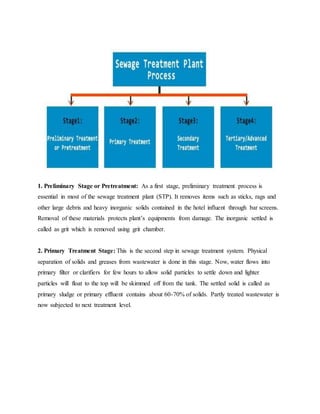
Compact or packaged sewage treatment plant for hospitals is done in series of steps.
Conventional treatment processes involved to remove impurities from the influent are listed
below.
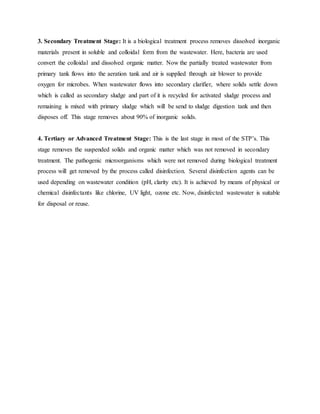
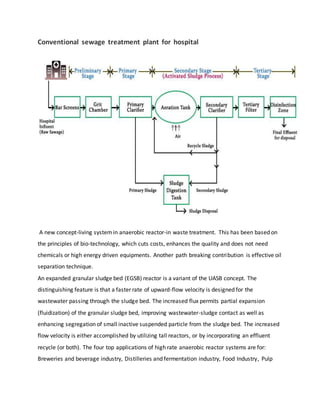
1. Preliminary Stage or Pretreatment: As a first stage, preliminary treatment process is
essential in most of the sewage treatment plant (STP). It removes items such as sticks, rags and
other large debris and heavy inorganic solids contained in the hotel influent through bar screens.
Removal of these materials protects plant’s equipments from damage. The inorganic settled is
called as grit which is removed using grit chamber.
2. Primary Treatment Stage: This is the second step in sewage treatment system. Physical
separation of solids and greases from wastewater is done in this stage. Now, water flows into
primary filter or clarifiers for few hours to allow solid particles to settle down and lighter
particles will float to the top will be skimmed off from the tank. The settled solid is called as
primary sludge or primary effluent contains about 60-70% of solids. Partly treated wastewater is
now subjected to next treatment level.
3. Secondary Treatment Stage: It is a biological treatment process removes dissolved inorganic
materials present in soluble and colloidal form from the wastewater. Here, bacteria are used
convert the colloidal and dissolved organic matter. Now the partially treated wastewater from
primary tank flows into the aeration tank and air is supplied through air blower to provide
oxygen for microbes. When wastewater flows into secondary clarifier, where solids settle down
which is called as secondary sludge and part of it is recycled for activated sludge process and
remaining is mixed with primary sludge which will be send to sludge digestion tank and then
disposes off. This stage removes about 90% of inorganic solids.
4. Tertiary or Advanced Treatment Stage: This is the last stage in most of the STP’s. This
stage removes the suspended solids and organic matter which was not removed in secondary
treatment. The pathogenic microorganisms which were not removed during biological treatment
process will get removed by the process called disinfection. Several disinfection agents can be
used depending on wastewater condition (pH, clarity etc). It is achieved by means of physical or
chemical disinfectants like chlorine, UV light, ozone etc. Now, disinfected wastewater is suitable
for disposal or reuse.
Conventional sewage treatment plant for hospital
A new concept-living systemin anaerobic reactor-in waste treatment. This has been based on
the principles of bio-technology, which cuts costs, enhances the quality and does not need
chemicals or high energy driven equipments. Another path breaking contribution is effective oil
separation technique.
An expanded granular sludge bed (EGSB) reactor is a variant of the UASB concept. The
distinguishing feature is that a faster rate of upward-flow velocity is designed for the
wastewater passing through the sludge bed. The increased flux permits partial expansion
(fluidization) of the granular sludge bed, improving wastewater-sludge contact as well as
enhancing segregation of small inactive suspended particle from the sludge bed. The increased
flow velocity is either accomplished by utilizing tall reactors, or by incorporating an effluent
recycle (or both). The four top applications of high rate anaerobic reactor systems are for:
Breweries and beverage industry, Distilleries and fermentation industry, Food Industry, Pulp
and paper. This technology is 100% natural and it makes use of the naturally occurring
anaerobic microbes to deal with wastes.
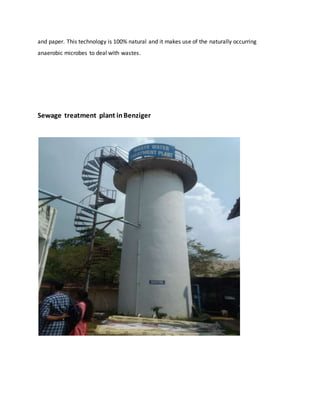
Sewage treatment plant inBenziger
BIOGAS PLANT
BIOGAS is produced by bacteria through the biodegradation of organic material under
anaerobic conditions. Natural generation of biogas is an important part of bio-geochemical
carbon cycle. It can be used both in rural and urban areas
Composition of biogas depends upon feed material also. Biogas is about 20% lighter than air
has an ignition temperature in range of 650 to 750oC.An odorless and colorless gas that burns
with blue flame similar to LPG gas. Its caloric value is 20 Mega Joules (MJ) /m3 and it usually
burns with 60 % efficiency in a conventional biogas stove. This gas is useful as fuel to substitute
firewood, cow-dung, petrol, LPG, diesel and electricity depending on the nature of the task and
local supply conditions and constraints. Biogas digester systems provides a residue organic
waste, after its anaerobic digestion(AD) that has superior nutrient qualities over normal organic
fertilizer, as it is in the form of ammonia and can be used as manure. Anaerobic biogas digesters
also function as waste disposal systems, particularly for human wastes and can prevent
potential sources of environmental contamination and the spread of pathogens and disease
causing bacteria. Biogas technology is particularly valuable in agricultural residual treatment of
animal excreta and kitchen refuse (residuals).
Biogas System
A typical biogas systemconsists of the following components:
1. Manure collection
2. Anaerobic digester
3. Effluent storage
4. Gas handling
5. Gas use Biogas is a renewable form of energy.
Methanogens (methane producing bacteria) are last link in a chain of microorganisms which
degrade organic material and returns product of decomposition to the environment.
Principles of Biogas Production Organic substances exist in wide variety from living beings to
dead organisms. Organic matters are composed of Carbon (C), combined with elements such as
Hydrogen (H), Oxygen (O), Nitrogen (N), and Sulphur (S) to form variety of organic compounds
such as carbohydrates, proteins and lipids. In nature MOs (microorganisms), through digestion
process breaks the complex carbon into smaller substances. There are 2 types of digestion
process: i. Aerobic digestion. ii. Anaerobic digestion. The digestion process occurring in
presence of Oxygen is called Aerobic digestion and produces mixtures of gases having carbon
dioxide (CO2), one of the main “green houses” responsible for global warming. The digestion
process occurring without (absence) oxygen is called An `aerobic digestion which generates
mixtures of gases. The gas produced which is mainly methane produces 5200- 5800 KJ/m3
which when burned at normal room temperature and presents a viable environmentally
friendly energy source to replace fossil fuels (nonrenewable).
ANAEROBIC DIGESTION
It is also referred to as biomethanization, is a natural process that takes place in absence of air
(oxygen). It involves biochemical decomposition of complex organic material by various
biochemical processes with release of energy rich biogas and production of nutrious effluents.
The three important biological process (microbiology) are, Hydrolysis In the first step the
organic matter is enzymolysed externally by extracellular enzymes, cellulose, amylase, protease
& lipase, of microorganisms. Bacteria decompose long chains of complex carbohydrates,
proteins, & lipids into small chains. For example, Polysaccharides are converted into
monosaccharide. Proteins are split into peptides and amino acids. Acidification Acid-producing
bacteria involved in this step, convert the intermediates of fermenting bacteria into acetic acid,
hydrogen and carbon dioxide. These bacteria are anaerobic and can grow under acidic
conditions. To produce acetic acid, they need oxygen and carbon. For this, they use dissolved
O2 or bounded-oxygen. Hereby, the acid-producing bacterium creates anaerobic condition
which is essential for the methane producing microorganisms. Also, they reduce the
compounds with low molecular weights into alcohols, organic acids, amino acids, carbon
dioxide, hydrogen sulphide and traces of methane. From a chemical point, this process is
partially endergonic (i.e. only possible with energy input), since bacteria alone are not capable
of sustaining that type of reaction. Methanogenesis (Methane formation) Methane-producing
bacteria, which were involved in the third step, decompose compounds having low molecular
weight. They utilize hydrogen, carbon dioxide and acetic acid to form methane and carbon
dioxide. Under natural conditions, CH4 producing microorganisms occur to the extent that
anaerobic conditions are provided, e.g. under water (for example in marine sediments), and in
marshes. They are basically anaerobic and very sensitive to environmental changes, if any
occurs. The methanogenic bacterium belongs to the archaebacter genus, i.e. to a group of
bacteria with heterogeneous morphology and lot of common biochemical and molecular-
biological properties that distinguishes them from other bacteria. The main difference lies in
the makeup of the bacteria’s cell walls.
In Benziger Hospital the food and kitchen waste are converted into biogas they have two large
biogas plant one with 400 liter capacity and other have 750 liter capacity.
TYPES OF WASTE
Waste is almost anything that has served its original intended purpose and is being
discarded or stored prior to being discarded. Health care (Hospital) waste includes all the waste
generated by health care establishments, research facilities and laboratories. In addition, it
includes the waste originating from minor or scattered sources such as that produced in the
course of health care undertaken in the home (dialysis, injections, insulin, etc..). The Medical
Waste Tracking Act of 1988 defines medical waste as "any solid waste that is generated in the
diagnosis, treatment, or immunization of human beings or animals, in research pertaining
thereto, or in the production or testing of biologicals."
Hospital-waste handling is a hazardous activity which requires a high standard of
training. It calls for specific training that depends on the nature of the work in the hospital, the
hazards and possibility of worker exposure, and the responsibilities of individual workers.
Training of health care waste management programs. Hospital waste is very different from the
ordinary waste that is produced in our homes on a daily basis that is why we need to adopt
certain different methods for disposing off the hospital waste materials. Various complex
substances are involved when it comes to the hospital waste. Hospitals are usually very big
organizations that involve a lot of different departments. Medical care is provided to the
patients in every department and during this process a lot of different materials are used which
are disposed off as hospital waste
In order to manage the waste in the most efficient manner, every hospital should operate
a special program, so that the waste gets disposed off without harming the health of the
patients or the people who are working in the hospital. In this article, my main focus would be
to provide you some critical information and special techniques for an efficient hospital waste
management system. The main steps of hospital management are as follows:
1. Identification of waste types
2. Segregation of waste
3. Transport & storage of waste
4. Proper disposal of waste
5. Implementation of contingency plans
6. Identify the need for use of personal protective equipment
Identification of types of hospital waste and Division of the waste
The hospital waste is divided into various different categories according to which they
are disposed off .Before the hospital waste is decomposed it is extremely important to treat it
with certain chemicals. Different categories of waste materials are divided into diverse sections
so that they can be treated accordingly. It is a very important step that should be carried out at
the place where the waste is generated. This activity should be carried out at diagnostic
services areas, labour rooms, operations theatres, activity areas. Hygiene should be maintained
at all time while treating the waste materials.
Hospital wastes are categorized according to their weight, density and constituents. The World
Health Organization (WHO) has classified medical waste into different categories. These are:
Infectious: material-containing pathogens in sufficient concentrations or quantities that, if
exposed, can cause diseases. e.g. laboratory cultures; waste from isolation wards;
tissues(swabs), materialsor equipment that have been in contact with infected patient’s
excreta. 2. Sharps: disposable needs, syringes, infusion sets, saws, blades, broken glasses, nails
or any other item that could cause a cut. 3. Pathological: tissues, organs, body parts, human
flesh, foetus, blood and body fluids. 4. Pharmaceuticals: drugs and chemicals that are returned
from wards, spilled, outdated, contaminated, or are no longer required (bottles, boxes).5.
Chemical waste: waste containing chemical substances e.g. laboratory reagents; film developer;
disinfectants; that are expired or no longer needed.6. General waste: No risk to human health.
E.g. office paper, wrapper, kitchen waste, general sweeping etc. Other than these categories ,
there is another division called radioactive wastes. But with the advancement of technologies,
the use of radioactive substances is avoided from the hospitals.
 Infectious waste
Infectious waste describes waste that has the possibility of causing infections to humans. It
can include human or animal tissue (blood or other body parts), blood-soaked bandages,
discarded surgical gloves, cultures, stocks, or swabs to inoculate cultures. Much of this
category, including human or animal tissue, can also be labelled as pathological waste,
which requires specific treatment methods. Pathological waste is either known or suspected
to contain pathogens. They are always disposed in red color containers
Sharps
Sharps including injection (puncture) pinhead, scalp pinhead, scalpel, suture needle and
acupuncture needle, one-way puncture needle, other sharps contaminated with blood and
body fluid. All the sharps must be considered as infectious waste. Origin: Generated in all
medical departments e.g. Wards, Surgery, Laboratories, Haemodialysis facilities, etc..
Disposal/ Treatment: Collected separately in puncture proof containers and disinfected, e.g.
through central autoclaving, shredded and disposed of on a landfill. Sharp wastes make up
most of the volume of medical wastes produced by SQGs. The next highest is blood and
body fluids.
Sharps waste is a form of biomedical waste composed of used "sharps", which includes any
device or object used to puncture or lacerate the skin. Sharps waste is classified as
biohazardous waste and must be carefully handled. Common medical materials treated as
sharps waste are:
 Hypodermic needles
 Disposable scalpels and blades
 Contaminated glass and some plastics
 In addition to needles and blades, anything attached to them will also be considered sharps
waste, such syringes and injection devices.
 Blades can include razors, scalpels, X-Acto knife, scissors, or any other medical items used
for cutting in the medical setting, regardless of if they have been contaminated with
biohazardous material. While glass and sharp plastic are considered sharps waste, their
handling methods can vary.
 Glass items which have been contaminated with a biohazardous material will be treated
with the same concern as needles and blades, even if unbroken. If glass is uncontaminated,
it is still often treated as a sharp, because it can break during the disposal process.
Contaminated plastic items which are not sharp can be disposed of in a biohazardous
wastereceptacle instead of a sharps container.
Mainly they disposed these types of sharps waste in blue containers as the part of
segregation. Other than this, a sharps container is a hard plastic container that is used to safely
dispose of hypodermic needles and other sharp medical instruments, such as an IV catheters and
disposable scalpels. Sharps containers may be single use which are disposed of with the waste
inside or reusable which are robotically emptied and sterilized before being returned for re-use.
Sharps waste is of great concern in developing and transitional regions of the world. Factors such
as high disease prevalence and lack of health care professionals amplify the dangers involved
with sharps waste, and the cost of newer disposal technology makes them unlikely to be used. As
with the rest of the world injection wastes make up the largest portion of sharps waste. However,
injection use is much more prevalent in this world segment. One of the contributors to this
increase is a larger emphasis placed on injections for therapeutic purposes. It has been estimated
that 95% of all injections in developing regions are for therapeutic purposes. The average person
has been estimated to receive up to 8.5 injections per year. Newly developed injection
technologies are rarely used to provide these injections due to added costs. Therefore, the
majority of injections are given with standard disposable syringes in developing regions.
The infrastructure of developing regions is not equipped to deal with this large volume of
contaminated sharps waste. Contrary to the industrialized world, disposal incinerators and
transportation networks are not always available. Cost restraints make the purchase of single
use disposable containers unrealistic. Facilities are often overwhelmed with patients and
understaffed with educated workers. Demand on these facilities can limit the emphasis or
enforcement of waste disposal protocols. These factors leave a dangerous quantity of sharps
waste in the environment. Contrasts between the industrialized and developing world segment
can be seen in accidental needle stick injuries. These occur at a rate of .18 to .74 per person per
year in industrialized nations and .93 to 4.68 per person per year in developing and transitional
nations.
Improper sharps management is a major factor involved in what is categorized as unsafe
injections. Annually these account for 21 million, 2 million, and 260,000 of new HBV, HCV, and
HIV infections annually. 40-65% of new HBV and HCV are due topercutaneous occupational
exposure.
Pathological waste
If you can recognize the waste came from a living organism, it is probably pathological
waste: consists of recognizable tissues, organs, and body parts derived from animals and
humans. Material removed from the body in surgery and fluids and solids removed in
autopsies is pathological waste, with the exception of teeth. Pathological waste is almost
always treated by incineration. Autoclaves are not used for pathological waste.
Chemical waste
Chemical waste mainly refers to fixer and developer solvent in X-ray department, discarded
materials like discarded reagent in labs, waste with mercury, like fluorescence lamp, amalgam
in dental dept., batteries with mercury and other materials with mercury (like broken
thermometer), other dangerous solid waste, like storage cell with lead, batteries, waste
contaminated with oil (solid waste with polychlorinated biphenyl solid chemical medicament)
other dangerous solvent, used oil, solvents with or without halogen, acid and alkaline waste
water, formaldehyde, pesticide. Origin: Generated in laboratories, X-ray, Research
departments, Dispensary, Drugstore, Pharmacy, Engineering department, etc.
Disposal/Treatment: Chemicals should be collected, transported and treated according to their
chemical characteristics. Photo chemicals should be de-silvered and vaporized. The residues can
be disposed of.
General waste
"General waste", material must be free of any actual or apparent contamination
(pathological/infectious, radioactive and/ or hazardous chemical). In some cases, after
disinfection or decontamination, previously contaminated material may be treated as general
waste. General waste makes up at least 85% of all waste generated at medical facilities, and is
no different from general household or office waste, and includes paper, plastics, liquids and
any other materials that do not fit into the previous three categories.
Pharmaceutical waste
Pharmaceutical wastes in hospital wards could be generated through partially used or unused
dosage forms, patient's personal medications, outdated drugs, etc. Besides, expired drugs may
accumulate, though albeit slowly, in dispensaries and drug stores of hospitals due to
inappropriate donations or inadequacies in stock management and distribution. In healthcare
facilities purchasing drugs through rate contract system, it is not uncommon to come across
substandard or misbranded drugs. All these factors contribute to increase in pharmaceutical
waste in hospitals. Substantial waste, similarly, can be generated from leftover medicines from
households and other places in society ranging from workplaces to zoos and cruise ships.
Because these products are frequently purchased in excess or are not fully consumed as
directed (due to patient non-compliance, physician-altered treatment, intolerable effects, etc.),
widespread accumulation of unwanted leftover drugs can occur eventually leading to need for
disposal.
ENVIRONMENTMANAGEMENTSYSTEM
Throughout the world, hospitals and other healthcare facilities are dedicated to providing
innovative and compassionate patient care that meets high standards of quality in a cost-
effective manner. However, in fulfilling this important mission to care for patients, healthcare
facilities have an impact on the natural environment. Over the past few years, regulatory
agencies and local communities have pushed for greater environmental controls within the
healthcare setting. From energy conservation to the proper disposal of medical waste and the
safe handling of highly potent pharmaceuticals, healthcare facilities are discovering that the
adage “do no harm” is applicable not only to their patients but to the natural environment and
communities around them. Healthcare facilities across the globe are rising to this challenge by
identifying and reducing the negative environmental impact of their operations. In particular,
hospitals, clinics, and doctors’ offices are adopting formal environmental management systems
and sharing best practices that have been successfully used by other organizations in the
healthcare section.
IMPORTANCE OF ENVIRONMENTAL MANAGEMENT SYSTEM IN THE HOSPITAL
Safety benefits
• Better handling of hazardous and toxic materials
• Awareness rising of the staff and patients
• Better and safer waste management
• Reduction of the number of accidents and injuries (e.g. needles)
Economic benefits
• Improvement of efficiency (technological, energetic staff, reduction of losses)
• Cost reduction (e.g. energy prices are and will continue
Increasing in the future, high costs of waste disposal)
• Improvement of management practices (e.g. green purchasing)
• Reduced turnover and higher productivity of staff
Environmental benefits
• Reduction of CO2 emissions
• Better resources management
• Water shortage abatement
• Reduction of air pollution
Health and social benefits for staff and patients
• Improvement of health impact (e.g. air quality)
• Decreased length of stay in hospital
• Nosocomial infection reduction
• Awareness raising (e.g. trainings)
• Motivation increase through involvement of staff.
OBJECTIVES OF EMS IN BISHOP BENZIGER HOSPITAL
The objectives of an environmental management system are to ensure that facilities are in full
compliance with environmental regulations and are operated and managed in such a way as to
result in the continual improvement of the environmental program.It isimportant to minimize
the amount and toxicity of waste generated by the healthcare sector, to ensure the proper
management and segregation of medical waste and to eliminate the dangerous practice of
incineration by promoting and implementing alternatives, such as non-incineration treatment.
Recycling and composting can also be a valuable solution for waste valorization.
1. General Aspect
Elaborate a waste management plan to establish a framework of policies and procedures with
an overall goal of zero waste
 Understand waste categories and segregation: domestic wastes (paper, glass, plastics,
etc.); regulated medical waste (bio-hazardous waste, potentially infectious medical
waste, biomedical waste, etc.); hazardous waste; low-level radioactive waste.
 Implement non-incineration technologies: thermal, chemical process, irradiative or
biological processes
 Promote waste recycling: paper, plastics, glass, batteries, etc.
 Encourage composting wastes, such as grass, leaves, flowers, etc.
 Track the treatment and disposal costs of waste from individual sections and
departments
2. Laboratories
 Promote recycling of paper, X-ray films and solutions, packing material, etc.
3. Patient care
 Reprocess single-use devices, such as arthroscopic shavers, blood pressure cuffs, soft
tissue ablators, scissors and staplers, etc.
 Separate bags used for the regular solid wastes and recyclables
 Donate or resale surplus
 Monitor waste management, and educate staff
4. Pharmacy
 Regulate pharmaceutical wastes: regulate entering products (green purchasing,
appropriate dose packaging, etc.) and modify management practices.
The waste minimization/energy conservation program runs through each department of the
hospital, including Contract Management, Materials Utilization, Materials, Property
Management, Environmental Services, Facilities and Food Services. By switching to less toxic
cleaning supplies, the hospital helps reduce poor indoor air quality for patients and staff as well
as reducing or even eliminating the exposure to chemicals causing cancer, reproductive
disorders, respiratory ailments, eye and skin irritation, central nervous system impairment, and
other human health effects.
SUSTAINABLEDEVELOPMENT INITIATIVES OF THEFIRM
Sustainable development is about making plans and decisions that meet current needs without
hindering the ability of future generations to meet their needs. This means that we have to
begin ‘living within our means’ environmentally, financially and socially to help secure the
health and wellbeing of future generations. Sustainable development is often partnered with
good corporate citizenship. This means that organizations in the health system can use their
corporate powers and resources in ways that benefit rather than damage the economic, social
and physical environment in which we live.
The following are the initiative put forth by the hospital taking into consideration protection of
the environment as well as the human welfare:
 Building a biogas plant with higher capacity when compared to an existing one.
 Building an additional water treatment plant, this helps in providing water for the purpose
of using in hospital as well as for supplying water to outside.
 Providing training for employees in using technologies for waste disposal and
management.
 Make sustainable healthcare a part of the core vision and values of the organization and
reflected in its own brand identity.
 Encourage staff to be part of the organizations sustainability journey by developing
initiatives such as office efficiency, healthy wards, green theatres and natural spaces to
which all can contribute.
CONCLUSION
A hospital represents a special environment, serving health care to patients, and as a work
environment for medical and other staff. The problems of the hospital environment, its risks
and the prevention of nosocomial infections have become an important topic in activities
concerning the environment. Sustainable healthcare is needed due to the weight of the
healthcare sector’s negative environmental and social impacts. The type of service it provides
further strengthens the argument for a healthy environment, as to prevent the ironic
disposition of contributing indirectly to the problem that it exists to solve. Hospitals are a seen
by the community as a beacon of health, both respected and seen as a model. It is therefore
necessary for healthcare organizations to officially accept this role and the responsibility that
accompanies it.
‘Sustainability’ is an anthropogenic concept, the laws of thermodynamics prevents ‘zero impact’
as chemical reactions are occurring all around us, without human intervention. The world itself
is a dynamic, morphing system running on the laws of physics and that of which is unbeknownst
to us. The idea of ‘conservation’ is a relatively new concept, leaving us without a wholly true
idea of what level we should be conserving to. Yet, the concept of sustainability addresses
these issues by examining human activity, presenting us the ability to retrace our steps and the
potential to return full cycle to what was marginally before. If we understand the lifecycle of
our operations we have the opportunity to undo or minimize our negative impacts on humanity
and the environment. Humans will not disappear from Earth anytime soon; sustainability is not
about removing human activity, it is about quieting our existence and allowing other life on
Earth to flourish with us
BIBLIOGRAPHY
 www.bishopbenzigerhospital.com
 www.google.com
PHOTO PROOF
Environment management system

Environment management system

  • 1.
    PROJECT ON SUSTAINABLEDEVELOPMENT & EMS Bishop Benziger Hospital Kollam Submitted in partial fulfillment of the requirements for the award of Degree in MASTER OF BUSINESS ADMINISTRATION KERALA UNIVERSITY By A. Aksha Ajay Navaneeth Krishnan Paravathy Kaladharan Reshma.P Roshni.S TKM INSTITUTE OF MANAGEMENT MUSALIAR HILLS,KOLLAM -691505 2017-2018 Under the guidance of Ms.Archana S
  • 2.
    DECLARATION We here bydeclared that the project entitled a project on “ Sustainable development &EMS” in Bishop Benziger Hospital Kollam is the report of the original work done by us under the guidance of Ms. Archana S (Assistant Professor Finance, TKM Institute of Management) towards partial fulfillment of the requirements for the award of Post graduate degree of MBA of University of Kerala during the period of study in TKM Institute of Management Karuvelil. We also declare that the report has not been submitted by us for the award of any degree, diploma, and any other university earlier. A. Aksha Ajay NavaneethKrishnan Parvathy Kaladharan Reshma.P Roshni.S Place : kollam Date : 18-12-2017
  • 3.
    ACKNOWLEDGEMENT Above all thefirst I take this golden opportunity to express my personal gratitude to Ms. Archana S (Assistant Professor-Finance, TKM Institute of Management). We consider it is our privilege a few words of gratitude and take these opportunities of do so. We wish to hearty thanks to everyone who helped for completing this project. Above all I thank God almighty for giving courage, wisdom, and for the abundant grace that be best owned upon me to complete this work successfully A. Aksha Ajay NavaneethKrishnan Parvathy Kaladharan Reshma.P Roshni.S
  • 4.
    CONTENT SL .NO TITLEPAGE NO 1 INTRODUCTION 1 2 INDUSTRY PROFILE 5 3 COMPANY PROFILE 7 4 PROCESS OF WASTE MANAGEMENT 4.1 SEWAGE TREATMENT PLANT 4.2 BIOGAS PLANT 9 10 15 5 TYPES OF WASTE 17 6 ENVIRONMENT MANAGEMENT SYSTEM 22 7 SUSTAINABLE DEVELOPMENT INITIATIVE 25 8 CONCLUSION 26 9 BIBLIOGRAPY 27
  • 5.
    LIST OF FIGURES SLNO TITLE PAGE NO 1 SEWAGE PLANT TREATMENT PROCEES 11 2 CONVENTIONAL SEWAGE TREATMENT PLANT 13 3 SEWAGE PLANT IN BENZIGER 14 4 PHOTO PROOF 27
  • 6.
    INTRODUCTION Hospitals and caresystems increasingly are looking for ways to improve efficiency and reduce overall costs while also improving the overall patient experience. One often overlooked opportunity is environmental sustainability. Making an active commitment to sustainability and aggressively pursuing goals provides multiple strategic benefits that can help hospitals and care systems thrive. Sustainability is a broad topic, but a simple definition is the ability of a system to continue doing what it’s doing over time. A growing number of scientists are focusing on sustainability and global trends to make the case that business as usual is unsustainable for our planet. Many organizations and campaigns are focused on “green” initiatives and ways to become more environmental friendly. But to be continued over time—to be truly sustainable—initiatives must be fiscally sound while also helping the community and the environment. Hospitals and care systems that accomplish truly sustainable initiatives reap benefits in multiple areas. Their efforts contribute to a healthier environment, improve the organization’s public perception and can help their local communities. Environmental sustainability is also good business, as it helps lower operational costs and allows hospitals to direct more resources to patient care. These benefits can help hospitals meet the Triple Aim—improving population health, improving the patient experience and reducing per capita cost. Sustainability can improve population health by contributing to healthier communities, reducing pollution and reducing the use of community resources such as water and energy. Sustainability can contribute to a better patient experience by improving a hospital’s environment and public perception and by promoting loyalty among patients concerned about the environment. Finally, sustainability can reduce the per capita cost of health care by reducing health care expenses; for example, spending less money on utilities enhances hospitals’ ability to free up resources for patient care.
  • 7.
    The benefits ofsustainability are more important than ever before. Hospitals and care systems are facing incredible financial and regulatory pressures to make changes as the health care environment shifts from a volume-based market to a valuebased market. In a 2011 report “Hospitals and Care Systems of the Future,” the American Hospital Association outlined key strategies hospitals must use to succeed in the future, value-based environment. Achieving sustainability goals can help hospitals pursue several strategies listed in the report, including becoming more efficient and focusing on population health. Most hospital CEOs rank financial pressures as their top concern.3 In the current health care climate, sustainability efforts must be financially viable to succeed long term. Hospitals and care systems around the country are already saving resources by adopting sustainability measures. • Peace Health, a nine-hospital system serving Washington, Oregon and Alaska, created a strategic energy management plan that cut energy use by 10 percent over three years, generating $800,000 in savings annually. • Gundersen Health System, which serves Wisconsin, Iowa and Minnesota, made energy reduction a priority in 2007, and by 2009 had achieved a 25 percent improvement in energy efficiency and more than $1 million in annual savings. Environmental Sustainability in Hospitals: The Value of Efficiency Implementing energy efficiency efforts—a major sustainability strategy—can help hospitals reduce costs and protect scarce resources. However, hospitals by their very nature are energy-intensive facilities, operating around the clock and using complex medical systems and equipment critical to patient care. Hospitals often house departments that use a lot of energy, such as laundry, sterilization, food service, refrigeration facilities and computer and data centers. The most recent data from the U.S. Energy Information Administration states that large hospitals make up just 2 percent of commercial floor space in the United States but use about 5.5 percent of energy delivered to the commercial sector.
  • 8.
    Rising energy costscoupled with the unique requirements of health care facilities are increasingly leading to financial challenges. Health care organizations spend more than $6.5 billion on energy costs every year. That figure represents a tremendous opportunity for savings. By trimming just 5 or 10 percent from energy bills, hospitals and care systems can make a real impact on their finances. Every $1 a nonprofit hospital or care system saves on energy is equivalent to generating $20 in new hospital revenues, and for-profit hospitals can raise their earnings by a penny a share by reducing energy costs just 5 percent.8 Energy projects are just one of many sustainability strategies. By expanding sustainability to encompass more than just energy reduction, hospitals and care systems can make even greater gains. Many hospitals and care systems have made commitments to becoming more efficient in all aspects through performance excellence initiatives, Lean training or the Baldrige award criteria. Sustainability aligns well with all these efforts. Hospitals that can become more efficient through sustainability initiatives have more resources to direct toward their missions of patient care. In addition to cost savings, hospitals and care systems reap other benefits from become more sustainable. CEOs of all fields most often cite the following drivers as the reasons they are pursuing environmental sustainability initiatives: • Improving brand image and reputation • Saving money • Increasing employee satisfaction and retention • Managing risk and regulatory compliance • Improving facility operations and pursuing performance excellence • Demonstrating corporate social responsibility9 In addition to these benefits, sustainability also brings a variety of other benefits specific to the health care field:
  • 9.
    • With communityhealth becoming a top priority for hospitals and care systems, many leaders are placing greater value on reducing pollution and creating a smaller environmental footprint. • Health care organizations are also increasingly pursuing Lean approaches to become more efficient in various processes, a natural fit with sustainability efforts. • Some sustainability efforts, such as retro commissioning, can improve patient health by contributing to lower infection rates and fewer patient transfers.10 The multiple drivers behind sustainability initiatives often overlap. Kaiser Permanente, for example, has attracted headlines with its public commitment to respond to climate change and create a healthier environment while saving millions of dollars through efficiency measures This guide aims to help hospital and care system leaders navigate the world of sustainability and build upon their organizations’ existing efforts. Hospitals are at different points on the journey toward sustainability. Some organizations are leading the charge and developing best practices, while others are addressing the issue for the first time. Leaders should consider options and determine what is right for their organizations. Environmental sustainability in hospitals is more than purchasing a single piece of energy- efficient equipment. Efficient hospitals create a culture of sustainability that creates lasting change. These sustainability efforts do not happen in hospitals and care systems without vision and commitment. Rather, these efforts are the result of strategic thinking from leaders who are committed to creating a culture of change. It is important to note that reducing energy expenses and other costs through sustainability efforts is only achievable if hospitals find solutions that work in the complex hospital facility. Switching to a more environmentally friendly cleaning solution, for example, is not an option for hospitals unless it is proven to kill germs and reduce infections as effectively as traditional products. The main objective of this study is to find out the sustainable development and environment management system in Bishop Benziger hospital kollam
  • 10.
    INDUSTRY PROFILE HEALTHCARE SECTOR Thehealthcare industry (also called the medical industry or health economy) is an aggregation and integration of sectors within the economic systemthat provides goods and services to treat patients with curative, preventive, rehabilitative, and palliative care. It includes the generation and commercialization of goods and services lending themselves to maintaining and re-establishing health. The modern healthcare industry is divided into many sectors and depends on interdisciplinary teams of trained professionals and paraprofessionals to meet health needs of individuals and populations. The healthcare industry is one of the world's largest and fastest-growing industries. Consuming over 10 percent of gross domestic product (GDP) of most developed nations, health care can form an enormous part of a country's economy. For purpose of finance and management, the healthcare industry is typically divided into several areas. As a basic framework for defining the sector, the United Nations International Standard Industrial Classification (ISIC) categorizes the healthcare industry as generally consisting of: • Hospital activities; • Medical and dental practice activities; "Other human health activities". This third class involves activities of, or under the supervision of, nurses, midwives, physiotherapists, scientific or diagnostic laboratories, pathology clinics, residential health facilities, or other allied health professions, e.g. in the field of optometry, hydrotherapy, medical massage, yoga therapy, music therapy, occupational therapy, speech therapy, chiropody, homeopathy, chiropractics, acupuncture, etc.
  • 11.
    The Global IndustryClassification Standard and the Industry Classification Benchmark further distinguish the industry as two main groups: • healthcare equipment and services; and • pharmaceuticals, biotechnology and related life sciences. The healthcare equipment and services group consists of companies and entities that provide medical equipment, medical supplies, and healthcare services, such as hospitals, home healthcare providers, and nursing homes. The latter listed industry group includes companies that produce biotechnology, pharmaceuticals, and miscellaneous scientific services. Other approaches to defining the scope of the healthcare industry tend to adopt a broader definition, also including other key actions related to health, such as education and training of health professionals, regulation and management of health services delivery, provision of traditional and complementary medicines, and administration of health insurance. In 2011, healthcare costs paid to hospitals, physicians, nursing homes, diagnostic laboratories, pharmacies, medical device manufacturers and other components of the health care system, consumed 17.9 percent of the Gross Domestic Product (GDP) of the United States, the largest of any country in the world. It is expected that the health share of the GDP will continue its upward trend, reaching 19.6 percent of GDP by 2016. In 2001, for the OECD countries the average was 8.4 percent with the United States (13.9%), Switzerland (10.9%), and Germany (10.7%) being the top three. US health care expenditures totalled US$2.2 trillion in 2006. According to Health Affairs, US$7,498 be spent on every woman, man and child in the United States in 2007, 20 percent of all spending. Costs are projected to increase to $12,782 by 2016.
  • 12.
    COMPANY PROFILE To perpetuatethe memory of his illustrious predecessor Bishop Aloysius Maria Benziger, Bishop Jerome Fernandez , the first Indian Bishop of the catholic diocese of Kollam, had the idea of erecting a befitting memorial. With the concurrence of the faithful of the diocese a decision was made to build a hospital. Bishop Benziger Hospital was thus established in a four-acre plot situated in the heart of Kollam town. The hospital started functioning on 17th August 1948, the anniversary of the death of Bishop Benziger. It was the first ever private hospital in Kollam town. The formal inauguration took place on 8th December, 1948.The Hospital is owned and managed by the Latin Catholic Diocese Of Quilon. Being a charitable society, this is not a profit oriented institution. Whatever profit that is generated is always ploughed back into the institution for the benefit of the public. Hence the institution's growth is to the benefit of the public which it aspires to serve and love with utmost sincerity. When established in the year 1948, bishop Benziger hospital was the very first private hospital in Quilon with inpatient facilities. After 65 years, today it is the one of the biggest hospitals in Kollam having all the major departments, modern equipments, excellent facilities, eminent doctors and efficient paramedical staff. The hospital is committed to its original inspiration while attempting to tune to the contemporary needs and situations. The belief that healing is for the whole person, who also has a spiritual dimension is uncompromisingly maintained and underlines the approach and treatment. Health care today is undergoing fast-paced changes in terms of technology, methodologies, perspectives, attitudes and values. Surviving and excelling amidst such a surge of changes call for the need for wisdom and conviction to be different. Consent vigilance is exercised not to fall into the pit of commercialization and at the same time, to excel in service aided by the advancement of modern medical science and technology.
  • 13.
    As part ofits attempt to rediscover its identity and mission amidst the present day realities, the hospital finds new avenues of involvement apart from the routine hospital activities. Initiatives like community health centre’s and community radio are example for this. Community health promotional activities form an integral component of our mission. Hence from the very inception of this hospital we have been involving ourselves in many community based activities. But the community health centre’s which we have started are the most tangible expression of our commitment to society. Catering to the primary health needs of a population of more than 25000 people of the coastal village in the vicinity of the hospital, our nursing students and staff are engaged in an activity of social purpose. Although it was only a happy coincidence, our decision to start a community radio came in perfect combination with community health activities. Bishop Benziger hospital will always remain committed to the ideals of a mission hospital. NABH Safe I Certified Hospital Accreditation from NABH Safe I Tsm Bishop Benziger Hospital has been assessed and found to comply with NABH Safe -I Standards, and accredited with the NABH Safe I certification. It is the first Private Hospital in Kollam District to get an accreditation from NABH Safe I (National Accreditation Board for Hospitals and Healthcare Providers), and the seventh one in all over Kerala and the fourteenth in India.
  • 14.
    Process of wastemanagement system The World Health Organization (WHO) categorizes waste substances produced by hospitals according to their density and constitution. Wastes are divided into the following groups: infectious, sharps, pathological, pharmaceuticals, radioactive, and others. Infectious waste substances are those containing pathogens that have the potential to spread infectious diseases to the hospital patients and staff as well as to the general public if they are left unattended. Surgical waste is an example of infectious waste. Needles, syringes, and other operation theater substances that could cause cuts and eventually, infection, are called sharps. Pathological wastes are body parts, tissues, organs, fetuses, body fluids, and other types of human waste. Pharmaceutical wastes are substances such as medicines and chemicals. Radioactive wastes are substances that contain radioactive materials, such as X-rays, radiotherapy, and so on. Finally, apart from these substances, other types of miscellaneous waste are sometimes present, including items such as bedding and laundry/kitchen wastes. Biological wastes are substances that are contaminated by biohazardous material. Examples include syringes, needles, surgical swabs, cultural tubes, absorbent pads, and blood vials. Their potential to cause infections is greater, because they could potentially cause diseases such as AIDS. Biological wastes in hospitals are classified as Category 1 and Category 2. The first category includes those substances that are harmful if released into the environment. The second contains non-infectious substances such as body parts and animal tissue. Importance of Waste Management Objectives Hospitals produce a vast amount of potentially dangerous wastes. Because there are so many people working in hospitals, serving all different types of functions, everyone from the doctor to the janitor needs to know the proper protocols for disposing of dangerous wastes. Otherwise, the wastes could pose problems for the hospital staff and/or public by making them vulnerable to infectious diseases such as AIDS, typhoid, boils, and Hepatitis A or B. For
  • 15.
    example, dioxin, aproduct of burnt plastics, can also cause cancer, birth defects, and related problems. Therefore, plastics must be disposed of differently then other waste products. Objectives Objectives for managing waste in hospitals deal with the problem of waste disposal at several levels. The objectives are based on the premise that not all wastes should be treated equally. A practical and useful waste management systems is one that takes all of the related factors, such as differences in wastes and dangers of waste, into consideration. In most hospitals, the overall goals or objectives include: 1) reducing risks and liabilities; 2) controlling costs; 3) planning for the future; and 4) coordinating with the respective government department or institution for better waste management practices. Process Implementing waste management strategies in hospitals is grounded in a process chain that includes many steps, including generation, segregation (removing hazardous wastes for treatment), collection, storage, processing transport, treatment, and disposal. Many hospitals also focus on educating management and staff, emphasizing concepts such as reuse, recycling, and segregation. In Bishop Benziger Hospital the process of waste are done by waste water treatment plant and biogas plant.
  • 16.
    Sewage treatment plant Generally,wastewater is defined as the composition of physical, chemical and biological waste present in wastewater. Hospital sewage is a wastewater generated relatively in larger quantities from all the units of the hospitals such as emergency and first aid, operating rooms, drug treatment, ICU, chemical and biological laboratories, radiology, canteen and laundry activities etc. Since, hospital sewage/wastewater consists of various potentially hazardous components that will cause many risks on human and environment by polluting surface and ground water. Hence, hospital sewage treatment is very much required. The major objective of hospital wastewater treatment plant is to treat the influent (untreated wastewater) generated by the hospitals and healthcare sectors before its direct release into natural environment. Hospital wastewater may have an adverse impact on environments and human health. Therefore, proper wastewater management in each and every hospital is prerequisite Hospital Sewage Characteristics: Wastewater from various hospitals consists of 1. Microbial pathogens and harmful bacteria and virus 2. Pharmaceuticals and its metabolites 3. Radioactive isotopes 4. Hazardous chemicals, heavy metals 5. Drug residues Hospital sewage or wastewater treatment plant process: Compact or packaged sewage treatment plant for hospitals is done in series of steps. Conventional treatment processes involved to remove impurities from the influent are listed below.
  • 17.
    1. Preliminary Stageor Pretreatment: As a first stage, preliminary treatment process is essential in most of the sewage treatment plant (STP). It removes items such as sticks, rags and other large debris and heavy inorganic solids contained in the hotel influent through bar screens. Removal of these materials protects plant’s equipments from damage. The inorganic settled is called as grit which is removed using grit chamber. 2. Primary Treatment Stage: This is the second step in sewage treatment system. Physical separation of solids and greases from wastewater is done in this stage. Now, water flows into primary filter or clarifiers for few hours to allow solid particles to settle down and lighter particles will float to the top will be skimmed off from the tank. The settled solid is called as primary sludge or primary effluent contains about 60-70% of solids. Partly treated wastewater is now subjected to next treatment level.
  • 18.
    3. Secondary TreatmentStage: It is a biological treatment process removes dissolved inorganic materials present in soluble and colloidal form from the wastewater. Here, bacteria are used convert the colloidal and dissolved organic matter. Now the partially treated wastewater from primary tank flows into the aeration tank and air is supplied through air blower to provide oxygen for microbes. When wastewater flows into secondary clarifier, where solids settle down which is called as secondary sludge and part of it is recycled for activated sludge process and remaining is mixed with primary sludge which will be send to sludge digestion tank and then disposes off. This stage removes about 90% of inorganic solids. 4. Tertiary or Advanced Treatment Stage: This is the last stage in most of the STP’s. This stage removes the suspended solids and organic matter which was not removed in secondary treatment. The pathogenic microorganisms which were not removed during biological treatment process will get removed by the process called disinfection. Several disinfection agents can be used depending on wastewater condition (pH, clarity etc). It is achieved by means of physical or chemical disinfectants like chlorine, UV light, ozone etc. Now, disinfected wastewater is suitable for disposal or reuse.
  • 19.
    Conventional sewage treatmentplant for hospital A new concept-living systemin anaerobic reactor-in waste treatment. This has been based on the principles of bio-technology, which cuts costs, enhances the quality and does not need chemicals or high energy driven equipments. Another path breaking contribution is effective oil separation technique. An expanded granular sludge bed (EGSB) reactor is a variant of the UASB concept. The distinguishing feature is that a faster rate of upward-flow velocity is designed for the wastewater passing through the sludge bed. The increased flux permits partial expansion (fluidization) of the granular sludge bed, improving wastewater-sludge contact as well as enhancing segregation of small inactive suspended particle from the sludge bed. The increased flow velocity is either accomplished by utilizing tall reactors, or by incorporating an effluent recycle (or both). The four top applications of high rate anaerobic reactor systems are for: Breweries and beverage industry, Distilleries and fermentation industry, Food Industry, Pulp
  • 20.
    and paper. Thistechnology is 100% natural and it makes use of the naturally occurring anaerobic microbes to deal with wastes. Sewage treatment plant inBenziger
  • 21.
    BIOGAS PLANT BIOGAS isproduced by bacteria through the biodegradation of organic material under anaerobic conditions. Natural generation of biogas is an important part of bio-geochemical carbon cycle. It can be used both in rural and urban areas Composition of biogas depends upon feed material also. Biogas is about 20% lighter than air has an ignition temperature in range of 650 to 750oC.An odorless and colorless gas that burns with blue flame similar to LPG gas. Its caloric value is 20 Mega Joules (MJ) /m3 and it usually burns with 60 % efficiency in a conventional biogas stove. This gas is useful as fuel to substitute firewood, cow-dung, petrol, LPG, diesel and electricity depending on the nature of the task and local supply conditions and constraints. Biogas digester systems provides a residue organic waste, after its anaerobic digestion(AD) that has superior nutrient qualities over normal organic fertilizer, as it is in the form of ammonia and can be used as manure. Anaerobic biogas digesters also function as waste disposal systems, particularly for human wastes and can prevent potential sources of environmental contamination and the spread of pathogens and disease causing bacteria. Biogas technology is particularly valuable in agricultural residual treatment of animal excreta and kitchen refuse (residuals). Biogas System A typical biogas systemconsists of the following components: 1. Manure collection 2. Anaerobic digester 3. Effluent storage 4. Gas handling 5. Gas use Biogas is a renewable form of energy. Methanogens (methane producing bacteria) are last link in a chain of microorganisms which degrade organic material and returns product of decomposition to the environment. Principles of Biogas Production Organic substances exist in wide variety from living beings to dead organisms. Organic matters are composed of Carbon (C), combined with elements such as Hydrogen (H), Oxygen (O), Nitrogen (N), and Sulphur (S) to form variety of organic compounds
  • 22.
    such as carbohydrates,proteins and lipids. In nature MOs (microorganisms), through digestion process breaks the complex carbon into smaller substances. There are 2 types of digestion process: i. Aerobic digestion. ii. Anaerobic digestion. The digestion process occurring in presence of Oxygen is called Aerobic digestion and produces mixtures of gases having carbon dioxide (CO2), one of the main “green houses” responsible for global warming. The digestion process occurring without (absence) oxygen is called An `aerobic digestion which generates mixtures of gases. The gas produced which is mainly methane produces 5200- 5800 KJ/m3 which when burned at normal room temperature and presents a viable environmentally friendly energy source to replace fossil fuels (nonrenewable). ANAEROBIC DIGESTION It is also referred to as biomethanization, is a natural process that takes place in absence of air (oxygen). It involves biochemical decomposition of complex organic material by various biochemical processes with release of energy rich biogas and production of nutrious effluents. The three important biological process (microbiology) are, Hydrolysis In the first step the organic matter is enzymolysed externally by extracellular enzymes, cellulose, amylase, protease & lipase, of microorganisms. Bacteria decompose long chains of complex carbohydrates, proteins, & lipids into small chains. For example, Polysaccharides are converted into monosaccharide. Proteins are split into peptides and amino acids. Acidification Acid-producing bacteria involved in this step, convert the intermediates of fermenting bacteria into acetic acid, hydrogen and carbon dioxide. These bacteria are anaerobic and can grow under acidic conditions. To produce acetic acid, they need oxygen and carbon. For this, they use dissolved O2 or bounded-oxygen. Hereby, the acid-producing bacterium creates anaerobic condition which is essential for the methane producing microorganisms. Also, they reduce the compounds with low molecular weights into alcohols, organic acids, amino acids, carbon dioxide, hydrogen sulphide and traces of methane. From a chemical point, this process is partially endergonic (i.e. only possible with energy input), since bacteria alone are not capable of sustaining that type of reaction. Methanogenesis (Methane formation) Methane-producing bacteria, which were involved in the third step, decompose compounds having low molecular weight. They utilize hydrogen, carbon dioxide and acetic acid to form methane and carbon
  • 23.
    dioxide. Under naturalconditions, CH4 producing microorganisms occur to the extent that anaerobic conditions are provided, e.g. under water (for example in marine sediments), and in marshes. They are basically anaerobic and very sensitive to environmental changes, if any occurs. The methanogenic bacterium belongs to the archaebacter genus, i.e. to a group of bacteria with heterogeneous morphology and lot of common biochemical and molecular- biological properties that distinguishes them from other bacteria. The main difference lies in the makeup of the bacteria’s cell walls. In Benziger Hospital the food and kitchen waste are converted into biogas they have two large biogas plant one with 400 liter capacity and other have 750 liter capacity. TYPES OF WASTE Waste is almost anything that has served its original intended purpose and is being discarded or stored prior to being discarded. Health care (Hospital) waste includes all the waste generated by health care establishments, research facilities and laboratories. In addition, it includes the waste originating from minor or scattered sources such as that produced in the course of health care undertaken in the home (dialysis, injections, insulin, etc..). The Medical Waste Tracking Act of 1988 defines medical waste as "any solid waste that is generated in the diagnosis, treatment, or immunization of human beings or animals, in research pertaining thereto, or in the production or testing of biologicals." Hospital-waste handling is a hazardous activity which requires a high standard of training. It calls for specific training that depends on the nature of the work in the hospital, the hazards and possibility of worker exposure, and the responsibilities of individual workers. Training of health care waste management programs. Hospital waste is very different from the ordinary waste that is produced in our homes on a daily basis that is why we need to adopt certain different methods for disposing off the hospital waste materials. Various complex substances are involved when it comes to the hospital waste. Hospitals are usually very big organizations that involve a lot of different departments. Medical care is provided to the
  • 24.
    patients in everydepartment and during this process a lot of different materials are used which are disposed off as hospital waste In order to manage the waste in the most efficient manner, every hospital should operate a special program, so that the waste gets disposed off without harming the health of the patients or the people who are working in the hospital. In this article, my main focus would be to provide you some critical information and special techniques for an efficient hospital waste management system. The main steps of hospital management are as follows: 1. Identification of waste types 2. Segregation of waste 3. Transport & storage of waste 4. Proper disposal of waste 5. Implementation of contingency plans 6. Identify the need for use of personal protective equipment Identification of types of hospital waste and Division of the waste The hospital waste is divided into various different categories according to which they are disposed off .Before the hospital waste is decomposed it is extremely important to treat it with certain chemicals. Different categories of waste materials are divided into diverse sections so that they can be treated accordingly. It is a very important step that should be carried out at the place where the waste is generated. This activity should be carried out at diagnostic services areas, labour rooms, operations theatres, activity areas. Hygiene should be maintained at all time while treating the waste materials. Hospital wastes are categorized according to their weight, density and constituents. The World Health Organization (WHO) has classified medical waste into different categories. These are: Infectious: material-containing pathogens in sufficient concentrations or quantities that, if
  • 25.
    exposed, can causediseases. e.g. laboratory cultures; waste from isolation wards; tissues(swabs), materialsor equipment that have been in contact with infected patient’s excreta. 2. Sharps: disposable needs, syringes, infusion sets, saws, blades, broken glasses, nails or any other item that could cause a cut. 3. Pathological: tissues, organs, body parts, human flesh, foetus, blood and body fluids. 4. Pharmaceuticals: drugs and chemicals that are returned from wards, spilled, outdated, contaminated, or are no longer required (bottles, boxes).5. Chemical waste: waste containing chemical substances e.g. laboratory reagents; film developer; disinfectants; that are expired or no longer needed.6. General waste: No risk to human health. E.g. office paper, wrapper, kitchen waste, general sweeping etc. Other than these categories , there is another division called radioactive wastes. But with the advancement of technologies, the use of radioactive substances is avoided from the hospitals.  Infectious waste Infectious waste describes waste that has the possibility of causing infections to humans. It can include human or animal tissue (blood or other body parts), blood-soaked bandages, discarded surgical gloves, cultures, stocks, or swabs to inoculate cultures. Much of this category, including human or animal tissue, can also be labelled as pathological waste, which requires specific treatment methods. Pathological waste is either known or suspected to contain pathogens. They are always disposed in red color containers Sharps Sharps including injection (puncture) pinhead, scalp pinhead, scalpel, suture needle and acupuncture needle, one-way puncture needle, other sharps contaminated with blood and body fluid. All the sharps must be considered as infectious waste. Origin: Generated in all medical departments e.g. Wards, Surgery, Laboratories, Haemodialysis facilities, etc.. Disposal/ Treatment: Collected separately in puncture proof containers and disinfected, e.g. through central autoclaving, shredded and disposed of on a landfill. Sharp wastes make up
  • 26.
    most of thevolume of medical wastes produced by SQGs. The next highest is blood and body fluids. Sharps waste is a form of biomedical waste composed of used "sharps", which includes any device or object used to puncture or lacerate the skin. Sharps waste is classified as biohazardous waste and must be carefully handled. Common medical materials treated as sharps waste are:  Hypodermic needles  Disposable scalpels and blades  Contaminated glass and some plastics  In addition to needles and blades, anything attached to them will also be considered sharps waste, such syringes and injection devices.  Blades can include razors, scalpels, X-Acto knife, scissors, or any other medical items used for cutting in the medical setting, regardless of if they have been contaminated with biohazardous material. While glass and sharp plastic are considered sharps waste, their handling methods can vary.  Glass items which have been contaminated with a biohazardous material will be treated with the same concern as needles and blades, even if unbroken. If glass is uncontaminated, it is still often treated as a sharp, because it can break during the disposal process. Contaminated plastic items which are not sharp can be disposed of in a biohazardous wastereceptacle instead of a sharps container. Mainly they disposed these types of sharps waste in blue containers as the part of segregation. Other than this, a sharps container is a hard plastic container that is used to safely dispose of hypodermic needles and other sharp medical instruments, such as an IV catheters and disposable scalpels. Sharps containers may be single use which are disposed of with the waste inside or reusable which are robotically emptied and sterilized before being returned for re-use. Sharps waste is of great concern in developing and transitional regions of the world. Factors such as high disease prevalence and lack of health care professionals amplify the dangers involved with sharps waste, and the cost of newer disposal technology makes them unlikely to be used. As
  • 27.
    with the restof the world injection wastes make up the largest portion of sharps waste. However, injection use is much more prevalent in this world segment. One of the contributors to this increase is a larger emphasis placed on injections for therapeutic purposes. It has been estimated that 95% of all injections in developing regions are for therapeutic purposes. The average person has been estimated to receive up to 8.5 injections per year. Newly developed injection technologies are rarely used to provide these injections due to added costs. Therefore, the majority of injections are given with standard disposable syringes in developing regions. The infrastructure of developing regions is not equipped to deal with this large volume of contaminated sharps waste. Contrary to the industrialized world, disposal incinerators and transportation networks are not always available. Cost restraints make the purchase of single use disposable containers unrealistic. Facilities are often overwhelmed with patients and understaffed with educated workers. Demand on these facilities can limit the emphasis or enforcement of waste disposal protocols. These factors leave a dangerous quantity of sharps waste in the environment. Contrasts between the industrialized and developing world segment can be seen in accidental needle stick injuries. These occur at a rate of .18 to .74 per person per year in industrialized nations and .93 to 4.68 per person per year in developing and transitional nations. Improper sharps management is a major factor involved in what is categorized as unsafe injections. Annually these account for 21 million, 2 million, and 260,000 of new HBV, HCV, and HIV infections annually. 40-65% of new HBV and HCV are due topercutaneous occupational exposure. Pathological waste If you can recognize the waste came from a living organism, it is probably pathological waste: consists of recognizable tissues, organs, and body parts derived from animals and humans. Material removed from the body in surgery and fluids and solids removed in autopsies is pathological waste, with the exception of teeth. Pathological waste is almost always treated by incineration. Autoclaves are not used for pathological waste. Chemical waste
  • 28.
    Chemical waste mainlyrefers to fixer and developer solvent in X-ray department, discarded materials like discarded reagent in labs, waste with mercury, like fluorescence lamp, amalgam in dental dept., batteries with mercury and other materials with mercury (like broken thermometer), other dangerous solid waste, like storage cell with lead, batteries, waste contaminated with oil (solid waste with polychlorinated biphenyl solid chemical medicament) other dangerous solvent, used oil, solvents with or without halogen, acid and alkaline waste water, formaldehyde, pesticide. Origin: Generated in laboratories, X-ray, Research departments, Dispensary, Drugstore, Pharmacy, Engineering department, etc. Disposal/Treatment: Chemicals should be collected, transported and treated according to their chemical characteristics. Photo chemicals should be de-silvered and vaporized. The residues can be disposed of. General waste "General waste", material must be free of any actual or apparent contamination (pathological/infectious, radioactive and/ or hazardous chemical). In some cases, after disinfection or decontamination, previously contaminated material may be treated as general waste. General waste makes up at least 85% of all waste generated at medical facilities, and is no different from general household or office waste, and includes paper, plastics, liquids and any other materials that do not fit into the previous three categories. Pharmaceutical waste Pharmaceutical wastes in hospital wards could be generated through partially used or unused dosage forms, patient's personal medications, outdated drugs, etc. Besides, expired drugs may accumulate, though albeit slowly, in dispensaries and drug stores of hospitals due to inappropriate donations or inadequacies in stock management and distribution. In healthcare facilities purchasing drugs through rate contract system, it is not uncommon to come across substandard or misbranded drugs. All these factors contribute to increase in pharmaceutical waste in hospitals. Substantial waste, similarly, can be generated from leftover medicines from households and other places in society ranging from workplaces to zoos and cruise ships.
  • 29.
    Because these productsare frequently purchased in excess or are not fully consumed as directed (due to patient non-compliance, physician-altered treatment, intolerable effects, etc.), widespread accumulation of unwanted leftover drugs can occur eventually leading to need for disposal. ENVIRONMENTMANAGEMENTSYSTEM Throughout the world, hospitals and other healthcare facilities are dedicated to providing innovative and compassionate patient care that meets high standards of quality in a cost- effective manner. However, in fulfilling this important mission to care for patients, healthcare facilities have an impact on the natural environment. Over the past few years, regulatory agencies and local communities have pushed for greater environmental controls within the healthcare setting. From energy conservation to the proper disposal of medical waste and the safe handling of highly potent pharmaceuticals, healthcare facilities are discovering that the adage “do no harm” is applicable not only to their patients but to the natural environment and communities around them. Healthcare facilities across the globe are rising to this challenge by identifying and reducing the negative environmental impact of their operations. In particular, hospitals, clinics, and doctors’ offices are adopting formal environmental management systems and sharing best practices that have been successfully used by other organizations in the healthcare section. IMPORTANCE OF ENVIRONMENTAL MANAGEMENT SYSTEM IN THE HOSPITAL Safety benefits • Better handling of hazardous and toxic materials • Awareness rising of the staff and patients • Better and safer waste management
  • 30.
    • Reduction ofthe number of accidents and injuries (e.g. needles) Economic benefits • Improvement of efficiency (technological, energetic staff, reduction of losses) • Cost reduction (e.g. energy prices are and will continue Increasing in the future, high costs of waste disposal) • Improvement of management practices (e.g. green purchasing) • Reduced turnover and higher productivity of staff Environmental benefits • Reduction of CO2 emissions • Better resources management • Water shortage abatement • Reduction of air pollution Health and social benefits for staff and patients • Improvement of health impact (e.g. air quality) • Decreased length of stay in hospital • Nosocomial infection reduction • Awareness raising (e.g. trainings) • Motivation increase through involvement of staff. OBJECTIVES OF EMS IN BISHOP BENZIGER HOSPITAL The objectives of an environmental management system are to ensure that facilities are in full compliance with environmental regulations and are operated and managed in such a way as to
  • 31.
    result in thecontinual improvement of the environmental program.It isimportant to minimize the amount and toxicity of waste generated by the healthcare sector, to ensure the proper management and segregation of medical waste and to eliminate the dangerous practice of incineration by promoting and implementing alternatives, such as non-incineration treatment. Recycling and composting can also be a valuable solution for waste valorization. 1. General Aspect Elaborate a waste management plan to establish a framework of policies and procedures with an overall goal of zero waste  Understand waste categories and segregation: domestic wastes (paper, glass, plastics, etc.); regulated medical waste (bio-hazardous waste, potentially infectious medical waste, biomedical waste, etc.); hazardous waste; low-level radioactive waste.  Implement non-incineration technologies: thermal, chemical process, irradiative or biological processes  Promote waste recycling: paper, plastics, glass, batteries, etc.  Encourage composting wastes, such as grass, leaves, flowers, etc.  Track the treatment and disposal costs of waste from individual sections and departments 2. Laboratories  Promote recycling of paper, X-ray films and solutions, packing material, etc. 3. Patient care  Reprocess single-use devices, such as arthroscopic shavers, blood pressure cuffs, soft tissue ablators, scissors and staplers, etc.  Separate bags used for the regular solid wastes and recyclables  Donate or resale surplus  Monitor waste management, and educate staff
  • 32.
    4. Pharmacy  Regulatepharmaceutical wastes: regulate entering products (green purchasing, appropriate dose packaging, etc.) and modify management practices. The waste minimization/energy conservation program runs through each department of the hospital, including Contract Management, Materials Utilization, Materials, Property Management, Environmental Services, Facilities and Food Services. By switching to less toxic cleaning supplies, the hospital helps reduce poor indoor air quality for patients and staff as well as reducing or even eliminating the exposure to chemicals causing cancer, reproductive disorders, respiratory ailments, eye and skin irritation, central nervous system impairment, and other human health effects.
  • 33.
    SUSTAINABLEDEVELOPMENT INITIATIVES OFTHEFIRM Sustainable development is about making plans and decisions that meet current needs without hindering the ability of future generations to meet their needs. This means that we have to begin ‘living within our means’ environmentally, financially and socially to help secure the health and wellbeing of future generations. Sustainable development is often partnered with good corporate citizenship. This means that organizations in the health system can use their corporate powers and resources in ways that benefit rather than damage the economic, social and physical environment in which we live. The following are the initiative put forth by the hospital taking into consideration protection of the environment as well as the human welfare:  Building a biogas plant with higher capacity when compared to an existing one.  Building an additional water treatment plant, this helps in providing water for the purpose of using in hospital as well as for supplying water to outside.  Providing training for employees in using technologies for waste disposal and management.  Make sustainable healthcare a part of the core vision and values of the organization and reflected in its own brand identity.  Encourage staff to be part of the organizations sustainability journey by developing initiatives such as office efficiency, healthy wards, green theatres and natural spaces to which all can contribute.
  • 34.
    CONCLUSION A hospital representsa special environment, serving health care to patients, and as a work environment for medical and other staff. The problems of the hospital environment, its risks and the prevention of nosocomial infections have become an important topic in activities concerning the environment. Sustainable healthcare is needed due to the weight of the healthcare sector’s negative environmental and social impacts. The type of service it provides further strengthens the argument for a healthy environment, as to prevent the ironic disposition of contributing indirectly to the problem that it exists to solve. Hospitals are a seen by the community as a beacon of health, both respected and seen as a model. It is therefore necessary for healthcare organizations to officially accept this role and the responsibility that accompanies it. ‘Sustainability’ is an anthropogenic concept, the laws of thermodynamics prevents ‘zero impact’ as chemical reactions are occurring all around us, without human intervention. The world itself is a dynamic, morphing system running on the laws of physics and that of which is unbeknownst to us. The idea of ‘conservation’ is a relatively new concept, leaving us without a wholly true idea of what level we should be conserving to. Yet, the concept of sustainability addresses these issues by examining human activity, presenting us the ability to retrace our steps and the potential to return full cycle to what was marginally before. If we understand the lifecycle of our operations we have the opportunity to undo or minimize our negative impacts on humanity and the environment. Humans will not disappear from Earth anytime soon; sustainability is not about removing human activity, it is about quieting our existence and allowing other life on Earth to flourish with us
  • 35.