International Journal of Humanities and Social Science Invention
ISSN (Online): 2319 – 7722, ISSN (Print): 2319 – 7714
www.ijhssi.org ||Volume 5 Issue 3 ||March. 2016 || PP.37-43
www.ijhssi.org 37 | P a g e
Environment In Context : A Perspective From Environment
Behavior Relation
Dr. JhumaMukhopadhyay
ABSTRACT: Researchers in a wide variety of fields – study of environment - behaviour relations – have
increasingly emphasized the role context in human functioning. It may be worth-while for those of us interested
in environment behaviour research to review some systematic approaches to context as a means for identifying
new research problems and for advancing our theoretical perspectives ,which may have practical implications
for improving the functioning of human beings in their everyday life environments through environmental
education .Socio-ecological models contribute to the understanding of how context influences human
development and construction of worldviews. However, the claim that socio-ecological models represent the
“true” influencers of an individual might be a misrepresentation of the complexity of whole eco-logical systems.
This article explores the possibility of adapting the use of the “socio-ecological model” to better represent the
ecological influencers, rather than the primary focus of human and social factors.
Keywords: Environment, Man-Environment relation ,Context, Socio-ecological factors.
I. INTRODUCTION
During the twilight zone of his infancy a man learns to enjoy the presence of others and to achieve his goals
with others‘ help and cooperation. These goals may be physical comforts, protection, survival, etc. All life must
have adapted to conditions of its environment. However, life in turn modifies in various forms, and its
conditions. In fact, an obvious but intense drive to belong or associate oneself with others is fundamental in man
and it motivates him to live together and such
living together in is thus a critical socio-
physical setting in the life of an individual
because it is the arena in which most early
learning occurs in his golden days of
childhood. Different streams from the spectrum
of knowledge—self-knowledge, knowledge
from others and knowledge of the environment
all initiated and crystallised in this sacred place
of man. A host of early self-perception related
to the concerned neighbourhood and a cluster
of correlates of place-identity will not only
germinate but also persist and consequently
determine the kind and horizon of experiences
the child is likely to carry in subsequent
settings. As adults due to passes of time, we
tend to lose sight of the drama involved in the
move from the home to the neighbourhood at
large, but this outside world presents a
kaleidoscopic environment with far great
complexity. Over and above, we have to have
an experience—a memory of days long gone
by and therefore an aromatic feelings of nostalgia as well as an emotional tinge and attachment to places or
spaces germinated during childhood which to some extent nurtured and persisted throughout a person‘s life.
Such ways of seeing, using and drawing satisfaction from the physical as well as social world may be
assimilated and integrated in the blooming of place-identity in the concerned person engulfing his or her
thinking, experiencing and behaving in the world—the extended horizon of his migratory living.
Environment: Holistic Approach
Environment is the complex set of physical, geographical, biological, social, cultural and political conditions
that surrounded by an individual or organism and that ultimately determines its form and nature of its survival.
There are several definitions for environment depending upon the subject and area where it is applied.
Environment In Context : A Perspective From Environment…
www.ijhssi.org 38 | P a g e
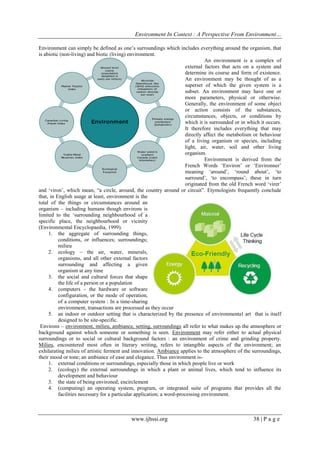
Environment can simply be defined as one‘s surroundings which includes everything around the organism, that
is abiotic (non-living) and biotic (living) environment.
An environment is a complex of
external factors that acts on a system and
determine its course and form of existence.
An environment may be thought of as a
superset of which the given system is a
subset. An environment may have one or
more parameters, physical or otherwise.
Generally, the environment of some object
or action consists of the substances,
circumstances, objects, or conditions by
which it is surrounded or in which it occurs.
It therefore includes everything that may
directly affect the metabolism or behaviour
of a living organism or species, including
light, air, water, soil and other living
organism.
Environment is derived from the
French Words ‗Environ‘ or ‗Environner‘
meaning ‗around‘, ‗round about‘, ‗to
surround‘, ‗to encompass‘; these in turn
originated from the old French word ‗virer‘
and ‗viron‘, which mean, ―a circle, around, the country around or circuit‖. Etymologists frequently conclude
that, in English usage at least, environment is the
total of the things or circumstances around an
organism – including humans though environs is
limited to the ‗surrounding neighbourhood of a
specific place, the neighbourhood or vicinity
(Environmental Encyclopaedia, 1999).
1. the aggregate of surrounding things,
conditions, or influences; surroundings;
milieu
2. ecology – the air, water, minerals,
organisms, and all other external factors
surrounding and affecting a given
organism at any time
3. the social and cultural forces that shape
the life of a person or a population
4. computers – the hardware or software
configuration, or the mode of operation,
of a computer system : In a time-sharing
environment, transactions are processed as they occur
5. an indoor or outdoor setting that is characterized by the presence of environmental art that is itself
designed to be site-specific.
Environs – environment, milieu, ambiance, setting, surroundings all refer to what makes up the atmosphere or
background against which someone or something is seen. Environment may refer either to actual physical
surroundings or to social or cultural background factors : an environment of crime and grinding property.
Milieu, encountered most often in literary writing, refers to intangible aspects of the environment; an
exhilarating milieu of artistic ferment and innovation. Ambiance applies to the atmosphere of the surroundings,
their mood or tone; an ambiance of ease and elegance. Thus environment is-
1. external conditions or surroundings, especially those in which people live or work
2. (ecology) the external surroundings in which a plant or animal lives, which tend to influence its
development and behaviour
3. the state of being environed; encirclement
4. (computing) an operating system, program, or integrated suite of programs that provides all the
facilities necessary for a particular application; a word-processing environment.
Environment In Context : A Perspective From Environment…
www.ijhssi.org 39 | P a g e
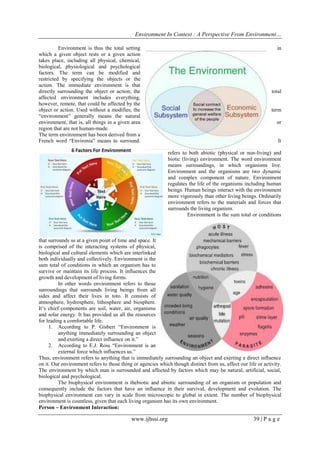
Environment is thus the total setting in
which a given object rests or a given action
takes place, including all physical, chemical,
biological, physiological and psychological
factors. The term can be modified and
restricted by specifying the objects or the
action. The immediate environment is that
directly surrounding the object or action; the total
affected environment includes everything,
however, remote, that could be affected by the
object or action. Used without a modifies, the term
―environment‖ generally means the natural
environment, that is, all things in a given area or
region that are not human-made.
The term environment has been derived from a
French word ―Environia‖ means to surround. It
refers to both abiotic (physical or non-living) and
biotic (living) environment. The word environment
means surroundings, in which organisms live.
Environment and the organisms are two dynamic
and complex component of nature. Environment
regulates the life of the organisms including human
beings. Human beings interact with the environment
more vigorously than other living beings. Ordinarily
environment refers to the materials and forces that
surrounds the living organism.
Environment is the sum total or conditions
that surrounds us at a given point of time and space. It
is comprised of the interacting systems of physical,
biological and cultural elements which are interlinked
both individually and collectively. Environment is the
sum total of conditions in which an organism has to
survive or maintain its life process. It influences the
growth and development of living forms.
In other words environment refers to those
surroundings that surrounds living beings from all
sides and affect their lives in toto. It consists of
atmosphere, hydrosphere, lithosphere and biosphere.
It‘s chief components are soil, water, air, organisms
and solar energy. It has provided us all the resources
for leading a comfortable life.
1. According to P. Gisbert ―Environment is
anything immediately surrounding an object
and exerting a direct influence on it.‖
2. According to E.J. Ross ―Environment is an
external force which influences us.‖
Thus, environment refers to anything that is immediately surrounding an object and exerting a direct influence
on it. Our environment refers to those thing or agencies which though distinct from us, affect our life or activity.
The environment by which man is surrounded and affected by factors which may be natural, artificial, social,
biological and psychological.
The biophysical environment is thebiotic and abiotic surrounding of an organism or population and
consequently include the factors that have an influence in their survival, development and evolution. The
biophysical environment can vary in scale from microscopic to global in extent. The number of biophysical
environment is countless, given that each living organism has its own environment.
Person – Environment Interaction:
Environment In Context : A Perspective From Environment…
www.ijhssi.org 40 | P a g e
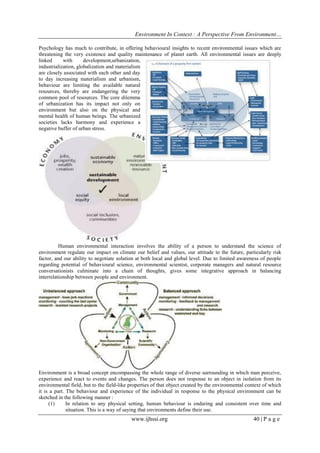
Psychology has much to contribute, in offering behavioural insights to recent environmental issues which are
threatening the very existence and quality maintenance of planet earth. All environmental issues are deeply
linked with development,urbanization,
industrialization, globalization and materialism
are closely associated with each other and day
to day increasing materialism and urbanism,
behaviour are limiting the available natural
resources, thereby are endangering the very
common pool of resources. The core dilemma
of urbanization has its impact not only on
environment but also on the physical and
mental health of human beings. The urbanized
societies lacks harmony and experience a
negative buffer of urban stress.
Human environmental interaction involves the ability of a person to understand the science of
environment regulate our impact on climate our belief and values, our attitude to the future, particularly risk
factor, and our ability to negotiate solution at both local and global level. Due to limited awareness of people
regarding potential of behavioural science, environmental scientist, corporate managers and natural resource
conversationists culminate into a chain of thoughts, gives some integrative approach in balancing
interrelationship between people and environment.
Environment is a broad concept encompassing the whole range of diverse surrounding in which man perceive,
experience and react to events and changes. The person does not response to an object in isolation from its
environmental field, but to the field-like properties of that object created by the environmental context of which
it is a part. The behaviour and experience of the individual in response to the physical environment can be
sketched in the following manner :
(1) In relation to any physical setting, human behaviour is enduring and consistent over time and
situation. This is a way of saying that environments define their use.
Environment In Context : A Perspective From Environment…
www.ijhssi.org 41 | P a g e
(2) Patterns of behaviour in response to a setting persist regardless of the specific individuals involved.
This demand character, however, is general and within the setting a person varies his behaviour
over time and space.
(3) The boundaries of a setting are defined not only by the setting‘s physical properties but through its
interactive relationship with other physical and social system. The environment is an open system.
(4) Because of this, its organisation is dynamic. The characteristic behaviour pattern of the setting as a
whole will be affected by a change in any of its components.
(5) When such changes preclude the characteristic behaviour pattern of the setting, this behaviour will
be conserved and enacted at a new time or place. In short, another, more adequate setting will be
sought out.
(6) The environment is inclusive not only of the physical components that are present, but also of social
and individual behaviours that occur within it. In this sense it is a process defined by its participants
and the nature of their interaction.
(7) For the individual, however, the environment will be perceived at any one moment as unique. This
vantage point and role will affect behaviour vis-a-vis the setting differently from others who
perceive the same environment as unique to them.
(8) Environment have a natural history of use, and we inherit this history when we participate in them.
Such use need not be congruent with the physical character of a setting- customs may dictate that
we keep our voices lowered in church and raise them at a public meeting.
(9) Environment are typically neutral. We are most aware of their characteristic when change is
introduced or when we encounter an unfamiliar setting.
(10) However, open they may be as social system, environments have physical limits. These can be
described as resistance, supportive or facilitative. Behaviour in the total environmental context will
always be affected by the physical opportunities that exist for expressing a desired behaviour.
Thus, the environment is taken to refer to anything external to the perceiver which influences or might influence
the perception process of an organism. The seven broad categories of information related to any environmental
situation and relevant to
environmental perception with
psychological viewpoint are :
(i) Environments have no
fixed or given
boundaries in space and
time;
(ii) Environments provide
information through all
the senses;
(iii) Environments include
peripheral as well as
central information;
(iv) Environments include for
more information than
can adequately be
handled;
(v) Environments are defined by and experienced through action.
(vi) Environments have symbolic meanings, and
(vii) Environmental experience always takes on the systematic quality of a coherent and predictable
whole.
Environment was
conceptualized as a complex
stimulus field whose
properties emerge from and
are determined by the
organization and
interrelationship of its
component parts.The two
components of nature,
organisms and their
environment are not only
highly complex and dynamic
Environment In Context : A Perspective From Environment…
www.ijhssi.org 42 | P a g e
but also interdependent mutually reactive and interrelated. Ecology, relatively a new science, deals with the
various principles, which govern such relationship between organisms and their environment. As ecosystems are
defined by the network of interaction among organism and between organism and their environment, they can
be of any size but usually encompass specific, limited spaces.
Interdependence is the important basis of ecology. Ecosystem includes interacting and interdependent
components that are open and linked to each other. It
is that usually an open system with a continuous but
variable influx and loss of materials and energy. An
ecosystem represents the highest level of ecological
integration, which is energy based and capable of
energy transformation, accumulation and circulation.
Its main function in ecological sense is to emphasize
obligatory relationship, interdependence and casual
relationship, i.e., coupling of components to form
functional autonomy.
Ecosystems provide a variety of goods and services
upon which people depend; the principle of ecosystem
management, suggest that rather than managing
individual species, natural resources should be
managed at the level of ecosystem itself. Classifying
ecosystem into ecological homogenous unit is an
important step towards effective ecosystem
management, but there is no single, agreed-upon way
to do this.
Historical domain of socio-ecology Bronfenbrenner (1976) suggested that the socio-ecological approach
contributes to a holistic research methodology of human development and education. That is, an ecological
approach helps us to understand the context outside of a laboratory. However, Bronfenbrenner‘s model is
ecological only through ―interrelationships‖ and immediate built and natural environments; This is a weak
metaphor of ecosystems. For instance, he describes how people learn through their educational settings as a
function of two systems: (A) The first comprises the relations between the characteristics of learners and the
surroundings in which they live out their lives (e.g., home, school, peer group, work place, neighborhood,
community). (B) The second encompasses the relations and interconnections that exist between these
environments. (Bronfenbrenner, 1976, p. 5) At this point it is necessary to point out that Bronfenbrenner‘s idea
of environments focuses almost entirely on that of human, cultural, and social environments and ―encompasses
both immediate and larger social contexts‖ (Bronfenbrenner, 1976, p. 6) rather than that of the entire ecosystem.
Perhaps the easiest way to understand his models is by referring to diagrams that illustrate his ideas of the
ecology of human development . Notice in the multiple scales of systems in this model, the human is
represented in the centre. These systems range from microsystem (family, school, peers and so structures),
macro-system (overarching beliefs and values, to chronosystem [factors over time]). Bronfenbrenner‘s
ecological structure of the educational environment is rooted in the metaphorical interpretation of ecosystems.
Its foundation is that human relationships resemble ecological relationships. However, emotional, social,
cognitive, and spiritual development in humans does not occur in an ecological vacuum. In fact, many
researchers suggest that environmental and ecological influences directly contribute to psychological
development (Ewert & Galloway, 2009; Gotschi, Vogel, Lindenthal, &Larcher, 2010; Maller, 2009; Mueller
Worster, 2006; Nicolaou, Korfiatis, Evagorou, &Constantinou, 2009; Schusler&Krasny, 2010).
There is information available and more people are aware of many of the problem associated with environment
and use of environmental resources. Formal education from primary to higher levels, as well as informal
education through television, the world wide web
etc., now have a strong content of conservation,
sustainability and the dangers from global warming.
Nevertheless many states, local authorities and
individuals maintain an equivocal position—
advocating sustainability but practising unsustainable
level of consumption. Research on environment will
need to support of effective programmes of education
to curb demand and possibly, to reverse the trends in
globalization.
Environment In Context : A Perspective From Environment…
www.ijhssi.org 43 | P a g e
CONCLUSION
The conception of persons of environments, and of person-in-environment systems, the approach has suggested
six context, namely,thephysica,psychological(interpersonal),and socio-cultural context of the person and
analogously, the physical ,interpersonal and socio-cultural contexts of the environment. On the specific level,
our view has proposed that there are an infinite number of specific situations or contexts within each of the
previous six more general contexts, which include aspects of both the person and the environment. Further, the
complex characteristics of every day life such reframing may also help psychology both to see itself and to be
seen by others as a unified (diffentiated and integrated) science, one concern not only with the study of human
functioning in isolated contexts, but also with the study of problems that cut across the various aspect of
persons, environments, systems, and their multifaceted contexts.(Wapner&Demick,1999
1998,2000a,2000b).
References
[1] Bronfenbrenner, U. (1976). The experimental ecology of education.Paperpresented at the American Educational Research
Association, SanFrancisco, CA.
[2] Ewert, A., & Galloway, G. (2009). Socially desirable responding in an en-vironmental context: Development of a domain
specific scale. Envi-ronmental Education Research, 15(1), 55-70.
[3] Environmental Encyclopedia(1999) : JaicoPublising House,121, M.G. Road, Mumbai.
[4] Gotschi, E., Vogel, S., Lindenthal, T., &Larcher, M. (2010). The role ofknowledge, social norms, and attitudes toward organic
products andshopping behavior: Survey results from high school students in Vien-na. Journal of Environmental Education, 41(2),
88-100.
[5] Maller, C. J. (2009).Promoting children‘s mental, emotional and socialhealth through contact with nature: A model. Health
Education,109(6), 522-543.
[6] Mueller Worster, A. (2006). I‘m an east coast kid: Surfing the waters ofspirituality and place. Canadian Journal of Environmental
Education, 11(1), 100-111.
[7] Nicolaou, C. T., Korfiatis, K., Evagorou, M., &Constantinou, C. (2009).Development of decision-making skills and
environmental concernthrough computer-based, scaffolded learning activities.Environmen-tal Education Research, 15(1), 39-54.
[8] Schusler, T. M., &Krasny, M. E. (2010).Environmental action as contextfor youth development.208-223.
[9] Wapner,s.&Demick,J.(1998).Developmental analysis:A holistic ,developmental, system oriented perspective .In W.
Damon(seriesEd.) & R.M. Lerner (vol.Ed.), Handbook of child psychology: vol.1 Theoritical models of human
development(5th
ed.,pp 761-805).New York: Wiley.
[10] Wapner,s.&Demick,J.(1999).Developmental theory and clinical practices: A holistic ,developmental, system oriented approach.
In W. K. Silverman& T. H. Ollendick(ed.). Developmental issues in the clinical treatment of children(pp 3-33).Boston: Allyn &
Bacon.
[11] Wapner,s.&Demick,J.(2000a). Assumptions, methods, and research problems of the,holistic, system- oriented
perspective.InS.Wapner,J. Demick,T.Yamamto&H.Minami(ed.), Theorical perspectives in environment behaviour holistic,
developmental research: Underlying assumption, research problems and methodologies(pp. 7-19)New York. Kulwer
Academic/Plenum.
[12] Wapner,s.&Demick,J.(2000b).Person-in-environment psychology: A,holistic, system- oriented perspective.In W.B. Walsh,K.H.
Craik,& R.H. Price(ed.), Person- Environment Psychology: New direction and perspectives(2nd
ed.,pp 25-60). Hills- dala, NJ:
Erlbaum.

Environment In Context : A Perspective From Environment Behavior Relation

  • 1.
    International Journal ofHumanities and Social Science Invention ISSN (Online): 2319 – 7722, ISSN (Print): 2319 – 7714 www.ijhssi.org ||Volume 5 Issue 3 ||March. 2016 || PP.37-43 www.ijhssi.org 37 | P a g e Environment In Context : A Perspective From Environment Behavior Relation Dr. JhumaMukhopadhyay ABSTRACT: Researchers in a wide variety of fields – study of environment - behaviour relations – have increasingly emphasized the role context in human functioning. It may be worth-while for those of us interested in environment behaviour research to review some systematic approaches to context as a means for identifying new research problems and for advancing our theoretical perspectives ,which may have practical implications for improving the functioning of human beings in their everyday life environments through environmental education .Socio-ecological models contribute to the understanding of how context influences human development and construction of worldviews. However, the claim that socio-ecological models represent the “true” influencers of an individual might be a misrepresentation of the complexity of whole eco-logical systems. This article explores the possibility of adapting the use of the “socio-ecological model” to better represent the ecological influencers, rather than the primary focus of human and social factors. Keywords: Environment, Man-Environment relation ,Context, Socio-ecological factors. I. INTRODUCTION During the twilight zone of his infancy a man learns to enjoy the presence of others and to achieve his goals with others‘ help and cooperation. These goals may be physical comforts, protection, survival, etc. All life must have adapted to conditions of its environment. However, life in turn modifies in various forms, and its conditions. In fact, an obvious but intense drive to belong or associate oneself with others is fundamental in man and it motivates him to live together and such living together in is thus a critical socio- physical setting in the life of an individual because it is the arena in which most early learning occurs in his golden days of childhood. Different streams from the spectrum of knowledge—self-knowledge, knowledge from others and knowledge of the environment all initiated and crystallised in this sacred place of man. A host of early self-perception related to the concerned neighbourhood and a cluster of correlates of place-identity will not only germinate but also persist and consequently determine the kind and horizon of experiences the child is likely to carry in subsequent settings. As adults due to passes of time, we tend to lose sight of the drama involved in the move from the home to the neighbourhood at large, but this outside world presents a kaleidoscopic environment with far great complexity. Over and above, we have to have an experience—a memory of days long gone by and therefore an aromatic feelings of nostalgia as well as an emotional tinge and attachment to places or spaces germinated during childhood which to some extent nurtured and persisted throughout a person‘s life. Such ways of seeing, using and drawing satisfaction from the physical as well as social world may be assimilated and integrated in the blooming of place-identity in the concerned person engulfing his or her thinking, experiencing and behaving in the world—the extended horizon of his migratory living. Environment: Holistic Approach Environment is the complex set of physical, geographical, biological, social, cultural and political conditions that surrounded by an individual or organism and that ultimately determines its form and nature of its survival. There are several definitions for environment depending upon the subject and area where it is applied.
  • 2.
    Environment In Context: A Perspective From Environment… www.ijhssi.org 38 | P a g e Environment can simply be defined as one‘s surroundings which includes everything around the organism, that is abiotic (non-living) and biotic (living) environment. An environment is a complex of external factors that acts on a system and determine its course and form of existence. An environment may be thought of as a superset of which the given system is a subset. An environment may have one or more parameters, physical or otherwise. Generally, the environment of some object or action consists of the substances, circumstances, objects, or conditions by which it is surrounded or in which it occurs. It therefore includes everything that may directly affect the metabolism or behaviour of a living organism or species, including light, air, water, soil and other living organism. Environment is derived from the French Words ‗Environ‘ or ‗Environner‘ meaning ‗around‘, ‗round about‘, ‗to surround‘, ‗to encompass‘; these in turn originated from the old French word ‗virer‘ and ‗viron‘, which mean, ―a circle, around, the country around or circuit‖. Etymologists frequently conclude that, in English usage at least, environment is the total of the things or circumstances around an organism – including humans though environs is limited to the ‗surrounding neighbourhood of a specific place, the neighbourhood or vicinity (Environmental Encyclopaedia, 1999). 1. the aggregate of surrounding things, conditions, or influences; surroundings; milieu 2. ecology – the air, water, minerals, organisms, and all other external factors surrounding and affecting a given organism at any time 3. the social and cultural forces that shape the life of a person or a population 4. computers – the hardware or software configuration, or the mode of operation, of a computer system : In a time-sharing environment, transactions are processed as they occur 5. an indoor or outdoor setting that is characterized by the presence of environmental art that is itself designed to be site-specific. Environs – environment, milieu, ambiance, setting, surroundings all refer to what makes up the atmosphere or background against which someone or something is seen. Environment may refer either to actual physical surroundings or to social or cultural background factors : an environment of crime and grinding property. Milieu, encountered most often in literary writing, refers to intangible aspects of the environment; an exhilarating milieu of artistic ferment and innovation. Ambiance applies to the atmosphere of the surroundings, their mood or tone; an ambiance of ease and elegance. Thus environment is- 1. external conditions or surroundings, especially those in which people live or work 2. (ecology) the external surroundings in which a plant or animal lives, which tend to influence its development and behaviour 3. the state of being environed; encirclement 4. (computing) an operating system, program, or integrated suite of programs that provides all the facilities necessary for a particular application; a word-processing environment.
  • 3.
    Environment In Context: A Perspective From Environment… www.ijhssi.org 39 | P a g e Environment is thus the total setting in which a given object rests or a given action takes place, including all physical, chemical, biological, physiological and psychological factors. The term can be modified and restricted by specifying the objects or the action. The immediate environment is that directly surrounding the object or action; the total affected environment includes everything, however, remote, that could be affected by the object or action. Used without a modifies, the term ―environment‖ generally means the natural environment, that is, all things in a given area or region that are not human-made. The term environment has been derived from a French word ―Environia‖ means to surround. It refers to both abiotic (physical or non-living) and biotic (living) environment. The word environment means surroundings, in which organisms live. Environment and the organisms are two dynamic and complex component of nature. Environment regulates the life of the organisms including human beings. Human beings interact with the environment more vigorously than other living beings. Ordinarily environment refers to the materials and forces that surrounds the living organism. Environment is the sum total or conditions that surrounds us at a given point of time and space. It is comprised of the interacting systems of physical, biological and cultural elements which are interlinked both individually and collectively. Environment is the sum total of conditions in which an organism has to survive or maintain its life process. It influences the growth and development of living forms. In other words environment refers to those surroundings that surrounds living beings from all sides and affect their lives in toto. It consists of atmosphere, hydrosphere, lithosphere and biosphere. It‘s chief components are soil, water, air, organisms and solar energy. It has provided us all the resources for leading a comfortable life. 1. According to P. Gisbert ―Environment is anything immediately surrounding an object and exerting a direct influence on it.‖ 2. According to E.J. Ross ―Environment is an external force which influences us.‖ Thus, environment refers to anything that is immediately surrounding an object and exerting a direct influence on it. Our environment refers to those thing or agencies which though distinct from us, affect our life or activity. The environment by which man is surrounded and affected by factors which may be natural, artificial, social, biological and psychological. The biophysical environment is thebiotic and abiotic surrounding of an organism or population and consequently include the factors that have an influence in their survival, development and evolution. The biophysical environment can vary in scale from microscopic to global in extent. The number of biophysical environment is countless, given that each living organism has its own environment. Person – Environment Interaction:
  • 4.
    Environment In Context: A Perspective From Environment… www.ijhssi.org 40 | P a g e Psychology has much to contribute, in offering behavioural insights to recent environmental issues which are threatening the very existence and quality maintenance of planet earth. All environmental issues are deeply linked with development,urbanization, industrialization, globalization and materialism are closely associated with each other and day to day increasing materialism and urbanism, behaviour are limiting the available natural resources, thereby are endangering the very common pool of resources. The core dilemma of urbanization has its impact not only on environment but also on the physical and mental health of human beings. The urbanized societies lacks harmony and experience a negative buffer of urban stress. Human environmental interaction involves the ability of a person to understand the science of environment regulate our impact on climate our belief and values, our attitude to the future, particularly risk factor, and our ability to negotiate solution at both local and global level. Due to limited awareness of people regarding potential of behavioural science, environmental scientist, corporate managers and natural resource conversationists culminate into a chain of thoughts, gives some integrative approach in balancing interrelationship between people and environment. Environment is a broad concept encompassing the whole range of diverse surrounding in which man perceive, experience and react to events and changes. The person does not response to an object in isolation from its environmental field, but to the field-like properties of that object created by the environmental context of which it is a part. The behaviour and experience of the individual in response to the physical environment can be sketched in the following manner : (1) In relation to any physical setting, human behaviour is enduring and consistent over time and situation. This is a way of saying that environments define their use.
  • 5.
    Environment In Context: A Perspective From Environment… www.ijhssi.org 41 | P a g e (2) Patterns of behaviour in response to a setting persist regardless of the specific individuals involved. This demand character, however, is general and within the setting a person varies his behaviour over time and space. (3) The boundaries of a setting are defined not only by the setting‘s physical properties but through its interactive relationship with other physical and social system. The environment is an open system. (4) Because of this, its organisation is dynamic. The characteristic behaviour pattern of the setting as a whole will be affected by a change in any of its components. (5) When such changes preclude the characteristic behaviour pattern of the setting, this behaviour will be conserved and enacted at a new time or place. In short, another, more adequate setting will be sought out. (6) The environment is inclusive not only of the physical components that are present, but also of social and individual behaviours that occur within it. In this sense it is a process defined by its participants and the nature of their interaction. (7) For the individual, however, the environment will be perceived at any one moment as unique. This vantage point and role will affect behaviour vis-a-vis the setting differently from others who perceive the same environment as unique to them. (8) Environment have a natural history of use, and we inherit this history when we participate in them. Such use need not be congruent with the physical character of a setting- customs may dictate that we keep our voices lowered in church and raise them at a public meeting. (9) Environment are typically neutral. We are most aware of their characteristic when change is introduced or when we encounter an unfamiliar setting. (10) However, open they may be as social system, environments have physical limits. These can be described as resistance, supportive or facilitative. Behaviour in the total environmental context will always be affected by the physical opportunities that exist for expressing a desired behaviour. Thus, the environment is taken to refer to anything external to the perceiver which influences or might influence the perception process of an organism. The seven broad categories of information related to any environmental situation and relevant to environmental perception with psychological viewpoint are : (i) Environments have no fixed or given boundaries in space and time; (ii) Environments provide information through all the senses; (iii) Environments include peripheral as well as central information; (iv) Environments include for more information than can adequately be handled; (v) Environments are defined by and experienced through action. (vi) Environments have symbolic meanings, and (vii) Environmental experience always takes on the systematic quality of a coherent and predictable whole. Environment was conceptualized as a complex stimulus field whose properties emerge from and are determined by the organization and interrelationship of its component parts.The two components of nature, organisms and their environment are not only highly complex and dynamic
  • 6.
    Environment In Context: A Perspective From Environment… www.ijhssi.org 42 | P a g e but also interdependent mutually reactive and interrelated. Ecology, relatively a new science, deals with the various principles, which govern such relationship between organisms and their environment. As ecosystems are defined by the network of interaction among organism and between organism and their environment, they can be of any size but usually encompass specific, limited spaces. Interdependence is the important basis of ecology. Ecosystem includes interacting and interdependent components that are open and linked to each other. It is that usually an open system with a continuous but variable influx and loss of materials and energy. An ecosystem represents the highest level of ecological integration, which is energy based and capable of energy transformation, accumulation and circulation. Its main function in ecological sense is to emphasize obligatory relationship, interdependence and casual relationship, i.e., coupling of components to form functional autonomy. Ecosystems provide a variety of goods and services upon which people depend; the principle of ecosystem management, suggest that rather than managing individual species, natural resources should be managed at the level of ecosystem itself. Classifying ecosystem into ecological homogenous unit is an important step towards effective ecosystem management, but there is no single, agreed-upon way to do this. Historical domain of socio-ecology Bronfenbrenner (1976) suggested that the socio-ecological approach contributes to a holistic research methodology of human development and education. That is, an ecological approach helps us to understand the context outside of a laboratory. However, Bronfenbrenner‘s model is ecological only through ―interrelationships‖ and immediate built and natural environments; This is a weak metaphor of ecosystems. For instance, he describes how people learn through their educational settings as a function of two systems: (A) The first comprises the relations between the characteristics of learners and the surroundings in which they live out their lives (e.g., home, school, peer group, work place, neighborhood, community). (B) The second encompasses the relations and interconnections that exist between these environments. (Bronfenbrenner, 1976, p. 5) At this point it is necessary to point out that Bronfenbrenner‘s idea of environments focuses almost entirely on that of human, cultural, and social environments and ―encompasses both immediate and larger social contexts‖ (Bronfenbrenner, 1976, p. 6) rather than that of the entire ecosystem. Perhaps the easiest way to understand his models is by referring to diagrams that illustrate his ideas of the ecology of human development . Notice in the multiple scales of systems in this model, the human is represented in the centre. These systems range from microsystem (family, school, peers and so structures), macro-system (overarching beliefs and values, to chronosystem [factors over time]). Bronfenbrenner‘s ecological structure of the educational environment is rooted in the metaphorical interpretation of ecosystems. Its foundation is that human relationships resemble ecological relationships. However, emotional, social, cognitive, and spiritual development in humans does not occur in an ecological vacuum. In fact, many researchers suggest that environmental and ecological influences directly contribute to psychological development (Ewert & Galloway, 2009; Gotschi, Vogel, Lindenthal, &Larcher, 2010; Maller, 2009; Mueller Worster, 2006; Nicolaou, Korfiatis, Evagorou, &Constantinou, 2009; Schusler&Krasny, 2010). There is information available and more people are aware of many of the problem associated with environment and use of environmental resources. Formal education from primary to higher levels, as well as informal education through television, the world wide web etc., now have a strong content of conservation, sustainability and the dangers from global warming. Nevertheless many states, local authorities and individuals maintain an equivocal position— advocating sustainability but practising unsustainable level of consumption. Research on environment will need to support of effective programmes of education to curb demand and possibly, to reverse the trends in globalization.
  • 7.
    Environment In Context: A Perspective From Environment… www.ijhssi.org 43 | P a g e CONCLUSION The conception of persons of environments, and of person-in-environment systems, the approach has suggested six context, namely,thephysica,psychological(interpersonal),and socio-cultural context of the person and analogously, the physical ,interpersonal and socio-cultural contexts of the environment. On the specific level, our view has proposed that there are an infinite number of specific situations or contexts within each of the previous six more general contexts, which include aspects of both the person and the environment. Further, the complex characteristics of every day life such reframing may also help psychology both to see itself and to be seen by others as a unified (diffentiated and integrated) science, one concern not only with the study of human functioning in isolated contexts, but also with the study of problems that cut across the various aspect of persons, environments, systems, and their multifaceted contexts.(Wapner&Demick,1999 1998,2000a,2000b). References [1] Bronfenbrenner, U. (1976). The experimental ecology of education.Paperpresented at the American Educational Research Association, SanFrancisco, CA. [2] Ewert, A., & Galloway, G. (2009). Socially desirable responding in an en-vironmental context: Development of a domain specific scale. Envi-ronmental Education Research, 15(1), 55-70. [3] Environmental Encyclopedia(1999) : JaicoPublising House,121, M.G. Road, Mumbai. [4] Gotschi, E., Vogel, S., Lindenthal, T., &Larcher, M. (2010). The role ofknowledge, social norms, and attitudes toward organic products andshopping behavior: Survey results from high school students in Vien-na. Journal of Environmental Education, 41(2), 88-100. [5] Maller, C. J. (2009).Promoting children‘s mental, emotional and socialhealth through contact with nature: A model. Health Education,109(6), 522-543. [6] Mueller Worster, A. (2006). I‘m an east coast kid: Surfing the waters ofspirituality and place. Canadian Journal of Environmental Education, 11(1), 100-111. [7] Nicolaou, C. T., Korfiatis, K., Evagorou, M., &Constantinou, C. (2009).Development of decision-making skills and environmental concernthrough computer-based, scaffolded learning activities.Environmen-tal Education Research, 15(1), 39-54. [8] Schusler, T. M., &Krasny, M. E. (2010).Environmental action as contextfor youth development.208-223. [9] Wapner,s.&Demick,J.(1998).Developmental analysis:A holistic ,developmental, system oriented perspective .In W. Damon(seriesEd.) & R.M. Lerner (vol.Ed.), Handbook of child psychology: vol.1 Theoritical models of human development(5th ed.,pp 761-805).New York: Wiley. [10] Wapner,s.&Demick,J.(1999).Developmental theory and clinical practices: A holistic ,developmental, system oriented approach. In W. K. Silverman& T. H. Ollendick(ed.). Developmental issues in the clinical treatment of children(pp 3-33).Boston: Allyn & Bacon. [11] Wapner,s.&Demick,J.(2000a). Assumptions, methods, and research problems of the,holistic, system- oriented perspective.InS.Wapner,J. Demick,T.Yamamto&H.Minami(ed.), Theorical perspectives in environment behaviour holistic, developmental research: Underlying assumption, research problems and methodologies(pp. 7-19)New York. Kulwer Academic/Plenum. [12] Wapner,s.&Demick,J.(2000b).Person-in-environment psychology: A,holistic, system- oriented perspective.In W.B. Walsh,K.H. Craik,& R.H. Price(ed.), Person- Environment Psychology: New direction and perspectives(2nd ed.,pp 25-60). Hills- dala, NJ: Erlbaum.