Compiled and Presented by
Prof V.K.Modi
Mechanical Engineering Department (GIA)
BBIT
Vallabh Vidyanagar
Entrepreneurship
Development
Source:- https://businessconnectindia.in/blogs/top-10-entrepreneurs-of-india/
• The word entrepreneur is derived from the
Frenchword ‘enterprendre’ it means “to undertake”
and literally translated means “between-taker” or
“go between”.
• Entrepreneur is an individual who takes risk and
starts something new.
Entrepreneur
Source :-https://trak.in/tags/business/2016/05/30/entrepreneurship-
easy-india/
Entrepreneurship is the act of setting out on your
own and starting a business.
It is basically communicative and management
functions to mobilize financial and material
resources.
Entrepreneurs play role in strengthening economic
growth of a country as well as speeds up
modernization by doing research and development.
(R & D)
Concept Of Entrepreneurship
Entrepreneurship is the process of creating
something new with value of devoting the
necessary time and effort, assuming the
accompanying financial, psychic and social risk
and receiving the resulting rewards of monetary
and personal satisfaction and Independence.
Entrepreneurship
Various Definition of
Entrepreneur by Management
scientist
Joseph A. Schumpeter (1934)
The entrepreneur in an advanced economy is
an individual who introduce something new in
the economy- a method of production not yet
tested by experience in the branch of
Manufacturing, a product with which
consumers are not yet familiar, a new source
of raw material or of new markets and the like
 1961: David McClelland—A person with a
high need for achievement [N-Ach] who is
energetic and a moderate risk taker.
 1964: Peter Drucker—One who searches for
change, responds to it and exploits
opportunities. Innovation is a specific tool
of an entrepreneur hence an effective
entrepreneur converts a source into a
resource.
 2013: Ronald May—Someone who
commercializes his or her innovation.
Entrepreneurship is a dynamic process of vision, change, and creation.
It needs an application of energy and passion near the creation and
implementation of new ideas and creative solutions.
An entrepreneur is an aggressive catalyst for modification in the world of
Business organization
He is an independent thinker who challenges to be different in a background of
common events thereby catering to the social and economic growth.
The key focus of any entrepreneur is to capitalize the opportunities and to shape
a strong ethical base.
Entrepreneurial development is a crucial issue that needs to be
addressed by any country to develop endowed entrepreneurs who can make a
mark in this world of competitions
Entrepreneurial development
Government Policies And Schemes
National Small Industries Corporation (NSIC) National Institute of Small Industry
Extension Training (NISIET) Hyderabad
National Institute for Entrepreneurship (NIE) Guwahati and National Institute for
Entrepreneurship and Small Business Development (NIESBD), New Delhi.
Mahila udhyam nidhi scheme
Mahila vikas nidhi scheme
Scheme for Market Development Assistance for MSME Exporters (MSME-MDA)
Rajiv Gandhi Udyami Mitra Yojana (RGUMY)
Assistance to States for Developing Export Infrastructure and Other Allied
Activities (ASIDE).
Entreprene
ur
Entreprene
urship
Enterprise
Person Process object
Characteristics Of an Entrepreneur
Hard Work
• Business Acumen And Sincerity
• Prudence
• Achievement Motivation
• Self-reliance And Independence
• Highly Optimistic
• Keen Foresight
• Planning And Organizing Ability
• Innovativeness
• Risk Taking
• Secrecy Maintenance
• Maintain Public Relations
• Communication Skill
Good Self Discipline
Qualities of An Entrepreneur
Enterprising
• Risk Bearer
• Creative Thinker
• Ambitious
• High Need Achievement
• Change Agent
• Good Organizer And Manager
• Decision Maker
• Strong Commitment
• Firm Determination
Functions of Entrepreneur
• Innovation.
- The unexpected success or failure or any unexpected outside event.
- Innovation based on process need.
- Changes in industry and market structure.
- Demographics changes.
- New knowledge.
• Risk and uncertainty bearing.
• Organization building.
- Perception of market opportunities.
- Gaining command over scarce resources.
- Purchasing inputs.
- Marketing the products.
- Dealing with bureaucrats.
- Managing human relations within the firm.
- Managing customer and supplier relations.
- Managing finance.
- Managing production.
- Acquiring and overseeing assembly of the factory.
- Upgrading process and product.
- Introducing new production techniques and products.
Role of Entrepreneurs in Economic Development.
• Capital formation.
• Generation of employment.
• Improvement in per capita income.
• Reduces concentration of wealth.
• Balanced regional development.
• Resource mobilization.
• Improvement in standard of living.
• National self-reliance.
• Harnessing natural resources.
• Backward and forward linkages.
• Sense of purpose.
Types Of Entrepreneurs
Clarence Danhof: Clarence Danhof, On the basis of American
Agriculture, classified entrepreneurs in the following categories
a) Innovative
Entrepreneurs
B) Adoptive Or
Imitative
Entrepreneurs
C) Fabian
Entrepreneurs
D) Drone
Entrepreneurs
They are generally aggressive on experimentation and
cleverly put attractive possibilities into practice.
An innovative entrepreneur, introduces new goods,
inaugurates new methods of production, discovers new
markets and reorganizes the enterprise.
Innovative entrepreneurs bring about a transformation
in lifestyle and are always interested in introducing
innovations
Innovative Entrepreneurs
Imitative entrepreneurs do not innovate the changes
themselves, they only imitate techniques and
technology innovated by others.
They copy and learn from the innovating
entrepreneurs.
While innovating entrepreneurs are creative,
imitative entrepreneurs are adoptive.
Adoptive Or Imitative Entrepreneurs
These entrepreneurs are traditionally bounded.
They would be cautious.
They neither introduce new changes nor adopt new methods
innovated by others entrepreneurs.
They are shy and lazy. They try to follow the footsteps of their
predecessors.
They follow old customs, traditions, sentiments etc. They take
up new projects only when it is necessary to do so.
Fabian Entrepreneurs
Drone entrepreneurs are those who refuse to adopt
and use
opportunities to make changes in production.
They would not change the method of production
already introduced.
They follow the traditional method of production.
They may even suffer losses but they are not ready to
make changes in their existing production methods.
Drone Entrepreneurs
Classification according to motivation of entrepreneur.
• Pure entrepreneur.
• Induced entrepreneur.
• Motivated entrepreneur.
• Spontaneous entrepreneur.
Classification according to growth.
• Growth entrepreneur.
• Super growth entrepreneur.
Classification according to stages of development.
• First generation entrepreneur.
• Modern entrepreneur.
• Classical entrepreneur.
Type of Entrepreneur
Entrepreneur Vs Manager
Entrepreneur Manager
Owner of the business Servant of the business
Profit Salary
Full risk bearing No risk bearing
All functions Managerial functions
only
Innovator Executor
• The new brand of corporate entrepreneurs from within an organization are
called as intrapreneurs.
• The term intrapreneur was coined in USA in the late seventies.
• Many senior executives of big companies in America left their jobs and started
small business of their own.
• They left the organization because they did not
get any opportunity to apply their own ideas and innovative ability.
• These entrepreneurs become successful in their own ventures.
• Some of them caused a threat to the corporations they left.
Intrapreneurs
Entrepreneur Intrapreneur
• Dependent • Independent
• Highly educated •Need not be highly educated
• No fund raising • Fund raising
• No risk bearing • Risk bearing
• Specialist • Routine work
• Operation from inside • Operation from outside
• Less authoritarian • Strong authoritarian
Entrepreneur Vs Intrapreneur
Major Entrepreneurial Competencies
Entrepreneurship Development Institute of India, Ahemedabad
conducted a study under Prof. David C. McClelland.
The core competencies according to the study are:
• Initiative
• Looking for opportunities
• Persistence
• Information seeker
• Quality conscious
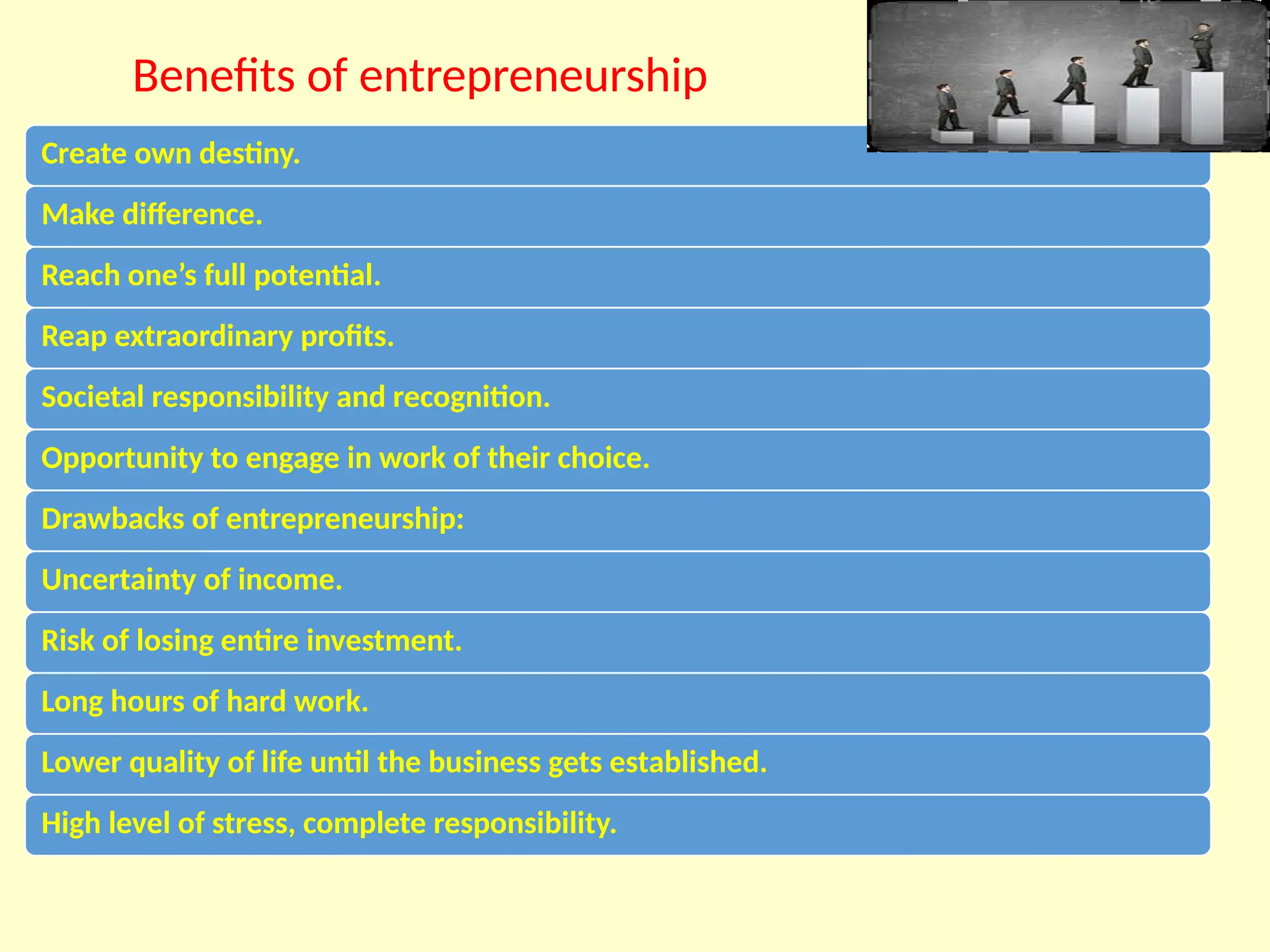
Create own destiny.
Make difference.
Reach one’s full potential.
Reap extraordinary profits.
Societal responsibility and recognition.
Opportunity to engage in work of their choice.
Drawbacks of entrepreneurship:
Uncertainty of income.
Risk of losing entire investment.
Long hours of hard work.
Lower quality of life until the business gets established.
High level of stress, complete responsibility.
Benefits of entrepreneurship
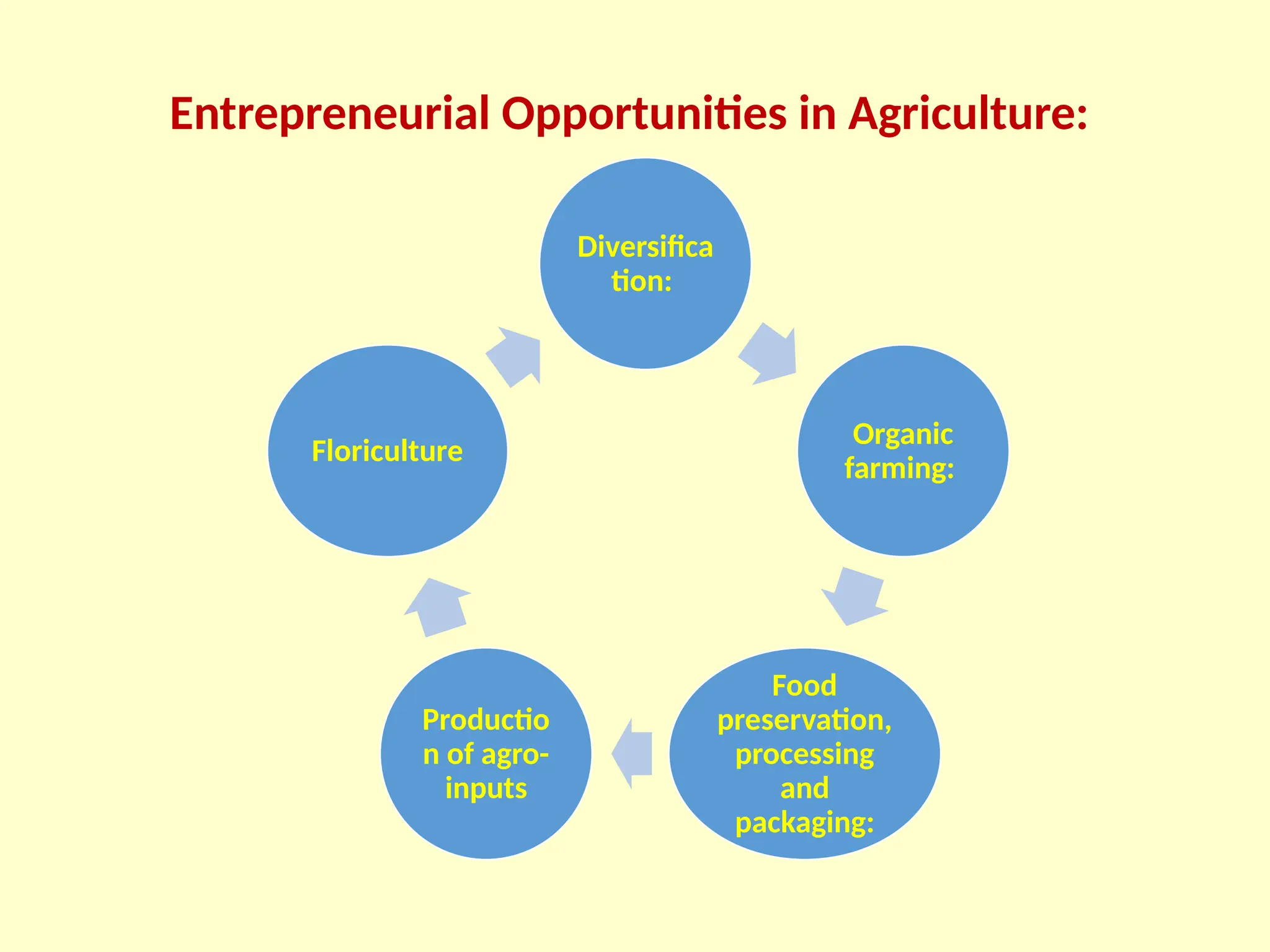
Entrepreneurial Opportunities in Agriculture:
Diversifica
tion:
Organic
farming:
Food
preservation,
processing
and
packaging:
Productio
n of agro-
inputs
Floriculture
Entrepreneurial Opportunities in Agriculture
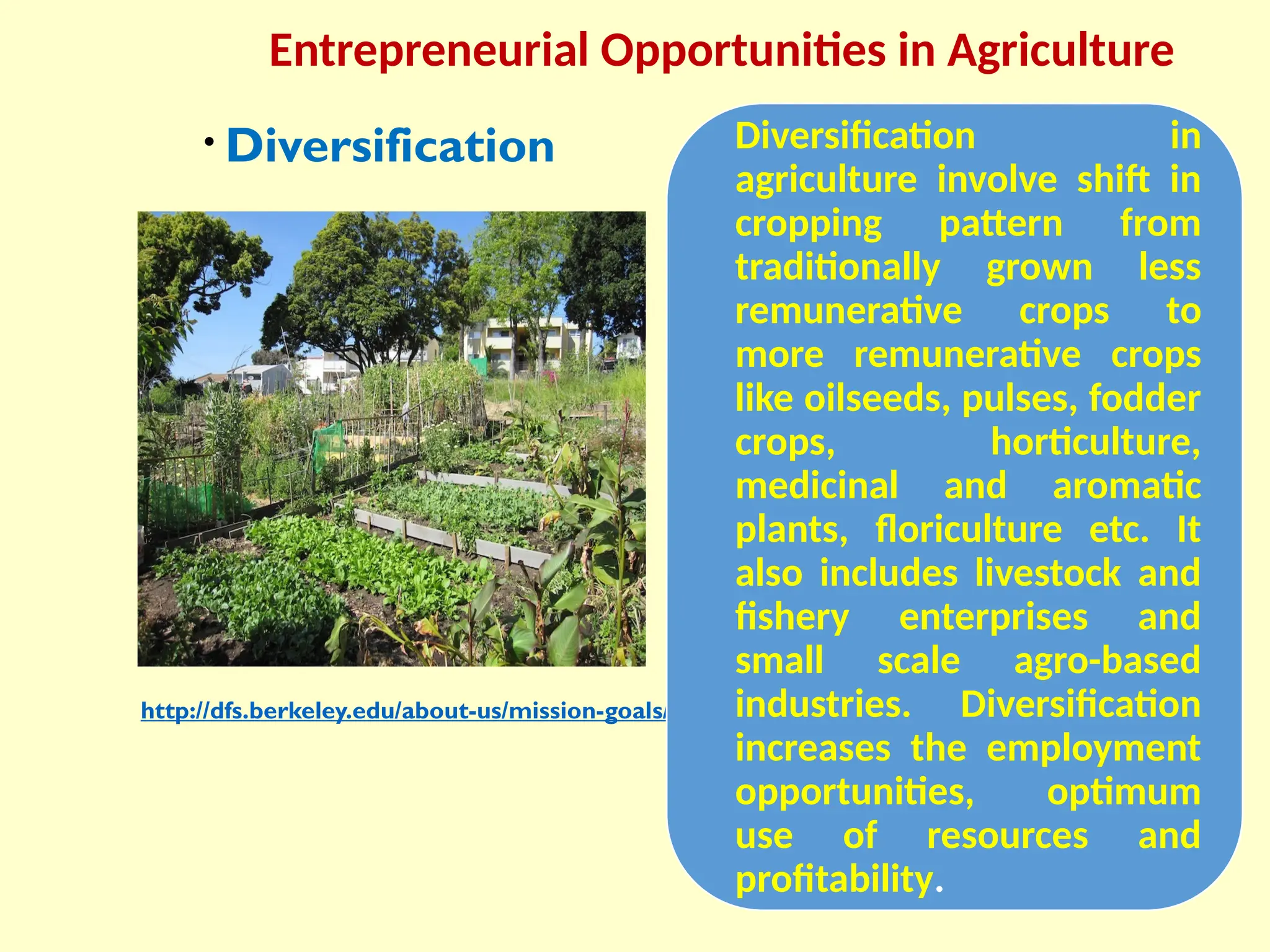
• Diversification
http://dfs.berkeley.edu/about-us/mission-goals/
Diversification in
agriculture involve shift in
cropping pattern from
traditionally grown less
remunerative crops to
more remunerative crops
like oilseeds, pulses, fodder
crops, horticulture,
medicinal and aromatic
plants, floriculture etc. It
also includes livestock and
fishery enterprises and
small scale agro-based
industries. Diversification
increases the employment
opportunities, optimum
use of resources and
profitability.
Entrepreneurial Opportunities in Agriculture:
• Organic farming:
The importance of organic farming is growing very fast particularly in
international market. This sector provides great business opportunities
to agro-based entrepreneur. Area under organic farming is increasing
but unable to meet the demand of organic produce.
http://www.organicagriculture.co/indian-scenario.php
Reference:- Ingnou
Entrepreneurial Opportunities in Agriculture:
• Food preservation, processing and packaging
Large proportion of agricultural produce is wastage due to improper
storage and warehousing, lack of transportation and food processing
facilities. There is a significant shift in consumer food preference towards
processed food products. Entrepreneurs can add value with proper
management and marketing initiatives. The processed food market opens
a great potential for entrepreneurs be it fast food, packaged food or
organic food.
food-preservation-can-jam-9-stone-fruits/
• Production of agro-inputs:
Farmers can start entrepreneurial activities in the production of seed, organic
fertilizers and pesticides.
Entrepreneurial Opportunities in Agriculture:
Entrepreneurship development for self emloyment.pptx

Entrepreneurship development for self emloyment.pptx

  • 1.
    Compiled and Presentedby Prof V.K.Modi Mechanical Engineering Department (GIA) BBIT Vallabh Vidyanagar Entrepreneurship Development
  • 2.
  • 4.
    • The wordentrepreneur is derived from the Frenchword ‘enterprendre’ it means “to undertake” and literally translated means “between-taker” or “go between”. • Entrepreneur is an individual who takes risk and starts something new. Entrepreneur
  • 5.
  • 6.
    Entrepreneurship is theact of setting out on your own and starting a business. It is basically communicative and management functions to mobilize financial and material resources. Entrepreneurs play role in strengthening economic growth of a country as well as speeds up modernization by doing research and development. (R & D) Concept Of Entrepreneurship
  • 7.
    Entrepreneurship is theprocess of creating something new with value of devoting the necessary time and effort, assuming the accompanying financial, psychic and social risk and receiving the resulting rewards of monetary and personal satisfaction and Independence. Entrepreneurship
  • 8.
    Various Definition of Entrepreneurby Management scientist Joseph A. Schumpeter (1934) The entrepreneur in an advanced economy is an individual who introduce something new in the economy- a method of production not yet tested by experience in the branch of Manufacturing, a product with which consumers are not yet familiar, a new source of raw material or of new markets and the like
  • 9.
     1961: DavidMcClelland—A person with a high need for achievement [N-Ach] who is energetic and a moderate risk taker.  1964: Peter Drucker—One who searches for change, responds to it and exploits opportunities. Innovation is a specific tool of an entrepreneur hence an effective entrepreneur converts a source into a resource.  2013: Ronald May—Someone who commercializes his or her innovation.
  • 11.
    Entrepreneurship is adynamic process of vision, change, and creation. It needs an application of energy and passion near the creation and implementation of new ideas and creative solutions. An entrepreneur is an aggressive catalyst for modification in the world of Business organization He is an independent thinker who challenges to be different in a background of common events thereby catering to the social and economic growth. The key focus of any entrepreneur is to capitalize the opportunities and to shape a strong ethical base. Entrepreneurial development is a crucial issue that needs to be addressed by any country to develop endowed entrepreneurs who can make a mark in this world of competitions Entrepreneurial development
  • 13.
  • 14.
    National Small IndustriesCorporation (NSIC) National Institute of Small Industry Extension Training (NISIET) Hyderabad National Institute for Entrepreneurship (NIE) Guwahati and National Institute for Entrepreneurship and Small Business Development (NIESBD), New Delhi. Mahila udhyam nidhi scheme Mahila vikas nidhi scheme Scheme for Market Development Assistance for MSME Exporters (MSME-MDA) Rajiv Gandhi Udyami Mitra Yojana (RGUMY) Assistance to States for Developing Export Infrastructure and Other Allied Activities (ASIDE).
  • 15.
  • 16.
    Characteristics Of anEntrepreneur Hard Work • Business Acumen And Sincerity • Prudence • Achievement Motivation • Self-reliance And Independence • Highly Optimistic • Keen Foresight • Planning And Organizing Ability • Innovativeness • Risk Taking • Secrecy Maintenance • Maintain Public Relations • Communication Skill Good Self Discipline
  • 17.
    Qualities of AnEntrepreneur Enterprising • Risk Bearer • Creative Thinker • Ambitious • High Need Achievement • Change Agent • Good Organizer And Manager • Decision Maker • Strong Commitment • Firm Determination
  • 19.
    Functions of Entrepreneur •Innovation. - The unexpected success or failure or any unexpected outside event. - Innovation based on process need. - Changes in industry and market structure. - Demographics changes. - New knowledge. • Risk and uncertainty bearing. • Organization building. - Perception of market opportunities. - Gaining command over scarce resources. - Purchasing inputs. - Marketing the products. - Dealing with bureaucrats. - Managing human relations within the firm. - Managing customer and supplier relations. - Managing finance. - Managing production. - Acquiring and overseeing assembly of the factory. - Upgrading process and product. - Introducing new production techniques and products.
  • 20.
    Role of Entrepreneursin Economic Development. • Capital formation. • Generation of employment. • Improvement in per capita income. • Reduces concentration of wealth. • Balanced regional development. • Resource mobilization. • Improvement in standard of living. • National self-reliance. • Harnessing natural resources. • Backward and forward linkages. • Sense of purpose.
  • 21.
    Types Of Entrepreneurs ClarenceDanhof: Clarence Danhof, On the basis of American Agriculture, classified entrepreneurs in the following categories a) Innovative Entrepreneurs B) Adoptive Or Imitative Entrepreneurs C) Fabian Entrepreneurs D) Drone Entrepreneurs
  • 22.
    They are generallyaggressive on experimentation and cleverly put attractive possibilities into practice. An innovative entrepreneur, introduces new goods, inaugurates new methods of production, discovers new markets and reorganizes the enterprise. Innovative entrepreneurs bring about a transformation in lifestyle and are always interested in introducing innovations Innovative Entrepreneurs
  • 23.
    Imitative entrepreneurs donot innovate the changes themselves, they only imitate techniques and technology innovated by others. They copy and learn from the innovating entrepreneurs. While innovating entrepreneurs are creative, imitative entrepreneurs are adoptive. Adoptive Or Imitative Entrepreneurs
  • 24.
    These entrepreneurs aretraditionally bounded. They would be cautious. They neither introduce new changes nor adopt new methods innovated by others entrepreneurs. They are shy and lazy. They try to follow the footsteps of their predecessors. They follow old customs, traditions, sentiments etc. They take up new projects only when it is necessary to do so. Fabian Entrepreneurs
  • 25.
    Drone entrepreneurs arethose who refuse to adopt and use opportunities to make changes in production. They would not change the method of production already introduced. They follow the traditional method of production. They may even suffer losses but they are not ready to make changes in their existing production methods. Drone Entrepreneurs
  • 26.
    Classification according tomotivation of entrepreneur. • Pure entrepreneur. • Induced entrepreneur. • Motivated entrepreneur. • Spontaneous entrepreneur. Classification according to growth. • Growth entrepreneur. • Super growth entrepreneur. Classification according to stages of development. • First generation entrepreneur. • Modern entrepreneur. • Classical entrepreneur. Type of Entrepreneur
  • 27.
    Entrepreneur Vs Manager EntrepreneurManager Owner of the business Servant of the business Profit Salary Full risk bearing No risk bearing All functions Managerial functions only Innovator Executor
  • 28.
    • The newbrand of corporate entrepreneurs from within an organization are called as intrapreneurs. • The term intrapreneur was coined in USA in the late seventies. • Many senior executives of big companies in America left their jobs and started small business of their own. • They left the organization because they did not get any opportunity to apply their own ideas and innovative ability. • These entrepreneurs become successful in their own ventures. • Some of them caused a threat to the corporations they left. Intrapreneurs
  • 29.
    Entrepreneur Intrapreneur • Dependent• Independent • Highly educated •Need not be highly educated • No fund raising • Fund raising • No risk bearing • Risk bearing • Specialist • Routine work • Operation from inside • Operation from outside • Less authoritarian • Strong authoritarian Entrepreneur Vs Intrapreneur
  • 30.
    Major Entrepreneurial Competencies EntrepreneurshipDevelopment Institute of India, Ahemedabad conducted a study under Prof. David C. McClelland. The core competencies according to the study are: • Initiative • Looking for opportunities • Persistence • Information seeker • Quality conscious
  • 31.
    Create own destiny. Makedifference. Reach one’s full potential. Reap extraordinary profits. Societal responsibility and recognition. Opportunity to engage in work of their choice. Drawbacks of entrepreneurship: Uncertainty of income. Risk of losing entire investment. Long hours of hard work. Lower quality of life until the business gets established. High level of stress, complete responsibility. Benefits of entrepreneurship
  • 32.
    Entrepreneurial Opportunities inAgriculture: Diversifica tion: Organic farming: Food preservation, processing and packaging: Productio n of agro- inputs Floriculture
  • 33.
    Entrepreneurial Opportunities inAgriculture • Diversification http://dfs.berkeley.edu/about-us/mission-goals/ Diversification in agriculture involve shift in cropping pattern from traditionally grown less remunerative crops to more remunerative crops like oilseeds, pulses, fodder crops, horticulture, medicinal and aromatic plants, floriculture etc. It also includes livestock and fishery enterprises and small scale agro-based industries. Diversification increases the employment opportunities, optimum use of resources and profitability.
  • 34.
    Entrepreneurial Opportunities inAgriculture: • Organic farming: The importance of organic farming is growing very fast particularly in international market. This sector provides great business opportunities to agro-based entrepreneur. Area under organic farming is increasing but unable to meet the demand of organic produce. http://www.organicagriculture.co/indian-scenario.php Reference:- Ingnou
  • 35.
    Entrepreneurial Opportunities inAgriculture: • Food preservation, processing and packaging Large proportion of agricultural produce is wastage due to improper storage and warehousing, lack of transportation and food processing facilities. There is a significant shift in consumer food preference towards processed food products. Entrepreneurs can add value with proper management and marketing initiatives. The processed food market opens a great potential for entrepreneurs be it fast food, packaged food or organic food. food-preservation-can-jam-9-stone-fruits/
  • 36.
    • Production ofagro-inputs: Farmers can start entrepreneurial activities in the production of seed, organic fertilizers and pesticides. Entrepreneurial Opportunities in Agriculture: