The Spring Framework TrainingGet to know Spring FrameworkRohit Prabhakarhttp://rohitprabhakar.com
Get to know Spring FrameworkThe Spring Framework: OverviewTopics:What is Spring?
Spring modules
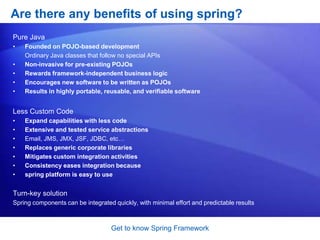
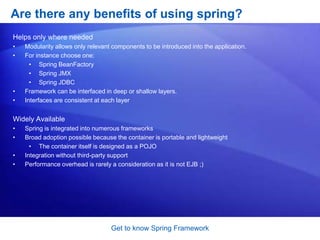
Why use Spring
Dependency injection / IOC in detail
Lab WorkGet to know Spring FrameworkWhat is Spring?The Spring Framework is an open source application framework for the Java platform and .NET Framework (Spring.NET)  It is based on code published in Expert One-on-One J2EE Design and Development by Rod Johnson (Wrox, 2002).“Spring is an open source framework created to address the complexity of enterprise application development. One of the chief advantages of the Spring framework is its layered architecture, which allows you to be selective about which of its components you use while also providing a cohesive framework for J2EE application development.
Get to know Spring FrameworkHow does the Spring Framework looks like?
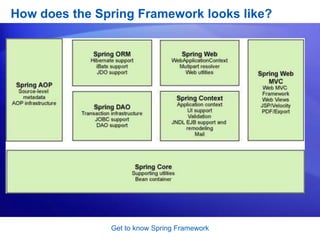
Get to know Spring FrameworkHow does the Spring Framework looks like?Each of the modules (or components) that comprise the Spring framework can stand on its own or be implemented jointly with one or more of the others. The functionality of each component is as follows:The core container: The core container provides the essential functionality of the Spring framework. A primary component of the core container is the BeanFactory, an implementation of the Factory pattern. The BeanFactory applies the Inversion of Control (IOC) pattern to separate an application's configuration and dependency specification from the actual application code.Spring context:The Spring context is a configuration file that provides context information to the Spring framework. The Spring context includes enterprise services such as JNDI, EJB, e-mail, internalization, validation, and scheduling functionality.Spring AOP:The Spring AOP module integrates aspect-oriented programming functionality directly into the Spring framework, through its configuration management feature. As a result you can easily AOP-enable any object managed by the Spring framework. The Spring AOP module provides transaction management services for objects in any Spring-based application. With Spring AOP you can incorporate declarative transaction management into your applications without relying on EJB components.
Get to know Spring FrameworkHow does the Spring Framework looks like?Spring DAO:The Spring JDBC DAO abstraction layer offers a meaningful exception hierarchy for managing the exception handling and error messages thrown by different database vendors. The exception hierarchy simplifies error handling and greatly reduces the amount of exception code you need to write, such as opening and closing connections. Spring DAO's JDBC-oriented exceptions comply to its generic DAO exception hierarchy.Spring ORM:The Spring framework plugs into several ORM frameworks to provide its Object Relational tool, including JDO, Hibernate, and iBatis SQL Maps. All of these comply to Spring's generic transaction and DAO exception hierarchies.Spring Web module:The Web context module builds on top of the application context module, providing contexts for Web-based applications. As a result, the Spring framework supports integration with Jakarta Struts. The Web module also eases the tasks of handling multi-part requests and binding request parameters to domain objects.Spring MVC framework:The MVC framework is a full-featured MVC implementation for building Web applications. The MVC framework is highly configurable via strategy interfaces and accommodates numerous view technologies including JSP, Velocity, Tiles, iText, and POI.
Get to know Spring FrameworkWhat does Spring Framework Offers: SummaryInversion of Control container: configuration of application components and lifecycle management of Java objectsAspect-oriented programming: enables implementation of cross-cutting routinesData access: working with relational database management systems on the Java platform using JDBC and object-relational mapping toolsTransaction management: unifies several transaction management APIs and coordinates transactions for Java objectsModel-view-controller: a HTTP and Servlet-based framework providing hooks for extension and customizationRemote Access framework: configurative RPC-style export and import of Java objects over networks supporting RMI, CORBA and HTTP-based protocols including web services (SOAP)Convention-over-configuration: a rapid application development solution for Spring-based enterprise applications is offered in the Spring Roo moduleBatch processing: a framework for high-volume processing featuring reusable functions including logging/tracing, transaction management, job processing statistics, job restart, skip, and resource managementAuthentication and authorization: configurable security processes that support a range of standards, protocols, tools and practices via the Spring Security sub-project (formerly Acegi).Remote Management: configurative exposure and management of Java objects for local or remote configuration via JMXMessaging: configurative registration of message listener objects for transparent message consumption from message queues via JMS, improvement of message sending over standard JMS APIsTesting: support classes for writing unit tests and integration tests
Get to know Spring FrameworkWhy use Spring?Have you ever encountered these question?Cant’ I have a simpler solution?
How can I handle my every changing requirements?
How can be the architecture flexible?
Can’t I have everything in components which can be verified independently?
Can I make a plug and play software?
How can the software components reusable and changeable?
Should we use EJB? As it makes the product complex, unpredictable and un-maintainable, non-portable and everything  is framework committed.
…………….. And many more like theseSPRING IS THE ANSWER!
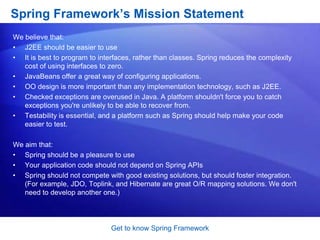
Get to know Spring FrameworkSpring Framework’s Mission StatementWe believe that:J2EE should be easier to use

Spring Framework Rohit

  • 1.
    The Spring FrameworkTrainingGet to know Spring FrameworkRohit Prabhakarhttp://rohitprabhakar.com
  • 2.
    Get to knowSpring FrameworkThe Spring Framework: OverviewTopics:What is Spring?
  • 3.
  • 4.
  • 5.
  • 6.
    Lab WorkGet toknow Spring FrameworkWhat is Spring?The Spring Framework is an open source application framework for the Java platform and .NET Framework (Spring.NET)  It is based on code published in Expert One-on-One J2EE Design and Development by Rod Johnson (Wrox, 2002).“Spring is an open source framework created to address the complexity of enterprise application development. One of the chief advantages of the Spring framework is its layered architecture, which allows you to be selective about which of its components you use while also providing a cohesive framework for J2EE application development.
  • 7.
    Get to knowSpring FrameworkHow does the Spring Framework looks like?
  • 8.
    Get to knowSpring FrameworkHow does the Spring Framework looks like?Each of the modules (or components) that comprise the Spring framework can stand on its own or be implemented jointly with one or more of the others. The functionality of each component is as follows:The core container: The core container provides the essential functionality of the Spring framework. A primary component of the core container is the BeanFactory, an implementation of the Factory pattern. The BeanFactory applies the Inversion of Control (IOC) pattern to separate an application's configuration and dependency specification from the actual application code.Spring context:The Spring context is a configuration file that provides context information to the Spring framework. The Spring context includes enterprise services such as JNDI, EJB, e-mail, internalization, validation, and scheduling functionality.Spring AOP:The Spring AOP module integrates aspect-oriented programming functionality directly into the Spring framework, through its configuration management feature. As a result you can easily AOP-enable any object managed by the Spring framework. The Spring AOP module provides transaction management services for objects in any Spring-based application. With Spring AOP you can incorporate declarative transaction management into your applications without relying on EJB components.
  • 9.
    Get to knowSpring FrameworkHow does the Spring Framework looks like?Spring DAO:The Spring JDBC DAO abstraction layer offers a meaningful exception hierarchy for managing the exception handling and error messages thrown by different database vendors. The exception hierarchy simplifies error handling and greatly reduces the amount of exception code you need to write, such as opening and closing connections. Spring DAO's JDBC-oriented exceptions comply to its generic DAO exception hierarchy.Spring ORM:The Spring framework plugs into several ORM frameworks to provide its Object Relational tool, including JDO, Hibernate, and iBatis SQL Maps. All of these comply to Spring's generic transaction and DAO exception hierarchies.Spring Web module:The Web context module builds on top of the application context module, providing contexts for Web-based applications. As a result, the Spring framework supports integration with Jakarta Struts. The Web module also eases the tasks of handling multi-part requests and binding request parameters to domain objects.Spring MVC framework:The MVC framework is a full-featured MVC implementation for building Web applications. The MVC framework is highly configurable via strategy interfaces and accommodates numerous view technologies including JSP, Velocity, Tiles, iText, and POI.
  • 10.
    Get to knowSpring FrameworkWhat does Spring Framework Offers: SummaryInversion of Control container: configuration of application components and lifecycle management of Java objectsAspect-oriented programming: enables implementation of cross-cutting routinesData access: working with relational database management systems on the Java platform using JDBC and object-relational mapping toolsTransaction management: unifies several transaction management APIs and coordinates transactions for Java objectsModel-view-controller: a HTTP and Servlet-based framework providing hooks for extension and customizationRemote Access framework: configurative RPC-style export and import of Java objects over networks supporting RMI, CORBA and HTTP-based protocols including web services (SOAP)Convention-over-configuration: a rapid application development solution for Spring-based enterprise applications is offered in the Spring Roo moduleBatch processing: a framework for high-volume processing featuring reusable functions including logging/tracing, transaction management, job processing statistics, job restart, skip, and resource managementAuthentication and authorization: configurable security processes that support a range of standards, protocols, tools and practices via the Spring Security sub-project (formerly Acegi).Remote Management: configurative exposure and management of Java objects for local or remote configuration via JMXMessaging: configurative registration of message listener objects for transparent message consumption from message queues via JMS, improvement of message sending over standard JMS APIsTesting: support classes for writing unit tests and integration tests
  • 11.
    Get to knowSpring FrameworkWhy use Spring?Have you ever encountered these question?Cant’ I have a simpler solution?
  • 12.
    How can Ihandle my every changing requirements?
  • 13.
    How can bethe architecture flexible?
  • 14.
    Can’t I haveeverything in components which can be verified independently?
  • 15.
    Can I makea plug and play software?
  • 16.
    How can thesoftware components reusable and changeable?
  • 17.
    Should we useEJB? As it makes the product complex, unpredictable and un-maintainable, non-portable and everything is framework committed.
  • 18.
    …………….. And manymore like theseSPRING IS THE ANSWER!
  • 19.
    Get to knowSpring FrameworkSpring Framework’s Mission StatementWe believe that:J2EE should be easier to use