ERP are management information system that integrate and automate many of the business practices associated with the operations or production aspects of a company. ERP is an integrated computer based system used to manage internal and external resources including tangible assets, financial resources, materials and human resources.
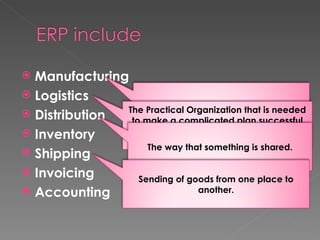
Manufacturing Logistics Distribution Inventory Shipping Invoicing Accounting Producing goods in large quantities. The Practical Organization that is needed to make a complicated plan successful when  a lot  of people and equipment involved. The way that something is shared. Sending of goods from one place to another.
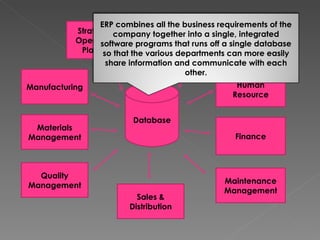
Strategic & Operational Planning Database Finance Human Resource Manufacturing Materials   Management Quality Management Logistics   Management Maintenance Management Sales & Distribution ERP combines all the business requirements of the company together into a single, integrated software programs that runs off a single database so that the various departments can more easily share information and communicate with each other.
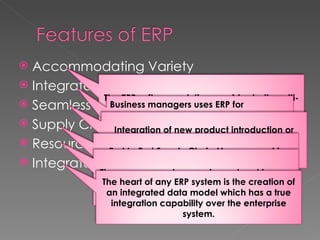
Accommodating Variety Integrated Management Information Seamless Integration Supply Chain Management Resource Management Integrated Data Model The ERP software solution provides both multi-lingual and multi-currency capabilities Business managers uses ERP for -Flexible Reporting -Electronic Data Interchange -Imaging -Database Creation Integration of new product introduction or changes to existing products fully into the Enterprise System. End to End Supply Chain Management is Crucial for Enterprise having multiple manufacturing units and distribution networks. The resource such as equipment and human resources should be effectively managed. The heart of any ERP system is the creation of an integrated data model which has a true integration capability over the enterprise system.
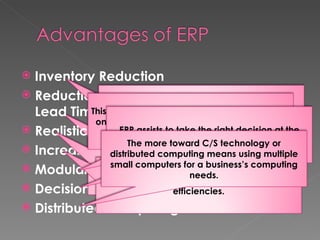
Inventory Reduction Reduction in Production and Delivery Lead Time Realistic Commitment Increased Efficiency Modular Approach Decision Support Distributed Computing  By coordinating inventories and Procurement and production decision the delay in production is avoided. It is possible to procure a component as it is needed. The Production department can give the marketing department timely information about likely delivery times to customer, thus maximizing customer services. ERP encourages and support production efficiencies. This approach enables ERP users to implement only those modules that they add maximum value to their business. ERP assists to take the right decision at the right time.  The more toward C/S technology or distributed computing means using multiple small computers for a business’s computing needs.
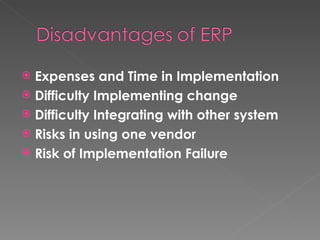
Expenses and Time in Implementation Difficulty Implementing change Difficulty Integrating with other system Risks in using one vendor Risk of Implementation Failure
 

Enterprise Resource Planning

  • 1.
    ERP are managementinformation system that integrate and automate many of the business practices associated with the operations or production aspects of a company. ERP is an integrated computer based system used to manage internal and external resources including tangible assets, financial resources, materials and human resources.
  • 2.
    Manufacturing Logistics DistributionInventory Shipping Invoicing Accounting Producing goods in large quantities. The Practical Organization that is needed to make a complicated plan successful when a lot of people and equipment involved. The way that something is shared. Sending of goods from one place to another.
  • 3.
    Strategic & OperationalPlanning Database Finance Human Resource Manufacturing Materials Management Quality Management Logistics Management Maintenance Management Sales & Distribution ERP combines all the business requirements of the company together into a single, integrated software programs that runs off a single database so that the various departments can more easily share information and communicate with each other.
  • 4.
    Accommodating Variety IntegratedManagement Information Seamless Integration Supply Chain Management Resource Management Integrated Data Model The ERP software solution provides both multi-lingual and multi-currency capabilities Business managers uses ERP for -Flexible Reporting -Electronic Data Interchange -Imaging -Database Creation Integration of new product introduction or changes to existing products fully into the Enterprise System. End to End Supply Chain Management is Crucial for Enterprise having multiple manufacturing units and distribution networks. The resource such as equipment and human resources should be effectively managed. The heart of any ERP system is the creation of an integrated data model which has a true integration capability over the enterprise system.
  • 5.
    Inventory Reduction Reductionin Production and Delivery Lead Time Realistic Commitment Increased Efficiency Modular Approach Decision Support Distributed Computing By coordinating inventories and Procurement and production decision the delay in production is avoided. It is possible to procure a component as it is needed. The Production department can give the marketing department timely information about likely delivery times to customer, thus maximizing customer services. ERP encourages and support production efficiencies. This approach enables ERP users to implement only those modules that they add maximum value to their business. ERP assists to take the right decision at the right time. The more toward C/S technology or distributed computing means using multiple small computers for a business’s computing needs.
  • 6.
    Expenses and Timein Implementation Difficulty Implementing change Difficulty Integrating with other system Risks in using one vendor Risk of Implementation Failure
  • 7.