BY FG OFFR ADITYA PASUMARTHY
INTRODUCTION
• Collective term used for typhoid and paratyphoid fevers.
HISTORY
• First decribed by Thomas Willis in 17th century.
• Feco oral route established in 1856.
• Causative bacillus isolated in 1880.
• Earliest vaccine developed in 1896.
• Paratyphoid species isolated in 1902.
DISEASE BURDEN
• Global burden of 21 million cases every year. (WHO 2004)
• Estimated deaths of >2.16 lakhs per annum.
• Enteric fever- endemic in india.
• with an incidence of 214.2/1 lakh/ yr.
STATISTICS
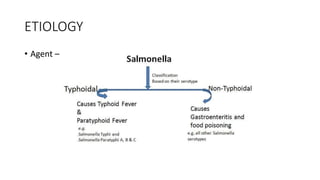
ETIOLOGY
• Agent –
TRANSMISSION
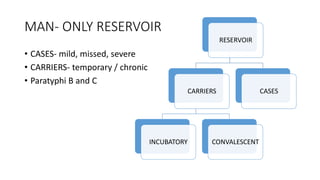
MAN- ONLY RESERVOIR
• CASES- mild, missed, severe
• CARRIERS- temporary / chronic
• Paratyphi B and C
RESERVOIR
CARRIERS
INCUBATORY CONVALESCENT
CASES
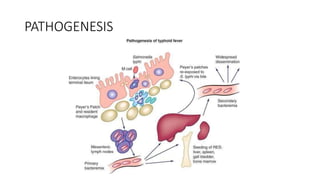
PATHOGENESIS
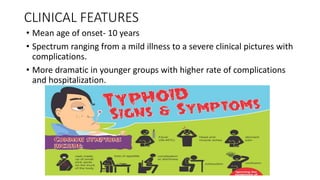
CLINICAL FEATURES
• Mean age of onset- 10 years
• Spectrum ranging from a mild illness to a severe clinical pictures with
complications.
• More dramatic in younger groups with higher rate of complications
and hospitalization.
DISEASE PROGRESSION
1st week
• Vomiting
• Diarrhea ( pea soup diarrhea) / constipation is rarer.
• Step ladder pyrexia
• Mild cough
• Relative bradycardia
• Expressionless and toxic facies
• Coated tongue
• Tender, doughy abdomen
2nd WEEK
• Continuous high grade fever
• Worsening of cough
• Abdominal pain and tenderness.
• Soft hepatosplenomegaly
• Rose spots
3rd week
• In absence of acute complications symptom start resolving at 2-4
weeks
• Associated with malnutrition in children
• Or progresses to- intestinal bleeding/perforation, peritonitis, septic
shock, altered sensorium.
COMPLICATIONS
INVESTIGATIONS
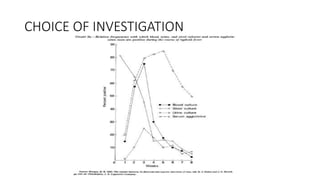
• BLOOD CULTURE-
 90% cases- FIRST WEEK
 75% cases- SECOND WEEK
 60% cases- THIRD WEEK
• ANTIGEN IN URINE/ SERUM
 Sensitised Staphylococcal coagglutination test
 PCR
• Other samples that can be used- bone marrow, feces, bile, CSF,
sputum.
• CBC shows relative leucocytopenia, leukocytosis in children,
thrombocytopenia in DIC.
CHOICE OF INVESTIGATION
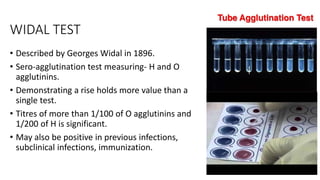
WIDAL TEST
• Described by Georges Widal in 1896.
• Sero-agglutination test measuring- H and O
agglutinins.
• Demonstrating a rise holds more value than a
single test.
• Titres of more than 1/100 of O agglutinins and
1/200 of H is significant.
• May also be positive in previous infections,
subclinical infections, immunization.
Other tests to detect antibodies
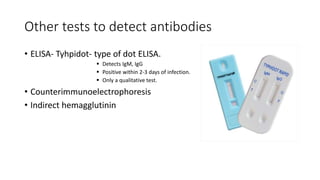
• ELISA- Tyhpidot- type of dot ELISA.
 Detects IgM, IgG
 Positive within 2-3 days of infection.
 Only a qualitative test.
• Counterimmunoelectrophoresis
• Indirect hemagglutinin
DIFFERENTIAL DIAGNOSIS
• Malaria
• Influenza
• Bacillary dysentery
• Typhus, rickettsial infections
• Abdominal tuberculosis
TREATMENT
• Majority may be treated at home with oral antibiotics with follow up
for complications
• Persistent vomiting, severe diarrhea, abdominal distension may
require hospitalization and parenteral antibiotics.
oSUPPORTIVE THERAPY-
 Adequate bed rest
 Adequate hydration
 Correct fluid and electrolytes.
 Antipyretics – PCM- 10-15 mg/kg.
DRUG THERAPY
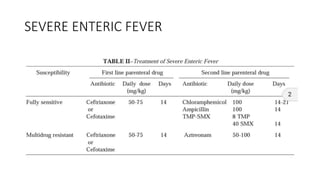
SEVERE ENTERIC FEVER
CARRIERS
• Chronic carrier if asymptomatic and continues
to have positive stool or rectal swab cultures a
year following recovery.
• Treatment- Ciprofloxacin 750 mg BD
• Avoid child care facilities and food handling.
• Epidemiological studies.
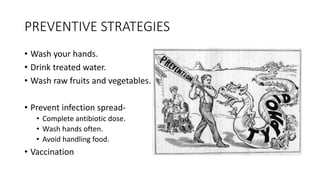
PREVENTIVE STRATEGIES
• Wash your hands.
• Drink treated water.
• Wash raw fruits and vegetables.
• Prevent infection spread-
• Complete antibiotic dose.
• Wash hands often.
• Avoid handling food.
• Vaccination
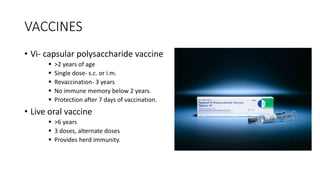
VACCINES
• Vi- capsular polysaccharide vaccine
 >2 years of age
 Single dose- s.c. or i.m.
 Revaccination- 3 years
 No immune memory below 2 years.
 Protection after 7 days of vaccination.

• Live oral vaccine
 >6 years
 3 doses, alternate doses
 Provides herd immunity.
Enteric fever

Enteric fever

  • 1.
    BY FG OFFRADITYA PASUMARTHY
  • 2.
    INTRODUCTION • Collective termused for typhoid and paratyphoid fevers.
  • 3.
    HISTORY • First decribedby Thomas Willis in 17th century. • Feco oral route established in 1856. • Causative bacillus isolated in 1880. • Earliest vaccine developed in 1896. • Paratyphoid species isolated in 1902.
  • 4.
    DISEASE BURDEN • Globalburden of 21 million cases every year. (WHO 2004) • Estimated deaths of >2.16 lakhs per annum. • Enteric fever- endemic in india. • with an incidence of 214.2/1 lakh/ yr.
  • 5.
  • 6.
  • 7.
  • 8.
    MAN- ONLY RESERVOIR •CASES- mild, missed, severe • CARRIERS- temporary / chronic • Paratyphi B and C RESERVOIR CARRIERS INCUBATORY CONVALESCENT CASES
  • 9.
  • 10.
    CLINICAL FEATURES • Meanage of onset- 10 years • Spectrum ranging from a mild illness to a severe clinical pictures with complications. • More dramatic in younger groups with higher rate of complications and hospitalization.
  • 11.
  • 12.
    1st week • Vomiting •Diarrhea ( pea soup diarrhea) / constipation is rarer. • Step ladder pyrexia • Mild cough • Relative bradycardia • Expressionless and toxic facies • Coated tongue • Tender, doughy abdomen
  • 13.
    2nd WEEK • Continuoushigh grade fever • Worsening of cough • Abdominal pain and tenderness. • Soft hepatosplenomegaly • Rose spots
  • 14.
    3rd week • Inabsence of acute complications symptom start resolving at 2-4 weeks • Associated with malnutrition in children • Or progresses to- intestinal bleeding/perforation, peritonitis, septic shock, altered sensorium.
  • 15.
  • 16.
    INVESTIGATIONS • BLOOD CULTURE- 90% cases- FIRST WEEK  75% cases- SECOND WEEK  60% cases- THIRD WEEK • ANTIGEN IN URINE/ SERUM  Sensitised Staphylococcal coagglutination test  PCR • Other samples that can be used- bone marrow, feces, bile, CSF, sputum. • CBC shows relative leucocytopenia, leukocytosis in children, thrombocytopenia in DIC.
  • 17.
  • 18.
    WIDAL TEST • Describedby Georges Widal in 1896. • Sero-agglutination test measuring- H and O agglutinins. • Demonstrating a rise holds more value than a single test. • Titres of more than 1/100 of O agglutinins and 1/200 of H is significant. • May also be positive in previous infections, subclinical infections, immunization.
  • 19.
    Other tests todetect antibodies • ELISA- Tyhpidot- type of dot ELISA.  Detects IgM, IgG  Positive within 2-3 days of infection.  Only a qualitative test. • Counterimmunoelectrophoresis • Indirect hemagglutinin
  • 20.
    DIFFERENTIAL DIAGNOSIS • Malaria •Influenza • Bacillary dysentery • Typhus, rickettsial infections • Abdominal tuberculosis
  • 21.
    TREATMENT • Majority maybe treated at home with oral antibiotics with follow up for complications • Persistent vomiting, severe diarrhea, abdominal distension may require hospitalization and parenteral antibiotics. oSUPPORTIVE THERAPY-  Adequate bed rest  Adequate hydration  Correct fluid and electrolytes.  Antipyretics – PCM- 10-15 mg/kg.
  • 22.
  • 23.
  • 24.
    CARRIERS • Chronic carrierif asymptomatic and continues to have positive stool or rectal swab cultures a year following recovery. • Treatment- Ciprofloxacin 750 mg BD • Avoid child care facilities and food handling. • Epidemiological studies.
  • 25.
    PREVENTIVE STRATEGIES • Washyour hands. • Drink treated water. • Wash raw fruits and vegetables. • Prevent infection spread- • Complete antibiotic dose. • Wash hands often. • Avoid handling food. • Vaccination
  • 26.
    VACCINES • Vi- capsularpolysaccharide vaccine  >2 years of age  Single dose- s.c. or i.m.  Revaccination- 3 years  No immune memory below 2 years.  Protection after 7 days of vaccination. • Live oral vaccine  >6 years  3 doses, alternate doses  Provides herd immunity.