SCIENCE PROJECT
WORK
Made by :-VAIBHAV KUMAR
SHRAWAN
HUMAN DISEASES
The term disease means DIS EASE or
without ease or discomfort. Thus disease
can be defined as the malfunctioning of the
body organs due to one reason or the other.
In other words disease is disorder of body.
Diseases are of two types:
 Communicable diseases
 Non communicable diseases
COMMUNICABLE DISEASES
MALARIA: It is caused by a protozoan
parasite plasmodium. This spreads through
the bite of an insect vector-female anopheles
mosquito which feeds on human food.
Symptoms of these disease are as follows:
 Headache
 Nausea
 Muscular pains
Malaria attack consists of three stages:
 Cold stage (feeling very cold & shivering)
 Hot stage (high fever, faster heart beat)
 Sweating stage( in which temperature goes
down to normal).
COMMUNICABLE DISEASES
These are caused by the attack of
microorganisms (Pathogens) such as bacteria,
viruses, fungi or protozoans. The causal
organism of the disease can be transmitted from
one person to other by means of air, water, food,
sexual contact & insects (vectors). Hence these
are called communicable diseases that are
communicated from diseased person to healthy
person.
NON COMMUNICABLE DISEASES
The diseases which do not spread from
infected person to healthy person are
known as non-communicable or non-
infectious disease, such as diabetes,
arthritis, heart disease, cancer, etc. Many
non-communicable diseases are due to
nutritional deficiency.
PREVENTION OF MALARIA
 PREVENTION:
 Use wire-gauze on doors &
windows to prevent entry of
mosquitoes.
 Use insect-repellents to
prevent mosquito-bite.
 Sleep under mosquito-net.
 Kill adult mosquitoes by
spreading insecticides.
 Destroy mosquito-breeding
places.
 CONTROL: A drug named
quinine is used to treat a
person suffering from malaria.
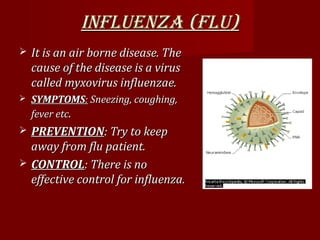
INFLUENZA (FLU)INFLUENZA (FLU)
 It is an air borne disease. TheIt is an air borne disease. The
cause of the disease is a viruscause of the disease is a virus
called myxovirus influenzae.called myxovirus influenzae.
 SYMPTOMSSYMPTOMS:: Sneezing, coughing,Sneezing, coughing,
fever etcfever etc..
 PREVENTIONPREVENTION: Try to keep: Try to keep
away from flu patient.away from flu patient.
 CONTROLCONTROL: There is no: There is no
effective control for influenza.effective control for influenza.
JAUNDICE/HEPATITIS
It is the disease of liver. It is caused by
viral infection. The types of hepatitis are:
Hepatitis-A, B, C, D, E or G. disease is
spread mostly by food & water
contaminated with hepatitis virus.
 SYMPTOMS:
High temperature & headache.
Loss of appetite with a feeling of nausea
& vomiting.
Irritating rashes
Dark yellow urine & light colored stool
after 3 to 10 days.
PREVENTION & COTROL OF
JAUNDICE
 PREVENTION:
Use chlorinated, boiled & ozonised water.
Properly clean hands after handling bed, & vessels of
the patient.
Hepatitis-B vaccine should be taken to prevent the
disease.
 CONTROL:
Interferon injection administered on the advice of the
doctor will control the disease.
Adequate rest is essential for early cure.
High calorie diet such as juice of sugarcane, radish
with gur should be taken.
Consumption of protein & fat should be limited.
RABIES (HYDROPHOBIA)
The bite of a rabid dog & some
other rabid mammals such as
monkeys, cats, or rabbits may
cause rabies, which is fatal. It is
a viral disease caused by a
rabies virus, which is present in
the saliva of the infected animals.
The viruses are injected into
human body by the bite of the
rabid animal. Disease is not
expressed after injection even up
to 1-3 months.
SYMPTOMS & PREVENTION OFSYMPTOMS & PREVENTION OF
RABIESRABIES
 SYMPTOMS:SYMPTOMS:
1.1. Severe headacheSevere headache
2.2. High feverHigh fever
3.3. Painful contraction of muscles of throat & chest.Painful contraction of muscles of throat & chest.
4.4. Choking feelingChoking feeling
 PREVENTION:PREVENTION:
1.1. Wash the wound withWash the wound with carbolic soap & clean watercarbolic soap & clean water
immediately after the bite.immediately after the bite.
2.2. Apply antiseptic medicine.Apply antiseptic medicine.
3.3. Consult a doctor immediately.Consult a doctor immediately.
4.4. It can be treated by Pasteur's treatment in which aIt can be treated by Pasteur's treatment in which a
course of 14 vaccines was given.course of 14 vaccines was given.
AIDSAIDS
Acquired Immuno DeficiencyAcquired Immuno Deficiency
Syndrome (AIDS) is a fatal diseaseSyndrome (AIDS) is a fatal disease
in which immune system of thein which immune system of the
body is seriously affected. It wasbody is seriously affected. It was
first detached in June 1981 in USA.first detached in June 1981 in USA.
The cause of the disease is aThe cause of the disease is a
retrovirus-HIV (human immunoretrovirus-HIV (human immuno
deficiency virus).deficiency virus).
The disease is transmitted through:The disease is transmitted through:
• Sexual contactSexual contact
• Blood transfusionBlood transfusion
• Use of contaminated needles orUse of contaminated needles or
other equipments.other equipments.
• Infected mother to the foetus.Infected mother to the foetus.
SYMPTOMS & PREVENTION OF AIDS
 SYMPTOMS:
1. Swollen lymph nodes
2. Decreased count of blood platelets
3. Sweating at night & weight loss.
4. Loss of memory, ability to speak & think
5. Patient becomes susceptible to other infections due to
breakdown of immune system.
 PREVENTION:
1. The common razors at the barbers shop should not be
used.
2. Blood donor should be first tested HIV negative.
3. Disposable needles & syringes should be used.
4. Sexual contact with unknown people should be
avoided.
TUBERCULOSISTUBERCULOSIS
It was first discovered by RobertIt was first discovered by Robert
Koch in 1882. It is an infectiousKoch in 1882. It is an infectious
disease which is communicated fromdisease which is communicated from
one human being to other directly orone human being to other directly or
indirectly. It may also be contractedindirectly. It may also be contracted
from animals. It is caused by afrom animals. It is caused by a
bacterium- called Mycobacteriumbacterium- called Mycobacterium
tuberculosis. It releases a toxin calledtuberculosis. It releases a toxin called
tuberculin. It can affect all parts oftuberculin. It can affect all parts of
the body. In human beings, thethe body. In human beings, the
infection spreads by inhaling infectedinfection spreads by inhaling infected
droplets released through coughing,droplets released through coughing,
sneezing, talking & spitting by thesneezing, talking & spitting by the
patient.patient.
SYMPTOMS & PREVENTION OFSYMPTOMS & PREVENTION OF
TUBERCULOSISTUBERCULOSIS
 SYMPTOMSSYMPTOMS
Patients feel sick & weak. There is a loss of appetite &Patients feel sick & weak. There is a loss of appetite &
weight. Typical fever pattern & night sweats are alsoweight. Typical fever pattern & night sweats are also
common.common.
 PREVENTION:PREVENTION:
 Vigorous public health measuresVigorous public health measures
 Immunization with BCG or Bacillus-Calmette-GuerinImmunization with BCG or Bacillus-Calmette-Guerin
vaccination in which weakened Tuberculosis bacillus isvaccination in which weakened Tuberculosis bacillus is
injected which prevents tuberculosis.injected which prevents tuberculosis.
 CONTROL:CONTROL: By the use of anti-tubercular therapy (ATT).By the use of anti-tubercular therapy (ATT).
CHOLERA
It is an acute infectious disease.
It is caused by the bacterium
Vibrio cholerae. It is transmitted
by flies, contaminated water &
food.
 SYMPTOMS:
 Watery diarrhea.
 Effortless vomiting without
nausea.
 Dehydration & muscle cramps
 weight loss.
 Eyes become shun ken.
PREVENTION OF CHOLERAPREVENTION OF CHOLERA
 PREVENTION:PREVENTION:
 Immunization by standard choleraImmunization by standard cholera
vaccine.vaccine.
 Boiled water & cooked food should beBoiled water & cooked food should be
taken.taken.
 Good sanitation condition.Good sanitation condition.
 Oral dehydration therapy should be usedOral dehydration therapy should be used
immediately. Taking small sips of thisimmediately. Taking small sips of this
solution at intervals preventssolution at intervals prevents
dehydration.dehydration.
 CONTROLCONTROL: Immediate medical advice: Immediate medical advice
should be taken.should be taken.
TYPHOID
Typhoid is our country's most common
communicable disease. This is common
in the age group of 1-15 years. Every
year 2.5 million persons suffer from
typhoid. It is caused by the bacteria
Salmonella typhi commonly found in
intestine of man. Human infection is
direct & the bacteria are spread through
faecal matter by house flies, etc.
SYMPTOMS & PREVENTIONSYMPTOMS & PREVENTION
OF TYPHOIDOF TYPHOID
 SYMPTOMS:SYMPTOMS:
Headache & typhoid fever which rise to theHeadache & typhoid fever which rise to the
maximum in the afternoon.maximum in the afternoon.
High fever in the second weak & then graduallyHigh fever in the second weak & then gradually
declines during third & fourth week.declines during third & fourth week.
 PREVENTION:PREVENTION:
Proper sanitation.Proper sanitation.
TAB-vaccination provides immunity.TAB-vaccination provides immunity.
Typhoral oral vaccine also prevents typhoid.Typhoral oral vaccine also prevents typhoid.
 CONTROL:CONTROL: There are standard drugs againstThere are standard drugs against
typhoid which cure the disease.typhoid which cure the disease.
DIaRRHOEaDIaRRHOEa
It can be defined as frequent looseIt can be defined as frequent loose
motions lasting more than 24 hours.motions lasting more than 24 hours.
Causal organism of Diarrhoea are certainCausal organism of Diarrhoea are certain
types of bacteria (E.coli, Shigella)types of bacteria (E.coli, Shigella)
protozoa and viruses.protozoa and viruses.
SYMPTOMS:SYMPTOMS:
Frequent loose motions, vomiting leadingFrequent loose motions, vomiting leading
to dehydration, weight loss, weak pulse,to dehydration, weight loss, weak pulse,
deep breathing and fever.deep breathing and fever.
PREVENTION OF
DIARRHOEA
Eatables should be covered.
Fruits and vegetables should be properly
washed before use.
Proper personal hygiene.
Washing hands before eating.
Stale food should not be consumed.
Community hygiene is also important.
CONTROLCONTROL OF DIaRRHOEaOF DIaRRHOEa
Complete bed rest.Complete bed rest.
Use anti microbial drugs and anti-Use anti microbial drugs and anti-
diarrhoeal agents to treat diarrhoea.diarrhoeal agents to treat diarrhoea.
Pulp of boiled unripe banana alongPulp of boiled unripe banana along
with required amount of salt, turmericwith required amount of salt, turmeric
powder & lime is useful.powder & lime is useful.
Husk of isabgol seed (Plarntago ovata)Husk of isabgol seed (Plarntago ovata)
with water or curd provides relief.with water or curd provides relief.
THANK YOU

SCIENCE PROJECT WORK

  • 1.
    SCIENCE PROJECT WORK Made by:-VAIBHAV KUMAR SHRAWAN
  • 2.
    HUMAN DISEASES The termdisease means DIS EASE or without ease or discomfort. Thus disease can be defined as the malfunctioning of the body organs due to one reason or the other. In other words disease is disorder of body. Diseases are of two types:  Communicable diseases  Non communicable diseases
  • 3.
    COMMUNICABLE DISEASES MALARIA: Itis caused by a protozoan parasite plasmodium. This spreads through the bite of an insect vector-female anopheles mosquito which feeds on human food. Symptoms of these disease are as follows:  Headache  Nausea  Muscular pains Malaria attack consists of three stages:  Cold stage (feeling very cold & shivering)  Hot stage (high fever, faster heart beat)  Sweating stage( in which temperature goes down to normal).
  • 4.
    COMMUNICABLE DISEASES These arecaused by the attack of microorganisms (Pathogens) such as bacteria, viruses, fungi or protozoans. The causal organism of the disease can be transmitted from one person to other by means of air, water, food, sexual contact & insects (vectors). Hence these are called communicable diseases that are communicated from diseased person to healthy person.
  • 5.
    NON COMMUNICABLE DISEASES Thediseases which do not spread from infected person to healthy person are known as non-communicable or non- infectious disease, such as diabetes, arthritis, heart disease, cancer, etc. Many non-communicable diseases are due to nutritional deficiency.
  • 6.
    PREVENTION OF MALARIA PREVENTION:  Use wire-gauze on doors & windows to prevent entry of mosquitoes.  Use insect-repellents to prevent mosquito-bite.  Sleep under mosquito-net.  Kill adult mosquitoes by spreading insecticides.  Destroy mosquito-breeding places.  CONTROL: A drug named quinine is used to treat a person suffering from malaria.
  • 7.
    INFLUENZA (FLU)INFLUENZA (FLU) It is an air borne disease. TheIt is an air borne disease. The cause of the disease is a viruscause of the disease is a virus called myxovirus influenzae.called myxovirus influenzae.  SYMPTOMSSYMPTOMS:: Sneezing, coughing,Sneezing, coughing, fever etcfever etc..  PREVENTIONPREVENTION: Try to keep: Try to keep away from flu patient.away from flu patient.  CONTROLCONTROL: There is no: There is no effective control for influenza.effective control for influenza.
  • 8.
    JAUNDICE/HEPATITIS It is thedisease of liver. It is caused by viral infection. The types of hepatitis are: Hepatitis-A, B, C, D, E or G. disease is spread mostly by food & water contaminated with hepatitis virus.  SYMPTOMS: High temperature & headache. Loss of appetite with a feeling of nausea & vomiting. Irritating rashes Dark yellow urine & light colored stool after 3 to 10 days.
  • 9.
    PREVENTION & COTROLOF JAUNDICE  PREVENTION: Use chlorinated, boiled & ozonised water. Properly clean hands after handling bed, & vessels of the patient. Hepatitis-B vaccine should be taken to prevent the disease.  CONTROL: Interferon injection administered on the advice of the doctor will control the disease. Adequate rest is essential for early cure. High calorie diet such as juice of sugarcane, radish with gur should be taken. Consumption of protein & fat should be limited.
  • 10.
    RABIES (HYDROPHOBIA) The biteof a rabid dog & some other rabid mammals such as monkeys, cats, or rabbits may cause rabies, which is fatal. It is a viral disease caused by a rabies virus, which is present in the saliva of the infected animals. The viruses are injected into human body by the bite of the rabid animal. Disease is not expressed after injection even up to 1-3 months.
  • 11.
    SYMPTOMS & PREVENTIONOFSYMPTOMS & PREVENTION OF RABIESRABIES  SYMPTOMS:SYMPTOMS: 1.1. Severe headacheSevere headache 2.2. High feverHigh fever 3.3. Painful contraction of muscles of throat & chest.Painful contraction of muscles of throat & chest. 4.4. Choking feelingChoking feeling  PREVENTION:PREVENTION: 1.1. Wash the wound withWash the wound with carbolic soap & clean watercarbolic soap & clean water immediately after the bite.immediately after the bite. 2.2. Apply antiseptic medicine.Apply antiseptic medicine. 3.3. Consult a doctor immediately.Consult a doctor immediately. 4.4. It can be treated by Pasteur's treatment in which aIt can be treated by Pasteur's treatment in which a course of 14 vaccines was given.course of 14 vaccines was given.
  • 12.
    AIDSAIDS Acquired Immuno DeficiencyAcquiredImmuno Deficiency Syndrome (AIDS) is a fatal diseaseSyndrome (AIDS) is a fatal disease in which immune system of thein which immune system of the body is seriously affected. It wasbody is seriously affected. It was first detached in June 1981 in USA.first detached in June 1981 in USA. The cause of the disease is aThe cause of the disease is a retrovirus-HIV (human immunoretrovirus-HIV (human immuno deficiency virus).deficiency virus). The disease is transmitted through:The disease is transmitted through: • Sexual contactSexual contact • Blood transfusionBlood transfusion • Use of contaminated needles orUse of contaminated needles or other equipments.other equipments. • Infected mother to the foetus.Infected mother to the foetus.
  • 13.
    SYMPTOMS & PREVENTIONOF AIDS  SYMPTOMS: 1. Swollen lymph nodes 2. Decreased count of blood platelets 3. Sweating at night & weight loss. 4. Loss of memory, ability to speak & think 5. Patient becomes susceptible to other infections due to breakdown of immune system.  PREVENTION: 1. The common razors at the barbers shop should not be used. 2. Blood donor should be first tested HIV negative. 3. Disposable needles & syringes should be used. 4. Sexual contact with unknown people should be avoided.
  • 14.
    TUBERCULOSISTUBERCULOSIS It was firstdiscovered by RobertIt was first discovered by Robert Koch in 1882. It is an infectiousKoch in 1882. It is an infectious disease which is communicated fromdisease which is communicated from one human being to other directly orone human being to other directly or indirectly. It may also be contractedindirectly. It may also be contracted from animals. It is caused by afrom animals. It is caused by a bacterium- called Mycobacteriumbacterium- called Mycobacterium tuberculosis. It releases a toxin calledtuberculosis. It releases a toxin called tuberculin. It can affect all parts oftuberculin. It can affect all parts of the body. In human beings, thethe body. In human beings, the infection spreads by inhaling infectedinfection spreads by inhaling infected droplets released through coughing,droplets released through coughing, sneezing, talking & spitting by thesneezing, talking & spitting by the patient.patient.
  • 15.
    SYMPTOMS & PREVENTIONOFSYMPTOMS & PREVENTION OF TUBERCULOSISTUBERCULOSIS  SYMPTOMSSYMPTOMS Patients feel sick & weak. There is a loss of appetite &Patients feel sick & weak. There is a loss of appetite & weight. Typical fever pattern & night sweats are alsoweight. Typical fever pattern & night sweats are also common.common.  PREVENTION:PREVENTION:  Vigorous public health measuresVigorous public health measures  Immunization with BCG or Bacillus-Calmette-GuerinImmunization with BCG or Bacillus-Calmette-Guerin vaccination in which weakened Tuberculosis bacillus isvaccination in which weakened Tuberculosis bacillus is injected which prevents tuberculosis.injected which prevents tuberculosis.  CONTROL:CONTROL: By the use of anti-tubercular therapy (ATT).By the use of anti-tubercular therapy (ATT).
  • 16.
    CHOLERA It is anacute infectious disease. It is caused by the bacterium Vibrio cholerae. It is transmitted by flies, contaminated water & food.  SYMPTOMS:  Watery diarrhea.  Effortless vomiting without nausea.  Dehydration & muscle cramps  weight loss.  Eyes become shun ken.
  • 17.
    PREVENTION OF CHOLERAPREVENTIONOF CHOLERA  PREVENTION:PREVENTION:  Immunization by standard choleraImmunization by standard cholera vaccine.vaccine.  Boiled water & cooked food should beBoiled water & cooked food should be taken.taken.  Good sanitation condition.Good sanitation condition.  Oral dehydration therapy should be usedOral dehydration therapy should be used immediately. Taking small sips of thisimmediately. Taking small sips of this solution at intervals preventssolution at intervals prevents dehydration.dehydration.  CONTROLCONTROL: Immediate medical advice: Immediate medical advice should be taken.should be taken.
  • 18.
    TYPHOID Typhoid is ourcountry's most common communicable disease. This is common in the age group of 1-15 years. Every year 2.5 million persons suffer from typhoid. It is caused by the bacteria Salmonella typhi commonly found in intestine of man. Human infection is direct & the bacteria are spread through faecal matter by house flies, etc.
  • 19.
    SYMPTOMS & PREVENTIONSYMPTOMS& PREVENTION OF TYPHOIDOF TYPHOID  SYMPTOMS:SYMPTOMS: Headache & typhoid fever which rise to theHeadache & typhoid fever which rise to the maximum in the afternoon.maximum in the afternoon. High fever in the second weak & then graduallyHigh fever in the second weak & then gradually declines during third & fourth week.declines during third & fourth week.  PREVENTION:PREVENTION: Proper sanitation.Proper sanitation. TAB-vaccination provides immunity.TAB-vaccination provides immunity. Typhoral oral vaccine also prevents typhoid.Typhoral oral vaccine also prevents typhoid.  CONTROL:CONTROL: There are standard drugs againstThere are standard drugs against typhoid which cure the disease.typhoid which cure the disease.
  • 20.
    DIaRRHOEaDIaRRHOEa It can bedefined as frequent looseIt can be defined as frequent loose motions lasting more than 24 hours.motions lasting more than 24 hours. Causal organism of Diarrhoea are certainCausal organism of Diarrhoea are certain types of bacteria (E.coli, Shigella)types of bacteria (E.coli, Shigella) protozoa and viruses.protozoa and viruses. SYMPTOMS:SYMPTOMS: Frequent loose motions, vomiting leadingFrequent loose motions, vomiting leading to dehydration, weight loss, weak pulse,to dehydration, weight loss, weak pulse, deep breathing and fever.deep breathing and fever.
  • 21.
    PREVENTION OF DIARRHOEA Eatables shouldbe covered. Fruits and vegetables should be properly washed before use. Proper personal hygiene. Washing hands before eating. Stale food should not be consumed. Community hygiene is also important.
  • 22.
    CONTROLCONTROL OF DIaRRHOEaOFDIaRRHOEa Complete bed rest.Complete bed rest. Use anti microbial drugs and anti-Use anti microbial drugs and anti- diarrhoeal agents to treat diarrhoea.diarrhoeal agents to treat diarrhoea. Pulp of boiled unripe banana alongPulp of boiled unripe banana along with required amount of salt, turmericwith required amount of salt, turmeric powder & lime is useful.powder & lime is useful. Husk of isabgol seed (Plarntago ovata)Husk of isabgol seed (Plarntago ovata) with water or curd provides relief.with water or curd provides relief.
  • 23.