Enteric Fever
Dr Avatar Verma
KISTMCTH
2076/03/13
• Enteric (typhoid) fever is a systemic disease characterized by fever and
abdominal pain and caused by dissemination of S. Typhi or S. Paratyphi
• Initially called typhoid fever because of its clinical similarity to typhus
• In early 1800s, clearly defined pathologically as a unique illness on the
basis of A/W with enlarged Peyer’s patches and mesenteric lymph nodes
• In 1869, acc. to site of infection, the term enteric fever was proposed as
an alternative designation to distinguish typhoid fever from typhus
Typhoid and paratyphoid
(enteric) fevers
• Transmitted by the faecal–oral route, and are important causes of fever in India,
sub-Saharan Africa and Latin America
• Caused by infection with Salmonella typhi and S. paratyphi A and B
• After a few days of bacteraemia, it localise, mainly in the lymphoid tissue of the
small intestine, causes lesions in the Peyer’s patches and follicles
• These swell at first, then ulcerate and usually heal
• After clinical recovery, about 5% of patients become chronic carriers (i.e.
continue to excrete the bacteria after 1 year); the bacilli may live in the gallbladder
for months or years and pass intermittently in the stool and, less commonly, in the
urine
Clinical features
Typhoid fever
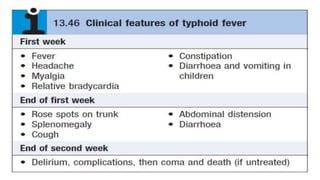
• Incubation period: 10–14 days can be longer, and the onset may insidious
• Temperature rises in a stepladder fashion for 4 or 5 days with malaise, increasing
headache, drowsiness and aching in the limbs
• Constipation d/t swelling of lymphoid tissue around the ileocaecal junction,
although in children diarrhoea and vomiting may be prominent early in the illness
• Relative bradycardia
• At the end of the first week, a rash may appear on the upper abdomen and on
the back as sparse, slightly raised, rose-red spots, which fade on pressure
visible only on white skin
• Cough and epistaxis occur
• Around the 7th–10th day, the spleen becomes palpable
• Constipation is then succeeded by diarrhea and abdominal distension with
tenderness
• Bronchitis and delirium may develop
• If untreated, by the end of the second week the patient may be profoundly ill
Paratyphoid fever
 Course shorter and milder than that of typhoid but onset is often more
abrupt with acute enteritis
 Rash may be more abundant and the intestinal complications less
frequent
Complications
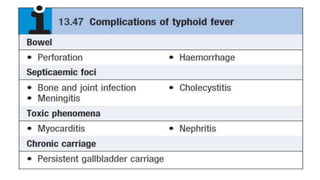
• Haemorrhage from, or a perforation of, the ulcerated Peyer’s patches may
occur at the end of the second week or during the third week of the illness
• A drop in temperature to normal or subnormal levels may be falsely
reassuring in patients with intestinal haemorrhage
• Additional complications may involve almost any viscus or system because
of the septicaemia present during the first week
• Bone and joint infection is common in children with sickle-cell disease
• A prospective study of 669 consecutive cases of enteric fever in
Kathmandu, Nepal, symptoms reported are
• Headache (80%), Chills (35–45%), Cough (30%), Sweating (20–25%),
Myalgias (20%), Malaise (10%), and Arthralgia (2–4%)
• Gastrointestinal manifestations included anorexia (55%), abdominal pain
(30–40%), nausea (18–24%), vomiting (18%), and diarrhea (22–28%) more
commonly than constipation (13–16%). Physical findings included coated
tongue (51–56%), splenomegaly (5–6%), and abdominal tenderness (4–5%)
•
• Early physical findings of enteric fever include rash (“rose spots”; 30%),
hepatosplenomegaly (3–6%), epistaxis, and relative bradycardia at the peak
of high fever (<50%)
Investigations
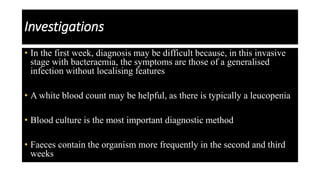
• In the first week, diagnosis may be difficult because, in this invasive
stage with bacteraemia, the symptoms are those of a generalised
infection without localising features
• A white blood count may be helpful, as there is typically a leucopenia
• Blood culture is the most important diagnostic method
• Faeces contain the organism more frequently in the second and third
weeks
D/D
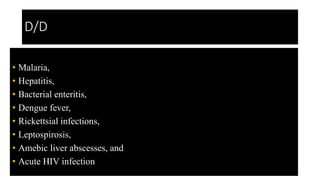
• Malaria,
• Hepatitis,
• Bacterial enteritis,
• Dengue fever,
• Rickettsial infections,
• Leptospirosis,
• Amebic liver abscesses, and
• Acute HIV infection
Management
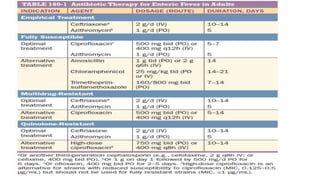
• Antibiotic therapy must be guided by sensitivity
• Chloramphenicol (500 mg 4 times daily),
• Ampicillin (750 mg 4 times daily) and
• Co-trimoxazole (2 tablets or IV equivalent twice daily) losing their
effect due to resistance in many areas of the world, especially India
and South-east Asia
• The fluoroquinolones are the drugs of choice (e.g. ciprofloxacin 500 mg
twice daily) if the organism is susceptible, but resistance is common,
especially in the Indian subcontinent and also in the UK
• Extended-spectrum cephalosporins (ceftriaxone and cefotaxime) are
useful alternatives but have a slightly increased treatment failure rate
• Azithromycin (500 mg once daily) is an alternative when
fluoroquinolone resistance is present but has not been validated in severe
disease
• Pyrexia may persist for up to 5 days after the start of specific therapy
• Even with effective chemotherapy, there is still a danger of
complications, recrudescence of the disease and the development of a
carrier state
• Chronic carriers were formerly treated for 4 weeks with ciprofloxacin
but may require an alternative agent and duration, as guided by
antimicrobial sensitivity testing
• Cholecystectomy may be necessary
Prevention
• Therapy should be administered for at least 10 days or for 5 days after fever
resolution
• Improved sanitation and living conditions
• Travellers to countries where it is endemic should be inoculated with one of the
three available typhoid vaccines (two inactivated injectable and one oral live
attenuated)
• Two typhoid vaccines are commercially available:
(1) Ty21a, an oral live attenuated S. Typhi vaccine (given on days 1, 3, 5,
and 7, with revaccination with a full 4-dose series every 5 years); and
(2) Vi CPS, a parenteral vaccine consisting of purified Vi polysaccharide
from the bacterial capsule (given in a single dose, with a booster every 2
years)
• The minimal age for vaccination is 6 years for Ty21a and 2 years for Vi
CPS

Enteric fever

  • 1.
    Enteric Fever Dr AvatarVerma KISTMCTH 2076/03/13
  • 2.
    • Enteric (typhoid)fever is a systemic disease characterized by fever and abdominal pain and caused by dissemination of S. Typhi or S. Paratyphi • Initially called typhoid fever because of its clinical similarity to typhus • In early 1800s, clearly defined pathologically as a unique illness on the basis of A/W with enlarged Peyer’s patches and mesenteric lymph nodes • In 1869, acc. to site of infection, the term enteric fever was proposed as an alternative designation to distinguish typhoid fever from typhus
  • 3.
    Typhoid and paratyphoid (enteric)fevers • Transmitted by the faecal–oral route, and are important causes of fever in India, sub-Saharan Africa and Latin America • Caused by infection with Salmonella typhi and S. paratyphi A and B • After a few days of bacteraemia, it localise, mainly in the lymphoid tissue of the small intestine, causes lesions in the Peyer’s patches and follicles • These swell at first, then ulcerate and usually heal • After clinical recovery, about 5% of patients become chronic carriers (i.e. continue to excrete the bacteria after 1 year); the bacilli may live in the gallbladder for months or years and pass intermittently in the stool and, less commonly, in the urine
  • 4.
    Clinical features Typhoid fever •Incubation period: 10–14 days can be longer, and the onset may insidious • Temperature rises in a stepladder fashion for 4 or 5 days with malaise, increasing headache, drowsiness and aching in the limbs • Constipation d/t swelling of lymphoid tissue around the ileocaecal junction, although in children diarrhoea and vomiting may be prominent early in the illness • Relative bradycardia
  • 5.
    • At theend of the first week, a rash may appear on the upper abdomen and on the back as sparse, slightly raised, rose-red spots, which fade on pressure visible only on white skin • Cough and epistaxis occur • Around the 7th–10th day, the spleen becomes palpable • Constipation is then succeeded by diarrhea and abdominal distension with tenderness • Bronchitis and delirium may develop • If untreated, by the end of the second week the patient may be profoundly ill
  • 6.
    Paratyphoid fever  Courseshorter and milder than that of typhoid but onset is often more abrupt with acute enteritis  Rash may be more abundant and the intestinal complications less frequent
  • 7.
    Complications • Haemorrhage from,or a perforation of, the ulcerated Peyer’s patches may occur at the end of the second week or during the third week of the illness • A drop in temperature to normal or subnormal levels may be falsely reassuring in patients with intestinal haemorrhage • Additional complications may involve almost any viscus or system because of the septicaemia present during the first week • Bone and joint infection is common in children with sickle-cell disease
  • 8.
    • A prospectivestudy of 669 consecutive cases of enteric fever in Kathmandu, Nepal, symptoms reported are • Headache (80%), Chills (35–45%), Cough (30%), Sweating (20–25%), Myalgias (20%), Malaise (10%), and Arthralgia (2–4%) • Gastrointestinal manifestations included anorexia (55%), abdominal pain (30–40%), nausea (18–24%), vomiting (18%), and diarrhea (22–28%) more commonly than constipation (13–16%). Physical findings included coated tongue (51–56%), splenomegaly (5–6%), and abdominal tenderness (4–5%) • • Early physical findings of enteric fever include rash (“rose spots”; 30%), hepatosplenomegaly (3–6%), epistaxis, and relative bradycardia at the peak of high fever (<50%)
  • 11.
    Investigations • In thefirst week, diagnosis may be difficult because, in this invasive stage with bacteraemia, the symptoms are those of a generalised infection without localising features • A white blood count may be helpful, as there is typically a leucopenia • Blood culture is the most important diagnostic method • Faeces contain the organism more frequently in the second and third weeks
  • 12.
    D/D • Malaria, • Hepatitis, •Bacterial enteritis, • Dengue fever, • Rickettsial infections, • Leptospirosis, • Amebic liver abscesses, and • Acute HIV infection
  • 13.
    Management • Antibiotic therapymust be guided by sensitivity • Chloramphenicol (500 mg 4 times daily), • Ampicillin (750 mg 4 times daily) and • Co-trimoxazole (2 tablets or IV equivalent twice daily) losing their effect due to resistance in many areas of the world, especially India and South-east Asia
  • 14.
    • The fluoroquinolonesare the drugs of choice (e.g. ciprofloxacin 500 mg twice daily) if the organism is susceptible, but resistance is common, especially in the Indian subcontinent and also in the UK • Extended-spectrum cephalosporins (ceftriaxone and cefotaxime) are useful alternatives but have a slightly increased treatment failure rate • Azithromycin (500 mg once daily) is an alternative when fluoroquinolone resistance is present but has not been validated in severe disease
  • 15.
    • Pyrexia maypersist for up to 5 days after the start of specific therapy • Even with effective chemotherapy, there is still a danger of complications, recrudescence of the disease and the development of a carrier state • Chronic carriers were formerly treated for 4 weeks with ciprofloxacin but may require an alternative agent and duration, as guided by antimicrobial sensitivity testing • Cholecystectomy may be necessary
  • 17.
    Prevention • Therapy shouldbe administered for at least 10 days or for 5 days after fever resolution • Improved sanitation and living conditions • Travellers to countries where it is endemic should be inoculated with one of the three available typhoid vaccines (two inactivated injectable and one oral live attenuated)
  • 18.
    • Two typhoidvaccines are commercially available: (1) Ty21a, an oral live attenuated S. Typhi vaccine (given on days 1, 3, 5, and 7, with revaccination with a full 4-dose series every 5 years); and (2) Vi CPS, a parenteral vaccine consisting of purified Vi polysaccharide from the bacterial capsule (given in a single dose, with a booster every 2 years) • The minimal age for vaccination is 6 years for Ty21a and 2 years for Vi CPS