ENT/ETR300 – FUNDAMENTALS OF ENTREPRENEURSHIP
                       MARKETING PLAN


MARKETING PLAN


MODULE 8
ENT/ETR300 – FUNDAMENTALS OF ENTREPRENEURSHIP
                      MARKETING PLAN


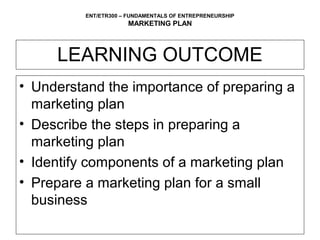
     LEARNING OUTCOME
• Understand the importance of preparing a
  marketing plan
• Describe the steps in preparing a
  marketing plan
• Identify components of a marketing plan
• Prepare a marketing plan for a small
  business
ENT/ETR300 – FUNDAMENTALS OF ENTREPRENEURSHIP
                      MARKETING PLAN


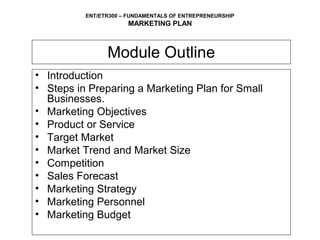
                Module Outline
• Introduction
• Steps in Preparing a Marketing Plan for Small
  Businesses.
• Marketing Objectives
• Product or Service
• Target Market
• Market Trend and Market Size
• Competition
• Sales Forecast
• Marketing Strategy
• Marketing Personnel
• Marketing Budget
ENT/ETR300 – FUNDAMENTALS OF ENTREPRENEURSHIP
                          MARKETING PLAN


                      Introduction
    A well prepared marketing plan helps
    entrepreneurs to:
•   evaluate market acceptance
•   develop strategies to market products or
    services of the business
•   identify required resources to execute the
    marketing strategy
•   estimate marketing financial requirement
ENT/ETR300 – FUNDAMENTALS OF ENTREPRENEURSHIP
                        MARKETING PLAN


     Steps in Preparing a Marketing Plan
1.   Setting Marketing Objectives
2.   Determining product or service
3.   Identifying target market
4.   Analyzing market trend and size
5.   Assessing competition
6.   Forecasting sales
7.   Developing marketing strategy
8.   Planning for marketing personnel
9.   Preparing marketing budget
ENT/ETR300 – FUNDAMENTALS OF ENTREPRENEURSHIP
                           MARKETING PLAN


  1. Setting Marketing Objectives:
New business:
• Introduce new products/services
• Estimate market acceptance and sales

Existing business
• Introduce new products/services
• Inform market of product improvement
• Enter new market
• Increase sales of existing products
• Increase market share
• Market penetration
• Regain market for existing product
ENT/ETR300 – FUNDAMENTALS OF ENTREPRENEURSHIP
                          MARKETING PLAN


  2. Determining product or service
• Needs & wants of customers
• Marketability of a product or service

Guide in describing product or services
State clearly the value and benefits of product or service to
customers. Capitalize on the uniqueness or strengths of
the product or services such as on its formulation,
ingredients used, safety, ease of use, life span, flexibility,
assortment, location, operation hours, personalization,
extended warranty etc.
ENT/ETR300 – FUNDAMENTALS OF ENTREPRENEURSHIP
                      MARKETING PLAN


     3. Identifying target market
• Who is the consumer of the product or
  service?

• What is their common needs or wants that
  would be satisfied by the product or
  service?

• What is their common characteristics?
ENT/ETR300 – FUNDAMENTALS OF ENTREPRENEURSHIP
                        MARKETING PLAN


       Target Market Alternatives
•   Segmented Marketing
-   target several or a particular market segments
-   design separate offers for each segment
    Niche Marketing:
    Targeting a large share of one or a few segments or
    niches
    Micromarketing:
    Tailoring products to suit the tastes of specific
    individuals and locations
ENT/ETR300 – FUNDAMENTALS OF ENTREPRENEURSHIP
                      MARKETING PLAN


     Target Market Alternatives
• Mass-Marketing
- ignoring market segment differences
- go after the whole market with one offer
ENT/ETR300 – FUNDAMENTALS OF ENTREPRENEURSHIP
                     MARKETING PLAN


Common Bases For Segmentation
• Demographic Segmentation
• Psychographic Segmentation
• Behavioral Segmentation
     • Occasions
     • Benefits Sought
     • User Status
     • Usage Rate
     • Loyalty Status
ENT/ETR300 – FUNDAMENTALS OF ENTREPRENEURSHIP
                        MARKETING PLAN


         4. Analyzing Market Trend
              and Market Size
•   What is the trend in the market?
•   What is market potential?
•   Size of the market - what is the RM value?
•   Customer profiles of relevant market
    segments.
ENT/ETR300 – FUNDAMENTALS OF ENTREPRENEURSHIP
                       MARKETING PLAN


Market Size:
- Total potential purchase of target market
- Should be translated into monetary value
- Growing, remain the same or shrinking

Market Share:
- a comparative measure to assess
performance against the competition
ENT/ETR300 – FUNDAMENTALS OF ENTREPRENEURSHIP
                        MARKETING PLAN


     5. Assessing Competition
Identify Competitors
• Assess their market positions and
  strategies i.e.; product quality, pricing,
  distribution and promotion
• Strengths and weaknesses
• Duration in market
• Customers
ENT/ETR300 – FUNDAMENTALS OF ENTREPRENEURSHIP
                     MARKETING PLAN


        6. Forecasting Sales
• Past performance
• Break-even – to set the minimum
• Secured projects
• On-going contracts
• Anticipated or intended growth
ENT/ETR300 – FUNDAMENTALS OF ENTREPRENEURSHIP
                      MARKETING PLAN


 7. Developing Marketing Strategy
• To enable business to plan for its limited
  resources in order to achieve stated
  marketing objectives
• The key idea is to deliver customer
  satisfaction yet provide business with a
  competitive advantage
ENT/ETR300 – FUNDAMENTALS OF ENTREPRENEURSHIP
                      MARKETING PLAN


          Marketing Strategy
• Product Strategy

• Pricing Strategy

• Place or Distribution Strategy

• Promotion Strategy
ENT/ETR300 – FUNDAMENTALS OF ENTREPRENEURSHIP
                        MARKETING PLAN


               Product Strategy
• Include product and service strategy
  – Product is a physical item that can be seen, owned,
    used or consumed
  – Ideas and creations of the minds can also be
    regarded as product

  – Service is intangible and cannot be seen or owned,
    but is useful, can be experienced and able to satisfy
    customer needs and wants

  – Product strategy refers to a product, service or a
    combination of both
ENT/ETR300 – FUNDAMENTALS OF ENTREPRENEURSHIP
                            MARKETING PLAN


                 Product Strategy
• Product attributes
    – Quality
    – Design
•   Trade name
•   Brand name
•   Packaging
•   Labeling
•   Warranty
•   After sales service
ENT/ETR300 – FUNDAMENTALS OF ENTREPRENEURSHIP
                      MARKETING PLAN


 Marketing Strategies for Services
• Service quality
  – consistency
• Service package
  – Combination of services at competitive price
• Service differentiation
  – Offering that is unique and can be
    differentiated from the competitors
• After sales services
  – Follow-up
ENT/ETR300 – FUNDAMENTALS OF ENTREPRENEURSHIP
                   MARKETING PLAN


           Pricing Strategy
Price is the value exchanged between
the seller and the buyer in order for the
buyer to possess, use or experience the
product or service offered
Most often, price is in the form of
monetary value paid by the buyer to
obtain the product or service
ENT/ETR300 – FUNDAMENTALS OF ENTREPRENEURSHIP
                     MARKETING PLAN


            Pricing Strategy
Common Pricing Methods:

• Based on Cost
  – Fixed Cost + Variable Cost + Desired Margin
• Based on Perceived Value
• Based on Competition
ENT/ETR300 – FUNDAMENTALS OF ENTREPRENEURSHIP
                       MARKETING PLAN


                Pricing Tactics

•   Price lining
•   Discounting
•   Purchase with purchase
•   Psychological pricing
•   Captive pricing
•   Product bundle pricing
•   Segmentation pricing
ENT/ETR300 – FUNDAMENTALS OF ENTREPRENEURSHIP
                    MARKETING PLAN


           Factors to Consider
           When Setting Price

• Marketing objectives
• Demand and supply
• Competitor’s pricing
ENT/ETR300 – FUNDAMENTALS OF ENTREPRENEURSHIP
                      MARKETING PLAN


   Place or Distribution Strategy

• Place strategy refers to the decision made on
  the location of the business
• Choice of location is crucial for most brick and
  mortar businesses

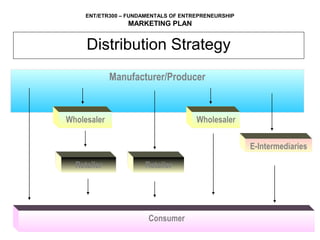
• Channel of distribution is a network developed
  to ensure product or services reach target
  consumers
• Distribution strategy for consumer product and
  industrial product may vary
ENT/ETR300 – FUNDAMENTALS OF ENTREPRENEURSHIP
                 MARKETING PLAN


     Distribution Strategy
             Manufacturer/Producer


Wholesaler                            Wholesaler


                                                     E-Intermediaries

  Retailer             Retailer


                        Consumer
ENT/ETR300 – FUNDAMENTALS OF ENTREPRENEURSHIP
                         MARKETING PLAN


        Factors to Consider When
     Determining Distribution Strategy

•   Type of product
•   Target market
•   Market coverage
•   Transportation ease
•   Product standardization
ENT/ETR300 – FUNDAMENTALS OF ENTREPRENEURSHIP
                    MARKETING PLAN


        Promotion Strategy

Promotion is any coordinated effort taken
to supplement the product, price and
place strategies in order to achieve
marketing objectives.
ENT/ETR300 – FUNDAMENTALS OF ENTREPRENEURSHIP
                      MARKETING PLAN


        Promotion Strategy
•   Advertising
•   Sales promotion
•   Personal Selling
•   Publicity
ENT/ETR300 – FUNDAMENTALS OF ENTREPRENEURSHIP
                            MARKETING PLAN


             Promotion Strategy
Advertising
Paid, non personal sales effort through a medium to influence a large number
of consumers.

   •   Channel of adverting:                 • Outdoor
   •   Printed                                   • Billboards
        • Newspaper                              • Banners
        • Magazines                              • Transportation
        • Yellow pages
        • Brochures
        • Business cards

   •   Electronic and Digital
        • Television
        • Radio
        • Internet
        • Sort messaging system
ENT/ETR300 – FUNDAMENTALS OF ENTREPRENEURSHIP
                               MARKETING PLAN


                Promotion Strategy
Sales promotion
• Promotional activities or incentives carried out or offered within a set time
   frame to influence purchase
• Common sales promotion strategies:
     – Rebates
     – Coupons
     – Purchase-with-purchase
     – Samples
     – Premiums
     – Contest
     – Rebates
     – Point-of-purchase promotion
     – Sweepstakes
     – Free delivery
     – Extended warranty
ENT/ETR300 – FUNDAMENTALS OF ENTREPRENEURSHIP
                          MARKETING PLAN


            Promotion Strategy
Personal Selling
• Personal sales presentation conducted by a trained
  sales person to influence potential customers. It is most
  often used for products that require demonstration or
  explanation


Publicity
• Efforts taken to develop and maintain good relationship
  with the public to ensure good favorable public image of
  the business.
ENT/ETR300 – FUNDAMENTALS OF ENTREPRENEURSHIP
                      MARKETING PLAN


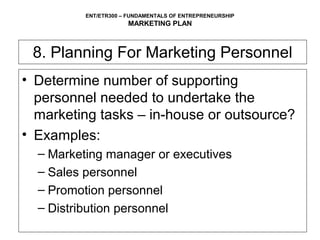
 8. Planning For Marketing Personnel
• Determine number of supporting
  personnel needed to undertake the
  marketing tasks – in-house or outsource?
• Examples:
  – Marketing manager or executives
  – Sales personnel
  – Promotion personnel
  – Distribution personnel
ENT/ETR300 – FUNDAMENTALS OF ENTREPRENEURSHIP
                       MARKETING PLAN


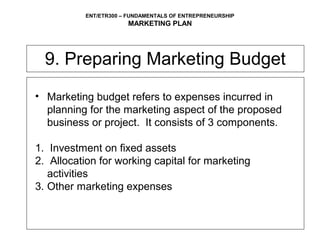
  9. Preparing Marketing Budget
• Marketing budget refers to expenses incurred in
  planning for the marketing aspect of the proposed
  business or project. It consists of 3 components.

1. Investment on fixed assets
2. Allocation for working capital for marketing
   activities
3. Other marketing expenses
ENT/ETR300 – FUNDAMENTALS OF ENTREPRENEURSHIP
            MARKETING PLAN


   END OF MODULE 8
ENT/ETR300 – FUNDAMENTALS OF ENTREPRENEURSHIP
                          MARKETING PLAN


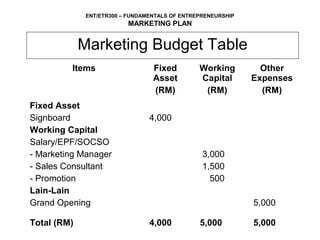
             Marketing Budget Table
         Items                    Fixed         Working         Other
                                  Asset         Capital       Expenses
                                  (RM)           (RM)           (RM)
Fixed Asset
Signboard                        4,000
Working Capital
Salary/EPF/SOCSO
- Marketing Manager                              3,000
- Sales Consultant                               1,500
- Promotion                                        500
Lain-Lain
Grand Opening                                                 5,000

Total (RM)                       4,000          5,000         5,000

Ent300 module08

  • 1.
    ENT/ETR300 – FUNDAMENTALSOF ENTREPRENEURSHIP MARKETING PLAN MARKETING PLAN MODULE 8
  • 2.
    ENT/ETR300 – FUNDAMENTALSOF ENTREPRENEURSHIP MARKETING PLAN LEARNING OUTCOME • Understand the importance of preparing a marketing plan • Describe the steps in preparing a marketing plan • Identify components of a marketing plan • Prepare a marketing plan for a small business
  • 3.
    ENT/ETR300 – FUNDAMENTALSOF ENTREPRENEURSHIP MARKETING PLAN Module Outline • Introduction • Steps in Preparing a Marketing Plan for Small Businesses. • Marketing Objectives • Product or Service • Target Market • Market Trend and Market Size • Competition • Sales Forecast • Marketing Strategy • Marketing Personnel • Marketing Budget
  • 4.
    ENT/ETR300 – FUNDAMENTALSOF ENTREPRENEURSHIP MARKETING PLAN Introduction A well prepared marketing plan helps entrepreneurs to: • evaluate market acceptance • develop strategies to market products or services of the business • identify required resources to execute the marketing strategy • estimate marketing financial requirement
  • 5.
    ENT/ETR300 – FUNDAMENTALSOF ENTREPRENEURSHIP MARKETING PLAN Steps in Preparing a Marketing Plan 1. Setting Marketing Objectives 2. Determining product or service 3. Identifying target market 4. Analyzing market trend and size 5. Assessing competition 6. Forecasting sales 7. Developing marketing strategy 8. Planning for marketing personnel 9. Preparing marketing budget
  • 6.
    ENT/ETR300 – FUNDAMENTALSOF ENTREPRENEURSHIP MARKETING PLAN 1. Setting Marketing Objectives: New business: • Introduce new products/services • Estimate market acceptance and sales Existing business • Introduce new products/services • Inform market of product improvement • Enter new market • Increase sales of existing products • Increase market share • Market penetration • Regain market for existing product
  • 7.
    ENT/ETR300 – FUNDAMENTALSOF ENTREPRENEURSHIP MARKETING PLAN 2. Determining product or service • Needs & wants of customers • Marketability of a product or service Guide in describing product or services State clearly the value and benefits of product or service to customers. Capitalize on the uniqueness or strengths of the product or services such as on its formulation, ingredients used, safety, ease of use, life span, flexibility, assortment, location, operation hours, personalization, extended warranty etc.
  • 8.
    ENT/ETR300 – FUNDAMENTALSOF ENTREPRENEURSHIP MARKETING PLAN 3. Identifying target market • Who is the consumer of the product or service? • What is their common needs or wants that would be satisfied by the product or service? • What is their common characteristics?
  • 9.
    ENT/ETR300 – FUNDAMENTALSOF ENTREPRENEURSHIP MARKETING PLAN Target Market Alternatives • Segmented Marketing - target several or a particular market segments - design separate offers for each segment Niche Marketing: Targeting a large share of one or a few segments or niches Micromarketing: Tailoring products to suit the tastes of specific individuals and locations
  • 10.
    ENT/ETR300 – FUNDAMENTALSOF ENTREPRENEURSHIP MARKETING PLAN Target Market Alternatives • Mass-Marketing - ignoring market segment differences - go after the whole market with one offer
  • 11.
    ENT/ETR300 – FUNDAMENTALSOF ENTREPRENEURSHIP MARKETING PLAN Common Bases For Segmentation • Demographic Segmentation • Psychographic Segmentation • Behavioral Segmentation • Occasions • Benefits Sought • User Status • Usage Rate • Loyalty Status
  • 12.
    ENT/ETR300 – FUNDAMENTALSOF ENTREPRENEURSHIP MARKETING PLAN 4. Analyzing Market Trend and Market Size • What is the trend in the market? • What is market potential? • Size of the market - what is the RM value? • Customer profiles of relevant market segments.
  • 13.
    ENT/ETR300 – FUNDAMENTALSOF ENTREPRENEURSHIP MARKETING PLAN Market Size: - Total potential purchase of target market - Should be translated into monetary value - Growing, remain the same or shrinking Market Share: - a comparative measure to assess performance against the competition
  • 14.
    ENT/ETR300 – FUNDAMENTALSOF ENTREPRENEURSHIP MARKETING PLAN 5. Assessing Competition Identify Competitors • Assess their market positions and strategies i.e.; product quality, pricing, distribution and promotion • Strengths and weaknesses • Duration in market • Customers
  • 15.
    ENT/ETR300 – FUNDAMENTALSOF ENTREPRENEURSHIP MARKETING PLAN 6. Forecasting Sales • Past performance • Break-even – to set the minimum • Secured projects • On-going contracts • Anticipated or intended growth
  • 16.
    ENT/ETR300 – FUNDAMENTALSOF ENTREPRENEURSHIP MARKETING PLAN 7. Developing Marketing Strategy • To enable business to plan for its limited resources in order to achieve stated marketing objectives • The key idea is to deliver customer satisfaction yet provide business with a competitive advantage
  • 17.
    ENT/ETR300 – FUNDAMENTALSOF ENTREPRENEURSHIP MARKETING PLAN Marketing Strategy • Product Strategy • Pricing Strategy • Place or Distribution Strategy • Promotion Strategy
  • 18.
    ENT/ETR300 – FUNDAMENTALSOF ENTREPRENEURSHIP MARKETING PLAN Product Strategy • Include product and service strategy – Product is a physical item that can be seen, owned, used or consumed – Ideas and creations of the minds can also be regarded as product – Service is intangible and cannot be seen or owned, but is useful, can be experienced and able to satisfy customer needs and wants – Product strategy refers to a product, service or a combination of both
  • 19.
    ENT/ETR300 – FUNDAMENTALSOF ENTREPRENEURSHIP MARKETING PLAN Product Strategy • Product attributes – Quality – Design • Trade name • Brand name • Packaging • Labeling • Warranty • After sales service
  • 20.
    ENT/ETR300 – FUNDAMENTALSOF ENTREPRENEURSHIP MARKETING PLAN Marketing Strategies for Services • Service quality – consistency • Service package – Combination of services at competitive price • Service differentiation – Offering that is unique and can be differentiated from the competitors • After sales services – Follow-up
  • 21.
    ENT/ETR300 – FUNDAMENTALSOF ENTREPRENEURSHIP MARKETING PLAN Pricing Strategy Price is the value exchanged between the seller and the buyer in order for the buyer to possess, use or experience the product or service offered Most often, price is in the form of monetary value paid by the buyer to obtain the product or service
  • 22.
    ENT/ETR300 – FUNDAMENTALSOF ENTREPRENEURSHIP MARKETING PLAN Pricing Strategy Common Pricing Methods: • Based on Cost – Fixed Cost + Variable Cost + Desired Margin • Based on Perceived Value • Based on Competition
  • 23.
    ENT/ETR300 – FUNDAMENTALSOF ENTREPRENEURSHIP MARKETING PLAN Pricing Tactics • Price lining • Discounting • Purchase with purchase • Psychological pricing • Captive pricing • Product bundle pricing • Segmentation pricing
  • 24.
    ENT/ETR300 – FUNDAMENTALSOF ENTREPRENEURSHIP MARKETING PLAN Factors to Consider When Setting Price • Marketing objectives • Demand and supply • Competitor’s pricing
  • 25.
    ENT/ETR300 – FUNDAMENTALSOF ENTREPRENEURSHIP MARKETING PLAN Place or Distribution Strategy • Place strategy refers to the decision made on the location of the business • Choice of location is crucial for most brick and mortar businesses • Channel of distribution is a network developed to ensure product or services reach target consumers • Distribution strategy for consumer product and industrial product may vary
  • 26.
    ENT/ETR300 – FUNDAMENTALSOF ENTREPRENEURSHIP MARKETING PLAN Distribution Strategy Manufacturer/Producer Wholesaler Wholesaler E-Intermediaries Retailer Retailer Consumer
  • 27.
    ENT/ETR300 – FUNDAMENTALSOF ENTREPRENEURSHIP MARKETING PLAN Factors to Consider When Determining Distribution Strategy • Type of product • Target market • Market coverage • Transportation ease • Product standardization
  • 28.
    ENT/ETR300 – FUNDAMENTALSOF ENTREPRENEURSHIP MARKETING PLAN Promotion Strategy Promotion is any coordinated effort taken to supplement the product, price and place strategies in order to achieve marketing objectives.
  • 29.
    ENT/ETR300 – FUNDAMENTALSOF ENTREPRENEURSHIP MARKETING PLAN Promotion Strategy • Advertising • Sales promotion • Personal Selling • Publicity
  • 30.
    ENT/ETR300 – FUNDAMENTALSOF ENTREPRENEURSHIP MARKETING PLAN Promotion Strategy Advertising Paid, non personal sales effort through a medium to influence a large number of consumers. • Channel of adverting: • Outdoor • Printed • Billboards • Newspaper • Banners • Magazines • Transportation • Yellow pages • Brochures • Business cards • Electronic and Digital • Television • Radio • Internet • Sort messaging system
  • 31.
    ENT/ETR300 – FUNDAMENTALSOF ENTREPRENEURSHIP MARKETING PLAN Promotion Strategy Sales promotion • Promotional activities or incentives carried out or offered within a set time frame to influence purchase • Common sales promotion strategies: – Rebates – Coupons – Purchase-with-purchase – Samples – Premiums – Contest – Rebates – Point-of-purchase promotion – Sweepstakes – Free delivery – Extended warranty
  • 32.
    ENT/ETR300 – FUNDAMENTALSOF ENTREPRENEURSHIP MARKETING PLAN Promotion Strategy Personal Selling • Personal sales presentation conducted by a trained sales person to influence potential customers. It is most often used for products that require demonstration or explanation Publicity • Efforts taken to develop and maintain good relationship with the public to ensure good favorable public image of the business.
  • 33.
    ENT/ETR300 – FUNDAMENTALSOF ENTREPRENEURSHIP MARKETING PLAN 8. Planning For Marketing Personnel • Determine number of supporting personnel needed to undertake the marketing tasks – in-house or outsource? • Examples: – Marketing manager or executives – Sales personnel – Promotion personnel – Distribution personnel
  • 34.
    ENT/ETR300 – FUNDAMENTALSOF ENTREPRENEURSHIP MARKETING PLAN 9. Preparing Marketing Budget • Marketing budget refers to expenses incurred in planning for the marketing aspect of the proposed business or project. It consists of 3 components. 1. Investment on fixed assets 2. Allocation for working capital for marketing activities 3. Other marketing expenses
  • 35.
    ENT/ETR300 – FUNDAMENTALSOF ENTREPRENEURSHIP MARKETING PLAN END OF MODULE 8
  • 36.
    ENT/ETR300 – FUNDAMENTALSOF ENTREPRENEURSHIP MARKETING PLAN Marketing Budget Table Items Fixed Working Other Asset Capital Expenses (RM) (RM) (RM) Fixed Asset Signboard 4,000 Working Capital Salary/EPF/SOCSO - Marketing Manager 3,000 - Sales Consultant 1,500 - Promotion 500 Lain-Lain Grand Opening 5,000 Total (RM) 4,000 5,000 5,000