ENT/ETR300 – FUNDAMENTALS OF ENTREPRENEURSHIP
                     ORGANIZATIONAL PLAN


ORGANIZATIONAL
PLAN


MODULE 10
ENT/ETR300 – FUNDAMENTALS OF ENTREPRENEURSHIP
                   ORGANIZATIONAL PLAN


DEFINITION OF MANAGEMENT
According to Mary Parker Follet it is “the art of
getting things done through other people”.
A process of planning all the resources
efficiently, organized the resources effectively,
leading then controlling the resources.
Resources here refer to capital, manpower,
technology and materials.
ENT/ETR300 – FUNDAMENTALS OF ENTREPRENEURSHIP
                    ORGANIZATIONAL PLAN


 FUNCTIONS OF MANAGEMENT
Planning
• A proper planning need to be developed
  in order to make sure all the resources is
  being fully utilized.
• Planning involved goal setting and
  defining the action those need to be
  taken in order to achieve goals.
ENT/ETR300 – FUNDAMENTALS OF ENTREPRENEURSHIP
                  ORGANIZATIONAL PLAN


• Managers that involved in planning require
  knowledge of the company, information on
  the factors of the environment, e.g.
  economic condition, good judgment in
  reducing risk and decision making.
ENT/ETR300 – FUNDAMENTALS OF ENTREPRENEURSHIP
                   ORGANIZATIONAL PLAN


Organizing

• Organizing involves determining the task
  to be done, who will do them and how
  those task will be managed and
  coordinated
• The manager’s role in this situation is to
  coordinate the effort of the workers of
  different task and create the conditions to
  find solutions.
ENT/ETR300 – FUNDAMENTALS OF ENTREPRENEURSHIP
                  ORGANIZATIONAL PLAN


Directing/Leading

• Managers must be also capable of leading
  their subordinates to work together to
  achieve the organization goals.
• Effective managers must try to understand
  individuals and group behavior, be able to
  motivate and discuss with their
  subordinates
ENT/ETR300 – FUNDAMENTALS OF ENTREPRENEURSHIP
                   ORGANIZATIONAL PLAN


Controlling

• Controlling is to identify between planned
  and actual result, whether the organization
  is performing as what had been planned.
• If the organization is not going towards the
  goal, corrective action need to be taken in
  order to adjust the plan to the existing
  situation
ENT/ETR300 – FUNDAMENTALS OF ENTREPRENEURSHIP
                   ORGANIZATIONAL PLAN


          BUSINESS VISION
• A vision statement describes what the
  organization aspires to be in the long term.
• It is a description of the way in which the
  business wants to be perceived by others
  at some future date.
• For example, TNB vision is “To be among
  the Leading Corporations in Energy and
  Related Businesses Globally"
ENT/ETR300 – FUNDAMENTALS OF ENTREPRENEURSHIP
                    ORGANIZATIONAL PLAN


         BUSINESS MISSION
• Many businesses also have mission.
• Mission statements are statements of how
  entrepreneurs will achieve their purposes in
  the environments in which they conduct
  business.
• It is also the reason why an organization
  exists.
• For example, TNB mission is “We Are
  Committed to Excellence in Our Products and
  Services”
ENT/ETR300 – FUNDAMENTALS OF ENTREPRENEURSHIP
                    ORGANIZATIONAL PLAN


       BUSINESS OBJECTIVES
• It is the starting point in effective management.
• Defined as what does a business hopes and
  plan to achieve.
• In other word, goals are performance target.
• Goals differ from business to business
  depending on its purpose and mission.
• Any business functions systematically
  because it sets goals and plan accordingly.
ENT/ETR300 – FUNDAMENTALS OF ENTREPRENEURSHIP
                  ORGANIZATIONAL PLAN


             GOAL SETTING
• Purposes
• To provides direction and guidance for all
  entrepreneurs
• To help firms allocate resources
• To define corporate culture
• To help entrepreneurs assess business
  performance
ENT/ETR300 – FUNDAMENTALS OF ENTREPRENEURSHIP
                  ORGANIZATIONAL PLAN


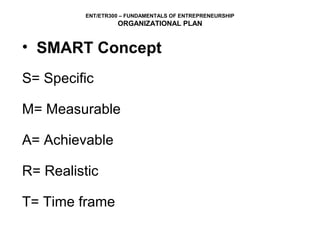
• SMART Concept
S= Specific

M= Measurable

A= Achievable

R= Realistic

T= Time frame
ENT/ETR300 – FUNDAMENTALS OF ENTREPRENEURSHIP
                   ORGANIZATIONAL PLAN


          TYPES OF GOALS
• Long term goals relate to extended period
  of time, typically five years or more.
• Intermediate goal are set for a period of
  one to five years.
• Short term goal are set for perhaps one
  year and are develop for several different
  areas.
ENT/ETR300 – FUNDAMENTALS OF ENTREPRENEURSHIP
                   ORGANIZATIONAL PLAN


ORGANIZATIONAL STRUCTURE
Organizational structure depends on the
needs of the organization
Steps are:
1.List all the work needed to be done in the
  organization
2.Group the work or job into section, unit or
  department
3.Construct diagrammatically through
  organizational chart
ENT/ETR300 – FUNDAMENTALS OF ENTREPRENEURSHIP
                  ORGANIZATIONAL PLAN


    ORGANIZATIONAL CHART
Organizational chart shows
• Job position
• Hierarchy
• Span of control
ENT/ETR300 – FUNDAMENTALS OF ENTREPRENEURSHIP
                    ORGANIZATIONAL PLAN


    TYPES OF ORGANIZATIONAL
           STRUCTURE
•   Function
•   Product
•   Client
•   Number of workers
•   Region
•   Shifts
ENT/ETR300 – FUNDAMENTALS OF ENTREPRENEURSHIP
              ORGANIZATIONAL PLAN


ORGANIZATIONAL STRUCTURE-
        FUNCTION
ENT/ETR300 – FUNDAMENTALS OF ENTREPRENEURSHIP
              ORGANIZATIONAL PLAN


ORGANIZATIONAL STRUCTURE-
        PRODUCT
ENT/ETR300 – FUNDAMENTALS OF ENTREPRENEURSHIP
              ORGANIZATIONAL PLAN


ORGANIZATIONAL STRUCTURE-
          CLIENT
ENT/ETR300 – FUNDAMENTALS OF ENTREPRENEURSHIP
             ORGANIZATIONAL PLAN


ORGANIZATIONAL STRUCTURE-
   NUMBER OF WORKERS
ENT/ETR300 – FUNDAMENTALS OF ENTREPRENEURSHIP
              ORGANIZATIONAL PLAN


ORGANIZATIONAL STRUCTURE-
         REGION
ENT/ETR300 – FUNDAMENTALS OF ENTREPRENEURSHIP
              ORGANIZATIONAL PLAN


ORGANIZATIONAL STRUCTURE-
          SHIFTS
ENT/ETR300 – FUNDAMENTALS OF ENTREPRENEURSHIP
                    ORGANIZATIONAL PLAN


         PREPARING AN
      ORGANISATIONAL PLAN
The steps in preparing an organisational plan
for a business:

1.   The introduction to the Organisation
2.   To develop an organisation chart
3.   To prepare a list of administration personnel
4.   To develop a schedule of tasks and
     responsibilities
5.   To develop a schedule of remuneration
6.   To determine the office equipment and supplies
7.   To prepare an administration budget
ENT/ETR300 – FUNDAMENTALS OF ENTREPRENEURSHIP
                      ORGANIZATIONAL PLAN


1.Introduction to the organisation
For the introduction, state the vision, mission and
objectives of the business organisation.
•   Business vision helps to prepare a small business to
    plan for the future and to achieve what it aspires to be.
•   Business mission is a statement that shows the
    purpose or reasons for its existence.
•   Business objectives are short term planning
    characterised by a more specific statements and with
    definite time frame. Use SMART concept.
•   Also include the following: business address, location
    plan, type of building and infrastructure.
ENT/ETR300 – FUNDAMENTALS OF ENTREPRENEURSHIP
                        ORGANIZATIONAL PLAN

2.Develop an organisation chart

Based on the structure of business, develop an
organisational chart that best suits the organisation.
The chart portrays the hierarchy and chain of command
of personnel in an organisation at a particular point of
time. The most commonly used organisational structure
by a small business is the line structure which is based
on :
•    Shifts
•    Number of workers
•    Functions
•    Products
•    Regions
•    Clients
ENT/ETR300 – FUNDAMENTALS OF ENTREPRENEURSHIP
                          ORGANIZATIONAL PLAN


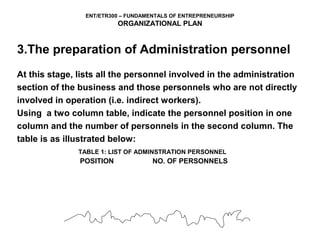
3.The preparation of Administration personnel
At this stage, lists all the personnel involved in the administration
section of the business and those personnels who are not directly
involved in operation (i.e. indirect workers).
Using a two column table, indicate the personnel position in one
column and the number of personnels in the second column. The
table is as illustrated below:
               TABLE 1: LIST OF ADMINSTRATION PERSONNEL
               POSITION             NO. OF PERSONNELS
ENT/ETR300 – FUNDAMENTALS OF ENTREPRENEURSHIP
                          ORGANIZATIONAL PLAN

4. Develop a schedule of Tasks and Responsibilities

The next step is to prepare a schedule of tasks and responsibilities.
For
each personnel position explain its main tasks and responsibilities.

This may be illustrated by drawing a two column table as in TABLE 2.
Then depict all the positions that have been described in TABLE 1
into
Column one of TABLE 2. In column two, explain the tasks and
responsibilities of each position.
              POSITION          TASKS AND RESPONSIBILITIES
                  TABLE 2: SCHEDULE OF TASKS AND RESPONSIBILITIES
ENT/ETR300 – FUNDAMENTALS OF ENTREPRENEURSHIP
                      ORGANIZATIONAL PLAN


5.Develop a Schedule of Remuneration
The remuneration of each personnel of all indirect workers has to
be taken into consideration beforehand. The remuneration
includes monthly salary or contractual wages, (daily, weekly or
on project basis) and all provident fund contribution as well as
work related insurance.

Take note that provident fund contribution to EPF by employers
is 12% (subject to regulatory changes) of base pay. Meanwhile,
SOCSO contribution will be based on an average of 2.5% of
personnel’s monthly salary not exceeding RM2000.

It would be made clearer, if a schedule of remuneration is
developed as below:
ENT/ETR300 – FUNDAMENTALS OF ENTREPRENEURSHIP
                       ORGANIZATIONAL PLAN


TABLE 3: SCHEDULE OF REMUNERATION


   POSITION   NO.      MONTHLY SALARY        EPF       SOCSO      TOTAL
                           (RM)             (RM)        (RM)   AMOUNT(RM)
                            (A)              (B)         (C)    (A)+(B)+( C)
ENT/ETR300 – FUNDAMENTALS OF ENTREPRENEURSHIP
                         ORGANIZATIONAL PLAN
6.Determine the Office Furniture and Fittings
The business owner is to list all the office furniture and
equipment that are necessary for the administration section.
It is also necessary to include all office supplies. In addition,
the owner should also survey and check on the prices of the
office equipment and supplies in order to spend within the
administration needs.
Develop a list of office furniture and fittings as shown below.
(Note: Also a prepare a separate list of office supplies. Example:
 Office stationeries)
                TABLE 4: LIST OF OFFICE FURNITURE AND FITTINGS


         TYPE         PRICE /UNIT         QUANTITY               TOTAL AMOUNT
                         (RM)                                        (RM)
ENT/ETR300 – FUNDAMENTALS OF ENTREPRENEURSHIP
                        ORGANIZATIONAL PLAN


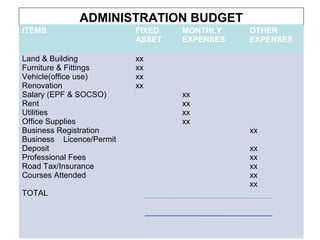
7.The Preparation of The Administration Budget
Upon the determination of the administration expenses classify
the items into the following categories:

   Capital Expenditures/ Fixed Asset Cost
   Working Capital/Monthly Expenses
   Other Expenses
ADMINISTRATION BUDGET
               ENT/ETR300 – FUNDAMENTALS OF ENTREPRENEURSHIP
                         ORGANIZATIONAL PLAN
ITEMS                        FIXED        MONTHLY              OTHER
                             ASSET        EXPENSES             EXPENSES

Land & Building              xx
Furniture & Fittings         xx
Vehicle(office use)          xx
Renovation                   xx
Salary (EPF & SOCSO)                      xx
Rent                                      xx
Utilities                                 xx
Office Supplies                           xx
Business Registration                                          xx
Business Licence/Permit
Deposit                                                        xx
Professional Fees                                              xx
Road Tax/Insurance                                             xx
Courses Attended                                               xx
                                                               xx
TOTAL
ENT/ETR300 – FUNDAMENTALS OF ENTREPRENEURSHIP
         ORGANIZATIONAL PLAN


 END OF MODULE 10

Ent300 module10

  • 1.
    ENT/ETR300 – FUNDAMENTALSOF ENTREPRENEURSHIP ORGANIZATIONAL PLAN ORGANIZATIONAL PLAN MODULE 10
  • 2.
    ENT/ETR300 – FUNDAMENTALSOF ENTREPRENEURSHIP ORGANIZATIONAL PLAN DEFINITION OF MANAGEMENT According to Mary Parker Follet it is “the art of getting things done through other people”. A process of planning all the resources efficiently, organized the resources effectively, leading then controlling the resources. Resources here refer to capital, manpower, technology and materials.
  • 3.
    ENT/ETR300 – FUNDAMENTALSOF ENTREPRENEURSHIP ORGANIZATIONAL PLAN FUNCTIONS OF MANAGEMENT Planning • A proper planning need to be developed in order to make sure all the resources is being fully utilized. • Planning involved goal setting and defining the action those need to be taken in order to achieve goals.
  • 4.
    ENT/ETR300 – FUNDAMENTALSOF ENTREPRENEURSHIP ORGANIZATIONAL PLAN • Managers that involved in planning require knowledge of the company, information on the factors of the environment, e.g. economic condition, good judgment in reducing risk and decision making.
  • 5.
    ENT/ETR300 – FUNDAMENTALSOF ENTREPRENEURSHIP ORGANIZATIONAL PLAN Organizing • Organizing involves determining the task to be done, who will do them and how those task will be managed and coordinated • The manager’s role in this situation is to coordinate the effort of the workers of different task and create the conditions to find solutions.
  • 6.
    ENT/ETR300 – FUNDAMENTALSOF ENTREPRENEURSHIP ORGANIZATIONAL PLAN Directing/Leading • Managers must be also capable of leading their subordinates to work together to achieve the organization goals. • Effective managers must try to understand individuals and group behavior, be able to motivate and discuss with their subordinates
  • 7.
    ENT/ETR300 – FUNDAMENTALSOF ENTREPRENEURSHIP ORGANIZATIONAL PLAN Controlling • Controlling is to identify between planned and actual result, whether the organization is performing as what had been planned. • If the organization is not going towards the goal, corrective action need to be taken in order to adjust the plan to the existing situation
  • 8.
    ENT/ETR300 – FUNDAMENTALSOF ENTREPRENEURSHIP ORGANIZATIONAL PLAN BUSINESS VISION • A vision statement describes what the organization aspires to be in the long term. • It is a description of the way in which the business wants to be perceived by others at some future date. • For example, TNB vision is “To be among the Leading Corporations in Energy and Related Businesses Globally"
  • 9.
    ENT/ETR300 – FUNDAMENTALSOF ENTREPRENEURSHIP ORGANIZATIONAL PLAN BUSINESS MISSION • Many businesses also have mission. • Mission statements are statements of how entrepreneurs will achieve their purposes in the environments in which they conduct business. • It is also the reason why an organization exists. • For example, TNB mission is “We Are Committed to Excellence in Our Products and Services”
  • 10.
    ENT/ETR300 – FUNDAMENTALSOF ENTREPRENEURSHIP ORGANIZATIONAL PLAN BUSINESS OBJECTIVES • It is the starting point in effective management. • Defined as what does a business hopes and plan to achieve. • In other word, goals are performance target. • Goals differ from business to business depending on its purpose and mission. • Any business functions systematically because it sets goals and plan accordingly.
  • 11.
    ENT/ETR300 – FUNDAMENTALSOF ENTREPRENEURSHIP ORGANIZATIONAL PLAN GOAL SETTING • Purposes • To provides direction and guidance for all entrepreneurs • To help firms allocate resources • To define corporate culture • To help entrepreneurs assess business performance
  • 12.
    ENT/ETR300 – FUNDAMENTALSOF ENTREPRENEURSHIP ORGANIZATIONAL PLAN • SMART Concept S= Specific M= Measurable A= Achievable R= Realistic T= Time frame
  • 13.
    ENT/ETR300 – FUNDAMENTALSOF ENTREPRENEURSHIP ORGANIZATIONAL PLAN TYPES OF GOALS • Long term goals relate to extended period of time, typically five years or more. • Intermediate goal are set for a period of one to five years. • Short term goal are set for perhaps one year and are develop for several different areas.
  • 14.
    ENT/ETR300 – FUNDAMENTALSOF ENTREPRENEURSHIP ORGANIZATIONAL PLAN ORGANIZATIONAL STRUCTURE Organizational structure depends on the needs of the organization Steps are: 1.List all the work needed to be done in the organization 2.Group the work or job into section, unit or department 3.Construct diagrammatically through organizational chart
  • 15.
    ENT/ETR300 – FUNDAMENTALSOF ENTREPRENEURSHIP ORGANIZATIONAL PLAN ORGANIZATIONAL CHART Organizational chart shows • Job position • Hierarchy • Span of control
  • 16.
    ENT/ETR300 – FUNDAMENTALSOF ENTREPRENEURSHIP ORGANIZATIONAL PLAN TYPES OF ORGANIZATIONAL STRUCTURE • Function • Product • Client • Number of workers • Region • Shifts
  • 17.
    ENT/ETR300 – FUNDAMENTALSOF ENTREPRENEURSHIP ORGANIZATIONAL PLAN ORGANIZATIONAL STRUCTURE- FUNCTION
  • 18.
    ENT/ETR300 – FUNDAMENTALSOF ENTREPRENEURSHIP ORGANIZATIONAL PLAN ORGANIZATIONAL STRUCTURE- PRODUCT
  • 19.
    ENT/ETR300 – FUNDAMENTALSOF ENTREPRENEURSHIP ORGANIZATIONAL PLAN ORGANIZATIONAL STRUCTURE- CLIENT
  • 20.
    ENT/ETR300 – FUNDAMENTALSOF ENTREPRENEURSHIP ORGANIZATIONAL PLAN ORGANIZATIONAL STRUCTURE- NUMBER OF WORKERS
  • 21.
    ENT/ETR300 – FUNDAMENTALSOF ENTREPRENEURSHIP ORGANIZATIONAL PLAN ORGANIZATIONAL STRUCTURE- REGION
  • 22.
    ENT/ETR300 – FUNDAMENTALSOF ENTREPRENEURSHIP ORGANIZATIONAL PLAN ORGANIZATIONAL STRUCTURE- SHIFTS
  • 23.
    ENT/ETR300 – FUNDAMENTALSOF ENTREPRENEURSHIP ORGANIZATIONAL PLAN PREPARING AN ORGANISATIONAL PLAN The steps in preparing an organisational plan for a business: 1. The introduction to the Organisation 2. To develop an organisation chart 3. To prepare a list of administration personnel 4. To develop a schedule of tasks and responsibilities 5. To develop a schedule of remuneration 6. To determine the office equipment and supplies 7. To prepare an administration budget
  • 24.
    ENT/ETR300 – FUNDAMENTALSOF ENTREPRENEURSHIP ORGANIZATIONAL PLAN 1.Introduction to the organisation For the introduction, state the vision, mission and objectives of the business organisation. • Business vision helps to prepare a small business to plan for the future and to achieve what it aspires to be. • Business mission is a statement that shows the purpose or reasons for its existence. • Business objectives are short term planning characterised by a more specific statements and with definite time frame. Use SMART concept. • Also include the following: business address, location plan, type of building and infrastructure.
  • 25.
    ENT/ETR300 – FUNDAMENTALSOF ENTREPRENEURSHIP ORGANIZATIONAL PLAN 2.Develop an organisation chart Based on the structure of business, develop an organisational chart that best suits the organisation. The chart portrays the hierarchy and chain of command of personnel in an organisation at a particular point of time. The most commonly used organisational structure by a small business is the line structure which is based on : • Shifts • Number of workers • Functions • Products • Regions • Clients
  • 26.
    ENT/ETR300 – FUNDAMENTALSOF ENTREPRENEURSHIP ORGANIZATIONAL PLAN 3.The preparation of Administration personnel At this stage, lists all the personnel involved in the administration section of the business and those personnels who are not directly involved in operation (i.e. indirect workers). Using a two column table, indicate the personnel position in one column and the number of personnels in the second column. The table is as illustrated below: TABLE 1: LIST OF ADMINSTRATION PERSONNEL POSITION NO. OF PERSONNELS
  • 27.
    ENT/ETR300 – FUNDAMENTALSOF ENTREPRENEURSHIP ORGANIZATIONAL PLAN 4. Develop a schedule of Tasks and Responsibilities The next step is to prepare a schedule of tasks and responsibilities. For each personnel position explain its main tasks and responsibilities. This may be illustrated by drawing a two column table as in TABLE 2. Then depict all the positions that have been described in TABLE 1 into Column one of TABLE 2. In column two, explain the tasks and responsibilities of each position. POSITION TASKS AND RESPONSIBILITIES TABLE 2: SCHEDULE OF TASKS AND RESPONSIBILITIES
  • 28.
    ENT/ETR300 – FUNDAMENTALSOF ENTREPRENEURSHIP ORGANIZATIONAL PLAN 5.Develop a Schedule of Remuneration The remuneration of each personnel of all indirect workers has to be taken into consideration beforehand. The remuneration includes monthly salary or contractual wages, (daily, weekly or on project basis) and all provident fund contribution as well as work related insurance. Take note that provident fund contribution to EPF by employers is 12% (subject to regulatory changes) of base pay. Meanwhile, SOCSO contribution will be based on an average of 2.5% of personnel’s monthly salary not exceeding RM2000. It would be made clearer, if a schedule of remuneration is developed as below:
  • 29.
    ENT/ETR300 – FUNDAMENTALSOF ENTREPRENEURSHIP ORGANIZATIONAL PLAN TABLE 3: SCHEDULE OF REMUNERATION POSITION NO. MONTHLY SALARY EPF SOCSO TOTAL (RM) (RM) (RM) AMOUNT(RM) (A) (B) (C) (A)+(B)+( C)
  • 30.
    ENT/ETR300 – FUNDAMENTALSOF ENTREPRENEURSHIP ORGANIZATIONAL PLAN 6.Determine the Office Furniture and Fittings The business owner is to list all the office furniture and equipment that are necessary for the administration section. It is also necessary to include all office supplies. In addition, the owner should also survey and check on the prices of the office equipment and supplies in order to spend within the administration needs. Develop a list of office furniture and fittings as shown below. (Note: Also a prepare a separate list of office supplies. Example: Office stationeries) TABLE 4: LIST OF OFFICE FURNITURE AND FITTINGS TYPE PRICE /UNIT QUANTITY TOTAL AMOUNT (RM) (RM)
  • 31.
    ENT/ETR300 – FUNDAMENTALSOF ENTREPRENEURSHIP ORGANIZATIONAL PLAN 7.The Preparation of The Administration Budget Upon the determination of the administration expenses classify the items into the following categories:  Capital Expenditures/ Fixed Asset Cost  Working Capital/Monthly Expenses  Other Expenses
  • 32.
    ADMINISTRATION BUDGET ENT/ETR300 – FUNDAMENTALS OF ENTREPRENEURSHIP ORGANIZATIONAL PLAN ITEMS FIXED MONTHLY OTHER ASSET EXPENSES EXPENSES Land & Building xx Furniture & Fittings xx Vehicle(office use) xx Renovation xx Salary (EPF & SOCSO) xx Rent xx Utilities xx Office Supplies xx Business Registration xx Business Licence/Permit Deposit xx Professional Fees xx Road Tax/Insurance xx Courses Attended xx xx TOTAL
  • 33.
    ENT/ETR300 – FUNDAMENTALSOF ENTREPRENEURSHIP ORGANIZATIONAL PLAN END OF MODULE 10