THE MARKETING
PLAN
Presented by:
Rhinelyn Bitonga
Michel Bula
Kc Mae Goloran
WHAT IS
MARKETING
PLAN?
A marketing plan is document
containing the marketing objectives,
marketing strategies, and the activities
that will be undertaken to execute this
strategies. The plan must consider the
overall goals of enterprise, which must
take precedence over the specific
marketing objectives.
The marketing strategies
that the entrepreneur will
execute must be based in
intelligent assessment of
the business environment.
 Pricing strategies- must consider the purchasing power
of the customers as long as the price levels of the similar
products available in the market.
 Distribution strategies- must consider the transportation
cost or the costs of operating a retail outlet.
• 4P’s of marketing- Product, Price, Place
(distribution), and promotion (also known as the
marketing mix)
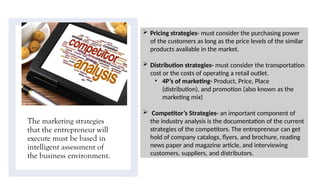
 Competitor’s Strategies- an important component of
the industry analysis is the documentation of the current
strategies of the competitors. The entrepreneur can get
hold of company catalogs, flyers, and brochure, reading
news paper and magazine article, and interviewing
customers, suppliers, and distributors.
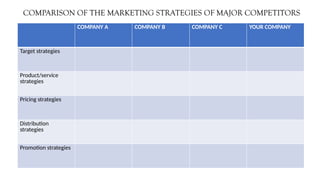
COMPANY A COMPANY B COMPANY C YOUR COMPANY
Target strategies
Product/service
strategies
Pricing strategies
Distribution
strategies
Promotion strategies
COMPARISON OF THE MARKETING STRATEGIES OF MAJOR COMPETITORS
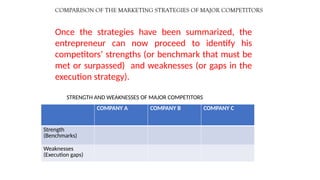
COMPANY A COMPANY B COMPANY C
Strength
(Benchmarks)
Weaknesses
(Execution gaps)
STRENGTH AND WEAKNESSES OF MAJOR COMPETITORS
Once the strategies have been summarized, the
entrepreneur can now proceed to identify his
competitors’ strengths (or benchmark that must be
met or surpassed) and weaknesses (or gaps in the
execution strategy).
COMPARISON OF THE MARKETING STRATEGIES OF MAJOR COMPETITORS
The MADI questions of Dr. Ned Roberto provides a useful way of
identifying unmet or unsatisfied customer need expectations. This will
require entrepreneur to interview customers or to conduct focus group
discussion (FGD) to determine the following of products or services that
now exist in the market.
oM- what is Missing?
oA- what is Annoying?
oD- what is Disappointing?
oI- what is Irritating?
PREPARING A MARKET PLAN INVOLVES THE
FOLLOWING STEPS;
Defining the target
Assessing the business situation
Step 1: decide what a general
market or industry you wish to
enter.
Step 2: Divide the market into
smaller groups based on
customer characteristics
a. Demograpic
b. Psychographic
c. Geographic
PREPARING A MARKET PLAN INVOLVES THE
FOLLOWING STEPS:
• Setting the market goals and objectives
Marketing objectives must be:
S- Specific,
M- Measurable,
A- Attainable,
R- Realistic,
T- Time-bound
PREPARING A
MARKET PLAN
INVOLVES THE
FOLLOWING
STEPS:
• Developing marketing strategy and marketing action
• Product must include the description of the product
or service that will be offered by the business.
• Pricing
 Cost-based pricing- calculating both variable cost (direct
labor, raw material, commission given to the salesperson or
the cost of packaging) and fixed cost (cost of things such as
facilities and equipment that do not change with the
number of units that are produced.
• Competition-based pricing- considering the existing
products or services in the market is a must.
• Value-based pricing- awareness of the value attached
by the customers to the products or services.
PREPARING A
MARKET PLAN
INVOLVES THE
FOLLOWING STEPS:
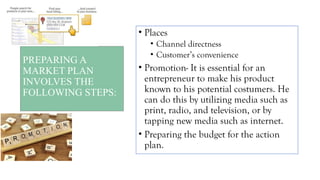
• Places
• Channel directness
• Customer’s convenience
• Promotion- It is essential for an
entrepreneur to make his product
known to his potential costumers. He
can do this by utilizing media such as
print, radio, and television, or by
tapping new media such as internet.
• Preparing the budget for the action
plan.
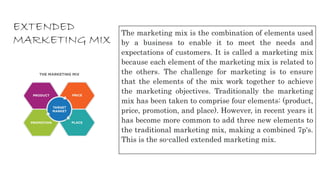
EXTENDED
MARKETING MIX
The marketing mix is the combination of elements used
by a business to enable it to meet the needs and
expectations of customers. It is called a marketing mix
because each element of the marketing mix is related to
the others. The challenge for marketing is to ensure
that the elements of the mix work together to achieve
the marketing objectives. Traditionally the marketing
mix has been taken to comprise four elements: (product,
price, promotion, and place). However, in recent years it
has become more common to add three new elements to
the traditional marketing mix, making a combined 7p's.
This is the so-called extended marketing mix.
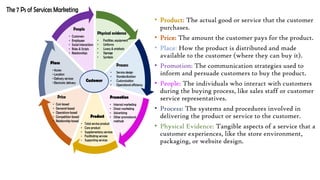
• Product: The actual good or service that the customer
purchases.
• Price: The amount the customer pays for the product.
• Place: How the product is distributed and made
available to the customer (where they can buy it).
• Promotion: The communication strategies used to
inform and persuade customers to buy the product.
• People: The individuals who interact with customers
during the buying process, like sales staff or customer
service representatives.
• Process: The systems and procedures involved in
delivering the product or service to the customer.
• Physical Evidence: Tangible aspects of a service that a
customer experiences, like the store environment,
packaging, or website design.
Marketing Plan is a guide for your making this plan

Marketing Plan is a guide for your making this plan

  • 2.
    THE MARKETING PLAN Presented by: RhinelynBitonga Michel Bula Kc Mae Goloran
  • 3.
    WHAT IS MARKETING PLAN? A marketingplan is document containing the marketing objectives, marketing strategies, and the activities that will be undertaken to execute this strategies. The plan must consider the overall goals of enterprise, which must take precedence over the specific marketing objectives.
  • 4.
    The marketing strategies thatthe entrepreneur will execute must be based in intelligent assessment of the business environment.  Pricing strategies- must consider the purchasing power of the customers as long as the price levels of the similar products available in the market.  Distribution strategies- must consider the transportation cost or the costs of operating a retail outlet. • 4P’s of marketing- Product, Price, Place (distribution), and promotion (also known as the marketing mix)  Competitor’s Strategies- an important component of the industry analysis is the documentation of the current strategies of the competitors. The entrepreneur can get hold of company catalogs, flyers, and brochure, reading news paper and magazine article, and interviewing customers, suppliers, and distributors.
  • 5.
    COMPANY A COMPANYB COMPANY C YOUR COMPANY Target strategies Product/service strategies Pricing strategies Distribution strategies Promotion strategies COMPARISON OF THE MARKETING STRATEGIES OF MAJOR COMPETITORS
  • 6.
    COMPARISON OF THEMARKETING STRATEGIES OF MAJOR COMPETITORS COMPANY A COMPANY B COMPANY C Strength (Benchmarks) Weaknesses (Execution gaps) STRENGTH AND WEAKNESSES OF MAJOR COMPETITORS Once the strategies have been summarized, the entrepreneur can now proceed to identify his competitors’ strengths (or benchmark that must be met or surpassed) and weaknesses (or gaps in the execution strategy).
  • 7.
    COMPARISON OF THEMARKETING STRATEGIES OF MAJOR COMPETITORS The MADI questions of Dr. Ned Roberto provides a useful way of identifying unmet or unsatisfied customer need expectations. This will require entrepreneur to interview customers or to conduct focus group discussion (FGD) to determine the following of products or services that now exist in the market. oM- what is Missing? oA- what is Annoying? oD- what is Disappointing? oI- what is Irritating?
  • 8.
    PREPARING A MARKETPLAN INVOLVES THE FOLLOWING STEPS; Defining the target Assessing the business situation Step 1: decide what a general market or industry you wish to enter. Step 2: Divide the market into smaller groups based on customer characteristics a. Demograpic b. Psychographic c. Geographic
  • 9.
    PREPARING A MARKETPLAN INVOLVES THE FOLLOWING STEPS: • Setting the market goals and objectives Marketing objectives must be: S- Specific, M- Measurable, A- Attainable, R- Realistic, T- Time-bound
  • 10.
    PREPARING A MARKET PLAN INVOLVESTHE FOLLOWING STEPS: • Developing marketing strategy and marketing action • Product must include the description of the product or service that will be offered by the business. • Pricing  Cost-based pricing- calculating both variable cost (direct labor, raw material, commission given to the salesperson or the cost of packaging) and fixed cost (cost of things such as facilities and equipment that do not change with the number of units that are produced. • Competition-based pricing- considering the existing products or services in the market is a must. • Value-based pricing- awareness of the value attached by the customers to the products or services.
  • 11.
    PREPARING A MARKET PLAN INVOLVESTHE FOLLOWING STEPS: • Places • Channel directness • Customer’s convenience • Promotion- It is essential for an entrepreneur to make his product known to his potential costumers. He can do this by utilizing media such as print, radio, and television, or by tapping new media such as internet. • Preparing the budget for the action plan.
  • 12.
    EXTENDED MARKETING MIX The marketingmix is the combination of elements used by a business to enable it to meet the needs and expectations of customers. It is called a marketing mix because each element of the marketing mix is related to the others. The challenge for marketing is to ensure that the elements of the mix work together to achieve the marketing objectives. Traditionally the marketing mix has been taken to comprise four elements: (product, price, promotion, and place). However, in recent years it has become more common to add three new elements to the traditional marketing mix, making a combined 7p's. This is the so-called extended marketing mix.
  • 13.
    • Product: Theactual good or service that the customer purchases. • Price: The amount the customer pays for the product. • Place: How the product is distributed and made available to the customer (where they can buy it). • Promotion: The communication strategies used to inform and persuade customers to buy the product. • People: The individuals who interact with customers during the buying process, like sales staff or customer service representatives. • Process: The systems and procedures involved in delivering the product or service to the customer. • Physical Evidence: Tangible aspects of a service that a customer experiences, like the store environment, packaging, or website design.