Edoardo Cervoni, M.D.
                                                       Ear Nose Throat Specialist


6th March 2013   GP Trainees - Education Centre, RPH
Discolosures
  Grant/Research Support: no disclosure
  Consultant: no disclosure
  Major Shareholder: Locumdoctor4u Ltd. (Locum and
   Concierge Medical Services)
  I will not be discussing “off-label” uses of medications
   or investigations


6th March 2013   GP Trainees - Education Centre, RPH
ENT Referrals
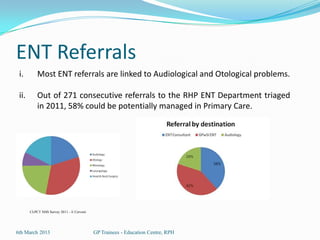
 i.        Most ENT referrals are linked to Audiological and Otological problems.

 ii.       Out of 271 consecutive referrals to the RHP ENT Department triaged
           in 2011, 58% could be potentially managed in Primary Care.


       CLPCT NHS Survey 2011 – E Cervoni


6th March 2013                             GP Trainees - Education Centre, RPH
ENT Referrals
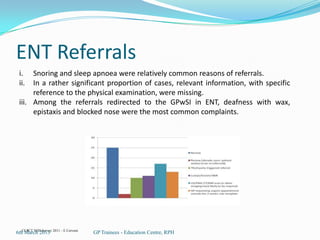
 i.   Snoring and sleep apnoea were relatively common reasons of referrals.
 ii.  In a rather significant proportion of cases, relevant information, with specific
      reference to the physical examination, were missing.
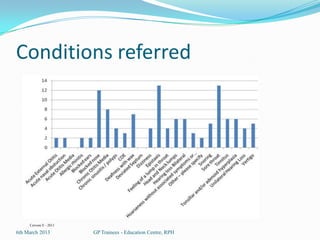
 iii. Among the referrals redirected to the GPwSI in ENT, deafness with wax,
      epistaxis and blocked nose were the most common complaints.


6thCLPCT NHS Survey 2011 – E Cervoni
    March 2013                         GP Trainees - Education Centre, RPH
Conditions referred


     Cervoni E - 2011

6th March 2013          GP Trainees - Education Centre, RPH
ENT Referral Pattern is changing


                     WHY?
    Ageing – Sanitation -
        Vaccinations
6th March 2013   GP Trainees - Education Centre, RPH
Demographics
  Lancashire residents grew during the decade to
   2011 by 3%. There was a 5% fall in the number of 0
   to 19 year olds, which was greater than the regional
   decrease.
  There was a 12% growth in people 65+ years, which
   was also above the regional average.
  The growth rate of the 65+ year olds was positive in
     all districts except Blackpool and the greatest in
     Chorley and West Lancashire.

6th March 2013   GP Trainees - Education Centre, RPH
 Sensory Presbycusis                       Metabolic Presbycusis
          High frequency down-                   Slowly progressive
        sloping SNHL                              Flat audiogram
       Speech discrimination                     Good speech discrimination
        remains good                              Atropy of stria vascularis
       Degeneration a basal
        potion of Organ of Corti               Conductive Presbycusis
        (predominately outer                      Thickening of basilar membrane
        hair cells)                               Gradual down-sloping high
    Neural presbycusis                           frequency hearing loss
       Flat audiogram
       Rapid hearing loss                       Progressive
       Poor speech                              Speech discrimination for similar
        discrimination                         pure tone hearing is worse in older
       Loss of spiral ganglion
        cells                                  patients than younger patients


6th March 2013       GP Trainees - Education Centre, RPH
Treatments
  Repeat testing
  Assistive devices
     Vibrating alarm clocks
     Flashing telephone and door signalers
     Television listening systems
     Personal amplifiers
  Hearing aids
       In U.S.A. an estimated 4.5 million hearing aid users , but
       only 10-20% who could use them do and 12% of people
       who have them don’t wear them.
6th March 2013     GP Trainees - Education Centre, RPH
Types of hearing aid circuitry
  Analog
  Digitally controlled analog
  Digital sound processing


  Body Aids
  Behind-the-ear (BTE)
  In-the-ear(ITE)
  In-the-canal(ITC)
  Completely-in-canal(CIC)
6th March 2013   GP Trainees - Education Centre, RPH
Dysphagia
  Phases of swallowing
     Oral (reduced facial muscle strength, decreased
      masticatory strength, reduced tongue control,
      missing dentition)
     Pharyngeal (delayed in elderly subjects,
      decreased pharyngolaryngeal sensory
      discrimination, abnormal UES function,
      increased penetration and silent aspiration)
     Oesophageal ( decreased or absent secondary
          peristalsis)


6th March 2013      GP Trainees - Education Centre, RPH
Evaluation
  History: Feeding problem vs. swallowing disorder
     Liquids vs. solids
     Globus, halitosis, wet vocal quality, reflux,
      odynophagia, recurrent pneumonia, hoarseness,
      dysarthria
  Physical Exam
     Oral cavity and upper aerodigestive tract, saliva
      quality/dentition/dentures
     Neurological evaluation including arousal,
      orientation, cognition, cranial nerves

6th March 2013   GP Trainees - Education Centre, RPH
Investigations
  Barium swallow (anatomic lesions)
  Modified barium swallow (dinamic view) of
   swallowing from oral cavity to lower
   esophageal sphincter)
  FEES – Functional endoscopic evaluation of
   swallowing
  Videofluoroscopic swallowing study, or
   VFSS test

6th March 2013   GP Trainees - Education Centre, RPH
Causes of dysphagia
  Stroke
  Neuromuscular disease - Parkinson’s disease (pill-
   rolling tremor, bradykinesia, cog-wheeling
   rigidity), Amyotrophic lateral sclerosis
  Medications (xerostomia, mental status change,
   dyskinesia, GERD, esophagitis)
  Cricopharyngeus dysfunction (functional,
   structural, “bar” on barium swallow)
  Zenker’s diverticulum (regurgitation)
  Neoplasms

6th March 2013   GP Trainees - Education Centre, RPH
Treatments
  Swallowing therapy
  Dietary modifications
  Rationalization of medications
  PEG
  Cricopharyngeal myotomy, Botox injection of
   cricopharyngeal bar
  Surgical repair of Zenker’s (open vs. endoscopic)


6th March 2013   GP Trainees - Education Centre, RPH
Balance Disorders
  Difficulties with sensory function, central nervous
   system integration, neuromuscular and skeletal
   function
  30-50% persons 65 and older fall in a given year
  50% per year fall age 80 or older
  1% of falls suffer hip fractures, 5% some type of
   fracture
  Roughly half of hip fractures are estimated to
   never recover normal function again

6th March 2013   GP Trainees - Education Centre, RPH
Vestibular changes with age
 Termed presbystasis
 Loss of hair cells primarily in the ampulla
 Total number of vestibular nerve axons is 37% than
  younger patients
 Loss of neurons in vestibular nuclei of 3% per decade
  age 40-90
 Reduction in gain of VOR, smooth pursuit, increase in
  saccade latencies
     Postural stability: Sensory (visual, hearing, vestibular,
     proprioceptive)/Musculoskeletal/Cognitive/Integrative
     function
6th March 2013     GP Trainees - Education Centre, RPH
Other factors in balance disorders
  Cerebellar degeneration, Parkinson’s disease,
     Huntington’s disease, vitamin B12 deficiency,
     dementia, diabetic neuropathy, brain and spinal cord
     tumors, postural hypotension, cerebrovascular disease,
     atherosclerosis, musculoskeletal disease, metabolic
     disorders, cardiovascular disorders, medications,
     visual impairment


6th March 2013   GP Trainees - Education Centre, RPH
 History
                    Dizziness, dysequilibrium, vertigo
                    Onset, duration, frequency, severity, provocation,
                      associated symptoms, falls
                     Medications, medical conditions
                  Physical exam
                     Examine sensory functions, posture, gait,
                      neurological function
                  Adjunctive testing
                     Audiogram, electronystagmography, MRI,
                      posturography


6th March 2013            GP Trainees - Education Centre, RPH
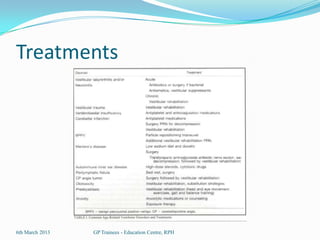
Treatments


6th March 2013   GP Trainees - Education Centre, RPH
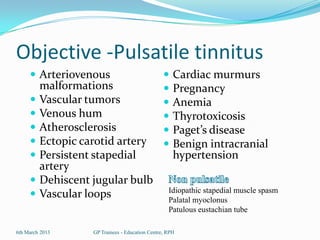
Objective -Pulsatile tinnitus
      Arteriovenous                                Cardiac murmurs
         malformations                              Pregnancy
        Vascular tumors                            Anemia
        Venous hum                                 Thyrotoxicosis
        Atherosclerosis                            Paget’s disease
        Ectopic carotid artery                     Benign intracranial
        Persistent stapedial                        hypertension
         artery
        Dehiscent jugular bulb
                                                   Idiopathic stapedial muscle spasm
        Vascular loops                            Palatal myoclonus
                                                   Patulous eustachian tube

6th March 2013     GP Trainees - Education Centre, RPH
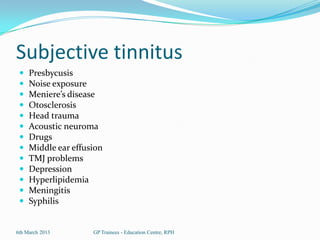
Subjective tinnitus
    Presbycusis
    Noise exposure
    Meniere’s disease
    Otosclerosis
    Head trauma
    Acoustic neuroma
    Drugs
    Middle ear effusion
    TMJ problems
    Depression
    Hyperlipidemia
    Meningitis
    Syphilis


6th March 2013       GP Trainees - Education Centre, RPH
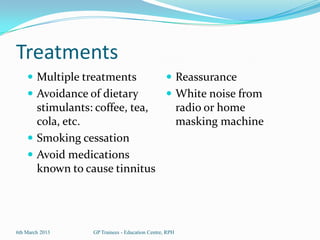
Treatments
     Multiple treatments                        Reassurance
     Avoidance of dietary                       White noise from
      stimulants: coffee, tea,                         radio or home
      cola, etc.                                       masking machine
     Smoking cessation
     Avoid medications
      known to cause tinnitus


6th March 2013   GP Trainees - Education Centre, RPH
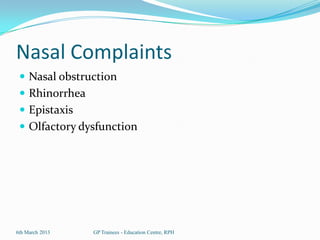
Nasal Complaints
  Nasal obstruction
  Rhinorrhea
  Epistaxis
  Olfactory dysfunction


6th March 2013   GP Trainees - Education Centre, RPH
Causes
  Inflammation: decrease immune function, mucociliary
     dysfunction, allergy, dehydration with thickening of
     secretions
    Dystrophic changes: both atrophy of nasal mucosa and
     increase in vasomotor rhinitis are common
    Neoplasia: nasal obstruction, pain, epistaxis, rhinorrhea
    Trauma: old traumas, previous surgery
    Endocrine-metabolic disorders: hypothyroidism, decreased
     vitamin A and zinc
    Pharmacologic effects: diuretics, tricyclic antidepressants,
     antihistamines

6th March 2013     GP Trainees - Education Centre, RPH
Voice changes
  Estimated 12% of the elderly have vocal dysfunction
  Fundamental frequency of the male voice tends to
   increase with age
  Fundamental frequency in females decreases with age


6th March 2013   GP Trainees - Education Centre, RPH
Voice changes
  Common vocal cord findings
     Atrophy
     Bowed cords
     Oedema
     Loss of collagen and elastic fibers, decrease in
      density of fibroblasts, atrophy of submucous
      glands, fibrosis, disorganization of collagen fibers


6th March 2013   GP Trainees - Education Centre, RPH
Neurological disorders with voice changes
  Essential tremor
  Parkinson’s disease: low volume, breathy, and
   monotonic
  Stroke
  Myasthenia gravis
  Amyotrophic lateral sclerosis


6th March 2013   GP Trainees - Education Centre, RPH
Treatments
  Speech therapy
  Medialization thyroplasty
  Diagnosis and treatment of underlying disorder


6th March 2013   GP Trainees - Education Centre, RPH
Cancer
  Squamous cell cancers
  Thyroid malignancies
     Well differentiated have worse course
     Anaplastic or undifferentiated more common
  Salivary gland malignancies
  Lymphomas


6th March 2013   GP Trainees - Education Centre, RPH
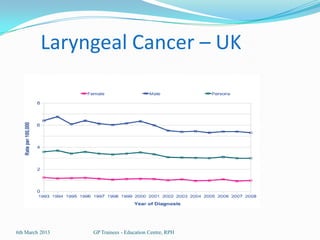
Laryngeal Cancer – UK


6th March 2013   GP Trainees - Education Centre, RPH
Cosmetics
  Elderly are leading more active lives for much longer
   than in the past
  With the explosive growth of cosmetic facial plastic
   surgery paired with the explosive growth of the elderly
   population there will be many more “elderly” cosmetic
   patients


6th March 2013   GP Trainees - Education Centre, RPH
 Skin- loss of tone, dynamic and static wrinkling,
  thinning, pigmentary changes, gravitational
  descent of soft tissues
    Chemical peel, laser resurfacing
    Botox injection
    Rhytidectomy
 Upper third-ptosis of eyebrows and forehead
   Direct brow lift
   Pretrichial/coronal/endoscopic

6th March 2013   GP Trainees - Education Centre, RPH
 Periorbital Region - lower eyelid laxity, prolapsed lacrimal gland, ptosis
      (usually dermatochalasis)
         Dacryoadenopexy
         Lower lid shortening
         Upper/lower blepharoplasty
     Nose – tip ptosis from loss of attachments between upper and lower lateral
      cartilages, loss of connections between medial crura and septum,
      ligamentous connections between domes of lower lateral cartilages and
      anterior septal angle
         Rhinoplasty-shorten lateral crura, place septal strut
     Lower third – loss of premental fat pad “witches chin”, cheiloptosis,
        platysmal bands
          Genioplasty
          Lip-lift
          Plication, imbrication, suture suspension, Z-plasty of platysma


6th March 2013          GP Trainees - Education Centre, RPH
Conclusions
  With the expected explosive growth of the elderly
   population, this group will become a larger proportion
   of patients
  The otolaryngologist must consider the patient’s
   health and well being as a whole especially in this
   group of patients who often have multiple problems


6th March 2013   GP Trainees - Education Centre, RPH
1.    Parham K, Lin FR, Coelho DH, Sataloff RT, Gates GA. Comprehensive Management of Presbycusis: Central and Peripheral. Otolaryngol
          Head Neck Surg. 2013 Feb 8.
    2.    Creighton FX Jr, Poliashenko SM, Statham MM, Abramson P, Johns MM 3rd. The growing geriatric otolaryngology patient population: a
          study of 131,700 new patient encounters. Laryngoscope. 2013 Jan;123(1):97-102.
    3.    Dagan E, Wolf M, Migirov LM. Why do geriatric patients attend otolaryngology emergency rooms? Isr Med Assoc J. 2012 Oct;14(10):633-
          6.
    4.    Kumar S, Rout N, Kumari P, Dey B. The conceptions of hearing impairment, causes and its management: a train survey. Int J Pediatr
          Otorhinolaryngol. 2012 Aug;76(8):1123-6. doi: 10.1016/j.ijporl.2012.04.014. Epub 2012 May 12.
    5.    Van Vuuren PA, Kagan SH, Chalian AA. Geriatric otolaryngology toolbox: what you and your nurse can do to improve outcomes for
          older adults. Ear Nose Throat J. 2009 Oct;88(10):1162-8.
    6.    Chalian AA. Accomplishment and opportunity in geriatric otolaryngology. Ear Nose Throat J. 2009 Oct;88(10):1156-61.
    7.    Goldstein JC. The American Society of Geriatric Otolaryngology. Ear Nose Throat J. 2007 Dec;86(12):718-9.
    8.    Eibenstein A, Fioretti AB, Simaskou MN, Sucapane P, Mearelli S, Mina C, Amabile G, Fusetti M. Olfactory screening test in mild
          cognitive impairment. Neurol Sci. 2005 Jul;26(3):156-60.
    9.    Bora H, Bandyopadhyay SN, Basu SK, Majhi PK. Geriatric problems in otolaryngology. J Indian Med Assoc. 2004 Jul;102(7):366, 368, 370.
          Review.
    10.   Vaiman M, Eviatar E, Segal S. Surface electromyographic studies of swallowing in normal subjects: a review of 440 adults. Report 1.
          Quantitative data: timing measures. Otolaryngol Head Neck Surg. 2004 Oct;131(4):548-55.
    11.   Belafsky PC, Postma GN, Amin MR, Koufman JA. Symptoms and findings of laryngopharyngeal reflux. Ear Nose Throat J. 2002 Sep;81(9
          Suppl 2):10-3.
    12.   Sahoo GC. Gerontology in ENT (Geriatric Otolaryngology) - an over view. Indian J Otolaryngol Head Neck Surg. 2001 Oct;53(4):267-9.
    13.   Jiang RS, Hsu CY. Endoscopic sinus surgery for the treatment of chronic sinusitis in geriatric patients. Ear Nose Throat J. 2001
          Apr;80(4):230-2.


6th March 2013                        GP Trainees - Education Centre, RPH

Ent: looking ahead

  • 1.
    Edoardo Cervoni, M.D. Ear Nose Throat Specialist 6th March 2013 GP Trainees - Education Centre, RPH
  • 2.
    Discolosures  Grant/ResearchSupport: no disclosure  Consultant: no disclosure  Major Shareholder: Locumdoctor4u Ltd. (Locum and Concierge Medical Services)  I will not be discussing “off-label” uses of medications or investigations 6th March 2013 GP Trainees - Education Centre, RPH
  • 3.
    ENT Referrals i. Most ENT referrals are linked to Audiological and Otological problems. ii. Out of 271 consecutive referrals to the RHP ENT Department triaged in 2011, 58% could be potentially managed in Primary Care. CLPCT NHS Survey 2011 – E Cervoni 6th March 2013 GP Trainees - Education Centre, RPH
  • 4.
    ENT Referrals i. Snoring and sleep apnoea were relatively common reasons of referrals. ii. In a rather significant proportion of cases, relevant information, with specific reference to the physical examination, were missing. iii. Among the referrals redirected to the GPwSI in ENT, deafness with wax, epistaxis and blocked nose were the most common complaints. 6thCLPCT NHS Survey 2011 – E Cervoni March 2013 GP Trainees - Education Centre, RPH
  • 5.
    Conditions referred Cervoni E - 2011 6th March 2013 GP Trainees - Education Centre, RPH
  • 6.
    ENT Referral Patternis changing WHY? Ageing – Sanitation - Vaccinations 6th March 2013 GP Trainees - Education Centre, RPH
  • 7.
    Demographics  Lancashireresidents grew during the decade to 2011 by 3%. There was a 5% fall in the number of 0 to 19 year olds, which was greater than the regional decrease.  There was a 12% growth in people 65+ years, which was also above the regional average.  The growth rate of the 65+ year olds was positive in all districts except Blackpool and the greatest in Chorley and West Lancashire. 6th March 2013 GP Trainees - Education Centre, RPH
  • 8.
     Sensory Presbycusis Metabolic Presbycusis  High frequency down- Slowly progressive sloping SNHL Flat audiogram  Speech discrimination Good speech discrimination remains good Atropy of stria vascularis  Degeneration a basal potion of Organ of Corti Conductive Presbycusis (predominately outer Thickening of basilar membrane hair cells) Gradual down-sloping high  Neural presbycusis frequency hearing loss  Flat audiogram  Rapid hearing loss Progressive  Poor speech Speech discrimination for similar discrimination pure tone hearing is worse in older  Loss of spiral ganglion cells patients than younger patients 6th March 2013 GP Trainees - Education Centre, RPH
  • 9.
    Treatments  Repeattesting  Assistive devices  Vibrating alarm clocks  Flashing telephone and door signalers  Television listening systems  Personal amplifiers  Hearing aids In U.S.A. an estimated 4.5 million hearing aid users , but only 10-20% who could use them do and 12% of people who have them don’t wear them. 6th March 2013 GP Trainees - Education Centre, RPH
  • 10.
    Types of hearingaid circuitry  Analog  Digitally controlled analog  Digital sound processing  Body Aids  Behind-the-ear (BTE)  In-the-ear(ITE)  In-the-canal(ITC)  Completely-in-canal(CIC) 6th March 2013 GP Trainees - Education Centre, RPH
  • 11.
    Dysphagia  Phasesof swallowing  Oral (reduced facial muscle strength, decreased masticatory strength, reduced tongue control, missing dentition)  Pharyngeal (delayed in elderly subjects, decreased pharyngolaryngeal sensory discrimination, abnormal UES function, increased penetration and silent aspiration)  Oesophageal ( decreased or absent secondary peristalsis) 6th March 2013 GP Trainees - Education Centre, RPH
  • 12.
    Evaluation  History:Feeding problem vs. swallowing disorder  Liquids vs. solids  Globus, halitosis, wet vocal quality, reflux, odynophagia, recurrent pneumonia, hoarseness, dysarthria  Physical Exam  Oral cavity and upper aerodigestive tract, saliva quality/dentition/dentures  Neurological evaluation including arousal, orientation, cognition, cranial nerves 6th March 2013 GP Trainees - Education Centre, RPH
  • 13.
    Investigations  Bariumswallow (anatomic lesions)  Modified barium swallow (dinamic view) of swallowing from oral cavity to lower esophageal sphincter)  FEES – Functional endoscopic evaluation of swallowing  Videofluoroscopic swallowing study, or VFSS test 6th March 2013 GP Trainees - Education Centre, RPH
  • 14.
    Causes of dysphagia  Stroke  Neuromuscular disease - Parkinson’s disease (pill- rolling tremor, bradykinesia, cog-wheeling rigidity), Amyotrophic lateral sclerosis  Medications (xerostomia, mental status change, dyskinesia, GERD, esophagitis)  Cricopharyngeus dysfunction (functional, structural, “bar” on barium swallow)  Zenker’s diverticulum (regurgitation)  Neoplasms 6th March 2013 GP Trainees - Education Centre, RPH
  • 15.
    Treatments  Swallowingtherapy  Dietary modifications  Rationalization of medications  PEG  Cricopharyngeal myotomy, Botox injection of cricopharyngeal bar  Surgical repair of Zenker’s (open vs. endoscopic) 6th March 2013 GP Trainees - Education Centre, RPH
  • 16.
    Balance Disorders Difficulties with sensory function, central nervous system integration, neuromuscular and skeletal function  30-50% persons 65 and older fall in a given year  50% per year fall age 80 or older  1% of falls suffer hip fractures, 5% some type of fracture  Roughly half of hip fractures are estimated to never recover normal function again 6th March 2013 GP Trainees - Education Centre, RPH
  • 17.
    Vestibular changes withage  Termed presbystasis  Loss of hair cells primarily in the ampulla  Total number of vestibular nerve axons is 37% than younger patients  Loss of neurons in vestibular nuclei of 3% per decade age 40-90  Reduction in gain of VOR, smooth pursuit, increase in saccade latencies Postural stability: Sensory (visual, hearing, vestibular, proprioceptive)/Musculoskeletal/Cognitive/Integrative function 6th March 2013 GP Trainees - Education Centre, RPH
  • 18.
    Other factors inbalance disorders  Cerebellar degeneration, Parkinson’s disease, Huntington’s disease, vitamin B12 deficiency, dementia, diabetic neuropathy, brain and spinal cord tumors, postural hypotension, cerebrovascular disease, atherosclerosis, musculoskeletal disease, metabolic disorders, cardiovascular disorders, medications, visual impairment 6th March 2013 GP Trainees - Education Centre, RPH
  • 19.
     History  Dizziness, dysequilibrium, vertigo  Onset, duration, frequency, severity, provocation, associated symptoms, falls  Medications, medical conditions  Physical exam  Examine sensory functions, posture, gait, neurological function  Adjunctive testing  Audiogram, electronystagmography, MRI, posturography 6th March 2013 GP Trainees - Education Centre, RPH
  • 20.
    Treatments 6th March 2013 GP Trainees - Education Centre, RPH
  • 21.
    Objective -Pulsatile tinnitus  Arteriovenous  Cardiac murmurs malformations  Pregnancy  Vascular tumors  Anemia  Venous hum  Thyrotoxicosis  Atherosclerosis  Paget’s disease  Ectopic carotid artery  Benign intracranial  Persistent stapedial hypertension artery  Dehiscent jugular bulb Idiopathic stapedial muscle spasm  Vascular loops Palatal myoclonus Patulous eustachian tube 6th March 2013 GP Trainees - Education Centre, RPH
  • 22.
    Subjective tinnitus  Presbycusis  Noise exposure  Meniere’s disease  Otosclerosis  Head trauma  Acoustic neuroma  Drugs  Middle ear effusion  TMJ problems  Depression  Hyperlipidemia  Meningitis  Syphilis 6th March 2013 GP Trainees - Education Centre, RPH
  • 23.
    Treatments  Multiple treatments  Reassurance  Avoidance of dietary  White noise from stimulants: coffee, tea, radio or home cola, etc. masking machine  Smoking cessation  Avoid medications known to cause tinnitus 6th March 2013 GP Trainees - Education Centre, RPH
  • 24.
    Nasal Complaints Nasal obstruction  Rhinorrhea  Epistaxis  Olfactory dysfunction 6th March 2013 GP Trainees - Education Centre, RPH
  • 25.
    Causes  Inflammation:decrease immune function, mucociliary dysfunction, allergy, dehydration with thickening of secretions  Dystrophic changes: both atrophy of nasal mucosa and increase in vasomotor rhinitis are common  Neoplasia: nasal obstruction, pain, epistaxis, rhinorrhea  Trauma: old traumas, previous surgery  Endocrine-metabolic disorders: hypothyroidism, decreased vitamin A and zinc  Pharmacologic effects: diuretics, tricyclic antidepressants, antihistamines 6th March 2013 GP Trainees - Education Centre, RPH
  • 26.
    Voice changes Estimated 12% of the elderly have vocal dysfunction  Fundamental frequency of the male voice tends to increase with age  Fundamental frequency in females decreases with age 6th March 2013 GP Trainees - Education Centre, RPH
  • 27.
    Voice changes Common vocal cord findings  Atrophy  Bowed cords  Oedema  Loss of collagen and elastic fibers, decrease in density of fibroblasts, atrophy of submucous glands, fibrosis, disorganization of collagen fibers 6th March 2013 GP Trainees - Education Centre, RPH
  • 28.
    Neurological disorders withvoice changes  Essential tremor  Parkinson’s disease: low volume, breathy, and monotonic  Stroke  Myasthenia gravis  Amyotrophic lateral sclerosis 6th March 2013 GP Trainees - Education Centre, RPH
  • 29.
    Treatments  Speechtherapy  Medialization thyroplasty  Diagnosis and treatment of underlying disorder 6th March 2013 GP Trainees - Education Centre, RPH
  • 30.
    Cancer  Squamouscell cancers  Thyroid malignancies  Well differentiated have worse course  Anaplastic or undifferentiated more common  Salivary gland malignancies  Lymphomas 6th March 2013 GP Trainees - Education Centre, RPH
  • 31.
    Laryngeal Cancer –UK 6th March 2013 GP Trainees - Education Centre, RPH
  • 32.
    Cosmetics  Elderlyare leading more active lives for much longer than in the past  With the explosive growth of cosmetic facial plastic surgery paired with the explosive growth of the elderly population there will be many more “elderly” cosmetic patients 6th March 2013 GP Trainees - Education Centre, RPH
  • 33.
     Skin- lossof tone, dynamic and static wrinkling, thinning, pigmentary changes, gravitational descent of soft tissues  Chemical peel, laser resurfacing  Botox injection  Rhytidectomy  Upper third-ptosis of eyebrows and forehead  Direct brow lift  Pretrichial/coronal/endoscopic 6th March 2013 GP Trainees - Education Centre, RPH
  • 34.
     Periorbital Region- lower eyelid laxity, prolapsed lacrimal gland, ptosis (usually dermatochalasis)  Dacryoadenopexy  Lower lid shortening  Upper/lower blepharoplasty  Nose – tip ptosis from loss of attachments between upper and lower lateral cartilages, loss of connections between medial crura and septum, ligamentous connections between domes of lower lateral cartilages and anterior septal angle  Rhinoplasty-shorten lateral crura, place septal strut  Lower third – loss of premental fat pad “witches chin”, cheiloptosis, platysmal bands  Genioplasty  Lip-lift  Plication, imbrication, suture suspension, Z-plasty of platysma 6th March 2013 GP Trainees - Education Centre, RPH
  • 35.
    Conclusions  Withthe expected explosive growth of the elderly population, this group will become a larger proportion of patients  The otolaryngologist must consider the patient’s health and well being as a whole especially in this group of patients who often have multiple problems 6th March 2013 GP Trainees - Education Centre, RPH
  • 36.
    1. Parham K, Lin FR, Coelho DH, Sataloff RT, Gates GA. Comprehensive Management of Presbycusis: Central and Peripheral. Otolaryngol Head Neck Surg. 2013 Feb 8. 2. Creighton FX Jr, Poliashenko SM, Statham MM, Abramson P, Johns MM 3rd. The growing geriatric otolaryngology patient population: a study of 131,700 new patient encounters. Laryngoscope. 2013 Jan;123(1):97-102. 3. Dagan E, Wolf M, Migirov LM. Why do geriatric patients attend otolaryngology emergency rooms? Isr Med Assoc J. 2012 Oct;14(10):633- 6. 4. Kumar S, Rout N, Kumari P, Dey B. The conceptions of hearing impairment, causes and its management: a train survey. Int J Pediatr Otorhinolaryngol. 2012 Aug;76(8):1123-6. doi: 10.1016/j.ijporl.2012.04.014. Epub 2012 May 12. 5. Van Vuuren PA, Kagan SH, Chalian AA. Geriatric otolaryngology toolbox: what you and your nurse can do to improve outcomes for older adults. Ear Nose Throat J. 2009 Oct;88(10):1162-8. 6. Chalian AA. Accomplishment and opportunity in geriatric otolaryngology. Ear Nose Throat J. 2009 Oct;88(10):1156-61. 7. Goldstein JC. The American Society of Geriatric Otolaryngology. Ear Nose Throat J. 2007 Dec;86(12):718-9. 8. Eibenstein A, Fioretti AB, Simaskou MN, Sucapane P, Mearelli S, Mina C, Amabile G, Fusetti M. Olfactory screening test in mild cognitive impairment. Neurol Sci. 2005 Jul;26(3):156-60. 9. Bora H, Bandyopadhyay SN, Basu SK, Majhi PK. Geriatric problems in otolaryngology. J Indian Med Assoc. 2004 Jul;102(7):366, 368, 370. Review. 10. Vaiman M, Eviatar E, Segal S. Surface electromyographic studies of swallowing in normal subjects: a review of 440 adults. Report 1. Quantitative data: timing measures. Otolaryngol Head Neck Surg. 2004 Oct;131(4):548-55. 11. Belafsky PC, Postma GN, Amin MR, Koufman JA. Symptoms and findings of laryngopharyngeal reflux. Ear Nose Throat J. 2002 Sep;81(9 Suppl 2):10-3. 12. Sahoo GC. Gerontology in ENT (Geriatric Otolaryngology) - an over view. Indian J Otolaryngol Head Neck Surg. 2001 Oct;53(4):267-9. 13. Jiang RS, Hsu CY. Endoscopic sinus surgery for the treatment of chronic sinusitis in geriatric patients. Ear Nose Throat J. 2001 Apr;80(4):230-2. 6th March 2013 GP Trainees - Education Centre, RPH