Locks On Students’ Ability
to Understand Directions
They don’t perceive the message we are
sending. (Gore 27)
They don’t discriminate between what they
are supposed to do and what they are not
supposed to do. (Gore 27)
They are confused. (Gore 27)
They have poor metacognition, resulting in
thinking that they understand our
directions when they don’t. (Gore 27)
As a result they have problems completing
assignments because they don’t get
started on the right foot. (Gore 27)
Studies on How to Give Instructions Are Far More
Common in Law and Medicine Than Education.
Many researchers in the
medical field have
investigated how to
clarify instructions in a
wide variety of contexts.
From this information,
teachers can conclude
that:

Instructions should be explicit rather
than implicit. (Gore 27)
Instructions should be worded clearly.
(Gore 27)
Instructions should be worded simply.
(Gore 27)
Subtle shifts in wording can produce
significant differences. (Gore 27)
Instructors should have learners repeat
back instructions to ensure
understanding. (Gore 27)
Further Observation in the
Field of Education
An education
administrator who
noted that he had
observed over one
thousand lessons
being taught
provided the
following
instructions on
giving
instructions.

Make instructions concrete. (Gore 28)
List the materials needed. (Gore 28)
List the steps to be followed so students can
mentally check them off; do NOT use paragraph
form. (Gore 28)

Give multiple representations of directions: written
and verbal, pictorial and diagrammatic, a
demonstration of exemplary exemplars (outstanding
work). (Gore 28)
When multiple steps are involved, give instructions
in “bite-sized chunks” (Dyrli, 1999), having students
complete several steps before discussing the
results and them presenting the next set of
instructions (Dyrli, 1999).
The 5 Keys to Giving
Instructions Successfully
Key 1: Gain Students’ Full Attention
Key 2: Provide Written and Oral Instructions

Key 3: Repeat Instructions
Key 4: Chunk Instructions
Key 5: Solicit Tell-Backs and Show-Mes
Gain Students Full
Attention
Executive attention: the ability to
willfully inhibit attention from being
drawn to irrelevant stimuli. (Gore 29)

Selective attention: being able to focus
attention on relevant stimuli while
screening out the irrelevant. (Gore 29)
Sustained attention: maintaining
attention over a prolonger period of
time in order to detect infrequent
signals. (Gore 29)
Orienting attention: direct attention to
a specified location and reorienting to
a new location. (Gore 29)

Utilize two-cue systems for gaining
attention and giving instructions.

Such as creating a hand signal to
signify when it is time to be silent
and another signal before you give
directions.
Using attentional cues to prepare
students for receiving instructions
is a good strategy because:
Attention is ensured and confusion
is eliminated. (Gore 29)
Provide Written and
Oral Instructions
According to Hursh, Schumaker,
Fawcett, and Sherman’s (2000)
comparison of instruction delivery,
the half of the students who
received written instructions
increased their performance on 58%
of the possible applications while the
students who received oral
instructions increased by 87%.
However, improvement in
applications was only maintained by
50% of the oral instruction students
compared to the 75% maintained by
students give written instructions.

Providing oral and written instructions
helps students with ELN succeed
because:
Perception improves with multicoding of
information. (Gore 30)
Confusion is eliminated when perception
is supported. (Gore 30)
Sequencing is facilitated when students
both hear and see instructions. (Gore 30)
Frustration is reduced when students
understand what they are supposed to do.
(Gore 30)
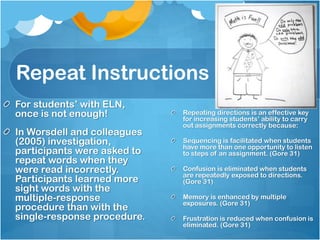
Repeat Instructions
For students’ with ELN,
once is not enough!
In Worsdell and colleagues
(2005) investigation,
participants were asked to
repeat words when they
were read incorrectly.
Participants learned more
sight words with the
multiple-response
procedure than with the
single-response procedure.

Repeating directions is an effective key
for increasing students’ ability to carry
out assignments correctly because:
Sequencing is facilitated when students
have more than one opportunity to listen
to steps of an assignment. (Gore 31)
Confusion is eliminated when students
are repeatedly exposed to directions.
(Gore 31)
Memory is enhanced by multiple
exposures. (Gore 31)
Frustration is reduced when confusion is
eliminated. (Gore 31)
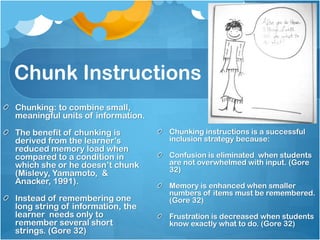
Chunk Instructions
Chunking: to combine small,
meaningful units of information.
The benefit of chunking is
derived from the learner’s
reduced memory load when
compared to a condition in
which she or he doesn’t chunk
(Mislevy, Yamamoto, &
Anacker, 1991).
Instead of remembering one
long string of information, the
learner needs only to
remember several short
strings. (Gore 32)

Chunking instructions is a successful
inclusion strategy because:
Confusion is eliminated when students
are not overwhelmed with input. (Gore
32)
Memory is enhanced when smaller
numbers of items must be remembered.
(Gore 32)
Frustration is decreased when students
know exactly what to do. (Gore 32)
Solicit Tell-Backs
and Show-Mes
According to Brown,
Dunne, and Cooper’s
(1996) investigation of how
ELN students can
overcome difficulties with
listening comprehension,
nine out of ten participants
showed improvement when
subjected to listening to
information and giving
back immediate retells.

Tell-Backs and Show-Mes are good inclusion
strategies because:
Confusion is eliminated when students know
exactly what to do. (Gore 33)
Memory is enhanced when students when
students repeat back or demonstrate
instructions. (Gore 33)
Metacognition is increased when students
know that they know what to do. (Gore 33)
Frustration is eliminated when confusion is
eliminated. (Gore 33)

Ensuring Students Understand Instructions

  • 2.
    Locks On Students’Ability to Understand Directions They don’t perceive the message we are sending. (Gore 27) They don’t discriminate between what they are supposed to do and what they are not supposed to do. (Gore 27) They are confused. (Gore 27) They have poor metacognition, resulting in thinking that they understand our directions when they don’t. (Gore 27) As a result they have problems completing assignments because they don’t get started on the right foot. (Gore 27)
  • 3.
    Studies on Howto Give Instructions Are Far More Common in Law and Medicine Than Education. Many researchers in the medical field have investigated how to clarify instructions in a wide variety of contexts. From this information, teachers can conclude that: Instructions should be explicit rather than implicit. (Gore 27) Instructions should be worded clearly. (Gore 27) Instructions should be worded simply. (Gore 27) Subtle shifts in wording can produce significant differences. (Gore 27) Instructors should have learners repeat back instructions to ensure understanding. (Gore 27)
  • 4.
    Further Observation inthe Field of Education An education administrator who noted that he had observed over one thousand lessons being taught provided the following instructions on giving instructions. Make instructions concrete. (Gore 28) List the materials needed. (Gore 28) List the steps to be followed so students can mentally check them off; do NOT use paragraph form. (Gore 28) Give multiple representations of directions: written and verbal, pictorial and diagrammatic, a demonstration of exemplary exemplars (outstanding work). (Gore 28) When multiple steps are involved, give instructions in “bite-sized chunks” (Dyrli, 1999), having students complete several steps before discussing the results and them presenting the next set of instructions (Dyrli, 1999).
  • 5.
    The 5 Keysto Giving Instructions Successfully Key 1: Gain Students’ Full Attention Key 2: Provide Written and Oral Instructions Key 3: Repeat Instructions Key 4: Chunk Instructions Key 5: Solicit Tell-Backs and Show-Mes
  • 6.
    Gain Students Full Attention Executiveattention: the ability to willfully inhibit attention from being drawn to irrelevant stimuli. (Gore 29) Selective attention: being able to focus attention on relevant stimuli while screening out the irrelevant. (Gore 29) Sustained attention: maintaining attention over a prolonger period of time in order to detect infrequent signals. (Gore 29) Orienting attention: direct attention to a specified location and reorienting to a new location. (Gore 29) Utilize two-cue systems for gaining attention and giving instructions. Such as creating a hand signal to signify when it is time to be silent and another signal before you give directions. Using attentional cues to prepare students for receiving instructions is a good strategy because: Attention is ensured and confusion is eliminated. (Gore 29)
  • 7.
    Provide Written and OralInstructions According to Hursh, Schumaker, Fawcett, and Sherman’s (2000) comparison of instruction delivery, the half of the students who received written instructions increased their performance on 58% of the possible applications while the students who received oral instructions increased by 87%. However, improvement in applications was only maintained by 50% of the oral instruction students compared to the 75% maintained by students give written instructions. Providing oral and written instructions helps students with ELN succeed because: Perception improves with multicoding of information. (Gore 30) Confusion is eliminated when perception is supported. (Gore 30) Sequencing is facilitated when students both hear and see instructions. (Gore 30) Frustration is reduced when students understand what they are supposed to do. (Gore 30)
  • 8.
    Repeat Instructions For students’with ELN, once is not enough! In Worsdell and colleagues (2005) investigation, participants were asked to repeat words when they were read incorrectly. Participants learned more sight words with the multiple-response procedure than with the single-response procedure. Repeating directions is an effective key for increasing students’ ability to carry out assignments correctly because: Sequencing is facilitated when students have more than one opportunity to listen to steps of an assignment. (Gore 31) Confusion is eliminated when students are repeatedly exposed to directions. (Gore 31) Memory is enhanced by multiple exposures. (Gore 31) Frustration is reduced when confusion is eliminated. (Gore 31)
  • 9.
    Chunk Instructions Chunking: tocombine small, meaningful units of information. The benefit of chunking is derived from the learner’s reduced memory load when compared to a condition in which she or he doesn’t chunk (Mislevy, Yamamoto, & Anacker, 1991). Instead of remembering one long string of information, the learner needs only to remember several short strings. (Gore 32) Chunking instructions is a successful inclusion strategy because: Confusion is eliminated when students are not overwhelmed with input. (Gore 32) Memory is enhanced when smaller numbers of items must be remembered. (Gore 32) Frustration is decreased when students know exactly what to do. (Gore 32)
  • 10.
    Solicit Tell-Backs and Show-Mes Accordingto Brown, Dunne, and Cooper’s (1996) investigation of how ELN students can overcome difficulties with listening comprehension, nine out of ten participants showed improvement when subjected to listening to information and giving back immediate retells. Tell-Backs and Show-Mes are good inclusion strategies because: Confusion is eliminated when students know exactly what to do. (Gore 33) Memory is enhanced when students when students repeat back or demonstrate instructions. (Gore 33) Metacognition is increased when students know that they know what to do. (Gore 33) Frustration is eliminated when confusion is eliminated. (Gore 33)