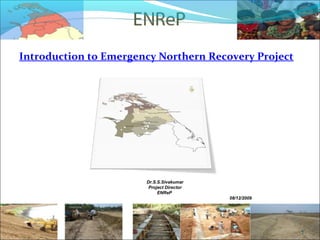
Introduction to Emergency Northern Recovery Project


                       Dr.S.S.Sivakumar
                        Project Director
                            ENReP
                                           08/12/2009


                                                        1
Development Objectives of ENReP
To support government’s efforts to rapidly
resettling IDPs in the Northern province to
their place of origin to start their livelihood
through
    Emergency Assistance to IDPs


    Work-fare Program (Cash for work)


    Rehabilitation and Reconstruction of Essential Public
     and Economic Infrastructure


                                                             2
IDPs Resettled to their place of origin as per
government’s phase iii and phase iv of the
resettlement program in the districts of
        1.   Jaffna

        2.   Kilinochchi

        3.   Mullaitivu

        4.   Mannar

        5.   Vavuniya

                                                 3
Project Components of ENReP
Component A: Emergency Assistance to IDPs
                   (US$6 million)

  This component would provide assistance to, returned
 households to re-engage in livelihood activities such as
 agricultural farming and marine fishing

Component B: Work-fare (US$12 million)
 The work-fare component is intended to provide labor
 employment to the returnees immediately after they have
 been resettled helping to bridge the income gap between
 the time of return (after having received emergency
 assistance) and until IDPs can obtain income from regular
 livelihoods.
                                                             4
Project Components of ENReP
 Component C: Rehabilitation and Reconstruction of Essential Public
  and Economic Infrastructure
                      (US$44 million)


  This component will provide assistance to repair reconstruct and restore vital
  public and economic infrastructure and facilities damaged by the war and that
  are dysfunctional or partly functional at present

 Component D: Project Management, Oversight, Monitoring and
  Evaluation, and Special Studies
                      (US$3 million)


  This component will support the Government in implementing the project,
  coordinating all project related activities, monitoring and evaluating project
  inputs,        outputs and results, carrying out financial management,
  technical, procurement and safeguard audits.
                                                                            5
This component will provide financing to:

•   Meet cost related to the operation of mobile land task forces,
    surveys and studies required to rapidly restore contested
    property rights of the resettled people
•   Conduct demining awareness program to IDPs, project staff
    and contractors
•   Clear thick vegetative growth of paddy lands to be able to
    resume land preparation for cultivation
•   Provide seeds, basic and miscellaneous agricultural and
    fishing implements to the people to be able to start paddy
    farming   and     marine   fishing   immediately   after   the
    resettlement.
                                                                 6
Component B: Work-fare (US$12 million)

 Execute small scale labor intensive repair and

   rehabilitation works of village level infrastructure
 Provide a minimum of 50 labor days of guaranteed

   work employment for one person from each IDP
   household

        Of these 50 days, returnees will be eligible to spend ten
         days to make their own homes repaired and functional


                                                                     7
Component B: Work-fare (US$12 million) ctd.

The    work-fare   program    fulfills   a   dual
objective


  provide    short-term and immediately
      required cash to the people
  undertake       urgent    labor   intensive
      repair works such as

                                                    8
Component B: Work-fare (US$12 million) ctd.

Possible labor intensive repair works

  •   Clearing debris of damaged houses and village
      buildings,
  •   Cleaning dug wells,
  •   Repairing hamlet level access roads
  •   Repairing small irrigation canals
  •   Repairing small drainage cannels

                                                      9
Component C: Rehabilitation and Reconstruction of Essential
          Public and Economic Infrastructure
                     (US$44 million)

Rehabilitation of Irrigation Systems (US$12
 million)
Rehabilitation of Rural Roads (US$10 million)

Restoration of Drinking Water Schemes (US$
 12 million)
Rehabilitation and Reconstruction of Public
 Buildings and Facilities (US$ 10 million)
                                                        10
Component D: Project Management, Oversight, Monitoring
   and Evaluation, and Special Studies (US$3 million)

    Incremental operating costs

    Procurement of goods

    Public information awareness campaigns

    Mine risk awareness campaigns

    Needs assessments


                                                         11
Component D: Project Management, Oversight, Monitoring
  and Evaluation, and Special Studies (US$3 million) ctd.

Independent technical audits

Financial management audits

Procurement and safeguard audits

Independent Monitoring and Evaluation (M&E)


     Note:-   If necessary, the project will also finance any strategic studies as
              well as special and feasibility studies required to improve
              the development effectiveness of this project as well as for
              future longer term development of the North.


                                                                                12
Resettlement Plan of ENReP Area

Phase III


    District      No of DS   No of GN    No of
                  Division   Division   Families

Jaffna               4          17       1346
Vavuniya             2          20       1684
Killinochchi         2          12       6020
Mannar               3          31       4991
Mulaitivu            1          48       8493
     Total           14        128       22534
                                                   13
Resettlement Plan of ENReP Area
PhaseIV

     District     No of DS   No of GN    No of
                  Division   Division   Families


Jaffna               4          17         1017
Vavuniya             1          7          1171
Killinochchi         3          18         7733
Mannar               -          -            -
Mulaitivu            1          1           118
      Total          9          49         10039
                                                   14
Resettlement Plan of ENReP Area

Phase III & IV


    District      No of DS   No of GN    No of
                  Division   Division   Families

Jaffna               8          34         2363
Vavuniya             3          27         2855
Killinochchi         5          30       13753
Mannar               3          31         4991
Mulaitivu            2          49         8611
      Total          23        177       32573

                                                   15
Distribution of Component A


                           Farm land      Providing      Supply of
            District
                            Clearing        seeds       basic needs


Jaffna
                                  13.78         19.95         16.69
Vavuniya
                                  16.65         24.10         20.16
Killinochchi
                                  80.22        116.11         97.11
Mannar
                                  29.11         42.14         35.24
Mulaitivu
                                  50.23         72.70         60.80
     Total (million Rs.)
                                   190            275           230

                                                                      16
Distribution of Component B


                                                                                Total
 Description of work   Jaffna   Vavuniya   Killinochchi   Mannar   Mulaitivu   (million
                                                                                 Rs.)


Cleaning of wells        4.35       5.26        25.33       9.19      15.86          60
Cleaning of debris       4.35       5.26        25.33       9.19      15.86          60

Rehabilitation of
rural roads             33.37     40.32        194.22      70.48     121.61         460

Rehabilitation of
irrigation canals       33.37     40.32        194.22      70.48     121.61         460

Rehabilitation of
drainage canals         25.03     30.24        145.67      52.86      91.20         345


                                                                                          17
Six month work plan

Full Component - ENReP 6 Month Work Plan

NP- ENReP 6 Month Work Plan

Jaffna- ENReP 6 Month Work Plan

Kilinochchi- ENReP 6 Month Work Plan

Mullaitivu- ENReP 6 Month Work Plan

Vavuniya - ENReP 6 Month Work Plan

Mannar- ENREP 6 Month Work Plan
                                            18
Implementation Responsibilities of the Project
                  Component A
Restitution of Land and Property Rights
   Mobile Land Task Forces

Farm Land clearing
   Irrigation Departments

Provision of Seeds
   Agriculture Department

Provision of Agriculture Implements
   Agriculture Department

Provision of Fishing Implements
   Fisheries Department

                                                     19
Implementation Responsibilities of the Project
              Component B

Selection and implementation by Divisional
Secretaries (assisted by GNs) in consultation
with the IDPs and relevant local government
agencies (assisted by RAP)


                                                 20
Implementation Responsibilities of the Project
                  Component C

Rehabilitation of Irrigation Schemes, Ponds
   Irrigation Department

 Rehabilitation of Rural Roads
   Local Government/Road Development Department

Restoration of Drinking Water Supply Schemes
   National Water Supply and Drainage Board

Rehabilitation of Public Buildings
   Department of Buildings/Appropriate Provincial Agencies
                                                              21
Procurement of Works
   International Competitive Bidding (ICB). Civil works contracts estimated to
    cost US$5.0 million equivalent or more per contract shall be procured using ICB
    (not envisaged at this time)


   National Competitive Bidding (NCB): Civil works contracts estimated to cost less
    than US$5.0 million equivalent per contract will be procured using NCB


   Shopping: For small value works, shopping procedures will be followed
    (solicitation of a minimum of three quotations from prequalified contractors), up to
    a limit of US$200,000 equivalent per contract


   Direct Contracting (DC): For priority works in the first eighteen months of
    implementation, direct contracting with autonomous state-owned agencies may be
    followed up to a limit of US$200,000 equivalent per contract.

                                                                                    22
Procurement of Works ctd.

   Community-Based Contracting (CBC):           Small value, simple civil
    works implemented with community participation (e.g. village roads,
    community wells, sanitation, irrigation channels, and infrastructure for
    community economic activities), up to US$50,000 equivalent per
    contract, may be awarded to community based organizations
    registered with the respective RAP PICs. Procurement procedures to be
    followed under CBC are detailed in the RAP Community Operational
    Manual


   Work-fare payments: Small quantities of materials and implements
    required for the program to function effectively will be procured by the
    communities, upto a limit of US$100 per purchase, following
    procedures agreed in the RAP community operational manual            23
Procurement of agriculture commodities


Procurement of agriculture commodities, such as seed
and fertilizers, will be through direct contracting
based on rates agreed between the Provincial
Agriculture Department and registered vendors, with
a justification provided for such rates


                                                   24
Role of RAP in Implementing ENEeP

 ENReP has been designed to complement its development effectiveness benefiting

  from the RAP’s design

 ENReP and RAP (with expected additional funding of US$12 million) would be

  programmed and implemented in tandem and with close coordination in all the
  villages covered by the ENReP

 RAP would extend its support with provision of block grants through simplified and

  speedy implementation mechanisms tailored to the specific emergency circumstances
  of the target villages

 Arrangement to use RAP implementation structure and staff for initial implementation

  to kick-off ENReP is expected to establish closer collaboration and coordination from
  the beginning of implementation of ENReP


                                                                                    25
The primary outcome of the project is that it would help in
        the resettlement of about 100,000 IDPs by

 Commodity grants (seeds and implements etc.) and assistance
  provided to about 15,000 farming households
 50 days of labor work opportunities per person provided to about
  45,000 IDP households
 About 12,000 hectares of agricultural (paddy) lands brought back to
  production
 650 km of rural roads rehabilitated ensuring inter-village connectivity
  and market linkages
 Eight drinking water supply schemes restored benefiting about 30,000
  households
 260 public buildings restored and functional
                                                                       26
27

ENReP 08-12-2009

  • 1.
    Introduction to EmergencyNorthern Recovery Project Dr.S.S.Sivakumar Project Director ENReP 08/12/2009 1
  • 2.
    Development Objectives ofENReP To support government’s efforts to rapidly resettling IDPs in the Northern province to their place of origin to start their livelihood through  Emergency Assistance to IDPs  Work-fare Program (Cash for work)  Rehabilitation and Reconstruction of Essential Public and Economic Infrastructure 2
  • 3.
    IDPs Resettled totheir place of origin as per government’s phase iii and phase iv of the resettlement program in the districts of 1. Jaffna 2. Kilinochchi 3. Mullaitivu 4. Mannar 5. Vavuniya 3
  • 4.
    Project Components ofENReP Component A: Emergency Assistance to IDPs (US$6 million) This component would provide assistance to, returned households to re-engage in livelihood activities such as agricultural farming and marine fishing Component B: Work-fare (US$12 million) The work-fare component is intended to provide labor employment to the returnees immediately after they have been resettled helping to bridge the income gap between the time of return (after having received emergency assistance) and until IDPs can obtain income from regular livelihoods. 4
  • 5.
    Project Components ofENReP  Component C: Rehabilitation and Reconstruction of Essential Public and Economic Infrastructure (US$44 million) This component will provide assistance to repair reconstruct and restore vital public and economic infrastructure and facilities damaged by the war and that are dysfunctional or partly functional at present  Component D: Project Management, Oversight, Monitoring and Evaluation, and Special Studies (US$3 million) This component will support the Government in implementing the project, coordinating all project related activities, monitoring and evaluating project inputs, outputs and results, carrying out financial management, technical, procurement and safeguard audits. 5
  • 6.
    This component willprovide financing to: • Meet cost related to the operation of mobile land task forces, surveys and studies required to rapidly restore contested property rights of the resettled people • Conduct demining awareness program to IDPs, project staff and contractors • Clear thick vegetative growth of paddy lands to be able to resume land preparation for cultivation • Provide seeds, basic and miscellaneous agricultural and fishing implements to the people to be able to start paddy farming and marine fishing immediately after the resettlement. 6
  • 7.
    Component B: Work-fare(US$12 million)  Execute small scale labor intensive repair and rehabilitation works of village level infrastructure  Provide a minimum of 50 labor days of guaranteed work employment for one person from each IDP household  Of these 50 days, returnees will be eligible to spend ten days to make their own homes repaired and functional 7
  • 8.
    Component B: Work-fare(US$12 million) ctd. The work-fare program fulfills a dual objective provide short-term and immediately required cash to the people undertake urgent labor intensive repair works such as 8
  • 9.
    Component B: Work-fare(US$12 million) ctd. Possible labor intensive repair works • Clearing debris of damaged houses and village buildings, • Cleaning dug wells, • Repairing hamlet level access roads • Repairing small irrigation canals • Repairing small drainage cannels 9
  • 10.
    Component C: Rehabilitationand Reconstruction of Essential Public and Economic Infrastructure (US$44 million) Rehabilitation of Irrigation Systems (US$12 million) Rehabilitation of Rural Roads (US$10 million) Restoration of Drinking Water Schemes (US$ 12 million) Rehabilitation and Reconstruction of Public Buildings and Facilities (US$ 10 million) 10
  • 11.
    Component D: ProjectManagement, Oversight, Monitoring and Evaluation, and Special Studies (US$3 million) Incremental operating costs Procurement of goods Public information awareness campaigns Mine risk awareness campaigns Needs assessments 11
  • 12.
    Component D: ProjectManagement, Oversight, Monitoring and Evaluation, and Special Studies (US$3 million) ctd. Independent technical audits Financial management audits Procurement and safeguard audits Independent Monitoring and Evaluation (M&E) Note:- If necessary, the project will also finance any strategic studies as well as special and feasibility studies required to improve the development effectiveness of this project as well as for future longer term development of the North. 12
  • 13.
    Resettlement Plan ofENReP Area Phase III District No of DS No of GN No of Division Division Families Jaffna 4 17 1346 Vavuniya 2 20 1684 Killinochchi 2 12 6020 Mannar 3 31 4991 Mulaitivu 1 48 8493 Total 14 128 22534 13
  • 14.
    Resettlement Plan ofENReP Area PhaseIV District No of DS No of GN No of Division Division Families Jaffna 4 17 1017 Vavuniya 1 7 1171 Killinochchi 3 18 7733 Mannar - - - Mulaitivu 1 1 118 Total 9 49 10039 14
  • 15.
    Resettlement Plan ofENReP Area Phase III & IV District No of DS No of GN No of Division Division Families Jaffna 8 34 2363 Vavuniya 3 27 2855 Killinochchi 5 30 13753 Mannar 3 31 4991 Mulaitivu 2 49 8611 Total 23 177 32573 15
  • 16.
    Distribution of ComponentA Farm land Providing Supply of District Clearing seeds basic needs Jaffna 13.78 19.95 16.69 Vavuniya 16.65 24.10 20.16 Killinochchi 80.22 116.11 97.11 Mannar 29.11 42.14 35.24 Mulaitivu 50.23 72.70 60.80 Total (million Rs.) 190 275 230 16
  • 17.
    Distribution of ComponentB Total Description of work Jaffna Vavuniya Killinochchi Mannar Mulaitivu (million Rs.) Cleaning of wells 4.35 5.26 25.33 9.19 15.86 60 Cleaning of debris 4.35 5.26 25.33 9.19 15.86 60 Rehabilitation of rural roads 33.37 40.32 194.22 70.48 121.61 460 Rehabilitation of irrigation canals 33.37 40.32 194.22 70.48 121.61 460 Rehabilitation of drainage canals 25.03 30.24 145.67 52.86 91.20 345 17
  • 18.
    Six month workplan Full Component - ENReP 6 Month Work Plan NP- ENReP 6 Month Work Plan Jaffna- ENReP 6 Month Work Plan Kilinochchi- ENReP 6 Month Work Plan Mullaitivu- ENReP 6 Month Work Plan Vavuniya - ENReP 6 Month Work Plan Mannar- ENREP 6 Month Work Plan 18
  • 19.
    Implementation Responsibilities ofthe Project Component A Restitution of Land and Property Rights  Mobile Land Task Forces Farm Land clearing  Irrigation Departments Provision of Seeds  Agriculture Department Provision of Agriculture Implements  Agriculture Department Provision of Fishing Implements  Fisheries Department 19
  • 20.
    Implementation Responsibilities ofthe Project Component B Selection and implementation by Divisional Secretaries (assisted by GNs) in consultation with the IDPs and relevant local government agencies (assisted by RAP) 20
  • 21.
    Implementation Responsibilities ofthe Project Component C Rehabilitation of Irrigation Schemes, Ponds  Irrigation Department  Rehabilitation of Rural Roads  Local Government/Road Development Department Restoration of Drinking Water Supply Schemes  National Water Supply and Drainage Board Rehabilitation of Public Buildings  Department of Buildings/Appropriate Provincial Agencies 21
  • 22.
    Procurement of Works  International Competitive Bidding (ICB). Civil works contracts estimated to cost US$5.0 million equivalent or more per contract shall be procured using ICB (not envisaged at this time)  National Competitive Bidding (NCB): Civil works contracts estimated to cost less than US$5.0 million equivalent per contract will be procured using NCB  Shopping: For small value works, shopping procedures will be followed (solicitation of a minimum of three quotations from prequalified contractors), up to a limit of US$200,000 equivalent per contract  Direct Contracting (DC): For priority works in the first eighteen months of implementation, direct contracting with autonomous state-owned agencies may be followed up to a limit of US$200,000 equivalent per contract. 22
  • 23.
    Procurement of Worksctd.  Community-Based Contracting (CBC): Small value, simple civil works implemented with community participation (e.g. village roads, community wells, sanitation, irrigation channels, and infrastructure for community economic activities), up to US$50,000 equivalent per contract, may be awarded to community based organizations registered with the respective RAP PICs. Procurement procedures to be followed under CBC are detailed in the RAP Community Operational Manual  Work-fare payments: Small quantities of materials and implements required for the program to function effectively will be procured by the communities, upto a limit of US$100 per purchase, following procedures agreed in the RAP community operational manual 23
  • 24.
    Procurement of agriculturecommodities Procurement of agriculture commodities, such as seed and fertilizers, will be through direct contracting based on rates agreed between the Provincial Agriculture Department and registered vendors, with a justification provided for such rates 24
  • 25.
    Role of RAPin Implementing ENEeP  ENReP has been designed to complement its development effectiveness benefiting from the RAP’s design  ENReP and RAP (with expected additional funding of US$12 million) would be programmed and implemented in tandem and with close coordination in all the villages covered by the ENReP  RAP would extend its support with provision of block grants through simplified and speedy implementation mechanisms tailored to the specific emergency circumstances of the target villages  Arrangement to use RAP implementation structure and staff for initial implementation to kick-off ENReP is expected to establish closer collaboration and coordination from the beginning of implementation of ENReP 25
  • 26.
    The primary outcomeof the project is that it would help in the resettlement of about 100,000 IDPs by  Commodity grants (seeds and implements etc.) and assistance provided to about 15,000 farming households  50 days of labor work opportunities per person provided to about 45,000 IDP households  About 12,000 hectares of agricultural (paddy) lands brought back to production  650 km of rural roads rehabilitated ensuring inter-village connectivity and market linkages  Eight drinking water supply schemes restored benefiting about 30,000 households  260 public buildings restored and functional 26
  • 27.