IPv6 capacity development
in developing economies
ITU Regional Development Forum
Smart Digital Asia-Pacific, Bangkok, Thailand
21- 22 Aug 2015
<Duncan@apnic.net>
Agenda
1. ICT growth and economic development
2. APNIC Development services
3. Collaboration between ITU and APNIC
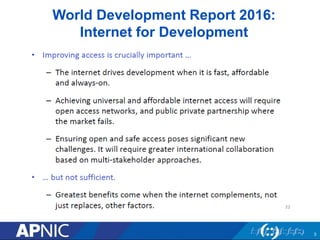
World Development Report 2016:
Internet for Development
3
4
APNIC – Regional Internet Registry for the
Asia Pacific region
“A global, open, stable, and secure
Internet that serves the entire Asia
Pacific Internet community”
• Provides capacity development
opportunities to community members
• Supports Internet development in the
region (NOGs, policy etc.)
• Neutral, independent,
not-for-profit
5
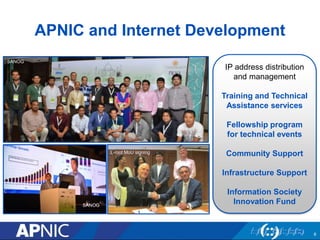
APNIC and Internet Development
IP address distribution
and management
Training and Technical
Assistance services
Fellowship program
for technical events
Community Support
Infrastructure Support
Information Society
Innovation Fund
SANOG
SANOG
L-root MoU signing
6
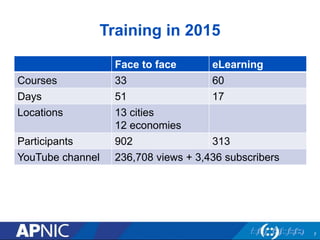
Training in 2015
7
Face to face eLearning
Courses 33 60
Days 51 17
Locations 13 cities
12 economies
Participants 902 313
YouTube channel 236,708 views + 3,436 subscribers
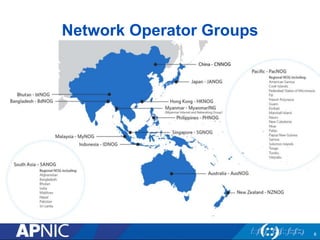
Network Operator Groups
8
ITU-APNIC Collaboration (1)
 Our focus is on technical workshops and capacity
development in developing economies
 Supported by:
 Ministry of Information and Communication Technology,
Thailand
 ToT Academy, Thailand
 Australian government
 Hands-on practical training courses and direct engineering
assistance to support smooth IPv6 adoption in developing
economies
9
ITU-APNIC Collaboration (2)
 Connect 2013: Initiated a joint project to support
the transition from IPv4 to IPv6 in the Asia-
Pacific
 Focused on capacity development for ITU and
APNIC members
 APNIC – ITU Asia Pacific (ASP) Centre of
Excellence
 Educate network operators, policy makers and
regulators from developing AP economies on
IPv6 deployment
10
ITU-APNIC collaboration (3)
 IPv6 migration strategies for telecom service
providers (2011, 2012)
 IPv6 infrastructure network security (2013,
2014, 2015)
 ITU country direct engineering assistance in Lao
(2014) and Mongolia (2015)
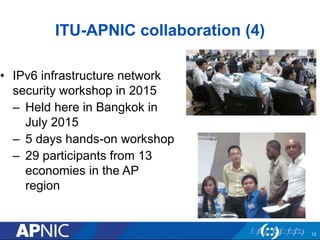
ITU-APNIC collaboration (4)
• IPv6 infrastructure network
security workshop in 2015
– Held here in Bangkok in
July 2015
– 5 days hands-on workshop
– 29 participants from 13
economies in the AP
region
12
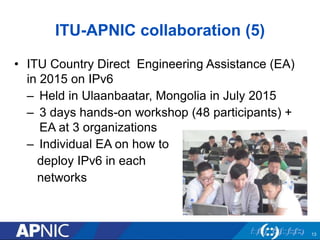
ITU-APNIC collaboration (5)
• ITU Country Direct Engineering Assistance (EA)
in 2015 on IPv6
– Held in Ulaanbaatar, Mongolia in July 2015
– 3 days hands-on workshop (48 participants) +
EA at 3 organizations
– Individual EA on how to
deploy IPv6 in each
networks
13
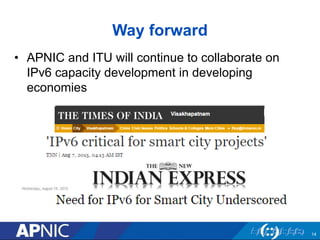
Way forward
• APNIC and ITU will continue to collaborate on
IPv6 capacity development in developing
economies
14
Thank you
You’re Invited!
• APNIC 40: Jakarta, 3-10 September 2015
• And…
– APNIC 41: Auckland, Feb 2016
– APNIC 42: Dhaka, Sep 2016
• See http://conference.apnic.net
15

IPv6 capacity development in developing economies

  • 1.
    IPv6 capacity development indeveloping economies ITU Regional Development Forum Smart Digital Asia-Pacific, Bangkok, Thailand 21- 22 Aug 2015 <Duncan@apnic.net>
  • 2.
    Agenda 1. ICT growthand economic development 2. APNIC Development services 3. Collaboration between ITU and APNIC
  • 3.
    World Development Report2016: Internet for Development 3
  • 4.
  • 5.
    APNIC – RegionalInternet Registry for the Asia Pacific region “A global, open, stable, and secure Internet that serves the entire Asia Pacific Internet community” • Provides capacity development opportunities to community members • Supports Internet development in the region (NOGs, policy etc.) • Neutral, independent, not-for-profit 5
  • 6.
    APNIC and InternetDevelopment IP address distribution and management Training and Technical Assistance services Fellowship program for technical events Community Support Infrastructure Support Information Society Innovation Fund SANOG SANOG L-root MoU signing 6
  • 7.
    Training in 2015 7 Faceto face eLearning Courses 33 60 Days 51 17 Locations 13 cities 12 economies Participants 902 313 YouTube channel 236,708 views + 3,436 subscribers
  • 8.
  • 9.
    ITU-APNIC Collaboration (1) Our focus is on technical workshops and capacity development in developing economies  Supported by:  Ministry of Information and Communication Technology, Thailand  ToT Academy, Thailand  Australian government  Hands-on practical training courses and direct engineering assistance to support smooth IPv6 adoption in developing economies 9
  • 10.
    ITU-APNIC Collaboration (2) Connect 2013: Initiated a joint project to support the transition from IPv4 to IPv6 in the Asia- Pacific  Focused on capacity development for ITU and APNIC members  APNIC – ITU Asia Pacific (ASP) Centre of Excellence  Educate network operators, policy makers and regulators from developing AP economies on IPv6 deployment 10
  • 11.
    ITU-APNIC collaboration (3) IPv6 migration strategies for telecom service providers (2011, 2012)  IPv6 infrastructure network security (2013, 2014, 2015)  ITU country direct engineering assistance in Lao (2014) and Mongolia (2015)
  • 12.
    ITU-APNIC collaboration (4) •IPv6 infrastructure network security workshop in 2015 – Held here in Bangkok in July 2015 – 5 days hands-on workshop – 29 participants from 13 economies in the AP region 12
  • 13.
    ITU-APNIC collaboration (5) •ITU Country Direct Engineering Assistance (EA) in 2015 on IPv6 – Held in Ulaanbaatar, Mongolia in July 2015 – 3 days hands-on workshop (48 participants) + EA at 3 organizations – Individual EA on how to deploy IPv6 in each networks 13
  • 14.
    Way forward • APNICand ITU will continue to collaborate on IPv6 capacity development in developing economies 14
  • 15.
    Thank you You’re Invited! •APNIC 40: Jakarta, 3-10 September 2015 • And… – APNIC 41: Auckland, Feb 2016 – APNIC 42: Dhaka, Sep 2016 • See http://conference.apnic.net 15

Editor's Notes

  • #2 ITU Regional Development Forum Smartly Digital Asia-Pacific 21-22 AUGUST 2015 BANGKOK, THAILAND Up to 15 min. 1. Sharing the experiences of successes or lessons learned and/or announce of any potential initiatives or projects relating to the topic within 15 minutes; 2. Making formal PowerPoint presentation covering introduction, , sharing experiences, key issues & challenges, way forward and recommendations 3. Contributing to sharing experiences in implementation of respective Regional Initiatives for ITU Asia-Pacific region especially for the ITU development cycle of 2015-2017.
  • #4 The World Bank’s 2016 World Development Report will explore the impact Internet and digital technologies have on development. The report is written by a group of World bank experts assembled for the task, and will be published at the end of 2015. The internet profoundly affects the lives of billions of people. The 2016 World Development Report will examine how it can be a force for development, especially for the poor in developing countries. The Report will explore the internet’s impact on economic growth, on social and economic opportunity, and on the efficiency of public service delivery.
  • #7 Technical assistance is offered to network operators that need help to tackle projects such as IPv6 deployment. It is provided on a cost recovery basis. In addition to the existing partnership with F, I and K-root operator, APNIC signed an MoU with ICANN to help distribute L-root servers in the AP region We provided 14 fellowships for APNIC 38. Fellows are given financial assistance on travel, accommodation and daily expenses. Thanks to Google and APIA for their generous contributions to the fellowships. We provided our first youth fellowships at APNIC 38. Stats from Cambodia ?
  • #9 APNIC actively supports and engages with professional communities of network operators, including Network Operator Groups (NOGs), by providing financial and logistical support in addition to participating in various regional conferences. NOGs are informal forums that bring together network operators, network engineers and the like to discuss matters relating to routing, network security, peering and interconnection and other operational issues. While the forums are generally structured around sharing relevant technical information, they also provide training and other capacity development opportunities to the region's operators. APNIC has ongoing commitments to various regional NOGs, participating and sharing information on key technologies affecting the Internet, for example, IPv6 deployment, and building capacity where relevant.