ENHANCING
SCRUM LIFE CYCLE EXPERIENCE
WITH DISCIPLINED AGILE TOOLKIT
Valentin Tudor Mocanu CDAC/CDAI | PMI Disciplined Agile
25 11 2020
PMI Disciplined Agile Toolkit
https://www.pmi.org/disciplined-agile
Valentin Tudor Mocanu
• Iterative development (1999)
• Agile development (2000)
• Agile training (2013)
• Disciplined Agile partner, instructor and coach (2015)
• DA Advisory Council
• PMP, PSM
• Training: Agile, Lean, Scrum, XP
• Training PMI DA workshops: DA Scrum Master, DA Senior Scrum Master
• Areas of interest: continuous improvement, agile & lean, agile products, clean architecture,
collaborative work.
valentinmocanu.com
@ValentinTudor
© 2020 Valentin Tudor Mocanu
Scrum Guide 2020
• This presentation will address first the known Scrum approach (before changes)
• Some Scrum changes are strongly related to discussed subjects
© 2020 Valentin Tudor Mocanu
Software development context
• Incertitude, complexity and knowledge work
• Changing requirements
• Solution inherent complexity
© 2020 Valentin Tudor Mocanu
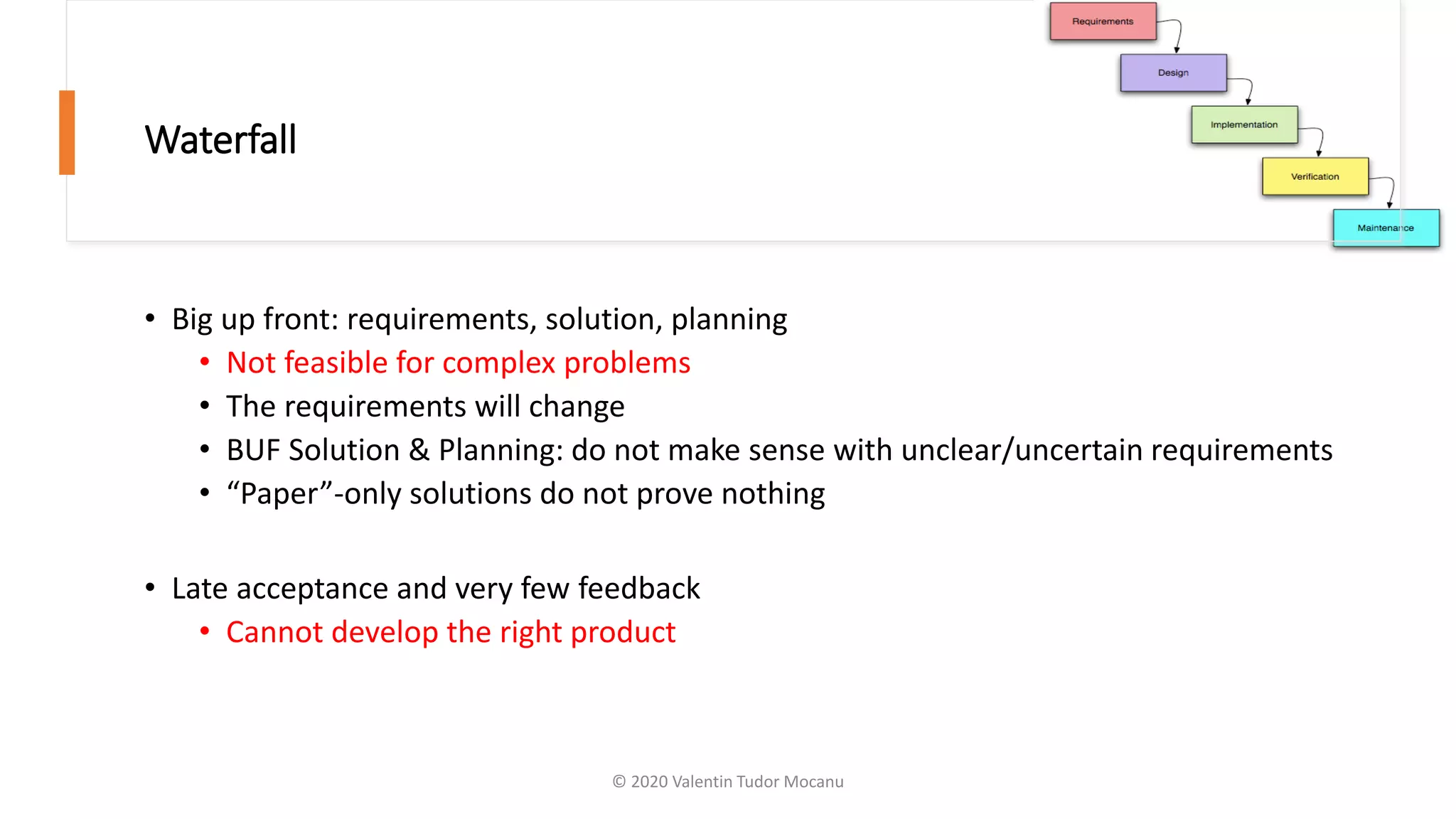
Waterfall
• Big up front: requirements, solution, planning
• Not feasible for complex problems
• The requirements will change
• BUF Solution & Planning: do not make sense with unclear/uncertain requirements
• “Paper”-only solutions do not prove nothing
• Late acceptance and very few feedback
• Cannot develop the right product
© 2020 Valentin Tudor Mocanu
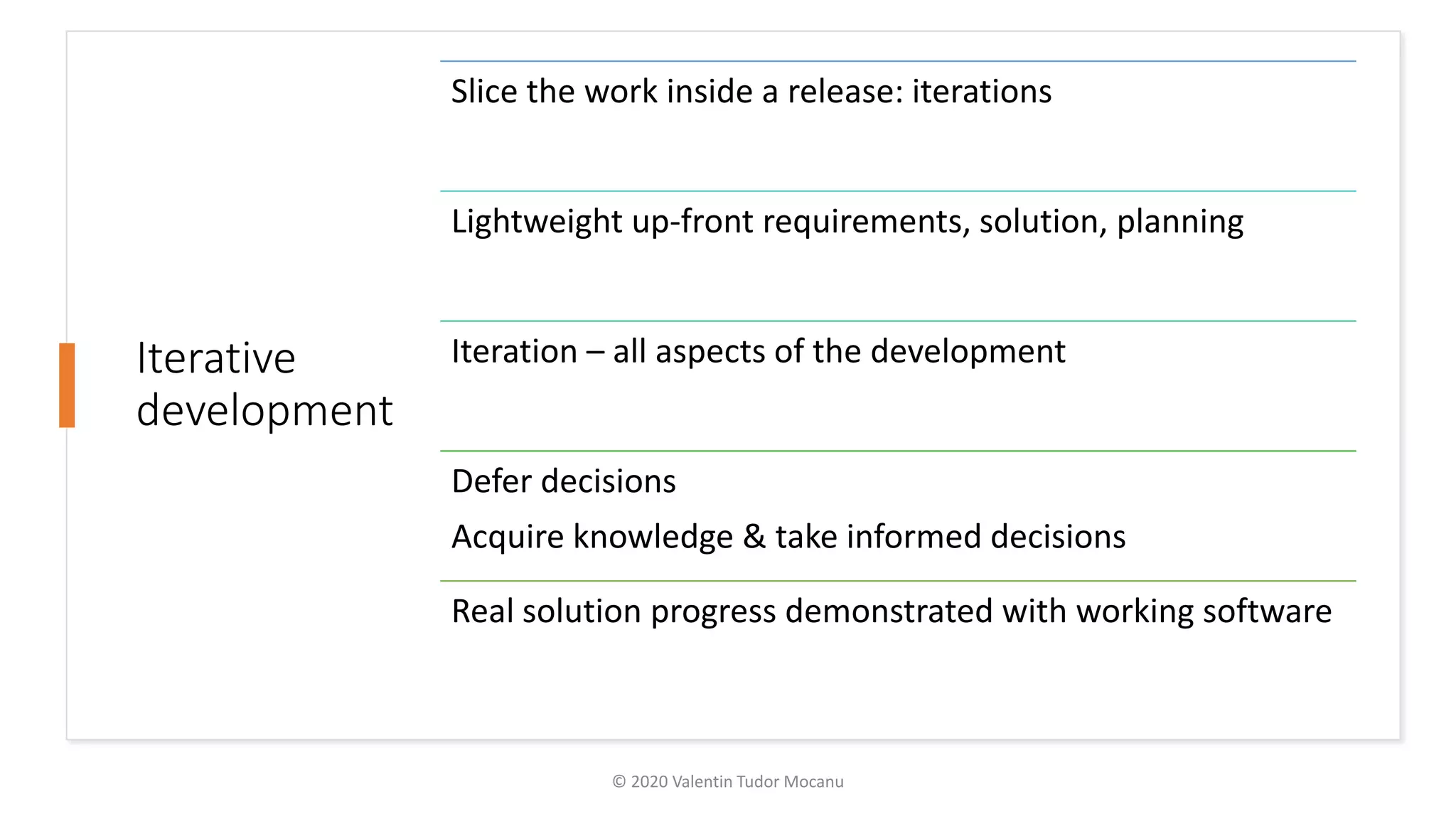
Iterative
development
Slice the work inside a release: iterations
Lightweight up-front requirements, solution, planning
Iteration – all aspects of the development
Defer decisions
Acquire knowledge & take informed decisions
Real solution progress demonstrated with working software
© 2020 Valentin Tudor Mocanu
Agile
• Iterative-adaptive
• “Responding to change over following a plan” – Agile Manifesto value
• Collaborative work
• Target the nature of the problem:
• often changing requirements, complexity, knowledge work
© 2020 Valentin Tudor Mocanu
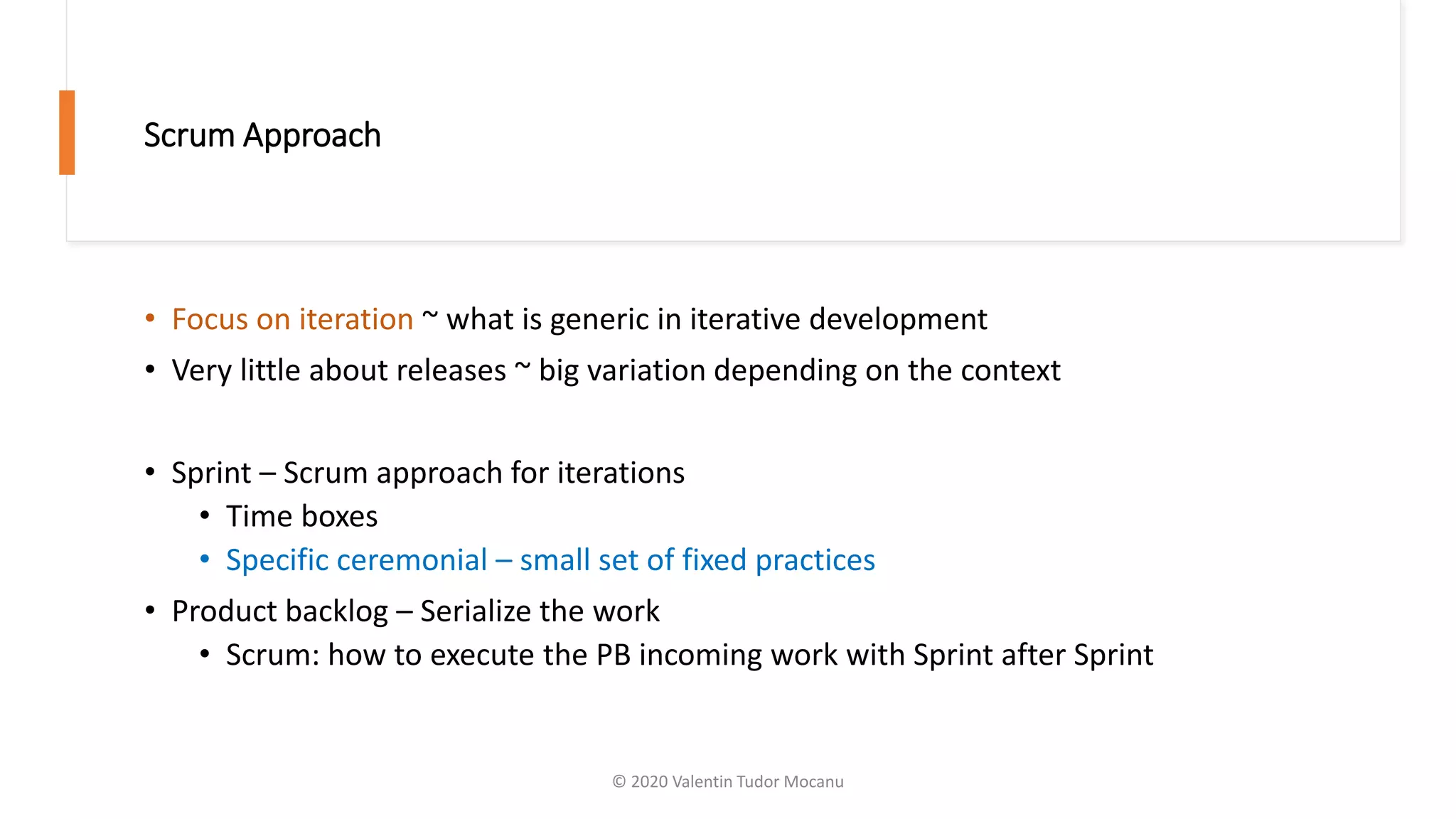
Scrum Approach
• Focus on iteration ~ what is generic in iterative development
• Very little about releases ~ big variation depending on the context
• Sprint – Scrum approach for iterations
• Time boxes
• Specific ceremonial – small set of fixed practices
• Product backlog – Serialize the work
• Scrum: how to execute the PB incoming work with Sprint after Sprint
© 2020 Valentin Tudor Mocanu
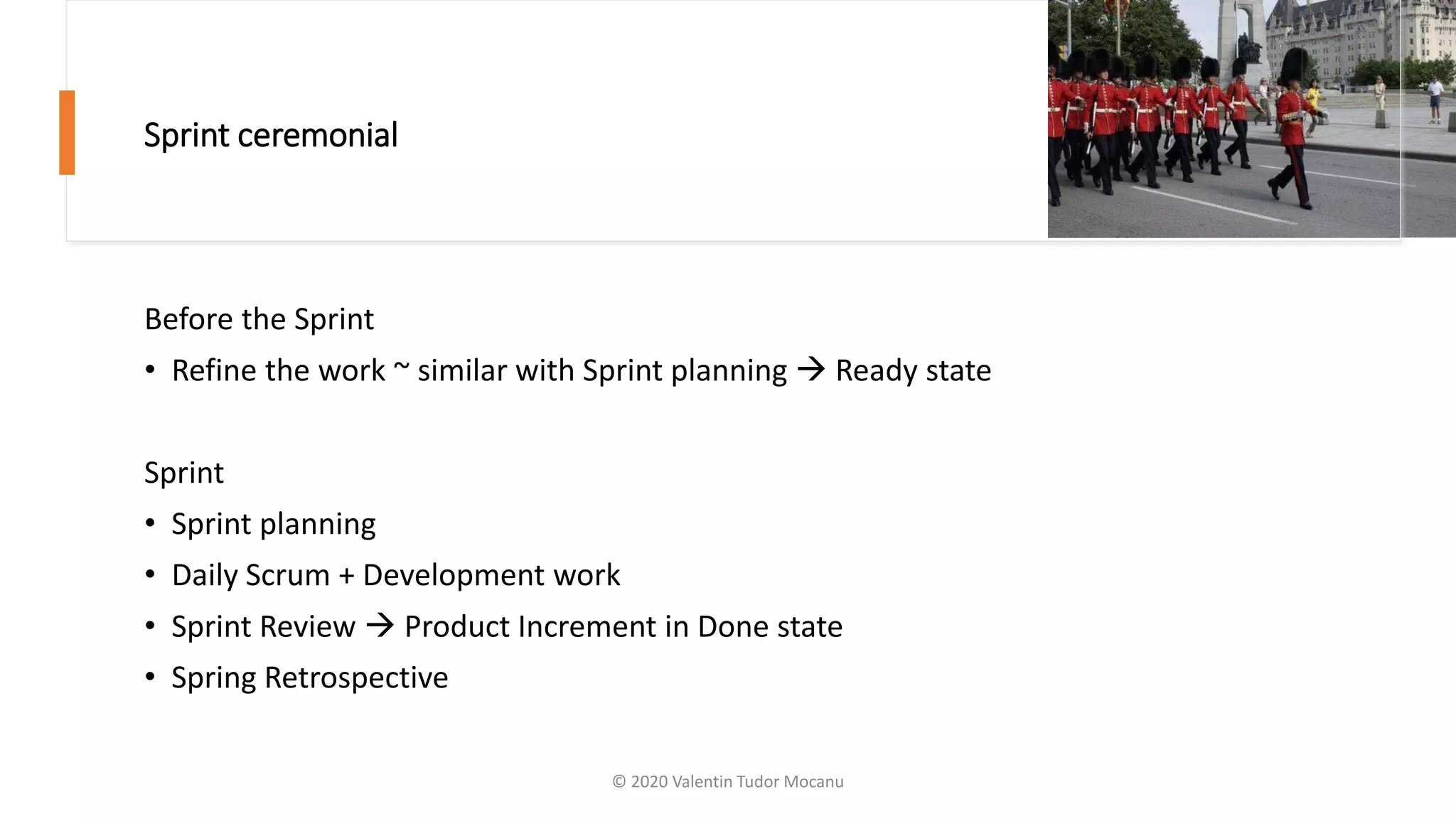
Sprint ceremonial
Before the Sprint
• Refine the work ~ similar with Sprint planning → Ready state
Sprint
• Sprint planning
• Daily Scrum + Development work
• Sprint Review → Product Increment in Done state
• Spring Retrospective
© 2020 Valentin Tudor Mocanu
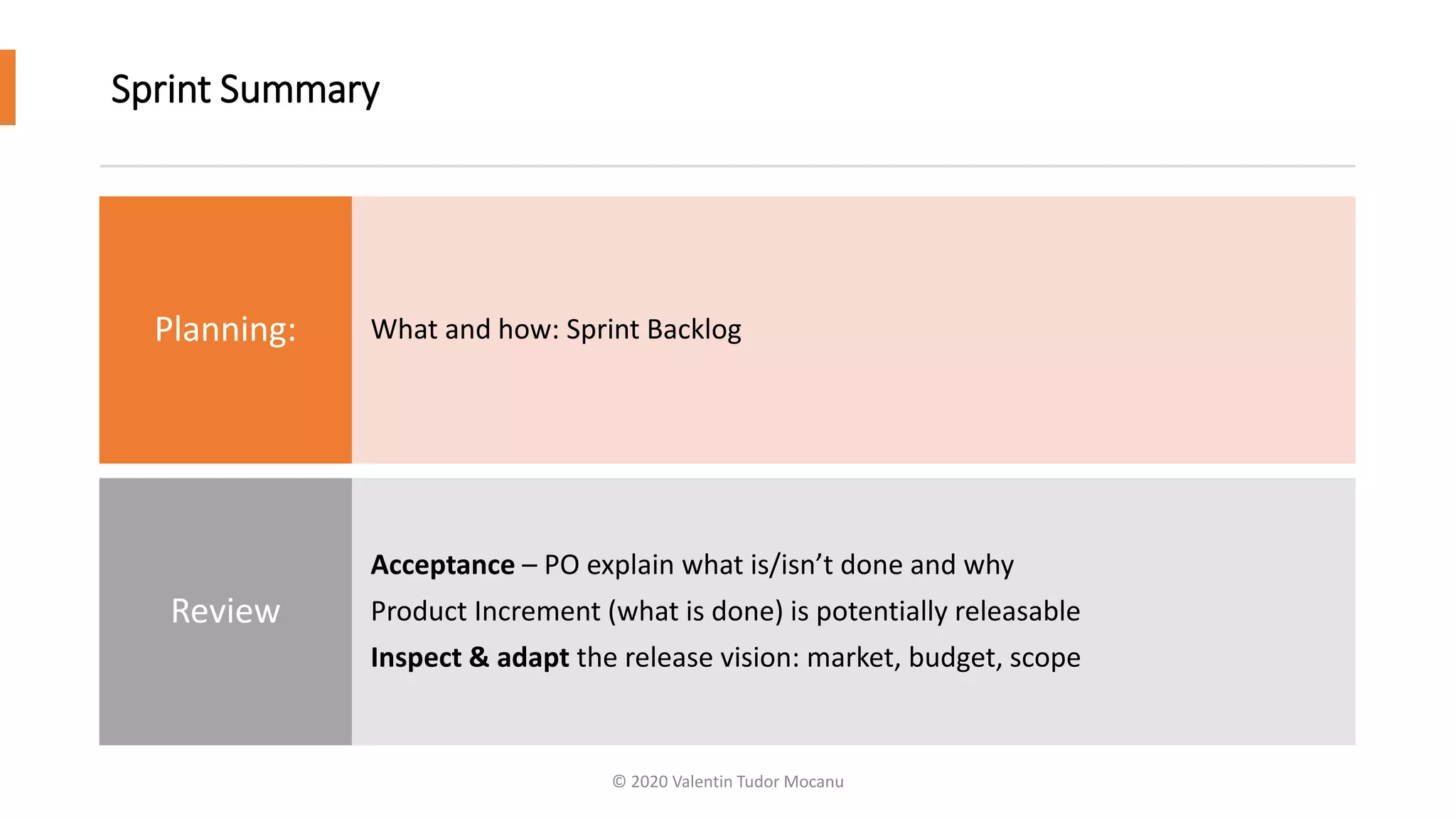
Sprint Summary
What and how: Sprint Backlog
Planning:
Acceptance – PO explain what is/isn’t done and why
Product Increment (what is done) is potentially releasable
Inspect & adapt the release vision: market, budget, scope
Review
© 2020 Valentin Tudor Mocanu
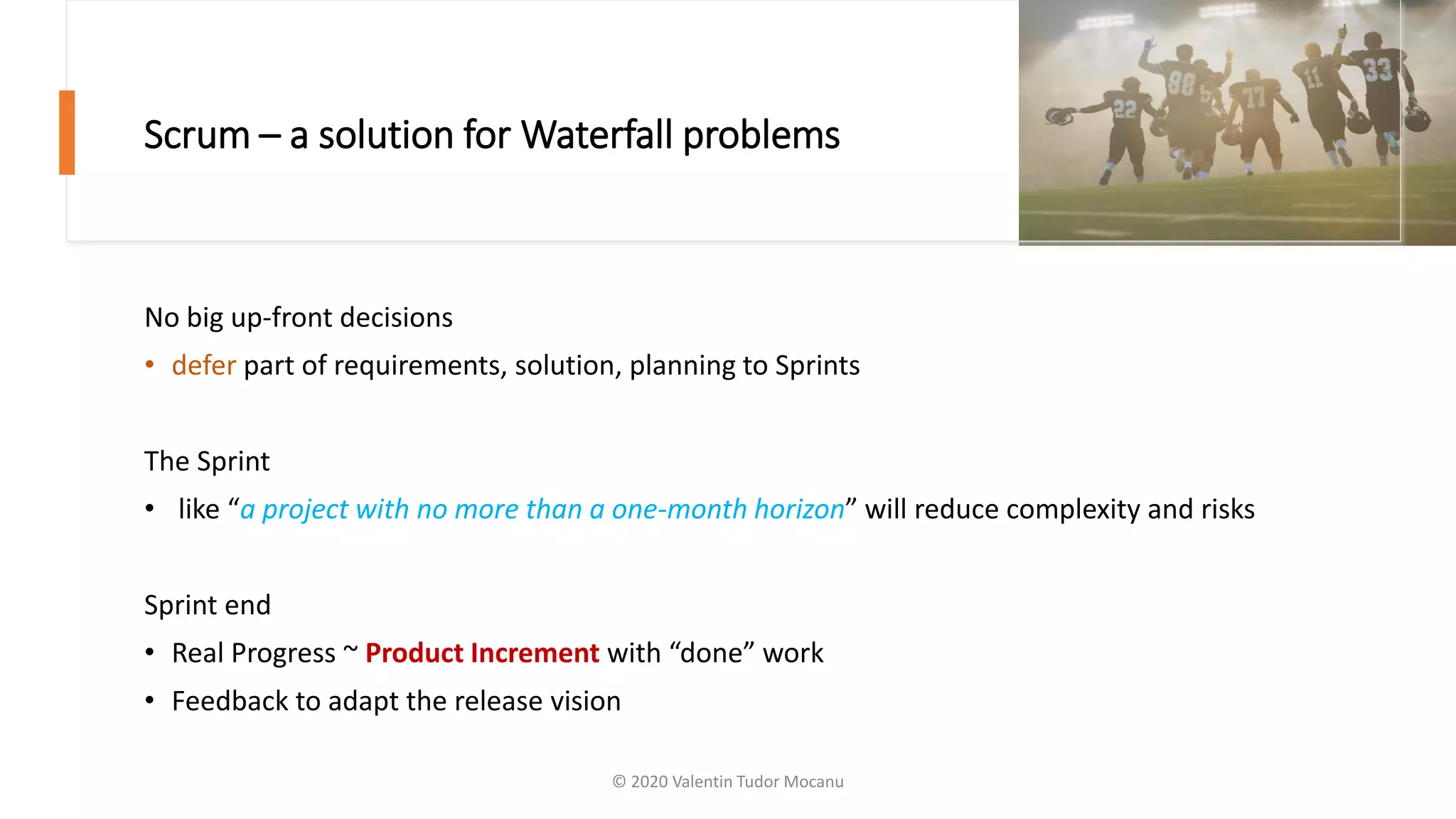
Scrum – a solution for Waterfall problems
No big up-front decisions
• defer part of requirements, solution, planning to Sprints
The Sprint
• like “a project with no more than a one-month horizon” will reduce complexity and risks
Sprint end
• Real Progress ~ Product Increment with “done” work
• Feedback to adapt the release vision
© 2020 Valentin Tudor Mocanu
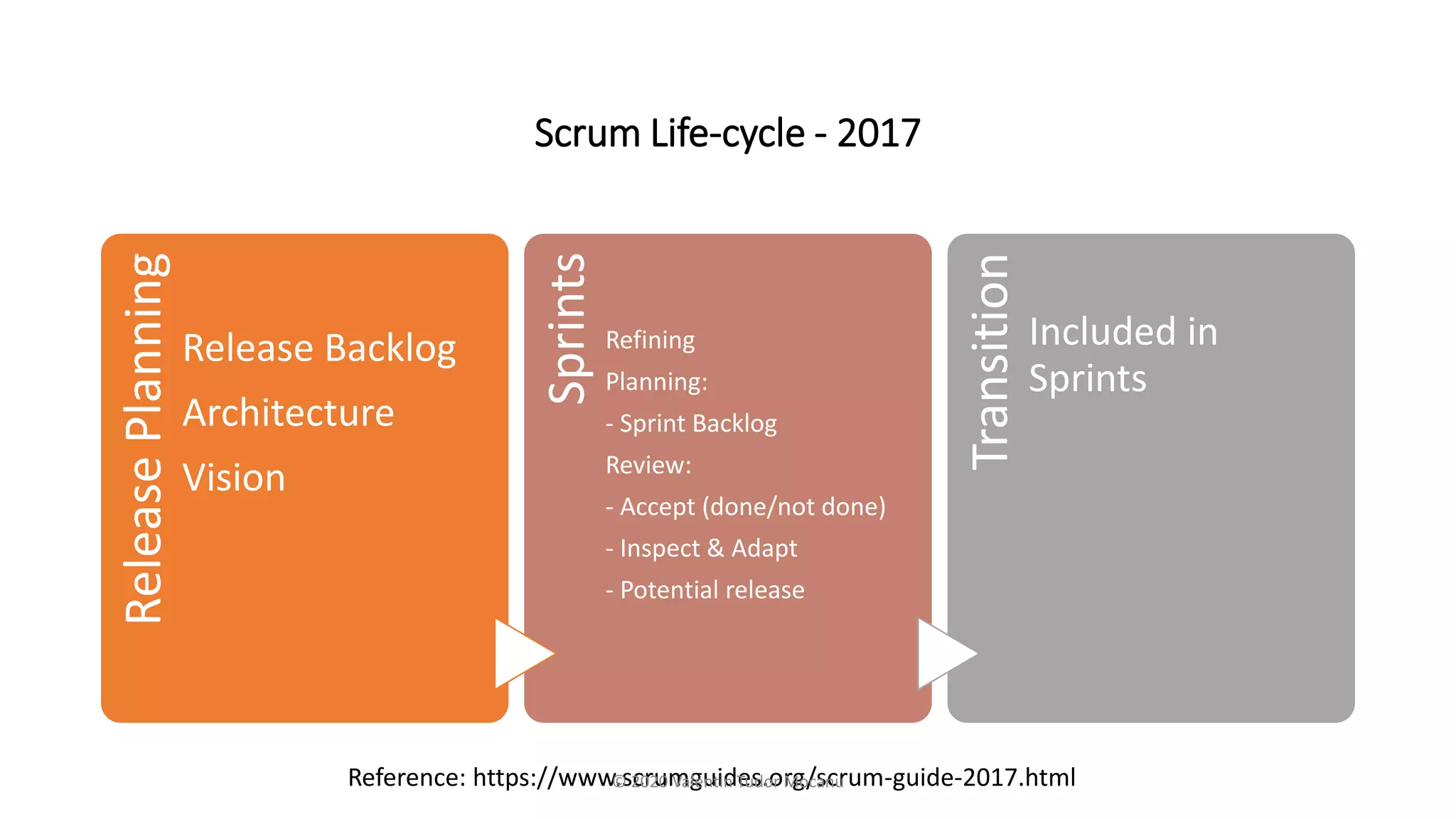
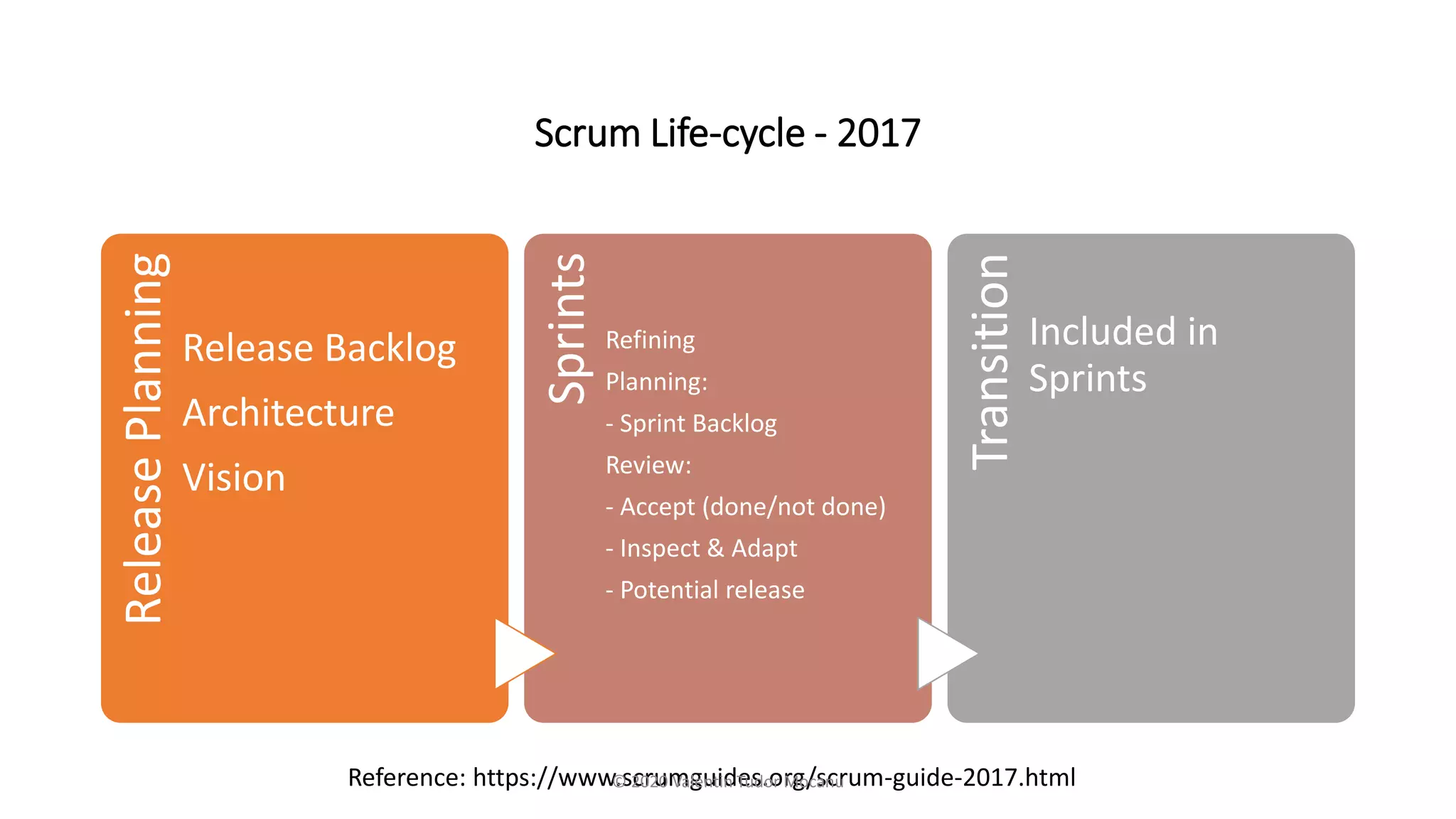
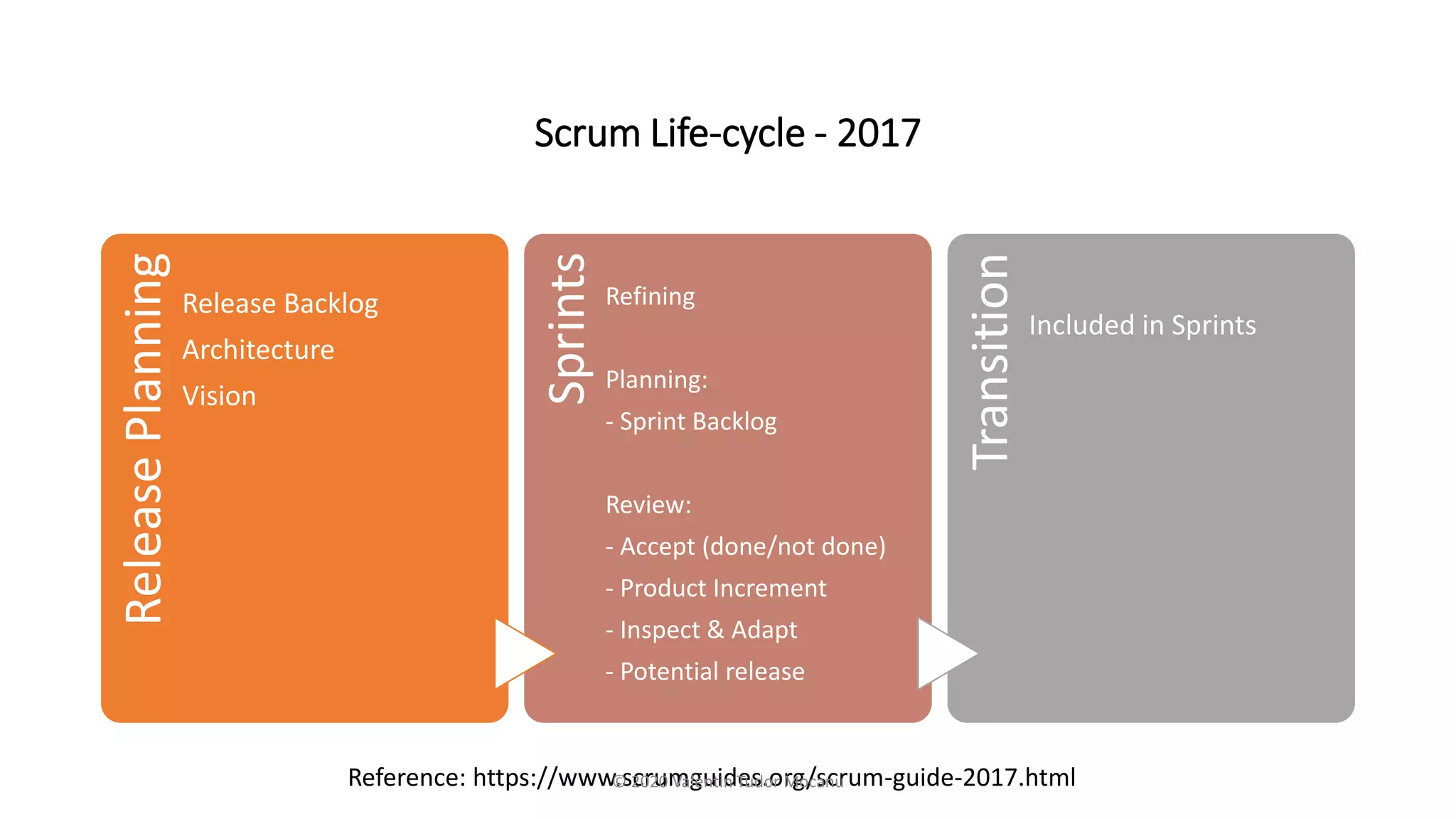
Scrum Life-cycle - 2017
Release
Planning
Release Backlog
Architecture
Vision
Sprints
Refining
Planning:
- Sprint Backlog
Review:
- Accept (done/not done)
- Inspect & Adapt
- Potential release
Transition
Included in
Sprints
Reference: https://www.scrumguides.org/scrum-guide-2017.html
© 2020 Valentin Tudor Mocanu
How generic is this approach?
© 2020 Valentin Tudor Mocanu
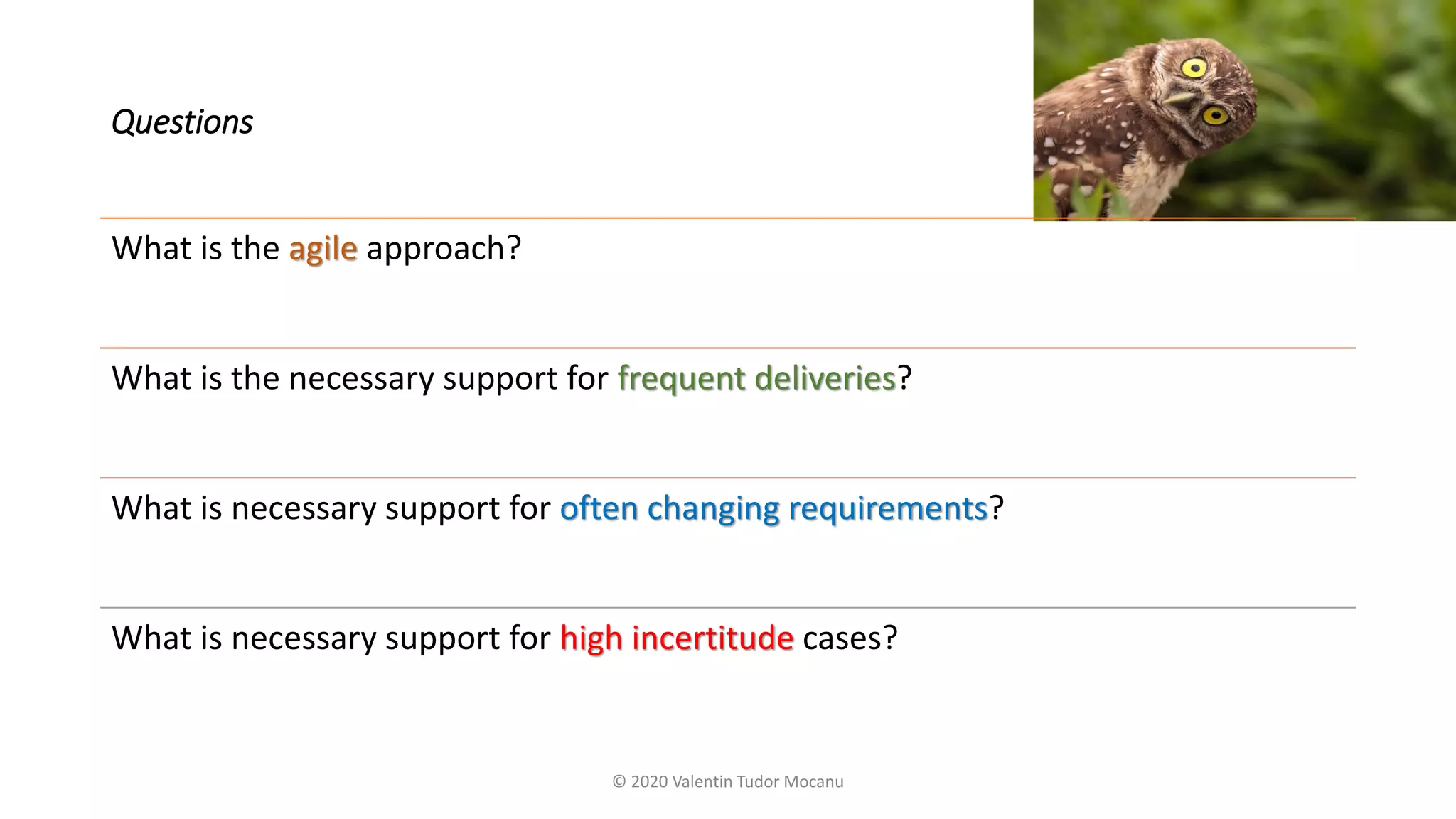
Questions
What is the agile approach?
What is the necessary support for frequent deliveries?
What is necessary support for often changing requirements?
What is necessary support for high incertitude cases?
© 2020 Valentin Tudor Mocanu
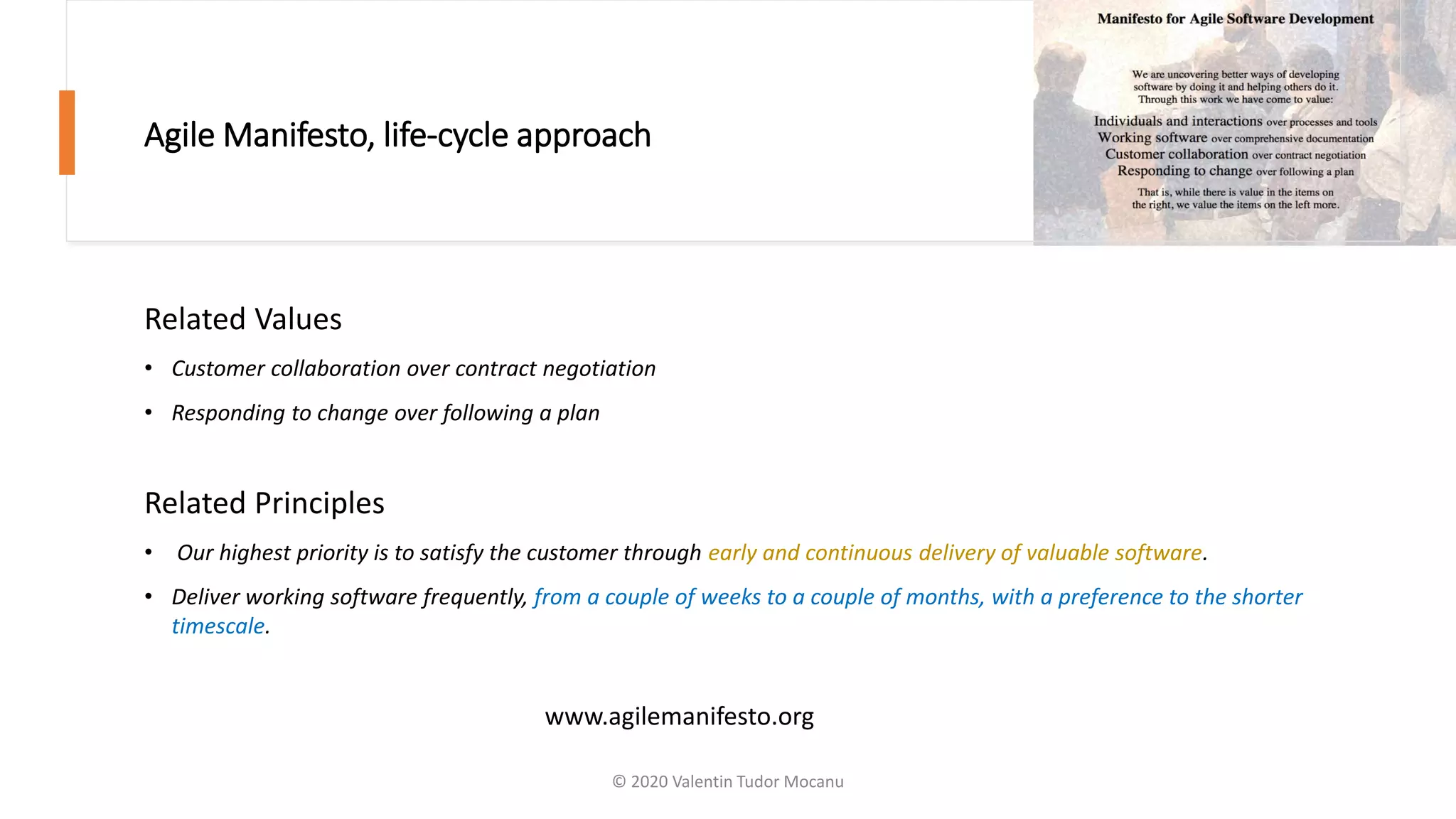
Agile Manifesto, life-cycle approach
Related Values
• Customer collaboration over contract negotiation
• Responding to change over following a plan
Related Principles
• Our highest priority is to satisfy the customer through early and continuous delivery of valuable software.
• Deliver working software frequently, from a couple of weeks to a couple of months, with a preference to the shorter
timescale.
www.agilemanifesto.org
© 2020 Valentin Tudor Mocanu
Agile approach – Small Releases
• Early & often delivery, preferably in no more than two weeks
• Production deployment included
• 2001, Agile Manifesto – no more than two weeks
• Today – also days, day, hours
© 2020 Valentin Tudor Mocanu
Small Releases Advantages
• Reduce overall complexity
• Value delivered early
• More stable release scope (fewer CRs)
• Easy to manage the change requests
• Real feedback more often
© 2020 Valentin Tudor Mocanu
Quick value delivery
• Big batches ~ delayed delivery
• Cost of delay ~ lost revenue or opportunity
• Delay ~ high risk of producing junk stories
• Quick delivery ~ small releases
© 2020 Valentin Tudor Mocanu
Support for Small Releases
• Scrum
• No explicit recommendation
• Some implicit support via releasable Sprint Product Increment
• Extreme Programming
• Recommend small releases
• Explain advantages
• XP practices and small releases are symbiotic (user stories, etc.)
• Disciplined Agile
• Recommend small releases ~ minimum business increments
• Offer substantial guidance (how to/tailoring): mindset, life-cycles, process goals, practices
• Explain advantages of accelerated value delivery
© 2020 Valentin Tudor Mocanu
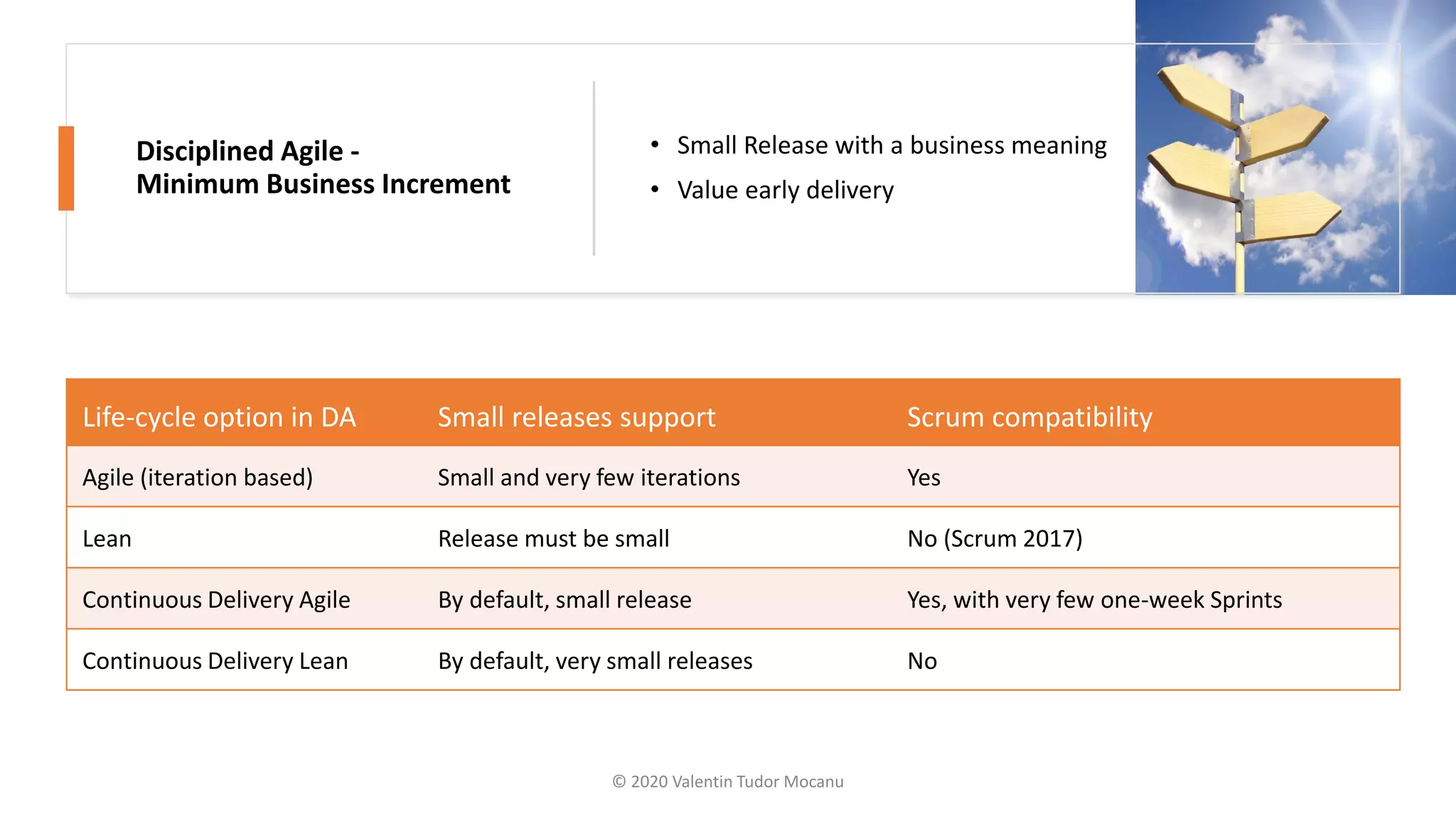
Disciplined Agile -
Minimum Business Increment
• Small Release with a business meaning
• Value early delivery
Life-cycle option in DA Small releases support Scrum compatibility
Agile (iteration based) Small and very few iterations Yes
Lean Release must be small No (Scrum 2017)
Continuous Delivery Agile By default, small release Yes, with very few one-week Sprints
Continuous Delivery Lean By default, very small releases No
© 2020 Valentin Tudor Mocanu
Scrum Life-cycle - 2017
Release
Planning
Release Backlog
Architecture
Vision
Sprints
Refining
Planning:
- Sprint Backlog
Review:
- Accept (done/not done)
- Inspect & Adapt
- Potential release
Transition
Included in
Sprints
Reference: https://www.scrumguides.org/scrum-guide-2017.html
© 2020 Valentin Tudor Mocanu
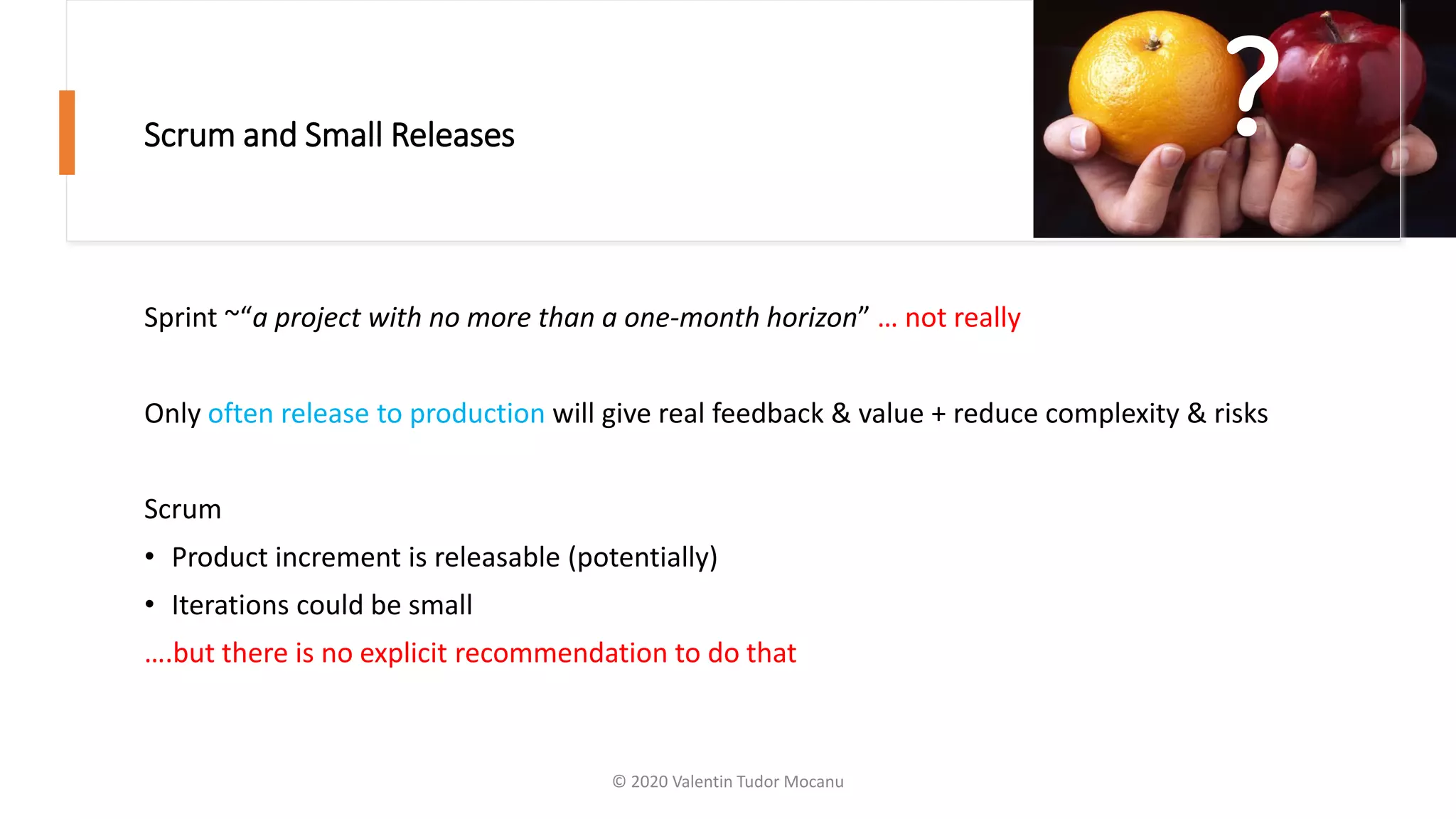
Scrum and Small Releases
Sprint ~“a project with no more than a one-month horizon” … not really
Only often release to production will give real feedback & value + reduce complexity & risks
Scrum
• Product increment is releasable (potentially)
• Iterations could be small
….but there is no explicit recommendation to do that
?
© 2020 Valentin Tudor Mocanu
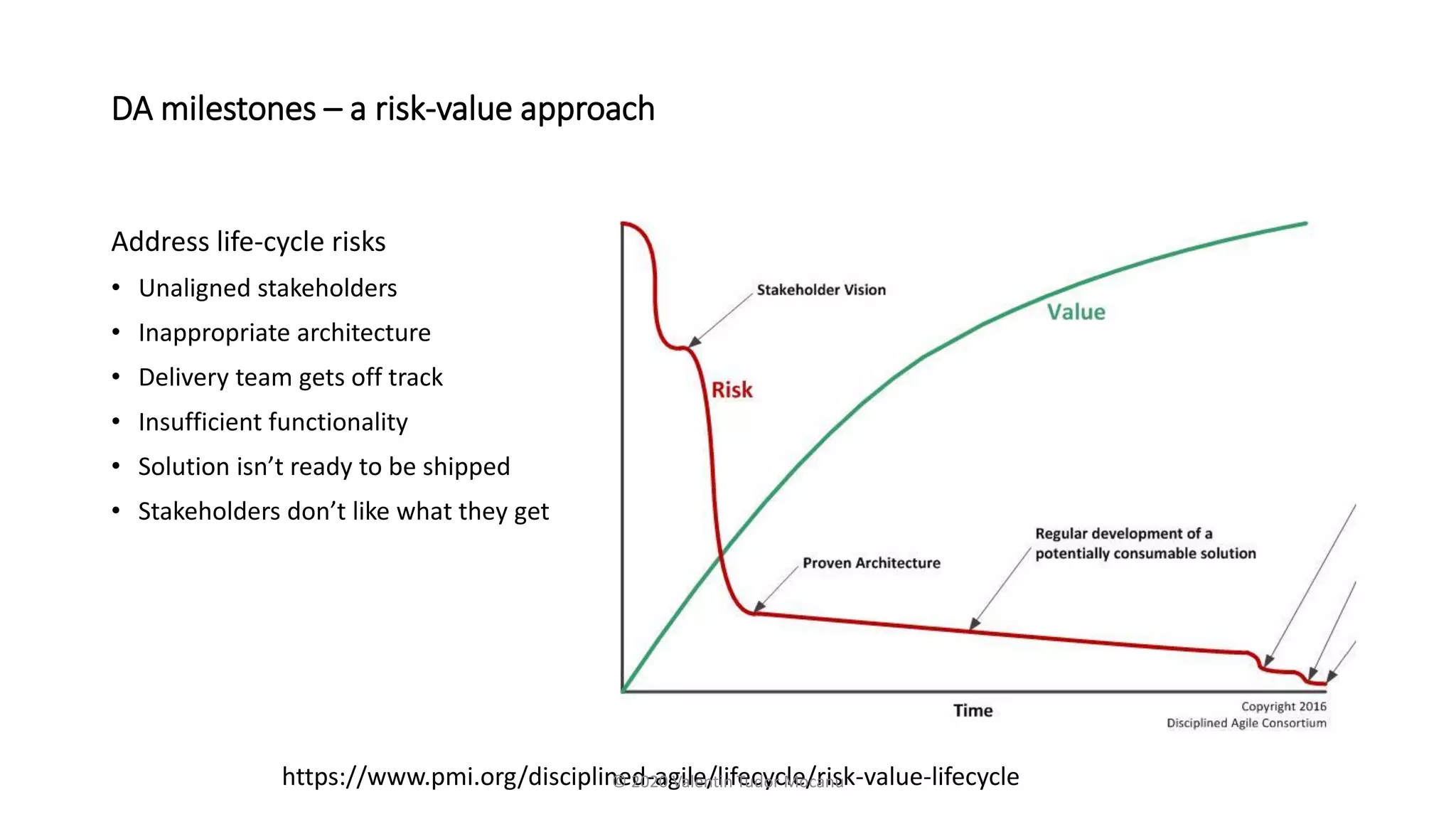
DA milestones – a risk-value approach
Address life-cycle risks
• Unaligned stakeholders
• Inappropriate architecture
• Delivery team gets off track
• Insufficient functionality
• Solution isn’t ready to be shipped
• Stakeholders don’t like what they get
https://www.pmi.org/disciplined-agile/lifecycle/risk-value-lifecycle
© 2020 Valentin Tudor Mocanu
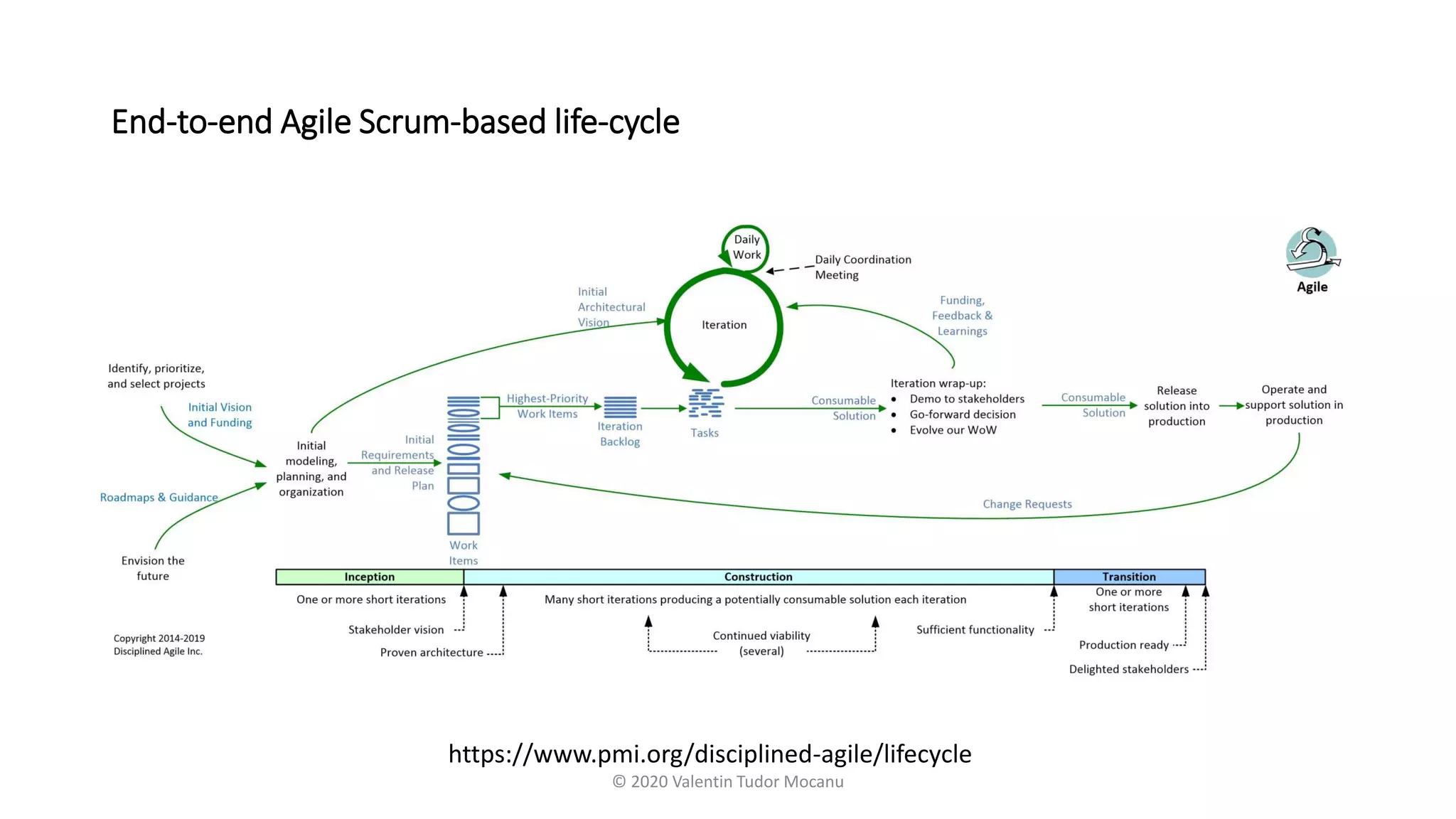
End-to-end Agile Scrum-based life-cycle
https://www.pmi.org/disciplined-agile/lifecycle
© 2020 Valentin Tudor Mocanu
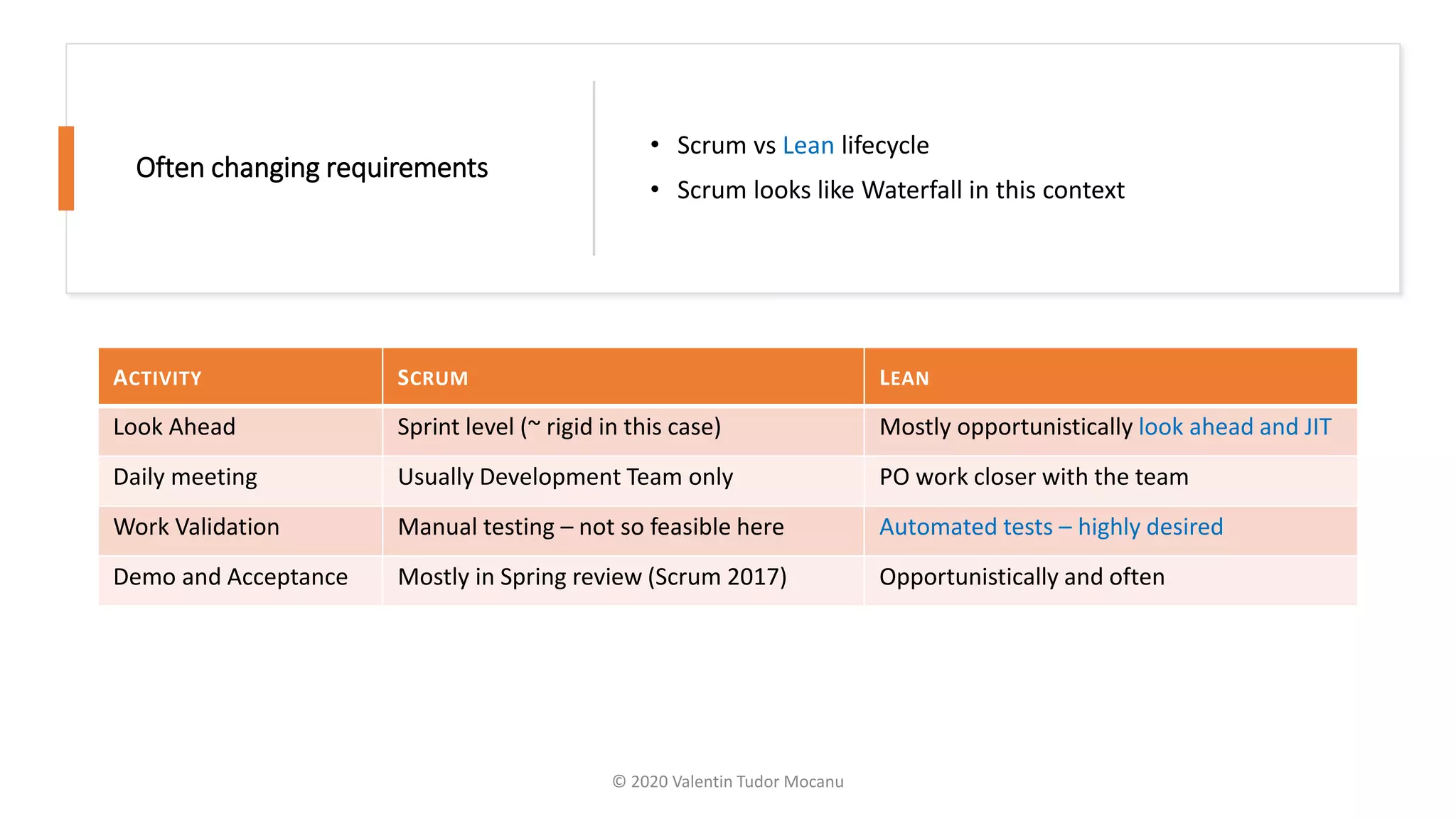
Often changing requirements
• Scrum vs Lean lifecycle
• Scrum looks like Waterfall in this context
ACTIVITY SCRUM LEAN
Look Ahead Sprint level (~ rigid in this case) Mostly opportunistically look ahead and JIT
Daily meeting Usually Development Team only PO work closer with the team
Work Validation Manual testing – not so feasible here Automated tests – highly desired
Demo and Acceptance Mostly in Spring review (Scrum 2017) Opportunistically and often
© 2020 Valentin Tudor Mocanu
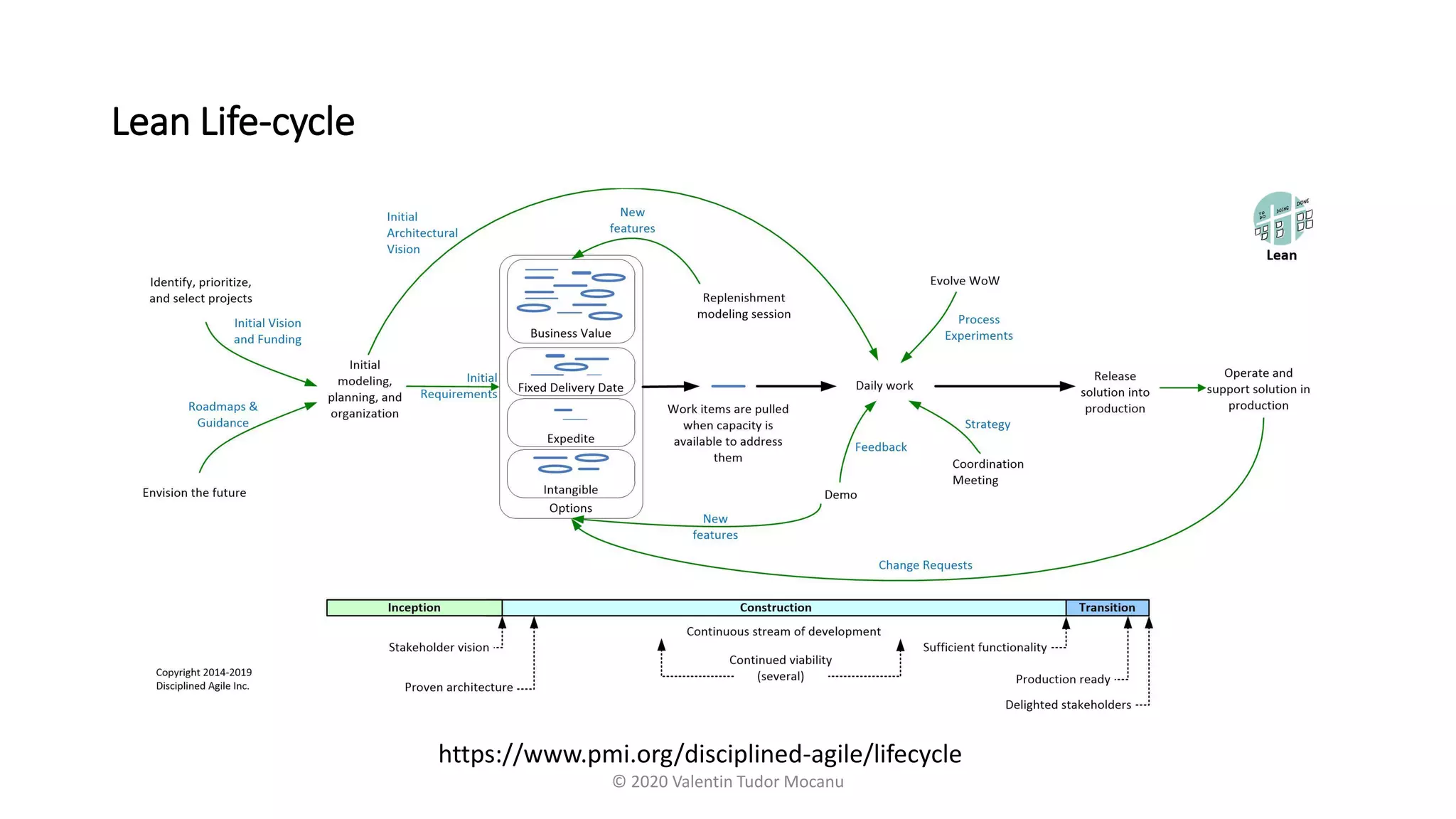
Lean Life-cycle
https://www.pmi.org/disciplined-agile/lifecycle
© 2020 Valentin Tudor Mocanu
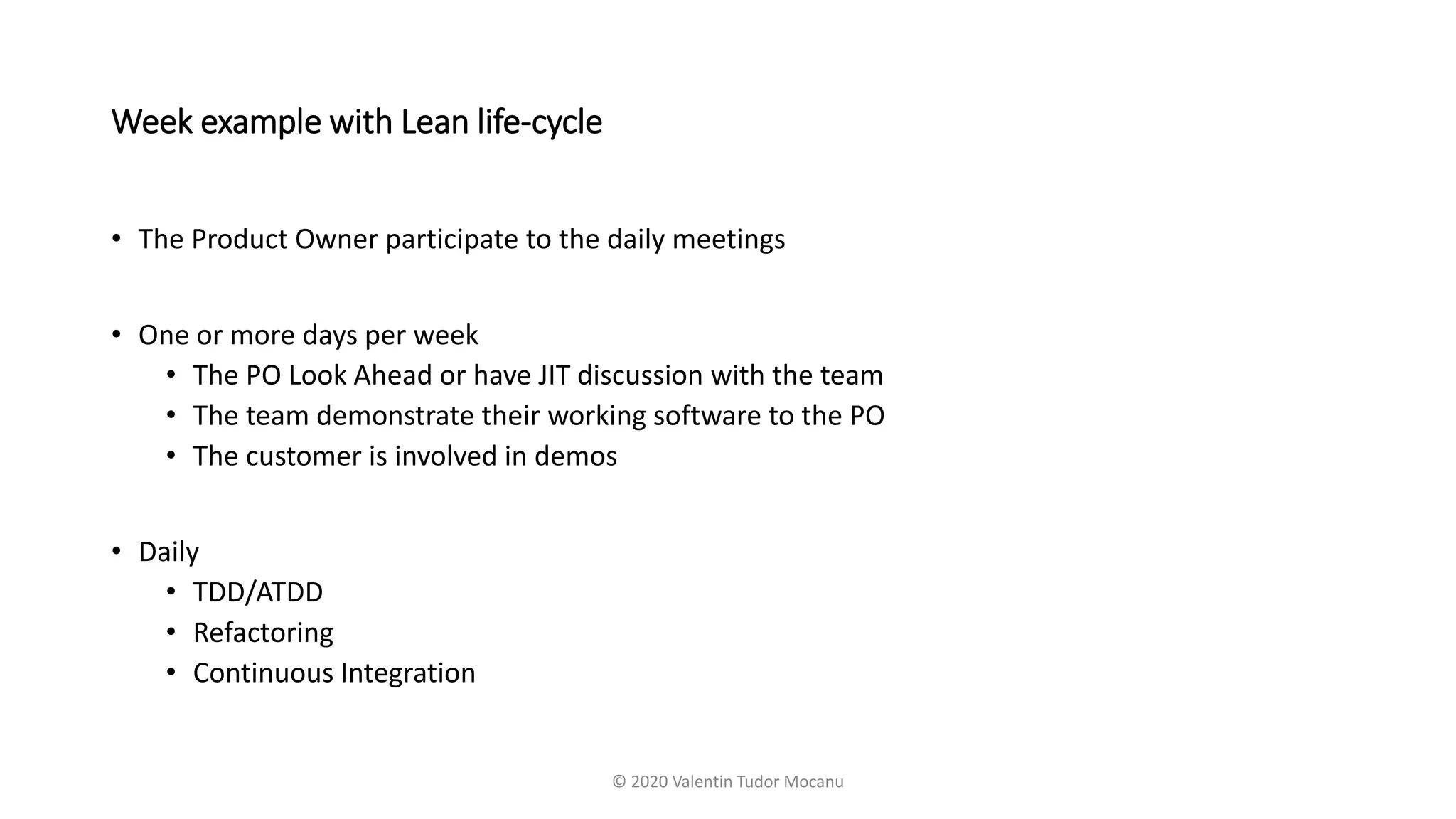
Week example with Lean life-cycle
• The Product Owner participate to the daily meetings
• One or more days per week
• The PO Look Ahead or have JIT discussion with the team
• The team demonstrate their working software to the PO
• The customer is involved in demos
• Daily
• TDD/ATDD
• Refactoring
• Continuous Integration
© 2020 Valentin Tudor Mocanu
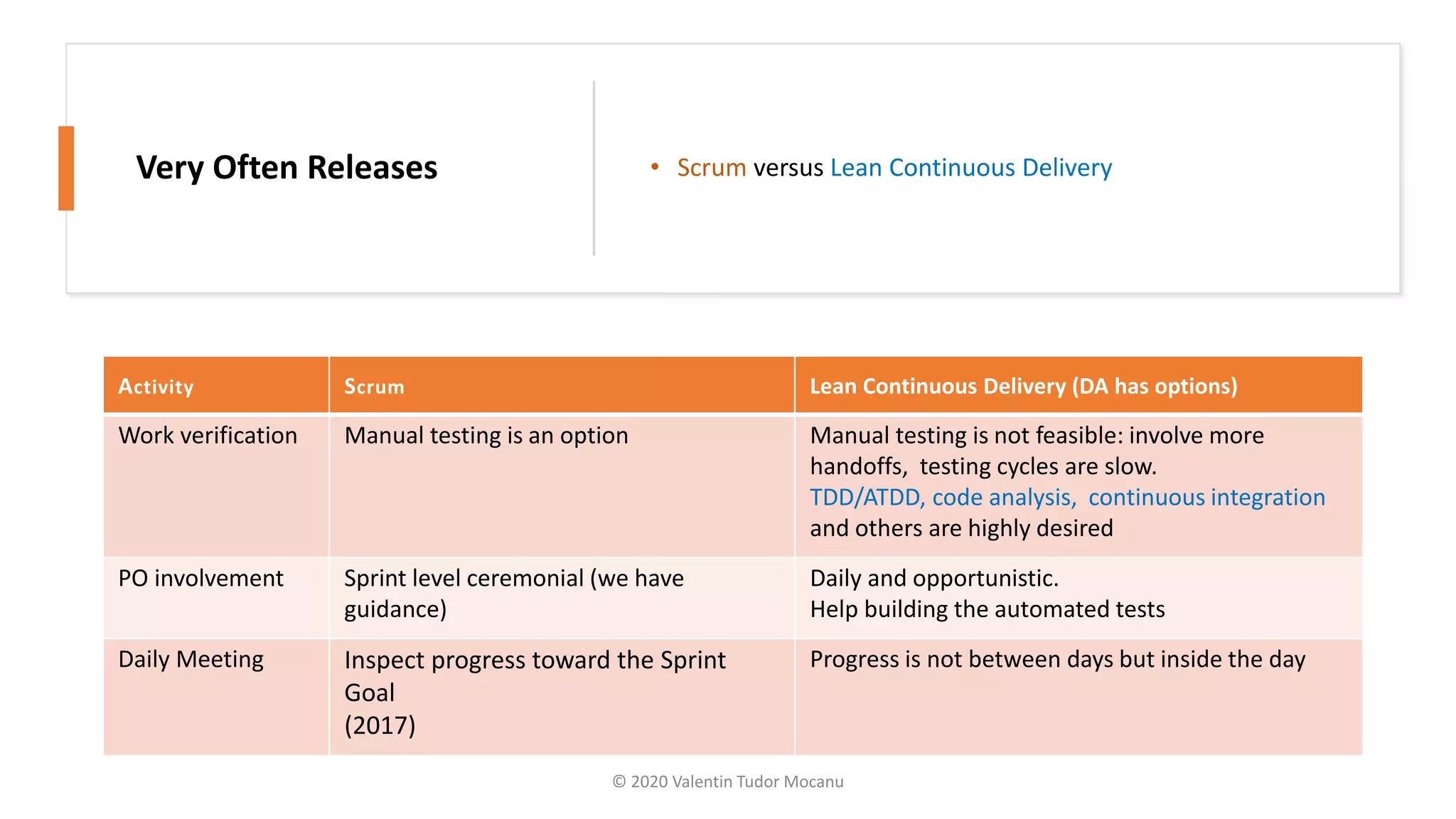
Very Often Releases • Scrum versus Lean Continuous Delivery
Activity Scrum Lean Continuous Delivery (DA has options)
Work verification Manual testing is an option Manual testing is not feasible: involve more
handoffs, testing cycles are slow.
TDD/ATDD, code analysis, continuous integration
and others are highly desired
PO involvement Sprint level ceremonial (we have
guidance)
Daily and opportunistic.
Help building the automated tests
Daily Meeting Inspect progress toward the Sprint
Goal
(2017)
Progress is not between days but inside the day
© 2020 Valentin Tudor Mocanu
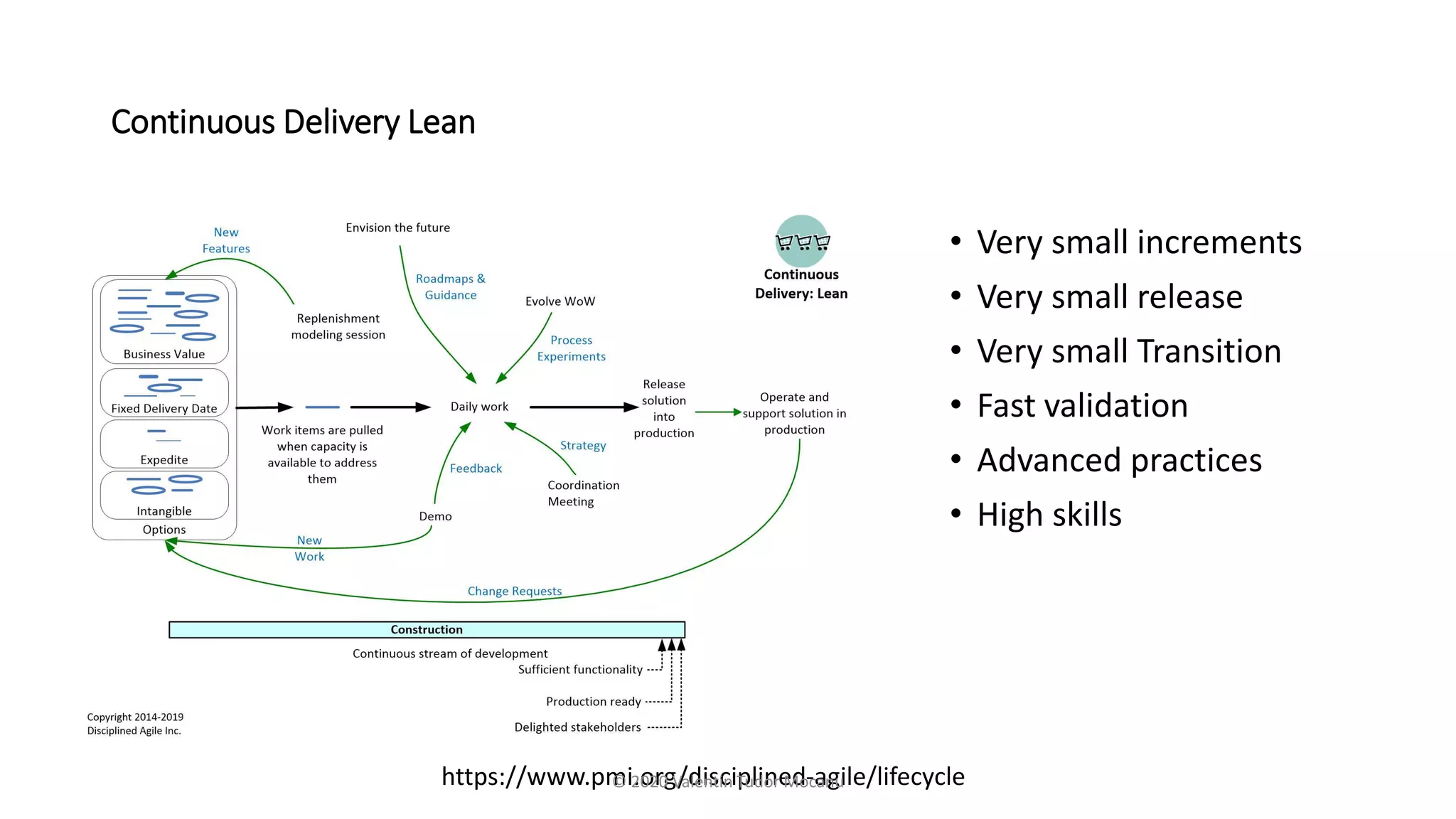
Continuous Delivery Lean
• Very small increments
• Very small release
• Very small Transition
• Fast validation
• Advanced practices
• High skills
https://www.pmi.org/disciplined-agile/lifecycle
© 2020 Valentin Tudor Mocanu
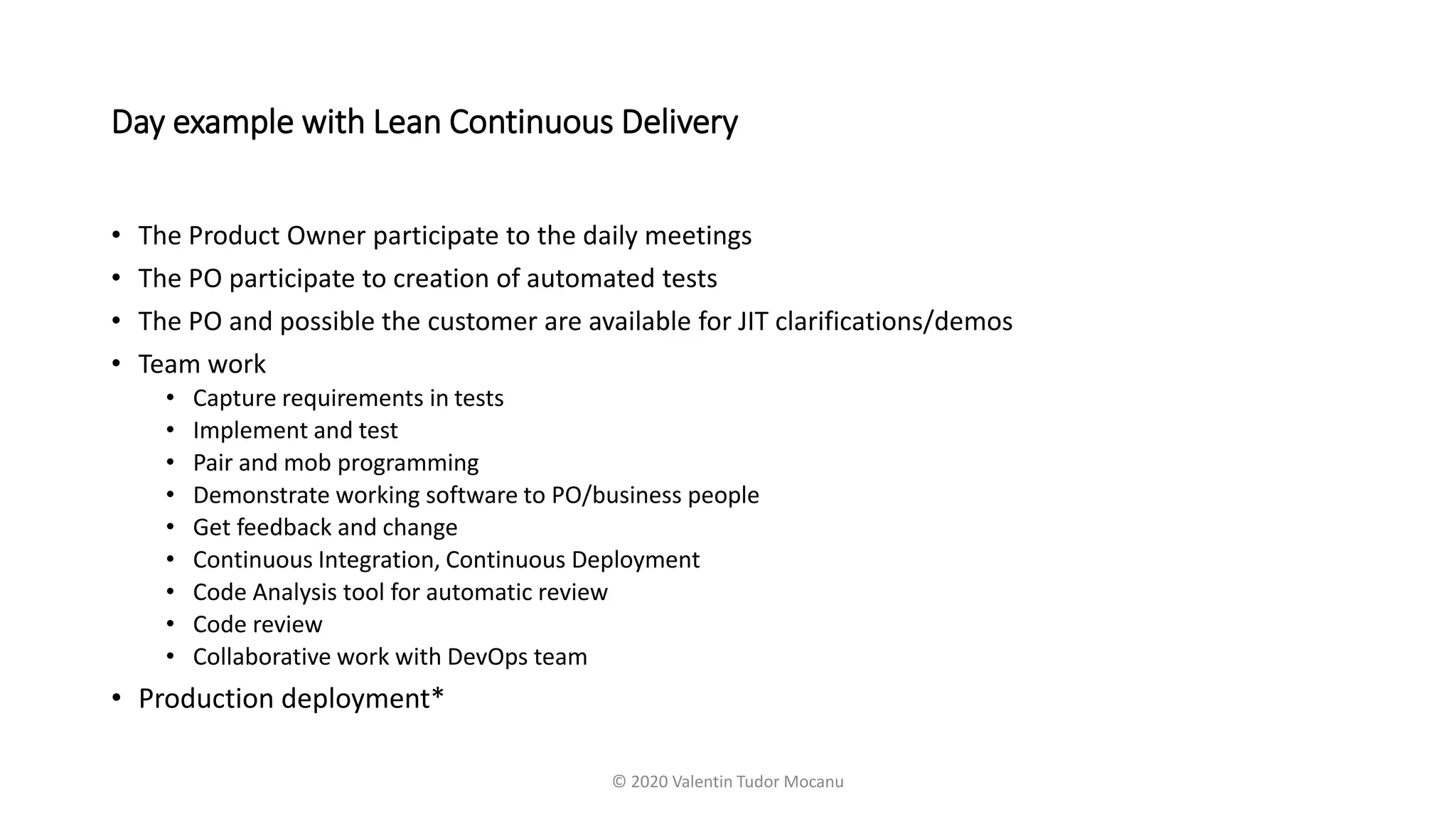
Day example with Lean Continuous Delivery
• The Product Owner participate to the daily meetings
• The PO participate to creation of automated tests
• The PO and possible the customer are available for JIT clarifications/demos
• Team work
• Capture requirements in tests
• Implement and test
• Pair and mob programming
• Demonstrate working software to PO/business people
• Get feedback and change
• Continuous Integration, Continuous Deployment
• Code Analysis tool for automatic review
• Code review
• Collaborative work with DevOps team
• Production deployment*
© 2020 Valentin Tudor Mocanu
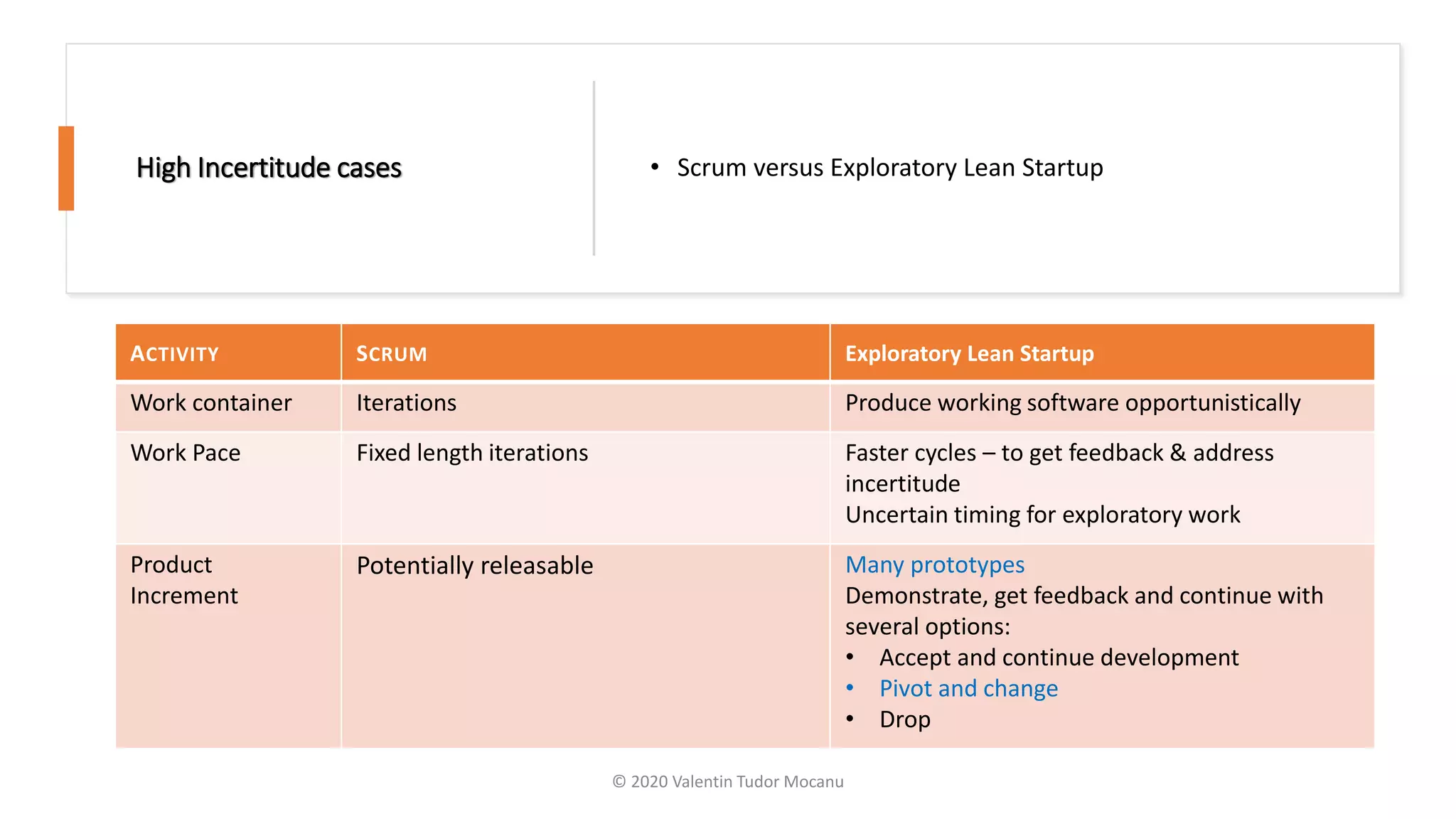
High Incertitude cases • Scrum versus Exploratory Lean Startup
ACTIVITY SCRUM Exploratory Lean Startup
Work container Iterations Produce working software opportunistically
Work Pace Fixed length iterations Faster cycles – to get feedback & address
incertitude
Uncertain timing for exploratory work
Product
Increment
Potentially releasable Many prototypes
Demonstrate, get feedback and continue with
several options:
• Accept and continue development
• Pivot and change
• Drop
© 2020 Valentin Tudor Mocanu
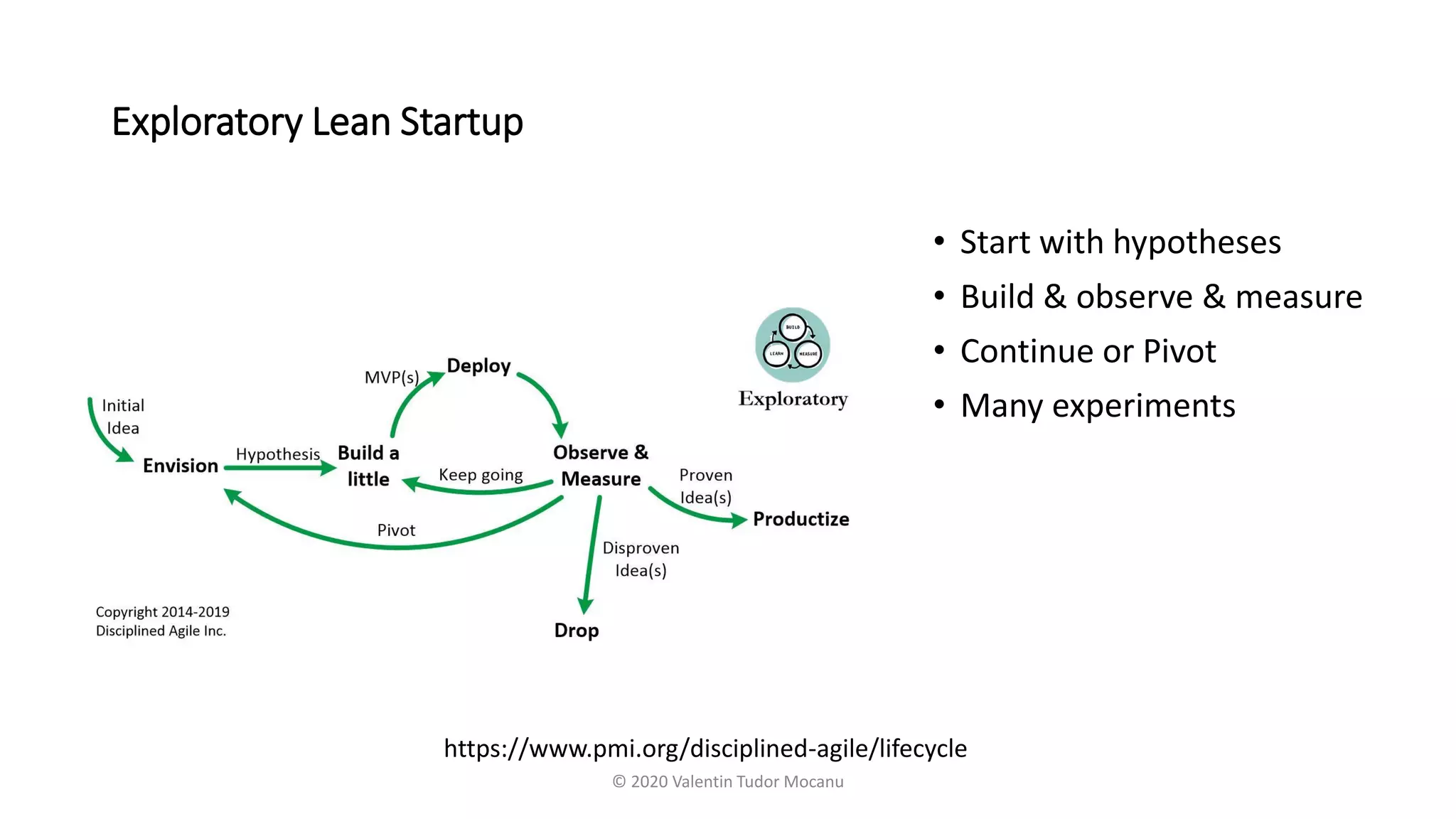
Exploratory Lean Startup
• Start with hypotheses
• Build & observe & measure
• Continue or Pivot
• Many experiments
https://www.pmi.org/disciplined-agile/lifecycle
© 2020 Valentin Tudor Mocanu
Scrum for all?
• Centralized organization decision
• Our organization will use Scrum
• Translation: all products, all teams, all projects must use Scrum
• What really happening?
• Scrum ceremonial is respected
• In some situations this ceremonial does not help
• A good part of the work performed without Agile & Lean guidance
• Ad-hoc process
© 2020 Valentin Tudor Mocanu
Adapt to the context – DA Principles
• Context Count
• Our situation is unique and evolve over time
• Be Pragmatic
• Our goal is not to use one method or another, it's to be effective and to improve
• Choice is Good
• We need to choose our WoW in a context-driven manner
• We need to know our choices & the associated tradeoffs
• We need guidance – PMI DA Toolkit
© 2020 Valentin Tudor Mocanu
Scrum Guide 2020 changes
• Less guidance for Scrum Events & Rules
• More generic, more potential options but only because of removed guidance
• Same small set of events/practices
• Fundamental & not commented changes
• More increments in one Sprint
• What is done/not done acceptance – before Scrum Review
© 2020 Valentin Tudor Mocanu
Scrum Life-cycle - 2017
Release
Planning
Release Backlog
Architecture
Vision
Sprints
Refining
Planning:
- Sprint Backlog
Review:
- Accept (done/not done)
- Product Increment
- Inspect & Adapt
- Potential release
Transition
Included in Sprints
Reference: https://www.scrumguides.org/scrum-guide-2017.html
© 2020 Valentin Tudor Mocanu
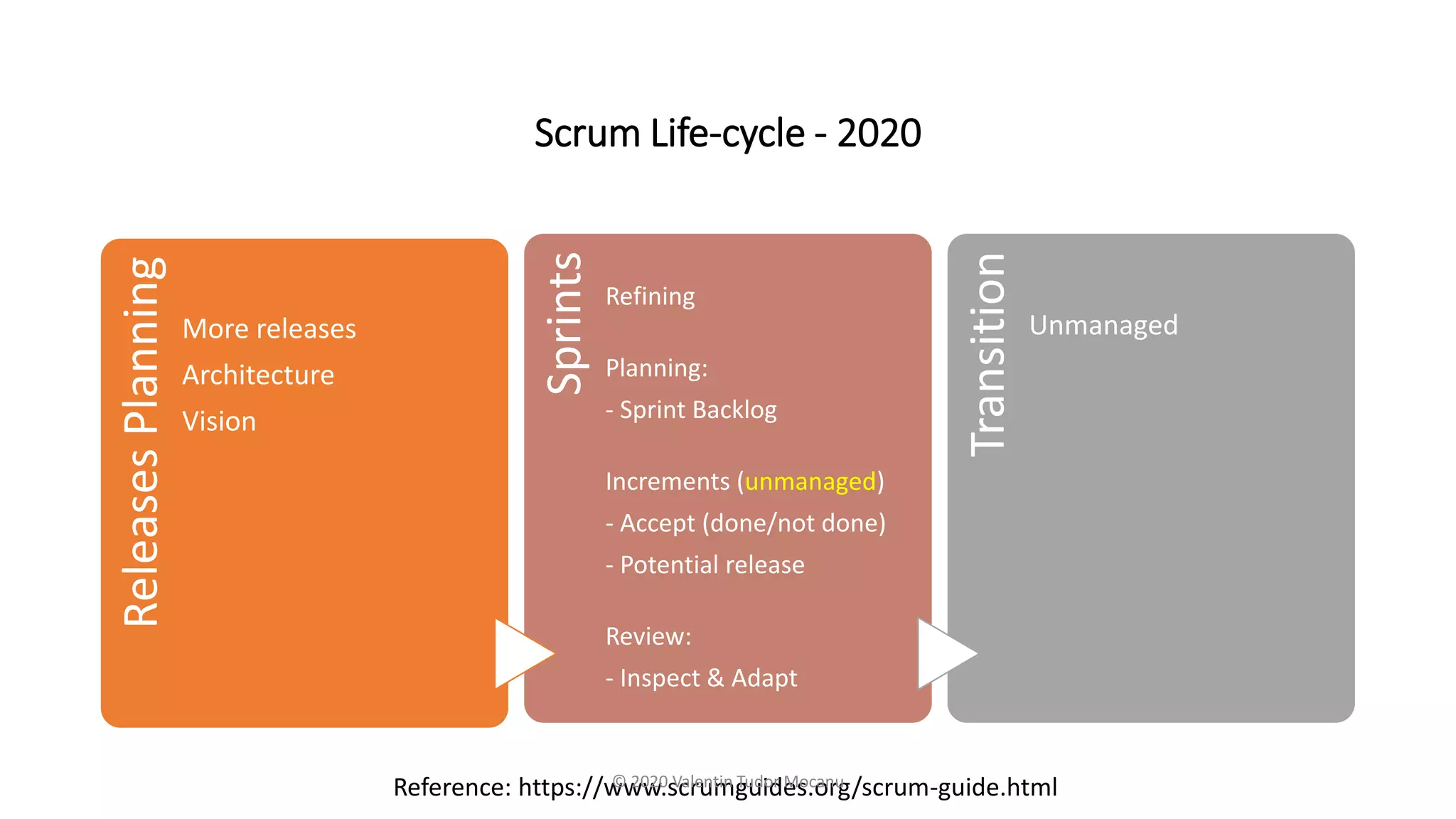
Scrum Life-cycle - 2020
Releases
Planning
More releases
Architecture
Vision
Sprints
Refining
Planning:
- Sprint Backlog
Increments (unmanaged)
- Accept (done/not done)
- Potential release
Review:
- Inspect & Adapt
Transition
Unmanaged
Reference: https://www.scrumguides.org/scrum-guide.html
© 2020 Valentin Tudor Mocanu
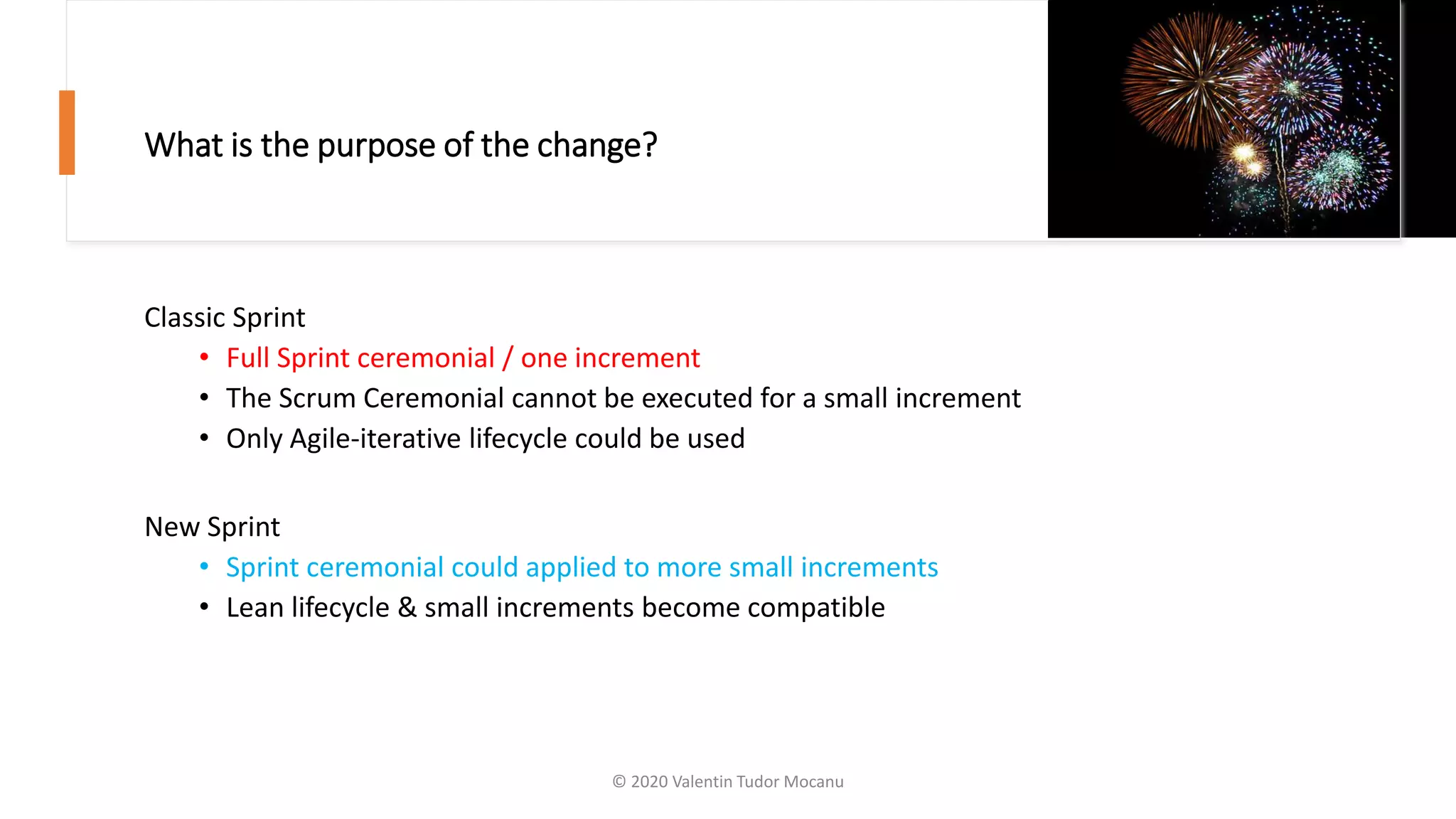
What is the purpose of the change?
Classic Sprint
• Full Sprint ceremonial / one increment
• The Scrum Ceremonial cannot be executed for a small increment
• Only Agile-iterative lifecycle could be used
New Sprint
• Sprint ceremonial could applied to more small increments
• Lean lifecycle & small increments become compatible
© 2020 Valentin Tudor Mocanu
What is the problem with the change?
• The Sprint is no longer an iteration and that is not a problem but …
• The Sprint (Scrum) become more generic, but …
• There is less explicit support in Scrum Events for releasing product increments
• …. and for organizing a release
© 2020 Valentin Tudor Mocanu
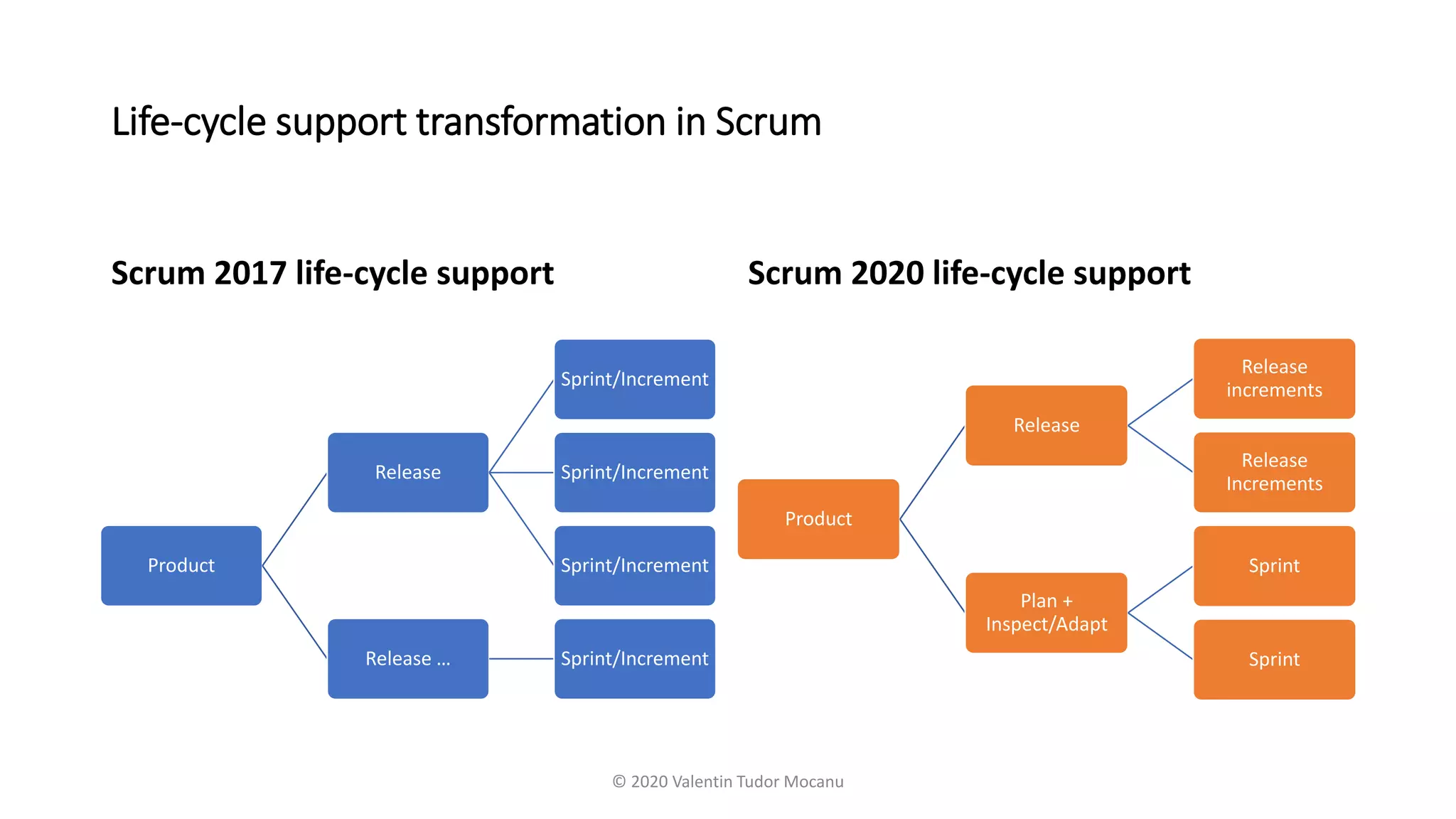
Life-cycle support transformation in Scrum
Scrum 2017 life-cycle support
Product
Release
Sprint/Increment
Sprint/Increment
Sprint/Increment
Release … Sprint/Increment
Scrum 2020 life-cycle support
Product
Release
Release
increments
Release
Increments
Plan +
Inspect/Adapt
Sprint
Sprint
© 2020 Valentin Tudor Mocanu
What is next?
• Scrum changes acknowledge the need to be less prescriptive
• Scrum-only approach has too little guidance for solution delivery aspects
• Main question: How we will prepare our releases?
• We need guidance for different ways of delivery
• DA is an excellent option for such guidance
• DA support Scrum, XP, or other working styles
© 2020 Valentin Tudor Mocanu
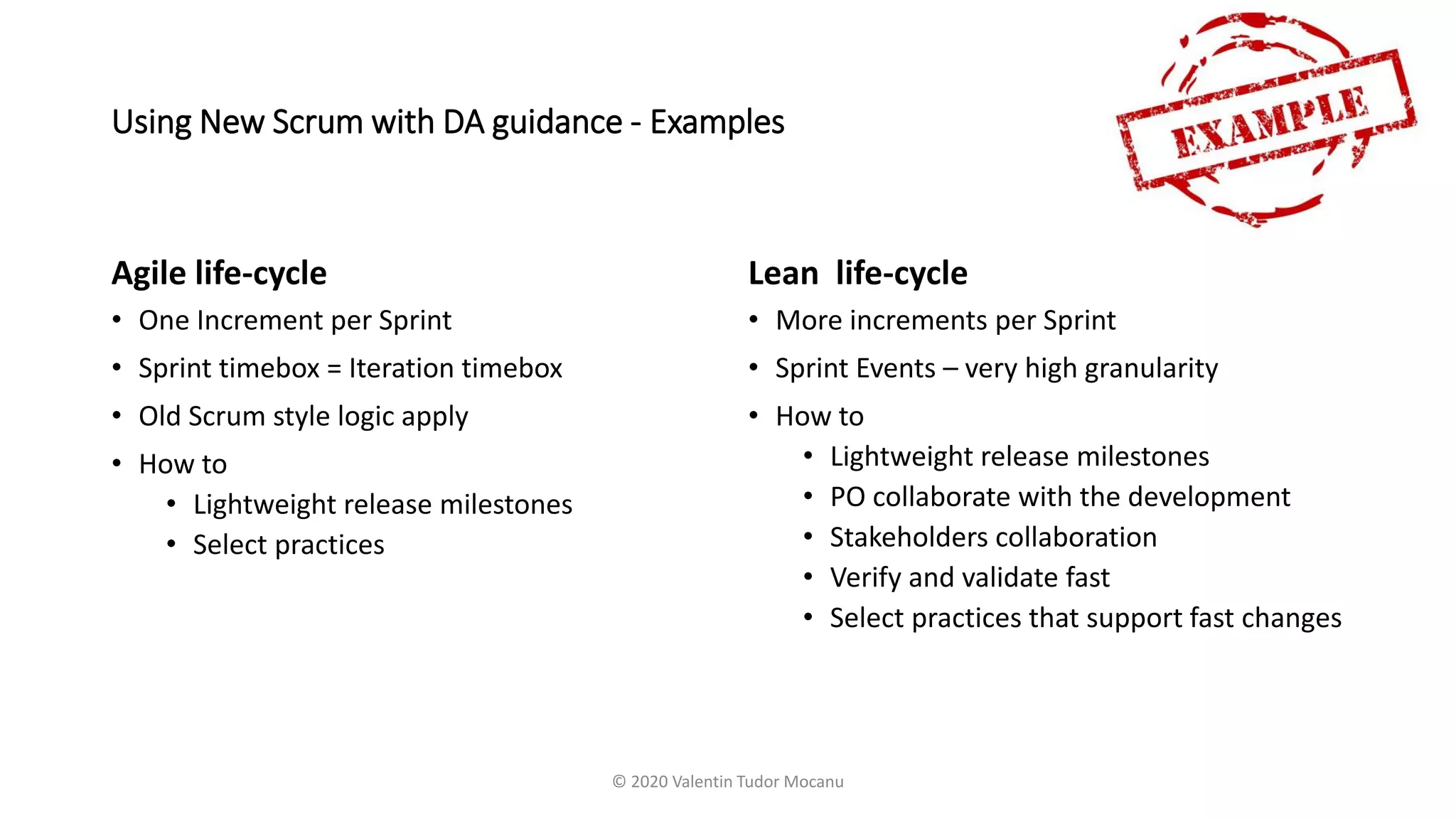
Using New Scrum with DA guidance - Examples
Agile life-cycle
• One Increment per Sprint
• Sprint timebox = Iteration timebox
• Old Scrum style logic apply
• How to
• Lightweight release milestones
• Select practices
Lean life-cycle
• More increments per Sprint
• Sprint Events – very high granularity
• How to
• Lightweight release milestones
• PO collaborate with the development
• Stakeholders collaboration
• Verify and validate fast
• Select practices that support fast changes
© 2020 Valentin Tudor Mocanu
Questions ?
© 2020 Valentin Tudor Mocanu
References
• [R1] The 2017 Scrum GuideTM - https://www.scrumguides.org/scrum-guide.html
• [R2] The 2020 Scrum GuideTM - https://www.scrumguides.org/scrum-guide-2017.html
• PMI Disciplined Agile - Lifecycles - https://www.pmi.org/disciplined-agile/lifecycle
• PMI Disciplined Agile – Risk Value Lifecycle - https://www.pmi.org/disciplined-agile/lifecycle/risk-value-lifecycle
© 2020 Valentin Tudor Mocanu

Enhancing Scrum Life Cycle experience with Disciplined Agile Toolkit

  • 1.
    ENHANCING SCRUM LIFE CYCLEEXPERIENCE WITH DISCIPLINED AGILE TOOLKIT Valentin Tudor Mocanu CDAC/CDAI | PMI Disciplined Agile 25 11 2020
  • 2.
    PMI Disciplined AgileToolkit https://www.pmi.org/disciplined-agile
  • 3.
    Valentin Tudor Mocanu •Iterative development (1999) • Agile development (2000) • Agile training (2013) • Disciplined Agile partner, instructor and coach (2015) • DA Advisory Council • PMP, PSM • Training: Agile, Lean, Scrum, XP • Training PMI DA workshops: DA Scrum Master, DA Senior Scrum Master • Areas of interest: continuous improvement, agile & lean, agile products, clean architecture, collaborative work. valentinmocanu.com @ValentinTudor © 2020 Valentin Tudor Mocanu
  • 4.
    Scrum Guide 2020 •This presentation will address first the known Scrum approach (before changes) • Some Scrum changes are strongly related to discussed subjects © 2020 Valentin Tudor Mocanu
  • 5.
    Software development context •Incertitude, complexity and knowledge work • Changing requirements • Solution inherent complexity © 2020 Valentin Tudor Mocanu
  • 6.
    Waterfall • Big upfront: requirements, solution, planning • Not feasible for complex problems • The requirements will change • BUF Solution & Planning: do not make sense with unclear/uncertain requirements • “Paper”-only solutions do not prove nothing • Late acceptance and very few feedback • Cannot develop the right product © 2020 Valentin Tudor Mocanu
  • 7.
    Iterative development Slice the workinside a release: iterations Lightweight up-front requirements, solution, planning Iteration – all aspects of the development Defer decisions Acquire knowledge & take informed decisions Real solution progress demonstrated with working software © 2020 Valentin Tudor Mocanu
  • 8.
    Agile • Iterative-adaptive • “Respondingto change over following a plan” – Agile Manifesto value • Collaborative work • Target the nature of the problem: • often changing requirements, complexity, knowledge work © 2020 Valentin Tudor Mocanu
  • 9.
    Scrum Approach • Focuson iteration ~ what is generic in iterative development • Very little about releases ~ big variation depending on the context • Sprint – Scrum approach for iterations • Time boxes • Specific ceremonial – small set of fixed practices • Product backlog – Serialize the work • Scrum: how to execute the PB incoming work with Sprint after Sprint © 2020 Valentin Tudor Mocanu
  • 10.
    Sprint ceremonial Before theSprint • Refine the work ~ similar with Sprint planning → Ready state Sprint • Sprint planning • Daily Scrum + Development work • Sprint Review → Product Increment in Done state • Spring Retrospective © 2020 Valentin Tudor Mocanu
  • 11.
    Sprint Summary What andhow: Sprint Backlog Planning: Acceptance – PO explain what is/isn’t done and why Product Increment (what is done) is potentially releasable Inspect & adapt the release vision: market, budget, scope Review © 2020 Valentin Tudor Mocanu
  • 12.
    Scrum – asolution for Waterfall problems No big up-front decisions • defer part of requirements, solution, planning to Sprints The Sprint • like “a project with no more than a one-month horizon” will reduce complexity and risks Sprint end • Real Progress ~ Product Increment with “done” work • Feedback to adapt the release vision © 2020 Valentin Tudor Mocanu
  • 13.
    Scrum Life-cycle -2017 Release Planning Release Backlog Architecture Vision Sprints Refining Planning: - Sprint Backlog Review: - Accept (done/not done) - Inspect & Adapt - Potential release Transition Included in Sprints Reference: https://www.scrumguides.org/scrum-guide-2017.html © 2020 Valentin Tudor Mocanu
  • 14.
    How generic isthis approach? © 2020 Valentin Tudor Mocanu
  • 15.
    Questions What is theagile approach? What is the necessary support for frequent deliveries? What is necessary support for often changing requirements? What is necessary support for high incertitude cases? © 2020 Valentin Tudor Mocanu
  • 16.
    Agile Manifesto, life-cycleapproach Related Values • Customer collaboration over contract negotiation • Responding to change over following a plan Related Principles • Our highest priority is to satisfy the customer through early and continuous delivery of valuable software. • Deliver working software frequently, from a couple of weeks to a couple of months, with a preference to the shorter timescale. www.agilemanifesto.org © 2020 Valentin Tudor Mocanu
  • 17.
    Agile approach –Small Releases • Early & often delivery, preferably in no more than two weeks • Production deployment included • 2001, Agile Manifesto – no more than two weeks • Today – also days, day, hours © 2020 Valentin Tudor Mocanu
  • 18.
    Small Releases Advantages •Reduce overall complexity • Value delivered early • More stable release scope (fewer CRs) • Easy to manage the change requests • Real feedback more often © 2020 Valentin Tudor Mocanu
  • 19.
    Quick value delivery •Big batches ~ delayed delivery • Cost of delay ~ lost revenue or opportunity • Delay ~ high risk of producing junk stories • Quick delivery ~ small releases © 2020 Valentin Tudor Mocanu
  • 20.
    Support for SmallReleases • Scrum • No explicit recommendation • Some implicit support via releasable Sprint Product Increment • Extreme Programming • Recommend small releases • Explain advantages • XP practices and small releases are symbiotic (user stories, etc.) • Disciplined Agile • Recommend small releases ~ minimum business increments • Offer substantial guidance (how to/tailoring): mindset, life-cycles, process goals, practices • Explain advantages of accelerated value delivery © 2020 Valentin Tudor Mocanu
  • 21.
    Disciplined Agile - MinimumBusiness Increment • Small Release with a business meaning • Value early delivery Life-cycle option in DA Small releases support Scrum compatibility Agile (iteration based) Small and very few iterations Yes Lean Release must be small No (Scrum 2017) Continuous Delivery Agile By default, small release Yes, with very few one-week Sprints Continuous Delivery Lean By default, very small releases No © 2020 Valentin Tudor Mocanu
  • 22.
    Scrum Life-cycle -2017 Release Planning Release Backlog Architecture Vision Sprints Refining Planning: - Sprint Backlog Review: - Accept (done/not done) - Inspect & Adapt - Potential release Transition Included in Sprints Reference: https://www.scrumguides.org/scrum-guide-2017.html © 2020 Valentin Tudor Mocanu
  • 23.
    Scrum and SmallReleases Sprint ~“a project with no more than a one-month horizon” … not really Only often release to production will give real feedback & value + reduce complexity & risks Scrum • Product increment is releasable (potentially) • Iterations could be small ….but there is no explicit recommendation to do that ? © 2020 Valentin Tudor Mocanu
  • 24.
    DA milestones –a risk-value approach Address life-cycle risks • Unaligned stakeholders • Inappropriate architecture • Delivery team gets off track • Insufficient functionality • Solution isn’t ready to be shipped • Stakeholders don’t like what they get https://www.pmi.org/disciplined-agile/lifecycle/risk-value-lifecycle © 2020 Valentin Tudor Mocanu
  • 25.
    End-to-end Agile Scrum-basedlife-cycle https://www.pmi.org/disciplined-agile/lifecycle © 2020 Valentin Tudor Mocanu
  • 26.
    Often changing requirements •Scrum vs Lean lifecycle • Scrum looks like Waterfall in this context ACTIVITY SCRUM LEAN Look Ahead Sprint level (~ rigid in this case) Mostly opportunistically look ahead and JIT Daily meeting Usually Development Team only PO work closer with the team Work Validation Manual testing – not so feasible here Automated tests – highly desired Demo and Acceptance Mostly in Spring review (Scrum 2017) Opportunistically and often © 2020 Valentin Tudor Mocanu
  • 27.
  • 28.
    Week example withLean life-cycle • The Product Owner participate to the daily meetings • One or more days per week • The PO Look Ahead or have JIT discussion with the team • The team demonstrate their working software to the PO • The customer is involved in demos • Daily • TDD/ATDD • Refactoring • Continuous Integration © 2020 Valentin Tudor Mocanu
  • 29.
    Very Often Releases• Scrum versus Lean Continuous Delivery Activity Scrum Lean Continuous Delivery (DA has options) Work verification Manual testing is an option Manual testing is not feasible: involve more handoffs, testing cycles are slow. TDD/ATDD, code analysis, continuous integration and others are highly desired PO involvement Sprint level ceremonial (we have guidance) Daily and opportunistic. Help building the automated tests Daily Meeting Inspect progress toward the Sprint Goal (2017) Progress is not between days but inside the day © 2020 Valentin Tudor Mocanu
  • 30.
    Continuous Delivery Lean •Very small increments • Very small release • Very small Transition • Fast validation • Advanced practices • High skills https://www.pmi.org/disciplined-agile/lifecycle © 2020 Valentin Tudor Mocanu
  • 31.
    Day example withLean Continuous Delivery • The Product Owner participate to the daily meetings • The PO participate to creation of automated tests • The PO and possible the customer are available for JIT clarifications/demos • Team work • Capture requirements in tests • Implement and test • Pair and mob programming • Demonstrate working software to PO/business people • Get feedback and change • Continuous Integration, Continuous Deployment • Code Analysis tool for automatic review • Code review • Collaborative work with DevOps team • Production deployment* © 2020 Valentin Tudor Mocanu
  • 32.
    High Incertitude cases• Scrum versus Exploratory Lean Startup ACTIVITY SCRUM Exploratory Lean Startup Work container Iterations Produce working software opportunistically Work Pace Fixed length iterations Faster cycles – to get feedback & address incertitude Uncertain timing for exploratory work Product Increment Potentially releasable Many prototypes Demonstrate, get feedback and continue with several options: • Accept and continue development • Pivot and change • Drop © 2020 Valentin Tudor Mocanu
  • 33.
    Exploratory Lean Startup •Start with hypotheses • Build & observe & measure • Continue or Pivot • Many experiments https://www.pmi.org/disciplined-agile/lifecycle © 2020 Valentin Tudor Mocanu
  • 34.
    Scrum for all? •Centralized organization decision • Our organization will use Scrum • Translation: all products, all teams, all projects must use Scrum • What really happening? • Scrum ceremonial is respected • In some situations this ceremonial does not help • A good part of the work performed without Agile & Lean guidance • Ad-hoc process © 2020 Valentin Tudor Mocanu
  • 35.
    Adapt to thecontext – DA Principles • Context Count • Our situation is unique and evolve over time • Be Pragmatic • Our goal is not to use one method or another, it's to be effective and to improve • Choice is Good • We need to choose our WoW in a context-driven manner • We need to know our choices & the associated tradeoffs • We need guidance – PMI DA Toolkit © 2020 Valentin Tudor Mocanu
  • 36.
    Scrum Guide 2020changes • Less guidance for Scrum Events & Rules • More generic, more potential options but only because of removed guidance • Same small set of events/practices • Fundamental & not commented changes • More increments in one Sprint • What is done/not done acceptance – before Scrum Review © 2020 Valentin Tudor Mocanu
  • 37.
    Scrum Life-cycle -2017 Release Planning Release Backlog Architecture Vision Sprints Refining Planning: - Sprint Backlog Review: - Accept (done/not done) - Product Increment - Inspect & Adapt - Potential release Transition Included in Sprints Reference: https://www.scrumguides.org/scrum-guide-2017.html © 2020 Valentin Tudor Mocanu
  • 38.
    Scrum Life-cycle -2020 Releases Planning More releases Architecture Vision Sprints Refining Planning: - Sprint Backlog Increments (unmanaged) - Accept (done/not done) - Potential release Review: - Inspect & Adapt Transition Unmanaged Reference: https://www.scrumguides.org/scrum-guide.html © 2020 Valentin Tudor Mocanu
  • 39.
    What is thepurpose of the change? Classic Sprint • Full Sprint ceremonial / one increment • The Scrum Ceremonial cannot be executed for a small increment • Only Agile-iterative lifecycle could be used New Sprint • Sprint ceremonial could applied to more small increments • Lean lifecycle & small increments become compatible © 2020 Valentin Tudor Mocanu
  • 40.
    What is theproblem with the change? • The Sprint is no longer an iteration and that is not a problem but … • The Sprint (Scrum) become more generic, but … • There is less explicit support in Scrum Events for releasing product increments • …. and for organizing a release © 2020 Valentin Tudor Mocanu
  • 41.
    Life-cycle support transformationin Scrum Scrum 2017 life-cycle support Product Release Sprint/Increment Sprint/Increment Sprint/Increment Release … Sprint/Increment Scrum 2020 life-cycle support Product Release Release increments Release Increments Plan + Inspect/Adapt Sprint Sprint © 2020 Valentin Tudor Mocanu
  • 42.
    What is next? •Scrum changes acknowledge the need to be less prescriptive • Scrum-only approach has too little guidance for solution delivery aspects • Main question: How we will prepare our releases? • We need guidance for different ways of delivery • DA is an excellent option for such guidance • DA support Scrum, XP, or other working styles © 2020 Valentin Tudor Mocanu
  • 43.
    Using New Scrumwith DA guidance - Examples Agile life-cycle • One Increment per Sprint • Sprint timebox = Iteration timebox • Old Scrum style logic apply • How to • Lightweight release milestones • Select practices Lean life-cycle • More increments per Sprint • Sprint Events – very high granularity • How to • Lightweight release milestones • PO collaborate with the development • Stakeholders collaboration • Verify and validate fast • Select practices that support fast changes © 2020 Valentin Tudor Mocanu
  • 44.
    Questions ? © 2020Valentin Tudor Mocanu
  • 45.
    References • [R1] The2017 Scrum GuideTM - https://www.scrumguides.org/scrum-guide.html • [R2] The 2020 Scrum GuideTM - https://www.scrumguides.org/scrum-guide-2017.html • PMI Disciplined Agile - Lifecycles - https://www.pmi.org/disciplined-agile/lifecycle • PMI Disciplined Agile – Risk Value Lifecycle - https://www.pmi.org/disciplined-agile/lifecycle/risk-value-lifecycle © 2020 Valentin Tudor Mocanu