USING 2020 SCRUM WITH DA TOOLKIT
Valentin Tudor Mocanu CDAC/CDAI | PMI Disciplined Agile
24 02 2021
PMI Disciplined Agile Toolkit
https://www.pmi.org/disciplined-agile
Valentin Tudor Mocanu
• Iterative development (1999) , Agile development (2000)
• Agile training (2013), Disciplined Agile partner, instructor and coach (2015)
• DA Advisory Council
• PMP, PSM
• Training: Agile, Lean, Scrum, XP
• Training PMI DA workshops: DA Scrum Master, DA Senior Scrum Master
• Development: training simulators, document management, retail
• Areas of interest: continuous improvement, agile & lean, agile products, collaborative
work.
valentinmocanu.com
@ValentinTudor
© 2020 Valentin Tudor Mocanu
Scrum Definition – Purposefully Incomplete
SG 2020, page 3:
“The Scrum framework is purposefully incomplete, only defining the parts required to implement Scrum
theory.”
By definition, you cannot rely only on Scrum to define your process and, you need more guidance beyond
Scrum.
Scrum Definition – Improvement instrument
SG 2020, page 3:
“Various processes, techniques and methods can be employed within the framework. Scrum wraps around
existing practices or renders them unnecessary. Scrum makes visible the relative efficacy of current
management, environment, and work techniques, so that improvements can be made. “
• Scrum is an improvement wrapper for our way of working
• Scrum is not the definition for our WoW
Q: Could you define your Way of Working? A: Scrum.
Wrong answer.
Scrum Theory - lean thinking
SG 2020, page 3
“Scrum is founded on empiricism and lean thinking.”
There is more lean thinking outside Scrum, so .for a real lean thinking we need more instruments
Lean thinking related strategies
What are our strategies?
• To eliminate all types of waste for software development (or for your domain)
• To enable delivery in small batches?
• To optimize the whole?
• To inspect and adapt on shorter time periods?
Implementing Lean Thinking – Optimize the whole
Lean principle: Optimize the whole
• Addressing only parts and optimize locally – could give us a very limited improvement
• We need the big picture: whole value stream, all activities that start and end with the customer
How to
• Optimize not only the development, but also at DevOps, Value Stream and Enterprise level
• Use DA Toolkit guidance for all these process layers
Implementing Lean Thinking - Avoid Waste
List with the main sources of waste
• Marry Poppendieck work, DA Lean Fundamentals
Methods to identify waste in our process
• Optimize the whole value stream (start and end with the customer), not only development
• Value Stream Mapping – DA Flex method, DA Value Stream layer guidance
Methods to avoid waste
• Root cause analysis
• DA Improvement guidance for each process capability (how to select needed practices)
Implementing Lean Thinking - Deliver in Small batches
Advantages of small batches
• It focuses on providing value earlier, reducing complexity and increasing efficiency
• It offers better adaptation to business changes, a better workflow and an optimization of the workload
Support delivery in in small batches
- Small Releases (XP), Minimum Business Increment (DA)
- Agile & lean life cycles for small releases (DA):
▪ Continuous Delivery Agile and Continuous Delivery Agile Lean
- Explicit guidance about how to accelerate value delivery (DA)
Inspect & Adapt
SG 2020, page 3 :
“Scrum combines four formal events for inspection and adaptation within a containing event, the Sprint.”
SG page 4, Inspection:
“The Scrum artifacts and the progress toward agreed goals must be inspected frequently and diligently to
detect potentially undesirable variances or problems. To help with inspection, Scrum provides cadence in
the form of its five events.”
- We need more than five events, we nee also just in time instruments, such as
- XP/DA core agile practices: pair programming, TDD
- DA : Just in time clarifications about requirements, design, code
Scrum Team
SG 2020, page 5
“Scrum Teams are cross-functional, meaning the members have all the skills necessary to create value each
Sprint. They are also self-managing, meaning they internally decide who does what, when, and how.”
A term is not a guidance.
What are our pragmatic (economic, feasible , useful) strategies for cross-functional skills?
• DA has the concept of Generalizing Specialist
What are our strategies for self-management beyond the five Scrum Events?
• You can use DA guidance for: forming the team, emotional intelligence, and coordination and collaboration
within and cross the teams.
•
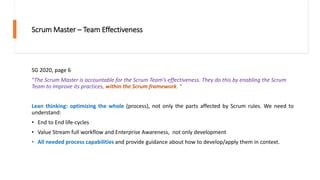
Scrum Master – Team Effectiveness
SG 2020, page 6
“The Scrum Master is accountable for the Scrum Team’s effectiveness. They do this by enabling the Scrum
Team to improve its practices, within the Scrum framework. “
Lean thinking: optimizing the whole (process), not only the parts affected by Scrum rules. We need to
understand:
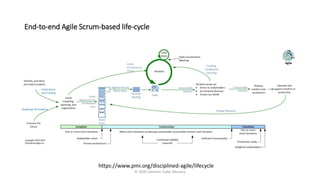
• End to End life-cycles
• Value Stream full workflow and Enterprise Awareness, not only development
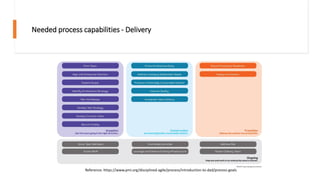
• All needed process capabilities and provide guidance about how to develop/apply them in context.
End-to-end Agile Scrum-based life-cycle
https://www.pmi.org/disciplined-agile/lifecycle
© 2020 Valentin Tudor Mocanu
Needed process capabilities - Delivery
Reference: https://www.pmi.org/disciplined-agile/process/introduction-to-dad/process-goals
Scrum Master – Organization Effectiveness
SG 2020, page 7
“The Scrum Master serves the organization in several ways, including: Leading, training, and coaching the
organization in its Scrum adoption […]”
What organization really need is Business Agility:
- Apply both Agile and Lean in our context, not only and not necessary Scrum
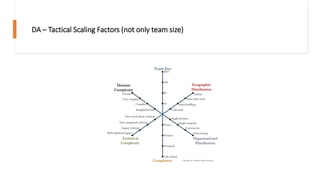
- Tactical Scaling - adapt our WoW to our situation scaling/complexity factors
- Strategic Scaling – all business areas must be agile, not only development
DA – Tactical Scaling Factors (not only team size)
Daily Scrum
SG 2020, page 9
“The Daily Scrum is not the only time Developers are allowed to adjust their plan. They often meet
throughout the day for more detailed discussions about adapting or re-planning the rest of the Sprint’s
work.”
Comment – try to address Scrum-only blind ceremonial. Also try to adapt Scrum to faster delivery cycles:
if the day is you smaller pace for inspect & adapt, how we will manage very often deliveries (days, day,
smaller)?
Product Goal
“The Product Goal describes a future state of the product which can serve as a target for the Scrum Team
to plan against. The Product Goal is in the Product Backlog. The rest of the Product Backlog emerges to
define “what” will fulfill the Product Goal.
The Product Goal is the long-term objective for the Scrum Team. They must fulfill (or abandon) one objective
before taking on the next.”
Comments
• Could be effective but also prescriptive: backlog visibility is ~ reduced to one goal only. Previously, the
backlog was an image of all known necessary work for the product
• We need more: product roadmaps, business roadmaps, technology roadmaps, and release level
backlog (See DA guidance).
DA – Rolling Wave Planning
DA: “Plan things that are near in time to you in detail and things that are distant in time at a higher level. “
Envisioning: roadmaps, releases
Look ahead: Iteration level or opportunistic
Just-in-time planning, after JIT clarifications about requirements & solution
Sprint Review – 2020 differences
SG 2017 page 13
“The Sprint Review includes the following elements:
• The Development Team demonstrates the work that it has “Done” and answers questions about the
Increment;
• The Product Owner explains what Product Backlog items have been “Done” and what has not been
“Done”; […]“
SG 2020 page 9
“The purpose of the Sprint Review is to inspect the outcome of the Sprint and determine future
adaptations. The Scrum Team presents the results of their work to key stakeholders and progress toward
the Product Goal is discussed. “
Sprint Review – important changes
2020 Sprint Review
- do not contain anymore the product increment demo and PO “acceptance” ~ when PO decide and
explain what is Done and what it isn’t
- The only remaining purpose is inspect & adapt versus product goal
Product Increment – the biggest change
SG 2017, page 17 - “The Increment is the sum of all the Product Backlog items completed during a Sprint
and the value of the increments of all previous Sprints. At the end of a Sprint, the new Increment must be
“Done,” […] The increment must be in useable condition regardless of whether the Product Owner decides
to release it. “
SG 2020, page 11 – “An Increment is a concrete stepping stone toward the Product Goal. Each Increment is
additive to all prior Increments and thoroughly verified, ensuring that all Increments work together. In order
to provide value, the Increment must be usable.
Multiple Increments may be created within a Sprint. The sum of the Increments is presented at the Sprint
Review thus supporting empiricism. However, an Increment may be delivered to stakeholders prior to the
end of the Sprint. The Sprint Review should never be considered a gate to releasing value. “
The new Sprint
It is no longer an iteration!
It is just a period for that we plan the work at the beginning and inspect and adapt at the end.
Sprints
• Are no more basic elements of the development life-cycle,
• Only planning/reviewing instruments “independent” of life-cycle approach.
We need to organize our development life-cycle beyond Scrum!
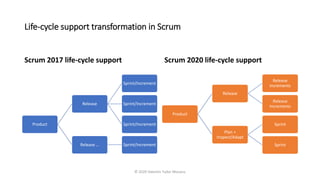
Life-cycle support transformation in Scrum
Scrum 2017 life-cycle support
Product
Release
Sprint/Increment
Sprint/Increment
Sprint/Increment
Release … Sprint/Increment
Scrum 2020 life-cycle support
Product
Release
Release
increments
Release
Increments
Plan +
Inspect/Adapt
Sprint
Sprint
© 2020 Valentin Tudor Mocanu
What is the purpose of the change?
The Scrum Ceremonial cannot be executed for small increment
• Only Agile-iterative lifecycle could use full ceremonial / one increment
New Sprint definition apply the ceremonial to more increments when needed
• Lean lifecycle, with much smaller increments, becomes somehow compatible
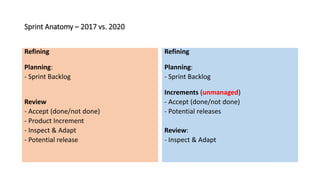
Sprint Anatomy – 2017 vs. 2020
Refining
Planning:
- Sprint Backlog
Review
- Accept (done/not done)
- Product Increment
- Inspect & Adapt
- Potential release
Refining
Planning:
- Sprint Backlog
Increments (unmanaged)
- Accept (done/not done)
- Potential releases
Review:
- Inspect & Adapt
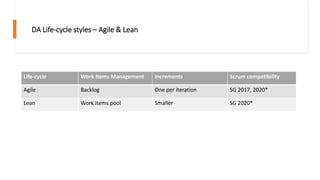
DA Life-cycle styles – Agile & Lean
Life-cycle Work Items Management Increments Scrum compatibility
Agile Backlog One per iteration SG 2017, 2020*
Lean Work Items pool Smaller SG 2020*
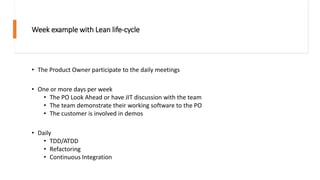
Week example with Lean life-cycle
• The Product Owner participate to the daily meetings
• One or more days per week
• The PO Look Ahead or have JIT discussion with the team
• The team demonstrate their working software to the PO
• The customer is involved in demos
• Daily
• TDD/ATDD
• Refactoring
• Continuous Integration
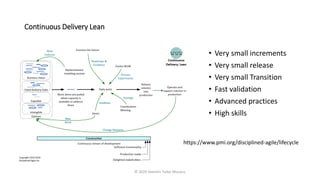
Continuous Delivery Lean
• Very small increments
• Very small release
• Very small Transition
• Fast validation
• Advanced practices
• High skills
https://www.pmi.org/disciplined-agile/lifecycle
© 2020 Valentin Tudor Mocanu
The magic Increment: some questions
Scrum Guide 2020, Definition of Done, page 12
“The moment a Product Backlog item meets the Definition of Done, an Increment is born.”
Scrum Guide 2020, Increment, page 12
“However, an Increment may be delivered to stakeholders prior to the end of the Sprint. “
Scrum try to be compatible with Continuous delivery, but just by declaring a possibility, without explicit
guidance. A Product Backlog Item (user story) cand be independently deliver anytime during a Sprint.
What is the real help of the five Scrum events in this endeavor? It is the Sprint planning a magic event that
could plan more releases? It is the Sprint review the magic event that could inspect more releases.?
What is the logic that transform a PBI in a Small Release/Minimum Business Increment?
DoD for a release and DoD for and user story are similar things?
Day example with Lean Continuous Delivery
• The Product Owner participate to the daily meetings
• The PO participate to creation of automated tests
• The PO and the customer are available for JIT clarifications/demos
• Team work
• Capture requirements in tests
• Implement and test
• Pair and mob programming
• Demonstrate working software to PO/business people
• Get feedback and change
• Continuous Integration, Continuous Deployment
• Code Analysis tool for automatic review
• Code review
• Collaborative work with DevOps team
• Production deployment
• Post-deployment strategies (intervention, validation)
New Scrum and Continuous Delivery Lean
CD Lean
- Very small releases
- Often changing requirements via Work item pool
New Scrum Often Delivery
• Product Backlog <> Work Item Pool
• Stable requirements - plan several very small releases in sets inside a Sprint
• Prescriptive – you must use a backlog
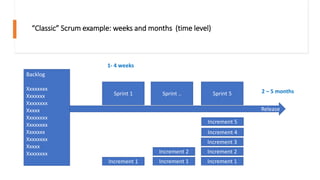
“Classic” Scrum example: weeks and months (time level)
Backlog
Xxxxxxxx
Xxxxxxx
Xxxxxxxx
Xxxxx
Xxxxxxxx
Xxxxxxxx
Xxxxxxx
Xxxxxxxx
Xxxxx
Xxxxxxxx
Sprint 1 Sprint .. Sprint 5
Increment 1
Increment 3
Increment 2
Increment 2
Increment 1 Increment 1
Increment 4
Increment 5
Release
1- 4 weeks
2 – 5 months
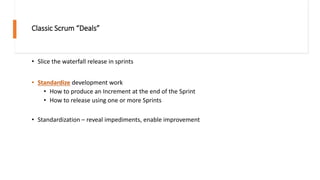
Classic Scrum “Deals”
• Slice the waterfall release in sprints
• Standardize development work
• How to produce an Increment at the end of the Sprint
• How to release using one or more Sprints
• Standardization – reveal impediments, enable improvement
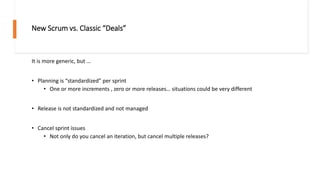
New Scrum vs. Classic “Deals”
It is more generic, but …
• Planning is “standardized” per sprint
• One or more increments , zero or more releases… situations could be very different
• Release is not standardized and not managed
• Cancel sprint issues
• Not only do you cancel an iteration, but cancel multiple releases?
Main questions for the New Scrum
What is the new Scrum approach to iterative way of working ?
What is the new Scrum approach to continuous flow way of working ?
Answer: you are a professional and you will figure out how it can be done
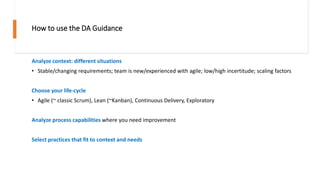
How to use the DA Guidance
Analyze context: different situations
• Stable/changing requirements; team is new/experienced with agile; low/high incertitude; scaling factors
Choose your life-cycle
• Agile (~ classic Scrum), Lean (~Kanban), Continuous Delivery, Exploratory
Analyze process capabilities where you need improvement
Select practices that fit to context and needs
DA Delivery Handbook
DA Online Resources
www.pmi.org/disciplined-agile/
Disciplined-Agile Blog at www.projectmanagement.com
Disciplined Agile – LinkedIn
DisciplinedAgile (@Disc_Agile) | Twitter
DA Training
DASM – Disciplined Agile Scrum Master
• Foundations: Agile, Lean, Agile Teams & Roles, Choose Your WoW
• DA for Delivery
DASSM – Disciplined Agile Senior Scrum Master
• Building Agile teams, Emotional Intelligence, Conflict Management
• DA for DevOps and Value Stream
• Pragmatic agile planning, measurements
Scrum references
Scrum Guide 2017
• https://scrumguides.org/docs/scrumguide/v2017/2017-Scrum-Guide-US.pdf
Scrum Guide 2020
• https://scrumguides.org/docs/scrumguide/v2020/2020-Scrum-Guide-US.pdf
QUESTIONS?
Q&A: valentinmocanu.com

Using Scrum 2020 with Disciplined Agile toolkit

  • 1.
    USING 2020 SCRUMWITH DA TOOLKIT Valentin Tudor Mocanu CDAC/CDAI | PMI Disciplined Agile 24 02 2021
  • 2.
    PMI Disciplined AgileToolkit https://www.pmi.org/disciplined-agile
  • 3.
    Valentin Tudor Mocanu •Iterative development (1999) , Agile development (2000) • Agile training (2013), Disciplined Agile partner, instructor and coach (2015) • DA Advisory Council • PMP, PSM • Training: Agile, Lean, Scrum, XP • Training PMI DA workshops: DA Scrum Master, DA Senior Scrum Master • Development: training simulators, document management, retail • Areas of interest: continuous improvement, agile & lean, agile products, collaborative work. valentinmocanu.com @ValentinTudor © 2020 Valentin Tudor Mocanu
  • 4.
    Scrum Definition –Purposefully Incomplete SG 2020, page 3: “The Scrum framework is purposefully incomplete, only defining the parts required to implement Scrum theory.” By definition, you cannot rely only on Scrum to define your process and, you need more guidance beyond Scrum.
  • 5.
    Scrum Definition –Improvement instrument SG 2020, page 3: “Various processes, techniques and methods can be employed within the framework. Scrum wraps around existing practices or renders them unnecessary. Scrum makes visible the relative efficacy of current management, environment, and work techniques, so that improvements can be made. “ • Scrum is an improvement wrapper for our way of working • Scrum is not the definition for our WoW Q: Could you define your Way of Working? A: Scrum. Wrong answer.
  • 6.
    Scrum Theory -lean thinking SG 2020, page 3 “Scrum is founded on empiricism and lean thinking.” There is more lean thinking outside Scrum, so .for a real lean thinking we need more instruments
  • 7.
    Lean thinking relatedstrategies What are our strategies? • To eliminate all types of waste for software development (or for your domain) • To enable delivery in small batches? • To optimize the whole? • To inspect and adapt on shorter time periods?
  • 8.
    Implementing Lean Thinking– Optimize the whole Lean principle: Optimize the whole • Addressing only parts and optimize locally – could give us a very limited improvement • We need the big picture: whole value stream, all activities that start and end with the customer How to • Optimize not only the development, but also at DevOps, Value Stream and Enterprise level • Use DA Toolkit guidance for all these process layers
  • 9.
    Implementing Lean Thinking- Avoid Waste List with the main sources of waste • Marry Poppendieck work, DA Lean Fundamentals Methods to identify waste in our process • Optimize the whole value stream (start and end with the customer), not only development • Value Stream Mapping – DA Flex method, DA Value Stream layer guidance Methods to avoid waste • Root cause analysis • DA Improvement guidance for each process capability (how to select needed practices)
  • 10.
    Implementing Lean Thinking- Deliver in Small batches Advantages of small batches • It focuses on providing value earlier, reducing complexity and increasing efficiency • It offers better adaptation to business changes, a better workflow and an optimization of the workload Support delivery in in small batches - Small Releases (XP), Minimum Business Increment (DA) - Agile & lean life cycles for small releases (DA): ▪ Continuous Delivery Agile and Continuous Delivery Agile Lean - Explicit guidance about how to accelerate value delivery (DA)
  • 11.
    Inspect & Adapt SG2020, page 3 : “Scrum combines four formal events for inspection and adaptation within a containing event, the Sprint.” SG page 4, Inspection: “The Scrum artifacts and the progress toward agreed goals must be inspected frequently and diligently to detect potentially undesirable variances or problems. To help with inspection, Scrum provides cadence in the form of its five events.” - We need more than five events, we nee also just in time instruments, such as - XP/DA core agile practices: pair programming, TDD - DA : Just in time clarifications about requirements, design, code
  • 12.
    Scrum Team SG 2020,page 5 “Scrum Teams are cross-functional, meaning the members have all the skills necessary to create value each Sprint. They are also self-managing, meaning they internally decide who does what, when, and how.” A term is not a guidance. What are our pragmatic (economic, feasible , useful) strategies for cross-functional skills? • DA has the concept of Generalizing Specialist What are our strategies for self-management beyond the five Scrum Events? • You can use DA guidance for: forming the team, emotional intelligence, and coordination and collaboration within and cross the teams. •
  • 13.
    Scrum Master –Team Effectiveness SG 2020, page 6 “The Scrum Master is accountable for the Scrum Team’s effectiveness. They do this by enabling the Scrum Team to improve its practices, within the Scrum framework. “ Lean thinking: optimizing the whole (process), not only the parts affected by Scrum rules. We need to understand: • End to End life-cycles • Value Stream full workflow and Enterprise Awareness, not only development • All needed process capabilities and provide guidance about how to develop/apply them in context.
  • 14.
    End-to-end Agile Scrum-basedlife-cycle https://www.pmi.org/disciplined-agile/lifecycle © 2020 Valentin Tudor Mocanu
  • 15.
    Needed process capabilities- Delivery Reference: https://www.pmi.org/disciplined-agile/process/introduction-to-dad/process-goals
  • 16.
    Scrum Master –Organization Effectiveness SG 2020, page 7 “The Scrum Master serves the organization in several ways, including: Leading, training, and coaching the organization in its Scrum adoption […]” What organization really need is Business Agility: - Apply both Agile and Lean in our context, not only and not necessary Scrum - Tactical Scaling - adapt our WoW to our situation scaling/complexity factors - Strategic Scaling – all business areas must be agile, not only development
  • 17.
    DA – TacticalScaling Factors (not only team size)
  • 18.
    Daily Scrum SG 2020,page 9 “The Daily Scrum is not the only time Developers are allowed to adjust their plan. They often meet throughout the day for more detailed discussions about adapting or re-planning the rest of the Sprint’s work.” Comment – try to address Scrum-only blind ceremonial. Also try to adapt Scrum to faster delivery cycles: if the day is you smaller pace for inspect & adapt, how we will manage very often deliveries (days, day, smaller)?
  • 19.
    Product Goal “The ProductGoal describes a future state of the product which can serve as a target for the Scrum Team to plan against. The Product Goal is in the Product Backlog. The rest of the Product Backlog emerges to define “what” will fulfill the Product Goal. The Product Goal is the long-term objective for the Scrum Team. They must fulfill (or abandon) one objective before taking on the next.” Comments • Could be effective but also prescriptive: backlog visibility is ~ reduced to one goal only. Previously, the backlog was an image of all known necessary work for the product • We need more: product roadmaps, business roadmaps, technology roadmaps, and release level backlog (See DA guidance).
  • 20.
    DA – RollingWave Planning DA: “Plan things that are near in time to you in detail and things that are distant in time at a higher level. “ Envisioning: roadmaps, releases Look ahead: Iteration level or opportunistic Just-in-time planning, after JIT clarifications about requirements & solution
  • 21.
    Sprint Review –2020 differences SG 2017 page 13 “The Sprint Review includes the following elements: • The Development Team demonstrates the work that it has “Done” and answers questions about the Increment; • The Product Owner explains what Product Backlog items have been “Done” and what has not been “Done”; […]“ SG 2020 page 9 “The purpose of the Sprint Review is to inspect the outcome of the Sprint and determine future adaptations. The Scrum Team presents the results of their work to key stakeholders and progress toward the Product Goal is discussed. “
  • 22.
    Sprint Review –important changes 2020 Sprint Review - do not contain anymore the product increment demo and PO “acceptance” ~ when PO decide and explain what is Done and what it isn’t - The only remaining purpose is inspect & adapt versus product goal
  • 23.
    Product Increment –the biggest change SG 2017, page 17 - “The Increment is the sum of all the Product Backlog items completed during a Sprint and the value of the increments of all previous Sprints. At the end of a Sprint, the new Increment must be “Done,” […] The increment must be in useable condition regardless of whether the Product Owner decides to release it. “ SG 2020, page 11 – “An Increment is a concrete stepping stone toward the Product Goal. Each Increment is additive to all prior Increments and thoroughly verified, ensuring that all Increments work together. In order to provide value, the Increment must be usable. Multiple Increments may be created within a Sprint. The sum of the Increments is presented at the Sprint Review thus supporting empiricism. However, an Increment may be delivered to stakeholders prior to the end of the Sprint. The Sprint Review should never be considered a gate to releasing value. “
  • 24.
    The new Sprint Itis no longer an iteration! It is just a period for that we plan the work at the beginning and inspect and adapt at the end. Sprints • Are no more basic elements of the development life-cycle, • Only planning/reviewing instruments “independent” of life-cycle approach. We need to organize our development life-cycle beyond Scrum!
  • 25.
    Life-cycle support transformationin Scrum Scrum 2017 life-cycle support Product Release Sprint/Increment Sprint/Increment Sprint/Increment Release … Sprint/Increment Scrum 2020 life-cycle support Product Release Release increments Release Increments Plan + Inspect/Adapt Sprint Sprint © 2020 Valentin Tudor Mocanu
  • 26.
    What is thepurpose of the change? The Scrum Ceremonial cannot be executed for small increment • Only Agile-iterative lifecycle could use full ceremonial / one increment New Sprint definition apply the ceremonial to more increments when needed • Lean lifecycle, with much smaller increments, becomes somehow compatible
  • 27.
    Sprint Anatomy –2017 vs. 2020 Refining Planning: - Sprint Backlog Review - Accept (done/not done) - Product Increment - Inspect & Adapt - Potential release Refining Planning: - Sprint Backlog Increments (unmanaged) - Accept (done/not done) - Potential releases Review: - Inspect & Adapt
  • 28.
    DA Life-cycle styles– Agile & Lean Life-cycle Work Items Management Increments Scrum compatibility Agile Backlog One per iteration SG 2017, 2020* Lean Work Items pool Smaller SG 2020*
  • 29.
    Week example withLean life-cycle • The Product Owner participate to the daily meetings • One or more days per week • The PO Look Ahead or have JIT discussion with the team • The team demonstrate their working software to the PO • The customer is involved in demos • Daily • TDD/ATDD • Refactoring • Continuous Integration
  • 30.
    Continuous Delivery Lean •Very small increments • Very small release • Very small Transition • Fast validation • Advanced practices • High skills https://www.pmi.org/disciplined-agile/lifecycle © 2020 Valentin Tudor Mocanu
  • 31.
    The magic Increment:some questions Scrum Guide 2020, Definition of Done, page 12 “The moment a Product Backlog item meets the Definition of Done, an Increment is born.” Scrum Guide 2020, Increment, page 12 “However, an Increment may be delivered to stakeholders prior to the end of the Sprint. “ Scrum try to be compatible with Continuous delivery, but just by declaring a possibility, without explicit guidance. A Product Backlog Item (user story) cand be independently deliver anytime during a Sprint. What is the real help of the five Scrum events in this endeavor? It is the Sprint planning a magic event that could plan more releases? It is the Sprint review the magic event that could inspect more releases.? What is the logic that transform a PBI in a Small Release/Minimum Business Increment? DoD for a release and DoD for and user story are similar things?
  • 32.
    Day example withLean Continuous Delivery • The Product Owner participate to the daily meetings • The PO participate to creation of automated tests • The PO and the customer are available for JIT clarifications/demos • Team work • Capture requirements in tests • Implement and test • Pair and mob programming • Demonstrate working software to PO/business people • Get feedback and change • Continuous Integration, Continuous Deployment • Code Analysis tool for automatic review • Code review • Collaborative work with DevOps team • Production deployment • Post-deployment strategies (intervention, validation)
  • 33.
    New Scrum andContinuous Delivery Lean CD Lean - Very small releases - Often changing requirements via Work item pool New Scrum Often Delivery • Product Backlog <> Work Item Pool • Stable requirements - plan several very small releases in sets inside a Sprint • Prescriptive – you must use a backlog
  • 34.
    “Classic” Scrum example:weeks and months (time level) Backlog Xxxxxxxx Xxxxxxx Xxxxxxxx Xxxxx Xxxxxxxx Xxxxxxxx Xxxxxxx Xxxxxxxx Xxxxx Xxxxxxxx Sprint 1 Sprint .. Sprint 5 Increment 1 Increment 3 Increment 2 Increment 2 Increment 1 Increment 1 Increment 4 Increment 5 Release 1- 4 weeks 2 – 5 months
  • 35.
    Classic Scrum “Deals” •Slice the waterfall release in sprints • Standardize development work • How to produce an Increment at the end of the Sprint • How to release using one or more Sprints • Standardization – reveal impediments, enable improvement
  • 36.
    New Scrum vs.Classic “Deals” It is more generic, but … • Planning is “standardized” per sprint • One or more increments , zero or more releases… situations could be very different • Release is not standardized and not managed • Cancel sprint issues • Not only do you cancel an iteration, but cancel multiple releases?
  • 37.
    Main questions forthe New Scrum What is the new Scrum approach to iterative way of working ? What is the new Scrum approach to continuous flow way of working ? Answer: you are a professional and you will figure out how it can be done
  • 38.
    How to usethe DA Guidance Analyze context: different situations • Stable/changing requirements; team is new/experienced with agile; low/high incertitude; scaling factors Choose your life-cycle • Agile (~ classic Scrum), Lean (~Kanban), Continuous Delivery, Exploratory Analyze process capabilities where you need improvement Select practices that fit to context and needs
  • 39.
  • 40.
    DA Online Resources www.pmi.org/disciplined-agile/ Disciplined-AgileBlog at www.projectmanagement.com Disciplined Agile – LinkedIn DisciplinedAgile (@Disc_Agile) | Twitter
  • 41.
    DA Training DASM –Disciplined Agile Scrum Master • Foundations: Agile, Lean, Agile Teams & Roles, Choose Your WoW • DA for Delivery DASSM – Disciplined Agile Senior Scrum Master • Building Agile teams, Emotional Intelligence, Conflict Management • DA for DevOps and Value Stream • Pragmatic agile planning, measurements
  • 42.
    Scrum references Scrum Guide2017 • https://scrumguides.org/docs/scrumguide/v2017/2017-Scrum-Guide-US.pdf Scrum Guide 2020 • https://scrumguides.org/docs/scrumguide/v2020/2020-Scrum-Guide-US.pdf
  • 43.