Quality Management
Plan Outline for External
Sites
By C. L. Griffin, CCRP
31-AUG-2021
Starting Point: Review Site’s Profile.
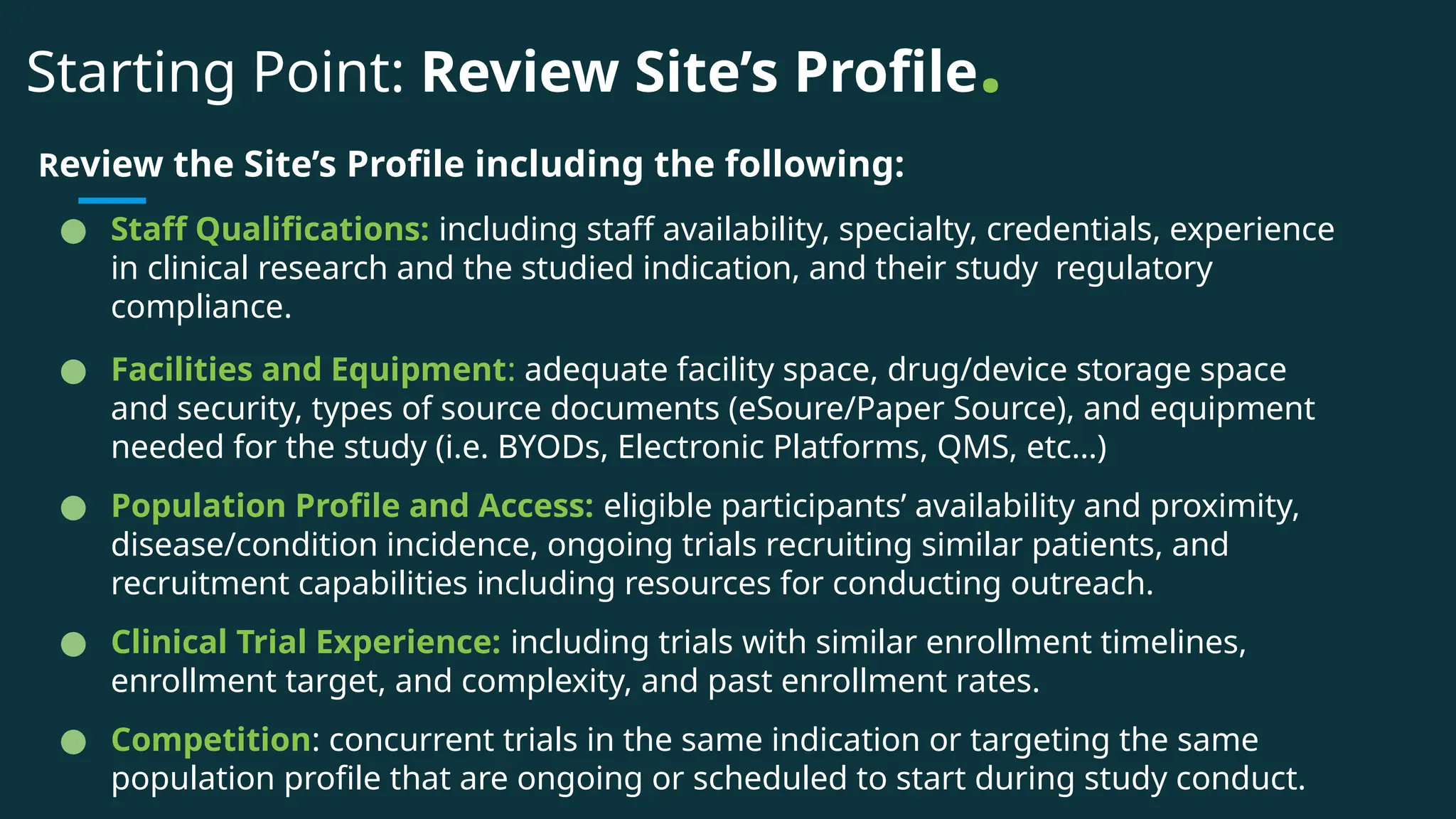
Review the Site’s Profile including the following:
● Staff Qualifications: including staff availability, specialty, credentials, experience
in clinical research and the studied indication, and their study regulatory
compliance.
● Facilities and Equipment: adequate facility space, drug/device storage space
and security, types of source documents (eSoure/Paper Source), and equipment
needed for the study (i.e. BYODs, Electronic Platforms, QMS, etc…)
● Population Profile and Access: eligible participants’ availability and proximity,
disease/condition incidence, ongoing trials recruiting similar patients, and
recruitment capabilities including resources for conducting outreach.
● Clinical Trial Experience: including trials with similar enrollment timelines,
enrollment target, and complexity, and past enrollment rates.
● Competition: concurrent trials in the same indication or targeting the same
population profile that are ongoing or scheduled to start during study conduct.
Review Site’s Quality Management Practices.
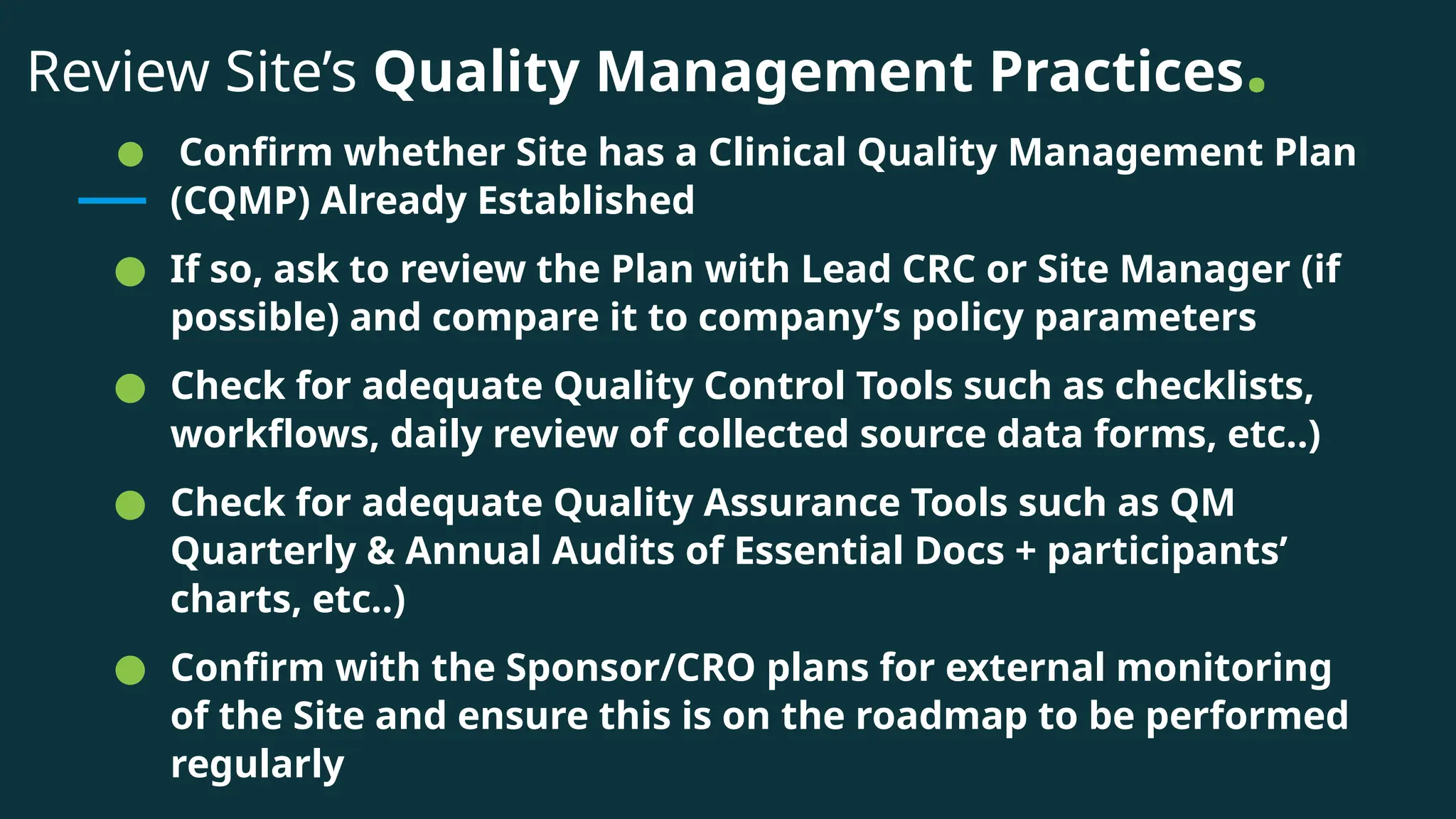
● Confirm whether Site has a Clinical Quality Management Plan
(CQMP) Already Established
● If so, ask to review the Plan with Lead CRC or Site Manager (if
possible) and compare it to company’s policy parameters
● Check for adequate Quality Control Tools such as checklists,
workflows, daily review of collected source data forms, etc..)
● Check for adequate Quality Assurance Tools such as QM
Quarterly & Annual Audits of Essential Docs + participants’
charts, etc..)
● Confirm with the Sponsor/CRO plans for external monitoring
of the Site and ensure this is on the roadmap to be performed
regularly
CQMP Main Focal Points for External Sites
Primary Focus Points:
● Ensure each study site has its own CQMP per each study protocol (per our company’s policy
parameters)
● Incorporate A Risk-Based Approach when developing a CQMP for each site and NOT use a “one
size fits all” strategy for the planning and performing of a clinical trial
○ Identify obstacles and risk that would negatively affect the performance of a trial
○ Implement risk control plans and ensure these are communicated and followed by study
team
The following will be considered for each study site’s protocol CQMP:
● WHERE will quality matter the most or have the greatest impact, especially when considering
limited time and resources? i.e., – if study includes a study drug, dosing compliance and
accountability of the study drug
● WHAT specific problems have occurred previously? i.e., – if there were multiple errors in obtaining
consent
● WHERE is the risk to the subject, the study staff, the study site and/or data quality and integrity?
Components of External Sites’ CQMP.
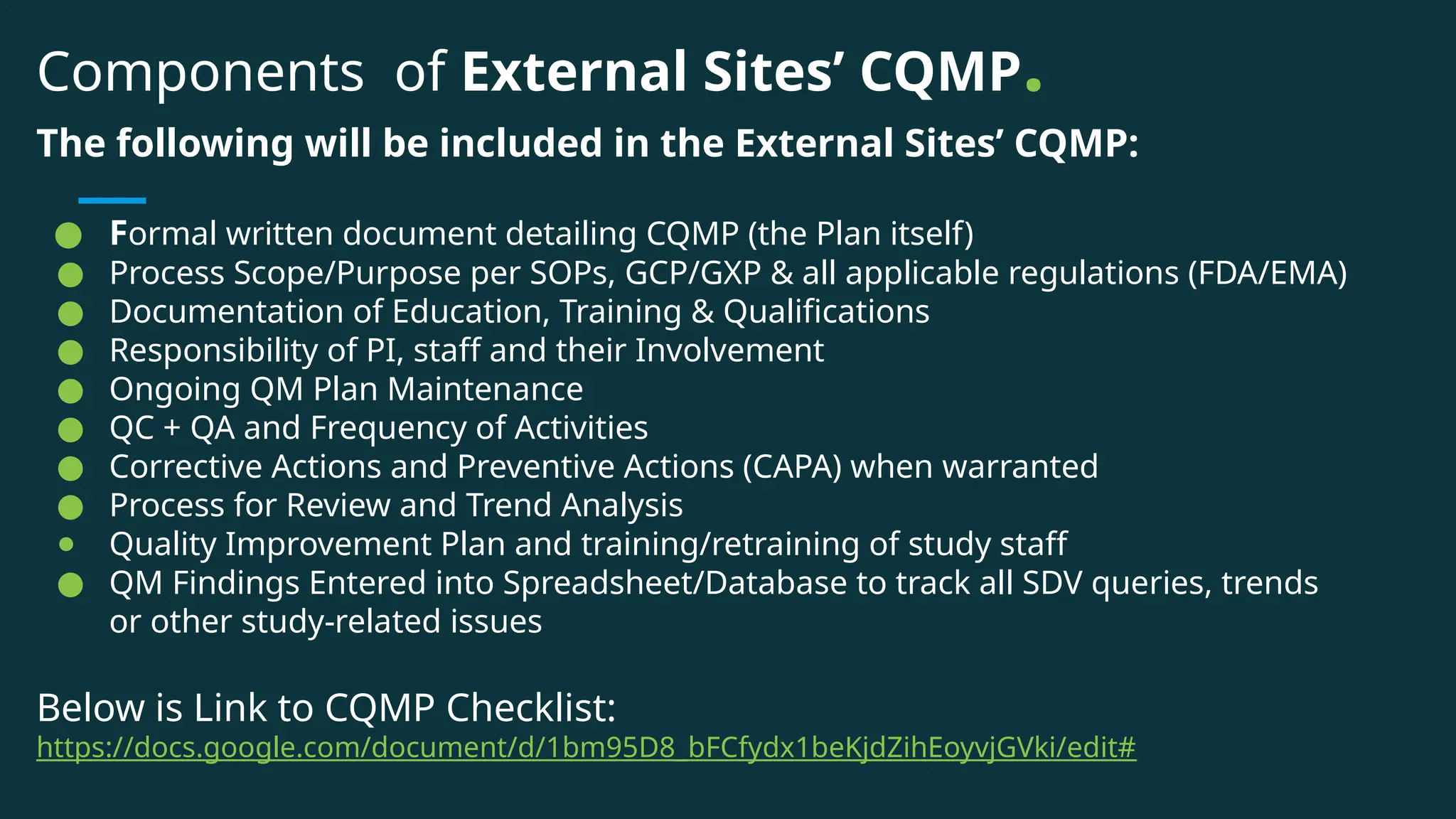
The following will be included in the External Sites’ CQMP:
● Formal written document detailing CQMP (the Plan itself)
● Process Scope/Purpose per SOPs, GCP/GXP & all applicable regulations (FDA/EMA)
● Documentation of Education, Training & Qualifications
● Responsibility of PI, staff and their Involvement
● Ongoing QM Plan Maintenance
● QC + QA and Frequency of Activities
● Corrective Actions and Preventive Actions (CAPA) when warranted
● Process for Review and Trend Analysis
● Quality Improvement Plan and training/retraining of study staff
● QM Findings Entered into Spreadsheet/Database to track all SDV queries, trends
or other study-related issues
Below is Link to CQMP Checklist:
https://docs.google.com/document/d/1bm95D8_bFCfydx1beKjdZihEoyvjGVki/edit#
Study QA Audit Review Based on Complexity
Scale.
tt1bm95D8_bFCfydx1beKjdZihEoyvjGVki/edit#
Complexity
Level
Study Type Examples
High Prospective Phase I–III interventional procedure, device, and/or
drug studies (novel product or indication). All studies under an
IND or IDE with the FDA.
Medium Studies using FDA-approved drugs, devices, or biologics for their
approved indication. Other studies that do not meet high
complexity but are more than minimal risk (e.g., behavioral
intervention, complex observational, tissue collection).
Low Studies using procedures generally considered to be minimal or
low risk (e.g., blood sample collection, imaging not using
sedation, questionnaires, and behavioral surveys).
Complexity
Level
Regulatory
Reviews
Participant Chart Reviews -
By Cumulative Enrollment
1-39 40-49 >/= 100
High Quarterly
(every 3-
months)
Quarterly
3 records
Quarterly
10 % of
records
Quarterly
10 records
Medium Bi-annually
(every 6-
months)
Quarterly
3 records
Quarterly
10 % of
records
Quarterly
10 records
Low Annually
(once per year)
Biannually
3 records
Biannually
10 % of
Biannually
10 records
How QA Audit Will Be Conducted Per Complexity
Level.
Example Chart
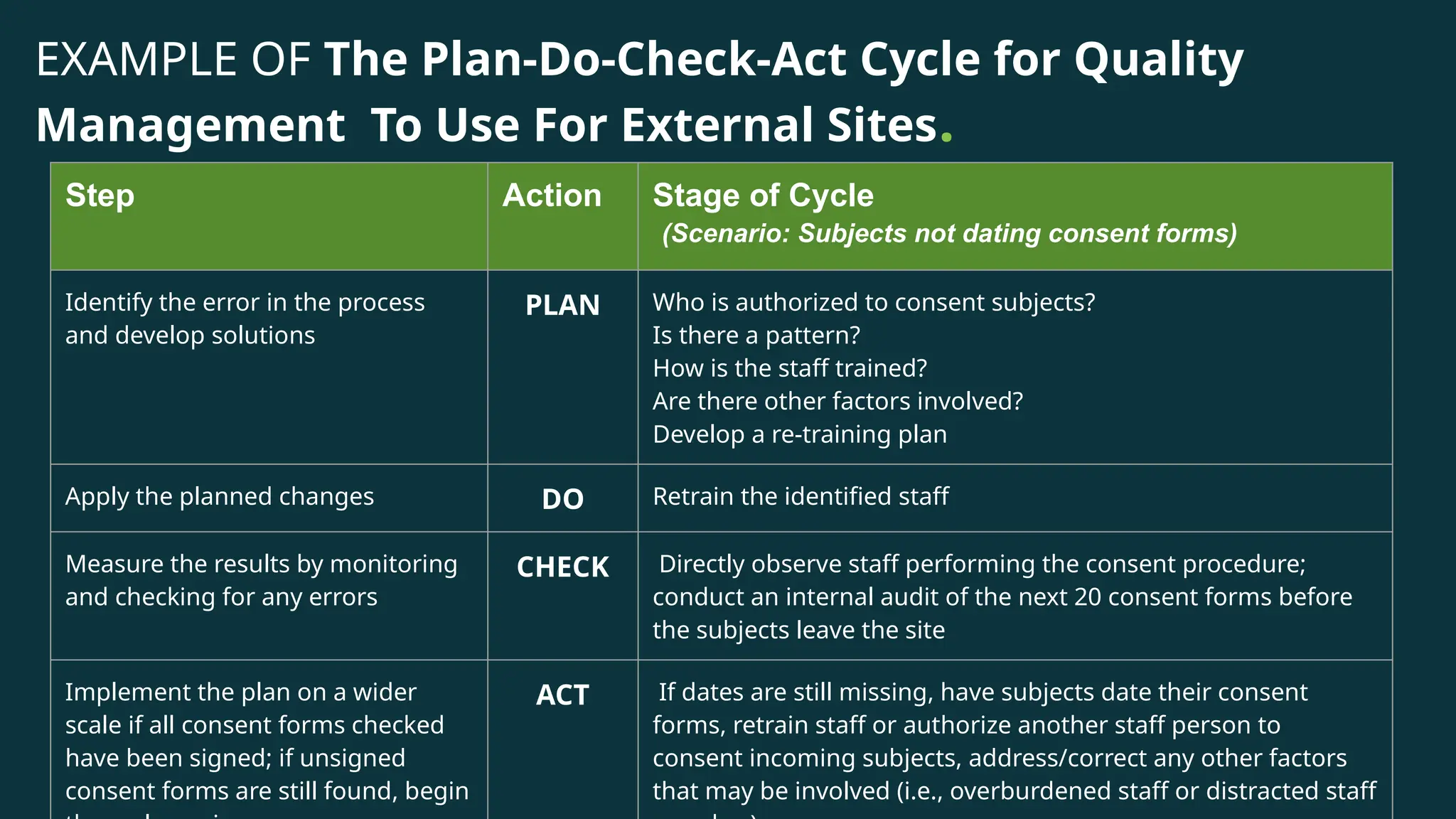
EXAMPLE OF The Plan-Do-Check-Act Cycle for Quality
Management To Use For External Sites.
Step Action Stage of Cycle
(Scenario: Subjects not dating consent forms)
Identify the error in the process
and develop solutions
PLAN Who is authorized to consent subjects?
Is there a pattern?
How is the staff trained?
Are there other factors involved?
Develop a re-training plan
Apply the planned changes DO Retrain the identified staff
Measure the results by monitoring
and checking for any errors
CHECK Directly observe staff performing the consent procedure;
conduct an internal audit of the next 20 consent forms before
the subjects leave the site
Implement the plan on a wider
scale if all consent forms checked
have been signed; if unsigned
consent forms are still found, begin
ACT If dates are still missing, have subjects date their consent
forms, retrain staff or authorize another staff person to
consent incoming subjects, address/correct any other factors
that may be involved (i.e., overburdened staff or distracted staff
Contacting External Site - Goal: Build A Good
Rapport
Once a throughout review of the External Site’s Profile,
the study protocol + all parameters and the drafting of a
preliminary Risk-Based Approach Clinical Quality
Management Plan, the final step will be to reach out to
the site with the goal of establishing and building good
rapport and effective communication regarding the
Quality and Compliance Aspect of their study(ies).
Contacting External Site - Goal: Build A Good Rapport
continues…
The following will actions may or will be performed:
● After communicating with site, ensure a open, welcoming environment is
promoted
● Ensure the entire study team is aware of the process and expectation
● Meet with the entire study team to review the CQMP (annually or quarterly)
● Study team should schedule a time for everyone to conduct reviews. QC reviews can be
added to their calendars daily; this would allowed for designated time to complete QC
reviews (ideally QC activities should be done daily and in real time)
● Present and/or coordinate educational training/retraining sessions
● Create and distribute tip sheets on how to avoid compliance issues
● Make tools and resources accessible to facilitate compliance
● Be available for and willing to answer questions – serve as a resource/SME
● If possible attend feasibility processes, study KOMs, and SIVs
● Attend clinical staff team meetings to reinforce plan and clarify any misconceptions
● Conduct regular/routine retrospective reviews & audits
Anticipated Positive Results.
Traditionally, assessing quality has been reactive; errors are identified and
addressed after the fact
The ideal method of quality management is proactive
This involves the study team implementing quality measures into a study,
ideally at all stages of the study process (from feasibility, start-up, study
management, & close-out)
If an effective CQMP is in place this will:
● Lead to increased compliance to Protocol, SOPs, GCP and Applicable Regulations
● Improve documentation practices via ALCOA-C
● Enhance identification and resolution of data errors
● Decreases number of monitor findings & number of electronic data queries
● Prepare Site for unexpected FDA Audit
● Identify areas where education and training efforts should be focused
● Creates an environment of teamwork
● Empower Study Team to conduct their study(ies) with confidence and reassurance

Quality Management Plan Outline for External Sites.pptx

  • 1.
    Quality Management Plan Outlinefor External Sites By C. L. Griffin, CCRP 31-AUG-2021
  • 2.
    Starting Point: ReviewSite’s Profile. Review the Site’s Profile including the following: ● Staff Qualifications: including staff availability, specialty, credentials, experience in clinical research and the studied indication, and their study regulatory compliance. ● Facilities and Equipment: adequate facility space, drug/device storage space and security, types of source documents (eSoure/Paper Source), and equipment needed for the study (i.e. BYODs, Electronic Platforms, QMS, etc…) ● Population Profile and Access: eligible participants’ availability and proximity, disease/condition incidence, ongoing trials recruiting similar patients, and recruitment capabilities including resources for conducting outreach. ● Clinical Trial Experience: including trials with similar enrollment timelines, enrollment target, and complexity, and past enrollment rates. ● Competition: concurrent trials in the same indication or targeting the same population profile that are ongoing or scheduled to start during study conduct.
  • 3.
    Review Site’s QualityManagement Practices. ● Confirm whether Site has a Clinical Quality Management Plan (CQMP) Already Established ● If so, ask to review the Plan with Lead CRC or Site Manager (if possible) and compare it to company’s policy parameters ● Check for adequate Quality Control Tools such as checklists, workflows, daily review of collected source data forms, etc..) ● Check for adequate Quality Assurance Tools such as QM Quarterly & Annual Audits of Essential Docs + participants’ charts, etc..) ● Confirm with the Sponsor/CRO plans for external monitoring of the Site and ensure this is on the roadmap to be performed regularly
  • 4.
    CQMP Main FocalPoints for External Sites Primary Focus Points: ● Ensure each study site has its own CQMP per each study protocol (per our company’s policy parameters) ● Incorporate A Risk-Based Approach when developing a CQMP for each site and NOT use a “one size fits all” strategy for the planning and performing of a clinical trial ○ Identify obstacles and risk that would negatively affect the performance of a trial ○ Implement risk control plans and ensure these are communicated and followed by study team The following will be considered for each study site’s protocol CQMP: ● WHERE will quality matter the most or have the greatest impact, especially when considering limited time and resources? i.e., – if study includes a study drug, dosing compliance and accountability of the study drug ● WHAT specific problems have occurred previously? i.e., – if there were multiple errors in obtaining consent ● WHERE is the risk to the subject, the study staff, the study site and/or data quality and integrity?
  • 5.
    Components of ExternalSites’ CQMP. The following will be included in the External Sites’ CQMP: ● Formal written document detailing CQMP (the Plan itself) ● Process Scope/Purpose per SOPs, GCP/GXP & all applicable regulations (FDA/EMA) ● Documentation of Education, Training & Qualifications ● Responsibility of PI, staff and their Involvement ● Ongoing QM Plan Maintenance ● QC + QA and Frequency of Activities ● Corrective Actions and Preventive Actions (CAPA) when warranted ● Process for Review and Trend Analysis ● Quality Improvement Plan and training/retraining of study staff ● QM Findings Entered into Spreadsheet/Database to track all SDV queries, trends or other study-related issues Below is Link to CQMP Checklist: https://docs.google.com/document/d/1bm95D8_bFCfydx1beKjdZihEoyvjGVki/edit#
  • 6.
    Study QA AuditReview Based on Complexity Scale. tt1bm95D8_bFCfydx1beKjdZihEoyvjGVki/edit# Complexity Level Study Type Examples High Prospective Phase I–III interventional procedure, device, and/or drug studies (novel product or indication). All studies under an IND or IDE with the FDA. Medium Studies using FDA-approved drugs, devices, or biologics for their approved indication. Other studies that do not meet high complexity but are more than minimal risk (e.g., behavioral intervention, complex observational, tissue collection). Low Studies using procedures generally considered to be minimal or low risk (e.g., blood sample collection, imaging not using sedation, questionnaires, and behavioral surveys).
  • 7.
    Complexity Level Regulatory Reviews Participant Chart Reviews- By Cumulative Enrollment 1-39 40-49 >/= 100 High Quarterly (every 3- months) Quarterly 3 records Quarterly 10 % of records Quarterly 10 records Medium Bi-annually (every 6- months) Quarterly 3 records Quarterly 10 % of records Quarterly 10 records Low Annually (once per year) Biannually 3 records Biannually 10 % of Biannually 10 records How QA Audit Will Be Conducted Per Complexity Level. Example Chart
  • 8.
    EXAMPLE OF ThePlan-Do-Check-Act Cycle for Quality Management To Use For External Sites. Step Action Stage of Cycle (Scenario: Subjects not dating consent forms) Identify the error in the process and develop solutions PLAN Who is authorized to consent subjects? Is there a pattern? How is the staff trained? Are there other factors involved? Develop a re-training plan Apply the planned changes DO Retrain the identified staff Measure the results by monitoring and checking for any errors CHECK Directly observe staff performing the consent procedure; conduct an internal audit of the next 20 consent forms before the subjects leave the site Implement the plan on a wider scale if all consent forms checked have been signed; if unsigned consent forms are still found, begin ACT If dates are still missing, have subjects date their consent forms, retrain staff or authorize another staff person to consent incoming subjects, address/correct any other factors that may be involved (i.e., overburdened staff or distracted staff
  • 9.
    Contacting External Site- Goal: Build A Good Rapport Once a throughout review of the External Site’s Profile, the study protocol + all parameters and the drafting of a preliminary Risk-Based Approach Clinical Quality Management Plan, the final step will be to reach out to the site with the goal of establishing and building good rapport and effective communication regarding the Quality and Compliance Aspect of their study(ies).
  • 10.
    Contacting External Site- Goal: Build A Good Rapport continues… The following will actions may or will be performed: ● After communicating with site, ensure a open, welcoming environment is promoted ● Ensure the entire study team is aware of the process and expectation ● Meet with the entire study team to review the CQMP (annually or quarterly) ● Study team should schedule a time for everyone to conduct reviews. QC reviews can be added to their calendars daily; this would allowed for designated time to complete QC reviews (ideally QC activities should be done daily and in real time) ● Present and/or coordinate educational training/retraining sessions ● Create and distribute tip sheets on how to avoid compliance issues ● Make tools and resources accessible to facilitate compliance ● Be available for and willing to answer questions – serve as a resource/SME ● If possible attend feasibility processes, study KOMs, and SIVs ● Attend clinical staff team meetings to reinforce plan and clarify any misconceptions ● Conduct regular/routine retrospective reviews & audits
  • 11.
    Anticipated Positive Results. Traditionally,assessing quality has been reactive; errors are identified and addressed after the fact The ideal method of quality management is proactive This involves the study team implementing quality measures into a study, ideally at all stages of the study process (from feasibility, start-up, study management, & close-out) If an effective CQMP is in place this will: ● Lead to increased compliance to Protocol, SOPs, GCP and Applicable Regulations ● Improve documentation practices via ALCOA-C ● Enhance identification and resolution of data errors ● Decreases number of monitor findings & number of electronic data queries ● Prepare Site for unexpected FDA Audit ● Identify areas where education and training efforts should be focused ● Creates an environment of teamwork ● Empower Study Team to conduct their study(ies) with confidence and reassurance

Editor's Notes

  • #2 n important element of assuring data quality is comparing the entries in the database with the original source of the data (e.g. laboratory results). This procedure is known as Source Data Verification (SDV).
  • #3 n important element of assuring data quality is comparing the entries in the database with the original source of the data (e.g. laboratory results). This procedure is known as Source Data Verification (SDV).
  • #4 An important element of ensuring data quality, is comparing the entries in the database with the original source of the data in a study; this is known as Source Data Verification (SDV). A CQMP is a detailed strategy outlining how errors will be identified and assessed during the conduct of a study.
  • #5 n important element of assuring data quality is comparing the entries in the database with the original source of the data (e.g. laboratory results). This procedure is known as Source Data Verification (SDV).
  • #6 n important element of assuring data quality is comparing the entries in the database with the original source of the data (e.g. laboratory results). This procedure is known as Source Data Verification (SDV).
  • #8 PDCA Cycle Plan is known as the Deming Cycle
  • #9 n important element of assuring data quality is comparing the entries in the database with the original source of the data (e.g. laboratory results). This procedure is known as Source Data Verification (SDV).
  • #10 n important element of assuring data quality is comparing the entries in the database with the original source of the data (e.g. laboratory results). This procedure is known as Source Data Verification (SDV).
  • #11 n important element of assuring data quality is comparing the entries in the database with the original source of the data (e.g. laboratory results). This procedure is known as Source Data Verification (SDV).