HigH level englisH
grammar
Book
and worksHeet
Want to score
more marks in
English?
Practice this
aBoUt tHe aUtHor
Name:- N.K.Rohit Kumar
Father’s name: - G.Nanda Kumar
Mother’s name: - V.Malarvizhi
Sisters’ name: - N.K.Keerthana, K.K.Kaviya
Nationality:- Indian
Phone number: - 9444850303
tenses
Simple Present Tense
A.Fill in the blanks
1) I _______in model town. (live)
2) The mother ______ food for us. (cook)
3) She __________ to temple every morning. (go)
4) The boys’ _________ a song. (sing)
5) I ______in the school which is the best in the city. (read)
6) The sun _________during the day.
(shine)
7) The farmer ______ rain.
(need)
8) The toy ______the child happy
(make)
9) You _______ up at 5 am.
(wake)
10) He________ his lessons regularly. (learn)
11) Farmers’ ______ a hard life.
(lead)
12) They ____to bed at 9 pm (go)
13) My watch _________a good time. ( keep)
14) They ____________for London. (leave)
15) Here_________the bus! (come)
16) The cat ______the rats.
(kill)
17) I _________everybody well.
(wish)
18) I ______ what my sister eats. ( eat)
19) Ram _____us English. (teach)
20) She _________on me whenever she wants.
(call)
Present Continuous Tense
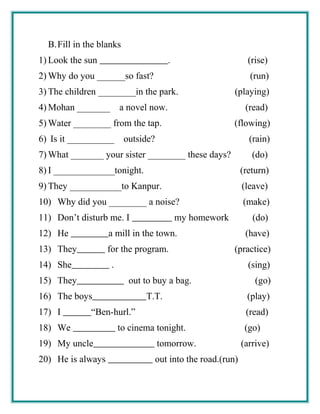
B.Fill in the blanks
1) Look the sun . (rise)
2) Why do you ______so fast? (run)
3) The children ________in the park. (playing)
4) Mohan _______ a novel now. (read)
5) Water ________ from the tap. (flowing)
6) Is it __________ outside? (rain)
7) What _______ your sister ________ these days? (do)
8) I _____________tonight. (return)
9) They ___________to Kanpur. (leave)
10) Why did you ________ a noise? (make)
11) Don’t disturb me. I my homework (do)
12) He a mill in the town. (have)
13) They for the program. (practice)
14) She . (sing)
15) They out to buy a bag. (go)
16) The boys T.T. (play)
17) I “Ben-hurl.” (read)
18) We to cinema tonight. (go)
19) My uncle tomorrow. (arrive)
20) He is always out into the road.(run)
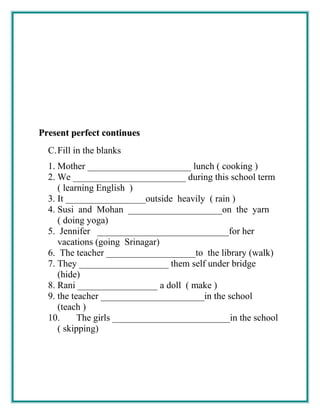
Present perfect continuesPresent perfect continues
C.Fill in the blanks
1. Mother ______________________ lunch ( cooking )
2. We ________________________ during this school term
( learning English )
3. It _________________outside heavily ( rain )
4. Susi and Mohan ____________________on the yarn
( doing yoga)
5. Jennifer ____________________________for her
vacations (going Srinagar)
6. The teacher ___________________to the library (walk)
7. They ___________________ them self under bridge
(hide)
8. Rani _________________ a doll ( make )
9. the teacher ______________________in the school
(teach )
10. The girls _________________________in the school
( skipping)
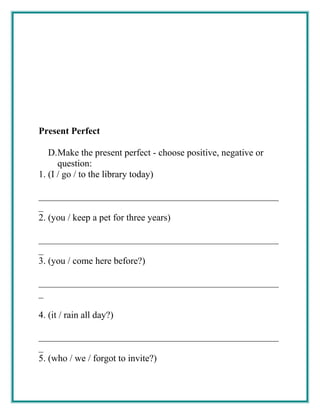
Present Perfect
D.Make the present perfect - choose positive, negative or
question:
1. (I / go / to the library today)
___________________________________________________
_
2. (you / keep a pet for three years)
___________________________________________________
_
3. (you / come here before?)
___________________________________________________
_
4. (it / rain all day?)
___________________________________________________
_
5. (who / we / forgot to invite?)
___________________________________________________
_
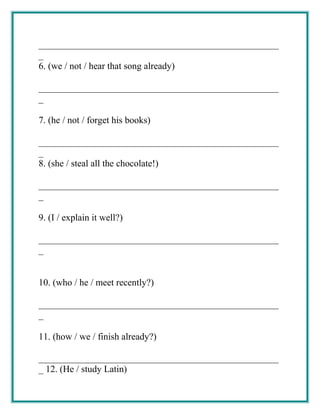
6. (we / not / hear that song already)
___________________________________________________
_
7. (he / not / forget his books)
___________________________________________________
_
8. (she / steal all the chocolate!)
___________________________________________________
_
9. (I / explain it well?)
___________________________________________________
_
10. (who / he / meet recently?)
___________________________________________________
_
11. (how / we / finish already?)
___________________________________________________
_ 12. (He / study Latin)
___________________________________________________
_
13. (I / know him for three months)
___________________________________________________
_
14. (where / you / study Arabic?)
___________________________________________________
_15. (what countries / they / visit in Europe?)
___________________________________________________
_
16. (he / hurt his leg)
___________________________________________________
_
17. (she / leave her phone in a taxi)
___________________________________________________
_
18. (we / not / lose our tickets)
___________________________________________________
_
19. (she / call her mother?)
___________________________________________________
_
20. (He / take a taxi?)
_________________________________________________
_
Present Perfect
E.Make the present perfect simple. Choose positive, negative
or question:
1. (she / pass the exam?)
___________________________________________________
_
2. (you / eat lunch yet?)
___________________________________________________
_
3. (he / read the newspaper today?)
___________________________________________________
_
4. (you / not / study French for ten years)
___________________________________________________
_
5. (they / be in London for six months)
___________________________________________________
_
6. (where / you / be?)
___________________________________________________
_
7. (we / not / go to Paris)
___________________________________________________
_
8. (she / not / see ‘The Lord of the Rings’)
___________________________________________________
_
9. (he / not / meet my mother)
___________________________________________________
_
10. (they / not / visit St. Paul’s Cathedral yet)
___________________________________________________
_
11. (what / she / eat today?)
___________________________________________________
_12. (why / you / do your homework already?)
___________________________________________________
_
13. (how / she / make this fantastic cake?)
___________________________________________________
_
14. (why / I / miss the plane?)
___________________________________________________
_
15. (they / not / go to bed)
___________________________________________________
_
16. (it / rain a lot this week)
___________________________________________________
_
17. (they / use a credit card before?)
___________________________________________________
_
18. (we / have enough to eat?)
___________________________________________________
_
19. (she / not / play basketball before)
___________________________________________________
_
20. (I / wear a kimono)
___________________________________________________
_
PAST TENCE
F. Fill in the blanks
1)Last year I _______ to England on holiday. (GO)
2)In the mornings we ____________in the streets of London.
(WALK)
3)The weather _______strangely fine. (IS)
4) Janet __________the bus.(MISS)
5)I ______lots of interesting places. (VISIT)
6)I______with two friends of mine. (AM)
7) They __________ a sandwich.(BRING)
8)We _________ to a new house. (MOVE)
9)We ______ sorry for him.(ARE)
10) It was warm, so I ________ off my coat.(TAKE)
11) It was a funny situation but nobody _______ (LAUGH)
12) The window was open and a bird _________ into the
room.(FLY)
13) It _____ (IS) hard work carrying bags. They _______very
heavy.(ARE)
14) Sue _________ more than 600 pieces of music.(write)
15) I was very thirsty. I _________ the water very quickly.
(DRINK)
16) We couldn’t afford to keep our car, so we ________ it.
(SELL)
17) Jim _________ (THROW) the ball to Sue, who
___________ it.(CATCH)
18) Don ________ down the stairs this morning.(FALL)
19) Ann _______ a lot of money yesterday.(SPEND)
20) The hotel wasn’t very expensive. It __________________
much.(COST)
21) My teacher _____________ me grammar .(TEACH)
PAST CONTINUOUS TENSE
G.Fill in the blanks
1)When I phoned my friends, they _______________
monopoly.(PLAY)
2)The kids ____________________ in the garden when it
suddenly began to rain.(PLAY)
3)I _________________ the guitar when he came home.
(PRACTISE)
4)While Alan __________________ (WORK) in the room,
his friends’ _________________ (SWIM) in the pool.
5)I tried to tell them truth but they _________________
(NOT / LISTEN)
6)Most of the time we ___________________ in the park.
(SIT)
7)We _________________ English at 4:00 pm yesterday.
(STUDY)
8)My mother _______________ a novel.(READ)
9)We ________________ about school.(TALK)
10) Julie ________________ at 3:00(sleep)
11) They ________________ chocolate yesterday.(EAT)
12) The maid _______________ the room.(CLEAN)
13) The dog __________________ at us.(BARK)
14) My teacher _______________ the exercise.
(EXPLAIN)
15) I _________________ to fix my computer.(TRY)
16) My sister and brother ___________________.(SING)
17) Yesterday at six I ___________________ dinner.
(PREPARE)
18) We ____________________ all day.(NOT / CYCLE)
19) We _________________ to London some days
before.(TRAVEL)
20) He ___________________ the internet that day.
(USE)
Past Perfect
H.Make past perfect simple ‘yes / no’ or ‘wh’ questions:
1. _______________________ (you / go) there before we went
together?
2. _______________________ (she / see) the film already?
3. Why _______________________ (he / forgot) about the
meeting?
4. _______________________ (it / be) cold all week?
5. _______________________ (I / read) the book before the
class?
6. When she arrived, _______________________ (we / eat)
already?
7. Where _______________________ (you / be) when I saw
you?
8. _______________________ (they / travel) by bullet train
before?
9. _______________________ (John / meet) Lucy before they
went on holiday together?
10. _______________________ (you / do) your homework
before I saw you?
11. Where _______________________ (she / work )?
12. _______________________ (I / pay) the bill before we left?
13. _______________________ (we / visit) my parents already
that winter?
14. When you called, _______________________ (they / eat)
dinner?
15. How _______________________ (he / manage) to fix the
cooker?
16. _______________________ (my sister / be) sick for a long
time?
17. How much _______________________ (she / study) before
the exam?
18. What _______________________ (you / cook) for dinner
that night?
19. When _______________________ (they / arrive)?
20. How many coffees _______________________ (she /
drink) before the interview?
Past Perfect
I. Make the past perfect:
1. When I arrived at the cinema, the film __________________
(start).
2. She ____________________ (live) in China before she went
to Thailand.
3. After they ____________________ (eat) the shellfish, they
began to feel sick.
4. If you ____________________ (listen) to me, you would
have got the job.
5. Julie didn’t arrive until after I ____________________
(leave).
6. When we ____________________ (finish) dinner, we went
out.
7. The garden was dead because it ____________________ (be)
dry all summer.
8. He ____________________ (meet) her before somewhere.
9. We were late for the plane because we
____________________ (forgot) our passports.
10. She told me that she ____________________ (study) a lot
before the exam.
11. The grass was yellow because it ___________________
(not / rain) all summer.
12. The lights went off because we ___________________ (not
/ pay) the electricity bill.
13. The children ___________________ (not / do) their
homework, so they were in trouble.
14. They ___________________ (not / eat) so we went to a
restaurant.
15. We couldn’t go into the concert because we
___________________ (not /bring) our tickets.
16. She said that she ___________________ (not / visit) the UK
before.
17. Julie and Anne ___________________ (not / meet) before
the party.
18. I ___________________ (not / have) breakfast when he
arrived.
19. He ___________________ (not / use) email before, so I
showed him how to use it.
20. You ___________________ (not / study) for the test, so you
were very nervous.
Past perfect continuesPast perfect continues
J. Fill in the blanks
1. She ___________________ to him for hours. (to talk)
2. The boy ____________________his computer all
afternoon. (to repair)
3. She __________________________in the Welsh
mountains for weeks. (to walk)
4. It __________________________ all morning.(to rain)
5. The pupils_____________________ at the computers all
morning. (to sit)
6. Emily ________________________ for an hour already.
(to run)
7. The Johnson _____________________ in Cardiff. (to live)
8. She ________________________________German at
school. (to learn)
9. At six o’clock he __________________________ the dog
for a walk. (to take)
10. We ____________________television (watch)
Future tense
K.Fill in the blanks
1. We __________ (to have) dinner at a seaside restaurant
on Sunday.
2. It __________(to snow) in Brighton tomorrow evening.
3. On Friday at 8 o’clock I __________ (to meet) my
friend.
4. Paul __________ (to fly) to London on Monday
morning.
5. Wait! I __________ (to drive) you to the station.
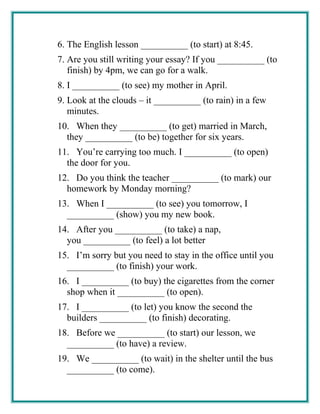
6. The English lesson __________ (to start) at 8:45.
7. Are you still writing your essay? If you __________ (to
finish) by 4pm, we can go for a walk.
8. I __________ (to see) my mother in April.
9. Look at the clouds – it __________ (to rain) in a few
minutes.
10. When they __________ (to get) married in March,
they __________ (to be) together for six years.
11. You’re carrying too much. I __________ (to open)
the door for you.
12. Do you think the teacher __________ (to mark) our
homework by Monday morning?
13. When I __________ (to see) you tomorrow, I
__________ (show) you my new book.
14. After you __________ (to take) a nap,
you __________ (to feel) a lot better
15. I’m sorry but you need to stay in the office until you
__________ (to finish) your work.
16. I __________ (to buy) the cigarettes from the corner
shop when it __________ (to open).
17. I __________ (to let) you know the second the
builders __________ (to finish) decorating.
18. Before we __________ (to start) our lesson, we
__________ (to have) a review.
19. We __________ (to wait) in the shelter until the bus
__________ (to come).
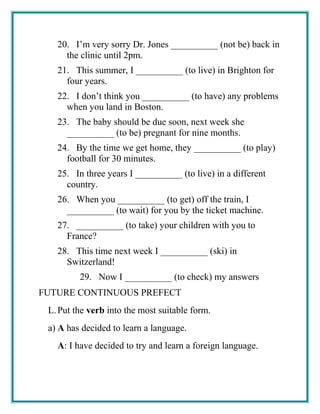
20. I’m very sorry Dr. Jones __________ (not be) back in
the clinic until 2pm.
21. This summer, I __________ (to live) in Brighton for
four years.
22. I don’t think you __________ (to have) any problems
when you land in Boston.
23. The baby should be due soon, next week she
__________ (to be) pregnant for nine months.
24. By the time we get home, they __________ (to play)
football for 30 minutes.
25. In three years I __________ (to live) in a different
country.
26. When you __________ (to get) off the train, I
__________ (to wait) for you by the ticket machine.
27. __________ (to take) your children with you to
France?
28. This time next week I __________ (ski) in
Switzerland!
29. Now I __________ (to check) my answers
FUTURE CONTINUOUS PREFECT
L.Put the verb into the most suitable form.
a) A has decided to learn a language.
A: I have decided to try and learn a foreign language.
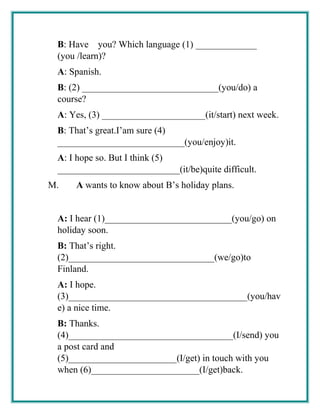
B: Have you? Which language (1) _____________
(you /learn)?
A: Spanish.
B: (2) _____________________________(you/do) a
course?
A: Yes, (3) ______________________(it/start) next week.
B: That’s great.I’am sure (4)
___________________________(you/enjoy)it.
A: I hope so. But I think (5)
__________________________(it/be)quite difficult.
M. A wants to know about B’s holiday plans.
A: I hear (1)___________________________(you/go) on
holiday soon.
B: That’s right.
(2)_______________________________(we/go)to
Finland.
A: I hope.
(3)______________________________________(you/hav
e) a nice time.
B: Thanks.
(4)___________________________________(I/send) you
a post card and
(5)_______________________(I/get) in touch with you
when (6)_______________________(I/get)back.
rePorted sPeeCH
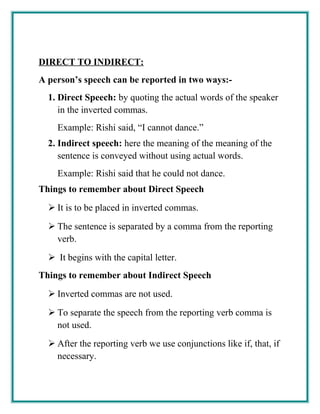
DIRECT TO INDIRECT:
A person’s speech can be reported in two ways:-
1. Direct Speech: by quoting the actual words of the speaker
in the inverted commas.
Example: Rishi said, “I cannot dance.”
2. Indirect speech: here the meaning of the meaning of the
sentence is conveyed without using actual words.
Example: Rishi said that he could not dance.
Things to remember about Direct Speech
 It is to be placed in inverted commas.
 The sentence is separated by a comma from the reporting
verb.
 It begins with the capital letter.
Things to remember about Indirect Speech
 Inverted commas are not used.
 To separate the speech from the reporting verb comma is
not used.
 After the reporting verb we use conjunctions like if, that, if
necessary.
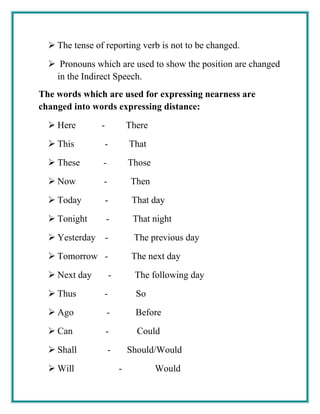
 The tense of reporting verb is not to be changed.
 Pronouns which are used to show the position are changed
in the Indirect Speech.
The words which are used for expressing nearness are
changed into words expressing distance:
 Here - There
 This - That
 These - Those
 Now - Then
 Today - That day
 Tonight - That night
 Yesterday - The previous day
 Tomorrow - The next day
 Next day - The following day
 Thus - So
 Ago - Before
 Can - Could
 Shall - Should/Would
 Will - Would
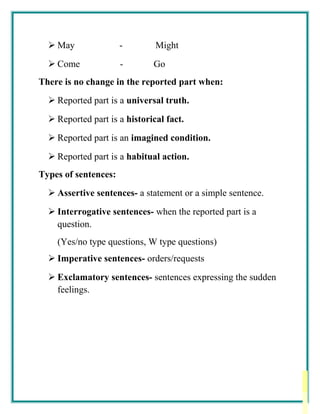
 May - Might
 Come - Go
There is no change in the reported part when:
 Reported part is a universal truth.
 Reported part is a historical fact.
 Reported part is an imagined condition.
 Reported part is a habitual action.
Types of sentences:
 Assertive sentences- a statement or a simple sentence.
 Interrogative sentences- when the reported part is a
question.
(Yes/no type questions, W type questions)
 Imperative sentences- orders/requests
 Exclamatory sentences- sentences expressing the sudden
feelings.
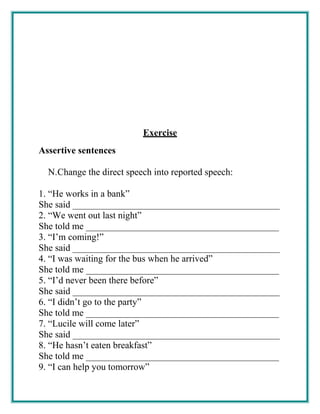
Exercise
Assertive sentences
N.Change the direct speech into reported speech:
1. “He works in a bank”
She said ____________________________________________
2. “We went out last night”
She told me _________________________________________
3. “I’m coming!”
She said ____________________________________________
4. “I was waiting for the bus when he arrived”
She told me _________________________________________
5. “I’d never been there before”
She said ____________________________________________
6. “I didn’t go to the party”
She told me _________________________________________
7. “Lucile will come later”
She said ____________________________________________
8. “He hasn’t eaten breakfast”
She told me _________________________________________
9. “I can help you tomorrow”
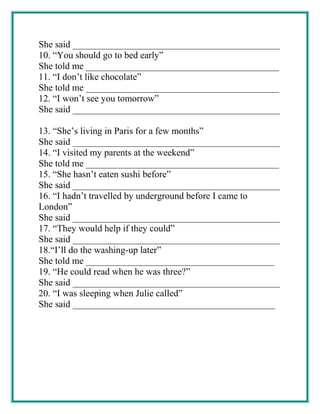
She said ____________________________________________
10. “You should go to bed early”
She told me _________________________________________
11. “I don’t like chocolate”
She told me _________________________________________
12. “I won’t see you tomorrow”
She said ____________________________________________
13. “She’s living in Paris for a few months”
She said ____________________________________________
14. “I visited my parents at the weekend”
She told me _________________________________________
15. “She hasn’t eaten sushi before”
She said ____________________________________________
16. “I hadn’t travelled by underground before I came to
London”
She said ____________________________________________
17. “They would help if they could”
She said ____________________________________________
18.“I’ll do the washing-up later”
She told me ________________________________________
19. “He could read when he was three?”
She said ____________________________________________
20. “I was sleeping when Julie called”
She said ___________________________________________
Interrogative sentences:-
O.Change the direct questions into reported questions:
1. Is John at home?
She asked me if ______________________________________
2. Am I late?
She asked me if ______________________________________
3. Is it cold outside?
She asked me if ______________________________________
4. Are they in Paris?
She asked me if ______________________________________
5. Is the bus stop near the shopping centre?
She asked me if ______________________________________
6. Is the milk fresh?
She asked me if ______________________________________
7. Are you a doctor?
She asked me if ______________________________________
8. Are James and Lucy from France?
She asked me if ______________________________________
9. Is my brother in the garden?
She asked me if ______________________________________
10. Is the weather good in Shanghai in the summer?
She asked me if ______________________________________
11. Where is the post office?
She asked me ________________________________________
12. Why is Julie sad?
She asked me ________________________________________
13. What's for dinner?
She asked me ________________________________________
14. Who is the woman in the red dress?
She asked me ________________________________________
15. How is your grandmother?
She asked me ________________________________________
16. When is the party?
She asked me ________________________________________
17. How much is the rent on your flat?
She asked me ________________________________________
18. Where are the glasses?
She asked me ________________________________________
19. How is the weather in Chicago?
She asked me ________________________________________
20. Who is the Prime Minister of Canada?
She asked me ________________________________________
Imperative sentences:-
P. Change the direct speech into reported speech:
1. “Please help me carry this”
She asked me ________________________________________
2. “Please come early”
She ________________________________________________
3. “Please buy some milk”
She ________________________________________________
4. “Could you please open the window?”
She ________________________________________________
5. “Could you bring the book tonight?”
She ________________________________________________
6. “Can you help me with my homework, please?”
She ________________________________________________
7. “Would you bring me a cup of coffee, please?”
She ________________________________________________
8. “Would you mind passing the salt?”
She ________________________________________________
9. “Would you mind lending me a pencil?”
She ________________________________________________
10. “I was wondering if you could possibly tell me the time.”
She ________________________________________________
11. “Do your homework!”
She told me _________________________________________
12. “Go to bed!”
She ________________________________________________
13. “Don’t be late!”
She ________________________________________________
14. “Don’t smoke!”
She ________________________________________________
15. “Tidy your room!”
She ________________________________________________
16. “Wait here!”
She ________________________________________________
17. “Don’t do that!
She ________________________________________________
18. “Eat your dinner!”
She ________________________________________________
19. “Don’t make a mess!”
She ________________________________________________
20. “Do the washing-up!”
She ________________________________________________
Exclamatory sentences:-
Q.Change the direct speech into reported speech:
1. Rosy said to David, “How wonderfully you sang!”
Rosy_______________________________________________
2. The foreigner said, “What a man Obama is!”
The
foreigner_________________________________________
3. John said, “That I should see you here!”
John_______________________________________________
_
4. The reporter said, “Alas! Many lives have been lost due to
tsunami.”
The
reporter__________________________________________
5. The grandmother said, “May you meet with success
wherever you go”
The
grandmother______________________________________
6. Father said, “Shakshi, don’t play in dirty water!”
Father______________________________________________
7. The beggar said, “O God! I have been cheated”.
The beggar__________________________________________
8. The boy said, ‘‘Hurrah! We have won the match.’’
The boy_____________________________________________
9. The old man said, ‘‘Alas! I have lost my purse.’’
The old man_________________________________________
10. The child said, ‘‘what a beautiful sight!’’
The child ___________________________________________
11. The girl said, ‘‘How beautiful the girl is!’’
The girl ____________________________________________
12. The candidate said, ‘‘How difficult the problem is!’’
The candidate________________________________________
13. The students said to the teacher, ‘‘Good morning,
Teacher!’’
The students’ ________________________________________
14. ‘‘How glad I am,’’ said Alice, ‘‘to meet my friend here?’’
Alice______________________________________________
15. The Emperor said, ‘‘Alas! Our foes are too strong!’’
The Emperor ________________________________________
16. ‘‘Hurrah!’’ cried the boy, ‘‘I have won a prize.’’
The boy ___________________________________________
17. “O, what a beautiful flower that is!” said she
She________________________________________________
_
18. “What a horrible sight!” we all exclaimed.
We________________________________________________
_
19. “Alas! I have broken my brother’s watch” said he.
He_________________________________________________
20. “How beautiful she is!” said Boon.
Boon_______________________________________________
R. Read the conversation a complete that passage that follow.
Child: I want a balloon, which I can release into the air.
Balloon man: Which colour balloon you want?
Child: Which colour balloon will take me up with it?
Balloon man: It is not the colour of the balloon; it is what is
inside that makes it go up.
A child told a balloon man that (a)…………………. The
balloon man (b)………………. The balloon man replied (d)
……………… the colour of the balloon but it was (e)
……………
Answer
a)__________________________________________________
b) _________________________________________________
c)__________________________________________________
d) _________________________________________________
e) _________________________________________________
S. Read the conversation a complete that passage that follow.
Jayanthan: Where were you yesterday evening?
Rohit: There is an exhibition of rare paintings at the Art
Gallery. I had gone there.
Jayanthan: How well are you prepared for the entrance exam
next week?
Rohit: I have been preparing for the whole week.
Jayanthan asked Rohit where he (a)……………… evening.
Rohit replied (b)………………… at the Art Gallery and (c)
……………….. there. Jayanthan wanted (d)……………………
for the entrance exam. Rohit (e)……………….. preparing for
the whole week.
Answer
a) _________________________________________________
b) _________________________________________________
c) _________________________________________________
d) _________________________________________________
e) _________________________________________________
T. Change the following sentences into reported speech.
1. The spokesman said: “I can’t understand why billiards has
been prohibited.”
_______________________________________________
_
_______________________________________________
_
2. Gihan exclaimed: “We have had too many prohibitions.”
_______________________________________________
_
_______________________________________________
_
3. The young lady said: “I did not make such a mistake.”
_______________________________________________
_
_______________________________________________
_
4. She said: “We’ll go and get some food.”
_______________________________________________
_
_______________________________________________
_
5. Winston Churchill said: “I wake up at six every day”
_______________________________________________
_
_______________________________________________
_
6. A company representative said: “This probably won’t
happen.”
_______________________________________________
_
_______________________________________________
_
7. A farmer said: “If the situation goes on like this, we will
lose the consumers’ confidence forever”.
_______________________________________________
_
_______________________________________________
_
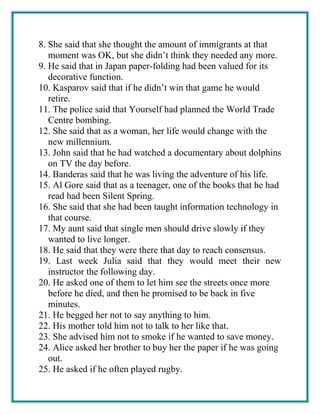
8. She said: “I think the amount of immigrants right now is
OK, but I don’t think we need any more”.
_______________________________________________
_
_______________________________________________
_
9. He said: “In Japan paper-folding was valued for its
decorative function”.
_______________________________________________
_
_______________________________________________
_
10.“If I don’t win this game, I will retire,” Kasparov said.
_______________________________________________
_
_______________________________________________
_
11. The police said: “Yourself planned the World
Trade Centre bombing”.
_______________________________________________
_
_______________________________________________
_
12.She said: “As a woman, my life will change with the new
millennium”.
_______________________________________________
_
_______________________________________________
_
13.“I watched a documentary about dolphins on TV
yesterday,” said John.
_______________________________________________
_
_______________________________________________
_
14.“I’m living the adventure of my life,” Bandera said.
_______________________________________________
_
15.Al Gore said: “As a teenager, one of the books that I read
was Silent Spring.”
_______________________________________________
_
_______________________________________________
_
16.“I was taught information technology in this course,” she
said.
_______________________________________________
_
_______________________________________________
_
17.My aunt said: “Single men should drive slowly if they
want to live longer”
_______________________________________________
_
_______________________________________________
_
18.He said: “We are here today to reach consensus”
_______________________________________________
_
_______________________________________________
_
19.Last week Julia said: “We will meet our new instructor
tomorrow"
_______________________________________________
_
_______________________________________________
_
20.He said to one of them: “Let me see the streets once more
before I die. I’ll be back in five minutes.”
_______________________________________________
_
_______________________________________________
_
21.“Please, don’t say anything to him”, he said.
_______________________________________________
_
_______________________________________________
_
22.“Don’t talk to me like that,” said his mother.
_______________________________________________
_
23.She said: “Don’t smoke if you want to save money.”
_______________________________________________
_
_______________________________________________
_
24.“Buy me the paper if you’re going out”, Alice asked her
brother.
_______________________________________________
_
_______________________________________________
_
25.He asked: “Do you often play rugby?”
_______________________________________________
_
_______________________________________________
_
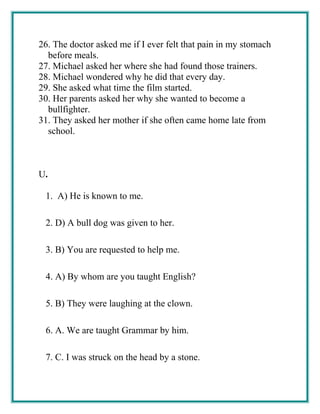
26.The doctor asked: “Do you ever feel this pain in your
stomach before meals?”
_______________________________________________
_
_______________________________________________
_
27.Michael asked her: “Where did you find these trainers?
_______________________________________________
_
_______________________________________________
_
28.Michael wondered: “Why do I do this every day?”
_______________________________________________
_
_______________________________________________
_
29. “What time did the film start?” she asked.
_______________________________________________
_
_______________________________________________
_
30. Her parents asked her: “Why do you want to
become a bullfighter?”
_______________________________________________
_
_______________________________________________
_
31. They asked her mother: “Does he often come home
late from school?”
_______________________________________________
_
_______________________________________________
_
ACTIVE TO PASSIVE
U.QUESTIONS WITH CHOICES
1. I know him.
• A. He is known to me.
• B. He has been known by me.
• C. He is known by me.
• D. He was known to me.
2. Someone gave her a bull dog.
• A. She is being given a bull dog by someone.
• B. She has been given a bull dog.
• C. She was given a bull dog.
• D. A bull dog was given to her.
3. Please help me.
• A. You were requested to help me.
• B. You are requested to help me.
• C. You are being requested to help me.
• D. You have been requested to help me.
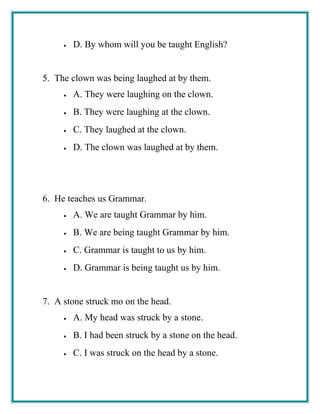
4. Who teaches you English?
• A. By whom are you taught English?
• B. English is taught by whom?
• C. By whom were you taught English?
• D. By whom will you be taught English?
5. The clown was being laughed at by them.
• A. They were laughing on the clown.
• B. They were laughing at the clown.
• C. They laughed at the clown.
• D. The clown was laughed at by them.
6. He teaches us Grammar.
• A. We are taught Grammar by him.
• B. We are being taught Grammar by him.
• C. Grammar is taught to us by him.
• D. Grammar is being taught us by him.
7. A stone struck mo on the head.
• A. My head was struck by a stone.
• B. I had been struck by a stone on the head.
• C. I was struck on the head by a stone.
• D. I was struck by a stone on the head.
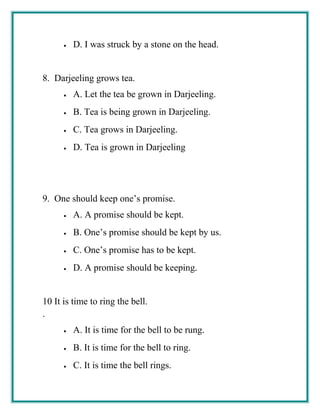
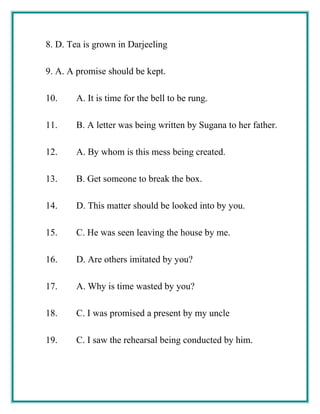
8. Darjeeling grows tea.
• A. Let the tea be grown in Darjeeling.
• B. Tea is being grown in Darjeeling.
• C. Tea grows in Darjeeling.
• D. Tea is grown in Darjeeling
9. One should keep one’s promise.
• A. A promise should be kept.
• B. One’s promise should be kept by us.
• C. One’s promise has to be kept.
• D. A promise should be keeping.
10
.
It is time to ring the bell.
• A. It is time for the bell to be rung.
• B. It is time for the bell to ring.
• C. It is time the bell rings.
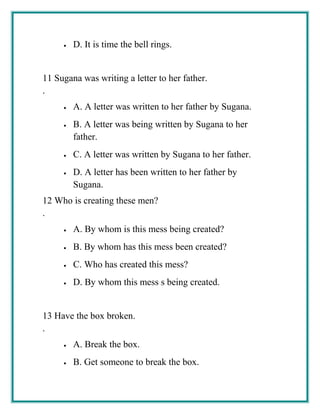
• D. It is time the bell rings.
11
.
Sugana was writing a letter to her father.
• A. A letter was written to her father by Sugana.
• B. A letter was being written by Sugana to her
father.
• C. A letter was written by Sugana to her father.
• D. A letter has been written to her father by
Sugana.
12
.
Who is creating these men?
• A. By whom is this mess being created?
• B. By whom has this mess been created?
• C. Who has created this mess?
• D. By whom this mess s being created.
13
.
Have the box broken.
• A. Break the box.
• B. Get someone to break the box.
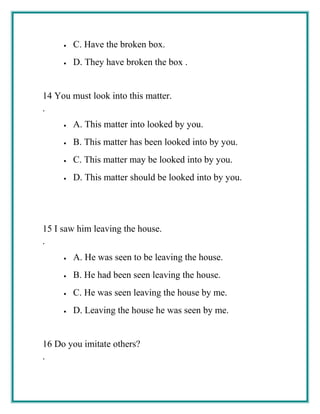
• C. Have the broken box.
• D. They have broken the box .
14
.
You must look into this matter.
• A. This matter into looked by you.
• B. This matter has been looked into by you.
• C. This matter may be looked into by you.
• D. This matter should be looked into by you.
15
.
I saw him leaving the house.
• A. He was seen to be leaving the house.
• B. He had been seen leaving the house.
• C. He was seen leaving the house by me.
• D. Leaving the house he was seen by me.
16
.
Do you imitate others?
• A. Have others been imitated by you?
• B. Were others being imitated by you?
• C. Are others being imitated by you?
• D. Are others imitated by you?
17
.
Why do you waste time?
• A. Why is time wasted by you?
• B. Why has time been wasted by you?
• C. Why is time being wasted by you?
• D. Why is time been wasted by you?
18
.
My uncle promised me a present.
• A. I was promised by my undo a present.
• B. A present was promised by my uncle to me.
• C. I was promised a present by my uncle.
• D. I had been promised a present by my uncle.
19
.
I saw him conducting the rehearsal.
• A. I saw the rehearsal to be conducted by him.
• B. He was seen conducting the rehearsal.
• C. I saw the rehearsal being conducted by him.
• D. He was seen by ma to conduct the rehearsal.
20
.
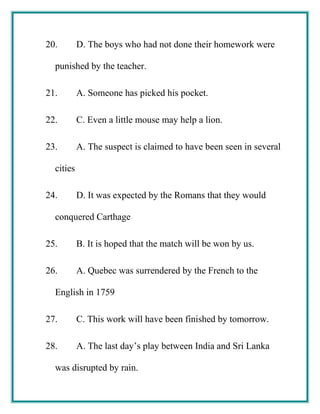
The teacher punished the boys who had not done their
homework?
• A. The boys were punished by their teacher who
had not done their homework.
• B. The boys who had not done their homework
had been punished by their teacher.
• C. The boys who had not done their homework
were being punished by the teacher.
• D. The boys who had not done their homework
were punished by the teacher.
21
.
His pocket has been picked.
• A. Someone has picked his pocket.
• B. Picked has been his pocket.
• C. They have his pocket picked.
• D. Picking has been done to his pocket.
22
.
A lion may be helped even by a little mouse.
• A. A little mouse may even help a lion.
• B. Even a little mouse ought to help a lion.
• C. Even a little mouse may help a lion.
• D. A little mouse may even help a lion.
23
.
People claim to have seen the suspect in several cities.
• A. The suspect is claimed to have been seen in
several cities.
• B. The suspect was seen by people in several
cities.
• C. The suspect has been the people in several
cities.
• D. The suspect is being seen in several cities.
24
.
The Romans expected to conquer Carthage.
• A. The Romans expected, to have conquered
Carthage.
• B. Carthage was expected to be conquered by the
Romans.
• C. The Romans were expected to conquer
Carthage.
• D. It was expected by the Romans that they
would conquered Carthage.
25
.
We hope that we shall win the match.
• A. We hope that we shall win the match.
• B. It is hoped that the match will be won by us.
• C. Match winning is our hope.
• D. The match is hoped to be won.
26
.
The French surrendered Quebec to the English in
1759.
• A. Quebec was surrendered by the French to the
English in 1759.
• B. Quebec was surrendered to the English in 1759
by the French.
• C. Quebec was surrendered in 1759 by the French
to the English.
• D. The English were surrendered Quebec in 1759
by the French.
27
.
You will have finished this work by tomorrow.
• A. This work will be finished by tomorrow.
• B. This work will finish tomorrow.
• C. This work will have been finished by
tomorrow.
• D. This work will have been finished tomorrow.
28
.
Rain disrupted the last day's play between India and
Sri Lanka.
• A. The last day’s play between India and Sri
Lanka was disrupted by rain.
• B. The last day’s play between India and Sri
Lanka were disrupted by rain.
• C. India and Sri Lanka’s play of the last day was
disrupted by rain.
• D. The last day’s play of India and Sri Lanka was
disrupted by rain.
29
.
They are building a house next door to our school.
• A. Next door to our school a house is being built
by them.
• B. A house next door to our school is being built
by them.
• C. Next door to our school is being built a house
by them.
• D. A house is being built by them next door to
our school.
30
.
The residents celebrated the Independence Day.
• A. Celebration of Independence Day was done by
the residents.
• B. The Independence Day is celebrated by the
residents.
• C. The Independence Day was celebrated by the
residents.
• D. The Independence Day has been celebrated by
the residents.
V.QUESTIOENS WITHOUT CHOICES
1. We are taught grammar by Ms Sullivan.
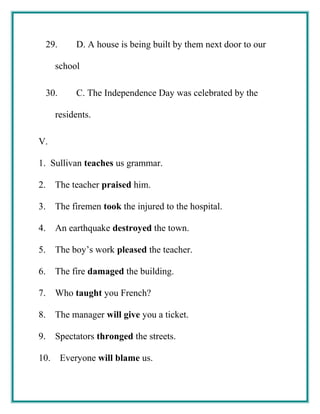
2. He was praised by the teacher.
3. The injured were taken to the hospital by the firemen.
4. The town was destroyed by an earthquake.
5. The teacher was pleased with the boy’s work.
6. The building was damaged by the fire.
7. By whom were you taught French?
8. You will be given a ticket by the manager.
9. The streets were thronged with spectators.
10. We will be blamed by everyone.
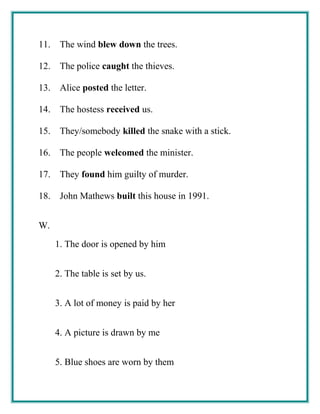
11. The trees were blown down by the wind.
12. The thieves were caught by the police.
13. The letter was posted by Alice.
14. We were received by the hostess.
15. The snake was killed with a stick.
16. The minister was welcomed by the people.
17. He was found guilty of murder.
18. This house was built by John Mathews in 1991.
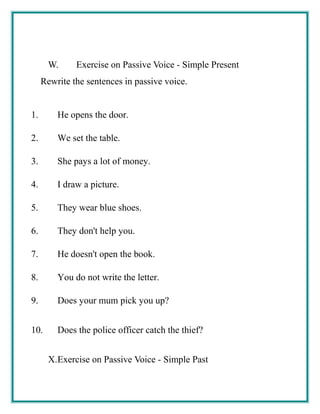
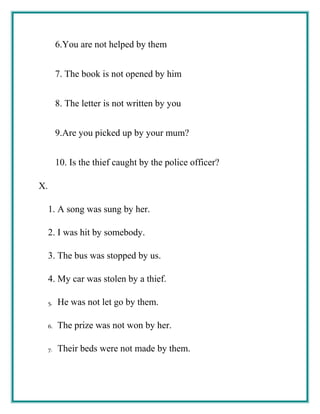
W. Exercise on Passive Voice - Simple Present
Rewrite the sentences in passive voice.
1. He opens the door.
2. We set the table.
3. She pays a lot of money.
4. I draw a picture.
5. They wear blue shoes.
6. They don't help you.
7. He doesn't open the book.
8. You do not write the letter.
9. Does your mum pick you up?
10. Does the police officer catch the thief?
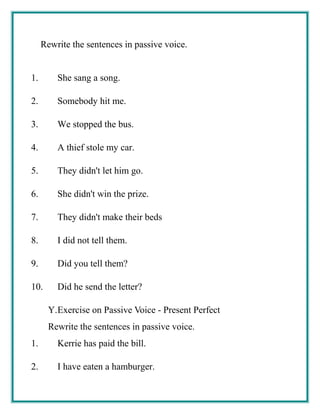
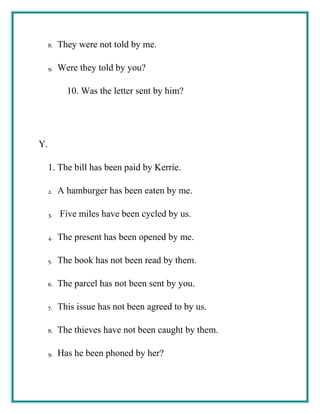
X.Exercise on Passive Voice - Simple Past
Rewrite the sentences in passive voice.
1. She sang a song.
2. Somebody hit me.
3. We stopped the bus.
4. A thief stole my car.
5. They didn't let him go.
6. She didn't win the prize.
7. They didn't make their beds
8. I did not tell them.
9. Did you tell them?
10. Did he send the letter?
Y.Exercise on Passive Voice - Present Perfect
Rewrite the sentences in passive voice.
1. Kerrie has paid the bill.
2. I have eaten a hamburger.
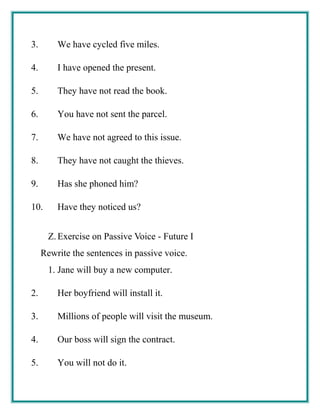
3. We have cycled five miles.
4. I have opened the present.
5. They have not read the book.
6. You have not sent the parcel.
7. We have not agreed to this issue.
8. They have not caught the thieves.
9. Has she phoned him?
10. Have they noticed us?
Z.Exercise on Passive Voice - Future I
Rewrite the sentences in passive voice.
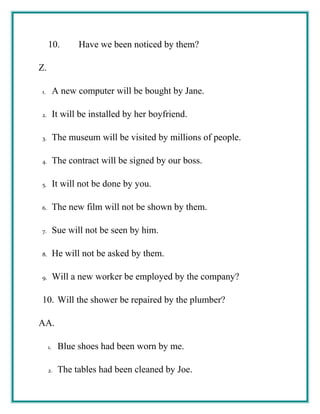
1. Jane will buy a new computer.
2. Her boyfriend will install it.
3. Millions of people will visit the museum.
4. Our boss will sign the contract.
5. You will not do it.
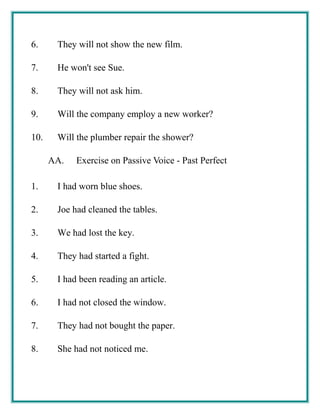
6. They will not show the new film.
7. He won't see Sue.
8. They will not ask him.
9. Will the company employ a new worker?
10. Will the plumber repair the shower?
AA. Exercise on Passive Voice - Past Perfect
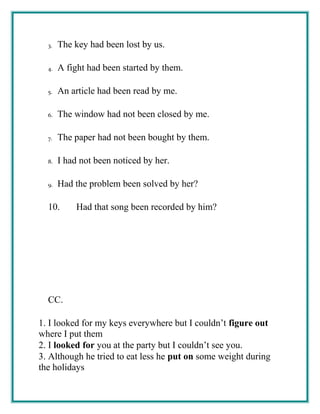
1. I had worn blue shoes.
2. Joe had cleaned the tables.
3. We had lost the key.
4. They had started a fight.
5. I had been reading an article.
6. I had not closed the window.
7. They had not bought the paper.
8. She had not noticed me.
9. Had she solved the problem?
10. Had he recorded that song?
BB. Smart Idioms and their Meanings
1) A penny for your thought
A way of asking what someone is thinking
2) Actions speak louder than words
People’s intentions can be judged better by what they do
than what they say.
3) An arm and a leg
Very expensive or costly. A large amount of money.
4) At the drop of a hat
Meaning: without any hesitation; instantly.
5) Back to the drawing board
When an attempt fails and it’s time to start all over.
6) Ball is in your court
It is up to you to make the next decision or step
7) Barking up the wrong tree
Looking in the wrong place. Accusing the wrong person
8) Beat around the bush
Avoiding the main topic. Not speaking directly about the
issue.
9) Best of both worlds
Meaning: All the advantages
10) Blessing in disguise
Something good that isn’t recognized at first
11) Burn the midnight oil
To work late into the night, alluding to the time before
electric lighting.
12) Caught between two stools
When someone finds it difficult to choose between two
alternatives.
13) Costs an arm and a leg
This idiom is used when something is very expensive.
14) Cry over spilt milk
When you complain about a loss from the past.
15) Cut corners
When something is done badly to save money.
16) Cut the mustard
To succeed; to come up to expectations; adequate enough
to compete or participate.
17) Devil’s Advocate
To present a counter argument
18) Every cloud has a silver lining
Be optimistic, even difficult times will lead to better days.
19) Hear it on the grapevine
This idiom means ‘to hear rumors’ about something or
someone.
20) Hit the nail on the head
Do or say something exactly right
21) In the heat of the moment
Overwhelmed by what is happening in the moment.
22) Keep something at bay
Keep something away.
23) Let sleeping dogs lie
Meaning – do not disturb a situation as it is – since it
would result in trouble or complications.
24) Let the cat out of the bag
To share information that was previously concealed
25) Make a long story short
Come to the point – leave out details
26) Method to my madness
An assertion that, despite one’s approach seeming random,
there actually is structure to it.
27) Miss the boat
This idiom is used to say that someone missed his or her
chance
28) Not a spark of decency
Meaning: No manners
29) Once in a blue moon
Meaning: happens very rarely
30) Picture paints a thousand words
A visual presentation is far more descriptive than words.
31) Piece of cake
A job, task or other activity that is easy or simple.
32) See eye to eye
This idioms is used to say that two (or more people) agree
on something.
33) Sit on the fence
This is used when someone does not want to choose or
make a decision.
34) Speak of the devil!
This expression is used when the person you have just
been talking about arrives.
35) Steal someone’s thunder
To take the credit for something someone else did.
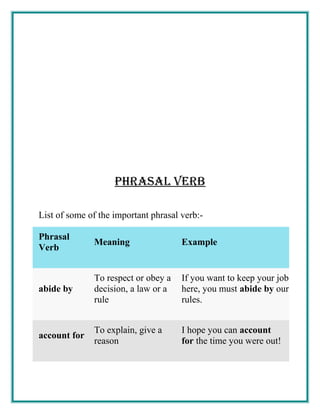
PHRASAL VERB
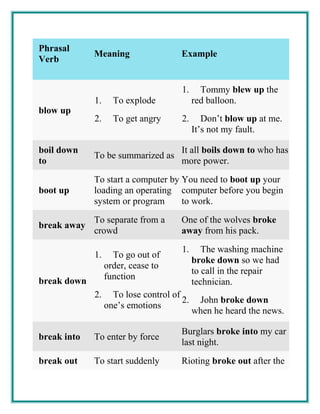
List of some of the important phrasal verb:-
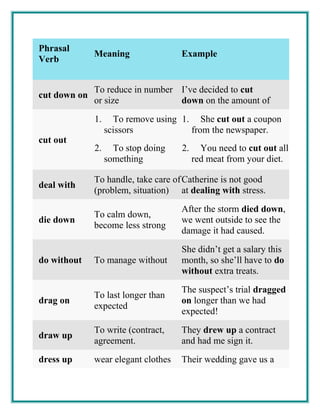
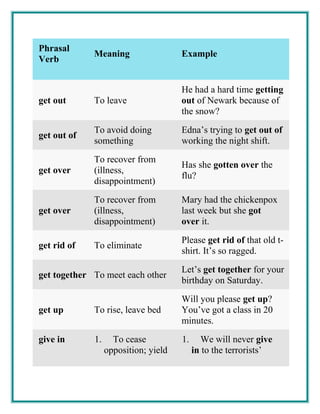
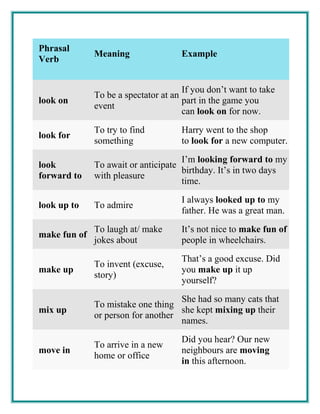
Phrasal
Verb
Meaning Example
abide by
To respect or obey a
decision, a law or a
rule
If you want to keep your job
here, you must abide by our
rules.
account for
To explain, give a
reason
I hope you can account
for the time you were out!
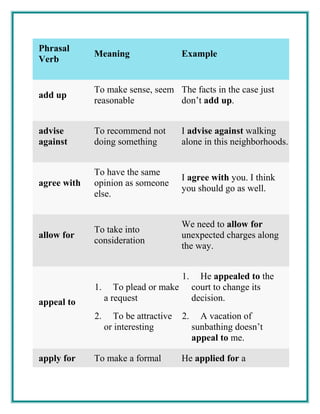
Phrasal
Verb
Meaning Example
add up
To make sense, seem
reasonable
The facts in the case just
don’t add up.
advise
against
To recommend not
doing something
I advise against walking
alone in this neighborhoods.
agree with
To have the same
opinion as someone
else.
I agree with you. I think
you should go as well.
allow for
To take into
consideration
We need to allow for
unexpected charges along
the way.
appeal to
1. To plead or make
a request
2. To be attractive
or interesting
1. He appealed to the
court to change its
decision.
2. A vacation of
sunbathing doesn’t
appeal to me.
apply for To make a formal He applied for a
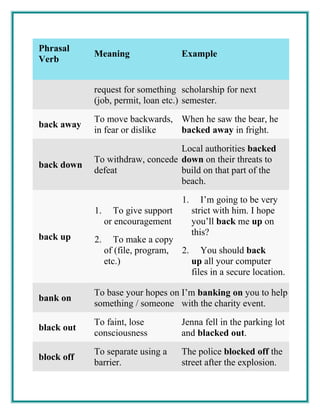
Phrasal
Verb
Meaning Example
request for something
(job, permit, loan etc.)
scholarship for next
semester.
back away
To move backwards,
in fear or dislike
When he saw the bear, he
backed away in fright.
back down
To withdraw, concede
defeat
Local authorities backed
down on their threats to
build on that part of the
beach.
back up
1. To give support
or encouragement
2. To make a copy
of (file, program,
etc.)
1. I’m going to be very
strict with him. I hope
you’ll back me up on
this?
2. You should back
up all your computer
files in a secure location.
bank on
To base your hopes on
something / someone
I’m banking on you to help
with the charity event.
black out
To faint, lose
consciousness
Jenna fell in the parking lot
and blacked out.
block off
To separate using a
barrier.
The police blocked off the
street after the explosion.
Phrasal
Verb
Meaning Example
blow up
1. To explode
2. To get angry
1. Tommy blew up the
red balloon.
2. Don’t blow up at me.
It’s not my fault.
boil down
to
To be summarized as
It all boils down to who has
more power.
boot up
To start a computer by
loading an operating
system or program
You need to boot up your
computer before you begin
to work.
break away
To separate from a
crowd
One of the wolves broke
away from his pack.
break down
1. To go out of
order, cease to
function
2. To lose control of
one’s emotions
1. The washing machine
broke down so we had
to call in the repair
technician.
2. John broke down
when he heard the news.
break into To enter by force
Burglars broke into my car
last night.
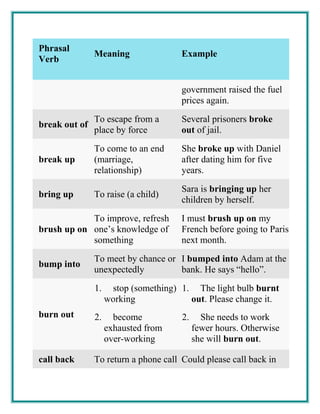
break out To start suddenly Rioting broke out after the
Phrasal
Verb
Meaning Example
government raised the fuel
prices again.
break out of
To escape from a
place by force
Several prisoners broke
out of jail.
break up
To come to an end
(marriage,
relationship)
She broke up with Daniel
after dating him for five
years.
bring up To raise (a child)
Sara is bringing up her
children by herself.
brush up on
To improve, refresh
one’s knowledge of
something
I must brush up on my
French before going to Paris
next month.
bump into
To meet by chance or
unexpectedly
I bumped into Adam at the
bank. He says “hello”.
burn out
1. stop (something)
working
2. become
exhausted from
over-working
1. The light bulb burnt
out. Please change it.
2. She needs to work
fewer hours. Otherwise
she will burn out.
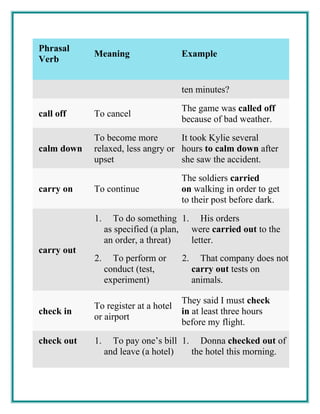
call back To return a phone call Could please call back in
Phrasal
Verb
Meaning Example
ten minutes?
call off To cancel
The game was called off
because of bad weather.
calm down
To become more
relaxed, less angry or
upset
It took Kylie several
hours to calm down after
she saw the accident.
carry on To continue
The soldiers carried
on walking in order to get
to their post before dark.
carry out
1. To do something
as specified (a plan,
an order, a threat)
2. To perform or
conduct (test,
experiment)
1. His orders
were carried out to the
letter.
2. That company does not
carry out tests on
animals.
check in
To register at a hotel
or airport
They said I must check
in at least three hours
before my flight.
check out 1. To pay one’s bill
and leave (a hotel)
1. Donna checked out of
the hotel this morning.
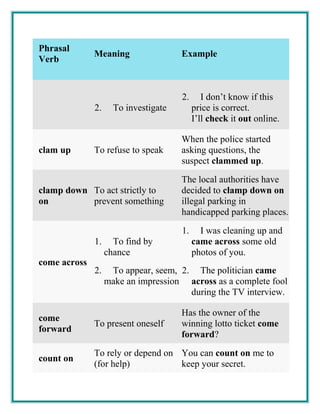
Phrasal
Verb
Meaning Example
2. To investigate
2. I don’t know if this
price is correct.
I’ll check it out online.
clam up To refuse to speak
When the police started
asking questions, the
suspect clammed up.
clamp down
on
To act strictly to
prevent something
The local authorities have
decided to clamp down on
illegal parking in
handicapped parking places.
come across
1. To find by
chance
2. To appear, seem,
make an impression
1. I was cleaning up and
came across some old
photos of you.
2. The politician came
across as a complete fool
during the TV interview.
come
forward
To present oneself
Has the owner of the
winning lotto ticket come
forward?
count on
To rely or depend on
(for help)
You can count on me to
keep your secret.
Phrasal
Verb
Meaning Example
cut down on
To reduce in number
or size
I’ve decided to cut
down on the amount of
cut out
1. To remove using
scissors
2. To stop doing
something
1. She cut out a coupon
from the newspaper.
2. You need to cut out all
red meat from your diet.
deal with
To handle, take care of
(problem, situation)
Catherine is not good
at dealing with stress.
die down
To calm down,
become less strong
After the storm died down,
we went outside to see the
damage it had caused.
do without To manage without
She didn’t get a salary this
month, so she’ll have to do
without extra treats.
drag on
To last longer than
expected
The suspect’s trial dragged
on longer than we had
expected!
draw up
To write (contract,
agreement.
They drew up a contract
and had me sign it.
dress up wear elegant clothes Their wedding gave us a
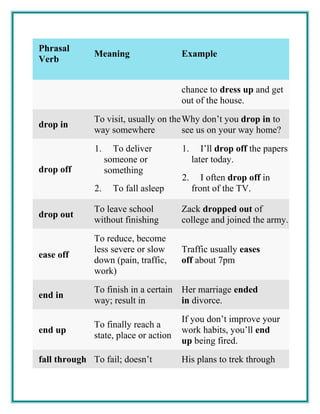
Phrasal
Verb
Meaning Example
chance to dress up and get
out of the house.
drop in
To visit, usually on the
way somewhere
Why don’t you drop in to
see us on your way home?
drop off
1. To deliver
someone or
something
2. To fall asleep
1. I’ll drop off the papers
later today.
2. I often drop off in
front of the TV.
drop out
To leave school
without finishing
Zack dropped out of
college and joined the army.
ease off
To reduce, become
less severe or slow
down (pain, traffic,
work)
Traffic usually eases
off about 7pm
end in
To finish in a certain
way; result in
Her marriage ended
in divorce.
end up
To finally reach a
state, place or action
If you don’t improve your
work habits, you’ll end
up being fired.
fall through To fail; doesn’t His plans to trek through
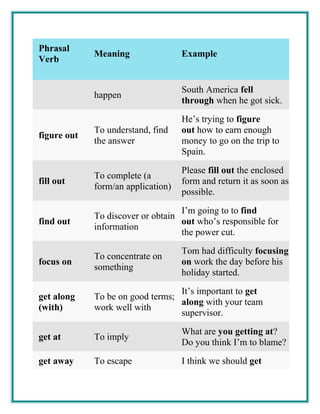
Phrasal
Verb
Meaning Example
happen
South America fell
through when he got sick.
figure out
To understand, find
the answer
He’s trying to figure
out how to earn enough
money to go on the trip to
Spain.
fill out
To complete (a
form/an application)
Please fill out the enclosed
form and return it as soon as
possible.
find out
To discover or obtain
information
I’m going to to find
out who’s responsible for
the power cut.
focus on
To concentrate on
something
Tom had difficulty focusing
on work the day before his
holiday started.
get along
(with)
To be on good terms;
work well with
It’s important to get
along with your team
supervisor.
get at To imply
What are you getting at?
Do you think I’m to blame?
get away To escape I think we should get
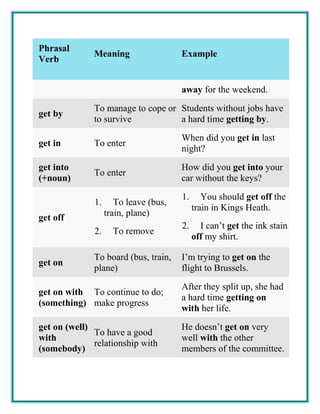
Phrasal
Verb
Meaning Example
away for the weekend.
get by
To manage to cope or
to survive
Students without jobs have
a hard time getting by.
get in To enter
When did you get in last
night?
get into
(+noun)
To enter
How did you get into your
car without the keys?
get off
1. To leave (bus,
train, plane)
2. To remove
1. You should get off the
train in Kings Heath.
2. I can’t get the ink stain
off my shirt.
get on
To board (bus, train,
plane)
I’m trying to get on the
flight to Brussels.
get on with
(something)
To continue to do;
make progress
After they split up, she had
a hard time getting on
with her life.
get on (well)
with
(somebody)
To have a good
relationship with
He doesn’t get on very
well with the other
members of the committee.
Phrasal
Verb
Meaning Example
get out To leave
He had a hard time getting
out of Newark because of
the snow?
get out of
To avoid doing
something
Edna’s trying to get out of
working the night shift.
get over
To recover from
(illness,
disappointment)
Has she gotten over the
flu?
get over
To recover from
(illness,
disappointment)
Mary had the chickenpox
last week but she got
over it.
get rid of To eliminate
Please get rid of that old t-
shirt. It’s so ragged.
get together To meet each other
Let’s get together for your
birthday on Saturday.
get up To rise, leave bed
Will you please get up?
You’ve got a class in 20
minutes.
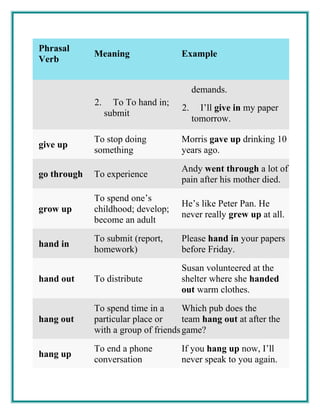
give in 1. To cease
opposition; yield
1. We will never give
in to the terrorists’
Phrasal
Verb
Meaning Example
2. To To hand in;
submit
demands.
2. I’ll give in my paper
tomorrow.
give up
To stop doing
something
Morris gave up drinking 10
years ago.
go through To experience
Andy went through a lot of
pain after his mother died.
grow up
To spend one’s
childhood; develop;
become an adult
He’s like Peter Pan. He
never really grew up at all.
hand in
To submit (report,
homework)
Please hand in your papers
before Friday.
hand out To distribute
Susan volunteered at the
shelter where she handed
out warm clothes.
hang out
To spend time in a
particular place or
with a group of friends
Which pub does the
team hang out at after the
game?
hang up
To end a phone
conversation
If you hang up now, I’ll
never speak to you again.
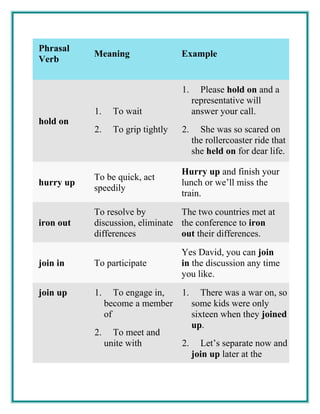
Phrasal
Verb
Meaning Example
hold on
1. To wait
2. To grip tightly
1. Please hold on and a
representative will
answer your call.
2. She was so scared on
the rollercoaster ride that
she held on for dear life.
hurry up
To be quick, act
speedily
Hurry up and finish your
lunch or we’ll miss the
train.
iron out
To resolve by
discussion, eliminate
differences
The two countries met at
the conference to iron
out their differences.
join in To participate
Yes David, you can join
in the discussion any time
you like.
join up 1. To engage in,
become a member
of
2. To meet and
unite with
1. There was a war on, so
some kids were only
sixteen when they joined
up.
2. Let’s separate now and
join up later at the
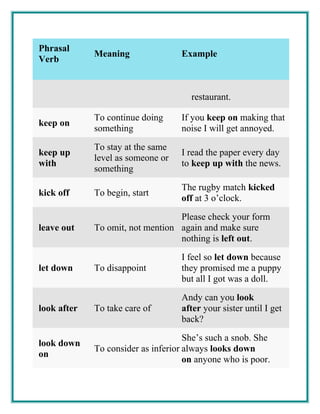
Phrasal
Verb
Meaning Example
restaurant.
keep on
To continue doing
something
If you keep on making that
noise I will get annoyed.
keep up
with
To stay at the same
level as someone or
something
I read the paper every day
to keep up with the news.
kick off To begin, start
The rugby match kicked
off at 3 o’clock.
leave out To omit, not mention
Please check your form
again and make sure
nothing is left out.
let down To disappoint
I feel so let down because
they promised me a puppy
but all I got was a doll.
look after To take care of
Andy can you look
after your sister until I get
back?
look down
on
To consider as inferior
She’s such a snob. She
always looks down
on anyone who is poor.
Phrasal
Verb
Meaning Example
look on
To be a spectator at an
event
If you don’t want to take
part in the game you
can look on for now.
look for
To try to find
something
Harry went to the shop
to look for a new computer.
look
forward to
To await or anticipate
with pleasure
I’m looking forward to my
birthday. It’s in two days
time.
look up to To admire
I always looked up to my
father. He was a great man.
make fun of
To laugh at/ make
jokes about
It’s not nice to make fun of
people in wheelchairs.
make up
To invent (excuse,
story)
That’s a good excuse. Did
you make up it up
yourself?
mix up
To mistake one thing
or person for another
She had so many cats that
she kept mixing up their
names.
move in
To arrive in a new
home or office
Did you hear? Our new
neighbours are moving
in this afternoon.
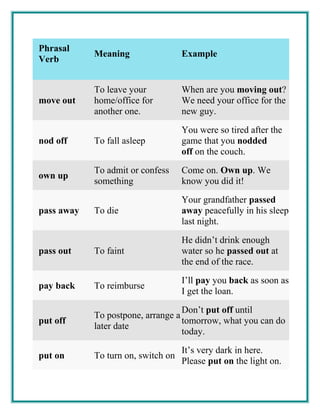
Phrasal
Verb
Meaning Example
move out
To leave your
home/office for
another one.
When are you moving out?
We need your office for the
new guy.
nod off To fall asleep
You were so tired after the
game that you nodded
off on the couch.
own up
To admit or confess
something
Come on. Own up. We
know you did it!
pass away To die
Your grandfather passed
away peacefully in his sleep
last night.
pass out To faint
He didn’t drink enough
water so he passed out at
the end of the race.
pay back To reimburse
I’ll pay you back as soon as
I get the loan.
put off
To postpone, arrange a
later date
Don’t put off until
tomorrow, what you can do
today.
put on To turn on, switch on
It’s very dark in here.
Please put on the light on.
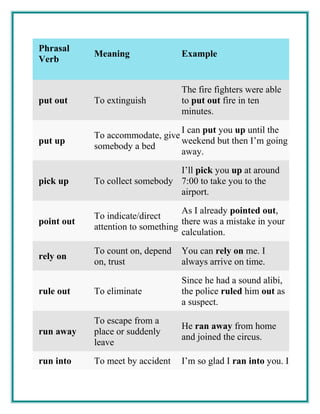
Phrasal
Verb
Meaning Example
put out To extinguish
The fire fighters were able
to put out fire in ten
minutes.
put up
To accommodate, give
somebody a bed
I can put you up until the
weekend but then I’m going
away.
pick up To collect somebody
I’ll pick you up at around
7:00 to take you to the
airport.
point out
To indicate/direct
attention to something
As I already pointed out,
there was a mistake in your
calculation.
rely on
To count on, depend
on, trust
You can rely on me. I
always arrive on time.
rule out To eliminate
Since he had a sound alibi,
the police ruled him out as
a suspect.
run away
To escape from a
place or suddenly
leave
He ran away from home
and joined the circus.
run into To meet by accident I’m so glad I ran into you. I
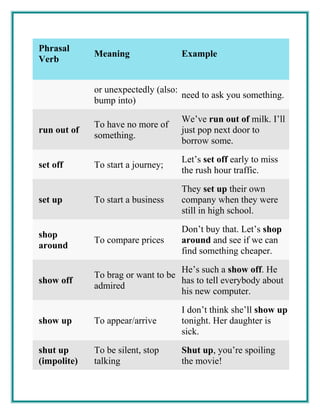
Phrasal
Verb
Meaning Example
or unexpectedly (also:
bump into)
need to ask you something.
run out of
To have no more of
something.
We’ve run out of milk. I’ll
just pop next door to
borrow some.
set off To start a journey;
Let’s set off early to miss
the rush hour traffic.
set up To start a business
They set up their own
company when they were
still in high school.
shop
around
To compare prices
Don’t buy that. Let’s shop
around and see if we can
find something cheaper.
show off
To brag or want to be
admired
He’s such a show off. He
has to tell everybody about
his new computer.
show up To appear/arrive
I don’t think she’ll show up
tonight. Her daughter is
sick.
shut up
(impolite)
To be silent, stop
talking
Shut up, you’re spoiling
the movie!
Phrasal
Verb
Meaning Example
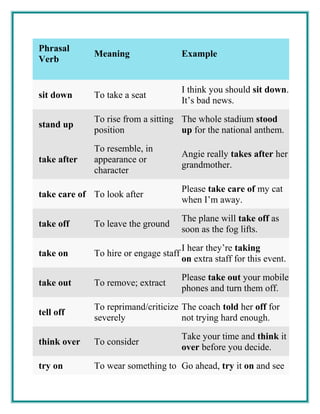
sit down To take a seat
I think you should sit down.
It’s bad news.
stand up
To rise from a sitting
position
The whole stadium stood
up for the national anthem.
take after
To resemble, in
appearance or
character
Angie really takes after her
grandmother.
take care of To look after
Please take care of my cat
when I’m away.
take off To leave the ground
The plane will take off as
soon as the fog lifts.
take on To hire or engage staff
I hear they’re taking
on extra staff for this event.
take out To remove; extract
Please take out your mobile
phones and turn them off.
tell off
To reprimand/criticize
severely
The coach told her off for
not trying hard enough.
think over To consider
Take your time and think it
over before you decide.
try on To wear something to Go ahead, try it on and see
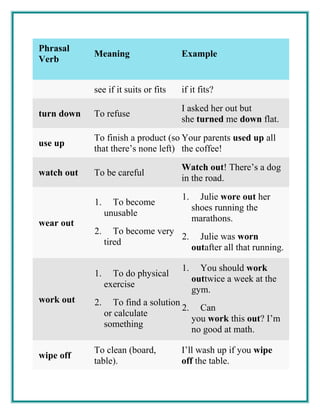
Phrasal
Verb
Meaning Example
see if it suits or fits if it fits?
turn down To refuse
I asked her out but
she turned me down flat.
use up
To finish a product (so
that there’s none left)
Your parents used up all
the coffee!
watch out To be careful
Watch out! There’s a dog
in the road.
wear out
1. To become
unusable
2. To become very
tired
1. Julie wore out her
shoes running the
marathons.
2. Julie was worn
outafter all that running.
work out
1. To do physical
exercise
2. To find a solution
or calculate
something
1. You should work
outtwice a week at the
gym.
2. Can
you work this out? I’m
no good at math.
wipe off
To clean (board,
table).
I’ll wash up if you wipe
off the table.
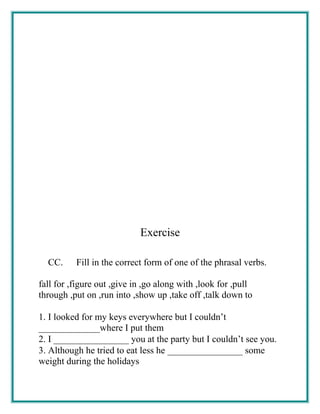
Exercise
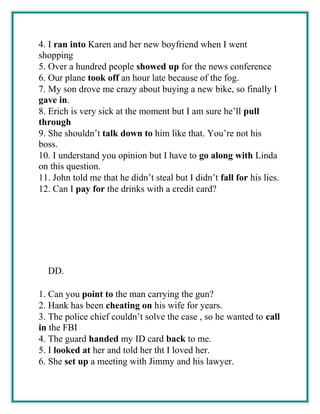
CC. Fill in the correct form of one of the phrasal verbs.
fall for ,figure out ,give in ,go along with ,look for ,pull
through ,put on ,run into ,show up ,take off ,talk down to
1. I looked for my keys everywhere but I couldn’t
_____________where I put them
2. I ________________ you at the party but I couldn’t see you.
3. Although he tried to eat less he ________________ some
weight during the holidays
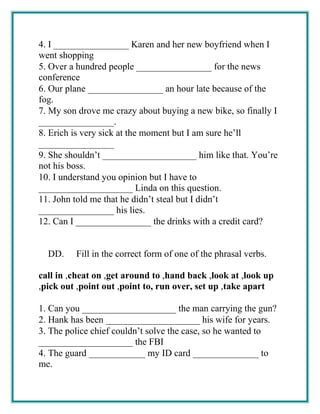
4. I ________________ Karen and her new boyfriend when I
went shopping
5. Over a hundred people ________________ for the news
conference
6. Our plane ________________ an hour late because of the
fog.
7. My son drove me crazy about buying a new bike, so finally I
________________.
8. Erich is very sick at the moment but I am sure he’ll
________________
9. She shouldn’t ____________________ him like that. You’re
not his boss.
10. I understand you opinion but I have to
____________________ Linda on this question.
11. John told me that he didn’t steal but I didn’t
________________ his lies.
12. Can I ________________ the drinks with a credit card?
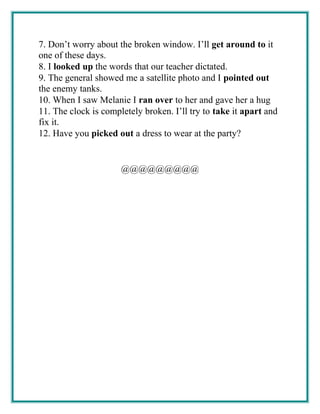
DD. Fill in the correct form of one of the phrasal verbs.
call in ,cheat on ,get around to ,hand back ,look at ,look up
,pick out ,point out ,point to, run over, set up ,take apart
1. Can you ____________________ the man carrying the gun?
2. Hank has been ____________________ his wife for years.
3. The police chief couldn’t solve the case, so he wanted to
____________________ the FBI
4. The guard ____________ my ID card ______________ to
me.
5. I ____________________ her and told her that I loved her.
6. She ____________________ a meeting with Jimmy and his
lawyer.
7. Don’t worry about the broken window. I’ll
____________________ it one of these days.
8. I ____________________ the words that our teacher
dictated.
9. The general showed me a satellite photo and I
____________________ the enemy tanks.
10. When I saw Melanie I ____________________ to her and
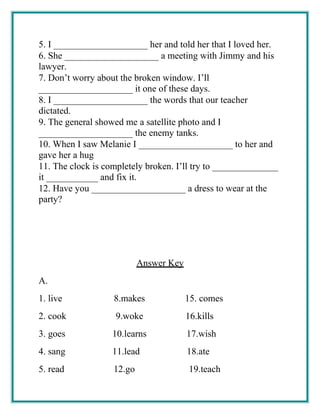
gave her a hug
11. The clock is completely broken. I’ll try to ______________
it ___________ and fix it.
12. Have you ____________________ a dress to wear at the
party?
Answer Key
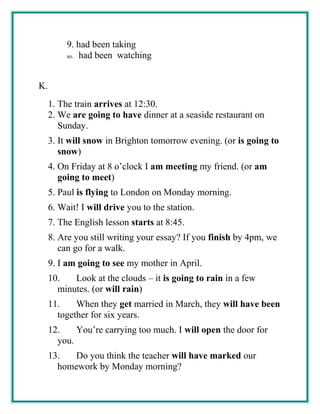
A.
1. live 8.makes 15. comes
2. cook 9.woke 16.kills
3. goes 10.learns 17.wish
4. sang 11.lead 18.ate
5. read 12.go 19.teach
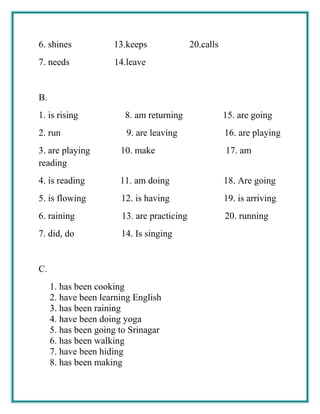
6. shines 13.keeps 20.calls
7. needs 14.leave
B.
1. is rising 8. am returning 15. are going
2. run 9. are leaving 16. are playing
3. are playing 10. make 17. am
reading
4. is reading 11. am doing 18. Are going
5. is flowing 12. is having 19. is arriving
6. raining 13. are practicing 20. running
7. did, do 14. Is singing
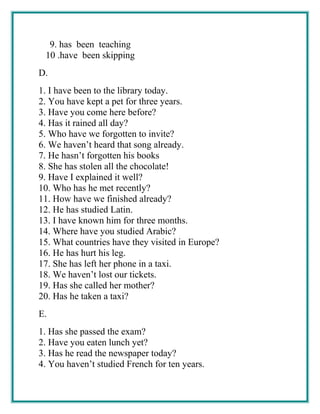
C.
1. has been cooking
2. have been learning English
3. has been raining
4. have been doing yoga
5. has been going to Srinagar
6. has been walking
7. have been hiding
8. has been making
9. has been teaching
10 .have been skipping
D.
1. I have been to the library today.
2. You have kept a pet for three years.
3. Have you come here before?
4. Has it rained all day?
5. Who have we forgotten to invite?
6. We haven’t heard that song already.
7. He hasn’t forgotten his books
8. She has stolen all the chocolate!
9. Have I explained it well?
10. Who has he met recently?
11. How have we finished already?
12. He has studied Latin.
13. I have known him for three months.
14. Where have you studied Arabic?
15. What countries have they visited in Europe?
16. He has hurt his leg.
17. She has left her phone in a taxi.
18. We haven’t lost our tickets.
19. Has she called her mother?
20. Has he taken a taxi?
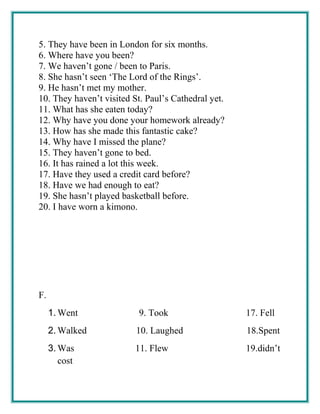
E.
1. Has she passed the exam?
2. Have you eaten lunch yet?
3. Has he read the newspaper today?
4. You haven’t studied French for ten years.
5. They have been in London for six months.
6. Where have you been?
7. We haven’t gone / been to Paris.
8. She hasn’t seen ‘The Lord of the Rings’.
9. He hasn’t met my mother.
10. They haven’t visited St. Paul’s Cathedral yet.
11. What has she eaten today?
12. Why have you done your homework already?
13. How has she made this fantastic cake?
14. Why have I missed the plane?
15. They haven’t gone to bed.
16. It has rained a lot this week.
17. Have they used a credit card before?
18. Have we had enough to eat?
19. She hasn’t played basketball before.
20. I have worn a kimono.
F.
1. Went 9. Took 17. Fell
2. Walked 10. Laughed 18.Spent
3. Was 11. Flew 19.didn’t
cost
4. Missed 12. was , were 20.
taught
5. Visited 13. wrote
6. Brought 14. drank
7. Moved 15. sold
8. Were 16. Threw, caught
G.
1. Were playing 11.Were eating
2. Were playing 12. Was cleaning
3. Was practicing 13. Was barking
4. Was working, were swimming 14. Was explaining
5. Weren’t listening 15. Was trying
6. Were sitting 16. were singing
7. Were studying 17.Was preparing
8. Was reading 18. Weren’t cycling
9. Were talking 19. were travelling
10. Was sleeping 20. was using
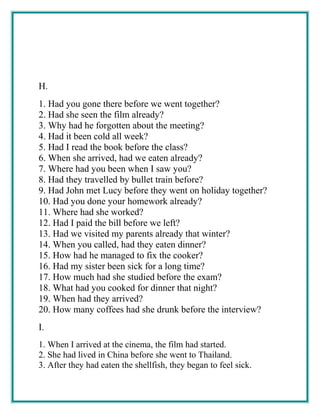
H.
1. Had you gone there before we went together?
2. Had she seen the film already?
3. Why had he forgotten about the meeting?
4. Had it been cold all week?
5. Had I read the book before the class?
6. When she arrived, had we eaten already?
7. Where had you been when I saw you?
8. Had they travelled by bullet train before?
9. Had John met Lucy before they went on holiday together?
10. Had you done your homework already?
11. Where had she worked?
12. Had I paid the bill before we left?
13. Had we visited my parents already that winter?
14. When you called, had they eaten dinner?
15. How had he managed to fix the cooker?
16. Had my sister been sick for a long time?
17. How much had she studied before the exam?
18. What had you cooked for dinner that night?
19. When had they arrived?
20. How many coffees had she drunk before the interview?
I.
1. When I arrived at the cinema, the film had started.
2. She had lived in China before she went to Thailand.
3. After they had eaten the shellfish, they began to feel sick.
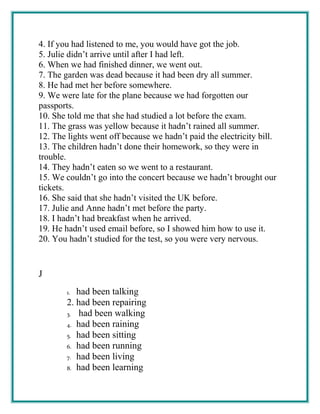
4. If you had listened to me, you would have got the job.
5. Julie didn’t arrive until after I had left.
6. When we had finished dinner, we went out.
7. The garden was dead because it had been dry all summer.
8. He had met her before somewhere.
9. We were late for the plane because we had forgotten our
passports.
10. She told me that she had studied a lot before the exam.
11. The grass was yellow because it hadn’t rained all summer.
12. The lights went off because we hadn’t paid the electricity bill.
13. The children hadn’t done their homework, so they were in
trouble.
14. They hadn’t eaten so we went to a restaurant.
15. We couldn’t go into the concert because we hadn’t brought our
tickets.
16. She said that she hadn’t visited the UK before.
17. Julie and Anne hadn’t met before the party.
18. I hadn’t had breakfast when he arrived.
19. He hadn’t used email before, so I showed him how to use it.
20. You hadn’t studied for the test, so you were very nervous.
J
1. had been talking
2. had been repairing
3. had been walking
4. had been raining
5. had been sitting
6. had been running
7. had been living
8. had been learning
9. had been taking
10. had been watching
K.
1. The train arrives at 12:30.
2. We are going to have dinner at a seaside restaurant on
Sunday.
3. It will snow in Brighton tomorrow evening. (or is going to
snow)
4. On Friday at 8 o’clock I am meeting my friend. (or am
going to meet)
5. Paul is flying to London on Monday morning.
6. Wait! I will drive you to the station.
7. The English lesson starts at 8:45.
8. Are you still writing your essay? If you finish by 4pm, we
can go for a walk.
9. I am going to see my mother in April.
10. Look at the clouds – it is going to rain in a few
minutes. (or will rain)
11. When they get married in March, they will have been
together for six years.
12. You’re carrying too much. I will open the door for
you.
13. Do you think the teacher will have marked our
homework by Monday morning?
14. When I see you tomorrow, I will show you my new
book.
15. After you take a nap, you will feel a lot better. (or
have taken)
16. I’m sorry but you need to stay in the office until you
have finished your work. (or finish)
17. I will buy the cigarettes from the corner shop when it
opens.
18. I will let you know the second the builders have
finished decorating. (or finish)
19. Before we start our lesson, we are going to have a
review. (or will have)
20. We will wait in the shelter until the bus comes.
21. I’m very sorry Dr. Jones won’t back in the clinic until
2pm.
22. This summer, I will have been living in Brighton for
four years.
23. I don’t think you will have any problems when you
land in Boston. (or are going to have)
24. The baby should be due soon, next week she will
have been pregnant for nine months.
25. By the time we get home, they will have been
playing football for 30 minutes.
26. In three years I am going to live in a different
country. (or will live)
27. When you get off the train, I will be waiting for you
by the ticket machine.
28. Are you going to take your children with you to
France?
29. This time next week I will be skiing in Switzerland!
L.
(a)
(1) Are you going to learn
(2) Are you going to do
(3) it starts
(4) you’ll enjoy
(5) it will/it’s going to be
b)
(1) you’re going
(2) we are going
(3) you have
(4) I will send
(5) I will get
(6) I get
N.
1. She said (that) he worked in a bank.
2. She told me (that) they went (had gone) out last night (the
night before).
3. She said (that) she was coming.
4. She told me (that) she had been waiting for the bus when he
arrived.
5. She said (that) she had never been there before.
6. She told me (that) she didn't go (hadn't gone) to the party.
7. She said (that) Lucy would come later.
8. She told me (that) he hadn't eaten breakfast.
9. She said (that) she could help me tomorrow.
10. She told me (that) I should go to bed early.
11. She told me (that) she didn't like chocolate.
12. She said (that) she wouldn't see me tomorrow.
13. She said (that) she was living in Paris for a few months.
14. She told me (that) she visited (had visited) her parents at the
weekend.
15. She said (that) she hadn't eaten sushi before.
16. She said (that) she hadn't travelled by underground before
she came to London.
17. She said (that) they would help if they could.
18. She told me (that) she would do the washing-up later.
19. She said (that) he could read when he was three.
20. She said (that) she had been sleeping when Julie called.
O.
1. She asked me if John was at home.
2. She asked me if she was late.
3. She asked me if it was cold outside.
4. She asked me if they were in Paris.
5. She asked me if the bus stop was near the shopping centre.
6. She asked me if the milk was fresh.
7. She asked me if I was a doctor.
8. She asked me if James and Lucy were from France.
9. She asked me if her brother was in the garden.
10. She asked me if the weather was good in Shanghai in the
summer.
11. She asked me where the post office was.
12. She asked me why Julie was sad.
13. She asked me what was for dinner.
14. She asked me who the woman in the red dress was.
15. She asked me how my grandmother was.
16. She asked me when the party was.
17. She asked me how much the rent on your flat was.
18. She asked me where the glasses were.
19. She asked me how the weather in Chicago was.
20. She asked me who the Prime Minister of Canada was.
P.
1. She asked me to help her carry this.
2. She asked me to come early.
3. She asked me to buy some milk.
4. She asked me to open the window.
5. She asked me to bring the book tonight (that night).
6. She asked me to help her with her homework.
7. She asked me to bring her a cup of coffee.
8. She asked me to pass the salt.
9. She asked me to lend her a pencil.
10. She asked me to tell her the time.
11. She told me to do my homework.
12. She told me to go to bed.
13. She told me not to be late.
14. She told me not to smoke.
15. She told me to tidy my room.
16. She told me to wait here (there).
17. She told me not to do that.
18. She told me to eat my dinner.
19. She told me not to make a mess.
20. She told me to do the washing-up.
Q.
1 .Rosy exclaimed with happiness that David had sung
wonderfully.
3. The foreigner exclaimed in wonder that
Obama was a great man.
3. John was surprised to see me there.
4. The reporter exclaimed sadly that many lives had been
lost due to tsunami.
5. The grandmother blessed her grandson that he should
meet with success wherever he goes.
6. Father forbade his daughter Sakshi to play in dirty water
7. The beggar called upon God with regret that he had been
cheated.
8. The boy exclaimed with joy that they had won the match.
9. The old man exclaimed with sorrow that he had lost his
purse.
10The child exclaimed with delight that it was a very beautiful
sight
11. The girl exclaimed with delight that the rainbow was very
beautiful
12. The candidate exclaimed with disapproval that the problem
was very difficult.
13. The students respectfully wished their teacher good
morning.
14. Alice exclaimed with delight that she was very glad to meet
her friend there
15. The Emperor exclaimed with sorrow that their foes were too
strong.
16. The boy exclaimed with delight he had done a prize
17. She exclaimed joyfully that that was a very beautiful flower
18. We all exclaimed that it was a very horrible sight
19. He exclaimed sorrowfully that he had broken his brother’s
watch.
20. Boon exclaimed joyfully that she was very beautiful.
R.
(a) He wanted a balloon that he could release into the air
(b) Asked him which colour balloon he wanted
(c) Asked him which colour balloon would take him up with it
(d) That it was not
(e) What was inside that made it go up
S.
(a) Had been the previous
(b) That there was an exhibition of rare paintings
(c) He had gone
(d) To know how well he was prepared
(e) Explained that he had been
T.
1. The spokesman said that he couldn’t understand why billiards
had been prohibited.
2. Gihan exclaimed that they had too many prohibitions.
3. The young lady said that she had not made such a mistake.
4. She said that that they would go and get some food.
5. Winston Churchill said that he woke up at six every day.
6. A company representative said that probably wouldn’t
happen.
7. A farmer said that if the situation went on like that they
would lose the consumers’ confidence for ever.
8. She said that she thought the amount of immigrants at that
moment was OK, but she didn’t think they needed any more.
9. He said that in Japan paper-folding had been valued for its
decorative function.
10. Kasparov said that if he didn’t win that game he would
retire.
11. The police said that Yourself had planned the World Trade
Centre bombing.
12. She said that as a woman, her life would change with the
new millennium.
13. John said that he had watched a documentary about dolphins
on TV the day before.
14. Banderas said that he was living the adventure of his life.
15. Al Gore said that as a teenager, one of the books that he had
read had been Silent Spring.
16. She said that she had been taught information technology in
that course.
17. My aunt said that single men should drive slowly if they
wanted to live longer.
18. He said that they were there that day to reach consensus.
19. Last week Julia said that they would meet their new
instructor the following day.
20. He asked one of them to let him see the streets once more
before he died, and then he promised to be back in five
minutes.
21. He begged her not to say anything to him.
22. His mother told him not to talk to her like that.
23. She advised him not to smoke if he wanted to save money.
24. Alice asked her brother to buy her the paper if he was going
out.
25. He asked if he often played rugby.
26. The doctor asked me if I ever felt that pain in my stomach
before meals.
27. Michael asked her where she had found those trainers.
28. Michael wondered why he did that every day.
29. She asked what time the film started.
30. Her parents asked her why she wanted to become a
bullfighter.
31. They asked her mother if she often came home late from
school.
U.
1. A) He is known to me.
2. D) A bull dog was given to her.
3. B) You are requested to help me.
4. A) By whom are you taught English?
5. B) They were laughing at the clown.
6. A. We are taught Grammar by him.
7. C. I was struck on the head by a stone.
8. D. Tea is grown in Darjeeling
9. A. A promise should be kept.
10. A. It is time for the bell to be rung.
11. B. A letter was being written by Sugana to her father.
12. A. By whom is this mess being created.
13. B. Get someone to break the box.
14. D. This matter should be looked into by you.
15. C. He was seen leaving the house by me.
16. D. Are others imitated by you?
17. A. Why is time wasted by you?
18. C. I was promised a present by my uncle
19. C. I saw the rehearsal being conducted by him.
20. D. The boys who had not done their homework were
punished by the teacher.
21. A. Someone has picked his pocket.
22. C. Even a little mouse may help a lion.
23. A. The suspect is claimed to have been seen in several
cities
24. D. It was expected by the Romans that they would
conquered Carthage
25. B. It is hoped that the match will be won by us.
26. A. Quebec was surrendered by the French to the
English in 1759
27. C. This work will have been finished by tomorrow.
28. A. The last day’s play between India and Sri Lanka
was disrupted by rain.
29. D. A house is being built by them next door to our
school
30. C. The Independence Day was celebrated by the
residents.
V.
1. Sullivan teaches us grammar.
2. The teacher praised him.
3. The firemen took the injured to the hospital.
4. An earthquake destroyed the town.
5. The boy’s work pleased the teacher.
6. The fire damaged the building.
7. Who taught you French?
8. The manager will give you a ticket.
9. Spectators thronged the streets.
10. Everyone will blame us.
11. The wind blew down the trees.
12. The police caught the thieves.
13. Alice posted the letter.
14. The hostess received us.
15. They/somebody killed the snake with a stick.
16. The people welcomed the minister.
17. They found him guilty of murder.
18. John Mathews built this house in 1991.
W.
1. The door is opened by him
2. The table is set by us.
3. A lot of money is paid by her
4. A picture is drawn by me
5. Blue shoes are worn by them
6.You are not helped by them
7. The book is not opened by him
8. The letter is not written by you
9.Are you picked up by your mum?
10. Is the thief caught by the police officer?
X.
1. A song was sung by her.
2. I was hit by somebody.
3. The bus was stopped by us.
4. My car was stolen by a thief.
5. He was not let go by them.
6. The prize was not won by her.
7. Their beds were not made by them.
8. They were not told by me.
9. Were they told by you?
10. Was the letter sent by him?
Y.
1. The bill has been paid by Kerrie.
2. A hamburger has been eaten by me.
3. Five miles have been cycled by us.
4. The present has been opened by me.
5. The book has not been read by them.
6. The parcel has not been sent by you.
7. This issue has not been agreed to by us.
8. The thieves have not been caught by them.
9. Has he been phoned by her?
10. Have we been noticed by them?
Z.
1. A new computer will be bought by Jane.
2. It will be installed by her boyfriend.
3. The museum will be visited by millions of people.
4. The contract will be signed by our boss.
5. It will not be done by you.
6. The new film will not be shown by them.
7. Sue will not be seen by him.
8. He will not be asked by them.
9. Will a new worker be employed by the company?
10. Will the shower be repaired by the plumber?
AA.
1. Blue shoes had been worn by me.
2. The tables had been cleaned by Joe.
3. The key had been lost by us.
4. A fight had been started by them.
5. An article had been read by me.
6. The window had not been closed by me.
7. The paper had not been bought by them.
8. I had not been noticed by her.
9. Had the problem been solved by her?
10. Had that song been recorded by him?
CC.
1. I looked for my keys everywhere but I couldn’t figure out
where I put them
2. I looked for you at the party but I couldn’t see you.
3. Although he tried to eat less he put on some weight during
the holidays
4. I ran into Karen and her new boyfriend when I went
shopping
5. Over a hundred people showed up for the news conference
6. Our plane took off an hour late because of the fog.
7. My son drove me crazy about buying a new bike, so finally I
gave in.
8. Erich is very sick at the moment but I am sure he’ll pull
through
9. She shouldn’t talk down to him like that. You’re not his
boss.
10. I understand you opinion but I have to go along with Linda
on this question.
11. John told me that he didn’t steal but I didn’t fall for his lies.
12. Can I pay for the drinks with a credit card?
DD.
1. Can you point to the man carrying the gun?
2. Hank has been cheating on his wife for years.
3. The police chief couldn’t solve the case , so he wanted to call
in the FBI
4. The guard handed my ID card back to me.
5. I looked at her and told her tht I loved her.
6. She set up a meeting with Jimmy and his lawyer.
7. Don’t worry about the broken window. I’ll get around to it
one of these days.
8. I looked up the words that our teacher dictated.
9. The general showed me a satellite photo and I pointed out
the enemy tanks.
10. When I saw Melanie I ran over to her and gave her a hug
11. The clock is completely broken. I’ll try to take it apart and
fix it.
12. Have you picked out a dress to wear at the party?
@@@@@@@@@

English work book

  • 1.
    HigH level englisH grammar Book andworksHeet Want to score more marks in English? Practice this
  • 2.
    aBoUt tHe aUtHor Name:-N.K.Rohit Kumar Father’s name: - G.Nanda Kumar Mother’s name: - V.Malarvizhi Sisters’ name: - N.K.Keerthana, K.K.Kaviya Nationality:- Indian Phone number: - 9444850303
  • 3.
    tenses Simple Present Tense A.Fillin the blanks 1) I _______in model town. (live) 2) The mother ______ food for us. (cook) 3) She __________ to temple every morning. (go) 4) The boys’ _________ a song. (sing) 5) I ______in the school which is the best in the city. (read) 6) The sun _________during the day. (shine) 7) The farmer ______ rain. (need)
  • 4.
    8) The toy______the child happy (make) 9) You _______ up at 5 am. (wake) 10) He________ his lessons regularly. (learn) 11) Farmers’ ______ a hard life. (lead) 12) They ____to bed at 9 pm (go) 13) My watch _________a good time. ( keep) 14) They ____________for London. (leave) 15) Here_________the bus! (come) 16) The cat ______the rats. (kill) 17) I _________everybody well. (wish) 18) I ______ what my sister eats. ( eat) 19) Ram _____us English. (teach) 20) She _________on me whenever she wants. (call) Present Continuous Tense
  • 5.
    B.Fill in theblanks 1) Look the sun . (rise) 2) Why do you ______so fast? (run) 3) The children ________in the park. (playing) 4) Mohan _______ a novel now. (read) 5) Water ________ from the tap. (flowing) 6) Is it __________ outside? (rain) 7) What _______ your sister ________ these days? (do) 8) I _____________tonight. (return) 9) They ___________to Kanpur. (leave) 10) Why did you ________ a noise? (make) 11) Don’t disturb me. I my homework (do) 12) He a mill in the town. (have) 13) They for the program. (practice) 14) She . (sing) 15) They out to buy a bag. (go) 16) The boys T.T. (play) 17) I “Ben-hurl.” (read) 18) We to cinema tonight. (go) 19) My uncle tomorrow. (arrive) 20) He is always out into the road.(run)
  • 6.
    Present perfect continuesPresentperfect continues C.Fill in the blanks 1. Mother ______________________ lunch ( cooking ) 2. We ________________________ during this school term ( learning English ) 3. It _________________outside heavily ( rain ) 4. Susi and Mohan ____________________on the yarn ( doing yoga) 5. Jennifer ____________________________for her vacations (going Srinagar) 6. The teacher ___________________to the library (walk) 7. They ___________________ them self under bridge (hide) 8. Rani _________________ a doll ( make ) 9. the teacher ______________________in the school (teach ) 10. The girls _________________________in the school ( skipping)
  • 7.
    Present Perfect D.Make thepresent perfect - choose positive, negative or question: 1. (I / go / to the library today) ___________________________________________________ _ 2. (you / keep a pet for three years) ___________________________________________________ _ 3. (you / come here before?) ___________________________________________________ _ 4. (it / rain all day?) ___________________________________________________ _ 5. (who / we / forgot to invite?)
  • 8.
    ___________________________________________________ _ 6. (we /not / hear that song already) ___________________________________________________ _ 7. (he / not / forget his books) ___________________________________________________ _ 8. (she / steal all the chocolate!) ___________________________________________________ _ 9. (I / explain it well?) ___________________________________________________ _ 10. (who / he / meet recently?) ___________________________________________________ _ 11. (how / we / finish already?) ___________________________________________________ _ 12. (He / study Latin)
  • 9.
    ___________________________________________________ _ 13. (I /know him for three months) ___________________________________________________ _ 14. (where / you / study Arabic?) ___________________________________________________ _15. (what countries / they / visit in Europe?) ___________________________________________________ _ 16. (he / hurt his leg) ___________________________________________________ _ 17. (she / leave her phone in a taxi) ___________________________________________________ _ 18. (we / not / lose our tickets) ___________________________________________________ _ 19. (she / call her mother?) ___________________________________________________ _
  • 10.
    20. (He /take a taxi?) _________________________________________________ _ Present Perfect E.Make the present perfect simple. Choose positive, negative or question: 1. (she / pass the exam?) ___________________________________________________ _ 2. (you / eat lunch yet?) ___________________________________________________ _ 3. (he / read the newspaper today?) ___________________________________________________ _ 4. (you / not / study French for ten years) ___________________________________________________ _ 5. (they / be in London for six months)
  • 11.
    ___________________________________________________ _ 6. (where /you / be?) ___________________________________________________ _ 7. (we / not / go to Paris) ___________________________________________________ _ 8. (she / not / see ‘The Lord of the Rings’) ___________________________________________________ _ 9. (he / not / meet my mother) ___________________________________________________ _ 10. (they / not / visit St. Paul’s Cathedral yet) ___________________________________________________ _ 11. (what / she / eat today?) ___________________________________________________ _12. (why / you / do your homework already?) ___________________________________________________ _
  • 12.
    13. (how /she / make this fantastic cake?) ___________________________________________________ _ 14. (why / I / miss the plane?) ___________________________________________________ _ 15. (they / not / go to bed) ___________________________________________________ _ 16. (it / rain a lot this week) ___________________________________________________ _ 17. (they / use a credit card before?) ___________________________________________________ _ 18. (we / have enough to eat?) ___________________________________________________ _ 19. (she / not / play basketball before) ___________________________________________________ _
  • 13.
    20. (I /wear a kimono) ___________________________________________________ _ PAST TENCE F. Fill in the blanks 1)Last year I _______ to England on holiday. (GO) 2)In the mornings we ____________in the streets of London. (WALK) 3)The weather _______strangely fine. (IS) 4) Janet __________the bus.(MISS) 5)I ______lots of interesting places. (VISIT) 6)I______with two friends of mine. (AM)
  • 14.
    7) They __________a sandwich.(BRING) 8)We _________ to a new house. (MOVE) 9)We ______ sorry for him.(ARE) 10) It was warm, so I ________ off my coat.(TAKE) 11) It was a funny situation but nobody _______ (LAUGH) 12) The window was open and a bird _________ into the room.(FLY) 13) It _____ (IS) hard work carrying bags. They _______very heavy.(ARE) 14) Sue _________ more than 600 pieces of music.(write) 15) I was very thirsty. I _________ the water very quickly. (DRINK) 16) We couldn’t afford to keep our car, so we ________ it. (SELL) 17) Jim _________ (THROW) the ball to Sue, who ___________ it.(CATCH) 18) Don ________ down the stairs this morning.(FALL) 19) Ann _______ a lot of money yesterday.(SPEND) 20) The hotel wasn’t very expensive. It __________________ much.(COST) 21) My teacher _____________ me grammar .(TEACH)
  • 15.
    PAST CONTINUOUS TENSE G.Fillin the blanks 1)When I phoned my friends, they _______________ monopoly.(PLAY) 2)The kids ____________________ in the garden when it suddenly began to rain.(PLAY) 3)I _________________ the guitar when he came home. (PRACTISE) 4)While Alan __________________ (WORK) in the room, his friends’ _________________ (SWIM) in the pool. 5)I tried to tell them truth but they _________________ (NOT / LISTEN) 6)Most of the time we ___________________ in the park. (SIT) 7)We _________________ English at 4:00 pm yesterday. (STUDY) 8)My mother _______________ a novel.(READ) 9)We ________________ about school.(TALK) 10) Julie ________________ at 3:00(sleep) 11) They ________________ chocolate yesterday.(EAT)
  • 16.
    12) The maid_______________ the room.(CLEAN) 13) The dog __________________ at us.(BARK) 14) My teacher _______________ the exercise. (EXPLAIN) 15) I _________________ to fix my computer.(TRY) 16) My sister and brother ___________________.(SING) 17) Yesterday at six I ___________________ dinner. (PREPARE) 18) We ____________________ all day.(NOT / CYCLE) 19) We _________________ to London some days before.(TRAVEL) 20) He ___________________ the internet that day. (USE) Past Perfect H.Make past perfect simple ‘yes / no’ or ‘wh’ questions: 1. _______________________ (you / go) there before we went together? 2. _______________________ (she / see) the film already? 3. Why _______________________ (he / forgot) about the meeting? 4. _______________________ (it / be) cold all week?
  • 17.
    5. _______________________ (I/ read) the book before the class? 6. When she arrived, _______________________ (we / eat) already? 7. Where _______________________ (you / be) when I saw you? 8. _______________________ (they / travel) by bullet train before? 9. _______________________ (John / meet) Lucy before they went on holiday together? 10. _______________________ (you / do) your homework before I saw you? 11. Where _______________________ (she / work )? 12. _______________________ (I / pay) the bill before we left? 13. _______________________ (we / visit) my parents already that winter? 14. When you called, _______________________ (they / eat) dinner? 15. How _______________________ (he / manage) to fix the cooker? 16. _______________________ (my sister / be) sick for a long time? 17. How much _______________________ (she / study) before the exam? 18. What _______________________ (you / cook) for dinner that night? 19. When _______________________ (they / arrive)? 20. How many coffees _______________________ (she / drink) before the interview?
  • 18.
    Past Perfect I. Makethe past perfect: 1. When I arrived at the cinema, the film __________________ (start). 2. She ____________________ (live) in China before she went to Thailand. 3. After they ____________________ (eat) the shellfish, they began to feel sick. 4. If you ____________________ (listen) to me, you would have got the job. 5. Julie didn’t arrive until after I ____________________ (leave). 6. When we ____________________ (finish) dinner, we went out. 7. The garden was dead because it ____________________ (be) dry all summer. 8. He ____________________ (meet) her before somewhere. 9. We were late for the plane because we ____________________ (forgot) our passports. 10. She told me that she ____________________ (study) a lot before the exam.
  • 19.
    11. The grasswas yellow because it ___________________ (not / rain) all summer. 12. The lights went off because we ___________________ (not / pay) the electricity bill. 13. The children ___________________ (not / do) their homework, so they were in trouble. 14. They ___________________ (not / eat) so we went to a restaurant. 15. We couldn’t go into the concert because we ___________________ (not /bring) our tickets. 16. She said that she ___________________ (not / visit) the UK before. 17. Julie and Anne ___________________ (not / meet) before the party. 18. I ___________________ (not / have) breakfast when he arrived. 19. He ___________________ (not / use) email before, so I showed him how to use it. 20. You ___________________ (not / study) for the test, so you were very nervous. Past perfect continuesPast perfect continues J. Fill in the blanks 1. She ___________________ to him for hours. (to talk) 2. The boy ____________________his computer all afternoon. (to repair)
  • 20.
    3. She __________________________inthe Welsh mountains for weeks. (to walk) 4. It __________________________ all morning.(to rain) 5. The pupils_____________________ at the computers all morning. (to sit) 6. Emily ________________________ for an hour already. (to run) 7. The Johnson _____________________ in Cardiff. (to live) 8. She ________________________________German at school. (to learn) 9. At six o’clock he __________________________ the dog for a walk. (to take) 10. We ____________________television (watch) Future tense K.Fill in the blanks 1. We __________ (to have) dinner at a seaside restaurant on Sunday. 2. It __________(to snow) in Brighton tomorrow evening. 3. On Friday at 8 o’clock I __________ (to meet) my friend. 4. Paul __________ (to fly) to London on Monday morning. 5. Wait! I __________ (to drive) you to the station.
  • 21.
    6. The Englishlesson __________ (to start) at 8:45. 7. Are you still writing your essay? If you __________ (to finish) by 4pm, we can go for a walk. 8. I __________ (to see) my mother in April. 9. Look at the clouds – it __________ (to rain) in a few minutes. 10. When they __________ (to get) married in March, they __________ (to be) together for six years. 11. You’re carrying too much. I __________ (to open) the door for you. 12. Do you think the teacher __________ (to mark) our homework by Monday morning? 13. When I __________ (to see) you tomorrow, I __________ (show) you my new book. 14. After you __________ (to take) a nap, you __________ (to feel) a lot better 15. I’m sorry but you need to stay in the office until you __________ (to finish) your work. 16. I __________ (to buy) the cigarettes from the corner shop when it __________ (to open). 17. I __________ (to let) you know the second the builders __________ (to finish) decorating. 18. Before we __________ (to start) our lesson, we __________ (to have) a review. 19. We __________ (to wait) in the shelter until the bus __________ (to come).
  • 22.
    20. I’m verysorry Dr. Jones __________ (not be) back in the clinic until 2pm. 21. This summer, I __________ (to live) in Brighton for four years. 22. I don’t think you __________ (to have) any problems when you land in Boston. 23. The baby should be due soon, next week she __________ (to be) pregnant for nine months. 24. By the time we get home, they __________ (to play) football for 30 minutes. 25. In three years I __________ (to live) in a different country. 26. When you __________ (to get) off the train, I __________ (to wait) for you by the ticket machine. 27. __________ (to take) your children with you to France? 28. This time next week I __________ (ski) in Switzerland! 29. Now I __________ (to check) my answers FUTURE CONTINUOUS PREFECT L.Put the verb into the most suitable form. a) A has decided to learn a language. A: I have decided to try and learn a foreign language.
  • 23.
    B: Have you?Which language (1) _____________ (you /learn)? A: Spanish. B: (2) _____________________________(you/do) a course? A: Yes, (3) ______________________(it/start) next week. B: That’s great.I’am sure (4) ___________________________(you/enjoy)it. A: I hope so. But I think (5) __________________________(it/be)quite difficult. M. A wants to know about B’s holiday plans. A: I hear (1)___________________________(you/go) on holiday soon. B: That’s right. (2)_______________________________(we/go)to Finland. A: I hope. (3)______________________________________(you/hav e) a nice time. B: Thanks. (4)___________________________________(I/send) you a post card and (5)_______________________(I/get) in touch with you when (6)_______________________(I/get)back.
  • 24.
  • 25.
    DIRECT TO INDIRECT: Aperson’s speech can be reported in two ways:- 1. Direct Speech: by quoting the actual words of the speaker in the inverted commas. Example: Rishi said, “I cannot dance.” 2. Indirect speech: here the meaning of the meaning of the sentence is conveyed without using actual words. Example: Rishi said that he could not dance. Things to remember about Direct Speech  It is to be placed in inverted commas.  The sentence is separated by a comma from the reporting verb.  It begins with the capital letter. Things to remember about Indirect Speech  Inverted commas are not used.  To separate the speech from the reporting verb comma is not used.  After the reporting verb we use conjunctions like if, that, if necessary.
  • 26.
     The tenseof reporting verb is not to be changed.  Pronouns which are used to show the position are changed in the Indirect Speech. The words which are used for expressing nearness are changed into words expressing distance:  Here - There  This - That  These - Those  Now - Then  Today - That day  Tonight - That night  Yesterday - The previous day  Tomorrow - The next day  Next day - The following day  Thus - So  Ago - Before  Can - Could  Shall - Should/Would  Will - Would
  • 27.
     May -Might  Come - Go There is no change in the reported part when:  Reported part is a universal truth.  Reported part is a historical fact.  Reported part is an imagined condition.  Reported part is a habitual action. Types of sentences:  Assertive sentences- a statement or a simple sentence.  Interrogative sentences- when the reported part is a question. (Yes/no type questions, W type questions)  Imperative sentences- orders/requests  Exclamatory sentences- sentences expressing the sudden feelings.
  • 28.
    Exercise Assertive sentences N.Change thedirect speech into reported speech: 1. “He works in a bank” She said ____________________________________________ 2. “We went out last night” She told me _________________________________________ 3. “I’m coming!” She said ____________________________________________ 4. “I was waiting for the bus when he arrived” She told me _________________________________________ 5. “I’d never been there before” She said ____________________________________________ 6. “I didn’t go to the party” She told me _________________________________________ 7. “Lucile will come later” She said ____________________________________________ 8. “He hasn’t eaten breakfast” She told me _________________________________________ 9. “I can help you tomorrow”
  • 29.
    She said ____________________________________________ 10.“You should go to bed early” She told me _________________________________________ 11. “I don’t like chocolate” She told me _________________________________________ 12. “I won’t see you tomorrow” She said ____________________________________________ 13. “She’s living in Paris for a few months” She said ____________________________________________ 14. “I visited my parents at the weekend” She told me _________________________________________ 15. “She hasn’t eaten sushi before” She said ____________________________________________ 16. “I hadn’t travelled by underground before I came to London” She said ____________________________________________ 17. “They would help if they could” She said ____________________________________________ 18.“I’ll do the washing-up later” She told me ________________________________________ 19. “He could read when he was three?” She said ____________________________________________ 20. “I was sleeping when Julie called” She said ___________________________________________
  • 30.
    Interrogative sentences:- O.Change thedirect questions into reported questions: 1. Is John at home? She asked me if ______________________________________ 2. Am I late? She asked me if ______________________________________ 3. Is it cold outside? She asked me if ______________________________________ 4. Are they in Paris? She asked me if ______________________________________ 5. Is the bus stop near the shopping centre? She asked me if ______________________________________ 6. Is the milk fresh? She asked me if ______________________________________ 7. Are you a doctor? She asked me if ______________________________________ 8. Are James and Lucy from France? She asked me if ______________________________________ 9. Is my brother in the garden? She asked me if ______________________________________ 10. Is the weather good in Shanghai in the summer?
  • 31.
    She asked meif ______________________________________ 11. Where is the post office? She asked me ________________________________________ 12. Why is Julie sad? She asked me ________________________________________ 13. What's for dinner? She asked me ________________________________________ 14. Who is the woman in the red dress? She asked me ________________________________________ 15. How is your grandmother? She asked me ________________________________________ 16. When is the party? She asked me ________________________________________ 17. How much is the rent on your flat? She asked me ________________________________________ 18. Where are the glasses? She asked me ________________________________________ 19. How is the weather in Chicago? She asked me ________________________________________ 20. Who is the Prime Minister of Canada? She asked me ________________________________________
  • 32.
    Imperative sentences:- P. Changethe direct speech into reported speech: 1. “Please help me carry this” She asked me ________________________________________ 2. “Please come early” She ________________________________________________ 3. “Please buy some milk” She ________________________________________________ 4. “Could you please open the window?” She ________________________________________________ 5. “Could you bring the book tonight?” She ________________________________________________ 6. “Can you help me with my homework, please?” She ________________________________________________ 7. “Would you bring me a cup of coffee, please?” She ________________________________________________ 8. “Would you mind passing the salt?” She ________________________________________________ 9. “Would you mind lending me a pencil?” She ________________________________________________ 10. “I was wondering if you could possibly tell me the time.” She ________________________________________________
  • 33.
    11. “Do yourhomework!” She told me _________________________________________ 12. “Go to bed!” She ________________________________________________ 13. “Don’t be late!” She ________________________________________________ 14. “Don’t smoke!” She ________________________________________________ 15. “Tidy your room!” She ________________________________________________ 16. “Wait here!” She ________________________________________________ 17. “Don’t do that! She ________________________________________________ 18. “Eat your dinner!” She ________________________________________________ 19. “Don’t make a mess!” She ________________________________________________ 20. “Do the washing-up!” She ________________________________________________
  • 34.
    Exclamatory sentences:- Q.Change thedirect speech into reported speech: 1. Rosy said to David, “How wonderfully you sang!” Rosy_______________________________________________ 2. The foreigner said, “What a man Obama is!” The foreigner_________________________________________ 3. John said, “That I should see you here!” John_______________________________________________ _ 4. The reporter said, “Alas! Many lives have been lost due to tsunami.” The reporter__________________________________________
  • 35.
    5. The grandmothersaid, “May you meet with success wherever you go” The grandmother______________________________________ 6. Father said, “Shakshi, don’t play in dirty water!” Father______________________________________________ 7. The beggar said, “O God! I have been cheated”. The beggar__________________________________________ 8. The boy said, ‘‘Hurrah! We have won the match.’’ The boy_____________________________________________ 9. The old man said, ‘‘Alas! I have lost my purse.’’ The old man_________________________________________ 10. The child said, ‘‘what a beautiful sight!’’ The child ___________________________________________ 11. The girl said, ‘‘How beautiful the girl is!’’ The girl ____________________________________________ 12. The candidate said, ‘‘How difficult the problem is!’’ The candidate________________________________________
  • 36.
    13. The studentssaid to the teacher, ‘‘Good morning, Teacher!’’ The students’ ________________________________________ 14. ‘‘How glad I am,’’ said Alice, ‘‘to meet my friend here?’’ Alice______________________________________________ 15. The Emperor said, ‘‘Alas! Our foes are too strong!’’ The Emperor ________________________________________ 16. ‘‘Hurrah!’’ cried the boy, ‘‘I have won a prize.’’ The boy ___________________________________________ 17. “O, what a beautiful flower that is!” said she She________________________________________________ _ 18. “What a horrible sight!” we all exclaimed. We________________________________________________ _ 19. “Alas! I have broken my brother’s watch” said he. He_________________________________________________ 20. “How beautiful she is!” said Boon. Boon_______________________________________________
  • 37.
    R. Read theconversation a complete that passage that follow. Child: I want a balloon, which I can release into the air. Balloon man: Which colour balloon you want? Child: Which colour balloon will take me up with it? Balloon man: It is not the colour of the balloon; it is what is inside that makes it go up. A child told a balloon man that (a)…………………. The balloon man (b)………………. The balloon man replied (d) ……………… the colour of the balloon but it was (e) …………… Answer a)__________________________________________________ b) _________________________________________________ c)__________________________________________________ d) _________________________________________________
  • 38.
    e) _________________________________________________ S. Readthe conversation a complete that passage that follow. Jayanthan: Where were you yesterday evening? Rohit: There is an exhibition of rare paintings at the Art Gallery. I had gone there. Jayanthan: How well are you prepared for the entrance exam next week? Rohit: I have been preparing for the whole week. Jayanthan asked Rohit where he (a)……………… evening. Rohit replied (b)………………… at the Art Gallery and (c) ……………….. there. Jayanthan wanted (d)…………………… for the entrance exam. Rohit (e)……………….. preparing for the whole week. Answer a) _________________________________________________ b) _________________________________________________ c) _________________________________________________ d) _________________________________________________
  • 39.
    e) _________________________________________________ T. Changethe following sentences into reported speech. 1. The spokesman said: “I can’t understand why billiards has been prohibited.” _______________________________________________ _ _______________________________________________ _ 2. Gihan exclaimed: “We have had too many prohibitions.” _______________________________________________ _ _______________________________________________ _ 3. The young lady said: “I did not make such a mistake.”
  • 40.
    _______________________________________________ _ _______________________________________________ _ 4. She said:“We’ll go and get some food.” _______________________________________________ _ _______________________________________________ _ 5. Winston Churchill said: “I wake up at six every day” _______________________________________________ _ _______________________________________________ _ 6. A company representative said: “This probably won’t happen.” _______________________________________________ _ _______________________________________________ _ 7. A farmer said: “If the situation goes on like this, we will lose the consumers’ confidence forever”. _______________________________________________ _
  • 41.
    _______________________________________________ _ 8. She said:“I think the amount of immigrants right now is OK, but I don’t think we need any more”. _______________________________________________ _ _______________________________________________ _ 9. He said: “In Japan paper-folding was valued for its decorative function”. _______________________________________________ _ _______________________________________________ _ 10.“If I don’t win this game, I will retire,” Kasparov said. _______________________________________________ _ _______________________________________________ _ 11. The police said: “Yourself planned the World Trade Centre bombing”.
  • 42.
    _______________________________________________ _ _______________________________________________ _ 12.She said: “Asa woman, my life will change with the new millennium”. _______________________________________________ _ _______________________________________________ _ 13.“I watched a documentary about dolphins on TV yesterday,” said John. _______________________________________________ _ _______________________________________________ _ 14.“I’m living the adventure of my life,” Bandera said. _______________________________________________ _
  • 43.
    15.Al Gore said:“As a teenager, one of the books that I read was Silent Spring.” _______________________________________________ _ _______________________________________________ _ 16.“I was taught information technology in this course,” she said. _______________________________________________ _ _______________________________________________ _ 17.My aunt said: “Single men should drive slowly if they want to live longer” _______________________________________________ _ _______________________________________________ _ 18.He said: “We are here today to reach consensus” _______________________________________________ _ _______________________________________________ _
  • 44.
    19.Last week Juliasaid: “We will meet our new instructor tomorrow" _______________________________________________ _ _______________________________________________ _ 20.He said to one of them: “Let me see the streets once more before I die. I’ll be back in five minutes.” _______________________________________________ _ _______________________________________________ _ 21.“Please, don’t say anything to him”, he said. _______________________________________________ _ _______________________________________________ _ 22.“Don’t talk to me like that,” said his mother. _______________________________________________ _ 23.She said: “Don’t smoke if you want to save money.”
  • 45.
    _______________________________________________ _ _______________________________________________ _ 24.“Buy me thepaper if you’re going out”, Alice asked her brother. _______________________________________________ _ _______________________________________________ _ 25.He asked: “Do you often play rugby?” _______________________________________________ _ _______________________________________________ _ 26.The doctor asked: “Do you ever feel this pain in your stomach before meals?” _______________________________________________ _ _______________________________________________ _ 27.Michael asked her: “Where did you find these trainers?
  • 46.
    _______________________________________________ _ _______________________________________________ _ 28.Michael wondered: “Whydo I do this every day?” _______________________________________________ _ _______________________________________________ _ 29. “What time did the film start?” she asked. _______________________________________________ _ _______________________________________________ _ 30. Her parents asked her: “Why do you want to become a bullfighter?” _______________________________________________ _ _______________________________________________ _
  • 47.
    31. They askedher mother: “Does he often come home late from school?” _______________________________________________ _ _______________________________________________ _ ACTIVE TO PASSIVE U.QUESTIONS WITH CHOICES 1. I know him. • A. He is known to me. • B. He has been known by me. • C. He is known by me. • D. He was known to me. 2. Someone gave her a bull dog.
  • 48.
    • A. Sheis being given a bull dog by someone. • B. She has been given a bull dog. • C. She was given a bull dog. • D. A bull dog was given to her. 3. Please help me. • A. You were requested to help me. • B. You are requested to help me. • C. You are being requested to help me. • D. You have been requested to help me. 4. Who teaches you English? • A. By whom are you taught English? • B. English is taught by whom? • C. By whom were you taught English?
  • 49.
    • D. Bywhom will you be taught English? 5. The clown was being laughed at by them. • A. They were laughing on the clown. • B. They were laughing at the clown. • C. They laughed at the clown. • D. The clown was laughed at by them. 6. He teaches us Grammar. • A. We are taught Grammar by him. • B. We are being taught Grammar by him. • C. Grammar is taught to us by him. • D. Grammar is being taught us by him. 7. A stone struck mo on the head. • A. My head was struck by a stone. • B. I had been struck by a stone on the head. • C. I was struck on the head by a stone.
  • 50.
    • D. Iwas struck by a stone on the head. 8. Darjeeling grows tea. • A. Let the tea be grown in Darjeeling. • B. Tea is being grown in Darjeeling. • C. Tea grows in Darjeeling. • D. Tea is grown in Darjeeling 9. One should keep one’s promise. • A. A promise should be kept. • B. One’s promise should be kept by us. • C. One’s promise has to be kept. • D. A promise should be keeping. 10 . It is time to ring the bell. • A. It is time for the bell to be rung. • B. It is time for the bell to ring. • C. It is time the bell rings.
  • 51.
    • D. Itis time the bell rings. 11 . Sugana was writing a letter to her father. • A. A letter was written to her father by Sugana. • B. A letter was being written by Sugana to her father. • C. A letter was written by Sugana to her father. • D. A letter has been written to her father by Sugana. 12 . Who is creating these men? • A. By whom is this mess being created? • B. By whom has this mess been created? • C. Who has created this mess? • D. By whom this mess s being created. 13 . Have the box broken. • A. Break the box. • B. Get someone to break the box.
  • 52.
    • C. Havethe broken box. • D. They have broken the box . 14 . You must look into this matter. • A. This matter into looked by you. • B. This matter has been looked into by you. • C. This matter may be looked into by you. • D. This matter should be looked into by you. 15 . I saw him leaving the house. • A. He was seen to be leaving the house. • B. He had been seen leaving the house. • C. He was seen leaving the house by me. • D. Leaving the house he was seen by me. 16 . Do you imitate others?
  • 53.
    • A. Haveothers been imitated by you? • B. Were others being imitated by you? • C. Are others being imitated by you? • D. Are others imitated by you? 17 . Why do you waste time? • A. Why is time wasted by you? • B. Why has time been wasted by you? • C. Why is time being wasted by you? • D. Why is time been wasted by you? 18 . My uncle promised me a present. • A. I was promised by my undo a present. • B. A present was promised by my uncle to me. • C. I was promised a present by my uncle. • D. I had been promised a present by my uncle.
  • 54.
    19 . I saw himconducting the rehearsal. • A. I saw the rehearsal to be conducted by him. • B. He was seen conducting the rehearsal. • C. I saw the rehearsal being conducted by him. • D. He was seen by ma to conduct the rehearsal. 20 . The teacher punished the boys who had not done their homework? • A. The boys were punished by their teacher who had not done their homework. • B. The boys who had not done their homework had been punished by their teacher. • C. The boys who had not done their homework were being punished by the teacher. • D. The boys who had not done their homework were punished by the teacher. 21 . His pocket has been picked.
  • 55.
    • A. Someonehas picked his pocket. • B. Picked has been his pocket. • C. They have his pocket picked. • D. Picking has been done to his pocket. 22 . A lion may be helped even by a little mouse. • A. A little mouse may even help a lion. • B. Even a little mouse ought to help a lion. • C. Even a little mouse may help a lion. • D. A little mouse may even help a lion. 23 . People claim to have seen the suspect in several cities. • A. The suspect is claimed to have been seen in several cities. • B. The suspect was seen by people in several cities. • C. The suspect has been the people in several cities. • D. The suspect is being seen in several cities.
  • 56.
    24 . The Romans expectedto conquer Carthage. • A. The Romans expected, to have conquered Carthage. • B. Carthage was expected to be conquered by the Romans. • C. The Romans were expected to conquer Carthage. • D. It was expected by the Romans that they would conquered Carthage. 25 . We hope that we shall win the match. • A. We hope that we shall win the match. • B. It is hoped that the match will be won by us. • C. Match winning is our hope. • D. The match is hoped to be won. 26 . The French surrendered Quebec to the English in 1759.
  • 57.
    • A. Quebecwas surrendered by the French to the English in 1759. • B. Quebec was surrendered to the English in 1759 by the French. • C. Quebec was surrendered in 1759 by the French to the English. • D. The English were surrendered Quebec in 1759 by the French. 27 . You will have finished this work by tomorrow. • A. This work will be finished by tomorrow. • B. This work will finish tomorrow. • C. This work will have been finished by tomorrow. • D. This work will have been finished tomorrow. 28 . Rain disrupted the last day's play between India and Sri Lanka. • A. The last day’s play between India and Sri
  • 58.
    Lanka was disruptedby rain. • B. The last day’s play between India and Sri Lanka were disrupted by rain. • C. India and Sri Lanka’s play of the last day was disrupted by rain. • D. The last day’s play of India and Sri Lanka was disrupted by rain. 29 . They are building a house next door to our school. • A. Next door to our school a house is being built by them. • B. A house next door to our school is being built by them. • C. Next door to our school is being built a house by them. • D. A house is being built by them next door to our school. 30 . The residents celebrated the Independence Day. • A. Celebration of Independence Day was done by
  • 59.
    the residents. • B.The Independence Day is celebrated by the residents. • C. The Independence Day was celebrated by the residents. • D. The Independence Day has been celebrated by the residents. V.QUESTIOENS WITHOUT CHOICES 1. We are taught grammar by Ms Sullivan. 2. He was praised by the teacher. 3. The injured were taken to the hospital by the firemen. 4. The town was destroyed by an earthquake. 5. The teacher was pleased with the boy’s work. 6. The building was damaged by the fire. 7. By whom were you taught French? 8. You will be given a ticket by the manager. 9. The streets were thronged with spectators.
  • 60.
    10. We willbe blamed by everyone. 11. The trees were blown down by the wind. 12. The thieves were caught by the police. 13. The letter was posted by Alice. 14. We were received by the hostess. 15. The snake was killed with a stick. 16. The minister was welcomed by the people. 17. He was found guilty of murder. 18. This house was built by John Mathews in 1991.
  • 61.
    W. Exercise onPassive Voice - Simple Present Rewrite the sentences in passive voice. 1. He opens the door. 2. We set the table. 3. She pays a lot of money. 4. I draw a picture. 5. They wear blue shoes. 6. They don't help you. 7. He doesn't open the book. 8. You do not write the letter. 9. Does your mum pick you up? 10. Does the police officer catch the thief? X.Exercise on Passive Voice - Simple Past
  • 62.
    Rewrite the sentencesin passive voice. 1. She sang a song. 2. Somebody hit me. 3. We stopped the bus. 4. A thief stole my car. 5. They didn't let him go. 6. She didn't win the prize. 7. They didn't make their beds 8. I did not tell them. 9. Did you tell them? 10. Did he send the letter? Y.Exercise on Passive Voice - Present Perfect Rewrite the sentences in passive voice. 1. Kerrie has paid the bill. 2. I have eaten a hamburger.
  • 63.
    3. We havecycled five miles. 4. I have opened the present. 5. They have not read the book. 6. You have not sent the parcel. 7. We have not agreed to this issue. 8. They have not caught the thieves. 9. Has she phoned him? 10. Have they noticed us? Z.Exercise on Passive Voice - Future I Rewrite the sentences in passive voice. 1. Jane will buy a new computer. 2. Her boyfriend will install it. 3. Millions of people will visit the museum. 4. Our boss will sign the contract. 5. You will not do it.
  • 64.
    6. They willnot show the new film. 7. He won't see Sue. 8. They will not ask him. 9. Will the company employ a new worker? 10. Will the plumber repair the shower? AA. Exercise on Passive Voice - Past Perfect 1. I had worn blue shoes. 2. Joe had cleaned the tables. 3. We had lost the key. 4. They had started a fight. 5. I had been reading an article. 6. I had not closed the window. 7. They had not bought the paper. 8. She had not noticed me.
  • 65.
    9. Had shesolved the problem? 10. Had he recorded that song? BB. Smart Idioms and their Meanings 1) A penny for your thought A way of asking what someone is thinking 2) Actions speak louder than words People’s intentions can be judged better by what they do than what they say. 3) An arm and a leg Very expensive or costly. A large amount of money. 4) At the drop of a hat
  • 66.
    Meaning: without anyhesitation; instantly. 5) Back to the drawing board When an attempt fails and it’s time to start all over. 6) Ball is in your court It is up to you to make the next decision or step 7) Barking up the wrong tree Looking in the wrong place. Accusing the wrong person 8) Beat around the bush Avoiding the main topic. Not speaking directly about the issue. 9) Best of both worlds Meaning: All the advantages 10) Blessing in disguise Something good that isn’t recognized at first 11) Burn the midnight oil To work late into the night, alluding to the time before electric lighting. 12) Caught between two stools
  • 67.
    When someone findsit difficult to choose between two alternatives. 13) Costs an arm and a leg This idiom is used when something is very expensive. 14) Cry over spilt milk When you complain about a loss from the past. 15) Cut corners When something is done badly to save money. 16) Cut the mustard To succeed; to come up to expectations; adequate enough to compete or participate. 17) Devil’s Advocate To present a counter argument 18) Every cloud has a silver lining Be optimistic, even difficult times will lead to better days. 19) Hear it on the grapevine This idiom means ‘to hear rumors’ about something or someone. 20) Hit the nail on the head
  • 68.
    Do or saysomething exactly right 21) In the heat of the moment Overwhelmed by what is happening in the moment. 22) Keep something at bay Keep something away. 23) Let sleeping dogs lie Meaning – do not disturb a situation as it is – since it would result in trouble or complications. 24) Let the cat out of the bag To share information that was previously concealed 25) Make a long story short Come to the point – leave out details 26) Method to my madness An assertion that, despite one’s approach seeming random, there actually is structure to it. 27) Miss the boat This idiom is used to say that someone missed his or her chance 28) Not a spark of decency Meaning: No manners
  • 69.
    29) Once ina blue moon Meaning: happens very rarely 30) Picture paints a thousand words A visual presentation is far more descriptive than words. 31) Piece of cake A job, task or other activity that is easy or simple. 32) See eye to eye This idioms is used to say that two (or more people) agree on something. 33) Sit on the fence This is used when someone does not want to choose or make a decision. 34) Speak of the devil! This expression is used when the person you have just been talking about arrives. 35) Steal someone’s thunder To take the credit for something someone else did.
  • 70.
    PHRASAL VERB List ofsome of the important phrasal verb:- Phrasal Verb Meaning Example abide by To respect or obey a decision, a law or a rule If you want to keep your job here, you must abide by our rules. account for To explain, give a reason I hope you can account for the time you were out!
  • 71.
    Phrasal Verb Meaning Example add up Tomake sense, seem reasonable The facts in the case just don’t add up. advise against To recommend not doing something I advise against walking alone in this neighborhoods. agree with To have the same opinion as someone else. I agree with you. I think you should go as well. allow for To take into consideration We need to allow for unexpected charges along the way. appeal to 1. To plead or make a request 2. To be attractive or interesting 1. He appealed to the court to change its decision. 2. A vacation of sunbathing doesn’t appeal to me. apply for To make a formal He applied for a
  • 72.
    Phrasal Verb Meaning Example request forsomething (job, permit, loan etc.) scholarship for next semester. back away To move backwards, in fear or dislike When he saw the bear, he backed away in fright. back down To withdraw, concede defeat Local authorities backed down on their threats to build on that part of the beach. back up 1. To give support or encouragement 2. To make a copy of (file, program, etc.) 1. I’m going to be very strict with him. I hope you’ll back me up on this? 2. You should back up all your computer files in a secure location. bank on To base your hopes on something / someone I’m banking on you to help with the charity event. black out To faint, lose consciousness Jenna fell in the parking lot and blacked out. block off To separate using a barrier. The police blocked off the street after the explosion.
  • 73.
    Phrasal Verb Meaning Example blow up 1.To explode 2. To get angry 1. Tommy blew up the red balloon. 2. Don’t blow up at me. It’s not my fault. boil down to To be summarized as It all boils down to who has more power. boot up To start a computer by loading an operating system or program You need to boot up your computer before you begin to work. break away To separate from a crowd One of the wolves broke away from his pack. break down 1. To go out of order, cease to function 2. To lose control of one’s emotions 1. The washing machine broke down so we had to call in the repair technician. 2. John broke down when he heard the news. break into To enter by force Burglars broke into my car last night. break out To start suddenly Rioting broke out after the
  • 74.
    Phrasal Verb Meaning Example government raisedthe fuel prices again. break out of To escape from a place by force Several prisoners broke out of jail. break up To come to an end (marriage, relationship) She broke up with Daniel after dating him for five years. bring up To raise (a child) Sara is bringing up her children by herself. brush up on To improve, refresh one’s knowledge of something I must brush up on my French before going to Paris next month. bump into To meet by chance or unexpectedly I bumped into Adam at the bank. He says “hello”. burn out 1. stop (something) working 2. become exhausted from over-working 1. The light bulb burnt out. Please change it. 2. She needs to work fewer hours. Otherwise she will burn out. call back To return a phone call Could please call back in
  • 75.
    Phrasal Verb Meaning Example ten minutes? calloff To cancel The game was called off because of bad weather. calm down To become more relaxed, less angry or upset It took Kylie several hours to calm down after she saw the accident. carry on To continue The soldiers carried on walking in order to get to their post before dark. carry out 1. To do something as specified (a plan, an order, a threat) 2. To perform or conduct (test, experiment) 1. His orders were carried out to the letter. 2. That company does not carry out tests on animals. check in To register at a hotel or airport They said I must check in at least three hours before my flight. check out 1. To pay one’s bill and leave (a hotel) 1. Donna checked out of the hotel this morning.
  • 76.
    Phrasal Verb Meaning Example 2. Toinvestigate 2. I don’t know if this price is correct. I’ll check it out online. clam up To refuse to speak When the police started asking questions, the suspect clammed up. clamp down on To act strictly to prevent something The local authorities have decided to clamp down on illegal parking in handicapped parking places. come across 1. To find by chance 2. To appear, seem, make an impression 1. I was cleaning up and came across some old photos of you. 2. The politician came across as a complete fool during the TV interview. come forward To present oneself Has the owner of the winning lotto ticket come forward? count on To rely or depend on (for help) You can count on me to keep your secret.
  • 77.
    Phrasal Verb Meaning Example cut downon To reduce in number or size I’ve decided to cut down on the amount of cut out 1. To remove using scissors 2. To stop doing something 1. She cut out a coupon from the newspaper. 2. You need to cut out all red meat from your diet. deal with To handle, take care of (problem, situation) Catherine is not good at dealing with stress. die down To calm down, become less strong After the storm died down, we went outside to see the damage it had caused. do without To manage without She didn’t get a salary this month, so she’ll have to do without extra treats. drag on To last longer than expected The suspect’s trial dragged on longer than we had expected! draw up To write (contract, agreement. They drew up a contract and had me sign it. dress up wear elegant clothes Their wedding gave us a
  • 78.
    Phrasal Verb Meaning Example chance todress up and get out of the house. drop in To visit, usually on the way somewhere Why don’t you drop in to see us on your way home? drop off 1. To deliver someone or something 2. To fall asleep 1. I’ll drop off the papers later today. 2. I often drop off in front of the TV. drop out To leave school without finishing Zack dropped out of college and joined the army. ease off To reduce, become less severe or slow down (pain, traffic, work) Traffic usually eases off about 7pm end in To finish in a certain way; result in Her marriage ended in divorce. end up To finally reach a state, place or action If you don’t improve your work habits, you’ll end up being fired. fall through To fail; doesn’t His plans to trek through
  • 79.
    Phrasal Verb Meaning Example happen South Americafell through when he got sick. figure out To understand, find the answer He’s trying to figure out how to earn enough money to go on the trip to Spain. fill out To complete (a form/an application) Please fill out the enclosed form and return it as soon as possible. find out To discover or obtain information I’m going to to find out who’s responsible for the power cut. focus on To concentrate on something Tom had difficulty focusing on work the day before his holiday started. get along (with) To be on good terms; work well with It’s important to get along with your team supervisor. get at To imply What are you getting at? Do you think I’m to blame? get away To escape I think we should get
  • 80.
    Phrasal Verb Meaning Example away forthe weekend. get by To manage to cope or to survive Students without jobs have a hard time getting by. get in To enter When did you get in last night? get into (+noun) To enter How did you get into your car without the keys? get off 1. To leave (bus, train, plane) 2. To remove 1. You should get off the train in Kings Heath. 2. I can’t get the ink stain off my shirt. get on To board (bus, train, plane) I’m trying to get on the flight to Brussels. get on with (something) To continue to do; make progress After they split up, she had a hard time getting on with her life. get on (well) with (somebody) To have a good relationship with He doesn’t get on very well with the other members of the committee.
  • 81.
    Phrasal Verb Meaning Example get outTo leave He had a hard time getting out of Newark because of the snow? get out of To avoid doing something Edna’s trying to get out of working the night shift. get over To recover from (illness, disappointment) Has she gotten over the flu? get over To recover from (illness, disappointment) Mary had the chickenpox last week but she got over it. get rid of To eliminate Please get rid of that old t- shirt. It’s so ragged. get together To meet each other Let’s get together for your birthday on Saturday. get up To rise, leave bed Will you please get up? You’ve got a class in 20 minutes. give in 1. To cease opposition; yield 1. We will never give in to the terrorists’
  • 82.
    Phrasal Verb Meaning Example 2. ToTo hand in; submit demands. 2. I’ll give in my paper tomorrow. give up To stop doing something Morris gave up drinking 10 years ago. go through To experience Andy went through a lot of pain after his mother died. grow up To spend one’s childhood; develop; become an adult He’s like Peter Pan. He never really grew up at all. hand in To submit (report, homework) Please hand in your papers before Friday. hand out To distribute Susan volunteered at the shelter where she handed out warm clothes. hang out To spend time in a particular place or with a group of friends Which pub does the team hang out at after the game? hang up To end a phone conversation If you hang up now, I’ll never speak to you again.
  • 83.
    Phrasal Verb Meaning Example hold on 1.To wait 2. To grip tightly 1. Please hold on and a representative will answer your call. 2. She was so scared on the rollercoaster ride that she held on for dear life. hurry up To be quick, act speedily Hurry up and finish your lunch or we’ll miss the train. iron out To resolve by discussion, eliminate differences The two countries met at the conference to iron out their differences. join in To participate Yes David, you can join in the discussion any time you like. join up 1. To engage in, become a member of 2. To meet and unite with 1. There was a war on, so some kids were only sixteen when they joined up. 2. Let’s separate now and join up later at the
  • 84.
    Phrasal Verb Meaning Example restaurant. keep on Tocontinue doing something If you keep on making that noise I will get annoyed. keep up with To stay at the same level as someone or something I read the paper every day to keep up with the news. kick off To begin, start The rugby match kicked off at 3 o’clock. leave out To omit, not mention Please check your form again and make sure nothing is left out. let down To disappoint I feel so let down because they promised me a puppy but all I got was a doll. look after To take care of Andy can you look after your sister until I get back? look down on To consider as inferior She’s such a snob. She always looks down on anyone who is poor.
  • 85.
    Phrasal Verb Meaning Example look on Tobe a spectator at an event If you don’t want to take part in the game you can look on for now. look for To try to find something Harry went to the shop to look for a new computer. look forward to To await or anticipate with pleasure I’m looking forward to my birthday. It’s in two days time. look up to To admire I always looked up to my father. He was a great man. make fun of To laugh at/ make jokes about It’s not nice to make fun of people in wheelchairs. make up To invent (excuse, story) That’s a good excuse. Did you make up it up yourself? mix up To mistake one thing or person for another She had so many cats that she kept mixing up their names. move in To arrive in a new home or office Did you hear? Our new neighbours are moving in this afternoon.
  • 86.
    Phrasal Verb Meaning Example move out Toleave your home/office for another one. When are you moving out? We need your office for the new guy. nod off To fall asleep You were so tired after the game that you nodded off on the couch. own up To admit or confess something Come on. Own up. We know you did it! pass away To die Your grandfather passed away peacefully in his sleep last night. pass out To faint He didn’t drink enough water so he passed out at the end of the race. pay back To reimburse I’ll pay you back as soon as I get the loan. put off To postpone, arrange a later date Don’t put off until tomorrow, what you can do today. put on To turn on, switch on It’s very dark in here. Please put on the light on.
  • 87.
    Phrasal Verb Meaning Example put outTo extinguish The fire fighters were able to put out fire in ten minutes. put up To accommodate, give somebody a bed I can put you up until the weekend but then I’m going away. pick up To collect somebody I’ll pick you up at around 7:00 to take you to the airport. point out To indicate/direct attention to something As I already pointed out, there was a mistake in your calculation. rely on To count on, depend on, trust You can rely on me. I always arrive on time. rule out To eliminate Since he had a sound alibi, the police ruled him out as a suspect. run away To escape from a place or suddenly leave He ran away from home and joined the circus. run into To meet by accident I’m so glad I ran into you. I
  • 88.
    Phrasal Verb Meaning Example or unexpectedly(also: bump into) need to ask you something. run out of To have no more of something. We’ve run out of milk. I’ll just pop next door to borrow some. set off To start a journey; Let’s set off early to miss the rush hour traffic. set up To start a business They set up their own company when they were still in high school. shop around To compare prices Don’t buy that. Let’s shop around and see if we can find something cheaper. show off To brag or want to be admired He’s such a show off. He has to tell everybody about his new computer. show up To appear/arrive I don’t think she’ll show up tonight. Her daughter is sick. shut up (impolite) To be silent, stop talking Shut up, you’re spoiling the movie!
  • 89.
    Phrasal Verb Meaning Example sit downTo take a seat I think you should sit down. It’s bad news. stand up To rise from a sitting position The whole stadium stood up for the national anthem. take after To resemble, in appearance or character Angie really takes after her grandmother. take care of To look after Please take care of my cat when I’m away. take off To leave the ground The plane will take off as soon as the fog lifts. take on To hire or engage staff I hear they’re taking on extra staff for this event. take out To remove; extract Please take out your mobile phones and turn them off. tell off To reprimand/criticize severely The coach told her off for not trying hard enough. think over To consider Take your time and think it over before you decide. try on To wear something to Go ahead, try it on and see
  • 90.
    Phrasal Verb Meaning Example see ifit suits or fits if it fits? turn down To refuse I asked her out but she turned me down flat. use up To finish a product (so that there’s none left) Your parents used up all the coffee! watch out To be careful Watch out! There’s a dog in the road. wear out 1. To become unusable 2. To become very tired 1. Julie wore out her shoes running the marathons. 2. Julie was worn outafter all that running. work out 1. To do physical exercise 2. To find a solution or calculate something 1. You should work outtwice a week at the gym. 2. Can you work this out? I’m no good at math. wipe off To clean (board, table). I’ll wash up if you wipe off the table.
  • 91.
    Exercise CC. Fill inthe correct form of one of the phrasal verbs. fall for ,figure out ,give in ,go along with ,look for ,pull through ,put on ,run into ,show up ,take off ,talk down to 1. I looked for my keys everywhere but I couldn’t _____________where I put them 2. I ________________ you at the party but I couldn’t see you. 3. Although he tried to eat less he ________________ some weight during the holidays
  • 92.
    4. I ________________Karen and her new boyfriend when I went shopping 5. Over a hundred people ________________ for the news conference 6. Our plane ________________ an hour late because of the fog. 7. My son drove me crazy about buying a new bike, so finally I ________________. 8. Erich is very sick at the moment but I am sure he’ll ________________ 9. She shouldn’t ____________________ him like that. You’re not his boss. 10. I understand you opinion but I have to ____________________ Linda on this question. 11. John told me that he didn’t steal but I didn’t ________________ his lies. 12. Can I ________________ the drinks with a credit card? DD. Fill in the correct form of one of the phrasal verbs. call in ,cheat on ,get around to ,hand back ,look at ,look up ,pick out ,point out ,point to, run over, set up ,take apart 1. Can you ____________________ the man carrying the gun? 2. Hank has been ____________________ his wife for years. 3. The police chief couldn’t solve the case, so he wanted to ____________________ the FBI 4. The guard ____________ my ID card ______________ to me.
  • 93.
    5. I ____________________her and told her that I loved her. 6. She ____________________ a meeting with Jimmy and his lawyer. 7. Don’t worry about the broken window. I’ll ____________________ it one of these days. 8. I ____________________ the words that our teacher dictated. 9. The general showed me a satellite photo and I ____________________ the enemy tanks. 10. When I saw Melanie I ____________________ to her and gave her a hug 11. The clock is completely broken. I’ll try to ______________ it ___________ and fix it. 12. Have you ____________________ a dress to wear at the party? Answer Key A. 1. live 8.makes 15. comes 2. cook 9.woke 16.kills 3. goes 10.learns 17.wish 4. sang 11.lead 18.ate 5. read 12.go 19.teach
  • 94.
    6. shines 13.keeps20.calls 7. needs 14.leave B. 1. is rising 8. am returning 15. are going 2. run 9. are leaving 16. are playing 3. are playing 10. make 17. am reading 4. is reading 11. am doing 18. Are going 5. is flowing 12. is having 19. is arriving 6. raining 13. are practicing 20. running 7. did, do 14. Is singing C. 1. has been cooking 2. have been learning English 3. has been raining 4. have been doing yoga 5. has been going to Srinagar 6. has been walking 7. have been hiding 8. has been making
  • 95.
    9. has beenteaching 10 .have been skipping D. 1. I have been to the library today. 2. You have kept a pet for three years. 3. Have you come here before? 4. Has it rained all day? 5. Who have we forgotten to invite? 6. We haven’t heard that song already. 7. He hasn’t forgotten his books 8. She has stolen all the chocolate! 9. Have I explained it well? 10. Who has he met recently? 11. How have we finished already? 12. He has studied Latin. 13. I have known him for three months. 14. Where have you studied Arabic? 15. What countries have they visited in Europe? 16. He has hurt his leg. 17. She has left her phone in a taxi. 18. We haven’t lost our tickets. 19. Has she called her mother? 20. Has he taken a taxi? E. 1. Has she passed the exam? 2. Have you eaten lunch yet? 3. Has he read the newspaper today? 4. You haven’t studied French for ten years.
  • 96.
    5. They havebeen in London for six months. 6. Where have you been? 7. We haven’t gone / been to Paris. 8. She hasn’t seen ‘The Lord of the Rings’. 9. He hasn’t met my mother. 10. They haven’t visited St. Paul’s Cathedral yet. 11. What has she eaten today? 12. Why have you done your homework already? 13. How has she made this fantastic cake? 14. Why have I missed the plane? 15. They haven’t gone to bed. 16. It has rained a lot this week. 17. Have they used a credit card before? 18. Have we had enough to eat? 19. She hasn’t played basketball before. 20. I have worn a kimono. F. 1. Went 9. Took 17. Fell 2. Walked 10. Laughed 18.Spent 3. Was 11. Flew 19.didn’t cost
  • 97.
    4. Missed 12.was , were 20. taught 5. Visited 13. wrote 6. Brought 14. drank 7. Moved 15. sold 8. Were 16. Threw, caught G. 1. Were playing 11.Were eating 2. Were playing 12. Was cleaning 3. Was practicing 13. Was barking 4. Was working, were swimming 14. Was explaining 5. Weren’t listening 15. Was trying 6. Were sitting 16. were singing 7. Were studying 17.Was preparing 8. Was reading 18. Weren’t cycling 9. Were talking 19. were travelling 10. Was sleeping 20. was using
  • 98.
    H. 1. Had yougone there before we went together? 2. Had she seen the film already? 3. Why had he forgotten about the meeting? 4. Had it been cold all week? 5. Had I read the book before the class? 6. When she arrived, had we eaten already? 7. Where had you been when I saw you? 8. Had they travelled by bullet train before? 9. Had John met Lucy before they went on holiday together? 10. Had you done your homework already? 11. Where had she worked? 12. Had I paid the bill before we left? 13. Had we visited my parents already that winter? 14. When you called, had they eaten dinner? 15. How had he managed to fix the cooker? 16. Had my sister been sick for a long time? 17. How much had she studied before the exam? 18. What had you cooked for dinner that night? 19. When had they arrived? 20. How many coffees had she drunk before the interview? I. 1. When I arrived at the cinema, the film had started. 2. She had lived in China before she went to Thailand. 3. After they had eaten the shellfish, they began to feel sick.
  • 99.
    4. If youhad listened to me, you would have got the job. 5. Julie didn’t arrive until after I had left. 6. When we had finished dinner, we went out. 7. The garden was dead because it had been dry all summer. 8. He had met her before somewhere. 9. We were late for the plane because we had forgotten our passports. 10. She told me that she had studied a lot before the exam. 11. The grass was yellow because it hadn’t rained all summer. 12. The lights went off because we hadn’t paid the electricity bill. 13. The children hadn’t done their homework, so they were in trouble. 14. They hadn’t eaten so we went to a restaurant. 15. We couldn’t go into the concert because we hadn’t brought our tickets. 16. She said that she hadn’t visited the UK before. 17. Julie and Anne hadn’t met before the party. 18. I hadn’t had breakfast when he arrived. 19. He hadn’t used email before, so I showed him how to use it. 20. You hadn’t studied for the test, so you were very nervous. J 1. had been talking 2. had been repairing 3. had been walking 4. had been raining 5. had been sitting 6. had been running 7. had been living 8. had been learning
  • 100.
    9. had beentaking 10. had been watching K. 1. The train arrives at 12:30. 2. We are going to have dinner at a seaside restaurant on Sunday. 3. It will snow in Brighton tomorrow evening. (or is going to snow) 4. On Friday at 8 o’clock I am meeting my friend. (or am going to meet) 5. Paul is flying to London on Monday morning. 6. Wait! I will drive you to the station. 7. The English lesson starts at 8:45. 8. Are you still writing your essay? If you finish by 4pm, we can go for a walk. 9. I am going to see my mother in April. 10. Look at the clouds – it is going to rain in a few minutes. (or will rain) 11. When they get married in March, they will have been together for six years. 12. You’re carrying too much. I will open the door for you. 13. Do you think the teacher will have marked our homework by Monday morning?
  • 101.
    14. When Isee you tomorrow, I will show you my new book. 15. After you take a nap, you will feel a lot better. (or have taken) 16. I’m sorry but you need to stay in the office until you have finished your work. (or finish) 17. I will buy the cigarettes from the corner shop when it opens. 18. I will let you know the second the builders have finished decorating. (or finish) 19. Before we start our lesson, we are going to have a review. (or will have) 20. We will wait in the shelter until the bus comes. 21. I’m very sorry Dr. Jones won’t back in the clinic until 2pm. 22. This summer, I will have been living in Brighton for four years. 23. I don’t think you will have any problems when you land in Boston. (or are going to have) 24. The baby should be due soon, next week she will have been pregnant for nine months. 25. By the time we get home, they will have been playing football for 30 minutes. 26. In three years I am going to live in a different country. (or will live)
  • 102.
    27. When youget off the train, I will be waiting for you by the ticket machine. 28. Are you going to take your children with you to France? 29. This time next week I will be skiing in Switzerland! L. (a) (1) Are you going to learn (2) Are you going to do (3) it starts (4) you’ll enjoy (5) it will/it’s going to be b) (1) you’re going (2) we are going
  • 103.
    (3) you have (4)I will send (5) I will get (6) I get N. 1. She said (that) he worked in a bank. 2. She told me (that) they went (had gone) out last night (the night before). 3. She said (that) she was coming. 4. She told me (that) she had been waiting for the bus when he arrived. 5. She said (that) she had never been there before. 6. She told me (that) she didn't go (hadn't gone) to the party. 7. She said (that) Lucy would come later. 8. She told me (that) he hadn't eaten breakfast. 9. She said (that) she could help me tomorrow. 10. She told me (that) I should go to bed early. 11. She told me (that) she didn't like chocolate. 12. She said (that) she wouldn't see me tomorrow. 13. She said (that) she was living in Paris for a few months. 14. She told me (that) she visited (had visited) her parents at the weekend. 15. She said (that) she hadn't eaten sushi before. 16. She said (that) she hadn't travelled by underground before she came to London. 17. She said (that) they would help if they could. 18. She told me (that) she would do the washing-up later.
  • 104.
    19. She said(that) he could read when he was three. 20. She said (that) she had been sleeping when Julie called. O. 1. She asked me if John was at home. 2. She asked me if she was late. 3. She asked me if it was cold outside. 4. She asked me if they were in Paris. 5. She asked me if the bus stop was near the shopping centre. 6. She asked me if the milk was fresh. 7. She asked me if I was a doctor. 8. She asked me if James and Lucy were from France. 9. She asked me if her brother was in the garden. 10. She asked me if the weather was good in Shanghai in the summer. 11. She asked me where the post office was. 12. She asked me why Julie was sad. 13. She asked me what was for dinner. 14. She asked me who the woman in the red dress was. 15. She asked me how my grandmother was. 16. She asked me when the party was. 17. She asked me how much the rent on your flat was. 18. She asked me where the glasses were. 19. She asked me how the weather in Chicago was. 20. She asked me who the Prime Minister of Canada was. P. 1. She asked me to help her carry this. 2. She asked me to come early. 3. She asked me to buy some milk.
  • 105.
    4. She askedme to open the window. 5. She asked me to bring the book tonight (that night). 6. She asked me to help her with her homework. 7. She asked me to bring her a cup of coffee. 8. She asked me to pass the salt. 9. She asked me to lend her a pencil. 10. She asked me to tell her the time. 11. She told me to do my homework. 12. She told me to go to bed. 13. She told me not to be late. 14. She told me not to smoke. 15. She told me to tidy my room. 16. She told me to wait here (there). 17. She told me not to do that. 18. She told me to eat my dinner. 19. She told me not to make a mess. 20. She told me to do the washing-up. Q. 1 .Rosy exclaimed with happiness that David had sung wonderfully. 3. The foreigner exclaimed in wonder that Obama was a great man. 3. John was surprised to see me there. 4. The reporter exclaimed sadly that many lives had been lost due to tsunami.
  • 106.
    5. The grandmotherblessed her grandson that he should meet with success wherever he goes. 6. Father forbade his daughter Sakshi to play in dirty water 7. The beggar called upon God with regret that he had been cheated. 8. The boy exclaimed with joy that they had won the match. 9. The old man exclaimed with sorrow that he had lost his purse. 10The child exclaimed with delight that it was a very beautiful sight 11. The girl exclaimed with delight that the rainbow was very beautiful 12. The candidate exclaimed with disapproval that the problem was very difficult. 13. The students respectfully wished their teacher good morning. 14. Alice exclaimed with delight that she was very glad to meet her friend there 15. The Emperor exclaimed with sorrow that their foes were too strong. 16. The boy exclaimed with delight he had done a prize 17. She exclaimed joyfully that that was a very beautiful flower 18. We all exclaimed that it was a very horrible sight
  • 107.
    19. He exclaimedsorrowfully that he had broken his brother’s watch. 20. Boon exclaimed joyfully that she was very beautiful. R. (a) He wanted a balloon that he could release into the air (b) Asked him which colour balloon he wanted (c) Asked him which colour balloon would take him up with it (d) That it was not (e) What was inside that made it go up S. (a) Had been the previous (b) That there was an exhibition of rare paintings (c) He had gone (d) To know how well he was prepared (e) Explained that he had been T. 1. The spokesman said that he couldn’t understand why billiards had been prohibited. 2. Gihan exclaimed that they had too many prohibitions. 3. The young lady said that she had not made such a mistake. 4. She said that that they would go and get some food. 5. Winston Churchill said that he woke up at six every day. 6. A company representative said that probably wouldn’t happen. 7. A farmer said that if the situation went on like that they would lose the consumers’ confidence for ever.
  • 108.
    8. She saidthat she thought the amount of immigrants at that moment was OK, but she didn’t think they needed any more. 9. He said that in Japan paper-folding had been valued for its decorative function. 10. Kasparov said that if he didn’t win that game he would retire. 11. The police said that Yourself had planned the World Trade Centre bombing. 12. She said that as a woman, her life would change with the new millennium. 13. John said that he had watched a documentary about dolphins on TV the day before. 14. Banderas said that he was living the adventure of his life. 15. Al Gore said that as a teenager, one of the books that he had read had been Silent Spring. 16. She said that she had been taught information technology in that course. 17. My aunt said that single men should drive slowly if they wanted to live longer. 18. He said that they were there that day to reach consensus. 19. Last week Julia said that they would meet their new instructor the following day. 20. He asked one of them to let him see the streets once more before he died, and then he promised to be back in five minutes. 21. He begged her not to say anything to him. 22. His mother told him not to talk to her like that. 23. She advised him not to smoke if he wanted to save money. 24. Alice asked her brother to buy her the paper if he was going out. 25. He asked if he often played rugby.
  • 109.
    26. The doctorasked me if I ever felt that pain in my stomach before meals. 27. Michael asked her where she had found those trainers. 28. Michael wondered why he did that every day. 29. She asked what time the film started. 30. Her parents asked her why she wanted to become a bullfighter. 31. They asked her mother if she often came home late from school. U. 1. A) He is known to me. 2. D) A bull dog was given to her. 3. B) You are requested to help me. 4. A) By whom are you taught English? 5. B) They were laughing at the clown. 6. A. We are taught Grammar by him. 7. C. I was struck on the head by a stone.
  • 110.
    8. D. Teais grown in Darjeeling 9. A. A promise should be kept. 10. A. It is time for the bell to be rung. 11. B. A letter was being written by Sugana to her father. 12. A. By whom is this mess being created. 13. B. Get someone to break the box. 14. D. This matter should be looked into by you. 15. C. He was seen leaving the house by me. 16. D. Are others imitated by you? 17. A. Why is time wasted by you? 18. C. I was promised a present by my uncle 19. C. I saw the rehearsal being conducted by him.
  • 111.
    20. D. Theboys who had not done their homework were punished by the teacher. 21. A. Someone has picked his pocket. 22. C. Even a little mouse may help a lion. 23. A. The suspect is claimed to have been seen in several cities 24. D. It was expected by the Romans that they would conquered Carthage 25. B. It is hoped that the match will be won by us. 26. A. Quebec was surrendered by the French to the English in 1759 27. C. This work will have been finished by tomorrow. 28. A. The last day’s play between India and Sri Lanka was disrupted by rain.
  • 112.
    29. D. Ahouse is being built by them next door to our school 30. C. The Independence Day was celebrated by the residents. V. 1. Sullivan teaches us grammar. 2. The teacher praised him. 3. The firemen took the injured to the hospital. 4. An earthquake destroyed the town. 5. The boy’s work pleased the teacher. 6. The fire damaged the building. 7. Who taught you French? 8. The manager will give you a ticket. 9. Spectators thronged the streets. 10. Everyone will blame us.
  • 113.
    11. The windblew down the trees. 12. The police caught the thieves. 13. Alice posted the letter. 14. The hostess received us. 15. They/somebody killed the snake with a stick. 16. The people welcomed the minister. 17. They found him guilty of murder. 18. John Mathews built this house in 1991. W. 1. The door is opened by him 2. The table is set by us. 3. A lot of money is paid by her 4. A picture is drawn by me 5. Blue shoes are worn by them
  • 114.
    6.You are nothelped by them 7. The book is not opened by him 8. The letter is not written by you 9.Are you picked up by your mum? 10. Is the thief caught by the police officer? X. 1. A song was sung by her. 2. I was hit by somebody. 3. The bus was stopped by us. 4. My car was stolen by a thief. 5. He was not let go by them. 6. The prize was not won by her. 7. Their beds were not made by them.
  • 115.
    8. They werenot told by me. 9. Were they told by you? 10. Was the letter sent by him? Y. 1. The bill has been paid by Kerrie. 2. A hamburger has been eaten by me. 3. Five miles have been cycled by us. 4. The present has been opened by me. 5. The book has not been read by them. 6. The parcel has not been sent by you. 7. This issue has not been agreed to by us. 8. The thieves have not been caught by them. 9. Has he been phoned by her?
  • 116.
    10. Have webeen noticed by them? Z. 1. A new computer will be bought by Jane. 2. It will be installed by her boyfriend. 3. The museum will be visited by millions of people. 4. The contract will be signed by our boss. 5. It will not be done by you. 6. The new film will not be shown by them. 7. Sue will not be seen by him. 8. He will not be asked by them. 9. Will a new worker be employed by the company? 10. Will the shower be repaired by the plumber? AA. 1. Blue shoes had been worn by me. 2. The tables had been cleaned by Joe.
  • 117.
    3. The keyhad been lost by us. 4. A fight had been started by them. 5. An article had been read by me. 6. The window had not been closed by me. 7. The paper had not been bought by them. 8. I had not been noticed by her. 9. Had the problem been solved by her? 10. Had that song been recorded by him? CC. 1. I looked for my keys everywhere but I couldn’t figure out where I put them 2. I looked for you at the party but I couldn’t see you. 3. Although he tried to eat less he put on some weight during the holidays
  • 118.
    4. I raninto Karen and her new boyfriend when I went shopping 5. Over a hundred people showed up for the news conference 6. Our plane took off an hour late because of the fog. 7. My son drove me crazy about buying a new bike, so finally I gave in. 8. Erich is very sick at the moment but I am sure he’ll pull through 9. She shouldn’t talk down to him like that. You’re not his boss. 10. I understand you opinion but I have to go along with Linda on this question. 11. John told me that he didn’t steal but I didn’t fall for his lies. 12. Can I pay for the drinks with a credit card? DD. 1. Can you point to the man carrying the gun? 2. Hank has been cheating on his wife for years. 3. The police chief couldn’t solve the case , so he wanted to call in the FBI 4. The guard handed my ID card back to me. 5. I looked at her and told her tht I loved her. 6. She set up a meeting with Jimmy and his lawyer.
  • 119.
    7. Don’t worryabout the broken window. I’ll get around to it one of these days. 8. I looked up the words that our teacher dictated. 9. The general showed me a satellite photo and I pointed out the enemy tanks. 10. When I saw Melanie I ran over to her and gave her a hug 11. The clock is completely broken. I’ll try to take it apart and fix it. 12. Have you picked out a dress to wear at the party? @@@@@@@@@