English Urdu Language ComparisonWilliam Hall  ESL 502
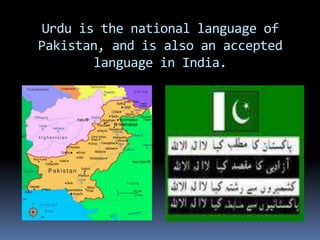
Urdu is the national language of Pakistan, and is also an accepted language in India.
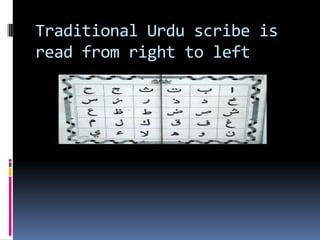
Traditional Urdu scribe is read from right to leftمرغی کے گوشت کی کیوں سڑک پار کرنے کا ہے?
مرغی کے گوشت کی کیوں سڑک پار کرنے کا ہے?To get to the other side, silly!
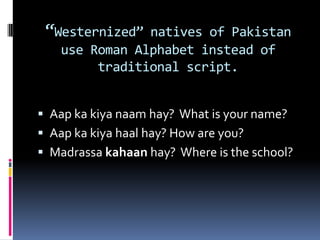
“Westernized” natives of Pakistan use Roman Alphabet instead of traditional script.Aap ka kiya naam hay?  What is your name?Aap ka kiyahaal hay? How are you?Madrassakahaanhay?  Where is the school?
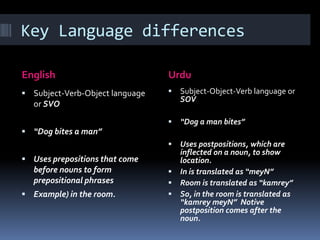
Key Language differencesEnglish	UrduSubject-Verb-Object language or SVO“Dog bites a man”Uses prepositions that come before nouns to form prepositional phrasesExample) in the room.Subject-Object-Verb language or SOV“Dog a man bites”Uses postpositions, which are inflected on a noun, to show location.In is translated as “meyN”Room is translated as “kamrey”So, in the room is translated as “kamreymeyN”  Notive postposition comes after the noun.
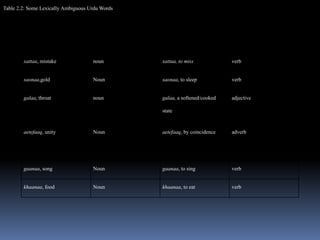
Table 2.2: Some Lexically Ambiguous Urdu Words
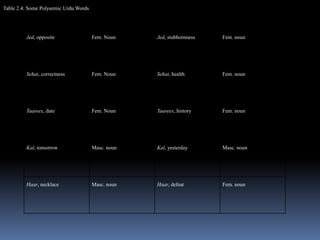
Table 2.4: Some Polysemic Urdu Words
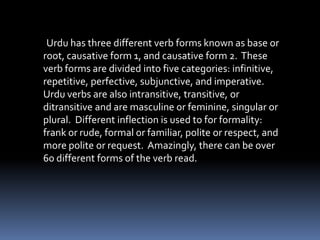
Urdu has three different verb forms known as base or root, causative form 1, and causative form 2.  These verb forms are divided into five categories: infinitive, repetitive, perfective, subjunctive, and imperative.  Urdu verbs are also intransitive, transitive, or ditransitive and are masculine or feminine, singular or plural.  Different inflection is used to for formality: frank or rude, formal or familiar, polite or respect, and more polite or request.  Amazingly, there can be over 60 different forms of the verb read.

English urdu language comparison

  • 1.
    English Urdu LanguageComparisonWilliam Hall ESL 502
  • 2.
    Urdu is thenational language of Pakistan, and is also an accepted language in India.
  • 3.
    Traditional Urdu scribeis read from right to leftمرغی کے گوشت کی کیوں سڑک پار کرنے کا ہے?
  • 4.
    مرغی کے گوشتکی کیوں سڑک پار کرنے کا ہے?To get to the other side, silly!
  • 5.
    “Westernized” natives ofPakistan use Roman Alphabet instead of traditional script.Aap ka kiya naam hay? What is your name?Aap ka kiyahaal hay? How are you?Madrassakahaanhay? Where is the school?
  • 6.
    Key Language differencesEnglish UrduSubject-Verb-Objectlanguage or SVO“Dog bites a man”Uses prepositions that come before nouns to form prepositional phrasesExample) in the room.Subject-Object-Verb language or SOV“Dog a man bites”Uses postpositions, which are inflected on a noun, to show location.In is translated as “meyN”Room is translated as “kamrey”So, in the room is translated as “kamreymeyN” Notive postposition comes after the noun.
  • 7.
    Table 2.2: SomeLexically Ambiguous Urdu Words
  • 8.
    Table 2.4: SomePolysemic Urdu Words
  • 9.
    Urdu has threedifferent verb forms known as base or root, causative form 1, and causative form 2. These verb forms are divided into five categories: infinitive, repetitive, perfective, subjunctive, and imperative. Urdu verbs are also intransitive, transitive, or ditransitive and are masculine or feminine, singular or plural. Different inflection is used to for formality: frank or rude, formal or familiar, polite or respect, and more polite or request. Amazingly, there can be over 60 different forms of the verb read.