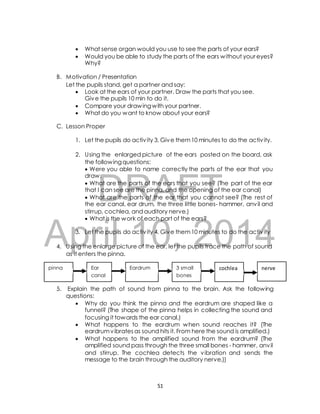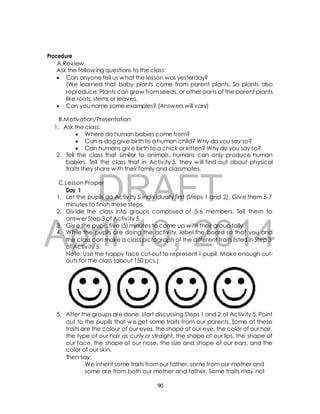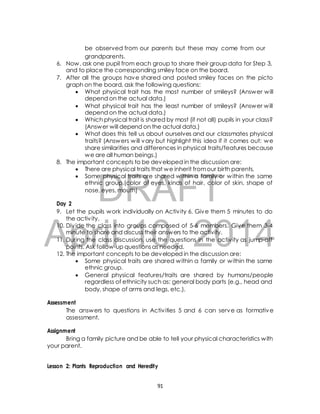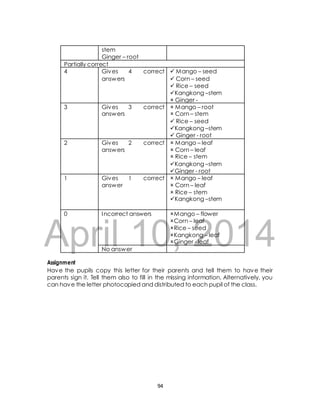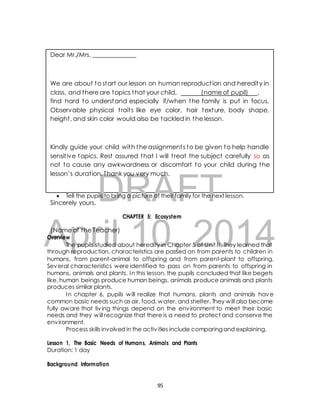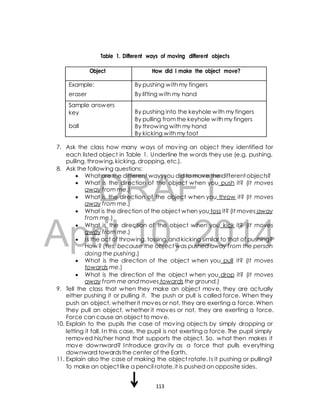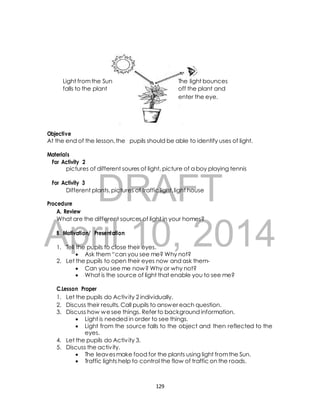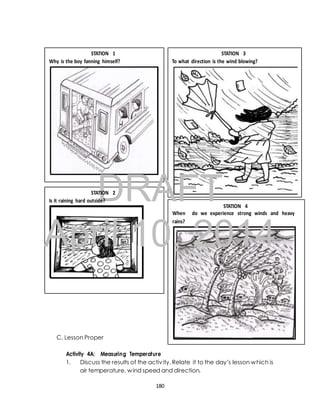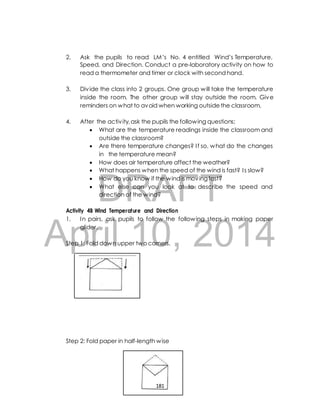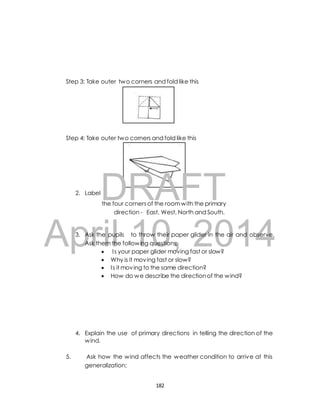

3 
3 
DRAFT 
April 10, 2014 
i
Date received by school: 
DRAFT 
Book Record 
School: 
District: 
Division: 
Region: 
Issued to 
(Name of Pupil) 
April 
To the Teacher 
Date 
Issued 
Condition 
Date 
Returned 
Condition
Write the pupil’s name clearly under the column “Issued to.” 
Use the following letters in recording the condition of the book: 
1. (New Book) 
2. (Used Book in Good Condition) 
3. (Used Book in Fair Condition) 
4. (Used Book in Poor Condition) 
i
Encourage and assist the pupil in repairing damaged textbooks. 
Take Care of Your Book 
1. Cover your book with plastic or manila paper. 
Old newspapers and magazines will do. 
2. Be sure your hands are clean when you handle or turn the 
DRAFT 
Dos: 
pages. 
3. When using a new book for the first time, lay it on its back. 
Open only a few pages at a time. Press lightly along the bound 
edge as you turn the pages. This will keep the cover in good 
condition. 
April 4. Use a piece of paper or cardboard for bookmarks. 
5. Paste or tape immediately 10, any torn pages. 
2014 
6. Handle the book with care when passing from one person 
to another. 
7. Always keep your book in a clean, dry place. 
8. When your book is lost, report it to your teacher right away. 
Don’ts: 
1. Do not fold the pages. 
2. Do not write on the cover or pages. 
3. Do not cut out any picture. 
4. Never tear or detach any page. 
ii
For inquiries or feedback, please write or call: 
DepEd-Bureau of Elementary Education 
Curriculum Development Division 
DRAFT 
2nd Floor, Bonifacio Bldg., DepEd Complex (ULTRA) 
April Meralco Avenue, 10, Pasig City, Philippines 2014 
1600 
Telefax: (632) 638-4799 or 637-4347 
E-mail Address: bee-deped@pldtdsl.net 
bee_director@yahoo.com 
INTRODUCTION 
iii
INTRODUCTION 
This Teacher’s Guide for Grade 3, was writ ten in response to the 
basic goal of educat ion under the K to12 Enhanced Basic Educat ion 
Program- “t o prepare learners to become product ive, worthy and 
compet it ive young scient ist s of the count ry.” 
This is divided into four unit s with illust rations describing each unit , 
represent ing the whole school year. Each unit has chapter with lessons 
and act ivities prepared which are aligned to the t eacher’s guide. 
DRAFT 
Dear Teachers: 
Learning to develop, keen and accurate observat ion skills through 
experiment , knowing more about mat ter, sense, living things, non-living 
things around you discovering more about your environment , climate 
change and other topics about the surroundings, earth and space are all 
given focus in this l learner’s material. 
April 10, 2014 
Explore Science and make it useful in your daily life. Teaching 
Science is having more fun. 
The Writers/Conceptualizers 
iv
ACKNOWLEDGEMENT 
Recognition is given to the following supervisors, administrators, 
teachers, BEE Staff and experts in Science for their enthusiastic commitment 
in the development, revision and finalization of the teaching guides and 
learning materials for Grade 3 under K to 12 Basic Education Program. 
Arthur DC. Sacatropes Luz E. Osmena, Ed.D. 
Education Prog. Supervisor Education Prog. Supervisor 
Region I II Region IV-A 
Michelle G. Hatid-Guadamor, Ph.D. Aiisa C. Corpuz 
Education Program Supervisor Science Coordinator 
Div ision Office, Sorsogon Prov. Div ision of Tarlac City 
Region V Region I II 
Jennifer M. Rojo Jennifer A. Tinaja 
Master Teacher II MasterTeacher I 
Neogen Elementary School Nueve de Febrero E.S. 
Districtof Tagaytay City Mandaluyong City 
DRAFT 
Job S. Zape, Jr. John Fitzgerald Secondes 
Education Program Supervisor Master Teacher I 
Region IV-A Don Felix Serra Nat’l. Hi-sch 
April 10, San Jaoquin, 2014 
Iloilo Province 
Leni S. Solutan Neolita S. Sarabia 
Master Teacher Principal II 
Sta. Barbara Elementary School STRIVE Coordinator 
Div ision of Iloilo Province Div ision of Tagbilaran City 
Romeo C. Ordoňez 
Master Teacher II/Illustrator 
Div isoria E.S. Mexico South District 
Div ision of Pampanga 
Susana D. Mota 
Jemmalyn N. Malabanan 
Encoders 
v
Appreciation is extended to the following consultants/reviewers for their 
untiring efforts in sharing their expertise: 
Evelyn L. Josue 
Science Educ. Specialist IV 
UP-NISMED 
Diliman, Quezon City 
Pia Campo May R. Chavez 
Science Educ. Specialist Science Educ. Specialist 
UP-NISMED UP-NISMED 
Diliman, Quezon City Diliman, Quezon City 
DRAFT 
Trinidad M. Lagarto, Ed.D. 
Senior Educ. Prog. Specialist , Anchorperson 
Curriculum Development Division 
Bureau of Elementary Educat ion 
April Marilet 10, te R. Almayda 
2014 
Director I II 
Bureau of Elementary Educat ion 
Marilyn D. Dimaano 
Director IV 
Bureau of Elementary Educat ion 
vi
TABLE OF CONTENTS 
Page 
Title Page i 
Book Record for the Teacher ii 
Copyright Page iii 
How to take care of your Book iv 
DRAFT 
Introduction v 
Acknowledgement vi 
April 10, UNIT I : Matter 
2014 
Overview 
Chapter 1 – Solids 1-9 
-Characteristics of Solids 
-Naming /Classifying Different Solids 
- Describing Solids according to Color 
- Describing Solids according to Shape 
- Describing Solids according to Size 
vii
- Describing Solids according to Texture 
Chapter 2 – Liquids 9-14 
- Characteristics of Liquids 
-Naming /Classifying Different Liquids 
- Describing Liquids according on how they flow 
- Describing Liquids on how they take the Shape 
of the container 
- Describing Liquids on how they occupy Space 
- Describing Liquids according to Smell 
DRAFT 
Chapter 3 – Gases 15-18 
1. Describing that Gases take the Shape of the Container 
2. Describing that Gases occupy Space 
3. Describing that Gases are Odorless and Tasteless 
April 10, 2014 
Chapter 4 – Proper Use and Handling of Common Solids, 
Liquids, and Gases at Home and in School 18-22 
-List of Common Products Found at Home and in School 
4. Harmful Effects of Common Materials Found 
at Home and in School 
5. Safety Measures in handling Harmful Materials 
Chapter 5 - Changes in Materials 23-39 
- Measuring the Temperature of Materials 
6. Measuring the Temperature 
of Hot/Warm Materials 
viii
7. Measuring the Temperature 
of a Cold Material 
8. Changes in Materials as affected 
by Temperature 
9. What happens to Water when Heated? 
10. What happens to Water Vapor when Cooled? 
11. What happens to Napthalene Ball when Heated? 
12. What happens to the Air inside the Bottle/Balloon when Heated or 
Cooled? 
UNIT 2: Living Things and their Environment 
Chapter 1 - Sense Organs 40-50 
DRAFT 
13. Identifying the Parts of the Eyes 
14. Proper Ways of Caring the Eyes 
15. Identifying the Parts of the Ears 
16. How the different Parts of the Ear Work? 
17. Proper Ways of Caring the Ears 
18. Identifying Parts of the Nose and its Functions 
19. Proper Ways of Caring the Nose 
April - Identifying the Uses 10, of Tongue 
2014 
20. Identifying the Parts and Functions of the Tongue 
21. Identifying the parts of the Skin and its Function 
22. Proper Ways of Caring the Skin 
Chapter 2 – Animals 50-61 
23. Naming Animals around you 
24. Parts of an Animal 
25. Body Parts Animals Use to Move 
26. Classifying Animals according to how they move 
27. Body Parts of Animals that they use in getting foods 
28. Classifying Animals according to what they Eat 
29. Classifying Animals according to their Body Covering 
30. Classifying Animals according to their Habitat 
31. Useful Animals 
32. Importance of Animals according to Use 
33. Animals that can Harm People 
34. Proper Ways of Caring Pets 
ix
Chapter 3 – Plants 61-76 
- Naming and Describing Plant Parts 
- Same Plant Parts, different Plants 
- Different Plant Parts have different Works 
- Things that come from or made of Plants 
- Different Uses of Plants 
- Harmful Plants 
- Proper Was of Caring Plants 
- Characteristics of Living and non-living Things 
DRAFT 
Chapter 4 : Heredity: Inheritance and Variation 76-84 
- Animals Produce Animals of the same Kind 
- Physical Traits of People from Different Ethnicity 
April - Physical Traits of Animals 10, of the same Kind 
2014 
- Plants Produce Plants of the same Kind 
- Growing Plants from other Plant Parts 
- Basic Needs Humans, Animals and Plants 
- Things We Need from the Environment 
- conservation and Protection of the Environment 
Chapter 5: Ecosystem 85-91 
UNIT 3: Force, Motion and Energy 
x
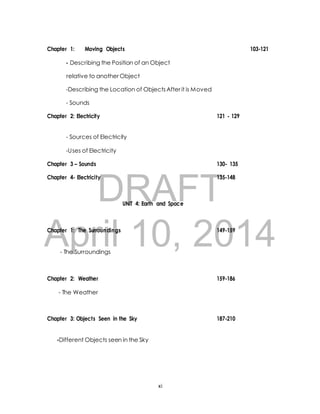
Chapter 1: Moving Objects 103-121 
- Describing the Position of an Object 
relative to another Object 
-Describing the Location of Objects After it is Moved 
Chapter 2: Electricity 121 - 129 
- Sources of Electricity 
-Uses of Electricity 
Chapter 3 – Sounds 130- 135 
DRAFT 
- Sounds 
Chapter 4- Electricity 135-148 
UNIT 4: Earth and Space 
April Chapter 1: The Surroundings 10, 2014 
149-159 
- The Surroundings 
Chapter 2: Weather 159-186 
- The Weather 
Chapter 3: Objects Seen in the Sky 187-210 
-Different Objects seen in the Sky 
xi
UNIT 1: Matter 
Chapter 1: Solids 
There are three states of matter. One of which are solids. Solids have 
different characteristics which enable us to describe one from the other. Solids 
maybe described in terms of color, size, shape, texture , weight and volume. 
Lesson 1 - Characteristics of Solids 
Durat ion: 1- 2 days 
Background Information 
Solids maybe described in terms of color, size, shape, texture and weight. 
We use our senses in identifying objects based on their characteristics. We can 
find various solids in our environment. Let us collect some solids in the garden 
and be able to identify each object. 
DRAFT 
Objectives 
At the end of each lesson, the pupils should be able to: 
1. name different object s around us; and 
2. classify the object s based on their characteristics. 
April Procedure 
10, 2014 
Motivation / Presentation 
Look around you . 
Ask :Look around you. Name the solid objects that you see? What can 
you say about the solid objects around you? 
B. Lesson Proper 
1. Div ide the class into five groups. 
Say: Today, we will visit the garden. While in the garden, collect 10 objects. 
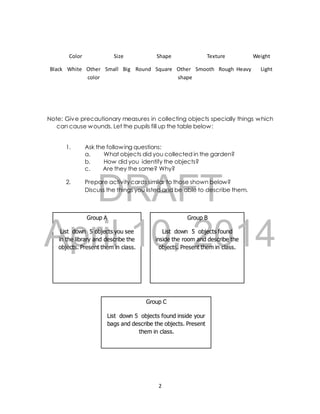
2. List down the objects based on their characteristics inside the chart below. 
Copy the chart in your notebook. 
1
Color Size Shape Texture Weight 
Black White Other Small Big Round Square Other Smooth Rough Heavy Light 
color shape 
Note: Give precautionary measures in collecting objects specially things which 
can cause wounds. Let the pupils fill up the table below: 
1. Ask the following questions: 
a. What objects did you collected in the garden? 
b. How did you identify the objects? 
c. Are they the same? Why? 
DRAFT 
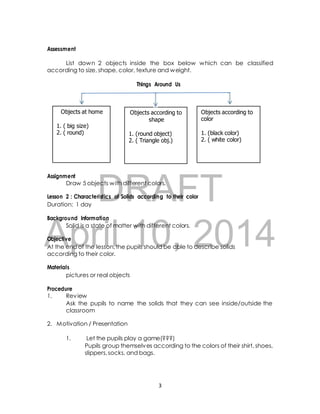
2. Prepare activity cards similar to those shown below? 
Discuss the things you listed and be able to describe them. 
Group A Group B 
April List down 5 objects you see 10, List down 5 2014 
objects found 
in the library and describe the inside the room and describe the 
objects. Present them in class. objects. Present them in class. 
Group C 
List down 5 objects found inside your 
bags and describe the objects. Present 
them in class. 
2
List down 2 objects inside the box below which can be classified 
according to size, shape, color, texture and weight. 
Things Around Us 
Objects at home 
Objects according to 
shape 
1. (round object) 
2. ( Triangle obj.) 
Objects according to 
color 
1. (black color) 
2. ( white color) 
DRAFT 
Assessment 
1. ( big size) 
2. ( round) 
Assignment 
Draw 5 objects with different colors. 
Lesson 2 : Characteristics of Solids according to their color 
Duration: 1 day 
Background Information 
April Solid is a state of matter 10, with different colors. 
2014 
Objective 
At the end of the lesson, the pupils should be able to describe solids 
according to their color. 
Materials 
pictures or real objects 
Procedure 
1. Review 
Ask the pupils to name the solids that they can see inside/outside the 
classroom 
2. Motivation / Presentation 
1. Let the pupils play a game(???) 
Pupils group themselves according to the colors of their shirt, shoes, 
slippers, socks, and bags. 
3
C. Lesson Proper 
1. Activ ity 
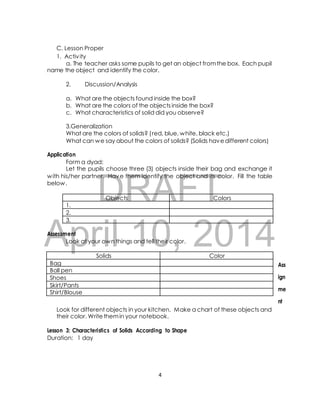
a. The teacher asks some pupils to get an object from the box. Each pupil 
name the object and identify the color. 
2. Discussion/Analysis 
a. What are the objects found inside the box? 
b. What are the colors of the objects inside the box? 
c. What characteristics of solid did you observe? 
3.Generalization 
What are the colors of solids? ( red, blue, white, black etc.) 
What can we say about the colors of solids? (Solids have different colors) 
Form a dyad: 
Let the pupils choose three (3) objects inside their bag and exchange it 
with his/her partner. Have them identify the object and its color. Fill the table 
below. 
DRAFT 
Application 
April Assessment 
10, 2014 
Look at your own things and tell their color. 
Ass 
ign 
me 
nt 
Solids Color 
Look for different objects in your kitchen. Make a chart of these objects and 
their color. Write them in your notebook. 
Lesson 3: Characteristics of Solids According to Shape 
Duration: 1 day 
4 
Bag 
Ball pen 
Shoes 
Skirt/Pants 
Shirt/Blouse 
Objects Colors 
1. 
2. 
3.
Background Information 
Solids have shapes too. The particles of solids are close together. They 
move back and forth but the particles do not change places. This is why solids 
do not change shapes. 
Objective 
At the end of the lesson, the pupils should be able to identify solids based on 
their shapes. 
Materials 
pictures or real objects with different shape 
A.Review 
Describe solids based on their color. 
B.Motivation 
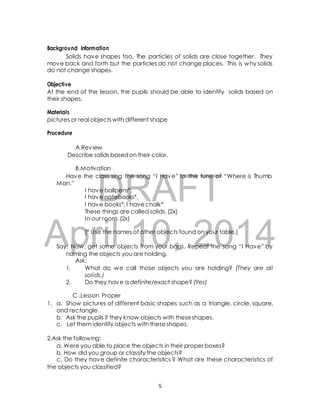
Have the class sing the song “I Hav e” to the tune of “Where is Thumb 
DRAFT 
Procedure 
Man.” 
I have ballpens*, 
I have notebooks*, 
I have books*, I have chalk* 
These things are called solids. (2x) 
In our room. (2x) 
April (* Use the names 10, of other objects found 2014 
on your table.) 
Say: Now, get some objects from your bags. Repeat the song “I Hav e” by 
naming the objects you are holding. 
Ask: 
1. What do we call those objects you are holding? (They are all 
solids.) 
2. Do they have a definite/exact shape? (Yes) 
C .Lesson Proper 
1. a. Show pictures of different basic shapes such as a triangle, circle, square, 
and rectangle. 
b. Ask the pupils if they know objects with these shapes. 
c. Let them identify objects with these shapes. 
2.Ask the following: 
a. Were you able to place the objects in their proper boxes? 
b. How did you group or classify the objects? 
c. Do they have definite characteristics ? What are these characteristics of 
the objects you classified? 
5
d. What are the ways of classifying solids? 
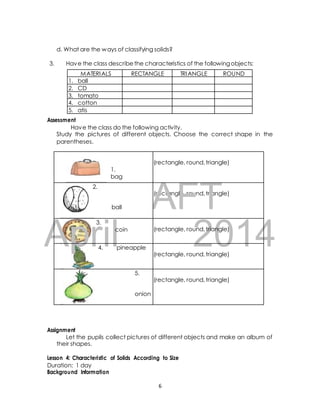
3. Have the class describe the characteristics of the following objects: 
Assessment 
MATERIALS RECTANGLE TRIANGLE ROUND 
Have the class do the following activity. 
Study the pictures of different objects. Choose the correct shape in the 
parentheses. 
(rectangle, round, triangle) DRAFT 
3. 
April 2014 
Assignment 
Let the pupils collect pictures of different objects and make an album of 
their shapes. 
Lesson 4: Characteristic of Solids According to Size 
Duration: 1 day 
Background Information 
6 
1. 
bag 
(rectangle, round, triangle) 
2. 
ball 
coin 
(rectangle, round, triangle) 
4. pineapple 
(rectangle, round, triangle) 
5. 
onion 
(rectangle, round, triangle) 
1. ball 
2. CD 
3. tomato 
4. cotton 
5. atis
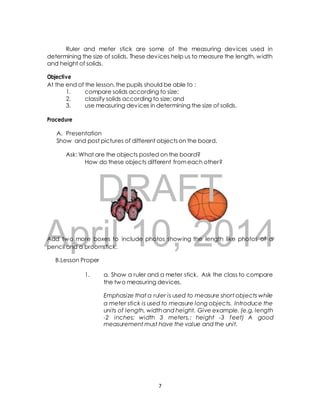
Ruler and meter stick are some of the measuring devices used in 
determining the size of solids. These devices help us to measure the length, width 
and height of solids. 
Objective 
At the end of the lesson, the pupils should be able to : 
1. compare solids according to size; 
2. classify solids according to size; and 
3. use measuring devices in determining the size of solids. 
A. Presentation 
Show and post pictures of different objects on the board. 
Ask: What are the objects posted on the board? 
How do these objects different from each other? 
DRAFT 
Procedure 
April Add two more boxes to include 10, photos showing 2014 
the length like photos of a 
pencil and a broomstick. 
B.Lesson Proper 
1. a. Show a ruler and a meter stick. Ask the class to compare 
the two measuring devices. 
Emphasize that a ruler is used to measure short objects while 
a meter stick is used to measure long objects. Introduce the 
units of length, width and height. Give example. (e.g. length 
-2 inches; width 3 meters,: height -3 feet) A good 
measurement must have the value and the unit. 
7
b. In groups , allow the class to work on the activ ity. Guide them in 
accomplishing LM No. 4. 
Discussion/Analysis 
a. What are the solids found in your list? 
b. How are they similar or different? 
c. How did you classify the solids? 
Generalization 
What characteristics of solids did you learn today? 
Application 
Draw objects showing different size. 
Name objects found in the room. Tell the size of the objects using a ruler 
or meter stick. Get the exact measurement of each object. 
DRAFT 
Assessment 
Assignment 
List down objects found at home and in school. Describe their sizes. 
Lesson 5 : Characteristics of Solids According to Texture 
Duration: 1day 
April Background Information 
Solids have different textures. 10, They can be categorized 2014 
as smooth, rough, 
hard and soft. 
Objective 
At the end of the lesson the pupils should be able to classify solids according to 
texture. 
Materials 
The objects to be observed will depend on the contents of the pupils’ 
bags. You can include objects like pad paper, sand, pebbles, sandpaper, 
pineapple peelings, wooden stick, sponge, drinking glass and others. 
Procedure 
A. Motivation / Presentation 
TEXTURE HUNT 
Ask the pupils to go on a walk around their classroom and let them 
touch various objects. Ask the pupils to describe the texture. (The descriptions 
could be : hard, soft, rough, smooth.) 
8
B. Lesson Proper 
1. Prepare all the necessary materials beforehand. (handout and different 
solids). 
2. Distribute the handout. Give the pupils 10 minutes to read and discuss the 
procedure. 
3. Remind the class to observe at all times the precautionary measures 
relevant to the activ ity. ( Hint: The teacher examines the objects before 
letting the pupils touch them) 
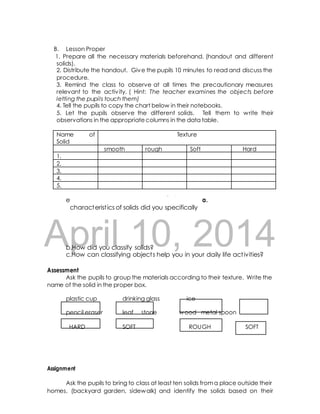
4. Tell the pupils to copy the chart below in their notebooks. 
5. Let the pupils observe the different solids. Tell them to write their 
observations in the appropriate columns in the data table. 
Name of 
Solid 
Texture 
smooth rough Soft Hard 
act ivity, 
ask 
the 
following 
quest ions: 
a. 
After 
th 
e 
characterist ics of solids did you specifically 
What DRAFTobserved? 
1. 
2. 
3. 
4. 
5. 
April 10, 2014 
b.How did you classify solids? 
c.How can classifying object s help you in your daily life act ivities? 
Assessment 
Ask the pupils to group the materials according to their texture. Write the 
name of the solid in the proper box. 
plastic cup drinking glass ice 
pencil eraser leaf stone wood metal spoon 
HARD SOFT ROUGH SOFT 
Assignment 
Ask the pupils to bring to class at least ten solids from a place outside their 
homes. (backyard garden, sidewalk) and identify the solids based on their
texture. 
9
Chapter 2 : Liquids 
Liquid is another state of matter. I t has no definite shape but it follows the 
shape of the container. The particles of liquids move freely than those of solids. 
The particles slide or roll over each other; this is why liquids have no shape of 
their own. I t has the ability to flow. Liquids occupy space. Some liquids have 
taste and odor/smell. 
Lesson 1: Characteristics of Liquids 
Duration : 1 day 
Background Information 
Liquids have the ability to flow. The particles of liquids are far apart. They 
can move, slide or roll around each other. They can be poured from one 
container to another. This is what makes liquids flow. Some liquids flow faster 
while some do not. 
DRAFT 
Overview 
Objective 
At the end of the lesson, the pupils should be able to describe different liquids 
based on their different characteristics. 
Materials 
pictures or real liquids 
April Procedure 
10, 2014 
1. Review 
Ask: What are the different characteristics of solids? 
2. Motivation / Presentation 
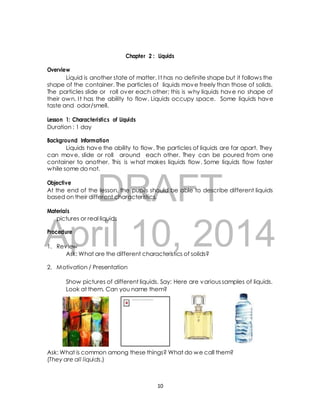
Show pictures of different liquids. Say: Here are various samples of liquids. 
Look at them. Can you name them? 
Ask: What is common among these things? What do we call them? 
(They are all liquids.) 
10
1. Teacher should tell the students to go to the canteen and ask the 
canteen staff to show the different liquids available. (Give some 
precautionary measures in dealing with liquids which may not be familiar 
to pupils). Demonstrate the activ ity first before letting the pupils do it. 
Have this table be filled up by the pupils. 
NAME OF LIQUID How objects Shape of the Taste Odor/ Space it 
flow 
container 
smell occupies 
DRAFT 
3. Lesson Proper 
Soy sauce 
Condensed milk 
Water in a plastic 
bottle 
Perfume 
2. Ask the following questions: 
April a. How did you describe 10, the different liquids ? 
2014 
b. Do liquids have the same or different characteristics? How do they differ 
or similar from each other ? 
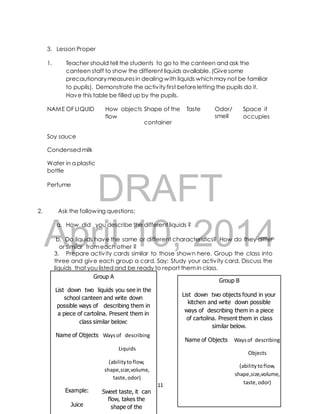
3. Prepare activ ity cards similar to those shown here. Group the class into 
three and give each group a card. Say: Study your activ ity card. Discuss the 
liquids that you listed and be ready to report them in class. 
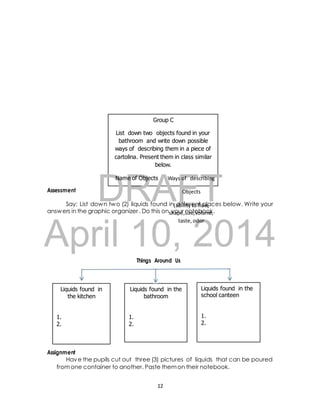
Group A 
List down two liquids you see in the 
school canteen and write down 
possible ways of describing them in 
a piece of cartolina. Present them in 
class similar below: 
Name of Objects Ways of describing 
Liquids 
Group B 
List down two objects found in your 
kitchen and write down possible 
ways of describing them in a piece 
of cartolina. Present them in class 
similar below. 
Name of Objects Ways of describing 
Objects 
Example: 
Juice 
(ability to flow, 
shape,size,volume, 
taste, odor) 
Sweet taste, it can 
flow, takes the 
shape of the 
11 
(ability to flow, 
shape,size,volume, 
taste, odor)
Group C 
List down two objects found in your 
bathroom and write down possible 
ways of describing them in a piece of 
cartolina. Present them in class similar 
below. 
DRAFT 
Name of Objects Ways of describing 
Assessment Objects 
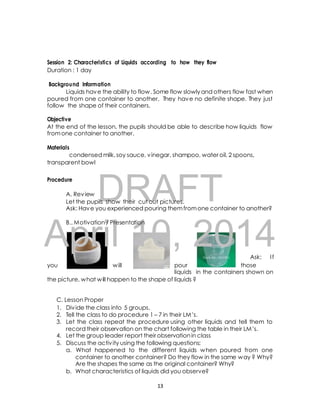
Say: List down two (2) liquids found in different places below. Write your 
(ability to flow, 
your notebook. 
answers in the graphic organizer . Do this onshape,size,volume, 
taste, odor 
April 10, 2014 
Things Around Us 
Liquids found in 
the kitchen 
1. 
2. 
Liquids found in the 
bathroom 
1. 
2. 
Liquids found in the 
school canteen 
1. 
2. 
Assignment 
Have the pupils cut out three (3) pictures of liquids that can be poured 
from one container to another. Paste them on their notebook. 
12
Session 2: Characteristics of Liquids according to how they flow 
Duration : 1 day 
Background Information 
Liquids have the ability to flow. Some flow slowly and others flow fast when 
poured from one container to another. They have no definite shape. They just 
follow the shape of their containers. 
Objective 
At the end of the lesson, the pupils should be able to describe how liquids flow 
from one container to another. 
condensed milk, soy sauce, vinegar, shampoo, water oil, 2 spoons, 
DRAFT 
Materials 
transparent bowl 
Procedure 
A. Review 
Let the pupils show their cut out pictures. 
Ask: Have you experienced pouring them from one container to another? 
April B.. Motivation / Presentation 
10, 2014 
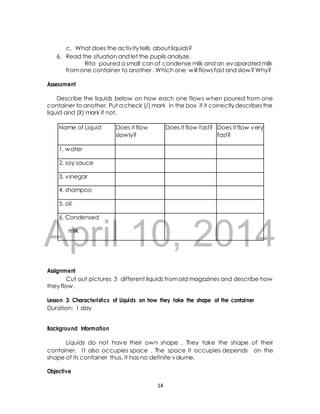
Ask: I f 
you will pour those 
liquids in the containers shown on 
the picture, what will happen to the shape of liquids ? 
C. Lesson Proper 
1. Div ide the class into 5 groups. 
2. Tell the class to do procedure 1 – 7 in their LM’s. 
3. Let the class repeat the procedure using other liquids and tell them to 
record their observation on the chart following the table in their LM’s. 
4. Let the group leader report their observation in class 
5. Discuss the activ ity using the following questions: 
a. What happened to the different liquids when poured from one 
container to another container? Do they flow in the same way ? Why? 
Are the shapes the same as the original container? Why? 
b. What characteristics of liquids did you observe? 
13
c. What does the activ ity tells about liquids? 
6. Read the situation and let the pupils analyze. 
Rita poured a small can of condense milk and an evaporated milk 
from one container to another . Which one will flows fast and slow? Why? 
Assessment 
Describe the liquids below on how each one flows when poured from one 
container to another. Put a check (/) mark in the box if it correctly describes the 
liquid and (X) mark if not. 
April 10, 2014 
Assignment 
Cut out pictures 3 different liquids from old magazines and describe how 
they flow. 
Lesson 3: Characteristics of Liquids on how they take the shape of the container 
Duration: 1 day 
Background Information 
Liquids do not have their own shape . They take the shape of their 
container. I t also occupies space . The space it occupies depends on the 
shape of its container thus, it has no definite volume. 
Objective 
14 
Name of Liquid Does it flow 
slowly? 
Does it flow fast? Does it flow very 
fast? 
1. water 
2. soy sauce 
3. vinegar 
4. shampoo 
5. oil 
6. Condensed 
milk
At the end of the lesson, the pupils should be able to describe the liquid 
according to the shape of the container and the space it occupies. 
Materials 
Glass, water 
Procedure 
1. Review 
Ask: Bring out your cut out pictures. How do these liquids flow? 
2. Motivation 
Say: Look at the glass on the table. What is inside it? What occupies the 
space in the glass? I f i will transfer the liquid into a glass with different shape, 
will the shape and space occupied by the liquid still looks the same? Why? 
3. Lesson Proper 
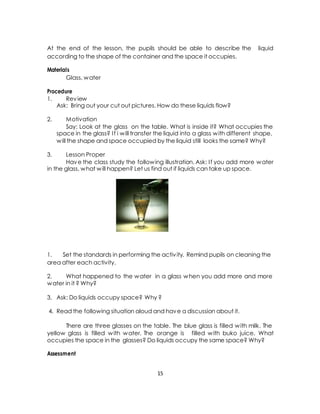
Have the class study the following illustration. Ask: I f you add more water 
in the glass, what will happen? Let us find out if liquids can take up space. 
1. Set the standards in performing the activ ity. Remind pupils on cleaning the 
area after each activity. 
2. What happened to the water in a glass when you add more and more 
water in it ? Why? 
3. Ask: Do liquids occupy space? Why ? 
4. Read the following situation aloud and have a discussion about it. 
There are three glasses on the table. The blue glass is filled with milk. The 
yellow glass is filled with water. The orange is filled with buko juice. What 
occupies the space in the glasses? Do liquids occupy the same space? Why? 
Assessment 
15
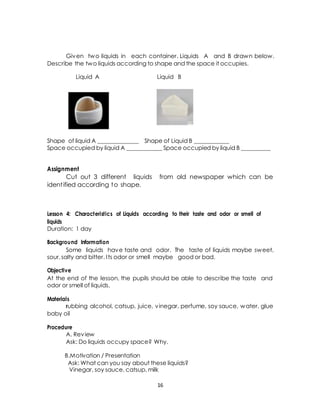
Given two liquids in each container. Liquids A and B drawn below. 
Describe the two liquids according to shape and the space it occupies. 
Liquid A Liquid B 
Shape of liquid A ______________ Shape of Liquid B ____________ 
Space occupied by liquid A ____________ Space occupied by liquid B __________ 
Assignment 
Cut out 3 different liquids from old newspaper which can be 
ident ified according to shape. 
Lesson 4: Characteristics of Liquids according to their taste and odor or smell of 
liquids 
Duration: 1 day 
Background Information 
Some liquids have taste and odor. The taste of liquids maybe sweet, 
sour, salty and bitter. I ts odor or smell maybe good or bad. 
Objective 
At the end of the lesson, the pupils should be able to describe the taste and 
odor or smell of liquids. 
Materials 
rubbing alcohol, catsup, juice, vinegar, perfume, soy sauce, water, glue 
baby oil 
Procedure 
A. Review 
Ask: Do liquids occupy space? Why. 
B.Motivation / Presentation 
Ask: What can you say about these liquids? 
Vinegar, soy sauce, catsup, milk 
16
C. Lesson Proper 
1. Prepare the set-up of liquids and let the pupils observe them. 
2. Have the pupils describe their characteristics according to taste and 
smell. 
3. Have them record their observations in an activ ity sheet. 
2. 
a. How did you describe the liquids? 
b. What is your basis in describing the liquids? 
c. What characteristic of liquids is observed in the samples provided? 
3. Have the class study the following liquids. Let them fill in the column with 
the characteristics of liquids in the following table. 
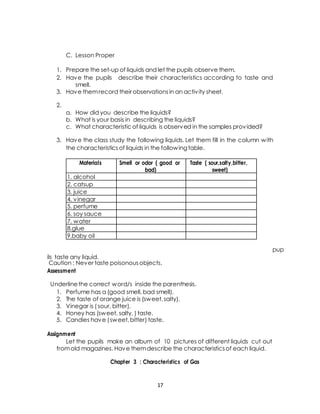
Materials Smell or odor ( good or 
Note 
: 
The 
teacher 
should 
provide 
precautionary 
measures 
before 
letting 
the 
pup 
ils taste any liquid. 
Caution : Never taste poisonous objects. 
Assessment 
Underline the correct word/s inside the parenthesis. 
1. Perfume has a (good smell, bad smell). 
2. The taste of orange juice is (sweet, salty). 
3. Vinegar is ( sour, bitter). 
4. Honey has (sweet, salty, ) taste. 
5. Candies have ( sweet, bitter) taste. 
Assignment 
Let the pupils make an album of 10 pictures of different liquids cut out 
from old magazines. Have them describe the characteristics of each liquid. 
Chapter 3 : Characteristics of Gas 
17 
bad) 
Taste ( sour,salty,bitter, 
sweet) 
1. alcohol 
2. catsup 
3. juice 
4. vinegar 
5. perfume 
6. soy sauce 
7. water 
8.glue 
9.baby oil
A gas is another state of matter. I t has no definite shape, thus it takes the 
shape of the container. We cannot see them but we can feel them. In this 
lesson, you will find the different characteristics of gas. 
Lesson 1: Characteristics of Gas according to the shape of the container 
Duration : 1 day 
Background Information 
Gases have no definite shape. They take the shape of the container. 
Objective 
At the end of the lesson, the pupils should be able to describe 
the characteristic of gases according to its shape. 
Materials 
3 Balloons of different sizes and shapes 
Procedure 
1. Review 
Ask: What are the different characteristics of liquids? 
B. Motivation / Presentation 
Show an inflated balloon to the pupils. Tell one of the pupils to blow air in it. 
Ask : I f you will release the balloon from your hand, what will happen to it? 
Why? 
C.Lesson Proper 
1. Div ide the class into 4 groups. Get different shapes of balloons. Blow air 
into it. Observe what happens to the balloons. 
2. Ask: 
a. What happen to the balloon as you blow air into it? 
b. What characteristic is shown by the balloon? 
c. What can you say about the shapes of the balloon ? 
Assessment 
Draw 5 balloons with different colors. Describe their shapes. 
Assignment 
18
List down 5 different gases found in the environment. 
Lesson 2: Characteristics of gases according to space they occupy 
Duration: 1 day 
Background Information 
Gas has no definite shape and volume. I t takes the shape and volume of 
Objective 
At the end of the lesson, the pupils should be able to describe the space 
occupy by the gases. 
air fresheners 
DRAFT 
its container. 
Materials 
Procedure 
A.Review 
B.Motivation/ Presentation 
Ask: Do you know the content of air freshener? 
C. Lesson Proper 
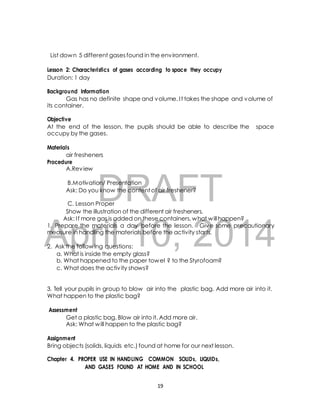
Show the illustration of the different air fresheners. 
Ask: I f more gas is added on these containers, what will happen? 
April 1. Prepare the materials a day 10, before the lesson. 2014 
Give some precautionary 
measure in handling the materials before the activity starts. 
2. Ask the following questions: 
a. What is inside the empty glass? 
b. What happened to the paper towel ? to the Styrofoam? 
c. What does the activ ity shows? 
3. Tell your pupils in group to blow air into the plastic bag. Add more air into it. 
What happen to the plastic bag? 
Assessment 
Get a plastic bag. Blow air into it. Add more air. 
Ask: What will happen to the plastic bag? 
Assignment 
Bring objects (solids, liquids etc.) found at home for our next lesson. 
Chapter 4. PROPER USE IN HANDLING COMMON SOLIDs, LIQUIDs, 
AND GASES FOUND AT HOME AND IN SCHOOL 
19
This chapter presents proper use in handling common solids, liquids, and 
gases found in school and at home. Classifying materials as hazardous and non-hazardous 
are included in this chapter. By performing the activ ities, different 
process skills of the pupils like identifying, describing ways on the proper use and 
handling of hazardous materials are given emphasis in the lessons presented. 
Lesson 1: Common Solids, Liquids, and Gases Found at Home 
Background Information 
Different materials can be found at home. These maybe solids, liquids or 
gases. Each material has its intended use. Substances found in the home are 
important to humans. 
Objectives 
At the end of the lesson, the pupils should be able to: 
1. Classify the materials found at home as solids, liquids, and gases ; and 
2. describe their uses . 
DRAFT 
Overview 
Duration: 2 days 
Materials 
pictures of common materials found at home 
April Procedure 
10, 2014 
1. Motivation / Presentation 
Ask: What are the common materials found in your home? Name as 
many as you can. Where can you find these materials? What are the things 
that you want to know about these substances? 
Use the KWL chart in this activ ity. 
2. Lesson Proper 
1. Div ide the class into 5 groups. Let the pupils do activ ity in the LM. 
2. Have the groups write in manila paper their answers. They may use the 
tabular form in activ ity 1 as guide. Post on the board the manila paper of 
each group. 
3. After all groups have done the activ ity, one representative in each group 
will report their findings. Come up with common answers of the pupils. 
4. Then, ask the following questions : 
1. What can you say about the common materials found in your 
home? 
b. How did you classify them ?Are these materials important? Why? 
20
c.Could people live without these materials? Why? 
d.What do you think would life be without these materials? 
2. Discuss with the pupils the following concept : 
1. Different materials can be found at home. These materials may be 
solids, liquids, or gases. 
2. Each material has its intended use. 
3. Materials found in the home are important to human lives. 
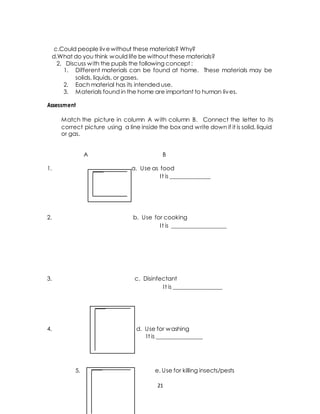
Assessment 
Match the picture in column A with column B. Connect the letter to its 
correct picture using a line inside the box and write down if it is solid, liquid 
or gas. 
A B 
1. a. Use as food 
I t is ______________ 
2. b. Use for cooking 
I t is ___________________ 
3. c. Disinfectant 
I t is _________________ 
4. d. Use for washing 
I t is ________________ 
5. e. Use for killing insects/pests 
21
I t is __________________ 
(Note: You may use/ include any picture of materials found at home, if 
possible different f rom those already given/listed by the pupils. The 
pictures should be placed in column A.) 
Remind the pupils to bring empty containers of the following materials: 
1. Bleaching liquid 
2. Shampoo 
3. Pesticide 
4. Any toilet freshener 
5. Mosquito coil empty box 
DRAFT 
Assignment 
Lesson 2. Harmful Effects of Common Materials Found at Home 
Duration: 1 day 
April Background Information 
I t is important to encourage 10, pupils to read 2014 
the labels on products they 
use to become more “chemically literate” or aware of the hazards to avoid 
any accident. Keep in mind that most household cleaning products and 
pesticides are reasonably safe when used as directed, and that the level of 
toxicity of a product is dependent on the dose of the product used (never use 
more than the amount listed on the label) and the length of exposure to the 
product. 
Objective 
At the end of the lesson, the pupils should be able to identify the harmful effects 
of the common materials found at home and in school 
Materials 
Pocket chart 
Procedure 
1. Review 
Call on some pupils to answer these questions: 
1. What can you say about the common substances found in your home? 
Are these substances important? Why? 
22
1. Could people live without these materials? Why? 
2. What do you think would life be without these materials? 
2. Motivation / Presentation 
A family in a remote barrio made use of empty mineral water bottles as 
containers for their washing and drinking water. One day, the father filled in 
one empty bottle with kerosene to be used in the farm. While preparing other 
things, he left the bottle with kerosene on top of the table. Unknowingly, his 
little boy who was playing outside, came in the house, got the bottle and 
used its content in washing his hands. Suddenly, the little boy felt itchiness and 
got his hands irritated. 
Why do you think this happened? What was done wrong? 
1. Let the pupils do Activ ity 2 in the LM (Group activ ity) 
2. They will write on manila paper the materials in the table. (Refer to the 
DRAFT 
3. Lesson Proper 
tabular form in activ ity. Post on the board the manila paper of each 
group. 
3. After the groups have done the activity, one representative in each group 
will report their findings. Come up with the common answers of the pupils 
by posting it in the pocket chart. Then ask the following questions : 
1. What should you do in order to know if the material is hazardous or not? 
April Why? 
Give emphasis on its harmful 10, effects when not 2014 
stored/ used properly. 
2. Discuss some undesirable/deadly effects of some materials and 
emphasize the following concepts : 
3. Materials maybe flammable, toxic, poisonous and corrosive to skin 
when not used properly. 
4. Reading product labels is important in order to determine the hazards 
of materials to man and other liv ing things. 
Assessment 
Write the hazards that the following materials may do to people when not 
used properly: 
1. Disinfectant 2. Insecticides 
1. LPG 4. Bleaching liquid 
1. Muriatic Acid 
Assignment 
23
List down at least 2 reasons on what should you do in order to avoid accident 
brought about by the misuse of the materials that are commonly found at 
home? 
Lesson 3. Safety Measures in Using and Handling Harmful Materials 
Duration: 1 day 
Background Information 
Precautions are essential for safety in using the materials commonly found 
at home and in school. Never use more than the amount listed on the label of 
the product. 
Objective 
At the end of the lesson, the pupils should be able to describe the proper ways 
in using and handling harmful materials at home and in school. 
Materials 
pocket chart, pictures of precautionary measures in handling harmful 
materials 
Procedure 
1. Review 
Ask: What should you do in order to know if the material is hazardous or 
not? Why? 
2. Motivation / Presentation 
April Say: I f I will give you 10, a liquid material which 2014 
you do not know , what 
should you do first ? Why do you have to read the label first? 
3. Lesson Proper 
1. Let the pupils do activ ity 3 in the LM (Individual activity). 
2. Tell them to write in their notebook. 
3. After the class has done the activ ity, discuss the lesson then ask the 
following questions: 
1. What are the proper ways of handling and using harmful materials found 
at home? 
2. How does a material become harmful to humans and other liv ing things? 
3. What should one do in order to avoid accident? 
Give emphasis to its harmful effects when not used properly. 
4. Discuss with the pupils the following concepts: 
1. Precautions are essential for safety in using the materials commonly found 
at home and in school. 
2. Never use more than the amount listed on the label of the product. 
Assessment 
24
Div ide the class into 4 groups and let them have a role play on the safety 
measures in using and handling harmful materials at home or in school. 
List down at least 2 materials found in your home and write down the 
proper way in handling the material that you listed. Write in your activ ity 
notebook. 
Chapter 5: Changes in Materials 
Matter exists in different forms: I t maybe solid, liquid, and gas. These 
different materials (solids, liquids, and gases) change when heated or cooled. 
In this chapter, the pupils will learn about the changes that may happen 
to materials when they are heated or cooled or when there is a change in 
temperature. 
DRAFT 
Assignment 
Overview 
Activ ity 1 provides a simple activ ity that activates pupils’ prior knowledge 
and ideas about hot and cold materials. 
Activ ities 2 and 3 develop pupils’ skills in using, measuring and reading 
temperature of materials using laboratory thermometer and help them compare 
materials of different temperature. 
April Activ ity 3 gives general 10, ideas/concepts to 2014 
pupils that when heat is 
added, the temperature of the material increases; but, when heat is removed, 
the temperature of the material decreases. These are basic ideas from where 
the concepts in the succeeding activities will be based and understood. 
Activ ities 4 to 8 develop the pupils’ understanding about the effects of the 
change in temperature on the material. I t focuses on the idea that when 
materials are heated or cooled, they may change their forms: from solid to 
liquid, liquid to solid, liquid to gas, or gas to liquid, and solid to gas. Other 
materials expand or contract when heated or cooled. 
Lesson 1: Is it Hot or Cold? 
Duration: 1 day 
Objective 
At the end of the lesson, the pupils should be able to tell whether the material is 
hot or cold. 
Materials 
25
flashcards/ Pictures or real hot and cold objects, manila paper, 
marker/pentel pen 
A.Motivation/ Presentation 
1. Let the pupils do this simple activ ity: 
Feel your hands by placing them to your cheeks. 
What did you feel? (e.g. cold, warm, hot)? 
Now, rub your hands together for 15 times. Put them again to your 
cheeks. What did you feel? (e.g. cold, warm, hot)? Why did you 
feel such? 
(In this activ ity, let the pupils understand that in rubbing their hands 
together, heat is produced and the heat produced makes their 
hands warm.) 
DRAFT 
Procedure 
So, can you now distinguish hot from cold materials. 
Today we will consider other materials you are familiar with and tell 
whether the material is hot or cold. 
April B.Lesson Proper 
10, 2014 
1. Let the pupils do Activ ity 1. You may ask them to do the activ ity by 
group. (This is a simple activ ity that aims to activate pupils’ prior 
knowledge about hot and cold objects/ materials). 
2. Give them the needed materials (manila paper, pentel pen, etc…) 
and instructions in doing the activ ity. Ask them too to present their 
output after 10 minutes. 
3. During the reporter’s presentation of output, take note of their 
responses particularly to the questions in the activ ity. 
4. Process pupil’s responses by giv ing focus to the pupils’ answers to 
the activ ity questions. The teacher should be able to solicit 
students’ prior knowledge or ideas about hot and cold materials. 
Though their ideas are not completely correct, they must be taken 
as input to the next lesson/ springboard for the discussion of the 
next lesson. 
Assessment 
26
Pupils’ activ ity outputs may be taken as a form of assessing their 
knowledge formatively. Take note that such assessment results 
should not be graded . I ts purpose is just for the teacher to 
determine pupils’ prior knowledge as a springboard for the 
discussion of the next lesson. 
What could be the temperature of hot objects compared to cold 
objects? 
Lesson 2: Measuring the Temperature of Hot/ Warm Material 
DRAFT 
Assignment 
Duration: 2 days 
Background Information 
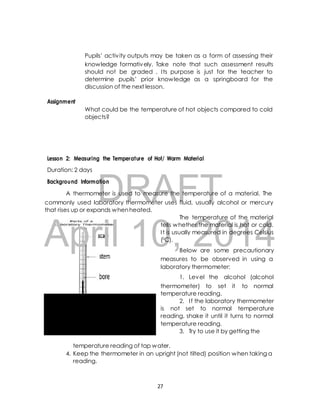
A thermometer is used to measure the temperature of a material. The 
commonly used laboratory thermometer uses fluid, usually alcohol or mercury 
that rises up or expands when heated. 
The temperature of the material 
April 10, tells whether the material is hot or cold. 
I t is usually measured 2014 
in degrees Celsius 
(0C). 
Below are some precautionary 
measures to be observed in using a 
laboratory thermometer: 
1. Level the alcohol (alcohol 
thermometer) to set it to normal 
temperature reading. 
2. I f the laboratory thermometer 
is not set to normal temperature 
reading, shake it until it turns to normal 
temperature reading. 
3. Try to use it by getting the 
temperature reading of tap water. 
4. Keep the thermometer in an upright (not tilted) position when taking a 
reading. 
27
5. The bulb of the thermometer should be surrounded from all sides by the 
substance of which the temperature is to be measured. 
6. The bulb should not touch the surface/ bottom of the container. 
The temperature of hot/warm water is higher than the temperature of 
tap water (room temperature). 
At the end of the lesson, the pupils should be able to: 
1. measure the temperature of tap water and hot/warm water using a 
thermometer; 
2. read the temperature from the thermometer correctly; and 
3. compare the temperature of tap water and hot/warm water. 
2 beakers/ identical glass containers 
laboratory thermometer 
equal amounts of hot/warm water and tap water 
DRAFT 
Objectives 
Materials 
Procedure 
1. Review 
Yesterday, we identified some materials that are hot and cold. Cite 
2 examples of hot materials you found at home. 
April 10, 2014 
2. Motivation/ Presentation 
1. Show the class 2 containers filled with water. Place them on the 
table. Label each container as container 1, and container 2. 
(Note: Container 1 contains warm water and container 2 contains 
tap water. But you don’t have to tell the class that they contain 
such.) 
2. Call some pupils. Tell them to do this activ ity: 
1. Dip your right hand fingers into container 1 and your left 
hand fingers into container 2, at the same time. Then ask: What did 
you feel when you dip your finger in container 1? 
What did you feel when you dip your finger in container 2? 
(Pupils answers may vary. Pupils would say that the water in container 
1 is hot or warm. But, they might describe what they feel in container 2 
differently. Pupils’ descriptions for water in container 2 could be cold, 
less hot, normal, etc….) 
28
Hence, the teacher should let the pupils realize that their sense of 
touch would not give accurate measure of how hot or cold the 
material is, and that a certain device is needed to measure how hot or 
cold the material is. 
Then, ask: What is the instrument that measures the hotness or 
coldness of the material ? (Thermometer) 
Today, we will investigate and understand more about heat and 
temperature. We will perform an activ ity that will help us understand 
how to use the thermometer and how to measure the temperature of 
materials using thermometer. We will also compare the temperature of 
tap water and hot/warm water, and describe the effect of heat on 
the material. 
2. Lesson Proper 
DRAFT 
3. Orient first the pupils with the parts and kinds of thermometer, the 
scale used, the proper way of using it, and some precautionary 
measures in using laboratory thermometer. (Please refer to 
background information section). 
4. In this activ ity, glass container will be used for warm water. Be 
April reminded that an 10, ordinary bottle cannot 2014 
be used for boiling water. 
5. Briefly, discuss with the pupils the procedure of the activity. 
6. Div ide the pupils into 5 small groups. Give them the materials 
needed, and other necessary instructions in accomplishing the task 
(i.e. time limit in doing the activ ity, group output reporting/ output 
presentation, etc…) 
7. Solicit some questions from the pupils to clarify some activ ity 
concerns before asking them to perform the activ ity. 
8. Let the pupils perform Activ ity 2. Supervise/ guide them as they do 
the activ ity. 
9. Let each group report their activ ity results. 
10. Discuss and process their answers to the questions. The following 
important ideas should be emphasized and understood by the 
pupils: 
29
1. Thermometer is a device used to measure the hotness or 
coldness of an object. 
2. The normal room temperature ranges from 20 
0C - 25 
0C. The average 
room temperature is 23 
0C. 
3. The temperature of hot/warm water is higher than the temperature of tap 
water (room temperature) and vice-versa. 
4. Heat added to the material increases the temperature of the material. 
DRAFT 
Assessment 
(Note: Tell the pupils that the diagram is just a portion of the whole 
thermometer 
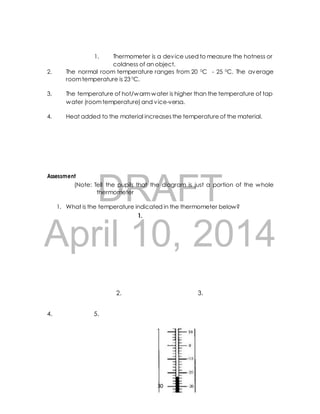
1. What is the temperature indicated in the thermometer below? 
1. 
April 10, 2014 
2. 3. 
4. 5. 
30
2. Complete the statement below. 
6. The temperature of hot water is ___________________ than the 
temperature of tap water. 
Compare the temperature of ice to the temperature of boiling 
water? Write your answer on your notebook. 
Lesson 3: Measuring the Temperature of Cold Material 
Duration: 2 days 
Objectives 
DRAFT 
Assignment 
At the end of the lesson, the pupils should be able to: 
1. measure the temperature of tap water and cold water using a 
thermometer; 
2. compare the temperature of tap water and cold water ; and 
3. read the temperature from the thermometer correctly. 
April Materials 
2 beakers/ identical glass 10, containers 
2014 
laboratory thermometer 
equal amounts of cold water and tap water 
Procedure 
A.Review 
Ask: What can you say about the temperature of ice as 
compared to the temperature of boiling water? 
B.Motivation/ Presentation 
Today, we will be doing an activ ity that will help you compare the 
temperature of tap water and cold water, and describe the effect 
of removing heat from the material. 
C.Lesson Proper 
31
1. Div ide the pupils into small groups. 
2. Give them the materials needed. Remind them of the proper way 
of using laboratory thermometer. 
3. Give other necessary instructions in accomplishing the task (i.e. 
time limit in doing the activ ity, group output reporting/ output 
presentation, etc…) 
4. Let the pupils perform Activ ity 3. Supervise/ guide them as they do 
the activ ity. 
5. Let the group presenter/reporter presents the activity results. 
DRAFT 
6. Discuss and process their answers to the questions in the activ ity. 
The following important ideas should be emphasized and 
understood by the pupils: 
1. The temperature of cold water is lower than the 
temperature of tap water (room temperature) and vice-versa. 
April 2. Heat when 10, removed from 2014 
the material lowers the 
temperature of the material. 
Assessment 
The activ ity output of the pupils may be considered in assessing them 
formatively. 
Assignment 
1. .What is the temperature of tap water? What is the temperature of cold 
water? 
2. How will you compare the temperature of tap water with that of cold 
water? (The temperature of tap water is higher than the temperature of 
cold water, or the temperature of cold water is lower than the 
temperature of tap water). 
3. What is the effect of removing heat from the water? (Heat removed f rom 
the water decreases the temperature of the water.) 
32
Lesson 4: What Happens when a Candle Wax is heated or Cooled? 
At the end of the lesson, the pupils should be able to describe the candle wax 
when heated and cooled. 
Materials 
small piece of candle wax, big spoon, thick cloth, candle 
small piece of wood, match 
Ask the pupils the following questions to recall the idea/concept 
that heat affects the temperature of the material: 
1. What can you say about the temperature of the material when 
DRAFT 
Duration: 2 days 
Objective 
Procedure 
1. Review 
heat is added to it? (Increases) 
2. What can you say about the temperature of the material when heat 
is removed from it? (Decreases) 
3. Motivation/ Presentation 
April Now, what do 10, you think will be the 2014 
effect of the increase or 
decrease in temperature on the material?........................... I f the 
candle wax is heated or cooled, what do you think will happen to 
it?......... This is what we will investigate today. 
4. Lesson Proper 
1. Div ide the pupils into small groups. 
2. Orient them with the materials that will be used in this activ ity. 
3. Give some precautionary measures, i.e. do not touch any hot 
material because you might get burned, etc… 
4. Let the pupils do the act ivity. 
5. Discuss answers to the activ ity questions. Process pupils’ responses 
to arrive at the correct ideas/concepts. 
33
6. Help the pupils formulate generalization by asking these questions: 
(a) What happens to the candle wax when heated or when heat is 
added? and (b) What happens to the melted candle wax when 
cooled ? 
Let the pupils understand that: 
Heat causes a change in the appearance of the material. Initially, 
the candle wax is solid in form, but when heat is added, it melts. I t 
changes from solid to liquid. 
However, when heat is removed or when the material is cooled, 
the melted candle wax becomes solid again. I t changes from 
liquid to solid. 
7. The teacher may ask the pupils to cite other examples of materials 
that change from solid to liquid when heated, or from liquid to solid 
when cooled. 
DRAFT 
Assessment 
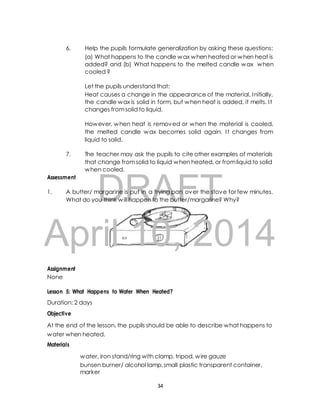
1. A butter/ margarine is put in a frying pan over the stove for few minutes. 
What do you think will happen to the butter/margarine? Why? 
April 10, 2014 
Assignment 
None 
Lesson 5: What Happens to Water When Heated? 
Duration: 2 days 
Objective 
At the end of the lesson, the pupils should be able to describe what happens to 
water when heated. 
Materials 
water, iron stand/ring with clamp, tripod, wire gauze 
bunsen burner/ alcohol lamp, small plastic transparent container, 
marker 
34
1. Motivation/ Presentation 
Have you observed your mother heating/ boiling water in the 
kettle? What did you observe while the water is boiling? What does 
it show? 
Today, we will do an activ ity that will help us describe what 
happens to water when heated. 
2. Lesson Proper 
3. Div ide the pupils into 5 small groups. Give them the materials 
needed, and other necessary instructions in accomplishing the task 
(i.e. time limit in doing the activ ity, group output reporting/ output 
presentation, etc…) 
DRAFT 
Procedure 
4. Let the pupils do activ ity 5. 
5. Let the group reporter presents the group output. 
April 6. Check pupils’ answers 10, to the activ 2014 
ity questions. Process their 
responses to correct misconceptions if there are and to arrive at 
the correct ideas/concepts. 
7. Help the pupils formulate generalization by asking: What is the 
effect of heat on the water? What happens to the water when 
heated? 
Let the pupils understand that: 
Water when heated increases its temperature. I t makes water 
change its form from liquid to gas (vapor) when it starts to boil. 
Hence, you observed that the amount or level of water is 
decreased after heating, because some water evaporates as 
vapor (steam). Water vapor is formed when liquid (water) is 
changed to gas. 
8. Ask the pupils to give other examples of materials that change 
from liquid to gas when heated. 
35
9. To apply the concept learned, ask: I f you want your wet clothes to 
dry quickly, where should you hang them? Why? 
Your mother is boiling water in a kettle for your coffee. What do you think 
will happen if she leaves the water boiling for a long time? Why? 
Lesson 6: What Happens to Water Vapor when Cooled? 
Duration: 2 days 
Background Information 
Water vapour is a gaseous form water. I t is formed when water starts 
to boil . When water vapor (gas) is cooled, it is changed to liquid. 
This can be shown in this simple experiment , when you put ice cubes 
and salt in the jar, the salted ice in the jar quickly makes the sides of the jar very 
cold. When water vapor is cooled, it changed to liquid (water droplets). The 
water droplets that you saw in the outside surface of the jar came from the 
water vapor in the air that touches the jar. 
DRAFT 
Assessment 
Objective 
At the end of the lesson, the pupils should be able to describe what happens to 
water vapor when cooled. 
April 10, 2014 
Materials 
ice cubes, glass jar with lid, tablespoon, table salt (rock salt) 
Procedure 
1. Review 
Recall: What happens to water when heated? Why? 
(The teacher should help the pupils recall the idea that when water 
is heated, it changes its form from liquid to solid.) 
B.Mot ivation/ Presentation 
36
When water is heated, it changes its form from liquid to gas. How 
about when water is cooled, what do you think will happen?..... This 
is the focus of our lesson today. 
2. Lesson Proper 
3. Div ide the pupils into 5 small groups. 
4. Orient them with the materials that they will use in the activ ity. Tell 
them to make sure that the bottle is clean and dry. 
5. Give them necessary instructions in accomplishing the task (i.e. 
time limit in doing the activ ity, group output reporting/ output 
presentation, etc…) 
6. Let the pupils do activ ity 6. 
7. Let the group reporter presents their output. 
DRAFT 
8. Check pupils’ answers to the activ ity questions. Process their 
responses to correct misconceptions if there are and to arrive at 
the correct ideas/concepts. 
9. Help the pupils formulate generalization by asking: What happens 
to the water vapor when cooled? 
April Let the pupils understand 10, that: 
2014 
When water vapor is cooled, it changes to liquid (water droplets). 
10. Give some applications or situations showing that gas is changed 
to liquid, i.e. the water droplets that collect on a shower door 
following a hot bath or shower, the moisture that appears on the 
outside of a cold water bottle or glass, or the droplets and fog that 
appear on a window during a rain shower. 
Assignment 
Bring naphthalene ball if you have at home for our next lesson. 
Lesson 7: What Happens to Naphthalene Ball when Heated? 
Duration: 2 days 
Objective 
At the end of the lesson, the pupils should be able to describe what happens to 
naphthalene ball when heated. 
37
small piece of camphor crystal or naphthalene ball l, 2 identical colored 
saucers,piece of stone, piece of cloth 
1. Review/ Motivation 
We learned from our previous activ ities/ lessons that when heat is 
added, a solid material can be changed to liquid, and a liquid 
material can be changed to gas. 
Can a solid material be changed to gas when heat is added to 
it?... Let’s find this out as we perform the activ ity. 
2. Lesson Proper 
DRAFT 
Materials 
Procedure 
3. Div ide the pupils into small groups. 
4. Give them the materials needed. 
Naphthalene ball crystal is available at the drug store. I t is safer to 
use a camphor crystal than mothball. However, if camphor crystal is not 
available, a mothball can be used. 
April 10, 2014 
Use colored saucers instead of white saucer to be able to see the 
pounded camphor crystal clearly, and get a good observation of 
the activ ity. 
5. Give some precautionary measures in using naphthalene ball or 
mothball, i.e. Do not eat the crystal, avoid contact to skin/eyes, use 
handkerchief to cover your mouth/nose, etc… 
6. Let the pupils do the activ ity. Teacher supervision is much needed. 
7. Give them necessary instructions in accomplishing the task (i.e. 
time limit in doing the activ ity, group output reporting/ output 
presentation, etc…) 
8. Let the pupils do activ ity 7. 
9. Let the group reporter presents the activity output. 
38
10. Check pupils’ answers to the activ ity questions. Process their 
responses to correct misconceptions if there are and to arrive at 
the correct ideas/concepts. 
11. Help the pupils formulate generalization by asking: What 
happens to naphthalene ball when cooled? 
Let the pupils understand that: 
When naphthalene ball is heated, it changes from solid (camphor 
crystal) to gas (vapor) without passing the liquid form/state. 
12. Give some applications or situations showing that solid is 
changed to gas when heated, i.e. solid toilet deodorizer solid air 
freshener, incense, naphthalene balls, dry ice (solid carbon 
dioxide) 
DRAFT 
Assessment 
Answer the following questions : 
1. Did you notice any change in the appearance of the naphthalene in 
saucer 1 and saucer 2? Why? 
2. What does this observation tell you? 
3. What is the effect of heat on the naphthalene ball? 
April Assignment 
None 
10, 2014 
Lesson 8: What Happens to the Air Inside the Bottle/Balloon when Heated or 
Cooled? 
Duration: 2 days 
Objective 
At the end of the lesson, the pupils should be able to describe what 
happens to the air inside the bottle/balloon when it is heated or cooled. 
Materials 
glass bottle (with narrow mouth), balloon, 2 small basins, hot water, cold water 
Procedure 
1. Motivation/ Presentation 
39
Have you noticed some vendors selling beautiful and big 
balloons during fiesta?..... To attract customers, some vendors stand 
under the heat of the sun for a long time. Can you guess what may 
happen to some balloons? .... Some balloons may burst. Why did this 
happen? 
Today, we will do an activ ity that would help us describe what 
happens to the air inside the balloon when it is heated or cooled. 
2. Lesson Proper 
3. Div ide the pupils into 5 small groups. 
4. Give them the materials needed, and other necessary instructions 
in accomplishing the task (i.e. time limit in doing the activ ity, group 
output reporting/ output presentation, etc…) 
DRAFT 
5. With the guidance/supervision of the teacher, let the pupils do the 
activ ity. 
6. Let the group reporter presents the activity output. 
7. Check pupils’ answers to the activ ity questions. Process their 
April responses to arrive 10, at the correct ideas/concepts. Clarify 
misconceptions if there are. 
2014 
8. Help the pupils formulate generalization by asking these questions: 
(a) What happens to the air inside the bottle/balloon when it is 
heated?, and (b) What happens to the air inside the 
bottle/balloon when it is cooled? 
Let the pupils understand that: 
As the air inside the bottle/ balloon heats up, air starts to expand 
making also the balloon to expand. 
But, when the air is cooled, it causes the balloon to contract/shrink. 
So here, we could say that addition of heat (increase in 
temperature) makes the balloon expand, and removal of heat 
(decrease in temperature) makes the balloon contract/shrink. 
40
9. Ask the pupils to cite other examples of materials that expand 
when heated or contract when cooled. 
10. Applying the concept we learned from the activ ity, why does the 
balloon get burst when placed under the heat of the sun for a long 
time? 
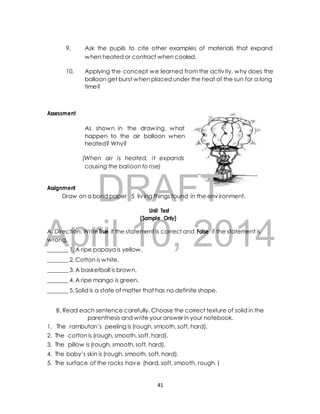
As shown in the drawing, what 
happen to the air balloon when 
heated? Why? 
(When air is heated, it expands 
causing the balloon to rise) 
DRAFT 
Assessment 
Assignment 
Draw on a bond paper 5 liv ing things found in the environment. 
Unit Test 
(Sample Only) 
April 10, 2014 
A. Direction: Write True if the statement is correct and False if the statement is 
wrong. 
_______ 1. A ripe papaya is yellow. 
_______ 2. Cotton is white. 
_______ 3. A basketball is brown. 
_______ 4. A ripe mango is green. 
_______ 5. Solid is a state of matter that has no definite shape. 
B. Read each sentence carefully. Choose the correct texture of solid in the 
parenthesis and write your answer in your notebook. 
1. The rambutan’s peeling is (rough, smooth, soft, hard). 
2. The cotton is (rough, smooth, soft, hard). 
3. The pillow is (rough, smooth, soft, hard). 
4. The baby’s skin is (rough, smooth, soft, hard). 
5. The surface of the rocks have (hard, soft, smooth, rough. ) 
41
C. Study the solids in column A. Match the size of solid in column B. Write the 
correct size in your notebook. 
A B 
Solid Long Short 
D. Draw a happy face if the liquid has a good 
smell and a sad face I f the liquid has a bad smell. 
_______1. fish sauce 
_______2. perfume 
_______3. alcohol 
_______4. soy sauce 
_______5. cologne 
DRAFT 
11. Write down how the following liquids flow. Choose the letter of the 
correct answer and write it on your notebook. 
_______6. water 
April a. slow 10, b. fast 2014 
c. very fast 
_______7. softdrinks 
a. slow b. fast c. very fast 
_______8. catsup 
a. slow b. fast c. very fast 
_______9. syrup 
a. slow b. fast c. very fast 
______10. shampoo 
a. slow b. fast c. very fast 
F. Study the liquids in column A. Write the correct taste of liquid in your 
notebook. Choose your answer in column B. 
A B 
___1. pineapple juice a. bitter 
___2. fish sauce b. salty 
___ 3. wine c. sweet 
42 
1. Ampalaya 
2. Okra 
3. Tape Measure 
4. Ruler 
5. Paper Clip
__ 4. vinegar d. sour 
__ 5. water e. tasteless 
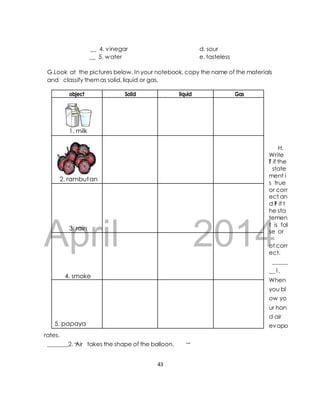
G.Look at the pictures below. In your notebook, copy the name of the materials 
and classify them as solid, liquid or gas. 
object Solid liquid Gas 
April 2014 
H. 
Write 
T if the 
state 
ment i 
s true 
or corr 
ect an 
d F if t 
he sta 
temen 
t is fal 
se or 
ot corr 
ect. 
_____ 
__1. 
When 
you bl 
ow yo 
ur han 
d air 
evapo 
rates. 
_______2. Air takes the shape of the balloon. 
43 
1. milk 
2. rambutan 
3. rain 
4. smoke 
5. papaya
_______3. LPG is a kind of gas. 
_______4. Deodorizer may change its size. 
______ 5. Gas occupies space. 
______ 6. Smoke is in a solid state. 
______ 7. Wind is moving air. 
______ 8. When water vapor is cooled it condensed and turns to liquid. 
______ 9. Air freshener takes the shape of the container. 
______ 10. Mothballs will dissapear if its in a dry place. 
DRAFT 
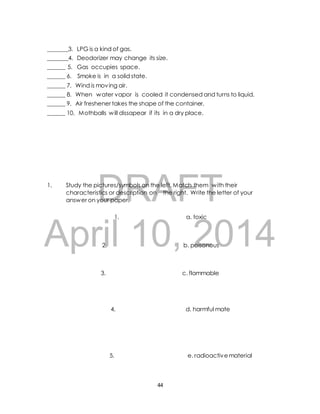
1. Study the pictures/symbols on the left. Match them with their 
characteristics or description on the right. Write the letter of your 
answer on your paper. 
1. a. toxic 
April 10, 2014 
2. b. poisonous 
3. c. flammable 
4. d. harmful mate 
5. e. radioactive material 
44
J. Read each sentence carefully. Draw a happy face  if it is a proper way of 
using and handling common harmful substances, and a sad face  if it is NOT. 
1. Keep flammable substances like gasoline and alcohol near the fire. 
2. See to it that LPG tank is properly closed after use. 
3. Do not play with insecticides /pesticides. 
4. Be careful in using kerosene, insecticides, pesticides, and fertilizer. 
5. Always wash your hands after using them. 
6. Avoid tasting or playing with unknown liquid. 
7. Always read labels of chemicals before using them. 
8. Unplug electric appliances with wet hands. 
9. Unplug electric iron and stove after using them. 
10. Keep poisonous chemicals safe in a separate cabinet away from reach 
of children. 
DRAFT 
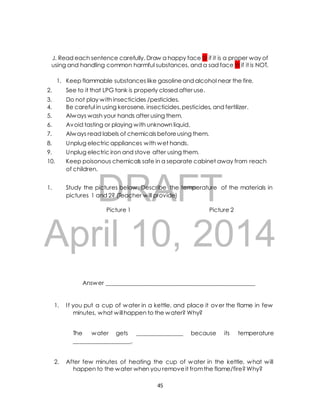
1. Study the pictures below. Describe the temperature of the materials in 
pictures 1 and 2? (Teacher will provide) 
Picture 1 Picture 2 
April 10, 2014 
Answer ____________________________________________________ 
1. I f you put a cup of water in a kettle, and place it over the flame in few 
minutes, what will happen to the water? Why? 
The water gets ________________ because its temperature 
____________________. 
2. After few minutes of heating the cup of water in the kettle, what will 
happen to the water when you remove it from the flame/fire? Why? 
45
The water gets ________________ because its temperature 
____________________. 
3. What will happen to the water inside the plastic bag when placed inside 
the freezer of the refrigerator? 
Answer: ____________________________________________________ 
4. What will happen to the mothballs/naphthalene balls when placed in a 
closet/cabinet for 2 weeks? 
Answer: ____________________________________________________ 
5. What will happen to the balloon when placed in a very cold place? 
Answer: ____________________________________________________ 
DRAFT 
6. What will happen to the ice cubes when placed under the heat of the 
sun? 
April 10, 2014 
7. What will happen to the water when placed under the heat of the sun for 
30 minutes? 
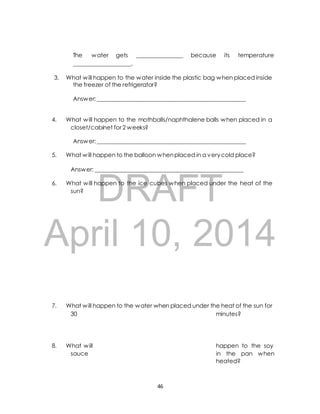
8. What will happen to the soy 
sauce in the pan when 
heated? 
46
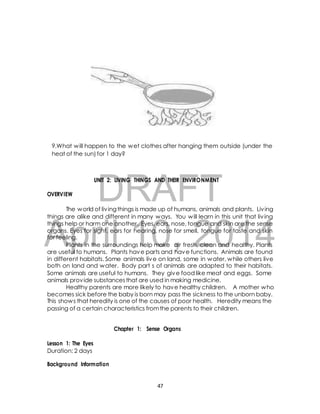
9.What will happen to the wet clothes after hanging them outside (under the 
heat of the sun) for 1 day? 
DRAFT 
UNIT 2: LIVING THINGS AND THEIR ENVIRONMENT 
OVERVIEW 
The world of liv ing things is made up of humans, animals and plants. Liv ing 
things are alike and different in many ways. You will learn in this unit that liv ing 
things help or harm one another. Eyes, ears, nose, tongue and skin are the sense 
organs. Eyes for sight, ears for hearing, nose for smell, tongue for taste and skin 
for feeling. 
April 10, 2014 
Plants in the surroundings help make air fresh, clean and healthy. Plants 
are useful to humans. Plants have parts and have functions. Animals are found 
in different habitats. Some animals live on land, some in water, while others live 
both on land and water. Body part s of animals are adapted to their habitats. 
Some animals are useful to humans. They give food like meat and eggs. Some 
animals provide substances that are used in making medicine. 
Healthy parents are more likely to have healthy children. A mother who 
becomes sick before the baby is born may pass the sickness to the unborn baby. 
This shows that heredity is one of the causes of poor health. Heredity means the 
passing of a certain characteristics from the parents to their children. 
Chapter 1: Sense Organs 
Lesson 1: The Eyes 
Duration: 2 days 
Background Information 
47
Our eyes help us to see. I t has different parts that work together so we can 
see things around us namely cornea, iris, pupil, lens, retina and optic nerve. 
Each has specific function. 
We should take care of our eyes in many ways. Read and work under 
good light. When reading, raise your eyes from the page once in a while. Do not 
read in a moving car or vehicle. Do not rub your eyes with dirty fingers or dirty 
handkerchief. Wash the eyes by opening and closing them in the water. The use 
of sharp or pointed objects may harm the eyes. Be careful when using pair of 
scissors, knives, and sticks. 
Objectives 
At the end of each lesson, the pupils should be able to: 
1. identify the parts of the eyes; and 
2. identify proper ways of caring the eyes. 
a big poster of the parts of the eyes 
DRAFT 
Materials 
Procedure 
A.Motivation / Presentation 
Let the pupils stand and get a partner and say: 
 Look at the eyes of your partner. Draw the parts that you see. 
Give the pupils 10 min to do it. 
April  Compare your drawing with your partner. 
 What do you want 10, to know about your 2014 
eyes? 
B. Lesson Proper 
1. Let the pupils do Activ ity 1. Give them 10 minutes to do the activ ity. 
2. Using the enlarged picture of the human eye posted on the 
board, ask the following questions : 
 Compare your labelled parts of the eyes which you did in 
the activ ity and the labelled parts in the enlarged picture.( The 
pupils are expected to have the same labelled parts which 
they did in the activ ity compared to the enlarged picture of 
the human eyes) 
 What are the parts of the eyes that we can see? (The parts of 
the eyes are the cornea, pupil and the iris.) 
 What are the inner parts of the eyes that you cannot see in a 
mirror? (Lens, retina, and optic nerve.) 
 What is the work of each part of the eye? 
 The cornea serves as the transparent covering of the 
eye. 
 The pupil serves as the opening where light enters. 
48
 The lens focuses light and projects the image on the 
retina. 
 The retina is where the image that is seen is focused. 
 The optic nerve sends messages to the brain. 
 How do we able to see objects? (We can see objects 
whenever there is light. Light is needed in order to see things. 
The light from a source falls into the object and then reflected 
to our eyes. Thus, we are able to see the object.) 
 How would you feel if you have your poor eyesight? ( I would 
feel difficulty in seeing all things around me) 
3. Let the pupils do activ ity 2. Give them 5 minutes to do the activ ity. 
4. After doing activ ity 2, ask the following questions : 
 Which pictures do not show proper ways of caring the eyes? (The pictures 
showing reading in a dark room and watching very near the television) 
 Why do we have to avoid these practices? (These practices can harm our 
eyes. Reading in the dark makes the eyes work harder and become 
tired.) 
 Which pictures show proper way of caring the eyes? (The pictures 
showing wearing sunglasses on a sunny day and using goggles when 
swimming.) 
DRAFT 
 Why are these practices good to do? (Wearing sunglasses protects the 
eyes from too much light. Wearing goggles gives protection from particles 
in water that may cause irritation of our eyes.) 
 Why should we need to take care of our eyes? (Our eyes help us see 
things around us. I t helps us to learn about the things around us. Our eyes 
need to be taken cared of to maintain good eyesight until old age.) 
April  What are other ways of 10, taking care of our eyes? 
2014 
 Avoid placing pointed objects near the eyes. 
 Read with sufficient light. 
 Eat foods rich in vitamin A such as green and yellow vegetables. 
 Do not read while riding in a moving vehicle. 
 Rest your eyes after reading for a long period. 
 Avoid rubbing the eyes. When dirt gets in or when it is itchy, use clean 
running water to rinse the eyes. 
 What should you do if you notice any problem with your eyes? 
(Consult a doctor who is an eye specialist, if you have problem with your 
eyes.) 
Assessment 
I . Match column A with column B. Write the letter before each number. 
A B 
_____1. Cornea a. Focuses light and projects the image 
on the retina 
_____2. Pupil b. Sends messages to the brain 
49
_____3. Lens c. The transparent covering of the eye 
_____4. Retina d. Where the image that is seen is 
DRAFT 
Lesson 2: The Ears 
focused 
_____5. Optic nerve e. The opening where light enters 
I I . Put a [] on the box if it shows a proper way of caring the eyes and put a [x] 
if it is not. 
 1. Reading with sufficient light 
 2. Rubbing eyes with hands when itchy 
 3. Resting eyes after reading for a long period 
 4. Looking at the Sun directly 
 5. Consult a doctor when having eye problem 
Assignment 
1. Find out who wears eyeglasses in your family. Ask the reasons why they 
are using eyeglasses. 
2. I s playing computer games for a long period good to your eyes? 
What should you do to take care of your eyes? 
April 10, 2014 
Duration: 3 days 
Background Information 
None 
Objectives 
At the end of each lesson, the pupils should be able to: 
1. identify the parts of the ears and its function, and 
2. identify proper ways of caring the ears 
Materials 
a big poster of the parts of the ears 
Procedure 
A. Review 
Ask: 
50
 What sense organ would you use to see the parts of your ears? 
 Would you be able to study the parts of the ears without your eyes? 
Why? 
B. Motivation / Presentation 
Let the pupils stand, get a partner and say: 
 Look at the ears of your partner. Draw the parts that you see. 
Give the pupils 10 min to do it. 
 Compare your drawing with your partner. 
 What do you want to know about your ears? 
C. Lesson Proper 
1. Let the pupils do activ ity 3. Give them 10 minutes to do the activ ity. 
2. Using the enlarged picture of the ears posted on the board, ask 
the following questions: 
 Were you able to name correctly the parts of the ear that you 
draw. 
 What that DRAFT 
are the parts of the ears that you see? (The part of the ear 
I can see are the pinna, and the opening of the ear canal) 
 What are the parts of the ear that you cannot see? (The rest of 
the ear canal, ear drum, the three little bones- hammer, anvil and 
stirrup, cochlea, and auditory nerve.) 
 What is the work of each part of the ears? 
April 3. Let the pupils do 10, activ ity 4. Give them 10 2014 
minutes to do the activ ity 
4. Using the enlarge picture of the ear, let the pupils trace the path of sound 
as it enters the pinna. 
pinna Ear 
canal 
Eardrum 3 small 
bones 
cochlea nerve 
5. Explain the path of sound from pinna to the brain. Ask the following 
questions: 
 Why do you think the pinna and the eardrum are shaped like a 
funnel? (The shape of the pinna helps in collecting the sound and 
focusing it towards the ear canal.) 
 What happens to the eardrum when sound reaches it? (The 
eardrum vibrates as sound hits it. From here the sound is amplified.) 
 What happens to the amplified sound from the eardrum? (The 
amplified sound pass through the three small bones - hammer, anvil 
and stirrup. The cochlea detects the vibration and sends the 
message to the brain through the auditory nerve.)) 
51
6. Let the pupils perform activity 5. Give them 10 minutes to do the activ ity. 
7. Ask the pupils the following questions : 
 What are the proper ways of caring the ears which you marked 
DRAFT 
Assessment 
check in your activ ity? (The proper ways are: using clean cloth in 
wiping the outer ear and having a doctor check the ears for any 
problem.) 
 Why are these ways good to do for our ears? (The ears should only 
be cleaned in the outside using a clean cloth. I t is not proper to 
insert objects inside the ear to avoid damaging it. Whenever there 
is a problem about the ears, it is best to consult a doctor. 
 What are ways that you should avoid? (Listening to loud music and 
inserting sharp objects in the ear.) 
 Why do you have to avoid doing these? (Sharp objects could hurt 
the ears especially the inner parts like the eardrum. Listening to very 
loud music may affect hearing.) 
 What other ways do you do to take good care of your ears? 
 Never put anything inside the ear 
 Avoid very noisy places. 
 Listen to not too loud radio or music, even when watching 
television 
 Consult a doctor when there is a sudden loss of hearing . 
April 10, 2014 
I . Match column A with column B. Write the letter before each number. 
A B 
_____1. Pinna a. Transmit sounds to the auditory nerve 
_____2. Ear canal b. Sends message to the brain 
_____3. Eardrum c. Collects sounds 
_____4. Cochlea d. Where sound travels from pinna to 
the ear drum 
_____5. Auditory e. Vibrates when sound hits it 
nerve 
I I . Put a [] on the box if it shows a proper way of caring the ears and put 
a [x] if it is not. 
 1. Avoiding noisy places 
52
 2. Consulting a doctor when there is a problem about the ears and 
hearing 
 3. Cleaning the inside of the ears with cotton buds 
 4. Turning the volume high when listening to music 
 5. Using earmuffs when in a place with loud sounds. 
1. Why are the ears important? 
2. What can happen if the sense of hearing is impaired? 
Objectives 
At the end of each lesson, the pupils should be able to: 
1. identify the parts of the nose and its function; and 
2. Identify proper ways of caring the nose. 
DRAFT 
Assignment 
Lesson 3: The Nose 
Duration : 2 days 
Material 
big Picture of a nose 
Procedure 
Review 
April Post the enlarge drawing 10, of the ear. 
Ask: Why are our ears important? Trace the path 2014 
of sound as it enters the 
outer ear to the inner ear and then to the brain for interpretation. 
Motivation/Presentation 
Ask the following questions: 
 How can you tell what your mother is cooking? 
 What sense organ do you use in smelling? 
 Can you tell the parts of your nose? What do you like to study about 
your nose? 
(Post questions on the pocket chart. 
Lesson Proper 
1. Let the pupils do activ ity 6. Give them 10 minutes to do the activ ity. 
2. After doing activ ity 6, ask the following questions: 
 Look at the drawing of your classmates. Do you have the same 
drawing of the nose? 
 What are the parts of the nose that we can see? (The part of the nose 
that we see are the two holes of the nose called the nostrils.) 
53
 What are the inside parts of the nose? (The nasal cavity and inside it 
are the nerve cells.) 
 What is the function of each part of the nose? 
 The nostrils receive the scents carried by air. Hairs are present on the 
nostrils which filter the air that gets through your nose. 
 The nasal cavity secretes mucus which further cleans the air. 
 The nerves in the nasal cavity send messages to the brain which 
interprets what we have smelled. 
 What can happen if the sense of smelling is impaired? (You will not be 
able to smell the odor or scents of things.) 
3. Let the pupils do Activ ity 7. Give them 10 minutes to do the activ ity 
4. Ask the pupils the following questions : 
 What are the proper ways of caring the nose which you marked check 
in your activ ity? (The proper ways are: covering the nose while passing 
by a dusty road and using a clean handkerchief or cloth in cleaning 
the nose) 
 Why do you have to care for your nose? 
 Which are NOT the proper ways to do in your nose? (Using sharp 
DRAFT 
objects to clean the nose and blowing hard.) 
 Why do you have to avoid doing these? (It can harm the nose.) 
 What are other ways of taking care of your nose? 
 Not inserting small objects inside the nose 
 Seek doctors help when an object is inserted in the nose 
April Assessment 
I . Match column A with column 10, B. Write the letter 2014 
before each number. 
A B 
_____1. Nostrils a. Carries the messages to the 
brain so the person will 
know what he smelled 
_____2. Nasal cavity b. Opening of the nose 
_____3. Nerves c. Secretes a sticky mucus which 
trap dust, dirt and germs 
carried by inhaled air 
I I . Put a [] on the box if it shows a proper way of caring the nose and put a 
[x] if it is not. 
 1. Inserting small objects inside the nose 
 2. Consulting a doctor when there is discomfort with our nose 
 3. Cleaning the inside of the nose with sharp objects 
 4. Covering the nose when passing a dusty road 
 5. Blowing the nose hard when with colds 
54
Answer the questions below: 
1. Why is the nose important? 
2. What can happen if the sense of smell is impaired or does not 
function well? 
Lesson 4: The Tongue 
Background Information 
None 
Objectives 
At the end of each lesson, the pupils should be able to: 
1. describe the uses of the tongue; and 
2. identify the parts and function of the tongue. 
DRAFT 
Assignment 
Duration: 3 days 
Materials 
big picture/ illustration of the tongue, flow chart of how the parts of the 
tongue function, real food samples (ex. kalamansi, salt) 
Procedure 
April A. Review 
What 10, are the parts of a nose? 
2014 
B. Motivation/ Presentation 
Call a pupil. Blindfold him/her and let him/her taste the kalamansi juice. 
Let the pupil guess what the liquid is. (The class will tell whether the answer is 
correct) 
Remove the blindfold as soon . Ask the pupil: 
 How did you know that it was kalamansi juice? ( I t tastes sour.) 
 What did you use to taste it?( My tongue.) 
Ask the class: 
Do you know how our tongue functions? 
C. Lesson Proper 
1. Tell the class to bring out their mirrors. Let them do activ ity 8 in their LM 
indiv idually first. Remind them to be careful in using and handling a mirror. 
2. After answering the activ ity, div ide the class into groups. Let the class 
compare and discuss their answers. Tell them to report their answers to the 
class. 
55
3. Ask 1-2 members of the group to report their work in class. Discuss the 
answers to the activ ity. (You may use a big picture / an enlarged 
illustration of the parts of a tongue.) 
4. Lead the pupils in developing these concepts: 
 Tongue is the sense organ that helps us taste all things we place inside 
our mouth. 
 The tongue has taste buds and nerves. 
5. Discuss thoroughly how the tongue functions as stated in the activ ity. (You 
may use the pupil’s enlarged flow chart. ) 
6. Let some pupils taste certain foods to demonstrate how the tongue 
7. Let the class check their answers to the activity. 
8. Tell the class to do activ ity 9 in their LM. Check the answers to the activ ity. 
Let the pupils explain their answers. 
9. Discuss with the class the following concepts: 
 Eating very hot food can scald the tongue. 
 I t is proper to consult a doctor when the tongue has sores. 
 Use a tongue scraper to clean the tongue so as not to damage the 
taste buds. 
DRAFT 
functions. 
 Brushing teeth is important to avoid infection of the tongue and gums 
and prevent tooth decay. 
Assessment 
Ask: What are the parts of a tongue and their functions? 
What’s the importance of caring the tongue? 
April Assignment 
10, 2014 
The tongue needs to be cleaned from time to time. How do members of 
your family clean their tongue? Write their responses on your notebook. 
Lesson 5: The Skin 
Duration: 2 days 
Background Information 
None 
Objectives 
At the end of each lesson, the pupils should be able to: 
1.describe the uses of the skin; 
2. identify the parts and function of the skin; and 
3. show proper ways of caring for the skin. 
Materials 
big picture / Enlarged illustration of the parts of the skin, magnifying glass 
56
A. Review 
What are the parts of the tongue? 
How does the tongue works? 
B. Motivation/ Presentation 
Place familiar objects with different shape, textures and thickness 
inside the pouch. 
Let some pupils identify these objects by a: touching using gloves 
and b: touching without using gloves) 
Ask: 
In which situation ( a or b ,can you easily identify the objects? Why? 
What sense organ is involved in this activity? 
C. Lesson Proper 
1. Distribute magnifying glass to the class. Discuss briefly the proper use of a 
magnifying glass. 
2. Tell the pupils to do activ ity 10 as a group. 
3. Tell the class to choose a leader to discuss the parts and function of the 
skin found in the LM. 
DRAFT 
Procedure 
4. Check the answers to the activ ity. 
5. Discuss the following concepts: 
 Using magnifying lens, we can see tiny hairs and openings on our 
skin. 
 The skin is the outer covering of our body. 
 The skin protects the body from losing too much water, injuries and 
April infection. 
 The skin helps maintain 10, body temperature. 
2014 
 The skin consists of two layers: 
 Epidermis: outer layer of the skin on the surface on which dead 
skin cells are found. 
 Dermis: inner layer of the skin which contains blood vessels, 
nerves, sweat glands and oil glands. 
 The sweat glands open to the surface of the skin through the pore. 
 The oil glands keep the hair and skin soft and moist. 
 The skin has nerve endings that sense touch, pain, pressure, and 
temperature. 
 The nerves send messages to the brain which interprets the 
message and we feel the objects. 
6. Discuss also how the skin works. 
7. Tell the pupils to do activ ity 11 in their LM indiv idually. 
8. Check and discuss the answers to the activ ity. Let the pupils explain their 
answers. 
9. Tell the class: 
 I t is good to take a bath everyday to avoid body odor. 
 Walking barefoot can harm the skin of your feet. 
 Wear clean clothes for personal hygiene. 
57
 Drink plenty of water to make the skin fresher. 
Assessment 
What are the parts and functions of the skin? 
How do we take care of the skin? 
Assignment 
Name animals found in the community. 
DRAFT 
April 10, 2014 
58
Chapter 2 : Animals 
The pupils studied about their sense organs in Chapter 1 of Unit I I. They 
described the parts and functions of the sense organs of the human body and 
they were encouraged to practice good health habits to take care of their eyes, 
ears, nose, tongue and skin. From a lesson on the human body, the pupils will 
now move to a lesson on the other liv ing thing in their environment, the animals. 
In chapter 2, pupils will learn that they share many things in common with 
animals by describing animal body parts and their functions. The pupils will also 
be able to classify animals based on some observable characteristics like body 
covering, food they eat, how they move, and their habitat. 
Furthermore, pupils should also be made to realize the importance of 
animals to humans by identifying their usefulness. However, they should also learn 
that there are also animals that could bring harm because they carry disease or 
they could inflict injuries. Finally, the pupils must be able to describe ways of 
proper handling of animals. This is important because it promotes animal welfare 
and prevention of injuries and fatal accidents. 
DRAFT 
Overview 
Process skills involved in the activ ities include observing, communicating 
(writing), describing and classifying. 
Lesson 1: Animals in the Environment 
Duration: 1 day 
April Background Information 
10, 2014 
There are different kinds of animals. Different kinds of animals live in 
different places. Some animals live in land and some live in water and some live 
on both places. Animals such as chicken, goat, sheep, pig, and cow can be 
found in a farm. Animals like lion, tiger, elephant, and giraffe can live in the wild 
or in the zoo. Animals such as the different fishes, whale, and stingray live in 
bodies of water. Some of the animals (cat, dog, and rabbit) live in the house 
because they are pets. 
Objective 
At the end of the lesson, the pupils should be able to identify common animals 
found in the environment 
Materials 
Pictures of animals 
Procedure 
A. Review 
59
Ask the pupils: 
 Look around. What do you see? What sense organ do you use to see 
things around you? 
 Listen. What do you hear? What sense organ do you use to hear? 
B. Motivation/Presentation 
1. Let the pupils sing the song “Old McDonald had a Farm.” 
Old McDonald had a Farm 
E – I – E – I – O 
And on his farm he had some chicks, 
E – I – E – I – O 
With a chick, chick here 
And a chick, chick there, 
here a chick, there a chick, 
Everywhere a chick, chick. 
Old MacDonald had a farm, 
E – I – E – I – O 
DRAFT 
(Replace the animals with the following:) 
Duck – quack, quack 
Cat – meow, meow 
Pig – oink, oink 
Cow – mooo, mooo 
Frog – ribbit, ribbit 
Bird – chirp, chirp 
Horse – neigh, neigh 
Bee – bzzz, bzzz 
April 10, 2014 
2. Ask the pupils to recite the names of the animals mentioned in the song. 
3. Explain to the pupils:Many kinds of animals live in the same environment 
with humans. 
Lesson Proper 
1. Let the pupils do Activ ity 1. Give them 10 minutes to answer the activity. 
2. After 10 minutes, use pictures a – f of Activ ity 1 to identify the animals. 
3. Post the pictures on the board one by one. 
4. Ask one pupil to write below the picture the name of the animal. 
5. Ask the class to describe the animal in the picture. The following questions 
may be asked to help the students in describing the animals. 
 Where can you find it? 
 I s it big? I s it small? 
 Can we keep it as a pet? 
6. Post the pictures h – k of Activ ity 1 on the board. 
7. Ask question in the activ ity sheet. 
8. Write the pupils’ answers on the board. 
60
9. The following questions may be asked to help the pupils in describing the 
animals they listed as answers to question g. 
 Where can you find it? 
 I s it big? I s it small? 
 Can we keep it as a pet? 
10. Ask the class to give other examples of animals and where the animals 
can be found. 
Ask the class to give a generalization. Examples: 
 There are different kinds of animals. 
 Different kinds of animals live in different places. 
 Some animals can be kept as pets, some help us in the farm, some 
provide us with food, some animals are helpful to plants, while 
some are pests. Some animals can be dangerous to smaller 
animals, plants, and people. 
Complete the table by listing different kinds of animals found in different 
places. 
DRAFT 
Assessment 
April Assignment 
Each group will bring a picture 10, of a frog, horse and 2014 
bird for the next activity. 
Lesson 2: Body Parts of Animal 
Duration: 2 days 
Background Information 
There are different kinds of animals. They have body parts which they use 
for movement, eating, protection and adaptation to habitat. Some animals 
have similar body parts which can be used as bases for classifying them into 
groups. 
Objectives 
At the end of each lesson, the pupils should be able to: 
1. identify the parts of some animals; and 
2. group animals according to their body parts. 
61 
Animals 
found in the 
House 
Animals 
found in the 
Farm 
Animals found 
in the Zoo 
Animals found in 
the River and 
Ocean
Large pictures of frog, horse , bird showing the body parts 
A. Review 
Relate the lesson on animals in the environment to the lesson on body 
parts of an animal. Ask the students: What animals do you have at home? 
What animals do you find in your garden? 
B. Motivation / Presentation 
1. Write on the board the lyrics of the song “My Toes, My Knees.” 
My Toes, My Knees 
My toes, my knees, my shoulder, my head 
Let us clap our hands together. 
2. Let the pupils sing the song “My Toes, My Knees.” 
3. Ask the pupils to read and encircle parts of your body mentioned in the 
DRAFT 
Materials 
Procedure 
song. 
4. Ask the class the question: 
 I f we have these body parts - toes, knees, shoulder and head, what 
about the animals, do they also have these parts? Can you name 
animals which have these body parts? 
April C. Lesson Proper 
10, 2014 
1. Let the pupils perform Activity 2 – Parts of an Animal. 
2. After the pupils finished answering the activ ity, facilitate the 
processing of the activity. 
3. Post on the board the large pictures of a frog, a horse and a bird. 
Ask the pupils to write on the board answers to the activity. 
4. Ask question no. 4, “What body parts are common in a frog, a horse 
and a bird?” 
5. After the pupils have answered, explain to the class that there are 
similarities and differences of body parts of many animals. 
6. Ask the class to give a generalization. Generalization can be: 
 Animals have body parts which makes them similar or different from 
each other. 
Assessment 
(The pupils may be grouped together to answer the assessment.) 
Complete the table below by listing animals described in each column. The 
pupils can write as many answers as possible. 
62
Group together animals that have the same body parts 
dove dog maya 
bangus bee fly 
cow crocodile eagle 
goat tilapia spider 
butterfly carabao turtle 
Lesson 3: Classifying Animals according to Body Parts and their Uses 
Duration: 2 days 
DRAFT 
Assignment 
Background Information 
Different animals use different parts of their body for movement. Having 
different body parts make the animals move in different ways. 
The horse and giraffe have long legs which they use for walking or running 
April fast. Some have legs that are not very long but they can also walk or run very 
fast. The cheetah runs the fastest 10, and the pronghorn 2014 
follows in speed. Other 
animals like rabbits and kangaroos have bigger hind legs which aid in jumping. 
The legs of carabaos, dogs, horses and cows make them walk, run, 
gallop, or jump. Birds have wings for flying. Birds have a pair of legs and feet with 
sharp claws for clinging to branches of trees. Fishes have fins and tail for 
swimming. The long and strong legs of frogs enable them to jump while the 
webbed feet of ducks help them swim. 
Earthworms have pairs of bristles that help them crawl and cling to the 
walls of their burrows. Monkeys have long arms, legs, and tails that help them 
climb and swing from tree to tree. Millipedes and centipedes have many small 
legs to help them crawl. Crabs and lobsters use their legs in crawling and 
swimming. 
Objectives 
At the end of each lesson, the pupils should be able to: 
1. describe how animals move; and 
2. Identify the body parts that enable animals to move; 
63 
Animals with 2 
legs and wings 
Animals with 6 
legs and wings 
Animals with 4 
legs and horns 
Animals with 
gills and fins
picture/ video of animals 
Show a picture of an animal and ask the pupils to name its body parts. 
Ask the questions “What are these body parts for?” 
B.Motivation/Presentation 
Guessing Game: 
The class will play a guessing game. Tell the class the following 
a. One pupil will pick a piece of paper with the name of an animal 
written on it. 
b. The pupil should not tell the name of the animals instead he or 
she will act out how the animal moves. 
c. The rest of the class will raise their hands and guess the name of 
the animal. 
DRAFT 
Materials 
Procedure 
A.Review 
instructions: 
d. The first pupil to raise hand and guess the correct animal will earn 
a prize. 
e. Each pupil shall have at least 5 animals to name correctly. 
C.Lesson Proper 
Day 1 
April 1. Let the pupils do Activ ity 3. Give them 10 minutes to do the activ ity. 
2. Write the names of 10, the animals on the board 2014 
following the format and 
sequence of questions 1 and 2 of Activ ity 3. 
3. Ask one pupil to identify the movement of each animal in question 1. 
4. Do these for animals a – j of question 1. 
5. Ask one pupil to identify the body part/s used by the animal for 
movement in question 2. 
6. Do these for animals a – j of question 2. 
7. Discuss to the class that animals have body parts that help them 
move. 
8. Ask them to relate the body parts of animals to their movement. 
Questions for discussion: 
 The frog has flexible or springy legs. What movement can it make? 
What are other animals that show this movement? Do these animals 
have the same kind of legs? 
(Animals with flexible or springy legs can jump.} 
 Butterflies can fly. What enables them to fly? What other animals have 
these body parts and make them fly? 
 What kind of movement can an animal without legs make? Example: 
snake 
64
(Animals without legs like the snake can crawl with their body.) 
 What kind of movement can animals with legs make? 
Examples: spider, bird, duck 
(Animals with legs can walk, run, and crawl with their body.) 
9. Ask the class to give a generalization. Examples: 
 Animals have body parts that enable their movement. 
 Animals move in different ways. 
1. Let the pupils do Activ ity 4. Give them 10 minutes to do the activ ity. 
2. Write the table on direction number 2. 
3. Post the picture of each animal on the board. 
4. Ask one student to write the name of the animal posted on the board 
on the correct column corresponding to the movement the animals 
make. 
5. Let the pupils read the group of animals that walk or run, jump or hop, 
swim, fly, and crawl. 
6. Discuss to the class that animals can be classified based on how they 
DRAFT 
Day 2 
move. 
7. Let the pupils make generalizations: 
 Animals can be grouped together based on their means of 
movement. 
Assessment 
April Choose an animal without legs and an animal with legs. Observe the 
body parts that these animals 10, use to move from 2014 
one place to another. Draw 
the animals in your notebook. Show the part or parts that they use to move. 
Assignment 
Ask the pupils to draw their pets in their assignment notebooks. What is the 
food of your pet? 
Lesson 4: Body Parts of animals for food getting and for eating 
Body Covering of Animals 
Habitat of different animals 
Duration:4 Days 
Background Information 
Animals have body parts for food getting. Frogs and lizards use their 
long tongues to catch insects for food. Cows, carabaos, and horses have big 
and flat teeth to chew grass. Tigers, cats, and dogs have long and sharp teeth to 
tear food apart. Some insects like bees have proboscis to suck nectar from 
flowers. Chimpanzees and monkeys use their hands in getting food. Ostrich and 
65
chicken use their beaks and bills in getting food. Grasshoppers and spiders make 
use of their legs to get food. 
Different animals eat different types of food. Some animals have teeth 
and some others do not. Some animals have different types of teeth for food-getting. 
Some animals have sharp teeth or incisors for gnawing like the rats, 
hamsters, and rabbits. These incisors grow continuously. They are worn down 
through constant gnawing. When gnawing is prevented, the incisors grow so 
long that the animals cannot eat and die of hunger. 
The cats and dogs have smaller incisors but bigger canine teeth. These 
canine teeth are also called fangs. They use their fangs for tearing meat and 
their molars for chopping the meat into smaller portions so they would be small 
enough to swallow. The horses, sheep, and cows have more closely spaced and 
even – sized teeth. These work well in clipping off grasses and plant leaves. 
Animals have body parts which they use to protect themselves from 
weather and their enemies. All animals have skin to protect their bodies from 
different kinds of weather. 
DRAFT 
Turtles, crabs, and lobsters have shells or carapace for protection from 
hard objects and attacks from enemies. Birds have feathers for protection from 
different weather conditions. Fish have scales to protect themselves. Insects 
have feelers or antennas that help them find their way. Cockroaches come out 
at night and use long feelers in the dark. Porcupines have spikes all over their 
body for protection against attackers. Some animals like polar bears have thick 
hair or fur for protection against cold weather. Cows, deer and carabaos have 
horns for protection against enemies. Some parts protect animals. The turtle 
hides inside its shell if it is in danger. The thick furs of polar bears protect it from 
the very cold climate in areas with snow. 
April 10, 2014 
The habitat is the specific environment or place where an animal lives. 
There are different kinds of habitats. There are animals that live on land like cows 
and dogs. There are animals that live in water. There are different kinds of fish. 
They have gills for breathing under water and fins for swimming. Some live 
underground like ants, worms, and moles. Others live in high places like birds. 
They have wings for flying. 
There are those animals that can live on both land and water. These are 
the turtles, frogs, and crocodiles. Animals that live in the forest include lions, 
tigers, deer and large birds. There are animals that also live in the farm. These are 
the cows, carabaos, chickens, and goats. Some live in the house as pets. These 
are the dogs, cats, and rabbits. 
Objectives 
At the end of each lesson, the pupils should be able to: 
66
1. infer the body parts used by different animals for eating/getting food; 
2. describe the body covering of animals; 
3. group animals according to their body coverings; and 
4. classify animals according to their habitat/place where they live. 
Live animals/pictures of animals Pictures of mouth parts of animals 
A. Review 
The teacher may ask the following guide questions to relate the lesson on 
body parts of animals to classifying animals based on body parts. 
a. Given different animals, what are the body parts that enable them to move? 
B. Motivation/Presentation 
1. Activ ity: The pupils will select the object which does not belong to the 
Which object does not belong? 
a. ball, orange, string, egg 
b. apple, rambutan, strawberry, banana 
c. ballpen, paper, pencil, pentel pen 
DRAFT 
Materials 
Procedure 
group. 
(The pupils should select a. string, b. banana and c. paper as the objects 
that do not belong to the group.) 
2. Emphasize that there is always a basis in grouping things. Likewise, animals 
can be classified based on how they move, on what they eat, on their 
body covering, and on where they live. 
April C. Lesson Proper 
10, 2014 
Day 1-4 
1. Let the pupils do Activ ity 5. Give them 10 minutes to do the activ ity. 
2. Let the pupils do Activ ity 6. Give them 10 minutes to do the activ ity. 
3. Post a chart similar to Table 1 (found in Activ ity 6) on the board. 
4. Let the pupils complete the table by writing the food the animal eats, the 
body part used for food-getting and eating and classify the animal on 
whether it is a meat – eater, plant – eater, variety – eater, and scavenger. 
5. Post pictures of each animal’s mouth parts on the board. 
6. Let the pupils compare the mouth parts of the animal to the food they 
each animal eats. 
7. Discuss to the class that animals can be classified based on what they 
eat. 
Assessment 
The pupils’ answers to the activ ity questions can serve as assessment.Rubrics 
must be crafted for the assessment. 
67
Tell the pupils to look for and bring colored photos or pictures of the animals 
listed in Activ ity 7 from magazines or books ,or from the library. Remind the 
pupils not to tear or cut pages of magazines or books.Tell them to bring these 
photos /books containing the photos to class on the next day. 
Lesson 5: Importance of Animals to Humans Proper Ways of Handling Plants 
Duration: 2 days 
Background Information 
Many animals are useful to human beings. There are animals that help us 
do work. Horses and carabaos are work animals. Some animals are sources of 
food like the meat of chickens, goats, pigs and cows. The skin of some 
animals are raw materials for bags, belts and clothing. 
Earthworms loosen the soil as they move through it. Loose soil enables the 
roots to get enough air and water.Earthworms add their waste products in 
the soil making it fertile for healthier plant growth.The silkworm is an insect that 
makes beautiful silk threads. People weave these threads into cloth. 
DRAFT 
Assignment 
Animal have different eating practices.A ladybug eats small insects that 
harm plants. Insects are used as food by birds and other animals. Frogs eat 
insects. Some mammals eat insects, too. There are insects that eat other 
insects. Spiders eat grasshoppers that destroy crops. They also eat flies and 
mosquitoes. 
April Some animals can be 10, harmful to people. 2014 
They can be carriers of 
diseases, sources of infection, allergy, and injury. Harmful organisms can be 
transferred from animals to people. These organisms can cause death. These 
are: rabies from dogs; bubonic plague from rats; anthrax and mad cow 
disease from cattle; malaria, dengue, and yellow fever from mosquitoes; 
gastroenteritis or diarrhea from flies; and the deadly ebola virus from 
monkeys. 
Cats, dogs, and rabbits can also cause allergic reactions in people 
because of their fleas, ticks, mites, and fur. Bee sting can cause allergy. Some 
animals such as cats and birds can also cause injury. I f you do not know how 
to handle them, cats put out their claws and scratch and bite. Birds will claw 
and peck you. They can tear your flesh with their sharp beaks or bills and 
claws. 
Insects grow and multiply very fast. Although most insects are small, they 
can do a lot of harm. Flies carry germs that cause diseases. Diarrhea and 
cholera are diseases caused by germs carried by flies. Mosquitoes also carry 
germs that cause malaria, dengue fever and H-fever. Cockroaches leave a 
bad odor on food they crawl on. They also leave germs on the food. These 
insects harm people because of the diseases they cause. 
68
Some insects need to be controlled. The following are ways of controlling 
1. Destroy mosquitoes and flies while they are not yet in the adult stage. 
This can be done by destroying their breeding places. 
2. Cockroaches breed in dark, damp places. Always keep the corners 
and cabinets in the kitchen clean. 
3. Insecticides may be used to destroy insects. 
4. Keep your home and surroundings clean. There will be no breeding 
places for insects that cause harm when surroundings are kept clean 
and sanitary. 
Objectives 
At the end of each lesson, the pupils should be able to: 
1. explain why animals are important to people; 
2. group animals according to what they give to people; 
3. identify harmful animals and their effects on people; and 
4. cite proper ways of handling animals. 
DRAFT 
them. 
Materials 
pictures of animals newspaper/magazine clippings on animal-borne 
diseases, 
Procedure 
A. Motivation/Presentation 
Read a story about an animal that helps people. 
April B. Lesson Proper 
10, 2014 
Day 1 
1. Let the pupils do Activ ity 9. Give them 30 minutes to do the activ ity. 
2. Post the table of Activ ity 9 on the board. 
3. Discuss the activ ity. Ask one pupil to write the name of the animal on the 
correct column corresponding to the use of the animal to humans. Some 
animals may be written under more than one column. 
4. Ask one pupil to read the group of animals that are sources of food items. 
5. Ask one pupil to read the group of animals that are sources of fur and skin 
for bags, shoes and others. 
6. Ask one pupil to read the group of animals that are used for tilling the field 
and carrying loads. 
7. Ask other pupils to answer questions a and b of Activ ity 9. 
8. Discuss to the class that many animals are useful to human beings. Show 
pictures. 
 There are animals that help humans do the work in the farm and fields. 
Horses and carabaos are referred to as work animals because they 
help people do heavy work. 
 There are also animals that carry load and are used as means for 
transportation. 
69
 Some animals are sources of food like chicken, pigs, cows, and goats. 
Some animals are source of food products like eggs, milk, and honey. 
 The skin of some animals is also used for clothing. 
9. Ask the pupils to give a generalization. 
 Many animals are useful to humans. 
1. Group the pupils. Make sure each group has a newspaper or 
magazine clipping reviewed and summarized. 
2. Let the group do Activ ity 10. Give them 15 minutes to do the activ ity. 
3. Post a chart similar to Activ ity 10 on the board. 
4. Ask each group to write their answers on the board. 
5. Ask other pupils to complete the paragraph in step 2. 
6. Guide the pupils in answering question 3. 
7. Ask the pupils to give a generalization: 
 Some animals can be harmful to people. 
 Some animals can be carriers of diseases, sources of infection, 
allergy, and injury. 
DRAFT 
Day 2 
Assessment 
The groups’ output can serve as assessment. 
Assignment 
Tell the pupils to bring a picture or drawing of their pet or favourite animal. 
They may add a short description of the animal. 
April 10, Chapter 3 :Plants 
2014 
Overview 
In chapter 1, pupils learned about the different sense organs of a human 
body. In chapter 2, they learned the different parts and functions of animals as 
well as the importance of animals to humans. In this chapter, they will learn 
about the different parts and functions of plants as well as their importance to 
humans. I t will also make the students realize and appreciate the contribution of 
plants in making the surroundings green and beautiful. 
In this chapter, pupils will learn to observe the plants around them. 
Describing, comparing, identifying and communicating through writing, drawing, 
and speaking are the science process skills that will be developed through the 
activ ities. 
Since the activ ities presented here involved a lot of plant observation, 
schools are encouraged to have a garden even a small one. Precautions must 
also be emphasized in observing and handling plants. I t is best that as teachers, 
you should be familiar with the plants in the school garden 
70
Lesson 1: Naming Plants and their Parts 
Duration: 2 days 
Background Information 
The external parts of the different plants are roots, stem, leaves, flower, 
and fruits. The root is the plant part that grows downward into the ground.The 
stem is the plant part where leaves and flower grows from. I t is usually found 
above the ground, but it can also be found below the ground, or both. The leaf 
is the plant part that grows from the stem. I t is usually flat and green, but could 
also have other shapes and colors. The flower is the most easily seen plant part 
because of its color. I t is also the part that develops into a fruit. 
Objectives 
At the end of each lesson, the pupils should be able to: 
1. name plants around; and 
2. identify the parts of a plant. 
DRAFT 
Materials 
pictures of animals, pictures of different gardens 
Procedure 
A. Review 
Show some pictures of animals and let them name it. 
Ask: Are animals important to us? Why? 
April 10, 2014 
B. Motivation/Presentation 
(“Garden Show ”) Show pictures of different gardens in school (if the pupils 
cannot go to the garden). 
Questions: 
 What is in the picture? (Garden) 
 What can we see in the garden? (Plants, animals, other things) 
 What are some of the plants that grow in our school? (Answers will depend 
on what plants are present in school.) 
 What are some of the plants that grow in your home? (Answers will 
vary.) 
Day 1 
C. Lesson Proper 
1. Refer to LM’s Activity 1. 
2. Let the pupils do Activ ity 1 Part A. 
3. Let the pupils check their work in Part A. (Refer to answers to questions in 
the activ ity.) 
71
4. Discuss the different plant parts. 
 The root is the plant part that grows downward into the ground. 
 The stem is the plant part where leaves and flower grows from. I t is 
usually found above the ground, but it can also be found below the 
ground, or both. 
 The leaf is the plant part that grows from the stem. I t is usually flat and 
green, but could also have other shapes and colors. 
 The flower is the most easily seen plant part because of its color. I t is 
also the part that develops into a fruit. Not all plants bear flowers and 
fruits. 
5. Tell the pupils that they will find out if the plants in the garden have the 
same parts as that of the tomato plant by doing Part B of Activ ity 1. 
6. Instruct the pupils to do Part B. The pupils will observe the plants in the 
school garden. Remind them of the things they should do while doing 
the activ ity. 
7. After the pupils finish Part B, tell them that the class will discuss the 
activ ity on the following day. 
Day 2 
1. Go over the activ ity that the pupils did previously. Ask them the parts of 
DRAFT 
the tomato plant. 
2. Post on the board a table similar to Table 1 in Activ ity 1. 
3. Call 10 pupils and tell them to write the name of one plant that they 
observed. Make sure there is no repetition on the kind of plant. Then, tell 
the pupils to put a check in the appropriate column on the plant parts 
that their plant has based on their observations. 
April 4. Point out to the pupils 10, that some of the plants 2014 
they have observed may 
not have flowers at the time of observation, but are actually flower-bearing 
plants. I t just so happened that when they observed the plant, 
the flowers have yet to develop because it is not the right time or season 
for flowering. Tell them also that that it is the same case for fruits: that 
there is a particular time or season when fruits develop from the plant’s 
flowers. Or, that in some plants, the flowers and fruits are too small or not 
easily seen. 
5. Lead students to generate the ideas that: 
 Plants have different parts: root, stem, leaf, flower, and fruit. 
 Some plant parts are not easily observed either because they are 
hidden or they are too small. 
 Some plants might appear to have no fruit or flower because the 
plant is too young or it is not yet the plant’s flowering or fruiting 
season at the time the observation was made 
6. Give the assessment then checked. 
7. Give the assignment. 
Assessment 
72
Label the parts of the plants. 
AprilAssignment 
10, 2014 
plantDRAFT 
Draw your favouriteand label its parts. 
Lesson 2: Same plant part, different plant 
Duration: 3 Days 
Background Information 
The external parts of the different plants are roots, stem, leaves, flower, 
and fruits. The root is the plant part that grows downward into the ground.The 
stem is the plant part where leaves and flower grows from. I t is usually found 
above the ground, but it can also be found below the ground, or both. The leaf 
is the plant part that grows from the stem. I t is usually flat and green, but could 
also have other shapes and colors. The flower is the most easily seen plant part 
because of its color. I t is also the part that develops into a fruit. 
73
DRAFT 
Taproot 
Fibrous root 
Taproot 
April Stems 
Stems may be found 10, above the ground, below 2014 
the ground, or both 
above and below the ground. Stems may grow straight up, trail along the 
ground, climb fences and trees, or stay underground. 
Trees grow up straight and have a main stem called trunk. Shrubs 
plantsare smaller than trees, have woody stems, but have multiple woody stems 
coming from the same point instead of having a trunk. Shrubs also grow straight 
up. Examples of shrubs are roses and santan plants. 
There are plants with soft stems that can grow straight up. Plants with soft 
stems are called herbs. Examples of herbs are kangkong, basil, and corn. They 
do not grow as tall as trees. 
There are also plants with soft stems but cannot grow straight up. Instead 
these plants creep on the ground or climb a fence or other plants. These plants 
are called vines. Examples of plants that creep on the ground or climb a fence 
are squash, camote, ampalaya and upo. 
74
The leaves of plants differ in shape, size, color and edges. Some leaves 
are round, oblong, or heart-shaped. There are leaves that are big such as the 
anahaw and banana leaves. There are leaves that are small such as the 
carabao grass or bermuda grass. Leaves also have different colors, but the most 
common is green. There are plants with red, yellow, or violet leaves. Mayana is 
an example of a plant that can have red, yellow, violet, and green leaves 
depending on the variety. The edges of leaves also vary from plant to plant. The 
leaf edge can be smooth or toothed (serrated). 
Flowers are usually the most beautiful part of the plant. There are flowers 
with bright colors such as sunflower and gumamela. There are flowers with dull 
colors such as the flowers of grasses. There are flowers that smell nice while some 
have unpleasant smell. There are flowers that grow singly such as gumamela and 
daisy. There are flowers that grow in cluster/group such as santan, frangipani, 
and milflores. Depending on when you observed the plant and how young the 
plant is, you may or may not observe flowers or fruits. 
DRAFT 
Leaves 
Flowers 
Fruits 
The flower is the part of the plant that develops into a fruit.Some fruits are 
big such as jackfruit, watermelon, and durian; while someare small like the 
aratiles, duhat and kalamansi. Some fruits grow singly while othersgrow in cluster 
or group like lanzones, and buko. Depending on your observations the plant and 
how young the plant is, you may or may not observe flowers or fruits. 
April Objectives 
10, 2014 
At the end of each lesson, the pupils should be able to: 
1. compare the plant parts of different plant; and 
2. describe similarities and differences in plants based on observable 
characteristics of their plant parts. 
Materials 
copy of the poem “Trees” 
Procedure 
A. Review 
Ask 2-3 pupils to present their assignment. 
B. Motivation/Presentation 
Read the poem: 
Trees 
I may be rough, you may be smooth 
I may be tall, you may be small 
I may be soft, you may be hard, 
75
I may be green, you may be different 
Trees they call us 
In many ways, we are the same 
In many ways, we are different 
By: Leni S. Solutan 
Questions 
1. What is the poem all about? (Trees) 
2. What does the poem tell us about trees? (Every tree is different.) 
C.Lesson Proper 
“Nature Hopping” 
Day 1(Gathering of Data) 
1. Div ide the class into groups. 
2. Refer to LM’s Activ ity 2. Each group will observe two plants. They will 
compare the stems, leaves and flower (if any) of the two plants. 
3. Bring the class to the school garden. Remind them to be careful in 
handling the plants while observing its plant parts. Make sure that each 
group observes two different plants. 
DRAFT 
4. Tell the class that the discussion of the activ ity will be done on the 
following day. 
Day 2 (Reporting) 
5. Call the reporter of each group to present their observations on their two 
April chosen plants. Give him/her 2-3 minutes to do so. 
6. After all groups have presented, 10, tell the class 2014 
to look at the answers/work 
of other groups. Then ask the following questions: 
 Which plants have stems that grow straight up? 
 Which plants have stems that trail along the ground? 
 Which plants have stems that climb fences or other plants? 
 Which plants have soft stems? 
 Which plants have hard stems? 
 What are different shapes of leaves that the class observed with 
their plants? 
 What are the different colors of leaves that the class observed with 
their plants? 
 Which plants have flowers? 
 For those plants with flowers, were the flowers in cluster/group or 
were they single? 
7. Lead pupils to generate the ideas that the two plants they observed may 
both have stems, but differ in thickness, appearance, color, and texture; 
both may have leaves, but differ in size, shape, and color; and both may 
have flowers, but their flowers differ in color, arrangement, number of 
petals, and how they grow. 
76
Day 3(Assessment Day) 
8. Discuss about the different kinds of roots of plants. Refer to the 
background information. Show real examples to the class if they are 
available or you may also draw . 
9. Ask the class why it is more difficult to transfer plants with taproots than 
plants with fibrous roots. 
10.Give the assessment and check. 
(The group’s output can serve as assessment.) 
Read about the different functions of the different plant parts. 
Lesson 3: Functions of the different Parts of the Plant 
Duration: 1 day 
Background Information 
DRAFT 
Assessment 
Assignment 
The roots of the plants are usually under the ground to keep the plant 
firmly in place. I t absorbs water and minerals needed by the plant. The stem 
supports the plants and holds the leaves. It carries water and minerals to other 
parts of the plants. I t also carries food from the leaves to other parts of the plant. 
The leaves make food for the plants. The flower develops into a fruit. The fruit 
contains seeds that can grow into new plants 
April 10, 2014 
Objective 
At the end of the lesson, the pupils should be able to inferthe function of each 
plant part. 
Materials 
wilted cut flower or stem in jar with water plant parts and functions written 
on separate strips of paper. 
Procedure 
A. Review 
Show a plant. 
Ask the pupils to name the different parts of the plant. 
B. Motivation 
Show a setup of a wilted, cut flower or stem in jar with water. 
Questions: 
 What do you notice about the cut flower/stem? (I t looks dead/ wilted. 
I ts leaves/flowers are sagging/ dropping.) 
77
 Why do you think the flower/stem looks that way? (I t doesn’t have 
roots. I t is dehydrated/It is not getting enough water.) 
 Plants need water. There is water inside the jar but still the plant died. 
What plant part is missing? (Roots) 
 Why is this plant part important? (Roots are important because they 
absorb water and nutrients from the soil.) 
C. Lesson Proper 
1. Let the pupils work in small groups composed of 5-6 members. 
2. Distribute Activ ity 3. Read through the activ ity sheet with the class and 
clarify procedures as needed. 
3. Give the groups 5-7 minutes to do Activ ity 3. 
4. Discuss the activ ity. Let the pupils check their answers (tell them to 
exchange papers with their seatmate). 
5. Discuss the function of each part of the plant. 
 The roots of the plants are usually under the ground to keep the plant 
firmly in place. 
 The roots absorb water and minerals needed by the plant. 
 The stem  The stem  The stem DRAFT 
supports the plants and holds the leaves. 
carries water and minerals to other parts of the plants. 
also carries food from the leaves to other parts of the plant. 
 The leaves make food for the plants. 
 The flower develops into a fruit. 
 The fruit contains seeds that can grow into new plants. 
6. Give the assessment and check the answers with the class. 
7. Give the assignment. 
April Assessment 
10, 2014 
Charade Game: 
 Make enough copies of pairs of a plant part and its function for the 
whole class. 
 Distribute strips of paper to each pupil. Written on the strips of papers 
are the parts and function of the different parts of plants. 
Example: 
ROOTS Absorb water and minerals from the soil 
 The pupils will find their partner but they will neither say anything on 
what is written on the paper nor show the paper to others. They have 
to act out what is written on their strips of paper. When they think they 
found their match, they have to go at once to the teacher and hand 
their strips of papers to see if they made a correct pairing. The first pair 
of pupils who presents a correct pair of plant part and function wins 
the game. 
78
Assignment 
Bring to class an example of an object made from plants. 
Lesson 4: Uses of Plants 
Duration: 1 day 
Background Information 
Some plants are used as food: 
Name of Plant Plant Part that can be Eaten 
1. ampalaya stems, leaves, fruits 
2. star apple fruit 
3. malunggay leaves, fruits 
4. camote stems, leaves, roots 
5. monggo fruit (seeds) 
Some plants are used as medicines: 
DRAFT 
Objectives 
At the en 
d of each 
lesson, th 
e pupils sh 
ould be able to: 
April 10, 2014 
1 
. id 
enti 
fy th 
ings 
tha 
t co 
me 
from or are made of plants; and 
2. identify different uses of plants 
 Food 
 building construction materials 
 medicine 
 fuel 
 decorative purposes 
 furniture 
Materials 
Video of different plants 
Procedure 
A. Review 
Ask the students to give the functions of the different parts of plants. 
B. Motivation 
79 
Name of Plant 
Plant Part that are Used as 
Medicine 
Used to cure 
1. sambong Leaves kidney trouble 
2. oregano Leaves scabies (skin disease) 
3. gumamela leaves, roots, flower boil, wound 
4. guava leaves, stems/twigs wound 
5. ipil-ipil Leaves deworming
Let the students name plants found in the school garden that are 
useful, and let them describe why it is useful. 
C. Lesson Proper 
1. Let the pupils work in small groups composed of 5-6 members. 
2. Distribute Activ ity 4. Read through the activ ity sheet with the class and 
clarify procedures as needed. 
3. Give the groups 5-7 minutes to do Activ ity 4. 
4. Discuss the activ ity using the questions in activ ity sheet as guide. Let the 
pupils check their answers. 
5. Discuss the uses of plants and the plant parts. Show pictures or video clips 
if available. Refer to background information for other examples. 
 Some plants are used as food. Examples: eggplant, okra, pechay 
 Some plants are used to make building materials. Examples: coconut, 
narra, molave. 
 Some plants are uses as fuel. Examples: ipil-ipil, coconut 
 Some plants are used in making medicines. Examples: Lagundi, 
sambong, banaba 
 Some plants are used for decoration. Examples: rose, daisy, fortune 
DRAFT 
plant 
 Some plants like cotton and piña (pineapple plant) are used as a 
clothing material. 
6. Give the assessment and check the answers with the class. 
April Assessment 
Give one example of a plant 10, for each purpose. 2014 
Tell them that they are not 
allowed to cite plants that were discussed or used in the activity. 
a. Used as food: 
b. Used as a building material: 
c. Used as fuel: 
d. Used as medicine: 
e. Used as decoration: 
Assignment 
Give Activity 5 as an assignment. 
Lesson 5: Harmful Plants 
Duration: 1 day 
Background Information 
None 
Objective 
At the end of each lesson, the pupils should be able to: 
80
1. identify plants that are harmful; and 
2. infer that some plants can be both harmful and useful. 
potted rose plant 
Let the students cite the different uses of plants. 
B. Motivation 
1. Show to the class a potted rose plant. 
2. Ask the following questions: 
a. What are the uses of a rose plant? (Decoration) 
b. Can this plant be harmful? (Yes) 
c. In what way can this plant cause us harm? (The thorn can hurt 
us if we are not careful in touching it.) 
d. How should we handle plants like this? (Use garden gloves) 
DRAFT 
Materials 
Procedure 
A. Review 
C. Lesson Proper 
1. Ask the students to bring out their answered Activity 5. 
2. Let the pupils work in groups. Each group will make a summary of their 
accomplished activity in a manila paper. 
3. Give the group 2-3 minutes I presenting their work. 
4. Discuss Activ ity 5.Point out to the class that though plants are very useful, 
April they should be handled 10, well because some of 2014 
them are poisonous. 
5. The pupils accomplished activity can serve as assessment. 
6. Give the assignment. 
Assessment 
(The pupil’s answered activity can serve as assessment.) 
Assignment 
Interview your parents or grandparents on how they take care of plants. 
Lesson 6: Proper Ways of Caring Plants 
Duration: 1 day 
Background Information 
None 
Objectives 
At the end of the lesson, the pupils should be able to: 
1.infer how to care plants; and 
2. describe ways of caring for and properly handling plants. 
81
picture of a plant with wilted leaves 
Ask the pupils to give example of plants that are harmful to people. 
B. Motivation 
1. Show to the class a picture of a plant with wilted leaves. 
2. Ask the following questions: 
 What can you see in the picture? (A dying plant) 
 Why do you think the plant is dying? (I t has not been watered.) 
 What is needed by this plant in order to live? (Water) 
 Plants provide people with lots of things. What should we do so that 
these plants stay alive and healthy? (We must take care of these 
plants.) 
C. Lesson Proper 
DRAFT 
Materials 
Procedure 
A. Review 
1. Let the pupils do Activ ity 6 individually first. 
2. Div ide the class into smaller groups composed of 5-6 members. Tell them 
to share their answers to the activ ity with the group. Give them 6 minutes 
to do this. 
3. Discuss Activity 6. 
 For questions a andb, the pupils should be able to tell that the girl is 
April breaking the branch 10, of a plant for no reason, 2014 
thus, it is not a good 
thing to do to plants. However, tell the class that sometimes plants are 
trimmed for decoration purposes or for the plants to grow well. 
 For questions c and d, the pupils should be able to tell that the two 
boys are placing a fence around the plant. This is a good thing to do 
to plants because it serves as protection especially if the plant is still 
small. 
 For questions e and f, the pupils should be able to tell that the girl is 
removing weeds around the plant. This is a good thing to do to plants 
because the weeds compete with the plants in terms of the nutrients 
of the soil. 
 For questions g and h, the pupils should be able to tell that the boy is 
stepping on the plants for no reason, thus, it is not a good thing to do 
to plants. 
 For questions i and j, the pupils should be able to tell that the two boys 
are placing fertilizer around the plant. This is a good thing to do 
because it helps the plant to grow well. The fertilizer provides the 
nutrients needed by plants to grow well. 
4. Ask the pupils to give other ways of caring for plants. 
5. Give the assessment and check it with the class. 
82
A potted plant was left inside your classroom for 3 days. The leaves of the 
plants are turning yellow and some are dropping. What should be done to 
the plant? 
Plant flower in the flower pot and take good care of it. Be able to discuss 
ways to take care of it in the class. 
Lesson 6 : Characteristics of Living Things and Non-Living Things 
Duration: 2 days 
Background Information 
All liv ing things possess the following characteristics: move, breathe or 
respire, need food or energy, grow or develop, and reproduce. Like people and 
animals, plants also move such as the movement of the leaves toward sunlight to 
capture energy and movement of the roots toward the soil to absorb water and 
minerals. Respiration is the process of breathing of all liv ing things. Plants breathe 
on their leaves through the process of food making called photosynthesis. Living 
organisms reproduce. Reproduction is the process of producing another 
organism of the same kind. 
DRAFT 
Assessment 
Assignment 
Objectives 
At the end of each lesson, the pupils should be able to: 
April 1. identify characteristics of living and nonliving things; 
2. identify the difference 10, between living and nonliv 2014 
ing things; and 
3. classify things into liv ing and non liv ing. 
Materials 
Manila paper, pentel pen, pictures of liv ing and non-living things 
Procedure 
Day 1 
A. Motivation/ Presentation 
Let the learners read the poem . 
Things Around Us 
Look up, look up 
What are above? 
Sun, moon, stars and clouds. 
Look down, look down 
What have you found? 
Rocks, soil, creatures , small and round 
Look around, look around 
83
What do you see? 
Plants and animals 
Objects made for you and me. 
by: Jennifer M. Rojo 
Ask: What is the poem all about? 
What are the things around us? 
Do you know which are living things? 
B. Lesson Proper 
1. Tell the pupils to do Activ ity 1 in LM . 
2. Then, div ide the class into groups. 
3. Let the group write on the manila paper their answers in step 3 of the 
4. After 5 - 7 minutes, tell them to submit their answers in the Manila paper. 
5. Check the answers of the pupils to step 1-2 of the activ ity.Tell them to 
exchange their answers written in the Manila paper. 
DRAFT 
activ ity. 
Day 2 
6. Tell the pupils to post their group work. 
7. Let them do the reporting by line- ups ( all members of the group will line up 
and each will tell the answer. ) 
8. Discuss the following characteristics of liv ing things based on the first 
activ ity. 
 Liv ing things grow. 
 Liv ing things reproduce. ( Explain to the pupils what is meant by 
April reproduction) 
10, 2014 
 Liv ing things move by itself. (Emphasize to the pupils that not all moving 
objects are liv ing things like cars and robots ) 
 Liv ing things breathe. (Teacher should explain lightly how plants breathe. 
 Liv ing things need food. 
9. Discuss also the answers of the pupils in group work. 
10. Refer to the background information for discussion. 
11. Tell that liv ing things may be grouped into people, plants and animals. 
12. Lead the pupils in comparing liv ing and nonliving things to see their 
differences. 
13. Let the pupils give other examples of liv ing things based on 
theircharacteristics. 
14. Give the assessment 
Assessment 
Pupils may play “Pinoy Henyo”. The game is played by putting the words 
written on a strip of paper on the pupil’s forehead. The pupils will guess the 
word by asking questions that could help her/him guess the word. The class 
84
can only respond with “oo (yes)”, “hindi ( no )” and “pw ede (maybe)”. The 
words to be guessed are either living or nonliving things. 
Assignment 
Have the picture below photocopy and let the learners answer this in a 
group of 5. 
April 2014 
85 
Objects 
Characteristics of liv ing things 
Does it 
grow? 
Does it 
repro-duce? 
Does it 
move by 
itself? 
Does it 
breathe? 
Does it 
need 
food? 
YES YES YES YES YES 
NO NO NO NO NO 
Rocks 
NO NO 
NO NO NO 
YES YES YES YES YES 
YES YES YES YES YES 
NO NO NO NO NO 
YES YES YES YES YES
NO NO NO NO NO 
YES YES YES YES YES 
YES YES YES YES YES 
DRAFT 
hap 
ter 
4 : H 
ere 
dity: 
April 10, 2014 
Inh 
erita 
nce 
and Variation 
Overview 
In chapters 1, 2 and 3 of Unit 2 pupils learned about the parts and 
functions of humans, animals and plants. In chapter 4, they learned that humans, 
animals, and plants are liv ing things. They also learned about some of the 
characteristics of living things that differentiate them from nonliv ing things. 
In the previous chapter, pupils learned about the similarities among 
humans, plants, and animals. Their understanding of similarities and differences 
will prepare them in understanding one characteristic of liv ing things that 
differentiates them from nonliv ing things and that is: Liv ing things can reproduce. 
Liv ing things around us reproduce. Through reproduction, liv ing things 
make copies of themselves so that their kind continues to live on earth. When 
liv ing things reproduce, certain characteristics of parents are transferred or 
passed on to their offspring or children. 
I t is important to develop in this chapter, skills in identifying, drawing, 
inferring, observing, naming, comparing, listing, asking (or interviewing) and 
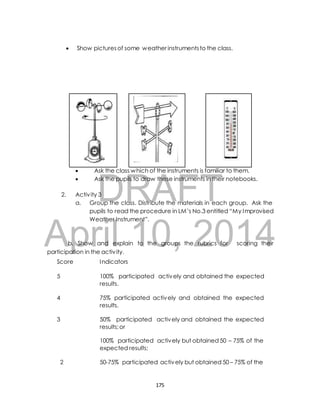
communicating (reporting or telling,) alongside development of appreciation of 
similarities and differences, indiv idual uniqueness and appreciation of the 
importance of parents, family and reproduction itself. 
Lesson 1: Animals Reproduction and Heredity 
Duration: 2 days 
Background Information 
86
Animals are liv ing things. Liv ing things can reproduce. Animals can 
reproduce creating offspring of their own kind. Animal offspring sharesimilar 
observable physical characteristics or traits with their parents such as the color, 
texture and length of the hair strands; shape of the face; eye shape, nose, and 
length and size of ears. 
Objectives 
At the end of each lesson, the pupils should be able to: 
1. infer that animals produce animals of the same kind; and 
2. infer that some physical traits are common or shared within the same 
group of animals. 
enlarged pictures of the animals in Activ ities 1 and 2, a series of pictures of 
a growing family of animals (video clip if available) 
A.Review 
Teacher: “What was our lesson about the other day?” 
DRAFT 
Materials 
Procedure 
B.Motivation/Presentation 
 Post a series of pictures of a growing family of animals. (A video clip can 
also be used.) 
 Ask the class: What does the picture show?/What was shown in the video? 
April (Answers will vary.) 
 Call 2-3 pupils to answer 10, the question. 
2014 
C.Lesson Proper 
Day 1 
1. Let the pupils work individually. 
2. Distribute the activ ity sheet. Give the pupils 5 minutes to answer the 
activ ity. 
3. While the pupils are doing the activ ity, post enlarged pictures of the 
animals on the board. 
4. After 5 minutes, tell the pupils to form small groups composed of 5-6 
members. 
5. Give the groups 7-8 minutes to share and discuss their answers with the 
group. Tell them to answer this question: “How did you know which adult 
animal and baby animal go together?” 
6. After doing the activ ity, tell the groups to choose a reporter who will share 
the group’s answers to the activ ity and the question on how they knew 
which animals match. 
7. After the reporting, discuss the activ ity. Refer to the pupils work during the 
class discussion. Here are some questions you can ask: 
87
 How did you know which adult animal and baby animal go 
together? 
 What characteristic is similar between the parent animal and the 
baby animal? 
8. Discuss one animal at a time. Ask: Can an animal like chicken have a 
baby fish? Why do you say so? 
9. The important concepts do be develop in this discussion are: 
 Animals can have baby animals. 
 An animal can only produce an animal of their own kind. 
 Baby animals share similar observable physical characteristics or traits 
with their parents such as the color, texture and length of the hair 
strands; shape of the face; eye shape, nose, and length and size of 
ears. 
Day 2 
10. Ask the class about what they learned from the previous activ ity as 
11. Tell them that today they will learn about observable physical traits shared 
by animals of the same kind. 
DRAFT 
review. 
12. Div ide the class into groups composed of 5-6 members. Distribute Activ ity 
2, ½ Manila paper (per group), and pens/crayons (for writing). Read 
through the procedure and clarify steps as needed. 
13. Give the groups 5-7 minutes to do the activ ity. Tell them to write their 
group answers on a ½ Manila paper 
14. The important concepts to be developed in this discussion are: 
April  Some observable physical 10, traits are shared 2014 
by animals of the same 
kind e.g., presence of fur, body shape, shapes of legs, etc. 
 While there are similar physical traits in animals of the same kind (e.g., 
dogs), the traits still differ because they come from different breed. 
Assessment 
The work of the groups in Activ ities 1 and 2 can serve as formative assessment 
for the lesson. 
Assignment (group assignment) 
Tell the class to work in groups and do Part A of Activ ity 3 (including the planting 
of mongo seeds). Tell them to bring their small container with seeds to school on 
the following day. 
Lesson 2: Human Reproduction and Heredity 
Duration: 2 days 
Background Information 
88
Reproduction is a process common to all liv ing things. I t is one of the 
various characteristics that distinguish a liv ing thing from non-liv ing thing. 
Reproduction is focused on two essential concepts: that liv ing things reproduce 
their own kind and it is important for passing on of traits from parents to offspring, 
properly termed as inheritance. 
The lessons on reproduction begin with animals (Lesson 1), plants (Lesson 
2), and humans (Lesson 3). This is to mitigate the sensitivity of discussing human 
reproduction and heredity. 
The type of reproduction, sexual and asexual, is not yet introduced in 
Grade 3. However, as a backgrounder: reproduction is sexual, when it involves 
the sperm from male and the ovum or egg cell from female, and asexual if it 
involves inheritance coming from a single parent. Sexual reproduction involves a 
chance combination of both parents’ traits, resulting in the variation and 
diversity within the same kind of liv ing things. This explains why, even in human 
families, children share similar physical traits with their biological parents. This also 
explains why people share similar characteristics within the same tribe or 
ethnicity i.e., Filipinos have similar physical features; Asians have similar physical 
features. 
DRAFT 
On the other hand, asexual reproduction results in formation of liv ing 
things which are exactly identical with the parent liv ing thing, since the new 
organism is grown from one and the same parent. When questions about sexual 
or asexual reproduction arise at this stage, pupils’ question may be entertained, 
but they should be informed that such will be discussed in the succeeding years 
of their science learning. 
April 10, 2014 
Care has to be taken in the discussion of the family. Society is faced with 
different family structures at present which defines family in a different way as 
before. Exposing a learner, who is nurtured within a family of single parent, 
adoption or any other contexts, into humiliation must be avoided. I t is highly 
suggested that parents are to be informed beforehand of the lesson and its 
possible impact on the learner so that proper actions may be done to protect 
the learner from any form of embarrassment in the treatment of the subject 
Objectives 
At the end of each lesson, the pupils should be able to: 
1. infer that humans can only have human babies; and 
2. infer that some physical traits are common or shared among a certain 
group of people (i.e., class, family, ethnic group). 
Materials 
enough cut-outs of a happy face (represent a child) 
enlarged picture showing children of different ethnicity 
89
A.Review 
Ask the following questions to the class: 
 Can anyone tell us what the lesson was yesterday? 
(We learned that baby plants come from parent plants. So plants also 
reproduce. Plants can grow from seeds, or other parts of the parent plants 
like roots, stems or leaves. 
 Can you name some examples? (Answers will vary) 
B.Motivation/Presentation 
1. Ask the class: 
 Where do human babies come from? 
 Can a dog give birth to a human child? Why do you say so? 
 Can humans give birth to a chick or kitten? Why do you say so? 
2. Tell the class that similar to animals, humans can only produce human 
babies. Tell the class that in Activ ity 5, they will find out about physical 
traits they share with their family and classmates. 
DRAFT 
Procedure 
C.Lesson Proper 
Day 1 
1. Let the pupils do Activ ity 5 indiv idually first (Steps 1 and 2). Give them 5-7 
minutes to finish these steps. 
2. Div ide the class into groups composed of 5-6 members. Tell them to 
answer Step 3 of Activ ity 5. 
April 3. Give the pupils five (5) minutes 10, to come up with 2014 
their group tally. 
4. While the pupils are doing the activ ity, label the board so that you and 
the class can make a class pictograph of the different traits listed in Step 3 
of Activ ity 5. 
Note: Use the happy face cut-out to represent 1 pupil. Make enough cut-outs 
for the class (about 150 pcs.) 
5. After the groups are done, start discussing Steps 1 and 2 of Activ ity 5. Point 
out to the pupils that we get some traits from our parents. Some of these 
traits are the colour of our eyes, the shape of our eye, the color of our hair, 
the type of our hair as curly or straight, the shape of our lips, the shape of 
our face, the shape of our nose, the size and shape of our ears, and the 
color of our skin. 
Then say: 
We inherit some traits from our father, some from our mother and 
some are from both our mother and father. Some traits may not 
90
be observed from our parents but these may come from our 
grandparents. 
6. Now, ask one pupil from each group to share their group data for Step 3, 
and to place the corresponding smiley face on the board. 
7. After all the groups have shared and posted smiley faces on the picto 
graph on the board, ask the following questions: 
 What physical trait has the most number of smileys? (Answer will 
depend on the actual data.) 
 What physical trait has the least number of smileys? (Answer will 
depend on the actual data.) 
 Which physical trait is shared by most (if not all) pupils in your class? 
(Answer will depend on the actual data.) 
 What does this tell us about ourselves and our classmates physical 
traits? (Answers will vary but highlight this idea if it comes out: we 
share similarities and differences in physical traits/features because 
we are all human beings.) 
8. The important concepts to be developed in the discussion are: 
 There are physical traits that we inherit from our birth parents. 
 Some physical traits are shared within a family or within the same 
DRAFT 
ethnic group.(color of eyes, kinds of hair, color of skin, shape of 
nose, eyes, mouth) 
Day 2 
9. Let the pupils work individually on Activ ity 6. Give them 5 minutes to do 
the activ ity. 
April 10. Div ide the class into groups composed of 5-6 members. Give them 3-4 
minute to share and discuss 10, their answers to the 2014 
activity. 
11. During the class discussion, use the questions in the activ ity as jump-off 
points. Ask follow-up questions as needed. 
12. The important concepts to be developed in the discussion are: 
 Some physical traits are shared within a family or within the same 
ethnic group. 
 General physical features/traits are shared by humans/people 
regardless of ethnicity such as: general body parts (e.g., head and 
body, shape of arms and legs, etc.). 
Assessment 
The answers to questions in Activ ities 5 and 6 can serve as formative 
assessment. 
Assignment 
Bring a family picture and be able to tell your physical characteristics with 
your parent. 
Lesson 2: Plants Reproduction and Heredity 
91
Background Information 
Many plants grow from seeds but they can also grow from other plants 
parts like the stem, leaf, and root. Plants like strawberry and spider plant produce 
new plant through its horizontal above-ground stem. Aloe plant can grow new 
plant by placing a cut leaf on top of soil and kept moist for a few days. 
Objectives 
At the end of each lesson, the pupils should be able to: 
1. infer that plants produce plants of the same kind; and 
2. infer that some physical traits are common or shared within the same 
group of plants. 
enlarged picture of a tomato plant and a mature mongo bean plant, real 
tomato fruit; Activity 4 - enlarged picture of katakataka and agave plant 
DRAFT 
Duration: 2 days 
Materials 
Procedure 
A.Review 
Ask the class: “What did you learn from our previous lesson?” 
(Animals give birth to baby animals of their own kind.) 
(There are similar and different physical traits in animals belonging to the 
same kind.) 
April 10, 2014 
B.Motivation/Presentation 
1. Post an enlarged picture/drawing of a tomato plant. 
2. Call pupils to label all the plant part of the tomato plant on the board. 
3. Ask the class: “What part of the tomato plant develops into a fruit?” 
(flower) 
4. Show a tomato fruit to the class before cutting it open. Then, ask the 
following: 
3. What do you see inside the fruit? (Flesh, pulp, seeds) 
4. What would happen if we plant the tomato seed in the ground? (I t 
would grow into a new tomato plant.) 
C.Lesson Proper 
Day 1 
1. Tell the pupils to bring out their materials (by group). 
2. Let the pupils continue Part B of Activity 3. Give the groups 5 minutes to do 
Part B. Tell them to make an enlarged version of their drawings in Boxes A, 
B, and C on a ½ sheet of Manila paper. 
3. Tell the groups to post their drawings on the board. Tell the groups choose 
a reporter. Give each reporter 2-3 minutes to present their work. 
92
4. Refer to the group outputs (drawing) during the discussion. 

5. Show a picture/drawing of a mature mongo plant. Then ask: 
 Does the parent plant look like its young? 
 Can a tomato plant grow from a mongo seed? Explain your answer. 
6. The important concepts to be developed in the discussion are: 
 Plants can have young plants. 
 A young plant can grow from seeds. 
 Plants can only reproduce plants of their own kind. 
Day 2 
7. Let the pupils work individually for Activity 4. Distribute the activity sheet. 
8. Give the class seven (7) minutes to do the activ ity. 
9. Post the enlarged picture of the katakataka plant on the board. Ask the 
questions in the activ ity sheet for the discussion. 
10. Post the enlarged picture of the agave plant on the board. 
11. Ask the questions in the activ ity sheet for the discussion. 
12. The important concept to be developed in the discussion is: 
 Many plants grow from seeds but they can also grow from other plants 
parts like the stem, leaf, and root. 
DRAFT 
Assessment 
Note to the teacher: You can choose 5 different plants that are commonly 
found in your community to indigenize the assessment activ ity. 
How do these plants produce plants of their own kind? Write your answers in 
April the table. 
Parent plant Plant 10, part where it grows from 2014 
(seed, stem, leaf, roots) 
Scoring Guide: 
93 
1. Mango 
2. Corn 
3. Rice 
4. Kangkong 
5. Ginger 
Point/s Criteria Sample answers 
Fully correct 
5 Gives 5 correct 
answers: 
Mango – seed 
Corn – seed 
Rice – seed 
Kangkong – seed or 
 Mango – seed 
 Corn – seed 
 Rice – seed 
Kangkong –stem 
 Ginger - root
April 10, 2014 
Assignment 
Have the pupils copy this letter for their parents and tell them to have their 
parents sign it. Tell them also to fill in the missing information. Alternatively, you 
can have the letter photocopied and distributed to each pupil of the class. 
94 
stem 
Ginger – root 
Partially correct 
4 Gives 4 correct 
answers 
 Mango – seed 
 Corn – seed 
 Rice – seed 
Kangkong –stem 
 Ginger - 
3 Gives 3 correct 
answers 
 Mango – root 
 Corn – stem 
 Rice – seed 
Kangkong –stem 
 Ginger - root 
2 Gives 2 correct 
answers 
 Mango – leaf 
 Corn – leaf 
 Rice – stem 
Kangkong –stem 
Ginger - root 
1 Gives 1 correct 
answer 
 Mango – leaf 
 Corn – leaf 
 Rice – stem 
Kangkong –stem 
Ginger - 
0 Incorrect answers Mango – flower 
Corn – leaf 
Rice – seed 
Kangkong – leaf 
Ginger - leaf 
No answer
Dear Mr./Mrs. ______________ 
We are about to start our lesson on human reproduct ion and heredity in 
class, and there are topics that your child, (name of pupil) , 
find hard to understand especially if/when the family is put in focus. 
Observable physical t rait s like eye color, hair texture, body shape, 
height , and skin color would also be tackled in the lesson. 
Kindly guide your child with the assignment s to be given to help handle 
sensit ive topics. Rest assured that I will t reat the subject carefully so as 
not to cause any awkwardness or discomfort to your child during the 
lesson’s durat ion. Thank you very much. 
DRAFT 
 Tell the pupils to bring a picture of their family for the next lesson. 
Sincerely yours, 
CHAPTER 5: Ecosystem 
April (Name of the Teacher) 
Overview 
10, 2014 
The pupils studied about heredity in Chapter 5 of Unit I I . They learned that 
through reproduction, characteristics are passed on from parents to children in 
humans, from parent-animal to offspring and from parent-plant to offspring. 
Several characteristics were identified to pass on from parents to offspring in 
humans, animals and plants. In this lesson, the pupils concluded that like begets 
like, human beings produce human beings, animals produce animals and plants 
produces similar plants. 
In chapter 6, pupils will realize that humans, plants and animals have 
common basic needs such as air, food, water, and shelter. They will also become 
fully aware that liv ing things depend on the environment to meet their basic 
needs and they will recognize that there is a need to protect and conserve the 
environment. 
Process skills involved in the activ ities include comparing and explaining. 
Lesson 1. The Basic Needs of Humans, Animals and Plants 
Duration: 1 day 
Background Information 
95
Plants and animals have the same needs as humans. All liv ing things need 
food, water and air. Plants need “food”, the minerals and nutrients from the soil, 
energy from the sun and water. They also need the carbon dioxide from plants. 
Humans and animals need enough nutritious food, clean water to drink, 
comfortable and safe home, and unpolluted air to breathe. 
1. Breathing in plants can be explained as the exchange of gases. The 
plants give off oxygen and absorb carbon dioxide from animals and humans. 
Eating in plants can be explained as the absorption of minerals and 
nutrients from the soil and energy from the sun. 
Drinking in plants can be explained as the absorption of water from the 
soil and movement as the reaction of the plants to gravity, sunlight and wind. 
a. Activ ities common to humans, animals and plants include breathing, 
eating, drinking, movement and liv ing in a habitat. 
b. Humans, animals and plants breathe the same air. The air they breathe is 
from the environment. 
DRAFT 
Note: 
2. 
c. Humans, animals and plants do not eat the same food but they get the 
food from one source, the environment. 
d. Humans, animals and plants drink the same water but not from the same 
source. The water they drink is from the environment. 
e. Humans, animals and plants do not live in the same habitat. All of these 
habitats are found in the environment. 
April Objectives 
10, 2014 
At the end of each lesson, the pupils should be able to: 
1. identify the basic needs of humans, animals and plants; and 
2. compare the similarities and differences in the basic needs of humans, 
animals and plants. 
Materials 
picture of the basic needs of human. Animals and plants 
Procedure 
A. Review 
The teacher can relate the lesson on heredity to the lesson on 
ecosystem. 
Sample questions the teacher can ask the students: 
a. What characteristics do children get from their parents? 
b. Can human parents produce children that are not humans? 
c. Can animals produce children that are humans? 
d. Can plants produce animals or humans? 
B. Motivation / Presentation 
96
The teacher can ask the students to determine the message about 
the environment by solving the puzzle. 
Guess the Secret Message 
Michelle was given a piece of paper containing a secret message 
by a stranger. Unfortunately, before she is able to read the message, the 
paper was torn into six pieces and blown by the wind. 
Can you help Michelle determine the secret message? Here are the six 
pieces of paper. 
avse eth tnenivnrom vase rou trefuu 
Secret Message: Save the environment, save our future. 
DRAFT 
C. Lesson Proper 
2. Let the pupils do Activ ity 1. Give them 15 minutes to answer the 
activ ity. 
3. Write the table on direction 1 on the board. 
4. After 15 minutes, ask the pupils to complete the table on the board. 
5. The teacher may elaborate on the answers of the pupils. 
6. Ask other pupils to answer question a of direction 2. 
7. The teacher may elaborate on the answers of the pupils. 
8. Ask other pupils to answer question b of direction 2. 
9. The teacher may elaborate on the answers of the pupils. 
10. Ask other pupils to answer question c of direction 2. 
11. The teacher may elaborate on the answers of the pupils. 
12. Ask other pupils to answer question d of direction 2. 
13. The teacher may elaborate on the answers of the pupils. 
14. As other pupils to answer question e of direction 2. 
15. The teacher may elaborate on the answers of the pupils. 
16. Come up with the following conclusions: 
April 10, 2014 
 Humans, animals and plants have basic needs such as air, food, 
water and shelter. 
Assessment 
1. What are the basic needs of human beings? 
2. What are the basic needs of animals? 
3. What are the basic needs of plants? 
4. Do humans, animals and plants have the same basic needs? 
Assignment 
97
The students may bring colored construction paper for the next activity. 
Lesson 2. Things We Need from the Environment 
Duration: 2 days 
Background Information 
The environment consists of liv ing and non-liv ing things. Liv ing things that 
live in the environment are the humans, plants and animals. They depend on 
both liv ing and non-liv ing things in the environment for their basic needs. Any 
activ ity, whether natural or man-made that changes the conditions of liv ing and 
non-liv ing things in the environment significantly affects living things. 
Objectives 
At the end of each lesson, the pupils should be able to: 
1. identify the needs of liv ing things that are provided by the 
environment; and 
2. explain how liv ing things depend on the environment to meet their 
DRAFT 
basic needs. 
Materials 
sun headband, headband pattern of sun, headband pattern of rain 
headband pattern of rice plant, headband pattern of caterpillar 
headband pattern of bird, headband pattern of chicken 
April Procedure 
10, 2014 
A. Review 
The teacher can relate the lesson on the basic needs of humans, 
animals and plants to the lesson on things we need from the environment. 
Sample questions the teacher can ask the students: 
1. What are the basic needs of humans, plants and animals? 
2. Where do we get the air, food and water we need? 
B. Motivation / Presentation 
My Favorite Food 
The teacher can ask a few students to share to class their favorite 
food. The teacher will write on the board the examples given by the 
students. She will then ask “Where do you think your favorite food comes 
from?” This is to emphasize that the things we need are obtained from the 
environment. 
Sample Flow of Conversation: 
Teacher: What is your favorite food? 
98
Student: My favorite food is fried chicken. 
Teacher: Where do you think the fried chicken comes from? 
Student: (possible responses) 
The fried chicken is from the grocery. 
The fried chicken is from the poultry. 
The fried chicken is from the fast food. 
Teacher: What is your favorite food? 
Student: My favorite food is fish. 
Teacher: Where do you think the fish comes from? 
Student: (possible responses) 
The fish is from the market. 
The fish is from the river. 
The fish is from the ocean. 
the fish is from the fishpond. 
C. Lesson Proper 
DRAFT 
Day 1 
1. Lead the pupils in doing Activ ity 2. Preparation and conduct of the 
activ ity could take the whole period. 
2. Care should be observed in the use of cutting materials like scissors. 
Day 2 
1. Review what the pupils did in Activ ity 2. The following guide questions may 
April be asked. 
10, 2014 
 What liv ing things were involved in the activity? 
 What non-liv ing things were involved in the activ ity? 
 What is the role of the sun? 
 What is the role of rain? 
 Who ate the rice plants? 
 Who ate the caterpillars? 
 Who ate the birds? 
 Who ate the chicken? 
2. Ask the pupils to answer question 7 of Activity 2. 
3. The teacher may elaborate on the answers given by the pupils. 
4. Ask the pupils to answer question 8 of Activity 2. 
5. The teacher may elaborate on the answers given by the pupils. 
6. Ask the pupils to answer question 9 of Activity 2. 
7. The teacher may elaborate on the answers given by the pupils. 
8. Ask the pupils to answer question 10 of Activity 2. 
9. The teacher may elaborate on the answers given by the pupils. 
10. Ask the pupils to answer question 11 of Activity 2. 
11. The teacher may elaborate on the answers given by the pupils. 
12. Come up with the following conclusions. 
99
 Liv ing things depend on the environment for their basic needs such 
as air, water, food, and shelter. 
 Human beings depend on plants and animals for their supply of 
food, on the environment for clean air, clean water and shelter. 
Plants depend on the environment for their supply of sunlight and 
water, minerals and nutrients from the soil. Animals depend on 
plants and other animals for food, on the environment for clean air, 
clean water and shelter. 
Identify the letter of correct answer. 
1. Why is water important? 
a. I t is a resource that cannot be replenished. 
b. I t has many uses. 
c. I t is found in many places. 
d. I t is part of the earth. 
2. Why is the sun important? 
DRAFT 
Assessment 
a. I t provides light. 
b. I t provides heat. 
c. it provides energy. 
d. all of the above 
3. Why are plants important? 
a. They serve as food to animals. 
b. They produce oxygen. 
c. They prevent soil erosion. 
d. all of the above. 
April 10, 2014 
Assignment 
The students may bring drawings or pictures of a beautiful things found in the 
environment 
Lesson 3. Conservation and Protection of the Environment 
Duration: 2 days 
Background Information 
The earth is one of the planets in the solar system. I t is the planet we call 
home. I t is the only planet that has the environment that can support life. I f we 
do not take care of the environment in our planet, we have no other planet to 
go to. I f humans continue to do the activ ities that harm the environment, it will 
result to a lot of problems like polluted air, polluted soil, and polluted water. Also, 
100
it could worsen the effects of natural calamities like typhoons. Mountain without 
forest cover because of massive cutting of trees will result to deadly landslides 
and floods. These do not only lead to damage to property but result in the loss of 
human lives as well. 
1.What are the things that humans do that harm animals and plants? 
Humans cut trees indiscriminately. This destroy the homes of a lot of 
animals that live in trees. They also capture animals in the wild and keep 
in them in cages as pets. Humans let dirty water from their houses and 
factories to flow into rivers and lakes. Humans also throw their garbage 
anywhere like in rivers that could pollute the water and kill fishes and 
other aquatic animals. Humans also do let the dirty exhaust from their 
vehicles to pollute the air. 
2.What will happen if we continue to cut a lot of trees. 
The continuous cutting of trees will result to the displacement of animals 
liv ing in these trees. I t could also result to the disappearance of a lot of 
animal and plant species that depend on trees. Moreover, the absence 
of trees in mountainous areas results to landslides and floods because of 
the absence of the roots of trees that absorbs water and help in 
maintaining the solidity of the soil. 
DRAFT 
3.What will happen if we will not take care of the air we breathe? 
April The breathing of polluted 10, air could result 2014 
to diseases in humans like 
asthma, allergy and other diseases of the lungs. 
Objective 
At the end of the lesson, the pupils should be able to explain why there is a need 
to protect and conserve the environment. 
Materials 
large pictures of Philippine plants and animals,Large pictures of human activ ities 
that harm the environment, Large drawing of the illustration in the activ ity. 
Procedure 
A. Review 
The teacher can relate the lesson on the things liv ing things need 
from the environment 
Sample questions the teacher can ask the students: 
a. What are the things we need from the environment? 
b. What will happen to liv ing things if the environment can no 
longer provide our needs? 
101
B. Motivation / Presentation 
The Treasures of the Philippines 
The teacher can show to class pictures of Philippine animals and 
plants. An example that can be used is the Philippine eagle. A short 
description and explanation on how the population of eagles 
deteriorated because of massive deforestation and how their existence is 
still threatened because of their disappearing habitat can be provided to 
students. The teacher needs to emphasize that there are things that 
humans do that harm the environment. In the same manner, humans can 
also do a lot of things to protect and conserve the environment. 
1. Let the pupils 2. After 15 minutes, 3. Ask pupils to DRAFT 
do Activ ity 3. Give them 15 minutes to do the activ ity. 
lead the pupils in answering the questions. 
answer question a of number 2. 
4. The teacher may elaborate on the answers given by the pupils. 
5. Ask pupils to answer question b of number 2. 
6. The teacher may elaborate on the answers given by the pupils. 
7. Ask pupils to answer question c of number 2. 
8. The teacher may elaborate on the answers given by the pupils. 
9. Ask pupils to answer question d of number 2. 
10. The teacher may elaborate on the answers given by the pupils. 
11. Ask pupils to answer question e of number 2. 
12. The teacher may elaborate on the answers given by the pupils. 
13. Come up with the following conclusions: 
C. Lesson Proper 
Day 1 
April 10, 2014 
 There is a need to protect and conserve the environment. 
 Humans perform activities that harm the environment. 
 Humans can do a lot of things that can protect and conserve the 
environment. 
Day 2 
1. Review what the pupils did in Activ ity 3. The following guide questions may 
be asked. 
 What activ ities do humans do that harm the environment 
 What activ ities can humans do to conserve and protect the 
environment? 
2. Group the students into six teams. Let them bring out the drawing 
materials they brought to class. 
3. Each team will write three promises, things that they will do to protect and 
conserve the environment. 
102
4. Let them decorate their outputs with their colouring materials. 
5. After the pupils are finished with their outputs. Let the teams present their 
promises in front of the class, with each member of the group reciting the 
promise and giv ing short explanation. 
6. Come up with the following conclusions. 
 There is a need to protect and conserve the environment. 
 Humans perform activities that harm the environment. 
 Humans can do a lot of things that can protect and conserve the 
environment. 
Sample rubric for evaluating the pupils’ outputs 
Points Description 
5 The pupils demonstrate full understanding of the 
topic. 
4 The pupils demonstrate good understanding of 
DRAFT 
Assessment 
the topic. 
3 The pupils demonstrate good understanding of 
parts of the topic. 
2 The pupils does not seem to understand the 
topic at all 
You may add neatness, legibility and attractiveness to the criteria for evaluation. 
April Assignment 
10, 2014 
The students may write their own slogans or draw a poster on environmental 
conservation and protection. 
Unit Test 
(Sample Only) 
Sense Organs How to take care 
Eyes 
 Wearing sunglasses on a sunny day 
 Using goggles when swimming 
103 
Ears 
 Using clean cloth in wiping the outer ear 
 Wear earmuffs 
Nose 
 Covering the nose while passing a dusty road 
 Using a clean cloth in cleaning the nose 
Tongue 
 Using a tongue scraper to clean the tongue 
 Brushing teeth 
Skin 
 Taking a bath everyday 
 Wearing clean clothes 
 Drinking plenty of water
Plant Plant Part Use 
FT / 
2014 
x / 
Uses of Coconut Plant 
 
 
 
 
 
1 
. 
2. 3. 4. 5. 
Write yes Liv ing thing and no if Non Liv ing thing 
DR 
A 
X 
10, 
/ 
/ 
x 
x 
x / x 
Coconut 
midrib of leaves To make into a broom 
Trunk For construction 
coconut shell 
As firewood 
Decoration 
coconut oil Medicine, cooking oil 
coconut meat and 
Food 
water
April 
/ 
104
Study the picture below. Write down the do’s and dont’s in conserving and 
protecting of our mother earth. 
DRAFT 
April 10, 2014 
UNIT 3: Force, Motion, and Energy 
Overview 
In the first quarter, pupils learned that there are different materials around 
them. These materials can be solid, liquid, or gas. In the second quarter, the 
pupils learned about people, animals and plants. In this quarter, they will learn 
that materials such as magnets, water, and moving air can make objects move. 
People, animals, and plants can also make an object move. 
Chapter 1: Moving Objects 
There are different ways in which we describe ways of moving objects. 
Some ways to make objects move can be by pushing, pulling, throwing, kicking, 
tossing, blowing, and dropping them. However, if you look closely at the different 
105
ways to make an object move, they can only be grouped into two – pushing 
and pulling. Force is introduced as a push or a pull. Force causes an object to 
move. In describing the motion of an object, using a reference point or a 
reference object is emphasized to give the accurate or precise location of the 
object. 
This chapter also discusses that when a force is applied on an object, the 
object can move fast or slow, forward or backward, or stretched or compressed. 
Using toys such toy car, wind wheel, and paper boat is used to make 
learning fun for the pupils. This way, the pupils will feel that science is not just a 
subject in school, but is also part of their everyday life. 
Science process skills such as observing, communicating, and classifying 
are emphasized in the activ ities. 
Lesson 1: Describing the Position of an Object relative to another object 
Duration : 2 days 
DRAFT 
Activity 1 
Background Information 
In describing the position of an object, relative to another object, give the 
accurate or precise location of an object t. 
April Objective 
At the end of the lesson, the 10, pupils should be able 2014 
to describe the position or 
location of an object relative to another object. 
Materials 
different objects like table, book, ball, door, balloon 
Procedure 
A. Motivation / Presentation 
2. Let the pupils do the KWL chart. 
3. Tell the pupils to write the names of their classmates in front, beside, and 
behind them. 
 Who sits in front of you? 
 Who sits on your right side? 
 Who sits on your left side? 
 Who sits behind you? 
4. After they finish writing, call 3 to 4 pupils to check if they have identified 
their classmates correctly. 
106
5. Tell the pupils that in describing the position of an object, they should 
always have a reference point or reference object to give the precise 
position of the object. 
6. Ask the class: “What was your reference point in identifying your 
classmate?”(The pupils should be able to tell that they were able to name 
their classmates with reference to themselves.) 
11. Let the pupils do Activ ity 1 indiv idually first. Give them 5 minutes to answer 
the activ ity. 
12. Let the pupils work in small groups composed of 5 members. 
13. Tell the pupils to discuss their indiv idual answers in the group to come up 
with group answers. Give them 5 minutes to discuss. 
14. Give each group 2-3 minutes to present their answers. 
15. While each group is presenting, tabulate their answers on the board as 
DRAFT 
B. Lesson Proper 
shown. 
April 2014 
16. Tell the pupils to look at other groups’ answers. Ask the class if they have 
the same answers or not. I f there are different answers, refer back to the 
pictures so the class can decide on the correct answer with your 
guidance. 
17. Use the enlarged pictures (a to e) in Activ ity 1 to ask the following 
questions. 
 What is the reference object in describing the position of the book? 
(The table serves as the reference object in describing the position 
of the book.) 
 What is the reference object in describing the position of the ball? 
(The boy serves as the reference object in describing the position of 
the ball.) 
107 
Activity 1 
Groups 
1 2 3 4 5 6 
a. The book is on ______of the 
_______. 
b. 
c. 
d. 
e.
 What is the reference object in describing the position of the door? 
(The boy serves as the reference object in describing the position of 
the door.) 
 What is the reference object in describing the position of the cat? 
(The table serves as the reference object in describing the position 
of the cat.) 
 What is the reference object in describing the position of the balloon? 
(The girl’s hand serves as the reference object in describing the position of 
the balloon.) 
 Why is it important to use a reference object in describing the position of 
an object? (I t is important to use a reference object to be able to give the 
precise position of the object.) 
18. Come up with conclusions about describing the position of an object based 
on the activ ity: 
 The position of an object can be determined by locating its position 
relative to another object. 
 I t is important to use a reference object to describe the position of 
another object to be able to locate them easily. 
DRAFT 
Assessment 
“Find Me” Game: 
1. Place 5 objects in different location inside the classroom (add more 
objects if there are more than 5 groups). 
2. Write each object on a piece of paper. 
3. Call the group leaders to pick one piece of paper. 
4. Distribute ¼ lengthwise strip of bond paper to each group. 
5. Tell each group to describe the position of the object that their leader 
April 10, 2014 
picked. 
Sample Rubric: 
Assignment 
Tell each group to bring a toy car for the next activ ity. 
108 
Level of 
Performance 
Criteria Sample answer 
Excellent 
(5 points) 
1) Used a reference object and 
the correct adverb of place 
to describe the position of the 
object. 
2) All members participated 
The box is behind the 
bookshelf. 
Very Good 
(3 points) 
Same as in excellent but some 
members did not participate. 
The box is behind the 
bookshelf. 
Fair 
(1 point) 
Members participated but the 
answer is not correct, 
incomplete, or unclear 
The box is in f ront of 
the bookshelf.
Activity 2. How do you know that an object has moved? 
Duration: 2 days 
Background Information 
An object has moved if it travels a distance from its reference point. A 
reference point is the position of an object where it starts before moving. I t is 
important to know the reference point of an object to describe how far an 
object moves. 
Road markers like the one shown below are important for travellers. I t tells 
how far the place from the sign. 
Gasoline Station 
500 m 
Town Center 
5 km 
DRAFT 
Objective 
At the end of the lesson, the pupils should be able to describe the location of an 
object after it was moved. 
April Materials 
10, 2014 
meter stick toy car picture of a road sign 
Procedure 
A. Review 
Ask the following questions: 
 What is needed to describe the position of an object correctly? (There 
must be a reference object/point.) 
 Why is it important to describe the precise location of an object? 
(Answers will vary but would include: to make it easier to f ind an 
object.) 
B. Motivation / Presentation 
1. Ask a one pupil to walk from one location to another, then ask: 
 Did your classmate move? 
 How did you know that your classmate moved? 
(The pupils should be able to tell that their classmate moved by describing 
his/her position relative to the starting point or another object.) 
109
2. Show to the class a meter stick. Discuss the unit of measurement used and 
how the measurement is taken (small and large lines). 
3. Measure the distance walked by the pupil from his/her starting point to 
the point where he or she stopped. Call a pupil to read the 
measurement. (Sample measurement could be 100 centimeters or 100 
cm; 1 meter or 1 m) 
C. Lesson Proper 
1. Let pupils work in groups, composed of 5 members each group. 
2. Let the pupils do activ ity 2 (refer to the LM). Give them 10 minutes to do 
the activ ity. 
3. Tell the groups to fill out the table on the board. Make sure that they write 
their answers in the row assigned to their group. 
Write an enlarged version of this table on the 
Note: DRAFTboard. Add more 
April 10, 2014 
r 
ows if there are more groups. 
4. Let each group report their answers to questions a to d. 
5. Check answers of the groups. Refer to the answers to questions in the 
activ ity. 
6. I f there are incorrect answers or different answers in questions a and d, let 
the pupils analyze their answers and identify where and how they made 
mistakes. 
7. After checking their answers, ask the class: 
 How do you know that an object has moved? (An object has 
moved if it travels a distance f rom its reference point.) 
 Why is it important to include the reference point in describing the 
location of an object? (It is important to include the reference 
point in describing how far an object moves to give a correct 
description of its location.) 
 Why is it important to measure the distance travelled by an object? 
(It is important to measure the distance travelled by an object to 
give the exact location of the object.) 
8. Show a picture of a road mark (Refer to the background information on 
what a road mark is and what to highlight). 
 I s this road mark important? (Yes) 
 Why is this important? (I t tells people or car drivers how far they 
need to travel to reach the indicated destination.) 
110 
Group 
Location of the 
car before it 
was pushed 
How far 
did the toy 
car move? 
Location of 
the toy car 
after 
pushing 
Reference 
point/object in 
describing the 
location 
1 
2 
3
Picture A shows a classroom while picture B shows the same classroom 
after a day. 
1. Encircle three objects that were moved from their original location. 
Picture A Picture B 
Left 
Right Right 
DRAFT 
Assessment 
Left 
2. Describe the present location of the three objects you encircles in step 
1. Write your answers in the table below. 
Object Location 
Assignment April 10, 2014 
Draw two objects which show movement on a short bond paper. Describe 
the location of the object after it was moved. 
Activity 3: How can you make objects move? 
Duration: 2 days 
Background Information 
Force is a push or a pull. Force can cause an object to move. Force 
maybe applied in different ways. Some ways to make objects move are by 
blowing, dropping the object, lifting, pressing, rolling, throwing, rotating, pushing 
and pulling. 
Objective 
111 
1. 
2. 
3.
At the end of the activ ity, the pupils should be able to describe different ways of 
moving objects. 
Chart (Similar to Table 1 in Activ ity 3 of the LM) 
Assorted objects (examples: eraser, pencil, notebook, key, coin, ball, clay) 
 How do you know that an object has moved? (An object has moved if 
it travels a distance from its reference point.) 
 Why is it important to include the reference point in describing the 
location of an object? (It is important to include the reference point in 
describing the location of an object to show the distance travelled by 
the object.) 
DRAFT 
Materials 
Procedure 
A. Review 
Ask: 
B. Motivation / Presentation 
1. Let the pupils read the rhyme below. 
Rhyme Reading 
What can you do with a ball? 
Shoot, throw, and make it roll. 
Come let's play with my ball. 
I t’s so fun, I know how to dribble. 
April 10, 2014 
2. Ask: What are the words that describe movement of the ball in the 
rhyme? (Shoot, throw, roll, and dribble) 
3. Tell pupils that they will find out different ways of making objects move. 
C. Lesson Proper 
1. Let the pupils work in groups composed of 5 members each. 
2. Let the pupils do Activ ity 3 (refer to the LM). Give them 10 minutes to do 
the activ ity. 
3. While the pupils are working, write or post an enlarged version of Table 1 
on the board. 
4. Give each group 2-3 minutes to present their work. 
5. While a group is reporting, write their chosen objects and how they made 
each object move on the enlarge version of Table 1. I f the same object is 
used by other groups, list their answers under the existing entry. 
6. After the group presentation, call a pupil to demonstrate how to move 
the object based on the summarize answers on the board. 
112
Table 1. Different ways of moving different objects 
Object How did I make the object move? 
7. Ask the class how many ways of moving an object they identified for 
each listed object in Table 1. Underline the words they use (e.g. pushing, 
pulling, throwing, kicking, dropping, etc.). 
8. Ask the following questions: 
 What are the different ways you did to move the different objects? 
 What is the direction of the object when you push it? (It moves 
DRAFT 
away f rom me.) 
 What is the direction of the object when you throw it? (It moves 
away f rom me.) 
 What is the direction of the object when you toss it? (It moves away 
f rom me.) 
April  What is the direction of the object when you kick it? (It moves 
away f rom me.) 
10, 2014 
 I s the act of throwing, tossing, and kicking similar to that of pushing? 
How? (Yes, because the object was pushed away f rom the person 
doing the pushing.) 
 What is the direction of the object when you pull it? (It moves 
towards me.) 
 What is the direction of the object when you drop it? (It moves 
away f rom me and moves towards the ground.) 
9. Tell the class that when they make an object move, they are actually 
either pushing it or pulling it. The push or pull is called force. When they 
push an object, whether it moves or not, they are exerting a force. When 
they pull an object, whether it moves or not, they are exerting a force. 
Force can cause an object to move. 
10. Explain to the pupils the case of moving objects by simply dropping or 
letting it fall. In this case, the pupil is not exerting a force. The pupil simply 
removed his/her hand that supports the object. So, what then makes it 
move downward? Introduce gravity as a force that pulls everything 
downward towards the center of the Earth. 
11. Explain also the case of making the object rotate. I s it pushing or pulling? 
To make an object like a pencil rotate, it is pushed on opposite sides. 
113 
Example: 
eraser 
By pushing with my fingers 
By lifting with my hand 
Sample answers 
key 
ball 
By pushing into the keyhole with my fingers 
By pulling from the keyhole with my fingers 
By throwing with my hand 
By kicking with my foot
12. Ask the pupils to give examples of how animals move objects. Show 
illustrations if available. 
 A carabao pulling a plow. 
 A horse pulling a cart. 
 An elephant lifting a trunk using its tusk. 
13. The concepts developed are as follows: 
 Pushing, pulling, tossing, dropping, kicking, and flipping are some of 
the ways in making objects move. 
 Force is a push or a pull. 
 Force can cause an object to move. 
 Animals can also move objects. 
1. List 2 tasks you do at home that involve pushing. 
2. List 2 tasks you do at home that involve pulling. 
DRAFT 
Assessment 
Assignment 
Draw or cut a picture of different ways in moving a ball. 
Lesson 4: Wind can make Objects Move 
Activity 4: Making a Wind Wheel 
Duration: 2 days 
April Background Information 
10, 2014 
Wind can make objects move. Wind exerts force on the object. Some of 
the objects that are moved by the wind are the flag in the flagpole, the leaves 
of trees, window curtains and other light objects. 
Objectives 
At the end of each lesson, the pupils should be able to: 
1. describe how wind moves objects; and 
2. make a wind wheel. 
Materials 
Paper for demonstration, finished wind wheel as model 
Pencil with eraser, paper, paperclip, tape 
Procedure 
A. Review 
114
Let the pupils present their drawings (or picture cut-outs) on the 
different ways in making a ball move (assignment the previous day). 
B. Motivation/Presentation 
Show a model of a wind wheel and ask the pupils the following questions: 
 Have you see this kind of object? How is it called? Do you know how 
to make a wind wheel? 
 Do you know where it is used? Let us make your own wind wheel and 
see how it works outside. 
1. Let the pupils read the procedure on how to make a wind wheel. I f they 
cannot follow it, demonstrate it step-by-step. All the pupils must make 
their own wind wheel. 
2. Check the wind wheel of each pupil. Make sure it is functional. Assist 
pupils who have a hard time making their wind wheel. CAUTION: be 
careful with the sharp ends of the paper clip and in attaching it to the 
paper and eraser. 
2. Let the pupils play with their wind wheels. 
3. Let the pupils work in small groups composed of 5 members each to 
DRAFT 
C. Lesson Proper 
answer the questions in the activity. 
4. Let a member from each group report their answers. 
5. Discuss the questions while the groups check their answers. For question a, 
call 3 pupils to demonstrate how they made their wind wheels move. 
Point out that they may have done different ways to make the wind 
wheel move but all involved wind or moving air. 
April 6. The following concepts 10, developed in the activity 2014 
are: 
 Wind can make objects move. 
 Wind exerts a force that causes an object to move. 
Assessment 
Ask the pupils to draw a wind wheel. Let them list two things that are 
moved by the wind outside the classroom. 
Assignment 
Let the pupils read and gather pictures about windmills that are used 
in producing electricity. They can get it from books, magazines, or the 
internet. 
Activity 5. Making a Paper Boat 
Duration: 1 day 
Background Information 
Water can make objects move. Water exerts a force on the object to make it 
move. The object moves in the same direction as the movement of water. 
115
At the end of each lesson, the pupils should be able to: 
1. describe how water moves objects; and 
2. make a paper boat. 
basin with water, paper, tape 
finished paper boat as model 
 What makes the wind wheel move? (The force exerted by the wind.) 
 Are there windmills in the Philippines that are used to generate 
electricity? 
DRAFT 
Objectives 
Materials 
Procedure 
A. Review 
1. Ask: 
2. Tell the class that windmills are like large versions of their wind wheel, but 
are fitted with other parts and devices to generate electricity. 
B. Motivation/Presentation 
Show a model of a paper boat and ask the pupils the following questions: 
 Where do you find this kind of object? How is it called? 
 Do you know how Let us try to make a paper boat and try it out in a 
April 10, 2014 
large basin of water. 
C. Lesson Proper 
1. Let the pupils read the procedure on how to make a paper boat. I f they 
cannot follow it, demonstrate it step-by-step. All the pupils must make 
their own paper boat. 
2. Check the paper boat of each pupil. Make sure it is functional. Assist 
pupils who have a hard time making their paper boat. 
3. Let the pupils play with their paper boat. 
4. Let them work in small groups composed of 5 members each in answering 
the questions in the activ ity. 
2. Let a member from each group report their answers. 
3. Discuss the questions while the groups check their answers. For question a, 
call 3 pupils to demonstrate how they made their paper boat move. Point 
out that they may have different ways of making the paper boat move, 
but all needed moving water. 
4. Ask the class: “What other objects can be moved by w ater?” Call 3 pupils 
to answer and ask them to describe how that object is moved by water. 
5. The concepts developed in the activ ity are: 
116
 Water can make objects move. 
 Water exerts a force that causes objects like the paper boat to move. 
A plastic ball is placed in a basin with water. Write two ways to make the 
ball move without touching or blowing unto into it. 
1. ___________________________ 
2.___________________________ 
Draw a situation where water is used to move an object. 
Lesson 2. Describing the Location of an Object After it has Moved 
Activity 1. Make it Move with a Magnet! 
DRAFT 
Assessment 
Assignment 
Duration: 1 day 
Background Information 
A magnet is a solid object that has the ability to attract other magnets or 
magnetic objects. Magnetic objects are made up of iron and some other 
metals. Not all metals are attracted to a magnet (e.g. aluminium, copper, zinc, 
and brass). A magnet doesn’t have to get into contact with a touch a magnetic 
object to affect it. I t can attract a magnetic object from a short distance. 
April Objectives 
10, 2014 
At the end of each lesson, the pupils should be able to: 
1. describe how a magnet can move objects; and 
2. identify materials that can be moved by magnets. 
Materials 
For the teacher: Different magnets, chart similar to activ ity 6 in the LM 
For the pupils: Paper clips, cardboard, thumbtacks, small nails, staple wire, 
eraser, crayon, plastic bottle caps, LM (Activ ity 6: Make it Move with a 
Magnet!) 
Procedure 
A. Review 
Ask: What are the things that can make objects move that have been 
discussed in the previous lessons? (People, animals, wind, and water can 
make objects move.) 
117
B. Motivation / Presentation 
Show different types of magnets. Ask: 
 Can you describe each of these magnets? 
 what name is given to each type? 
 What does a magnet do? 
C. Lesson Proper 
1. Let the pupils do the activ ity in small groups composed of 5 members 
2. Give the groups 10 minutes to read the procedure and do Activ ity 1 
(Make it Move with a Magnet). 
3. Ask a representative from each group to report their answers. Give 
him/her 2-3 minutes to report. Use an enlarged version of the chart to 
summarize the answer of each group on the board. 
4. Discuss each question in the activ ity. Refer to the answers to 
questions/tasks in the background information. Let the group check their 
answers as you discuss the answers. I f there are different results, let the 
pupils explain their answers to be able to identify where they made the 
mistakes or call a pupil from the concerned group to demonstrate what 
they did. 
DRAFT 
each. 
5. After answering question a, ask the pupils of the direction of the 
movement of paperclip. (They should be able to observe that the 
paperclip move in the same direction as their magnet). 
Recall that force can cause an object to move. The activ ity shows that 
the magnet exerts force on the paperclip. 
April 6. For question b, the pupils should identify the objects that can be moved 
by a magnet. 
10, 2014 
7. For question c, they should observe that the objects that can be moved 
by the magnet are made iron, steel or other metal objects that contain 
these two. Those that did not move are non-metals like plastic, rubber and 
wood. I f a paperclip that is made of pure plastic is available, show to the 
pupils that a plastic paperclip will not move when placed near a magnet. 
This shows that it is not the object but the kind of material that the object is 
made of that is attracted to a magnet. 
8. The concepts developed in the activ ity are: 
 Objects attracted to a magnet are made of iron and some metals. 
Not all metals are attracted to a magnet (e.g. aluminium, brass, 
copper). 
 A magnet doesn’t necessarily have to be directly touching a 
magnetic object to affect it. I t can attract a magnetic object at a 
distance. 
Assessment 
(The group’s output in the activ ity can serve as assessment.) 
Assignment 
118
Read about where magnets came from. 
Activity 2. Attract or Repel! 
Background Information 
A bar magnet is a rectangular-shaped magnet. Each end of a bar magnet is 
called a pole. One pole is called north and the other is called south. A bar 
magnet when suspended freely will align itself so that the north pole points 
towards the Earth’s magnetic north pole. The north pole of the magnet is usually 
painted red. The strength of a magnet is strongest at the poles. When the north 
and south poles of two bar magnets are brought close to each other, they 
attract or stick together. When the north poles of two bar magnets are brought 
close to each other they repel. The same thing will happen to two south poles of 
two bar magnets that are brought close to each other. Thus, unlike poles attract 
and like poles repel 
DRAFT 
N S N 
S 
N S N 
S 
S N N S 
April Objectives 
10, 2014 
At the end of each lesson, the pupils should be able to: 
1. identify the poles of a magnet; 
2. infer that a magnet has two poles; 
3. state that like poles repel; unlike poles attract; and 
4. infer that the strength of the magnet is strongest at the poles. 
Materials 
bar magnets paper clips (without the plastic coating) 
Procedure 
A. Review 
Ask: 
What kind of objects do magnets attract? 
What should objects possess for them to be attracted by magnets? 
What have you read about the origin of magnet? 
B. Motivation/Presentation 
119
Show a bar magnet to the class. Let them describe the a bar magnet. 
Ask the pupils what they would like to know about bar magnets. Write their 
questions on the board. Go back to these questions after the lesson has been 
discussed. 
C. Lesson Proper 
1. Let the pupils do Activ ity 2 (Attract or Repel) in small groups composed of 
5 members each. 
2. Go through the procedure before distributing the materials. Give the 
groups 5 minutes to perform the activ ity. 
3. Give each group 2-3 minutes to present their answers. 
4. Let the group check their answers while you discuss each question. I f 
there are different answers, let the pupils analyze their answers and 
identify where they made mistakes. 
5. For question a, show to the pupils the bar magnet with paperclips 
attached to it. In question b, point out that the paperclips actually cling 
to the poles of the bar magnet and not at the middle part. Question c, is 
a question asking for an inference. The pupils should be able to infer that 
the strength of the magnet is strongest at the opposite ends. Then, 
introduce the term “pole” to refer to the opposite ends of the magnet. 
DRAFT 
6. For questions d and e, refer to the answers to questions in the activity. Tell 
the pupils that the red color side of the magnet is usually the north pole 
and other side is the south pole. 
7. Ask the pupils to state what they have learned. 
Expected answers are as follows: 
(A bar magnet has two magnetic poles called south and north poles.) 
(The strength of magnets is strongest at the poles.) 
(Like poles repel, while unlike poles attract.) 
April 10, 2014 
Assessment 
Draw what would happen to two bar magnets that are placed: 
1. with their N poles facing each other; 
2. with their S poles facing each other; and 
3. with their N and S poles facing each other. 
Assignment 
Bring a toy car (not battery-operated) for tomorrows activity. 
Activity 3: Ready, Set, Go! 
Duration: 2 days 
Background Information 
Wind can make an object move. The wind pushes the object along the 
direction where the wind blows. Strong winds can topple trees and houses. 
120
A magnet exerts a force of attraction to magnetic objects by attracting 
or pulling it towards them. 
People can make objects move. They can either push it or pull it. 
Objectives 
At the end of each lesson, the pupils should be able to: 
1. describe different ways of making a toy car move; and 
2. identify objects or materials that can move a toy car. 
bar magnets, toy cars, fan, string, 
A. Review 
Ask: 
 How can you make objects move? 
 What are the different ways in of making objects move? 
B. Motivation / Presentation 
1. Ask: 
DRAFT 
Materials 
Procedure 
 Do like toy car racing? 
 How can you make the toy cars move in different ways? List down 
the different answers on the board. 
C. Lesson Proper 
1. Explain to the pupils the race. Each group will have one toy car for each 
April race. The groups can 10, add accessories to their 2014 
cars depending on the 
type of race they will play. The preparation of the cars can be made 
before the class period. 
2. Ask the groups to read in the LM the description for each type of race. Tell 
which race they will play. 
3. Remind the pupils to behave properly and not be too noisy during the 
race so as not to disturb other classes. The race can be better conducted 
outside the classroom. 
4. Determine the starting line point and the finish line for the race. This will 
depend on the available space. 
5. Signal the start by loudly saying: “ready, get set and go”. The car to reach 
the finish line first will be declared as the winner. 
6. Let the pupils answer the questions in the activ ity in small groups of 5 
members each. Then, let each group present their answers. Give them 2- 
3 minutes to present their answers. 
7. Ask the pupils to give generalizations about making objects move: 
 Objects can be move by pushing, pulling, using a magnet, and by 
fanning. 
121
 People, water, wind and magnets can make objects move. 
8. Discuss the KWL chart. The pupils will answer the last column. They will write 
what they have learned from Lessons 1 and 2 of Unit 3. 
DRAFT 
April 10, 2014 
The table can be pushed by_______. 
Assessment 
Complete the statement on the right of the picture. Choose the word from the 
box below. 
wind people magnet 
1. Flag on the pole 
The flag on top of the pole can be 
moved by ____________. 
2. Thumbtacks 
The thumbtacks on the floor can be 
picked using a ____________. 
3. Balloon 
The balloon t ied on the chair can 
be moved by ___________ and 
______________. 
4. Table 
Assignment 
Let the pupils bring two identical toy cars. 
Lesson 3: Describing the Different Ways Objects Move 
Duration: 1 day 
Activity 1 : Fast or slow; Forward or Backward 
Background Information 
The movement of objects can be described as fast or slow and forward or 
backward. To describe an object as fast or slow it should be compared to 
another object. In the activ ity, the movement of one toy car is described as fast 
122
or slow compared to another toy car. This shows that in describing the 
movement of the toy car the other toy car is used as the reference object. I t 
should be noted that both toy cars started at the same position and pushed at 
the same time but with different amounts of force. One toy car is pushed lightly 
and the other harder. The movement of the toy car that first reached the 
marked line can be described as fast and the other car as slow. The toy car 
described as fast was the one pushed harder while the toy car described as slow 
was the one pushed lightly. 
The movement of the toy car is described as forward if it is pushed away 
from the person pushing it, The movement is described as backward I f the toy 
car is pulled towards the person pulling it, 
At the end of each lesson, the pupils should be able to: 
1. describe the movement of an object as fast or slow; and 
2. describe the movement of an object as forward or backward. 
DRAFT 
Objectives 
Material 
2 toy cars 
Procedure 
A. Review 
April Call on several pupils to answer 10, these questions: 
2014 
 How did you move the car in the race yesterday? 
 Who won in the car race yesterday? 
 What are the reasons why they won the game? 
B. Motivation / Presentation 
Ask: 
 Who among you have seen a track and field competition during an 
athletic meet? 
 How can one win in a game like the 100-m dash? 
C. Lesson Proper 
1. Let the pupils do the activ ity in small groups composed of 5 members. 
2. Read and discuss the procedures before distributing the materials. 
3. Give the groups 10 minutes to do the activ ity, and 10 minutes more to 
discuss and write their report. 
4. Give the group 2-3 minutes to present their answers to questions in the 
activ ity. 
5. Let the group check their work as you discuss each questions. 
6. Refer to background information for the discussion of the concepts. 
123
7. I f there are different answers, let the pupils analyze their answers and 
identify the source of their errors. 
8. Ask the pupils to give a generalization of what they have learned: 
 The movement of objects can be described as fast or slow and 
forward or backward. 
 To describe an object as fast or slow it should be compared to another 
object. The other object serves as the reference point or reference 
object. 
 The toy car described as fast was the one pushed harder while the toy 
car described as slow was the one pushed lightly. 
I . Describe a situation that shows a car moving fast. 
I I . Describe a situation that shows a car moving forward and another that 
shows a car moving backward. 
Bring a notebook spring and a rubber band. 
DRAFT 
Assessment 
Assignment 
the person pulling it, the movement is described as backward. 
Activity 2: Describing the Movement of Objects–Stretched or Compressed 
Duration: 1 day 
April Background Information 
Objects that can be 10, stretched and compressed 2014 
are elastic. Force is 
applied in stretching and compressing an object. To stretch an object, the 
object is pulled apart. To compress an object, the object is pushed towards its 
center. 
Stretching: 
Direct ion of force 
applied 
elast ic material 
Compressing: 
Direct ion of force 
applied 
elast ic material 
Objectives 
At the end of each lesson, the pupils should be able to: 
124
1. describe stretching and compressing objects; and 
2. name objects that can be stretched and compressed. 
meter stick, garter, different colors rubber bands, chalk 
Ask pupils to demonstrate: 
 How to make an object move forward and backward. 
 How to make an object move fast and slow. 
B. Motivation/Presentation 
 What can you do with a rubber band? Where do you usually use 
rubber bands? 
 What specific use do we prefer a rubber band instead of other 
materials like thread or strip of cloth? 
DRAFT 
Materials 
Procedure 
A. Review 
Ask: 
C. Lesson Proper 
1. Let the pupils do the activ ity in small groups composed of 5 members. 
2. Read and discuss the procedures before distributing the materials. 
3. Give the groups 10 minutes to do the activ ity and another 10 minutes 
discuss their results. 
4. Give the group 2-3 minutes to present their results and answers to 
April questions in the activ ity. 
5. Let the group check their 10, work as you discuss each 2014 
questions. 
6. Refer to background information for the discussion of the concepts. 
7. I f there are different answers, let the pupils analyze their answers and 
identify their sources of errors. Ask the pupils to give a generalization of 
what they have learned: 
 Objects that can be stretched and compressed are elastic. 
 Force is applied in stretching and compressing an object. 
 To stretch an object, the object is pulled apart. To compress an object, 
the object is pushed towards its center. 
Assessment 
Which of these objects can be stretched and compressed? 
(Note : Teacher will provide pictures/illustrations) 
125
String 
rubber band 
Plastic Ball 
plastic rope 
DRAFT 
Balloon 
Assignment 
Draw an object which you can find at home that can be stretched. 
Then, write below your drawing the use of the object. 
April Chapter 10, 2: Light and Heat 
2014 
Overview 
This chapter presents the different sources and uses of light and heat. 
Though light and heat are forms of energy, it is not yet introduced as such. 
Instead, the focus of this chapter is on the sources of light and how people use 
light. Pupils will classify the different sources of light into natural and artificial. They 
are introduced to objects such as the Moon and mirrors that are not actually 
sources of light but merely reflect light. Pupils will also observe that some objects 
are not only a source of light but a source of heat as well. 
Pupils will learn that light has many uses to people, animals and plants. 
People and animals are able to see things because of light. Plants need light in 
order to make its own food. Like light, heat has many uses. Pupils will learn its 
importance particularly to people as well as the danger it poses when not 
properly used. 
126
This chapter also enhance the different process skills of the pupils like 
identifying, observing, classifying, describing, inferring, communicating, 
organizing and experimenting. 
Lesson 1: Sources of Light 
Activity 1. The wonderful Light 
Duration: 2 days 
Background Information 
Natural sources of light Human-made sources of light 
Sun 
star 
lava 
firefly 
fire (can be natural or 
man-made) 
fire (from wood, lighter) 
candle 
bulbs 
flashlight 
glow in the dark toys DRAFT 
April 10, 2014 
Objectives 
Other things that give off light: moon, firefly, Christmas light, traffic 
light, spotlight, disco/mirror/glitter ball, lava, television, glow in the dark 
toys, oven, gas range 
traffic 
At the end of each lesson, the pupils should be able to: 
1. identify sources of light; and 
2. classify sources of light into natural and artificial. 
Materials 
real objects (sources of light: flashlight, kerosene lamp, matches 
candle, light bulb, pictures of lighted charcoal, sun, and moon 
Procedure 
A. Motivation/Presentation 
1. When there is power interruption/brownout, what do you use in order to 
see things around you? (f lashlight, candle, kerosene lamp) 
2. Ask the class what they know about light. Let the pupils do the KWL Chart. 
127 
Chris 
tmas 
spotlight 
oven 
television 
light 
lights
B. Lesson Proper 
1. Let the pupils do activ ity 1 in their LM individually first. 
Natural sources of light Artificial sources of light 
2. Then, the pupils will work in groups. They will write in a manila paper their 
answers for the activity. 
3. Post on the board the manila paper of each group. Give each group 2-3 
minutes to present their answers. 
4. Discuss the activ ity. Start with their answers in a – f of the activ ity followed 
by naming other things that give off light. Discuss about the natural 
sources of light and point out that the Sun is the main source of light on 
Earth. Differentiate natural source to artificial source of light. Show 
examples to pupils. Point out that Moon may look like a natural source of 
light at night but it is actually reflecting the light from the Sun. 
5. Emphasize the following concepts. 
 There are different things that give off light. 
 The Sun is the main source of light on Earth. 
 There are natural sources of light. 
 There are artificial (man-made) sources of light. 
 There are things that look like they are sources of light but actually 
DRAFT 
reflecting light only. Examples: moon, disco/mirror/glitter ball 
6. Give the assessment. 
April Assessment 
10, 2014 
Pupils may play “Pinoy Henyo”. The game is played by putting the words 
written on a strip of paper on the pupil’s forehead. The pupils will guess the 
word by asking questions that could help her/him guess the word. The class 
can only respond with “oo (yes)”, “no (hindi)” and “pw ede (maybe)”. The 
words to be guessed are all sources of light. 
Assignment 
List 3 sources of light in your home. 
Activity 2: Uses of Light 
Activity 3: Other Uses of Light 
Duration: 2 days 
Background Information 
Many of the things around us that appear to be lighted are not 
considered sources of light, but we can see them. Light is needed in order to see 
these things. Light from the source falls on these things and then is reflected to 
our eyes. 
128
Light from the Sun 
falls to the plant 
The light bounces 
off the plant and 
enter the eye. 
Objective 
At the end of the lesson, the pupils should be able to identify uses of light. 
pictures of different soures of light, picture of a boy playing tennis 
DRAFT 
Materials 
For Activity 2 
For Activity 3 
Different plants, pictures of traffic light, light house 
Procedure 
A. Review 
What are the different sources of light in your homes? 
April B. Motivation/ Presentation 
10, 2014 
1. Tell the pupils to close their eyes. 
 Ask them “can you see me? Why not? 
2. Let the pupils to open their eyes now and ask them- 
 Can you see me now? Why or why not? 
 What is the source of light that enable you to see me? 
C.Lesson Proper 
1. Let the pupils do Activ ity 2 individually. 
2. Discuss their results. Call pupils to answer each question. 
3. Discuss how we see things. Refer to background information. 
 Light is needed in order to see things. 
 Light from the source falls to the object and then reflected to the 
eyes. 
4. Let the pupils do Activ ity 3. 
5. Discuss the activ ity. 
 The leaves make food for the plants using light from the Sun. 
 Traffic lights help to control the flow of traffic on the roads. 
129
 Lighthouse helps to guide ships in the dark. I t also warns ships of 
danger. 
6. Ask the pupils to give other examples of uses of light. 
 Colorful lights are used to decorate or beautify places. 
 Overhead or LCD projectors are used to produce images on the 
screen. 
 Laser light is used in presentation as pointer. 
7. Give the assessment and check it. 
8. Give the assignment. 
Match column A with column B. 
A B 
1. Sunlight A. Help to control the flow of traffic on 
2. Traffic lights the road 
3. Lighthouse B. Use to decorate or beautify places 
4. Colorful lights C. Use to warn ships 
5. Laser D. Use by plants for making food 
DRAFT 
Assessment 
through its leaves 
E. Use in presentation as pointer 
Assignment 
Research on other sources and uses of light, using open source data and the 
internet. 
April 10, 2014 
Activity 4: Safety in Using Light 
Duration: 1 day 
Objective 
At the end of the lesson, the pupils should be able to identify the proper ways of 
using light. 
Materials 
laser if available or picture of laser 
Procedure 
A. Review 
Ask pupils to give examples of uses of light. 
B. Motivation/presentation 
Show a laser (if available) or a picture of laser. 
Questions: 
130
 Are you familiar with this object? If so, where have you seen it? 
 Where do we use laser? 
 I s it safe to point it to others eyes? 
Say: Light is important but we have to be careful in using them. 
C.Lesson Proper 
1. Let the pupils do Activ ity 4. Define what a good practice means. 
2. Discuss the results of activity. Ask the following questions: 
 Why is not good to look directly at the Sun? (Looking directly to the Sun 
can damage our eyes.) 
 Why is it good to use sunglasses? (Wearing sunglasses protect our eyes 
f rom glare or too bright light or sunlight.) 
 Why is it not good to read in the dark? (Reading in the dark will make 
the eyes work harder and become tired.) 
 Why is it good to use umbrella? (Using umbrella can protect us f rom 
sunburn.) 
3. Ask the pupils to give other examples of the harm of too much light or too 
little of it to people, plants, or animals. 
 People get sunburned skin when exposed to too much light. 
 Plants may die if exposed to too much light. Their leaves may turn 
DRAFT 
yellow or brown. 
 Plants may not grow well if not exposed to light. 
4. Give the assessment and check it. 
5. Give the assignment. 
April Assessment 
List down at least 3 proper 10, ways of using light. 
2014 
Assignment 
Draw one proper way of using light on a short bond paper 
Activity 5: Sources of Heat 
Duration: 1 day 
Objective 
At the end of the lesson, the pupils should be able to identify things that give off 
heat. 
Materials 
KWL Chart 
sun, kettle with boiling water, 
electric toaster, lighted charcoal 
Procedure 
A. Review 
131
Name some sources of light. 
What other thing do these sources of light produce? 
(Try to elicit that some objects produce both heat and light.) 
B. Motivation/ Presentation 
Tell the pupils to rub their palm together for 30 seconds. 
Ask: What do you feel? 
You may also present the KWL chart before the start of the lesson. 
1. Let the pupils do Activ ity 5. 
2. Lead the pupils in identifying and describing things that give off heat. 
DRAFT 
C. Lesson Proper 
 Sources of heat are things that give off heat. 
 The Sun is the main source of light and heat on Earth. 
 Burning wood, burning gas and electrical equipment or appliances 
such as ovens and flatirons are some other examples of sources of 
heat. 
3. Ask pupils to give other examples of things that give off heat. 
4. Ask students to give examples of things that give off light and heat. 
5. Give the assessment. 
6. Give the assignment. 
April 10, 2014 
Assessment 
Make a collage of different sources of heat. (Pictures assigned beforehand ) 
Assignment 
Have the pupils list three 3 other sources of heat at home. 
Activity 6: Uses of Heat 
Duration: 1 day 
Background Information 
People, animals and plants also use light and heat from the Sun in many 
ways. People use heat to dry clothes, fish or meat, palay, coffee, and other 
things. People have also found a way to convert the heat of the Sun into 
electricity by using solar panels. 
132 
What I Know about 
Heat 
What I Want to Know 
about Heat 
What I Learned about 
Heat
Some animals depend on the heat from the Sun to keep their body warm. 
These animals bask themselves in the Sun to warm themselves. This heat enables 
their body to function normally. 
Plants need heat from the Sun to live and grow. Seeds only start to grow 
when there is warmth from the Sun. 
At the end of the lesson, pupils should be able to describe uses of heat. 
enlarge pictures of uses of heat 
DRAFT 
Objective 
Materials 
Procedure 
A. Review 
Name some of the things that give off heat. 
B. Motivation/ Presentation 
Why is heat important to us? Can you live without heat? 
C. Lesson Proper 
April 10, 2014 
1. Let the pupils do Activ ity 6 per group. 
2. Give 2-3 minutes for each group to present their answers. 
3. Discuss the activ ity. Refer to the answers to questions in the activ ity. 
4. Ask students to give other uses of heat not mentioned in the activ ity. 
5. Discuss other uses of heat. 
Assessment 
Match the sources of heat on the left with their uses. 
1. flat iron a. for boiling water 
2. gas stove b. used for cooking 
3. airpot c. to keep warm 
4. oven d. used to press clothes 
5. fireplace e. food warming 
Assignment 
Read on the other uses of heat. 
Activity 7: Safety in Using Heat 
Duration: 1 day 
133
At the end of the lesson, the pupils should be able to identify the proper ways of 
handling hot objects. 
enlarge pictures of proper ways in handling hot objects 
Name some uses of heat. 
B. Motivation/ Presentation 
Tell the pupils that heat has a lot of uses but they must be careful in using it. 
1. Let the pupils do Activ ity 7. 
2. Discuss Activity 7. Refer to answers to questions in the activ ity. 
3. Let the pupils explain their answers in the activity. 
4. Discuss why it is important to be careful in handling hot objects. 
DRAFT 
Objective 
Materials 
Procedure 
A. Review 
C. Lesson Proper 
 We can get burned by objects that produce heat and objects that 
are hot. 
April Assessment 
10, 2014 
The completion of the KWL chart presented at the beginning of the lesson 
can serve as assessment. Fill up the column – What I learned about Heat. 
Assignment 
List 2 other safety tips in using sources of heat. 
I 
Chapter 3: Sounds 
Overview 
This chapter presents the different sources and uses of sounds. The 
different ways of producing sound and proper use of sound are integrated in 
the lesson. Making an improvised Kazoo is added as one of the activ ities as one 
source of sound. By performing the activ ities, different process skills of the pupils 
like identifying, describing sounds and appreciating its importance will be 
enhanced. 
134
Lesson1: Sources of Sounds 
Duration: 1 day 
Activity 1: Sounds around Me 
Background Information 
Sounds come from various sources. Different objects produce different 
sounds. Animals and other liv ing things including people produce different 
sounds. 
At the end of the lesson, the pupils should be able to identify various 
Manila Paper, pictures of different animals 
pictures of objects having various sounds 
DRAFT 
Objective 
sources of sound. 
Materials 
Procedure 
A. Motivation /Presentation: 
Guessing game: objects laced in a pouch or box (bell, maracas, toy duck, 
etc.) that can produce sound. Make each object produce sound. Let the 
pupils guess what objects produce these sounds. 
April What are the sounds you heard? 
What objects produced 10, these sounds? 
2014 
What are other sources of sound? 
B. Lesson Proper: 
1. Let the pupils do activ ity 1 in the LM as a group 
2. They will write in Manila paper the sounds heard and the objects that 
produce the sound. Refer to the tabular form in activ ity 1. Post on the 
board the Manila paper of each group. 
3. After all groups have done the activ ity, one representative in each 
group will report their answers. 
4. Ask the following questions: 
 What are the different sounds you heard? 
 How did you know that the object/animal/person produces the 
sound you heard? 
 What are the different sounds produced by animals? 
 Can people produce different sounds? 
5. Through the questions asked, the pupils should be able to arrive at the 
following concepts: 
 Sounds come from different sources. 
135
 Different objects produce different sounds. 
 Animals produce different sounds. 
- Dogs: arf, arf/ aw, aw 
- Cat: meow 
- Cow: moo 
 People can produce different sounds. 
- Talk in different voices. 
- Whistle 
- Sing 
- Hum 
Pupils will play “guessing game”. Each group will produce a sound 
from objects around them. They will hide behind a curtain the objects when 
they made it produce the sound. The other group will guess the objects that 
produce the sound. 
Remind the students to bring the following: 
1. Maracas 
2. Drum/box 
3. Guitar 
4. Whistle 
DRAFT 
Assessment 
Assignment 
April Activity 2: Ways of Producing Sound 
Duration: 1 day 
10, 2014 
Background Information 
Sounds are produced by objects that vibrate. The vibrations of an object 
disturb the air in such a way that sounds are produced. Sounds travel in all 
direction from its source. 
Musical instruments produced sound because they are made to vibrate. 
The drum, cymbal, tambourine, and xylophone produced sound by beating 
them. They vibrate when they are beaten. The guitar, violin and cello produced 
sound by strumming them. Their strings vibrate producing sound. The flute, 
trumpet, and trombone produced sound when they are blown. The air inside 
them vibrates producing sound. 
Objective 
At the end of the lesson, the pupils can describe the different ways of producing 
sound. 
Materials 
maracas, drum/box, guitar, whistle 
Procedure 
136
What are the different sources of sounds we discussed the other day? 
B. Motivation /Presentation 
Tell the pupils to produce sounds using the different parts of their body. 
Example: 
 I can clap my hand to produce sound. 
 I can stomp my feet to produce sound. 
1. Let the pupils do activ ity 2 in the LM as a group. 
2. After the groups have done the activity, one representative in each group 
will report their findings. 
3. Ask the following questions : 
 How is sound produced using the maracas? (By shaking it) 
 Why do you have to shake the maracas for it to produce sound? 
(So the beads [or small objects] inside it will move hitting each 
other and the maracas covering thus producing sound.) 
 How is sound produced using the drum? (By beating it using the 
DRAFT 
A. Review 
C. Lesson Proper 
stick) 
 Look at the drum when you beat it, what do you observe? (The 
drum vibrates.) 
 How is sound produced using the guitar? (By plucking the string, by 
strumming the string) 
 Look at the strings when you pluck and strum the guitar, what do 
April you observe? (The strings vibrate.) 
 How is sound produced 10, using the whistle? 2014 
(By blowing through the 
mouth piece) 
 Blow the whistle again, place your hand near the opening and feel 
it. What do you feel? (There is wind/air coming out.) 
 What are the different ways of producing sound? 
4. Tell the class that all the objects (maracas, drum, guitar, whistle)they used 
were able to produce sound because something moved or vibrated. 
Sounds are produced by objects that vibrate. 
5. Tell the class to feel their throat as they talk. Ask: 
 What do you feel? 
 Why do you think you were able to produce sound? 
6. These are the concepts to be developed in this lesson: 
 Sound is produced by objects that vibrate. 
 Sounds maybe produced by beating, blowing, strumming, and 
shaking. 
 When we speak or sing, our vocal cords vibrate and produce 
sounds unique to us. 
7. Give the assessment and check it. 
8. Give the assignment. 
137
Write on the blanks how sounds are produced by the following objects: 
1. Whistle ___________________________ 
2. Ambulance _________________________ 
3. Bell _______________________________ 
4. Xylophone _________________________ 
5. Tambourine _______________________ 
Remind the pupils to bring the following materials: 
1. Cardboard tube from toilet paper or cardboard only 
2. Waxed paper 
3. Rubber band 
4. A sharp pointed object 
5. Scotch tap 
Lesson 3: Make Your Own Kazoo 
Duration: 1 day 
DRAFT 
Assessment 
Assignment 
Background Information 
Kazoos produce a distinctive buzzing sound when you hum or sing in 
one end. The children can improve their fine motor skills by making and 
playing this simple wood wind instrument. They can make kazoos with 
common materials found around the house or school. 
April Objectives 
10, 2014 
At the end of each lesson, the pupils should be able to: 
1. make an improvised kazoo; and 
2. describe how sound is produced using a kazoo. 
Materials 
improvised kazoo 
(cardboard or tube from tissue paper. Paper, waxed paper, 
rubber band, a sharp pointed object) 
Procedure 
A. Review 
 How are sounds produced? 
 What are the different ways of producing sound? 
B. Motivation / Presentation 
Let the pupils sing “Bahay Kubo ” while holding their vocal cord and ask: 
 What do you feel when you hold your vocal cord while singing? 
Give emphasis on how sound is produced by the vibration of the vocal cord. 
138
1. Show to the class an improvised kazoo. 
2. Let the pupils do activ ity 3 in the LM as a group activ ity. 
3. When each pupils has their own kazoo, ask them to hum and let them feel 
the other end of the kazoo. Ask: 
 What happens when you cover the end of the tube with your hand? 
DRAFT 
C. Lesson Proper 
Score Description 
5 Most functional 
4 Functional 
3 Moderately functional 
2 Less functional 
1 Not functional 
April 10, 2014 
Assignment 
(The other end vibrates.) 
 How does a kazoo produces sound? (I t produces sound because of 
the vibration of the wax paper placed at one end of the kazoo.) 
4. Discuss with the pupils the following concepts : 
 Kazoos produce a distinctive buzzing sound when you hum or sing in 
one end. Humming into the tube makes the wax paper vibrate which 
produces the sound. 
5. Give the assessment and check it. 
6. Give the assignment. 
Assessment 
The pupils kazoo can serve as assessment. Let the pupils play with the 
kazoo and give a score based on the functionality of the kazoos. Use the 
sample rubric below. 
Read: Importance of sounds 
Lesson 4: Uses of Sounds 
Duration: 1 day 
Background Information 
Sound has many uses. Sonar, for instance, is used in the water. Sonar 
stands for Sound Navigation Ranging. Submarines use sonar to locate other large 
objects and to find the depth of the ocean floor. Many devices use ultra-sonic 
sound like the ultrasound device for seeing an unborn child. 
Objectives 
At the end of each lesson, the pupils should be able to: 
1. describe the uses of sound; and 
139
2. appreciate the importance of sound. 
Kazzoo made the previous day 
pictures of ambulance vehicle, fire truck, church with bell, 
real alarm clock, doorbell 
How does a kazoo produce sound? 
B. Motivation /Presentation 
Asks: 
Who is fond of listening to music? 
What kind of music do you like best? 
Why do you like to listen to this kind of music? 
DRAFT 
Materials 
Procedure 
A. Review 
C. Lesson Proper 
1. Let the pupils do activ ity 4 in the LM as a group activ ity. 
2. After the groups have done the activity, one representative in each group 
will report their answers. 
3. Discuss the answers to the questions. Then, ask the following questions : 
 Are sounds produced by objects and people important? 
 In what way are sounds important? 
April 4. Discuss about the effect 10, of loud sounds to hearing. 2014 
Recall the lesson on 
taking care of the ears in Unit I I. 
5. Come up with the following conclusion: 
 Sounds are used to give warnings, to communicate and to 
entertain. 
 Pleasant sounds can entertain people. 
 Loud sounds can harm our ears. 
Assessment 
List down two uses of sound not mentioned in the activ ity. 
Assignment 
Make a list of the sources of noise pollution in your place. 
Write down how you can help lessen noise pollution in your community 
140
Chapter 4: Electricity 
Electricity is a form of energy like light, heat and sound. I t may come from 
batteries or an electric power plant or power stations. Most of the appliances in 
the homes are powered by electricity. In this chapter pupils learn the different 
sources and uses of electricity and how it could be used safely at home. The 
different process skills of the pupils such as classifying, describing and identifying 
will be enhanced in performing the activ ities. 
Lesson1: Sources of Electricity 
Duration: 2 days 
Background Information 
Electricity can come from batteries or an electric power plant or power 
stations. There are different kinds of batteries. There are batteries for flashlights, 
mobile phone, laptop and cars. A battery has a positive and a negative 
terminal. When both terminals are connected to a device or gadget, the 
chemicals inside the battery will undergo chemcal reaction to produce 
electricity. 
DRAFT 
Overview 
The electricity from outlet comes from electric power plant. A power plant 
has turbine (which could be turned by steam) which is connected to a 
generator. The generators produce electricity which travels through electrical 
cables into our homes. 
April 10, 2014 
Objectives 
At the end of each lesson, the pupils should be able to: 
1.classify objects that operate using battery or when plugged in outlets; 
2.identify various sources of electricity; and 
3.describe the different sources of electricity. 
Materials 
pictures or actual examples of different batteries, Manila paper 
computer , electric fan, television, cellphone, toy car, flashlight, radio 
Procedure 
A. Motivation /Presentation 
Ask: 
What supplies electricity in your homes? 
B. Lesson proper 
141
1. Let the pupils do activ ity 1 in the LM (Group activity). 
2. They will write in Manila paper the answer in tabular form similar in Activ ity 
3. Post on the board the Manila paper of each group. 
4. After the groups have done the activity, one representative in each group 
will report their answers. 
5. Come up with the common answers of the pupils. Everybody should 
agree to the answers given by the whole class. 
6. Then, ask the following questions : 
 What are the sources of electricity in your home? (Battery, electric 
power station, generator) 
7. Show different batteries. Ask the class to tell where the batteries shown 
are used. Tell that batteries are sources of electricity when both terminals 
(positive and negative terminals) are connected. Show a battery used in 
flashlight to point the positive and negative terminals. 
8. Explain how power plant produces electricity. Use an illustration. 
9. Lead the pupils in formulating this concept : 
 Electricity may come from batteries and an electric power station. 
 Electrical devices or equipment in the homes may operate using 
DRAFT 
1. 
battery or electricity from power stations. Some electrical 
equipment operate by using both sources. 
10. Give the assessment and check it. 
11. Give the assignment. 
Assessment 
April List five electrical equipment in your home. 
Assignment 
10, 2014 
Research on the different power plants in the Philippines. 
Activity2: Uses of Electricity 
Duration: (1 day) 
Background Information 
Electricity has many uses. Objects that need electricity to work are called 
electrical devices or equipment. Computers, music players, television sets and 
tablets need electricity to work to provide us with entertainment. Electricity is also 
used in electric fans and air-conditioners to keep us cool. 
Objective 
At the end of the lesson, the pupils should be able to describe the uses of 
electricity. 
142
electrical devices, pocket chart 
What are the different sources of electricity? 
B. Motivation/Presentation 
Look around you and name the equipment/devices that use 
electricity in the classroom. What do these equipment/devices do when 
switched on? 
1. Let the pupils do activ ity 2 in the LM (Group activity). 
2. They will write in Manila paper the answers in letters a to i. Post on the 
board the Manila paper of each group. 
3. After the groups have done the activ ity, one representative in each 
DRAFT 
Materials 
Procedure 
A. Review 
C. Lesson Proper 
group will report their findings. Come up with the common answers of the 
pupils by posting it in the pocket chart. Then ask the following questions 
: 
 How are electricity used in the different situations shown in the 
pictures? 
4. Discuss with the pupils the following concepts : 
April  Electricity is used to produce light, heat, motion, and sound. 
 Electricity is very 10, important in the home 2014 
and in all places to help 
people in doing daily life activ ities. 
Assessment 
List down 3 electrical equipment/devices and describe the use of the device. 
Assignment 
Read about safety measures in using electricity. 
Lesson 3: Using Electricity Safely 
Duration: 1 day 
Background Information 
Electricity is so much part of our modern liv ing. I t is a powerful and 
versatile energy but can be dangerous if it is not use properly. Most of the 
accidents that occur are due either to carelessness or to a lack of awareness of 
some basic rules that should always be observed when using electricity. 
143
At the end of each lesson, the pupils should be able to: 
1. identify the proper use of electricity; and 
2. appreciate the importance of electricity. 
pictures of safety measures in using electricity 
electric fan, electrical outlet 
Show the pictures used in Activity 2 and ask: 
 How is electricity used in the different situations shown in the pictures? 
B. Motivation / Presentation 
Show a news clips and pictures of accidents caused by electrocution. 
Tell the class that though electricity is important it can also pose danger. 
Faulty electrical connections and outlets can cause fire. 
Caution should be observed at all times. 
DRAFT 
Objectives 
Materials 
Procedure 
A. Review 
C. Lesson Proper 
1. Let the pupils do activ ity 3 in the LM (Individual activity). 
2. Check the work of the pupils in activ ity 3 and come up with the common 
answers. 
April 3. Then, ask the pupils the following questions : 
 Why is it not good 10, to insert other objects 2014 
particularly metals in 
electrical socket? (Some objects like metals can conduct or allow 
electricity to pass through. You may get electrocuted if you touch 
such objects.) 
 Why is it not good to touch a switch with a wet hand? (Water is a 
conductor of electricity. You may get electrocuted if your hand is 
wet.) 
 Why is it good to remove plug of electrical devices when not in 
use? (To save on electricity and avoid overheatng that can cause 
f ire.) 
 Why is it not good to insert too many devices into one extension 
cord? (The cord may get very hot and can be the cause of f ire.) 
4. Discuss other safety measures in handling electricity. 
 Inform an adult family member if you see exposed wires in your 
house. Do not touch exposed wires. 
 Use electrical equipment properly. 
 Don’t yank an electrical cord from the wall. 
Assessment 
List two ways of what not to do to avoid electrocution. 
144
DRAFT 
Assignment 
Look for news about accidents involving electricity. 
Unit Test 
(Sample Only) 
I. Check the picture below showing safety tips in using electricity. 
Insert ing other object s in 
an elect rical socket Touching a switch with a wet 
hand 
April 10, 2014 
Removing plug of elect rical 
devices when not in use 
Connect ing too many 
appliances into one extension 
cord 
145
II. Put a check in the picture below for the proper way of using 
light/sunlight. (Note : Teacher will provide) 
Looking direct ly at 
Using sunglasses 
the Sun 
DRAFT 
April Reading in the dark 10, Using 2014 
umbrella 
Read carefully the inst ructions in each test item below. Use a separate 
sheet of paper for your answer. 
I . Picture A shows a classroom while picture B shows the same classroom 
after a day. Encircle five object s in picture B that were moved from 
their original locat ion. 
Picture A 
146
I I . Read the informat ion of the relat ive posit ion of each object . Draw the 
relat ive posit ion of each object on the right box. 
DRAFT 
Picture B 
1. The is oi is on top of the table. 
April 10, 2014 
2. The 
is between the window and the door. 
3. The is under the bed. 
147
4. The is beside the bookshelf. 
5. The is in front of the faucet . 
I I I. Ident ify whether each act ion is a push or a pull. 
DRAFT2 
1 
April 10, 2014 
3 4 
5 
148
IV. Draw on the box what will happen when two bar magnet s are place. 
Do this is your notebook 
1. With their N-poles facing each other; 
S N N S 
2. With their S-poles facing each other; and 
N S S N 
3. With their N and S poles facing each other. 
N S N S 
a. I t moves away from the person that released it. 
b. (Name of the c. (Name of the d. Rubber used DRAFT 
pupil that has the rubber band moves the farthest.) 
pupil that has the rubber band moves the nearest.) 
in slingshots, gum, etc. 
e. By pulling it apart. 
f. By pushing it towards its center. 
g. Spring toys, sponge, etc. 
April Read carefully the inst ructions of each test item below. Use a separate 
sheet for your answer. 
10, 2014 
I . Match the object in A with the sound it makes in B. Write only the 
let ter of your answer. 
A B 
_____ 1. a. clang, clang, clang 
_____ 2. b. ark, ark, ark 
_____ 3. c. meow, meow, meow 
149
_____ 4. d. kring, kring, kring 
_____ 5. e. hiss, hiss, hiss 
I I . Tell how you can produce sound using the following musical 
inst rument. 
DRAFT 
April 2014 
150 
Musical Instrument 
How to make it 
produce sound 
1. Trumpet 
10, 
2. cymbals
AFT 
April 10, 2014 
I I I. Write T if the statement is t rue and F if it is false. 
_____ 1. Sound is produced by vibrat ing object s. 
_____ 2.The siren of an ambulance tells us that the parade started. 
_____ 3. Loud sound is good for our ears. 
_____4. We hear sounds when the vibrat ions reach our 
ears. 
_____5. Sounds may be produced by plucking, blowing, 
hit t ing or beat ing. 
151 
3. xylophone 
4. ukulele 
5. kumintang DR
Read carefully the inst ructions of each test item below. Use a separate 
sheet for your answer. 
I .Fill in the blanks with the correct word from the box. 
television radio safely battery 
electrical power station 
Elect ricity can come from (1) and (2) . It is 
used in elect rical equipment such as elect ric fan, (3) 
, (4) and refrigerator. It must be used (5) 
to avoid elect rocut ion. 
I I . Put a check () mark on good pract ices and ( x ) for not good 
DRAFT 
pract ices. 
_____ 1. Touching exposed wires. 
_____ 2. Ask an adult for help when using elect rical equipment . 
_____ 3. Keep elect rical equipment away from water. 
_____ 4. Tell an adult to put safety caps on all unused out let . 
_____ 5. Pull an elect rical cord from the wall. 
April 10, 2014 
Unit 4: Earth and Space 
OVERVIEW 
Many things make up our surroundings. Our surroundings consist all liv ing 
and non-liv ing things that occur naturally on Earth. Liv ing things as discussed in 
Unit I I include people, plants and animals around us. Non-liv ing things include 
water in water bodies, soil, rocks, and the landforms. 
This Unit contains three lessons. In Lesson 1, it focuses on the things that 
make up our surroundings at home, school and community. In Lessons 2 and 3, it 
tackle the bodies of water and landforms found in the community, in other 
places in the country, and their importance to people and other liv ing things. 
Through these lessons, it is hoped that pupils will learn to appreciate their 
immediate surroundings and learn to care for the natural resources in their 
community. 
152
The activ ities are fun-based and exploratory in nature. All these activ ities 
aim to develop the basic science process skills like observing, recording, 
gathering and recording data and communicating data. 
The activ ities can be modified to meet the needs of the learners in view of 
the availability of resources. As the teacher, you may add activ ities as needed 
to help the pupils’ conceptual understanding. 
Chapter 1: Things in the Surroundings 
Lesson 1. Things in the Surroundings 
Duration: 3 days 
Background Information 
The environment includes everything plus the air, sun, water, weather, and 
the Earth itself. http://www.mbgnet.net/bioplants/earth.html 
DRAFT 
Plants are the primary habitat for thousands of other organisms. Animals 
live in, on, or under plants. They provide shelter and safety for animals. They also 
provide a place for animals to find other food. On a small scale, plants provide 
shade, help moderate the temperature, and protect animals from the wind. On 
a larger scale, such as in rainforests, plants actually change the rainfall patterns 
over large areas of the earth's surface. 
April In the forest and the 10, grasslands, the roots of 2014 
plants help hold the soil 
together. This reduces erosion and helps conserve the soil. Plants also help 
make soil. Soil is made up of lots of particles of rocks which are broken down into 
very small pieces. When plants die, their decomposed remains are added to the 
soil. This helps to make the soil rich with nutrients. 
Many plants are important sources of products that people use including 
food, fibers (for cloth), and medicines. They help provide some of our energy 
needs. In some parts of the world, wood is the primary fuel used by people to 
cook their meals and heat their homes. 
Plants, because of their beauty, are important elements of our human 
world. 
Objectives 
At the end of the lesson, the pupils should be able to: 
1.describe one’s environment as being made up of life forms, land, water and 
air; 
153
2.make observations of the school’s and community’s surroundings and ; 
3.tell something about the surroundings. 
magic square chart, garden, a body of water like a pond or a river 
1. Ask the class the following questions: 
 What do you see in this room ? Name as many as you can. 
 What place in your surroundings do you like most? Why? 
 What place in your surroundings you don’t like? Why? 
1. Post the lyrics of the song “Bahay Kubo” on the board. Ask the class to 
2. Ask the pupils what things are found in the bahay kubo. You can also 
DRAFT 
Materials 
Procedure 
A. Motivation 
sing. 
show a picture of a bahay kubo and ask the pupils what are the things 
they see in the picture. 
C. Lesson Proper 
Activity 1. 
April 1. Post the magic square chart 10, on the board. Explain 2014 
what the magic square 
chart is all about. Introduce LM No.1 entitled Things in Our Surroundings. 
Ask the pupils to write their ideas about their surroundings at home using 
the magic chart as guide. Tell them to give a short description about 
what they write. 
2. Tell the pupils to answer the guide questions to make them more aware of 
the nature of their home surroundings. 
3. When they have finished writing, ask few pupils to share their ideas and 
experiences with their immediate surroundings. Select pupils who come 
from different environments to come up with varied sample answers. Look 
for commonalities and differences in their ideas. 
4. Summarize the pupils ideas of their surroundings. 
Activity 2 
1. After discussing the indiv idual environments, introduce LM No.2 entitled 
Take A Tour Around . 
2. Give the usual precautions in doing outdoor activities. 
154
3. Let them identify the places assigned to them. Ask them to observe at 
least four different places and describe each. They can use the magic 
square chart as guide. 
4. When they have finished writing, ask them to return to the classroom. Ask 
at least four pupils to share their ideas and experiences of the four places 
they observed. Look for commonalities and differences in the four places. 
4. Summarize the pupils ideas on the four places observed. 
1. Make a list of things you see at home and in school. Opposite it place 
a check mark if these things are important to the people. 
2. Your friend Samantha lives in a farm. Her father and brother take good 
care of the pond near their house. There are plants in the pond that 
served as food of some “dalag”. Why does her father and brother need 
to take care of the pond? 
DRAFT 
Assessment 
Assignment 
Draw a picture of the surroundings of your house. Color it to show a 
happier and livelier mood. Share in class next meeting. 
April Lesson 2. Things in the Garden 
10, 2014 
Duration: 3 days 
Background Information 
Plants are the primary habitat for thousands of other organisms. Animals 
live in, on, or under plants. Plants provide shelter and safety for animals. Plants 
also provide a place for animals to find other food. 
Plants help make soil. Soil is made up of lots of particles of rocks which are 
broken down into very small pieces. When plants die, their decomposed 
remains are added to the soil. This helps to make the soil rich with nutrients. 
Many plants are important sources of products that people use, including 
food, fibers (for cloth), and medicines. Plants also help provide some of our 
energy needs. In our community, wood is the primary fuel used by people to 
cook their meals and heat their homes. 
155
Plants, because of their beauty, are important elements of our 
community. When we build houses and other buildings, we never think the job is 
done until we have planted trees, shrubs, and flowers to make what we have 
built much nicer. 
Objectives 
At the end of each lesson, the pupils should be able to: 
1. identify things that are found in a garden; 
2. classify the things in the garden as liv ing and nonliv ing; and 
3. describe the importance of living and nonliving things in the surroundings. 
paper, pencil and crayons, 
A. Motivation / Presentation 
DRAFT 
Materials 
Procedure 
1, Show six objects to the class. (i.e., stone, paper, plant seedling, little 
aquarium, a small worm, soil, wooden stick). 
2, Ask the pupils to identify the objects and classify them as liv ing or nonliving 
things. 
3. Review the lessons on liv ing and non-liv ing things taken up in the second 
quarter. 
April C. Lesson Proper 
10, 2014 
1. Introduce the use of a magnifying lens. 
2. Let the pupils perform LM No. 3 : A Walk in the Garden . 
3. Give the necessary precautions while observing objects in the garden. 
4. Ask the pupils to answer the guide questions. 
5. Discuss the objects observed by the pupils and the classification they 
made. Discuss also the importance of the animals to other liv ing things in 
the garden. 
Assessment 
1. List down 5 examples of liv ing and non-liv ing things that you can find in a 
garden. Make a table to show their classification as liv ing and non liv ing 
things. 
156
2. Lolo Domeng likes planting vegetables and flowers in his garden. This keeps 
him busy and happy every day. He has planted pechay, kamote, okra, and 
malunggay. On one side, along the fence, he also planted gumamela, 
rosal, and a row of roses. What do you think are the reasons why Lolo 
Domeng enjoys planting different plants? 
__________________________________________________________________ 
__________________________________________________________________ 
__________________________________________________________________ 
 Draw a water body found in your community. 
 Collect pictures of the different kinds of bodies of water. 
Lesson 3. Bodies of Water in your Community 
Duration: 3 days 
DRAFT 
Assignment 
Background Information 
Water bodies are described in a plethora of different names in English - 
rivers, streams, ponds, bays, gulfs, and seas to name a few. 
April There are different forms 10, of flowing water. The 2014 
smallest water channels are 
often called brooks but creeks are often larger than brooks but may either be 
permanent or intermittent. Creeks are sometimes known as streams but the word 
stream is quite a generic term for any body of flowing water. 
A stream is a body of water with a current, confined within a bed and 
stream banks. I t moves to a lower level in a channel on land. Example of this is 
Tandawan stream in Davao. 
A river is a natural watercourse usually freshwater, flowing towards an 
ocean, a lake, or sea, or another river. In few cases, a river simply flows into the 
ground or dries up completely before reaching another body of water. The rivers 
in the Philippines are the Pasig River ,called Ilog Pasig in Filipino that connects 
Laguna De bay to Manila Bay. 
Another example is the Pampanga River formerly known as Rio Grande 
De Pampanga, the second largest r iver in the island of Luzon. Another is 
Cagayan River, the third largest located in Central Luzon Region and traverses 
the provinces of Pampanga, Nueva Ecija, Bulacan, Tarlac and Quezon. 
157
Another river is Agusan River located in the eastern part of Mindanao 
draining majority at Caraga Region and some par ts of Compostela Valley 
province whose length is 350 km and its basin area is 10,921 km². 
A hot spring is produced by the emergence of geothermally heated 
groundwater from the Earth’s crust, Example is the Tangub Hot Spring in 
Camiguin. I t is in the sea at normal water level. At low tide the warm water 
comes out between the rocks. 
A body of relatively still water of considerable size, localized in a basin, 
that is surrounded by land apart from a river, stream, or other form of moving 
water that serves to feed or drain the lake. Example is Laguna de Bay, the largest 
lake in the Philippines located east of Metro Manila between the provinces of 
Laguna to the south and Rizal to the north. 
A pond is a small lake, most often in a natural depression. Like a stream, 
the word lake is quite a generic term - it refers to any accumulation of water 
surrounded by land - although it is often of a considerable size. 
DRAFT 
A sea is a large body of saline water that may be connected with an 
ocean or may be a large saline lake that lacks a natural outlet. An example is 
the Camotes Sea, a small sea between the Eastern Visayas and the Central 
Visayas. I t is bordered by the islands of Leyte to the north and east, Bohol to the 
South and Cebu to the West. 
April Oceans are the ultimate bodies of water and refers to the five oceans - 
Atlantic, Pacific, Arctic, Indian, 10, and Southern. The equator 2014 
div ides the Atlantic 
Ocean and Pacific Oceans into the North and South Atlantic Ocean and the 
North and South Pacific Ocean. 
Coves are the smallest indentations of land by a lake, sea, or ocean. A 
bay is larger than a cove and can refer to any wide indentation of the land. 
Example is the Anawangin Cove in Zambales, a province of the Philippines 
located in the Central Luzon region. 
Larger than a bay is a gulf which is usually a deep cut of the land, such as 
Ragay Gulf IN Camarines Sur . Bays and gulfs can also be known as inlets. 
Any lake or pond directly connected to a larger body of water can be 
called a lagoon and a channel explains a narrow sea between two land 
masses. 
Objectives 
At the end of each lesson, the pupils should be able to: 
1. describe the bodies of water; and 
158
2. infer that plants and animals are present around and in the bodies of 
pictures of different bodies of water; pencil 
A. Motivation/ Presentation 
1. Ask the pupils these questions: 
 Have you gone swimming with their parents, brothers and sisters. 
Where was the place? Did you enjoy swimming? 
 Have you traveled by boat with their parents, brothers and sisters. 
Where was the place? Did you enjoy the travel? 
 Where do you get the water you use for drinking, for taking a bath, 
and for washing their clothes? 
DRAFT 
water. 
Materials 
Procedure 
 Based on the answers to the questions, ask the pupils: are there 
different kinds of bodies of water? Name some of them. 
B. Lesson Proper 
April 1. Perform LM Activ ity 4, Bodies of Water in the Community. 
2, Let the pupils examine closely 10, the pictures in the 2014 
Activity Sheet. Ask them if 
the body of water is familiar to them. 
4. Discuss further the characteristic of the different bodies of water. Refer to 
the background information for this topic. 
Assessment 
Match Column A with Column B. Write the letter of the correct 
answer on your paper. 
A B 
1. a body of water with a current, 
confined within a bed and stream banks. 
I t moves to a lower level in a channel on land. a. st ream 
2. usually 
freshwater, flowing towards an ocean, 
a lake, or sea, or another river. b. river 
3. produced by 
159
the emergence of geothermally heated 
ground water from the Earth’s crust, c. hot spring 
4. localized in a basin, 
that is surrounded by land apart from 
a river, stream, or other form of moving 
water that serves to feed or drain the lake d. lake 
5. a large body of saline water that 
is connected to an ocean or may 
be a large saline lake that lacks a natural outlet. e. sea 
f. oceans 
6. the smallest indentations of land g. coves 
by a lake, sea, or ocean. 
DRAFT 
7. larger than a cove and can refer h. bay 
to any wide indentation of the land. 
8. larger than a bay which is 
usually a deep cut of the land i. gulf 
April 10, 2014 
Assignment 
1. Draw a landform found in your place. Write a three sentence 
description of the landform. 
Lesson 4. Land Forms in the Community 
Duration: 3 Days 
Background Information 
Mount Apo. The highest mountain in the Philippines, towering over 
Southern Mindanao, covering the provinces of Davao del Sur and North 
Cotabato. At 2, 956 MASL, it possesses a formidable array of landscapes, from 
craggy rocks capes to virgin forests; from mossy swamps to volcanic structures. 
160
The Chocolate Hills are probably Bohol's most famous tourist attraction. 
They look like giant mole hills. The chocolate hills consist of are no less than 1268. 
They are very uniform in shape and mostly between 30 and 50 meters high. They 
are covered with grass, which, at the end of the dry season, turns chocolate 
brown. From this color, the hills derive their name. At other times, the hills are 
green. 
Cagayan Valley. In a round- up of the Philippines’ stunning destinations, 
Cagayan will most likely go unmentioned. Yet this beautiful province is home to 
picturesque beaches, volcanic islands and historically significant natural and 
man-made sites. I t may be devoid of luxury trappings, true, but it is rich in natural, 
rugged beauty. 
Plateaus of Bukidnon. Bukidnon comprises more than half of Northern 
Mindanao, and is the four th largest prov ince in the Philippines. I t’s also 
Mindanao’s major producer of rice and corn, and has vast pineapple, banana 
and sugarcane plantations. The c ity’s cool climate is a result of it being a 
plateau some 915 meters above sea level, surrounded by mountain ranges. 
DRAFT 
The Central Plains of Luzon ( Region III ).Only 66 kilometers away from 
Metro Manila, Central Luzon contains the largest plain in the country and is the 
gateway to the Northern Luzon regions. I t covers a total land area of 21,470 
square kilometres. I t includes all land area north of Manila Bay from the tip of 
Bataan peninsula on the west, and all the lands north of the Caraballo 
mountains on the east. I t is the longest contiguous area of lowlands, and is 
otherwise known as the Central Plains of Luzon. The region produces one third of 
the country’s total rice production, thus is also called the Rice Granary of the 
Philippines. 
April 10, 2014 
Objectives 
At the end of each lesson, the pupils should be able to: 
1. describe common landforms; and 
2. discuss how landforms can be beneficial to people, plants, and animals. 
Materials 
pictures of different landforms, pencil, activ ity sheet, pair of scissors, glue 
or paste, crayons 
Procedure 
A. Motivation 
1. Ask the pupils the questions: 
161
 I s there any kind of landform in your community (hill. mountain, plain, 
volcano, valley). 
 Are there plants growing in these landforms? 
 Have you tried mountain climbing? How did you feel while climbing? 
 What is meant by landform ? Are landforms naturally occurring or 
man-made? 
 What are some of the different land forms? 
DRAFT 
B. Lesson Proper 
1. Perform LM No. 5; The land forms . Ask the pupils to look closely at the 
pictures. 
2. Ask the pupils to carefully read the descriptions of different land forms. 
3. Ask them to match each picture with the description. 
4. Make a poster using the matched drawing and description. 
5. Allow them to answer the questions indicated in the learners material. 
Assessment 
Post a photocopy of 10 land forms on the board. Ask them to identify and 
describe each landform . ( see attached pictures) 
April 10, 2014 
162
DRAFT 
canyon strait 
April 10, 2014 
peninsula delta 
isthmus valley 
163
Chapter 2: Weather 
The condition of the air at a particular place and time – whether it is warm 
or cold, wet or dry and how cloudy or windy it is tells the weather of that 
particular place. 
Weather can be simply measured by observing and recording 
temperature, rainfall, humidity, wind and cloudiness. I t can be predicted to 
some degree by observing the condition of the sky and the wind thus came 
the possibility of identifying and naming different types of clouds associated 
with different patterns of weather. 
To attain the learning competencies in this chapter, the activ ities in each 
lesson provide opportunities for pupils to build on their concepts about weather. 
I t also allow pupils to practice broader science skills and use scientific inquiry in 
developing the ability to think and act in ways associated with inquiry including 
asking questions, planning and conducting simple investigations, using 
appropriate instruments and procedure to gather data, thinking critically and 
logically about relationships between evidence and explanations, making and 
analyzing alternative explanations and communicating information using 
drawing symbols and short phrases. 
DRAFT 
Overview 
The eight lessons in this chapter integrate v alues development like 
accuracy in recording observations, appreciation of different weather 
conditions, discipline in group work and work performance. 
April 10, 2014 
Lesson 1. The Weather 
Duration: 3 days 
Background Information 
Whenever we describe the condition of the day, we talk about the 
weather. When describing the weather, we always consider the presence of the 
sun, condition of the clouds, speed of the wind and the temperature of the air 
Weather is the condition of the atmosphere in a given place at a certain time . 
The four weather conditions are sunny, rainy, windy and cloudy. 
I t is a sunny day when the sun is shining, the air is warm, and the wind is 
weak. I t is a rainy day when the sun cannot be seen, the clouds are dark and 
the rain is falling. I t is a windy day when the sun is shining, clouds are slightly dark 
or clear and the air is blowing hard. I t is a cloudy day when the sun is not seen 
and there are plenty of slightly clouds yet the rain is not falling . 
164
Objective 
At the end of the lesson, the pupils should be able to describe the appearance 
of the clouds. 
Materials 
word puzzle; charts showing pupils’ description and observations of the 
sky , KWL chart 
Procedure 
A. Motivation/ Presentation 
1. Post the word puzzle on the board . Ask the pupils to encircle the words 
in the puzzle. Ask them to write it on the board. 
( thunder, lightning, wind, clouds, rain, weather ) 
DRAFT 
April 10,2014 
list Using the word puzzle, ask your pupils to in column one all words that 
are familiar to them. In column two, ask them to write the words that are 
not familiar to them. Under the column with unfamiliar words, let them write 
what they want to know about it. 
The KWL Chart 
What I know 
(Familiar Words) 
What I want to know 
( Not Familiar Words) 
What I learned(Very 
Familiar) 
165
Before starting the activ ity, go over the KWL chart with the pupils. Find out 
the top 10 words that pupils are unfamiliar with that are related to the day’s 
lesson. Make sure you include this in the activ ity or post-discussion. 
1. Find a place in the school where your pupils can observe the clouds, 
either through an open window or outside the room. Form five groups. 
Have your pupils look up the sky for a few minutes. CAUTION: Warn your 
pupils about the bad effects of looking directly at the sun. 
DRAFT 
C. Lesson Proper 
2. Distribute the learners material and ask them to open LM No. 1 entitled 
Weather Watcher. Ask them to draw what they have observe in the sky. 
The pupils will write their answers in their activ ity notebook. Give them 
enough time to draw the clouds on their notebook. 
April 3. After the activ ity, ask 10, your pupils what they 2014 
notice about the things in 
the sky and the clouds with the following questions; 
 I s the sky clear? cloudy? 
 Can you see clouds? How does it appear? 
 I s the sun shining bright? I s the sun hiding? 
 I s the rain falling? 
 I s the wind blowing? 
The description may just be shapes like short clouds, puf fy clouds, a cloud 
that looks like a curly hair , thread-like clouds. 
4. Discuss further the descriptions made by the pupils. Ask your pupils to 
exchange LMs to see the drawing of other pupils. Ask them to describe 
the clouds in the drawing. You may also ask the following questions after 
looking at their drawings. 
 What is the weather today? 
 What is the shape of the cloud ? 
 What is the color of the cloud? 
166
There are plenty of clouds. 
The sun is shining and there are no clouds. 
The clouds look like groups of cotton balls 
DRAFT 
SAMPLE ANSWERS 
Descriptions 
The sun cannot be seen 
The sun is shining and the wind is blowing 
I t is going to rain because the clouds look dark 
The sky is blue and there are many white clouds 
April I cannot see the blue 10, sky because it is covered 2014 
with white and gray 
clouds. 
5. Based from Charts 1 and 2, ask your pupils to arrive at this 
generalizations; 
 (The weather may be sunny or fair, cloudy, rainy or wind). 
 (We consider the presence of the sun, condition of the clouds in 
describing the weather.) 
Assessment 
Check the pupils’ outputs to evaluate whether they performed their 
activ ity correctly. Look at the descriptions for each drawing. Present the 
rubrics. Ask them to evaluate their work . 
Assignment 
Draw the basic types of clouds. I f available, use the internet or any 
science books to get details about them. 
167
Lesson 2. The Types of Clouds 
Background Information 
Certain conditions must exist for clouds to form - water vapor in the air, 
temperature change, and particles in the air for the water vapor to condense 
on. As warm, moist air rises, it begins to cool and condense on dust particles 
forming water droplets. These water droplets form clouds. They will not fall to 
Earth because they are too small. 
DRAFT 
Duration: 5 days 
Clouds 
A cloud is a large collection of very tiny droplets of water or ice crystals. The 
droplets are so small and light that they can float in the air. 
All air contains water, but near the ground it is usually in the form of an invisible 
gas called water vapor. When warm air rises, it expands and cools. Cool air can't 
hold as much water vapor as warm air, so some of the vapor condenses onto 
tiny pieces of dust that are floating in the air and forms a tiny droplet around 
each dust particle. When billions of these droplets come together they become 
a visible cloud. 
April 10, 2014 
Clouds are white because their water droplets or ice crystals are large 
enough to scatter the light of the seven wavelengths (red, orange, yellow, 
green, blue, indigo, and violet), which combine to produce white light. Clouds 
take different shapes depending on the amount of water vapor available and 
the speed and direction of the moving air. Clouds are classified according to 
how they are formed. Below are the main types and their descriptions. 
 Stratus clouds are low, flat, gray clouds that look like sheets covering the 
sky. They are the closest clouds to the ground. They form as low as surface 
level (fog) to about 6,500 feet above the ground. They can produce rain, 
drizzle, snow, or mist. 
168
 Cumulus clouds are puffy and white-like cotton balls. They form from 2,000 
to 20,000 feet above the ground. They usually indicate fair weather. 
Sometimes they grow very large and become thunderheads. As these 
clouds gather they create thunder and lightning and produce precipitation 
in the form of rain and hail. 
 Cirrus clouds are thin, curly, wispy clouds. They are sometimes referred to as 
mares’ tails. They form between 25,000 to 40,000 feet above the ground. 
They are so high in the atmosphere that the water droplets freeze into ice 
crystals. They often indicate an incoming storm or weather change. 
There are cloud charts that you can buy to show what these clouds look like. 
However, most cloud charts will have more than these basic clouds. They use the 
prefixes “alto” and “nimbo” to tell more about these three basic clouds. I f the 
prefix “alto” is use d, it means middle, referring to the position of the clouds in their 
respective areas. I f they use prefix “nimbo” is used, it means water and these 
clouds will often bring rain. 
DRAFT 
Objectives 
At the end of each lesson, the pupils should be able to: 
1. draw and describe the basic types of clouds; and 
2. show a four-day observation of the clouds in the locality. 
April Materials 
crayons, cotton balls, glitters 10, for lighting and rain, 2014 
paper and scissors 
glue 
Procedure 
A. Motivation/Presentation 
1. Ask the pupils about the weather the other day. 
2. Tell the pupils that in the next three (3) days they will observe the clouds 
and weather. They will go out for a total of four days for this activ ity. 
3. Distribute the LM No. 2 entitled Types of Clouds. Discuss how to fill up the 
spaces in the worksheets. 
Activity 2 A. Observing The Basic Types of Clouds 
1. Ask the pupils to go out of the classroom with their pencils, crayons and 
worksheets. Observe the clouds and the weather using the following 
questions as guide: 
169
Weather Condition: (is it sunny, rainy, windy, stormy?) 
Clouds characteristics Day 1 Day 2 Day 3 Day 4 
Color: I s it white? Light gray? 
Dark gray? 
Height: how far or near 
from the ground? 
Size: How big or small? 
DRAFT 
Shape: How do they 
appear? Are they many? 
Are they in clusters? Are 
they spread out far from 
each other? 
April 2. Tell the pupils to write their 10, answers to the questions 2014 
in column 2 
3. Tell them to draw the clouds using their notebook (Refer to LM#2). 
4. Tell the pupils that they will do the same activ ity for three more days. They 
can do this at the start of the class period. 
Activity 2 B. Making Models of the Basic Types of Clouds 
5. On the second day, after observing the clouds and weather, Ask them to 
make a model of what they have observed for the day and the previous 
day using the materials. Use the cotton to emphasize the type of clouds. 
Refer to the materials and procedure 1 to 4 found in LM. No.2 .Ask them to 
answer the succeeding questions. 
6. Ask them to classify the clouds they have observed into three types: Cirrus 
clouds, cumulus clouds, and stratus clouds. 
7. Repeat Activ ities 2A and 2B for the 3rd and 4th days. 
170
8. At the end of the 4th day, ask each group to present and compare their 
9. Ask each group to make a generalization regarding the different types of 
clouds, their characteristics and how they are linked to weather. 
10. Ask the pupils to fill out column 3 of their KWL chart, “w hat they have 
learned about clouds and weather. 
Ask each group to evaluate the model done by each group using the 
rubrics. 
DRAFT 
outputs. 
Assessment 
Assignment 
List down the different weather instruments. 
April Lesson 3. A Basic Weather Instruments 
Duration: 2 days 
10, 2014 
Background Information 
Weather Instruments & Their Uses 
Meteorologists use a wide v ariety of different instruments to measure 
weather conditions, but many of these instruments fall into relatively common, 
over-arching categories. Thermometers, for instance, come in traditional liquid-in- 
glass forms and newer electronic forms, but both measure temperature in 
Celsius and Fahrenheit. These instruments and measurements allow 
meteorologists to make predictions on weather conditions in the near future. The 
following are the common instruments in studying weather. 
Thermometers measure the high and low outdoor temperatures in 
degrees Fahrenheit and degrees Celsius. Meteorologists first used liquid-in-glass 
thermometers in the late 1800s, but now use electronic Maximum-Minimum 
Temperature Sensor systems more frequently. The MMTS system uses an 
171
electronic temperature sensor to measure and record high and low 
temperatures. 
 Barometers measure atmospheric pressure, providing the measurement in 
Millibars. Under most conditions, high and rising pressure indicates sunny weather, 
while low and falling pressure indicates approaching rain. The traditional aneroid 
barometer first appeared in the 1840s. The microbarograph also measures air 
pressure, but records its continuous measurements on paper. 
 Hygrometers measure temperature and humidity using degrees Celsius and 
degrees Fahrenheit. One type of hygrometer, called a sling psychrometer, uses 
one dry and one wet bulb thermometer to measure the relative humidity of the 
air. Other hygrometers use a sheaf of hair, which increases in length as relative 
humidity increases. 
 Anemometers measure the direction and speed of wind in miles per hour. A 
DRAFT 
common type of anemometer has three cups fixed to a mobile shaft. As the 
wind blows faster, the cups spin around faster. The actual speed of the wind 
shows up on a dial. Another type of anemometer uses a propeller instead of 
cups to accomplish the same function. 
April 10, 2014 
 A wind vane, also called a wind sock, measures the direction of the wind at any 
given point in time. A weighted arrow spins around a fixed shaft and points north, 
south, east or west, typically marked on separate fixed shafts parallel to the 
arrow. 
 A rain gauge measures the amount of rainfall. The standard rain gauge consists 
of a long, narrow cylinder capable of measuring rainfall up to 8 inches. Many 
rain gauges measure precipitation in millimeters, or to the nearest 100th of an 
inch. Other gauges collect the rain and weigh it, later converting this 
measurement into inches. 
 Hail pads measure the size of hail that falls during a storm. A standard hail pad 
consists of florist's foam and aluminum foil. The falling hail strikes the foil and 
creates dimples for the observer to measure after the storm. 
 The Campbell Stokes Recorder measures sunshine. Sunlight shines into one side of 
a glass ball and leaves through the opposite side in a concentrated ray. This ray 
of light burns a mark onto a thick piece of card. The extensiveness of the burn 
mark indicates how many hours the sun shone during that day. 
Objectives 
172
At the end of each lesson, the pupils should be able to: 
1. make s simple weather instrument; and 
2. describe the uses of the instrument. 
DRAFT 
Materials 
wooden sticks, strip of paper, glue , cardboard, wooden sticks, glue 
Procedure 
A. Motivation/ Presentation 
Post the drawings below on the board. Ask the pupils to arrange the 
letters to form the words describing the pictures posted on the board. Post 
the correct word above the picture. Ask the following questions after the word 
was formed for each picture. 
April 10, 2014 
173
U S N N Y Y A R I N 
T S Y M R O U O C L Y D 
D Y I N W 
DRAFT 
April 10, 2014 
 What is the difference between sunny and rainy day? 
 What is the difference between sunny and windy day? 
 What is the difference between rainy day and cloudy day? 
 What is the difference between cloudy day and windy day? 
 What is the difference between windy day and stormy day? 
C. Lesson Proper 
1. Presentation 
174
 Show pictures of some weather instruments to the class. 
 Ask the class which of the instruments is familiar to them. 
 Ask the pupils to draw these instruments in their notebooks. 
DRAFT 
2. Activ ity 3 
a. Group the class. Distribute the materials in each group. Ask the 
pupils to read the procedure in LM’s No.3 entitled “My Improvised 
Weather Instrument”. 
April 10, 2014 
b. Show and explain to the groups the rubrics for scoring their 
participation in the activ ity. 
Score Indicators 
5 100% participated actively and obtained the expected 
results. 
4 75% participated actively and obtained the expected 
results. 
3 50% participated actively and obtained the expected 
results; or 
100% participated actively but obtained 50 – 75% of the 
expected results; 
2 50-75% participated actively but obtained 50 – 75% of the 
175
expected results; 
1 50-75% participated actively but obtained wrong results 
0 Less than 50% participated actively but obtained wrong 
results 
b. Div ide the groups into 2. Assign half of the group (called group A) 
to do Model A, the other half (called group B) to Model B. Models 
A and B are different models of the wind vane. 
c. Go around while the groups are working. Check their designs. 
d. Ask each group to present their output and show how it works. 
Ask them also to answer the questions. As one group is 
presenting, ask the other groups to rate the group using the 
rubrics. 
DRAFT 
e. Discuss the use of these basic instruments in knowing the weather 
condition. Emphasize in the discussion that; 
April  An anemometer measures the speed of the wind. 
 The wind 10, vane shows the direction 2014 
from which the wind 
blows. 
 A rain gauge measures the amount of rainfall by collecting 
the water as it falls into a container. 
Assignment 
1. Assign pupils to draw in their notebook the weather 
symbols for rainy, sunny , windy and stormy day. Prepare also 
a weather chart as in the table below: 
Monday Tuesday Wednesday Thursday Friday 
176
Lesson 4. Wind’s Temperature Wind Speed and Wind Direction 
Background Information 
Measuring and Recording Speed and Direction of the wind 
Weathermen gather information about the speed and direction of the 
wind. They do this to predict weather. They use instruments to measure the speed 
and direction of the wind. 
Wind speed is measured by an anemometer. The wind speed is shown by 
the number of circles or revolutions the anemometer makes in one minute. 
At times the anemometer almost does not move. We say that the wind is 
calm. A slow wind will move the anemometer a little. A moderate wind can turn 
the cups of the anemometer. At times the anemometer can make several 
circles or revolutions. We say that the wind is strong or fast. 
DRAFT 
Duration : 4 days 
Some anemometers have a device that measures the speed of the 
wind. This can be used to name the wind. 
April The wind vane is an instrument 10, with an arrowhead 2014 
and a tail. The wind 
pushes the tail. The arrowhead points toward the direction from which the wind 
comes. 
Winds are always described according to the direction from which they 
are blowing. As the wind strikes the tail of the wind vane, the wind vane turns so 
that the arrow points in the directions from which the wind is blowing 
Name Speed (km/hr) 
Calm 0-1 
Light Air 1-5 
Light Breeze 6-11 
Gentle Breeze 12-19 
Moderate Breeze 20-28 
177
Fresh Breeze 29-38 
Strong Breeze 39-49 
Moderate Gale 50-61 
Fresh Gale 62-74 
Strong Gale 75-88 
Storm 103-117 
Hurricane/ Typhoon More than 117 
Temperature is the degree of hotness or coldness of air. A place gets hot 
when it is heated by the sun. I t gets cool when the place is not directly heated 
by the sun. The coldest time of a 24 hour day is just before sunrise, this is because 
the earth has been losing heat all night. 
DRAFT 
During the day, the temperature depends on the amount of sunlight that 
enters the earth. I f it is sunny, then it is warm and the temperature is high. When 
it is cloudy, then it is cool and the temperature is low. Even if it is sunny , places 
which receive less sunlight sun light under the tree , inside the building, heat 
will be less and the temperature lower. 
April 10, 2014 
The movement of wind also affects the air temperature. When the wind 
blows, it blows out warm air. Cooler air comes in and air temperature will also be 
lower. 
An area gets hotter when it is heated by the sun and gets cooler when 
the heat leaves it. The coldest time of a day is just before sunrise, after the earth 
has been losing heat all night. 
Air temperature is measured by a device called air thermometer. I t is 
expressed in degree Celsius or °C. The highest point in the centigrade scale is 
100°c and the lowest point is O°. In Fahrenheit scale the highest point is 212°F 
and the lowest point is 32°F. A thermometer is a narrow glass tube containing 
mercury or colored alcohol. As the temperature increases, the mercury or 
alcohol expands and its level in the tube rises. The number corresponding to the 
liquid’s level is the temperature reading. 
178
Air temperature affects the weather conditions. During warm weather, 
the temperature rises. We say the temperature is high. During cooler days, the 
temperature sinks or drops. We say the temperature is low. The average air 
temperature is 19-32 C. A temperature reading below 19 C means it is cold. A 
temperature reading above 32 C means it is warm. Air temperature changes 
from time to time and from place to place. 
Objectives 
At the end of each lesson, the pupils should be able to: 
1. tell how cold or hot the air is ; 
2. compare the temperature of air in different places; and 
3. describe the speed and direction of the wind. 
DRAFT 
Materials 
SET A: 2 thermometers and crochet thread or thin rope 
SET B: improvised wind vane 
weather chart timer 
Procedure 
A. Motivation/Presentation 
April 1.Prepare the illustrations ahead 10, of time. Make them 2014 
large enough for the 
pupils to be able to see even at a distance. 
2. Div ide the class into four or five groups. They will do the activ ity by station. 
Ask them to move from one station to another after 3 minutes. This should 
give them time to answer the questions in the activ ity cards. The pupils 
can write their answers in their notebooks. 
179
STATION 1 
Why is the boy fanning himself? 
STATION 3 
To what direction is the wind blowing? 
DRAFT 
STATION 2 
Is it raining hard outside? 
STATION 4 
When do we experience strong winds and heavy 
rains? 
April 10, 2014 
C. Lesson Proper 
Activity 4A: Measuring Temperature 
1. Discuss the results of the activ ity. Relate it to the day’s lesson which is 
air temperature, wind speed and direction. 
180
2. Ask the pupils to read LM’s No. 4 entitled Wind’s Temperature, 
Speed, and Direction. Conduct a pre-laboratory activity on how to 
read a thermometer and timer or clock with second hand. 
3. Div ide the class into 2 groups. One group will take the temperature 
inside the room. The other group will stay outside the room. Give 
reminders on what to avoid when working outside the classroom. 
4. After the activ ity, ask the pupils the following questions; 
 What are the temperature readings inside the classroom and 
outside the classroom? 
 Are there temperature changes? I f so, what do the changes 
in the temperature mean? 
 How does air temperature affect the weather? 
 What happens when the speed of the wind is fast? I s slow? 
 How do you know if the wind is moving fast? 
 What else can you look at to describe the speed and 
DRAFT 
direction of the wind? 
Activity 4B Wind Temperature and Direction 
1. In pairs, ask pupils to follow the following steps in making paper 
April glider. 
10, 2014 
Step 1: Fold down upper two corners. 
Step 2: Fold paper in half-length wise 
181
Step 3: Take outer two corners and fold like this 
Step 4: Take outer two corners and fold like this 
2. 
LabelDRAFT 
the four corners of the room with the primary 
direction - East, West, North and South. 
April 3. Ask the pupils 10, to throw their paper glider 2014 
in the air and observe. 
Ask them the following questions; 
 I s your paper glider moving fast or slow? 
 Why is it moving fast or slow? 
 I s it moving to the same direction? 
 How do we describe the direction of the wind? 
4. Explain the use of primary directions in telling the direction of the 
wind. 
5. Ask how the wind affects the weather condition to arrive at this 
generalization; 
182
Changes in the speed of the wind cause changes in 
weather conditions 
6. Assign pupils to tell their parents at home about the paper gliders 
and their uses in knowing the direction of the wind. 
Lesson 5. The Daily Weather 
Background Information 
Weather is the state of the atmosphere, to the degree that it is hot or cold, 
wet or dry, calm or stormy, clear or cloudy.[1] Most weather phenomena occur in 
the troposphere, just below the stratosphere. Weather generally refers to day-to-day 
DRAFT 
Duration: 4 days 
temperature and precipitation activ ity, whereas climate is the term for the 
average atmospheric conditions over longer periods of time 
Weather is driven by air pressure (temperature and moisture) differences 
between one place and another. These pressure and temperature differences 
can occur due to the sun angle at any par ticular spot, which v ar ies 
by latitude from the tropics. The strong temperature contrast between polar and 
tropical air gives rise to the jet stream. Weather systems in the mid-latitudes, such 
as extratropical cyclones, are caused by instabilities of the jet stream f low. 
Because the Earth's axis is tilted relative to its orbital plane, sunlight is incident at 
different angles at different times of the year. On Earth's surface, temperatures 
usually range ±40 °C (−40 °F to 100 °F) annually. Ov er thousands of year s, 
changes in Ear th's orbit af fect the amount and distr ibution of solar 
energy received by the Ear th and inf luence long-term climate and 
global climate change. 
April 10, 2014 
Surface temperature differences in turn cause pressure differences. Higher 
altitudes are cooler than lower altitudes due to differences in compressional 
heating. Weather forecasting is the application of science and technology to 
predict the state of the atmosphere for a future time and a given location. The 
atmosphere is a chaotic system, so small changes to one part of the system can 
grow to have large effects on the system as a whole. Human attempts to control 
the weather have occurred throughout human history, and there is evidence 
that human activ ity such as agriculture and industry has inadvertently modified 
weather patterns. 
183
At the end of the lesson, the pupils should be able to: 
1. describe how the wind moves within the day; 
2. tell how hot or cold is a place; 
3. identify the elements of weather and; 
4. describe the weather for the day. 
weather chart , improvised wind vane, thermometer, 
string or thin rope 
 A. Distribute the weather chart done by the group. Ask the pupils to 
draw the weather symbol for each day. 
DRAFT 
Objectives 
Materials 
Procedure 
Monday Tuesday Wednesday Thursday Friday 
Sunny Cloudy Windy Rainy Stormy 
April 10, 2014 
B. Ask the class the following questions; 
 What is the kind of weather from Monday to Friday? 
 What tells you that the day is sunny? windy? cloudy? Rainy 
 Does the weather remain the same everyday? 
B. Motivation/Presentation: 
 Present a weather bulletin. Ask the pupils to answer the following 
questions. 
1. The weather in Metro Manila is _______________. 
2. The wind is blowing from ___________ direction. 
3. The lowest temperature reading is _____________. 
4. The highest temperature reading is _____________. 
5. The general weather condition is _____________. 
184
Weather Bulletin of the Day 
Metro Manila : Fair weather condition with rain showers in the afternoon. 
Rest of the Country: Luzon will have occasional rain showers. Other parts of the country 
will have fair weather with light winds blowing from the east. 
Temperature Range: 23 C – 31 C 
C. Lesson Proper 
1. Group the class into five groups. Select a leader for each group. 
2. Ask them to read the instructions of the activ ity entitled The Daily 
Weather on LM No.5. Assist them in their assigned area. 
3. After the activ ity, Ask the following questions: 
a. Based on the activ ity, is the temperature inside and outside the 
room the same? What about in the shade and under the sun? 
DRAFT 
b. Why does the air temperature inside and outside the room not 
the same? 
c. How does air temperature affect the weather? 
d. During what kind of weather is the temperature of the air 
usually warm or cool? 
April 4. Emphasize further in the discussion the changes in the speed and 
direction of the 10, wind and its effect 2014 
on weather by asking the 
pupils the following questions; 
 Using your improvised weather instruments, can it help you 
describe the direction of the wind? 
 What happens when the speed of the wind is fast? How do you 
know if the wind is moving fast or slow? 
 Do wind speed and direction vary in different locations at the 
same time? Why? 
5. Ask pupils to arrive at a generalization using these questions; 
185
 What does the change in temperature from time to time shows? 
 How does air temperature and wind speed affect the weather? 
Air temperature tells the hotness or coldness of the 
atmosphere. I t is affected by the suns heat. 
Wind speed affects the weather condition. When the 
wind speed is fast, the surroundings feel cooler and 
when the wind speed is slow, the surroundings feel 
warmer. 
6. Assign the pupils to illustrate or draw one situation showing what 
happens when the wind blows hard and when the wind blows 
lightly or weakly. Explain the details of the rubrics to guide the 
pupils in doing their work at home. 
Lesson 6. The Weather Reporter 
Duration: 4 days 
DRAFT 
Objectives 
At the end of each lesson, the pupils should be able to: 
1. make a weather bulletin for a week; and 
2. report orally the weather for the week. 
April Materials 
10, 2014 
weather chart, thermometer 
Procedure 
A. Motivation/Presentation 
1. Div ide the class into four groups. 
2. Ask each group to draw and complete a set of pictures. Ask each 
group to present their drawing. 
Ask the following questions : 
a) What is the kind of the weather in the story? 
b) What gives you the idea that it is a rainy day ? 
C. Lesson Proper 
1. Distribute the weather charts done in the previous lesson. 
186
2. Ask the class to work on Activity 6 found in LM No. 6 entitled The Weather 
3. Ask each group to present their weather bulletin in class. Allow each 
group to use the rubric below to evaluate the presentation. 
4. Guide the pupils in arriv ing at a generalization using the following 
 What makes up the weather? 
 What do we consider in determining the weather 
conditions of the day? 
Assessment 
Ask each group to report the weather forecast. Use the rubrics in evaluating 
the group output. 
Assign pupils to collect and bring pictures that show activ ities when; 
a. the sun is high 
b. the wind blows fast and 
c. the wind blows lightly 
DRAFT 
Reporter. 
questions; 
Assignment 
Lesson 7. Weather Collage 
Duration : 4 days 
April 10, 2014 
Background Information 
A collage is a work of ar t composed of numerous mater ials, such as 
paper , newsprint, photographs, r ibbons or other objects attached to 
background support, such as plain paper. A collage can even be made with 
physical materials or electronic images, attaching them to a digital background. 
Originating from the French word "coller", meaning "to glue", the collage allows 
you to experiment with a wide range of materials to achieve amazing end 
results. 
Objectives 
At the end of each lesson, the pupils should be able to: 
1. describe how weather affects people, plants, and animals. 
2. make a collage showing the effects of weather on people, plants, 
and animals. 
Materials 
187
cut out pictures showing different activities of people 
paste or glue 
coloring pen/pencils 
cartolina for each group 
Procedure 
A. Motivation/Presentation 
1.Post a picture on the board. Ask them to tell the activ ities seen in 
pictures A, B and C. 
DRAFT 
A B 
April 10, 2014 
C 
188
C. Lesson Proper 
1. Ask the pupils to read the instructions found in LM No. 7 entitled 
Weather Collage. 
2. Ask the pupils to complete the table posted on the board by listing the 
activ ities done in each of the weather conditions? 
Activities done in each of the weather conditions 
DRAFT 
3. Ask the pupils the following questions; 
 Are the activ ities during sunny weather different from the 
April activ ities done during rainy weather? 
 Are the activ ities done during rainy weather different from 
the activ 10, ities that are done during 2014 
stormy weather? 
 How different are the activ ities during warm or sunny days 
from the activ ities during rainy days or stormy days? 
 What can you say about the activ ities done by the 
people in the community during different weather. 
4. Ask the pupils to write a paragraph or make a table telling or showing 
activ ities one enjoys during sunny or rainy days. Show the table below. 
Activ ities I enjoy 
Sunny Rainy 
189
Ask to the class to complete the paragraph by writing their answers in 
their notebook. 
Today is a ________. The sky is _________. The wind is ___________. I like to 
do the following _________, ____________, ________ , and ____________ 
Assignment 
Ask your parents the what are the safety measures in dealing different 
weather conditions. 
DRAFT 
Assessment 
Assessment 
Lesson 8. Let’s Be Careful with What We Do 
Duration: 5 days 
Objective 
At the end of each lesson, the pupils should be able to draw the safety and 
April precautionary measures in 10, dealing with the different 2014 
types of weather 
condition. 
Materials 
clothes and things used in different weather conditions 
Procedure 
A. Motivation/Presentation 
1. Display pictures on what to wear during different kinds of weather. 
190
C. Lesson Proper 
1. Introduce the activ ity by asking the pupils to read the instructions 
found in LM No. 8 entitled Safety and Precautionary Measures in 
Dealing with Different Types of Weather. 
2. After the activ ity, ask the pupils the following questions; 
DRAFT 
a. What are some activ ities that can be done on good/fine weather? 
b. What activ ities cannot be done on bad weather? Why? 
c. What activ ities should be done during bad weather? 
d. What can you say about the food and clothes of people during 
hot or cold weather? 
e. Why is it important to have knowledge about the kind of weather 
every day? 
April f. What can weather 10, do to people? 
2014 
3. Guide the pupils in making generalizations about safety measures on 
what to do in case the weather changes. The fillowing guide 
questions can be asked to the pupils; 
 How do people prepare for weather changes? 
 What safety preparations do you know of in dealing with 
different types of weather? 
 How do you prepare yourself for weather changes? 
4. Ask the pupils why they should practice safety measures in different 
weather conditions. 
5. In groups, ask the class to present a skit, talk show, song about what 
valuable lessons they learned about weather. Discuss the rubrics to 
guide the pupils on what to show in their presentation. 
191
Write the kind of weather in each situation. 
______1. The sun cannot be seen and there are plenty of dark clouds, 
but the rain is not falling. 
______2. The sun is shining and the wind is blowing very slightly. 
______3. There are plenty of dark clouds and rain is falling. 
______4. The sky is dark, the wind is strong and the rain is falling. 
______5. The sky is clear and the clouds are so high. 
Look up in the sky tonight and draw objects you saw. 
Chapter 3 : Objects Seen in the Sky 
DRAFT 
Assessment 
Assignment 
Lesson 1. Objects Seen in the sky 
Duration : 1 Day 
April Background Information 
10, 2014 
1. We can see the sun during the day and the moon at night. Gazing 
at the sun directly can damage your eyes. 
2. Aside from the sun and the moon, stars and other heavenly bodies 
can be seen in the sky. 
3. Stars, along with the brighter planets, can be seen with the 
unaided human eye in a daytime sky that is, when the sun is above 
the horizon normally only during a total solar eclipse. 
Objective 
At the end of the lesson, the pupils should be able to describe the objects seen 
in the sky. 
192
10, B 
Materials 
blue and white metacards; pictures; 
Procedure 
A. Motivation/ Presentation 
1. Post the pictures one at a time on the board. Ask your pupils the following 
questions; 
 What objects can you see in picture A? picture B? 
Picture A: sun 
Picture B: moon, stars 
 I s it daytime or night time? 
Picture A: daytime 
Picture B: night time 
DRAFT 
April 2014 
B. Lesson Proper 
1.Div ide the class into four. Distribute the meta-cards to each group. 
2.Tell the pupils to write their answers on the metacards, white for objects seen 
during daytime and blue for objects seen at night. 
3.Ask the pupils to refer to LMs No 1. Objects Seen In The Sky to complete the 
graphic organizers . After the activ ity, ask the pupils to paste the metacards in 
the graphic organizers posted on the board. 
193
Organizer 1. Objects in the sky during night time 
Sky at 
night 
DRAFT 
Other? STARS ? SHOOTING Other? MOON ? 
STARS ? 
Organizer 2. Objects in the sky during daytime 
April 10, 2014 
Sky at 
day 
SUN ????? ?????? ?????? 
4. After the two graphic organizers are completed, ask your pupils the 
following questions; 
 What are the objects seen in the sky at night? during the day? 
 Are they the same objects? 
 Why do these objects seen at night not seen during the day? 
194
5. Lead the class to come up with a generalization using the following 
questions ; 
 Which objects do you see at night time? During the day? 
 Why do objects seen during the day not seen at night time? 
Ask the class to copy the following in their notes; 
Go out of the house at night time when the sky is clear. Observe. 
1. List the objects you see in the sky. Name them. 
2. Write your answers in your assignment notebook. 
3. On your drawing pads, draw what you will see. Share it to class tomorrow. 
Lesson 2. Sizes of Objects Seen in the Sky 
DRAFT 
Assignment 
Duration: 2 Days 
Background Information 
Different sizes of objects are seen at night and during the day. Objects 
may appear smaller than their actual size because of their location at a 
distance. 
April Objective 
10, 2014 
At the end of the lesson, the pupils should be able to describe the sizes of 
objects seen in the sky. 
Materials 
big pictures of sunset and sunrise 
Procedure 
A. Motivation/Presentation 
1. Post the pictures on the board. Ask your class the following 
questions; 
195
A B 
Are the Pictures A and B the same as what you have actually observed? 
(Responses may vary. Pupils may have different descriptions of what they saw 
in the night sky ) 
DRAFT 
Tell something about the objects that you saw in the two pictures? 
(Responses may vary ) 
C. Lesson Proper 
1. Group the class into five groups. Explain the procedure of the activ ity. Ask 
pupils to observe the following; 
 take turns 
 talk about their observations with members of their group 
 record all observations 
 make agreements on the results of the activity 
 write observations on a manila paper for presentation to the class 
April 10, 2014 
2. Perform the activity found in LM for Unit 4. 
3. After the activ ity, ask each group to write their results in the manila paper 
The rapporteur of the group will do the presentation. 
4. Ask each group to use the rubrics to assess their performance. 
Scoring Rubric for the group presentation 
Category 
Scoring Criteria 
196 
Total 
Points 
Score 
Organization Activ ity results are presented clearly. 5 
Content All the expected results were obtained. 
The questions are answered correctly. A 
10
conclusion summarizing the presentation is 
given. 
5. Facilitate the discussion based on the data gathered by each group. 
Make agreements using the following questions as guides: 
a. In set-up A, which ball looked bigger as you saw it? 
b. Describe what you saw in set-up B. Which of the 2 balls appeared 
bigger? or smaller? 
c. How did the big ball appear in set-up C? How about the small ball? 
DRAFT 
6. Guide your pupils to arrive at a generalization using the following 
questions: 
d. Based on your observations in the 3 set-ups, why is there a change in 
the size of the balls? 
e. Which of the balls in the 3 set-ups looked bigger? smaller? 
April 7. Show the big pictures 10, to guide pupils in applying the concepts to real 
and new situations using the following situations: 
2014 
The flying birds are of the same size. 
But when John looked up, it appeared that 
1 of the birds looked the smallest. Why do 
you think that the 2nd bird looked smaller 
and 3rd the smallest? 
(The1st bird appears biggest since it is at the nearest distance from the 
viewer. The 3rd bird appears smallest because it is at the farthest 
distance from the viewer). 
197 
Presentation 
The rapporteur maintains good eye 
contact with the audience and is 
appropriately animated (e.g., gestures, 
moving around, etc.). 
5 
Length of presentation is within the 
assigned time limits. 
5 
Information was well communicated. 5 
Score Total Points 30
Why does the sun looks 
big during sunset? small 
at noontime? 
DRAFT 
Assessment 
On a sunny day, Peter looked up the sky. He was wondering why the flying 
bird looks big while the moving airplane appears very small. What will you tell 
Peter to help him understand the situation? 
April 10, 2014 
Assignment 
What are the objects seen in the sky which are bright at night? Why? Make a 
three sentence paragraph for your answer. 
198
Lesson 3. Brightness and Dimness of Objects Seen in the Sky 
Duration: 2 days 
Background Information 
http://earthsky.org/space/stellar-luminosity-the-true-brightness-of-stars 
In our cosmology, the stars we see with the eye alone on a dark 
night are located at very different distances from us, from several light-years 
to over 1,000 light-years. Telescopes show the light of stars millions or 
billions of light-years away. 
Thus today when we talk about a star’s brightness, we might mean 
one of two things: its intrinsic brightness or its apparent brightness. When 
astronomers speak of the luminosity of a star, they’re speaking of a star’s 
intrinsic brightness, how bright it really is. A star’s apparent magnitude – its 
brightness as it appears from Earth – is something different and depends on 
how far away we are from that star. 
DRAFT 
For instance, nearly every star that you see with the unaided eye is 
larger and more luminous than our sun. The vast majority of stars that we 
see at night with the eye alone are millions – even hundreds of millions – of 
times farther away than the sun. Regardless, these distant suns can be 
seen from Earth because they are hundreds or thousands of times more 
luminous than our local star. 
April That’s not to say 10, that our sun is a lightweight 2014 
among stars. In fact, 
the sun is thought to be more luminous than 85% of the stars in our Milky 
Way galaxy. Yet most of these less luminous stars are too small and faint to 
see without an optical aid. 
Have you ever noticed that stars shine in an array of different colors 
in a dark country sky? I f not, try looking at stars with binoculars sometime. 
Color is a telltale sign of surface temperature. The hottest stars radiate blue 
or blue-white, whereas the coolest stars exhibit distinctly ruddy hues. Our 
yellow-colored sun indicates a moderate surface temperature in between 
the two extremes. Spica serves as prime example of a hot blue-white star, 
Altair: moderately-hot white star, Capella: middle-of-the-road yellow star, 
Arcturus: lukewarm orange star and Betelgeuse: cool red supergiant. 
Bottom line: Some stars look bright because they’re near Earth. 
Others are truly extremely bright members of our Milky Way galaxy. 
Astronomers call the true, intrinsic brightness of a star its luminosity. The 
luminosity of any star depends on size and surface temperature. Some 
199
extremely large and hot stars blaze away with the luminosity of a million 
suns! 
Objective 
At the end of the lesson, pupils should be able to describe the brightness and 
dimness of objects seen in the sky at night time 
candles ; ruler; venn diagram 
A. Motivation/Presentation 
1. In groups, ask your pupils to draw and color objects they see in the sky 
at night and day. 
2. Ask them to post their drawing on the board. 
DRAFT 
Materials 
Procedure 
B. Lesson Proper 
3. Ask your pupils to complete the Venn diagram using the two pictures. 
1 2 3 
April 1. Objects that 10, are bright at day 
2. Objects that are bright at night 2014 
and day 
4. Check the Venn diagram . Emphasize the correct answers 
Ask your pupils to perform the activ ity found at LM No 3. 
After the activ ity, facilitate the ideas presented by each group with the 
following questions as guides: 
 Which candle looked brighter and bigger? Why? 
 Which candle looks smaller and dimmer? Why? 
 How would you relate the distance between the 3 candles to 
their brightness or dimness? 
5. Guide pupils to make a generalization using the following questions ; 
 Why do objects appear brighter than the other objects seen at 
daytime? at night time? 
 Why do some objects in the sky appear dimmer than the other 
objects seen? 
200
Helen loves to look up the sky on a clear night. She sees the stars, so many 
of them, but she was wondering why some stars appear big and bright , others 
appear so small and bright and more others appear very small and dim. 
Having done with the lessons on objects seen in the sky during daytime 
and night time, what will you tell Helen? Why do some stars appear big and 
bright? Some stars appear small but bright? Other stars appear very small and 
dim? 
_____________________________________________________________ 
_____________________________________________________________ 
_____________________________________________________________ 
Lesson 4. Positions of the Sun at Different Times of the Day 
DRAFT 
Assessment 
Duration : 2 Days 
Objective 
At the end of the lesson, the pupils should be able to make observations of the 
position of the sun at different times of the day 
April Materials 
roulette; piece of cardboard 10, with names, manila paper 
2014 
Procedure 
A. Presentation 
1. Allow the class to play a game using a roulette. The center of the 
roulette refers to any object on earth. Each spin refers to the position of 
201
the sun relative to the object on Earth. Tell your class to observe the 
position of the “sun” for every spin or turn in the roulettte. 
2. Ask the class to write their observations on the board using the table 
below. (Observations may vary, depending on the position of the “sun” 
after every spin ) 
Observations 
3. Ask the class the following questions; 
 What is the name found at the center in the original position of the 
roulette? ( The center of the roulette refers to any object on Earth, 
which serves as a reference point to the position of the sun at different 
times of the day) 
DRAFT 
 What happened after the first spin? second spin? (Observations may 
vary.) 
C. Lesson Proper 
1.Ask each group to perform the simulation activity using LM’s No. 4 . 
April 2.Distribute the manila 10, paper to each group 2014 
for them to write their 
observations. 
3.After the presentation of each group, ask these questions to the class: 
a. In the morning, what is the position of the sun? Why? 
b. At noontime, where is the sun? Why? 
c. In the afternoon, where can you find the sun? 
4. Ask your pupils to make a conclusion about the position of the 
sun. 
During daytime, the sun can be seen across the sky in different places or 
location. In the morning, it rises in the east, at noon it is overhead and in the 
afternoon, the sun sets in the west. After a few hours, the moon and the stars 
replace the sun in the sky. 
202 
1 st spin 
2 n d spin 
3r d spin
Lesson 5. Harmful Effects of Sun’s Heat and Light on People 
Background Information 
Skin cancer is on the increase, partly because people are increasingly 
image-conscious and like to spend a lot of time in the sun, but also owing to 
depletion of the all-important layer of protection around the world - the ozone 
layer. But a good tan looks so wonderfully healthy that it's difficult to imagine 
travelling to hot countries and positively avoiding the sun! However, sunbathing is 
a risky business, and it's worth taking a few precautions to avoid the effects of 
the sun. 
The sun emits ultraviolet radiation - a kind of light that is not visible. There 
are three kinds of ultraviolet light, each with a different frequency, or "colour". 
The first, UVA has a long wavelength, and is least damaging to us. I t does cause 
some damage in the have shorter wavelengths for us, UVC, the most DRAFT 
long term, but it tends to give us a nice tan first! UVB & UVC 
and tend to burn us rather than give a tan. Fortunately 
damaging of the two types, is completely filtered out by 
the planet's ozone layer. This is why it is so important to preserve the ozone layer, 
as even small doses of UVC are damaging to humans and many other significant 
life forms. 
Duration : 1 Day 
April The short-term effects of excessive sun are serious enough by themselves. 
Of course, spending time in hot 10, countries generally becoming dehydrated - a potentially serious condition 2014 
increases your likelihood of 
- but direct sunshine can 
be much more dangerous. 
The sun can be harmful very rapidly in some places. A hot summer sun in 
relatively northern climes is safe only for up to 40 minutes, and hotter areas of the 
world are, of course, much less safe. 
The sun affects some people more than others. In particular, those with fair 
or freckled skin (and usually blonde or red hair). People with dark hair and dark 
skin are less likely to suffer from sunburn. People with black skin are likely to be not 
affected by the sun, and yellow and brown-skinned people are much less likely 
to suffer than white-skinned people. All colors of skin do burn however, given 
enough time. 
Sun is much more dangerous to children. I have heard medical reports 
suggesting that children who are sunburned even once in their young childhood 
are many times more likely to suffer from skin cancer than a sunburned adult is. 
Please bear this in mind if you go away with children to a hot place, and always 
put total sunblock on children, even in a relatively mild climate. 
203
Sunburn is easy to spot - it hurts! Sunburned skin is bright red, swollen and 
tender, and often very painful. Usually, sunburn will get better by itself, but more 
serious burns should be treated as though they are normal burns, i.e. keep cold, 
then keep it clean to prevent infection. I f you suffer from severe sunburn, then 
get medical advice at once. 
Hopefully, you agree that you should be moderately sensible about your 
exposure to the sun, but even so, it's worth your while taking a bottle of after-sun 
lotion with you. You'll be very glad to have the soothing effect of this stuff if you 
do find yourself a little burnt. A variety of types are available and your local 
pharmacist should be able to advise on the matter. Those containing Aloe are 
very soothing. Calamine Lotion is effective and available cheaply from 
pharmacists, but it's not so good as other remedies because it leaves a white 
residue on your skin until you wash. I f your sunburn is more serious, a painkiller 
should help reduce inflammation and pain. 
The long-term effects of excessive sun are much more worrying. In 
particular, long-term exposure to sun causes premature ageing of the skin, 
wrinkles, blotching, yellowing, etc. 
DRAFT 
After repeated sunburn, cancerous areas can develop. Skin cancer can 
spread quickly to other areas of the body, and it is not unknown for even young 
people to die from cancers directly attributable to over-exposure to the sun. 
I t's important to watch moles on your body, and check out any changes 
April 10, 2014 
that occur. I f a mole changes in any way - increases in size, changes colour, 
itches, etc. - then go to your GP and have it checked. I came back from a 
longish trip in Africa and had a mole on my back that I'd never noticed before. I t 
was itching like mad and so I went to my doctor. He removed the thing (I now 
have a scar on my back instead!) and sent it off for analysis. As it is, the mole was 
harmless, but the doctor and I both agreed that it was a sensible precaution. 
Protection! The two important protective measures are sunscreen and a 
hat. I know this advice sounds obvious, but there are many people who don't 
travel with either. Incidentally, a hat should have a good peak and a neck flap 
that covers the neck and ears, or a brim. 
Sunscreens work by absorbing the sun's harmful rays, and converting them 
into heat. Until fairly recently, they were only useful at absorbing UVB rays, but 
nowadays they can absorb both UVA & UVB - check the products' packaging 
for more details. Sunscreens have a sun protection factor (SPF) which represents 
the number of times longer you can stay in the sun. For example, an SPF of five 
would enable you to stay in the sun five times longer. 
However, all lotions become less effective as they dry off, or wear off on 
towels, etc., so you'll need to put more on from time to time. I f you're likely to be 
204
swimming, invest in a waterproof sun lotion, but even these types tend to wash 
off after a bit so reapply regularly. 
Some sunscreens can cause skin irritation so it's worth checking that yours 
does not, before you leave. 
Complete sunblock is particularly important for young children, who 
should always be liberally plastered with the stuff in any sun. Concentrate on 
neck, nose, ears, cheeks and forearms, all of which seem to get the most 
exposure. 
You can buy a handy twin pack that has conjoined bottles of different 
strengths. I like a pack available from pharmacists that contains a lot of low 
factor and a smaller section of high factor lotion. 
I f you feel as though you will not be able to avoid being in the sun, it is 
also worth buying a protective balm, that will protect the sensitive skin on your 
lips, blocking the sun completely. These are reflective - rather than absorbing the 
rays, they contain tiny pieces of metal that reflect the sun's rays. 
DRAFT 
You should build up your exposure to the sun gradually. The skin naturally 
thickens with exposure to the sun, and builds up levels of pigmentation (a tan!), 
both of which are the body's own response to prevent further damage. Start off 
by avoiding it as much as possible, and gradually work up to longer periods of 
exposure, but remember that sunburn can happen in only a few minutes in the 
most fierce sun. 
April When the sun is highest 10, in the sky, its rays are strongest. 2014 
The most important 
thing is to avoid the mid-day sun at all costs. I t's also worth noting that a cool 
breeze, or a refreshing soak in water, may relieve the heat associated with 
sunbathing, but they don't get rid of the harmful rays. 
Objective 
At the end of the lesson, the pupils should be able to describe the effects of the 
heat of the sun to people. 
Materials 
big pictures showing a child putting sunglasses, young mother with 2 kids 
on the beach, 
Procedure 
A. Motivation / Presentation 
1. Post the 3 big pictures on the board. Ask your pupils to study these 
pictures. 
205
Picture A: Child putting on sun glasses Picture B: Young mother and her two 
kids on the beach 
DRAFT 
April Picture 10, C: A girl holding an umbrella 
2014 
C. Lesson Proper 
1.Ask your pupils the following questions; 
 In picture A, what is the weather of the day? (Sunny Day ) 
 Why does the girl needs to put on sunglasses? (The girl needs to put 
on sunglasses to protect her eyes from the glaring brightness of the sun 
during sunny days) 
 In picture B, what are the mother and the children wearing? Describe 
what they wear. ( Mother and the children are wearing thin, cotton 
beachwear) 
 Why do they wear hats? (They wear hats to protect their heads from 
the heat of the sun and to shade their eyes from extreme brightness of 
the sun at different time of the day) 
 What is the weather condition of the day?(Sunny Day ) 
206
 I n picture C, why does the gir l hold an umbrella?(I t is raining. She 
protects herself from getting wet) 
 What should you wear on a hot, sunny day? At home? In school? 
(On a hot, sunny day: in school, wear something white to reflect 
the heat. You can also wear a white short sleeve thin shirt to feel 
the least heat possible the white reflects all visible light thus making 
it cooler. Also the thinner shirt makes it cooler. I f you are going to 
wear longs sleeves wear very breathable fabric, like cotton. 
At home, You can also wear white shirts, or any thin shirts, some 
khaki or bermuda shorts and some sandals or flip-flops ) 
- How will you protect yourself from the heat of the sun? Why? 
(You protect your self f rom the heat of the sun through a) 
appropriate clothing; b) wear headgears like hat to protect your 
head shade umbrella DRAFT 
f rom long exposure to sun’s heat; c) wear sunglasses to 
your eyes f rom extreme br ightness of the sun; d) use 
to shade not only your head but your body f rom too 
much exposure to the heat of the sun; e) apply sun block lotion on 
your skin for soothing effect and protection from too much heat) 
April 2. Ask them to list the things 10, they do on a hot, sunny 2014 
day (Responses of the 
pupils may v ary. Each response will be accepted. The group will make 
justifications as to why they do and do not do such activ ities) 
3. Ask them complete the table . 
Time of the day What I do What I don’t do 
8:00 AM 
12:00 NN 
2:00 PM 
4. Guide them to arrive at a generalization using the following questions; 
a. I f the weather condition is a hot, sunny day, how 
are you affected by the heat of the sun? 
b. Does the heat of the sun affect your daily activ ities? At what time of 
the day? 
c. What should you do to protect yourself from the heat of the sun? 
207
5. Ask the class to work in groups. Answer the following situations and 
report their answers in class. 
 The weather forecast is a warm, sunny day. Raul and friends are going 
to a picnic. He is thinking of what to wear. What will you suggest him to 
wear in the picnic? 
(Suggestion: Wear thin shirts and protective gear like hat and 
sunglasses. Bringing un umbrella will also be a protection. Thin long 
sleeves is also appropriate for protection of the arms against exposure 
to sun’s heat, over Bermuda shorts and sandals or hiking shoes) 
 Make a list of what to bring if you wish to go hiking on a hot sunny day. 
Tell why.(Responses of pupils may vary.) 
What to bring Why? 
a. 
b. 
c. 
d. 
e. 
Assessment DRAFT 
1. The class of Mrs. Santos is on a field trip to the Dinosaur’s Land in Angeles City, 
Pampanga, the following day. Samantha is so excited to wear her leather 
jacket, a birthday present from her uncle in the USA. The weather forecast is 
a hot, sunny week. What will you advise Samantha to wear? Why? 
April 10, 2014 
2. Raul, Tirso and Jake planned to go swimming on Saturday. Raul wanted to be 
at the swimming pool by 12:00 noon. Jake insisted that they go at 4:00 
o’clock in the afternoon. Tirso told his two friends that it’s a warm, sunny day 
on Saturday. Whom do you think has the better idea, Raul or Jake? Why? 
Assignment 
None 
Lesson 6. Effects of Suns Heat on Plants 
Duration : 1 day 
Background Information 
In nature, plants are triggered to flower by any number of factors. I t might 
be warm weather. I t might be the beginning of the rainy season. Or it might be 
the amount of available light. Some plants, such as the kalanchoe plant or 
poinsettia plant, time their blooms to the amount of sunlight they receive. When 
the hours of sunlight declines, they are triggered to bloom. These are called 
208
"short day" plants. Others, such as spinach, are triggered to bloom only after the 
days stretch out to a certain length. These are called "long-day plants." This trait 
in plants is called photoperiodism. I t simply means the plant's reproductive cycle 
is timed to the amount of light available. 
Most home growers will never have to worry about photoperiods, but 
there are some cases where it matters. For example, poinsettias don't naturally 
bloom around Christmas. Instead, they are forced to bloom by keeping them in 
the dark for a certain number of hours each day in the winter to trick them into 
blooming for the holiday. The same is true for kalanchoes: they can be forced 
into bloom any time of the year simply by keeping them in darkness for 14 hours 
a day. That's why you can find flowering kalanchoe any time of the year, but 
they'll only bloom in the fall or early spring on their own. 
Plants that don't base their flowering on available light, such as tomatoes, 
are known as day neutral. In these plants, flowering is triggered by different 
factors, such as age, water and nutrition levels, and hormones. 
Photoperiodism refers to the effect on the growth and reproduction of 
DRAFT 
plants or animals of varying exposures to light and darkness. I t also refers to the 
relative amounts of light and darkness in a 24-hour period required to best effect 
the growth, reproduction, and flowering of plant species or the growth and 
reproduction of animals. 
Transpiration can be hazardous to plants if there is a higher rate of 
April 10, 2014 
transpiration than rate of moisture absorption through the roots. This is called 
moisture stress or plant stress. This often happens to houseplants in the winter 
months when we increase the ambient temperature. Furnaces typically create 
dry heat which results in a warm, dry environment. Even well watered plants may 
wilt if the plant cannot adapt it transpiration rate. 
There are many environmental factors that can affect the rate of transpiration. 
Five of the most important; light, temperature, humidity, wind, and soil water. 
Light stimulates the opening of the stomata at daybreak. As the stomata 
opens to allow photosynthesis to occur, the transpiration rate increases. With light 
comes heat. The leaf can be heated by the temperature of the environment 
and also by the heat released during photosynthesis. 
Transpiration provides a cooling mechanism for the plant to release 
excess heat in the leaves and maintain internal temperature necessary for 
biological and chemical processes to occur. Transpiration occurs more quickly at 
higher temperatures due to increased evaporation. Summer tends to be a time 
of decreased transpiration in plants because of increased temperature. A 
difference of 10°C can lead to three times the amount of transpiration in a leaf. 
209
In dry climates transpiration is increased. Water is forced to diffuse more 
rapidly into the air due to the concentration difference between the 
environments outside and inside the plant. Low humidity creates a vapor 
gradient between the plant and the air. In dry air, there is a lack of water, forcing 
water to be pulled from the plant to the atmosphere increasing transpiration. 
Therefore, in humid climates, transpiration is less effected by diffusion 
On windy days the moisture present in the air is swept away from the leaf 
causing it to transpire more. On calmer days, the humidity rate can rise causing 
a decrease in transpiration. The amount of water in the soil also plays a major 
role in the rate of transpiration. The plant must have a continuous supply of water 
to be able to transpire. I f adequate water cannot be absorbed by the roots and 
carried up the xylem, the rate of transpiration will decrease. A lack of water 
supply will also decrease the rate of photosynthesis and the overall health of the 
plant. 
Objective 
At the end of the lesson, the pupils should be able to describe the effects of the 
sun’s heat on plants. 
DRAFT 
April 10, 2014 
Table 1. Plants under the shade 
Materials 
a plant on a dry potted soil and a wilting plant, manila paper 
Procedure 
A. Motivation/Presentation 
1. Show to the class plants on a dry potted soil in a room and plants wilting 
under the sun. Ask them to compare the two plants. 
2. Ask the class the following questions; 
 Do plants look healthy? ( Observations may vary) 
 What can you say with the two plants? ( Descriptions may vary) 
B. Lesson Proper 
3. Ask your pupils to look for plants under the shade of the tree and those 
planted on the sunny side of the garden. Ask them to name the plants by 
accomplishing Tables 1and 2. ( Observations may vary) 
Name of the Plant What can I tell ? 
210
Table 2. Plants in the sunny side 
Name of the Plant What can I tell ? 
2.Ask your pupils to prepare the needed materials before referring to 
Activ ity No. 6 in the LM. 
3.After the activ ity, ask each group to present the charts. Explain 
the rubrics to be used by pupils in assessing their performance in 
the activ ity. 
4.After the report , ask your pupils the following questions; 
DRAFT 
 Do plant A and B look the same? 
 What happens to Plant A and Plant B after two days? Do they 
look the same? 
 What happens to Plant A and Plant B after 3 days? Do they 
look the same? 
April  Does the sun 10, have any effect on both plants? 
Assessment 
2014 
Mrs. Gonzales received a potted plant as a gift on her birthday. She 
told her daughter to water it every morning. I t is a house plant but she 
thought the plant will be healthier if she puts it under the sun. After 2 days, 
the plant looked like the picture. Predict what happened to the plant. Why 
did the plant wilt? 
Assignment 
Ask pupils to conduct an informal interview to at least 2-3 farmers in the 
community using the following questions: 
 How does weather affect the growth of plants? 
 What do they plant during the dry season? rainy season? 
211
Lesson 7: Effects of the Heat of the Sun on Animals 
Background Information 
Insects in general are poikilotherms, but some of them exhibit a limited 
degree of heterothermy by maintaining their body temperature a little higher or 
lower than that of their environment. The grasshopper, Oedipoda coerulescens, 
gets warmer than air shortly after sunset (Franz, 1930) 
I t is thought that coloration plays some role in the thermal economy of 
insects, that metallic colors in insects, like beetles, serve to reflect heat rays in 
sunshine. 
The wings considerably reflect heat rays while the general body of the 
butterfly however, the primary function of the wing spots is absorption of heat 
rays. 
Animals, like lizards and snakes, also form basking groups with respect to 
solar radiation with the result that, for instance, certain desert lizards have a 
cloacal temperature of 38° C at an air temperature of 13° C 
DRAFT 
Duration : 1 day 
High temperatures cause a direct metabolic effect on the organism 
resulting in greater speed of locomotion, and an indirect effect of avoiding 
reactions by action through the nervous system, which no longer exists under 
optimal conditions. 
Cockroaches and other insects are known to prefer warm places. 
Whereas, cockroaches are active in night, they exhibit what may be taken as an 
indication of orthokinetic reaction to temperature during daytime as the speed 
of running increases in warmer regions. 
April 10, 2014 
The preferred temperature of an insect may vary during its life history. Thus 
in the housefly, migration from the feeding place ( = dung) to pupation site( = 
ground) is due to behavioral changes in the central nervous system which 
modifies the temperature preferendum as the larvae grows. 
All domestic livestock are homeotherms; that is, they maintain relatively 
constant internal body temperatures, usually within a 1 to 2° C range. 
The body temperature of most domestic animals is considerably higher 
than the environmental temperature to which they are exposed most of the 
time. They maintain their body temperatures by balancing internal heat 
production and heat loss to the environment. The hypothalmus gland acts as a 
body thermostat by stimulating mechanisms to counteract either high or low 
ambient temperatures. For example, increased conversion of feed to-heat 
energy is used to counteract low ambient temperatures, while for example 
increased respiration (rate and volume) and blood circulation in the skin 
counteracts high ambient temperatures. Varying temperature also results in 
changed behavior. Most animals reduce their level of activ ity in a hot 
environment and, for example, pigs lie clustered in a heap at low temperatures, 
212
while they lie spread out with extended limbs at high temperatures. This would 
suggest increased space requirement for pigs held in a warm, tropical climate. 
The body can tolerate short periods of heat stress, but if the ambient 
temperature exceeds the body temperature for an extended period, it may 
prove fatal. 
Objective 
At the end of the lesson, the pupils should be able to describe the effects of sun’s 
heat on animals 
in the garden, magnifying lens, paper and pencil or crayons 
A. Motivation / Presentation 
1.Group the class into 5 groups. Each group will choose a leader and a 
DRAFT 
Materials 
Procedure 
B. Lesson Proper 
rapporteur for the group report. 
2.Accompany the pupils to the school garden for the activity found in 
Activ ity No 7 of the LM. 
3. After the activ ity, ask each group to present their output based on the 
April following questions; 
a. Where did you see 10, the animals? Name the 2014 
animals. 
b. Did you see animals staying in shady areas? Why do they like to stay 
there? 
c. Did you see animals under the plants or trees? Did you see animals 
under the sun? 
d. What were the animals doing under the shady area? 
e. What were the animals doing under the sun? 
f. Does the sun have an effect on animals? 
g. Ask your pupils to tell the effect of the heat of the sun on animals in 
one or two sentences. ( Responses may vary depending on their 
observations of different animals which are exposed to sun’s heat at 
different time of the day) 
Assessment 
Dogs, like people can suffer in the hot weather. Pedro observed that his 
dog is panting, the mouth is open and the tongue is hanging out. 
Why? What should Pedro do? 
Assignment 
Draw a situation at home showing an animal is affected by suns heat. 
213
Unit Test 
(Sample Only) 
1. Dogs, like people can suffer in the hot weather. Pedro observed that his dog 
is panting, the mouth is open and the tongue is hanging out. 
Why? What should Pedro do? 
2. Mrs. Gonzales received a potted plant as a gift on her birthday. She told her 
daughter to water it every morning. I t is a house plant but she thought the 
plant will be healthier if she puts it under the sun. After 2 days, the plant 
looked like the picture below. 
Predict what happened to the plant. Why did the plant wilt? 
3. On a sunny day, Peter looked up the sky. He was wondering why the flying 
bird looks big while the moving airplane appears very small. 
What will you tell Peter to help him understand the situation? 
DRAFT 
4. The class of Mrs. Santos is going on a field trip to the Dinosaur’s Land in 
Angeles City, Pampanga, the following day. Samantha is so excited to wear 
her leather jacket, a birthday present from her uncle in the USA. The weather 
forecast is a hot, sunny week. 
What will you advise Samantha to wear? Why? 
April 5. Helen loves to look up the 10, sky on a clear night. She 2014 
sees the stars, so many of 
them, but she was wondering why some stars appear big and bright , others 
appear so small and bright and more others appear very small and dim. 
Having done with the lessons on objects seen in the sky during daytime and 
night time, what will you tell Helen? Why do some stars appear big and 
bright? Some stars appear small but bright? Other stars appear very small 
and dim? 
The teacher may add the following situations: 
6. Raul, Tirso and Jake planned to go swimming on Saturday. Raul wanted to be 
at the swimming pool by 12:00 noon. Jake insisted that they go at 4:00 
o’clock in the afternoon. Tirso told his two friends that it’s a warm, sunny day 
on Saturday. 
Whom do you think has the better idea, Raul or Jake? Why? 
214
7. The girl scouts under Mr. Obena are joining the District Camping. Carla, the 
patrol leader chose to pitch tents under the trees, and build the kitchen in an 
open area. She said that it would be nice to cook where the sun shines 
directly overhead. 
What do you think Mrs. Obena would advise them? 
A. 
Post the following situations in a manila paper. Ask your pupils to answer the 
questions in each situation on a piece of paper. 
1. One day, John was playing at their front lawn when an “ASKAL” – street dog 
ran by. Two boys were after the dog with bamboo sticks. They wanted to 
beat the dog. 
DRAFT 
Do you think that’s a good way to treat the dog? Why? Do you find the dog 
important in the community? 
April 10, 2014 
2. Father goes to the hillside to hunt animals like wild pigs and birds. Mother 
cooks the meat and serves it hot. Pedro and Maria eat heartily the delicious 
food. 
Will you tell if hunting animals is a good practice? Why? 
215
3. The Novero family built a house near the creek which is found in their 
community. Mr. Novero thought of throwing garbage in the water body. 
Having learned the importance of water bodies to people, plants and 
animals, will you suggest the following barangay activity to maintain the 
cleanliness of the creek? Why ? 
DRAFT 
April 10, 2014 
2. Guide the pupils to arrive at this generalization 
(missing generalization here) 
Study the Table. Identify where each liv ing thing is found by putting a check ( √ ) 
mark under the proper heading. 
Living Things Water Land Air 
1. chicken √ 
2. butterfly √ 
3. tilapia √ 
4. carabao √ 
5. snake √ 
6. bee √ 
7. bangus √ 
8. papaya plant √ 
9. eagle √ 
10. seaweeds √ 
216
Living Things Water Land Air 
1. chicken √ 
2. butterfly √ 
3. tilapia √ 
4. carabao √ 
5. snake √ 
6. bee √ 
7. bangus √ 
8. papaya plant √ 
9. eagle √ 
10. seaweeds √ 
 Write True before the number if the statement is correct and False 
if the statement is wrong. 
__________ 1. Wind changes in speed. 
__________ 2. __________ 3. __________ 4. DRAFT 
Wind comes from a single direction. 
The sun makes the land and water warm. 
When you feel warm, the temperature of the air is high. 
__________ 5. The temperature of the air helps us to tell the weather. 
__________ 6. Weather affects the people and the environment 
__________ 7. People avoid doing outdoor activities during sunny days. 
__________ 8. Animals prefer to sleep during hot sunny days. 
__________ 9. When the weather is hot, animals look for cool places. 
__________ 10. Some plants grow best in cold rainy weather. 
April 10, 2014 
 Choose the letter of the best answer and write on the space 
before each number 
________ 1. Which refers to the daily condition of the atmosphere? 
a. climate 
b. weather 
c. season 
d. temperature 
________ 2. Strong winds tell us that the weather is __________. 
a. sunny 
b. cloudy 
c. rainy 
d. windy 
217
________ 3. The air moves because _____________. 
a. the Earth is moving 
b. of the unequal heating of the sun 
c. of the air pressure 
d. the sun keeps on shining 
________ 4. Which type of clouds will bring rain? 
a. thick and cotton like 
b. thin and dark 
c. thick and white 
d. white and thin 
________ 5. What is used to measure the speed of the wind? 
a. anemometer 
c. wind vane 
c. thermometer 
d. wind gauge 
DRAFT 
C.Write Good before the number if the statement is correct and Bad if the 
statement is wrong. 
________ 1. Have a towel in your bag. You will use it to wipe off your 
April sweat. 
10, 2014 
________ 2. Drink plenty of water and fruit juices. This will make you feel 
comfortable. 
________ 3. Wear thick clothes. This will help keep your body warm. 
________ 4. You go on a picnic with your friends during rainy days. 
________ 5. Use umbrella when walking under a very hot sun. 
________ 6. Bring raincoat or umbrella every day. 
________ 7. Stay at home when the rain is continuously pouring. 
________ 8. Listen or watch the weather bulletin/ report every day 
________ 9. Use sun block lotion. 
________ 10. Go on a field trip during stormy days. 
D.Determine whether the following practices are Good or Bad. 
________1. Have a towel in your bag. You will use it to wipe off your 
sweat. 
________2. Drink plenty of water and fruit juices. This will make you 
feel comfortable. 
________3. Wear thick clothes. This will help keep your body warm. 
________4. You go on a picnic with your friends during rainy days. 
218
_________5. Use umbrella when walking under a very hot sun. 
_________6. Bring raincoat or umbrella every day. 
_________7. Stay at home when the rain is continuously pouring. 
_________8.Listen or watch the weather bulletin/ report every day 
_________9.Use sun block lotion on sunny days. 
________10. Go on a field trip during stormy days. 
REFERENCES 
Activ ity Workbook in Integrated Science TIMSS-Based. Deped-Region V. Book 
Wise Publishing House, Inc. Philippine Copyright, 2003. 
Alberto, Myrna R. et.al. Science and Health 3. St. Augustine Publications, Inc. 
Sampaloc, Manila, 1994. 
Abracia, Efren E., Science and Me 5. Missionbook Publishing, Inc., Quezon City, 
2005. 
DRAFT 
Aurea Sarmiento, Tita Reyes , Hands on Science pp. 172-173 
Coronel, Carmelita C., Health and Science 3Vibal Publishing House, Inc., 
Quezon City, 1995 . pp. 192-193 
Cyber Science. Pp. 216 – 218, 261-269. 
April Espino, Corazon , Sample Lesson 10, Plan in Science .pp 2014 
89- 93. 
Developing Science Power – p. 128. 
Goh Sao Ee, Tea Gwan Wai Lan ans Koh Siew Luan. 
GwanWaiLan, KohSiew Luan, Published by Marshall Cavendish Education 
Singapore ,2010, pp. 47-57, 89-105. 
Integrating Hots – Based Activities for Grade III p.114 -117 
K to 12 Curriculum Guide 
Lesson Guides, Integrating HOTS for Grade 3, pp.162-173 
Learning Guide in Science and Health . Grade IV. Interpreting Weather 
Conditions 
219
Learning Guide in Science and Health. Grade IV. Wind and Speed Direction 
Learning Guide in Science and Health. Grade IV. Warm or Cool. 
My Pals are Here! Science 3B Activity Book, pp. 36-43, 59-79 
My Pals are Here! 3A Science Activity Book,, Dr. KwaSiewHwa, Goh Sao-Ee, Teo- 
GwanWaiLan, KohSiew Luan, Published by Marshall Cavendish Education 
Singapore ,2010, pp. 47-57, 89-105. 
Pioneering School Teachers’ Guide 3, pp. 322 – 333, 382-397 
Romero, Angelita D, Biteng, Oralla P., et.al. Science and Health 4. Rex Printing 
Company, Inc. Quezon City, August 1995. 
Science and Health 4 DLP Module 43. DepEd- BEAM. 
DRAFT 
Science, Health and Environment by Lilia R. Villanueva, p. 205-208 
Science and Health Grade 4. BEAM Learning Guide, DepEd-BEAM, April 
2009. 
April Science and Health 3, pp.182 10, – 185 
2014 
Science, Health and the Environment pp.230 – 231 
Science and Health 3, pp.182 – 185 
Science, Health and the Environment pp.230 – 231 
Science , Health and the Environment pp. 230 – 231 
Science and Health for Better Life Series pp. 182-183 
Science for Everyone pp. 143-144 
Science and health, Coronel, Romero p.166 
Teacher”s Guide (TG) G3 p. 37-39, p. 50-52, p. 63-65, p. 94-116 
Science Quest TG3 p. 200-205 
Teacher”s Guide (TG) G3 p. 37-39, p. 50-52, p. 63-65, p. 94-116 
220
DRAFT 
April 10, 2014 
221

Science 3 tg draft 4.10.2014 yes

  • 1.
    3 3 DRAFT April 10, 2014 i
  • 2.
    Date received byschool: DRAFT Book Record School: District: Division: Region: Issued to (Name of Pupil) April To the Teacher Date Issued Condition Date Returned Condition
  • 3.
    Write the pupil’sname clearly under the column “Issued to.” Use the following letters in recording the condition of the book: 1. (New Book) 2. (Used Book in Good Condition) 3. (Used Book in Fair Condition) 4. (Used Book in Poor Condition) i
  • 4.
    Encourage and assistthe pupil in repairing damaged textbooks. Take Care of Your Book 1. Cover your book with plastic or manila paper. Old newspapers and magazines will do. 2. Be sure your hands are clean when you handle or turn the DRAFT Dos: pages. 3. When using a new book for the first time, lay it on its back. Open only a few pages at a time. Press lightly along the bound edge as you turn the pages. This will keep the cover in good condition. April 4. Use a piece of paper or cardboard for bookmarks. 5. Paste or tape immediately 10, any torn pages. 2014 6. Handle the book with care when passing from one person to another. 7. Always keep your book in a clean, dry place. 8. When your book is lost, report it to your teacher right away. Don’ts: 1. Do not fold the pages. 2. Do not write on the cover or pages. 3. Do not cut out any picture. 4. Never tear or detach any page. ii
  • 5.
    For inquiries orfeedback, please write or call: DepEd-Bureau of Elementary Education Curriculum Development Division DRAFT 2nd Floor, Bonifacio Bldg., DepEd Complex (ULTRA) April Meralco Avenue, 10, Pasig City, Philippines 2014 1600 Telefax: (632) 638-4799 or 637-4347 E-mail Address: bee-deped@pldtdsl.net bee_director@yahoo.com INTRODUCTION iii
  • 6.
    INTRODUCTION This Teacher’sGuide for Grade 3, was writ ten in response to the basic goal of educat ion under the K to12 Enhanced Basic Educat ion Program- “t o prepare learners to become product ive, worthy and compet it ive young scient ist s of the count ry.” This is divided into four unit s with illust rations describing each unit , represent ing the whole school year. Each unit has chapter with lessons and act ivities prepared which are aligned to the t eacher’s guide. DRAFT Dear Teachers: Learning to develop, keen and accurate observat ion skills through experiment , knowing more about mat ter, sense, living things, non-living things around you discovering more about your environment , climate change and other topics about the surroundings, earth and space are all given focus in this l learner’s material. April 10, 2014 Explore Science and make it useful in your daily life. Teaching Science is having more fun. The Writers/Conceptualizers iv
  • 7.
    ACKNOWLEDGEMENT Recognition isgiven to the following supervisors, administrators, teachers, BEE Staff and experts in Science for their enthusiastic commitment in the development, revision and finalization of the teaching guides and learning materials for Grade 3 under K to 12 Basic Education Program. Arthur DC. Sacatropes Luz E. Osmena, Ed.D. Education Prog. Supervisor Education Prog. Supervisor Region I II Region IV-A Michelle G. Hatid-Guadamor, Ph.D. Aiisa C. Corpuz Education Program Supervisor Science Coordinator Div ision Office, Sorsogon Prov. Div ision of Tarlac City Region V Region I II Jennifer M. Rojo Jennifer A. Tinaja Master Teacher II MasterTeacher I Neogen Elementary School Nueve de Febrero E.S. Districtof Tagaytay City Mandaluyong City DRAFT Job S. Zape, Jr. John Fitzgerald Secondes Education Program Supervisor Master Teacher I Region IV-A Don Felix Serra Nat’l. Hi-sch April 10, San Jaoquin, 2014 Iloilo Province Leni S. Solutan Neolita S. Sarabia Master Teacher Principal II Sta. Barbara Elementary School STRIVE Coordinator Div ision of Iloilo Province Div ision of Tagbilaran City Romeo C. Ordoňez Master Teacher II/Illustrator Div isoria E.S. Mexico South District Div ision of Pampanga Susana D. Mota Jemmalyn N. Malabanan Encoders v
  • 8.
    Appreciation is extendedto the following consultants/reviewers for their untiring efforts in sharing their expertise: Evelyn L. Josue Science Educ. Specialist IV UP-NISMED Diliman, Quezon City Pia Campo May R. Chavez Science Educ. Specialist Science Educ. Specialist UP-NISMED UP-NISMED Diliman, Quezon City Diliman, Quezon City DRAFT Trinidad M. Lagarto, Ed.D. Senior Educ. Prog. Specialist , Anchorperson Curriculum Development Division Bureau of Elementary Educat ion April Marilet 10, te R. Almayda 2014 Director I II Bureau of Elementary Educat ion Marilyn D. Dimaano Director IV Bureau of Elementary Educat ion vi
  • 9.
    TABLE OF CONTENTS Page Title Page i Book Record for the Teacher ii Copyright Page iii How to take care of your Book iv DRAFT Introduction v Acknowledgement vi April 10, UNIT I : Matter 2014 Overview Chapter 1 – Solids 1-9 -Characteristics of Solids -Naming /Classifying Different Solids - Describing Solids according to Color - Describing Solids according to Shape - Describing Solids according to Size vii
  • 10.
    - Describing Solidsaccording to Texture Chapter 2 – Liquids 9-14 - Characteristics of Liquids -Naming /Classifying Different Liquids - Describing Liquids according on how they flow - Describing Liquids on how they take the Shape of the container - Describing Liquids on how they occupy Space - Describing Liquids according to Smell DRAFT Chapter 3 – Gases 15-18 1. Describing that Gases take the Shape of the Container 2. Describing that Gases occupy Space 3. Describing that Gases are Odorless and Tasteless April 10, 2014 Chapter 4 – Proper Use and Handling of Common Solids, Liquids, and Gases at Home and in School 18-22 -List of Common Products Found at Home and in School 4. Harmful Effects of Common Materials Found at Home and in School 5. Safety Measures in handling Harmful Materials Chapter 5 - Changes in Materials 23-39 - Measuring the Temperature of Materials 6. Measuring the Temperature of Hot/Warm Materials viii
  • 11.
    7. Measuring theTemperature of a Cold Material 8. Changes in Materials as affected by Temperature 9. What happens to Water when Heated? 10. What happens to Water Vapor when Cooled? 11. What happens to Napthalene Ball when Heated? 12. What happens to the Air inside the Bottle/Balloon when Heated or Cooled? UNIT 2: Living Things and their Environment Chapter 1 - Sense Organs 40-50 DRAFT 13. Identifying the Parts of the Eyes 14. Proper Ways of Caring the Eyes 15. Identifying the Parts of the Ears 16. How the different Parts of the Ear Work? 17. Proper Ways of Caring the Ears 18. Identifying Parts of the Nose and its Functions 19. Proper Ways of Caring the Nose April - Identifying the Uses 10, of Tongue 2014 20. Identifying the Parts and Functions of the Tongue 21. Identifying the parts of the Skin and its Function 22. Proper Ways of Caring the Skin Chapter 2 – Animals 50-61 23. Naming Animals around you 24. Parts of an Animal 25. Body Parts Animals Use to Move 26. Classifying Animals according to how they move 27. Body Parts of Animals that they use in getting foods 28. Classifying Animals according to what they Eat 29. Classifying Animals according to their Body Covering 30. Classifying Animals according to their Habitat 31. Useful Animals 32. Importance of Animals according to Use 33. Animals that can Harm People 34. Proper Ways of Caring Pets ix
  • 12.
    Chapter 3 –Plants 61-76 - Naming and Describing Plant Parts - Same Plant Parts, different Plants - Different Plant Parts have different Works - Things that come from or made of Plants - Different Uses of Plants - Harmful Plants - Proper Was of Caring Plants - Characteristics of Living and non-living Things DRAFT Chapter 4 : Heredity: Inheritance and Variation 76-84 - Animals Produce Animals of the same Kind - Physical Traits of People from Different Ethnicity April - Physical Traits of Animals 10, of the same Kind 2014 - Plants Produce Plants of the same Kind - Growing Plants from other Plant Parts - Basic Needs Humans, Animals and Plants - Things We Need from the Environment - conservation and Protection of the Environment Chapter 5: Ecosystem 85-91 UNIT 3: Force, Motion and Energy x
  • 13.
    Chapter 1: MovingObjects 103-121 - Describing the Position of an Object relative to another Object -Describing the Location of Objects After it is Moved Chapter 2: Electricity 121 - 129 - Sources of Electricity -Uses of Electricity Chapter 3 – Sounds 130- 135 DRAFT - Sounds Chapter 4- Electricity 135-148 UNIT 4: Earth and Space April Chapter 1: The Surroundings 10, 2014 149-159 - The Surroundings Chapter 2: Weather 159-186 - The Weather Chapter 3: Objects Seen in the Sky 187-210 -Different Objects seen in the Sky xi
  • 14.
    UNIT 1: Matter Chapter 1: Solids There are three states of matter. One of which are solids. Solids have different characteristics which enable us to describe one from the other. Solids maybe described in terms of color, size, shape, texture , weight and volume. Lesson 1 - Characteristics of Solids Durat ion: 1- 2 days Background Information Solids maybe described in terms of color, size, shape, texture and weight. We use our senses in identifying objects based on their characteristics. We can find various solids in our environment. Let us collect some solids in the garden and be able to identify each object. DRAFT Objectives At the end of each lesson, the pupils should be able to: 1. name different object s around us; and 2. classify the object s based on their characteristics. April Procedure 10, 2014 Motivation / Presentation Look around you . Ask :Look around you. Name the solid objects that you see? What can you say about the solid objects around you? B. Lesson Proper 1. Div ide the class into five groups. Say: Today, we will visit the garden. While in the garden, collect 10 objects. 2. List down the objects based on their characteristics inside the chart below. Copy the chart in your notebook. 1
  • 15.
    Color Size ShapeTexture Weight Black White Other Small Big Round Square Other Smooth Rough Heavy Light color shape Note: Give precautionary measures in collecting objects specially things which can cause wounds. Let the pupils fill up the table below: 1. Ask the following questions: a. What objects did you collected in the garden? b. How did you identify the objects? c. Are they the same? Why? DRAFT 2. Prepare activity cards similar to those shown below? Discuss the things you listed and be able to describe them. Group A Group B April List down 5 objects you see 10, List down 5 2014 objects found in the library and describe the inside the room and describe the objects. Present them in class. objects. Present them in class. Group C List down 5 objects found inside your bags and describe the objects. Present them in class. 2
  • 16.
    List down 2objects inside the box below which can be classified according to size, shape, color, texture and weight. Things Around Us Objects at home Objects according to shape 1. (round object) 2. ( Triangle obj.) Objects according to color 1. (black color) 2. ( white color) DRAFT Assessment 1. ( big size) 2. ( round) Assignment Draw 5 objects with different colors. Lesson 2 : Characteristics of Solids according to their color Duration: 1 day Background Information April Solid is a state of matter 10, with different colors. 2014 Objective At the end of the lesson, the pupils should be able to describe solids according to their color. Materials pictures or real objects Procedure 1. Review Ask the pupils to name the solids that they can see inside/outside the classroom 2. Motivation / Presentation 1. Let the pupils play a game(???) Pupils group themselves according to the colors of their shirt, shoes, slippers, socks, and bags. 3
  • 17.
    C. Lesson Proper 1. Activ ity a. The teacher asks some pupils to get an object from the box. Each pupil name the object and identify the color. 2. Discussion/Analysis a. What are the objects found inside the box? b. What are the colors of the objects inside the box? c. What characteristics of solid did you observe? 3.Generalization What are the colors of solids? ( red, blue, white, black etc.) What can we say about the colors of solids? (Solids have different colors) Form a dyad: Let the pupils choose three (3) objects inside their bag and exchange it with his/her partner. Have them identify the object and its color. Fill the table below. DRAFT Application April Assessment 10, 2014 Look at your own things and tell their color. Ass ign me nt Solids Color Look for different objects in your kitchen. Make a chart of these objects and their color. Write them in your notebook. Lesson 3: Characteristics of Solids According to Shape Duration: 1 day 4 Bag Ball pen Shoes Skirt/Pants Shirt/Blouse Objects Colors 1. 2. 3.
  • 18.
    Background Information Solidshave shapes too. The particles of solids are close together. They move back and forth but the particles do not change places. This is why solids do not change shapes. Objective At the end of the lesson, the pupils should be able to identify solids based on their shapes. Materials pictures or real objects with different shape A.Review Describe solids based on their color. B.Motivation Have the class sing the song “I Hav e” to the tune of “Where is Thumb DRAFT Procedure Man.” I have ballpens*, I have notebooks*, I have books*, I have chalk* These things are called solids. (2x) In our room. (2x) April (* Use the names 10, of other objects found 2014 on your table.) Say: Now, get some objects from your bags. Repeat the song “I Hav e” by naming the objects you are holding. Ask: 1. What do we call those objects you are holding? (They are all solids.) 2. Do they have a definite/exact shape? (Yes) C .Lesson Proper 1. a. Show pictures of different basic shapes such as a triangle, circle, square, and rectangle. b. Ask the pupils if they know objects with these shapes. c. Let them identify objects with these shapes. 2.Ask the following: a. Were you able to place the objects in their proper boxes? b. How did you group or classify the objects? c. Do they have definite characteristics ? What are these characteristics of the objects you classified? 5
  • 19.
    d. What arethe ways of classifying solids? 3. Have the class describe the characteristics of the following objects: Assessment MATERIALS RECTANGLE TRIANGLE ROUND Have the class do the following activity. Study the pictures of different objects. Choose the correct shape in the parentheses. (rectangle, round, triangle) DRAFT 3. April 2014 Assignment Let the pupils collect pictures of different objects and make an album of their shapes. Lesson 4: Characteristic of Solids According to Size Duration: 1 day Background Information 6 1. bag (rectangle, round, triangle) 2. ball coin (rectangle, round, triangle) 4. pineapple (rectangle, round, triangle) 5. onion (rectangle, round, triangle) 1. ball 2. CD 3. tomato 4. cotton 5. atis
  • 20.
    Ruler and meterstick are some of the measuring devices used in determining the size of solids. These devices help us to measure the length, width and height of solids. Objective At the end of the lesson, the pupils should be able to : 1. compare solids according to size; 2. classify solids according to size; and 3. use measuring devices in determining the size of solids. A. Presentation Show and post pictures of different objects on the board. Ask: What are the objects posted on the board? How do these objects different from each other? DRAFT Procedure April Add two more boxes to include 10, photos showing 2014 the length like photos of a pencil and a broomstick. B.Lesson Proper 1. a. Show a ruler and a meter stick. Ask the class to compare the two measuring devices. Emphasize that a ruler is used to measure short objects while a meter stick is used to measure long objects. Introduce the units of length, width and height. Give example. (e.g. length -2 inches; width 3 meters,: height -3 feet) A good measurement must have the value and the unit. 7
  • 21.
    b. In groups, allow the class to work on the activ ity. Guide them in accomplishing LM No. 4. Discussion/Analysis a. What are the solids found in your list? b. How are they similar or different? c. How did you classify the solids? Generalization What characteristics of solids did you learn today? Application Draw objects showing different size. Name objects found in the room. Tell the size of the objects using a ruler or meter stick. Get the exact measurement of each object. DRAFT Assessment Assignment List down objects found at home and in school. Describe their sizes. Lesson 5 : Characteristics of Solids According to Texture Duration: 1day April Background Information Solids have different textures. 10, They can be categorized 2014 as smooth, rough, hard and soft. Objective At the end of the lesson the pupils should be able to classify solids according to texture. Materials The objects to be observed will depend on the contents of the pupils’ bags. You can include objects like pad paper, sand, pebbles, sandpaper, pineapple peelings, wooden stick, sponge, drinking glass and others. Procedure A. Motivation / Presentation TEXTURE HUNT Ask the pupils to go on a walk around their classroom and let them touch various objects. Ask the pupils to describe the texture. (The descriptions could be : hard, soft, rough, smooth.) 8
  • 22.
    B. Lesson Proper 1. Prepare all the necessary materials beforehand. (handout and different solids). 2. Distribute the handout. Give the pupils 10 minutes to read and discuss the procedure. 3. Remind the class to observe at all times the precautionary measures relevant to the activ ity. ( Hint: The teacher examines the objects before letting the pupils touch them) 4. Tell the pupils to copy the chart below in their notebooks. 5. Let the pupils observe the different solids. Tell them to write their observations in the appropriate columns in the data table. Name of Solid Texture smooth rough Soft Hard act ivity, ask the following quest ions: a. After th e characterist ics of solids did you specifically What DRAFTobserved? 1. 2. 3. 4. 5. April 10, 2014 b.How did you classify solids? c.How can classifying object s help you in your daily life act ivities? Assessment Ask the pupils to group the materials according to their texture. Write the name of the solid in the proper box. plastic cup drinking glass ice pencil eraser leaf stone wood metal spoon HARD SOFT ROUGH SOFT Assignment Ask the pupils to bring to class at least ten solids from a place outside their homes. (backyard garden, sidewalk) and identify the solids based on their
  • 23.
  • 24.
    Chapter 2 :Liquids Liquid is another state of matter. I t has no definite shape but it follows the shape of the container. The particles of liquids move freely than those of solids. The particles slide or roll over each other; this is why liquids have no shape of their own. I t has the ability to flow. Liquids occupy space. Some liquids have taste and odor/smell. Lesson 1: Characteristics of Liquids Duration : 1 day Background Information Liquids have the ability to flow. The particles of liquids are far apart. They can move, slide or roll around each other. They can be poured from one container to another. This is what makes liquids flow. Some liquids flow faster while some do not. DRAFT Overview Objective At the end of the lesson, the pupils should be able to describe different liquids based on their different characteristics. Materials pictures or real liquids April Procedure 10, 2014 1. Review Ask: What are the different characteristics of solids? 2. Motivation / Presentation Show pictures of different liquids. Say: Here are various samples of liquids. Look at them. Can you name them? Ask: What is common among these things? What do we call them? (They are all liquids.) 10
  • 25.
    1. Teacher shouldtell the students to go to the canteen and ask the canteen staff to show the different liquids available. (Give some precautionary measures in dealing with liquids which may not be familiar to pupils). Demonstrate the activ ity first before letting the pupils do it. Have this table be filled up by the pupils. NAME OF LIQUID How objects Shape of the Taste Odor/ Space it flow container smell occupies DRAFT 3. Lesson Proper Soy sauce Condensed milk Water in a plastic bottle Perfume 2. Ask the following questions: April a. How did you describe 10, the different liquids ? 2014 b. Do liquids have the same or different characteristics? How do they differ or similar from each other ? 3. Prepare activ ity cards similar to those shown here. Group the class into three and give each group a card. Say: Study your activ ity card. Discuss the liquids that you listed and be ready to report them in class. Group A List down two liquids you see in the school canteen and write down possible ways of describing them in a piece of cartolina. Present them in class similar below: Name of Objects Ways of describing Liquids Group B List down two objects found in your kitchen and write down possible ways of describing them in a piece of cartolina. Present them in class similar below. Name of Objects Ways of describing Objects Example: Juice (ability to flow, shape,size,volume, taste, odor) Sweet taste, it can flow, takes the shape of the 11 (ability to flow, shape,size,volume, taste, odor)
  • 26.
    Group C Listdown two objects found in your bathroom and write down possible ways of describing them in a piece of cartolina. Present them in class similar below. DRAFT Name of Objects Ways of describing Assessment Objects Say: List down two (2) liquids found in different places below. Write your (ability to flow, your notebook. answers in the graphic organizer . Do this onshape,size,volume, taste, odor April 10, 2014 Things Around Us Liquids found in the kitchen 1. 2. Liquids found in the bathroom 1. 2. Liquids found in the school canteen 1. 2. Assignment Have the pupils cut out three (3) pictures of liquids that can be poured from one container to another. Paste them on their notebook. 12
  • 27.
    Session 2: Characteristicsof Liquids according to how they flow Duration : 1 day Background Information Liquids have the ability to flow. Some flow slowly and others flow fast when poured from one container to another. They have no definite shape. They just follow the shape of their containers. Objective At the end of the lesson, the pupils should be able to describe how liquids flow from one container to another. condensed milk, soy sauce, vinegar, shampoo, water oil, 2 spoons, DRAFT Materials transparent bowl Procedure A. Review Let the pupils show their cut out pictures. Ask: Have you experienced pouring them from one container to another? April B.. Motivation / Presentation 10, 2014 Ask: I f you will pour those liquids in the containers shown on the picture, what will happen to the shape of liquids ? C. Lesson Proper 1. Div ide the class into 5 groups. 2. Tell the class to do procedure 1 – 7 in their LM’s. 3. Let the class repeat the procedure using other liquids and tell them to record their observation on the chart following the table in their LM’s. 4. Let the group leader report their observation in class 5. Discuss the activ ity using the following questions: a. What happened to the different liquids when poured from one container to another container? Do they flow in the same way ? Why? Are the shapes the same as the original container? Why? b. What characteristics of liquids did you observe? 13
  • 28.
    c. What doesthe activ ity tells about liquids? 6. Read the situation and let the pupils analyze. Rita poured a small can of condense milk and an evaporated milk from one container to another . Which one will flows fast and slow? Why? Assessment Describe the liquids below on how each one flows when poured from one container to another. Put a check (/) mark in the box if it correctly describes the liquid and (X) mark if not. April 10, 2014 Assignment Cut out pictures 3 different liquids from old magazines and describe how they flow. Lesson 3: Characteristics of Liquids on how they take the shape of the container Duration: 1 day Background Information Liquids do not have their own shape . They take the shape of their container. I t also occupies space . The space it occupies depends on the shape of its container thus, it has no definite volume. Objective 14 Name of Liquid Does it flow slowly? Does it flow fast? Does it flow very fast? 1. water 2. soy sauce 3. vinegar 4. shampoo 5. oil 6. Condensed milk
  • 29.
    At the endof the lesson, the pupils should be able to describe the liquid according to the shape of the container and the space it occupies. Materials Glass, water Procedure 1. Review Ask: Bring out your cut out pictures. How do these liquids flow? 2. Motivation Say: Look at the glass on the table. What is inside it? What occupies the space in the glass? I f i will transfer the liquid into a glass with different shape, will the shape and space occupied by the liquid still looks the same? Why? 3. Lesson Proper Have the class study the following illustration. Ask: I f you add more water in the glass, what will happen? Let us find out if liquids can take up space. 1. Set the standards in performing the activ ity. Remind pupils on cleaning the area after each activity. 2. What happened to the water in a glass when you add more and more water in it ? Why? 3. Ask: Do liquids occupy space? Why ? 4. Read the following situation aloud and have a discussion about it. There are three glasses on the table. The blue glass is filled with milk. The yellow glass is filled with water. The orange is filled with buko juice. What occupies the space in the glasses? Do liquids occupy the same space? Why? Assessment 15
  • 30.
    Given two liquidsin each container. Liquids A and B drawn below. Describe the two liquids according to shape and the space it occupies. Liquid A Liquid B Shape of liquid A ______________ Shape of Liquid B ____________ Space occupied by liquid A ____________ Space occupied by liquid B __________ Assignment Cut out 3 different liquids from old newspaper which can be ident ified according to shape. Lesson 4: Characteristics of Liquids according to their taste and odor or smell of liquids Duration: 1 day Background Information Some liquids have taste and odor. The taste of liquids maybe sweet, sour, salty and bitter. I ts odor or smell maybe good or bad. Objective At the end of the lesson, the pupils should be able to describe the taste and odor or smell of liquids. Materials rubbing alcohol, catsup, juice, vinegar, perfume, soy sauce, water, glue baby oil Procedure A. Review Ask: Do liquids occupy space? Why. B.Motivation / Presentation Ask: What can you say about these liquids? Vinegar, soy sauce, catsup, milk 16
  • 31.
    C. Lesson Proper 1. Prepare the set-up of liquids and let the pupils observe them. 2. Have the pupils describe their characteristics according to taste and smell. 3. Have them record their observations in an activ ity sheet. 2. a. How did you describe the liquids? b. What is your basis in describing the liquids? c. What characteristic of liquids is observed in the samples provided? 3. Have the class study the following liquids. Let them fill in the column with the characteristics of liquids in the following table. Materials Smell or odor ( good or Note : The teacher should provide precautionary measures before letting the pup ils taste any liquid. Caution : Never taste poisonous objects. Assessment Underline the correct word/s inside the parenthesis. 1. Perfume has a (good smell, bad smell). 2. The taste of orange juice is (sweet, salty). 3. Vinegar is ( sour, bitter). 4. Honey has (sweet, salty, ) taste. 5. Candies have ( sweet, bitter) taste. Assignment Let the pupils make an album of 10 pictures of different liquids cut out from old magazines. Have them describe the characteristics of each liquid. Chapter 3 : Characteristics of Gas 17 bad) Taste ( sour,salty,bitter, sweet) 1. alcohol 2. catsup 3. juice 4. vinegar 5. perfume 6. soy sauce 7. water 8.glue 9.baby oil
  • 32.
    A gas isanother state of matter. I t has no definite shape, thus it takes the shape of the container. We cannot see them but we can feel them. In this lesson, you will find the different characteristics of gas. Lesson 1: Characteristics of Gas according to the shape of the container Duration : 1 day Background Information Gases have no definite shape. They take the shape of the container. Objective At the end of the lesson, the pupils should be able to describe the characteristic of gases according to its shape. Materials 3 Balloons of different sizes and shapes Procedure 1. Review Ask: What are the different characteristics of liquids? B. Motivation / Presentation Show an inflated balloon to the pupils. Tell one of the pupils to blow air in it. Ask : I f you will release the balloon from your hand, what will happen to it? Why? C.Lesson Proper 1. Div ide the class into 4 groups. Get different shapes of balloons. Blow air into it. Observe what happens to the balloons. 2. Ask: a. What happen to the balloon as you blow air into it? b. What characteristic is shown by the balloon? c. What can you say about the shapes of the balloon ? Assessment Draw 5 balloons with different colors. Describe their shapes. Assignment 18
  • 33.
    List down 5different gases found in the environment. Lesson 2: Characteristics of gases according to space they occupy Duration: 1 day Background Information Gas has no definite shape and volume. I t takes the shape and volume of Objective At the end of the lesson, the pupils should be able to describe the space occupy by the gases. air fresheners DRAFT its container. Materials Procedure A.Review B.Motivation/ Presentation Ask: Do you know the content of air freshener? C. Lesson Proper Show the illustration of the different air fresheners. Ask: I f more gas is added on these containers, what will happen? April 1. Prepare the materials a day 10, before the lesson. 2014 Give some precautionary measure in handling the materials before the activity starts. 2. Ask the following questions: a. What is inside the empty glass? b. What happened to the paper towel ? to the Styrofoam? c. What does the activ ity shows? 3. Tell your pupils in group to blow air into the plastic bag. Add more air into it. What happen to the plastic bag? Assessment Get a plastic bag. Blow air into it. Add more air. Ask: What will happen to the plastic bag? Assignment Bring objects (solids, liquids etc.) found at home for our next lesson. Chapter 4. PROPER USE IN HANDLING COMMON SOLIDs, LIQUIDs, AND GASES FOUND AT HOME AND IN SCHOOL 19
  • 34.
    This chapter presentsproper use in handling common solids, liquids, and gases found in school and at home. Classifying materials as hazardous and non-hazardous are included in this chapter. By performing the activ ities, different process skills of the pupils like identifying, describing ways on the proper use and handling of hazardous materials are given emphasis in the lessons presented. Lesson 1: Common Solids, Liquids, and Gases Found at Home Background Information Different materials can be found at home. These maybe solids, liquids or gases. Each material has its intended use. Substances found in the home are important to humans. Objectives At the end of the lesson, the pupils should be able to: 1. Classify the materials found at home as solids, liquids, and gases ; and 2. describe their uses . DRAFT Overview Duration: 2 days Materials pictures of common materials found at home April Procedure 10, 2014 1. Motivation / Presentation Ask: What are the common materials found in your home? Name as many as you can. Where can you find these materials? What are the things that you want to know about these substances? Use the KWL chart in this activ ity. 2. Lesson Proper 1. Div ide the class into 5 groups. Let the pupils do activ ity in the LM. 2. Have the groups write in manila paper their answers. They may use the tabular form in activ ity 1 as guide. Post on the board the manila paper of each group. 3. After all groups have done the activ ity, one representative in each group will report their findings. Come up with common answers of the pupils. 4. Then, ask the following questions : 1. What can you say about the common materials found in your home? b. How did you classify them ?Are these materials important? Why? 20
  • 35.
    c.Could people livewithout these materials? Why? d.What do you think would life be without these materials? 2. Discuss with the pupils the following concept : 1. Different materials can be found at home. These materials may be solids, liquids, or gases. 2. Each material has its intended use. 3. Materials found in the home are important to human lives. Assessment Match the picture in column A with column B. Connect the letter to its correct picture using a line inside the box and write down if it is solid, liquid or gas. A B 1. a. Use as food I t is ______________ 2. b. Use for cooking I t is ___________________ 3. c. Disinfectant I t is _________________ 4. d. Use for washing I t is ________________ 5. e. Use for killing insects/pests 21
  • 36.
    I t is__________________ (Note: You may use/ include any picture of materials found at home, if possible different f rom those already given/listed by the pupils. The pictures should be placed in column A.) Remind the pupils to bring empty containers of the following materials: 1. Bleaching liquid 2. Shampoo 3. Pesticide 4. Any toilet freshener 5. Mosquito coil empty box DRAFT Assignment Lesson 2. Harmful Effects of Common Materials Found at Home Duration: 1 day April Background Information I t is important to encourage 10, pupils to read 2014 the labels on products they use to become more “chemically literate” or aware of the hazards to avoid any accident. Keep in mind that most household cleaning products and pesticides are reasonably safe when used as directed, and that the level of toxicity of a product is dependent on the dose of the product used (never use more than the amount listed on the label) and the length of exposure to the product. Objective At the end of the lesson, the pupils should be able to identify the harmful effects of the common materials found at home and in school Materials Pocket chart Procedure 1. Review Call on some pupils to answer these questions: 1. What can you say about the common substances found in your home? Are these substances important? Why? 22
  • 37.
    1. Could peoplelive without these materials? Why? 2. What do you think would life be without these materials? 2. Motivation / Presentation A family in a remote barrio made use of empty mineral water bottles as containers for their washing and drinking water. One day, the father filled in one empty bottle with kerosene to be used in the farm. While preparing other things, he left the bottle with kerosene on top of the table. Unknowingly, his little boy who was playing outside, came in the house, got the bottle and used its content in washing his hands. Suddenly, the little boy felt itchiness and got his hands irritated. Why do you think this happened? What was done wrong? 1. Let the pupils do Activ ity 2 in the LM (Group activ ity) 2. They will write on manila paper the materials in the table. (Refer to the DRAFT 3. Lesson Proper tabular form in activ ity. Post on the board the manila paper of each group. 3. After the groups have done the activity, one representative in each group will report their findings. Come up with the common answers of the pupils by posting it in the pocket chart. Then ask the following questions : 1. What should you do in order to know if the material is hazardous or not? April Why? Give emphasis on its harmful 10, effects when not 2014 stored/ used properly. 2. Discuss some undesirable/deadly effects of some materials and emphasize the following concepts : 3. Materials maybe flammable, toxic, poisonous and corrosive to skin when not used properly. 4. Reading product labels is important in order to determine the hazards of materials to man and other liv ing things. Assessment Write the hazards that the following materials may do to people when not used properly: 1. Disinfectant 2. Insecticides 1. LPG 4. Bleaching liquid 1. Muriatic Acid Assignment 23
  • 38.
    List down atleast 2 reasons on what should you do in order to avoid accident brought about by the misuse of the materials that are commonly found at home? Lesson 3. Safety Measures in Using and Handling Harmful Materials Duration: 1 day Background Information Precautions are essential for safety in using the materials commonly found at home and in school. Never use more than the amount listed on the label of the product. Objective At the end of the lesson, the pupils should be able to describe the proper ways in using and handling harmful materials at home and in school. Materials pocket chart, pictures of precautionary measures in handling harmful materials Procedure 1. Review Ask: What should you do in order to know if the material is hazardous or not? Why? 2. Motivation / Presentation April Say: I f I will give you 10, a liquid material which 2014 you do not know , what should you do first ? Why do you have to read the label first? 3. Lesson Proper 1. Let the pupils do activ ity 3 in the LM (Individual activity). 2. Tell them to write in their notebook. 3. After the class has done the activ ity, discuss the lesson then ask the following questions: 1. What are the proper ways of handling and using harmful materials found at home? 2. How does a material become harmful to humans and other liv ing things? 3. What should one do in order to avoid accident? Give emphasis to its harmful effects when not used properly. 4. Discuss with the pupils the following concepts: 1. Precautions are essential for safety in using the materials commonly found at home and in school. 2. Never use more than the amount listed on the label of the product. Assessment 24
  • 39.
    Div ide theclass into 4 groups and let them have a role play on the safety measures in using and handling harmful materials at home or in school. List down at least 2 materials found in your home and write down the proper way in handling the material that you listed. Write in your activ ity notebook. Chapter 5: Changes in Materials Matter exists in different forms: I t maybe solid, liquid, and gas. These different materials (solids, liquids, and gases) change when heated or cooled. In this chapter, the pupils will learn about the changes that may happen to materials when they are heated or cooled or when there is a change in temperature. DRAFT Assignment Overview Activ ity 1 provides a simple activ ity that activates pupils’ prior knowledge and ideas about hot and cold materials. Activ ities 2 and 3 develop pupils’ skills in using, measuring and reading temperature of materials using laboratory thermometer and help them compare materials of different temperature. April Activ ity 3 gives general 10, ideas/concepts to 2014 pupils that when heat is added, the temperature of the material increases; but, when heat is removed, the temperature of the material decreases. These are basic ideas from where the concepts in the succeeding activities will be based and understood. Activ ities 4 to 8 develop the pupils’ understanding about the effects of the change in temperature on the material. I t focuses on the idea that when materials are heated or cooled, they may change their forms: from solid to liquid, liquid to solid, liquid to gas, or gas to liquid, and solid to gas. Other materials expand or contract when heated or cooled. Lesson 1: Is it Hot or Cold? Duration: 1 day Objective At the end of the lesson, the pupils should be able to tell whether the material is hot or cold. Materials 25
  • 40.
    flashcards/ Pictures orreal hot and cold objects, manila paper, marker/pentel pen A.Motivation/ Presentation 1. Let the pupils do this simple activ ity: Feel your hands by placing them to your cheeks. What did you feel? (e.g. cold, warm, hot)? Now, rub your hands together for 15 times. Put them again to your cheeks. What did you feel? (e.g. cold, warm, hot)? Why did you feel such? (In this activ ity, let the pupils understand that in rubbing their hands together, heat is produced and the heat produced makes their hands warm.) DRAFT Procedure So, can you now distinguish hot from cold materials. Today we will consider other materials you are familiar with and tell whether the material is hot or cold. April B.Lesson Proper 10, 2014 1. Let the pupils do Activ ity 1. You may ask them to do the activ ity by group. (This is a simple activ ity that aims to activate pupils’ prior knowledge about hot and cold objects/ materials). 2. Give them the needed materials (manila paper, pentel pen, etc…) and instructions in doing the activ ity. Ask them too to present their output after 10 minutes. 3. During the reporter’s presentation of output, take note of their responses particularly to the questions in the activ ity. 4. Process pupil’s responses by giv ing focus to the pupils’ answers to the activ ity questions. The teacher should be able to solicit students’ prior knowledge or ideas about hot and cold materials. Though their ideas are not completely correct, they must be taken as input to the next lesson/ springboard for the discussion of the next lesson. Assessment 26
  • 41.
    Pupils’ activ ityoutputs may be taken as a form of assessing their knowledge formatively. Take note that such assessment results should not be graded . I ts purpose is just for the teacher to determine pupils’ prior knowledge as a springboard for the discussion of the next lesson. What could be the temperature of hot objects compared to cold objects? Lesson 2: Measuring the Temperature of Hot/ Warm Material DRAFT Assignment Duration: 2 days Background Information A thermometer is used to measure the temperature of a material. The commonly used laboratory thermometer uses fluid, usually alcohol or mercury that rises up or expands when heated. The temperature of the material April 10, tells whether the material is hot or cold. I t is usually measured 2014 in degrees Celsius (0C). Below are some precautionary measures to be observed in using a laboratory thermometer: 1. Level the alcohol (alcohol thermometer) to set it to normal temperature reading. 2. I f the laboratory thermometer is not set to normal temperature reading, shake it until it turns to normal temperature reading. 3. Try to use it by getting the temperature reading of tap water. 4. Keep the thermometer in an upright (not tilted) position when taking a reading. 27
  • 42.
    5. The bulbof the thermometer should be surrounded from all sides by the substance of which the temperature is to be measured. 6. The bulb should not touch the surface/ bottom of the container. The temperature of hot/warm water is higher than the temperature of tap water (room temperature). At the end of the lesson, the pupils should be able to: 1. measure the temperature of tap water and hot/warm water using a thermometer; 2. read the temperature from the thermometer correctly; and 3. compare the temperature of tap water and hot/warm water. 2 beakers/ identical glass containers laboratory thermometer equal amounts of hot/warm water and tap water DRAFT Objectives Materials Procedure 1. Review Yesterday, we identified some materials that are hot and cold. Cite 2 examples of hot materials you found at home. April 10, 2014 2. Motivation/ Presentation 1. Show the class 2 containers filled with water. Place them on the table. Label each container as container 1, and container 2. (Note: Container 1 contains warm water and container 2 contains tap water. But you don’t have to tell the class that they contain such.) 2. Call some pupils. Tell them to do this activ ity: 1. Dip your right hand fingers into container 1 and your left hand fingers into container 2, at the same time. Then ask: What did you feel when you dip your finger in container 1? What did you feel when you dip your finger in container 2? (Pupils answers may vary. Pupils would say that the water in container 1 is hot or warm. But, they might describe what they feel in container 2 differently. Pupils’ descriptions for water in container 2 could be cold, less hot, normal, etc….) 28
  • 43.
    Hence, the teachershould let the pupils realize that their sense of touch would not give accurate measure of how hot or cold the material is, and that a certain device is needed to measure how hot or cold the material is. Then, ask: What is the instrument that measures the hotness or coldness of the material ? (Thermometer) Today, we will investigate and understand more about heat and temperature. We will perform an activ ity that will help us understand how to use the thermometer and how to measure the temperature of materials using thermometer. We will also compare the temperature of tap water and hot/warm water, and describe the effect of heat on the material. 2. Lesson Proper DRAFT 3. Orient first the pupils with the parts and kinds of thermometer, the scale used, the proper way of using it, and some precautionary measures in using laboratory thermometer. (Please refer to background information section). 4. In this activ ity, glass container will be used for warm water. Be April reminded that an 10, ordinary bottle cannot 2014 be used for boiling water. 5. Briefly, discuss with the pupils the procedure of the activity. 6. Div ide the pupils into 5 small groups. Give them the materials needed, and other necessary instructions in accomplishing the task (i.e. time limit in doing the activ ity, group output reporting/ output presentation, etc…) 7. Solicit some questions from the pupils to clarify some activ ity concerns before asking them to perform the activ ity. 8. Let the pupils perform Activ ity 2. Supervise/ guide them as they do the activ ity. 9. Let each group report their activ ity results. 10. Discuss and process their answers to the questions. The following important ideas should be emphasized and understood by the pupils: 29
  • 44.
    1. Thermometer isa device used to measure the hotness or coldness of an object. 2. The normal room temperature ranges from 20 0C - 25 0C. The average room temperature is 23 0C. 3. The temperature of hot/warm water is higher than the temperature of tap water (room temperature) and vice-versa. 4. Heat added to the material increases the temperature of the material. DRAFT Assessment (Note: Tell the pupils that the diagram is just a portion of the whole thermometer 1. What is the temperature indicated in the thermometer below? 1. April 10, 2014 2. 3. 4. 5. 30
  • 45.
    2. Complete thestatement below. 6. The temperature of hot water is ___________________ than the temperature of tap water. Compare the temperature of ice to the temperature of boiling water? Write your answer on your notebook. Lesson 3: Measuring the Temperature of Cold Material Duration: 2 days Objectives DRAFT Assignment At the end of the lesson, the pupils should be able to: 1. measure the temperature of tap water and cold water using a thermometer; 2. compare the temperature of tap water and cold water ; and 3. read the temperature from the thermometer correctly. April Materials 2 beakers/ identical glass 10, containers 2014 laboratory thermometer equal amounts of cold water and tap water Procedure A.Review Ask: What can you say about the temperature of ice as compared to the temperature of boiling water? B.Motivation/ Presentation Today, we will be doing an activ ity that will help you compare the temperature of tap water and cold water, and describe the effect of removing heat from the material. C.Lesson Proper 31
  • 46.
    1. Div idethe pupils into small groups. 2. Give them the materials needed. Remind them of the proper way of using laboratory thermometer. 3. Give other necessary instructions in accomplishing the task (i.e. time limit in doing the activ ity, group output reporting/ output presentation, etc…) 4. Let the pupils perform Activ ity 3. Supervise/ guide them as they do the activ ity. 5. Let the group presenter/reporter presents the activity results. DRAFT 6. Discuss and process their answers to the questions in the activ ity. The following important ideas should be emphasized and understood by the pupils: 1. The temperature of cold water is lower than the temperature of tap water (room temperature) and vice-versa. April 2. Heat when 10, removed from 2014 the material lowers the temperature of the material. Assessment The activ ity output of the pupils may be considered in assessing them formatively. Assignment 1. .What is the temperature of tap water? What is the temperature of cold water? 2. How will you compare the temperature of tap water with that of cold water? (The temperature of tap water is higher than the temperature of cold water, or the temperature of cold water is lower than the temperature of tap water). 3. What is the effect of removing heat from the water? (Heat removed f rom the water decreases the temperature of the water.) 32
  • 47.
    Lesson 4: WhatHappens when a Candle Wax is heated or Cooled? At the end of the lesson, the pupils should be able to describe the candle wax when heated and cooled. Materials small piece of candle wax, big spoon, thick cloth, candle small piece of wood, match Ask the pupils the following questions to recall the idea/concept that heat affects the temperature of the material: 1. What can you say about the temperature of the material when DRAFT Duration: 2 days Objective Procedure 1. Review heat is added to it? (Increases) 2. What can you say about the temperature of the material when heat is removed from it? (Decreases) 3. Motivation/ Presentation April Now, what do 10, you think will be the 2014 effect of the increase or decrease in temperature on the material?........................... I f the candle wax is heated or cooled, what do you think will happen to it?......... This is what we will investigate today. 4. Lesson Proper 1. Div ide the pupils into small groups. 2. Orient them with the materials that will be used in this activ ity. 3. Give some precautionary measures, i.e. do not touch any hot material because you might get burned, etc… 4. Let the pupils do the act ivity. 5. Discuss answers to the activ ity questions. Process pupils’ responses to arrive at the correct ideas/concepts. 33
  • 48.
    6. Help thepupils formulate generalization by asking these questions: (a) What happens to the candle wax when heated or when heat is added? and (b) What happens to the melted candle wax when cooled ? Let the pupils understand that: Heat causes a change in the appearance of the material. Initially, the candle wax is solid in form, but when heat is added, it melts. I t changes from solid to liquid. However, when heat is removed or when the material is cooled, the melted candle wax becomes solid again. I t changes from liquid to solid. 7. The teacher may ask the pupils to cite other examples of materials that change from solid to liquid when heated, or from liquid to solid when cooled. DRAFT Assessment 1. A butter/ margarine is put in a frying pan over the stove for few minutes. What do you think will happen to the butter/margarine? Why? April 10, 2014 Assignment None Lesson 5: What Happens to Water When Heated? Duration: 2 days Objective At the end of the lesson, the pupils should be able to describe what happens to water when heated. Materials water, iron stand/ring with clamp, tripod, wire gauze bunsen burner/ alcohol lamp, small plastic transparent container, marker 34
  • 49.
    1. Motivation/ Presentation Have you observed your mother heating/ boiling water in the kettle? What did you observe while the water is boiling? What does it show? Today, we will do an activ ity that will help us describe what happens to water when heated. 2. Lesson Proper 3. Div ide the pupils into 5 small groups. Give them the materials needed, and other necessary instructions in accomplishing the task (i.e. time limit in doing the activ ity, group output reporting/ output presentation, etc…) DRAFT Procedure 4. Let the pupils do activ ity 5. 5. Let the group reporter presents the group output. April 6. Check pupils’ answers 10, to the activ 2014 ity questions. Process their responses to correct misconceptions if there are and to arrive at the correct ideas/concepts. 7. Help the pupils formulate generalization by asking: What is the effect of heat on the water? What happens to the water when heated? Let the pupils understand that: Water when heated increases its temperature. I t makes water change its form from liquid to gas (vapor) when it starts to boil. Hence, you observed that the amount or level of water is decreased after heating, because some water evaporates as vapor (steam). Water vapor is formed when liquid (water) is changed to gas. 8. Ask the pupils to give other examples of materials that change from liquid to gas when heated. 35
  • 50.
    9. To applythe concept learned, ask: I f you want your wet clothes to dry quickly, where should you hang them? Why? Your mother is boiling water in a kettle for your coffee. What do you think will happen if she leaves the water boiling for a long time? Why? Lesson 6: What Happens to Water Vapor when Cooled? Duration: 2 days Background Information Water vapour is a gaseous form water. I t is formed when water starts to boil . When water vapor (gas) is cooled, it is changed to liquid. This can be shown in this simple experiment , when you put ice cubes and salt in the jar, the salted ice in the jar quickly makes the sides of the jar very cold. When water vapor is cooled, it changed to liquid (water droplets). The water droplets that you saw in the outside surface of the jar came from the water vapor in the air that touches the jar. DRAFT Assessment Objective At the end of the lesson, the pupils should be able to describe what happens to water vapor when cooled. April 10, 2014 Materials ice cubes, glass jar with lid, tablespoon, table salt (rock salt) Procedure 1. Review Recall: What happens to water when heated? Why? (The teacher should help the pupils recall the idea that when water is heated, it changes its form from liquid to solid.) B.Mot ivation/ Presentation 36
  • 51.
    When water isheated, it changes its form from liquid to gas. How about when water is cooled, what do you think will happen?..... This is the focus of our lesson today. 2. Lesson Proper 3. Div ide the pupils into 5 small groups. 4. Orient them with the materials that they will use in the activ ity. Tell them to make sure that the bottle is clean and dry. 5. Give them necessary instructions in accomplishing the task (i.e. time limit in doing the activ ity, group output reporting/ output presentation, etc…) 6. Let the pupils do activ ity 6. 7. Let the group reporter presents their output. DRAFT 8. Check pupils’ answers to the activ ity questions. Process their responses to correct misconceptions if there are and to arrive at the correct ideas/concepts. 9. Help the pupils formulate generalization by asking: What happens to the water vapor when cooled? April Let the pupils understand 10, that: 2014 When water vapor is cooled, it changes to liquid (water droplets). 10. Give some applications or situations showing that gas is changed to liquid, i.e. the water droplets that collect on a shower door following a hot bath or shower, the moisture that appears on the outside of a cold water bottle or glass, or the droplets and fog that appear on a window during a rain shower. Assignment Bring naphthalene ball if you have at home for our next lesson. Lesson 7: What Happens to Naphthalene Ball when Heated? Duration: 2 days Objective At the end of the lesson, the pupils should be able to describe what happens to naphthalene ball when heated. 37
  • 52.
    small piece ofcamphor crystal or naphthalene ball l, 2 identical colored saucers,piece of stone, piece of cloth 1. Review/ Motivation We learned from our previous activ ities/ lessons that when heat is added, a solid material can be changed to liquid, and a liquid material can be changed to gas. Can a solid material be changed to gas when heat is added to it?... Let’s find this out as we perform the activ ity. 2. Lesson Proper DRAFT Materials Procedure 3. Div ide the pupils into small groups. 4. Give them the materials needed. Naphthalene ball crystal is available at the drug store. I t is safer to use a camphor crystal than mothball. However, if camphor crystal is not available, a mothball can be used. April 10, 2014 Use colored saucers instead of white saucer to be able to see the pounded camphor crystal clearly, and get a good observation of the activ ity. 5. Give some precautionary measures in using naphthalene ball or mothball, i.e. Do not eat the crystal, avoid contact to skin/eyes, use handkerchief to cover your mouth/nose, etc… 6. Let the pupils do the activ ity. Teacher supervision is much needed. 7. Give them necessary instructions in accomplishing the task (i.e. time limit in doing the activ ity, group output reporting/ output presentation, etc…) 8. Let the pupils do activ ity 7. 9. Let the group reporter presents the activity output. 38
  • 53.
    10. Check pupils’answers to the activ ity questions. Process their responses to correct misconceptions if there are and to arrive at the correct ideas/concepts. 11. Help the pupils formulate generalization by asking: What happens to naphthalene ball when cooled? Let the pupils understand that: When naphthalene ball is heated, it changes from solid (camphor crystal) to gas (vapor) without passing the liquid form/state. 12. Give some applications or situations showing that solid is changed to gas when heated, i.e. solid toilet deodorizer solid air freshener, incense, naphthalene balls, dry ice (solid carbon dioxide) DRAFT Assessment Answer the following questions : 1. Did you notice any change in the appearance of the naphthalene in saucer 1 and saucer 2? Why? 2. What does this observation tell you? 3. What is the effect of heat on the naphthalene ball? April Assignment None 10, 2014 Lesson 8: What Happens to the Air Inside the Bottle/Balloon when Heated or Cooled? Duration: 2 days Objective At the end of the lesson, the pupils should be able to describe what happens to the air inside the bottle/balloon when it is heated or cooled. Materials glass bottle (with narrow mouth), balloon, 2 small basins, hot water, cold water Procedure 1. Motivation/ Presentation 39
  • 54.
    Have you noticedsome vendors selling beautiful and big balloons during fiesta?..... To attract customers, some vendors stand under the heat of the sun for a long time. Can you guess what may happen to some balloons? .... Some balloons may burst. Why did this happen? Today, we will do an activ ity that would help us describe what happens to the air inside the balloon when it is heated or cooled. 2. Lesson Proper 3. Div ide the pupils into 5 small groups. 4. Give them the materials needed, and other necessary instructions in accomplishing the task (i.e. time limit in doing the activ ity, group output reporting/ output presentation, etc…) DRAFT 5. With the guidance/supervision of the teacher, let the pupils do the activ ity. 6. Let the group reporter presents the activity output. 7. Check pupils’ answers to the activ ity questions. Process their April responses to arrive 10, at the correct ideas/concepts. Clarify misconceptions if there are. 2014 8. Help the pupils formulate generalization by asking these questions: (a) What happens to the air inside the bottle/balloon when it is heated?, and (b) What happens to the air inside the bottle/balloon when it is cooled? Let the pupils understand that: As the air inside the bottle/ balloon heats up, air starts to expand making also the balloon to expand. But, when the air is cooled, it causes the balloon to contract/shrink. So here, we could say that addition of heat (increase in temperature) makes the balloon expand, and removal of heat (decrease in temperature) makes the balloon contract/shrink. 40
  • 55.
    9. Ask thepupils to cite other examples of materials that expand when heated or contract when cooled. 10. Applying the concept we learned from the activ ity, why does the balloon get burst when placed under the heat of the sun for a long time? As shown in the drawing, what happen to the air balloon when heated? Why? (When air is heated, it expands causing the balloon to rise) DRAFT Assessment Assignment Draw on a bond paper 5 liv ing things found in the environment. Unit Test (Sample Only) April 10, 2014 A. Direction: Write True if the statement is correct and False if the statement is wrong. _______ 1. A ripe papaya is yellow. _______ 2. Cotton is white. _______ 3. A basketball is brown. _______ 4. A ripe mango is green. _______ 5. Solid is a state of matter that has no definite shape. B. Read each sentence carefully. Choose the correct texture of solid in the parenthesis and write your answer in your notebook. 1. The rambutan’s peeling is (rough, smooth, soft, hard). 2. The cotton is (rough, smooth, soft, hard). 3. The pillow is (rough, smooth, soft, hard). 4. The baby’s skin is (rough, smooth, soft, hard). 5. The surface of the rocks have (hard, soft, smooth, rough. ) 41
  • 56.
    C. Study thesolids in column A. Match the size of solid in column B. Write the correct size in your notebook. A B Solid Long Short D. Draw a happy face if the liquid has a good smell and a sad face I f the liquid has a bad smell. _______1. fish sauce _______2. perfume _______3. alcohol _______4. soy sauce _______5. cologne DRAFT 11. Write down how the following liquids flow. Choose the letter of the correct answer and write it on your notebook. _______6. water April a. slow 10, b. fast 2014 c. very fast _______7. softdrinks a. slow b. fast c. very fast _______8. catsup a. slow b. fast c. very fast _______9. syrup a. slow b. fast c. very fast ______10. shampoo a. slow b. fast c. very fast F. Study the liquids in column A. Write the correct taste of liquid in your notebook. Choose your answer in column B. A B ___1. pineapple juice a. bitter ___2. fish sauce b. salty ___ 3. wine c. sweet 42 1. Ampalaya 2. Okra 3. Tape Measure 4. Ruler 5. Paper Clip
  • 57.
    __ 4. vinegard. sour __ 5. water e. tasteless G.Look at the pictures below. In your notebook, copy the name of the materials and classify them as solid, liquid or gas. object Solid liquid Gas April 2014 H. Write T if the state ment i s true or corr ect an d F if t he sta temen t is fal se or ot corr ect. _____ __1. When you bl ow yo ur han d air evapo rates. _______2. Air takes the shape of the balloon. 43 1. milk 2. rambutan 3. rain 4. smoke 5. papaya
  • 58.
    _______3. LPG isa kind of gas. _______4. Deodorizer may change its size. ______ 5. Gas occupies space. ______ 6. Smoke is in a solid state. ______ 7. Wind is moving air. ______ 8. When water vapor is cooled it condensed and turns to liquid. ______ 9. Air freshener takes the shape of the container. ______ 10. Mothballs will dissapear if its in a dry place. DRAFT 1. Study the pictures/symbols on the left. Match them with their characteristics or description on the right. Write the letter of your answer on your paper. 1. a. toxic April 10, 2014 2. b. poisonous 3. c. flammable 4. d. harmful mate 5. e. radioactive material 44
  • 59.
    J. Read eachsentence carefully. Draw a happy face  if it is a proper way of using and handling common harmful substances, and a sad face  if it is NOT. 1. Keep flammable substances like gasoline and alcohol near the fire. 2. See to it that LPG tank is properly closed after use. 3. Do not play with insecticides /pesticides. 4. Be careful in using kerosene, insecticides, pesticides, and fertilizer. 5. Always wash your hands after using them. 6. Avoid tasting or playing with unknown liquid. 7. Always read labels of chemicals before using them. 8. Unplug electric appliances with wet hands. 9. Unplug electric iron and stove after using them. 10. Keep poisonous chemicals safe in a separate cabinet away from reach of children. DRAFT 1. Study the pictures below. Describe the temperature of the materials in pictures 1 and 2? (Teacher will provide) Picture 1 Picture 2 April 10, 2014 Answer ____________________________________________________ 1. I f you put a cup of water in a kettle, and place it over the flame in few minutes, what will happen to the water? Why? The water gets ________________ because its temperature ____________________. 2. After few minutes of heating the cup of water in the kettle, what will happen to the water when you remove it from the flame/fire? Why? 45
  • 60.
    The water gets________________ because its temperature ____________________. 3. What will happen to the water inside the plastic bag when placed inside the freezer of the refrigerator? Answer: ____________________________________________________ 4. What will happen to the mothballs/naphthalene balls when placed in a closet/cabinet for 2 weeks? Answer: ____________________________________________________ 5. What will happen to the balloon when placed in a very cold place? Answer: ____________________________________________________ DRAFT 6. What will happen to the ice cubes when placed under the heat of the sun? April 10, 2014 7. What will happen to the water when placed under the heat of the sun for 30 minutes? 8. What will happen to the soy sauce in the pan when heated? 46
  • 61.
    9.What will happento the wet clothes after hanging them outside (under the heat of the sun) for 1 day? DRAFT UNIT 2: LIVING THINGS AND THEIR ENVIRONMENT OVERVIEW The world of liv ing things is made up of humans, animals and plants. Liv ing things are alike and different in many ways. You will learn in this unit that liv ing things help or harm one another. Eyes, ears, nose, tongue and skin are the sense organs. Eyes for sight, ears for hearing, nose for smell, tongue for taste and skin for feeling. April 10, 2014 Plants in the surroundings help make air fresh, clean and healthy. Plants are useful to humans. Plants have parts and have functions. Animals are found in different habitats. Some animals live on land, some in water, while others live both on land and water. Body part s of animals are adapted to their habitats. Some animals are useful to humans. They give food like meat and eggs. Some animals provide substances that are used in making medicine. Healthy parents are more likely to have healthy children. A mother who becomes sick before the baby is born may pass the sickness to the unborn baby. This shows that heredity is one of the causes of poor health. Heredity means the passing of a certain characteristics from the parents to their children. Chapter 1: Sense Organs Lesson 1: The Eyes Duration: 2 days Background Information 47
  • 62.
    Our eyes helpus to see. I t has different parts that work together so we can see things around us namely cornea, iris, pupil, lens, retina and optic nerve. Each has specific function. We should take care of our eyes in many ways. Read and work under good light. When reading, raise your eyes from the page once in a while. Do not read in a moving car or vehicle. Do not rub your eyes with dirty fingers or dirty handkerchief. Wash the eyes by opening and closing them in the water. The use of sharp or pointed objects may harm the eyes. Be careful when using pair of scissors, knives, and sticks. Objectives At the end of each lesson, the pupils should be able to: 1. identify the parts of the eyes; and 2. identify proper ways of caring the eyes. a big poster of the parts of the eyes DRAFT Materials Procedure A.Motivation / Presentation Let the pupils stand and get a partner and say:  Look at the eyes of your partner. Draw the parts that you see. Give the pupils 10 min to do it. April  Compare your drawing with your partner.  What do you want 10, to know about your 2014 eyes? B. Lesson Proper 1. Let the pupils do Activ ity 1. Give them 10 minutes to do the activ ity. 2. Using the enlarged picture of the human eye posted on the board, ask the following questions :  Compare your labelled parts of the eyes which you did in the activ ity and the labelled parts in the enlarged picture.( The pupils are expected to have the same labelled parts which they did in the activ ity compared to the enlarged picture of the human eyes)  What are the parts of the eyes that we can see? (The parts of the eyes are the cornea, pupil and the iris.)  What are the inner parts of the eyes that you cannot see in a mirror? (Lens, retina, and optic nerve.)  What is the work of each part of the eye?  The cornea serves as the transparent covering of the eye.  The pupil serves as the opening where light enters. 48
  • 63.
     The lensfocuses light and projects the image on the retina.  The retina is where the image that is seen is focused.  The optic nerve sends messages to the brain.  How do we able to see objects? (We can see objects whenever there is light. Light is needed in order to see things. The light from a source falls into the object and then reflected to our eyes. Thus, we are able to see the object.)  How would you feel if you have your poor eyesight? ( I would feel difficulty in seeing all things around me) 3. Let the pupils do activ ity 2. Give them 5 minutes to do the activ ity. 4. After doing activ ity 2, ask the following questions :  Which pictures do not show proper ways of caring the eyes? (The pictures showing reading in a dark room and watching very near the television)  Why do we have to avoid these practices? (These practices can harm our eyes. Reading in the dark makes the eyes work harder and become tired.)  Which pictures show proper way of caring the eyes? (The pictures showing wearing sunglasses on a sunny day and using goggles when swimming.) DRAFT  Why are these practices good to do? (Wearing sunglasses protects the eyes from too much light. Wearing goggles gives protection from particles in water that may cause irritation of our eyes.)  Why should we need to take care of our eyes? (Our eyes help us see things around us. I t helps us to learn about the things around us. Our eyes need to be taken cared of to maintain good eyesight until old age.) April  What are other ways of 10, taking care of our eyes? 2014  Avoid placing pointed objects near the eyes.  Read with sufficient light.  Eat foods rich in vitamin A such as green and yellow vegetables.  Do not read while riding in a moving vehicle.  Rest your eyes after reading for a long period.  Avoid rubbing the eyes. When dirt gets in or when it is itchy, use clean running water to rinse the eyes.  What should you do if you notice any problem with your eyes? (Consult a doctor who is an eye specialist, if you have problem with your eyes.) Assessment I . Match column A with column B. Write the letter before each number. A B _____1. Cornea a. Focuses light and projects the image on the retina _____2. Pupil b. Sends messages to the brain 49
  • 64.
    _____3. Lens c.The transparent covering of the eye _____4. Retina d. Where the image that is seen is DRAFT Lesson 2: The Ears focused _____5. Optic nerve e. The opening where light enters I I . Put a [] on the box if it shows a proper way of caring the eyes and put a [x] if it is not.  1. Reading with sufficient light  2. Rubbing eyes with hands when itchy  3. Resting eyes after reading for a long period  4. Looking at the Sun directly  5. Consult a doctor when having eye problem Assignment 1. Find out who wears eyeglasses in your family. Ask the reasons why they are using eyeglasses. 2. I s playing computer games for a long period good to your eyes? What should you do to take care of your eyes? April 10, 2014 Duration: 3 days Background Information None Objectives At the end of each lesson, the pupils should be able to: 1. identify the parts of the ears and its function, and 2. identify proper ways of caring the ears Materials a big poster of the parts of the ears Procedure A. Review Ask: 50
  • 65.
     What senseorgan would you use to see the parts of your ears?  Would you be able to study the parts of the ears without your eyes? Why? B. Motivation / Presentation Let the pupils stand, get a partner and say:  Look at the ears of your partner. Draw the parts that you see. Give the pupils 10 min to do it.  Compare your drawing with your partner.  What do you want to know about your ears? C. Lesson Proper 1. Let the pupils do activ ity 3. Give them 10 minutes to do the activ ity. 2. Using the enlarged picture of the ears posted on the board, ask the following questions:  Were you able to name correctly the parts of the ear that you draw.  What that DRAFT are the parts of the ears that you see? (The part of the ear I can see are the pinna, and the opening of the ear canal)  What are the parts of the ear that you cannot see? (The rest of the ear canal, ear drum, the three little bones- hammer, anvil and stirrup, cochlea, and auditory nerve.)  What is the work of each part of the ears? April 3. Let the pupils do 10, activ ity 4. Give them 10 2014 minutes to do the activ ity 4. Using the enlarge picture of the ear, let the pupils trace the path of sound as it enters the pinna. pinna Ear canal Eardrum 3 small bones cochlea nerve 5. Explain the path of sound from pinna to the brain. Ask the following questions:  Why do you think the pinna and the eardrum are shaped like a funnel? (The shape of the pinna helps in collecting the sound and focusing it towards the ear canal.)  What happens to the eardrum when sound reaches it? (The eardrum vibrates as sound hits it. From here the sound is amplified.)  What happens to the amplified sound from the eardrum? (The amplified sound pass through the three small bones - hammer, anvil and stirrup. The cochlea detects the vibration and sends the message to the brain through the auditory nerve.)) 51
  • 66.
    6. Let thepupils perform activity 5. Give them 10 minutes to do the activ ity. 7. Ask the pupils the following questions :  What are the proper ways of caring the ears which you marked DRAFT Assessment check in your activ ity? (The proper ways are: using clean cloth in wiping the outer ear and having a doctor check the ears for any problem.)  Why are these ways good to do for our ears? (The ears should only be cleaned in the outside using a clean cloth. I t is not proper to insert objects inside the ear to avoid damaging it. Whenever there is a problem about the ears, it is best to consult a doctor.  What are ways that you should avoid? (Listening to loud music and inserting sharp objects in the ear.)  Why do you have to avoid doing these? (Sharp objects could hurt the ears especially the inner parts like the eardrum. Listening to very loud music may affect hearing.)  What other ways do you do to take good care of your ears?  Never put anything inside the ear  Avoid very noisy places.  Listen to not too loud radio or music, even when watching television  Consult a doctor when there is a sudden loss of hearing . April 10, 2014 I . Match column A with column B. Write the letter before each number. A B _____1. Pinna a. Transmit sounds to the auditory nerve _____2. Ear canal b. Sends message to the brain _____3. Eardrum c. Collects sounds _____4. Cochlea d. Where sound travels from pinna to the ear drum _____5. Auditory e. Vibrates when sound hits it nerve I I . Put a [] on the box if it shows a proper way of caring the ears and put a [x] if it is not.  1. Avoiding noisy places 52
  • 67.
     2. Consultinga doctor when there is a problem about the ears and hearing  3. Cleaning the inside of the ears with cotton buds  4. Turning the volume high when listening to music  5. Using earmuffs when in a place with loud sounds. 1. Why are the ears important? 2. What can happen if the sense of hearing is impaired? Objectives At the end of each lesson, the pupils should be able to: 1. identify the parts of the nose and its function; and 2. Identify proper ways of caring the nose. DRAFT Assignment Lesson 3: The Nose Duration : 2 days Material big Picture of a nose Procedure Review April Post the enlarge drawing 10, of the ear. Ask: Why are our ears important? Trace the path 2014 of sound as it enters the outer ear to the inner ear and then to the brain for interpretation. Motivation/Presentation Ask the following questions:  How can you tell what your mother is cooking?  What sense organ do you use in smelling?  Can you tell the parts of your nose? What do you like to study about your nose? (Post questions on the pocket chart. Lesson Proper 1. Let the pupils do activ ity 6. Give them 10 minutes to do the activ ity. 2. After doing activ ity 6, ask the following questions:  Look at the drawing of your classmates. Do you have the same drawing of the nose?  What are the parts of the nose that we can see? (The part of the nose that we see are the two holes of the nose called the nostrils.) 53
  • 68.
     What arethe inside parts of the nose? (The nasal cavity and inside it are the nerve cells.)  What is the function of each part of the nose?  The nostrils receive the scents carried by air. Hairs are present on the nostrils which filter the air that gets through your nose.  The nasal cavity secretes mucus which further cleans the air.  The nerves in the nasal cavity send messages to the brain which interprets what we have smelled.  What can happen if the sense of smelling is impaired? (You will not be able to smell the odor or scents of things.) 3. Let the pupils do Activ ity 7. Give them 10 minutes to do the activ ity 4. Ask the pupils the following questions :  What are the proper ways of caring the nose which you marked check in your activ ity? (The proper ways are: covering the nose while passing by a dusty road and using a clean handkerchief or cloth in cleaning the nose)  Why do you have to care for your nose?  Which are NOT the proper ways to do in your nose? (Using sharp DRAFT objects to clean the nose and blowing hard.)  Why do you have to avoid doing these? (It can harm the nose.)  What are other ways of taking care of your nose?  Not inserting small objects inside the nose  Seek doctors help when an object is inserted in the nose April Assessment I . Match column A with column 10, B. Write the letter 2014 before each number. A B _____1. Nostrils a. Carries the messages to the brain so the person will know what he smelled _____2. Nasal cavity b. Opening of the nose _____3. Nerves c. Secretes a sticky mucus which trap dust, dirt and germs carried by inhaled air I I . Put a [] on the box if it shows a proper way of caring the nose and put a [x] if it is not.  1. Inserting small objects inside the nose  2. Consulting a doctor when there is discomfort with our nose  3. Cleaning the inside of the nose with sharp objects  4. Covering the nose when passing a dusty road  5. Blowing the nose hard when with colds 54
  • 69.
    Answer the questionsbelow: 1. Why is the nose important? 2. What can happen if the sense of smell is impaired or does not function well? Lesson 4: The Tongue Background Information None Objectives At the end of each lesson, the pupils should be able to: 1. describe the uses of the tongue; and 2. identify the parts and function of the tongue. DRAFT Assignment Duration: 3 days Materials big picture/ illustration of the tongue, flow chart of how the parts of the tongue function, real food samples (ex. kalamansi, salt) Procedure April A. Review What 10, are the parts of a nose? 2014 B. Motivation/ Presentation Call a pupil. Blindfold him/her and let him/her taste the kalamansi juice. Let the pupil guess what the liquid is. (The class will tell whether the answer is correct) Remove the blindfold as soon . Ask the pupil:  How did you know that it was kalamansi juice? ( I t tastes sour.)  What did you use to taste it?( My tongue.) Ask the class: Do you know how our tongue functions? C. Lesson Proper 1. Tell the class to bring out their mirrors. Let them do activ ity 8 in their LM indiv idually first. Remind them to be careful in using and handling a mirror. 2. After answering the activ ity, div ide the class into groups. Let the class compare and discuss their answers. Tell them to report their answers to the class. 55
  • 70.
    3. Ask 1-2members of the group to report their work in class. Discuss the answers to the activ ity. (You may use a big picture / an enlarged illustration of the parts of a tongue.) 4. Lead the pupils in developing these concepts:  Tongue is the sense organ that helps us taste all things we place inside our mouth.  The tongue has taste buds and nerves. 5. Discuss thoroughly how the tongue functions as stated in the activ ity. (You may use the pupil’s enlarged flow chart. ) 6. Let some pupils taste certain foods to demonstrate how the tongue 7. Let the class check their answers to the activity. 8. Tell the class to do activ ity 9 in their LM. Check the answers to the activ ity. Let the pupils explain their answers. 9. Discuss with the class the following concepts:  Eating very hot food can scald the tongue.  I t is proper to consult a doctor when the tongue has sores.  Use a tongue scraper to clean the tongue so as not to damage the taste buds. DRAFT functions.  Brushing teeth is important to avoid infection of the tongue and gums and prevent tooth decay. Assessment Ask: What are the parts of a tongue and their functions? What’s the importance of caring the tongue? April Assignment 10, 2014 The tongue needs to be cleaned from time to time. How do members of your family clean their tongue? Write their responses on your notebook. Lesson 5: The Skin Duration: 2 days Background Information None Objectives At the end of each lesson, the pupils should be able to: 1.describe the uses of the skin; 2. identify the parts and function of the skin; and 3. show proper ways of caring for the skin. Materials big picture / Enlarged illustration of the parts of the skin, magnifying glass 56
  • 71.
    A. Review Whatare the parts of the tongue? How does the tongue works? B. Motivation/ Presentation Place familiar objects with different shape, textures and thickness inside the pouch. Let some pupils identify these objects by a: touching using gloves and b: touching without using gloves) Ask: In which situation ( a or b ,can you easily identify the objects? Why? What sense organ is involved in this activity? C. Lesson Proper 1. Distribute magnifying glass to the class. Discuss briefly the proper use of a magnifying glass. 2. Tell the pupils to do activ ity 10 as a group. 3. Tell the class to choose a leader to discuss the parts and function of the skin found in the LM. DRAFT Procedure 4. Check the answers to the activ ity. 5. Discuss the following concepts:  Using magnifying lens, we can see tiny hairs and openings on our skin.  The skin is the outer covering of our body.  The skin protects the body from losing too much water, injuries and April infection.  The skin helps maintain 10, body temperature. 2014  The skin consists of two layers:  Epidermis: outer layer of the skin on the surface on which dead skin cells are found.  Dermis: inner layer of the skin which contains blood vessels, nerves, sweat glands and oil glands.  The sweat glands open to the surface of the skin through the pore.  The oil glands keep the hair and skin soft and moist.  The skin has nerve endings that sense touch, pain, pressure, and temperature.  The nerves send messages to the brain which interprets the message and we feel the objects. 6. Discuss also how the skin works. 7. Tell the pupils to do activ ity 11 in their LM indiv idually. 8. Check and discuss the answers to the activ ity. Let the pupils explain their answers. 9. Tell the class:  I t is good to take a bath everyday to avoid body odor.  Walking barefoot can harm the skin of your feet.  Wear clean clothes for personal hygiene. 57
  • 72.
     Drink plentyof water to make the skin fresher. Assessment What are the parts and functions of the skin? How do we take care of the skin? Assignment Name animals found in the community. DRAFT April 10, 2014 58
  • 73.
    Chapter 2 :Animals The pupils studied about their sense organs in Chapter 1 of Unit I I. They described the parts and functions of the sense organs of the human body and they were encouraged to practice good health habits to take care of their eyes, ears, nose, tongue and skin. From a lesson on the human body, the pupils will now move to a lesson on the other liv ing thing in their environment, the animals. In chapter 2, pupils will learn that they share many things in common with animals by describing animal body parts and their functions. The pupils will also be able to classify animals based on some observable characteristics like body covering, food they eat, how they move, and their habitat. Furthermore, pupils should also be made to realize the importance of animals to humans by identifying their usefulness. However, they should also learn that there are also animals that could bring harm because they carry disease or they could inflict injuries. Finally, the pupils must be able to describe ways of proper handling of animals. This is important because it promotes animal welfare and prevention of injuries and fatal accidents. DRAFT Overview Process skills involved in the activ ities include observing, communicating (writing), describing and classifying. Lesson 1: Animals in the Environment Duration: 1 day April Background Information 10, 2014 There are different kinds of animals. Different kinds of animals live in different places. Some animals live in land and some live in water and some live on both places. Animals such as chicken, goat, sheep, pig, and cow can be found in a farm. Animals like lion, tiger, elephant, and giraffe can live in the wild or in the zoo. Animals such as the different fishes, whale, and stingray live in bodies of water. Some of the animals (cat, dog, and rabbit) live in the house because they are pets. Objective At the end of the lesson, the pupils should be able to identify common animals found in the environment Materials Pictures of animals Procedure A. Review 59
  • 74.
    Ask the pupils:  Look around. What do you see? What sense organ do you use to see things around you?  Listen. What do you hear? What sense organ do you use to hear? B. Motivation/Presentation 1. Let the pupils sing the song “Old McDonald had a Farm.” Old McDonald had a Farm E – I – E – I – O And on his farm he had some chicks, E – I – E – I – O With a chick, chick here And a chick, chick there, here a chick, there a chick, Everywhere a chick, chick. Old MacDonald had a farm, E – I – E – I – O DRAFT (Replace the animals with the following:) Duck – quack, quack Cat – meow, meow Pig – oink, oink Cow – mooo, mooo Frog – ribbit, ribbit Bird – chirp, chirp Horse – neigh, neigh Bee – bzzz, bzzz April 10, 2014 2. Ask the pupils to recite the names of the animals mentioned in the song. 3. Explain to the pupils:Many kinds of animals live in the same environment with humans. Lesson Proper 1. Let the pupils do Activ ity 1. Give them 10 minutes to answer the activity. 2. After 10 minutes, use pictures a – f of Activ ity 1 to identify the animals. 3. Post the pictures on the board one by one. 4. Ask one pupil to write below the picture the name of the animal. 5. Ask the class to describe the animal in the picture. The following questions may be asked to help the students in describing the animals.  Where can you find it?  I s it big? I s it small?  Can we keep it as a pet? 6. Post the pictures h – k of Activ ity 1 on the board. 7. Ask question in the activ ity sheet. 8. Write the pupils’ answers on the board. 60
  • 75.
    9. The followingquestions may be asked to help the pupils in describing the animals they listed as answers to question g.  Where can you find it?  I s it big? I s it small?  Can we keep it as a pet? 10. Ask the class to give other examples of animals and where the animals can be found. Ask the class to give a generalization. Examples:  There are different kinds of animals.  Different kinds of animals live in different places.  Some animals can be kept as pets, some help us in the farm, some provide us with food, some animals are helpful to plants, while some are pests. Some animals can be dangerous to smaller animals, plants, and people. Complete the table by listing different kinds of animals found in different places. DRAFT Assessment April Assignment Each group will bring a picture 10, of a frog, horse and 2014 bird for the next activity. Lesson 2: Body Parts of Animal Duration: 2 days Background Information There are different kinds of animals. They have body parts which they use for movement, eating, protection and adaptation to habitat. Some animals have similar body parts which can be used as bases for classifying them into groups. Objectives At the end of each lesson, the pupils should be able to: 1. identify the parts of some animals; and 2. group animals according to their body parts. 61 Animals found in the House Animals found in the Farm Animals found in the Zoo Animals found in the River and Ocean
  • 76.
    Large pictures offrog, horse , bird showing the body parts A. Review Relate the lesson on animals in the environment to the lesson on body parts of an animal. Ask the students: What animals do you have at home? What animals do you find in your garden? B. Motivation / Presentation 1. Write on the board the lyrics of the song “My Toes, My Knees.” My Toes, My Knees My toes, my knees, my shoulder, my head My toes, my knees, my shoulder, my head My toes, my knees, my shoulder, my head Let us clap our hands together. 2. Let the pupils sing the song “My Toes, My Knees.” 3. Ask the pupils to read and encircle parts of your body mentioned in the DRAFT Materials Procedure song. 4. Ask the class the question:  I f we have these body parts - toes, knees, shoulder and head, what about the animals, do they also have these parts? Can you name animals which have these body parts? April C. Lesson Proper 10, 2014 1. Let the pupils perform Activity 2 – Parts of an Animal. 2. After the pupils finished answering the activ ity, facilitate the processing of the activity. 3. Post on the board the large pictures of a frog, a horse and a bird. Ask the pupils to write on the board answers to the activity. 4. Ask question no. 4, “What body parts are common in a frog, a horse and a bird?” 5. After the pupils have answered, explain to the class that there are similarities and differences of body parts of many animals. 6. Ask the class to give a generalization. Generalization can be:  Animals have body parts which makes them similar or different from each other. Assessment (The pupils may be grouped together to answer the assessment.) Complete the table below by listing animals described in each column. The pupils can write as many answers as possible. 62
  • 77.
    Group together animalsthat have the same body parts dove dog maya bangus bee fly cow crocodile eagle goat tilapia spider butterfly carabao turtle Lesson 3: Classifying Animals according to Body Parts and their Uses Duration: 2 days DRAFT Assignment Background Information Different animals use different parts of their body for movement. Having different body parts make the animals move in different ways. The horse and giraffe have long legs which they use for walking or running April fast. Some have legs that are not very long but they can also walk or run very fast. The cheetah runs the fastest 10, and the pronghorn 2014 follows in speed. Other animals like rabbits and kangaroos have bigger hind legs which aid in jumping. The legs of carabaos, dogs, horses and cows make them walk, run, gallop, or jump. Birds have wings for flying. Birds have a pair of legs and feet with sharp claws for clinging to branches of trees. Fishes have fins and tail for swimming. The long and strong legs of frogs enable them to jump while the webbed feet of ducks help them swim. Earthworms have pairs of bristles that help them crawl and cling to the walls of their burrows. Monkeys have long arms, legs, and tails that help them climb and swing from tree to tree. Millipedes and centipedes have many small legs to help them crawl. Crabs and lobsters use their legs in crawling and swimming. Objectives At the end of each lesson, the pupils should be able to: 1. describe how animals move; and 2. Identify the body parts that enable animals to move; 63 Animals with 2 legs and wings Animals with 6 legs and wings Animals with 4 legs and horns Animals with gills and fins
  • 78.
    picture/ video ofanimals Show a picture of an animal and ask the pupils to name its body parts. Ask the questions “What are these body parts for?” B.Motivation/Presentation Guessing Game: The class will play a guessing game. Tell the class the following a. One pupil will pick a piece of paper with the name of an animal written on it. b. The pupil should not tell the name of the animals instead he or she will act out how the animal moves. c. The rest of the class will raise their hands and guess the name of the animal. DRAFT Materials Procedure A.Review instructions: d. The first pupil to raise hand and guess the correct animal will earn a prize. e. Each pupil shall have at least 5 animals to name correctly. C.Lesson Proper Day 1 April 1. Let the pupils do Activ ity 3. Give them 10 minutes to do the activ ity. 2. Write the names of 10, the animals on the board 2014 following the format and sequence of questions 1 and 2 of Activ ity 3. 3. Ask one pupil to identify the movement of each animal in question 1. 4. Do these for animals a – j of question 1. 5. Ask one pupil to identify the body part/s used by the animal for movement in question 2. 6. Do these for animals a – j of question 2. 7. Discuss to the class that animals have body parts that help them move. 8. Ask them to relate the body parts of animals to their movement. Questions for discussion:  The frog has flexible or springy legs. What movement can it make? What are other animals that show this movement? Do these animals have the same kind of legs? (Animals with flexible or springy legs can jump.}  Butterflies can fly. What enables them to fly? What other animals have these body parts and make them fly?  What kind of movement can an animal without legs make? Example: snake 64
  • 79.
    (Animals without legslike the snake can crawl with their body.)  What kind of movement can animals with legs make? Examples: spider, bird, duck (Animals with legs can walk, run, and crawl with their body.) 9. Ask the class to give a generalization. Examples:  Animals have body parts that enable their movement.  Animals move in different ways. 1. Let the pupils do Activ ity 4. Give them 10 minutes to do the activ ity. 2. Write the table on direction number 2. 3. Post the picture of each animal on the board. 4. Ask one student to write the name of the animal posted on the board on the correct column corresponding to the movement the animals make. 5. Let the pupils read the group of animals that walk or run, jump or hop, swim, fly, and crawl. 6. Discuss to the class that animals can be classified based on how they DRAFT Day 2 move. 7. Let the pupils make generalizations:  Animals can be grouped together based on their means of movement. Assessment April Choose an animal without legs and an animal with legs. Observe the body parts that these animals 10, use to move from 2014 one place to another. Draw the animals in your notebook. Show the part or parts that they use to move. Assignment Ask the pupils to draw their pets in their assignment notebooks. What is the food of your pet? Lesson 4: Body Parts of animals for food getting and for eating Body Covering of Animals Habitat of different animals Duration:4 Days Background Information Animals have body parts for food getting. Frogs and lizards use their long tongues to catch insects for food. Cows, carabaos, and horses have big and flat teeth to chew grass. Tigers, cats, and dogs have long and sharp teeth to tear food apart. Some insects like bees have proboscis to suck nectar from flowers. Chimpanzees and monkeys use their hands in getting food. Ostrich and 65
  • 80.
    chicken use theirbeaks and bills in getting food. Grasshoppers and spiders make use of their legs to get food. Different animals eat different types of food. Some animals have teeth and some others do not. Some animals have different types of teeth for food-getting. Some animals have sharp teeth or incisors for gnawing like the rats, hamsters, and rabbits. These incisors grow continuously. They are worn down through constant gnawing. When gnawing is prevented, the incisors grow so long that the animals cannot eat and die of hunger. The cats and dogs have smaller incisors but bigger canine teeth. These canine teeth are also called fangs. They use their fangs for tearing meat and their molars for chopping the meat into smaller portions so they would be small enough to swallow. The horses, sheep, and cows have more closely spaced and even – sized teeth. These work well in clipping off grasses and plant leaves. Animals have body parts which they use to protect themselves from weather and their enemies. All animals have skin to protect their bodies from different kinds of weather. DRAFT Turtles, crabs, and lobsters have shells or carapace for protection from hard objects and attacks from enemies. Birds have feathers for protection from different weather conditions. Fish have scales to protect themselves. Insects have feelers or antennas that help them find their way. Cockroaches come out at night and use long feelers in the dark. Porcupines have spikes all over their body for protection against attackers. Some animals like polar bears have thick hair or fur for protection against cold weather. Cows, deer and carabaos have horns for protection against enemies. Some parts protect animals. The turtle hides inside its shell if it is in danger. The thick furs of polar bears protect it from the very cold climate in areas with snow. April 10, 2014 The habitat is the specific environment or place where an animal lives. There are different kinds of habitats. There are animals that live on land like cows and dogs. There are animals that live in water. There are different kinds of fish. They have gills for breathing under water and fins for swimming. Some live underground like ants, worms, and moles. Others live in high places like birds. They have wings for flying. There are those animals that can live on both land and water. These are the turtles, frogs, and crocodiles. Animals that live in the forest include lions, tigers, deer and large birds. There are animals that also live in the farm. These are the cows, carabaos, chickens, and goats. Some live in the house as pets. These are the dogs, cats, and rabbits. Objectives At the end of each lesson, the pupils should be able to: 66
  • 81.
    1. infer thebody parts used by different animals for eating/getting food; 2. describe the body covering of animals; 3. group animals according to their body coverings; and 4. classify animals according to their habitat/place where they live. Live animals/pictures of animals Pictures of mouth parts of animals A. Review The teacher may ask the following guide questions to relate the lesson on body parts of animals to classifying animals based on body parts. a. Given different animals, what are the body parts that enable them to move? B. Motivation/Presentation 1. Activ ity: The pupils will select the object which does not belong to the Which object does not belong? a. ball, orange, string, egg b. apple, rambutan, strawberry, banana c. ballpen, paper, pencil, pentel pen DRAFT Materials Procedure group. (The pupils should select a. string, b. banana and c. paper as the objects that do not belong to the group.) 2. Emphasize that there is always a basis in grouping things. Likewise, animals can be classified based on how they move, on what they eat, on their body covering, and on where they live. April C. Lesson Proper 10, 2014 Day 1-4 1. Let the pupils do Activ ity 5. Give them 10 minutes to do the activ ity. 2. Let the pupils do Activ ity 6. Give them 10 minutes to do the activ ity. 3. Post a chart similar to Table 1 (found in Activ ity 6) on the board. 4. Let the pupils complete the table by writing the food the animal eats, the body part used for food-getting and eating and classify the animal on whether it is a meat – eater, plant – eater, variety – eater, and scavenger. 5. Post pictures of each animal’s mouth parts on the board. 6. Let the pupils compare the mouth parts of the animal to the food they each animal eats. 7. Discuss to the class that animals can be classified based on what they eat. Assessment The pupils’ answers to the activ ity questions can serve as assessment.Rubrics must be crafted for the assessment. 67
  • 82.
    Tell the pupilsto look for and bring colored photos or pictures of the animals listed in Activ ity 7 from magazines or books ,or from the library. Remind the pupils not to tear or cut pages of magazines or books.Tell them to bring these photos /books containing the photos to class on the next day. Lesson 5: Importance of Animals to Humans Proper Ways of Handling Plants Duration: 2 days Background Information Many animals are useful to human beings. There are animals that help us do work. Horses and carabaos are work animals. Some animals are sources of food like the meat of chickens, goats, pigs and cows. The skin of some animals are raw materials for bags, belts and clothing. Earthworms loosen the soil as they move through it. Loose soil enables the roots to get enough air and water.Earthworms add their waste products in the soil making it fertile for healthier plant growth.The silkworm is an insect that makes beautiful silk threads. People weave these threads into cloth. DRAFT Assignment Animal have different eating practices.A ladybug eats small insects that harm plants. Insects are used as food by birds and other animals. Frogs eat insects. Some mammals eat insects, too. There are insects that eat other insects. Spiders eat grasshoppers that destroy crops. They also eat flies and mosquitoes. April Some animals can be 10, harmful to people. 2014 They can be carriers of diseases, sources of infection, allergy, and injury. Harmful organisms can be transferred from animals to people. These organisms can cause death. These are: rabies from dogs; bubonic plague from rats; anthrax and mad cow disease from cattle; malaria, dengue, and yellow fever from mosquitoes; gastroenteritis or diarrhea from flies; and the deadly ebola virus from monkeys. Cats, dogs, and rabbits can also cause allergic reactions in people because of their fleas, ticks, mites, and fur. Bee sting can cause allergy. Some animals such as cats and birds can also cause injury. I f you do not know how to handle them, cats put out their claws and scratch and bite. Birds will claw and peck you. They can tear your flesh with their sharp beaks or bills and claws. Insects grow and multiply very fast. Although most insects are small, they can do a lot of harm. Flies carry germs that cause diseases. Diarrhea and cholera are diseases caused by germs carried by flies. Mosquitoes also carry germs that cause malaria, dengue fever and H-fever. Cockroaches leave a bad odor on food they crawl on. They also leave germs on the food. These insects harm people because of the diseases they cause. 68
  • 83.
    Some insects needto be controlled. The following are ways of controlling 1. Destroy mosquitoes and flies while they are not yet in the adult stage. This can be done by destroying their breeding places. 2. Cockroaches breed in dark, damp places. Always keep the corners and cabinets in the kitchen clean. 3. Insecticides may be used to destroy insects. 4. Keep your home and surroundings clean. There will be no breeding places for insects that cause harm when surroundings are kept clean and sanitary. Objectives At the end of each lesson, the pupils should be able to: 1. explain why animals are important to people; 2. group animals according to what they give to people; 3. identify harmful animals and their effects on people; and 4. cite proper ways of handling animals. DRAFT them. Materials pictures of animals newspaper/magazine clippings on animal-borne diseases, Procedure A. Motivation/Presentation Read a story about an animal that helps people. April B. Lesson Proper 10, 2014 Day 1 1. Let the pupils do Activ ity 9. Give them 30 minutes to do the activ ity. 2. Post the table of Activ ity 9 on the board. 3. Discuss the activ ity. Ask one pupil to write the name of the animal on the correct column corresponding to the use of the animal to humans. Some animals may be written under more than one column. 4. Ask one pupil to read the group of animals that are sources of food items. 5. Ask one pupil to read the group of animals that are sources of fur and skin for bags, shoes and others. 6. Ask one pupil to read the group of animals that are used for tilling the field and carrying loads. 7. Ask other pupils to answer questions a and b of Activ ity 9. 8. Discuss to the class that many animals are useful to human beings. Show pictures.  There are animals that help humans do the work in the farm and fields. Horses and carabaos are referred to as work animals because they help people do heavy work.  There are also animals that carry load and are used as means for transportation. 69
  • 84.
     Some animalsare sources of food like chicken, pigs, cows, and goats. Some animals are source of food products like eggs, milk, and honey.  The skin of some animals is also used for clothing. 9. Ask the pupils to give a generalization.  Many animals are useful to humans. 1. Group the pupils. Make sure each group has a newspaper or magazine clipping reviewed and summarized. 2. Let the group do Activ ity 10. Give them 15 minutes to do the activ ity. 3. Post a chart similar to Activ ity 10 on the board. 4. Ask each group to write their answers on the board. 5. Ask other pupils to complete the paragraph in step 2. 6. Guide the pupils in answering question 3. 7. Ask the pupils to give a generalization:  Some animals can be harmful to people.  Some animals can be carriers of diseases, sources of infection, allergy, and injury. DRAFT Day 2 Assessment The groups’ output can serve as assessment. Assignment Tell the pupils to bring a picture or drawing of their pet or favourite animal. They may add a short description of the animal. April 10, Chapter 3 :Plants 2014 Overview In chapter 1, pupils learned about the different sense organs of a human body. In chapter 2, they learned the different parts and functions of animals as well as the importance of animals to humans. In this chapter, they will learn about the different parts and functions of plants as well as their importance to humans. I t will also make the students realize and appreciate the contribution of plants in making the surroundings green and beautiful. In this chapter, pupils will learn to observe the plants around them. Describing, comparing, identifying and communicating through writing, drawing, and speaking are the science process skills that will be developed through the activ ities. Since the activ ities presented here involved a lot of plant observation, schools are encouraged to have a garden even a small one. Precautions must also be emphasized in observing and handling plants. I t is best that as teachers, you should be familiar with the plants in the school garden 70
  • 85.
    Lesson 1: NamingPlants and their Parts Duration: 2 days Background Information The external parts of the different plants are roots, stem, leaves, flower, and fruits. The root is the plant part that grows downward into the ground.The stem is the plant part where leaves and flower grows from. I t is usually found above the ground, but it can also be found below the ground, or both. The leaf is the plant part that grows from the stem. I t is usually flat and green, but could also have other shapes and colors. The flower is the most easily seen plant part because of its color. I t is also the part that develops into a fruit. Objectives At the end of each lesson, the pupils should be able to: 1. name plants around; and 2. identify the parts of a plant. DRAFT Materials pictures of animals, pictures of different gardens Procedure A. Review Show some pictures of animals and let them name it. Ask: Are animals important to us? Why? April 10, 2014 B. Motivation/Presentation (“Garden Show ”) Show pictures of different gardens in school (if the pupils cannot go to the garden). Questions:  What is in the picture? (Garden)  What can we see in the garden? (Plants, animals, other things)  What are some of the plants that grow in our school? (Answers will depend on what plants are present in school.)  What are some of the plants that grow in your home? (Answers will vary.) Day 1 C. Lesson Proper 1. Refer to LM’s Activity 1. 2. Let the pupils do Activ ity 1 Part A. 3. Let the pupils check their work in Part A. (Refer to answers to questions in the activ ity.) 71
  • 86.
    4. Discuss thedifferent plant parts.  The root is the plant part that grows downward into the ground.  The stem is the plant part where leaves and flower grows from. I t is usually found above the ground, but it can also be found below the ground, or both.  The leaf is the plant part that grows from the stem. I t is usually flat and green, but could also have other shapes and colors.  The flower is the most easily seen plant part because of its color. I t is also the part that develops into a fruit. Not all plants bear flowers and fruits. 5. Tell the pupils that they will find out if the plants in the garden have the same parts as that of the tomato plant by doing Part B of Activ ity 1. 6. Instruct the pupils to do Part B. The pupils will observe the plants in the school garden. Remind them of the things they should do while doing the activ ity. 7. After the pupils finish Part B, tell them that the class will discuss the activ ity on the following day. Day 2 1. Go over the activ ity that the pupils did previously. Ask them the parts of DRAFT the tomato plant. 2. Post on the board a table similar to Table 1 in Activ ity 1. 3. Call 10 pupils and tell them to write the name of one plant that they observed. Make sure there is no repetition on the kind of plant. Then, tell the pupils to put a check in the appropriate column on the plant parts that their plant has based on their observations. April 4. Point out to the pupils 10, that some of the plants 2014 they have observed may not have flowers at the time of observation, but are actually flower-bearing plants. I t just so happened that when they observed the plant, the flowers have yet to develop because it is not the right time or season for flowering. Tell them also that that it is the same case for fruits: that there is a particular time or season when fruits develop from the plant’s flowers. Or, that in some plants, the flowers and fruits are too small or not easily seen. 5. Lead students to generate the ideas that:  Plants have different parts: root, stem, leaf, flower, and fruit.  Some plant parts are not easily observed either because they are hidden or they are too small.  Some plants might appear to have no fruit or flower because the plant is too young or it is not yet the plant’s flowering or fruiting season at the time the observation was made 6. Give the assessment then checked. 7. Give the assignment. Assessment 72
  • 87.
    Label the partsof the plants. AprilAssignment 10, 2014 plantDRAFT Draw your favouriteand label its parts. Lesson 2: Same plant part, different plant Duration: 3 Days Background Information The external parts of the different plants are roots, stem, leaves, flower, and fruits. The root is the plant part that grows downward into the ground.The stem is the plant part where leaves and flower grows from. I t is usually found above the ground, but it can also be found below the ground, or both. The leaf is the plant part that grows from the stem. I t is usually flat and green, but could also have other shapes and colors. The flower is the most easily seen plant part because of its color. I t is also the part that develops into a fruit. 73
  • 88.
    DRAFT Taproot Fibrousroot Taproot April Stems Stems may be found 10, above the ground, below 2014 the ground, or both above and below the ground. Stems may grow straight up, trail along the ground, climb fences and trees, or stay underground. Trees grow up straight and have a main stem called trunk. Shrubs plantsare smaller than trees, have woody stems, but have multiple woody stems coming from the same point instead of having a trunk. Shrubs also grow straight up. Examples of shrubs are roses and santan plants. There are plants with soft stems that can grow straight up. Plants with soft stems are called herbs. Examples of herbs are kangkong, basil, and corn. They do not grow as tall as trees. There are also plants with soft stems but cannot grow straight up. Instead these plants creep on the ground or climb a fence or other plants. These plants are called vines. Examples of plants that creep on the ground or climb a fence are squash, camote, ampalaya and upo. 74
  • 89.
    The leaves ofplants differ in shape, size, color and edges. Some leaves are round, oblong, or heart-shaped. There are leaves that are big such as the anahaw and banana leaves. There are leaves that are small such as the carabao grass or bermuda grass. Leaves also have different colors, but the most common is green. There are plants with red, yellow, or violet leaves. Mayana is an example of a plant that can have red, yellow, violet, and green leaves depending on the variety. The edges of leaves also vary from plant to plant. The leaf edge can be smooth or toothed (serrated). Flowers are usually the most beautiful part of the plant. There are flowers with bright colors such as sunflower and gumamela. There are flowers with dull colors such as the flowers of grasses. There are flowers that smell nice while some have unpleasant smell. There are flowers that grow singly such as gumamela and daisy. There are flowers that grow in cluster/group such as santan, frangipani, and milflores. Depending on when you observed the plant and how young the plant is, you may or may not observe flowers or fruits. DRAFT Leaves Flowers Fruits The flower is the part of the plant that develops into a fruit.Some fruits are big such as jackfruit, watermelon, and durian; while someare small like the aratiles, duhat and kalamansi. Some fruits grow singly while othersgrow in cluster or group like lanzones, and buko. Depending on your observations the plant and how young the plant is, you may or may not observe flowers or fruits. April Objectives 10, 2014 At the end of each lesson, the pupils should be able to: 1. compare the plant parts of different plant; and 2. describe similarities and differences in plants based on observable characteristics of their plant parts. Materials copy of the poem “Trees” Procedure A. Review Ask 2-3 pupils to present their assignment. B. Motivation/Presentation Read the poem: Trees I may be rough, you may be smooth I may be tall, you may be small I may be soft, you may be hard, 75
  • 90.
    I may begreen, you may be different Trees they call us In many ways, we are the same In many ways, we are different By: Leni S. Solutan Questions 1. What is the poem all about? (Trees) 2. What does the poem tell us about trees? (Every tree is different.) C.Lesson Proper “Nature Hopping” Day 1(Gathering of Data) 1. Div ide the class into groups. 2. Refer to LM’s Activ ity 2. Each group will observe two plants. They will compare the stems, leaves and flower (if any) of the two plants. 3. Bring the class to the school garden. Remind them to be careful in handling the plants while observing its plant parts. Make sure that each group observes two different plants. DRAFT 4. Tell the class that the discussion of the activ ity will be done on the following day. Day 2 (Reporting) 5. Call the reporter of each group to present their observations on their two April chosen plants. Give him/her 2-3 minutes to do so. 6. After all groups have presented, 10, tell the class 2014 to look at the answers/work of other groups. Then ask the following questions:  Which plants have stems that grow straight up?  Which plants have stems that trail along the ground?  Which plants have stems that climb fences or other plants?  Which plants have soft stems?  Which plants have hard stems?  What are different shapes of leaves that the class observed with their plants?  What are the different colors of leaves that the class observed with their plants?  Which plants have flowers?  Which plants have flowers?  For those plants with flowers, were the flowers in cluster/group or were they single? 7. Lead pupils to generate the ideas that the two plants they observed may both have stems, but differ in thickness, appearance, color, and texture; both may have leaves, but differ in size, shape, and color; and both may have flowers, but their flowers differ in color, arrangement, number of petals, and how they grow. 76
  • 91.
    Day 3(Assessment Day) 8. Discuss about the different kinds of roots of plants. Refer to the background information. Show real examples to the class if they are available or you may also draw . 9. Ask the class why it is more difficult to transfer plants with taproots than plants with fibrous roots. 10.Give the assessment and check. (The group’s output can serve as assessment.) Read about the different functions of the different plant parts. Lesson 3: Functions of the different Parts of the Plant Duration: 1 day Background Information DRAFT Assessment Assignment The roots of the plants are usually under the ground to keep the plant firmly in place. I t absorbs water and minerals needed by the plant. The stem supports the plants and holds the leaves. It carries water and minerals to other parts of the plants. I t also carries food from the leaves to other parts of the plant. The leaves make food for the plants. The flower develops into a fruit. The fruit contains seeds that can grow into new plants April 10, 2014 Objective At the end of the lesson, the pupils should be able to inferthe function of each plant part. Materials wilted cut flower or stem in jar with water plant parts and functions written on separate strips of paper. Procedure A. Review Show a plant. Ask the pupils to name the different parts of the plant. B. Motivation Show a setup of a wilted, cut flower or stem in jar with water. Questions:  What do you notice about the cut flower/stem? (I t looks dead/ wilted. I ts leaves/flowers are sagging/ dropping.) 77
  • 92.
     Why doyou think the flower/stem looks that way? (I t doesn’t have roots. I t is dehydrated/It is not getting enough water.)  Plants need water. There is water inside the jar but still the plant died. What plant part is missing? (Roots)  Why is this plant part important? (Roots are important because they absorb water and nutrients from the soil.) C. Lesson Proper 1. Let the pupils work in small groups composed of 5-6 members. 2. Distribute Activ ity 3. Read through the activ ity sheet with the class and clarify procedures as needed. 3. Give the groups 5-7 minutes to do Activ ity 3. 4. Discuss the activ ity. Let the pupils check their answers (tell them to exchange papers with their seatmate). 5. Discuss the function of each part of the plant.  The roots of the plants are usually under the ground to keep the plant firmly in place.  The roots absorb water and minerals needed by the plant.  The stem  The stem  The stem DRAFT supports the plants and holds the leaves. carries water and minerals to other parts of the plants. also carries food from the leaves to other parts of the plant.  The leaves make food for the plants.  The flower develops into a fruit.  The fruit contains seeds that can grow into new plants. 6. Give the assessment and check the answers with the class. 7. Give the assignment. April Assessment 10, 2014 Charade Game:  Make enough copies of pairs of a plant part and its function for the whole class.  Distribute strips of paper to each pupil. Written on the strips of papers are the parts and function of the different parts of plants. Example: ROOTS Absorb water and minerals from the soil  The pupils will find their partner but they will neither say anything on what is written on the paper nor show the paper to others. They have to act out what is written on their strips of paper. When they think they found their match, they have to go at once to the teacher and hand their strips of papers to see if they made a correct pairing. The first pair of pupils who presents a correct pair of plant part and function wins the game. 78
  • 93.
    Assignment Bring toclass an example of an object made from plants. Lesson 4: Uses of Plants Duration: 1 day Background Information Some plants are used as food: Name of Plant Plant Part that can be Eaten 1. ampalaya stems, leaves, fruits 2. star apple fruit 3. malunggay leaves, fruits 4. camote stems, leaves, roots 5. monggo fruit (seeds) Some plants are used as medicines: DRAFT Objectives At the en d of each lesson, th e pupils sh ould be able to: April 10, 2014 1 . id enti fy th ings tha t co me from or are made of plants; and 2. identify different uses of plants  Food  building construction materials  medicine  fuel  decorative purposes  furniture Materials Video of different plants Procedure A. Review Ask the students to give the functions of the different parts of plants. B. Motivation 79 Name of Plant Plant Part that are Used as Medicine Used to cure 1. sambong Leaves kidney trouble 2. oregano Leaves scabies (skin disease) 3. gumamela leaves, roots, flower boil, wound 4. guava leaves, stems/twigs wound 5. ipil-ipil Leaves deworming
  • 94.
    Let the studentsname plants found in the school garden that are useful, and let them describe why it is useful. C. Lesson Proper 1. Let the pupils work in small groups composed of 5-6 members. 2. Distribute Activ ity 4. Read through the activ ity sheet with the class and clarify procedures as needed. 3. Give the groups 5-7 minutes to do Activ ity 4. 4. Discuss the activ ity using the questions in activ ity sheet as guide. Let the pupils check their answers. 5. Discuss the uses of plants and the plant parts. Show pictures or video clips if available. Refer to background information for other examples.  Some plants are used as food. Examples: eggplant, okra, pechay  Some plants are used to make building materials. Examples: coconut, narra, molave.  Some plants are uses as fuel. Examples: ipil-ipil, coconut  Some plants are used in making medicines. Examples: Lagundi, sambong, banaba  Some plants are used for decoration. Examples: rose, daisy, fortune DRAFT plant  Some plants like cotton and piña (pineapple plant) are used as a clothing material. 6. Give the assessment and check the answers with the class. April Assessment Give one example of a plant 10, for each purpose. 2014 Tell them that they are not allowed to cite plants that were discussed or used in the activity. a. Used as food: b. Used as a building material: c. Used as fuel: d. Used as medicine: e. Used as decoration: Assignment Give Activity 5 as an assignment. Lesson 5: Harmful Plants Duration: 1 day Background Information None Objective At the end of each lesson, the pupils should be able to: 80
  • 95.
    1. identify plantsthat are harmful; and 2. infer that some plants can be both harmful and useful. potted rose plant Let the students cite the different uses of plants. B. Motivation 1. Show to the class a potted rose plant. 2. Ask the following questions: a. What are the uses of a rose plant? (Decoration) b. Can this plant be harmful? (Yes) c. In what way can this plant cause us harm? (The thorn can hurt us if we are not careful in touching it.) d. How should we handle plants like this? (Use garden gloves) DRAFT Materials Procedure A. Review C. Lesson Proper 1. Ask the students to bring out their answered Activity 5. 2. Let the pupils work in groups. Each group will make a summary of their accomplished activity in a manila paper. 3. Give the group 2-3 minutes I presenting their work. 4. Discuss Activ ity 5.Point out to the class that though plants are very useful, April they should be handled 10, well because some of 2014 them are poisonous. 5. The pupils accomplished activity can serve as assessment. 6. Give the assignment. Assessment (The pupil’s answered activity can serve as assessment.) Assignment Interview your parents or grandparents on how they take care of plants. Lesson 6: Proper Ways of Caring Plants Duration: 1 day Background Information None Objectives At the end of the lesson, the pupils should be able to: 1.infer how to care plants; and 2. describe ways of caring for and properly handling plants. 81
  • 96.
    picture of aplant with wilted leaves Ask the pupils to give example of plants that are harmful to people. B. Motivation 1. Show to the class a picture of a plant with wilted leaves. 2. Ask the following questions:  What can you see in the picture? (A dying plant)  Why do you think the plant is dying? (I t has not been watered.)  What is needed by this plant in order to live? (Water)  Plants provide people with lots of things. What should we do so that these plants stay alive and healthy? (We must take care of these plants.) C. Lesson Proper DRAFT Materials Procedure A. Review 1. Let the pupils do Activ ity 6 individually first. 2. Div ide the class into smaller groups composed of 5-6 members. Tell them to share their answers to the activ ity with the group. Give them 6 minutes to do this. 3. Discuss Activity 6.  For questions a andb, the pupils should be able to tell that the girl is April breaking the branch 10, of a plant for no reason, 2014 thus, it is not a good thing to do to plants. However, tell the class that sometimes plants are trimmed for decoration purposes or for the plants to grow well.  For questions c and d, the pupils should be able to tell that the two boys are placing a fence around the plant. This is a good thing to do to plants because it serves as protection especially if the plant is still small.  For questions e and f, the pupils should be able to tell that the girl is removing weeds around the plant. This is a good thing to do to plants because the weeds compete with the plants in terms of the nutrients of the soil.  For questions g and h, the pupils should be able to tell that the boy is stepping on the plants for no reason, thus, it is not a good thing to do to plants.  For questions i and j, the pupils should be able to tell that the two boys are placing fertilizer around the plant. This is a good thing to do because it helps the plant to grow well. The fertilizer provides the nutrients needed by plants to grow well. 4. Ask the pupils to give other ways of caring for plants. 5. Give the assessment and check it with the class. 82
  • 97.
    A potted plantwas left inside your classroom for 3 days. The leaves of the plants are turning yellow and some are dropping. What should be done to the plant? Plant flower in the flower pot and take good care of it. Be able to discuss ways to take care of it in the class. Lesson 6 : Characteristics of Living Things and Non-Living Things Duration: 2 days Background Information All liv ing things possess the following characteristics: move, breathe or respire, need food or energy, grow or develop, and reproduce. Like people and animals, plants also move such as the movement of the leaves toward sunlight to capture energy and movement of the roots toward the soil to absorb water and minerals. Respiration is the process of breathing of all liv ing things. Plants breathe on their leaves through the process of food making called photosynthesis. Living organisms reproduce. Reproduction is the process of producing another organism of the same kind. DRAFT Assessment Assignment Objectives At the end of each lesson, the pupils should be able to: April 1. identify characteristics of living and nonliving things; 2. identify the difference 10, between living and nonliv 2014 ing things; and 3. classify things into liv ing and non liv ing. Materials Manila paper, pentel pen, pictures of liv ing and non-living things Procedure Day 1 A. Motivation/ Presentation Let the learners read the poem . Things Around Us Look up, look up What are above? Sun, moon, stars and clouds. Look down, look down What have you found? Rocks, soil, creatures , small and round Look around, look around 83
  • 98.
    What do yousee? Plants and animals Objects made for you and me. by: Jennifer M. Rojo Ask: What is the poem all about? What are the things around us? Do you know which are living things? B. Lesson Proper 1. Tell the pupils to do Activ ity 1 in LM . 2. Then, div ide the class into groups. 3. Let the group write on the manila paper their answers in step 3 of the 4. After 5 - 7 minutes, tell them to submit their answers in the Manila paper. 5. Check the answers of the pupils to step 1-2 of the activ ity.Tell them to exchange their answers written in the Manila paper. DRAFT activ ity. Day 2 6. Tell the pupils to post their group work. 7. Let them do the reporting by line- ups ( all members of the group will line up and each will tell the answer. ) 8. Discuss the following characteristics of liv ing things based on the first activ ity.  Liv ing things grow.  Liv ing things reproduce. ( Explain to the pupils what is meant by April reproduction) 10, 2014  Liv ing things move by itself. (Emphasize to the pupils that not all moving objects are liv ing things like cars and robots )  Liv ing things breathe. (Teacher should explain lightly how plants breathe.  Liv ing things need food. 9. Discuss also the answers of the pupils in group work. 10. Refer to the background information for discussion. 11. Tell that liv ing things may be grouped into people, plants and animals. 12. Lead the pupils in comparing liv ing and nonliving things to see their differences. 13. Let the pupils give other examples of liv ing things based on theircharacteristics. 14. Give the assessment Assessment Pupils may play “Pinoy Henyo”. The game is played by putting the words written on a strip of paper on the pupil’s forehead. The pupils will guess the word by asking questions that could help her/him guess the word. The class 84
  • 99.
    can only respondwith “oo (yes)”, “hindi ( no )” and “pw ede (maybe)”. The words to be guessed are either living or nonliving things. Assignment Have the picture below photocopy and let the learners answer this in a group of 5. April 2014 85 Objects Characteristics of liv ing things Does it grow? Does it repro-duce? Does it move by itself? Does it breathe? Does it need food? YES YES YES YES YES NO NO NO NO NO Rocks NO NO NO NO NO YES YES YES YES YES YES YES YES YES YES NO NO NO NO NO YES YES YES YES YES
  • 100.
    NO NO NONO NO YES YES YES YES YES YES YES YES YES YES DRAFT hap ter 4 : H ere dity: April 10, 2014 Inh erita nce and Variation Overview In chapters 1, 2 and 3 of Unit 2 pupils learned about the parts and functions of humans, animals and plants. In chapter 4, they learned that humans, animals, and plants are liv ing things. They also learned about some of the characteristics of living things that differentiate them from nonliv ing things. In the previous chapter, pupils learned about the similarities among humans, plants, and animals. Their understanding of similarities and differences will prepare them in understanding one characteristic of liv ing things that differentiates them from nonliv ing things and that is: Liv ing things can reproduce. Liv ing things around us reproduce. Through reproduction, liv ing things make copies of themselves so that their kind continues to live on earth. When liv ing things reproduce, certain characteristics of parents are transferred or passed on to their offspring or children. I t is important to develop in this chapter, skills in identifying, drawing, inferring, observing, naming, comparing, listing, asking (or interviewing) and communicating (reporting or telling,) alongside development of appreciation of similarities and differences, indiv idual uniqueness and appreciation of the importance of parents, family and reproduction itself. Lesson 1: Animals Reproduction and Heredity Duration: 2 days Background Information 86
  • 101.
    Animals are living things. Liv ing things can reproduce. Animals can reproduce creating offspring of their own kind. Animal offspring sharesimilar observable physical characteristics or traits with their parents such as the color, texture and length of the hair strands; shape of the face; eye shape, nose, and length and size of ears. Objectives At the end of each lesson, the pupils should be able to: 1. infer that animals produce animals of the same kind; and 2. infer that some physical traits are common or shared within the same group of animals. enlarged pictures of the animals in Activ ities 1 and 2, a series of pictures of a growing family of animals (video clip if available) A.Review Teacher: “What was our lesson about the other day?” DRAFT Materials Procedure B.Motivation/Presentation  Post a series of pictures of a growing family of animals. (A video clip can also be used.)  Ask the class: What does the picture show?/What was shown in the video? April (Answers will vary.)  Call 2-3 pupils to answer 10, the question. 2014 C.Lesson Proper Day 1 1. Let the pupils work individually. 2. Distribute the activ ity sheet. Give the pupils 5 minutes to answer the activ ity. 3. While the pupils are doing the activ ity, post enlarged pictures of the animals on the board. 4. After 5 minutes, tell the pupils to form small groups composed of 5-6 members. 5. Give the groups 7-8 minutes to share and discuss their answers with the group. Tell them to answer this question: “How did you know which adult animal and baby animal go together?” 6. After doing the activ ity, tell the groups to choose a reporter who will share the group’s answers to the activ ity and the question on how they knew which animals match. 7. After the reporting, discuss the activ ity. Refer to the pupils work during the class discussion. Here are some questions you can ask: 87
  • 102.
     How didyou know which adult animal and baby animal go together?  What characteristic is similar between the parent animal and the baby animal? 8. Discuss one animal at a time. Ask: Can an animal like chicken have a baby fish? Why do you say so? 9. The important concepts do be develop in this discussion are:  Animals can have baby animals.  An animal can only produce an animal of their own kind.  Baby animals share similar observable physical characteristics or traits with their parents such as the color, texture and length of the hair strands; shape of the face; eye shape, nose, and length and size of ears. Day 2 10. Ask the class about what they learned from the previous activ ity as 11. Tell them that today they will learn about observable physical traits shared by animals of the same kind. DRAFT review. 12. Div ide the class into groups composed of 5-6 members. Distribute Activ ity 2, ½ Manila paper (per group), and pens/crayons (for writing). Read through the procedure and clarify steps as needed. 13. Give the groups 5-7 minutes to do the activ ity. Tell them to write their group answers on a ½ Manila paper 14. The important concepts to be developed in this discussion are: April  Some observable physical 10, traits are shared 2014 by animals of the same kind e.g., presence of fur, body shape, shapes of legs, etc.  While there are similar physical traits in animals of the same kind (e.g., dogs), the traits still differ because they come from different breed. Assessment The work of the groups in Activ ities 1 and 2 can serve as formative assessment for the lesson. Assignment (group assignment) Tell the class to work in groups and do Part A of Activ ity 3 (including the planting of mongo seeds). Tell them to bring their small container with seeds to school on the following day. Lesson 2: Human Reproduction and Heredity Duration: 2 days Background Information 88
  • 103.
    Reproduction is aprocess common to all liv ing things. I t is one of the various characteristics that distinguish a liv ing thing from non-liv ing thing. Reproduction is focused on two essential concepts: that liv ing things reproduce their own kind and it is important for passing on of traits from parents to offspring, properly termed as inheritance. The lessons on reproduction begin with animals (Lesson 1), plants (Lesson 2), and humans (Lesson 3). This is to mitigate the sensitivity of discussing human reproduction and heredity. The type of reproduction, sexual and asexual, is not yet introduced in Grade 3. However, as a backgrounder: reproduction is sexual, when it involves the sperm from male and the ovum or egg cell from female, and asexual if it involves inheritance coming from a single parent. Sexual reproduction involves a chance combination of both parents’ traits, resulting in the variation and diversity within the same kind of liv ing things. This explains why, even in human families, children share similar physical traits with their biological parents. This also explains why people share similar characteristics within the same tribe or ethnicity i.e., Filipinos have similar physical features; Asians have similar physical features. DRAFT On the other hand, asexual reproduction results in formation of liv ing things which are exactly identical with the parent liv ing thing, since the new organism is grown from one and the same parent. When questions about sexual or asexual reproduction arise at this stage, pupils’ question may be entertained, but they should be informed that such will be discussed in the succeeding years of their science learning. April 10, 2014 Care has to be taken in the discussion of the family. Society is faced with different family structures at present which defines family in a different way as before. Exposing a learner, who is nurtured within a family of single parent, adoption or any other contexts, into humiliation must be avoided. I t is highly suggested that parents are to be informed beforehand of the lesson and its possible impact on the learner so that proper actions may be done to protect the learner from any form of embarrassment in the treatment of the subject Objectives At the end of each lesson, the pupils should be able to: 1. infer that humans can only have human babies; and 2. infer that some physical traits are common or shared among a certain group of people (i.e., class, family, ethnic group). Materials enough cut-outs of a happy face (represent a child) enlarged picture showing children of different ethnicity 89
  • 104.
    A.Review Ask thefollowing questions to the class:  Can anyone tell us what the lesson was yesterday? (We learned that baby plants come from parent plants. So plants also reproduce. Plants can grow from seeds, or other parts of the parent plants like roots, stems or leaves.  Can you name some examples? (Answers will vary) B.Motivation/Presentation 1. Ask the class:  Where do human babies come from?  Can a dog give birth to a human child? Why do you say so?  Can humans give birth to a chick or kitten? Why do you say so? 2. Tell the class that similar to animals, humans can only produce human babies. Tell the class that in Activ ity 5, they will find out about physical traits they share with their family and classmates. DRAFT Procedure C.Lesson Proper Day 1 1. Let the pupils do Activ ity 5 indiv idually first (Steps 1 and 2). Give them 5-7 minutes to finish these steps. 2. Div ide the class into groups composed of 5-6 members. Tell them to answer Step 3 of Activ ity 5. April 3. Give the pupils five (5) minutes 10, to come up with 2014 their group tally. 4. While the pupils are doing the activ ity, label the board so that you and the class can make a class pictograph of the different traits listed in Step 3 of Activ ity 5. Note: Use the happy face cut-out to represent 1 pupil. Make enough cut-outs for the class (about 150 pcs.) 5. After the groups are done, start discussing Steps 1 and 2 of Activ ity 5. Point out to the pupils that we get some traits from our parents. Some of these traits are the colour of our eyes, the shape of our eye, the color of our hair, the type of our hair as curly or straight, the shape of our lips, the shape of our face, the shape of our nose, the size and shape of our ears, and the color of our skin. Then say: We inherit some traits from our father, some from our mother and some are from both our mother and father. Some traits may not 90
  • 105.
    be observed fromour parents but these may come from our grandparents. 6. Now, ask one pupil from each group to share their group data for Step 3, and to place the corresponding smiley face on the board. 7. After all the groups have shared and posted smiley faces on the picto graph on the board, ask the following questions:  What physical trait has the most number of smileys? (Answer will depend on the actual data.)  What physical trait has the least number of smileys? (Answer will depend on the actual data.)  Which physical trait is shared by most (if not all) pupils in your class? (Answer will depend on the actual data.)  What does this tell us about ourselves and our classmates physical traits? (Answers will vary but highlight this idea if it comes out: we share similarities and differences in physical traits/features because we are all human beings.) 8. The important concepts to be developed in the discussion are:  There are physical traits that we inherit from our birth parents.  Some physical traits are shared within a family or within the same DRAFT ethnic group.(color of eyes, kinds of hair, color of skin, shape of nose, eyes, mouth) Day 2 9. Let the pupils work individually on Activ ity 6. Give them 5 minutes to do the activ ity. April 10. Div ide the class into groups composed of 5-6 members. Give them 3-4 minute to share and discuss 10, their answers to the 2014 activity. 11. During the class discussion, use the questions in the activ ity as jump-off points. Ask follow-up questions as needed. 12. The important concepts to be developed in the discussion are:  Some physical traits are shared within a family or within the same ethnic group.  General physical features/traits are shared by humans/people regardless of ethnicity such as: general body parts (e.g., head and body, shape of arms and legs, etc.). Assessment The answers to questions in Activ ities 5 and 6 can serve as formative assessment. Assignment Bring a family picture and be able to tell your physical characteristics with your parent. Lesson 2: Plants Reproduction and Heredity 91
  • 106.
    Background Information Manyplants grow from seeds but they can also grow from other plants parts like the stem, leaf, and root. Plants like strawberry and spider plant produce new plant through its horizontal above-ground stem. Aloe plant can grow new plant by placing a cut leaf on top of soil and kept moist for a few days. Objectives At the end of each lesson, the pupils should be able to: 1. infer that plants produce plants of the same kind; and 2. infer that some physical traits are common or shared within the same group of plants. enlarged picture of a tomato plant and a mature mongo bean plant, real tomato fruit; Activity 4 - enlarged picture of katakataka and agave plant DRAFT Duration: 2 days Materials Procedure A.Review Ask the class: “What did you learn from our previous lesson?” (Animals give birth to baby animals of their own kind.) (There are similar and different physical traits in animals belonging to the same kind.) April 10, 2014 B.Motivation/Presentation 1. Post an enlarged picture/drawing of a tomato plant. 2. Call pupils to label all the plant part of the tomato plant on the board. 3. Ask the class: “What part of the tomato plant develops into a fruit?” (flower) 4. Show a tomato fruit to the class before cutting it open. Then, ask the following: 3. What do you see inside the fruit? (Flesh, pulp, seeds) 4. What would happen if we plant the tomato seed in the ground? (I t would grow into a new tomato plant.) C.Lesson Proper Day 1 1. Tell the pupils to bring out their materials (by group). 2. Let the pupils continue Part B of Activity 3. Give the groups 5 minutes to do Part B. Tell them to make an enlarged version of their drawings in Boxes A, B, and C on a ½ sheet of Manila paper. 3. Tell the groups to post their drawings on the board. Tell the groups choose a reporter. Give each reporter 2-3 minutes to present their work. 92
  • 107.
    4. Refer tothe group outputs (drawing) during the discussion. 5. Show a picture/drawing of a mature mongo plant. Then ask:  Does the parent plant look like its young?  Can a tomato plant grow from a mongo seed? Explain your answer. 6. The important concepts to be developed in the discussion are:  Plants can have young plants.  A young plant can grow from seeds.  Plants can only reproduce plants of their own kind. Day 2 7. Let the pupils work individually for Activity 4. Distribute the activity sheet. 8. Give the class seven (7) minutes to do the activ ity. 9. Post the enlarged picture of the katakataka plant on the board. Ask the questions in the activ ity sheet for the discussion. 10. Post the enlarged picture of the agave plant on the board. 11. Ask the questions in the activ ity sheet for the discussion. 12. The important concept to be developed in the discussion is:  Many plants grow from seeds but they can also grow from other plants parts like the stem, leaf, and root. DRAFT Assessment Note to the teacher: You can choose 5 different plants that are commonly found in your community to indigenize the assessment activ ity. How do these plants produce plants of their own kind? Write your answers in April the table. Parent plant Plant 10, part where it grows from 2014 (seed, stem, leaf, roots) Scoring Guide: 93 1. Mango 2. Corn 3. Rice 4. Kangkong 5. Ginger Point/s Criteria Sample answers Fully correct 5 Gives 5 correct answers: Mango – seed Corn – seed Rice – seed Kangkong – seed or  Mango – seed  Corn – seed  Rice – seed Kangkong –stem  Ginger - root
  • 108.
    April 10, 2014 Assignment Have the pupils copy this letter for their parents and tell them to have their parents sign it. Tell them also to fill in the missing information. Alternatively, you can have the letter photocopied and distributed to each pupil of the class. 94 stem Ginger – root Partially correct 4 Gives 4 correct answers  Mango – seed  Corn – seed  Rice – seed Kangkong –stem  Ginger - 3 Gives 3 correct answers  Mango – root  Corn – stem  Rice – seed Kangkong –stem  Ginger - root 2 Gives 2 correct answers  Mango – leaf  Corn – leaf  Rice – stem Kangkong –stem Ginger - root 1 Gives 1 correct answer  Mango – leaf  Corn – leaf  Rice – stem Kangkong –stem Ginger - 0 Incorrect answers Mango – flower Corn – leaf Rice – seed Kangkong – leaf Ginger - leaf No answer
  • 109.
    Dear Mr./Mrs. ______________ We are about to start our lesson on human reproduct ion and heredity in class, and there are topics that your child, (name of pupil) , find hard to understand especially if/when the family is put in focus. Observable physical t rait s like eye color, hair texture, body shape, height , and skin color would also be tackled in the lesson. Kindly guide your child with the assignment s to be given to help handle sensit ive topics. Rest assured that I will t reat the subject carefully so as not to cause any awkwardness or discomfort to your child during the lesson’s durat ion. Thank you very much. DRAFT  Tell the pupils to bring a picture of their family for the next lesson. Sincerely yours, CHAPTER 5: Ecosystem April (Name of the Teacher) Overview 10, 2014 The pupils studied about heredity in Chapter 5 of Unit I I . They learned that through reproduction, characteristics are passed on from parents to children in humans, from parent-animal to offspring and from parent-plant to offspring. Several characteristics were identified to pass on from parents to offspring in humans, animals and plants. In this lesson, the pupils concluded that like begets like, human beings produce human beings, animals produce animals and plants produces similar plants. In chapter 6, pupils will realize that humans, plants and animals have common basic needs such as air, food, water, and shelter. They will also become fully aware that liv ing things depend on the environment to meet their basic needs and they will recognize that there is a need to protect and conserve the environment. Process skills involved in the activ ities include comparing and explaining. Lesson 1. The Basic Needs of Humans, Animals and Plants Duration: 1 day Background Information 95
  • 110.
    Plants and animalshave the same needs as humans. All liv ing things need food, water and air. Plants need “food”, the minerals and nutrients from the soil, energy from the sun and water. They also need the carbon dioxide from plants. Humans and animals need enough nutritious food, clean water to drink, comfortable and safe home, and unpolluted air to breathe. 1. Breathing in plants can be explained as the exchange of gases. The plants give off oxygen and absorb carbon dioxide from animals and humans. Eating in plants can be explained as the absorption of minerals and nutrients from the soil and energy from the sun. Drinking in plants can be explained as the absorption of water from the soil and movement as the reaction of the plants to gravity, sunlight and wind. a. Activ ities common to humans, animals and plants include breathing, eating, drinking, movement and liv ing in a habitat. b. Humans, animals and plants breathe the same air. The air they breathe is from the environment. DRAFT Note: 2. c. Humans, animals and plants do not eat the same food but they get the food from one source, the environment. d. Humans, animals and plants drink the same water but not from the same source. The water they drink is from the environment. e. Humans, animals and plants do not live in the same habitat. All of these habitats are found in the environment. April Objectives 10, 2014 At the end of each lesson, the pupils should be able to: 1. identify the basic needs of humans, animals and plants; and 2. compare the similarities and differences in the basic needs of humans, animals and plants. Materials picture of the basic needs of human. Animals and plants Procedure A. Review The teacher can relate the lesson on heredity to the lesson on ecosystem. Sample questions the teacher can ask the students: a. What characteristics do children get from their parents? b. Can human parents produce children that are not humans? c. Can animals produce children that are humans? d. Can plants produce animals or humans? B. Motivation / Presentation 96
  • 111.
    The teacher canask the students to determine the message about the environment by solving the puzzle. Guess the Secret Message Michelle was given a piece of paper containing a secret message by a stranger. Unfortunately, before she is able to read the message, the paper was torn into six pieces and blown by the wind. Can you help Michelle determine the secret message? Here are the six pieces of paper. avse eth tnenivnrom vase rou trefuu Secret Message: Save the environment, save our future. DRAFT C. Lesson Proper 2. Let the pupils do Activ ity 1. Give them 15 minutes to answer the activ ity. 3. Write the table on direction 1 on the board. 4. After 15 minutes, ask the pupils to complete the table on the board. 5. The teacher may elaborate on the answers of the pupils. 6. Ask other pupils to answer question a of direction 2. 7. The teacher may elaborate on the answers of the pupils. 8. Ask other pupils to answer question b of direction 2. 9. The teacher may elaborate on the answers of the pupils. 10. Ask other pupils to answer question c of direction 2. 11. The teacher may elaborate on the answers of the pupils. 12. Ask other pupils to answer question d of direction 2. 13. The teacher may elaborate on the answers of the pupils. 14. As other pupils to answer question e of direction 2. 15. The teacher may elaborate on the answers of the pupils. 16. Come up with the following conclusions: April 10, 2014  Humans, animals and plants have basic needs such as air, food, water and shelter. Assessment 1. What are the basic needs of human beings? 2. What are the basic needs of animals? 3. What are the basic needs of plants? 4. Do humans, animals and plants have the same basic needs? Assignment 97
  • 112.
    The students maybring colored construction paper for the next activity. Lesson 2. Things We Need from the Environment Duration: 2 days Background Information The environment consists of liv ing and non-liv ing things. Liv ing things that live in the environment are the humans, plants and animals. They depend on both liv ing and non-liv ing things in the environment for their basic needs. Any activ ity, whether natural or man-made that changes the conditions of liv ing and non-liv ing things in the environment significantly affects living things. Objectives At the end of each lesson, the pupils should be able to: 1. identify the needs of liv ing things that are provided by the environment; and 2. explain how liv ing things depend on the environment to meet their DRAFT basic needs. Materials sun headband, headband pattern of sun, headband pattern of rain headband pattern of rice plant, headband pattern of caterpillar headband pattern of bird, headband pattern of chicken April Procedure 10, 2014 A. Review The teacher can relate the lesson on the basic needs of humans, animals and plants to the lesson on things we need from the environment. Sample questions the teacher can ask the students: 1. What are the basic needs of humans, plants and animals? 2. Where do we get the air, food and water we need? B. Motivation / Presentation My Favorite Food The teacher can ask a few students to share to class their favorite food. The teacher will write on the board the examples given by the students. She will then ask “Where do you think your favorite food comes from?” This is to emphasize that the things we need are obtained from the environment. Sample Flow of Conversation: Teacher: What is your favorite food? 98
  • 113.
    Student: My favoritefood is fried chicken. Teacher: Where do you think the fried chicken comes from? Student: (possible responses) The fried chicken is from the grocery. The fried chicken is from the poultry. The fried chicken is from the fast food. Teacher: What is your favorite food? Student: My favorite food is fish. Teacher: Where do you think the fish comes from? Student: (possible responses) The fish is from the market. The fish is from the river. The fish is from the ocean. the fish is from the fishpond. C. Lesson Proper DRAFT Day 1 1. Lead the pupils in doing Activ ity 2. Preparation and conduct of the activ ity could take the whole period. 2. Care should be observed in the use of cutting materials like scissors. Day 2 1. Review what the pupils did in Activ ity 2. The following guide questions may April be asked. 10, 2014  What liv ing things were involved in the activity?  What non-liv ing things were involved in the activ ity?  What is the role of the sun?  What is the role of rain?  Who ate the rice plants?  Who ate the caterpillars?  Who ate the birds?  Who ate the chicken? 2. Ask the pupils to answer question 7 of Activity 2. 3. The teacher may elaborate on the answers given by the pupils. 4. Ask the pupils to answer question 8 of Activity 2. 5. The teacher may elaborate on the answers given by the pupils. 6. Ask the pupils to answer question 9 of Activity 2. 7. The teacher may elaborate on the answers given by the pupils. 8. Ask the pupils to answer question 10 of Activity 2. 9. The teacher may elaborate on the answers given by the pupils. 10. Ask the pupils to answer question 11 of Activity 2. 11. The teacher may elaborate on the answers given by the pupils. 12. Come up with the following conclusions. 99
  • 114.
     Liv ingthings depend on the environment for their basic needs such as air, water, food, and shelter.  Human beings depend on plants and animals for their supply of food, on the environment for clean air, clean water and shelter. Plants depend on the environment for their supply of sunlight and water, minerals and nutrients from the soil. Animals depend on plants and other animals for food, on the environment for clean air, clean water and shelter. Identify the letter of correct answer. 1. Why is water important? a. I t is a resource that cannot be replenished. b. I t has many uses. c. I t is found in many places. d. I t is part of the earth. 2. Why is the sun important? DRAFT Assessment a. I t provides light. b. I t provides heat. c. it provides energy. d. all of the above 3. Why are plants important? a. They serve as food to animals. b. They produce oxygen. c. They prevent soil erosion. d. all of the above. April 10, 2014 Assignment The students may bring drawings or pictures of a beautiful things found in the environment Lesson 3. Conservation and Protection of the Environment Duration: 2 days Background Information The earth is one of the planets in the solar system. I t is the planet we call home. I t is the only planet that has the environment that can support life. I f we do not take care of the environment in our planet, we have no other planet to go to. I f humans continue to do the activ ities that harm the environment, it will result to a lot of problems like polluted air, polluted soil, and polluted water. Also, 100
  • 115.
    it could worsenthe effects of natural calamities like typhoons. Mountain without forest cover because of massive cutting of trees will result to deadly landslides and floods. These do not only lead to damage to property but result in the loss of human lives as well. 1.What are the things that humans do that harm animals and plants? Humans cut trees indiscriminately. This destroy the homes of a lot of animals that live in trees. They also capture animals in the wild and keep in them in cages as pets. Humans let dirty water from their houses and factories to flow into rivers and lakes. Humans also throw their garbage anywhere like in rivers that could pollute the water and kill fishes and other aquatic animals. Humans also do let the dirty exhaust from their vehicles to pollute the air. 2.What will happen if we continue to cut a lot of trees. The continuous cutting of trees will result to the displacement of animals liv ing in these trees. I t could also result to the disappearance of a lot of animal and plant species that depend on trees. Moreover, the absence of trees in mountainous areas results to landslides and floods because of the absence of the roots of trees that absorbs water and help in maintaining the solidity of the soil. DRAFT 3.What will happen if we will not take care of the air we breathe? April The breathing of polluted 10, air could result 2014 to diseases in humans like asthma, allergy and other diseases of the lungs. Objective At the end of the lesson, the pupils should be able to explain why there is a need to protect and conserve the environment. Materials large pictures of Philippine plants and animals,Large pictures of human activ ities that harm the environment, Large drawing of the illustration in the activ ity. Procedure A. Review The teacher can relate the lesson on the things liv ing things need from the environment Sample questions the teacher can ask the students: a. What are the things we need from the environment? b. What will happen to liv ing things if the environment can no longer provide our needs? 101
  • 116.
    B. Motivation /Presentation The Treasures of the Philippines The teacher can show to class pictures of Philippine animals and plants. An example that can be used is the Philippine eagle. A short description and explanation on how the population of eagles deteriorated because of massive deforestation and how their existence is still threatened because of their disappearing habitat can be provided to students. The teacher needs to emphasize that there are things that humans do that harm the environment. In the same manner, humans can also do a lot of things to protect and conserve the environment. 1. Let the pupils 2. After 15 minutes, 3. Ask pupils to DRAFT do Activ ity 3. Give them 15 minutes to do the activ ity. lead the pupils in answering the questions. answer question a of number 2. 4. The teacher may elaborate on the answers given by the pupils. 5. Ask pupils to answer question b of number 2. 6. The teacher may elaborate on the answers given by the pupils. 7. Ask pupils to answer question c of number 2. 8. The teacher may elaborate on the answers given by the pupils. 9. Ask pupils to answer question d of number 2. 10. The teacher may elaborate on the answers given by the pupils. 11. Ask pupils to answer question e of number 2. 12. The teacher may elaborate on the answers given by the pupils. 13. Come up with the following conclusions: C. Lesson Proper Day 1 April 10, 2014  There is a need to protect and conserve the environment.  Humans perform activities that harm the environment.  Humans can do a lot of things that can protect and conserve the environment. Day 2 1. Review what the pupils did in Activ ity 3. The following guide questions may be asked.  What activ ities do humans do that harm the environment  What activ ities can humans do to conserve and protect the environment? 2. Group the students into six teams. Let them bring out the drawing materials they brought to class. 3. Each team will write three promises, things that they will do to protect and conserve the environment. 102
  • 117.
    4. Let themdecorate their outputs with their colouring materials. 5. After the pupils are finished with their outputs. Let the teams present their promises in front of the class, with each member of the group reciting the promise and giv ing short explanation. 6. Come up with the following conclusions.  There is a need to protect and conserve the environment.  Humans perform activities that harm the environment.  Humans can do a lot of things that can protect and conserve the environment. Sample rubric for evaluating the pupils’ outputs Points Description 5 The pupils demonstrate full understanding of the topic. 4 The pupils demonstrate good understanding of DRAFT Assessment the topic. 3 The pupils demonstrate good understanding of parts of the topic. 2 The pupils does not seem to understand the topic at all You may add neatness, legibility and attractiveness to the criteria for evaluation. April Assignment 10, 2014 The students may write their own slogans or draw a poster on environmental conservation and protection. Unit Test (Sample Only) Sense Organs How to take care Eyes  Wearing sunglasses on a sunny day  Using goggles when swimming 103 Ears  Using clean cloth in wiping the outer ear  Wear earmuffs Nose  Covering the nose while passing a dusty road  Using a clean cloth in cleaning the nose Tongue  Using a tongue scraper to clean the tongue  Brushing teeth Skin  Taking a bath everyday  Wearing clean clothes  Drinking plenty of water
  • 118.
    Plant Plant PartUse FT / 2014 x / Uses of Coconut Plant      1 . 2. 3. 4. 5. Write yes Liv ing thing and no if Non Liv ing thing DR A X 10, / / x x x / x Coconut midrib of leaves To make into a broom Trunk For construction coconut shell As firewood Decoration coconut oil Medicine, cooking oil coconut meat and Food water
  • 119.
  • 120.
    Study the picturebelow. Write down the do’s and dont’s in conserving and protecting of our mother earth. DRAFT April 10, 2014 UNIT 3: Force, Motion, and Energy Overview In the first quarter, pupils learned that there are different materials around them. These materials can be solid, liquid, or gas. In the second quarter, the pupils learned about people, animals and plants. In this quarter, they will learn that materials such as magnets, water, and moving air can make objects move. People, animals, and plants can also make an object move. Chapter 1: Moving Objects There are different ways in which we describe ways of moving objects. Some ways to make objects move can be by pushing, pulling, throwing, kicking, tossing, blowing, and dropping them. However, if you look closely at the different 105
  • 121.
    ways to makean object move, they can only be grouped into two – pushing and pulling. Force is introduced as a push or a pull. Force causes an object to move. In describing the motion of an object, using a reference point or a reference object is emphasized to give the accurate or precise location of the object. This chapter also discusses that when a force is applied on an object, the object can move fast or slow, forward or backward, or stretched or compressed. Using toys such toy car, wind wheel, and paper boat is used to make learning fun for the pupils. This way, the pupils will feel that science is not just a subject in school, but is also part of their everyday life. Science process skills such as observing, communicating, and classifying are emphasized in the activ ities. Lesson 1: Describing the Position of an Object relative to another object Duration : 2 days DRAFT Activity 1 Background Information In describing the position of an object, relative to another object, give the accurate or precise location of an object t. April Objective At the end of the lesson, the 10, pupils should be able 2014 to describe the position or location of an object relative to another object. Materials different objects like table, book, ball, door, balloon Procedure A. Motivation / Presentation 2. Let the pupils do the KWL chart. 3. Tell the pupils to write the names of their classmates in front, beside, and behind them.  Who sits in front of you?  Who sits on your right side?  Who sits on your left side?  Who sits behind you? 4. After they finish writing, call 3 to 4 pupils to check if they have identified their classmates correctly. 106
  • 122.
    5. Tell thepupils that in describing the position of an object, they should always have a reference point or reference object to give the precise position of the object. 6. Ask the class: “What was your reference point in identifying your classmate?”(The pupils should be able to tell that they were able to name their classmates with reference to themselves.) 11. Let the pupils do Activ ity 1 indiv idually first. Give them 5 minutes to answer the activ ity. 12. Let the pupils work in small groups composed of 5 members. 13. Tell the pupils to discuss their indiv idual answers in the group to come up with group answers. Give them 5 minutes to discuss. 14. Give each group 2-3 minutes to present their answers. 15. While each group is presenting, tabulate their answers on the board as DRAFT B. Lesson Proper shown. April 2014 16. Tell the pupils to look at other groups’ answers. Ask the class if they have the same answers or not. I f there are different answers, refer back to the pictures so the class can decide on the correct answer with your guidance. 17. Use the enlarged pictures (a to e) in Activ ity 1 to ask the following questions.  What is the reference object in describing the position of the book? (The table serves as the reference object in describing the position of the book.)  What is the reference object in describing the position of the ball? (The boy serves as the reference object in describing the position of the ball.) 107 Activity 1 Groups 1 2 3 4 5 6 a. The book is on ______of the _______. b. c. d. e.
  • 123.
     What isthe reference object in describing the position of the door? (The boy serves as the reference object in describing the position of the door.)  What is the reference object in describing the position of the cat? (The table serves as the reference object in describing the position of the cat.)  What is the reference object in describing the position of the balloon? (The girl’s hand serves as the reference object in describing the position of the balloon.)  Why is it important to use a reference object in describing the position of an object? (I t is important to use a reference object to be able to give the precise position of the object.) 18. Come up with conclusions about describing the position of an object based on the activ ity:  The position of an object can be determined by locating its position relative to another object.  I t is important to use a reference object to describe the position of another object to be able to locate them easily. DRAFT Assessment “Find Me” Game: 1. Place 5 objects in different location inside the classroom (add more objects if there are more than 5 groups). 2. Write each object on a piece of paper. 3. Call the group leaders to pick one piece of paper. 4. Distribute ¼ lengthwise strip of bond paper to each group. 5. Tell each group to describe the position of the object that their leader April 10, 2014 picked. Sample Rubric: Assignment Tell each group to bring a toy car for the next activ ity. 108 Level of Performance Criteria Sample answer Excellent (5 points) 1) Used a reference object and the correct adverb of place to describe the position of the object. 2) All members participated The box is behind the bookshelf. Very Good (3 points) Same as in excellent but some members did not participate. The box is behind the bookshelf. Fair (1 point) Members participated but the answer is not correct, incomplete, or unclear The box is in f ront of the bookshelf.
  • 124.
    Activity 2. Howdo you know that an object has moved? Duration: 2 days Background Information An object has moved if it travels a distance from its reference point. A reference point is the position of an object where it starts before moving. I t is important to know the reference point of an object to describe how far an object moves. Road markers like the one shown below are important for travellers. I t tells how far the place from the sign. Gasoline Station 500 m Town Center 5 km DRAFT Objective At the end of the lesson, the pupils should be able to describe the location of an object after it was moved. April Materials 10, 2014 meter stick toy car picture of a road sign Procedure A. Review Ask the following questions:  What is needed to describe the position of an object correctly? (There must be a reference object/point.)  Why is it important to describe the precise location of an object? (Answers will vary but would include: to make it easier to f ind an object.) B. Motivation / Presentation 1. Ask a one pupil to walk from one location to another, then ask:  Did your classmate move?  How did you know that your classmate moved? (The pupils should be able to tell that their classmate moved by describing his/her position relative to the starting point or another object.) 109
  • 125.
    2. Show tothe class a meter stick. Discuss the unit of measurement used and how the measurement is taken (small and large lines). 3. Measure the distance walked by the pupil from his/her starting point to the point where he or she stopped. Call a pupil to read the measurement. (Sample measurement could be 100 centimeters or 100 cm; 1 meter or 1 m) C. Lesson Proper 1. Let pupils work in groups, composed of 5 members each group. 2. Let the pupils do activ ity 2 (refer to the LM). Give them 10 minutes to do the activ ity. 3. Tell the groups to fill out the table on the board. Make sure that they write their answers in the row assigned to their group. Write an enlarged version of this table on the Note: DRAFTboard. Add more April 10, 2014 r ows if there are more groups. 4. Let each group report their answers to questions a to d. 5. Check answers of the groups. Refer to the answers to questions in the activ ity. 6. I f there are incorrect answers or different answers in questions a and d, let the pupils analyze their answers and identify where and how they made mistakes. 7. After checking their answers, ask the class:  How do you know that an object has moved? (An object has moved if it travels a distance f rom its reference point.)  Why is it important to include the reference point in describing the location of an object? (It is important to include the reference point in describing how far an object moves to give a correct description of its location.)  Why is it important to measure the distance travelled by an object? (It is important to measure the distance travelled by an object to give the exact location of the object.) 8. Show a picture of a road mark (Refer to the background information on what a road mark is and what to highlight).  I s this road mark important? (Yes)  Why is this important? (I t tells people or car drivers how far they need to travel to reach the indicated destination.) 110 Group Location of the car before it was pushed How far did the toy car move? Location of the toy car after pushing Reference point/object in describing the location 1 2 3
  • 126.
    Picture A showsa classroom while picture B shows the same classroom after a day. 1. Encircle three objects that were moved from their original location. Picture A Picture B Left Right Right DRAFT Assessment Left 2. Describe the present location of the three objects you encircles in step 1. Write your answers in the table below. Object Location Assignment April 10, 2014 Draw two objects which show movement on a short bond paper. Describe the location of the object after it was moved. Activity 3: How can you make objects move? Duration: 2 days Background Information Force is a push or a pull. Force can cause an object to move. Force maybe applied in different ways. Some ways to make objects move are by blowing, dropping the object, lifting, pressing, rolling, throwing, rotating, pushing and pulling. Objective 111 1. 2. 3.
  • 127.
    At the endof the activ ity, the pupils should be able to describe different ways of moving objects. Chart (Similar to Table 1 in Activ ity 3 of the LM) Assorted objects (examples: eraser, pencil, notebook, key, coin, ball, clay)  How do you know that an object has moved? (An object has moved if it travels a distance from its reference point.)  Why is it important to include the reference point in describing the location of an object? (It is important to include the reference point in describing the location of an object to show the distance travelled by the object.) DRAFT Materials Procedure A. Review Ask: B. Motivation / Presentation 1. Let the pupils read the rhyme below. Rhyme Reading What can you do with a ball? Shoot, throw, and make it roll. Come let's play with my ball. I t’s so fun, I know how to dribble. April 10, 2014 2. Ask: What are the words that describe movement of the ball in the rhyme? (Shoot, throw, roll, and dribble) 3. Tell pupils that they will find out different ways of making objects move. C. Lesson Proper 1. Let the pupils work in groups composed of 5 members each. 2. Let the pupils do Activ ity 3 (refer to the LM). Give them 10 minutes to do the activ ity. 3. While the pupils are working, write or post an enlarged version of Table 1 on the board. 4. Give each group 2-3 minutes to present their work. 5. While a group is reporting, write their chosen objects and how they made each object move on the enlarge version of Table 1. I f the same object is used by other groups, list their answers under the existing entry. 6. After the group presentation, call a pupil to demonstrate how to move the object based on the summarize answers on the board. 112
  • 128.
    Table 1. Differentways of moving different objects Object How did I make the object move? 7. Ask the class how many ways of moving an object they identified for each listed object in Table 1. Underline the words they use (e.g. pushing, pulling, throwing, kicking, dropping, etc.). 8. Ask the following questions:  What are the different ways you did to move the different objects?  What is the direction of the object when you push it? (It moves DRAFT away f rom me.)  What is the direction of the object when you throw it? (It moves away f rom me.)  What is the direction of the object when you toss it? (It moves away f rom me.) April  What is the direction of the object when you kick it? (It moves away f rom me.) 10, 2014  I s the act of throwing, tossing, and kicking similar to that of pushing? How? (Yes, because the object was pushed away f rom the person doing the pushing.)  What is the direction of the object when you pull it? (It moves towards me.)  What is the direction of the object when you drop it? (It moves away f rom me and moves towards the ground.) 9. Tell the class that when they make an object move, they are actually either pushing it or pulling it. The push or pull is called force. When they push an object, whether it moves or not, they are exerting a force. When they pull an object, whether it moves or not, they are exerting a force. Force can cause an object to move. 10. Explain to the pupils the case of moving objects by simply dropping or letting it fall. In this case, the pupil is not exerting a force. The pupil simply removed his/her hand that supports the object. So, what then makes it move downward? Introduce gravity as a force that pulls everything downward towards the center of the Earth. 11. Explain also the case of making the object rotate. I s it pushing or pulling? To make an object like a pencil rotate, it is pushed on opposite sides. 113 Example: eraser By pushing with my fingers By lifting with my hand Sample answers key ball By pushing into the keyhole with my fingers By pulling from the keyhole with my fingers By throwing with my hand By kicking with my foot
  • 129.
    12. Ask thepupils to give examples of how animals move objects. Show illustrations if available.  A carabao pulling a plow.  A horse pulling a cart.  An elephant lifting a trunk using its tusk. 13. The concepts developed are as follows:  Pushing, pulling, tossing, dropping, kicking, and flipping are some of the ways in making objects move.  Force is a push or a pull.  Force can cause an object to move.  Animals can also move objects. 1. List 2 tasks you do at home that involve pushing. 2. List 2 tasks you do at home that involve pulling. DRAFT Assessment Assignment Draw or cut a picture of different ways in moving a ball. Lesson 4: Wind can make Objects Move Activity 4: Making a Wind Wheel Duration: 2 days April Background Information 10, 2014 Wind can make objects move. Wind exerts force on the object. Some of the objects that are moved by the wind are the flag in the flagpole, the leaves of trees, window curtains and other light objects. Objectives At the end of each lesson, the pupils should be able to: 1. describe how wind moves objects; and 2. make a wind wheel. Materials Paper for demonstration, finished wind wheel as model Pencil with eraser, paper, paperclip, tape Procedure A. Review 114
  • 130.
    Let the pupilspresent their drawings (or picture cut-outs) on the different ways in making a ball move (assignment the previous day). B. Motivation/Presentation Show a model of a wind wheel and ask the pupils the following questions:  Have you see this kind of object? How is it called? Do you know how to make a wind wheel?  Do you know where it is used? Let us make your own wind wheel and see how it works outside. 1. Let the pupils read the procedure on how to make a wind wheel. I f they cannot follow it, demonstrate it step-by-step. All the pupils must make their own wind wheel. 2. Check the wind wheel of each pupil. Make sure it is functional. Assist pupils who have a hard time making their wind wheel. CAUTION: be careful with the sharp ends of the paper clip and in attaching it to the paper and eraser. 2. Let the pupils play with their wind wheels. 3. Let the pupils work in small groups composed of 5 members each to DRAFT C. Lesson Proper answer the questions in the activity. 4. Let a member from each group report their answers. 5. Discuss the questions while the groups check their answers. For question a, call 3 pupils to demonstrate how they made their wind wheels move. Point out that they may have done different ways to make the wind wheel move but all involved wind or moving air. April 6. The following concepts 10, developed in the activity 2014 are:  Wind can make objects move.  Wind exerts a force that causes an object to move. Assessment Ask the pupils to draw a wind wheel. Let them list two things that are moved by the wind outside the classroom. Assignment Let the pupils read and gather pictures about windmills that are used in producing electricity. They can get it from books, magazines, or the internet. Activity 5. Making a Paper Boat Duration: 1 day Background Information Water can make objects move. Water exerts a force on the object to make it move. The object moves in the same direction as the movement of water. 115
  • 131.
    At the endof each lesson, the pupils should be able to: 1. describe how water moves objects; and 2. make a paper boat. basin with water, paper, tape finished paper boat as model  What makes the wind wheel move? (The force exerted by the wind.)  Are there windmills in the Philippines that are used to generate electricity? DRAFT Objectives Materials Procedure A. Review 1. Ask: 2. Tell the class that windmills are like large versions of their wind wheel, but are fitted with other parts and devices to generate electricity. B. Motivation/Presentation Show a model of a paper boat and ask the pupils the following questions:  Where do you find this kind of object? How is it called?  Do you know how Let us try to make a paper boat and try it out in a April 10, 2014 large basin of water. C. Lesson Proper 1. Let the pupils read the procedure on how to make a paper boat. I f they cannot follow it, demonstrate it step-by-step. All the pupils must make their own paper boat. 2. Check the paper boat of each pupil. Make sure it is functional. Assist pupils who have a hard time making their paper boat. 3. Let the pupils play with their paper boat. 4. Let them work in small groups composed of 5 members each in answering the questions in the activ ity. 2. Let a member from each group report their answers. 3. Discuss the questions while the groups check their answers. For question a, call 3 pupils to demonstrate how they made their paper boat move. Point out that they may have different ways of making the paper boat move, but all needed moving water. 4. Ask the class: “What other objects can be moved by w ater?” Call 3 pupils to answer and ask them to describe how that object is moved by water. 5. The concepts developed in the activ ity are: 116
  • 132.
     Water canmake objects move.  Water exerts a force that causes objects like the paper boat to move. A plastic ball is placed in a basin with water. Write two ways to make the ball move without touching or blowing unto into it. 1. ___________________________ 2.___________________________ Draw a situation where water is used to move an object. Lesson 2. Describing the Location of an Object After it has Moved Activity 1. Make it Move with a Magnet! DRAFT Assessment Assignment Duration: 1 day Background Information A magnet is a solid object that has the ability to attract other magnets or magnetic objects. Magnetic objects are made up of iron and some other metals. Not all metals are attracted to a magnet (e.g. aluminium, copper, zinc, and brass). A magnet doesn’t have to get into contact with a touch a magnetic object to affect it. I t can attract a magnetic object from a short distance. April Objectives 10, 2014 At the end of each lesson, the pupils should be able to: 1. describe how a magnet can move objects; and 2. identify materials that can be moved by magnets. Materials For the teacher: Different magnets, chart similar to activ ity 6 in the LM For the pupils: Paper clips, cardboard, thumbtacks, small nails, staple wire, eraser, crayon, plastic bottle caps, LM (Activ ity 6: Make it Move with a Magnet!) Procedure A. Review Ask: What are the things that can make objects move that have been discussed in the previous lessons? (People, animals, wind, and water can make objects move.) 117
  • 133.
    B. Motivation /Presentation Show different types of magnets. Ask:  Can you describe each of these magnets?  what name is given to each type?  What does a magnet do? C. Lesson Proper 1. Let the pupils do the activ ity in small groups composed of 5 members 2. Give the groups 10 minutes to read the procedure and do Activ ity 1 (Make it Move with a Magnet). 3. Ask a representative from each group to report their answers. Give him/her 2-3 minutes to report. Use an enlarged version of the chart to summarize the answer of each group on the board. 4. Discuss each question in the activ ity. Refer to the answers to questions/tasks in the background information. Let the group check their answers as you discuss the answers. I f there are different results, let the pupils explain their answers to be able to identify where they made the mistakes or call a pupil from the concerned group to demonstrate what they did. DRAFT each. 5. After answering question a, ask the pupils of the direction of the movement of paperclip. (They should be able to observe that the paperclip move in the same direction as their magnet). Recall that force can cause an object to move. The activ ity shows that the magnet exerts force on the paperclip. April 6. For question b, the pupils should identify the objects that can be moved by a magnet. 10, 2014 7. For question c, they should observe that the objects that can be moved by the magnet are made iron, steel or other metal objects that contain these two. Those that did not move are non-metals like plastic, rubber and wood. I f a paperclip that is made of pure plastic is available, show to the pupils that a plastic paperclip will not move when placed near a magnet. This shows that it is not the object but the kind of material that the object is made of that is attracted to a magnet. 8. The concepts developed in the activ ity are:  Objects attracted to a magnet are made of iron and some metals. Not all metals are attracted to a magnet (e.g. aluminium, brass, copper).  A magnet doesn’t necessarily have to be directly touching a magnetic object to affect it. I t can attract a magnetic object at a distance. Assessment (The group’s output in the activ ity can serve as assessment.) Assignment 118
  • 134.
    Read about wheremagnets came from. Activity 2. Attract or Repel! Background Information A bar magnet is a rectangular-shaped magnet. Each end of a bar magnet is called a pole. One pole is called north and the other is called south. A bar magnet when suspended freely will align itself so that the north pole points towards the Earth’s magnetic north pole. The north pole of the magnet is usually painted red. The strength of a magnet is strongest at the poles. When the north and south poles of two bar magnets are brought close to each other, they attract or stick together. When the north poles of two bar magnets are brought close to each other they repel. The same thing will happen to two south poles of two bar magnets that are brought close to each other. Thus, unlike poles attract and like poles repel DRAFT N S N S N S N S S N N S April Objectives 10, 2014 At the end of each lesson, the pupils should be able to: 1. identify the poles of a magnet; 2. infer that a magnet has two poles; 3. state that like poles repel; unlike poles attract; and 4. infer that the strength of the magnet is strongest at the poles. Materials bar magnets paper clips (without the plastic coating) Procedure A. Review Ask: What kind of objects do magnets attract? What should objects possess for them to be attracted by magnets? What have you read about the origin of magnet? B. Motivation/Presentation 119
  • 135.
    Show a barmagnet to the class. Let them describe the a bar magnet. Ask the pupils what they would like to know about bar magnets. Write their questions on the board. Go back to these questions after the lesson has been discussed. C. Lesson Proper 1. Let the pupils do Activ ity 2 (Attract or Repel) in small groups composed of 5 members each. 2. Go through the procedure before distributing the materials. Give the groups 5 minutes to perform the activ ity. 3. Give each group 2-3 minutes to present their answers. 4. Let the group check their answers while you discuss each question. I f there are different answers, let the pupils analyze their answers and identify where they made mistakes. 5. For question a, show to the pupils the bar magnet with paperclips attached to it. In question b, point out that the paperclips actually cling to the poles of the bar magnet and not at the middle part. Question c, is a question asking for an inference. The pupils should be able to infer that the strength of the magnet is strongest at the opposite ends. Then, introduce the term “pole” to refer to the opposite ends of the magnet. DRAFT 6. For questions d and e, refer to the answers to questions in the activity. Tell the pupils that the red color side of the magnet is usually the north pole and other side is the south pole. 7. Ask the pupils to state what they have learned. Expected answers are as follows: (A bar magnet has two magnetic poles called south and north poles.) (The strength of magnets is strongest at the poles.) (Like poles repel, while unlike poles attract.) April 10, 2014 Assessment Draw what would happen to two bar magnets that are placed: 1. with their N poles facing each other; 2. with their S poles facing each other; and 3. with their N and S poles facing each other. Assignment Bring a toy car (not battery-operated) for tomorrows activity. Activity 3: Ready, Set, Go! Duration: 2 days Background Information Wind can make an object move. The wind pushes the object along the direction where the wind blows. Strong winds can topple trees and houses. 120
  • 136.
    A magnet exertsa force of attraction to magnetic objects by attracting or pulling it towards them. People can make objects move. They can either push it or pull it. Objectives At the end of each lesson, the pupils should be able to: 1. describe different ways of making a toy car move; and 2. identify objects or materials that can move a toy car. bar magnets, toy cars, fan, string, A. Review Ask:  How can you make objects move?  What are the different ways in of making objects move? B. Motivation / Presentation 1. Ask: DRAFT Materials Procedure  Do like toy car racing?  How can you make the toy cars move in different ways? List down the different answers on the board. C. Lesson Proper 1. Explain to the pupils the race. Each group will have one toy car for each April race. The groups can 10, add accessories to their 2014 cars depending on the type of race they will play. The preparation of the cars can be made before the class period. 2. Ask the groups to read in the LM the description for each type of race. Tell which race they will play. 3. Remind the pupils to behave properly and not be too noisy during the race so as not to disturb other classes. The race can be better conducted outside the classroom. 4. Determine the starting line point and the finish line for the race. This will depend on the available space. 5. Signal the start by loudly saying: “ready, get set and go”. The car to reach the finish line first will be declared as the winner. 6. Let the pupils answer the questions in the activ ity in small groups of 5 members each. Then, let each group present their answers. Give them 2- 3 minutes to present their answers. 7. Ask the pupils to give generalizations about making objects move:  Objects can be move by pushing, pulling, using a magnet, and by fanning. 121
  • 137.
     People, water,wind and magnets can make objects move. 8. Discuss the KWL chart. The pupils will answer the last column. They will write what they have learned from Lessons 1 and 2 of Unit 3. DRAFT April 10, 2014 The table can be pushed by_______. Assessment Complete the statement on the right of the picture. Choose the word from the box below. wind people magnet 1. Flag on the pole The flag on top of the pole can be moved by ____________. 2. Thumbtacks The thumbtacks on the floor can be picked using a ____________. 3. Balloon The balloon t ied on the chair can be moved by ___________ and ______________. 4. Table Assignment Let the pupils bring two identical toy cars. Lesson 3: Describing the Different Ways Objects Move Duration: 1 day Activity 1 : Fast or slow; Forward or Backward Background Information The movement of objects can be described as fast or slow and forward or backward. To describe an object as fast or slow it should be compared to another object. In the activ ity, the movement of one toy car is described as fast 122
  • 138.
    or slow comparedto another toy car. This shows that in describing the movement of the toy car the other toy car is used as the reference object. I t should be noted that both toy cars started at the same position and pushed at the same time but with different amounts of force. One toy car is pushed lightly and the other harder. The movement of the toy car that first reached the marked line can be described as fast and the other car as slow. The toy car described as fast was the one pushed harder while the toy car described as slow was the one pushed lightly. The movement of the toy car is described as forward if it is pushed away from the person pushing it, The movement is described as backward I f the toy car is pulled towards the person pulling it, At the end of each lesson, the pupils should be able to: 1. describe the movement of an object as fast or slow; and 2. describe the movement of an object as forward or backward. DRAFT Objectives Material 2 toy cars Procedure A. Review April Call on several pupils to answer 10, these questions: 2014  How did you move the car in the race yesterday?  Who won in the car race yesterday?  What are the reasons why they won the game? B. Motivation / Presentation Ask:  Who among you have seen a track and field competition during an athletic meet?  How can one win in a game like the 100-m dash? C. Lesson Proper 1. Let the pupils do the activ ity in small groups composed of 5 members. 2. Read and discuss the procedures before distributing the materials. 3. Give the groups 10 minutes to do the activ ity, and 10 minutes more to discuss and write their report. 4. Give the group 2-3 minutes to present their answers to questions in the activ ity. 5. Let the group check their work as you discuss each questions. 6. Refer to background information for the discussion of the concepts. 123
  • 139.
    7. I fthere are different answers, let the pupils analyze their answers and identify the source of their errors. 8. Ask the pupils to give a generalization of what they have learned:  The movement of objects can be described as fast or slow and forward or backward.  To describe an object as fast or slow it should be compared to another object. The other object serves as the reference point or reference object.  The toy car described as fast was the one pushed harder while the toy car described as slow was the one pushed lightly. I . Describe a situation that shows a car moving fast. I I . Describe a situation that shows a car moving forward and another that shows a car moving backward. Bring a notebook spring and a rubber band. DRAFT Assessment Assignment the person pulling it, the movement is described as backward. Activity 2: Describing the Movement of Objects–Stretched or Compressed Duration: 1 day April Background Information Objects that can be 10, stretched and compressed 2014 are elastic. Force is applied in stretching and compressing an object. To stretch an object, the object is pulled apart. To compress an object, the object is pushed towards its center. Stretching: Direct ion of force applied elast ic material Compressing: Direct ion of force applied elast ic material Objectives At the end of each lesson, the pupils should be able to: 124
  • 140.
    1. describe stretchingand compressing objects; and 2. name objects that can be stretched and compressed. meter stick, garter, different colors rubber bands, chalk Ask pupils to demonstrate:  How to make an object move forward and backward.  How to make an object move fast and slow. B. Motivation/Presentation  What can you do with a rubber band? Where do you usually use rubber bands?  What specific use do we prefer a rubber band instead of other materials like thread or strip of cloth? DRAFT Materials Procedure A. Review Ask: C. Lesson Proper 1. Let the pupils do the activ ity in small groups composed of 5 members. 2. Read and discuss the procedures before distributing the materials. 3. Give the groups 10 minutes to do the activ ity and another 10 minutes discuss their results. 4. Give the group 2-3 minutes to present their results and answers to April questions in the activ ity. 5. Let the group check their 10, work as you discuss each 2014 questions. 6. Refer to background information for the discussion of the concepts. 7. I f there are different answers, let the pupils analyze their answers and identify their sources of errors. Ask the pupils to give a generalization of what they have learned:  Objects that can be stretched and compressed are elastic.  Force is applied in stretching and compressing an object.  To stretch an object, the object is pulled apart. To compress an object, the object is pushed towards its center. Assessment Which of these objects can be stretched and compressed? (Note : Teacher will provide pictures/illustrations) 125
  • 141.
    String rubber band Plastic Ball plastic rope DRAFT Balloon Assignment Draw an object which you can find at home that can be stretched. Then, write below your drawing the use of the object. April Chapter 10, 2: Light and Heat 2014 Overview This chapter presents the different sources and uses of light and heat. Though light and heat are forms of energy, it is not yet introduced as such. Instead, the focus of this chapter is on the sources of light and how people use light. Pupils will classify the different sources of light into natural and artificial. They are introduced to objects such as the Moon and mirrors that are not actually sources of light but merely reflect light. Pupils will also observe that some objects are not only a source of light but a source of heat as well. Pupils will learn that light has many uses to people, animals and plants. People and animals are able to see things because of light. Plants need light in order to make its own food. Like light, heat has many uses. Pupils will learn its importance particularly to people as well as the danger it poses when not properly used. 126
  • 142.
    This chapter alsoenhance the different process skills of the pupils like identifying, observing, classifying, describing, inferring, communicating, organizing and experimenting. Lesson 1: Sources of Light Activity 1. The wonderful Light Duration: 2 days Background Information Natural sources of light Human-made sources of light Sun star lava firefly fire (can be natural or man-made) fire (from wood, lighter) candle bulbs flashlight glow in the dark toys DRAFT April 10, 2014 Objectives Other things that give off light: moon, firefly, Christmas light, traffic light, spotlight, disco/mirror/glitter ball, lava, television, glow in the dark toys, oven, gas range traffic At the end of each lesson, the pupils should be able to: 1. identify sources of light; and 2. classify sources of light into natural and artificial. Materials real objects (sources of light: flashlight, kerosene lamp, matches candle, light bulb, pictures of lighted charcoal, sun, and moon Procedure A. Motivation/Presentation 1. When there is power interruption/brownout, what do you use in order to see things around you? (f lashlight, candle, kerosene lamp) 2. Ask the class what they know about light. Let the pupils do the KWL Chart. 127 Chris tmas spotlight oven television light lights
  • 143.
    B. Lesson Proper 1. Let the pupils do activ ity 1 in their LM individually first. Natural sources of light Artificial sources of light 2. Then, the pupils will work in groups. They will write in a manila paper their answers for the activity. 3. Post on the board the manila paper of each group. Give each group 2-3 minutes to present their answers. 4. Discuss the activ ity. Start with their answers in a – f of the activ ity followed by naming other things that give off light. Discuss about the natural sources of light and point out that the Sun is the main source of light on Earth. Differentiate natural source to artificial source of light. Show examples to pupils. Point out that Moon may look like a natural source of light at night but it is actually reflecting the light from the Sun. 5. Emphasize the following concepts.  There are different things that give off light.  The Sun is the main source of light on Earth.  There are natural sources of light.  There are artificial (man-made) sources of light.  There are things that look like they are sources of light but actually DRAFT reflecting light only. Examples: moon, disco/mirror/glitter ball 6. Give the assessment. April Assessment 10, 2014 Pupils may play “Pinoy Henyo”. The game is played by putting the words written on a strip of paper on the pupil’s forehead. The pupils will guess the word by asking questions that could help her/him guess the word. The class can only respond with “oo (yes)”, “no (hindi)” and “pw ede (maybe)”. The words to be guessed are all sources of light. Assignment List 3 sources of light in your home. Activity 2: Uses of Light Activity 3: Other Uses of Light Duration: 2 days Background Information Many of the things around us that appear to be lighted are not considered sources of light, but we can see them. Light is needed in order to see these things. Light from the source falls on these things and then is reflected to our eyes. 128
  • 144.
    Light from theSun falls to the plant The light bounces off the plant and enter the eye. Objective At the end of the lesson, the pupils should be able to identify uses of light. pictures of different soures of light, picture of a boy playing tennis DRAFT Materials For Activity 2 For Activity 3 Different plants, pictures of traffic light, light house Procedure A. Review What are the different sources of light in your homes? April B. Motivation/ Presentation 10, 2014 1. Tell the pupils to close their eyes.  Ask them “can you see me? Why not? 2. Let the pupils to open their eyes now and ask them-  Can you see me now? Why or why not?  What is the source of light that enable you to see me? C.Lesson Proper 1. Let the pupils do Activ ity 2 individually. 2. Discuss their results. Call pupils to answer each question. 3. Discuss how we see things. Refer to background information.  Light is needed in order to see things.  Light from the source falls to the object and then reflected to the eyes. 4. Let the pupils do Activ ity 3. 5. Discuss the activ ity.  The leaves make food for the plants using light from the Sun.  Traffic lights help to control the flow of traffic on the roads. 129
  • 145.
     Lighthouse helpsto guide ships in the dark. I t also warns ships of danger. 6. Ask the pupils to give other examples of uses of light.  Colorful lights are used to decorate or beautify places.  Overhead or LCD projectors are used to produce images on the screen.  Laser light is used in presentation as pointer. 7. Give the assessment and check it. 8. Give the assignment. Match column A with column B. A B 1. Sunlight A. Help to control the flow of traffic on 2. Traffic lights the road 3. Lighthouse B. Use to decorate or beautify places 4. Colorful lights C. Use to warn ships 5. Laser D. Use by plants for making food DRAFT Assessment through its leaves E. Use in presentation as pointer Assignment Research on other sources and uses of light, using open source data and the internet. April 10, 2014 Activity 4: Safety in Using Light Duration: 1 day Objective At the end of the lesson, the pupils should be able to identify the proper ways of using light. Materials laser if available or picture of laser Procedure A. Review Ask pupils to give examples of uses of light. B. Motivation/presentation Show a laser (if available) or a picture of laser. Questions: 130
  • 146.
     Are youfamiliar with this object? If so, where have you seen it?  Where do we use laser?  I s it safe to point it to others eyes? Say: Light is important but we have to be careful in using them. C.Lesson Proper 1. Let the pupils do Activ ity 4. Define what a good practice means. 2. Discuss the results of activity. Ask the following questions:  Why is not good to look directly at the Sun? (Looking directly to the Sun can damage our eyes.)  Why is it good to use sunglasses? (Wearing sunglasses protect our eyes f rom glare or too bright light or sunlight.)  Why is it not good to read in the dark? (Reading in the dark will make the eyes work harder and become tired.)  Why is it good to use umbrella? (Using umbrella can protect us f rom sunburn.) 3. Ask the pupils to give other examples of the harm of too much light or too little of it to people, plants, or animals.  People get sunburned skin when exposed to too much light.  Plants may die if exposed to too much light. Their leaves may turn DRAFT yellow or brown.  Plants may not grow well if not exposed to light. 4. Give the assessment and check it. 5. Give the assignment. April Assessment List down at least 3 proper 10, ways of using light. 2014 Assignment Draw one proper way of using light on a short bond paper Activity 5: Sources of Heat Duration: 1 day Objective At the end of the lesson, the pupils should be able to identify things that give off heat. Materials KWL Chart sun, kettle with boiling water, electric toaster, lighted charcoal Procedure A. Review 131
  • 147.
    Name some sourcesof light. What other thing do these sources of light produce? (Try to elicit that some objects produce both heat and light.) B. Motivation/ Presentation Tell the pupils to rub their palm together for 30 seconds. Ask: What do you feel? You may also present the KWL chart before the start of the lesson. 1. Let the pupils do Activ ity 5. 2. Lead the pupils in identifying and describing things that give off heat. DRAFT C. Lesson Proper  Sources of heat are things that give off heat.  The Sun is the main source of light and heat on Earth.  Burning wood, burning gas and electrical equipment or appliances such as ovens and flatirons are some other examples of sources of heat. 3. Ask pupils to give other examples of things that give off heat. 4. Ask students to give examples of things that give off light and heat. 5. Give the assessment. 6. Give the assignment. April 10, 2014 Assessment Make a collage of different sources of heat. (Pictures assigned beforehand ) Assignment Have the pupils list three 3 other sources of heat at home. Activity 6: Uses of Heat Duration: 1 day Background Information People, animals and plants also use light and heat from the Sun in many ways. People use heat to dry clothes, fish or meat, palay, coffee, and other things. People have also found a way to convert the heat of the Sun into electricity by using solar panels. 132 What I Know about Heat What I Want to Know about Heat What I Learned about Heat
  • 148.
    Some animals dependon the heat from the Sun to keep their body warm. These animals bask themselves in the Sun to warm themselves. This heat enables their body to function normally. Plants need heat from the Sun to live and grow. Seeds only start to grow when there is warmth from the Sun. At the end of the lesson, pupils should be able to describe uses of heat. enlarge pictures of uses of heat DRAFT Objective Materials Procedure A. Review Name some of the things that give off heat. B. Motivation/ Presentation Why is heat important to us? Can you live without heat? C. Lesson Proper April 10, 2014 1. Let the pupils do Activ ity 6 per group. 2. Give 2-3 minutes for each group to present their answers. 3. Discuss the activ ity. Refer to the answers to questions in the activ ity. 4. Ask students to give other uses of heat not mentioned in the activ ity. 5. Discuss other uses of heat. Assessment Match the sources of heat on the left with their uses. 1. flat iron a. for boiling water 2. gas stove b. used for cooking 3. airpot c. to keep warm 4. oven d. used to press clothes 5. fireplace e. food warming Assignment Read on the other uses of heat. Activity 7: Safety in Using Heat Duration: 1 day 133
  • 149.
    At the endof the lesson, the pupils should be able to identify the proper ways of handling hot objects. enlarge pictures of proper ways in handling hot objects Name some uses of heat. B. Motivation/ Presentation Tell the pupils that heat has a lot of uses but they must be careful in using it. 1. Let the pupils do Activ ity 7. 2. Discuss Activity 7. Refer to answers to questions in the activ ity. 3. Let the pupils explain their answers in the activity. 4. Discuss why it is important to be careful in handling hot objects. DRAFT Objective Materials Procedure A. Review C. Lesson Proper  We can get burned by objects that produce heat and objects that are hot. April Assessment 10, 2014 The completion of the KWL chart presented at the beginning of the lesson can serve as assessment. Fill up the column – What I learned about Heat. Assignment List 2 other safety tips in using sources of heat. I Chapter 3: Sounds Overview This chapter presents the different sources and uses of sounds. The different ways of producing sound and proper use of sound are integrated in the lesson. Making an improvised Kazoo is added as one of the activ ities as one source of sound. By performing the activ ities, different process skills of the pupils like identifying, describing sounds and appreciating its importance will be enhanced. 134
  • 150.
    Lesson1: Sources ofSounds Duration: 1 day Activity 1: Sounds around Me Background Information Sounds come from various sources. Different objects produce different sounds. Animals and other liv ing things including people produce different sounds. At the end of the lesson, the pupils should be able to identify various Manila Paper, pictures of different animals pictures of objects having various sounds DRAFT Objective sources of sound. Materials Procedure A. Motivation /Presentation: Guessing game: objects laced in a pouch or box (bell, maracas, toy duck, etc.) that can produce sound. Make each object produce sound. Let the pupils guess what objects produce these sounds. April What are the sounds you heard? What objects produced 10, these sounds? 2014 What are other sources of sound? B. Lesson Proper: 1. Let the pupils do activ ity 1 in the LM as a group 2. They will write in Manila paper the sounds heard and the objects that produce the sound. Refer to the tabular form in activ ity 1. Post on the board the Manila paper of each group. 3. After all groups have done the activ ity, one representative in each group will report their answers. 4. Ask the following questions:  What are the different sounds you heard?  How did you know that the object/animal/person produces the sound you heard?  What are the different sounds produced by animals?  Can people produce different sounds? 5. Through the questions asked, the pupils should be able to arrive at the following concepts:  Sounds come from different sources. 135
  • 151.
     Different objectsproduce different sounds.  Animals produce different sounds. - Dogs: arf, arf/ aw, aw - Cat: meow - Cow: moo  People can produce different sounds. - Talk in different voices. - Whistle - Sing - Hum Pupils will play “guessing game”. Each group will produce a sound from objects around them. They will hide behind a curtain the objects when they made it produce the sound. The other group will guess the objects that produce the sound. Remind the students to bring the following: 1. Maracas 2. Drum/box 3. Guitar 4. Whistle DRAFT Assessment Assignment April Activity 2: Ways of Producing Sound Duration: 1 day 10, 2014 Background Information Sounds are produced by objects that vibrate. The vibrations of an object disturb the air in such a way that sounds are produced. Sounds travel in all direction from its source. Musical instruments produced sound because they are made to vibrate. The drum, cymbal, tambourine, and xylophone produced sound by beating them. They vibrate when they are beaten. The guitar, violin and cello produced sound by strumming them. Their strings vibrate producing sound. The flute, trumpet, and trombone produced sound when they are blown. The air inside them vibrates producing sound. Objective At the end of the lesson, the pupils can describe the different ways of producing sound. Materials maracas, drum/box, guitar, whistle Procedure 136
  • 152.
    What are thedifferent sources of sounds we discussed the other day? B. Motivation /Presentation Tell the pupils to produce sounds using the different parts of their body. Example:  I can clap my hand to produce sound.  I can stomp my feet to produce sound. 1. Let the pupils do activ ity 2 in the LM as a group. 2. After the groups have done the activity, one representative in each group will report their findings. 3. Ask the following questions :  How is sound produced using the maracas? (By shaking it)  Why do you have to shake the maracas for it to produce sound? (So the beads [or small objects] inside it will move hitting each other and the maracas covering thus producing sound.)  How is sound produced using the drum? (By beating it using the DRAFT A. Review C. Lesson Proper stick)  Look at the drum when you beat it, what do you observe? (The drum vibrates.)  How is sound produced using the guitar? (By plucking the string, by strumming the string)  Look at the strings when you pluck and strum the guitar, what do April you observe? (The strings vibrate.)  How is sound produced 10, using the whistle? 2014 (By blowing through the mouth piece)  Blow the whistle again, place your hand near the opening and feel it. What do you feel? (There is wind/air coming out.)  What are the different ways of producing sound? 4. Tell the class that all the objects (maracas, drum, guitar, whistle)they used were able to produce sound because something moved or vibrated. Sounds are produced by objects that vibrate. 5. Tell the class to feel their throat as they talk. Ask:  What do you feel?  Why do you think you were able to produce sound? 6. These are the concepts to be developed in this lesson:  Sound is produced by objects that vibrate.  Sounds maybe produced by beating, blowing, strumming, and shaking.  When we speak or sing, our vocal cords vibrate and produce sounds unique to us. 7. Give the assessment and check it. 8. Give the assignment. 137
  • 153.
    Write on theblanks how sounds are produced by the following objects: 1. Whistle ___________________________ 2. Ambulance _________________________ 3. Bell _______________________________ 4. Xylophone _________________________ 5. Tambourine _______________________ Remind the pupils to bring the following materials: 1. Cardboard tube from toilet paper or cardboard only 2. Waxed paper 3. Rubber band 4. A sharp pointed object 5. Scotch tap Lesson 3: Make Your Own Kazoo Duration: 1 day DRAFT Assessment Assignment Background Information Kazoos produce a distinctive buzzing sound when you hum or sing in one end. The children can improve their fine motor skills by making and playing this simple wood wind instrument. They can make kazoos with common materials found around the house or school. April Objectives 10, 2014 At the end of each lesson, the pupils should be able to: 1. make an improvised kazoo; and 2. describe how sound is produced using a kazoo. Materials improvised kazoo (cardboard or tube from tissue paper. Paper, waxed paper, rubber band, a sharp pointed object) Procedure A. Review  How are sounds produced?  What are the different ways of producing sound? B. Motivation / Presentation Let the pupils sing “Bahay Kubo ” while holding their vocal cord and ask:  What do you feel when you hold your vocal cord while singing? Give emphasis on how sound is produced by the vibration of the vocal cord. 138
  • 154.
    1. Show tothe class an improvised kazoo. 2. Let the pupils do activ ity 3 in the LM as a group activ ity. 3. When each pupils has their own kazoo, ask them to hum and let them feel the other end of the kazoo. Ask:  What happens when you cover the end of the tube with your hand? DRAFT C. Lesson Proper Score Description 5 Most functional 4 Functional 3 Moderately functional 2 Less functional 1 Not functional April 10, 2014 Assignment (The other end vibrates.)  How does a kazoo produces sound? (I t produces sound because of the vibration of the wax paper placed at one end of the kazoo.) 4. Discuss with the pupils the following concepts :  Kazoos produce a distinctive buzzing sound when you hum or sing in one end. Humming into the tube makes the wax paper vibrate which produces the sound. 5. Give the assessment and check it. 6. Give the assignment. Assessment The pupils kazoo can serve as assessment. Let the pupils play with the kazoo and give a score based on the functionality of the kazoos. Use the sample rubric below. Read: Importance of sounds Lesson 4: Uses of Sounds Duration: 1 day Background Information Sound has many uses. Sonar, for instance, is used in the water. Sonar stands for Sound Navigation Ranging. Submarines use sonar to locate other large objects and to find the depth of the ocean floor. Many devices use ultra-sonic sound like the ultrasound device for seeing an unborn child. Objectives At the end of each lesson, the pupils should be able to: 1. describe the uses of sound; and 139
  • 155.
    2. appreciate theimportance of sound. Kazzoo made the previous day pictures of ambulance vehicle, fire truck, church with bell, real alarm clock, doorbell How does a kazoo produce sound? B. Motivation /Presentation Asks: Who is fond of listening to music? What kind of music do you like best? Why do you like to listen to this kind of music? DRAFT Materials Procedure A. Review C. Lesson Proper 1. Let the pupils do activ ity 4 in the LM as a group activ ity. 2. After the groups have done the activity, one representative in each group will report their answers. 3. Discuss the answers to the questions. Then, ask the following questions :  Are sounds produced by objects and people important?  In what way are sounds important? April 4. Discuss about the effect 10, of loud sounds to hearing. 2014 Recall the lesson on taking care of the ears in Unit I I. 5. Come up with the following conclusion:  Sounds are used to give warnings, to communicate and to entertain.  Pleasant sounds can entertain people.  Loud sounds can harm our ears. Assessment List down two uses of sound not mentioned in the activ ity. Assignment Make a list of the sources of noise pollution in your place. Write down how you can help lessen noise pollution in your community 140
  • 156.
    Chapter 4: Electricity Electricity is a form of energy like light, heat and sound. I t may come from batteries or an electric power plant or power stations. Most of the appliances in the homes are powered by electricity. In this chapter pupils learn the different sources and uses of electricity and how it could be used safely at home. The different process skills of the pupils such as classifying, describing and identifying will be enhanced in performing the activ ities. Lesson1: Sources of Electricity Duration: 2 days Background Information Electricity can come from batteries or an electric power plant or power stations. There are different kinds of batteries. There are batteries for flashlights, mobile phone, laptop and cars. A battery has a positive and a negative terminal. When both terminals are connected to a device or gadget, the chemicals inside the battery will undergo chemcal reaction to produce electricity. DRAFT Overview The electricity from outlet comes from electric power plant. A power plant has turbine (which could be turned by steam) which is connected to a generator. The generators produce electricity which travels through electrical cables into our homes. April 10, 2014 Objectives At the end of each lesson, the pupils should be able to: 1.classify objects that operate using battery or when plugged in outlets; 2.identify various sources of electricity; and 3.describe the different sources of electricity. Materials pictures or actual examples of different batteries, Manila paper computer , electric fan, television, cellphone, toy car, flashlight, radio Procedure A. Motivation /Presentation Ask: What supplies electricity in your homes? B. Lesson proper 141
  • 157.
    1. Let thepupils do activ ity 1 in the LM (Group activity). 2. They will write in Manila paper the answer in tabular form similar in Activ ity 3. Post on the board the Manila paper of each group. 4. After the groups have done the activity, one representative in each group will report their answers. 5. Come up with the common answers of the pupils. Everybody should agree to the answers given by the whole class. 6. Then, ask the following questions :  What are the sources of electricity in your home? (Battery, electric power station, generator) 7. Show different batteries. Ask the class to tell where the batteries shown are used. Tell that batteries are sources of electricity when both terminals (positive and negative terminals) are connected. Show a battery used in flashlight to point the positive and negative terminals. 8. Explain how power plant produces electricity. Use an illustration. 9. Lead the pupils in formulating this concept :  Electricity may come from batteries and an electric power station.  Electrical devices or equipment in the homes may operate using DRAFT 1. battery or electricity from power stations. Some electrical equipment operate by using both sources. 10. Give the assessment and check it. 11. Give the assignment. Assessment April List five electrical equipment in your home. Assignment 10, 2014 Research on the different power plants in the Philippines. Activity2: Uses of Electricity Duration: (1 day) Background Information Electricity has many uses. Objects that need electricity to work are called electrical devices or equipment. Computers, music players, television sets and tablets need electricity to work to provide us with entertainment. Electricity is also used in electric fans and air-conditioners to keep us cool. Objective At the end of the lesson, the pupils should be able to describe the uses of electricity. 142
  • 158.
    electrical devices, pocketchart What are the different sources of electricity? B. Motivation/Presentation Look around you and name the equipment/devices that use electricity in the classroom. What do these equipment/devices do when switched on? 1. Let the pupils do activ ity 2 in the LM (Group activity). 2. They will write in Manila paper the answers in letters a to i. Post on the board the Manila paper of each group. 3. After the groups have done the activ ity, one representative in each DRAFT Materials Procedure A. Review C. Lesson Proper group will report their findings. Come up with the common answers of the pupils by posting it in the pocket chart. Then ask the following questions :  How are electricity used in the different situations shown in the pictures? 4. Discuss with the pupils the following concepts : April  Electricity is used to produce light, heat, motion, and sound.  Electricity is very 10, important in the home 2014 and in all places to help people in doing daily life activ ities. Assessment List down 3 electrical equipment/devices and describe the use of the device. Assignment Read about safety measures in using electricity. Lesson 3: Using Electricity Safely Duration: 1 day Background Information Electricity is so much part of our modern liv ing. I t is a powerful and versatile energy but can be dangerous if it is not use properly. Most of the accidents that occur are due either to carelessness or to a lack of awareness of some basic rules that should always be observed when using electricity. 143
  • 159.
    At the endof each lesson, the pupils should be able to: 1. identify the proper use of electricity; and 2. appreciate the importance of electricity. pictures of safety measures in using electricity electric fan, electrical outlet Show the pictures used in Activity 2 and ask:  How is electricity used in the different situations shown in the pictures? B. Motivation / Presentation Show a news clips and pictures of accidents caused by electrocution. Tell the class that though electricity is important it can also pose danger. Faulty electrical connections and outlets can cause fire. Caution should be observed at all times. DRAFT Objectives Materials Procedure A. Review C. Lesson Proper 1. Let the pupils do activ ity 3 in the LM (Individual activity). 2. Check the work of the pupils in activ ity 3 and come up with the common answers. April 3. Then, ask the pupils the following questions :  Why is it not good 10, to insert other objects 2014 particularly metals in electrical socket? (Some objects like metals can conduct or allow electricity to pass through. You may get electrocuted if you touch such objects.)  Why is it not good to touch a switch with a wet hand? (Water is a conductor of electricity. You may get electrocuted if your hand is wet.)  Why is it good to remove plug of electrical devices when not in use? (To save on electricity and avoid overheatng that can cause f ire.)  Why is it not good to insert too many devices into one extension cord? (The cord may get very hot and can be the cause of f ire.) 4. Discuss other safety measures in handling electricity.  Inform an adult family member if you see exposed wires in your house. Do not touch exposed wires.  Use electrical equipment properly.  Don’t yank an electrical cord from the wall. Assessment List two ways of what not to do to avoid electrocution. 144
  • 160.
    DRAFT Assignment Lookfor news about accidents involving electricity. Unit Test (Sample Only) I. Check the picture below showing safety tips in using electricity. Insert ing other object s in an elect rical socket Touching a switch with a wet hand April 10, 2014 Removing plug of elect rical devices when not in use Connect ing too many appliances into one extension cord 145
  • 161.
    II. Put acheck in the picture below for the proper way of using light/sunlight. (Note : Teacher will provide) Looking direct ly at Using sunglasses the Sun DRAFT April Reading in the dark 10, Using 2014 umbrella Read carefully the inst ructions in each test item below. Use a separate sheet of paper for your answer. I . Picture A shows a classroom while picture B shows the same classroom after a day. Encircle five object s in picture B that were moved from their original locat ion. Picture A 146
  • 162.
    I I .Read the informat ion of the relat ive posit ion of each object . Draw the relat ive posit ion of each object on the right box. DRAFT Picture B 1. The is oi is on top of the table. April 10, 2014 2. The is between the window and the door. 3. The is under the bed. 147
  • 163.
    4. The isbeside the bookshelf. 5. The is in front of the faucet . I I I. Ident ify whether each act ion is a push or a pull. DRAFT2 1 April 10, 2014 3 4 5 148
  • 164.
    IV. Draw onthe box what will happen when two bar magnet s are place. Do this is your notebook 1. With their N-poles facing each other; S N N S 2. With their S-poles facing each other; and N S S N 3. With their N and S poles facing each other. N S N S a. I t moves away from the person that released it. b. (Name of the c. (Name of the d. Rubber used DRAFT pupil that has the rubber band moves the farthest.) pupil that has the rubber band moves the nearest.) in slingshots, gum, etc. e. By pulling it apart. f. By pushing it towards its center. g. Spring toys, sponge, etc. April Read carefully the inst ructions of each test item below. Use a separate sheet for your answer. 10, 2014 I . Match the object in A with the sound it makes in B. Write only the let ter of your answer. A B _____ 1. a. clang, clang, clang _____ 2. b. ark, ark, ark _____ 3. c. meow, meow, meow 149
  • 165.
    _____ 4. d.kring, kring, kring _____ 5. e. hiss, hiss, hiss I I . Tell how you can produce sound using the following musical inst rument. DRAFT April 2014 150 Musical Instrument How to make it produce sound 1. Trumpet 10, 2. cymbals
  • 166.
    AFT April 10,2014 I I I. Write T if the statement is t rue and F if it is false. _____ 1. Sound is produced by vibrat ing object s. _____ 2.The siren of an ambulance tells us that the parade started. _____ 3. Loud sound is good for our ears. _____4. We hear sounds when the vibrat ions reach our ears. _____5. Sounds may be produced by plucking, blowing, hit t ing or beat ing. 151 3. xylophone 4. ukulele 5. kumintang DR
  • 167.
    Read carefully theinst ructions of each test item below. Use a separate sheet for your answer. I .Fill in the blanks with the correct word from the box. television radio safely battery electrical power station Elect ricity can come from (1) and (2) . It is used in elect rical equipment such as elect ric fan, (3) , (4) and refrigerator. It must be used (5) to avoid elect rocut ion. I I . Put a check () mark on good pract ices and ( x ) for not good DRAFT pract ices. _____ 1. Touching exposed wires. _____ 2. Ask an adult for help when using elect rical equipment . _____ 3. Keep elect rical equipment away from water. _____ 4. Tell an adult to put safety caps on all unused out let . _____ 5. Pull an elect rical cord from the wall. April 10, 2014 Unit 4: Earth and Space OVERVIEW Many things make up our surroundings. Our surroundings consist all liv ing and non-liv ing things that occur naturally on Earth. Liv ing things as discussed in Unit I I include people, plants and animals around us. Non-liv ing things include water in water bodies, soil, rocks, and the landforms. This Unit contains three lessons. In Lesson 1, it focuses on the things that make up our surroundings at home, school and community. In Lessons 2 and 3, it tackle the bodies of water and landforms found in the community, in other places in the country, and their importance to people and other liv ing things. Through these lessons, it is hoped that pupils will learn to appreciate their immediate surroundings and learn to care for the natural resources in their community. 152
  • 168.
    The activ itiesare fun-based and exploratory in nature. All these activ ities aim to develop the basic science process skills like observing, recording, gathering and recording data and communicating data. The activ ities can be modified to meet the needs of the learners in view of the availability of resources. As the teacher, you may add activ ities as needed to help the pupils’ conceptual understanding. Chapter 1: Things in the Surroundings Lesson 1. Things in the Surroundings Duration: 3 days Background Information The environment includes everything plus the air, sun, water, weather, and the Earth itself. http://www.mbgnet.net/bioplants/earth.html DRAFT Plants are the primary habitat for thousands of other organisms. Animals live in, on, or under plants. They provide shelter and safety for animals. They also provide a place for animals to find other food. On a small scale, plants provide shade, help moderate the temperature, and protect animals from the wind. On a larger scale, such as in rainforests, plants actually change the rainfall patterns over large areas of the earth's surface. April In the forest and the 10, grasslands, the roots of 2014 plants help hold the soil together. This reduces erosion and helps conserve the soil. Plants also help make soil. Soil is made up of lots of particles of rocks which are broken down into very small pieces. When plants die, their decomposed remains are added to the soil. This helps to make the soil rich with nutrients. Many plants are important sources of products that people use including food, fibers (for cloth), and medicines. They help provide some of our energy needs. In some parts of the world, wood is the primary fuel used by people to cook their meals and heat their homes. Plants, because of their beauty, are important elements of our human world. Objectives At the end of the lesson, the pupils should be able to: 1.describe one’s environment as being made up of life forms, land, water and air; 153
  • 169.
    2.make observations ofthe school’s and community’s surroundings and ; 3.tell something about the surroundings. magic square chart, garden, a body of water like a pond or a river 1. Ask the class the following questions:  What do you see in this room ? Name as many as you can.  What place in your surroundings do you like most? Why?  What place in your surroundings you don’t like? Why? 1. Post the lyrics of the song “Bahay Kubo” on the board. Ask the class to 2. Ask the pupils what things are found in the bahay kubo. You can also DRAFT Materials Procedure A. Motivation sing. show a picture of a bahay kubo and ask the pupils what are the things they see in the picture. C. Lesson Proper Activity 1. April 1. Post the magic square chart 10, on the board. Explain 2014 what the magic square chart is all about. Introduce LM No.1 entitled Things in Our Surroundings. Ask the pupils to write their ideas about their surroundings at home using the magic chart as guide. Tell them to give a short description about what they write. 2. Tell the pupils to answer the guide questions to make them more aware of the nature of their home surroundings. 3. When they have finished writing, ask few pupils to share their ideas and experiences with their immediate surroundings. Select pupils who come from different environments to come up with varied sample answers. Look for commonalities and differences in their ideas. 4. Summarize the pupils ideas of their surroundings. Activity 2 1. After discussing the indiv idual environments, introduce LM No.2 entitled Take A Tour Around . 2. Give the usual precautions in doing outdoor activities. 154
  • 170.
    3. Let themidentify the places assigned to them. Ask them to observe at least four different places and describe each. They can use the magic square chart as guide. 4. When they have finished writing, ask them to return to the classroom. Ask at least four pupils to share their ideas and experiences of the four places they observed. Look for commonalities and differences in the four places. 4. Summarize the pupils ideas on the four places observed. 1. Make a list of things you see at home and in school. Opposite it place a check mark if these things are important to the people. 2. Your friend Samantha lives in a farm. Her father and brother take good care of the pond near their house. There are plants in the pond that served as food of some “dalag”. Why does her father and brother need to take care of the pond? DRAFT Assessment Assignment Draw a picture of the surroundings of your house. Color it to show a happier and livelier mood. Share in class next meeting. April Lesson 2. Things in the Garden 10, 2014 Duration: 3 days Background Information Plants are the primary habitat for thousands of other organisms. Animals live in, on, or under plants. Plants provide shelter and safety for animals. Plants also provide a place for animals to find other food. Plants help make soil. Soil is made up of lots of particles of rocks which are broken down into very small pieces. When plants die, their decomposed remains are added to the soil. This helps to make the soil rich with nutrients. Many plants are important sources of products that people use, including food, fibers (for cloth), and medicines. Plants also help provide some of our energy needs. In our community, wood is the primary fuel used by people to cook their meals and heat their homes. 155
  • 171.
    Plants, because oftheir beauty, are important elements of our community. When we build houses and other buildings, we never think the job is done until we have planted trees, shrubs, and flowers to make what we have built much nicer. Objectives At the end of each lesson, the pupils should be able to: 1. identify things that are found in a garden; 2. classify the things in the garden as liv ing and nonliv ing; and 3. describe the importance of living and nonliving things in the surroundings. paper, pencil and crayons, A. Motivation / Presentation DRAFT Materials Procedure 1, Show six objects to the class. (i.e., stone, paper, plant seedling, little aquarium, a small worm, soil, wooden stick). 2, Ask the pupils to identify the objects and classify them as liv ing or nonliving things. 3. Review the lessons on liv ing and non-liv ing things taken up in the second quarter. April C. Lesson Proper 10, 2014 1. Introduce the use of a magnifying lens. 2. Let the pupils perform LM No. 3 : A Walk in the Garden . 3. Give the necessary precautions while observing objects in the garden. 4. Ask the pupils to answer the guide questions. 5. Discuss the objects observed by the pupils and the classification they made. Discuss also the importance of the animals to other liv ing things in the garden. Assessment 1. List down 5 examples of liv ing and non-liv ing things that you can find in a garden. Make a table to show their classification as liv ing and non liv ing things. 156
  • 172.
    2. Lolo Domenglikes planting vegetables and flowers in his garden. This keeps him busy and happy every day. He has planted pechay, kamote, okra, and malunggay. On one side, along the fence, he also planted gumamela, rosal, and a row of roses. What do you think are the reasons why Lolo Domeng enjoys planting different plants? __________________________________________________________________ __________________________________________________________________ __________________________________________________________________  Draw a water body found in your community.  Collect pictures of the different kinds of bodies of water. Lesson 3. Bodies of Water in your Community Duration: 3 days DRAFT Assignment Background Information Water bodies are described in a plethora of different names in English - rivers, streams, ponds, bays, gulfs, and seas to name a few. April There are different forms 10, of flowing water. The 2014 smallest water channels are often called brooks but creeks are often larger than brooks but may either be permanent or intermittent. Creeks are sometimes known as streams but the word stream is quite a generic term for any body of flowing water. A stream is a body of water with a current, confined within a bed and stream banks. I t moves to a lower level in a channel on land. Example of this is Tandawan stream in Davao. A river is a natural watercourse usually freshwater, flowing towards an ocean, a lake, or sea, or another river. In few cases, a river simply flows into the ground or dries up completely before reaching another body of water. The rivers in the Philippines are the Pasig River ,called Ilog Pasig in Filipino that connects Laguna De bay to Manila Bay. Another example is the Pampanga River formerly known as Rio Grande De Pampanga, the second largest r iver in the island of Luzon. Another is Cagayan River, the third largest located in Central Luzon Region and traverses the provinces of Pampanga, Nueva Ecija, Bulacan, Tarlac and Quezon. 157
  • 173.
    Another river isAgusan River located in the eastern part of Mindanao draining majority at Caraga Region and some par ts of Compostela Valley province whose length is 350 km and its basin area is 10,921 km². A hot spring is produced by the emergence of geothermally heated groundwater from the Earth’s crust, Example is the Tangub Hot Spring in Camiguin. I t is in the sea at normal water level. At low tide the warm water comes out between the rocks. A body of relatively still water of considerable size, localized in a basin, that is surrounded by land apart from a river, stream, or other form of moving water that serves to feed or drain the lake. Example is Laguna de Bay, the largest lake in the Philippines located east of Metro Manila between the provinces of Laguna to the south and Rizal to the north. A pond is a small lake, most often in a natural depression. Like a stream, the word lake is quite a generic term - it refers to any accumulation of water surrounded by land - although it is often of a considerable size. DRAFT A sea is a large body of saline water that may be connected with an ocean or may be a large saline lake that lacks a natural outlet. An example is the Camotes Sea, a small sea between the Eastern Visayas and the Central Visayas. I t is bordered by the islands of Leyte to the north and east, Bohol to the South and Cebu to the West. April Oceans are the ultimate bodies of water and refers to the five oceans - Atlantic, Pacific, Arctic, Indian, 10, and Southern. The equator 2014 div ides the Atlantic Ocean and Pacific Oceans into the North and South Atlantic Ocean and the North and South Pacific Ocean. Coves are the smallest indentations of land by a lake, sea, or ocean. A bay is larger than a cove and can refer to any wide indentation of the land. Example is the Anawangin Cove in Zambales, a province of the Philippines located in the Central Luzon region. Larger than a bay is a gulf which is usually a deep cut of the land, such as Ragay Gulf IN Camarines Sur . Bays and gulfs can also be known as inlets. Any lake or pond directly connected to a larger body of water can be called a lagoon and a channel explains a narrow sea between two land masses. Objectives At the end of each lesson, the pupils should be able to: 1. describe the bodies of water; and 158
  • 174.
    2. infer thatplants and animals are present around and in the bodies of pictures of different bodies of water; pencil A. Motivation/ Presentation 1. Ask the pupils these questions:  Have you gone swimming with their parents, brothers and sisters. Where was the place? Did you enjoy swimming?  Have you traveled by boat with their parents, brothers and sisters. Where was the place? Did you enjoy the travel?  Where do you get the water you use for drinking, for taking a bath, and for washing their clothes? DRAFT water. Materials Procedure  Based on the answers to the questions, ask the pupils: are there different kinds of bodies of water? Name some of them. B. Lesson Proper April 1. Perform LM Activ ity 4, Bodies of Water in the Community. 2, Let the pupils examine closely 10, the pictures in the 2014 Activity Sheet. Ask them if the body of water is familiar to them. 4. Discuss further the characteristic of the different bodies of water. Refer to the background information for this topic. Assessment Match Column A with Column B. Write the letter of the correct answer on your paper. A B 1. a body of water with a current, confined within a bed and stream banks. I t moves to a lower level in a channel on land. a. st ream 2. usually freshwater, flowing towards an ocean, a lake, or sea, or another river. b. river 3. produced by 159
  • 175.
    the emergence ofgeothermally heated ground water from the Earth’s crust, c. hot spring 4. localized in a basin, that is surrounded by land apart from a river, stream, or other form of moving water that serves to feed or drain the lake d. lake 5. a large body of saline water that is connected to an ocean or may be a large saline lake that lacks a natural outlet. e. sea f. oceans 6. the smallest indentations of land g. coves by a lake, sea, or ocean. DRAFT 7. larger than a cove and can refer h. bay to any wide indentation of the land. 8. larger than a bay which is usually a deep cut of the land i. gulf April 10, 2014 Assignment 1. Draw a landform found in your place. Write a three sentence description of the landform. Lesson 4. Land Forms in the Community Duration: 3 Days Background Information Mount Apo. The highest mountain in the Philippines, towering over Southern Mindanao, covering the provinces of Davao del Sur and North Cotabato. At 2, 956 MASL, it possesses a formidable array of landscapes, from craggy rocks capes to virgin forests; from mossy swamps to volcanic structures. 160
  • 176.
    The Chocolate Hillsare probably Bohol's most famous tourist attraction. They look like giant mole hills. The chocolate hills consist of are no less than 1268. They are very uniform in shape and mostly between 30 and 50 meters high. They are covered with grass, which, at the end of the dry season, turns chocolate brown. From this color, the hills derive their name. At other times, the hills are green. Cagayan Valley. In a round- up of the Philippines’ stunning destinations, Cagayan will most likely go unmentioned. Yet this beautiful province is home to picturesque beaches, volcanic islands and historically significant natural and man-made sites. I t may be devoid of luxury trappings, true, but it is rich in natural, rugged beauty. Plateaus of Bukidnon. Bukidnon comprises more than half of Northern Mindanao, and is the four th largest prov ince in the Philippines. I t’s also Mindanao’s major producer of rice and corn, and has vast pineapple, banana and sugarcane plantations. The c ity’s cool climate is a result of it being a plateau some 915 meters above sea level, surrounded by mountain ranges. DRAFT The Central Plains of Luzon ( Region III ).Only 66 kilometers away from Metro Manila, Central Luzon contains the largest plain in the country and is the gateway to the Northern Luzon regions. I t covers a total land area of 21,470 square kilometres. I t includes all land area north of Manila Bay from the tip of Bataan peninsula on the west, and all the lands north of the Caraballo mountains on the east. I t is the longest contiguous area of lowlands, and is otherwise known as the Central Plains of Luzon. The region produces one third of the country’s total rice production, thus is also called the Rice Granary of the Philippines. April 10, 2014 Objectives At the end of each lesson, the pupils should be able to: 1. describe common landforms; and 2. discuss how landforms can be beneficial to people, plants, and animals. Materials pictures of different landforms, pencil, activ ity sheet, pair of scissors, glue or paste, crayons Procedure A. Motivation 1. Ask the pupils the questions: 161
  • 177.
     I sthere any kind of landform in your community (hill. mountain, plain, volcano, valley).  Are there plants growing in these landforms?  Have you tried mountain climbing? How did you feel while climbing?  What is meant by landform ? Are landforms naturally occurring or man-made?  What are some of the different land forms? DRAFT B. Lesson Proper 1. Perform LM No. 5; The land forms . Ask the pupils to look closely at the pictures. 2. Ask the pupils to carefully read the descriptions of different land forms. 3. Ask them to match each picture with the description. 4. Make a poster using the matched drawing and description. 5. Allow them to answer the questions indicated in the learners material. Assessment Post a photocopy of 10 land forms on the board. Ask them to identify and describe each landform . ( see attached pictures) April 10, 2014 162
  • 178.
    DRAFT canyon strait April 10, 2014 peninsula delta isthmus valley 163
  • 179.
    Chapter 2: Weather The condition of the air at a particular place and time – whether it is warm or cold, wet or dry and how cloudy or windy it is tells the weather of that particular place. Weather can be simply measured by observing and recording temperature, rainfall, humidity, wind and cloudiness. I t can be predicted to some degree by observing the condition of the sky and the wind thus came the possibility of identifying and naming different types of clouds associated with different patterns of weather. To attain the learning competencies in this chapter, the activ ities in each lesson provide opportunities for pupils to build on their concepts about weather. I t also allow pupils to practice broader science skills and use scientific inquiry in developing the ability to think and act in ways associated with inquiry including asking questions, planning and conducting simple investigations, using appropriate instruments and procedure to gather data, thinking critically and logically about relationships between evidence and explanations, making and analyzing alternative explanations and communicating information using drawing symbols and short phrases. DRAFT Overview The eight lessons in this chapter integrate v alues development like accuracy in recording observations, appreciation of different weather conditions, discipline in group work and work performance. April 10, 2014 Lesson 1. The Weather Duration: 3 days Background Information Whenever we describe the condition of the day, we talk about the weather. When describing the weather, we always consider the presence of the sun, condition of the clouds, speed of the wind and the temperature of the air Weather is the condition of the atmosphere in a given place at a certain time . The four weather conditions are sunny, rainy, windy and cloudy. I t is a sunny day when the sun is shining, the air is warm, and the wind is weak. I t is a rainy day when the sun cannot be seen, the clouds are dark and the rain is falling. I t is a windy day when the sun is shining, clouds are slightly dark or clear and the air is blowing hard. I t is a cloudy day when the sun is not seen and there are plenty of slightly clouds yet the rain is not falling . 164
  • 180.
    Objective At theend of the lesson, the pupils should be able to describe the appearance of the clouds. Materials word puzzle; charts showing pupils’ description and observations of the sky , KWL chart Procedure A. Motivation/ Presentation 1. Post the word puzzle on the board . Ask the pupils to encircle the words in the puzzle. Ask them to write it on the board. ( thunder, lightning, wind, clouds, rain, weather ) DRAFT April 10,2014 list Using the word puzzle, ask your pupils to in column one all words that are familiar to them. In column two, ask them to write the words that are not familiar to them. Under the column with unfamiliar words, let them write what they want to know about it. The KWL Chart What I know (Familiar Words) What I want to know ( Not Familiar Words) What I learned(Very Familiar) 165
  • 181.
    Before starting theactiv ity, go over the KWL chart with the pupils. Find out the top 10 words that pupils are unfamiliar with that are related to the day’s lesson. Make sure you include this in the activ ity or post-discussion. 1. Find a place in the school where your pupils can observe the clouds, either through an open window or outside the room. Form five groups. Have your pupils look up the sky for a few minutes. CAUTION: Warn your pupils about the bad effects of looking directly at the sun. DRAFT C. Lesson Proper 2. Distribute the learners material and ask them to open LM No. 1 entitled Weather Watcher. Ask them to draw what they have observe in the sky. The pupils will write their answers in their activ ity notebook. Give them enough time to draw the clouds on their notebook. April 3. After the activ ity, ask 10, your pupils what they 2014 notice about the things in the sky and the clouds with the following questions;  I s the sky clear? cloudy?  Can you see clouds? How does it appear?  I s the sun shining bright? I s the sun hiding?  I s the rain falling?  I s the wind blowing? The description may just be shapes like short clouds, puf fy clouds, a cloud that looks like a curly hair , thread-like clouds. 4. Discuss further the descriptions made by the pupils. Ask your pupils to exchange LMs to see the drawing of other pupils. Ask them to describe the clouds in the drawing. You may also ask the following questions after looking at their drawings.  What is the weather today?  What is the shape of the cloud ?  What is the color of the cloud? 166
  • 182.
    There are plentyof clouds. The sun is shining and there are no clouds. The clouds look like groups of cotton balls DRAFT SAMPLE ANSWERS Descriptions The sun cannot be seen The sun is shining and the wind is blowing I t is going to rain because the clouds look dark The sky is blue and there are many white clouds April I cannot see the blue 10, sky because it is covered 2014 with white and gray clouds. 5. Based from Charts 1 and 2, ask your pupils to arrive at this generalizations;  (The weather may be sunny or fair, cloudy, rainy or wind).  (We consider the presence of the sun, condition of the clouds in describing the weather.) Assessment Check the pupils’ outputs to evaluate whether they performed their activ ity correctly. Look at the descriptions for each drawing. Present the rubrics. Ask them to evaluate their work . Assignment Draw the basic types of clouds. I f available, use the internet or any science books to get details about them. 167
  • 183.
    Lesson 2. TheTypes of Clouds Background Information Certain conditions must exist for clouds to form - water vapor in the air, temperature change, and particles in the air for the water vapor to condense on. As warm, moist air rises, it begins to cool and condense on dust particles forming water droplets. These water droplets form clouds. They will not fall to Earth because they are too small. DRAFT Duration: 5 days Clouds A cloud is a large collection of very tiny droplets of water or ice crystals. The droplets are so small and light that they can float in the air. All air contains water, but near the ground it is usually in the form of an invisible gas called water vapor. When warm air rises, it expands and cools. Cool air can't hold as much water vapor as warm air, so some of the vapor condenses onto tiny pieces of dust that are floating in the air and forms a tiny droplet around each dust particle. When billions of these droplets come together they become a visible cloud. April 10, 2014 Clouds are white because their water droplets or ice crystals are large enough to scatter the light of the seven wavelengths (red, orange, yellow, green, blue, indigo, and violet), which combine to produce white light. Clouds take different shapes depending on the amount of water vapor available and the speed and direction of the moving air. Clouds are classified according to how they are formed. Below are the main types and their descriptions.  Stratus clouds are low, flat, gray clouds that look like sheets covering the sky. They are the closest clouds to the ground. They form as low as surface level (fog) to about 6,500 feet above the ground. They can produce rain, drizzle, snow, or mist. 168
  • 184.
     Cumulus cloudsare puffy and white-like cotton balls. They form from 2,000 to 20,000 feet above the ground. They usually indicate fair weather. Sometimes they grow very large and become thunderheads. As these clouds gather they create thunder and lightning and produce precipitation in the form of rain and hail.  Cirrus clouds are thin, curly, wispy clouds. They are sometimes referred to as mares’ tails. They form between 25,000 to 40,000 feet above the ground. They are so high in the atmosphere that the water droplets freeze into ice crystals. They often indicate an incoming storm or weather change. There are cloud charts that you can buy to show what these clouds look like. However, most cloud charts will have more than these basic clouds. They use the prefixes “alto” and “nimbo” to tell more about these three basic clouds. I f the prefix “alto” is use d, it means middle, referring to the position of the clouds in their respective areas. I f they use prefix “nimbo” is used, it means water and these clouds will often bring rain. DRAFT Objectives At the end of each lesson, the pupils should be able to: 1. draw and describe the basic types of clouds; and 2. show a four-day observation of the clouds in the locality. April Materials crayons, cotton balls, glitters 10, for lighting and rain, 2014 paper and scissors glue Procedure A. Motivation/Presentation 1. Ask the pupils about the weather the other day. 2. Tell the pupils that in the next three (3) days they will observe the clouds and weather. They will go out for a total of four days for this activ ity. 3. Distribute the LM No. 2 entitled Types of Clouds. Discuss how to fill up the spaces in the worksheets. Activity 2 A. Observing The Basic Types of Clouds 1. Ask the pupils to go out of the classroom with their pencils, crayons and worksheets. Observe the clouds and the weather using the following questions as guide: 169
  • 185.
    Weather Condition: (isit sunny, rainy, windy, stormy?) Clouds characteristics Day 1 Day 2 Day 3 Day 4 Color: I s it white? Light gray? Dark gray? Height: how far or near from the ground? Size: How big or small? DRAFT Shape: How do they appear? Are they many? Are they in clusters? Are they spread out far from each other? April 2. Tell the pupils to write their 10, answers to the questions 2014 in column 2 3. Tell them to draw the clouds using their notebook (Refer to LM#2). 4. Tell the pupils that they will do the same activ ity for three more days. They can do this at the start of the class period. Activity 2 B. Making Models of the Basic Types of Clouds 5. On the second day, after observing the clouds and weather, Ask them to make a model of what they have observed for the day and the previous day using the materials. Use the cotton to emphasize the type of clouds. Refer to the materials and procedure 1 to 4 found in LM. No.2 .Ask them to answer the succeeding questions. 6. Ask them to classify the clouds they have observed into three types: Cirrus clouds, cumulus clouds, and stratus clouds. 7. Repeat Activ ities 2A and 2B for the 3rd and 4th days. 170
  • 186.
    8. At theend of the 4th day, ask each group to present and compare their 9. Ask each group to make a generalization regarding the different types of clouds, their characteristics and how they are linked to weather. 10. Ask the pupils to fill out column 3 of their KWL chart, “w hat they have learned about clouds and weather. Ask each group to evaluate the model done by each group using the rubrics. DRAFT outputs. Assessment Assignment List down the different weather instruments. April Lesson 3. A Basic Weather Instruments Duration: 2 days 10, 2014 Background Information Weather Instruments & Their Uses Meteorologists use a wide v ariety of different instruments to measure weather conditions, but many of these instruments fall into relatively common, over-arching categories. Thermometers, for instance, come in traditional liquid-in- glass forms and newer electronic forms, but both measure temperature in Celsius and Fahrenheit. These instruments and measurements allow meteorologists to make predictions on weather conditions in the near future. The following are the common instruments in studying weather. Thermometers measure the high and low outdoor temperatures in degrees Fahrenheit and degrees Celsius. Meteorologists first used liquid-in-glass thermometers in the late 1800s, but now use electronic Maximum-Minimum Temperature Sensor systems more frequently. The MMTS system uses an 171
  • 187.
    electronic temperature sensorto measure and record high and low temperatures.  Barometers measure atmospheric pressure, providing the measurement in Millibars. Under most conditions, high and rising pressure indicates sunny weather, while low and falling pressure indicates approaching rain. The traditional aneroid barometer first appeared in the 1840s. The microbarograph also measures air pressure, but records its continuous measurements on paper.  Hygrometers measure temperature and humidity using degrees Celsius and degrees Fahrenheit. One type of hygrometer, called a sling psychrometer, uses one dry and one wet bulb thermometer to measure the relative humidity of the air. Other hygrometers use a sheaf of hair, which increases in length as relative humidity increases.  Anemometers measure the direction and speed of wind in miles per hour. A DRAFT common type of anemometer has three cups fixed to a mobile shaft. As the wind blows faster, the cups spin around faster. The actual speed of the wind shows up on a dial. Another type of anemometer uses a propeller instead of cups to accomplish the same function. April 10, 2014  A wind vane, also called a wind sock, measures the direction of the wind at any given point in time. A weighted arrow spins around a fixed shaft and points north, south, east or west, typically marked on separate fixed shafts parallel to the arrow.  A rain gauge measures the amount of rainfall. The standard rain gauge consists of a long, narrow cylinder capable of measuring rainfall up to 8 inches. Many rain gauges measure precipitation in millimeters, or to the nearest 100th of an inch. Other gauges collect the rain and weigh it, later converting this measurement into inches.  Hail pads measure the size of hail that falls during a storm. A standard hail pad consists of florist's foam and aluminum foil. The falling hail strikes the foil and creates dimples for the observer to measure after the storm.  The Campbell Stokes Recorder measures sunshine. Sunlight shines into one side of a glass ball and leaves through the opposite side in a concentrated ray. This ray of light burns a mark onto a thick piece of card. The extensiveness of the burn mark indicates how many hours the sun shone during that day. Objectives 172
  • 188.
    At the endof each lesson, the pupils should be able to: 1. make s simple weather instrument; and 2. describe the uses of the instrument. DRAFT Materials wooden sticks, strip of paper, glue , cardboard, wooden sticks, glue Procedure A. Motivation/ Presentation Post the drawings below on the board. Ask the pupils to arrange the letters to form the words describing the pictures posted on the board. Post the correct word above the picture. Ask the following questions after the word was formed for each picture. April 10, 2014 173
  • 189.
    U S NN Y Y A R I N T S Y M R O U O C L Y D D Y I N W DRAFT April 10, 2014  What is the difference between sunny and rainy day?  What is the difference between sunny and windy day?  What is the difference between rainy day and cloudy day?  What is the difference between cloudy day and windy day?  What is the difference between windy day and stormy day? C. Lesson Proper 1. Presentation 174
  • 190.
     Show picturesof some weather instruments to the class.  Ask the class which of the instruments is familiar to them.  Ask the pupils to draw these instruments in their notebooks. DRAFT 2. Activ ity 3 a. Group the class. Distribute the materials in each group. Ask the pupils to read the procedure in LM’s No.3 entitled “My Improvised Weather Instrument”. April 10, 2014 b. Show and explain to the groups the rubrics for scoring their participation in the activ ity. Score Indicators 5 100% participated actively and obtained the expected results. 4 75% participated actively and obtained the expected results. 3 50% participated actively and obtained the expected results; or 100% participated actively but obtained 50 – 75% of the expected results; 2 50-75% participated actively but obtained 50 – 75% of the 175
  • 191.
    expected results; 150-75% participated actively but obtained wrong results 0 Less than 50% participated actively but obtained wrong results b. Div ide the groups into 2. Assign half of the group (called group A) to do Model A, the other half (called group B) to Model B. Models A and B are different models of the wind vane. c. Go around while the groups are working. Check their designs. d. Ask each group to present their output and show how it works. Ask them also to answer the questions. As one group is presenting, ask the other groups to rate the group using the rubrics. DRAFT e. Discuss the use of these basic instruments in knowing the weather condition. Emphasize in the discussion that; April  An anemometer measures the speed of the wind.  The wind 10, vane shows the direction 2014 from which the wind blows.  A rain gauge measures the amount of rainfall by collecting the water as it falls into a container. Assignment 1. Assign pupils to draw in their notebook the weather symbols for rainy, sunny , windy and stormy day. Prepare also a weather chart as in the table below: Monday Tuesday Wednesday Thursday Friday 176
  • 192.
    Lesson 4. Wind’sTemperature Wind Speed and Wind Direction Background Information Measuring and Recording Speed and Direction of the wind Weathermen gather information about the speed and direction of the wind. They do this to predict weather. They use instruments to measure the speed and direction of the wind. Wind speed is measured by an anemometer. The wind speed is shown by the number of circles or revolutions the anemometer makes in one minute. At times the anemometer almost does not move. We say that the wind is calm. A slow wind will move the anemometer a little. A moderate wind can turn the cups of the anemometer. At times the anemometer can make several circles or revolutions. We say that the wind is strong or fast. DRAFT Duration : 4 days Some anemometers have a device that measures the speed of the wind. This can be used to name the wind. April The wind vane is an instrument 10, with an arrowhead 2014 and a tail. The wind pushes the tail. The arrowhead points toward the direction from which the wind comes. Winds are always described according to the direction from which they are blowing. As the wind strikes the tail of the wind vane, the wind vane turns so that the arrow points in the directions from which the wind is blowing Name Speed (km/hr) Calm 0-1 Light Air 1-5 Light Breeze 6-11 Gentle Breeze 12-19 Moderate Breeze 20-28 177
  • 193.
    Fresh Breeze 29-38 Strong Breeze 39-49 Moderate Gale 50-61 Fresh Gale 62-74 Strong Gale 75-88 Storm 103-117 Hurricane/ Typhoon More than 117 Temperature is the degree of hotness or coldness of air. A place gets hot when it is heated by the sun. I t gets cool when the place is not directly heated by the sun. The coldest time of a 24 hour day is just before sunrise, this is because the earth has been losing heat all night. DRAFT During the day, the temperature depends on the amount of sunlight that enters the earth. I f it is sunny, then it is warm and the temperature is high. When it is cloudy, then it is cool and the temperature is low. Even if it is sunny , places which receive less sunlight sun light under the tree , inside the building, heat will be less and the temperature lower. April 10, 2014 The movement of wind also affects the air temperature. When the wind blows, it blows out warm air. Cooler air comes in and air temperature will also be lower. An area gets hotter when it is heated by the sun and gets cooler when the heat leaves it. The coldest time of a day is just before sunrise, after the earth has been losing heat all night. Air temperature is measured by a device called air thermometer. I t is expressed in degree Celsius or °C. The highest point in the centigrade scale is 100°c and the lowest point is O°. In Fahrenheit scale the highest point is 212°F and the lowest point is 32°F. A thermometer is a narrow glass tube containing mercury or colored alcohol. As the temperature increases, the mercury or alcohol expands and its level in the tube rises. The number corresponding to the liquid’s level is the temperature reading. 178
  • 194.
    Air temperature affectsthe weather conditions. During warm weather, the temperature rises. We say the temperature is high. During cooler days, the temperature sinks or drops. We say the temperature is low. The average air temperature is 19-32 C. A temperature reading below 19 C means it is cold. A temperature reading above 32 C means it is warm. Air temperature changes from time to time and from place to place. Objectives At the end of each lesson, the pupils should be able to: 1. tell how cold or hot the air is ; 2. compare the temperature of air in different places; and 3. describe the speed and direction of the wind. DRAFT Materials SET A: 2 thermometers and crochet thread or thin rope SET B: improvised wind vane weather chart timer Procedure A. Motivation/Presentation April 1.Prepare the illustrations ahead 10, of time. Make them 2014 large enough for the pupils to be able to see even at a distance. 2. Div ide the class into four or five groups. They will do the activ ity by station. Ask them to move from one station to another after 3 minutes. This should give them time to answer the questions in the activ ity cards. The pupils can write their answers in their notebooks. 179
  • 195.
    STATION 1 Whyis the boy fanning himself? STATION 3 To what direction is the wind blowing? DRAFT STATION 2 Is it raining hard outside? STATION 4 When do we experience strong winds and heavy rains? April 10, 2014 C. Lesson Proper Activity 4A: Measuring Temperature 1. Discuss the results of the activ ity. Relate it to the day’s lesson which is air temperature, wind speed and direction. 180
  • 196.
    2. Ask thepupils to read LM’s No. 4 entitled Wind’s Temperature, Speed, and Direction. Conduct a pre-laboratory activity on how to read a thermometer and timer or clock with second hand. 3. Div ide the class into 2 groups. One group will take the temperature inside the room. The other group will stay outside the room. Give reminders on what to avoid when working outside the classroom. 4. After the activ ity, ask the pupils the following questions;  What are the temperature readings inside the classroom and outside the classroom?  Are there temperature changes? I f so, what do the changes in the temperature mean?  How does air temperature affect the weather?  What happens when the speed of the wind is fast? I s slow?  How do you know if the wind is moving fast?  What else can you look at to describe the speed and DRAFT direction of the wind? Activity 4B Wind Temperature and Direction 1. In pairs, ask pupils to follow the following steps in making paper April glider. 10, 2014 Step 1: Fold down upper two corners. Step 2: Fold paper in half-length wise 181
  • 197.
    Step 3: Takeouter two corners and fold like this Step 4: Take outer two corners and fold like this 2. LabelDRAFT the four corners of the room with the primary direction - East, West, North and South. April 3. Ask the pupils 10, to throw their paper glider 2014 in the air and observe. Ask them the following questions;  I s your paper glider moving fast or slow?  Why is it moving fast or slow?  I s it moving to the same direction?  How do we describe the direction of the wind? 4. Explain the use of primary directions in telling the direction of the wind. 5. Ask how the wind affects the weather condition to arrive at this generalization; 182
  • 198.
    Changes in thespeed of the wind cause changes in weather conditions 6. Assign pupils to tell their parents at home about the paper gliders and their uses in knowing the direction of the wind. Lesson 5. The Daily Weather Background Information Weather is the state of the atmosphere, to the degree that it is hot or cold, wet or dry, calm or stormy, clear or cloudy.[1] Most weather phenomena occur in the troposphere, just below the stratosphere. Weather generally refers to day-to-day DRAFT Duration: 4 days temperature and precipitation activ ity, whereas climate is the term for the average atmospheric conditions over longer periods of time Weather is driven by air pressure (temperature and moisture) differences between one place and another. These pressure and temperature differences can occur due to the sun angle at any par ticular spot, which v ar ies by latitude from the tropics. The strong temperature contrast between polar and tropical air gives rise to the jet stream. Weather systems in the mid-latitudes, such as extratropical cyclones, are caused by instabilities of the jet stream f low. Because the Earth's axis is tilted relative to its orbital plane, sunlight is incident at different angles at different times of the year. On Earth's surface, temperatures usually range ±40 °C (−40 °F to 100 °F) annually. Ov er thousands of year s, changes in Ear th's orbit af fect the amount and distr ibution of solar energy received by the Ear th and inf luence long-term climate and global climate change. April 10, 2014 Surface temperature differences in turn cause pressure differences. Higher altitudes are cooler than lower altitudes due to differences in compressional heating. Weather forecasting is the application of science and technology to predict the state of the atmosphere for a future time and a given location. The atmosphere is a chaotic system, so small changes to one part of the system can grow to have large effects on the system as a whole. Human attempts to control the weather have occurred throughout human history, and there is evidence that human activ ity such as agriculture and industry has inadvertently modified weather patterns. 183
  • 199.
    At the endof the lesson, the pupils should be able to: 1. describe how the wind moves within the day; 2. tell how hot or cold is a place; 3. identify the elements of weather and; 4. describe the weather for the day. weather chart , improvised wind vane, thermometer, string or thin rope  A. Distribute the weather chart done by the group. Ask the pupils to draw the weather symbol for each day. DRAFT Objectives Materials Procedure Monday Tuesday Wednesday Thursday Friday Sunny Cloudy Windy Rainy Stormy April 10, 2014 B. Ask the class the following questions;  What is the kind of weather from Monday to Friday?  What tells you that the day is sunny? windy? cloudy? Rainy  Does the weather remain the same everyday? B. Motivation/Presentation:  Present a weather bulletin. Ask the pupils to answer the following questions. 1. The weather in Metro Manila is _______________. 2. The wind is blowing from ___________ direction. 3. The lowest temperature reading is _____________. 4. The highest temperature reading is _____________. 5. The general weather condition is _____________. 184
  • 200.
    Weather Bulletin ofthe Day Metro Manila : Fair weather condition with rain showers in the afternoon. Rest of the Country: Luzon will have occasional rain showers. Other parts of the country will have fair weather with light winds blowing from the east. Temperature Range: 23 C – 31 C C. Lesson Proper 1. Group the class into five groups. Select a leader for each group. 2. Ask them to read the instructions of the activ ity entitled The Daily Weather on LM No.5. Assist them in their assigned area. 3. After the activ ity, Ask the following questions: a. Based on the activ ity, is the temperature inside and outside the room the same? What about in the shade and under the sun? DRAFT b. Why does the air temperature inside and outside the room not the same? c. How does air temperature affect the weather? d. During what kind of weather is the temperature of the air usually warm or cool? April 4. Emphasize further in the discussion the changes in the speed and direction of the 10, wind and its effect 2014 on weather by asking the pupils the following questions;  Using your improvised weather instruments, can it help you describe the direction of the wind?  What happens when the speed of the wind is fast? How do you know if the wind is moving fast or slow?  Do wind speed and direction vary in different locations at the same time? Why? 5. Ask pupils to arrive at a generalization using these questions; 185
  • 201.
     What doesthe change in temperature from time to time shows?  How does air temperature and wind speed affect the weather? Air temperature tells the hotness or coldness of the atmosphere. I t is affected by the suns heat. Wind speed affects the weather condition. When the wind speed is fast, the surroundings feel cooler and when the wind speed is slow, the surroundings feel warmer. 6. Assign the pupils to illustrate or draw one situation showing what happens when the wind blows hard and when the wind blows lightly or weakly. Explain the details of the rubrics to guide the pupils in doing their work at home. Lesson 6. The Weather Reporter Duration: 4 days DRAFT Objectives At the end of each lesson, the pupils should be able to: 1. make a weather bulletin for a week; and 2. report orally the weather for the week. April Materials 10, 2014 weather chart, thermometer Procedure A. Motivation/Presentation 1. Div ide the class into four groups. 2. Ask each group to draw and complete a set of pictures. Ask each group to present their drawing. Ask the following questions : a) What is the kind of the weather in the story? b) What gives you the idea that it is a rainy day ? C. Lesson Proper 1. Distribute the weather charts done in the previous lesson. 186
  • 202.
    2. Ask theclass to work on Activity 6 found in LM No. 6 entitled The Weather 3. Ask each group to present their weather bulletin in class. Allow each group to use the rubric below to evaluate the presentation. 4. Guide the pupils in arriv ing at a generalization using the following  What makes up the weather?  What do we consider in determining the weather conditions of the day? Assessment Ask each group to report the weather forecast. Use the rubrics in evaluating the group output. Assign pupils to collect and bring pictures that show activ ities when; a. the sun is high b. the wind blows fast and c. the wind blows lightly DRAFT Reporter. questions; Assignment Lesson 7. Weather Collage Duration : 4 days April 10, 2014 Background Information A collage is a work of ar t composed of numerous mater ials, such as paper , newsprint, photographs, r ibbons or other objects attached to background support, such as plain paper. A collage can even be made with physical materials or electronic images, attaching them to a digital background. Originating from the French word "coller", meaning "to glue", the collage allows you to experiment with a wide range of materials to achieve amazing end results. Objectives At the end of each lesson, the pupils should be able to: 1. describe how weather affects people, plants, and animals. 2. make a collage showing the effects of weather on people, plants, and animals. Materials 187
  • 203.
    cut out picturesshowing different activities of people paste or glue coloring pen/pencils cartolina for each group Procedure A. Motivation/Presentation 1.Post a picture on the board. Ask them to tell the activ ities seen in pictures A, B and C. DRAFT A B April 10, 2014 C 188
  • 204.
    C. Lesson Proper 1. Ask the pupils to read the instructions found in LM No. 7 entitled Weather Collage. 2. Ask the pupils to complete the table posted on the board by listing the activ ities done in each of the weather conditions? Activities done in each of the weather conditions DRAFT 3. Ask the pupils the following questions;  Are the activ ities during sunny weather different from the April activ ities done during rainy weather?  Are the activ ities done during rainy weather different from the activ 10, ities that are done during 2014 stormy weather?  How different are the activ ities during warm or sunny days from the activ ities during rainy days or stormy days?  What can you say about the activ ities done by the people in the community during different weather. 4. Ask the pupils to write a paragraph or make a table telling or showing activ ities one enjoys during sunny or rainy days. Show the table below. Activ ities I enjoy Sunny Rainy 189
  • 205.
    Ask to theclass to complete the paragraph by writing their answers in their notebook. Today is a ________. The sky is _________. The wind is ___________. I like to do the following _________, ____________, ________ , and ____________ Assignment Ask your parents the what are the safety measures in dealing different weather conditions. DRAFT Assessment Assessment Lesson 8. Let’s Be Careful with What We Do Duration: 5 days Objective At the end of each lesson, the pupils should be able to draw the safety and April precautionary measures in 10, dealing with the different 2014 types of weather condition. Materials clothes and things used in different weather conditions Procedure A. Motivation/Presentation 1. Display pictures on what to wear during different kinds of weather. 190
  • 206.
    C. Lesson Proper 1. Introduce the activ ity by asking the pupils to read the instructions found in LM No. 8 entitled Safety and Precautionary Measures in Dealing with Different Types of Weather. 2. After the activ ity, ask the pupils the following questions; DRAFT a. What are some activ ities that can be done on good/fine weather? b. What activ ities cannot be done on bad weather? Why? c. What activ ities should be done during bad weather? d. What can you say about the food and clothes of people during hot or cold weather? e. Why is it important to have knowledge about the kind of weather every day? April f. What can weather 10, do to people? 2014 3. Guide the pupils in making generalizations about safety measures on what to do in case the weather changes. The fillowing guide questions can be asked to the pupils;  How do people prepare for weather changes?  What safety preparations do you know of in dealing with different types of weather?  How do you prepare yourself for weather changes? 4. Ask the pupils why they should practice safety measures in different weather conditions. 5. In groups, ask the class to present a skit, talk show, song about what valuable lessons they learned about weather. Discuss the rubrics to guide the pupils on what to show in their presentation. 191
  • 207.
    Write the kindof weather in each situation. ______1. The sun cannot be seen and there are plenty of dark clouds, but the rain is not falling. ______2. The sun is shining and the wind is blowing very slightly. ______3. There are plenty of dark clouds and rain is falling. ______4. The sky is dark, the wind is strong and the rain is falling. ______5. The sky is clear and the clouds are so high. Look up in the sky tonight and draw objects you saw. Chapter 3 : Objects Seen in the Sky DRAFT Assessment Assignment Lesson 1. Objects Seen in the sky Duration : 1 Day April Background Information 10, 2014 1. We can see the sun during the day and the moon at night. Gazing at the sun directly can damage your eyes. 2. Aside from the sun and the moon, stars and other heavenly bodies can be seen in the sky. 3. Stars, along with the brighter planets, can be seen with the unaided human eye in a daytime sky that is, when the sun is above the horizon normally only during a total solar eclipse. Objective At the end of the lesson, the pupils should be able to describe the objects seen in the sky. 192
  • 208.
    10, B Materials blue and white metacards; pictures; Procedure A. Motivation/ Presentation 1. Post the pictures one at a time on the board. Ask your pupils the following questions;  What objects can you see in picture A? picture B? Picture A: sun Picture B: moon, stars  I s it daytime or night time? Picture A: daytime Picture B: night time DRAFT April 2014 B. Lesson Proper 1.Div ide the class into four. Distribute the meta-cards to each group. 2.Tell the pupils to write their answers on the metacards, white for objects seen during daytime and blue for objects seen at night. 3.Ask the pupils to refer to LMs No 1. Objects Seen In The Sky to complete the graphic organizers . After the activ ity, ask the pupils to paste the metacards in the graphic organizers posted on the board. 193
  • 209.
    Organizer 1. Objectsin the sky during night time Sky at night DRAFT Other? STARS ? SHOOTING Other? MOON ? STARS ? Organizer 2. Objects in the sky during daytime April 10, 2014 Sky at day SUN ????? ?????? ?????? 4. After the two graphic organizers are completed, ask your pupils the following questions;  What are the objects seen in the sky at night? during the day?  Are they the same objects?  Why do these objects seen at night not seen during the day? 194
  • 210.
    5. Lead theclass to come up with a generalization using the following questions ;  Which objects do you see at night time? During the day?  Why do objects seen during the day not seen at night time? Ask the class to copy the following in their notes; Go out of the house at night time when the sky is clear. Observe. 1. List the objects you see in the sky. Name them. 2. Write your answers in your assignment notebook. 3. On your drawing pads, draw what you will see. Share it to class tomorrow. Lesson 2. Sizes of Objects Seen in the Sky DRAFT Assignment Duration: 2 Days Background Information Different sizes of objects are seen at night and during the day. Objects may appear smaller than their actual size because of their location at a distance. April Objective 10, 2014 At the end of the lesson, the pupils should be able to describe the sizes of objects seen in the sky. Materials big pictures of sunset and sunrise Procedure A. Motivation/Presentation 1. Post the pictures on the board. Ask your class the following questions; 195
  • 211.
    A B Arethe Pictures A and B the same as what you have actually observed? (Responses may vary. Pupils may have different descriptions of what they saw in the night sky ) DRAFT Tell something about the objects that you saw in the two pictures? (Responses may vary ) C. Lesson Proper 1. Group the class into five groups. Explain the procedure of the activ ity. Ask pupils to observe the following;  take turns  talk about their observations with members of their group  record all observations  make agreements on the results of the activity  write observations on a manila paper for presentation to the class April 10, 2014 2. Perform the activity found in LM for Unit 4. 3. After the activ ity, ask each group to write their results in the manila paper The rapporteur of the group will do the presentation. 4. Ask each group to use the rubrics to assess their performance. Scoring Rubric for the group presentation Category Scoring Criteria 196 Total Points Score Organization Activ ity results are presented clearly. 5 Content All the expected results were obtained. The questions are answered correctly. A 10
  • 212.
    conclusion summarizing thepresentation is given. 5. Facilitate the discussion based on the data gathered by each group. Make agreements using the following questions as guides: a. In set-up A, which ball looked bigger as you saw it? b. Describe what you saw in set-up B. Which of the 2 balls appeared bigger? or smaller? c. How did the big ball appear in set-up C? How about the small ball? DRAFT 6. Guide your pupils to arrive at a generalization using the following questions: d. Based on your observations in the 3 set-ups, why is there a change in the size of the balls? e. Which of the balls in the 3 set-ups looked bigger? smaller? April 7. Show the big pictures 10, to guide pupils in applying the concepts to real and new situations using the following situations: 2014 The flying birds are of the same size. But when John looked up, it appeared that 1 of the birds looked the smallest. Why do you think that the 2nd bird looked smaller and 3rd the smallest? (The1st bird appears biggest since it is at the nearest distance from the viewer. The 3rd bird appears smallest because it is at the farthest distance from the viewer). 197 Presentation The rapporteur maintains good eye contact with the audience and is appropriately animated (e.g., gestures, moving around, etc.). 5 Length of presentation is within the assigned time limits. 5 Information was well communicated. 5 Score Total Points 30
  • 213.
    Why does thesun looks big during sunset? small at noontime? DRAFT Assessment On a sunny day, Peter looked up the sky. He was wondering why the flying bird looks big while the moving airplane appears very small. What will you tell Peter to help him understand the situation? April 10, 2014 Assignment What are the objects seen in the sky which are bright at night? Why? Make a three sentence paragraph for your answer. 198
  • 214.
    Lesson 3. Brightnessand Dimness of Objects Seen in the Sky Duration: 2 days Background Information http://earthsky.org/space/stellar-luminosity-the-true-brightness-of-stars In our cosmology, the stars we see with the eye alone on a dark night are located at very different distances from us, from several light-years to over 1,000 light-years. Telescopes show the light of stars millions or billions of light-years away. Thus today when we talk about a star’s brightness, we might mean one of two things: its intrinsic brightness or its apparent brightness. When astronomers speak of the luminosity of a star, they’re speaking of a star’s intrinsic brightness, how bright it really is. A star’s apparent magnitude – its brightness as it appears from Earth – is something different and depends on how far away we are from that star. DRAFT For instance, nearly every star that you see with the unaided eye is larger and more luminous than our sun. The vast majority of stars that we see at night with the eye alone are millions – even hundreds of millions – of times farther away than the sun. Regardless, these distant suns can be seen from Earth because they are hundreds or thousands of times more luminous than our local star. April That’s not to say 10, that our sun is a lightweight 2014 among stars. In fact, the sun is thought to be more luminous than 85% of the stars in our Milky Way galaxy. Yet most of these less luminous stars are too small and faint to see without an optical aid. Have you ever noticed that stars shine in an array of different colors in a dark country sky? I f not, try looking at stars with binoculars sometime. Color is a telltale sign of surface temperature. The hottest stars radiate blue or blue-white, whereas the coolest stars exhibit distinctly ruddy hues. Our yellow-colored sun indicates a moderate surface temperature in between the two extremes. Spica serves as prime example of a hot blue-white star, Altair: moderately-hot white star, Capella: middle-of-the-road yellow star, Arcturus: lukewarm orange star and Betelgeuse: cool red supergiant. Bottom line: Some stars look bright because they’re near Earth. Others are truly extremely bright members of our Milky Way galaxy. Astronomers call the true, intrinsic brightness of a star its luminosity. The luminosity of any star depends on size and surface temperature. Some 199
  • 215.
    extremely large andhot stars blaze away with the luminosity of a million suns! Objective At the end of the lesson, pupils should be able to describe the brightness and dimness of objects seen in the sky at night time candles ; ruler; venn diagram A. Motivation/Presentation 1. In groups, ask your pupils to draw and color objects they see in the sky at night and day. 2. Ask them to post their drawing on the board. DRAFT Materials Procedure B. Lesson Proper 3. Ask your pupils to complete the Venn diagram using the two pictures. 1 2 3 April 1. Objects that 10, are bright at day 2. Objects that are bright at night 2014 and day 4. Check the Venn diagram . Emphasize the correct answers Ask your pupils to perform the activ ity found at LM No 3. After the activ ity, facilitate the ideas presented by each group with the following questions as guides:  Which candle looked brighter and bigger? Why?  Which candle looks smaller and dimmer? Why?  How would you relate the distance between the 3 candles to their brightness or dimness? 5. Guide pupils to make a generalization using the following questions ;  Why do objects appear brighter than the other objects seen at daytime? at night time?  Why do some objects in the sky appear dimmer than the other objects seen? 200
  • 216.
    Helen loves tolook up the sky on a clear night. She sees the stars, so many of them, but she was wondering why some stars appear big and bright , others appear so small and bright and more others appear very small and dim. Having done with the lessons on objects seen in the sky during daytime and night time, what will you tell Helen? Why do some stars appear big and bright? Some stars appear small but bright? Other stars appear very small and dim? _____________________________________________________________ _____________________________________________________________ _____________________________________________________________ Lesson 4. Positions of the Sun at Different Times of the Day DRAFT Assessment Duration : 2 Days Objective At the end of the lesson, the pupils should be able to make observations of the position of the sun at different times of the day April Materials roulette; piece of cardboard 10, with names, manila paper 2014 Procedure A. Presentation 1. Allow the class to play a game using a roulette. The center of the roulette refers to any object on earth. Each spin refers to the position of 201
  • 217.
    the sun relativeto the object on Earth. Tell your class to observe the position of the “sun” for every spin or turn in the roulettte. 2. Ask the class to write their observations on the board using the table below. (Observations may vary, depending on the position of the “sun” after every spin ) Observations 3. Ask the class the following questions;  What is the name found at the center in the original position of the roulette? ( The center of the roulette refers to any object on Earth, which serves as a reference point to the position of the sun at different times of the day) DRAFT  What happened after the first spin? second spin? (Observations may vary.) C. Lesson Proper 1.Ask each group to perform the simulation activity using LM’s No. 4 . April 2.Distribute the manila 10, paper to each group 2014 for them to write their observations. 3.After the presentation of each group, ask these questions to the class: a. In the morning, what is the position of the sun? Why? b. At noontime, where is the sun? Why? c. In the afternoon, where can you find the sun? 4. Ask your pupils to make a conclusion about the position of the sun. During daytime, the sun can be seen across the sky in different places or location. In the morning, it rises in the east, at noon it is overhead and in the afternoon, the sun sets in the west. After a few hours, the moon and the stars replace the sun in the sky. 202 1 st spin 2 n d spin 3r d spin
  • 218.
    Lesson 5. HarmfulEffects of Sun’s Heat and Light on People Background Information Skin cancer is on the increase, partly because people are increasingly image-conscious and like to spend a lot of time in the sun, but also owing to depletion of the all-important layer of protection around the world - the ozone layer. But a good tan looks so wonderfully healthy that it's difficult to imagine travelling to hot countries and positively avoiding the sun! However, sunbathing is a risky business, and it's worth taking a few precautions to avoid the effects of the sun. The sun emits ultraviolet radiation - a kind of light that is not visible. There are three kinds of ultraviolet light, each with a different frequency, or "colour". The first, UVA has a long wavelength, and is least damaging to us. I t does cause some damage in the have shorter wavelengths for us, UVC, the most DRAFT long term, but it tends to give us a nice tan first! UVB & UVC and tend to burn us rather than give a tan. Fortunately damaging of the two types, is completely filtered out by the planet's ozone layer. This is why it is so important to preserve the ozone layer, as even small doses of UVC are damaging to humans and many other significant life forms. Duration : 1 Day April The short-term effects of excessive sun are serious enough by themselves. Of course, spending time in hot 10, countries generally becoming dehydrated - a potentially serious condition 2014 increases your likelihood of - but direct sunshine can be much more dangerous. The sun can be harmful very rapidly in some places. A hot summer sun in relatively northern climes is safe only for up to 40 minutes, and hotter areas of the world are, of course, much less safe. The sun affects some people more than others. In particular, those with fair or freckled skin (and usually blonde or red hair). People with dark hair and dark skin are less likely to suffer from sunburn. People with black skin are likely to be not affected by the sun, and yellow and brown-skinned people are much less likely to suffer than white-skinned people. All colors of skin do burn however, given enough time. Sun is much more dangerous to children. I have heard medical reports suggesting that children who are sunburned even once in their young childhood are many times more likely to suffer from skin cancer than a sunburned adult is. Please bear this in mind if you go away with children to a hot place, and always put total sunblock on children, even in a relatively mild climate. 203
  • 219.
    Sunburn is easyto spot - it hurts! Sunburned skin is bright red, swollen and tender, and often very painful. Usually, sunburn will get better by itself, but more serious burns should be treated as though they are normal burns, i.e. keep cold, then keep it clean to prevent infection. I f you suffer from severe sunburn, then get medical advice at once. Hopefully, you agree that you should be moderately sensible about your exposure to the sun, but even so, it's worth your while taking a bottle of after-sun lotion with you. You'll be very glad to have the soothing effect of this stuff if you do find yourself a little burnt. A variety of types are available and your local pharmacist should be able to advise on the matter. Those containing Aloe are very soothing. Calamine Lotion is effective and available cheaply from pharmacists, but it's not so good as other remedies because it leaves a white residue on your skin until you wash. I f your sunburn is more serious, a painkiller should help reduce inflammation and pain. The long-term effects of excessive sun are much more worrying. In particular, long-term exposure to sun causes premature ageing of the skin, wrinkles, blotching, yellowing, etc. DRAFT After repeated sunburn, cancerous areas can develop. Skin cancer can spread quickly to other areas of the body, and it is not unknown for even young people to die from cancers directly attributable to over-exposure to the sun. I t's important to watch moles on your body, and check out any changes April 10, 2014 that occur. I f a mole changes in any way - increases in size, changes colour, itches, etc. - then go to your GP and have it checked. I came back from a longish trip in Africa and had a mole on my back that I'd never noticed before. I t was itching like mad and so I went to my doctor. He removed the thing (I now have a scar on my back instead!) and sent it off for analysis. As it is, the mole was harmless, but the doctor and I both agreed that it was a sensible precaution. Protection! The two important protective measures are sunscreen and a hat. I know this advice sounds obvious, but there are many people who don't travel with either. Incidentally, a hat should have a good peak and a neck flap that covers the neck and ears, or a brim. Sunscreens work by absorbing the sun's harmful rays, and converting them into heat. Until fairly recently, they were only useful at absorbing UVB rays, but nowadays they can absorb both UVA & UVB - check the products' packaging for more details. Sunscreens have a sun protection factor (SPF) which represents the number of times longer you can stay in the sun. For example, an SPF of five would enable you to stay in the sun five times longer. However, all lotions become less effective as they dry off, or wear off on towels, etc., so you'll need to put more on from time to time. I f you're likely to be 204
  • 220.
    swimming, invest ina waterproof sun lotion, but even these types tend to wash off after a bit so reapply regularly. Some sunscreens can cause skin irritation so it's worth checking that yours does not, before you leave. Complete sunblock is particularly important for young children, who should always be liberally plastered with the stuff in any sun. Concentrate on neck, nose, ears, cheeks and forearms, all of which seem to get the most exposure. You can buy a handy twin pack that has conjoined bottles of different strengths. I like a pack available from pharmacists that contains a lot of low factor and a smaller section of high factor lotion. I f you feel as though you will not be able to avoid being in the sun, it is also worth buying a protective balm, that will protect the sensitive skin on your lips, blocking the sun completely. These are reflective - rather than absorbing the rays, they contain tiny pieces of metal that reflect the sun's rays. DRAFT You should build up your exposure to the sun gradually. The skin naturally thickens with exposure to the sun, and builds up levels of pigmentation (a tan!), both of which are the body's own response to prevent further damage. Start off by avoiding it as much as possible, and gradually work up to longer periods of exposure, but remember that sunburn can happen in only a few minutes in the most fierce sun. April When the sun is highest 10, in the sky, its rays are strongest. 2014 The most important thing is to avoid the mid-day sun at all costs. I t's also worth noting that a cool breeze, or a refreshing soak in water, may relieve the heat associated with sunbathing, but they don't get rid of the harmful rays. Objective At the end of the lesson, the pupils should be able to describe the effects of the heat of the sun to people. Materials big pictures showing a child putting sunglasses, young mother with 2 kids on the beach, Procedure A. Motivation / Presentation 1. Post the 3 big pictures on the board. Ask your pupils to study these pictures. 205
  • 221.
    Picture A: Childputting on sun glasses Picture B: Young mother and her two kids on the beach DRAFT April Picture 10, C: A girl holding an umbrella 2014 C. Lesson Proper 1.Ask your pupils the following questions;  In picture A, what is the weather of the day? (Sunny Day )  Why does the girl needs to put on sunglasses? (The girl needs to put on sunglasses to protect her eyes from the glaring brightness of the sun during sunny days)  In picture B, what are the mother and the children wearing? Describe what they wear. ( Mother and the children are wearing thin, cotton beachwear)  Why do they wear hats? (They wear hats to protect their heads from the heat of the sun and to shade their eyes from extreme brightness of the sun at different time of the day)  What is the weather condition of the day?(Sunny Day ) 206
  • 222.
     I npicture C, why does the gir l hold an umbrella?(I t is raining. She protects herself from getting wet)  What should you wear on a hot, sunny day? At home? In school? (On a hot, sunny day: in school, wear something white to reflect the heat. You can also wear a white short sleeve thin shirt to feel the least heat possible the white reflects all visible light thus making it cooler. Also the thinner shirt makes it cooler. I f you are going to wear longs sleeves wear very breathable fabric, like cotton. At home, You can also wear white shirts, or any thin shirts, some khaki or bermuda shorts and some sandals or flip-flops ) - How will you protect yourself from the heat of the sun? Why? (You protect your self f rom the heat of the sun through a) appropriate clothing; b) wear headgears like hat to protect your head shade umbrella DRAFT f rom long exposure to sun’s heat; c) wear sunglasses to your eyes f rom extreme br ightness of the sun; d) use to shade not only your head but your body f rom too much exposure to the heat of the sun; e) apply sun block lotion on your skin for soothing effect and protection from too much heat) April 2. Ask them to list the things 10, they do on a hot, sunny 2014 day (Responses of the pupils may v ary. Each response will be accepted. The group will make justifications as to why they do and do not do such activ ities) 3. Ask them complete the table . Time of the day What I do What I don’t do 8:00 AM 12:00 NN 2:00 PM 4. Guide them to arrive at a generalization using the following questions; a. I f the weather condition is a hot, sunny day, how are you affected by the heat of the sun? b. Does the heat of the sun affect your daily activ ities? At what time of the day? c. What should you do to protect yourself from the heat of the sun? 207
  • 223.
    5. Ask theclass to work in groups. Answer the following situations and report their answers in class.  The weather forecast is a warm, sunny day. Raul and friends are going to a picnic. He is thinking of what to wear. What will you suggest him to wear in the picnic? (Suggestion: Wear thin shirts and protective gear like hat and sunglasses. Bringing un umbrella will also be a protection. Thin long sleeves is also appropriate for protection of the arms against exposure to sun’s heat, over Bermuda shorts and sandals or hiking shoes)  Make a list of what to bring if you wish to go hiking on a hot sunny day. Tell why.(Responses of pupils may vary.) What to bring Why? a. b. c. d. e. Assessment DRAFT 1. The class of Mrs. Santos is on a field trip to the Dinosaur’s Land in Angeles City, Pampanga, the following day. Samantha is so excited to wear her leather jacket, a birthday present from her uncle in the USA. The weather forecast is a hot, sunny week. What will you advise Samantha to wear? Why? April 10, 2014 2. Raul, Tirso and Jake planned to go swimming on Saturday. Raul wanted to be at the swimming pool by 12:00 noon. Jake insisted that they go at 4:00 o’clock in the afternoon. Tirso told his two friends that it’s a warm, sunny day on Saturday. Whom do you think has the better idea, Raul or Jake? Why? Assignment None Lesson 6. Effects of Suns Heat on Plants Duration : 1 day Background Information In nature, plants are triggered to flower by any number of factors. I t might be warm weather. I t might be the beginning of the rainy season. Or it might be the amount of available light. Some plants, such as the kalanchoe plant or poinsettia plant, time their blooms to the amount of sunlight they receive. When the hours of sunlight declines, they are triggered to bloom. These are called 208
  • 224.
    "short day" plants.Others, such as spinach, are triggered to bloom only after the days stretch out to a certain length. These are called "long-day plants." This trait in plants is called photoperiodism. I t simply means the plant's reproductive cycle is timed to the amount of light available. Most home growers will never have to worry about photoperiods, but there are some cases where it matters. For example, poinsettias don't naturally bloom around Christmas. Instead, they are forced to bloom by keeping them in the dark for a certain number of hours each day in the winter to trick them into blooming for the holiday. The same is true for kalanchoes: they can be forced into bloom any time of the year simply by keeping them in darkness for 14 hours a day. That's why you can find flowering kalanchoe any time of the year, but they'll only bloom in the fall or early spring on their own. Plants that don't base their flowering on available light, such as tomatoes, are known as day neutral. In these plants, flowering is triggered by different factors, such as age, water and nutrition levels, and hormones. Photoperiodism refers to the effect on the growth and reproduction of DRAFT plants or animals of varying exposures to light and darkness. I t also refers to the relative amounts of light and darkness in a 24-hour period required to best effect the growth, reproduction, and flowering of plant species or the growth and reproduction of animals. Transpiration can be hazardous to plants if there is a higher rate of April 10, 2014 transpiration than rate of moisture absorption through the roots. This is called moisture stress or plant stress. This often happens to houseplants in the winter months when we increase the ambient temperature. Furnaces typically create dry heat which results in a warm, dry environment. Even well watered plants may wilt if the plant cannot adapt it transpiration rate. There are many environmental factors that can affect the rate of transpiration. Five of the most important; light, temperature, humidity, wind, and soil water. Light stimulates the opening of the stomata at daybreak. As the stomata opens to allow photosynthesis to occur, the transpiration rate increases. With light comes heat. The leaf can be heated by the temperature of the environment and also by the heat released during photosynthesis. Transpiration provides a cooling mechanism for the plant to release excess heat in the leaves and maintain internal temperature necessary for biological and chemical processes to occur. Transpiration occurs more quickly at higher temperatures due to increased evaporation. Summer tends to be a time of decreased transpiration in plants because of increased temperature. A difference of 10°C can lead to three times the amount of transpiration in a leaf. 209
  • 225.
    In dry climatestranspiration is increased. Water is forced to diffuse more rapidly into the air due to the concentration difference between the environments outside and inside the plant. Low humidity creates a vapor gradient between the plant and the air. In dry air, there is a lack of water, forcing water to be pulled from the plant to the atmosphere increasing transpiration. Therefore, in humid climates, transpiration is less effected by diffusion On windy days the moisture present in the air is swept away from the leaf causing it to transpire more. On calmer days, the humidity rate can rise causing a decrease in transpiration. The amount of water in the soil also plays a major role in the rate of transpiration. The plant must have a continuous supply of water to be able to transpire. I f adequate water cannot be absorbed by the roots and carried up the xylem, the rate of transpiration will decrease. A lack of water supply will also decrease the rate of photosynthesis and the overall health of the plant. Objective At the end of the lesson, the pupils should be able to describe the effects of the sun’s heat on plants. DRAFT April 10, 2014 Table 1. Plants under the shade Materials a plant on a dry potted soil and a wilting plant, manila paper Procedure A. Motivation/Presentation 1. Show to the class plants on a dry potted soil in a room and plants wilting under the sun. Ask them to compare the two plants. 2. Ask the class the following questions;  Do plants look healthy? ( Observations may vary)  What can you say with the two plants? ( Descriptions may vary) B. Lesson Proper 3. Ask your pupils to look for plants under the shade of the tree and those planted on the sunny side of the garden. Ask them to name the plants by accomplishing Tables 1and 2. ( Observations may vary) Name of the Plant What can I tell ? 210
  • 226.
    Table 2. Plantsin the sunny side Name of the Plant What can I tell ? 2.Ask your pupils to prepare the needed materials before referring to Activ ity No. 6 in the LM. 3.After the activ ity, ask each group to present the charts. Explain the rubrics to be used by pupils in assessing their performance in the activ ity. 4.After the report , ask your pupils the following questions; DRAFT  Do plant A and B look the same?  What happens to Plant A and Plant B after two days? Do they look the same?  What happens to Plant A and Plant B after 3 days? Do they look the same? April  Does the sun 10, have any effect on both plants? Assessment 2014 Mrs. Gonzales received a potted plant as a gift on her birthday. She told her daughter to water it every morning. I t is a house plant but she thought the plant will be healthier if she puts it under the sun. After 2 days, the plant looked like the picture. Predict what happened to the plant. Why did the plant wilt? Assignment Ask pupils to conduct an informal interview to at least 2-3 farmers in the community using the following questions:  How does weather affect the growth of plants?  What do they plant during the dry season? rainy season? 211
  • 227.
    Lesson 7: Effectsof the Heat of the Sun on Animals Background Information Insects in general are poikilotherms, but some of them exhibit a limited degree of heterothermy by maintaining their body temperature a little higher or lower than that of their environment. The grasshopper, Oedipoda coerulescens, gets warmer than air shortly after sunset (Franz, 1930) I t is thought that coloration plays some role in the thermal economy of insects, that metallic colors in insects, like beetles, serve to reflect heat rays in sunshine. The wings considerably reflect heat rays while the general body of the butterfly however, the primary function of the wing spots is absorption of heat rays. Animals, like lizards and snakes, also form basking groups with respect to solar radiation with the result that, for instance, certain desert lizards have a cloacal temperature of 38° C at an air temperature of 13° C DRAFT Duration : 1 day High temperatures cause a direct metabolic effect on the organism resulting in greater speed of locomotion, and an indirect effect of avoiding reactions by action through the nervous system, which no longer exists under optimal conditions. Cockroaches and other insects are known to prefer warm places. Whereas, cockroaches are active in night, they exhibit what may be taken as an indication of orthokinetic reaction to temperature during daytime as the speed of running increases in warmer regions. April 10, 2014 The preferred temperature of an insect may vary during its life history. Thus in the housefly, migration from the feeding place ( = dung) to pupation site( = ground) is due to behavioral changes in the central nervous system which modifies the temperature preferendum as the larvae grows. All domestic livestock are homeotherms; that is, they maintain relatively constant internal body temperatures, usually within a 1 to 2° C range. The body temperature of most domestic animals is considerably higher than the environmental temperature to which they are exposed most of the time. They maintain their body temperatures by balancing internal heat production and heat loss to the environment. The hypothalmus gland acts as a body thermostat by stimulating mechanisms to counteract either high or low ambient temperatures. For example, increased conversion of feed to-heat energy is used to counteract low ambient temperatures, while for example increased respiration (rate and volume) and blood circulation in the skin counteracts high ambient temperatures. Varying temperature also results in changed behavior. Most animals reduce their level of activ ity in a hot environment and, for example, pigs lie clustered in a heap at low temperatures, 212
  • 228.
    while they liespread out with extended limbs at high temperatures. This would suggest increased space requirement for pigs held in a warm, tropical climate. The body can tolerate short periods of heat stress, but if the ambient temperature exceeds the body temperature for an extended period, it may prove fatal. Objective At the end of the lesson, the pupils should be able to describe the effects of sun’s heat on animals in the garden, magnifying lens, paper and pencil or crayons A. Motivation / Presentation 1.Group the class into 5 groups. Each group will choose a leader and a DRAFT Materials Procedure B. Lesson Proper rapporteur for the group report. 2.Accompany the pupils to the school garden for the activity found in Activ ity No 7 of the LM. 3. After the activ ity, ask each group to present their output based on the April following questions; a. Where did you see 10, the animals? Name the 2014 animals. b. Did you see animals staying in shady areas? Why do they like to stay there? c. Did you see animals under the plants or trees? Did you see animals under the sun? d. What were the animals doing under the shady area? e. What were the animals doing under the sun? f. Does the sun have an effect on animals? g. Ask your pupils to tell the effect of the heat of the sun on animals in one or two sentences. ( Responses may vary depending on their observations of different animals which are exposed to sun’s heat at different time of the day) Assessment Dogs, like people can suffer in the hot weather. Pedro observed that his dog is panting, the mouth is open and the tongue is hanging out. Why? What should Pedro do? Assignment Draw a situation at home showing an animal is affected by suns heat. 213
  • 229.
    Unit Test (SampleOnly) 1. Dogs, like people can suffer in the hot weather. Pedro observed that his dog is panting, the mouth is open and the tongue is hanging out. Why? What should Pedro do? 2. Mrs. Gonzales received a potted plant as a gift on her birthday. She told her daughter to water it every morning. I t is a house plant but she thought the plant will be healthier if she puts it under the sun. After 2 days, the plant looked like the picture below. Predict what happened to the plant. Why did the plant wilt? 3. On a sunny day, Peter looked up the sky. He was wondering why the flying bird looks big while the moving airplane appears very small. What will you tell Peter to help him understand the situation? DRAFT 4. The class of Mrs. Santos is going on a field trip to the Dinosaur’s Land in Angeles City, Pampanga, the following day. Samantha is so excited to wear her leather jacket, a birthday present from her uncle in the USA. The weather forecast is a hot, sunny week. What will you advise Samantha to wear? Why? April 5. Helen loves to look up the 10, sky on a clear night. She 2014 sees the stars, so many of them, but she was wondering why some stars appear big and bright , others appear so small and bright and more others appear very small and dim. Having done with the lessons on objects seen in the sky during daytime and night time, what will you tell Helen? Why do some stars appear big and bright? Some stars appear small but bright? Other stars appear very small and dim? The teacher may add the following situations: 6. Raul, Tirso and Jake planned to go swimming on Saturday. Raul wanted to be at the swimming pool by 12:00 noon. Jake insisted that they go at 4:00 o’clock in the afternoon. Tirso told his two friends that it’s a warm, sunny day on Saturday. Whom do you think has the better idea, Raul or Jake? Why? 214
  • 230.
    7. The girlscouts under Mr. Obena are joining the District Camping. Carla, the patrol leader chose to pitch tents under the trees, and build the kitchen in an open area. She said that it would be nice to cook where the sun shines directly overhead. What do you think Mrs. Obena would advise them? A. Post the following situations in a manila paper. Ask your pupils to answer the questions in each situation on a piece of paper. 1. One day, John was playing at their front lawn when an “ASKAL” – street dog ran by. Two boys were after the dog with bamboo sticks. They wanted to beat the dog. DRAFT Do you think that’s a good way to treat the dog? Why? Do you find the dog important in the community? April 10, 2014 2. Father goes to the hillside to hunt animals like wild pigs and birds. Mother cooks the meat and serves it hot. Pedro and Maria eat heartily the delicious food. Will you tell if hunting animals is a good practice? Why? 215
  • 231.
    3. The Noverofamily built a house near the creek which is found in their community. Mr. Novero thought of throwing garbage in the water body. Having learned the importance of water bodies to people, plants and animals, will you suggest the following barangay activity to maintain the cleanliness of the creek? Why ? DRAFT April 10, 2014 2. Guide the pupils to arrive at this generalization (missing generalization here) Study the Table. Identify where each liv ing thing is found by putting a check ( √ ) mark under the proper heading. Living Things Water Land Air 1. chicken √ 2. butterfly √ 3. tilapia √ 4. carabao √ 5. snake √ 6. bee √ 7. bangus √ 8. papaya plant √ 9. eagle √ 10. seaweeds √ 216
  • 232.
    Living Things WaterLand Air 1. chicken √ 2. butterfly √ 3. tilapia √ 4. carabao √ 5. snake √ 6. bee √ 7. bangus √ 8. papaya plant √ 9. eagle √ 10. seaweeds √  Write True before the number if the statement is correct and False if the statement is wrong. __________ 1. Wind changes in speed. __________ 2. __________ 3. __________ 4. DRAFT Wind comes from a single direction. The sun makes the land and water warm. When you feel warm, the temperature of the air is high. __________ 5. The temperature of the air helps us to tell the weather. __________ 6. Weather affects the people and the environment __________ 7. People avoid doing outdoor activities during sunny days. __________ 8. Animals prefer to sleep during hot sunny days. __________ 9. When the weather is hot, animals look for cool places. __________ 10. Some plants grow best in cold rainy weather. April 10, 2014  Choose the letter of the best answer and write on the space before each number ________ 1. Which refers to the daily condition of the atmosphere? a. climate b. weather c. season d. temperature ________ 2. Strong winds tell us that the weather is __________. a. sunny b. cloudy c. rainy d. windy 217
  • 233.
    ________ 3. Theair moves because _____________. a. the Earth is moving b. of the unequal heating of the sun c. of the air pressure d. the sun keeps on shining ________ 4. Which type of clouds will bring rain? a. thick and cotton like b. thin and dark c. thick and white d. white and thin ________ 5. What is used to measure the speed of the wind? a. anemometer c. wind vane c. thermometer d. wind gauge DRAFT C.Write Good before the number if the statement is correct and Bad if the statement is wrong. ________ 1. Have a towel in your bag. You will use it to wipe off your April sweat. 10, 2014 ________ 2. Drink plenty of water and fruit juices. This will make you feel comfortable. ________ 3. Wear thick clothes. This will help keep your body warm. ________ 4. You go on a picnic with your friends during rainy days. ________ 5. Use umbrella when walking under a very hot sun. ________ 6. Bring raincoat or umbrella every day. ________ 7. Stay at home when the rain is continuously pouring. ________ 8. Listen or watch the weather bulletin/ report every day ________ 9. Use sun block lotion. ________ 10. Go on a field trip during stormy days. D.Determine whether the following practices are Good or Bad. ________1. Have a towel in your bag. You will use it to wipe off your sweat. ________2. Drink plenty of water and fruit juices. This will make you feel comfortable. ________3. Wear thick clothes. This will help keep your body warm. ________4. You go on a picnic with your friends during rainy days. 218
  • 234.
    _________5. Use umbrellawhen walking under a very hot sun. _________6. Bring raincoat or umbrella every day. _________7. Stay at home when the rain is continuously pouring. _________8.Listen or watch the weather bulletin/ report every day _________9.Use sun block lotion on sunny days. ________10. Go on a field trip during stormy days. REFERENCES Activ ity Workbook in Integrated Science TIMSS-Based. Deped-Region V. Book Wise Publishing House, Inc. Philippine Copyright, 2003. Alberto, Myrna R. et.al. Science and Health 3. St. Augustine Publications, Inc. Sampaloc, Manila, 1994. Abracia, Efren E., Science and Me 5. Missionbook Publishing, Inc., Quezon City, 2005. DRAFT Aurea Sarmiento, Tita Reyes , Hands on Science pp. 172-173 Coronel, Carmelita C., Health and Science 3Vibal Publishing House, Inc., Quezon City, 1995 . pp. 192-193 Cyber Science. Pp. 216 – 218, 261-269. April Espino, Corazon , Sample Lesson 10, Plan in Science .pp 2014 89- 93. Developing Science Power – p. 128. Goh Sao Ee, Tea Gwan Wai Lan ans Koh Siew Luan. GwanWaiLan, KohSiew Luan, Published by Marshall Cavendish Education Singapore ,2010, pp. 47-57, 89-105. Integrating Hots – Based Activities for Grade III p.114 -117 K to 12 Curriculum Guide Lesson Guides, Integrating HOTS for Grade 3, pp.162-173 Learning Guide in Science and Health . Grade IV. Interpreting Weather Conditions 219
  • 235.
    Learning Guide inScience and Health. Grade IV. Wind and Speed Direction Learning Guide in Science and Health. Grade IV. Warm or Cool. My Pals are Here! Science 3B Activity Book, pp. 36-43, 59-79 My Pals are Here! 3A Science Activity Book,, Dr. KwaSiewHwa, Goh Sao-Ee, Teo- GwanWaiLan, KohSiew Luan, Published by Marshall Cavendish Education Singapore ,2010, pp. 47-57, 89-105. Pioneering School Teachers’ Guide 3, pp. 322 – 333, 382-397 Romero, Angelita D, Biteng, Oralla P., et.al. Science and Health 4. Rex Printing Company, Inc. Quezon City, August 1995. Science and Health 4 DLP Module 43. DepEd- BEAM. DRAFT Science, Health and Environment by Lilia R. Villanueva, p. 205-208 Science, Health and Environment by Lilia R. Villanueva, p. 205-208 Science and Health Grade 4. BEAM Learning Guide, DepEd-BEAM, April 2009. April Science and Health 3, pp.182 10, – 185 2014 Science, Health and the Environment pp.230 – 231 Science and Health 3, pp.182 – 185 Science, Health and the Environment pp.230 – 231 Science , Health and the Environment pp. 230 – 231 Science and Health for Better Life Series pp. 182-183 Science for Everyone pp. 143-144 Science and health, Coronel, Romero p.166 Teacher”s Guide (TG) G3 p. 37-39, p. 50-52, p. 63-65, p. 94-116 Science Quest TG3 p. 200-205 Teacher”s Guide (TG) G3 p. 37-39, p. 50-52, p. 63-65, p. 94-116 220
  • 236.