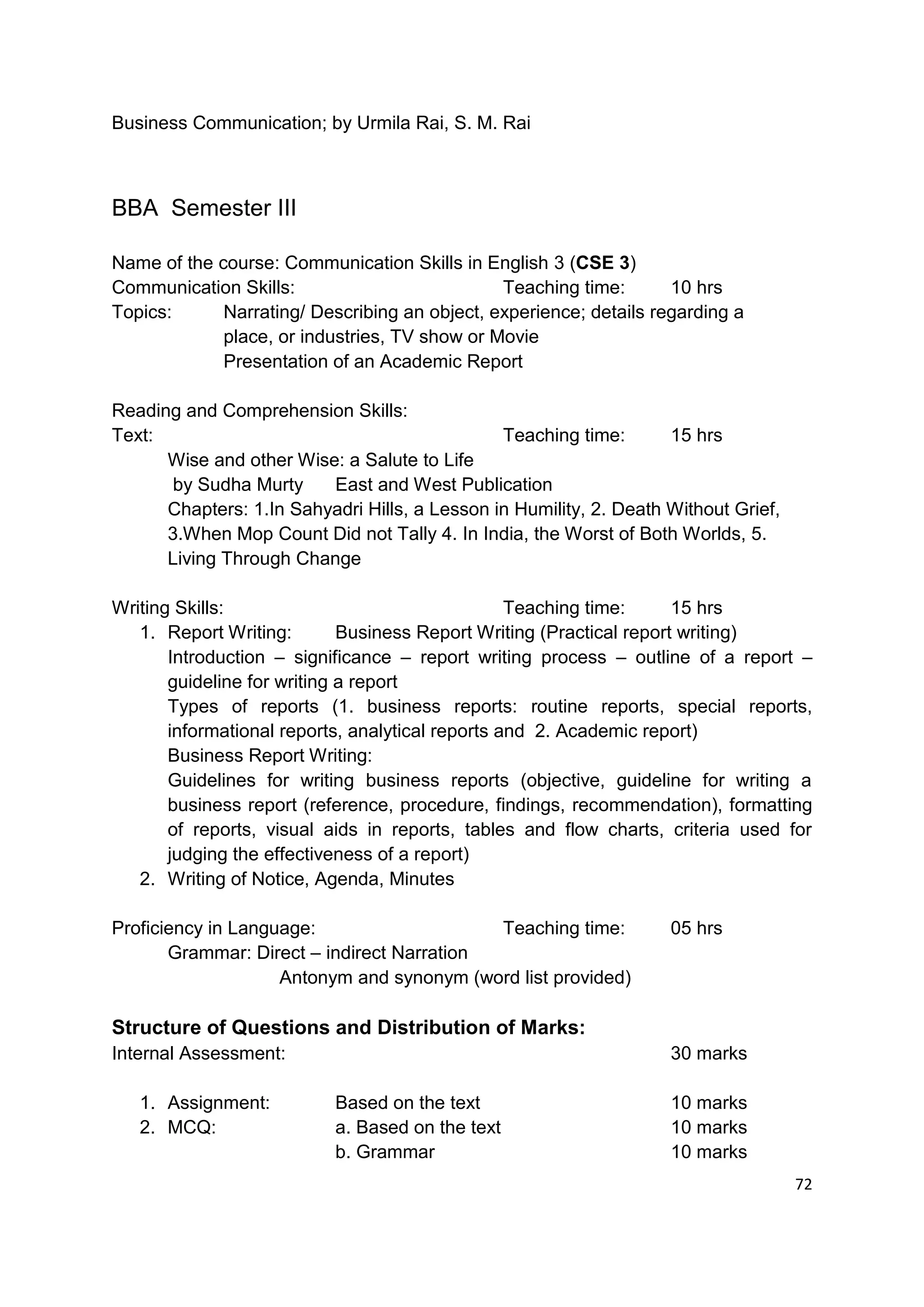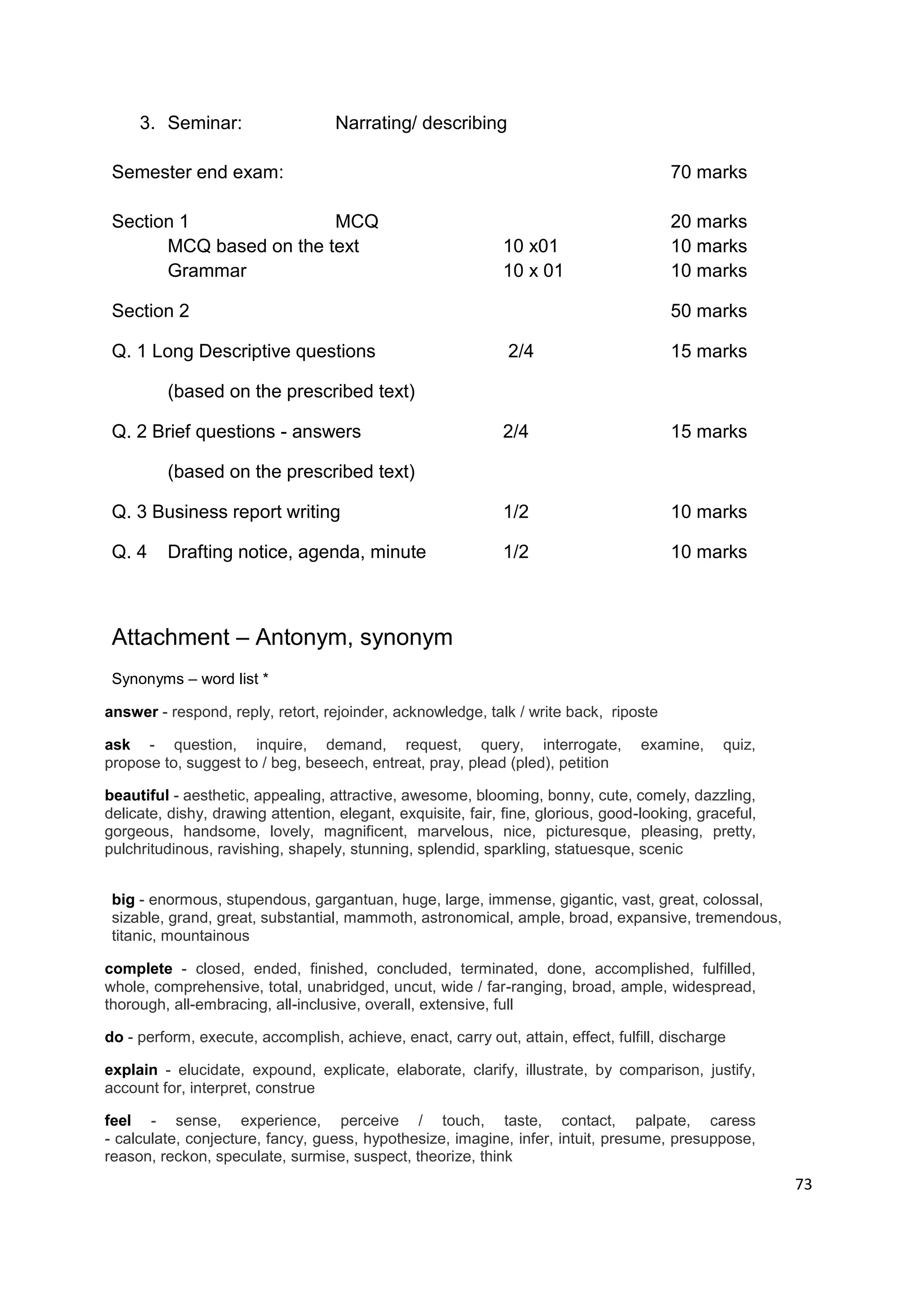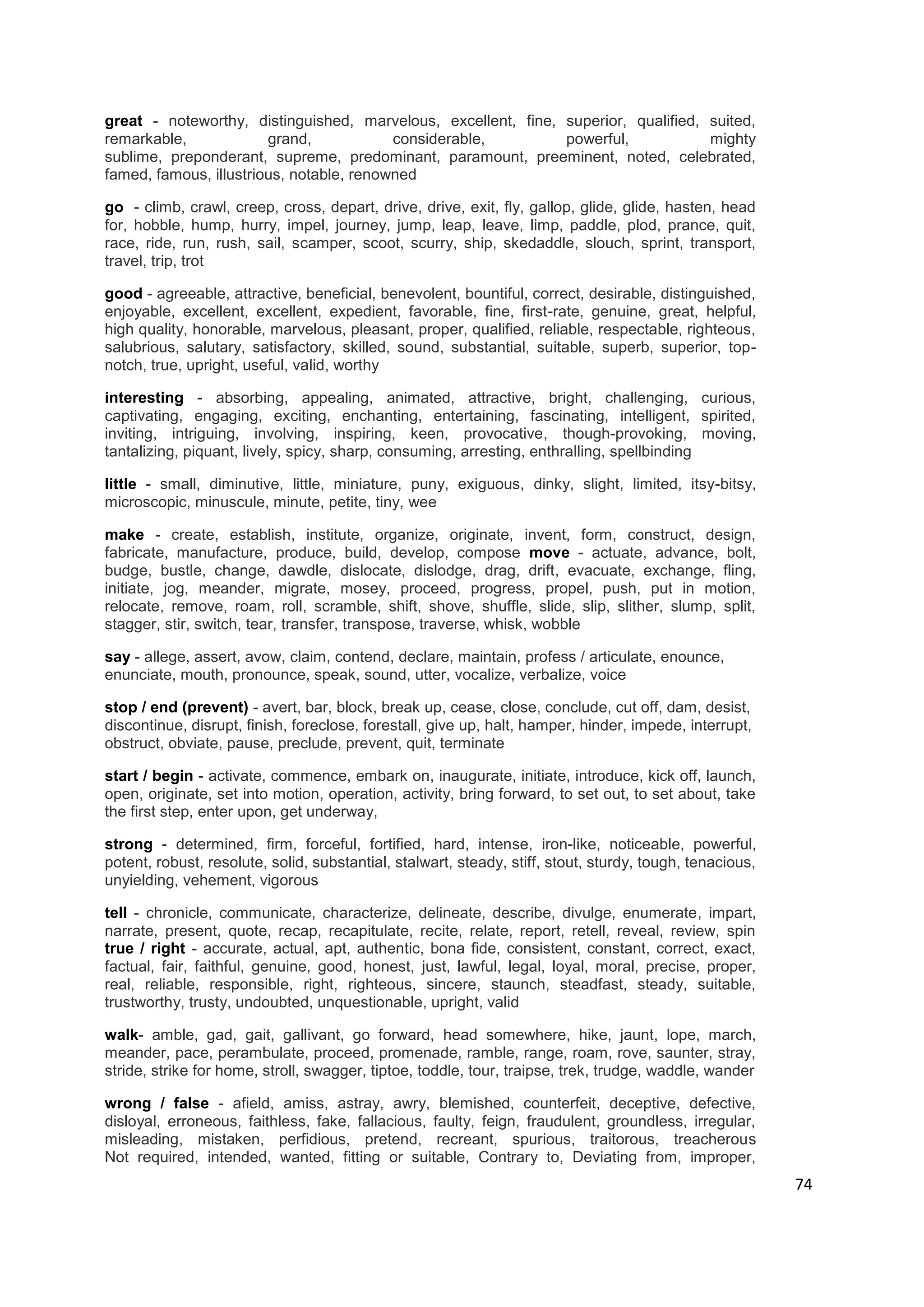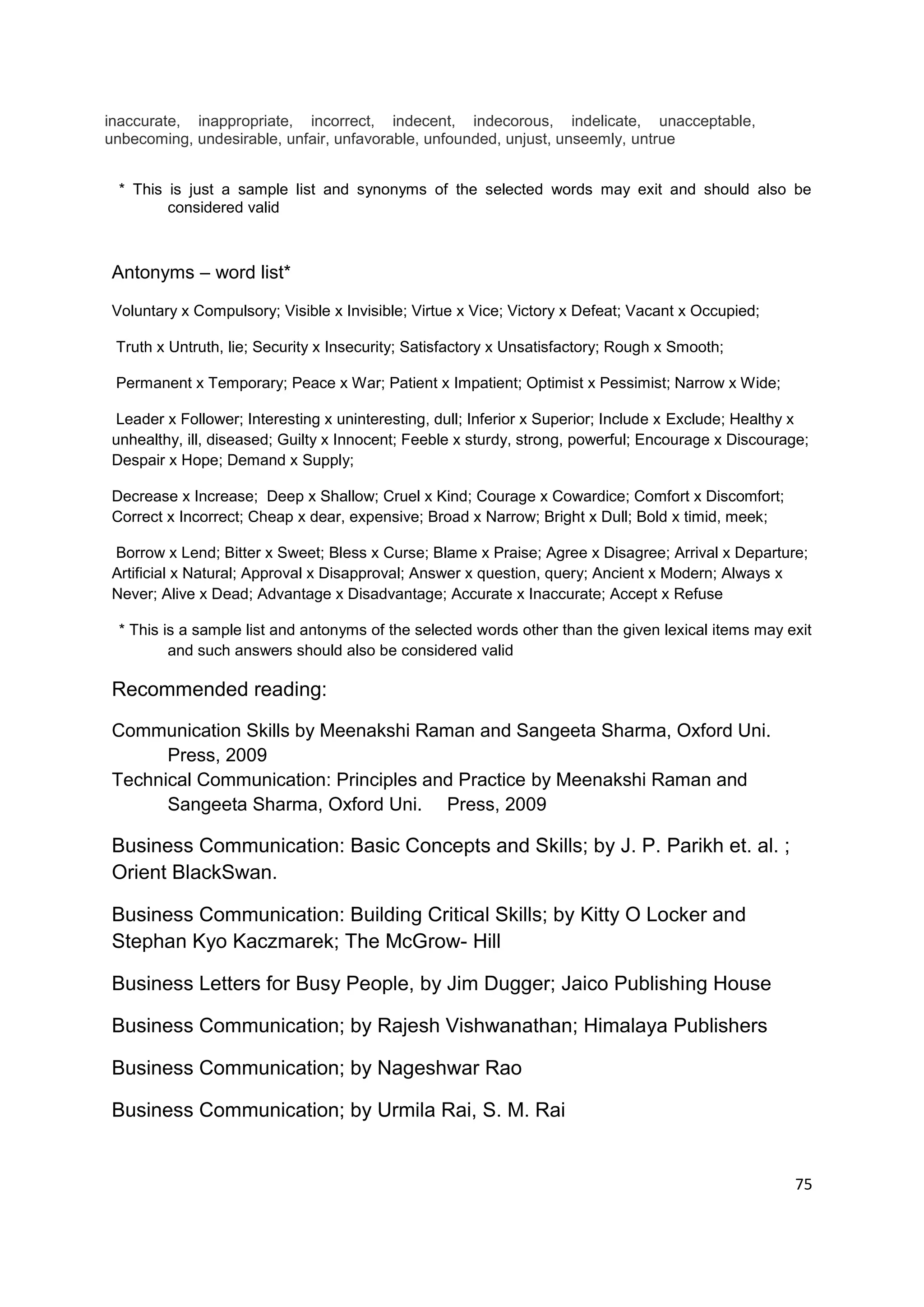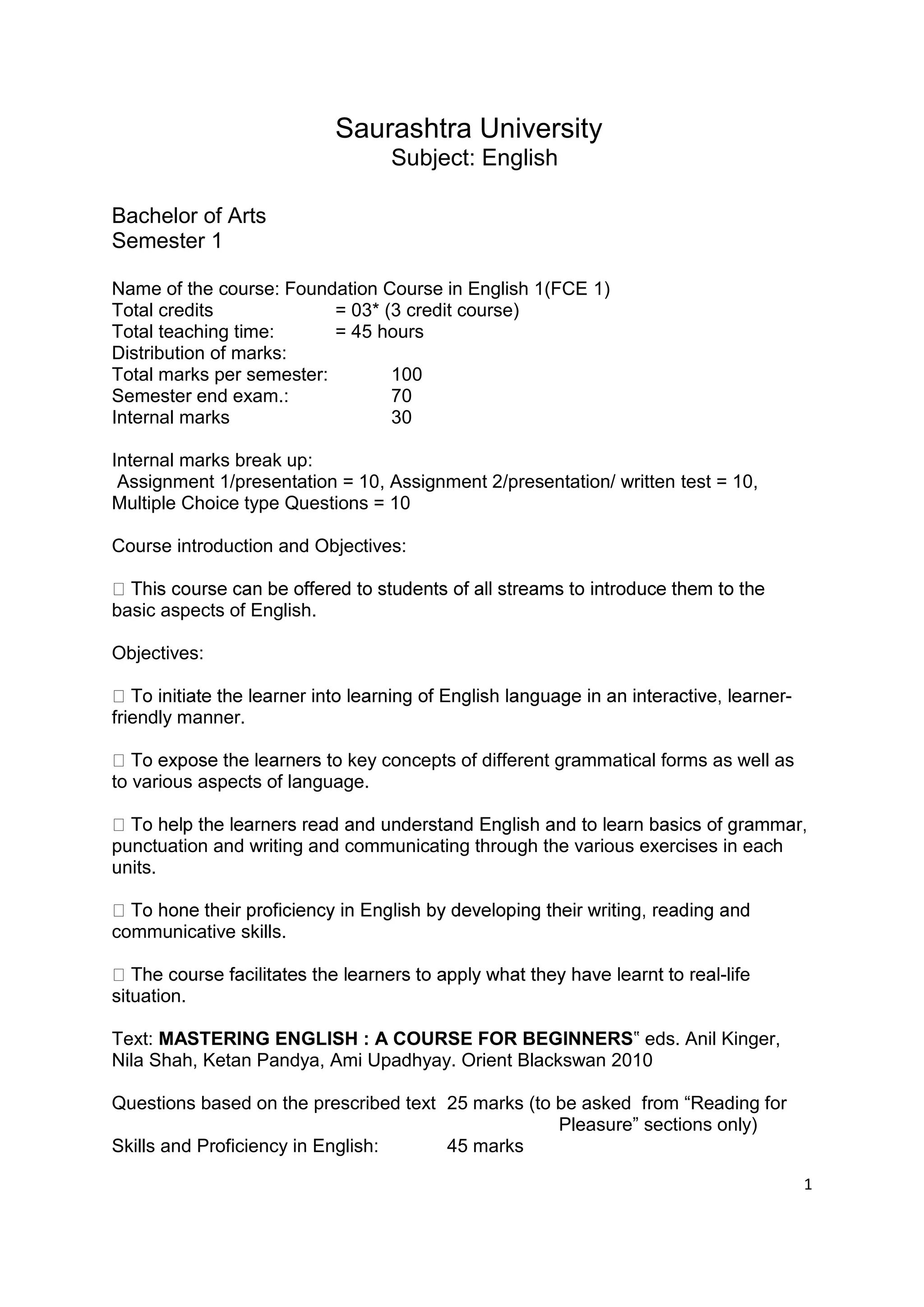
Saurashtra University
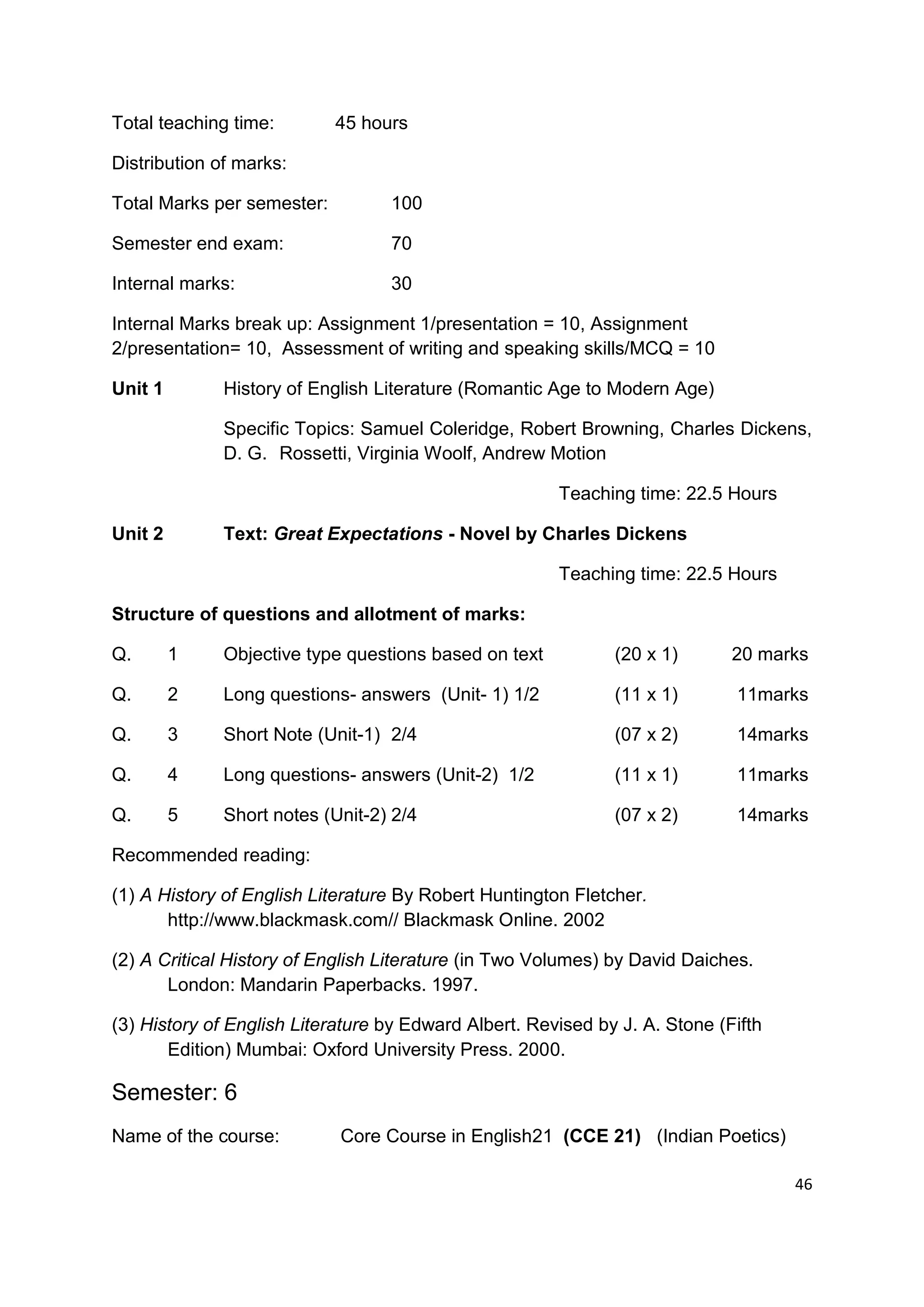
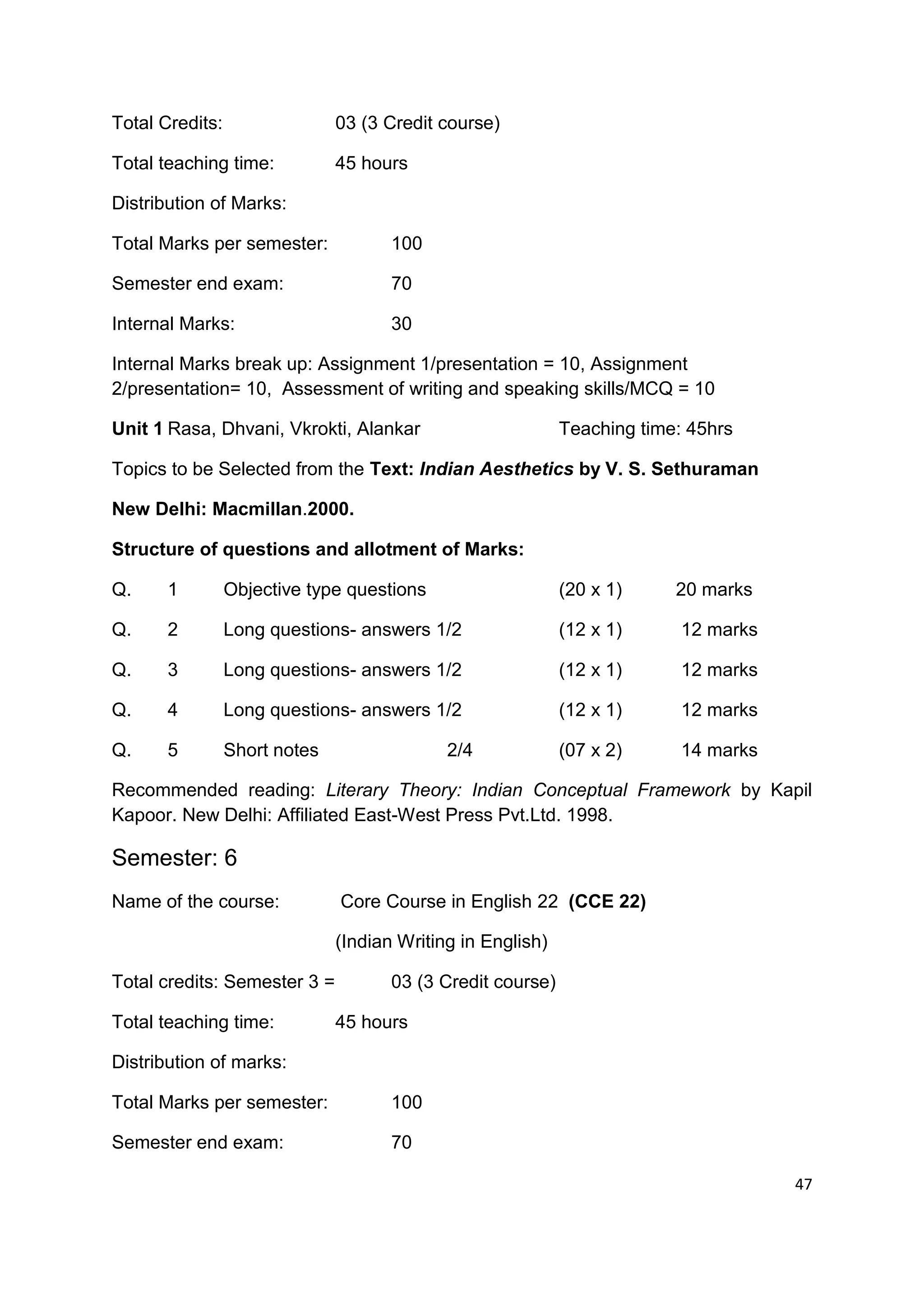
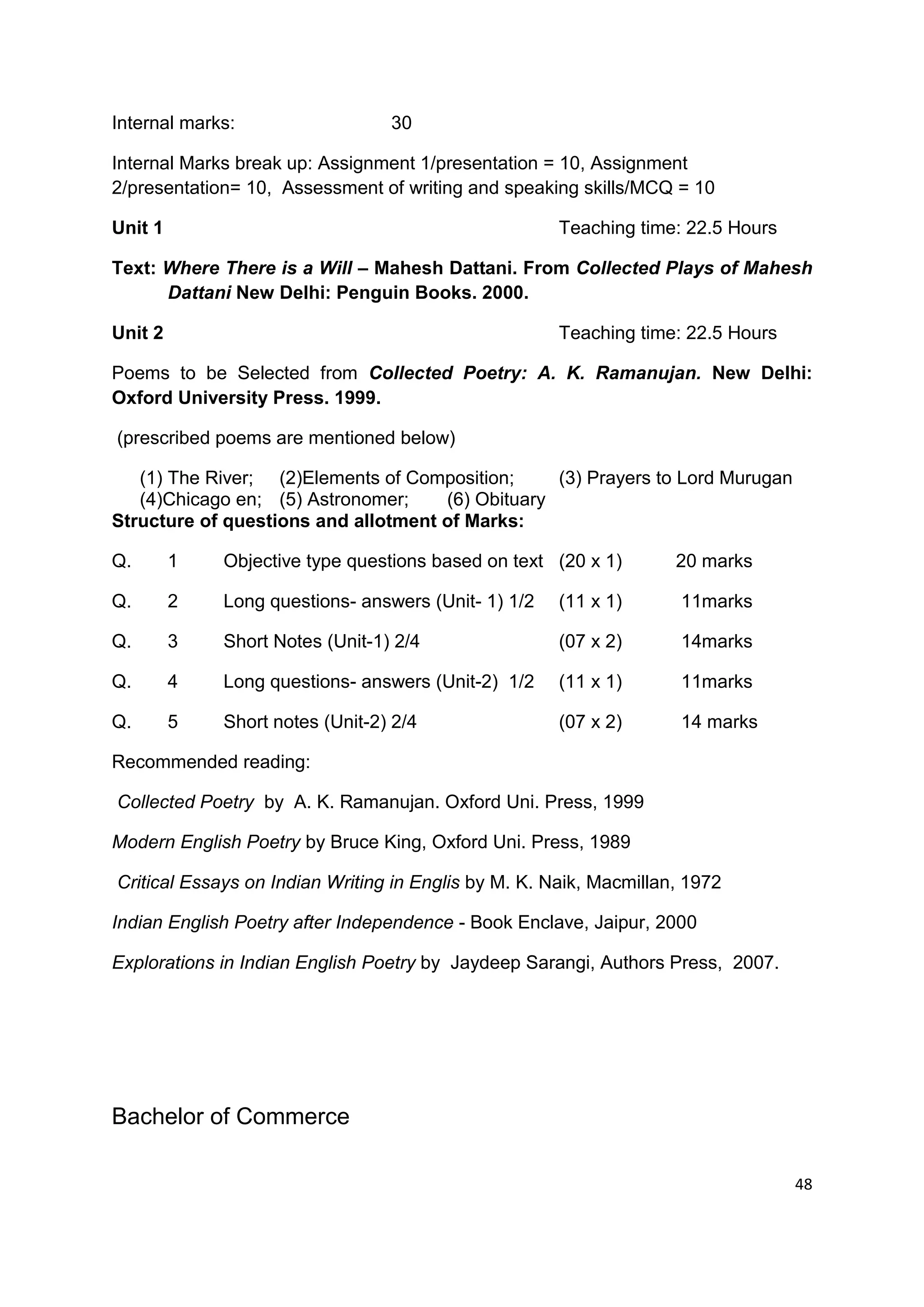
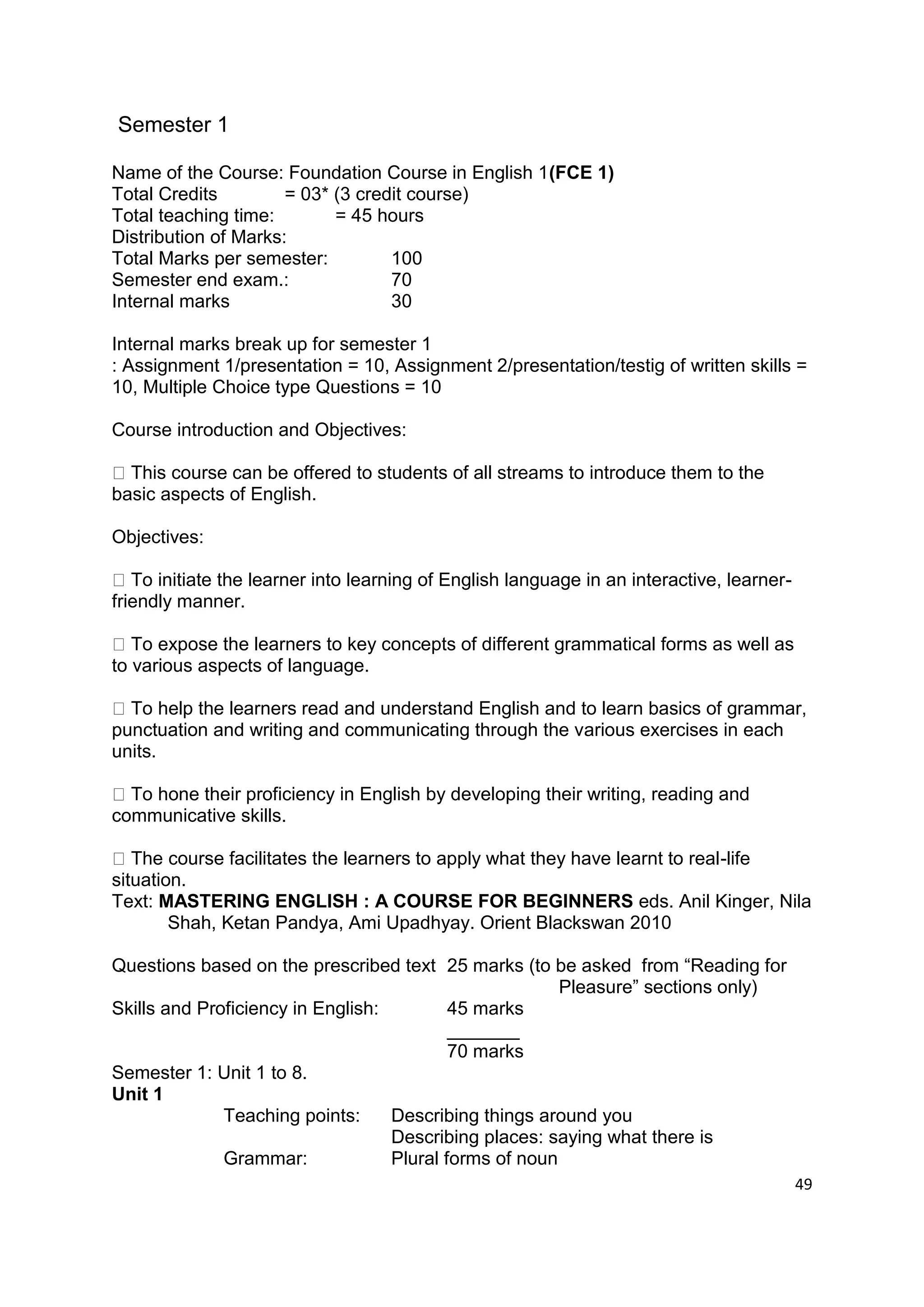
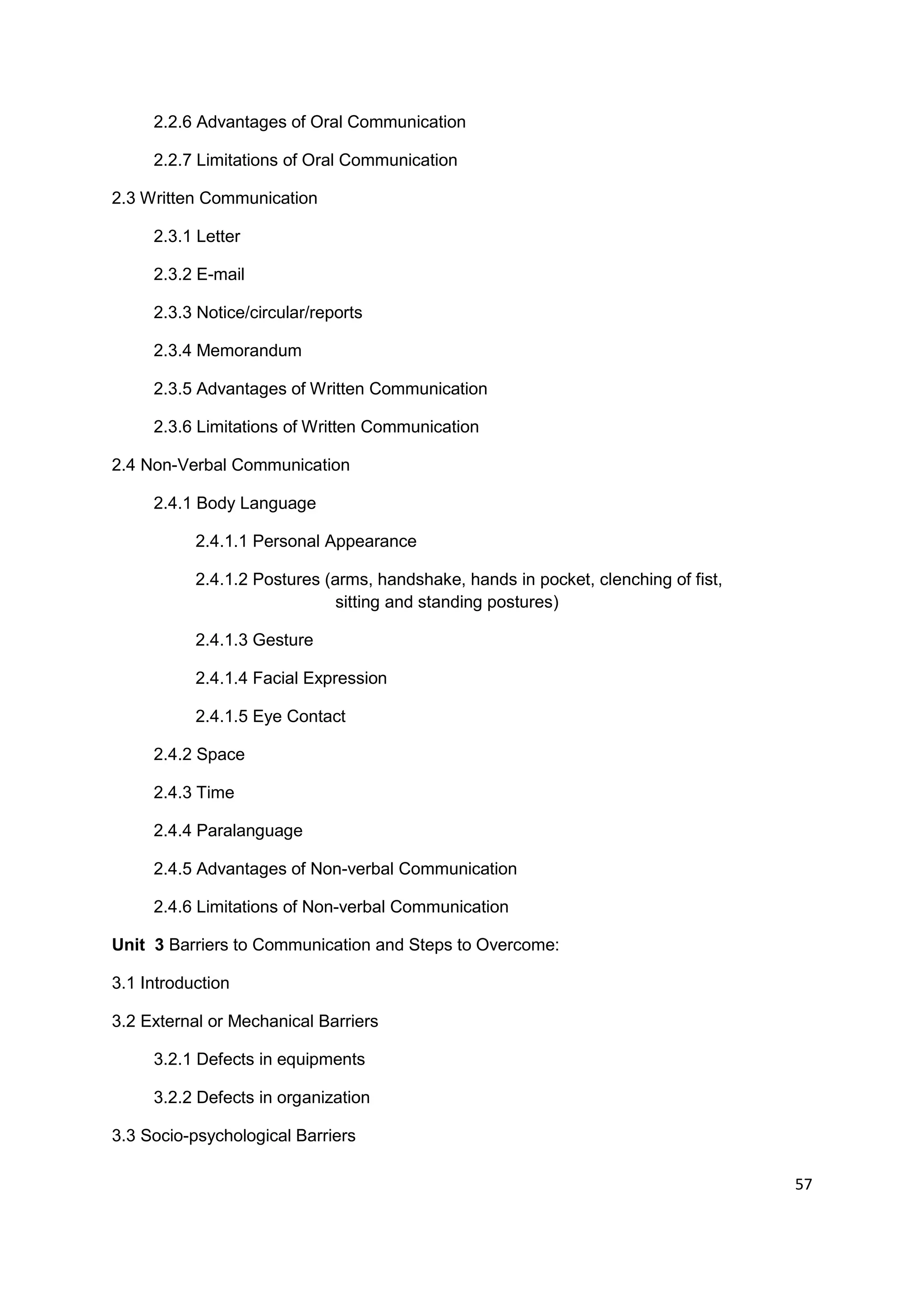
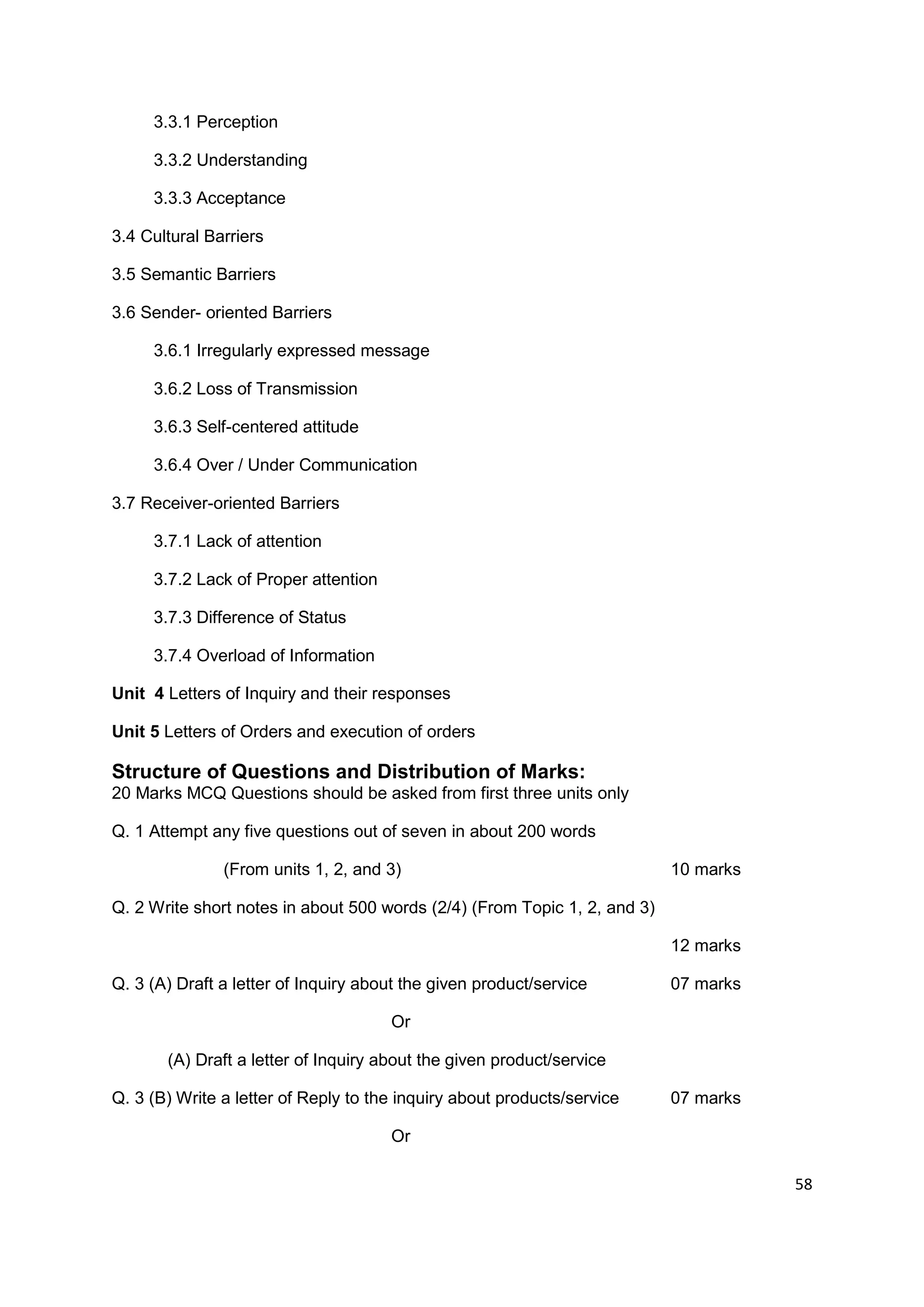
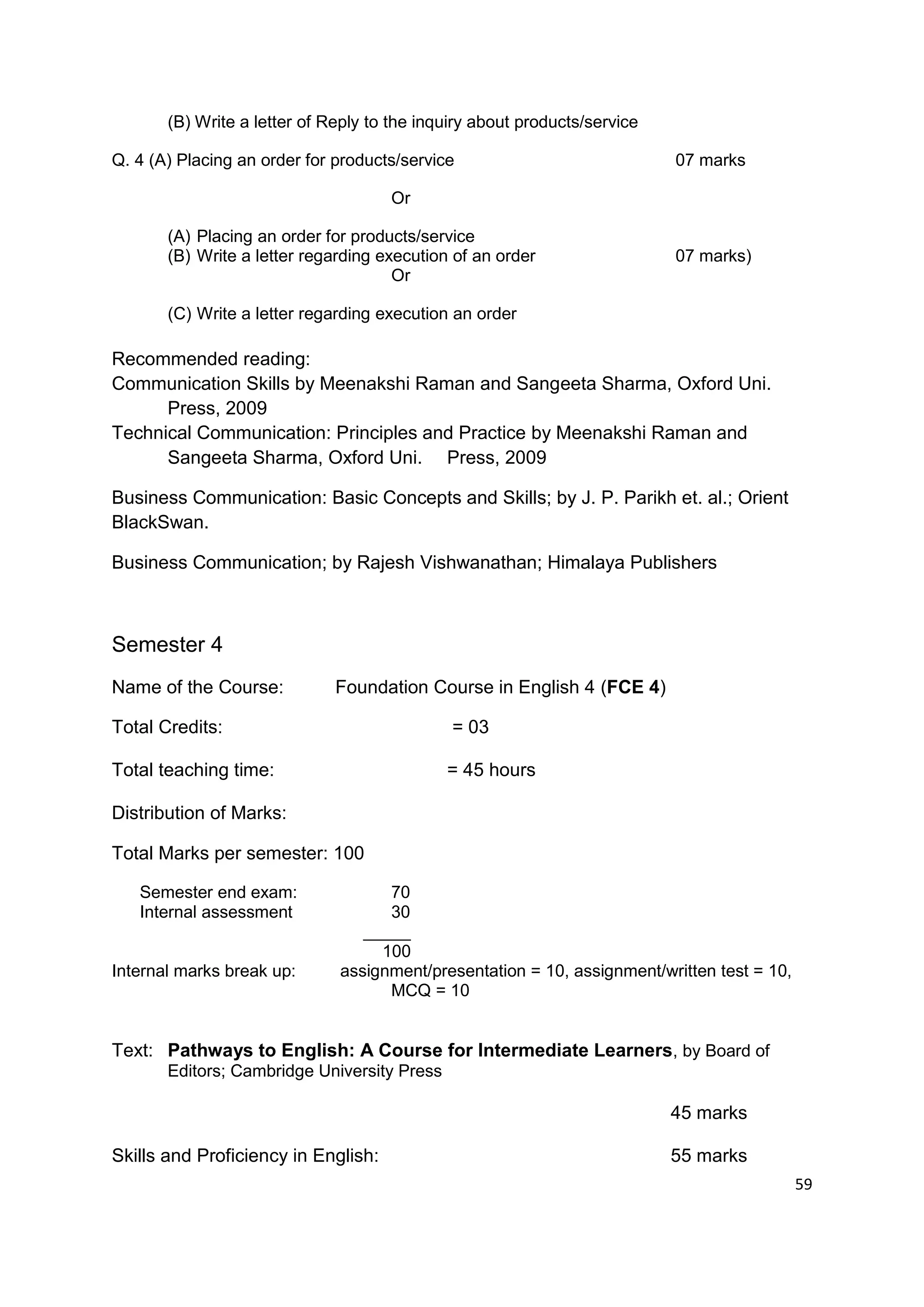
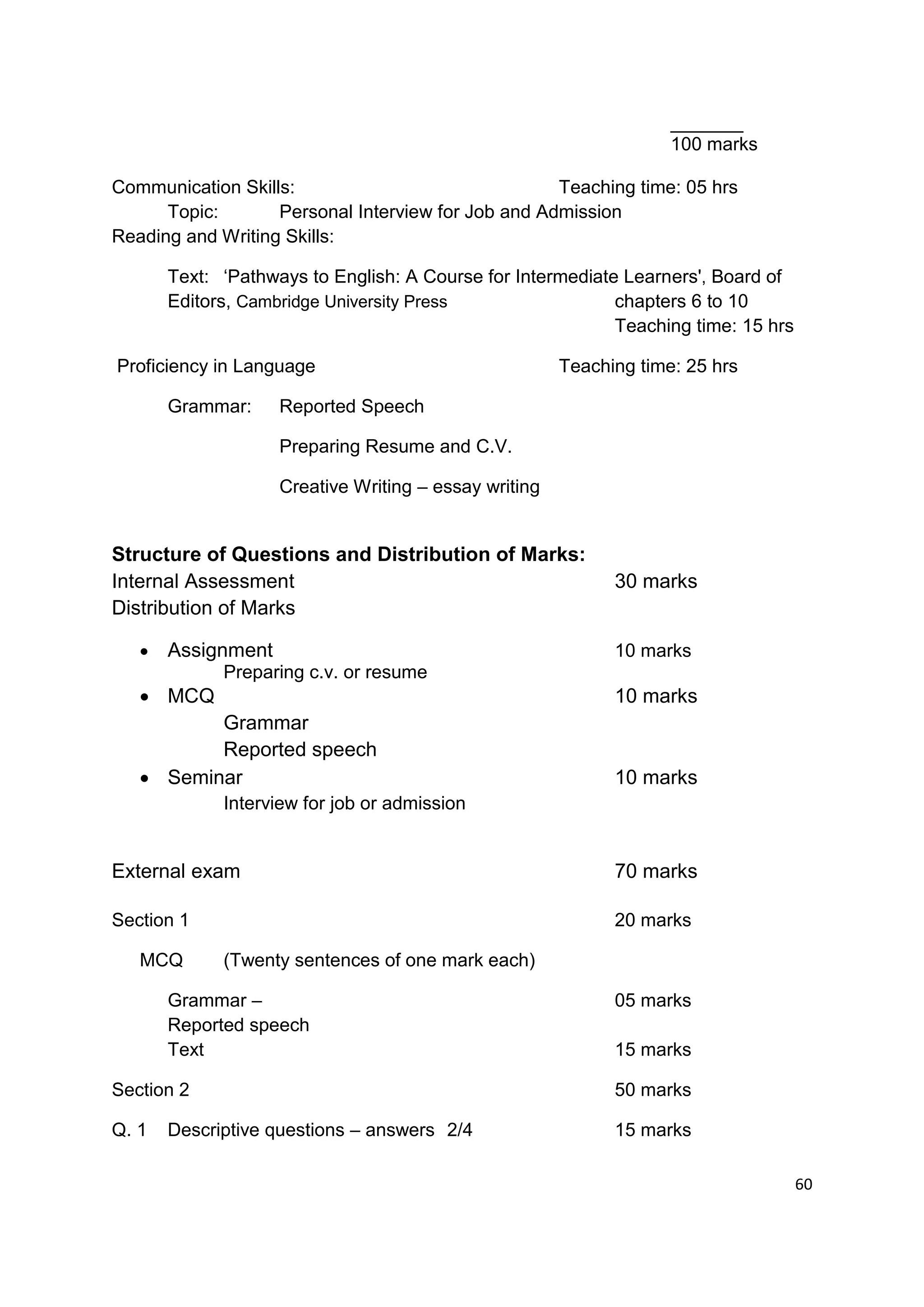
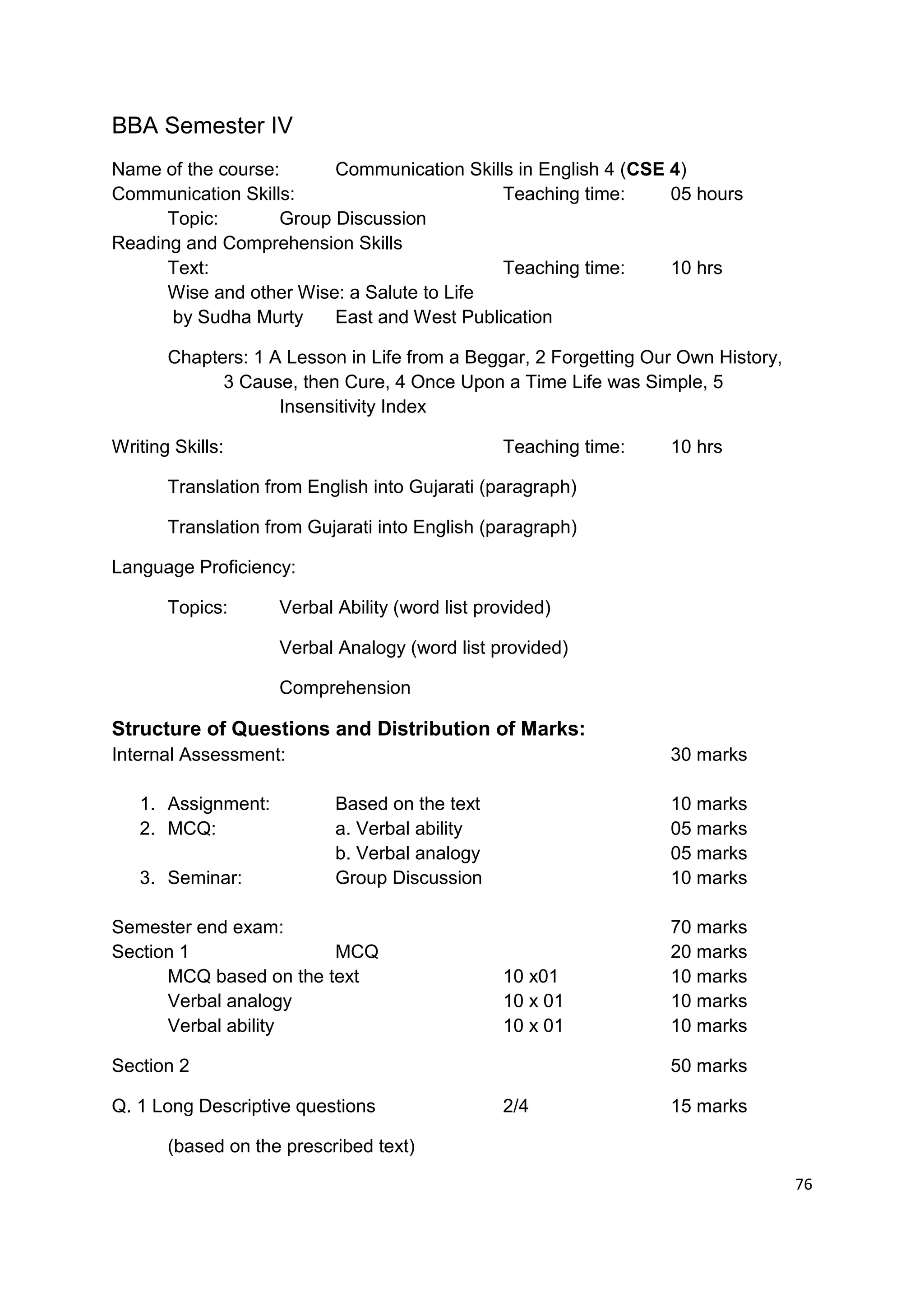
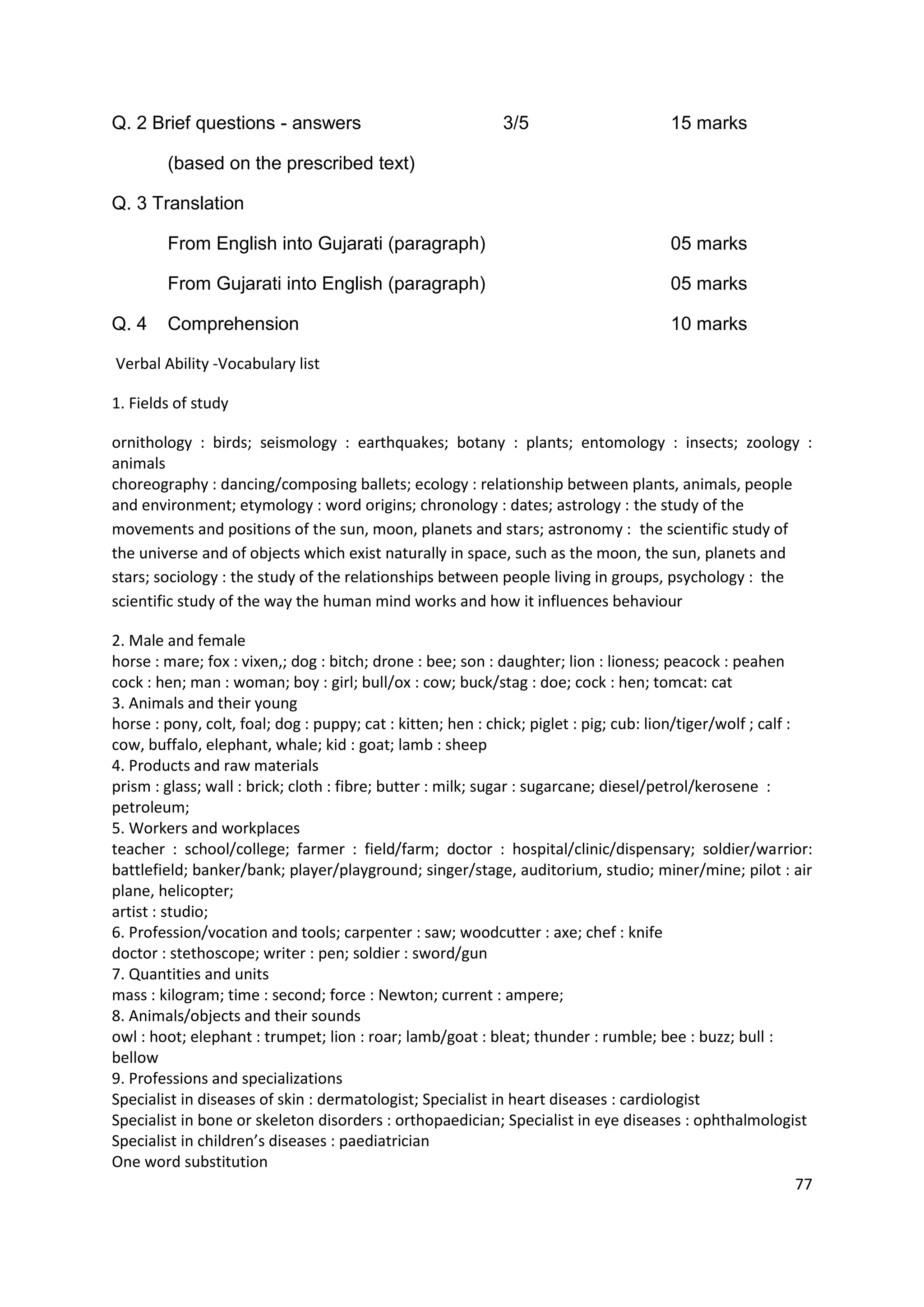
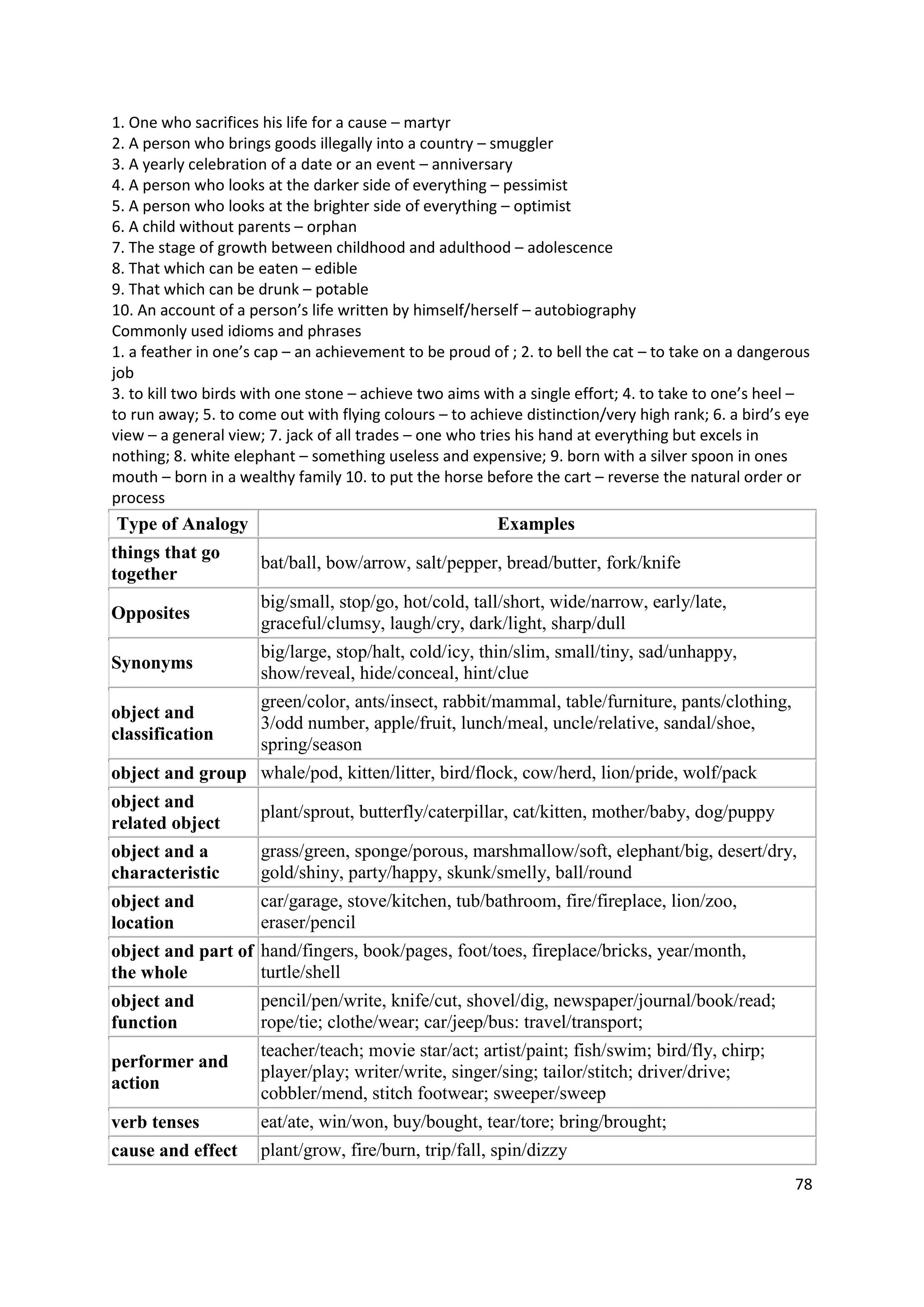
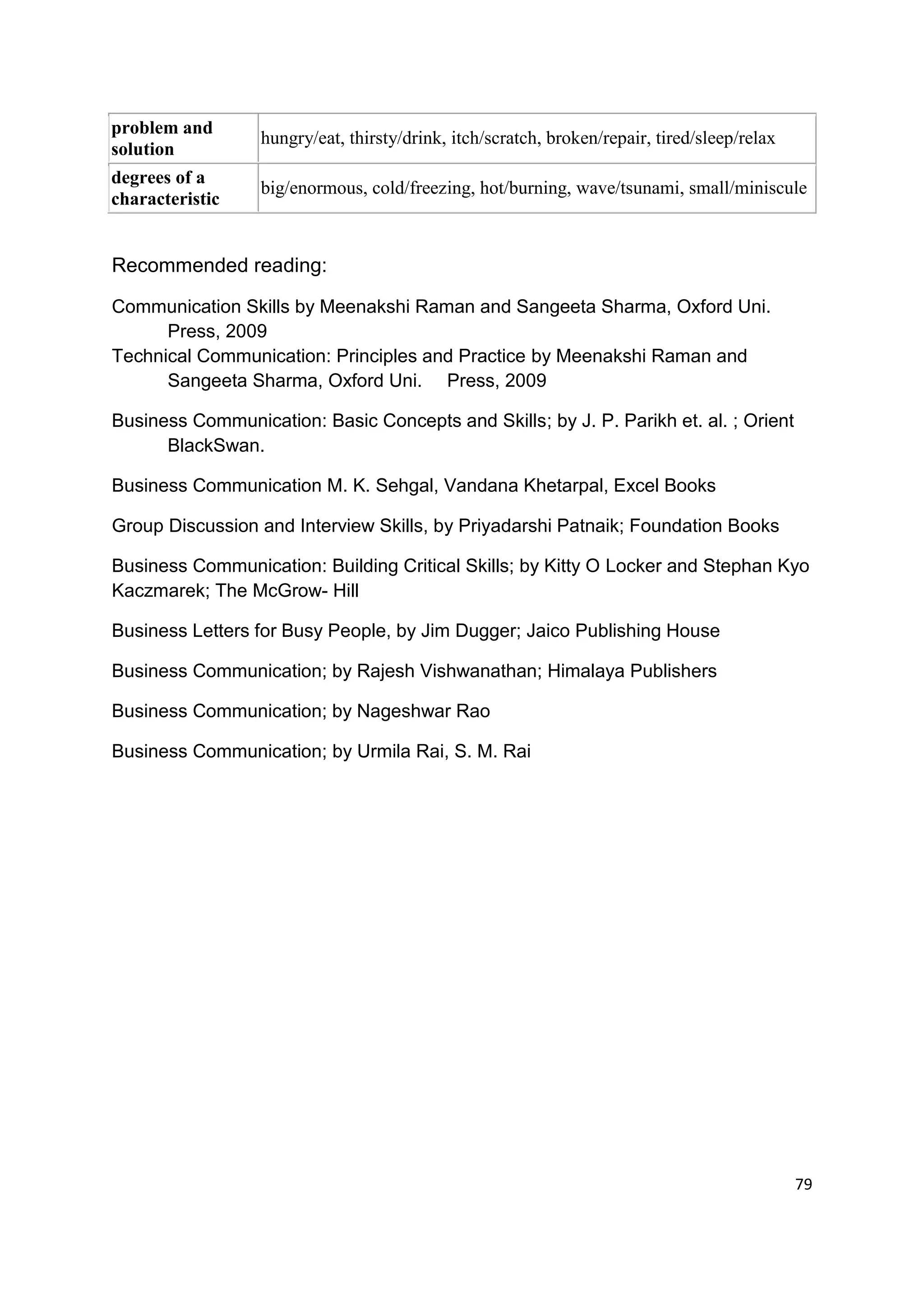
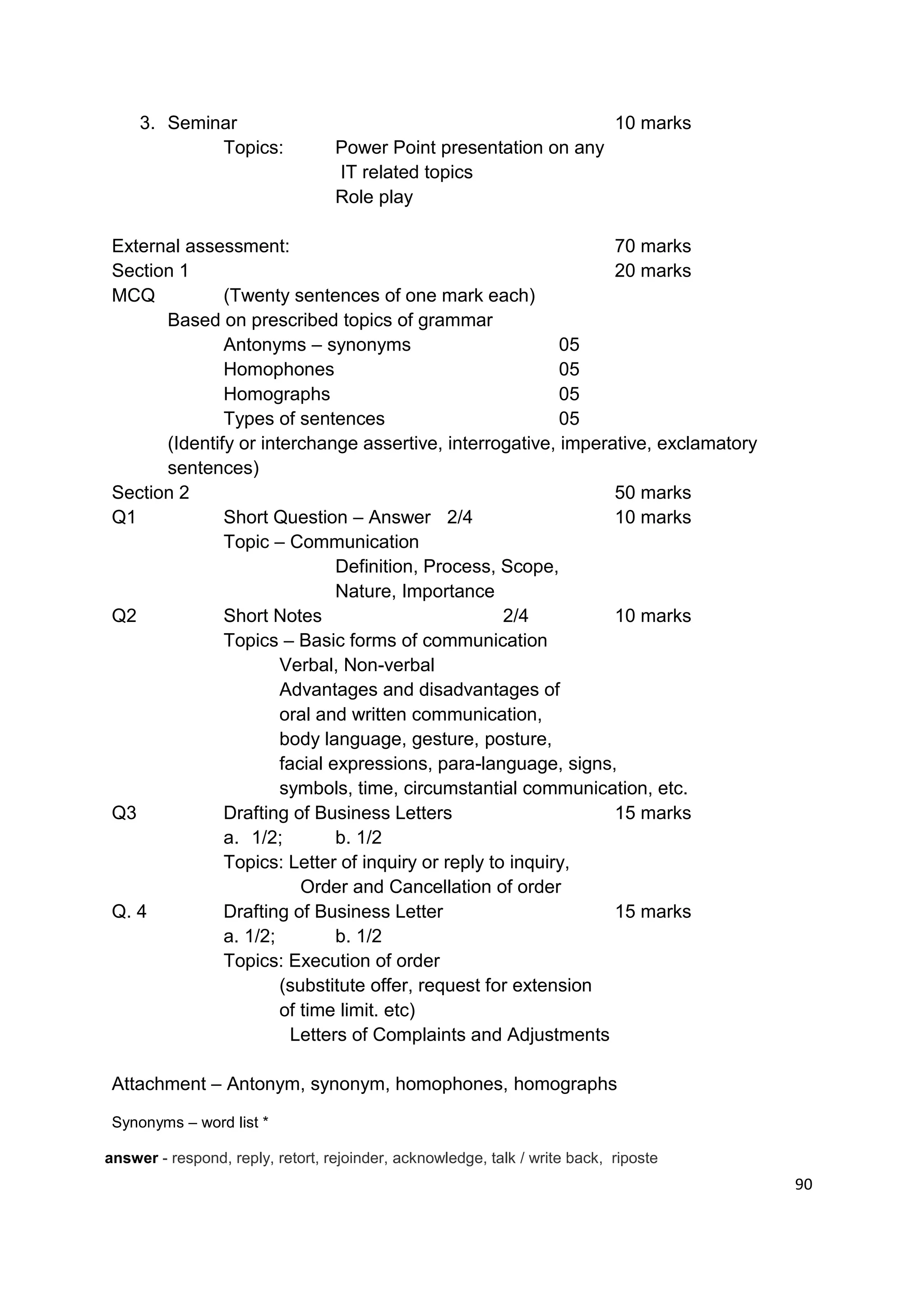
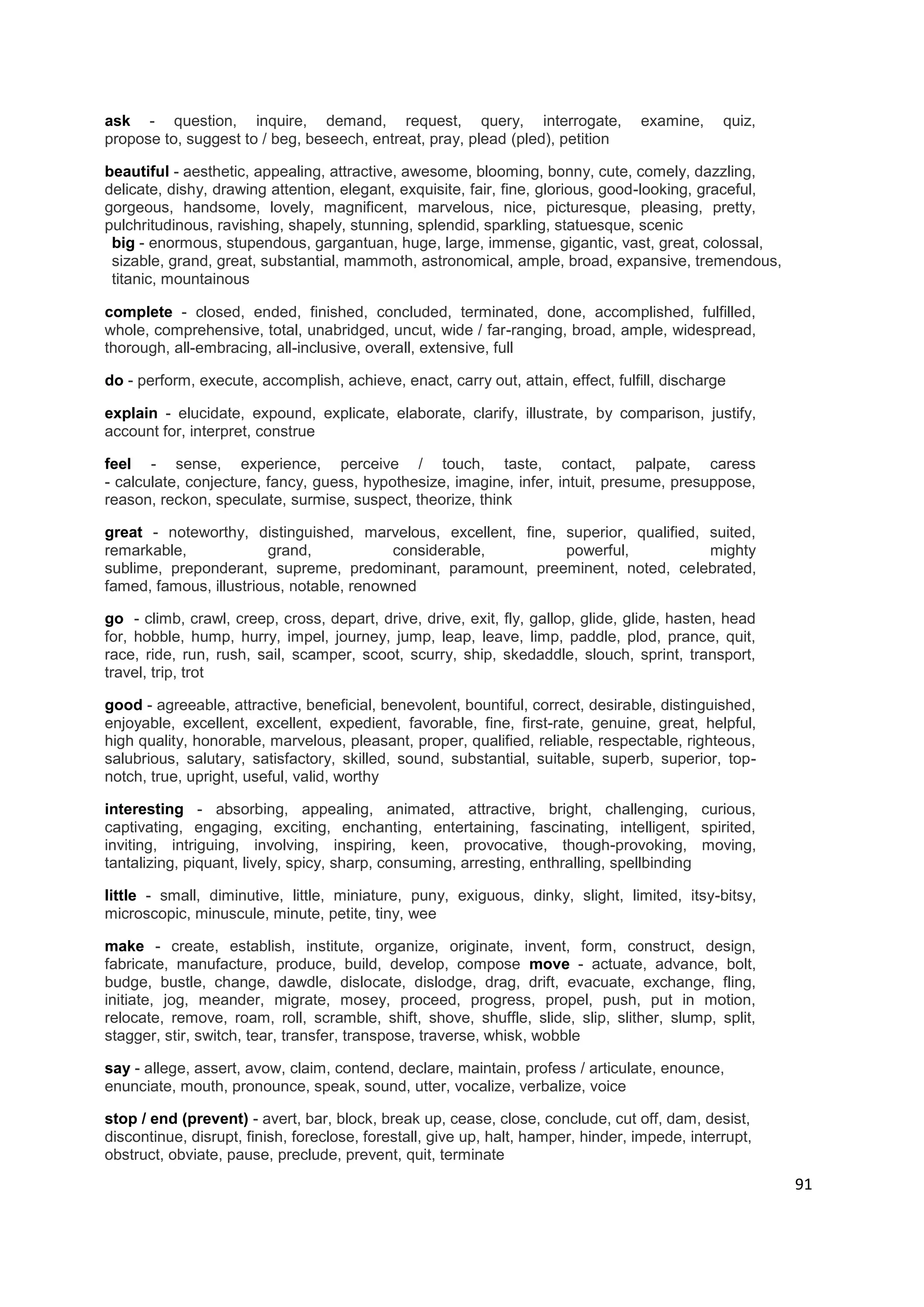
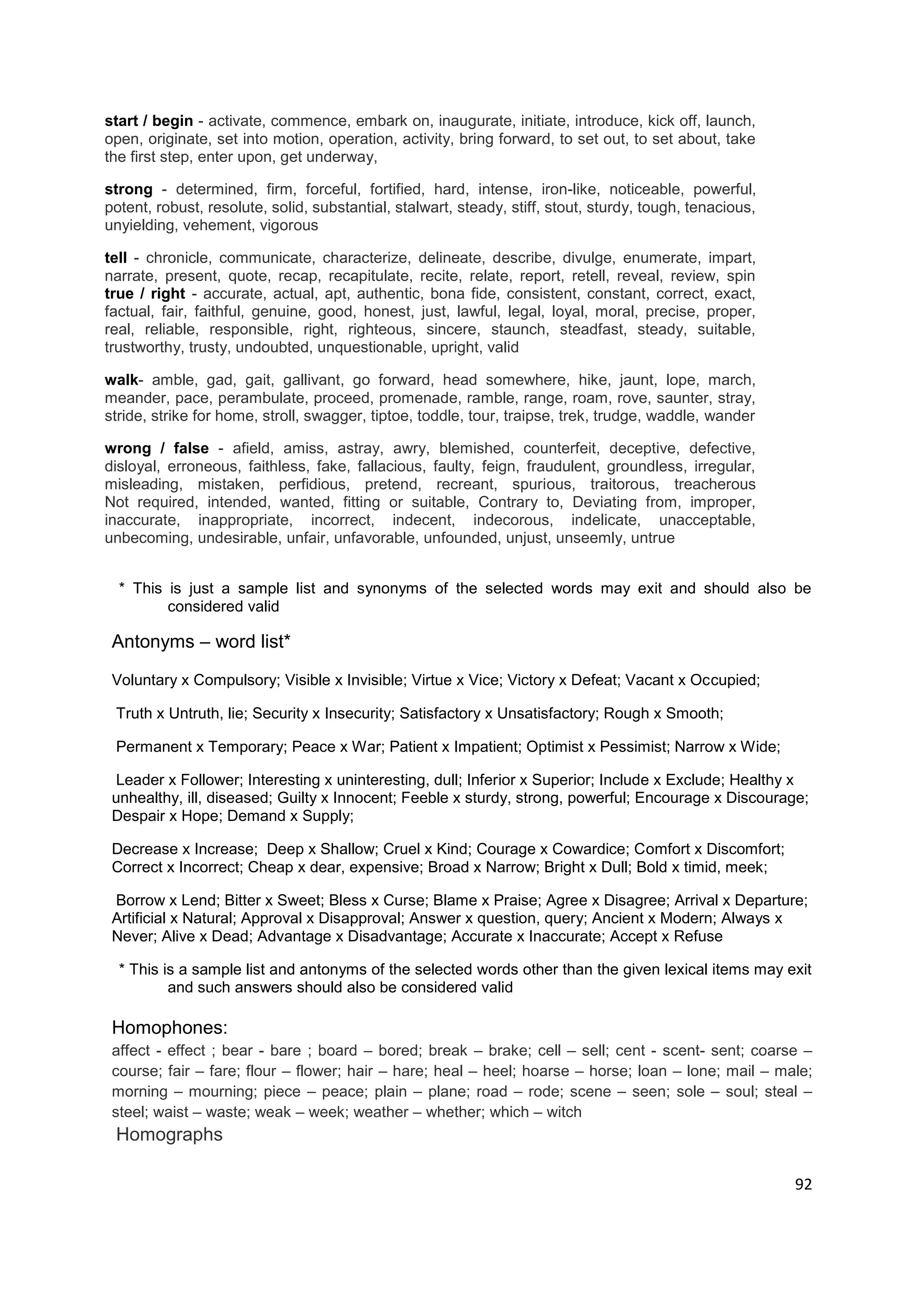
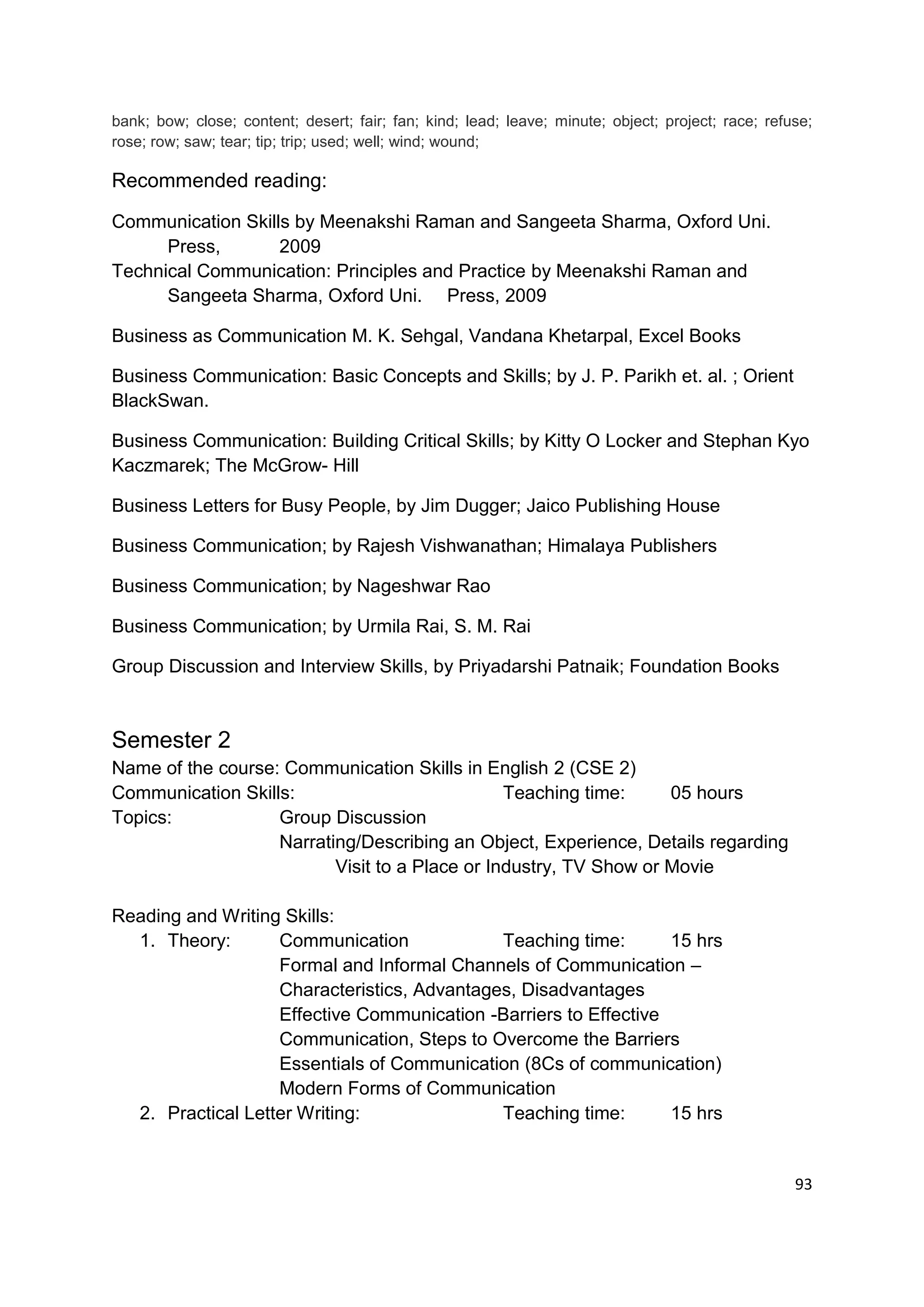
                                 Subject: English

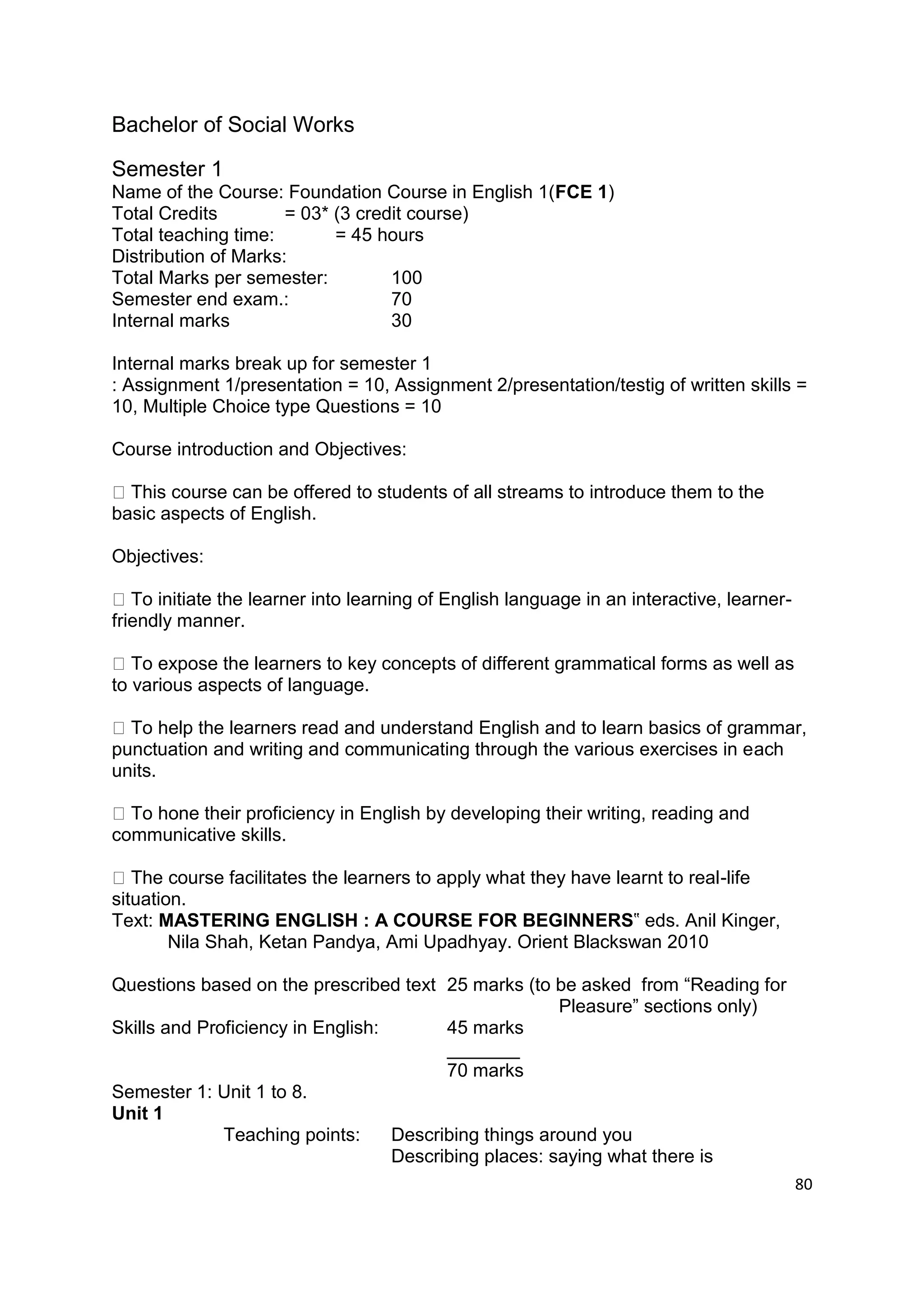
Bachelor of Arts
Semester 1

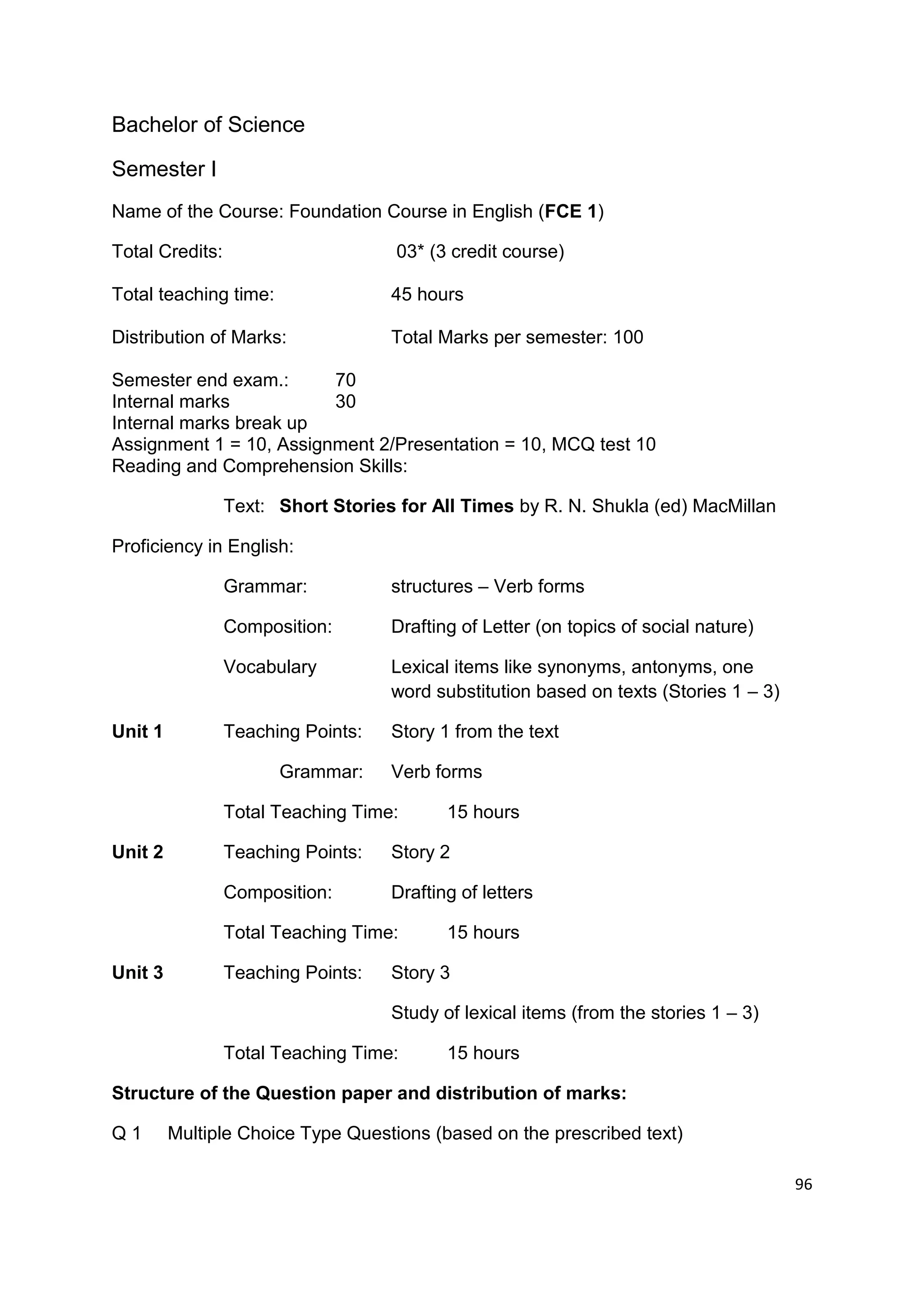
Name of the course: Foundation Course in English 1(FCE 1)
Total credits             = 03* (3 credit course)
Total teaching time:      = 45 hours
Distribution of marks:
Total marks per semester:        100
Semester end exam.:              70
Internal marks                   30

Internal marks break up:
 Assignment 1/presentation = 10, Assignment 2/presentation/ written test = 10,
Multiple Choice type Questions = 10

Course introduction and Objectives:


basic aspects of English.

Objectives:

                                                                                  -
friendly manner.

                            key concepts of different grammatical forms as well as
to various aspects of language.


punctuation and writing and communicating through the various exercises in each
units.


communicative skills.

                                                                         -life
situation.

Text: MASTERING ENGLISH : A COURSE FOR BEGINNERS‟ eds. Anil Kinger,
Nila Shah, Ketan Pandya, Ami Upadhyay. Orient Blackswan 2010

Questions based on the prescribed text 25 marks (to be asked from “Reading for
                                                    Pleasure” sections only)
Skills and Proficiency in English:     45 marks

                                                                                      1
_______
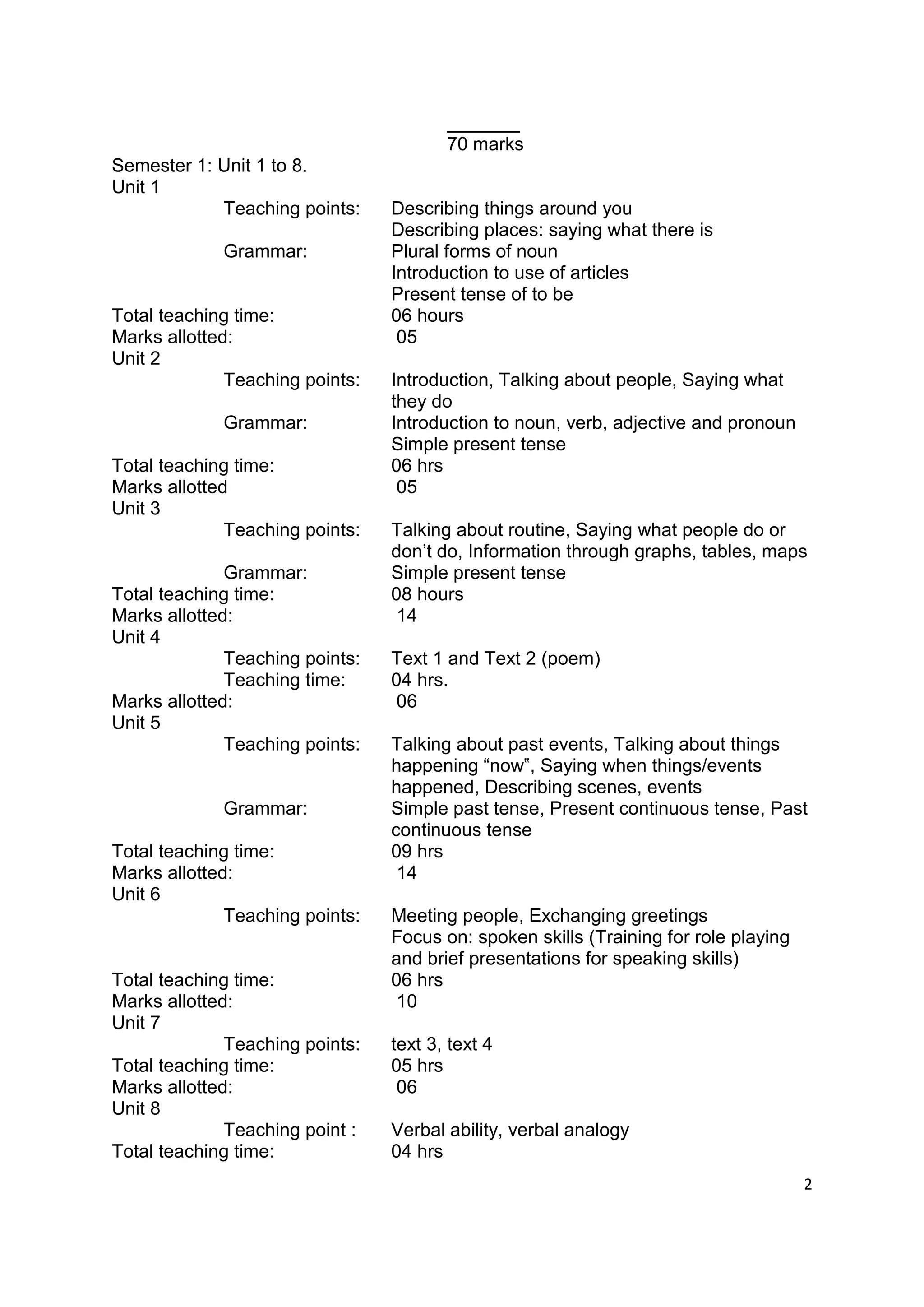
                                        70 marks
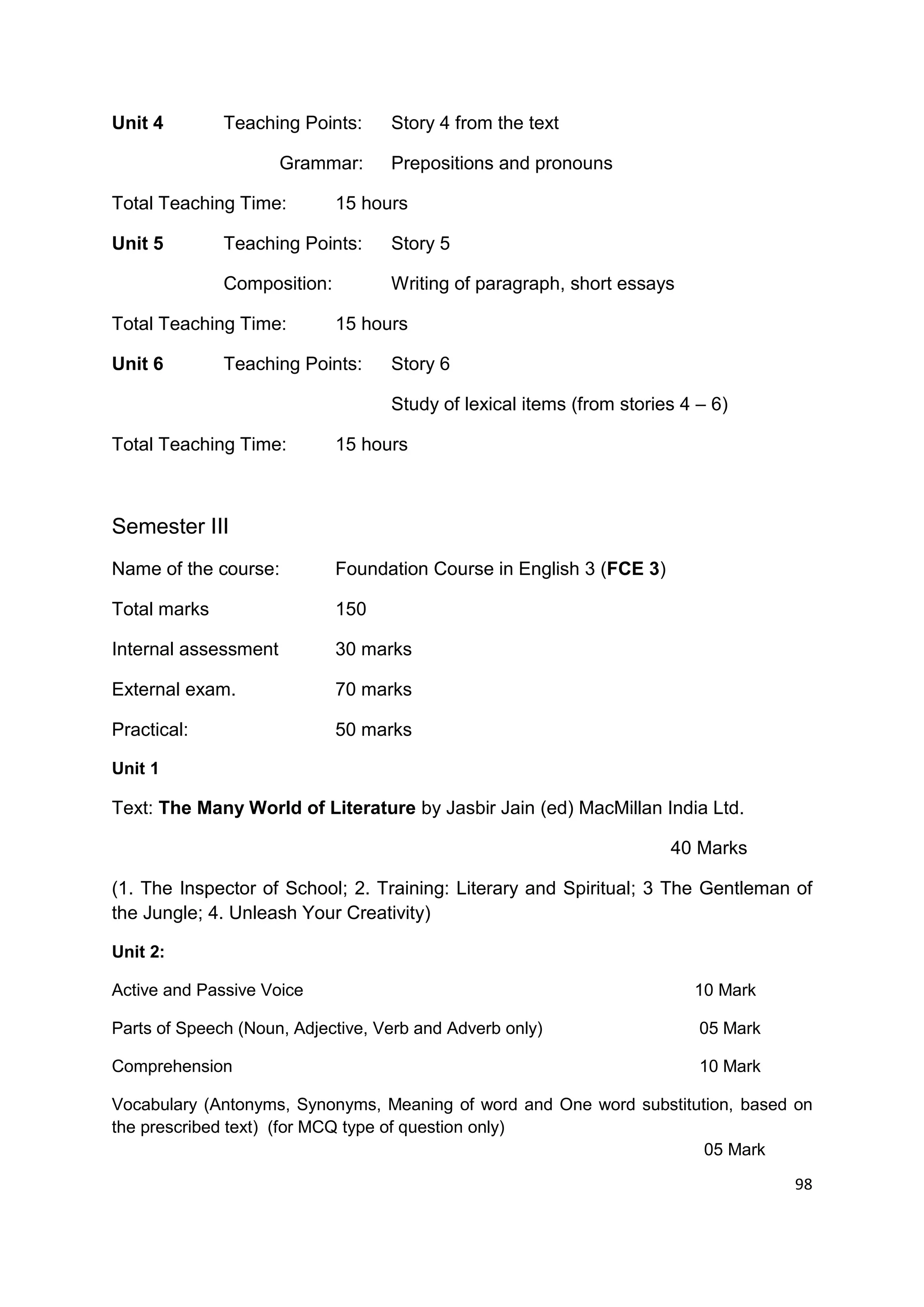
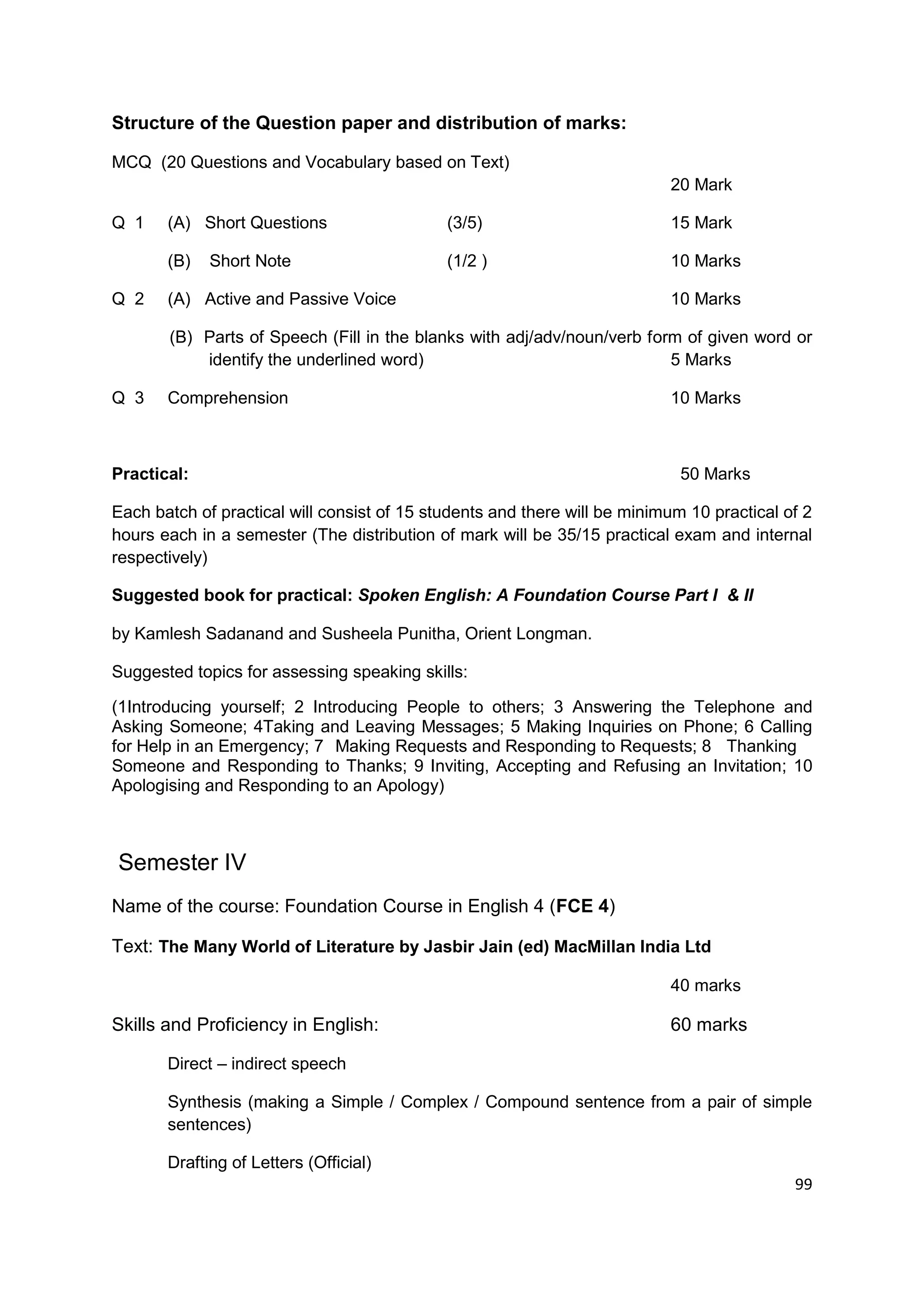
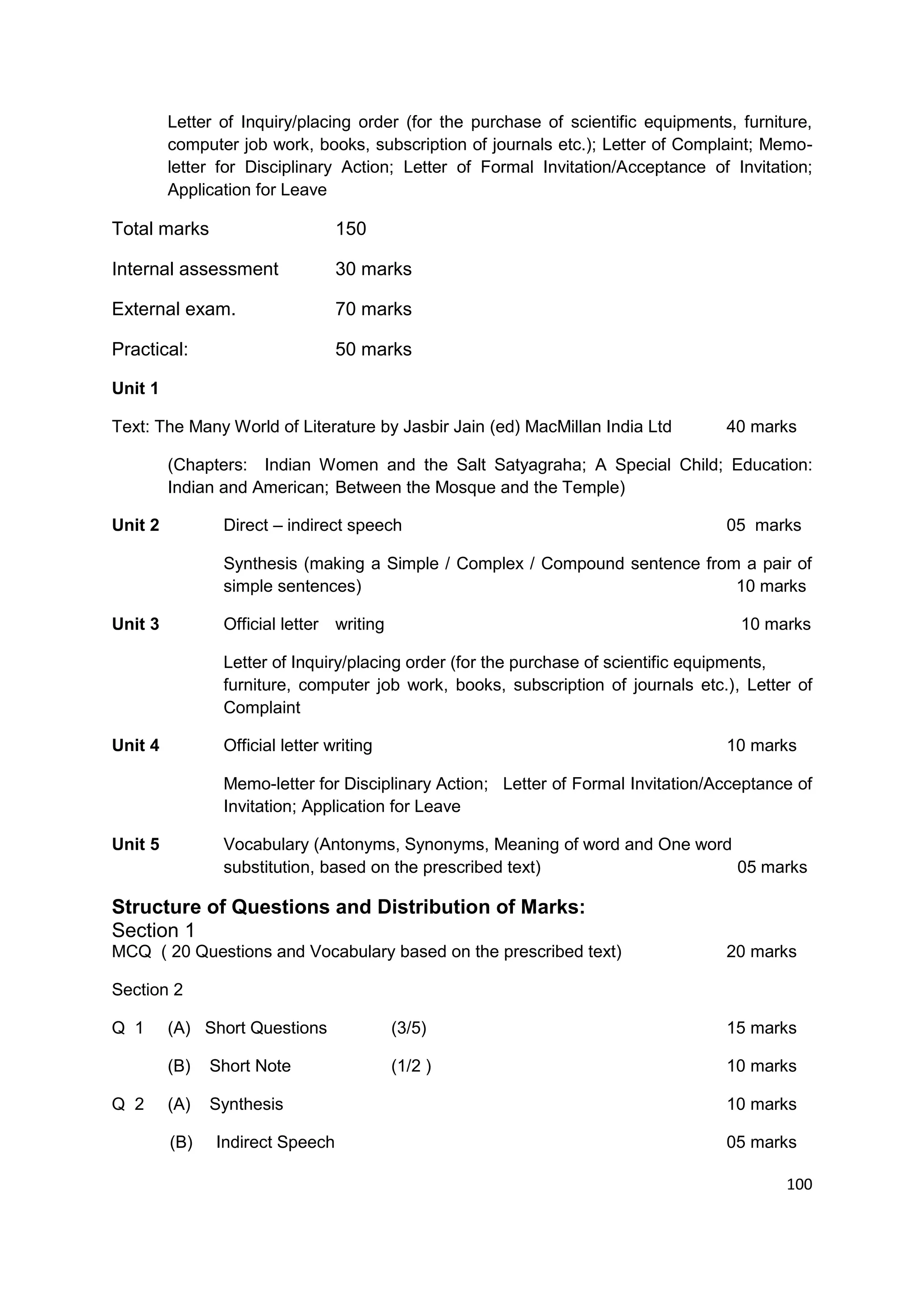
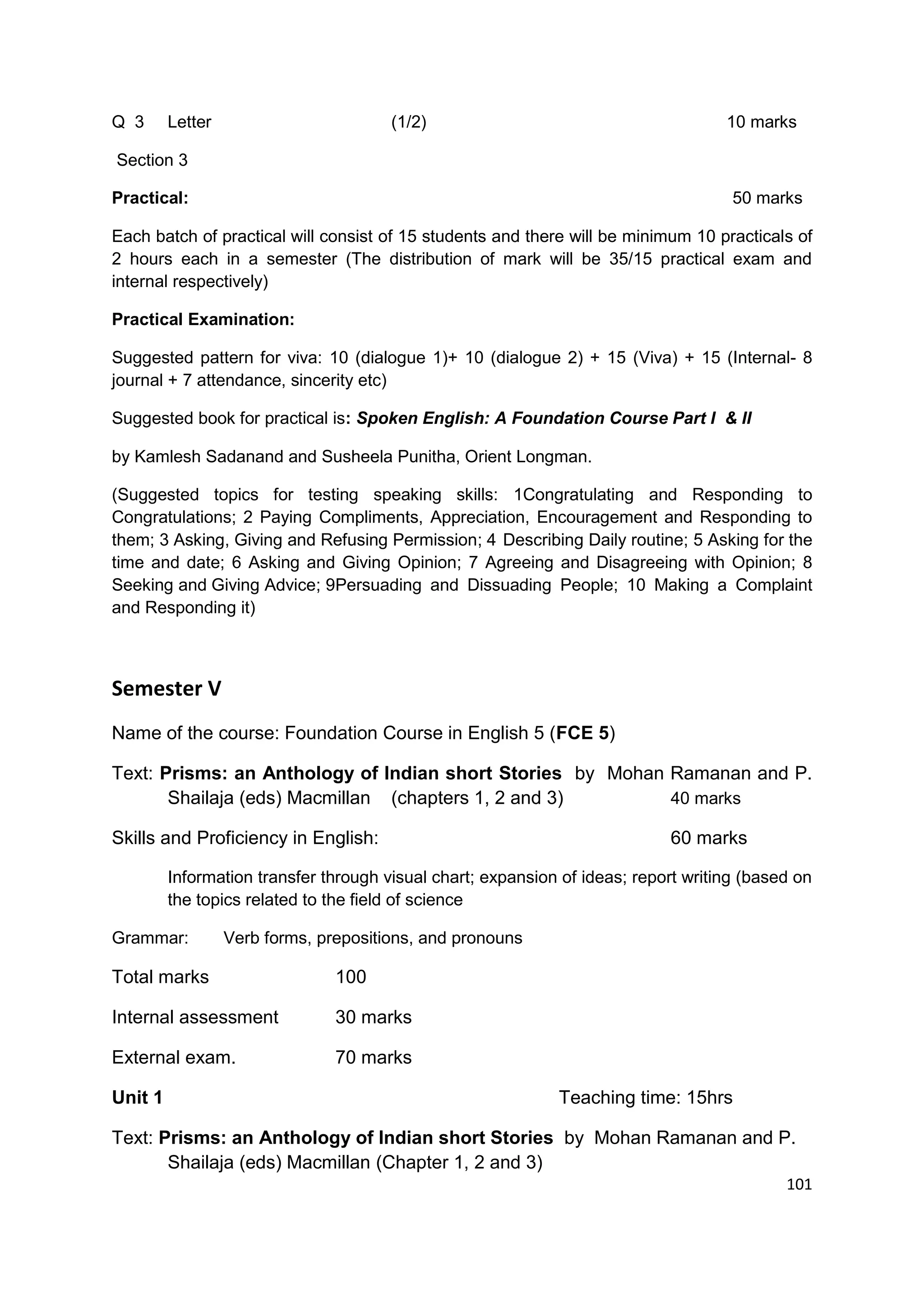
Semester 1: Unit 1 to 8.
Unit 1
            Teaching points:     Describing things around you
                                 Describing places: saying what there is
             Grammar:            Plural forms of noun
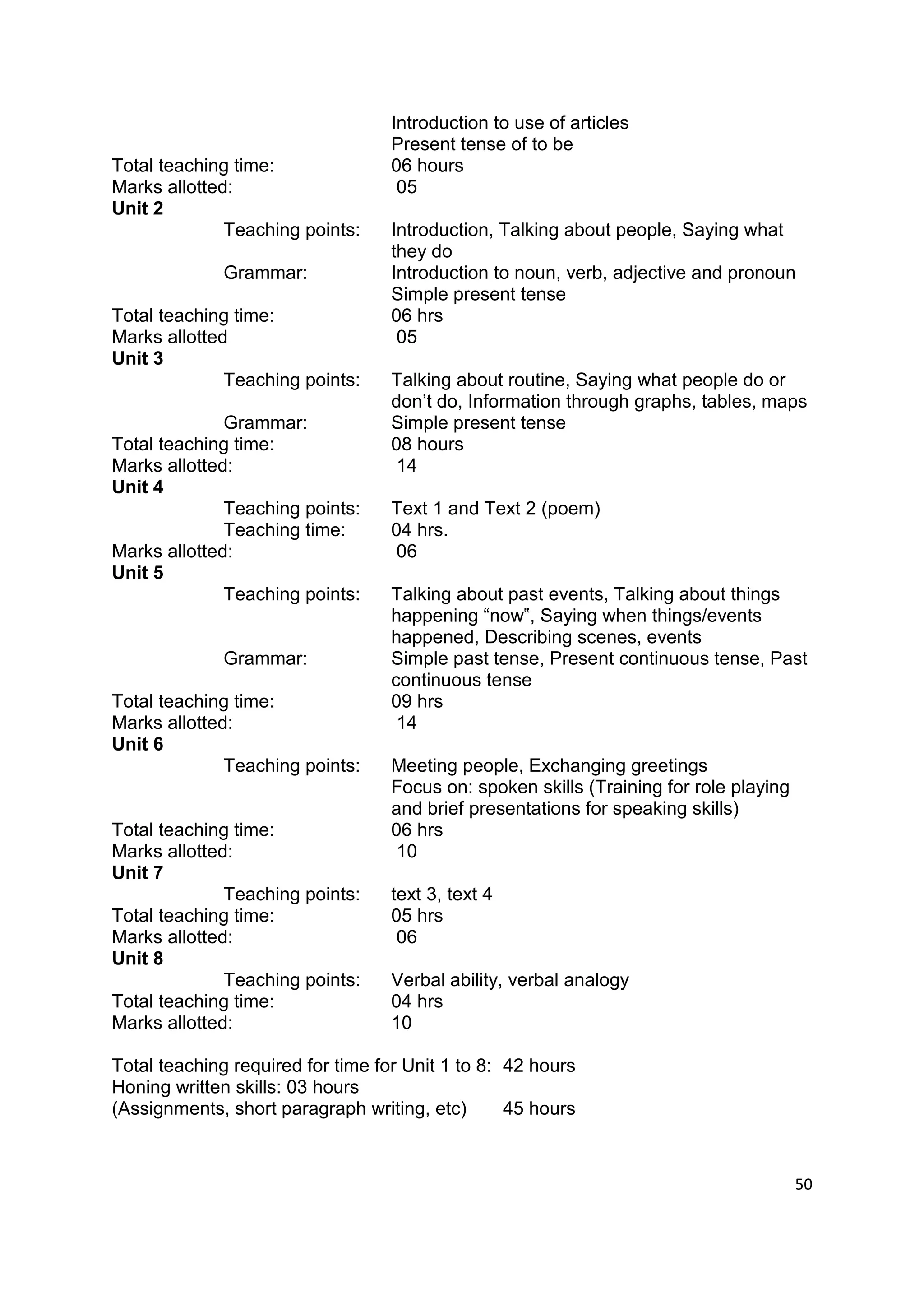
                                 Introduction to use of articles
                                 Present tense of to be
Total teaching time:             06 hours
Marks allotted:                   05
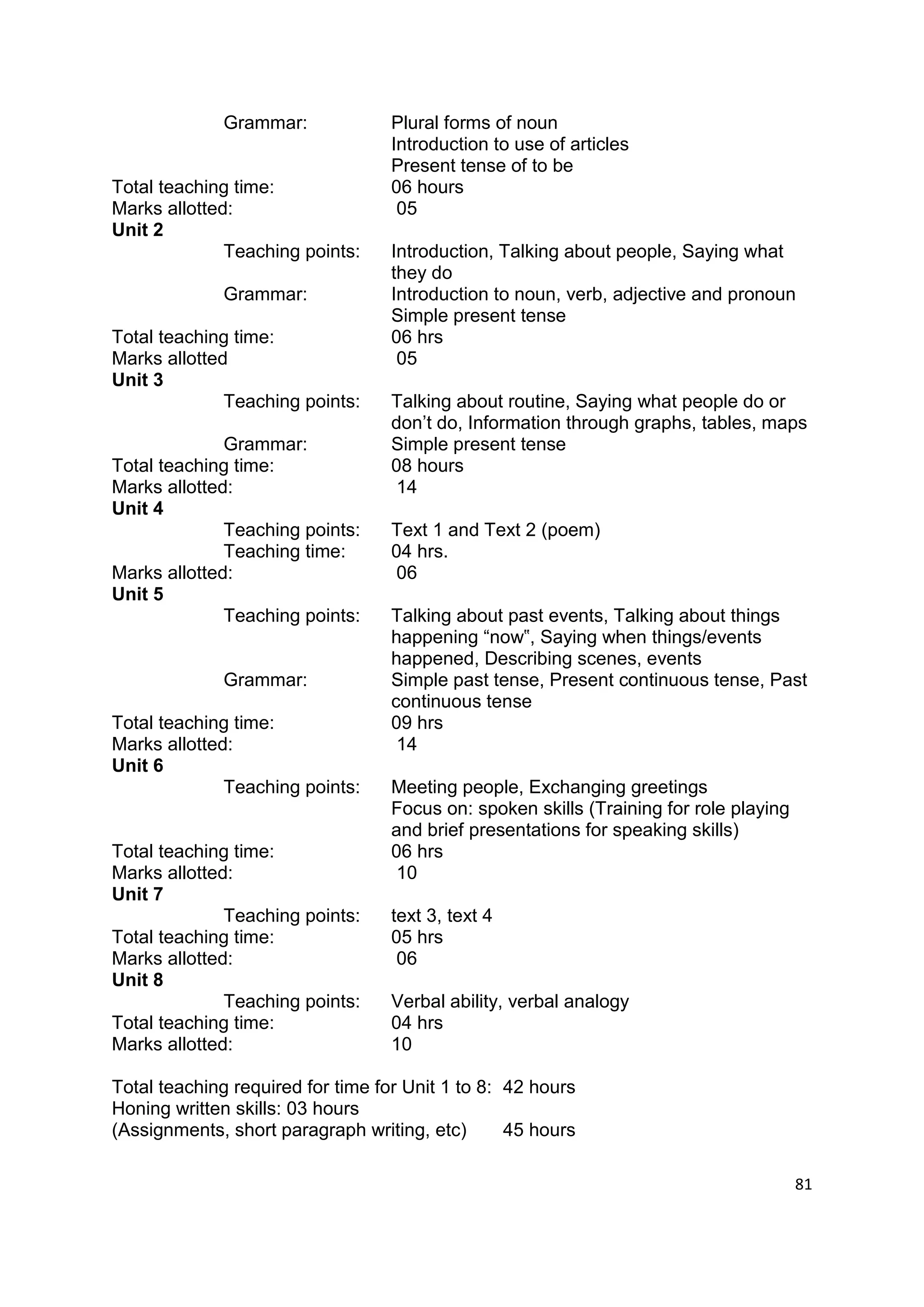
Unit 2
              Teaching points:   Introduction, Talking about people, Saying what
                                 they do
             Grammar:            Introduction to noun, verb, adjective and pronoun
                                 Simple present tense
Total teaching time:             06 hrs
Marks allotted                    05
Unit 3
              Teaching points:   Talking about routine, Saying what people do or
                                 don‟t do, Information through graphs, tables, maps
              Grammar:           Simple present tense
Total teaching time:             08 hours
Marks allotted:                   14
Unit 4
              Teaching points:   Text 1 and Text 2 (poem)
              Teaching time:     04 hrs.
Marks allotted:                   06
Unit 5
              Teaching points:   Talking about past events, Talking about things
                                 happening “now‟, Saying when things/events
                                 happened, Describing scenes, events
             Grammar:            Simple past tense, Present continuous tense, Past
                                 continuous tense
Total teaching time:             09 hrs
Marks allotted:                   14
Unit 6
              Teaching points:   Meeting people, Exchanging greetings
                                 Focus on: spoken skills (Training for role playing
                                 and brief presentations for speaking skills)
Total teaching time:             06 hrs
Marks allotted:                   10
Unit 7
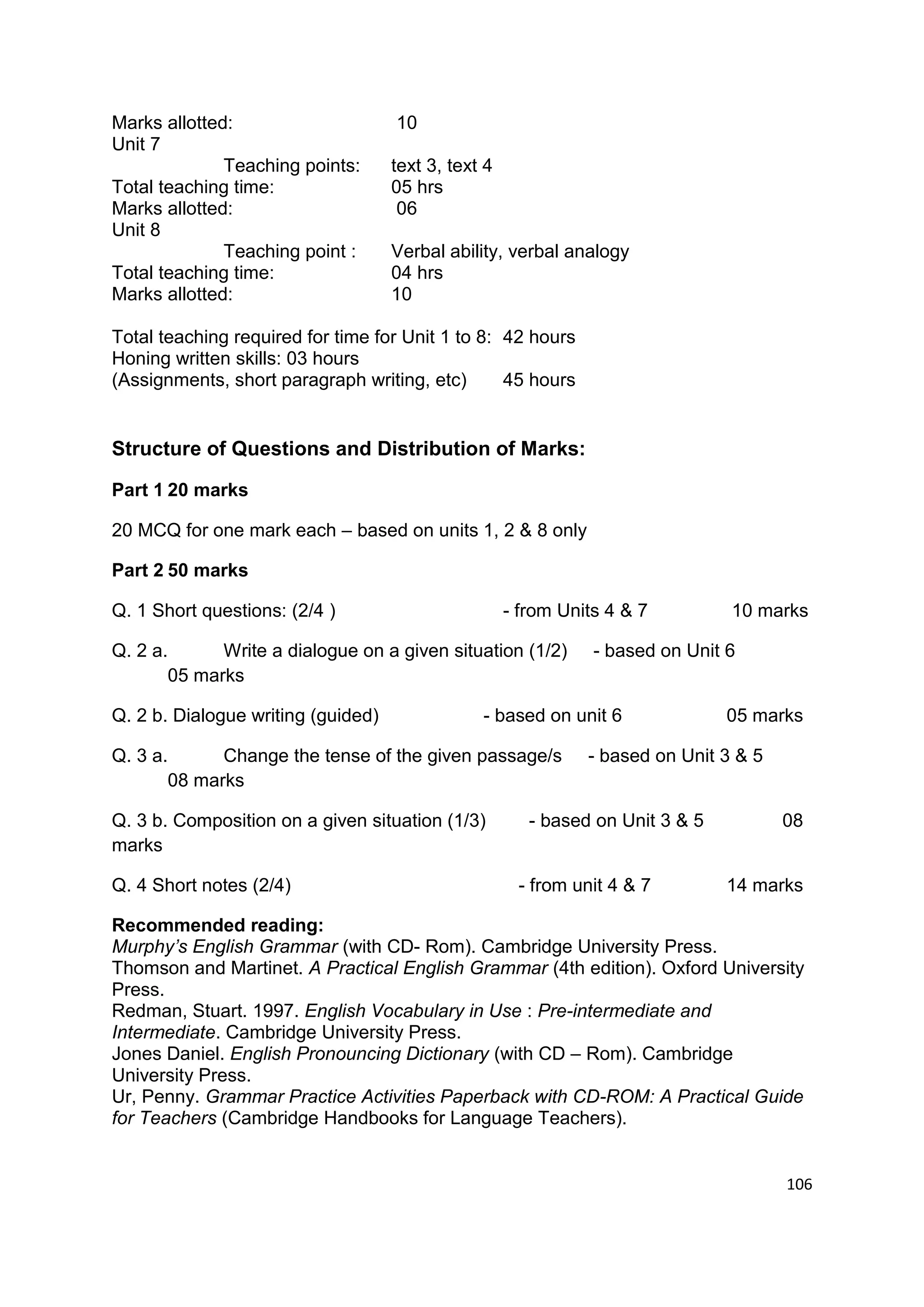
              Teaching points:   text 3, text 4
Total teaching time:             05 hrs
Marks allotted:                   06
Unit 8
              Teaching point :   Verbal ability, verbal analogy
Total teaching time:             04 hrs
                                                                                      2
Marks allotted:                     10

Total teaching required for time for Unit 1 to 8: 42 hours
Honing written skills: 03 hours
(Assignments, short paragraph writing, etc)       45 hours

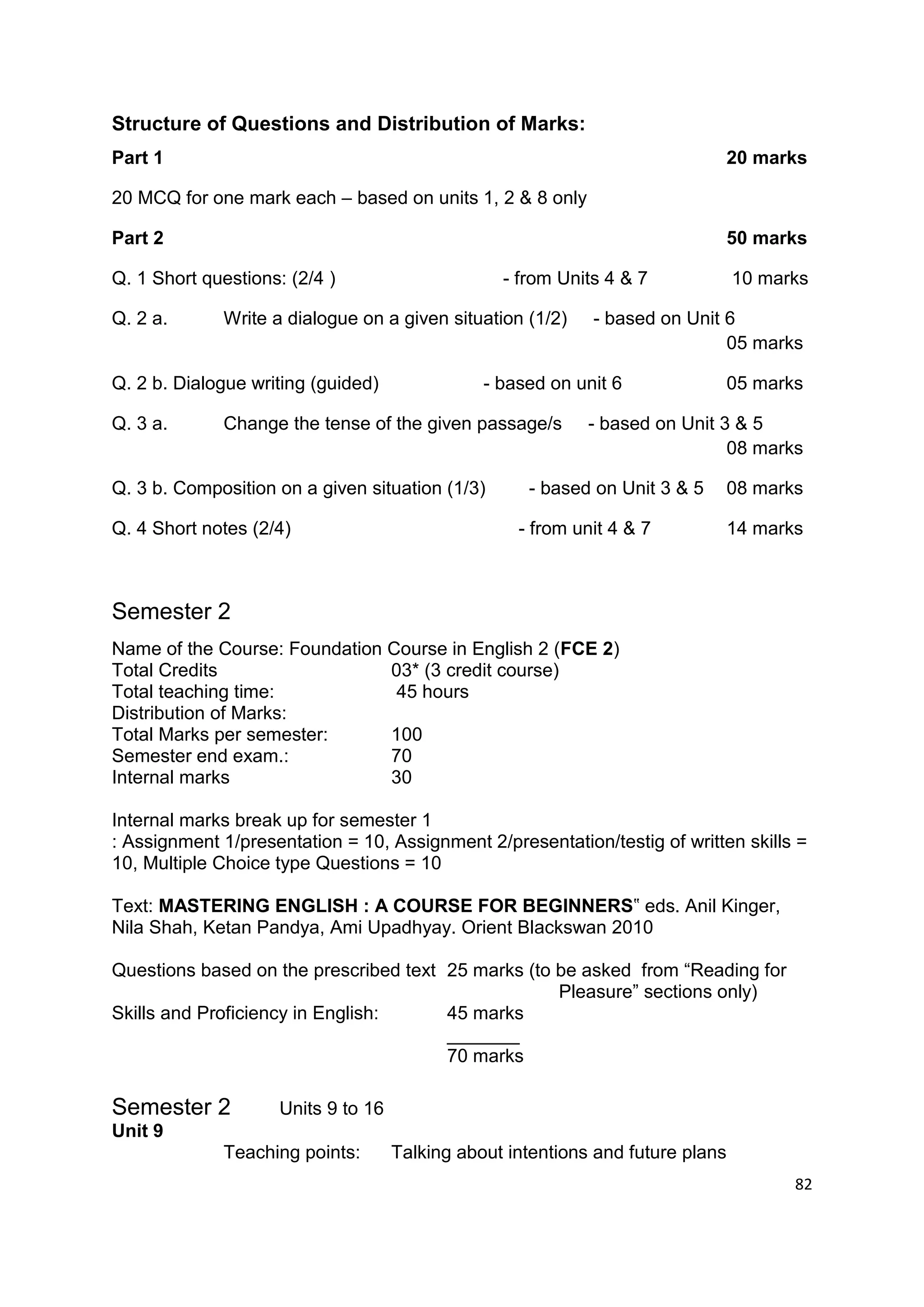
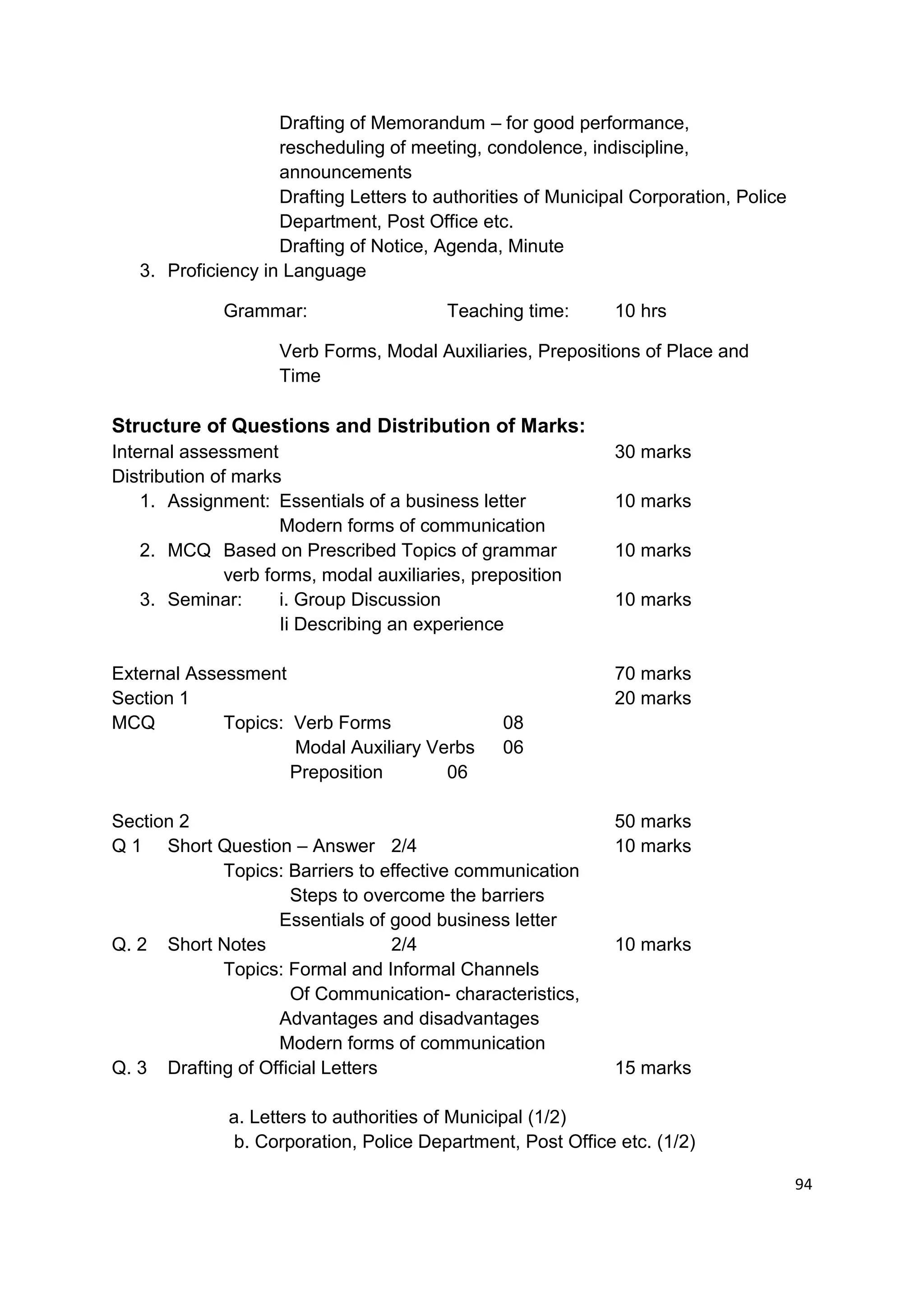
Structure of Questions and Distribution of Marks:

Part 1 20 marks

20 MCQ for one mark each – based on units 1, 2 & 8 only

Part 2 50 marks

Q. 1 Short questions: (2/4 )                     - from Units 4 & 7           10 marks

Q. 2 a.      Write a dialogue on a given situation (1/2)     - based on Unit 6
       05 marks

Q. 2 b. Dialogue writing (guided)             - based on unit 6              05 marks

Q. 3 a.      Change the tense of the given passage/s         - based on Unit 3 & 5
       08 marks

Q. 3 b. Composition on a given situation (1/3)      - based on Unit 3 & 5    08 marks

Q. 4 Short notes (2/4)                             - from unit 4 & 7         14 marks


Recommended reading:
Murphy’s English Grammar (with CD- Rom). Cambridge University Press.
Thomson and Martinet. A Practical English Grammar (4th edition). Oxford University
Press.
Redman, Stuart. 1997. English Vocabulary in Use : Pre-intermediate and
Intermediate. Cambridge University Press.
Jones Daniel. English Pronouncing Dictionary (with CD – Rom). Cambridge
University Press.
Ur, Penny. Grammar Practice Activities Paperback with CD-ROM: A Practical Guide
for Teachers (Cambridge Handbooks for Language Teachers).
*[1 credit = 1 hour of teaching per week (1 credit course = 15 hours of lectures per
semester; 3 credits = 3 hours of instruction per week (3 credit course = 45 hours of
lectures per semester)]

Semester 1

Name of the course: Core Course in English (CCE 1)

Total credits:             03* (3 credit course)

                                                                                        3
Total teaching time:         45 hours

Distribution of marks:
Total marks per semester:           100
Semester end exam.:                 70
Internal marks:                     30

Internal marks break up: Assignment 1/ presentation = 10, Assignment
2/Presentation = 10, MCQ test/assessment of writing skills: 10

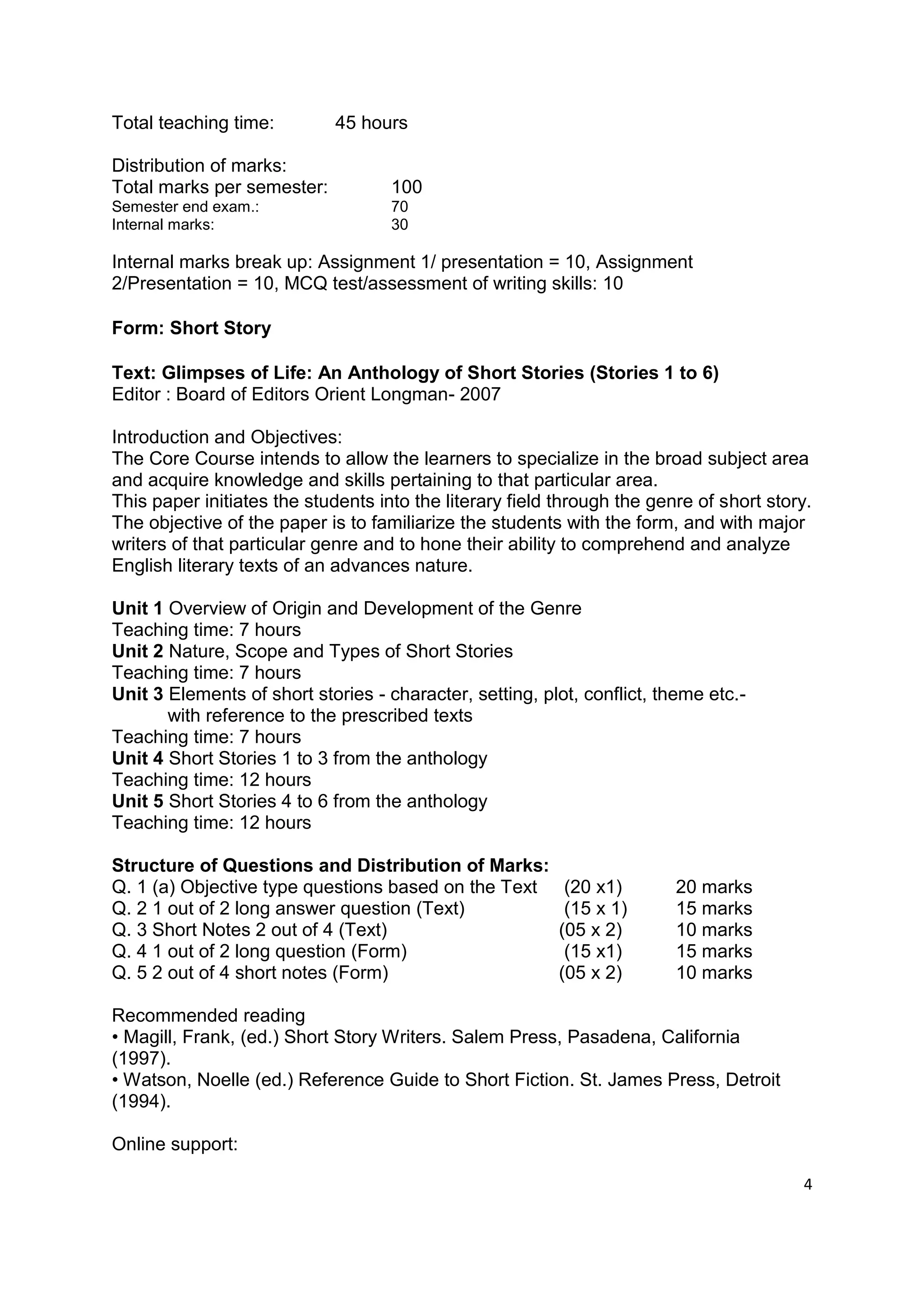
Form: Short Story

Text: Glimpses of Life: An Anthology of Short Stories (Stories 1 to 6)
Editor : Board of Editors Orient Longman- 2007

Introduction and Objectives:
The Core Course intends to allow the learners to specialize in the broad subject area
and acquire knowledge and skills pertaining to that particular area.
This paper initiates the students into the literary field through the genre of short story.
The objective of the paper is to familiarize the students with the form, and with major
writers of that particular genre and to hone their ability to comprehend and analyze
English literary texts of an advances nature.

Unit 1 Overview of Origin and Development of the Genre
Teaching time: 7 hours
Unit 2 Nature, Scope and Types of Short Stories
Teaching time: 7 hours
Unit 3 Elements of short stories - character, setting, plot, conflict, theme etc.-
       with reference to the prescribed texts
Teaching time: 7 hours
Unit 4 Short Stories 1 to 3 from the anthology
Teaching time: 12 hours
Unit 5 Short Stories 4 to 6 from the anthology
Teaching time: 12 hours

Structure of Questions and Distribution of Marks:
Q. 1 (a) Objective type questions based on the Text        (20 x1)       20 marks
Q. 2 1 out of 2 long answer question (Text)                (15 x 1)      15 marks
Q. 3 Short Notes 2 out of 4 (Text)                        (05 x 2)       10 marks
Q. 4 1 out of 2 long question (Form)                       (15 x1)       15 marks
Q. 5 2 out of 4 short notes (Form)                        (05 x 2)       10 marks

Recommended reading
• Magill, Frank, (ed.) Short Story Writers. Salem Press, Pasadena, California
(1997).
• Watson, Noelle (ed.) Reference Guide to Short Fiction. St. James Press, Detroit
(1994).

Online support:

                                                                                         4
• http://en.wikipedia.org/wiki/Short_story
• The Writing of the Short Story by Lewis Worthington Smith.
http://www.gutenberg.org/etext/27224
*[1 credit = 1 hour of teaching per week (1 credit course = 15 hours of lectures per
semester; 3 credits = 3 hours of instruction per week (3 credit course = 45 hours of
lectures
per semester)]

Semester 1
Name of the course: Core Course in English (CCE 2)
Total credits: = 03* (3 credit course)
Total teaching time: = 45 hours
Distribution of marks:
Total Marks per semester: 100
Semester end exam.:          70
Internal marks               30

Internal marks break up: Assignment 1/ presentation = 10, Assignment
2/Presentation = 10, MCQ test/assessment of writing skills: 10

Form: Lyric
Text: Appreciating English Poetry ( Poems 1 to 6)
Editor : Praveen K. Thaker Orient Longman. 2005

Introduction and Objectives:
The Core Course intends to allow the learners to specialize in the broad subject area
and acquire knowledge and skills pertaining to that particular area.
This paper initiates the students into the literary field through the genre of lyric. The
objective of the paper is to familiarize the students with the form, and with major
creative writers of that particular genre and to hone their ability to comprehend and
analyze English literary texts of an advances nature.

Unit 1
Origin and Development of the genre                         Teaching time: 7 hours
Unit 2
Types - Ballad, Sonnet, Ode, Hymn and Chant, Elegy, etc.; Characteristics of Lyric
                                                            Teaching time: 7 hours
Unit 3
Concepts of poetic techniques -regarding structure, rhyme, meter, alliteration, lines
and stanza, assonance etc. with reference to the prescribed works
                                                            Teaching time: 7 hours
Unit 4
Appreciating English Poetry : Poem 1 to 6                  Teaching time : 24 hours

Structure of Questions and Allotment of Marks:
Q. 1 Text Based Objective types questions               20 x 1         20 marks
Q. 2 Long questions - answers (Poems) (1/2)             15 x1          15 marks
Q. 3 Short note (Poems)                (2/4)            05x 2          10 marks
Q. 4 Long questions –answers (Form) (1/2)               15 x1          15 marks
                                                                                       5
Q. 5     Short notes (Form)                (2/4)       5x2           10 marks


Recommended reading:
Alexander, L. G. 1963. Poetry and Prose Appreciation for the Overseas Students.
Longmans.
Blackstone, Bernard. Practical English Prosody. Longmans. Goose,
Edmund. 1990. Appreciation of Poetry. Orient Blackswan Ltd. Palgrave,
F. T. Golden Treasury . Macmillan: London, New York
Online support:
Cary, John. Practical English Prosody and Versification
http://www.archive.org/details/practicalenglis00caregoog
*[1 credit = 1 hour of teaching per week (1 credit course = 15 hours of lectures per
semester; 3 credits = 3 hours of instruction per week (3 credit course = 45 hours of
lectures
per semester)]

Semester 1
Elective 1
Name of the course: (Functional English FE I: (Introduction to Phonetics)

Objectives:

      To familiarize the learners with the functioning of English sounds
      To enable the learners to acquire fluency and accuracy in pronunciation and
       speech
Distribution of marks:       100

Practical:                    20 Marks

       10 Questions to assess practical understanding of the subject
       10 transcribed words to be read out
Semester end exam:      50

Internal Marks:               30

     Assignment (10 marks)
     Presentation (5 marks)
     Journal (5 marks) One journal to be maintained for Sem I and II
      (Exercises from Bansal and Harrison)
    Consistent Assessment, Class tests (10 Marks)
Text: A Course in Phonetics and Spoken English, J. Sethi and P. V. Dhamija
(1999) 2nd edition. Prentice Hall, New Delhi

Topics

Unit I Introduction to Phonetics, Organs of Speech

Unit II Description and Classification of consonants and vowels
                                                                                       6
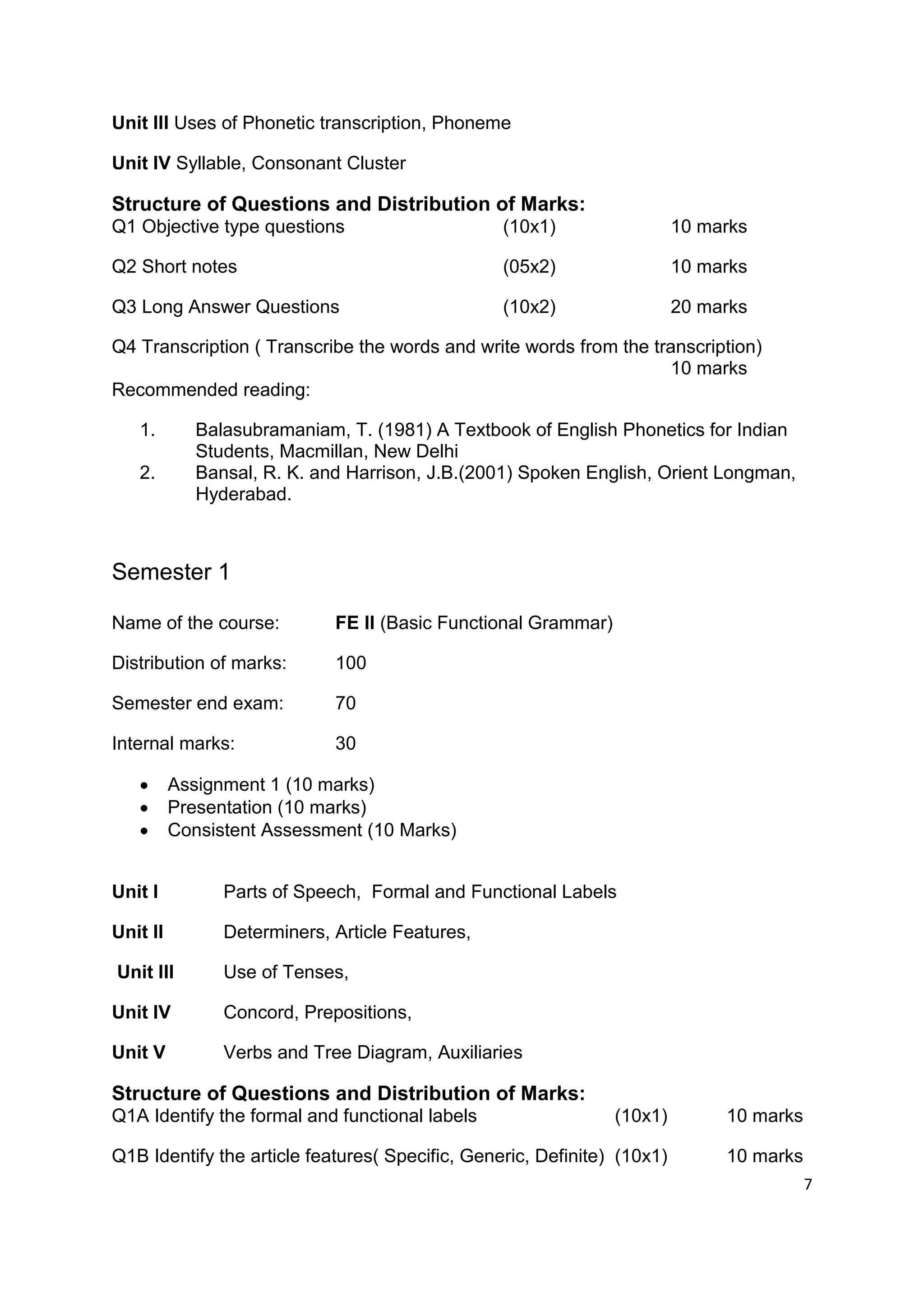
Unit III Uses of Phonetic transcription, Phoneme

Unit IV Syllable, Consonant Cluster

Structure of Questions and Distribution of Marks:
Q1 Objective type questions                      (10x1)                  10 marks

Q2 Short notes                                   (05x2)                  10 marks

Q3 Long Answer Questions                         (10x2)                  20 marks

Q4 Transcription ( Transcribe the words and write words from the transcription)
                                                                   10 marks
Recommended reading:

   1.        Balasubramaniam, T. (1981) A Textbook of English Phonetics for Indian
             Students, Macmillan, New Delhi
   2.        Bansal, R. K. and Harrison, J.B.(2001) Spoken English, Orient Longman,
             Hyderabad.


Semester 1

Name of the course:          FE II (Basic Functional Grammar)

Distribution of marks:       100

Semester end exam:           70

Internal marks:              30

         Assignment 1 (10 marks)
         Presentation (10 marks)
         Consistent Assessment (10 Marks)


Unit I          Parts of Speech, Formal and Functional Labels

Unit II         Determiners, Article Features,

Unit III        Use of Tenses,

Unit IV         Concord, Prepositions,

Unit V          Verbs and Tree Diagram, Auxiliaries

Structure of Questions and Distribution of Marks:
Q1A Identify the formal and functional labels                   (10x1)        10 marks

Q1B Identify the article features( Specific, Generic, Definite) (10x1)        10 marks
                                                                                         7
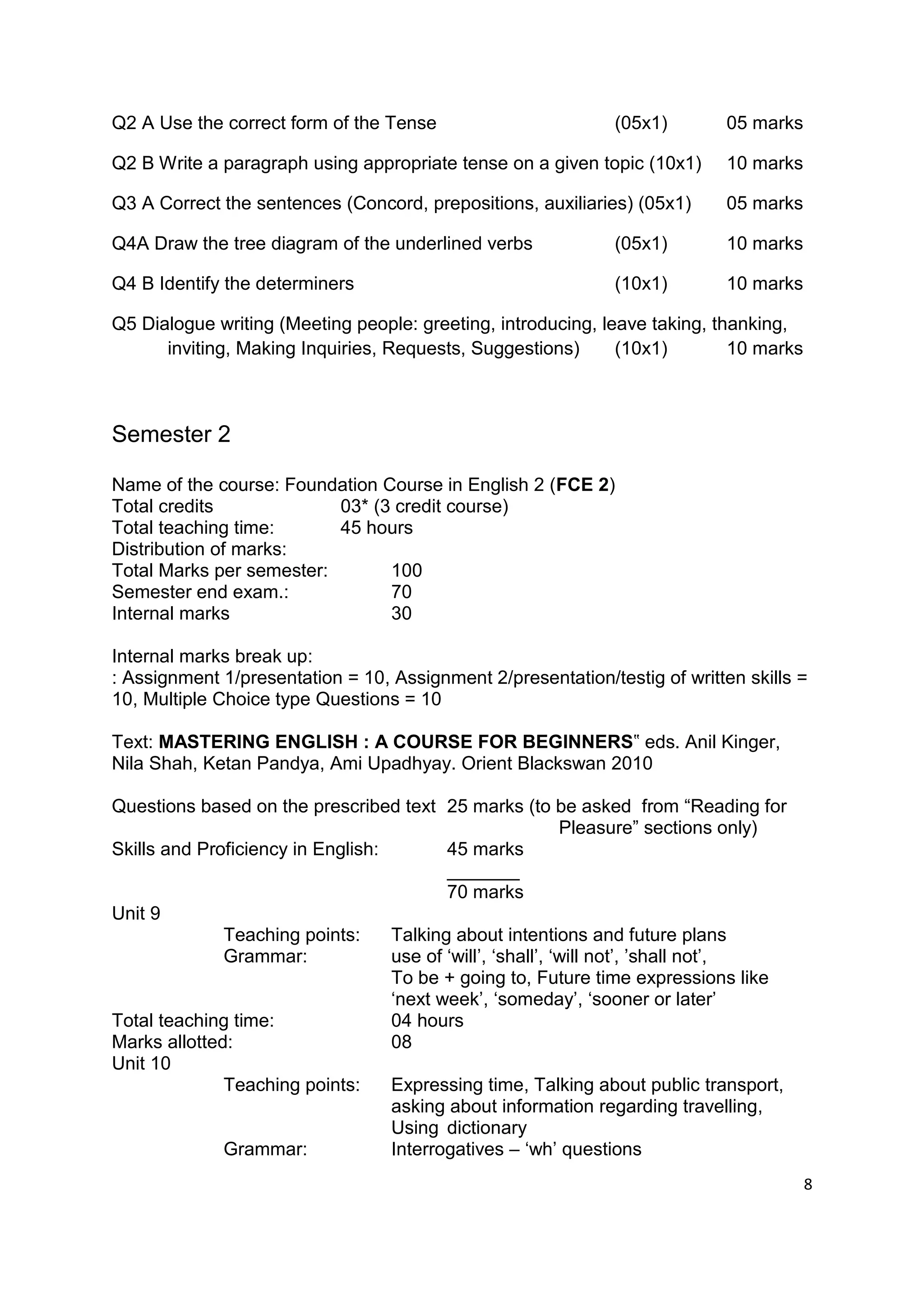
Q2 A Use the correct form of the Tense                        (05x1)        05 marks

Q2 B Write a paragraph using appropriate tense on a given topic (10x1)      10 marks

Q3 A Correct the sentences (Concord, prepositions, auxiliaries) (05x1)      05 marks

Q4A Draw the tree diagram of the underlined verbs             (05x1)        10 marks

Q4 B Identify the determiners                                 (10x1)        10 marks

Q5 Dialogue writing (Meeting people: greeting, introducing, leave taking, thanking,
      inviting, Making Inquiries, Requests, Suggestions)      (10x1)        10 marks


Semester 2

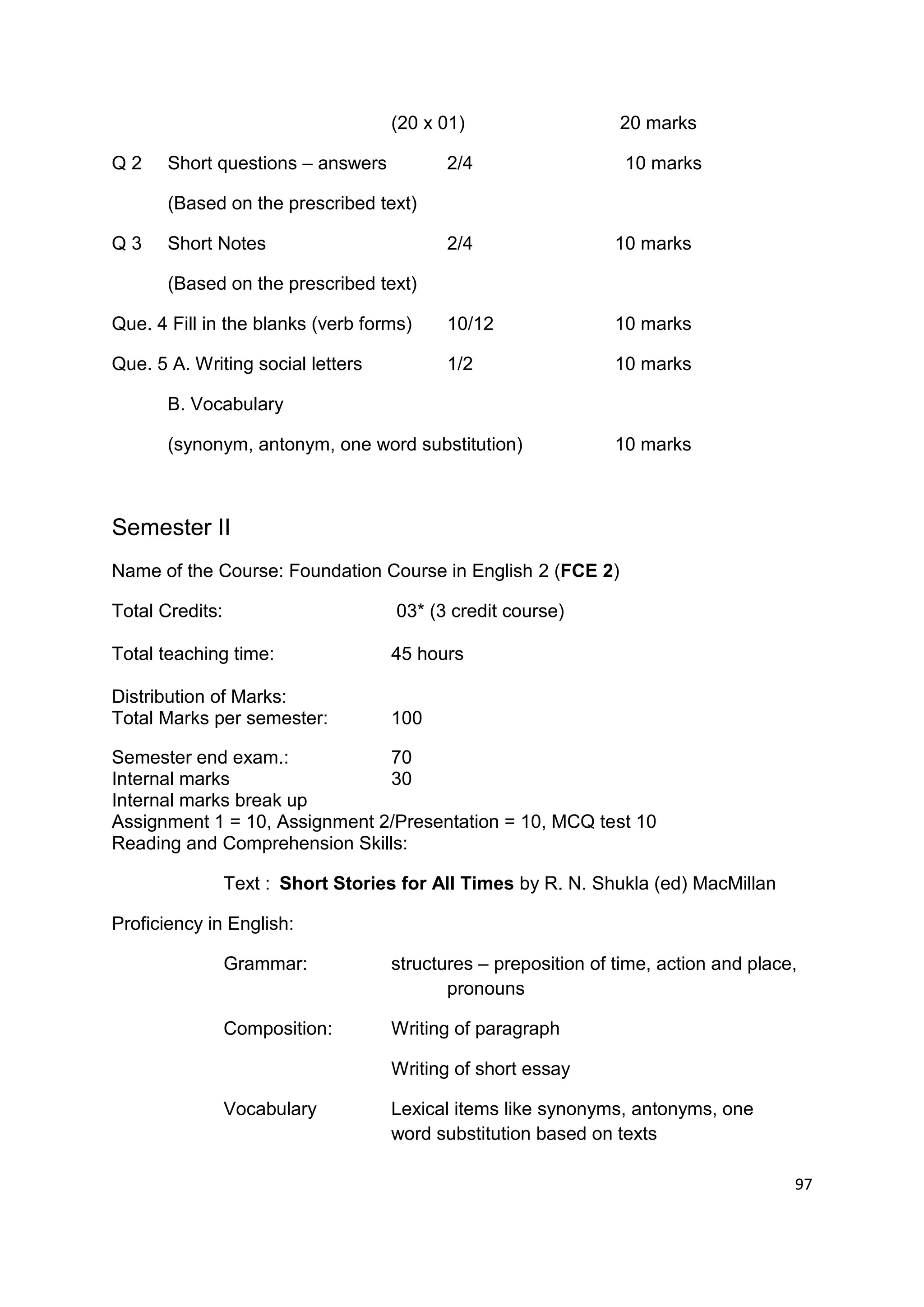
Name of the course: Foundation Course in English 2 (FCE 2)
Total credits             03* (3 credit course)
Total teaching time:      45 hours
Distribution of marks:
Total Marks per semester:       100
Semester end exam.:             70
Internal marks                  30

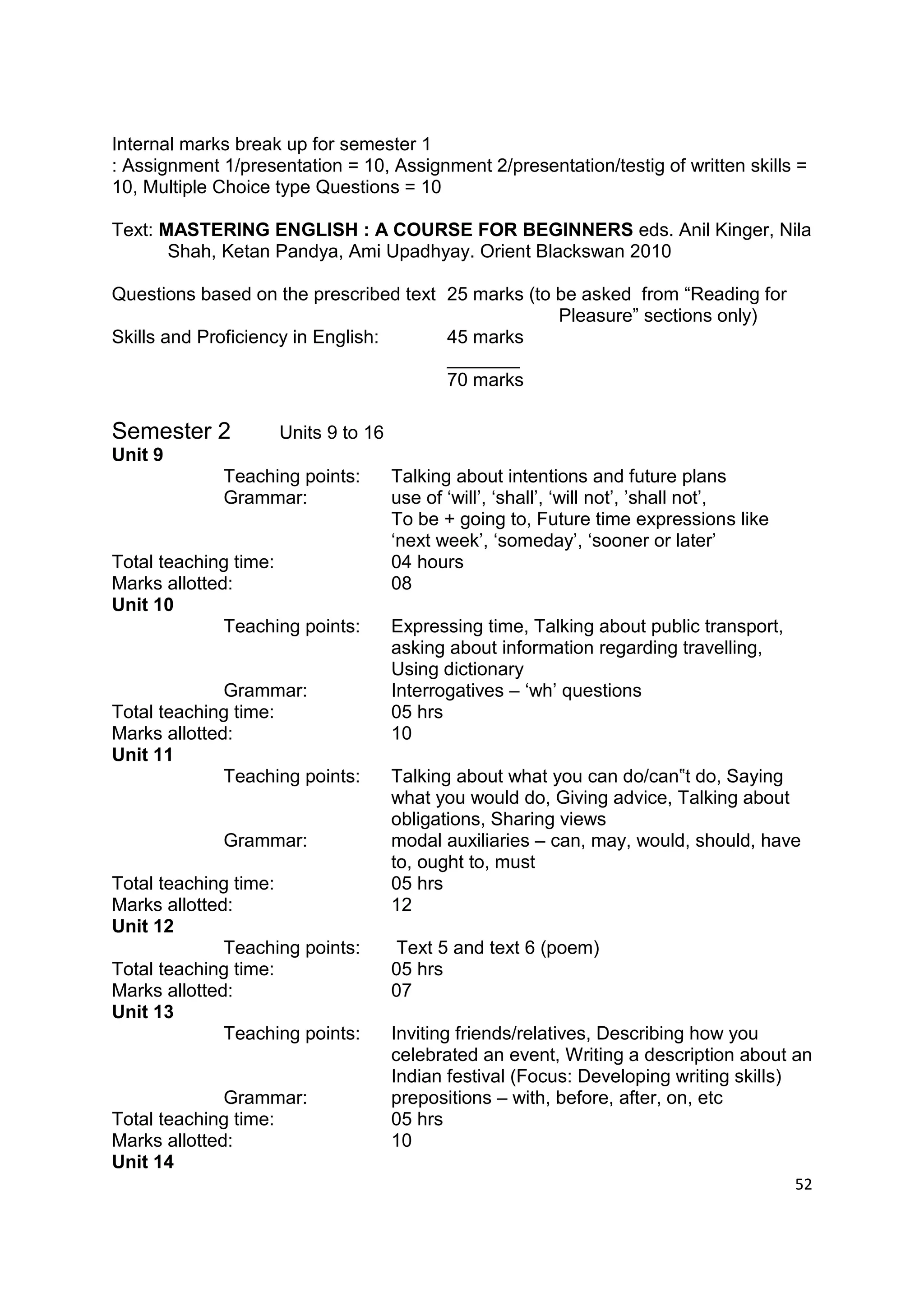
Internal marks break up:
: Assignment 1/presentation = 10, Assignment 2/presentation/testig of written skills =
10, Multiple Choice type Questions = 10

Text: MASTERING ENGLISH : A COURSE FOR BEGINNERS‟ eds. Anil Kinger,
Nila Shah, Ketan Pandya, Ami Upadhyay. Orient Blackswan 2010

Questions based on the prescribed text 25 marks (to be asked from “Reading for
                                                            Pleasure” sections only)
Skills and Proficiency in English:        45 marks
                                          _______
                                          70 marks
Unit 9
              Teaching points:     Talking about intentions and future plans
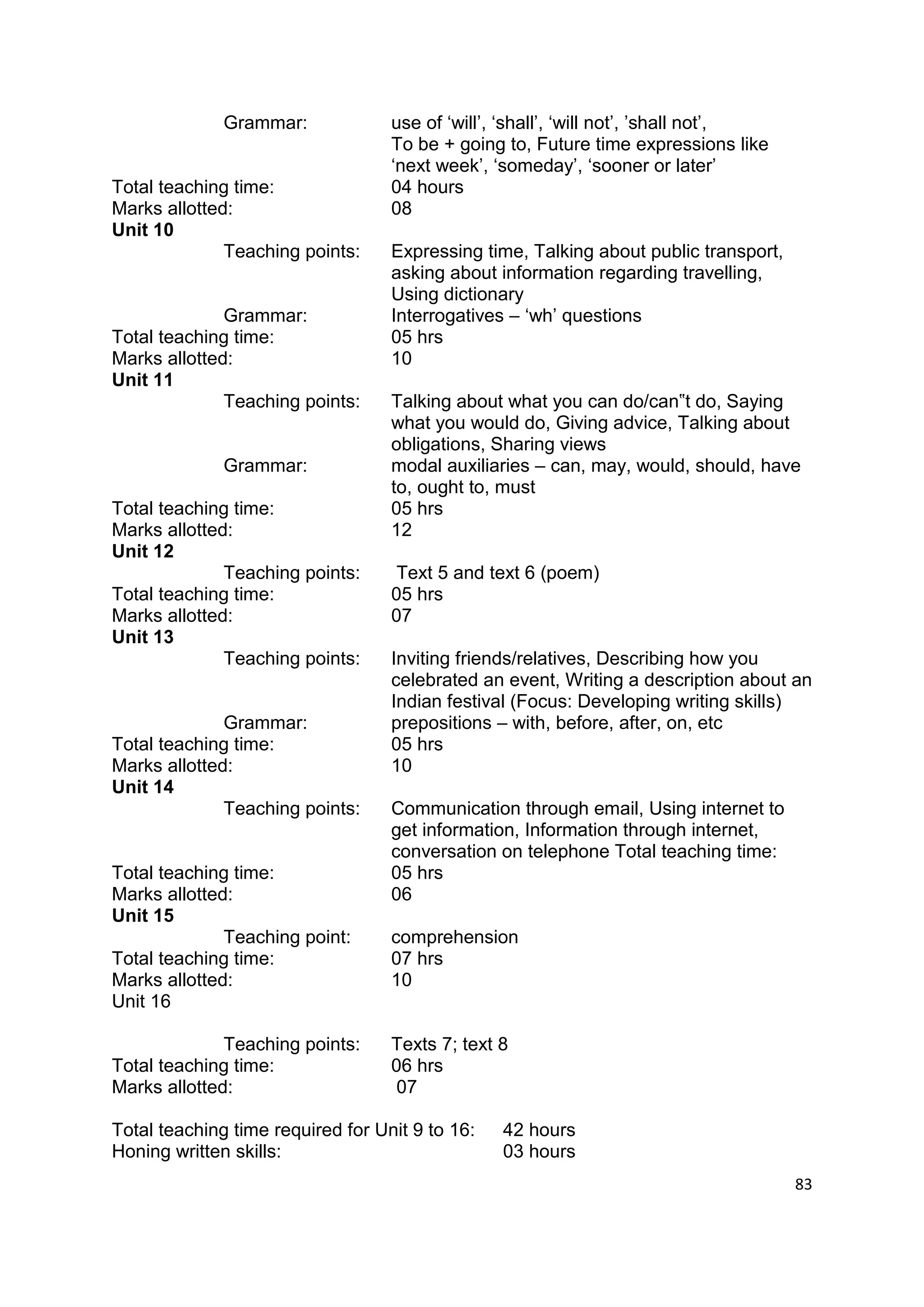
              Grammar:             use of „will‟, „shall‟, „will not‟, ‟shall not‟,
                                   To be + going to, Future time expressions like
                                   „next week‟, „someday‟, „sooner or later‟
Total teaching time:               04 hours
Marks allotted:                    08
Unit 10
              Teaching points:     Expressing time, Talking about public transport,
                                   asking about information regarding travelling,
                                   Using dictionary
              Grammar:             Interrogatives – „wh‟ questions
                                                                                       8
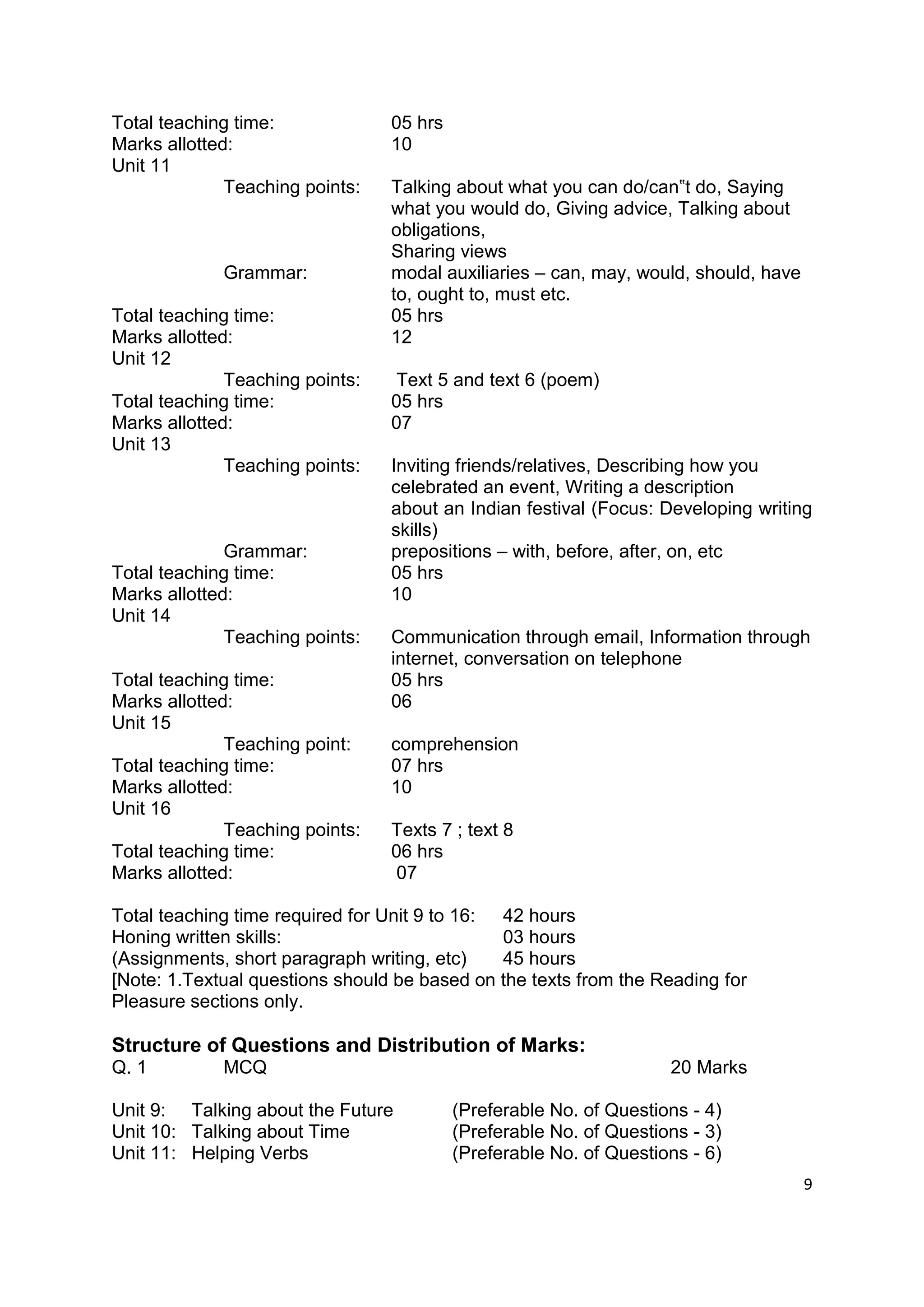
Total teaching time:             05 hrs
Marks allotted:                  10
Unit 11
              Teaching points:   Talking about what you can do/can‟t do, Saying
                                 what you would do, Giving advice, Talking about
                                 obligations,
                                 Sharing views
             Grammar:            modal auxiliaries – can, may, would, should, have
                                 to, ought to, must etc.
Total teaching time:             05 hrs
Marks allotted:                  12
Unit 12
              Teaching points:    Text 5 and text 6 (poem)
Total teaching time:             05 hrs
Marks allotted:                  07
Unit 13
              Teaching points:   Inviting friends/relatives, Describing how you
                                 celebrated an event, Writing a description
                                 about an Indian festival (Focus: Developing writing
                                 skills)
              Grammar:           prepositions – with, before, after, on, etc
Total teaching time:             05 hrs
Marks allotted:                  10
Unit 14
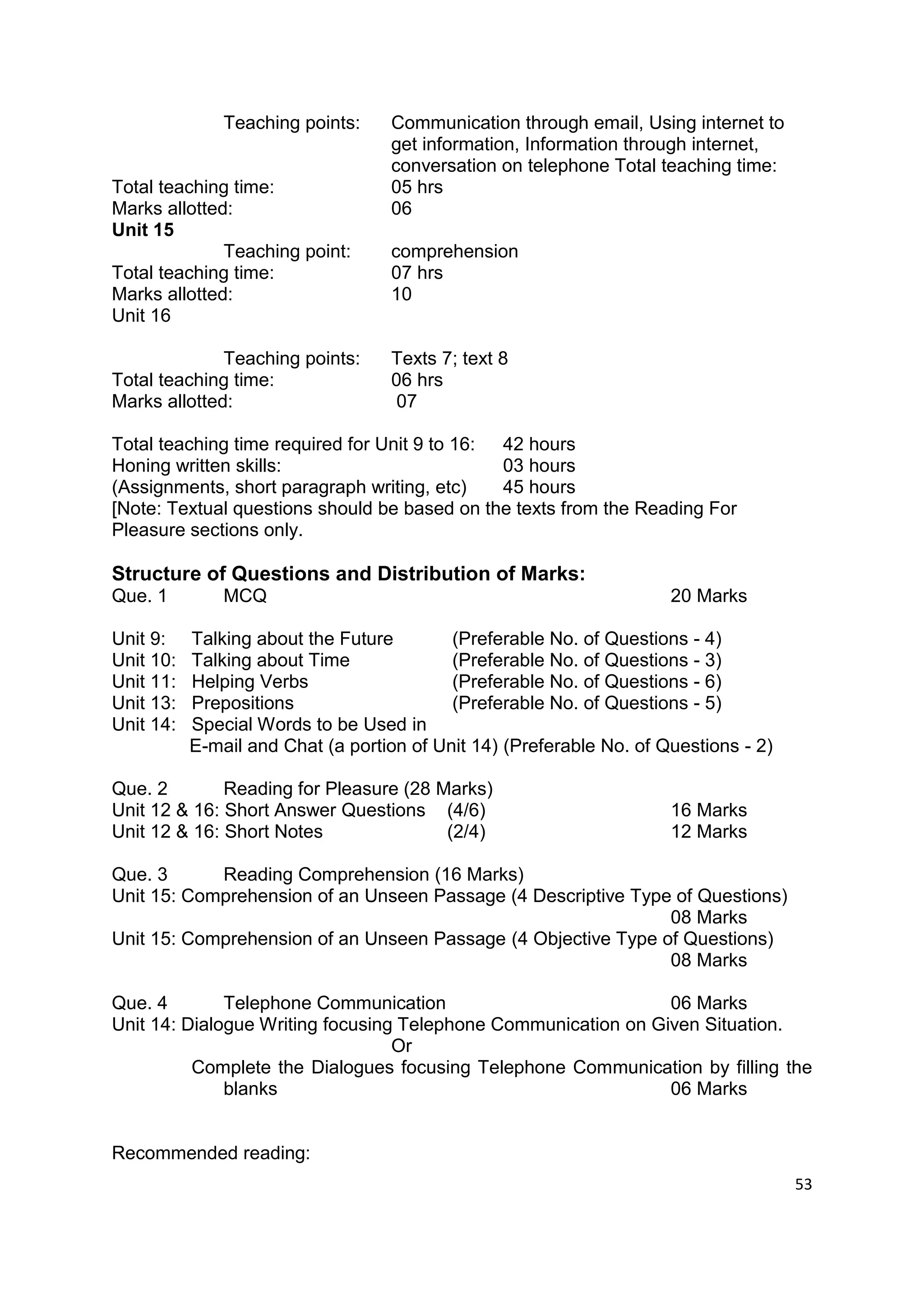
              Teaching points:   Communication through email, Information through
                                 internet, conversation on telephone
Total teaching time:             05 hrs
Marks allotted:                  06
Unit 15
              Teaching point:    comprehension
Total teaching time:             07 hrs
Marks allotted:                  10
Unit 16
              Teaching points:   Texts 7 ; text 8
Total teaching time:             06 hrs
Marks allotted:                   07

Total teaching time required for Unit 9 to 16: 42 hours
Honing written skills:                         03 hours
(Assignments, short paragraph writing, etc)    45 hours
[Note: 1.Textual questions should be based on the texts from the Reading for
Pleasure sections only.

Structure of Questions and Distribution of Marks:
Q. 1         MCQ                                                    20 Marks

Unit 9: Talking about the Future          (Preferable No. of Questions - 4)
Unit 10: Talking about Time               (Preferable No. of Questions - 3)
Unit 11: Helping Verbs                    (Preferable No. of Questions - 6)
                                                                                     9
Unit 13: Prepositions                    (Preferable No. of Questions - 5)
Unit 14: Special words to be used in
         E-mail and Chat (a portion of Unit 14) (Preferable No. of Questions - 2)

Q. 2 Reading for Pleasure (28 Marks)
Unit 12 & 16: Short Answer Questions (4/6)                          16 marks
Unit 12 & 16: Short Notes            (2/4)                          12 marks

Q. 3 Reading Comprehension                                     16 marks
Unit 15: Comprehension of an Unseen Passage (4 Descriptive Type of Questions)
                                                               08 marks
Unit 15: Comprehension of an Unseen Passage (4 Objective Type of Questions)
                                                               08 marks

Q. 4 Telephone Communication                                    06 marks
Unit 14: Dialogue Writing focusing Telephone Communication on Given Situation.
                                  Or
          Complete the Dialogues focusing Telephone Communication by filling the
              blanks                                            06 marks

Recommended reading:
Murphy’s English Grammar (with CD- Rom). Cambridge University Press.
Thomson and Martinet. A Practical English Grammar (4th edition). Oxford University
Press.
Redman, Stuart. 1997. English Vocabulary in Use : Pre-intermediate and
Intermediate. Cambridge University Press.
Jones Daniel. English Pronouncing Dictionary (with CD – Rom). Cambridge
University Press.
Ur, Penny. Grammar Practice Activities Paperback with CD-ROM: A Practical Guide
for Teachers (Cambridge Handbooks for Language Teachers).
*[1 credit = 1 hour of teaching per week (1 credit course = 15 hours of lectures per
semester; 3 credits = 3 hours of instruction per week (3 credit course = 45 hours of
lectures per semester)]

Semester 2

Name of the course: Core Course in English 3 (CCE 3)
Name of the paper: English Literature up to 1660
Total credits: Semester 2 = 03* (3 credit course)
Total teaching time: = 45 hours
Distribution of marks:
Total marks per semester:         100
Semester end exam.:               70
Internal marks                    30

Internal marks break up: Assignment 1/ presentation = 10, Assignment
2/Presentation = 10, MCQ test/assessment of writing skills: 10


                                                                                    10
Introduction and Objectives:
The Core Course intends to allow the learners to specialize in the broad subject area
and acquire knowledge and skills pertaining to that particular area. This paper will
cover the history of English literature from 1400 to 1660. It aims to develop an
understanding of the relevant socio-political and literary context of the given time
span. The text will be taught in terms of thematic concerns as well as literary form,
along with the connection of the text with the Age.
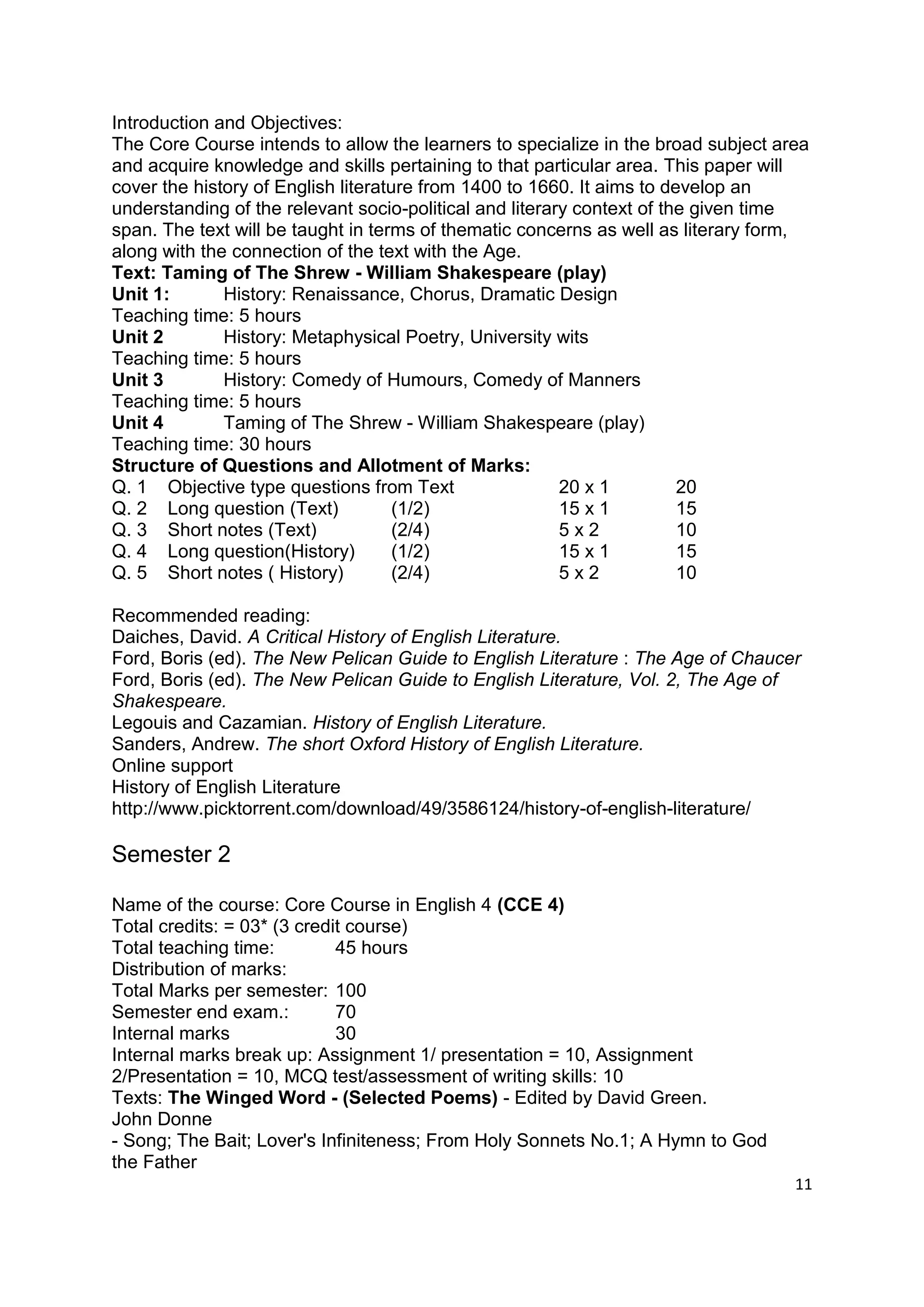
Text: Taming of The Shrew - William Shakespeare (play)
Unit 1:       History: Renaissance, Chorus, Dramatic Design
Teaching time: 5 hours
Unit 2        History: Metaphysical Poetry, University wits
Teaching time: 5 hours
Unit 3        History: Comedy of Humours, Comedy of Manners
Teaching time: 5 hours
Unit 4        Taming of The Shrew - William Shakespeare (play)
Teaching time: 30 hours
Structure of Questions and Allotment of Marks:
Q. 1 Objective type questions from Text                  20 x 1         20
Q. 2 Long question (Text)            (1/2)               15 x 1         15
Q. 3 Short notes (Text)              (2/4)               5x2            10
Q. 4 Long question(History)          (1/2)               15 x 1         15
Q. 5 Short notes ( History)          (2/4)               5x2            10

Recommended reading:
Daiches, David. A Critical History of English Literature.
Ford, Boris (ed). The New Pelican Guide to English Literature : The Age of Chaucer
Ford, Boris (ed). The New Pelican Guide to English Literature, Vol. 2, The Age of
Shakespeare.
Legouis and Cazamian. History of English Literature.
Sanders, Andrew. The short Oxford History of English Literature.
Online support
History of English Literature
http://www.picktorrent.com/download/49/3586124/history-of-english-literature/

Semester 2

Name of the course: Core Course in English 4 (CCE 4)
Total credits: = 03* (3 credit course)
Total teaching time:         45 hours
Distribution of marks:
Total Marks per semester: 100
Semester end exam.:          70
Internal marks               30
Internal marks break up: Assignment 1/ presentation = 10, Assignment
2/Presentation = 10, MCQ test/assessment of writing skills: 10
Texts: The Winged Word - (Selected Poems) - Edited by David Green.
John Donne
- Song; The Bait; Lover's Infiniteness; From Holy Sonnets No.1; A Hymn to God
the Father
                                                                                   11
George Herbert
- Virtue; The Pulley
Unit 1          Poems : Song; The Bait
Teaching time: 10 hours
Unit 2          Poems : Lover's Infiniteness; From Holy Sonnets No.1; A Hymn to God
                the Father
Teaching time: 10 hours
Unit 3          Poems : Virtue; The Pulley
Teaching time: 10 hours
Unit 4
Poetic Devices, with an emphasis on the prescribed figures of speech
(1) Alliteration (2) Simile (3) Metaphor (4) Personification (5) Paradox (6) Conceit
(7) Oxymoron (8) Onomatopoeia (9) Hyperbole (10) Climax
Teaching time: 15 hours
Structure of Questions and Allotment of Marks:
Q. 1 Objective type questions - Poems                     20 x 1               20 marks
Q. 2 Long questions – Poems                (1/2)          15 x 1               15 marks
Q. 3 Short notes – Poems                   (2/4)          5x2                  10 marks
Q. 4 Figures of Speech                     (5/7)          5x5                  25 marks
Recommended reading
Thomas N. Corns, The Cambridge Companion to English Poetry, Donne to Marvell,
Cambridge University Press, 1993.
Online Support:
The Works of John Donne
http://www.luminarium.org/sevenlit/donne/donnebib.htm
http://www.sparknotes.com/poetry/donne/
http://en.wikipedia.org/wiki/George_Herbert
*[1 credit = 1 hour of teaching per week (1 credit course = 15 hours of lectures per
semester; 3 credits = 3 hours of instruction per week (3 credit course = 45 hours of
lectures
per semester)]


Semester 2
Elective Course
Name of the course: Functional English 3 (FE 3) (Phonetics and Spoken English)

Distribution of marks:       100

Practical:                   20 marks

      5 questions to assess the practical understanding
      5 sentences with correct intonation to be read
      5 transcribed words to be read with correct stress
      5 words to be read with syllable break
Semester end Exam:                  50 marks
                                                                                     12
Internal assessment:                 30 marks

         Assignment 1 (05 marks)
         Assignment 2 (05 marks)
         Presentation (5+5 marks)
         Consistent Assessment (10 marks)


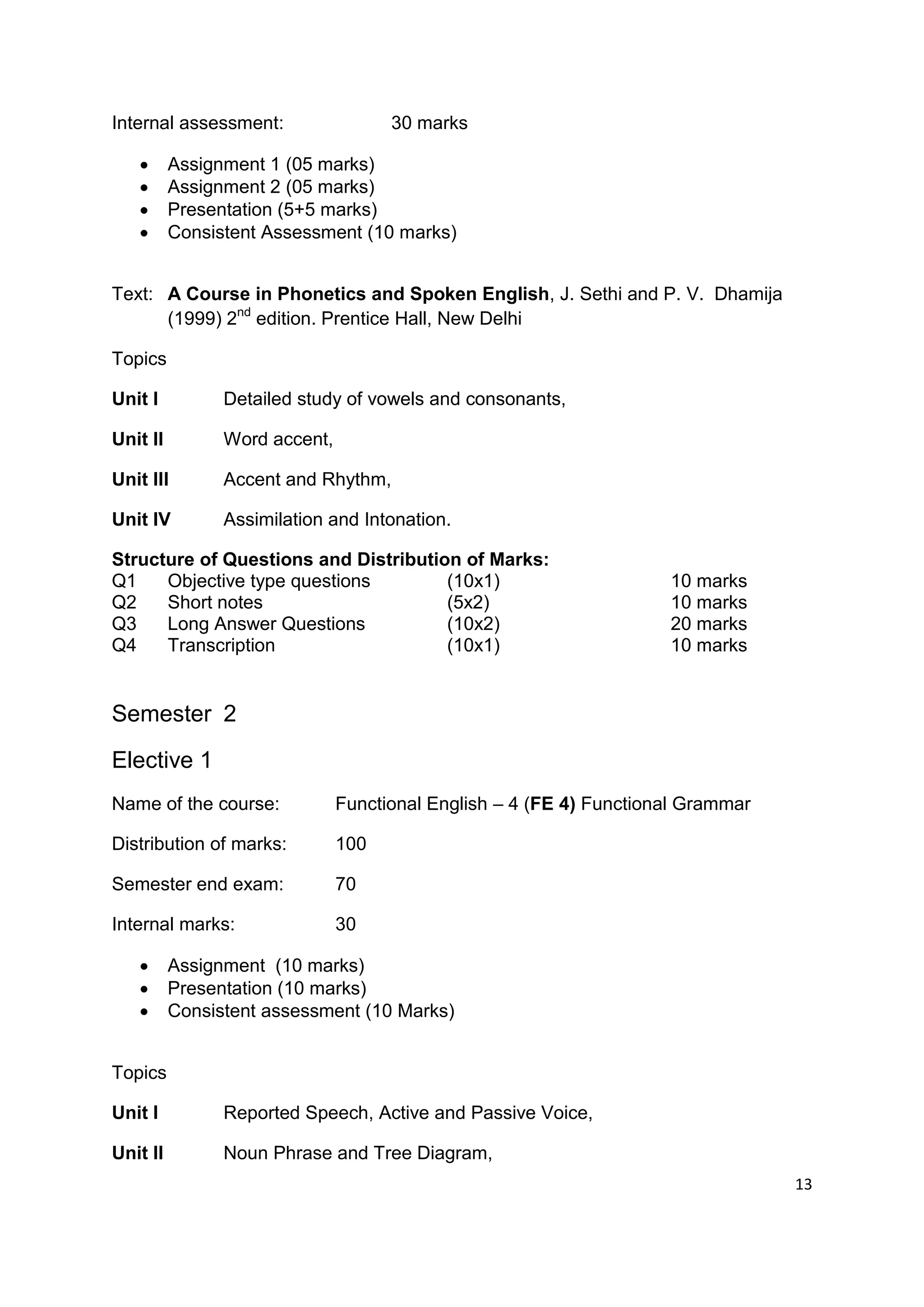
Text: A Course in Phonetics and Spoken English, J. Sethi and P. V. Dhamija
      (1999) 2nd edition. Prentice Hall, New Delhi

Topics

Unit I          Detailed study of vowels and consonants,

Unit II         Word accent,

Unit III        Accent and Rhythm,

Unit IV         Assimilation and Intonation.

Structure of Questions and Distribution of Marks:
Q1    Objective type questions        (10x1)                         10 marks
Q2    Short notes                     (5x2)                          10 marks
Q3    Long Answer Questions           (10x2)                         20 marks
Q4    Transcription                   (10x1)                         10 marks


Semester 2
Elective 1
Name of the course:            Functional English – 4 (FE 4) Functional Grammar

Distribution of marks:         100

Semester end exam:             70

Internal marks:                30

         Assignment (10 marks)
         Presentation (10 marks)
         Consistent assessment (10 Marks)


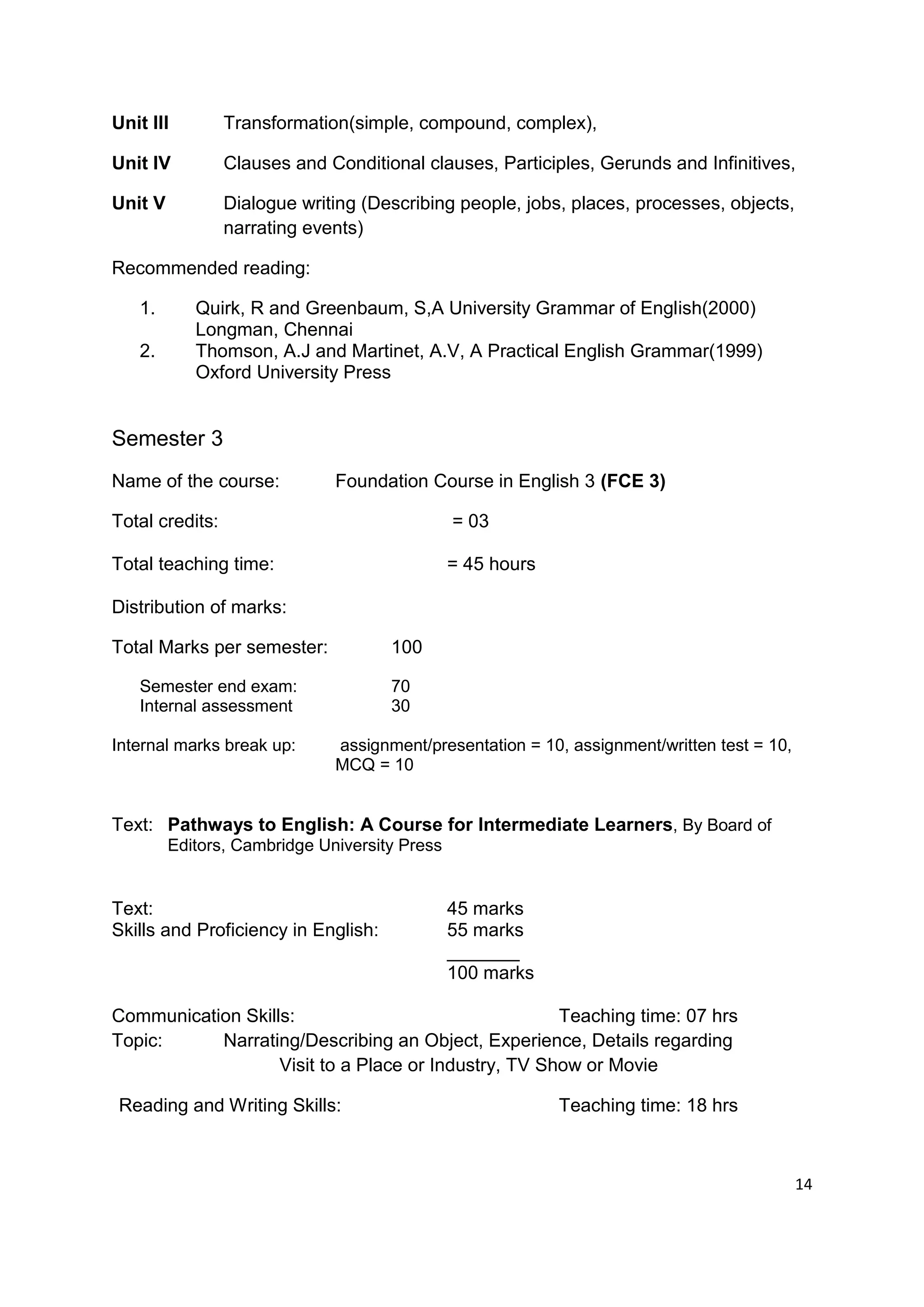
Topics

Unit I          Reported Speech, Active and Passive Voice,

Unit II         Noun Phrase and Tree Diagram,
                                                                                  13
Unit III         Transformation(simple, compound, complex),

Unit IV          Clauses and Conditional clauses, Participles, Gerunds and Infinitives,

Unit V           Dialogue writing (Describing people, jobs, places, processes, objects,
                 narrating events)

Recommended reading:

   1.       Quirk, R and Greenbaum, S,A University Grammar of English(2000)
            Longman, Chennai
   2.       Thomson, A.J and Martinet, A.V, A Practical English Grammar(1999)
            Oxford University Press


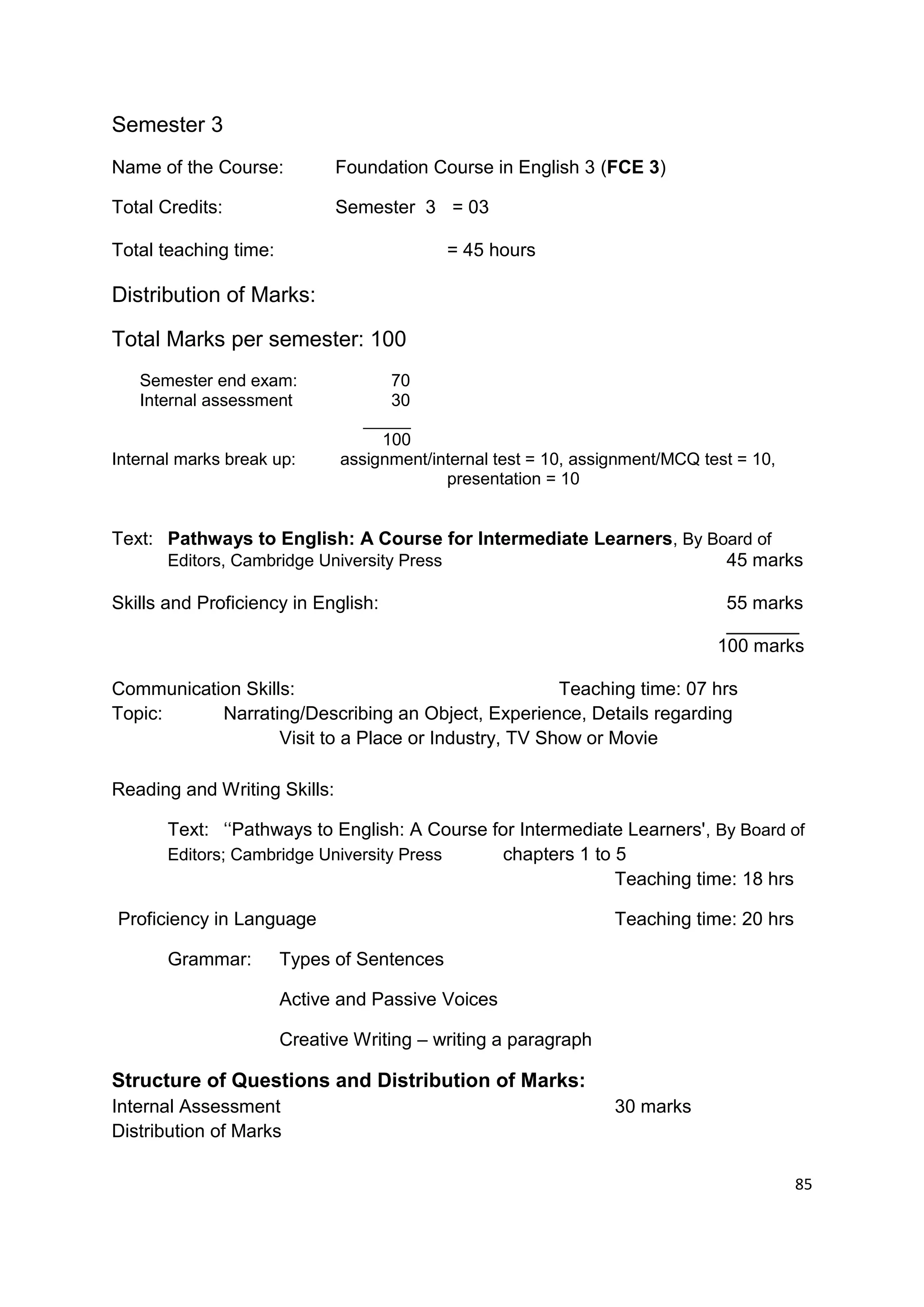
Semester 3
Name of the course:           Foundation Course in English 3 (FCE 3)

Total credits:                                 = 03

Total teaching time:                           = 45 hours

Distribution of marks:

Total Marks per semester:            100

   Semester end exam:                70
   Internal assessment               30

Internal marks break up:      assignment/presentation = 10, assignment/written test = 10,
                              MCQ = 10


Text: Pathways to English: A Course for Intermediate Learners, By Board of
         Editors, Cambridge University Press


Text:                                          45 marks
Skills and Proficiency in English:             55 marks
                                               _______
                                               100 marks

Communication Skills:                                 Teaching time: 07 hrs
Topic:     Narrating/Describing an Object, Experience, Details regarding
                   Visit to a Place or Industry, TV Show or Movie

Reading and Writing Skills:                                 Teaching time: 18 hrs


                                                                                            14
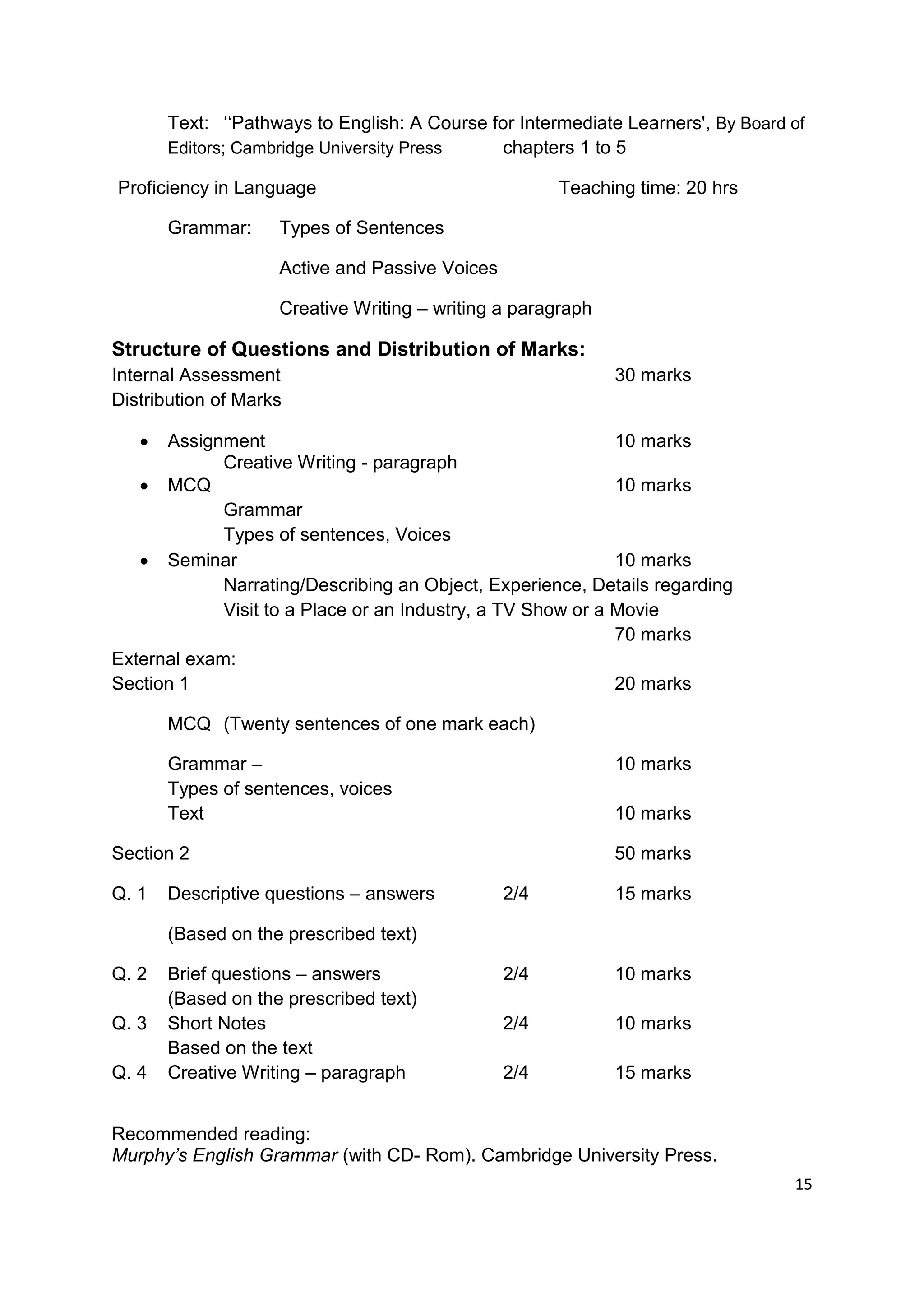
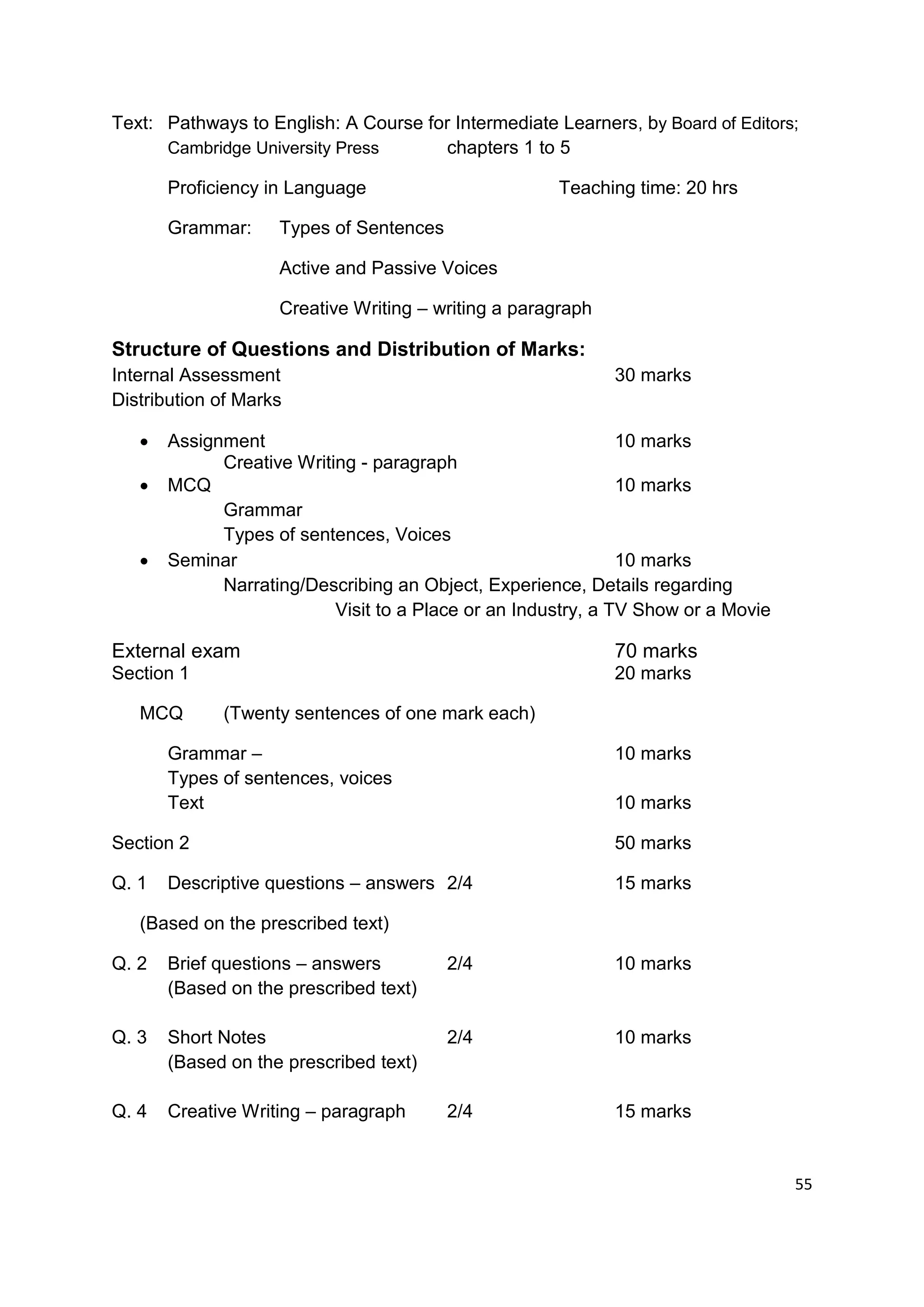
Text: „„Pathways to English: A Course for Intermediate Learners', By Board of
       Editors; Cambridge University Press    chapters 1 to 5

Proficiency in Language                               Teaching time: 20 hrs

       Grammar:     Types of Sentences

                    Active and Passive Voices

                    Creative Writing – writing a paragraph

Structure of Questions and Distribution of Marks:
Internal Assessment                                          30 marks
Distribution of Marks

     Assignment                                             10 marks
             Creative Writing - paragraph
    MCQ                                                     10 marks
             Grammar
             Types of sentences, Voices
    Seminar                                                 10 marks
             Narrating/Describing an Object, Experience, Details regarding
             Visit to a Place or an Industry, a TV Show or a Movie
                                                             70 marks
External exam:
Section 1                                                    20 marks

       MCQ (Twenty sentences of one mark each)

       Grammar –                                             10 marks
       Types of sentences, voices
       Text                                                  10 marks

Section 2                                                    50 marks

Q. 1   Descriptive questions – answers          2/4          15 marks

       (Based on the prescribed text)

Q. 2   Brief questions – answers                2/4          10 marks
       (Based on the prescribed text)
Q. 3   Short Notes                              2/4          10 marks
       Based on the text
Q. 4   Creative Writing – paragraph             2/4          15 marks


Recommended reading:
Murphy’s English Grammar (with CD- Rom). Cambridge University Press.
                                                                                  15
Thomson and Martinet. A Practical English Grammar (4th edition). Oxford University
Press.
Redman, Stuart. 1997. English Vocabulary in Use : Pre-intermediate and
Intermediate. Cambridge University Press.
Jones Daniel. English Pronouncing Dictionary (with CD – Rom). Cambridge
University Press.
Ur, Penny. Grammar Practice Activities Paperback with CD-ROM: A Practical Guide
for Teachers (Cambridge Handbooks for Language Teachers).
*[1 credit = 1 hour of teaching per week (1 credit course = 15 hours of lectures per
semester; 3 credits = 3 hours of instruction per week (3 credit course = 45 hours of
lectures per semester)]


Semester: 3
Name of the course:           Core Course in English (CCE 5)

Total credits: Semester 3 =        03 (3 Credit course)

Total teaching time:               45 hours

Distribution of marks:

Total Marks per semester:          100

Semester exam:                     70

Internal marks:                    30

Internal marks break up: Assignment 1= 05, Assignment 2= 05, Presentation: 05

                         Assessment of writing and speaking skills = 15

Form: Comedy

Text: Arms and the Man- G. B. Shaw (Play) Orient Edition First Published
      1953.

       Edited with Introduction by A. C. Ward. New Delhi: Orient Longman.
       1979.

Unit: 1       Comedy Form, Origin and Development of Comedy Form, Types of
              Comedies, Characteristics of Comedy, Short notes like Character, Plot,
              Setting, Conflict, Theme etc.

                                                          Teaching time: 20 Hours

Unit: 2       Arms & the Man- G. B. Shaw (Play)

                                                          Teaching time: 25 Hours
                                                                                    16
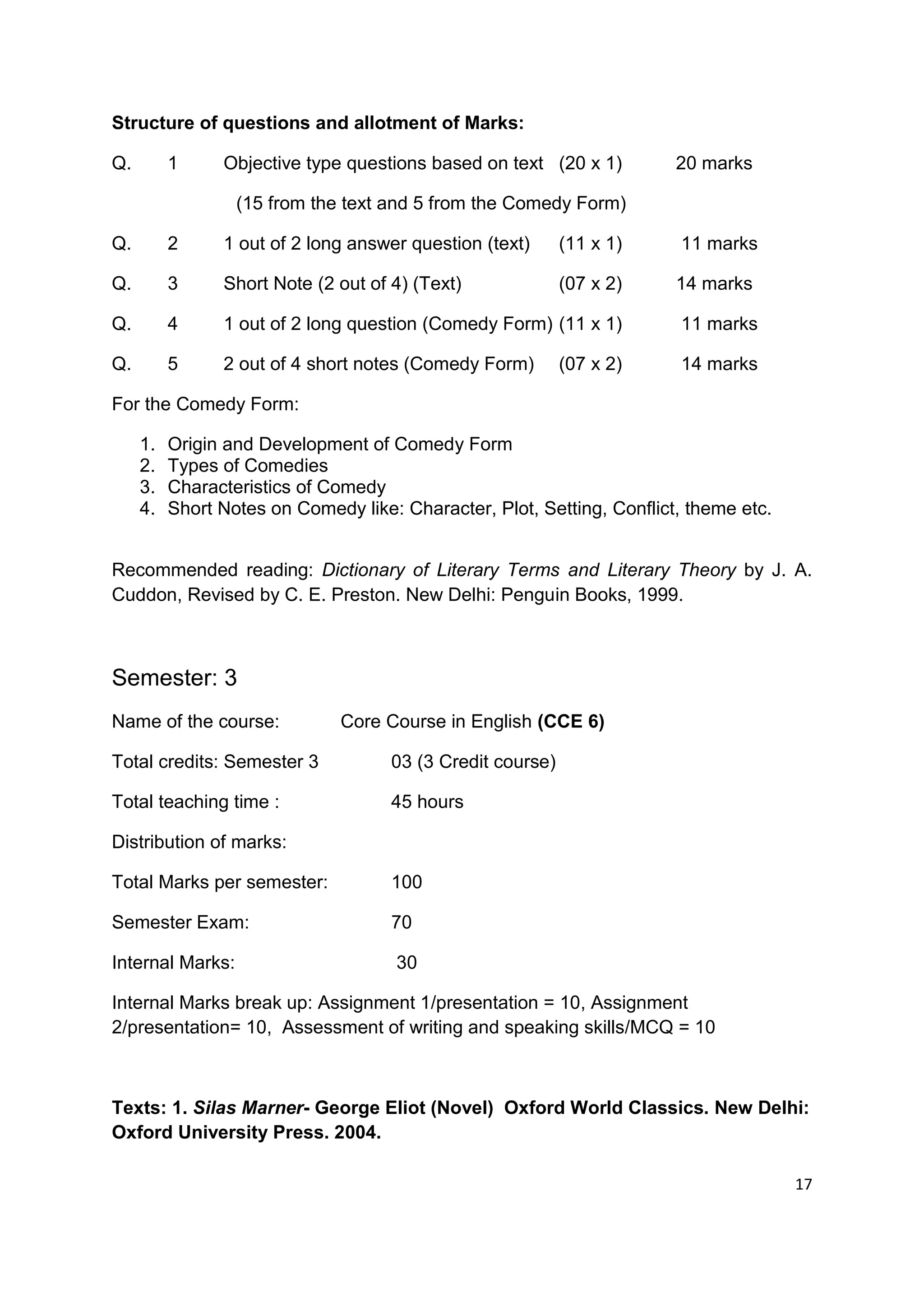
Structure of questions and allotment of Marks:

Q.        1     Objective type questions based on text (20 x 1)         20 marks

                  (15 from the text and 5 from the Comedy Form)

Q.        2     1 out of 2 long answer question (text)      (11 x 1)    11 marks

Q.        3     Short Note (2 out of 4) (Text)              (07 x 2)    14 marks

Q.        4     1 out of 2 long question (Comedy Form) (11 x 1)         11 marks

Q.        5     2 out of 4 short notes (Comedy Form)        (07 x 2)    14 marks

For the Comedy Form:

     1.   Origin and Development of Comedy Form
     2.   Types of Comedies
     3.   Characteristics of Comedy
     4.   Short Notes on Comedy like: Character, Plot, Setting, Conflict, theme etc.


Recommended reading: Dictionary of Literary Terms and Literary Theory by J. A.
Cuddon, Revised by C. E. Preston. New Delhi: Penguin Books, 1999.


Semester: 3
Name of the course:            Core Course in English (CCE 6)

Total credits: Semester 3            03 (3 Credit course)

Total teaching time :                45 hours

Distribution of marks:

Total Marks per semester:            100

Semester Exam:                       70

Internal Marks:                       30

Internal Marks break up: Assignment 1/presentation = 10, Assignment
2/presentation= 10, Assessment of writing and speaking skills/MCQ = 10


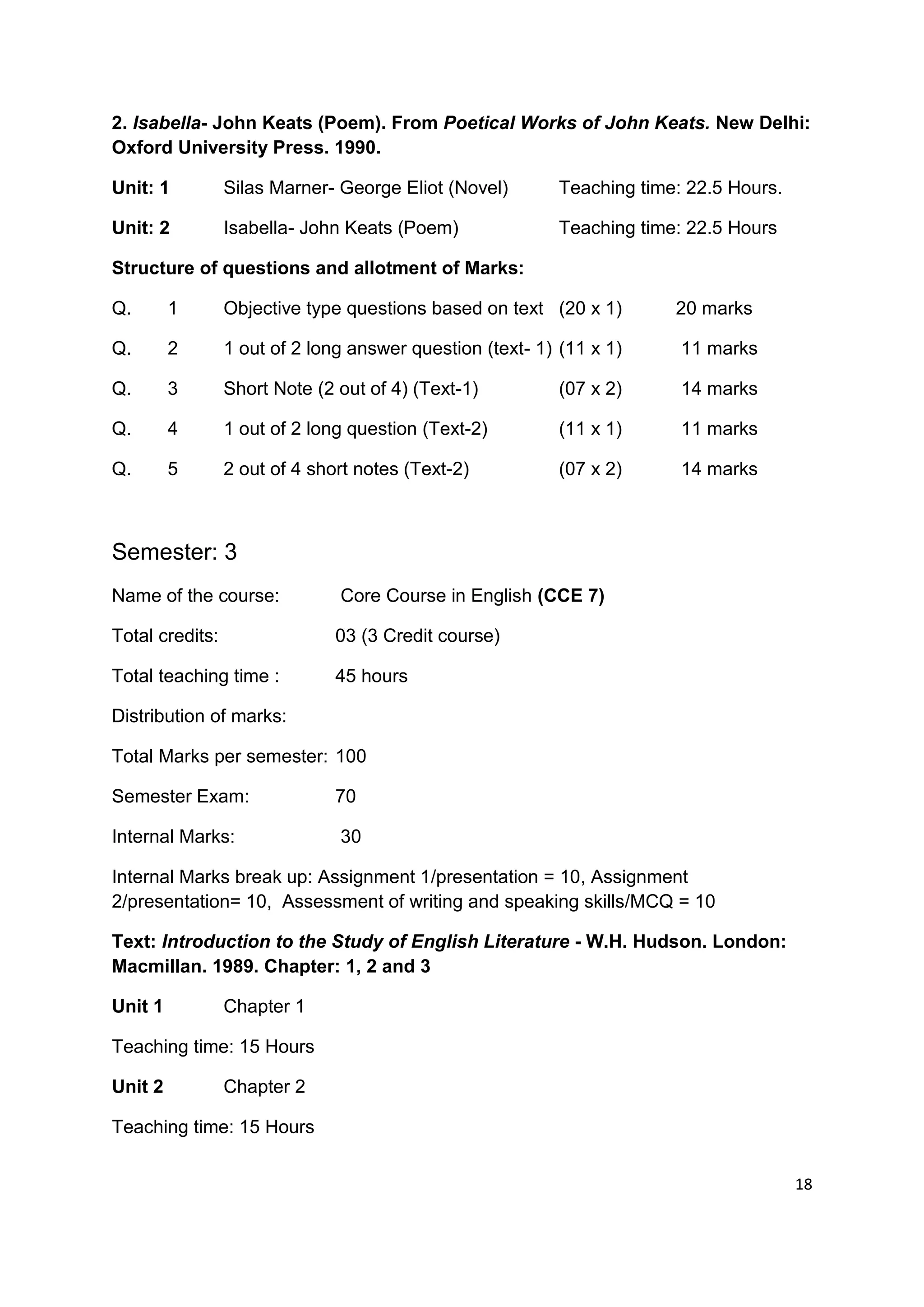
Texts: 1. Silas Marner- George Eliot (Novel) Oxford World Classics. New Delhi:
Oxford University Press. 2004.

                                                                                       17
2. Isabella- John Keats (Poem). From Poetical Works of John Keats. New Delhi:
Oxford University Press. 1990.

Unit: 1          Silas Marner- George Eliot (Novel)        Teaching time: 22.5 Hours.

Unit: 2          Isabella- John Keats (Poem)               Teaching time: 22.5 Hours

Structure of questions and allotment of Marks:

Q.       1       Objective type questions based on text (20 x 1)        20 marks

Q.       2       1 out of 2 long answer question (text- 1) (11 x 1)      11 marks

Q.       3       Short Note (2 out of 4) (Text-1)          (07 x 2)      14 marks

Q.       4       1 out of 2 long question (Text-2)         (11 x 1)      11 marks

Q.       5       2 out of 4 short notes (Text-2)           (07 x 2)      14 marks


Semester: 3
Name of the course:            Core Course in English (CCE 7)

Total credits:                 03 (3 Credit course)

Total teaching time :          45 hours

Distribution of marks:

Total Marks per semester: 100

Semester Exam:                 70

Internal Marks:                30

Internal Marks break up: Assignment 1/presentation = 10, Assignment
2/presentation= 10, Assessment of writing and speaking skills/MCQ = 10

Text: Introduction to the Study of English Literature - W.H. Hudson. London:
Macmillan. 1989. Chapter: 1, 2 and 3

Unit 1           Chapter 1

Teaching time: 15 Hours

Unit 2           Chapter 2

Teaching time: 15 Hours


                                                                                        18
Unit 3             Chapter 3 (Only from the Sections: 1 to 4)

Teaching time : 15 Hours

Structure of questions and allotment of Marks:

Q.       1         Objective type questions based on Ch.1,2,3)     (20 x 1)        20 marks

Q.       2         1 out of 2 long answer question (Cha- 1) (12 x 1)               12 marks

Q.       3         1 out of 2 long question (Cha-2)         (12 x 1)               12 marks

Q.       4         1 out of 2 long question (Cha-3)         (12 x 1)               12 marks

Q.       5         2 out of 4 short notes (Cha-1,2,3)       (07 x 2)               14 marks


Semester 3
Elective 1

Name of the course: Functional English Paper V (FE 5)

Introduction to Creative Writing
Theory]                                                                       [Marks: 50
Unit 1: Reviews (Books & Movies)                            Teaching Time: 10 hrs.
         Topics: (a) Theory [how to write book reviews], studying a text for the
                          purpose;
               (b) Theory [how to write movie reviews], studying a movie for the purpose.
Suggested Texts for Book Reviews:
         (i)      Swami and Friends by R. K. Narayan
         (ii)     The Guide       by    R. K. Narayan
         (iii)    Five Point Someone by Chetan Bhagat
Suggested Movies for Movie Reviews:
         (i)       The Guide
         (ii)      Three Idiots
         (iii)      Slum Dog Millionaire
Unit 2: Creative Writing                                    Teaching Time: 10 hrs.
       1. Interpreting a text
         Suggested Texts for Interpretative Study:
         Poems:

                                                                                            19
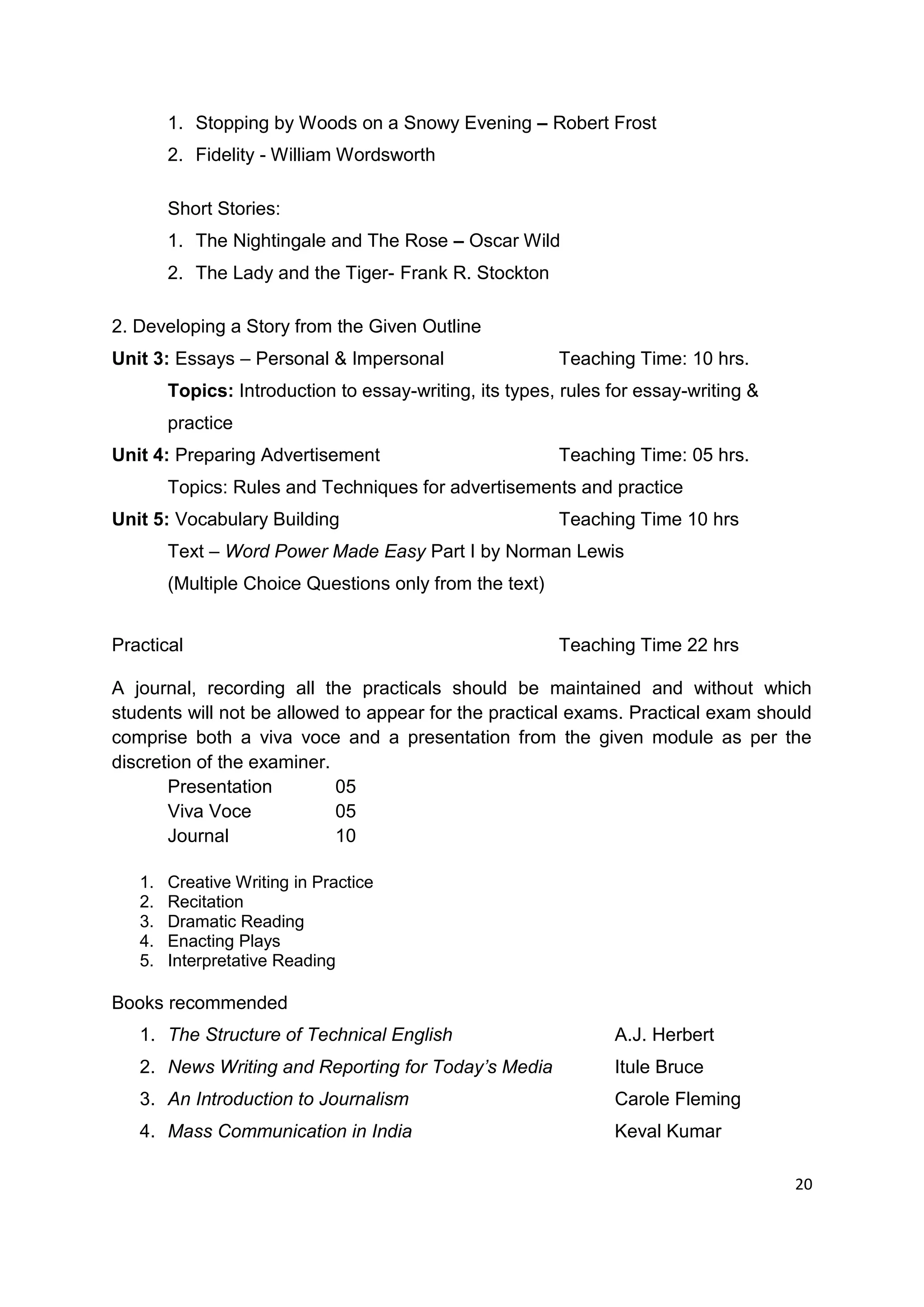
1. Stopping by Woods on a Snowy Evening – Robert Frost
        2. Fidelity - William Wordsworth

        Short Stories:
        1. The Nightingale and The Rose – Oscar Wild
        2. The Lady and the Tiger- Frank R. Stockton

2. Developing a Story from the Given Outline
Unit 3: Essays – Personal & Impersonal                   Teaching Time: 10 hrs.
        Topics: Introduction to essay-writing, its types, rules for essay-writing &
        practice
Unit 4: Preparing Advertisement                          Teaching Time: 05 hrs.
        Topics: Rules and Techniques for advertisements and practice
Unit 5: Vocabulary Building                              Teaching Time 10 hrs
        Text – Word Power Made Easy Part I by Norman Lewis
        (Multiple Choice Questions only from the text)


Practical                                                Teaching Time 22 hrs

A journal, recording all the practicals should be maintained and without which
students will not be allowed to appear for the practical exams. Practical exam should
comprise both a viva voce and a presentation from the given module as per the
discretion of the examiner.
       Presentation         05
       Viva Voce            05
       Journal              10

   1.   Creative Writing in Practice
   2.   Recitation
   3.   Dramatic Reading
   4.   Enacting Plays
   5.   Interpretative Reading

Books recommended
   1. The Structure of Technical English                        A.J. Herbert
   2. News Writing and Reporting for Today’s Media              Itule Bruce
   3. An Introduction to Journalism                             Carole Fleming
   4. Mass Communication in India                               Keval Kumar

                                                                                      20
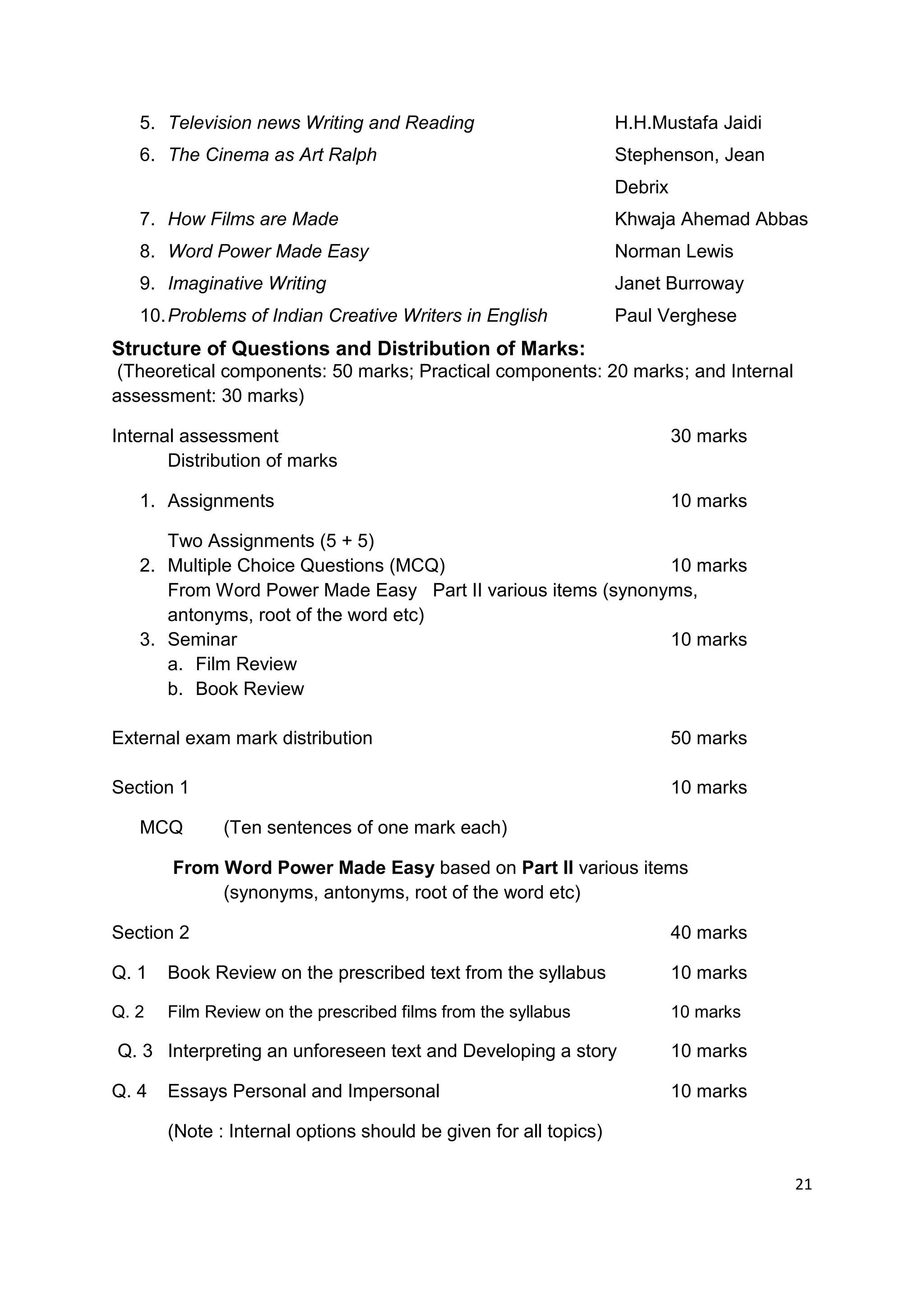
5. Television news Writing and Reading                         H.H.Mustafa Jaidi
   6. The Cinema as Art Ralph                                     Stephenson, Jean
                                                                  Debrix
   7. How Films are Made                                          Khwaja Ahemad Abbas
   8. Word Power Made Easy                                        Norman Lewis
   9. Imaginative Writing                                         Janet Burroway
   10. Problems of Indian Creative Writers in English             Paul Verghese
Structure of Questions and Distribution of Marks:
 (Theoretical components: 50 marks; Practical components: 20 marks; and Internal
assessment: 30 marks)

Internal assessment                                                        30 marks
       Distribution of marks

   1. Assignments                                                          10 marks

      Two Assignments (5 + 5)
   2. Multiple Choice Questions (MCQ)                        10 marks
      From Word Power Made Easy Part II various items (synonyms,
      antonyms, root of the word etc)
   3. Seminar                                                10 marks
      a. Film Review
      b. Book Review

External exam mark distribution                                            50 marks

Section 1                                                                  10 marks

   MCQ        (Ten sentences of one mark each)

       From Word Power Made Easy based on Part II various items
            (synonyms, antonyms, root of the word etc)

Section 2                                                                  40 marks

Q. 1   Book Review on the prescribed text from the syllabus                10 marks

Q. 2   Film Review on the prescribed films from the syllabus               10 marks

Q. 3 Interpreting an unforeseen text and Developing a story                10 marks

Q. 4   Essays Personal and Impersonal                                      10 marks

       (Note : Internal options should be given for all topics)

                                                                                      21
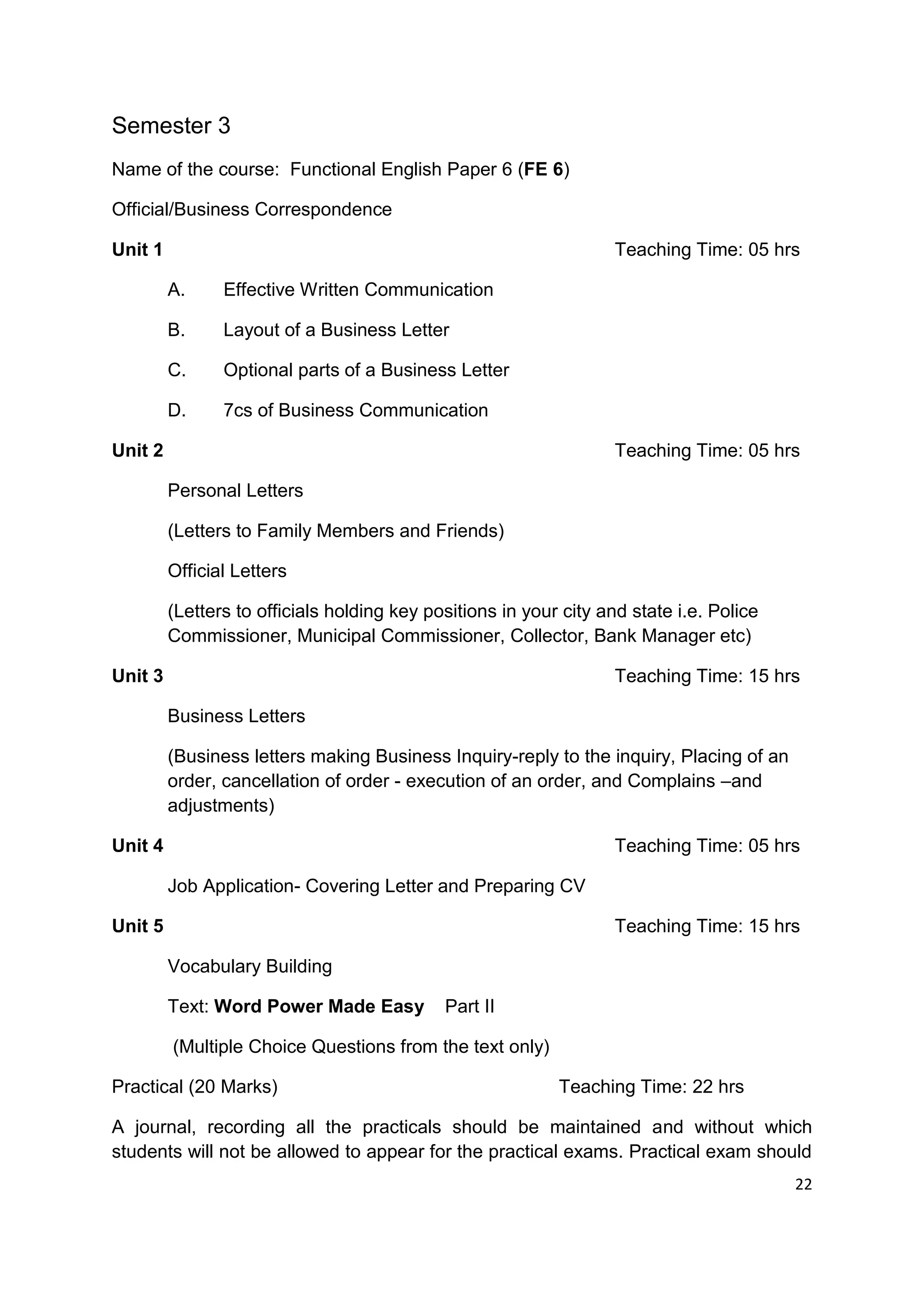
Semester 3
Name of the course: Functional English Paper 6 (FE 6)

Official/Business Correspondence

Unit 1                                                              Teaching Time: 05 hrs

         A.     Effective Written Communication

         B.     Layout of a Business Letter

         C.     Optional parts of a Business Letter

         D.     7cs of Business Communication

Unit 2                                                              Teaching Time: 05 hrs

         Personal Letters

         (Letters to Family Members and Friends)

         Official Letters

         (Letters to officials holding key positions in your city and state i.e. Police
         Commissioner, Municipal Commissioner, Collector, Bank Manager etc)

Unit 3                                                              Teaching Time: 15 hrs

         Business Letters

         (Business letters making Business Inquiry-reply to the inquiry, Placing of an
         order, cancellation of order - execution of an order, and Complains –and
         adjustments)

Unit 4                                                              Teaching Time: 05 hrs

         Job Application- Covering Letter and Preparing CV

Unit 5                                                              Teaching Time: 15 hrs

         Vocabulary Building

         Text: Word Power Made Easy          Part II

         (Multiple Choice Questions from the text only)

Practical (20 Marks)                                        Teaching Time: 22 hrs

A journal, recording all the practicals should be maintained and without which
students will not be allowed to appear for the practical exams. Practical exam should
                                                                                          22
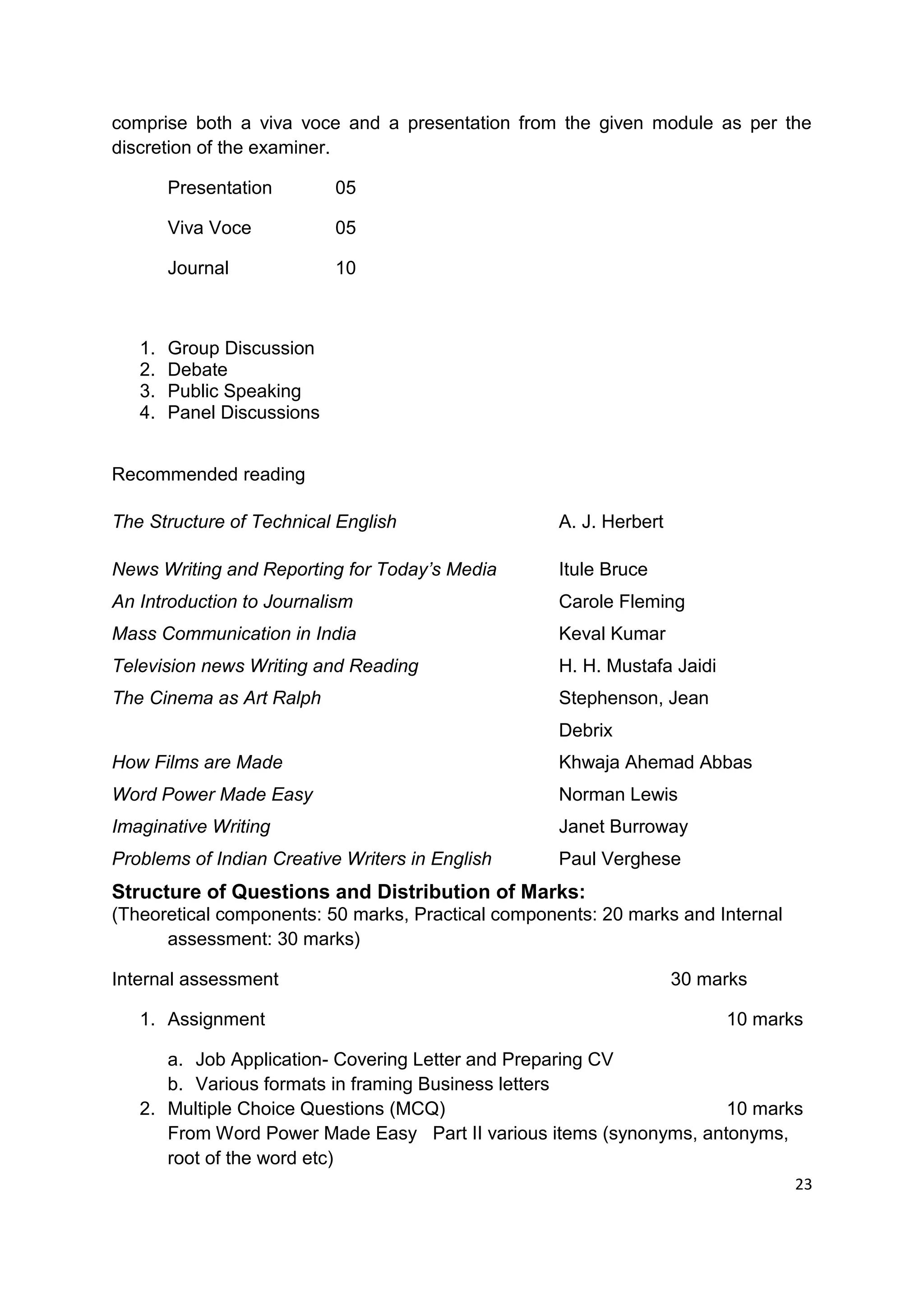
comprise both a viva voce and a presentation from the given module as per the
discretion of the examiner.

        Presentation        05

        Viva Voce           05

        Journal             10


   1.   Group Discussion
   2.   Debate
   3.   Public Speaking
   4.   Panel Discussions


Recommended reading

The Structure of Technical English                 A. J. Herbert

News Writing and Reporting for Today’s Media       Itule Bruce
An Introduction to Journalism                      Carole Fleming
Mass Communication in India                        Keval Kumar
Television news Writing and Reading                H. H. Mustafa Jaidi
The Cinema as Art Ralph                            Stephenson, Jean
                                                   Debrix
How Films are Made                                 Khwaja Ahemad Abbas
Word Power Made Easy                               Norman Lewis
Imaginative Writing                                Janet Burroway
Problems of Indian Creative Writers in English     Paul Verghese
Structure of Questions and Distribution of Marks:
(Theoretical components: 50 marks, Practical components: 20 marks and Internal
      assessment: 30 marks)

Internal assessment                                                30 marks

   1. Assignment                                                         10 marks

      a. Job Application- Covering Letter and Preparing CV
      b. Various formats in framing Business letters
   2. Multiple Choice Questions (MCQ)                               10 marks
      From Word Power Made Easy Part II various items (synonyms, antonyms,
      root of the word etc)
                                                                                 23
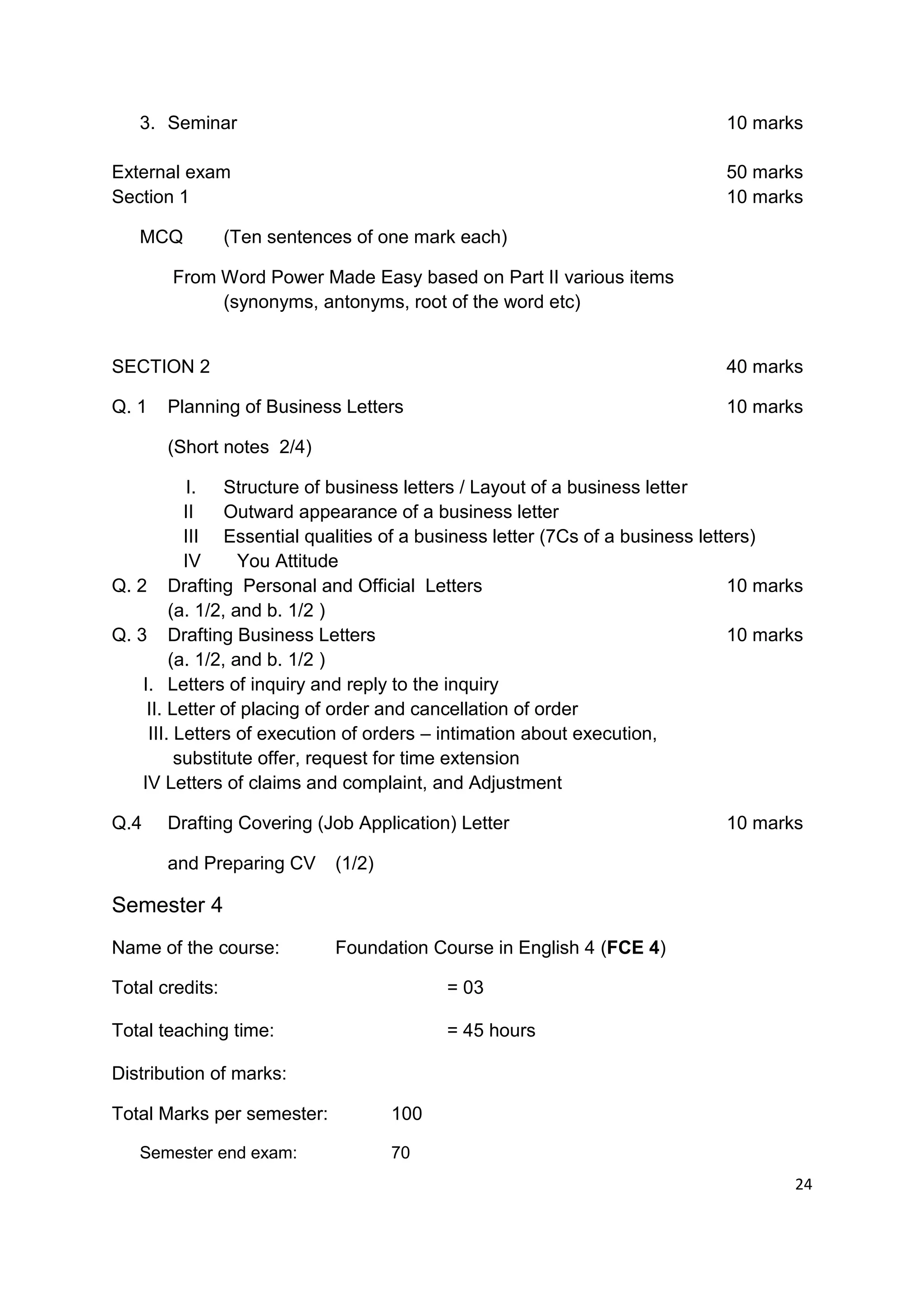
3. Seminar                                                                10 marks

External exam                                                                50 marks
Section 1                                                                    10 marks

   MCQ           (Ten sentences of one mark each)

        From Word Power Made Easy based on Part II various items
             (synonyms, antonyms, root of the word etc)


SECTION 2                                                                    40 marks

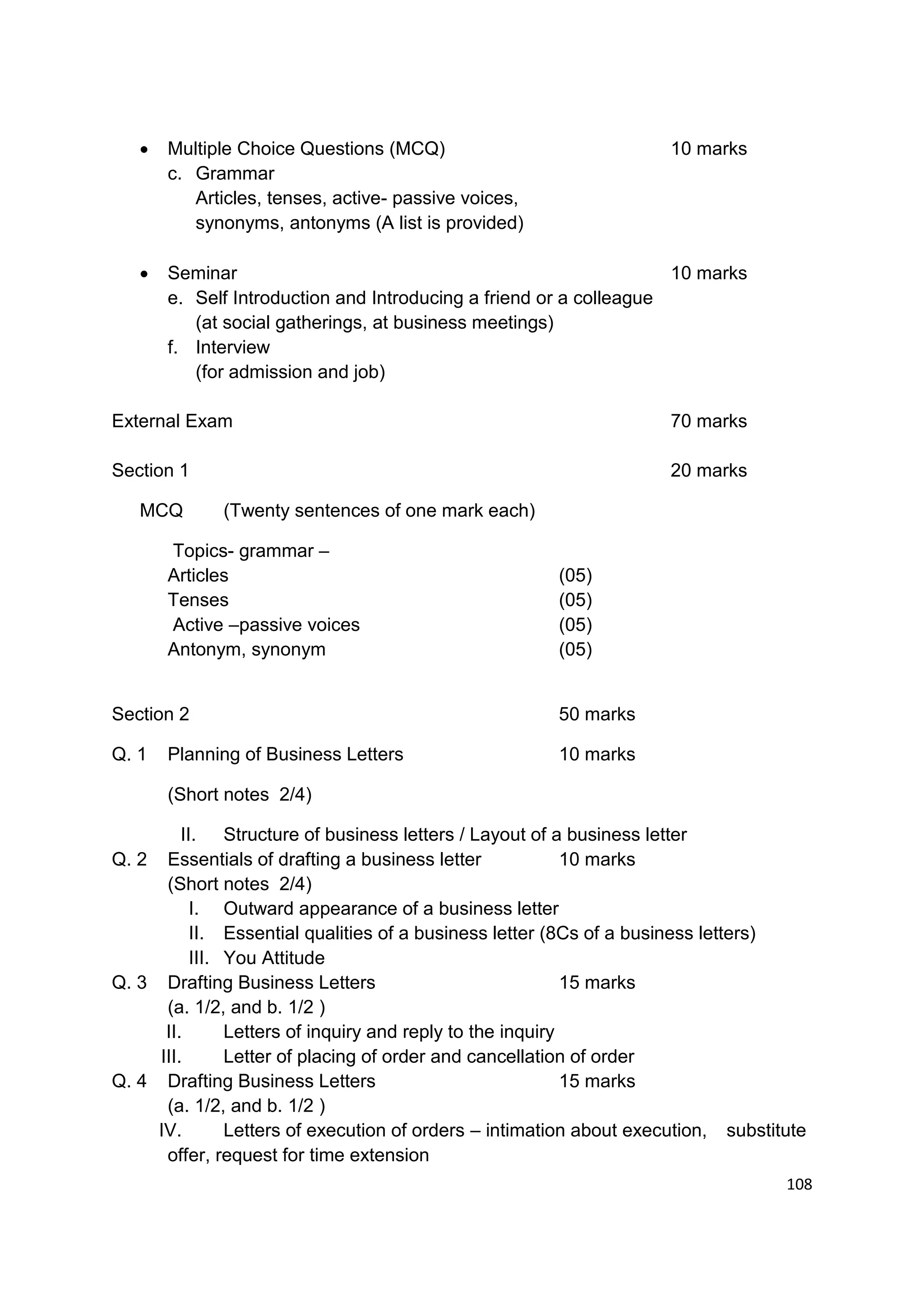
Q. 1   Planning of Business Letters                                          10 marks

       (Short notes 2/4)

           I. Structure of business letters / Layout of a business letter
           II    Outward appearance of a business letter
           III Essential qualities of a business letter (7Cs of a business letters)
           IV      You Attitude
Q. 2 Drafting Personal and Official Letters                                    10 marks
         (a. 1/2, and b. 1/2 )
Q. 3 Drafting Business Letters                                                 10 marks
         (a. 1/2, and b. 1/2 )
    I. Letters of inquiry and reply to the inquiry
     II. Letter of placing of order and cancellation of order
     III. Letters of execution of orders – intimation about execution,
          substitute offer, request for time extension
    IV Letters of claims and complaint, and Adjustment

Q.4    Drafting Covering (Job Application) Letter                            10 marks

       and Preparing CV      (1/2)

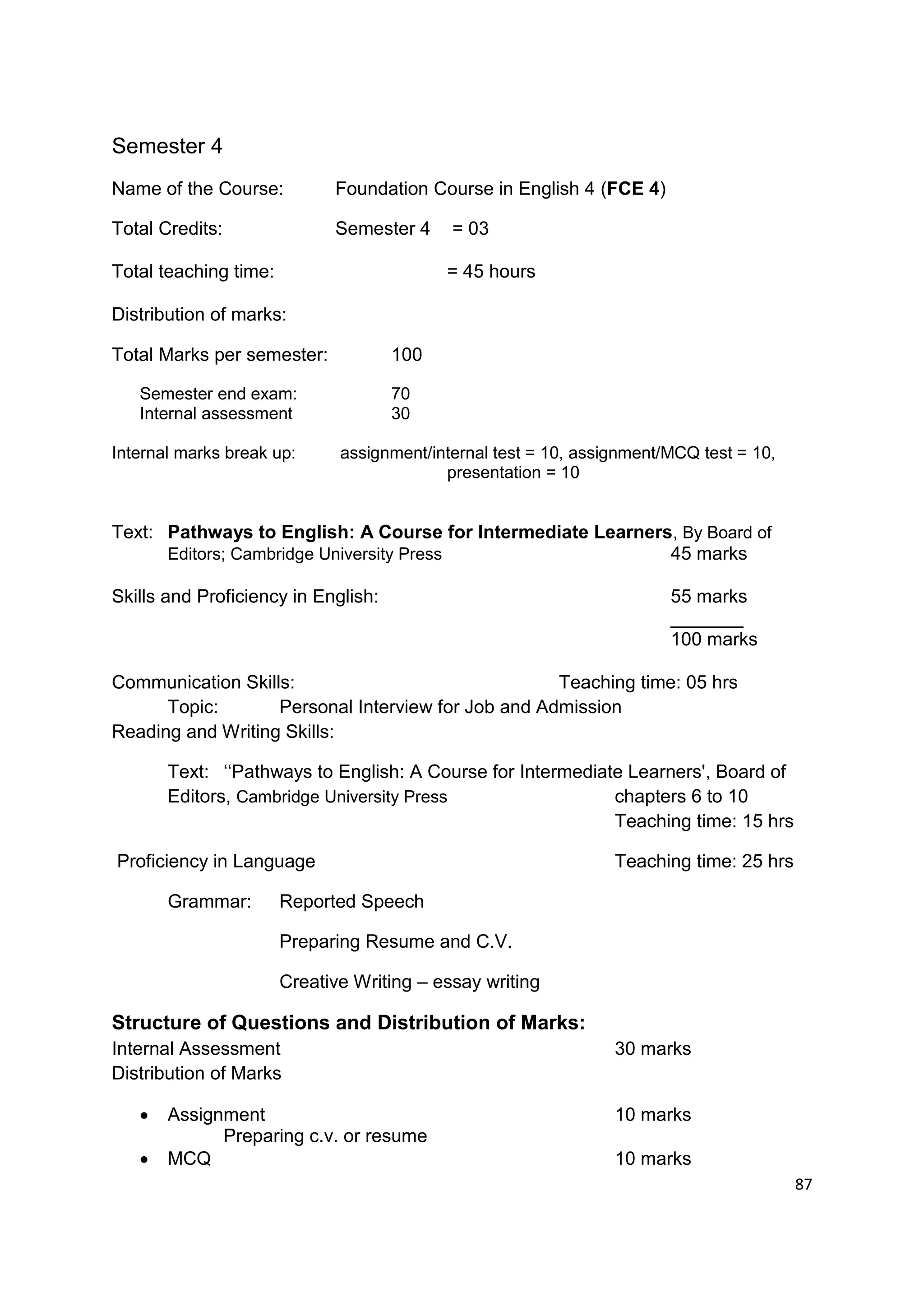
Semester 4
Name of the course:          Foundation Course in English 4 (FCE 4)

Total credits:                             = 03

Total teaching time:                       = 45 hours

Distribution of marks:

Total Marks per semester:            100

   Semester end exam:                70
                                                                                     24
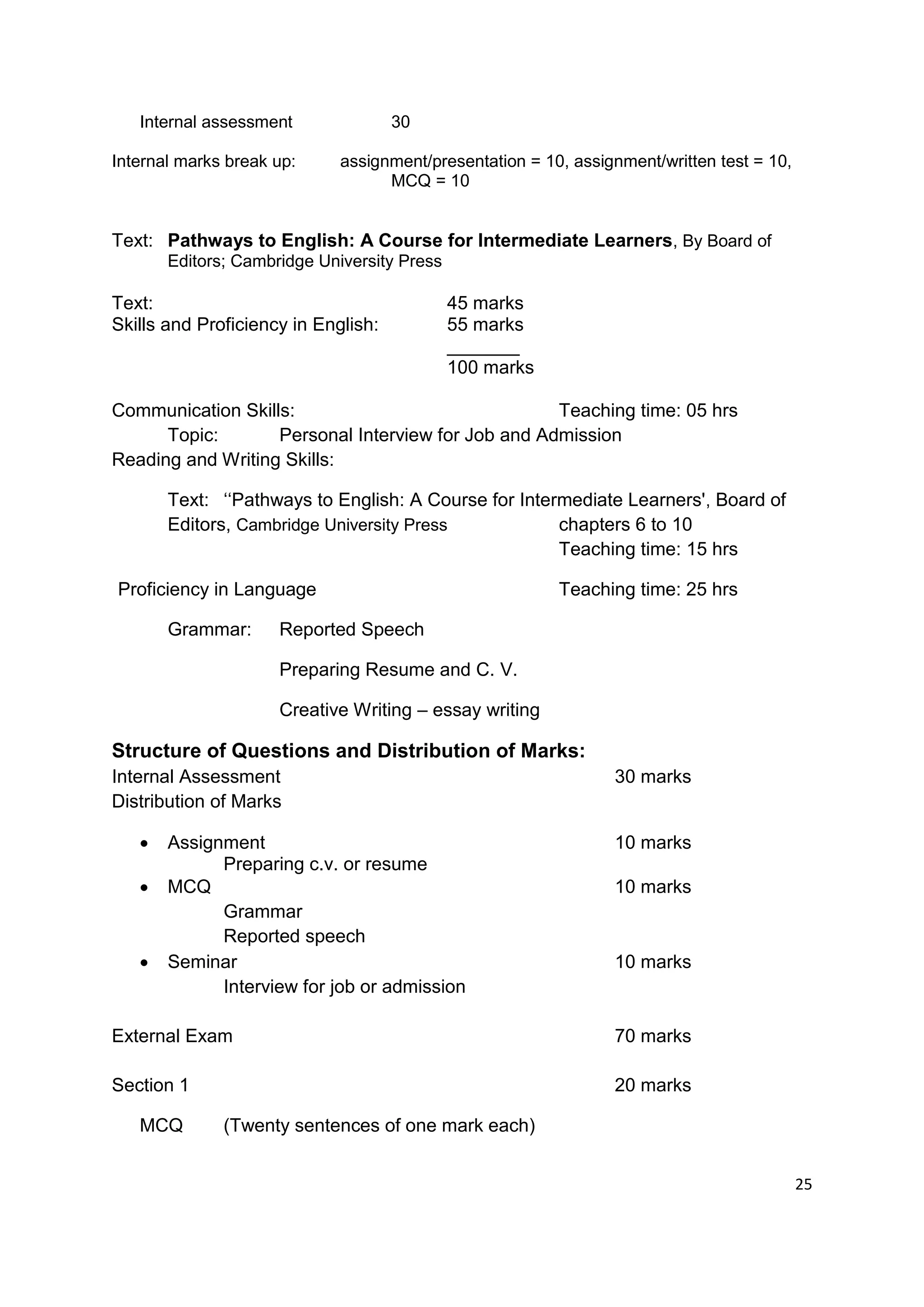
Internal assessment               30

Internal marks break up:     assignment/presentation = 10, assignment/written test = 10,
                                   MCQ = 10


Text: Pathways to English: A Course for Intermediate Learners, By Board of
       Editors; Cambridge University Press

Text:                                        45 marks
Skills and Proficiency in English:           55 marks
                                             _______
                                             100 marks

Communication Skills:                               Teaching time: 05 hrs
      Topic:       Personal Interview for Job and Admission
Reading and Writing Skills:

       Text: „„Pathways to English: A Course for Intermediate Learners', Board of
       Editors, Cambridge University Press            chapters 6 to 10
                                                      Teaching time: 15 hrs

Proficiency in Language                                  Teaching time: 25 hrs

       Grammar:      Reported Speech

                     Preparing Resume and C. V.

                     Creative Writing – essay writing

Structure of Questions and Distribution of Marks:
Internal Assessment                                             30 marks
Distribution of Marks

      Assignment                                               10 marks
             Preparing c.v. or resume
      MCQ                                                      10 marks
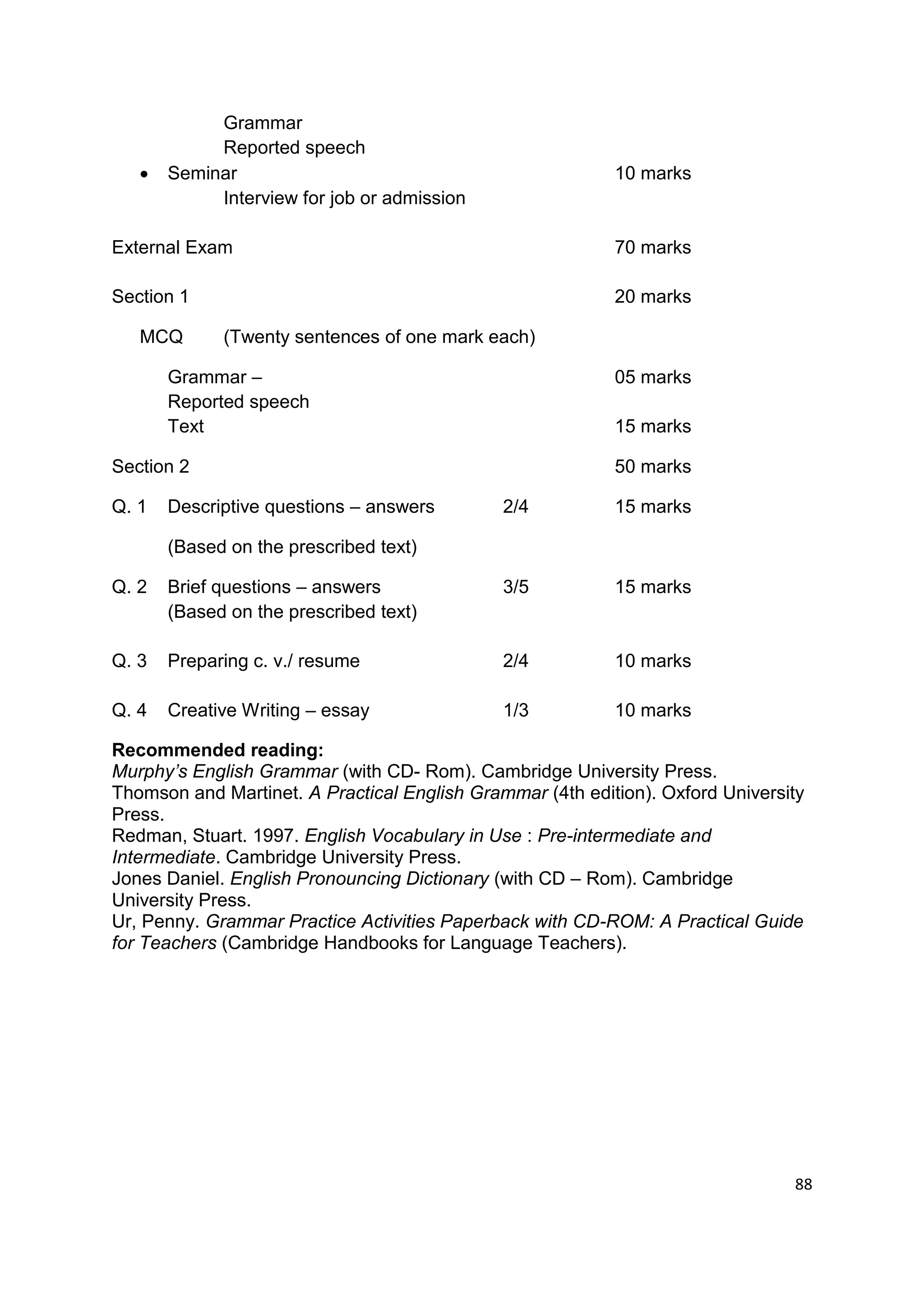
             Grammar
             Reported speech
      Seminar                                                  10 marks
             Interview for job or admission

External Exam                                                   70 marks

Section 1                                                       20 marks

   MCQ        (Twenty sentences of one mark each)


                                                                                           25
Grammar –                                            05 marks
       Reported speech
       Text                                                 15 marks

Section 2                                                   50 marks

Q. 1   Descriptive questions – answers         2/4          15 marks

       (Based on the prescribed text)

Q. 2   Brief questions – answers               3/5          15 marks
       (Based on the prescribed text)

Q. 3   Preparing c. v./ resume                 2/4          10 marks

Q. 4   Creative Writing – essay                1/3          10 marks

Recommended reading:
Murphy’s English Grammar (with CD- Rom). Cambridge University Press.
Thomson and Martinet. A Practical English Grammar (4th edition). Oxford University
Press.
Redman, Stuart. 1997. English Vocabulary in Use : Pre-intermediate and
Intermediate. Cambridge University Press.
Jones Daniel. English Pronouncing Dictionary (with CD – Rom). Cambridge
University Press.
Ur, Penny. Grammar Practice Activities Paperback with CD-ROM: A Practical Guide
for Teachers (Cambridge Handbooks for Language Teachers).
*[1 credit = 1 hour of teaching per week (1 credit course = 15 hours of lectures per
semester; 3 credits = 3 hours of instruction per week (3 credit course = 45 hours of
lectures per semester)]


Semester: 4
Name of the course:        Core Course in English 8 (CCE 8)

Total Credits:             03

Total teaching time:       45 hours

Distribution of Marks:

Total Marks per semester: 100

Semester Exam:             70

Internal Marks:            30


                                                                                  26
Internal Marks break up: Assignment 1/presentation = 10, Assignment
2/presentation= 10, Assessment of writing and speaking skills/MCQ = 10


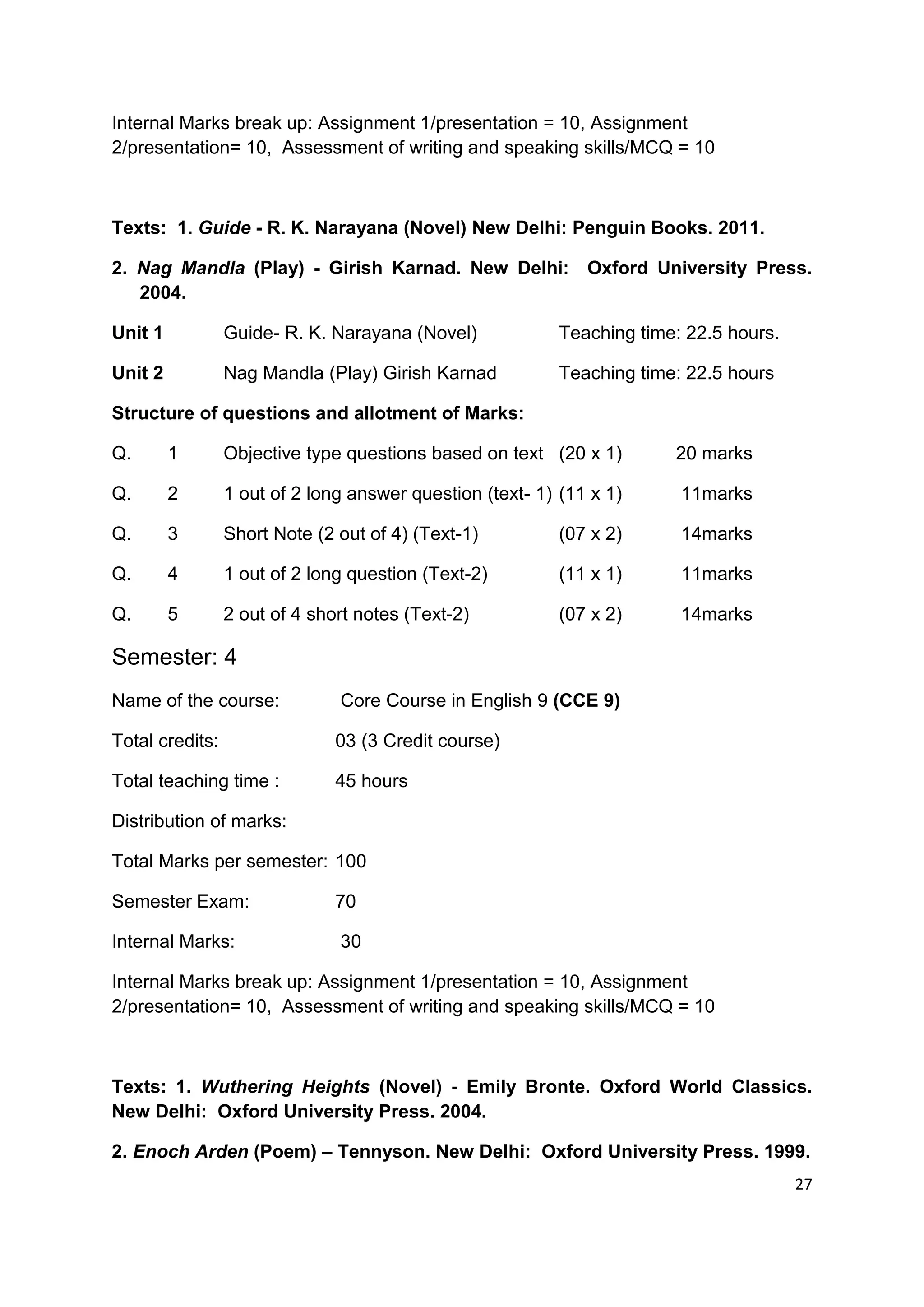
Texts: 1. Guide - R. K. Narayana (Novel) New Delhi: Penguin Books. 2011.

2. Nag Mandla (Play) - Girish Karnad. New Delhi: Oxford University Press.
   2004.

Unit 1           Guide- R. K. Narayana (Novel)             Teaching time: 22.5 hours.

Unit 2           Nag Mandla (Play) Girish Karnad           Teaching time: 22.5 hours

Structure of questions and allotment of Marks:

Q.       1       Objective type questions based on text (20 x 1)        20 marks

Q.       2       1 out of 2 long answer question (text- 1) (11 x 1)      11marks

Q.       3       Short Note (2 out of 4) (Text-1)          (07 x 2)      14marks

Q.       4       1 out of 2 long question (Text-2)         (11 x 1)      11marks

Q.       5       2 out of 4 short notes (Text-2)           (07 x 2)      14marks

Semester: 4
Name of the course:            Core Course in English 9 (CCE 9)

Total credits:                 03 (3 Credit course)

Total teaching time :          45 hours

Distribution of marks:

Total Marks per semester: 100

Semester Exam:                 70

Internal Marks:                30

Internal Marks break up: Assignment 1/presentation = 10, Assignment
2/presentation= 10, Assessment of writing and speaking skills/MCQ = 10


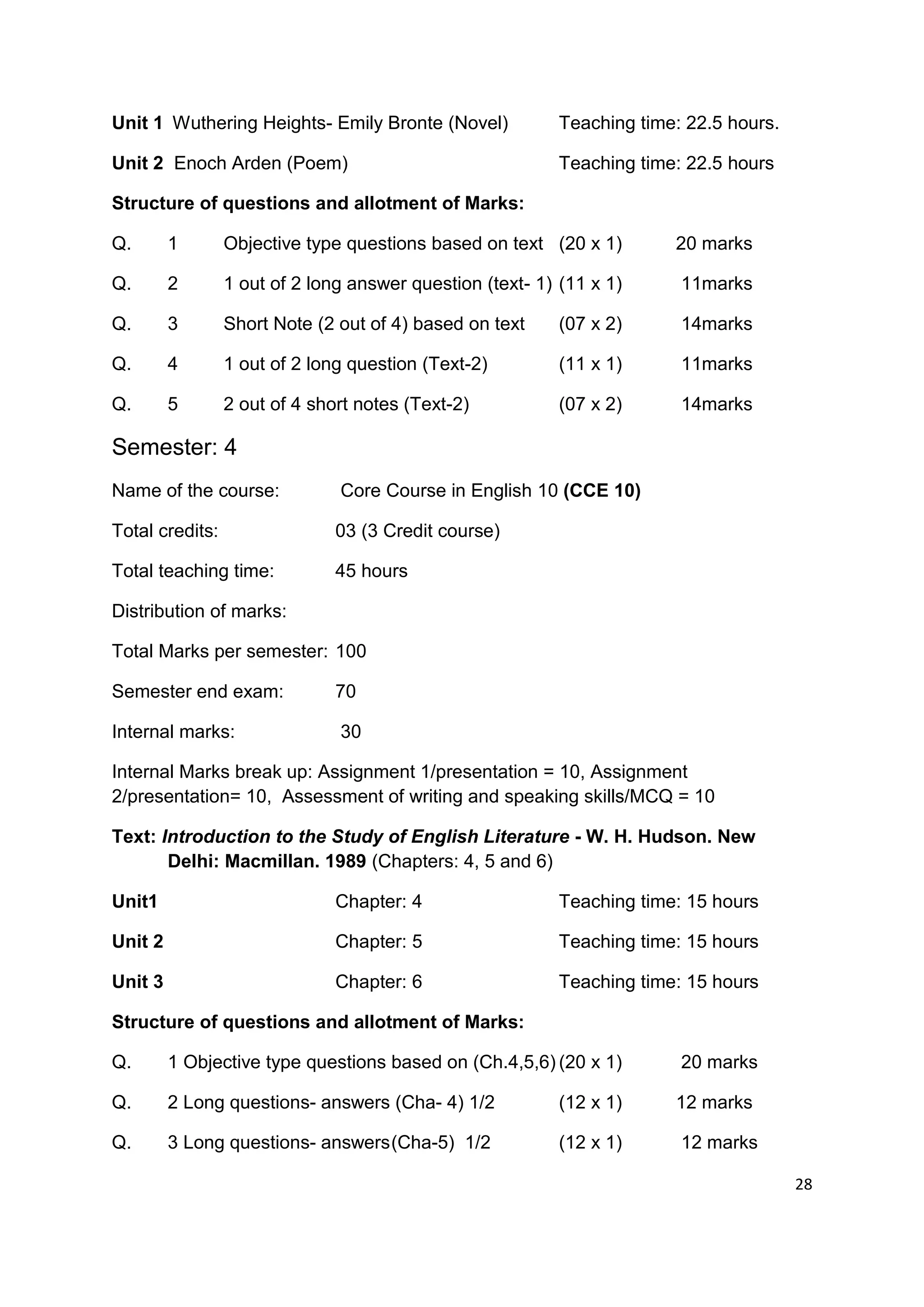
Texts: 1. Wuthering Heights (Novel) - Emily Bronte. Oxford World Classics.
New Delhi: Oxford University Press. 2004.

2. Enoch Arden (Poem) – Tennyson. New Delhi: Oxford University Press. 1999.
                                                                                        27
Unit 1 Wuthering Heights- Emily Bronte (Novel)             Teaching time: 22.5 hours.

Unit 2 Enoch Arden (Poem)                                  Teaching time: 22.5 hours

Structure of questions and allotment of Marks:

Q.       1       Objective type questions based on text (20 x 1)        20 marks

Q.       2       1 out of 2 long answer question (text- 1) (11 x 1)      11marks

Q.       3       Short Note (2 out of 4) based on text     (07 x 2)      14marks

Q.       4       1 out of 2 long question (Text-2)         (11 x 1)      11marks

Q.       5       2 out of 4 short notes (Text-2)           (07 x 2)      14marks

Semester: 4
Name of the course:            Core Course in English 10 (CCE 10)

Total credits:                 03 (3 Credit course)

Total teaching time:           45 hours

Distribution of marks:

Total Marks per semester: 100

Semester end exam:             70

Internal marks:                30

Internal Marks break up: Assignment 1/presentation = 10, Assignment
2/presentation= 10, Assessment of writing and speaking skills/MCQ = 10

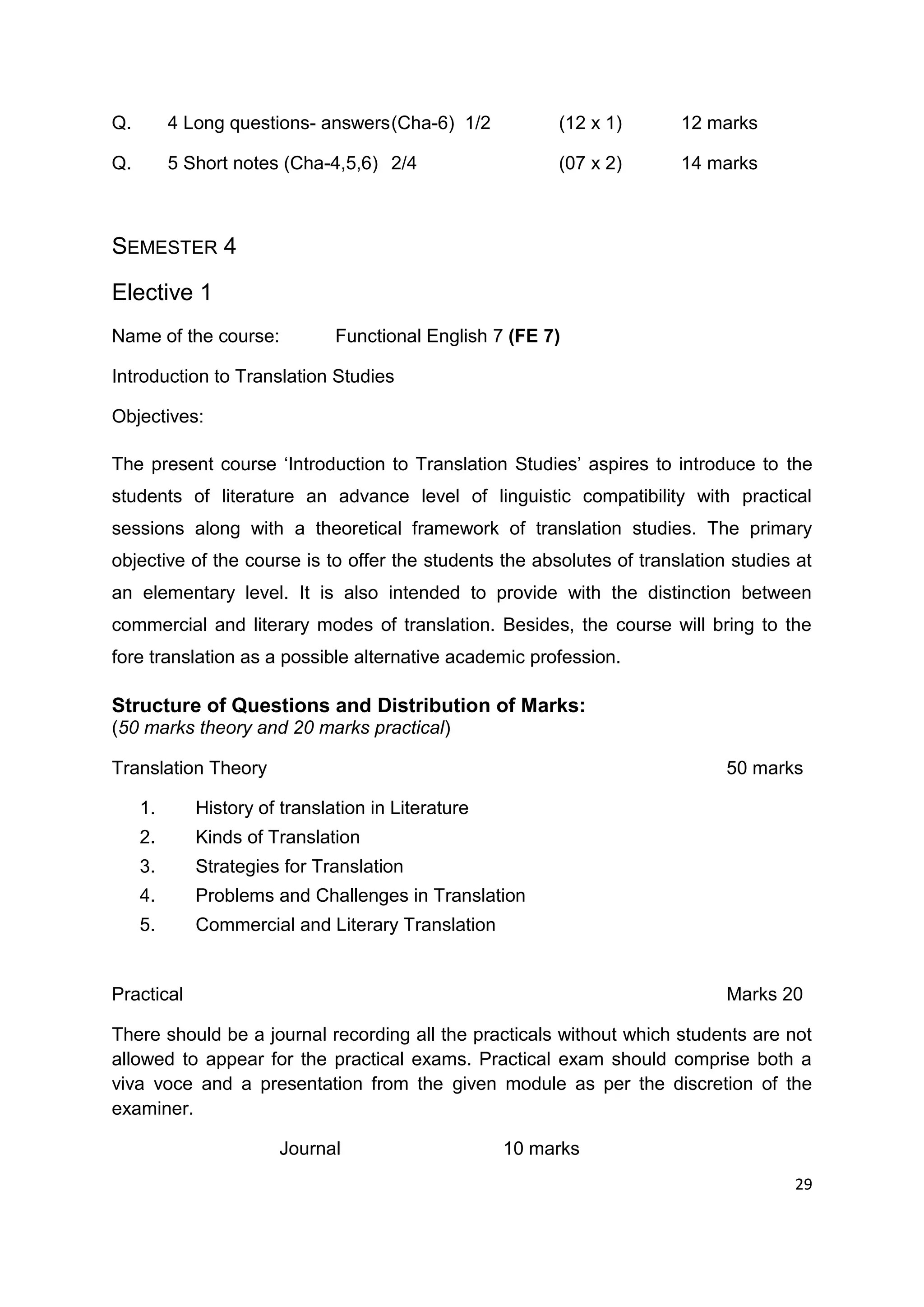
Text: Introduction to the Study of English Literature - W. H. Hudson. New
       Delhi: Macmillan. 1989 (Chapters: 4, 5 and 6)

Unit1                          Chapter: 4                  Teaching time: 15 hours

Unit 2                         Chapter: 5                  Teaching time: 15 hours

Unit 3                         Chapter: 6                  Teaching time: 15 hours

Structure of questions and allotment of Marks:

Q.       1 Objective type questions based on (Ch.4,5,6) (20 x 1)         20 marks

Q.       2 Long questions- answers (Cha- 4) 1/2            (12 x 1)     12 marks

Q.       3 Long questions- answers (Cha-5) 1/2             (12 x 1)      12 marks

                                                                                        28
Q.        4 Long questions- answers (Cha-6) 1/2          (12 x 1)      12 marks

Q.        5 Short notes (Cha-4,5,6) 2/4                  (07 x 2)      14 marks


SEMESTER 4
Elective 1
Name of the course:            Functional English 7 (FE 7)

Introduction to Translation Studies

Objectives:

The present course „Introduction to Translation Studies‟ aspires to introduce to the
students of literature an advance level of linguistic compatibility with practical
sessions along with a theoretical framework of translation studies. The primary
objective of the course is to offer the students the absolutes of translation studies at
an elementary level. It is also intended to provide with the distinction between
commercial and literary modes of translation. Besides, the course will bring to the
fore translation as a possible alternative academic profession.

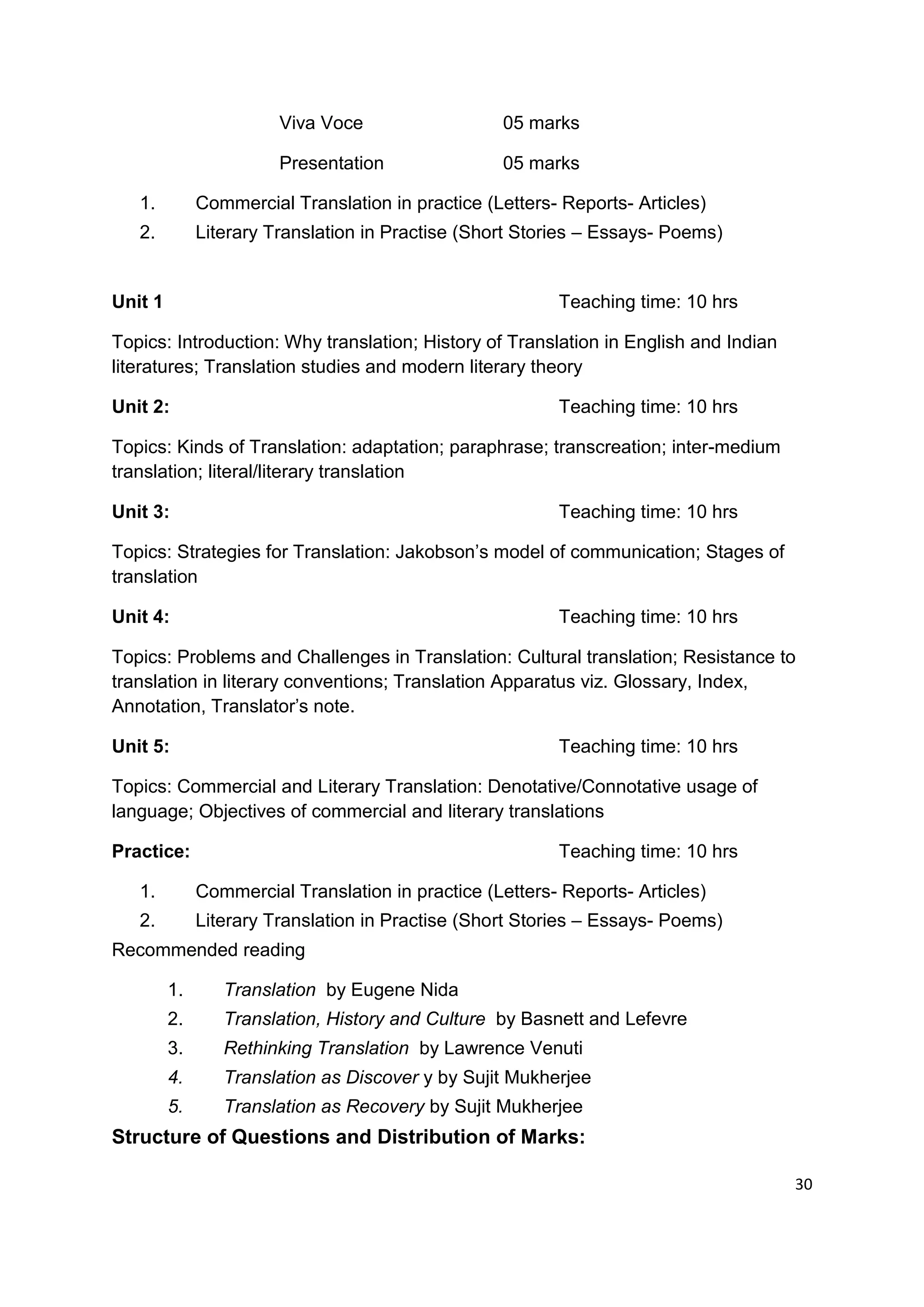
Structure of Questions and Distribution of Marks:
(50 marks theory and 20 marks practical)

Translation Theory                                                           50 marks

     1.      History of translation in Literature
     2.      Kinds of Translation
     3.      Strategies for Translation
     4.      Problems and Challenges in Translation
     5.      Commercial and Literary Translation


Practical                                                                    Marks 20

There should be a journal recording all the practicals without which students are not
allowed to appear for the practical exams. Practical exam should comprise both a
viva voce and a presentation from the given module as per the discretion of the
examiner.

                        Journal                     10 marks
                                                                                     29
Viva Voce                  05 marks

                        Presentation               05 marks

   1.         Commercial Translation in practice (Letters- Reports- Articles)
   2.         Literary Translation in Practise (Short Stories – Essays- Poems)


Unit 1                                                    Teaching time: 10 hrs

Topics: Introduction: Why translation; History of Translation in English and Indian
literatures; Translation studies and modern literary theory

Unit 2:                                                   Teaching time: 10 hrs

Topics: Kinds of Translation: adaptation; paraphrase; transcreation; inter-medium
translation; literal/literary translation

Unit 3:                                                   Teaching time: 10 hrs

Topics: Strategies for Translation: Jakobson‟s model of communication; Stages of
translation

Unit 4:                                                   Teaching time: 10 hrs

Topics: Problems and Challenges in Translation: Cultural translation; Resistance to
translation in literary conventions; Translation Apparatus viz. Glossary, Index,
Annotation, Translator‟s note.

Unit 5:                                                   Teaching time: 10 hrs

Topics: Commercial and Literary Translation: Denotative/Connotative usage of
language; Objectives of commercial and literary translations

Practice:                                                 Teaching time: 10 hrs

   1.         Commercial Translation in practice (Letters- Reports- Articles)
   2.         Literary Translation in Practise (Short Stories – Essays- Poems)
Recommended reading

         1.      Translation by Eugene Nida
         2.      Translation, History and Culture by Basnett and Lefevre
         3.      Rethinking Translation by Lawrence Venuti
         4.      Translation as Discover y by Sujit Mukherjee
         5.      Translation as Recovery by Sujit Mukherjee
Structure of Questions and Distribution of Marks:

                                                                                      30
(50 marks theoretical components, 20 marks practical components and 30 internal
assessment)

Internal Exam Marks Division:                                      30 marks

      Assignment: 10 Marks [Translation in Praxis]
      Presentation: 10 Marks [Translation Theory]
      MCQ Test 10 Marks

External Exam Marks Division:                                      50 marks

Section I                                                          10 marks

       MCQ (Chronological facts, History of Translation, Theory)

Section II                                                         40 marks

       Translation Theory

       Q.1 Descriptive Long Question      (1/2)                    10 marks

       Q.2 Descriptive Long Question      (1/2)                    10 marks

       Q.3 Paragraph answers              (2/4)                    10 marks

       Q.4 A Paragraph for Translation into English                10 marks

       (Note: Internal options should be given for all topics)


Semester 4
Name of the course: Functional English Paper 8 (FE 8) Written Communication

Theory 50marks

Unit 1 Communication                              Teaching time:   05 hrs
       Topics:
       1. Definition
       2. Communication Process
       3. Verbal communication
       4. non Verbal communication
Unit 2 Report Writing                             Teaching time:   10 hrs

       Topics:
       1. Different types of reports

                                                                                   31
2. Lay out of a business report
       3. Essential qualities of a business report
       4. Individual Report
       5. Committee Report
Unit 3 Business Writing                         Teaching time:             10 hrs
       1. Preparing A Summery
       2. Note Making
       3. Notices and Circulars
       4. Writing Minutes
       5. Complains and FIRs
Unit 4 Media Writing                            Teaching time:             10 hrs
       1. Layout of news report
       2. Do‟s and Don‟ts
       3. News Paper Reports
       4. Layout of press Release
       5. Do‟s and Don‟ts
       6. Press Release

Unit 5 Vocabulary Building                          Teaching time:         10 hrs
      Text: Word Power made Easy Part III
      (Multiple Choice Questions only from the text)

Practical                                           Teaching time:         10 hrs

There should be a journal recording all the practicals without which students will not
be considered eligible to appear for the practical exams. Practical exam should
comprise both a viva voce and a presentation from the given module as per the
discretion of the examiner.

                     Journal                                10 marks
                     Viva Voce                              05 marks
                     Presentation                           05 marks
   (Topics for presentation: Presentation Skills; Interview; Anchoring; Role plays)

Structure of Questions and Distribution of Marks:

(50 marks theoretical components, 20 marks practical components and 30 internal
assessment)

Internal assessment                                                        30 marks
Distribution of marks

   1. Assignments                                                          10 marks

      Two Assignments (5 + 5)

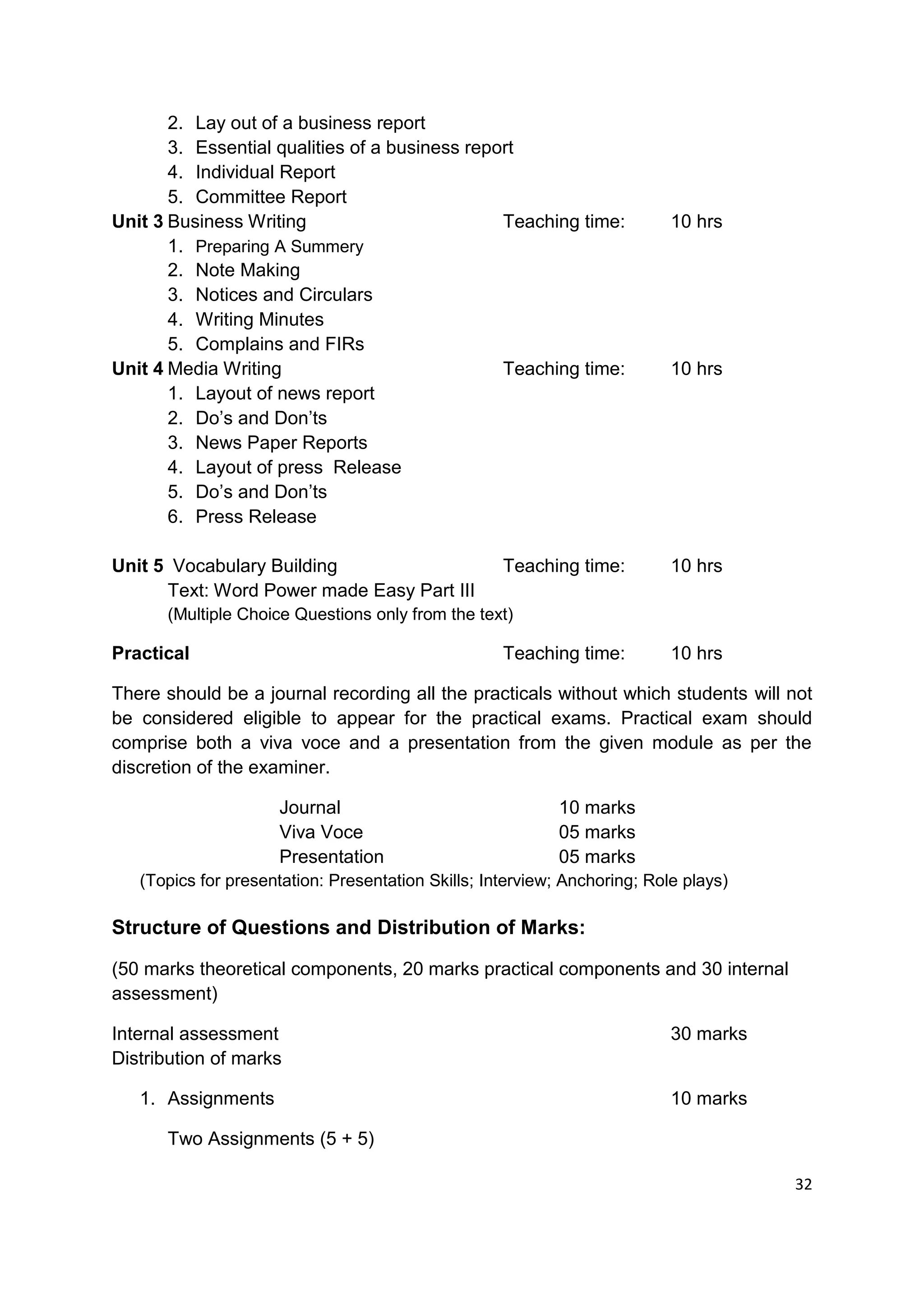
                                                                                      32
2. Multiple Choice Questions (MCQ)                        10 marks
      From Word Power Made Easy Part II various items (synonyms,
      antonyms, root of the word etc)
   3. Seminar                                                10 marks

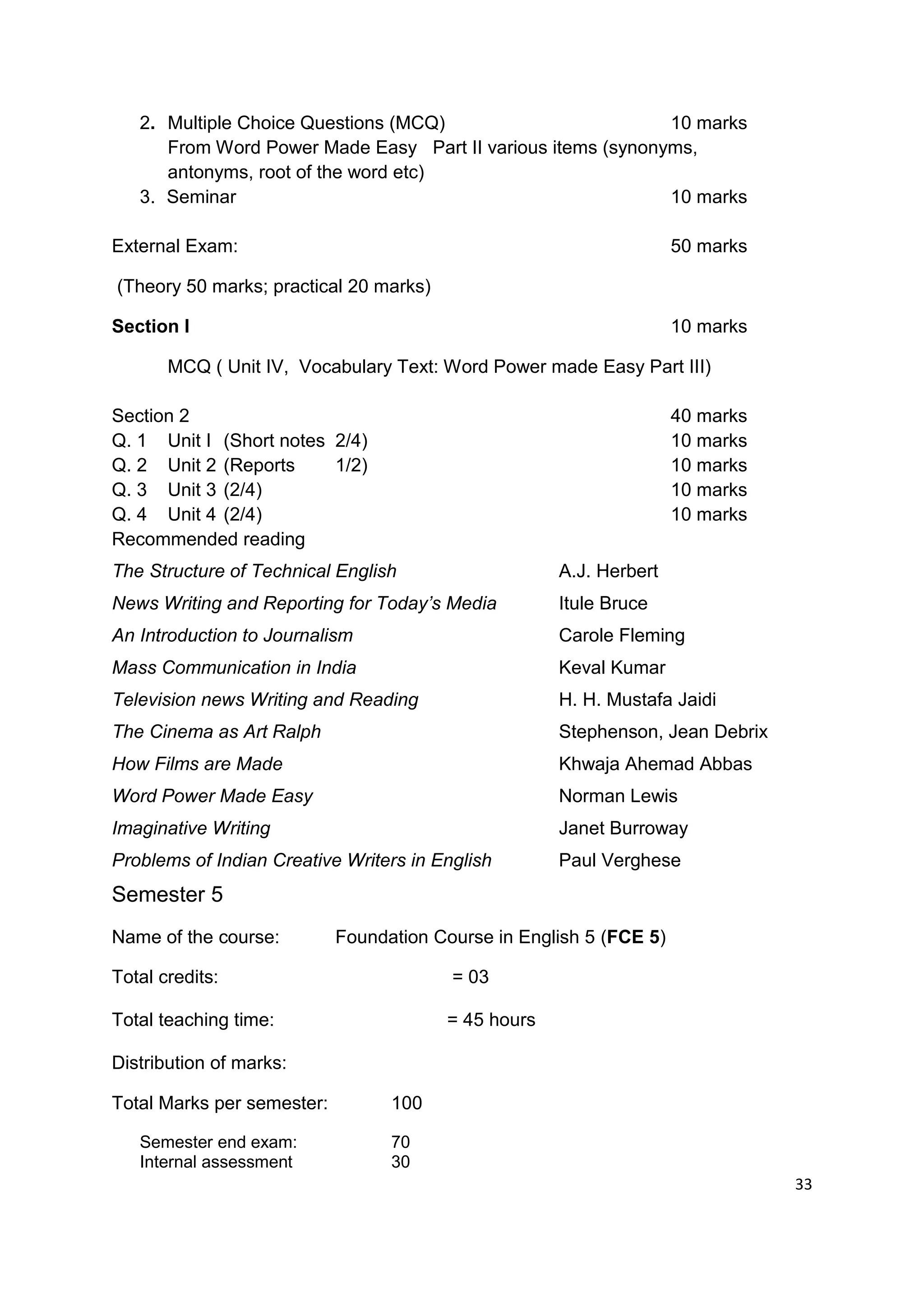
External Exam:                                                       50 marks

(Theory 50 marks; practical 20 marks)

Section I                                                            10 marks

       MCQ ( Unit IV, Vocabulary Text: Word Power made Easy Part III)

Section 2                                                            40 marks
Q. 1 Unit I (Short notes 2/4)                                        10 marks
Q. 2 Unit 2 (Reports     1/2)                                        10 marks
Q. 3 Unit 3 (2/4)                                                    10 marks
Q. 4 Unit 4 (2/4)                                                    10 marks
Recommended reading
The Structure of Technical English                   A.J. Herbert
News Writing and Reporting for Today’s Media         Itule Bruce
An Introduction to Journalism                        Carole Fleming
Mass Communication in India                          Keval Kumar
Television news Writing and Reading                  H. H. Mustafa Jaidi
The Cinema as Art Ralph                              Stephenson, Jean Debrix
How Films are Made                                   Khwaja Ahemad Abbas
Word Power Made Easy                                 Norman Lewis
Imaginative Writing                                  Janet Burroway
Problems of Indian Creative Writers in English       Paul Verghese
Semester 5
Name of the course:         Foundation Course in English 5 (FCE 5)

Total credits:                           = 03

Total teaching time:                    = 45 hours

Distribution of marks:

Total Marks per semester:         100

   Semester end exam:             70
   Internal assessment            30
                                                                                33
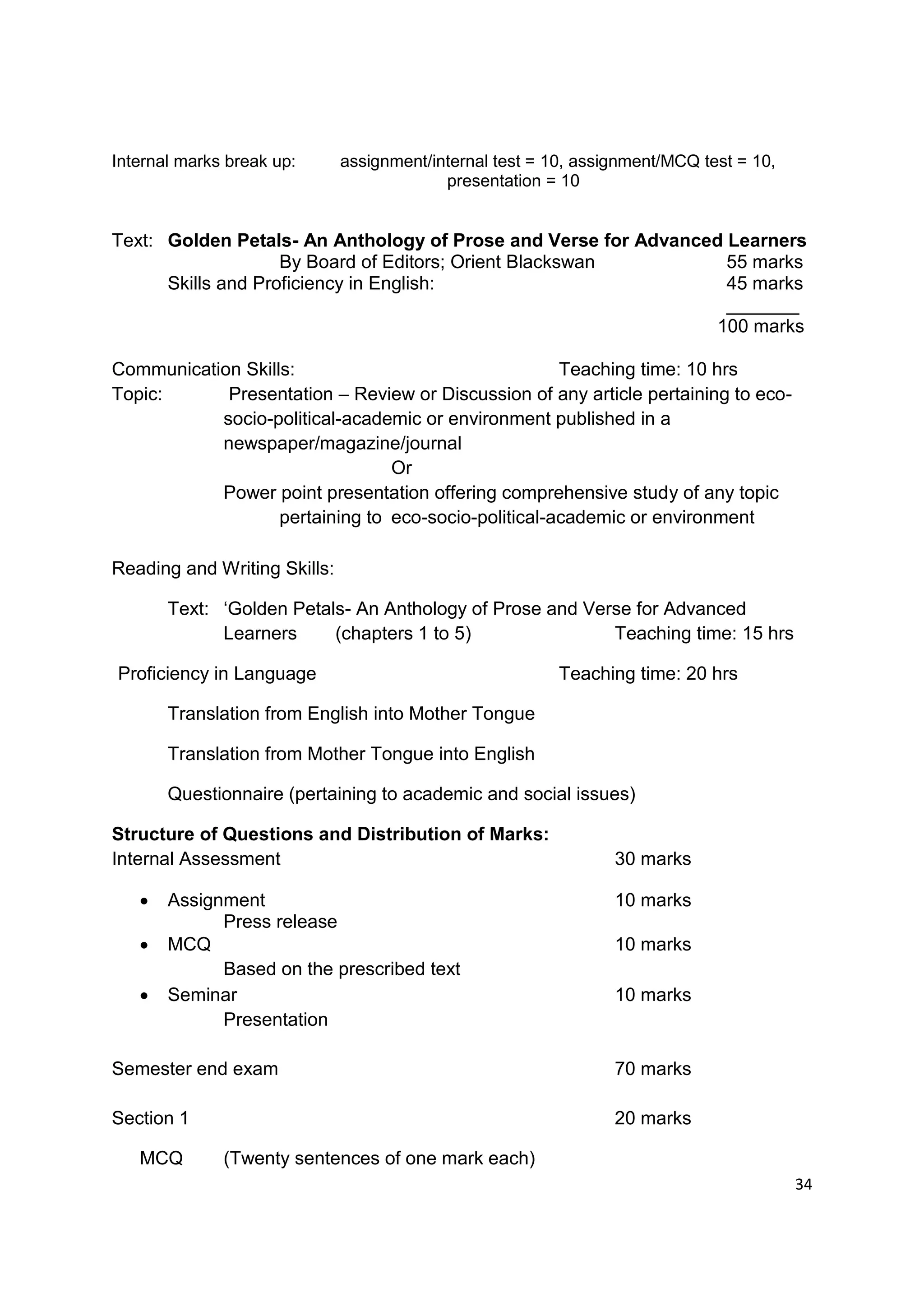
Internal marks break up:      assignment/internal test = 10, assignment/MCQ test = 10,
                                           presentation = 10


Text: Golden Petals- An Anthology of Prose and Verse for Advanced Learners
                    By Board of Editors; Orient Blackswan         55 marks
      Skills and Proficiency in English:                          45 marks
                                                                  _______
                                                                 100 marks

Communication Skills:                                 Teaching time: 10 hrs
Topic:      Presentation – Review or Discussion of any article pertaining to eco-
           socio-political-academic or environment published in a
           newspaper/magazine/journal
                                 Or
           Power point presentation offering comprehensive study of any topic
                   pertaining to eco-socio-political-academic or environment

Reading and Writing Skills:

       Text: „Golden Petals- An Anthology of Prose and Verse for Advanced
             Learners     (chapters 1 to 5)               Teaching time: 15 hrs

Proficiency in Language                                   Teaching time: 20 hrs

       Translation from English into Mother Tongue

       Translation from Mother Tongue into English

       Questionnaire (pertaining to academic and social issues)

Structure of Questions and Distribution of Marks:
Internal Assessment                                              30 marks

      Assignment                                                10 marks
             Press release
      MCQ                                                       10 marks
             Based on the prescribed text
      Seminar                                                   10 marks
             Presentation

Semester end exam                                                70 marks

Section 1                                                        20 marks

   MCQ        (Twenty sentences of one mark each)
                                                                                         34
Based on the prescribed text

Section 2                                                       50 marks

Q. 1   Descriptive questions – answers           2/4            15 marks

   (Based on the prescribed text)

Q. 2   Brief questions – answers                 2/4            10 marks
       (Based on the prescribed text)

Q. 3   Questionnaire                             1/2            10 marks

Q. 4   Translation from English into Mother Tongue         15 marks
       (Paragraph)
       Translation from Mother Tongue into English

Recommended reading:
Murphy’s English Grammar (with CD- Rom). Cambridge University Press.
Thomson and Martinet. A Practical English Grammar (4th edition). Oxford University
Press.
Redman, Stuart. 1997. English Vocabulary in Use : Pre-intermediate and
Intermediate. Cambridge University Press.
Jones Daniel. English Pronouncing Dictionary (with CD – Rom). Cambridge
University Press.
Ur, Penny. Grammar Practice Activities Paperback with CD-ROM: A Practical Guide
for Teachers (Cambridge Handbooks for Language Teachers).
*[1 credit = 1 hour of teaching per week (1 credit course = 15 hours of lectures per
semester; 3 credits = 3 hours of instruction per week (3 credit course = 45 hours of
lectures per semester)]


Semester: 5
Name of the course:           Core Course in English (CCE 11) (Shakespeare)

Total credits: Semester 3 =         03 (3 Credit course)

Total teaching time:                45 hours

Distribution of marks:

Total Marks per semester:           100

Semester Exam:                      70

Internal Marks:                     30


                                                                                  35
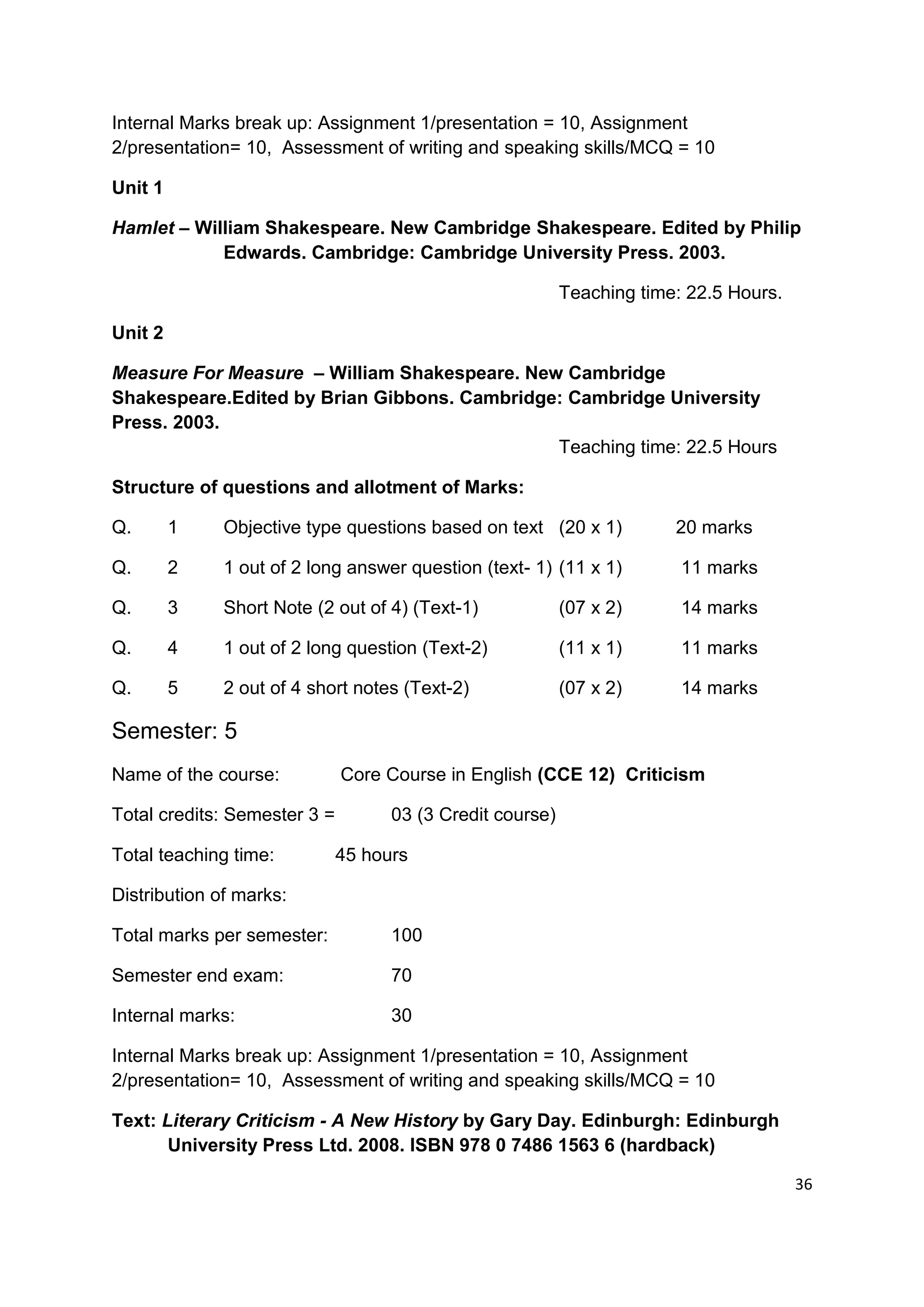
Internal Marks break up: Assignment 1/presentation = 10, Assignment
2/presentation= 10, Assessment of writing and speaking skills/MCQ = 10

Unit 1

Hamlet – William Shakespeare. New Cambridge Shakespeare. Edited by Philip
            Edwards. Cambridge: Cambridge University Press. 2003.

                                                           Teaching time: 22.5 Hours.

Unit 2

Measure For Measure – William Shakespeare. New Cambridge
Shakespeare.Edited by Brian Gibbons. Cambridge: Cambridge University
Press. 2003.
                                              Teaching time: 22.5 Hours

Structure of questions and allotment of Marks:

Q.       1    Objective type questions based on text (20 x 1)           20 marks

Q.       2    1 out of 2 long answer question (text- 1) (11 x 1)         11 marks

Q.       3    Short Note (2 out of 4) (Text-1)             (07 x 2)      14 marks

Q.       4    1 out of 2 long question (Text-2)            (11 x 1)      11 marks

Q.       5    2 out of 4 short notes (Text-2)              (07 x 2)      14 marks

Semester: 5
Name of the course:           Core Course in English (CCE 12) Criticism

Total credits: Semester 3 =         03 (3 Credit course)

Total teaching time:          45 hours

Distribution of marks:

Total marks per semester:           100

Semester end exam:                  70

Internal marks:                     30

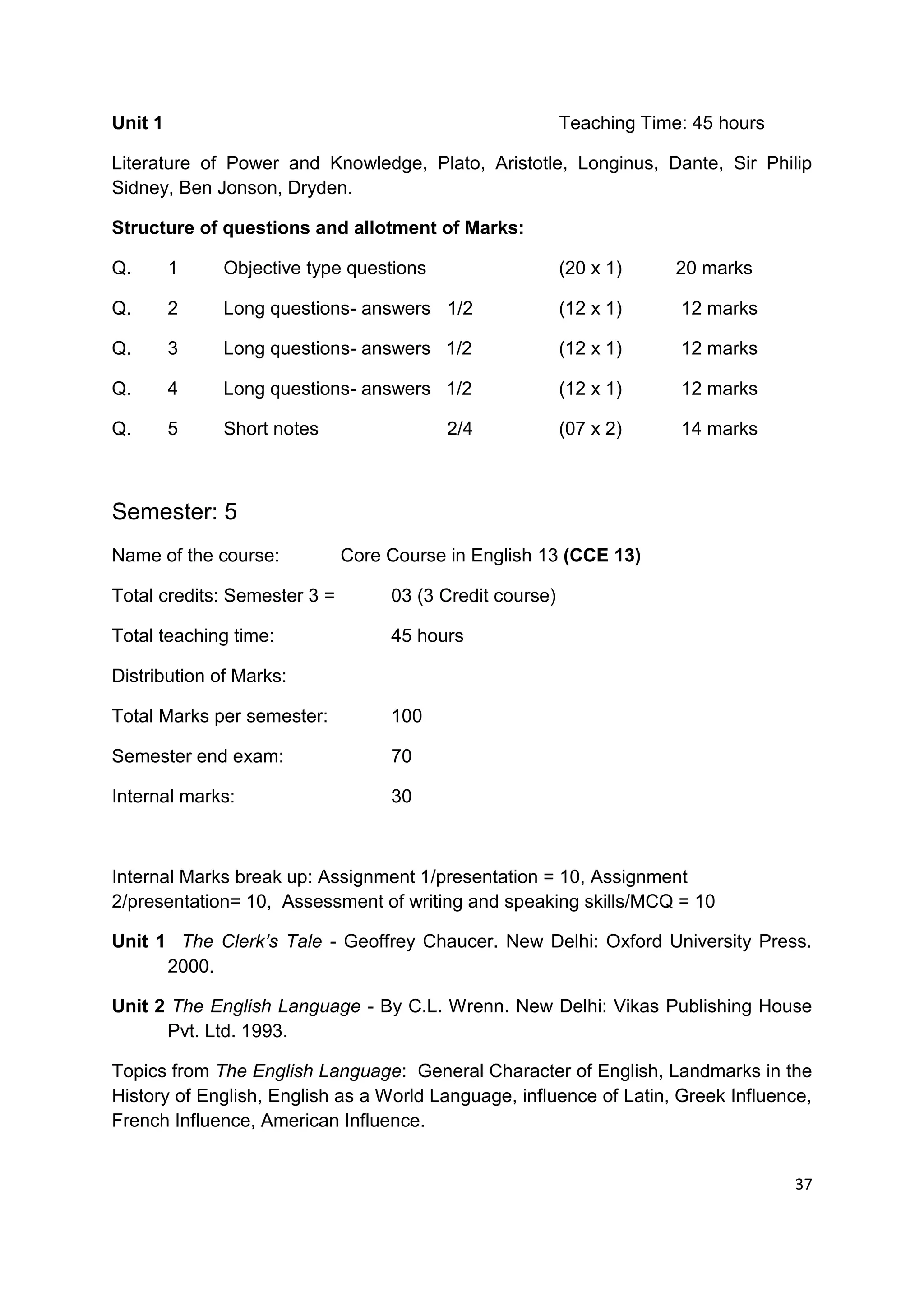
Internal Marks break up: Assignment 1/presentation = 10, Assignment
2/presentation= 10, Assessment of writing and speaking skills/MCQ = 10

Text: Literary Criticism - A New History by Gary Day. Edinburgh: Edinburgh
       University Press Ltd. 2008. ISBN 978 0 7486 1563 6 (hardback)

                                                                                        36
Unit 1                                                    Teaching Time: 45 hours

Literature of Power and Knowledge, Plato, Aristotle, Longinus, Dante, Sir Philip
Sidney, Ben Jonson, Dryden.

Structure of questions and allotment of Marks:

Q.       1    Objective type questions                    (20 x 1)     20 marks

Q.       2    Long questions- answers 1/2                 (12 x 1)     12 marks

Q.       3    Long questions- answers 1/2                 (12 x 1)     12 marks

Q.       4    Long questions- answers 1/2                 (12 x 1)     12 marks

Q.       5    Short notes                 2/4             (07 x 2)     14 marks


Semester: 5
Name of the course:           Core Course in English 13 (CCE 13)

Total credits: Semester 3 =        03 (3 Credit course)

Total teaching time:               45 hours

Distribution of Marks:

Total Marks per semester:          100

Semester end exam:                 70

Internal marks:                    30


Internal Marks break up: Assignment 1/presentation = 10, Assignment
2/presentation= 10, Assessment of writing and speaking skills/MCQ = 10

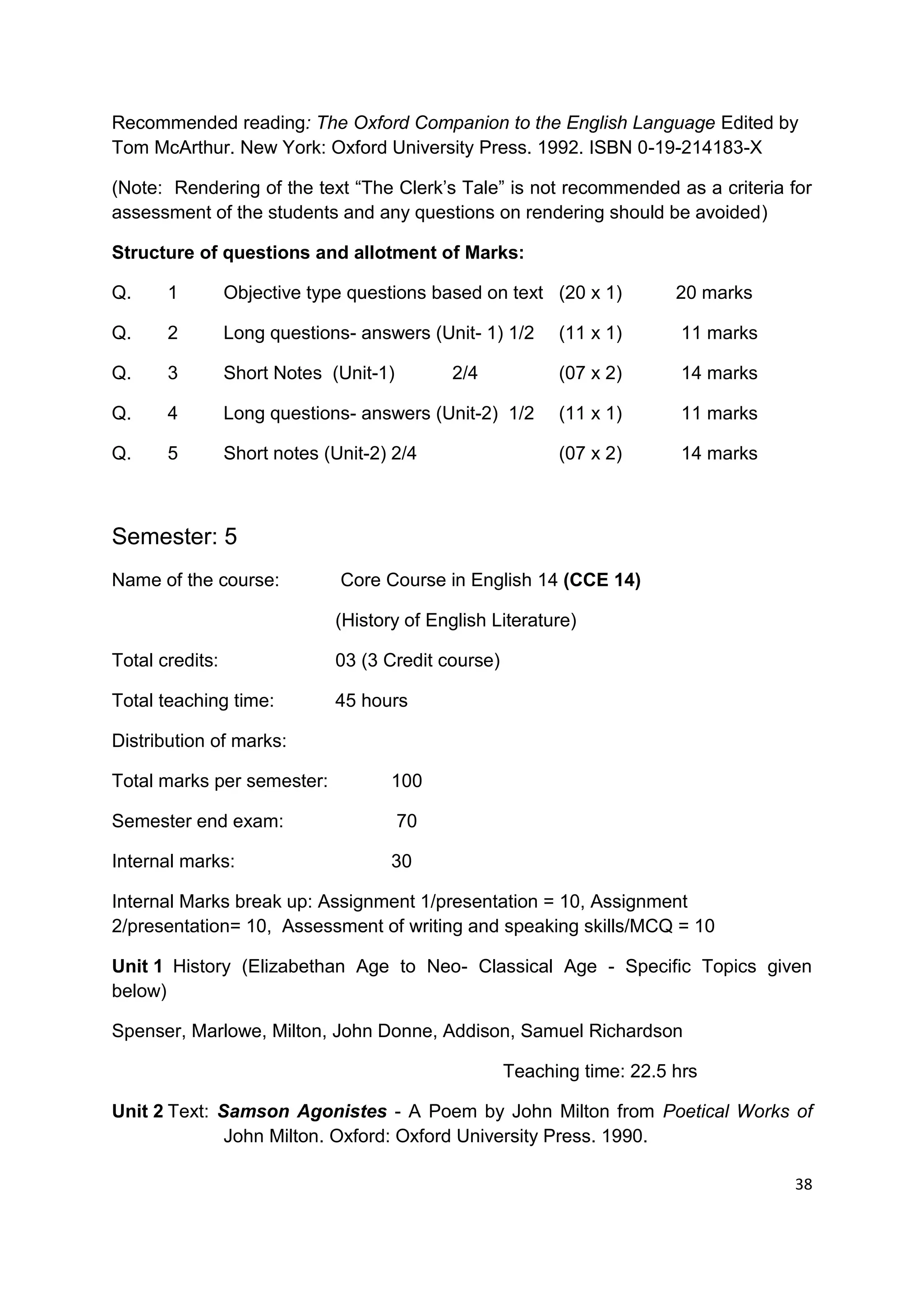
Unit 1 The Clerk’s Tale - Geoffrey Chaucer. New Delhi: Oxford University Press.
      2000.

Unit 2 The English Language - By C.L. Wrenn. New Delhi: Vikas Publishing House
      Pvt. Ltd. 1993.

Topics from The English Language: General Character of English, Landmarks in the
History of English, English as a World Language, influence of Latin, Greek Influence,
French Influence, American Influence.


                                                                                    37
Recommended reading: The Oxford Companion to the English Language Edited by
Tom McArthur. New York: Oxford University Press. 1992. ISBN 0-19-214183-X

(Note: Rendering of the text “The Clerk‟s Tale” is not recommended as a criteria for
assessment of the students and any questions on rendering should be avoided)

Structure of questions and allotment of Marks:

Q.     1         Objective type questions based on text (20 x 1)         20 marks

Q.     2         Long questions- answers (Unit- 1) 1/2     (11 x 1)       11 marks

Q.     3         Short Notes (Unit-1)        2/4           (07 x 2)       14 marks

Q.     4         Long questions- answers (Unit-2) 1/2      (11 x 1)       11 marks

Q.     5         Short notes (Unit-2) 2/4                  (07 x 2)       14 marks


Semester: 5
Name of the course:            Core Course in English 14 (CCE 14)

                              (History of English Literature)

Total credits:                03 (3 Credit course)

Total teaching time:          45 hours

Distribution of marks:

Total marks per semester:            100

Semester end exam:                      70

Internal marks:                      30

Internal Marks break up: Assignment 1/presentation = 10, Assignment
2/presentation= 10, Assessment of writing and speaking skills/MCQ = 10

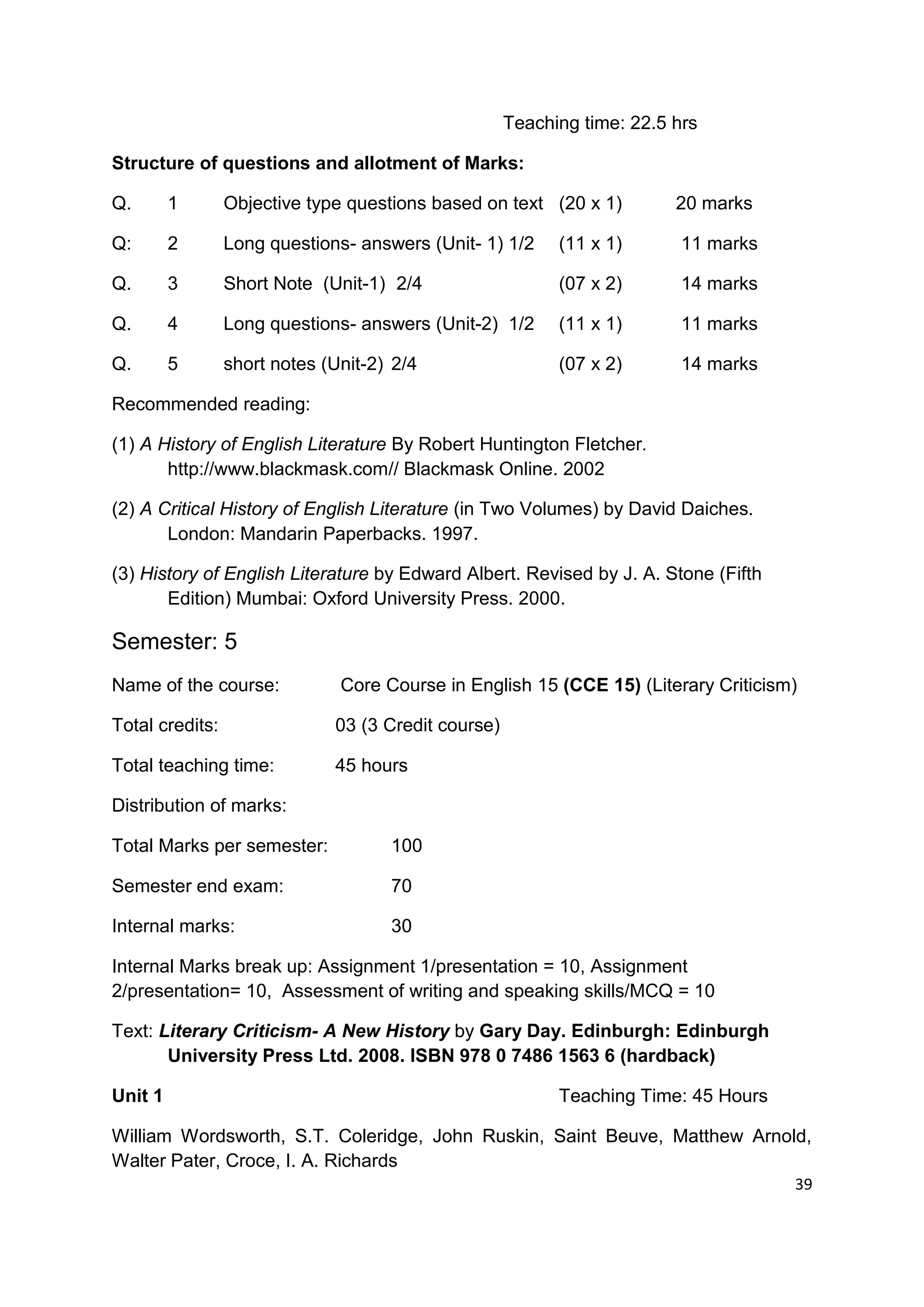
Unit 1 History (Elizabethan Age to Neo- Classical Age - Specific Topics given
below)

Spenser, Marlowe, Milton, John Donne, Addison, Samuel Richardson

                                                     Teaching time: 22.5 hrs

Unit 2 Text: Samson Agonistes - A Poem by John Milton from Poetical Works of
              John Milton. Oxford: Oxford University Press. 1990.

                                                                                     38
Teaching time: 22.5 hrs

Structure of questions and allotment of Marks:

Q.       1       Objective type questions based on text (20 x 1)         20 marks

Q:       2       Long questions- answers (Unit- 1) 1/2     (11 x 1)       11 marks

Q.       3       Short Note (Unit-1) 2/4                   (07 x 2)       14 marks

Q.       4       Long questions- answers (Unit-2) 1/2      (11 x 1)       11 marks

Q.       5       short notes (Unit-2) 2/4                  (07 x 2)       14 marks

Recommended reading:

(1) A History of English Literature By Robert Huntington Fletcher.
       http://www.blackmask.com// Blackmask Online. 2002

(2) A Critical History of English Literature (in Two Volumes) by David Daiches.
       London: Mandarin Paperbacks. 1997.

(3) History of English Literature by Edward Albert. Revised by J. A. Stone (Fifth
       Edition) Mumbai: Oxford University Press. 2000.

Semester: 5
Name of the course:            Core Course in English 15 (CCE 15) (Literary Criticism)

Total credits:                03 (3 Credit course)

Total teaching time:          45 hours

Distribution of marks:

Total Marks per semester:            100

Semester end exam:                   70

Internal marks:                      30

Internal Marks break up: Assignment 1/presentation = 10, Assignment
2/presentation= 10, Assessment of writing and speaking skills/MCQ = 10

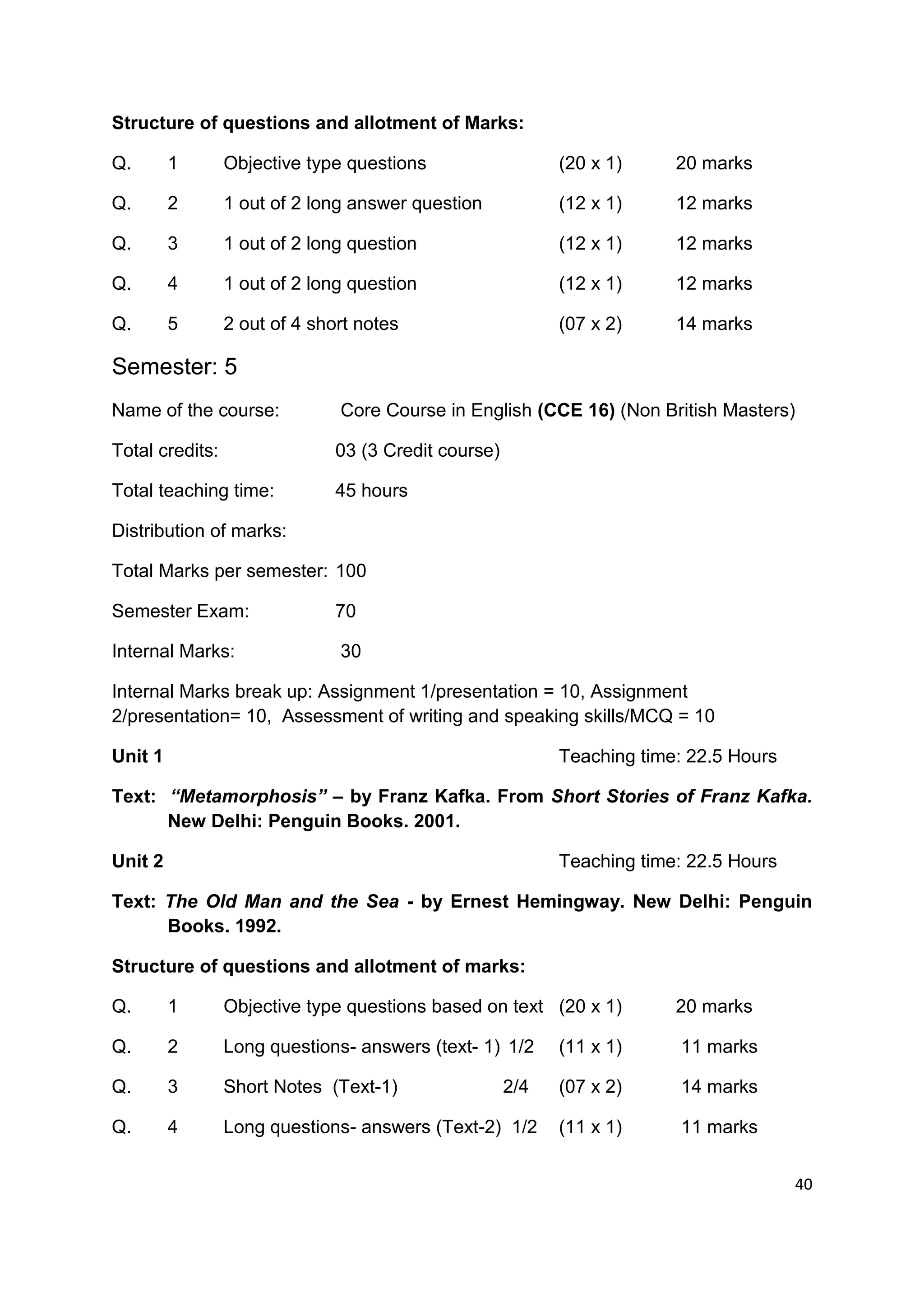
Text: Literary Criticism- A New History by Gary Day. Edinburgh: Edinburgh
       University Press Ltd. 2008. ISBN 978 0 7486 1563 6 (hardback)

Unit 1                                                     Teaching Time: 45 Hours

William Wordsworth, S.T. Coleridge, John Ruskin, Saint Beuve, Matthew Arnold,
Walter Pater, Croce, I. A. Richards
                                                                                     39
Structure of questions and allotment of Marks:

Q.       1       Objective type questions                   (20 x 1)     20 marks

Q.       2       1 out of 2 long answer question            (12 x 1)     12 marks

Q.       3       1 out of 2 long question                   (12 x 1)     12 marks

Q.       4       1 out of 2 long question                   (12 x 1)     12 marks

Q.       5       2 out of 4 short notes                     (07 x 2)     14 marks

Semester: 5
Name of the course:            Core Course in English (CCE 16) (Non British Masters)

Total credits:                 03 (3 Credit course)

Total teaching time:           45 hours

Distribution of marks:

Total Marks per semester: 100

Semester Exam:                 70

Internal Marks:                30

Internal Marks break up: Assignment 1/presentation = 10, Assignment
2/presentation= 10, Assessment of writing and speaking skills/MCQ = 10

Unit 1                                                      Teaching time: 22.5 Hours

Text: “Metamorphosis” – by Franz Kafka. From Short Stories of Franz Kafka.
      New Delhi: Penguin Books. 2001.

Unit 2                                                      Teaching time: 22.5 Hours

Text: The Old Man and the Sea - by Ernest Hemingway. New Delhi: Penguin
      Books. 1992.

Structure of questions and allotment of marks:

Q.       1       Objective type questions based on text (20 x 1)         20 marks

Q.       2       Long questions- answers (text- 1) 1/2      (11 x 1)     11 marks

Q.       3       Short Notes (Text-1)                 2/4   (07 x 2)     14 marks

Q.       4       Long questions- answers (Text-2) 1/2       (11 x 1)     11 marks


                                                                                        40
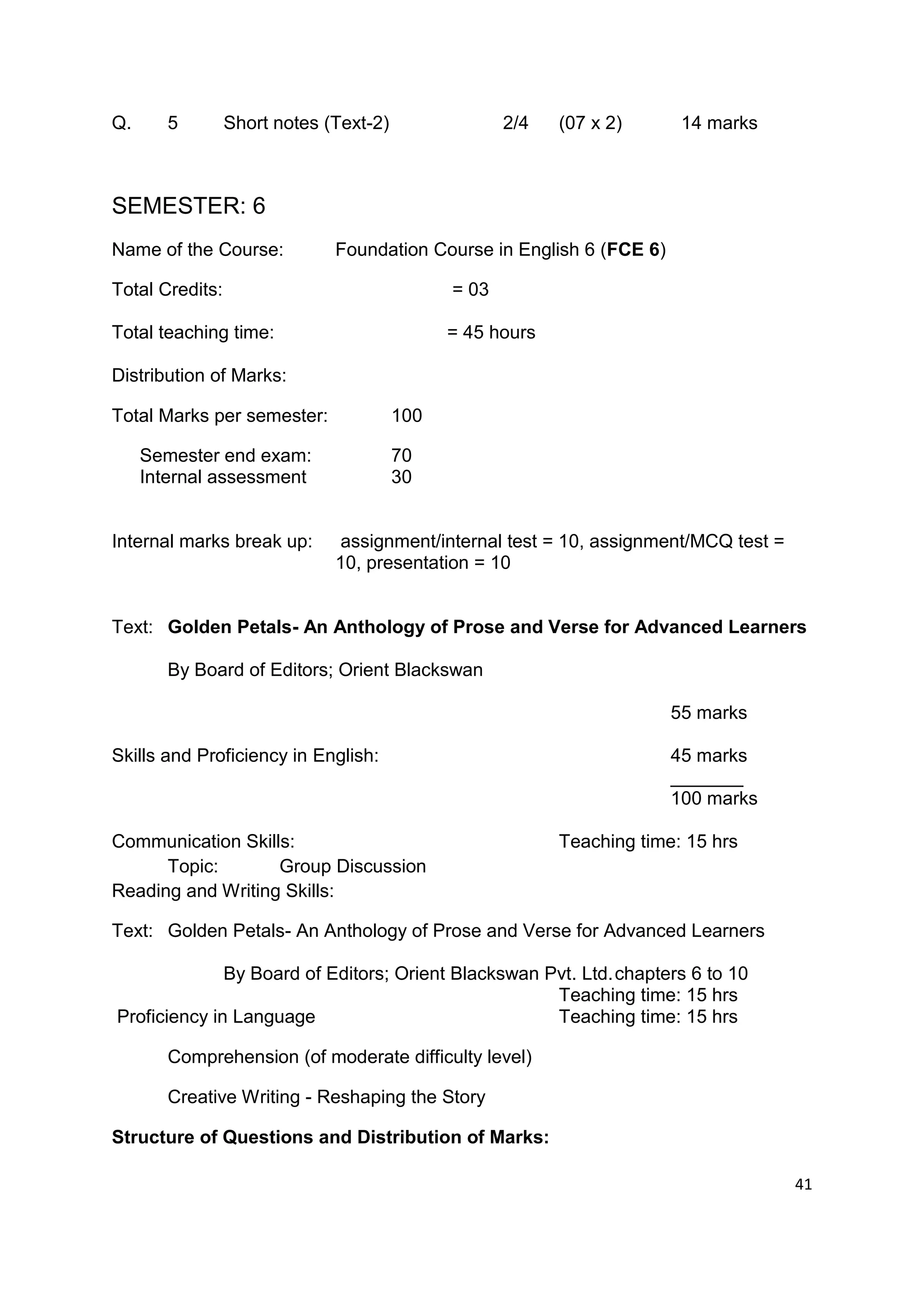
Q.      5        Short notes (Text-2)                2/4   (07 x 2)      14 marks


SEMESTER: 6
Name of the Course:           Foundation Course in English 6 (FCE 6)

Total Credits:                                = 03

Total teaching time:                          = 45 hours

Distribution of Marks:

Total Marks per semester:               100

     Semester end exam:                 70
     Internal assessment                30


Internal marks break up:       assignment/internal test = 10, assignment/MCQ test =
                              10, presentation = 10


Text: Golden Petals- An Anthology of Prose and Verse for Advanced Learners

        By Board of Editors; Orient Blackswan

                                                                        55 marks

Skills and Proficiency in English:                                      45 marks
                                                                        _______
                                                                        100 marks

Communication Skills:                                      Teaching time: 15 hrs
      Topic:       Group Discussion
Reading and Writing Skills:

Text: Golden Petals- An Anthology of Prose and Verse for Advanced Learners

              By Board of Editors; Orient Blackswan Pvt. Ltd. chapters 6 to 10
                                                     Teaching time: 15 hrs
Proficiency in Language                              Teaching time: 15 hrs

        Comprehension (of moderate difficulty level)

        Creative Writing - Reshaping the Story

Structure of Questions and Distribution of Marks:

                                                                                      41
Internal Assessment                                          30 marks

Distribution of Marks

      Assignment                                            10 marks
             Reshaping of story
      MCQ                                                   10 marks
             Based on the prescribed text
      Seminar                                               10 marks
             Group discussion

External Exam                                                70 marks

Section 1                                                    20 marks

   MCQ       (Twenty sentences of one mark each)

       Based on the prescribed text

Section 2                                                    50 marks

Q. 1   Descriptive questions – answers         2/4           14 marks

       (Based on the prescribed text)

Q. 2   Brief questions – answers               3/5           10 marks
       (Based on the prescribed text)

Q. 3   Reshaping the story                     01            10 marks

Q. 4   Comprehension         (08 x 02)         02            16 marks
       (08 x 01 = 08)

Recommended reading:
Murphy’s English Grammar (with CD- Rom). Cambridge University Press.
Thomson and Martinet. A Practical English Grammar (4th edition). Oxford University
Press.
Redman, Stuart. 1997. English Vocabulary in Use : Pre-intermediate and
Intermediate. Cambridge University Press.
Jones Daniel. English Pronouncing Dictionary (with CD – Rom). Cambridge
University Press.
Ur, Penny. Grammar Practice Activities Paperback with CD-ROM: A Practical Guide
for Teachers (Cambridge Handbooks for Language Teachers).
*[1 credit = 1 hour of teaching per week (1 credit course = 15 hours of lectures per
semester; 3 credits = 3 hours of instruction per week (3 credit course = 45 hours of
lectures per semester)]


                                                                                  42
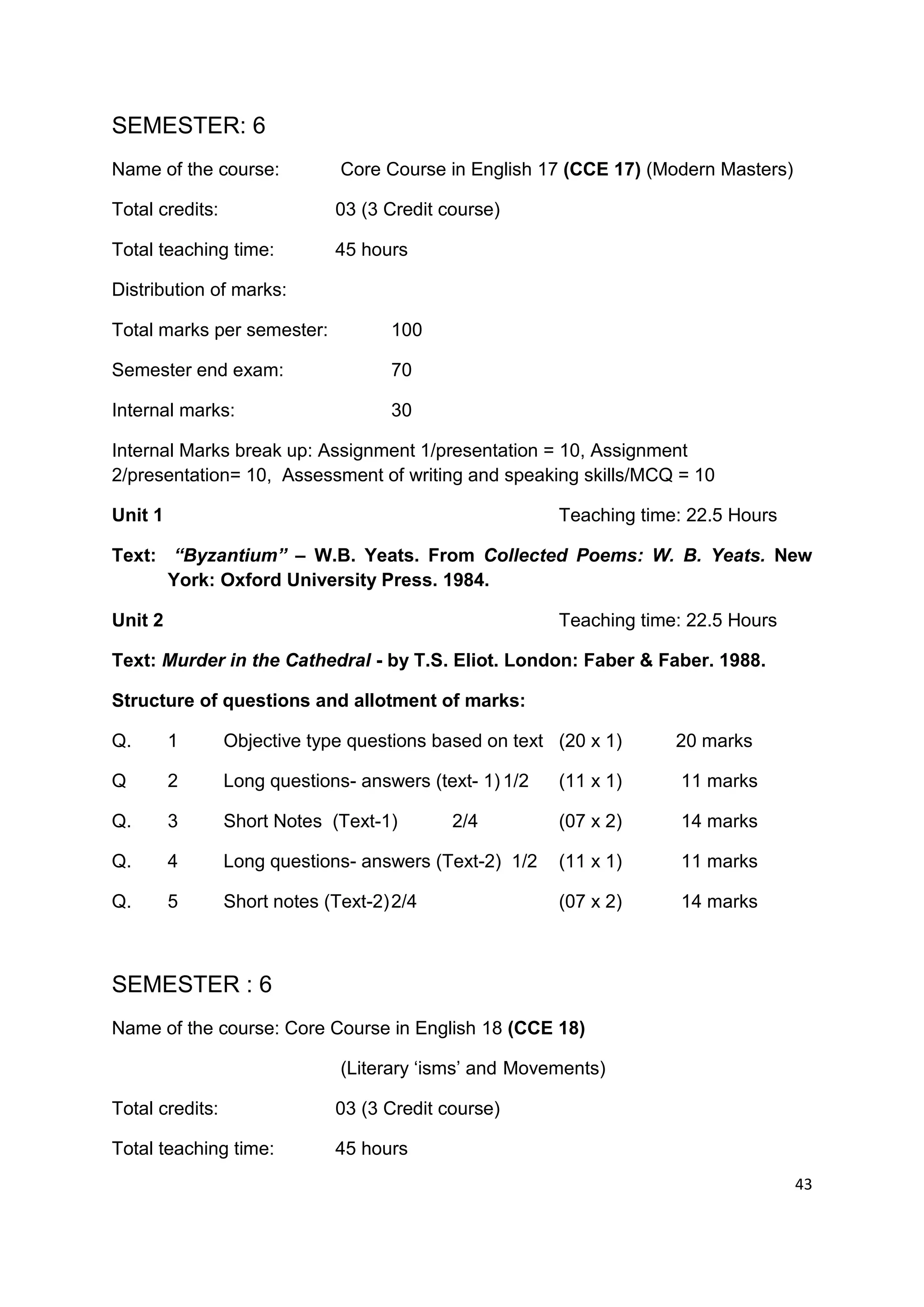
SEMESTER: 6
Name of the course:            Core Course in English 17 (CCE 17) (Modern Masters)

Total credits:                03 (3 Credit course)

Total teaching time:          45 hours

Distribution of marks:

Total marks per semester:            100

Semester end exam:                   70

Internal marks:                      30

Internal Marks break up: Assignment 1/presentation = 10, Assignment
2/presentation= 10, Assessment of writing and speaking skills/MCQ = 10

Unit 1                                                   Teaching time: 22.5 Hours

Text: “Byzantium” – W.B. Yeats. From Collected Poems: W. B. Yeats. New
      York: Oxford University Press. 1984.

Unit 2                                                   Teaching time: 22.5 Hours

Text: Murder in the Cathedral - by T.S. Eliot. London: Faber & Faber. 1988.

Structure of questions and allotment of marks:

Q.       1       Objective type questions based on text (20 x 1)      20 marks

Q        2       Long questions- answers (text- 1) 1/2   (11 x 1)     11 marks

Q.       3       Short Notes (Text-1)       2/4          (07 x 2)     14 marks

Q.       4       Long questions- answers (Text-2) 1/2    (11 x 1)     11 marks

Q.       5       Short notes (Text-2) 2/4                (07 x 2)     14 marks


SEMESTER : 6
Name of the course: Core Course in English 18 (CCE 18)

                               (Literary „isms‟ and Movements)

Total credits:                03 (3 Credit course)

Total teaching time:          45 hours
                                                                                     43
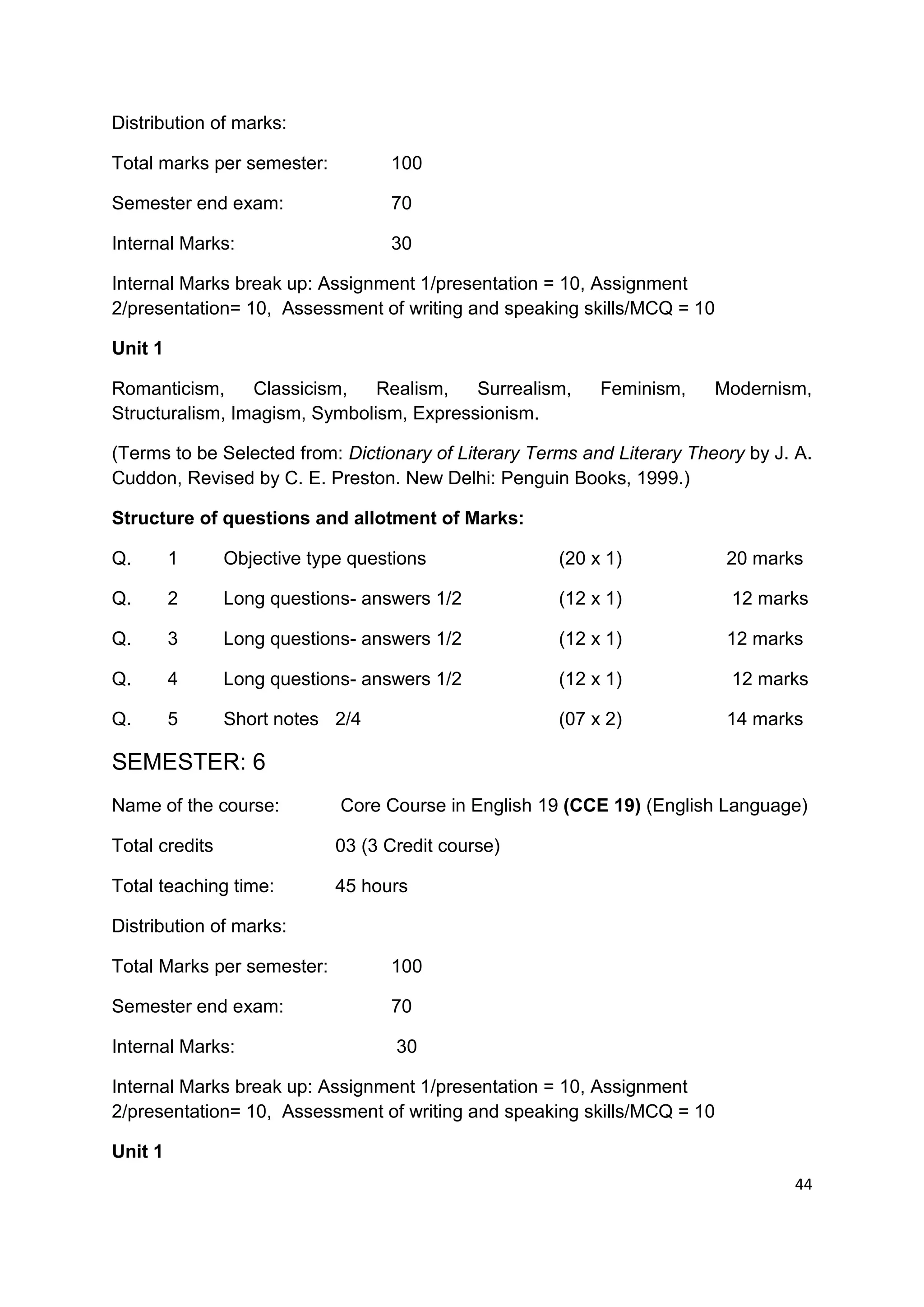
Distribution of marks:

Total marks per semester:          100

Semester end exam:                 70

Internal Marks:                    30

Internal Marks break up: Assignment 1/presentation = 10, Assignment
2/presentation= 10, Assessment of writing and speaking skills/MCQ = 10

Unit 1

Romanticism,     Classicism,   Realism,   Surrealism,      Feminism,     Modernism,
Structuralism, Imagism, Symbolism, Expressionism.

(Terms to be Selected from: Dictionary of Literary Terms and Literary Theory by J. A.
Cuddon, Revised by C. E. Preston. New Delhi: Penguin Books, 1999.)

Structure of questions and allotment of Marks:

Q.       1      Objective type questions              (20 x 1)            20 marks

Q.       2      Long questions- answers 1/2           (12 x 1)             12 marks

Q.       3      Long questions- answers 1/2           (12 x 1)            12 marks

Q.       4      Long questions- answers 1/2           (12 x 1)             12 marks

Q.       5      Short notes 2/4                       (07 x 2)            14 marks

SEMESTER: 6
Name of the course:          Core Course in English 19 (CCE 19) (English Language)

Total credits                03 (3 Credit course)

Total teaching time:         45 hours

Distribution of marks:

Total Marks per semester:          100

Semester end exam:                 70

Internal Marks:                     30

Internal Marks break up: Assignment 1/presentation = 10, Assignment
2/presentation= 10, Assessment of writing and speaking skills/MCQ = 10

Unit 1
                                                                                  44
Spelling and Pronunciation only General Considerations Portion, The Ordering of
Words and Syntax, Syntax and Parts of Speech-           Marks-40 (20 marks of
Objective)Reference Book: The English Language by C. L. Wrenn

                                                                   Teaching time: 15 hrs

Unit 2

Terms: Autobiography, Absurd, Epic, Post-Colonialism, Science Fiction, Free Verse,
      Irony, Monologue.                                           14 marks

(Terms to be Selected from: Dictionary of Literary Terms & Literary Theory by J. A.
Cuddon, Revised by C. E. Preston. New Delhi: Penguin Books, 1999)

                                                                   Teaching time: 15 hrs

Unit 3           Transcription                                                16 marks

(A) Sentences to be asked of 08 marks ( Transcription to be done by the Student)

(B) Words to be asked to be specified as which are Vowels and Consonants of 08
      marks.

                                                                   Teaching time: 15 hrs

Text: An English Phonetic Reader - BY R. K. Bansal and Clive Brasnett, Orient
      Longman, 1989.

Exercises in Spoken English - By R. K. Bansal.

Structure of questions and allotment of marks:

Q.       1       Objective type questions based on Unit-1 & 2 (20 x 1)            20 marks

Q.       2       Long questions- answers (Unit- 1)           1/2   (12 x 1)        12 marks

Q.       3       Short Notes (Unit-1) 1/2                          (08 x 1)        08 marks

Q.       4       Explain Terms      (Unit-2)   2/4                 (07 x 2)        14 marks

Q.       5       Phonetic Transcription - 08 Sentences             (08 x 1)        08 marks

                 Phonetic Transcription- 08 words (Unit-3)         (08 x 1)        08 marks

SEMESTER : 6
Name of the course:              Core Course in English 20 (CCE 20)

                                 (History of English Literature)

Total Credits:                   03 (3 Credit course)
                                                                                           45
Total teaching time:        45 hours

Distribution of marks:

Total Marks per semester:         100

Semester end exam:                70

Internal marks:                   30

Internal Marks break up: Assignment 1/presentation = 10, Assignment
2/presentation= 10, Assessment of writing and speaking skills/MCQ = 10

Unit 1        History of English Literature (Romantic Age to Modern Age)

              Specific Topics: Samuel Coleridge, Robert Browning, Charles Dickens,
              D. G. Rossetti, Virginia Woolf, Andrew Motion

                                                       Teaching time: 22.5 Hours

Unit 2        Text: Great Expectations - Novel by Charles Dickens

                                                       Teaching time: 22.5 Hours

Structure of questions and allotment of marks:

Q.       1    Objective type questions based on text          (20 x 1)       20 marks

Q.       2    Long questions- answers (Unit- 1) 1/2           (11 x 1)       11marks

Q.       3    Short Note (Unit-1) 2/4                         (07 x 2)       14marks

Q.       4    Long questions- answers (Unit-2) 1/2            (11 x 1)       11marks

Q.       5    Short notes (Unit-2) 2/4                        (07 x 2)       14marks

Recommended reading:

(1) A History of English Literature By Robert Huntington Fletcher.
       http://www.blackmask.com// Blackmask Online. 2002

(2) A Critical History of English Literature (in Two Volumes) by David Daiches.
       London: Mandarin Paperbacks. 1997.

(3) History of English Literature by Edward Albert. Revised by J. A. Stone (Fifth
       Edition) Mumbai: Oxford University Press. 2000.

Semester: 6
Name of the course:         Core Course in English21 (CCE 21) (Indian Poetics)

                                                                                    46
Total Credits:                 03 (3 Credit course)

Total teaching time:           45 hours

Distribution of Marks:

Total Marks per semester:             100

Semester end exam:                    70

Internal Marks:                       30

Internal Marks break up: Assignment 1/presentation = 10, Assignment
2/presentation= 10, Assessment of writing and speaking skills/MCQ = 10

Unit 1 Rasa, Dhvani, Vkrokti, Alankar                        Teaching time: 45hrs

Topics to be Selected from the Text: Indian Aesthetics by V. S. Sethuraman

New Delhi: Macmillan.2000.

Structure of questions and allotment of Marks:

Q.     1         Objective type questions                    (20 x 1)     20 marks

Q.     2         Long questions- answers 1/2                 (12 x 1)      12 marks

Q.     3         Long questions- answers 1/2                 (12 x 1)      12 marks

Q.     4         Long questions- answers 1/2                 (12 x 1)      12 marks

Q.     5         Short notes                 2/4             (07 x 2)      14 marks

Recommended reading: Literary Theory: Indian Conceptual Framework by Kapil
Kapoor. New Delhi: Affiliated East-West Press Pvt.Ltd. 1998.

Semester: 6
Name of the course:            Core Course in English 22 (CCE 22)

                               (Indian Writing in English)

Total credits: Semester 3 =           03 (3 Credit course)

Total teaching time:           45 hours

Distribution of marks:

Total Marks per semester:             100

Semester end exam:                    70

                                                                                      47
Internal marks:                  30

Internal Marks break up: Assignment 1/presentation = 10, Assignment
2/presentation= 10, Assessment of writing and speaking skills/MCQ = 10

Unit 1                                                Teaching time: 22.5 Hours

Text: Where There is a Will – Mahesh Dattani. From Collected Plays of Mahesh
      Dattani New Delhi: Penguin Books. 2000.

Unit 2                                                Teaching time: 22.5 Hours

Poems to be Selected from Collected Poetry: A. K. Ramanujan. New Delhi:
Oxford University Press. 1999.

(prescribed poems are mentioned below)

   (1) The River; (2)Elements of Composition;     (3) Prayers to Lord Murugan
   (4)Chicago en; (5) Astronomer;    (6) Obituary
Structure of questions and allotment of Marks:

Q.       1   Objective type questions based on text (20 x 1)        20 marks

Q.       2   Long questions- answers (Unit- 1) 1/2    (11 x 1)       11marks

Q.       3   Short Notes (Unit-1) 2/4                 (07 x 2)       14marks

Q.       4   Long questions- answers (Unit-2) 1/2     (11 x 1)       11marks

Q.       5   Short notes (Unit-2) 2/4                 (07 x 2)       14 marks

Recommended reading:

Collected Poetry by A. K. Ramanujan. Oxford Uni. Press, 1999

Modern English Poetry by Bruce King, Oxford Uni. Press, 1989

Critical Essays on Indian Writing in Englis by M. K. Naik, Macmillan, 1972

Indian English Poetry after Independence - Book Enclave, Jaipur, 2000

Explorations in Indian English Poetry by Jaydeep Sarangi, Authors Press, 2007.


Bachelor of Commerce

                                                                                  48
Semester 1

Name of the Course: Foundation Course in English 1(FCE 1)
Total Credits         = 03* (3 credit course)
Total teaching time:        = 45 hours
Distribution of Marks:
Total Marks per semester:          100
Semester end exam.:                70
Internal marks                     30

Internal marks break up for semester 1
: Assignment 1/presentation = 10, Assignment 2/presentation/testig of written skills =
10, Multiple Choice type Questions = 10

Course introduction and Objectives:

  This course can be offered to students of all streams to introduce them to the
basic aspects of English.

Objectives:

   To initiate the learner into learning of English language in an interactive, learner-
friendly manner.

   To expose the learners to key concepts of different grammatical forms as well as
to various aspects of language.

  To help the learners read and understand English and to learn basics of grammar,
punctuation and writing and communicating through the various exercises in each
units.

  To hone their proficiency in English by developing their writing, reading and
communicative skills.

   The course facilitates the learners to apply what they have learnt to real-life
situation.
Text: MASTERING ENGLISH : A COURSE FOR BEGINNERS eds. Anil Kinger, Nila
        Shah, Ketan Pandya, Ami Upadhyay. Orient Blackswan 2010

Questions based on the prescribed text 25 marks (to be asked from “Reading for
                                                        Pleasure” sections only)
Skills and Proficiency in English:         45 marks
                                           _______
                                           70 marks
Semester 1: Unit 1 to 8.
Unit 1
              Teaching points:     Describing things around you
                                   Describing places: saying what there is
              Grammar:             Plural forms of noun
                                                                                           49
Introduction to use of articles
                                  Present tense of to be
Total teaching time:              06 hours
Marks allotted:                    05
Unit 2
              Teaching points:    Introduction, Talking about people, Saying what
                                  they do
             Grammar:             Introduction to noun, verb, adjective and pronoun
                                  Simple present tense
Total teaching time:              06 hrs
Marks allotted                     05
Unit 3
              Teaching points:    Talking about routine, Saying what people do or
                                  don‟t do, Information through graphs, tables, maps
              Grammar:            Simple present tense
Total teaching time:              08 hours
Marks allotted:                    14
Unit 4
              Teaching points:    Text 1 and Text 2 (poem)
              Teaching time:      04 hrs.
Marks allotted:                    06
Unit 5
              Teaching points:    Talking about past events, Talking about things
                                  happening “now‟, Saying when things/events
                                  happened, Describing scenes, events
             Grammar:             Simple past tense, Present continuous tense, Past
                                  continuous tense
Total teaching time:              09 hrs
Marks allotted:                    14
Unit 6
              Teaching points:    Meeting people, Exchanging greetings
                                  Focus on: spoken skills (Training for role playing
                                  and brief presentations for speaking skills)
Total teaching time:              06 hrs
Marks allotted:                    10
Unit 7
              Teaching points:    text 3, text 4
Total teaching time:              05 hrs
Marks allotted:                    06
Unit 8
              Teaching points:    Verbal ability, verbal analogy
Total teaching time:              04 hrs
Marks allotted:                   10

Total teaching required for time for Unit 1 to 8: 42 hours
Honing written skills: 03 hours
(Assignments, short paragraph writing, etc)       45 hours


                                                                                       50
Structure of Questions and Distribution of Marks:
Part 1 20 marks

20 MCQ for one mark each – based on units 1, 2 & 8 only

Part 2 50 marks

Q. 1 Short questions: (2/4 )                     - from Units 4 & 7         10 marks

Q. 2 a.      Write a dialogue on a given situation (1/2)    - based on Unit 6
       05 marks

Q. 2 b. Dialogue writing (guided)            - based on unit 6              05 marks

Q. 3 a.      Change the tense of the given passage/s       - based on Unit 3 & 5
       08 marks

Q. 3 b. Composition on a given situation (1/3)      - based on Unit 3 & 5          08
marks

Q. 4 Short notes (2/4)                            - from unit 4 & 7         14 marks


Recommended reading:
Murphy’s English Grammar (with CD- Rom). Cambridge University Press.
Thomson and Martinet. A Practical English Grammar (4th edition). Oxford University
Press.
Redman, Stuart. 1997. English Vocabulary in Use : Pre-intermediate and
Intermediate. Cambridge University Press.
Jones Daniel. English Pronouncing Dictionary (with CD – Rom). Cambridge
University Press.
Ur, Penny. Grammar Practice Activities Paperback with CD-ROM: A Practical Guide
for Teachers (Cambridge Handbooks for Language Teachers).
*[1 credit = 1 hour of teaching per week (1 credit course = 15 hours of lectures per
semester; 3 credits = 3 hours of instruction per week (3 credit course = 45 hours of
lectures per semester)]


Semester 2
Name of the Course: Foundation Course in English 2 (FCE 2)
Total Credits                  03* (3 credit course)
Total teaching time:            45 hours
Distribution of Marks:
Total Marks per semester:      100
Semester end exam.:            70
Internal marks                 30

                                                                                    51
Internal marks break up for semester 1
: Assignment 1/presentation = 10, Assignment 2/presentation/testig of written skills =
10, Multiple Choice type Questions = 10

Text: MASTERING ENGLISH : A COURSE FOR BEGINNERS eds. Anil Kinger, Nila
       Shah, Ketan Pandya, Ami Upadhyay. Orient Blackswan 2010

Questions based on the prescribed text 25 marks (to be asked from “Reading for
                                                    Pleasure” sections only)
Skills and Proficiency in English:     45 marks
                                       _______
                                       70 marks

Semester 2          Units 9 to 16
Unit 9
             Teaching points:       Talking about intentions and future plans
             Grammar:               use of „will‟, „shall‟, „will not‟, ‟shall not‟,
                                    To be + going to, Future time expressions like
                                    „next week‟, „someday‟, „sooner or later‟
Total teaching time:                04 hours
Marks allotted:                     08
Unit 10
              Teaching points:      Expressing time, Talking about public transport,
                                    asking about information regarding travelling,
                                    Using dictionary
              Grammar:              Interrogatives – „wh‟ questions
Total teaching time:                05 hrs
Marks allotted:                     10
Unit 11
              Teaching points:      Talking about what you can do/can‟t do, Saying
                                    what you would do, Giving advice, Talking about
                                    obligations, Sharing views
             Grammar:               modal auxiliaries – can, may, would, should, have
                                    to, ought to, must
Total teaching time:                05 hrs
Marks allotted:                     12
Unit 12
              Teaching points:       Text 5 and text 6 (poem)
Total teaching time:                05 hrs
Marks allotted:                     07
Unit 13
              Teaching points:      Inviting friends/relatives, Describing how you
                                    celebrated an event, Writing a description about an
                                    Indian festival (Focus: Developing writing skills)
              Grammar:              prepositions – with, before, after, on, etc
Total teaching time:                05 hrs
Marks allotted:                     10
Unit 14
                                                                                       52
Teaching points:    Communication through email, Using internet to
                                   get information, Information through internet,
                                   conversation on telephone Total teaching time:
Total teaching time:               05 hrs
Marks allotted:                    06
Unit 15
              Teaching point:      comprehension
Total teaching time:               07 hrs
Marks allotted:                    10
Unit 16

              Teaching points:     Texts 7; text 8
Total teaching time:               06 hrs
Marks allotted:                     07

Total teaching time required for Unit 9 to 16: 42 hours
Honing written skills:                         03 hours
(Assignments, short paragraph writing, etc)    45 hours
[Note: Textual questions should be based on the texts from the Reading For
Pleasure sections only.

Structure of Questions and Distribution of Marks:
Que. 1         MCQ                                                    20 Marks

Unit 9:    Talking about the Future        (Preferable No. of Questions - 4)
Unit 10:   Talking about Time              (Preferable No. of Questions - 3)
Unit 11:   Helping Verbs                   (Preferable No. of Questions - 6)
Unit 13:   Prepositions                    (Preferable No. of Questions - 5)
Unit 14:   Special Words to be Used in
           E-mail and Chat (a portion of Unit 14) (Preferable No. of Questions - 2)

Que. 2        Reading for Pleasure (28 Marks)
Unit 12 & 16: Short Answer Questions (4/6)                            16 Marks
Unit 12 & 16: Short Notes               (2/4)                         12 Marks

Que. 3      Reading Comprehension (16 Marks)
Unit 15: Comprehension of an Unseen Passage (4 Descriptive Type of Questions)
                                                               08 Marks
Unit 15: Comprehension of an Unseen Passage (4 Objective Type of Questions)
                                                               08 Marks

Que. 4        Telephone Communication                           06 Marks
Unit 14: Dialogue Writing focusing Telephone Communication on Given Situation.
                                  Or
          Complete the Dialogues focusing Telephone Communication by filling the
              blanks                                            06 Marks


Recommended reading:
                                                                                      53
Murphy’s English Grammar (with CD- Rom). Cambridge University Press.
Thomson and Martinet. A Practical English Grammar (4th edition). Oxford University
Press.
Redman, Stuart. 1997. English Vocabulary in Use : Pre-intermediate and
Intermediate. Cambridge University Press.
Jones Daniel. English Pronouncing Dictionary (with CD – Rom). Cambridge
University Press.
Ur, Penny. Grammar Practice Activities Paperback with CD-ROM: A Practical Guide
for Teachers (Cambridge Handbooks for Language Teachers).
*[1 credit = 1 hour of teaching per week (1 credit course = 15 hours of lectures per
semester; 3 credits = 3 hours of instruction per week (3 credit course = 45 hours of
lectures per semester)]


Semester III
Name of the Course:         Foundation Course in English 3 (FCE 3)

Total Credits:                               = 03

Total teaching time:                         = 45 hours

Distribution of Marks:

Total Marks per semester: 100

   Semester end exam:              70
   Internal assessment             30
                                _____
                                  100
Internal marks break up:     assignment/presentation = 10, assignment/written test = 10,
                                   MCQ = 10

Text: Pathways to English: A Course for Intermediate Learners, by Board of
       Editors, Cambridge University Press

                                                                               45 marks

Skills and Proficiency in English:                                             55 marks
                                                                               _______
                                                                               100

Communication Skills:                                 Teaching time: 07 hrs
Topic:     Narrating/Describing an Object, Experience, Details regarding
                   Visit to a Place or Industry, TV Show or Movie

       Reading and Writing Skills:                        Teaching time: 18 hrs
                                                                                           54
Text: Pathways to English: A Course for Intermediate Learners, by Board of Editors;
      Cambridge University Press      chapters 1 to 5

       Proficiency in Language                        Teaching time: 20 hrs

       Grammar:     Types of Sentences

                    Active and Passive Voices

                    Creative Writing – writing a paragraph

Structure of Questions and Distribution of Marks:
Internal Assessment                                          30 marks
Distribution of Marks

      Assignment                                              10 marks
             Creative Writing - paragraph
      MCQ                                                     10 marks
             Grammar
             Types of sentences, Voices
      Seminar                                                 10 marks
             Narrating/Describing an Object, Experience, Details regarding
                           Visit to a Place or an Industry, a TV Show or a Movie

External exam                                                70 marks
Section 1                                                    20 marks

   MCQ       (Twenty sentences of one mark each)

       Grammar –                                             10 marks
       Types of sentences, voices
       Text                                                  10 marks

Section 2                                                    50 marks

Q. 1   Descriptive questions – answers 2/4                   15 marks

   (Based on the prescribed text)

Q. 2   Brief questions – answers         2/4                 10 marks
       (Based on the prescribed text)

Q. 3   Short Notes                       2/4                 10 marks
       (Based on the prescribed text)

Q. 4   Creative Writing – paragraph      2/4                 15 marks


                                                                                   55
Recommended Reading:
Murphy’s English Grammar (with CD- Rom). Cambridge University Press.
Thomson and Martinet. A Practical English Grammar (4th edition). Oxford University
Press.
Redman, Stuart. 1997. English Vocabulary in Use : Pre-intermediate and
Intermediate. Cambridge University Press.
Jones Daniel. English Pronouncing Dictionary (with CD – Rom). Cambridge
University Press.
Ur, Penny. Grammar Practice Activities Paperback with CD-ROM: A Practical Guide
for Teachers (Cambridge Handbooks for Language Teachers).
*[1 credit = 1 hour of teaching per week (1 credit course = 15 hours of lectures per
semester; 3 credits = 3 hours of instruction per week (3 credit course = 45 hours of
lectures per semester)]


Semester III
Name of the course:            Business Communication – I (BC1)

Unit 1         Communication: Meanings and explanation                  14 marks

Unit 2         Basic Forms of Communication                             14 marks

Unit 3         Barriers to Communication and steps to overcome          14 marks

Unit 4         Letters of Inquiry and their Replies                     14 marks

Unit 5         Letters of Orders and Executions                         14 marks

Unit 1 Communication : Meanings and Explanation

1.1 Introduction
1.2 Definitions and Meaning of Communication
1.3 Process of Communication : Diagram and explanation
1.4 Communication in Business:     scope and nature
1.5 Aims of Good Communication : (A) Timely (B) Clear (C) Interesting
Unit 2 Basic Forms of Communication

2. 1 Introduction

2. 2 Forms of Communication: Verbal & Non-verbal (Oral)

     2.2.1 Face to Face Discussion

     2.2.2 Telephone or Cellular Phone

     2.2.3 Lecture

     2.2.4 Interview

     2.2.5 Seminar/ Conference / Presentation

                                                                                   56
2.2.6 Advantages of Oral Communication

     2.2.7 Limitations of Oral Communication

2.3 Written Communication

     2.3.1 Letter

     2.3.2 E-mail

     2.3.3 Notice/circular/reports

     2.3.4 Memorandum

     2.3.5 Advantages of Written Communication

     2.3.6 Limitations of Written Communication

2.4 Non-Verbal Communication

     2.4.1 Body Language

           2.4.1.1 Personal Appearance

           2.4.1.2 Postures (arms, handshake, hands in pocket, clenching of fist,
                              sitting and standing postures)

           2.4.1.3 Gesture

           2.4.1.4 Facial Expression

           2.4.1.5 Eye Contact

     2.4.2 Space

     2.4.3 Time

     2.4.4 Paralanguage

     2.4.5 Advantages of Non-verbal Communication

     2.4.6 Limitations of Non-verbal Communication

Unit 3 Barriers to Communication and Steps to Overcome:

3.1 Introduction

3.2 External or Mechanical Barriers

     3.2.1 Defects in equipments

     3.2.2 Defects in organization

3.3 Socio-psychological Barriers

                                                                                    57
3.3.1 Perception

     3.3.2 Understanding

     3.3.3 Acceptance

3.4 Cultural Barriers

3.5 Semantic Barriers

3.6 Sender- oriented Barriers

     3.6.1 Irregularly expressed message

     3.6.2 Loss of Transmission

     3.6.3 Self-centered attitude

     3.6.4 Over / Under Communication

3.7 Receiver-oriented Barriers

     3.7.1 Lack of attention

     3.7.2 Lack of Proper attention

     3.7.3 Difference of Status

     3.7.4 Overload of Information

Unit 4 Letters of Inquiry and their responses

Unit 5 Letters of Orders and execution of orders

Structure of Questions and Distribution of Marks:
20 Marks MCQ Questions should be asked from first three units only

Q. 1 Attempt any five questions out of seven in about 200 words

               (From units 1, 2, and 3)                                    10 marks

Q. 2 Write short notes in about 500 words (2/4) (From Topic 1, 2, and 3)

                                                                           12 marks

Q. 3 (A) Draft a letter of Inquiry about the given product/service         07 marks

                                      Or

       (A) Draft a letter of Inquiry about the given product/service

Q. 3 (B) Write a letter of Reply to the inquiry about products/service     07 marks

                                      Or

                                                                                      58
(B) Write a letter of Reply to the inquiry about products/service

Q. 4 (A) Placing an order for products/service                             07 marks

                                     Or

       (A) Placing an order for products/service
       (B) Write a letter regarding execution of an order                  07 marks)
                                      Or

       (C) Write a letter regarding execution an order

Recommended reading:
Communication Skills by Meenakshi Raman and Sangeeta Sharma, Oxford Uni.
      Press, 2009
Technical Communication: Principles and Practice by Meenakshi Raman and
      Sangeeta Sharma, Oxford Uni. Press, 2009

Business Communication: Basic Concepts and Skills; by J. P. Parikh et. al.; Orient
BlackSwan.

Business Communication; by Rajesh Vishwanathan; Himalaya Publishers


Semester 4
Name of the Course:           Foundation Course in English 4 (FCE 4)

Total Credits:                                = 03

Total teaching time:                         = 45 hours

Distribution of Marks:

Total Marks per semester: 100

   Semester end exam:               70
   Internal assessment              30
                                 _____
                                   100
Internal marks break up:      assignment/presentation = 10, assignment/written test = 10,
                                    MCQ = 10


Text: Pathways to English: A Course for Intermediate Learners, by Board of
       Editors; Cambridge University Press

                                                                           45 marks

Skills and Proficiency in English:                                         55 marks
                                                                                            59
_______
                                                                    100 marks

Communication Skills:                               Teaching time: 05 hrs
      Topic:       Personal Interview for Job and Admission
Reading and Writing Skills:

       Text: „Pathways to English: A Course for Intermediate Learners', Board of
       Editors, Cambridge University Press                  chapters 6 to 10
                                                            Teaching time: 15 hrs

Proficiency in Language                                Teaching time: 25 hrs

       Grammar:     Reported Speech

                    Preparing Resume and C.V.

                    Creative Writing – essay writing


Structure of Questions and Distribution of Marks:
Internal Assessment                                          30 marks
Distribution of Marks

      Assignment                                            10 marks
             Preparing c.v. or resume
    MCQ                                                     10 marks
          Grammar
          Reported speech
    Seminar                                                 10 marks
             Interview for job or admission


External exam                                                70 marks

Section 1                                                    20 marks

   MCQ       (Twenty sentences of one mark each)

       Grammar –                                             05 marks
       Reported speech
       Text                                                  15 marks

Section 2                                                    50 marks

Q. 1   Descriptive questions – answers 2/4                   15 marks

                                                                                    60
(Based on the prescribed text)

Q. 2      Brief questions – answers         3/5               15 marks
          (Based on the prescribed text)

Q. 3      Preparing c. v./ resume           2/4               10 marks

Q. 4      Creative Writing – essay          1/3               10 marks

Recommended reading:
Murphy’s English Grammar (with CD- Rom). Cambridge University Press.
Thomson and Martinet. A Practical English Grammar (4th edition). Oxford University
Press.
Redman, Stuart. 1997. English Vocabulary in Use : Pre-intermediate and
Intermediate. Cambridge University Press.
Jones Daniel. English Pronouncing Dictionary (with CD – Rom). Cambridge
University Press.
Ur, Penny. Grammar Practice Activities Paperback with CD-ROM: A Practical Guide
for Teachers (Cambridge Handbooks for Language Teachers).
*[1 credit = 1 hour of teaching per week (1 credit course = 15 hours of lectures per
semester; 3 credits = 3 hours of instruction per week (3 credit course = 45 hours of
lectures per semester)]


Semester – IV
Name of the Course: Business Communication-II (BC2)

Unit: 1                Types of Communication

Unit: 2                Technology in Communication

Unit: 3                Letters of Complaints and their Adjustments

Unit: 4                Collection Letters

Unit 1          Types of Communication

1.1             Introduction
1.2             Upward Communication
1.2.1.1         Importance of Upward Communication
1.2.2           Limitations of Upward Communication
1.2.3           Downward Communication
1.2.4           Importance of Downward Communication
1.2.5           Limitations of Downward Communication
1.2.6           Horizontal Communication
1.2.7           Importance of Horizontal Communication
1.2.8           Limitations of Horizontal Communication
1.2.9           Diagonal Communication
                                                                                  61
1.2.10          Importance of Diagonal Communication
1.2.11          Limitations of Diagonal Communication


Unit 2          Communication through Technology

2.1             Introduction
2.2             Fax and its functions and utilities
2.3             Advantages of Fax
2.4             Disadvantages of Fax
2.5             E-mail and its functions
2.6             Advantages of E-mail
2.7             Disadvantages of E-mail
2.8             Video conference and its functions and utilities
2.9             Advantages of Video conference
2.10            Disadvantages of Video conference
2.11            Cellular phone and its functions and utilities
2.12            Advantages of Cell phone
2.13            Disadvantages of Cell phone
Unit 3          Letters of Complaints and their Adjustments

Unit 4          Collection Letters

Structure of Questions and Distribution of Marks:
(Note: MCQ should be asked from first two units only. The descriptive type of
questions should be of 50 marks)

Q. 1 Brief questions – answers         (5/7)   (From units 1, 2)               10 marks

Q. 2 Write short notes in about 500 words each (2/4) (from unit 1, 2)
                                                                               12 marks

Q. 3 (A) Draft a letter of Complaint regarding the supplied goods/service

                                                                               07 marks

                                       Or

         (A) Draft a letter of Complain regarding the supplied goods/service


Q. 3 (B) Draft a letter of Adjustment in response to a complaint               07 marks

                                       Or

         (B) Draft a letter of Adjustment in response to a complaint


Q. 4 (A) Draft a letter of Collection in polite words                          07 marks

                                       Or

                                                                                          62
(A) Draft a letter to remind to settle an outstanding bill


       (B) Draft a letter of collection suggesting to facilitate the payment of outstanding
           amount in installments
                                                                          07 Marks

                                       Or

       (B) Draft a letter of Collection requesting to settle the outstanding immediately to
       avoid legal action

Recommended Reading:
Communication Skills by Meenakshi Raman and Sangeeta Sharma, Oxford Uni.
      Press, 2009
Technical Communication: Principles and Practice by Meenakshi Raman and
      Sangeeta Sharma, Oxford Uni. Press, 2009

Business Communication: Basic Concepts and Skills; by J. P. Parikh et. al.; Orient
      BlackSwan.

Business Communication; by Rajesh Vishwanathan; Himalaya Publishers


Semester 5
Name of the Course:            Foundation Course in English 5 (FCE 5)

Total Credits:                                 = 03

Total teaching time:                           = 45 hours

Distribution of Marks:

Total Marks per semester:              100

   Semester end exam:                  70
   Internal assessment                 30


Internal marks break up:       assignment/internal test = 10, assignment/MCQ test = 10,
                                            presentation = 10


Text: Fusion - An Anthology for Advanced Learners by Board of Editors; Orient
      Blackswan                                                    55 marks
      Skills and Proficiency in English:                           45 marks
                                                                   _______
                                                                   100

                                                                                              63
Communication Skills:                                 Teaching time: 10 hrs
Topic:      Presentation – Review or Discussion of any article pertaining to eco-
           socio-political-academic or environment published in a
           newspaper/magazine/journal
                                 Or
           Power point presentation offering comprehensive study of any topic
                   pertaining to eco-socio-political-academic or environment

Reading and Writing Skills:

       Text: „Fusion - An Anthology for Advanced Learners (chapters 1 to 5)
                                                    Teaching time: 15 hrs

Proficiency in Language                               Teaching time: 20 hrs

       Translation from English into Mother Tongue

       Translation from Mother Tongue into English

       Questionnaire (related to the topics of commercial or academic interests)

Structure of Questions and Distribution of Marks:
Internal Assessment                                          30 marks

      Assignment                                            10 marks
             Press release
      MCQ                                                   10 marks
             Based on the prescribed text
      Seminar                                               10 marks
             Presentation

External exam                                                70 marks

Section 1                                                    20 marks

   MCQ       (Twenty sentences of one mark each)

       Based on the prescribed text

Section 2                                                    50 marks

Q. 1   Descriptive questions – answers 2/4                   15 marks

   (Based on the prescribed text)

Q. 2   Brief questions – answers         2/4                 10 marks
       (Based on the prescribed text)

                                                                                    64
Q. 3   Questionnaire                       1/2               10 marks

Q. 4   Translation from English into Mother Tongue           15 marks
       (Paragraph)
       Translation from Mother Tongue into English

Recommended reading:
Murphy’s English Grammar (with CD- Rom). Cambridge University Press.
Thomson and Martinet. A Practical English Grammar (4th edition). Oxford University
Press.
Redman, Stuart. 1997. English Vocabulary in Use : Pre-intermediate and
Intermediate. Cambridge University Press.
Jones Daniel. English Pronouncing Dictionary (with CD – Rom). Cambridge
University Press.
Ur, Penny. Grammar Practice Activities Paperback with CD-ROM: A Practical Guide
for Teachers (Cambridge Handbooks for Language Teachers).
*[1 credit = 1 hour of teaching per week (1 credit course = 15 hours of lectures per
semester; 3 credits = 3 hours of instruction per week (3 credit course = 45 hours of
lectures per semester)]


Semester 6
Name of the Course:         Foundation Course in English 6 (FCE 6)

Total Credits:                             = 03

Total teaching time:                       = 45 hours

Distribution of Marks:

Total Marks per semester:            100

   Semester end exam:                70
   Internal assessment               30


Internal marks break up:     assignment/internal test = 10, assignment/MCQ test =
                            10, presentation = 10

Text: Fusion - An Anthology for Advanced Learners by Board of Editors; Orient
      Blackswan                                             55 marks

Skills and Proficiency in English:                                   45 marks
                                                                     _______
                                                                     100 marks


                                                                                    65
Communication Skills:                                 Teaching time: 15 hrs
      Topic:       Group Discussion
Reading and Writing Skills:

Text: Fusion - An Anthology for Advanced Learners chapters 6 to 10
                                                  Teaching time: 15 hrs
Proficiency in Language                           Teaching time: 15 hrs

       Press release (pertaining to academic or commercial topics)

       Creative Writing - Reshaping the Story

Structure of Questions and Distribution of Marks:

Internal Assessment                                         30 marks

Distribution of Marks

      Assignment                                           10 marks

      MCQ                                                  10 marks
            Based on the prescribed text
      Seminar                                              10 marks
            Group discussion

External Exam                                               70 marks

Section 1                                                   20 marks

   MCQ       (Twenty sentences of one mark each)

       Based on the prescribed text

Section 2                                                   50 marks

Q. 1   Descriptive questions – answers          2/4         14 marks

       (Based on the prescribed text)

Q. 2   Brief questions – answers                3/5         10 marks
       (Based on the prescribed text)

Q. 3   Reshaping the story                      01          10 marks

Q. 4   Press release                            1/2         08 marks
       Comprehension of report                  01          08 marks

Recommended reading:

                                                                              66
Murphy’s English Grammar (with CD- Rom). Cambridge University Press.
Thomson and Martinet. A Practical English Grammar (4th edition). Oxford University
Press.
Redman, Stuart. 1997. English Vocabulary in Use : Pre-intermediate and
Intermediate. Cambridge University Press.
Jones Daniel. English Pronouncing Dictionary (with CD – Rom). Cambridge
University Press.
Ur, Penny. Grammar Practice Activities Paperback with CD-ROM: A Practical Guide
for Teachers (Cambridge Handbooks for Language Teachers).
*[1 credit = 1 hour of teaching per week (1 credit course = 15 hours of lectures per
semester; 3 credits = 3 hours of instruction per week (3 credit course = 45 hours of
lectures per semester)]


                                                                                  67
Bachelor of Business Administration
Semester I
Name of the course:         Communication Skills in English 1(CSE 1)
Listening and Speaking Skills                                          05 hrs
Topics:      i. Self introduction, Introducing a friend or a colleague
             ii. Personal Interview
Reading and Writing Skills:
       Reading and Comprehension Skill

       Text: You Can Win by Shiv Khera           Teaching time:       10 hrs

       Chapters: 1. Importance of Attitude; 2 How to Build a Positive Attitude;

                        3 Success; 4 What is Holding Us Back

Reading and Writing Skills:                    Teaching time:       10 hrs
      a. Theory of Business Communication
         Definition; nature; scope; importance
         Process of communication
         Layout / format of business communication
         Outward appearance and essential qualities of a business letter (8Cs)
      b. Practical Letter Writing:             Teaching time:       10 hrs
         Letters of Inquiry and Reply; Placing of Order, Cancellation of Order;
         Execution of Order (– intimation of execution, a substitute offer, request for
         extension of time limit)
      c. Filling of Application Forms          Teaching time:
         For admission, Competitive exams, opening a bank account, etc.

Proficiency in Language                          Teaching time:        10 hrs

              Grammar:      Articles, Verb Forms, Preposition of place and time

Structure of Questions and Distribution of Marks:
Internal Assessment                                            30 marks
Distribution of Marks

       Assignment                                              10 marks

       a. Filling of Application Forms
          (for admission, Competitive exams,
          opening a bank account, etc.)
       b. Business letters


                                                                                     68
  MCQ                                                     10 marks
      a. Theory of business communication
      b. Grammar
           Articles, verb forms, prepositions
    Seminar                                                  10 marks
      c. Self Introduction and Introducing a friend or a colleague
          (at social gatherings, at business meetings)
      d. Interview                                            10 marks
          (for admission and job)
External Exam                                                 70 marks
Section 1                                                     20 marks

   MCQ        (Twenty sentences of one mark each)

       Grammar –                                             10 marks
       Articles; Tenses; Preposition
       Theory of business communication                      10 marks

Section 2                                                    50 marks

Q. 1   Short notes                               3/5         15 marks

   (Based on the prescribed text)

Q. 2  Brief questions – answers                   3/5        15 marks
      (Based on the prescribed text)
Q. 3 Short Notes                                  2/4        10 marks
      Lay out, format of a business letter
   a. Outward appearance of a business letter
   b. Essential qualities of a business letter
Q. 4 Drafting Business Letters                               10 marks
      (a. 1/2, and b. 1/2 )
        Letters of inquiry, quotation, Placing of an order
        and execution of order

Recommended reading:

Communication Skills by Meenakshi Raman and Sangeeta Sharma, Oxford Uni.
    Press, 2009

Business Communication: Basic Concepts and Skills; by J. P. Parikh et. al.; Orient
BlackSwan.

Business Communication: Building Critical Skills; by Kitty O Locker and Stephan Kyo
Kaczmarek; The McGrow- Hill

Business Letters for Busy People, by Jim Dugger; Jaico Publishing House
                                                                                     69
Business Communication; by Rajesh Vishwanathan; Himalaya Publishers

Business Communication; by Nageshwar Rao

Business Communication; by Urmila Rai, S. M. Rai


BBA Semester 2

Name of the course:       Communication Skills in English 2 (CSE 2)
Communication Skills:                   Teaching time:              05 hrs
Topics:      Role play – inquiries at a railway station, bus station or airport, bank,
             supermarket/mall; telephonic talks; introducing a friend or colleague

Reading and Writing Skills:         Teaching time:                   10 hrs
  a. Reading and Comprehension Skills

   Text:      You Can Win by Shiv Khera

Chapter: Importance of Interpersonal Skills; chapter: Subconscious Mind and Habits;
chapter: Goal Setting; chapter: Values and Vision

Reading and Writing Skills:                Teaching time:            15 hrs

           Barriers to Communication – Categorization of barriers; technical aspects
           in communication barriers; overcoming the barriers in communication
           Media and Modes of Communication –
           Choice of medium;
           Modes of communication- conventional modes (mail, courier, hand
           delivery, telegraph); electronic modes (telephone, intercom, cell phone,
           fax, email, e-conferencing, tele-conferencing, internet, computer net works
           LAN, WAN, MAN)
           Media of mass communication (newspapers, magazines, notice board,
           hoardings and bill boards, radio, television, film, internet)

Practical Letter Writing:                        Teaching time:      `10 hrs

       Letters of Complaint and Adjustment; Collection letters
Proficiency in Language                       Teaching time:         05 hrs

              Grammar:        Active and passive voices

              Composition: Writing of Paragraphs (With given outlines and key
                           words)

Structure of Questions and Distribution of Marks:
Internal Assessment                                           30 marks
                                                                                    70
Distribution of Marks
       1. Assignment                                         10 marks
           Question – Answer based on the text
       2. MCQ                                                10 marks

            a. Theory of business communication

            b. Grammar

      Seminar                                               10 marks
         Role Play

Semester end exam.                                           70 marks
Section 1                                                    20 marks

   MCQ         (Twenty sentences of one mark each)

       a. Active – passive voices                            05 marks
       b. Theory of business communication                   15 marks

Section 2                                                    50 marks

Q. 1   Descriptive questions – answers 2/4                   15 marks

       Based on the prescribe text

Q. 2   Brief Questions – Answers        3/5                  15 marks
       Based on the prescribed text
Q. 3   Drafting Business Letters        1/2                  10 marks
       Letters of complaints and adjustments
        Collection letters
Q. 4   Writing of Paragraphs            2/4                  10 marks
       (With given outlines and key words)

Recommended reading:

Business Communication: Basic Concepts and Skills; by J. P. Parikh et. al. ; Orient
BlackSwan.

Business Communication: Building Critical Skills; by Kitty O Locker and Stephan Kyo
Kaczmarek; The McGrow- Hill

Business Letters for Busy People, by Jim Dugger; Jaico Publishing House

Business Communication; by Rajesh Vishwanathan; Himalaya Publishers

Business Communication; by Nageshwar Rao

                                                                                      71
Business Communication; by Urmila Rai, S. M. Rai


BBA Semester III

Name of the course: Communication Skills in English 3 (CSE 3)
Communication Skills:                          Teaching time:       10 hrs
Topics:      Narrating/ Describing an object, experience; details regarding a
             place, or industries, TV show or Movie
             Presentation of an Academic Report

Reading and Comprehension Skills:
Text:                                          Teaching time:       15 hrs
      Wise and other Wise: a Salute to Life
       by Sudha Murty    East and West Publication
      Chapters: 1.In Sahyadri Hills, a Lesson in Humility, 2. Death Without Grief,
      3.When Mop Count Did not Tally 4. In India, the Worst of Both Worlds, 5.
      Living Through Change

Writing Skills:                                   Teaching time:      15 hrs
   1. Report Writing:        Business Report Writing (Practical report writing)
       Introduction – significance – report writing process – outline of a report –
       guideline for writing a report
       Types of reports (1. business reports: routine reports, special reports,
       informational reports, analytical reports and 2. Academic report)
       Business Report Writing:
       Guidelines for writing business reports (objective, guideline for writing a
       business report (reference, procedure, findings, recommendation), formatting
       of reports, visual aids in reports, tables and flow charts, criteria used for
       judging the effectiveness of a report)
   2. Writing of Notice, Agenda, Minutes

Proficiency in Language:                    Teaching time:          05 hrs
       Grammar: Direct – indirect Narration
                    Antonym and synonym (word list provided)

Structure of Questions and Distribution of Marks:
Internal Assessment:                                                30 marks

   1. Assignment:          Based on the text                        10 marks
   2. MCQ:                 a. Based on the text                     10 marks
                           b. Grammar                               10 marks
                                                                                     72
3. Seminar:                   Narrating/ describing

 Semester end exam:                                                                    70 marks

 Section 1               MCQ                                                           20 marks
       MCQ based on the text                                 10 x01                    10 marks
       Grammar                                               10 x 01                   10 marks

 Section 2                                                                             50 marks

 Q. 1 Long Descriptive questions                              2/4                      15 marks

         (based on the prescribed text)

 Q. 2 Brief questions - answers                              2/4                       15 marks

         (based on the prescribed text)

 Q. 3 Business report writing                                1/2                       10 marks

 Q. 4    Drafting notice, agenda, minute                     1/2                       10 marks


 Attachment – Antonym, synonym
 Synonyms – word list *

answer - respond, reply, retort, rejoinder, acknowledge, talk / write back, riposte

ask - question, inquire, demand, request, query, interrogate,                      examine,    quiz,
propose to, suggest to / beg, beseech, entreat, pray, plead (pled), petition

beautiful - aesthetic, appealing, attractive, awesome, blooming, bonny, cute, comely, dazzling,
delicate, dishy, drawing attention, elegant, exquisite, fair, fine, glorious, good-looking, graceful,
gorgeous, handsome, lovely, magnificent, marvelous, nice, picturesque, pleasing, pretty,
pulchritudinous, ravishing, shapely, stunning, splendid, sparkling, statuesque, scenic


 big - enormous, stupendous, gargantuan, huge, large, immense, gigantic, vast, great, colossal,
 sizable, grand, great, substantial, mammoth, astronomical, ample, broad, expansive, tremendous,
 titanic, mountainous

complete - closed, ended, finished, concluded, terminated, done, accomplished, fulfilled,
whole, comprehensive, total, unabridged, uncut, wide / far-ranging, broad, ample, widespread,
thorough, all-embracing, all-inclusive, overall, extensive, full

do - perform, execute, accomplish, achieve, enact, carry out, attain, effect, fulfill, discharge

explain - elucidate, expound, explicate, elaborate, clarify, illustrate, by comparison, justify,
account for, interpret, construe

feel - sense, experience, perceive / touch, taste, contact, palpate, caress
- calculate, conjecture, fancy, guess, hypothesize, imagine, infer, intuit, presume, presuppose,
reason, reckon, speculate, surmise, suspect, theorize, think
                                                                                                        73
great - noteworthy, distinguished, marvelous, excellent, fine, superior, qualified, suited,
remarkable,             grand,            considerable,        powerful,            mighty
sublime, preponderant, supreme, predominant, paramount, preeminent, noted, celebrated,
famed, famous, illustrious, notable, renowned

go - climb, crawl, creep, cross, depart, drive, drive, exit, fly, gallop, glide, glide, hasten, head
for, hobble, hump, hurry, impel, journey, jump, leap, leave, limp, paddle, plod, prance, quit,
race, ride, run, rush, sail, scamper, scoot, scurry, ship, skedaddle, slouch, sprint, transport,
travel, trip, trot

good - agreeable, attractive, beneficial, benevolent, bountiful, correct, desirable, distinguished,
enjoyable, excellent, excellent, expedient, favorable, fine, first-rate, genuine, great, helpful,
high quality, honorable, marvelous, pleasant, proper, qualified, reliable, respectable, righteous,
salubrious, salutary, satisfactory, skilled, sound, substantial, suitable, superb, superior, top-
notch, true, upright, useful, valid, worthy

interesting - absorbing, appealing, animated, attractive, bright, challenging, curious,
captivating, engaging, exciting, enchanting, entertaining, fascinating, intelligent, spirited,
inviting, intriguing, involving, inspiring, keen, provocative, though-provoking, moving,
tantalizing, piquant, lively, spicy, sharp, consuming, arresting, enthralling, spellbinding

little - small, diminutive, little, miniature, puny, exiguous, dinky, slight, limited, itsy-bitsy,
microscopic, minuscule, minute, petite, tiny, wee

make - create, establish, institute, organize, originate, invent, form, construct, design,
fabricate, manufacture, produce, build, develop, compose move - actuate, advance, bolt,
budge, bustle, change, dawdle, dislocate, dislodge, drag, drift, evacuate, exchange, fling,
initiate, jog, meander, migrate, mosey, proceed, progress, propel, push, put in motion,
relocate, remove, roam, roll, scramble, shift, shove, shuffle, slide, slip, slither, slump, split,
stagger, stir, switch, tear, transfer, transpose, traverse, whisk, wobble

say - allege, assert, avow, claim, contend, declare, maintain, profess / articulate, enounce,
enunciate, mouth, pronounce, speak, sound, utter, vocalize, verbalize, voice

stop / end (prevent) - avert, bar, block, break up, cease, close, conclude, cut off, dam, desist,
discontinue, disrupt, finish, foreclose, forestall, give up, halt, hamper, hinder, impede, interrupt,
obstruct, obviate, pause, preclude, prevent, quit, terminate

start / begin - activate, commence, embark on, inaugurate, initiate, introduce, kick off, launch,
open, originate, set into motion, operation, activity, bring forward, to set out, to set about, take
the first step, enter upon, get underway,

strong - determined, firm, forceful, fortified, hard, intense, iron-like, noticeable, powerful,
potent, robust, resolute, solid, substantial, stalwart, steady, stiff, stout, sturdy, tough, tenacious,
unyielding, vehement, vigorous

tell - chronicle, communicate, characterize, delineate, describe, divulge, enumerate, impart,
narrate, present, quote, recap, recapitulate, recite, relate, report, retell, reveal, review, spin
true / right - accurate, actual, apt, authentic, bona fide, consistent, constant, correct, exact,
factual, fair, faithful, genuine, good, honest, just, lawful, legal, loyal, moral, precise, proper,
real, reliable, responsible, right, righteous, sincere, staunch, steadfast, steady, suitable,
trustworthy, trusty, undoubted, unquestionable, upright, valid

walk- amble, gad, gait, gallivant, go forward, head somewhere, hike, jaunt, lope, march,
meander, pace, perambulate, proceed, promenade, ramble, range, roam, rove, saunter, stray,
stride, strike for home, stroll, swagger, tiptoe, toddle, tour, traipse, trek, trudge, waddle, wander

wrong / false - afield, amiss, astray, awry, blemished, counterfeit, deceptive, defective,
disloyal, erroneous, faithless, fake, fallacious, faulty, feign, fraudulent, groundless, irregular,
misleading, mistaken, perfidious, pretend, recreant, spurious, traitorous, treacherous
Not required, intended, wanted, fitting or suitable, Contrary to, Deviating from, improper,
                                                                                                          74
inaccurate, inappropriate, incorrect, indecent, indecorous, indelicate, unacceptable,
unbecoming, undesirable, unfair, unfavorable, unfounded, unjust, unseemly, untrue


 * This is just a sample list and synonyms of the selected words may exit and should also be
        considered valid


Antonyms – word list*

Voluntary x Compulsory; Visible x Invisible; Virtue x Vice; Victory x Defeat; Vacant x Occupied;

 Truth x Untruth, lie; Security x Insecurity; Satisfactory x Unsatisfactory; Rough x Smooth;

 Permanent x Temporary; Peace x War; Patient x Impatient; Optimist x Pessimist; Narrow x Wide;

Leader x Follower; Interesting x uninteresting, dull; Inferior x Superior; Include x Exclude; Healthy x
unhealthy, ill, diseased; Guilty x Innocent; Feeble x sturdy, strong, powerful; Encourage x Discourage;
Despair x Hope; Demand x Supply;

Decrease x Increase; Deep x Shallow; Cruel x Kind; Courage x Cowardice; Comfort x Discomfort;
Correct x Incorrect; Cheap x dear, expensive; Broad x Narrow; Bright x Dull; Bold x timid, meek;

Borrow x Lend; Bitter x Sweet; Bless x Curse; Blame x Praise; Agree x Disagree; Arrival x Departure;
Artificial x Natural; Approval x Disapproval; Answer x question, query; Ancient x Modern; Always x
Never; Alive x Dead; Advantage x Disadvantage; Accurate x Inaccurate; Accept x Refuse

 * This is a sample list and antonyms of the selected words other than the given lexical items may exit
         and such answers should also be considered valid

Recommended reading:

Communication Skills by Meenakshi Raman and Sangeeta Sharma, Oxford Uni.
      Press, 2009
Technical Communication: Principles and Practice by Meenakshi Raman and
      Sangeeta Sharma, Oxford Uni. Press, 2009

Business Communication: Basic Concepts and Skills; by J. P. Parikh et. al. ;
Orient BlackSwan.

Business Communication: Building Critical Skills; by Kitty O Locker and
Stephan Kyo Kaczmarek; The McGrow- Hill

Business Letters for Busy People, by Jim Dugger; Jaico Publishing House

Business Communication; by Rajesh Vishwanathan; Himalaya Publishers

Business Communication; by Nageshwar Rao

Business Communication; by Urmila Rai, S. M. Rai


                                                                                                    75
BBA Semester IV
Name of the course:      Communication Skills in English 4 (CSE 4)
Communication Skills:                       Teaching time:      05 hours
      Topic:       Group Discussion
Reading and Comprehension Skills
      Text:                                 Teaching time:      10 hrs
      Wise and other Wise: a Salute to Life
      by Sudha Murty     East and West Publication

       Chapters: 1 A Lesson in Life from a Beggar, 2 Forgetting Our Own History,
             3 Cause, then Cure, 4 Once Upon a Time Life was Simple, 5
                    Insensitivity Index

Writing Skills:                                 Teaching time:    10 hrs

       Translation from English into Gujarati (paragraph)

       Translation from Gujarati into English (paragraph)

Language Proficiency:

       Topics:      Verbal Ability (word list provided)

                    Verbal Analogy (word list provided)

                    Comprehension

Structure of Questions and Distribution of Marks:
Internal Assessment:                                              30 marks

   1. Assignment:          Based on the text                      10 marks
   2. MCQ:                 a. Verbal ability                      05 marks
                           b. Verbal analogy                      05 marks
   3. Seminar:             Group Discussion                       10 marks

Semester end exam:                                                70 marks
Section 1               MCQ                                       20 marks
      MCQ based on the text                     10 x01            10 marks
      Verbal analogy                            10 x 01           10 marks
      Verbal ability                            10 x 01           10 marks

Section 2                                                         50 marks

Q. 1 Long Descriptive questions                 2/4               15 marks

       (based on the prescribed text)

                                                                                   76
Q. 2 Brief questions - answers                                3/5                        15 marks

        (based on the prescribed text)

Q. 3 Translation

        From English into Gujarati (paragraph)                                           05 marks

        From Gujarati into English (paragraph)                                           05 marks

Q. 4    Comprehension                                                                    10 marks

Verbal Ability -Vocabulary list

1. Fields of study

ornithology : birds; seismology : earthquakes; botany : plants; entomology : insects; zoology :
animals
choreography : dancing/composing ballets; ecology : relationship between plants, animals, people
and environment; etymology : word origins; chronology : dates; astrology : the study of the
movements and positions of the sun, moon, planets and stars; astronomy : the scientific study of
the universe and of objects which exist naturally in space, such as the moon, the sun, planets and
stars; sociology : the study of the relationships between people living in groups, psychology : the
scientific study of the way the human mind works and how it influences behaviour

2. Male and female
horse : mare; fox : vixen,; dog : bitch; drone : bee; son : daughter; lion : lioness; peacock : peahen
cock : hen; man : woman; boy : girl; bull/ox : cow; buck/stag : doe; cock : hen; tomcat: cat
3. Animals and their young
horse : pony, colt, foal; dog : puppy; cat : kitten; hen : chick; piglet : pig; cub: lion/tiger/wolf ; calf :
cow, buffalo, elephant, whale; kid : goat; lamb : sheep
4. Products and raw materials
prism : glass; wall : brick; cloth : fibre; butter : milk; sugar : sugarcane; diesel/petrol/kerosene :
petroleum;
5. Workers and workplaces
teacher : school/college; farmer : field/farm; doctor : hospital/clinic/dispensary; soldier/warrior:
battlefield; banker/bank; player/playground; singer/stage, auditorium, studio; miner/mine; pilot : air
plane, helicopter;
artist : studio;
6. Profession/vocation and tools; carpenter : saw; woodcutter : axe; chef : knife
doctor : stethoscope; writer : pen; soldier : sword/gun
7. Quantities and units
mass : kilogram; time : second; force : Newton; current : ampere;
8. Animals/objects and their sounds
owl : hoot; elephant : trumpet; lion : roar; lamb/goat : bleat; thunder : rumble; bee : buzz; bull :
bellow
9. Professions and specializations
Specialist in diseases of skin : dermatologist; Specialist in heart diseases : cardiologist
Specialist in bone or skeleton disorders : orthopaedician; Specialist in eye diseases : ophthalmologist
Specialist in children’s diseases : paediatrician
One word substitution
                                                                                                              77
1. One who sacrifices his life for a cause – martyr
2. A person who brings goods illegally into a country – smuggler
3. A yearly celebration of a date or an event – anniversary
4. A person who looks at the darker side of everything – pessimist
5. A person who looks at the brighter side of everything – optimist
6. A child without parents – orphan
7. The stage of growth between childhood and adulthood – adolescence
8. That which can be eaten – edible
9. That which can be drunk – potable
10. An account of a person’s life written by himself/herself – autobiography
Commonly used idioms and phrases
1. a feather in one’s cap – an achievement to be proud of ; 2. to bell the cat – to take on a dangerous
job
3. to kill two birds with one stone – achieve two aims with a single effort; 4. to take to one’s heel –
to run away; 5. to come out with flying colours – to achieve distinction/very high rank; 6. a bird’s eye
view – a general view; 7. jack of all trades – one who tries his hand at everything but excels in
nothing; 8. white elephant – something useless and expensive; 9. born with a silver spoon in ones
mouth – born in a wealthy family 10. to put the horse before the cart – reverse the natural order or
process
Type of Analogy                                          Examples
things that go
                      bat/ball, bow/arrow, salt/pepper, bread/butter, fork/knife
together
                      big/small, stop/go, hot/cold, tall/short, wide/narrow, early/late,
Opposites
                      graceful/clumsy, laugh/cry, dark/light, sharp/dull
                      big/large, stop/halt, cold/icy, thin/slim, small/tiny, sad/unhappy,
Synonyms
                      show/reveal, hide/conceal, hint/clue
                      green/color, ants/insect, rabbit/mammal, table/furniture, pants/clothing,
object and
                      3/odd number, apple/fruit, lunch/meal, uncle/relative, sandal/shoe,
classification
                      spring/season
object and group whale/pod, kitten/litter, bird/flock, cow/herd, lion/pride, wolf/pack
object and
                      plant/sprout, butterfly/caterpillar, cat/kitten, mother/baby, dog/puppy
related object
object and a          grass/green, sponge/porous, marshmallow/soft, elephant/big, desert/dry,
characteristic        gold/shiny, party/happy, skunk/smelly, ball/round
object and            car/garage, stove/kitchen, tub/bathroom, fire/fireplace, lion/zoo,
location              eraser/pencil
object and part of hand/fingers, book/pages, foot/toes, fireplace/bricks, year/month,
the whole          turtle/shell
object and            pencil/pen/write, knife/cut, shovel/dig, newspaper/journal/book/read;
function              rope/tie; clothe/wear; car/jeep/bus: travel/transport;
                      teacher/teach; movie star/act; artist/paint; fish/swim; bird/fly, chirp;
performer and
                      player/play; writer/write, singer/sing; tailor/stitch; driver/drive;
action
                      cobbler/mend, stitch footwear; sweeper/sweep
verb tenses           eat/ate, win/won, buy/bought, tear/tore; bring/brought;
cause and effect      plant/grow, fire/burn, trip/fall, spin/dizzy
                                                                                                     78
problem and
                  hungry/eat, thirsty/drink, itch/scratch, broken/repair, tired/sleep/relax
solution
degrees of a
                  big/enormous, cold/freezing, hot/burning, wave/tsunami, small/miniscule
characteristic


Recommended reading:

Communication Skills by Meenakshi Raman and Sangeeta Sharma, Oxford Uni.
      Press, 2009
Technical Communication: Principles and Practice by Meenakshi Raman and
      Sangeeta Sharma, Oxford Uni. Press, 2009

Business Communication: Basic Concepts and Skills; by J. P. Parikh et. al. ; Orient
      BlackSwan.

Business Communication M. K. Sehgal, Vandana Khetarpal, Excel Books

Group Discussion and Interview Skills, by Priyadarshi Patnaik; Foundation Books

Business Communication: Building Critical Skills; by Kitty O Locker and Stephan Kyo
Kaczmarek; The McGrow- Hill

Business Letters for Busy People, by Jim Dugger; Jaico Publishing House

Business Communication; by Rajesh Vishwanathan; Himalaya Publishers

Business Communication; by Nageshwar Rao

Business Communication; by Urmila Rai, S. M. Rai


                                                                                              79
Bachelor of Social Works

Semester 1
Name of the Course: Foundation Course in English 1(FCE 1)
Total Credits         = 03* (3 credit course)
Total teaching time:        = 45 hours
Distribution of Marks:
Total Marks per semester:          100
Semester end exam.:                70
Internal marks                     30

Internal marks break up for semester 1
: Assignment 1/presentation = 10, Assignment 2/presentation/testig of written skills =
10, Multiple Choice type Questions = 10

Course introduction and Objectives:

  This course can be offered to students of all streams to introduce them to the
basic aspects of English.

Objectives:

   To initiate the learner into learning of English language in an interactive, learner-
friendly manner.

   To expose the learners to key concepts of different grammatical forms as well as
to various aspects of language.

  To help the learners read and understand English and to learn basics of grammar,
punctuation and writing and communicating through the various exercises in each
units.

  To hone their proficiency in English by developing their writing, reading and
communicative skills.

   The course facilitates the learners to apply what they have learnt to real-life
situation.
Text: MASTERING ENGLISH : A COURSE FOR BEGINNERS‟ eds. Anil Kinger,
        Nila Shah, Ketan Pandya, Ami Upadhyay. Orient Blackswan 2010

Questions based on the prescribed text 25 marks (to be asked from “Reading for
                                                       Pleasure” sections only)
Skills and Proficiency in English:       45 marks
                                         _______
                                         70 marks
Semester 1: Unit 1 to 8.
Unit 1
              Teaching points:     Describing things around you
                                   Describing places: saying what there is
                                                                                           80
Grammar:             Plural forms of noun
                                  Introduction to use of articles
                                  Present tense of to be
Total teaching time:              06 hours
Marks allotted:                    05
Unit 2
              Teaching points:    Introduction, Talking about people, Saying what
                                  they do
             Grammar:             Introduction to noun, verb, adjective and pronoun
                                  Simple present tense
Total teaching time:              06 hrs
Marks allotted                     05
Unit 3
              Teaching points:    Talking about routine, Saying what people do or
                                  don‟t do, Information through graphs, tables, maps
              Grammar:            Simple present tense
Total teaching time:              08 hours
Marks allotted:                    14
Unit 4
              Teaching points:    Text 1 and Text 2 (poem)
              Teaching time:      04 hrs.
Marks allotted:                    06
Unit 5
              Teaching points:    Talking about past events, Talking about things
                                  happening “now‟, Saying when things/events
                                  happened, Describing scenes, events
             Grammar:             Simple past tense, Present continuous tense, Past
                                  continuous tense
Total teaching time:              09 hrs
Marks allotted:                    14
Unit 6
              Teaching points:    Meeting people, Exchanging greetings
                                  Focus on: spoken skills (Training for role playing
                                  and brief presentations for speaking skills)
Total teaching time:              06 hrs
Marks allotted:                    10
Unit 7
              Teaching points:    text 3, text 4
Total teaching time:              05 hrs
Marks allotted:                    06
Unit 8
              Teaching points:    Verbal ability, verbal analogy
Total teaching time:              04 hrs
Marks allotted:                   10

Total teaching required for time for Unit 1 to 8: 42 hours
Honing written skills: 03 hours
(Assignments, short paragraph writing, etc)       45 hours

                                                                                       81
Structure of Questions and Distribution of Marks:
Part 1                                                                          20 marks

20 MCQ for one mark each – based on units 1, 2 & 8 only

Part 2                                                                          50 marks

Q. 1 Short questions: (2/4 )                     - from Units 4 & 7             10 marks

Q. 2 a.      Write a dialogue on a given situation (1/2)    - based on Unit 6
                                                                            05 marks

Q. 2 b. Dialogue writing (guided)              - based on unit 6                05 marks

Q. 3 a.      Change the tense of the given passage/s        - based on Unit 3 & 5
                                                                             08 marks

Q. 3 b. Composition on a given situation (1/3)      - based on Unit 3 & 5       08 marks

Q. 4 Short notes (2/4)                             - from unit 4 & 7            14 marks


Semester 2
Name of the Course: Foundation Course in English 2 (FCE 2)
Total Credits                  03* (3 credit course)
Total teaching time:            45 hours
Distribution of Marks:
Total Marks per semester:      100
Semester end exam.:            70
Internal marks                 30

Internal marks break up for semester 1
: Assignment 1/presentation = 10, Assignment 2/presentation/testig of written skills =
10, Multiple Choice type Questions = 10

Text: MASTERING ENGLISH : A COURSE FOR BEGINNERS‟ eds. Anil Kinger,
Nila Shah, Ketan Pandya, Ami Upadhyay. Orient Blackswan 2010

Questions based on the prescribed text 25 marks (to be asked from “Reading for
                                                    Pleasure” sections only)
Skills and Proficiency in English:     45 marks
                                       _______
                                       70 marks

Semester 2          Units 9 to 16
Unit 9
             Teaching points:       Talking about intentions and future plans
                                                                                       82
Grammar:             use of „will‟, „shall‟, „will not‟, ‟shall not‟,
                                   To be + going to, Future time expressions like
                                   „next week‟, „someday‟, „sooner or later‟
Total teaching time:               04 hours
Marks allotted:                    08
Unit 10
              Teaching points:     Expressing time, Talking about public transport,
                                   asking about information regarding travelling,
                                   Using dictionary
              Grammar:             Interrogatives – „wh‟ questions
Total teaching time:               05 hrs
Marks allotted:                    10
Unit 11
              Teaching points:     Talking about what you can do/can‟t do, Saying
                                   what you would do, Giving advice, Talking about
                                   obligations, Sharing views
              Grammar:             modal auxiliaries – can, may, would, should, have
                                   to, ought to, must
Total teaching time:               05 hrs
Marks allotted:                    12
Unit 12
              Teaching points:      Text 5 and text 6 (poem)
Total teaching time:               05 hrs
Marks allotted:                    07
Unit 13
              Teaching points:     Inviting friends/relatives, Describing how you
                                   celebrated an event, Writing a description about an
                                   Indian festival (Focus: Developing writing skills)
              Grammar:             prepositions – with, before, after, on, etc
Total teaching time:               05 hrs
Marks allotted:                    10
Unit 14
              Teaching points:     Communication through email, Using internet to
                                   get information, Information through internet,
                                   conversation on telephone Total teaching time:
Total teaching time:               05 hrs
Marks allotted:                    06
Unit 15
              Teaching point:      comprehension
Total teaching time:               07 hrs
Marks allotted:                    10
Unit 16

              Teaching points:     Texts 7; text 8
Total teaching time:               06 hrs
Marks allotted:                     07

Total teaching time required for Unit 9 to 16:   42 hours
Honing written skills:                           03 hours
                                                                                      83
(Assignments, short paragraph writing, etc)   45 hours
[Note: Textual questions should be based on the texts from the Reading For
Pleasure sections only.

Structure of Questions and Distribution of Marks:

Que. 1           MCQ                                                      20 Marks

Unit 9:     Talking about the Future........... (Preferable No. of Questions - 4)
Unit 10:    Talking about Time ................... (Preferable No. of Questions - 3)
Unit 11:    Helping Verbs .......................... (Preferable No. of Questions - 6)
Unit 13:    Prepositions ............................. (Preferable No. of Questions - 5)
Unit 14:    Special Words to be Used in
            E-mail & Chat (a portion of Unit 14)..... (Preferable No. of Questions - 2)

Que. 2        Reading for Pleasure (28 Marks)
Unit 12 & 16: Short Answer Questions..........4 / 6..........             16 Marks
Unit 12 & 16: Short Notes ..............................2 / 4 .........   12 Marks

Que. 3           Reading Comprehension (16 Marks)
Unit 15: Comprehension of an Unseen Passage (4 Descriptive Type of Questions)
08 Marks
Unit 15: Comprehension of an Unseen Passage (4 Objective Type of Questions)
............08 Marks

Que. 4        Telephone Communication                           06 Marks
Unit 14: Dialogue Writing focusing Telephone Communication on Given Situation.
                                  Or
          Complete the Dialogues focusing Telephone Communication by filling the
              blanks                                            06 Marks

Recommended reading:
Murphy’s English Grammar (with CD- Rom). Cambridge University Press.
Thomson and Martinet. A Practical English Grammar (4th edition). Oxford University
Press.
Redman, Stuart. 1997. English Vocabulary in Use : Pre-intermediate and
Intermediate. Cambridge University Press.
Jones Daniel. English Pronouncing Dictionary (with CD – Rom). Cambridge
University Press.
Ur, Penny. Grammar Practice Activities Paperback with CD-ROM: A Practical Guide
for Teachers (Cambridge Handbooks for Language Teachers).
*[1 credit = 1 hour of teaching per week (1 credit course = 15 hours of lectures per
semester; 3 credits = 3 hours of instruction per week (3 credit course = 45 hours of
lectures per semester)]


                                                                                           84
Semester 3
Name of the Course:           Foundation Course in English 3 (FCE 3)

Total Credits:                Semester 3 = 03

Total teaching time:                        = 45 hours

Distribution of Marks:

Total Marks per semester: 100
   Semester end exam:               70
   Internal assessment              30
                                 _____
                                   100
Internal marks break up:      assignment/internal test = 10, assignment/MCQ test = 10,
                                           presentation = 10


Text: Pathways to English: A Course for Intermediate Learners, By Board of
      Editors, Cambridge University Press                           45 marks

Skills and Proficiency in English:                                             55 marks
                                                                               _______
                                                                              100 marks

Communication Skills:                                 Teaching time: 07 hrs
Topic:     Narrating/Describing an Object, Experience, Details regarding
                   Visit to a Place or Industry, TV Show or Movie

Reading and Writing Skills:

       Text: „„Pathways to English: A Course for Intermediate Learners', By Board of
       Editors; Cambridge University Press    chapters 1 to 5
                                                            Teaching time: 18 hrs

Proficiency in Language                                          Teaching time: 20 hrs

       Grammar:        Types of Sentences

                       Active and Passive Voices

                       Creative Writing – writing a paragraph

Structure of Questions and Distribution of Marks:
Internal Assessment                                              30 marks
Distribution of Marks

                                                                                         85
   Assignment                                              10 marks
             Creative Writing - paragraph
      MCQ                                                     10 marks
             Grammar
             Types of sentences, Voices
      Seminar                                                 10 marks
             Narrating/Describing an Object, Experience, Details regarding
                           Visit to a Place or an Industry, a TV Show or a Movie

External Exam                                                70 marks

Section 1                                                    20 marks

   MCQ       (Twenty sentences of one mark each)

       Grammar –                                             10 marks
       Types of sentences, voices
       Text                                                  10 marks

Section 2                                                    50 marks

Q. 1   Descriptive questions – answers 2/4            15 marks

       (Based on the prescribed text)

Q. 2   Brief questions – answers        2/4           10 marks
       (Based on the prescribed text)

Q. 3   Short Notes                      2/4           10 marks
       Based on the text

Q. 4   Creative Writing – paragraph            2/4           15 marks

Recommended reading:
Murphy’s English Grammar (with CD- Rom). Cambridge University Press.
Thomson and Martinet. A Practical English Grammar (4th edition). Oxford University
Press.
Redman, Stuart. 1997. English Vocabulary in Use : Pre-intermediate and
Intermediate. Cambridge University Press.
Jones Daniel. English Pronouncing Dictionary (with CD – Rom). Cambridge
University Press.
Ur, Penny. Grammar Practice Activities Paperback with CD-ROM: A Practical Guide
for Teachers (Cambridge Handbooks for Language Teachers).
*[1 credit = 1 hour of teaching per week (1 credit course = 15 hours of lectures per
semester; 3 credits = 3 hours of instruction per week (3 credit course = 45 hours of
lectures per semester)]

                                                                                   86
Semester 4
Name of the Course:          Foundation Course in English 4 (FCE 4)

Total Credits:               Semester 4     = 03

Total teaching time:                       = 45 hours

Distribution of marks:

Total Marks per semester:            100

   Semester end exam:                70
   Internal assessment               30

Internal marks break up:      assignment/internal test = 10, assignment/MCQ test = 10,
                                           presentation = 10


Text: Pathways to English: A Course for Intermediate Learners, By Board of
      Editors; Cambridge University Press                    45 marks

Skills and Proficiency in English:                                      55 marks
                                                                        _______
                                                                        100 marks

Communication Skills:                               Teaching time: 05 hrs
      Topic:       Personal Interview for Job and Admission
Reading and Writing Skills:

       Text: „„Pathways to English: A Course for Intermediate Learners', Board of
       Editors, Cambridge University Press                  chapters 6 to 10
                                                            Teaching time: 15 hrs

Proficiency in Language                                          Teaching time: 25 hrs

       Grammar:        Reported Speech

                       Preparing Resume and C.V.

                       Creative Writing – essay writing

Structure of Questions and Distribution of Marks:
Internal Assessment                                              30 marks
Distribution of Marks

      Assignment                                                10 marks
             Preparing c.v. or resume
      MCQ                                                       10 marks
                                                                                         87
Grammar
            Reported speech
      Seminar                                             10 marks
            Interview for job or admission

External Exam                                              70 marks

Section 1                                                  20 marks

   MCQ       (Twenty sentences of one mark each)

       Grammar –                                           05 marks
       Reported speech
       Text                                                15 marks

Section 2                                                  50 marks

Q. 1   Descriptive questions – answers        2/4          15 marks

       (Based on the prescribed text)

Q. 2   Brief questions – answers              3/5          15 marks
       (Based on the prescribed text)

Q. 3   Preparing c. v./ resume                2/4          10 marks

Q. 4   Creative Writing – essay               1/3          10 marks

Recommended reading:
Murphy’s English Grammar (with CD- Rom). Cambridge University Press.
Thomson and Martinet. A Practical English Grammar (4th edition). Oxford University
Press.
Redman, Stuart. 1997. English Vocabulary in Use : Pre-intermediate and
Intermediate. Cambridge University Press.
Jones Daniel. English Pronouncing Dictionary (with CD – Rom). Cambridge
University Press.
Ur, Penny. Grammar Practice Activities Paperback with CD-ROM: A Practical Guide
for Teachers (Cambridge Handbooks for Language Teachers).


                                                                                88
BSc IT
Semester 1
Name of the course:         Communication Skills in English 1 (CSE 1)
Communication Skills and Soft Skills:                    Teaching time: 10 hours
Topics:      Role play – inquiries at a railway station, bus station or airport; bank,
             supermarket/mall, telephonic talks, introducing a friend or colleague
             Power Point Presentation – on given IT related topics
Reading and Writing Skills:
   1. Theory:       Communication                        Teaching time: 15 hrs
                    Definition, Process, Nature, Scope, Importance, You Attitude
                    Basic Forms of Communication - Verbal and non-verbal
                    Advantages and Limitations of Written and Oral
                            Communication
                    Body Language – Posture, Gesture, Facial Expression
                    Para-language, Signs, Symbols, Time, Circumstantial
                    Communication, etc.
   2. Practical Letter Writing:                          Teaching time: 15 hrs
                    Letters of Inquiry and Reply; Placing of Order, Cancellation of
                            Order; Execution of Order (– intimation of execution, a
                                   substitute offer, request for extension of time limit);
      Letters of                   Complaint and Adjustment
   3. Proficiency in Language

              Grammar:                                   Teaching time: 05 hrs

                   Types of Sentences (Assertive, Interrogative, Imperative,
                   Exclamatory)
              Vocabulary:
                   Antonyms, synonyms; homophones; homographs
                   (based on the provided word-lists)
Structure of Questions and Distribution of Marks:
Internal assessment                                         30 marks
Distribution of marks
    1. Assignment - Structure of a business letter          10 marks
                       Outward Appearance of a business letter
                      You Attitude
    2. MCQ Based on Prescribed Topics of grammar            10 marks
               Topic: Vocabulary (from the provided list)
                                    Antonyms- synonyms      04
                                    Homophones              03
                                   Homographs               03


                                                                                        89
3. Seminar                                                             10 marks
             Topics:              Power Point presentation on any
                                  IT related topics
                                  Role play

 External assessment:                                           70 marks
 Section 1                                                      20 marks
 MCQ           (Twenty sentences of one mark each)
       Based on prescribed topics of grammar
               Antonyms – synonyms                         05
               Homophones                                  05
               Homographs                                  05
               Types of sentences                          05
       (Identify or interchange assertive, interrogative, imperative, exclamatory
       sentences)
 Section 2                                                      50 marks
 Q1            Short Question – Answer 2/4                      10 marks
               Topic – Communication
                               Definition, Process, Scope,
                               Nature, Importance
 Q2            Short Notes                          2/4         10 marks
               Topics – Basic forms of communication
                       Verbal, Non-verbal
                       Advantages and disadvantages of
                       oral and written communication,
                       body language, gesture, posture,
                       facial expressions, para-language, signs,
                       symbols, time, circumstantial communication, etc.
 Q3            Drafting of Business Letters                     15 marks
               a. 1/2;         b. 1/2
               Topics: Letter of inquiry or reply to inquiry,
                          Order and Cancellation of order
 Q. 4          Drafting of Business Letter                      15 marks
               a. 1/2;         b. 1/2
               Topics: Execution of order
                       (substitute offer, request for extension
                       of time limit. etc)
                         Letters of Complaints and Adjustments

 Attachment – Antonym, synonym, homophones, homographs

 Synonyms – word list *

answer - respond, reply, retort, rejoinder, acknowledge, talk / write back, riposte
                                                                                       90
ask - question, inquire, demand, request, query, interrogate,                      examine,     quiz,
propose to, suggest to / beg, beseech, entreat, pray, plead (pled), petition

beautiful - aesthetic, appealing, attractive, awesome, blooming, bonny, cute, comely, dazzling,
delicate, dishy, drawing attention, elegant, exquisite, fair, fine, glorious, good-looking, graceful,
gorgeous, handsome, lovely, magnificent, marvelous, nice, picturesque, pleasing, pretty,
pulchritudinous, ravishing, shapely, stunning, splendid, sparkling, statuesque, scenic
 big - enormous, stupendous, gargantuan, huge, large, immense, gigantic, vast, great, colossal,
 sizable, grand, great, substantial, mammoth, astronomical, ample, broad, expansive, tremendous,
 titanic, mountainous

complete - closed, ended, finished, concluded, terminated, done, accomplished, fulfilled,
whole, comprehensive, total, unabridged, uncut, wide / far-ranging, broad, ample, widespread,
thorough, all-embracing, all-inclusive, overall, extensive, full

do - perform, execute, accomplish, achieve, enact, carry out, attain, effect, fulfill, discharge

explain - elucidate, expound, explicate, elaborate, clarify, illustrate, by comparison, justify,
account for, interpret, construe

feel - sense, experience, perceive / touch, taste, contact, palpate, caress
- calculate, conjecture, fancy, guess, hypothesize, imagine, infer, intuit, presume, presuppose,
reason, reckon, speculate, surmise, suspect, theorize, think

great - noteworthy, distinguished, marvelous, excellent, fine, superior, qualified, suited,
remarkable,             grand,            considerable,        powerful,            mighty
sublime, preponderant, supreme, predominant, paramount, preeminent, noted, celebrated,
famed, famous, illustrious, notable, renowned

go - climb, crawl, creep, cross, depart, drive, drive, exit, fly, gallop, glide, glide, hasten, head
for, hobble, hump, hurry, impel, journey, jump, leap, leave, limp, paddle, plod, prance, quit,
race, ride, run, rush, sail, scamper, scoot, scurry, ship, skedaddle, slouch, sprint, transport,
travel, trip, trot

good - agreeable, attractive, beneficial, benevolent, bountiful, correct, desirable, distinguished,
enjoyable, excellent, excellent, expedient, favorable, fine, first-rate, genuine, great, helpful,
high quality, honorable, marvelous, pleasant, proper, qualified, reliable, respectable, righteous,
salubrious, salutary, satisfactory, skilled, sound, substantial, suitable, superb, superior, top-
notch, true, upright, useful, valid, worthy

interesting - absorbing, appealing, animated, attractive, bright, challenging, curious,
captivating, engaging, exciting, enchanting, entertaining, fascinating, intelligent, spirited,
inviting, intriguing, involving, inspiring, keen, provocative, though-provoking, moving,
tantalizing, piquant, lively, spicy, sharp, consuming, arresting, enthralling, spellbinding

little - small, diminutive, little, miniature, puny, exiguous, dinky, slight, limited, itsy-bitsy,
microscopic, minuscule, minute, petite, tiny, wee

make - create, establish, institute, organize, originate, invent, form, construct, design,
fabricate, manufacture, produce, build, develop, compose move - actuate, advance, bolt,
budge, bustle, change, dawdle, dislocate, dislodge, drag, drift, evacuate, exchange, fling,
initiate, jog, meander, migrate, mosey, proceed, progress, propel, push, put in motion,
relocate, remove, roam, roll, scramble, shift, shove, shuffle, slide, slip, slither, slump, split,
stagger, stir, switch, tear, transfer, transpose, traverse, whisk, wobble

say - allege, assert, avow, claim, contend, declare, maintain, profess / articulate, enounce,
enunciate, mouth, pronounce, speak, sound, utter, vocalize, verbalize, voice

stop / end (prevent) - avert, bar, block, break up, cease, close, conclude, cut off, dam, desist,
discontinue, disrupt, finish, foreclose, forestall, give up, halt, hamper, hinder, impede, interrupt,
obstruct, obviate, pause, preclude, prevent, quit, terminate
                                                                                                        91
start / begin - activate, commence, embark on, inaugurate, initiate, introduce, kick off, launch,
open, originate, set into motion, operation, activity, bring forward, to set out, to set about, take
the first step, enter upon, get underway,

strong - determined, firm, forceful, fortified, hard, intense, iron-like, noticeable, powerful,
potent, robust, resolute, solid, substantial, stalwart, steady, stiff, stout, sturdy, tough, tenacious,
unyielding, vehement, vigorous

tell - chronicle, communicate, characterize, delineate, describe, divulge, enumerate, impart,
narrate, present, quote, recap, recapitulate, recite, relate, report, retell, reveal, review, spin
true / right - accurate, actual, apt, authentic, bona fide, consistent, constant, correct, exact,
factual, fair, faithful, genuine, good, honest, just, lawful, legal, loyal, moral, precise, proper,
real, reliable, responsible, right, righteous, sincere, staunch, steadfast, steady, suitable,
trustworthy, trusty, undoubted, unquestionable, upright, valid

walk- amble, gad, gait, gallivant, go forward, head somewhere, hike, jaunt, lope, march,
meander, pace, perambulate, proceed, promenade, ramble, range, roam, rove, saunter, stray,
stride, strike for home, stroll, swagger, tiptoe, toddle, tour, traipse, trek, trudge, waddle, wander

wrong / false - afield, amiss, astray, awry, blemished, counterfeit, deceptive, defective,
disloyal, erroneous, faithless, fake, fallacious, faulty, feign, fraudulent, groundless, irregular,
misleading, mistaken, perfidious, pretend, recreant, spurious, traitorous, treacherous
Not required, intended, wanted, fitting or suitable, Contrary to, Deviating from, improper,
inaccurate, inappropriate, incorrect, indecent, indecorous, indelicate, unacceptable,
unbecoming, undesirable, unfair, unfavorable, unfounded, unjust, unseemly, untrue


  * This is just a sample list and synonyms of the selected words may exit and should also be
         considered valid

 Antonyms – word list*

 Voluntary x Compulsory; Visible x Invisible; Virtue x Vice; Victory x Defeat; Vacant x Occupied;

 Truth x Untruth, lie; Security x Insecurity; Satisfactory x Unsatisfactory; Rough x Smooth;

 Permanent x Temporary; Peace x War; Patient x Impatient; Optimist x Pessimist; Narrow x Wide;

 Leader x Follower; Interesting x uninteresting, dull; Inferior x Superior; Include x Exclude; Healthy x
 unhealthy, ill, diseased; Guilty x Innocent; Feeble x sturdy, strong, powerful; Encourage x Discourage;
 Despair x Hope; Demand x Supply;

 Decrease x Increase; Deep x Shallow; Cruel x Kind; Courage x Cowardice; Comfort x Discomfort;
 Correct x Incorrect; Cheap x dear, expensive; Broad x Narrow; Bright x Dull; Bold x timid, meek;

 Borrow x Lend; Bitter x Sweet; Bless x Curse; Blame x Praise; Agree x Disagree; Arrival x Departure;
 Artificial x Natural; Approval x Disapproval; Answer x question, query; Ancient x Modern; Always x
 Never; Alive x Dead; Advantage x Disadvantage; Accurate x Inaccurate; Accept x Refuse

  * This is a sample list and antonyms of the selected words other than the given lexical items may exit
          and such answers should also be considered valid

 Homophones:
 affect - effect ; bear - bare ; board – bored; break – brake; cell – sell; cent - scent- sent; coarse –
 course; fair – fare; flour – flower; hair – hare; heal – heel; hoarse – horse; loan – lone; mail – male;
 morning – mourning; piece – peace; plain – plane; road – rode; scene – seen; sole – soul; steal –
 steel; waist – waste; weak – week; weather – whether; which – witch
 Homographs

                                                                                                          92
bank; bow; close; content; desert; fair; fan; kind; lead; leave; minute; object; project; race; refuse;
rose; row; saw; tear; tip; trip; used; well; wind; wound;

Recommended reading:

Communication Skills by Meenakshi Raman and Sangeeta Sharma, Oxford Uni.
      Press,       2009
Technical Communication: Principles and Practice by Meenakshi Raman and
      Sangeeta Sharma, Oxford Uni. Press, 2009

Business as Communication M. K. Sehgal, Vandana Khetarpal, Excel Books

Business Communication: Basic Concepts and Skills; by J. P. Parikh et. al. ; Orient
BlackSwan.

Business Communication: Building Critical Skills; by Kitty O Locker and Stephan Kyo
Kaczmarek; The McGrow- Hill

Business Letters for Busy People, by Jim Dugger; Jaico Publishing House

Business Communication; by Rajesh Vishwanathan; Himalaya Publishers

Business Communication; by Nageshwar Rao

Business Communication; by Urmila Rai, S. M. Rai

Group Discussion and Interview Skills, by Priyadarshi Patnaik; Foundation Books


Semester 2
Name of the course: Communication Skills in English 2 (CSE 2)
Communication Skills:                           Teaching time:     05 hours
Topics:            Group Discussion
                   Narrating/Describing an Object, Experience, Details regarding
                          Visit to a Place or Industry, TV Show or Movie

Reading and Writing Skills:
  1. Theory:       Communication             Teaching time:       15 hrs
                   Formal and Informal Channels of Communication –
                   Characteristics, Advantages, Disadvantages
                   Effective Communication -Barriers to Effective
                   Communication, Steps to Overcome the Barriers
                   Essentials of Communication (8Cs of communication)
                   Modern Forms of Communication
  2. Practical Letter Writing:               Teaching time:       15 hrs


                                                                                                    93
Drafting of Memorandum – for good performance,
                    rescheduling of meeting, condolence, indiscipline,
                    announcements
                    Drafting Letters to authorities of Municipal Corporation, Police
                    Department, Post Office etc.
                    Drafting of Notice, Agenda, Minute
   3. Proficiency in Language

              Grammar:                    Teaching time:      10 hrs

                     Verb Forms, Modal Auxiliaries, Prepositions of Place and
                     Time

Structure of Questions and Distribution of Marks:
Internal assessment                                           30 marks
Distribution of marks
    1. Assignment: Essentials of a business letter            10 marks
                      Modern forms of communication
    2. MCQ Based on Prescribed Topics of grammar              10 marks
               verb forms, modal auxiliaries, preposition
    3. Seminar:       i. Group Discussion                     10 marks
                      Ii Describing an experience

External Assessment                                           70 marks
Section 1                                                     20 marks
MCQ          Topics: Verb Forms                  08
                     Modal Auxiliary Verbs       06
                     Preposition       06

Section 2                                                     50 marks
Q 1 Short Question – Answer 2/4                               10 marks
            Topics: Barriers to effective communication
                     Steps to overcome the barriers
                   Essentials of good business letter
Q. 2 Short Notes                  2/4                         10 marks
            Topics: Formal and Informal Channels
                     Of Communication- characteristics,
                   Advantages and disadvantages
                   Modern forms of communication
Q. 3 Drafting of Official Letters                             15 marks

              a. Letters to authorities of Municipal (1/2)
               b. Corporation, Police Department, Post Office etc. (1/2)

                                                                                       94
Q. 4   a.    Drafting of Notice, Agenda, minutes (1/2)    15 marks
       b.    Drafting of Memorandum
              (for good performance, rescheduling of meeting, condolence,
               indiscipline, announcements) (1/2)


Recommended reading:

Communication Skills by Meenakshi Raman and Sangeeta Sharma, Oxford Uni.
      Press, 2009
Technical Communication: Principles and Practice by Meenakshi Raman and
      Sangeeta Sharma, Oxford Uni. Press, 2009

Business as Communication M. K. Sehgal, Vandana Khetarpal, Excel Books

Business Communication: Basic Concepts and Skills; by J. P. Parikh et. al. ; Orient
BlackSwan.

Business Communication: Building Critical Skills; by Kitty O Locker and Stephan Kyo
Kaczmarek; The McGrow- Hill

Business Letters for Busy People, by Jim Dugger; Jaico Publishing House

Business Communication; by Rajesh Vishwanathan; Himalaya Publishers

Business Communication; by Nageshwar Rao

Business Communication; by Urmila Rai, S. M. Rai

Group Discussion and Interview Skills, by Priyadarshi Patnaik; Foundation Books


                                                                                      95
Bachelor of Science

Semester I
Name of the Course: Foundation Course in English (FCE 1)

Total Credits:                       03* (3 credit course)

Total teaching time:                45 hours

Distribution of Marks:              Total Marks per semester: 100

Semester end exam.:      70
Internal marks           30
Internal marks break up
Assignment 1 = 10, Assignment 2/Presentation = 10, MCQ test 10
Reading and Comprehension Skills:

                 Text: Short Stories for All Times by R. N. Shukla (ed) MacMillan

Proficiency in English:

                 Grammar:           structures – Verb forms

                 Composition:       Drafting of Letter (on topics of social nature)

                 Vocabulary         Lexical items like synonyms, antonyms, one
                                    word substitution based on texts (Stories 1 – 3)

Unit 1           Teaching Points:   Story 1 from the text

                       Grammar:     Verb forms

                 Total Teaching Time:      15 hours

Unit 2           Teaching Points:   Story 2

                 Composition:       Drafting of letters

                 Total Teaching Time:      15 hours

Unit 3           Teaching Points:   Story 3

                                    Study of lexical items (from the stories 1 – 3)

                 Total Teaching Time:      15 hours

Structure of the Question paper and distribution of marks:

Q1       Multiple Choice Type Questions (based on the prescribed text)

                                                                                       96
(20 x 01)                   20 marks

Q2     Short questions – answers           2/4                   10 marks

       (Based on the prescribed text)

Q3     Short Notes                         2/4                  10 marks

       (Based on the prescribed text)

Que. 4 Fill in the blanks (verb forms)     10/12                10 marks

Que. 5 A. Writing social letters           1/2                  10 marks

       B. Vocabulary

       (synonym, antonym, one word substitution)                10 marks


Semester II
Name of the Course: Foundation Course in English 2 (FCE 2)

Total Credits:                       03* (3 credit course)

Total teaching time:                45 hours

Distribution of Marks:
Total Marks per semester:           100

Semester end exam.:            70
Internal marks                 30
Internal marks break up
Assignment 1 = 10, Assignment 2/Presentation = 10, MCQ test 10
Reading and Comprehension Skills:

                 Text : Short Stories for All Times by R. N. Shukla (ed) MacMillan

Proficiency in English:

                 Grammar:           structures – preposition of time, action and place,
                                           pronouns

                 Composition:       Writing of paragraph

                                    Writing of short essay

                 Vocabulary         Lexical items like synonyms, antonyms, one
                                    word substitution based on texts

                                                                                      97
Unit 4        Teaching Points:     Story 4 from the text

                      Grammar:     Prepositions and pronouns

Total Teaching Time:         15 hours

Unit 5        Teaching Points:     Story 5

              Composition:         Writing of paragraph, short essays

Total Teaching Time:         15 hours

Unit 6        Teaching Points:     Story 6

                                   Study of lexical items (from stories 4 – 6)

Total Teaching Time:         15 hours


Semester III
Name of the course:          Foundation Course in English 3 (FCE 3)

Total marks                  150

Internal assessment          30 marks

External exam.               70 marks

Practical:                   50 marks

Unit 1

Text: The Many World of Literature by Jasbir Jain (ed) MacMillan India Ltd.

                                                                      40 Marks

(1. The Inspector of School; 2. Training: Literary and Spiritual; 3 The Gentleman of
the Jungle; 4. Unleash Your Creativity)

Unit 2:

Active and Passive Voice                                                 10 Mark

Parts of Speech (Noun, Adjective, Verb and Adverb only)                   05 Mark

Comprehension                                                             10 Mark

Vocabulary (Antonyms, Synonyms, Meaning of word and One word substitution, based on
the prescribed text) (for MCQ type of question only)
                                                                      05 Mark
                                                                                    98
Structure of the Question paper and distribution of marks:

MCQ (20 Questions and Vocabulary based on Text)
                                                                           20 Mark

Q 1    (A) Short Questions                   (3/5)                         15 Mark

       (B)   Short Note                      (1/2 )                        10 Marks

Q 2    (A) Active and Passive Voice                                        10 Marks

       (B) Parts of Speech (Fill in the blanks with adj/adv/noun/verb form of given word or
           identify the underlined word)                                 5 Marks

Q 3    Comprehension                                                       10 Marks


Practical:                                                                   50 Marks

Each batch of practical will consist of 15 students and there will be minimum 10 practical of 2
hours each in a semester (The distribution of mark will be 35/15 practical exam and internal
respectively)

Suggested book for practical: Spoken English: A Foundation Course Part I & II

by Kamlesh Sadanand and Susheela Punitha, Orient Longman.

Suggested topics for assessing speaking skills:

(1Introducing yourself; 2 Introducing People to others; 3 Answering the Telephone and
Asking Someone; 4Taking and Leaving Messages; 5 Making Inquiries on Phone; 6 Calling
for Help in an Emergency; 7 Making Requests and Responding to Requests; 8 Thanking
Someone and Responding to Thanks; 9 Inviting, Accepting and Refusing an Invitation; 10
Apologising and Responding to an Apology)


Semester IV
Name of the course: Foundation Course in English 4 (FCE 4)

Text: The Many World of Literature by Jasbir Jain (ed) MacMillan India Ltd

                                                                           40 marks

Skills and Proficiency in English:                                         60 marks

       Direct – indirect speech

       Synthesis (making a Simple / Complex / Compound sentence from a pair of simple
       sentences)

       Drafting of Letters (Official)
                                                                                            99
Letter of Inquiry/placing order (for the purchase of scientific equipments, furniture,
         computer job work, books, subscription of journals etc.); Letter of Complaint; Memo-
         letter for Disciplinary Action; Letter of Formal Invitation/Acceptance of Invitation;
         Application for Leave

Total marks                      150

Internal assessment              30 marks

External exam.                   70 marks

Practical:                       50 marks

Unit 1

Text: The Many World of Literature by Jasbir Jain (ed) MacMillan India Ltd         40 marks

         (Chapters: Indian Women and the Salt Satyagraha; A Special Child; Education:
         Indian and American; Between the Mosque and the Temple)

Unit 2          Direct – indirect speech                                           05 marks

                Synthesis (making a Simple / Complex / Compound sentence from a pair of
                simple sentences)                                            10 marks

Unit 3          Official letter writing                                              10 marks

                Letter of Inquiry/placing order (for the purchase of scientific equipments,
                furniture, computer job work, books, subscription of journals etc.), Letter of
                Complaint

Unit 4          Official letter writing                                            10 marks

                Memo-letter for Disciplinary Action; Letter of Formal Invitation/Acceptance of
                Invitation; Application for Leave

Unit 5          Vocabulary (Antonyms, Synonyms, Meaning of word and One word
                substitution, based on the prescribed text)                  05 marks

Structure of Questions and Distribution of Marks:
Section 1
MCQ ( 20 Questions and Vocabulary based on the prescribed text)                    20 marks

Section 2

Q 1      (A) Short Questions              (3/5)                                    15 marks

         (B)   Short Note                 (1/2 )                                   10 marks

Q 2      (A)   Synthesis                                                           10 marks

         (B)   Indirect Speech                                                     05 marks

                                                                                           100
Q 3      Letter                        (1/2)                                        10 marks

Section 3

Practical:                                                                           50 marks

Each batch of practical will consist of 15 students and there will be minimum 10 practicals of
2 hours each in a semester (The distribution of mark will be 35/15 practical exam and
internal respectively)

Practical Examination:

Suggested pattern for viva: 10 (dialogue 1)+ 10 (dialogue 2) + 15 (Viva) + 15 (Internal- 8
journal + 7 attendance, sincerity etc)

Suggested book for practical is: Spoken English: A Foundation Course Part I & II

by Kamlesh Sadanand and Susheela Punitha, Orient Longman.

(Suggested topics for testing speaking skills: 1Congratulating and Responding to
Congratulations; 2 Paying Compliments, Appreciation, Encouragement and Responding to
them; 3 Asking, Giving and Refusing Permission; 4 Describing Daily routine; 5 Asking for the
time and date; 6 Asking and Giving Opinion; 7 Agreeing and Disagreeing with Opinion; 8
Seeking and Giving Advice; 9Persuading and Dissuading People; 10 Making a Complaint
and Responding it)


Semester V
Name of the course: Foundation Course in English 5 (FCE 5)

Text: Prisms: an Anthology of Indian short Stories by Mohan Ramanan and P.
       Shailaja (eds) Macmillan (chapters 1, 2 and 3)       40 marks

Skills and Proficiency in English:                                          60 marks

         Information transfer through visual chart; expansion of ideas; report writing (based on
         the topics related to the field of science

Grammar:          Verb forms, prepositions, and pronouns

Total marks                     100

Internal assessment             30 marks

External exam.                  70 marks

Unit 1                                                       Teaching time: 15hrs

Text: Prisms: an Anthology of Indian short Stories by Mohan Ramanan and P.
       Shailaja (eds) Macmillan (Chapter 1, 2 and 3)
                                                                                            101
Unit 2:                                                       Teaching time: 15 hrs

        Information transfer through visual chart

        Expansion of ideas

Unit 3:                                                       Teaching time: 15hrs

        Report writing (based on scientific topics)

        Transformation of sentence (Affirmative/Negative; Interrogative/Assertive

        Exclamatory/Assertive only)

Structure of Questions and Distribution of Marks:
Section 1
MCQ (a) Objective type of question 10 (text based)                          10 marks

        (b) Vocabulary (text based)                                         05 marks

        (c)   General Grammar (verb forms, Preposition and Pronoun only – as a part
               of revision of previous four semesters)             05 marks

Section 2:

Q. 1    Short Questions- answers 3/5                                          12 marks

Q. 2    Short Notes                   1/2                                     08 marks

Q. 3 a. Information transfer through visual chart                             06 marks

       b. Expansion of ideas                                                  08 marks

Q. 4    Report writing (based on scientific topics)                           08 marks

Q. 5    Transformation of sentence (Affirmative/Negative; Interrogative/Assertive

        Exclamatory/Assertive only)                                             08 marks


Semester 6
Name of the course: Foundation Course in English 6 (FCE 6)

Text: Prisms: an Anthology of Indian short Stories by Mohan Ramanan and P.
       Shailaja (eds) Macmillan (chapters 1, 2 and 3)       40 marks

Skills and Proficiency in English:                                          60 marks

        i. Questionnaire;      ii. Dialogue writing;   iii. Comprehension

        iv. Translation from English into mother tongue
                                                                                         102
v. Translation from mother tongue into English

Total marks                    100

Internal assessment            30 marks

External exam.                 70 marks

Unit 1                                                    Teaching time: 15hrs

Text: Prisms: an Anthology of Indian short Stories by Mohan Ramanan and P.
       Shailaja (eds) Macmillan (Chapter 8, 9 and 10)

Unit 2:                                                   Teaching time: 15 hrs

         Questionnaire

         Dialogues

Unit 3:                                                   Teaching time: 15hrs

         Translation (from English into mother tongue)

         Translation (from mother tongue into English)

         Comprehension

Structure of Questions and Distribution of Marks:
Section 1
MCQ (a) Objective type of question 10 (text based)                     10 marks

         (b) Vocabulary (text based)                                   05 marks

         (c)   General Grammar (verb forms, Preposition and Pronoun only – as a part
                of revision of previous four semesters)             05 marks

Section 2:

Q. 1     Short Questions- answers 3/5                                    12 marks

Q. 2     Short Notes                  1/2                                08 marks

Q. 3 a. Dialogue writing              1/2                                06 marks

       b. Questionnaire               1/2                                 08 marks

Q. 4     Comprehension                                                    08 marks

Q. 5 a. Translation (English into mother tongue)                          04 marks

       b. Translation (Mother tongue into English)                        04 marks

                                                                                     103
Home Science
Semester 1

Name of the Course: Foundation Course in English 1 (FCE 1)
Total Credits             = 03* (3 credit course)
Total teaching time:      = 45 hours
Distribution of Marks:
Total Marks per semester:        100
Semester end exam.:              70
Internal marks                   30

Internal marks break up:
 Assignment 1/presentation = 10, Assignment 2/presentation/ written test = 10,
Multiple Choice type Questions = 10

Course introduction and Objectives:


basic aspects of English.

Objectives:

                                                                                  -
friendly manner.

                            key concepts of different grammatical forms as well as
to various aspects of language.


punctuation and writing and communicating through the various exercises in each
units.


communicative skills.

                                                                         -life
situation.


                                                                                  104
Text: MASTERING ENGLISH : A COURSE FOR BEGINNERS‟ eds. Anil Kinger,
Nila Shah, Ketan Pandya, Ami Upadhyay. Orient Blackswan 2010

Questions based on the prescribed text 25 marks (to be asked from “Reading for
                                                                 Pleasure” sections
only)
Skills and Proficiency in English:         45 marks
                                           _______
                                           70 marks
Semester 1: Unit 1 to 8.
Unit 1
              Teaching points:     Describing things around you
                                   Describing places: saying what there is
              Grammar:             Plural forms of noun
                                   Introduction to use of articles
                                   Present tense of to be
Total teaching time:               06 hours
Marks allotted:                     05
Unit 2
              Teaching points:     Introduction, Talking about people, Saying what
                                   they do
              Grammar:             Introduction to noun, verb, adjective and pronoun
                                   Simple present tense
Total teaching time:               06 hrs
Marks allotted                      05
Unit 3
              Teaching points:     Talking about routine, Saying what people do or
                                   don‟t do, Information through graphs, tables, maps
              Grammar:             Simple present tense
Total teaching time:               08 hours
Marks allotted:                     14
Unit 4
              Teaching points:     Text 1 and Text 2 (poem)
              Teaching time:       04 hrs.
Marks allotted:                     06
Unit 5
              Teaching points:     Talking about past events, Talking about things
                                           happening “now‟, Saying when
things/events                                                    happened, Describing
scenes, events
              Grammar:             Simple past tense, Present continuous tense, Past
                                           continuous tense
Total teaching time:               09 hrs
Marks allotted:                     14
Unit 6
              Teaching points:     Meeting people, Exchanging greetings
                                   Focus on: spoken skills (Training for role playing
and                                        brief presentations for speaking skills)
Total teaching time:               06 hrs
                                                                                  105
Marks allotted:                     10
Unit 7
              Teaching points:      text 3, text 4
Total teaching time:                05 hrs
Marks allotted:                      06
Unit 8
              Teaching point :      Verbal ability, verbal analogy
Total teaching time:                04 hrs
Marks allotted:                     10

Total teaching required for time for Unit 1 to 8: 42 hours
Honing written skills: 03 hours
(Assignments, short paragraph writing, etc)       45 hours


Structure of Questions and Distribution of Marks:

Part 1 20 marks

20 MCQ for one mark each – based on units 1, 2 & 8 only

Part 2 50 marks

Q. 1 Short questions: (2/4 )                         - from Units 4 & 7         10 marks

Q. 2 a.      Write a dialogue on a given situation (1/2)        - based on Unit 6
       05 marks

Q. 2 b. Dialogue writing (guided)               - based on unit 6               05 marks

Q. 3 a.      Change the tense of the given passage/s           - based on Unit 3 & 5
       08 marks

Q. 3 b. Composition on a given situation (1/3)          - based on Unit 3 & 5          08
marks

Q. 4 Short notes (2/4)                                - from unit 4 & 7         14 marks

Recommended reading:
Murphy’s English Grammar (with CD- Rom). Cambridge University Press.
Thomson and Martinet. A Practical English Grammar (4th edition). Oxford University
Press.
Redman, Stuart. 1997. English Vocabulary in Use : Pre-intermediate and
Intermediate. Cambridge University Press.
Jones Daniel. English Pronouncing Dictionary (with CD – Rom). Cambridge
University Press.
Ur, Penny. Grammar Practice Activities Paperback with CD-ROM: A Practical Guide
for Teachers (Cambridge Handbooks for Language Teachers).


                                                                                       106
*[1 credit = 1 hour of teaching per week (1 credit course = 15 hours of lectures per
semester; 3 credits = 3 hours of instruction per week (3 credit course = 45 hours of
lectures per semester)]

BCA
Semester 1
Name of the course: Communication Skills in English 1(CSE 1)
Unit 1                                                   Teaching time: 05 hrs
Communication Skills:
Topics:      Self introduction, Introducing a friend or a colleague
             Personal Interview
Unit 2                                            Teaching time:     10 hrs

Reading and Writing Skills:

   Theory:

               Lay out of a business letters, Essential qualities of a business
                     letter, Outward appearance of a business letter, You Attitude
Unit 3                                            Teaching time:        15 hrs

   Practical Letter Writing:

             Filling of forms for different purposes, Letters of Inquiry and
             Reply; Placing of Order, Cancellation of Order; Execution of
             Order (– intimation of execution, a substitute offer, request for
             extension of time limit); Letters of Complaint and Adjustment
Unit 4                                            Teaching time:        15 hrs
   Proficiency in Language

               Grammar:        Articles, Tenses and Voices,

               Vocabulary: Antonyms- synonyms (based on the provided word-lists)

Structure of Questions and Distribution of Marks:

Internal Assessment                                                   30 marks
Distribution of Marks

         Assignment                                                   10 marks

         c. Filling of Application Forms
            (for admission, Competitive exams,
            opening a bank account, etc.)
         d. Business letters
                                                                                     107
   Multiple Choice Questions (MCQ)                                10 marks
       c. Grammar
          Articles, tenses, active- passive voices,
          synonyms, antonyms (A list is provided)

      Seminar                                                      10 marks
       e. Self Introduction and Introducing a friend or a colleague
          (at social gatherings, at business meetings)
       f. Interview
          (for admission and job)

External Exam                                                         70 marks

Section 1                                                             20 marks

   MCQ       (Twenty sentences of one mark each)

       Topics- grammar –
       Articles                                         (05)
       Tenses                                           (05)
       Active –passive voices                           (05)
       Antonym, synonym                                 (05)


Section 2                                               50 marks

Q. 1   Planning of Business Letters                     10 marks

       (Short notes 2/4)

         II. Structure of business letters / Layout of a business letter
Q. 2 Essentials of drafting a business letter               10 marks
      (Short notes 2/4)
           I. Outward appearance of a business letter
           II. Essential qualities of a business letter (8Cs of a business letters)
           III. You Attitude
Q. 3 Drafting Business Letters                              15 marks
      (a. 1/2, and b. 1/2 )
      II.       Letters of inquiry and reply to the inquiry
     III.       Letter of placing of order and cancellation of order
Q. 4 Drafting Business Letters                              15 marks
      (a. 1/2, and b. 1/2 )
     IV.        Letters of execution of orders – intimation about execution, substitute
      offer, request for time extension
                                                                                    108
V.      Letters of claims and complaint, and Adjustment

Attachment – Antonym and synonym
Synonyms – word list *
answer - respond, reply, retort, rejoinder, acknowledge, talk / write back,
riposte
ask - question, inquire, demand, request, query, interrogate, examine, quiz,
propose to, suggest to / beg, beseech, entreat, pray, plead (pled), petition
beautiful - aesthetic, appealing, attractive, awesome, blooming, bonny, cute,
comely, dazzling, delicate, dishy, drawing attention, elegant, exquisite, fair,
fine, glorious, good-looking, graceful, gorgeous, handsome, lovely,
magnificent, marvelous, nice, picturesque, pleasing, pretty, pulchritudinous,
ravishing, shapely, stunning, splendid, sparkling, statuesque, scenic
 big - enormous, stupendous, gargantuan, huge, large, immense, gigantic, vast,
 great, colossal, sizable, grand, great, substantial, mammoth, astronomical, ample,
 broad, expansive, tremendous, titanic, mountainous
complete - closed, ended, finished, concluded, terminated, done, accomplished,
fulfilled, whole, comprehensive, total, unabridged, uncut, wide / far-ranging, broad,
ample, widespread, thorough, all-embracing, all-inclusive, overall, extensive, full
do - perform, execute, accomplish, achieve, enact, carry out, attain, effect,
fulfill, discharge
explain - elucidate, expound, explicate, elaborate, clarify, illustrate, by
comparison, justify, account for, interpret, construe
feel - sense, experience, perceive / touch, taste, contact, palpate, caress
- calculate, conjecture, fancy, guess, hypothesize, imagine, infer, intuit,
presume, presuppose, reason, reckon, speculate, surmise, suspect, theorize,
think
great - noteworthy, distinguished, marvelous, excellent, fine, superior,
qualified, suited, remarkable, grand, considerable, powerful, mighty
sublime, preponderant, supreme, predominant, paramount, preeminent, noted,
celebrated, famed, famous, illustrious, notable, renowned
go - climb, crawl, creep, cross, depart, drive, drive, exit, fly, gallop, glide, glide,
hasten, head for, hobble, hump, hurry, impel, journey, jump, leap, leave, limp,
paddle, plod, prance, quit, race, ride, run, rush, sail, scamper, scoot, scurry,
ship, skedaddle, slouch, sprint, transport, travel, trip, trot
good - agreeable, attractive, beneficial, benevolent, bountiful, correct,
desirable, distinguished, enjoyable, excellent, excellent, expedient, favorable,
fine, first-rate, genuine, great, helpful, high quality, honorable, marvelous,
pleasant, proper, qualified, reliable, respectable, righteous, salubrious,
salutary, satisfactory, skilled, sound, substantial, suitable, superb, superior,
top-notch, true, upright, useful, valid, worthy
                                                                                          109
interesting - absorbing, appealing, animated, attractive, bright, challenging,
curious, captivating, engaging, exciting, enchanting, entertaining, fascinating,
intelligent, spirited, inviting, intriguing, involving, inspiring, keen, provocative,
though-provoking, moving, tantalizing, piquant, lively, spicy, sharp, consuming,
arresting, enthralling, spellbinding
little - small, diminutive, little, miniature, puny, exiguous, dinky, slight, limited,
itsy-bitsy, microscopic, minuscule, minute, petite, tiny, wee
make - create, establish, institute, organize, originate, invent, form, construct,
design, fabricate, manufacture, produce, build, develop, compose move -
actuate, advance, bolt, budge, bustle, change, dawdle, dislocate, dislodge,
drag, drift, evacuate, exchange, fling, initiate, jog, meander, migrate, mosey,
proceed, progress, propel, push, put in motion, relocate, remove, roam, roll,
scramble, shift, shove, shuffle, slide, slip, slither, slump, split, stagger, stir,
switch, tear, transfer, transpose, traverse, whisk, wobble
say - allege, assert, avow, claim, contend, declare, maintain, profess /
articulate, enounce, enunciate, mouth, pronounce, speak, sound, utter,
vocalize, verbalize, voice
stop / end (prevent) - avert, bar, block, break up, cease, close, conclude, cut
off, dam, desist, discontinue, disrupt, finish, foreclose, forestall, give up, halt,
hamper, hinder, impede, interrupt, obstruct, obviate, pause, preclude, prevent,
quit, terminate
start / begin - activate, commence, embark on, inaugurate, initiate, introduce,
kick off, launch, open, originate, set into motion, operation, activity, bring
forward, to set out, to set about, take the first step, enter upon, get underway,
strong - determined, firm, forceful, fortified, hard, intense, iron-like, noticeable,
powerful, potent, robust, resolute, solid, substantial, stalwart, steady, stiff,
stout, sturdy, tough, tenacious, unyielding, vehement, vigorous
tell - chronicle, communicate, characterize, delineate, describe, divulge,
enumerate, impart, narrate, present, quote, recap, recapitulate, recite, relate,
report,          retell,                     reveal,        review,             spin
true / right - accurate, actual, apt, authentic, bona fide, consistent, constant,
correct, exact, factual, fair, faithful, genuine, good, honest, just, lawful, legal,
loyal, moral, precise, proper, real, reliable, responsible, right, righteous,
sincere, staunch, steadfast, steady, suitable, trustworthy, trusty, undoubted,
unquestionable, upright, valid
walk- amble, gad, gait, gallivant, go forward, head somewhere, hike, jaunt,
lope, march, meander, pace, perambulate, proceed, promenade, ramble,
range, roam, rove, saunter, stray, stride, strike for home, stroll, swagger, tiptoe,
toddle, tour, traipse, trek, trudge, waddle, wander
wrong / false - afield, amiss, astray, awry, blemished, counterfeit, deceptive,
defective, disloyal, erroneous, faithless, fake, fallacious, faulty, feign,
fraudulent, groundless, irregular, misleading, mistaken, perfidious, pretend,
recreant,             spurious,             traitorous,            treacherous
                                                                                         110
Not required, intended, wanted, fitting or suitable, Contrary to, Deviating from,
improper, inaccurate, inappropriate, incorrect, indecent, indecorous, indelicate,
unacceptable, unbecoming, undesirable, unfair, unfavorable, unfounded,
unjust, unseemly, untrue
* This is just a sample list and synonyms of the selected words may exit and
should also be considered valid
 Antonyms – word list*
Voluntary x Compulsory; Visible x Invisible; Virtue x Vice; Victory x Defeat; Vacant x
Occupied; Truth x Untruth, lie; Security x Insecurity; Satisfactory x Unsatisfactory;
Rough x Smooth; Permanent x Temporary; Peace x War; Patient x Impatient;
Optimist x Pessimist; Narrow x Wide; Leader x Follower; Interesting x uninteresting,
dull; Inferior x Superior; Include x Exclude; Healthy x unhealthy, ill, diseased; Guilty x
Innocent; Feeble x sturdy, strong, powerful; Encourage x Discourage; Despair x
Hope; Demand x Supply; Decrease x Increase; Deep x Shallow; Cruel x Kind;
Courage x Cowardice; Comfort x Discomfort; Correct x Incorrect; Cheap x dear,
expensive; Broad x Narrow; Bright x Dull; Bold x timid, meek; Borrow x Lend; Bitter x
Sweet; Bless x Curse; Blame x Praise; Agree x Disagree; Arrival x Departure;
Artificial x Natural; Approval x Disapproval; Answer x question, query; Ancient x
Modern; Always x Never; Alive x Dead; Advantage x Disadvantage; Accurate x
Inaccurate; Accept x Refuse
 * This is a sample list and antonyms of the selected words other than the given
       lexical items may exit and such answers should also be considered valid
Recommended reading:

Communication Skills by Meenakshi Raman and Sangeeta Sharma, Oxford Uni.
      Press, 2009
Technical Communication: Principles and Practice by Meenakshi Raman and
      Sangeeta Sharma, Oxford Uni. Press, 2009

Business as Communication M. K. Sehgal, Vandana Khetarpal, Excel Books

Business Communication: Basic Concepts and Skills; by J. P. Parikh et. al. ; Orient
BlackSwan.

Business Communication: Building Critical Skills; by Kitty O Locker and Stephan Kyo
Kaczmarek; The McGrow- Hill

Business Letters for Busy People, by Jim Dugger; Jaico Publishing House

Business Communication; by Rajesh Vishwanathan; Himalaya Publishers

Business Communication; by Nageshwar Rao

Business Communication; by Urmila Rai, S. M. Rai


                                                                                      111
Semester 2
Name of the course: Communication Skills in English 2 (CSE 2)

Unit 1                                          Teaching time:     05 hrs
Communication Skills:
Topics:       Group Discussion
Unit 2                                          Teaching time:     15 hrs
Reading and Writing Skills:
   1. Practical Letter Writing:
       Letters of Complaint and Adjustment
       Correspondence with Banks (for opening an account, applying for loan, stop
       payment, Complaint about lost ATM/Debit card)
       Drafting Official Letters (- letters to Authorities of Municipal Corporation,
       Police Station, Post Office pertaining to inquiry or complaint regarding
       services and amenities)
   2. Preparing Resume
Unit 3                                          Teaching time:     10 hrs
       Paragraph Writing (with given outline and key words)
Unit 4                                          Teaching time:     15 hrs
       Proficiency in Language

             Grammar:       Modal Auxiliary Verbs, Direct-Indirect Narration,
                                  Preposition of time and place
Structure of Questions and Distribution of Marks:
Internal Assessment                                           30 marks

   1. Assignment                                              10 marks
      a. Resume
      b. Official letters
   2. MCQ                                                     10 marks

      Grammar

      Modal Auxiliaries                                       05 marks

      Direct- indirect narration                              05 marks

   3. Seminar                                                 10 marks
      g. Group discussion

External Exam                                                 70 marks
Section 1                                                     20 marks

   MCQ


                                                                                112
(Twenty sentences of one mark each)
        Topics- grammar –
       Modal auxiliaries
       Direct – indirect narration
       Preposition of time and place


Section 2                                                    50 marks

Q. 1   Preparing Resume                 1/2                  10 marks

Q. 2   Writing of Paragraphs                                 10 marks

       (With given outlines and key words 2/5)
Q. 3 Drafting Official Letters                             15 marks
       (a. 1/2, and b. 1/2 )
      I. Letters to Municipal Corporation/ Police Commissioner
         (Pertaining to inquiry or complaints regarding
         services and amenities)
   II. Correspondence with Bank

Q. 4   Letters of complaints and adjustments (1/2)    15 marks

Recommended reading:

Communication Skills by Meenakshi Raman and Sangeeta Sharma, Oxford Uni.
      Press, 2009
Technical Communication: Principles and Practice by Meenakshi Raman and
      Sangeeta Sharma, Oxford Uni. Press, 2009

Business as Communication M. K. Sehgal, Vandana Khetarpal, Excel Books

Group Discussion and Interview Skills, by Priyadarshi Patnaik; Foundation Books

Business Communication: Basic Concepts and Skills; by J. P. Parikh et. al. ; Orient
BlackSwan.

Business Communication: Building Critical Skills; by Kitty O Locker and Stephan Kyo
Kaczmarek; The McGrow- Hill

Business Letters for Busy People, by Jim Dugger; Jaico Publishing House

Business Communication; by Rajesh Vishwanathan; Himalaya Publishers

Business Communication; by Nageshwar Rao

Business Communication; by Urmila Rai, S. M. Rai


                                                                                  113

English syllabus 2011

  • 1.
    Saurashtra University Subject: English Bachelor of Arts Semester 1 Name of the course: Foundation Course in English 1(FCE 1) Total credits = 03* (3 credit course) Total teaching time: = 45 hours Distribution of marks: Total marks per semester: 100 Semester end exam.: 70 Internal marks 30 Internal marks break up: Assignment 1/presentation = 10, Assignment 2/presentation/ written test = 10, Multiple Choice type Questions = 10 Course introduction and Objectives: basic aspects of English. Objectives: - friendly manner. key concepts of different grammatical forms as well as to various aspects of language. punctuation and writing and communicating through the various exercises in each units. communicative skills. -life situation. Text: MASTERING ENGLISH : A COURSE FOR BEGINNERS‟ eds. Anil Kinger, Nila Shah, Ketan Pandya, Ami Upadhyay. Orient Blackswan 2010 Questions based on the prescribed text 25 marks (to be asked from “Reading for Pleasure” sections only) Skills and Proficiency in English: 45 marks 1
  • 2.
    _______ 70 marks Semester 1: Unit 1 to 8. Unit 1 Teaching points: Describing things around you Describing places: saying what there is Grammar: Plural forms of noun Introduction to use of articles Present tense of to be Total teaching time: 06 hours Marks allotted: 05 Unit 2 Teaching points: Introduction, Talking about people, Saying what they do Grammar: Introduction to noun, verb, adjective and pronoun Simple present tense Total teaching time: 06 hrs Marks allotted 05 Unit 3 Teaching points: Talking about routine, Saying what people do or don‟t do, Information through graphs, tables, maps Grammar: Simple present tense Total teaching time: 08 hours Marks allotted: 14 Unit 4 Teaching points: Text 1 and Text 2 (poem) Teaching time: 04 hrs. Marks allotted: 06 Unit 5 Teaching points: Talking about past events, Talking about things happening “now‟, Saying when things/events happened, Describing scenes, events Grammar: Simple past tense, Present continuous tense, Past continuous tense Total teaching time: 09 hrs Marks allotted: 14 Unit 6 Teaching points: Meeting people, Exchanging greetings Focus on: spoken skills (Training for role playing and brief presentations for speaking skills) Total teaching time: 06 hrs Marks allotted: 10 Unit 7 Teaching points: text 3, text 4 Total teaching time: 05 hrs Marks allotted: 06 Unit 8 Teaching point : Verbal ability, verbal analogy Total teaching time: 04 hrs 2
  • 3.
    Marks allotted: 10 Total teaching required for time for Unit 1 to 8: 42 hours Honing written skills: 03 hours (Assignments, short paragraph writing, etc) 45 hours Structure of Questions and Distribution of Marks: Part 1 20 marks 20 MCQ for one mark each – based on units 1, 2 & 8 only Part 2 50 marks Q. 1 Short questions: (2/4 ) - from Units 4 & 7 10 marks Q. 2 a. Write a dialogue on a given situation (1/2) - based on Unit 6 05 marks Q. 2 b. Dialogue writing (guided) - based on unit 6 05 marks Q. 3 a. Change the tense of the given passage/s - based on Unit 3 & 5 08 marks Q. 3 b. Composition on a given situation (1/3) - based on Unit 3 & 5 08 marks Q. 4 Short notes (2/4) - from unit 4 & 7 14 marks Recommended reading: Murphy’s English Grammar (with CD- Rom). Cambridge University Press. Thomson and Martinet. A Practical English Grammar (4th edition). Oxford University Press. Redman, Stuart. 1997. English Vocabulary in Use : Pre-intermediate and Intermediate. Cambridge University Press. Jones Daniel. English Pronouncing Dictionary (with CD – Rom). Cambridge University Press. Ur, Penny. Grammar Practice Activities Paperback with CD-ROM: A Practical Guide for Teachers (Cambridge Handbooks for Language Teachers). *[1 credit = 1 hour of teaching per week (1 credit course = 15 hours of lectures per semester; 3 credits = 3 hours of instruction per week (3 credit course = 45 hours of lectures per semester)] Semester 1 Name of the course: Core Course in English (CCE 1) Total credits: 03* (3 credit course) 3
  • 4.
    Total teaching time: 45 hours Distribution of marks: Total marks per semester: 100 Semester end exam.: 70 Internal marks: 30 Internal marks break up: Assignment 1/ presentation = 10, Assignment 2/Presentation = 10, MCQ test/assessment of writing skills: 10 Form: Short Story Text: Glimpses of Life: An Anthology of Short Stories (Stories 1 to 6) Editor : Board of Editors Orient Longman- 2007 Introduction and Objectives: The Core Course intends to allow the learners to specialize in the broad subject area and acquire knowledge and skills pertaining to that particular area. This paper initiates the students into the literary field through the genre of short story. The objective of the paper is to familiarize the students with the form, and with major writers of that particular genre and to hone their ability to comprehend and analyze English literary texts of an advances nature. Unit 1 Overview of Origin and Development of the Genre Teaching time: 7 hours Unit 2 Nature, Scope and Types of Short Stories Teaching time: 7 hours Unit 3 Elements of short stories - character, setting, plot, conflict, theme etc.- with reference to the prescribed texts Teaching time: 7 hours Unit 4 Short Stories 1 to 3 from the anthology Teaching time: 12 hours Unit 5 Short Stories 4 to 6 from the anthology Teaching time: 12 hours Structure of Questions and Distribution of Marks: Q. 1 (a) Objective type questions based on the Text (20 x1) 20 marks Q. 2 1 out of 2 long answer question (Text) (15 x 1) 15 marks Q. 3 Short Notes 2 out of 4 (Text) (05 x 2) 10 marks Q. 4 1 out of 2 long question (Form) (15 x1) 15 marks Q. 5 2 out of 4 short notes (Form) (05 x 2) 10 marks Recommended reading • Magill, Frank, (ed.) Short Story Writers. Salem Press, Pasadena, California (1997). • Watson, Noelle (ed.) Reference Guide to Short Fiction. St. James Press, Detroit (1994). Online support: 4
  • 5.
    • http://en.wikipedia.org/wiki/Short_story • TheWriting of the Short Story by Lewis Worthington Smith. http://www.gutenberg.org/etext/27224 *[1 credit = 1 hour of teaching per week (1 credit course = 15 hours of lectures per semester; 3 credits = 3 hours of instruction per week (3 credit course = 45 hours of lectures per semester)] Semester 1 Name of the course: Core Course in English (CCE 2) Total credits: = 03* (3 credit course) Total teaching time: = 45 hours Distribution of marks: Total Marks per semester: 100 Semester end exam.: 70 Internal marks 30 Internal marks break up: Assignment 1/ presentation = 10, Assignment 2/Presentation = 10, MCQ test/assessment of writing skills: 10 Form: Lyric Text: Appreciating English Poetry ( Poems 1 to 6) Editor : Praveen K. Thaker Orient Longman. 2005 Introduction and Objectives: The Core Course intends to allow the learners to specialize in the broad subject area and acquire knowledge and skills pertaining to that particular area. This paper initiates the students into the literary field through the genre of lyric. The objective of the paper is to familiarize the students with the form, and with major creative writers of that particular genre and to hone their ability to comprehend and analyze English literary texts of an advances nature. Unit 1 Origin and Development of the genre Teaching time: 7 hours Unit 2 Types - Ballad, Sonnet, Ode, Hymn and Chant, Elegy, etc.; Characteristics of Lyric Teaching time: 7 hours Unit 3 Concepts of poetic techniques -regarding structure, rhyme, meter, alliteration, lines and stanza, assonance etc. with reference to the prescribed works Teaching time: 7 hours Unit 4 Appreciating English Poetry : Poem 1 to 6 Teaching time : 24 hours Structure of Questions and Allotment of Marks: Q. 1 Text Based Objective types questions 20 x 1 20 marks Q. 2 Long questions - answers (Poems) (1/2) 15 x1 15 marks Q. 3 Short note (Poems) (2/4) 05x 2 10 marks Q. 4 Long questions –answers (Form) (1/2) 15 x1 15 marks 5
  • 6.
    Q. 5 Short notes (Form) (2/4) 5x2 10 marks Recommended reading: Alexander, L. G. 1963. Poetry and Prose Appreciation for the Overseas Students. Longmans. Blackstone, Bernard. Practical English Prosody. Longmans. Goose, Edmund. 1990. Appreciation of Poetry. Orient Blackswan Ltd. Palgrave, F. T. Golden Treasury . Macmillan: London, New York Online support: Cary, John. Practical English Prosody and Versification http://www.archive.org/details/practicalenglis00caregoog *[1 credit = 1 hour of teaching per week (1 credit course = 15 hours of lectures per semester; 3 credits = 3 hours of instruction per week (3 credit course = 45 hours of lectures per semester)] Semester 1 Elective 1 Name of the course: (Functional English FE I: (Introduction to Phonetics) Objectives:  To familiarize the learners with the functioning of English sounds  To enable the learners to acquire fluency and accuracy in pronunciation and speech Distribution of marks: 100 Practical: 20 Marks  10 Questions to assess practical understanding of the subject  10 transcribed words to be read out Semester end exam: 50 Internal Marks: 30  Assignment (10 marks)  Presentation (5 marks)  Journal (5 marks) One journal to be maintained for Sem I and II (Exercises from Bansal and Harrison)  Consistent Assessment, Class tests (10 Marks) Text: A Course in Phonetics and Spoken English, J. Sethi and P. V. Dhamija (1999) 2nd edition. Prentice Hall, New Delhi Topics Unit I Introduction to Phonetics, Organs of Speech Unit II Description and Classification of consonants and vowels 6
  • 7.
    Unit III Usesof Phonetic transcription, Phoneme Unit IV Syllable, Consonant Cluster Structure of Questions and Distribution of Marks: Q1 Objective type questions (10x1) 10 marks Q2 Short notes (05x2) 10 marks Q3 Long Answer Questions (10x2) 20 marks Q4 Transcription ( Transcribe the words and write words from the transcription) 10 marks Recommended reading: 1. Balasubramaniam, T. (1981) A Textbook of English Phonetics for Indian Students, Macmillan, New Delhi 2. Bansal, R. K. and Harrison, J.B.(2001) Spoken English, Orient Longman, Hyderabad. Semester 1 Name of the course: FE II (Basic Functional Grammar) Distribution of marks: 100 Semester end exam: 70 Internal marks: 30  Assignment 1 (10 marks)  Presentation (10 marks)  Consistent Assessment (10 Marks) Unit I Parts of Speech, Formal and Functional Labels Unit II Determiners, Article Features, Unit III Use of Tenses, Unit IV Concord, Prepositions, Unit V Verbs and Tree Diagram, Auxiliaries Structure of Questions and Distribution of Marks: Q1A Identify the formal and functional labels (10x1) 10 marks Q1B Identify the article features( Specific, Generic, Definite) (10x1) 10 marks 7
  • 8.
    Q2 A Usethe correct form of the Tense (05x1) 05 marks Q2 B Write a paragraph using appropriate tense on a given topic (10x1) 10 marks Q3 A Correct the sentences (Concord, prepositions, auxiliaries) (05x1) 05 marks Q4A Draw the tree diagram of the underlined verbs (05x1) 10 marks Q4 B Identify the determiners (10x1) 10 marks Q5 Dialogue writing (Meeting people: greeting, introducing, leave taking, thanking, inviting, Making Inquiries, Requests, Suggestions) (10x1) 10 marks Semester 2 Name of the course: Foundation Course in English 2 (FCE 2) Total credits 03* (3 credit course) Total teaching time: 45 hours Distribution of marks: Total Marks per semester: 100 Semester end exam.: 70 Internal marks 30 Internal marks break up: : Assignment 1/presentation = 10, Assignment 2/presentation/testig of written skills = 10, Multiple Choice type Questions = 10 Text: MASTERING ENGLISH : A COURSE FOR BEGINNERS‟ eds. Anil Kinger, Nila Shah, Ketan Pandya, Ami Upadhyay. Orient Blackswan 2010 Questions based on the prescribed text 25 marks (to be asked from “Reading for Pleasure” sections only) Skills and Proficiency in English: 45 marks _______ 70 marks Unit 9 Teaching points: Talking about intentions and future plans Grammar: use of „will‟, „shall‟, „will not‟, ‟shall not‟, To be + going to, Future time expressions like „next week‟, „someday‟, „sooner or later‟ Total teaching time: 04 hours Marks allotted: 08 Unit 10 Teaching points: Expressing time, Talking about public transport, asking about information regarding travelling, Using dictionary Grammar: Interrogatives – „wh‟ questions 8
  • 9.
    Total teaching time: 05 hrs Marks allotted: 10 Unit 11 Teaching points: Talking about what you can do/can‟t do, Saying what you would do, Giving advice, Talking about obligations, Sharing views Grammar: modal auxiliaries – can, may, would, should, have to, ought to, must etc. Total teaching time: 05 hrs Marks allotted: 12 Unit 12 Teaching points: Text 5 and text 6 (poem) Total teaching time: 05 hrs Marks allotted: 07 Unit 13 Teaching points: Inviting friends/relatives, Describing how you celebrated an event, Writing a description about an Indian festival (Focus: Developing writing skills) Grammar: prepositions – with, before, after, on, etc Total teaching time: 05 hrs Marks allotted: 10 Unit 14 Teaching points: Communication through email, Information through internet, conversation on telephone Total teaching time: 05 hrs Marks allotted: 06 Unit 15 Teaching point: comprehension Total teaching time: 07 hrs Marks allotted: 10 Unit 16 Teaching points: Texts 7 ; text 8 Total teaching time: 06 hrs Marks allotted: 07 Total teaching time required for Unit 9 to 16: 42 hours Honing written skills: 03 hours (Assignments, short paragraph writing, etc) 45 hours [Note: 1.Textual questions should be based on the texts from the Reading for Pleasure sections only. Structure of Questions and Distribution of Marks: Q. 1 MCQ 20 Marks Unit 9: Talking about the Future (Preferable No. of Questions - 4) Unit 10: Talking about Time (Preferable No. of Questions - 3) Unit 11: Helping Verbs (Preferable No. of Questions - 6) 9
  • 10.
    Unit 13: Prepositions (Preferable No. of Questions - 5) Unit 14: Special words to be used in E-mail and Chat (a portion of Unit 14) (Preferable No. of Questions - 2) Q. 2 Reading for Pleasure (28 Marks) Unit 12 & 16: Short Answer Questions (4/6) 16 marks Unit 12 & 16: Short Notes (2/4) 12 marks Q. 3 Reading Comprehension 16 marks Unit 15: Comprehension of an Unseen Passage (4 Descriptive Type of Questions) 08 marks Unit 15: Comprehension of an Unseen Passage (4 Objective Type of Questions) 08 marks Q. 4 Telephone Communication 06 marks Unit 14: Dialogue Writing focusing Telephone Communication on Given Situation. Or Complete the Dialogues focusing Telephone Communication by filling the blanks 06 marks Recommended reading: Murphy’s English Grammar (with CD- Rom). Cambridge University Press. Thomson and Martinet. A Practical English Grammar (4th edition). Oxford University Press. Redman, Stuart. 1997. English Vocabulary in Use : Pre-intermediate and Intermediate. Cambridge University Press. Jones Daniel. English Pronouncing Dictionary (with CD – Rom). Cambridge University Press. Ur, Penny. Grammar Practice Activities Paperback with CD-ROM: A Practical Guide for Teachers (Cambridge Handbooks for Language Teachers). *[1 credit = 1 hour of teaching per week (1 credit course = 15 hours of lectures per semester; 3 credits = 3 hours of instruction per week (3 credit course = 45 hours of lectures per semester)] Semester 2 Name of the course: Core Course in English 3 (CCE 3) Name of the paper: English Literature up to 1660 Total credits: Semester 2 = 03* (3 credit course) Total teaching time: = 45 hours Distribution of marks: Total marks per semester: 100 Semester end exam.: 70 Internal marks 30 Internal marks break up: Assignment 1/ presentation = 10, Assignment 2/Presentation = 10, MCQ test/assessment of writing skills: 10 10
  • 11.
    Introduction and Objectives: TheCore Course intends to allow the learners to specialize in the broad subject area and acquire knowledge and skills pertaining to that particular area. This paper will cover the history of English literature from 1400 to 1660. It aims to develop an understanding of the relevant socio-political and literary context of the given time span. The text will be taught in terms of thematic concerns as well as literary form, along with the connection of the text with the Age. Text: Taming of The Shrew - William Shakespeare (play) Unit 1: History: Renaissance, Chorus, Dramatic Design Teaching time: 5 hours Unit 2 History: Metaphysical Poetry, University wits Teaching time: 5 hours Unit 3 History: Comedy of Humours, Comedy of Manners Teaching time: 5 hours Unit 4 Taming of The Shrew - William Shakespeare (play) Teaching time: 30 hours Structure of Questions and Allotment of Marks: Q. 1 Objective type questions from Text 20 x 1 20 Q. 2 Long question (Text) (1/2) 15 x 1 15 Q. 3 Short notes (Text) (2/4) 5x2 10 Q. 4 Long question(History) (1/2) 15 x 1 15 Q. 5 Short notes ( History) (2/4) 5x2 10 Recommended reading: Daiches, David. A Critical History of English Literature. Ford, Boris (ed). The New Pelican Guide to English Literature : The Age of Chaucer Ford, Boris (ed). The New Pelican Guide to English Literature, Vol. 2, The Age of Shakespeare. Legouis and Cazamian. History of English Literature. Sanders, Andrew. The short Oxford History of English Literature. Online support History of English Literature http://www.picktorrent.com/download/49/3586124/history-of-english-literature/ Semester 2 Name of the course: Core Course in English 4 (CCE 4) Total credits: = 03* (3 credit course) Total teaching time: 45 hours Distribution of marks: Total Marks per semester: 100 Semester end exam.: 70 Internal marks 30 Internal marks break up: Assignment 1/ presentation = 10, Assignment 2/Presentation = 10, MCQ test/assessment of writing skills: 10 Texts: The Winged Word - (Selected Poems) - Edited by David Green. John Donne - Song; The Bait; Lover's Infiniteness; From Holy Sonnets No.1; A Hymn to God the Father 11
  • 12.
    George Herbert - Virtue;The Pulley Unit 1 Poems : Song; The Bait Teaching time: 10 hours Unit 2 Poems : Lover's Infiniteness; From Holy Sonnets No.1; A Hymn to God the Father Teaching time: 10 hours Unit 3 Poems : Virtue; The Pulley Teaching time: 10 hours Unit 4 Poetic Devices, with an emphasis on the prescribed figures of speech (1) Alliteration (2) Simile (3) Metaphor (4) Personification (5) Paradox (6) Conceit (7) Oxymoron (8) Onomatopoeia (9) Hyperbole (10) Climax Teaching time: 15 hours Structure of Questions and Allotment of Marks: Q. 1 Objective type questions - Poems 20 x 1 20 marks Q. 2 Long questions – Poems (1/2) 15 x 1 15 marks Q. 3 Short notes – Poems (2/4) 5x2 10 marks Q. 4 Figures of Speech (5/7) 5x5 25 marks Recommended reading Thomas N. Corns, The Cambridge Companion to English Poetry, Donne to Marvell, Cambridge University Press, 1993. Online Support: The Works of John Donne http://www.luminarium.org/sevenlit/donne/donnebib.htm http://www.sparknotes.com/poetry/donne/ http://en.wikipedia.org/wiki/George_Herbert *[1 credit = 1 hour of teaching per week (1 credit course = 15 hours of lectures per semester; 3 credits = 3 hours of instruction per week (3 credit course = 45 hours of lectures per semester)] Semester 2 Elective Course Name of the course: Functional English 3 (FE 3) (Phonetics and Spoken English) Distribution of marks: 100 Practical: 20 marks  5 questions to assess the practical understanding  5 sentences with correct intonation to be read  5 transcribed words to be read with correct stress  5 words to be read with syllable break Semester end Exam: 50 marks 12
  • 13.
    Internal assessment: 30 marks  Assignment 1 (05 marks)  Assignment 2 (05 marks)  Presentation (5+5 marks)  Consistent Assessment (10 marks) Text: A Course in Phonetics and Spoken English, J. Sethi and P. V. Dhamija (1999) 2nd edition. Prentice Hall, New Delhi Topics Unit I Detailed study of vowels and consonants, Unit II Word accent, Unit III Accent and Rhythm, Unit IV Assimilation and Intonation. Structure of Questions and Distribution of Marks: Q1 Objective type questions (10x1) 10 marks Q2 Short notes (5x2) 10 marks Q3 Long Answer Questions (10x2) 20 marks Q4 Transcription (10x1) 10 marks Semester 2 Elective 1 Name of the course: Functional English – 4 (FE 4) Functional Grammar Distribution of marks: 100 Semester end exam: 70 Internal marks: 30  Assignment (10 marks)  Presentation (10 marks)  Consistent assessment (10 Marks) Topics Unit I Reported Speech, Active and Passive Voice, Unit II Noun Phrase and Tree Diagram, 13
  • 14.
    Unit III Transformation(simple, compound, complex), Unit IV Clauses and Conditional clauses, Participles, Gerunds and Infinitives, Unit V Dialogue writing (Describing people, jobs, places, processes, objects, narrating events) Recommended reading: 1. Quirk, R and Greenbaum, S,A University Grammar of English(2000) Longman, Chennai 2. Thomson, A.J and Martinet, A.V, A Practical English Grammar(1999) Oxford University Press Semester 3 Name of the course: Foundation Course in English 3 (FCE 3) Total credits: = 03 Total teaching time: = 45 hours Distribution of marks: Total Marks per semester: 100 Semester end exam: 70 Internal assessment 30 Internal marks break up: assignment/presentation = 10, assignment/written test = 10, MCQ = 10 Text: Pathways to English: A Course for Intermediate Learners, By Board of Editors, Cambridge University Press Text: 45 marks Skills and Proficiency in English: 55 marks _______ 100 marks Communication Skills: Teaching time: 07 hrs Topic: Narrating/Describing an Object, Experience, Details regarding Visit to a Place or Industry, TV Show or Movie Reading and Writing Skills: Teaching time: 18 hrs 14
  • 15.
    Text: „„Pathways toEnglish: A Course for Intermediate Learners', By Board of Editors; Cambridge University Press chapters 1 to 5 Proficiency in Language Teaching time: 20 hrs Grammar: Types of Sentences Active and Passive Voices Creative Writing – writing a paragraph Structure of Questions and Distribution of Marks: Internal Assessment 30 marks Distribution of Marks  Assignment 10 marks Creative Writing - paragraph  MCQ 10 marks Grammar Types of sentences, Voices  Seminar 10 marks Narrating/Describing an Object, Experience, Details regarding Visit to a Place or an Industry, a TV Show or a Movie 70 marks External exam: Section 1 20 marks MCQ (Twenty sentences of one mark each) Grammar – 10 marks Types of sentences, voices Text 10 marks Section 2 50 marks Q. 1 Descriptive questions – answers 2/4 15 marks (Based on the prescribed text) Q. 2 Brief questions – answers 2/4 10 marks (Based on the prescribed text) Q. 3 Short Notes 2/4 10 marks Based on the text Q. 4 Creative Writing – paragraph 2/4 15 marks Recommended reading: Murphy’s English Grammar (with CD- Rom). Cambridge University Press. 15
  • 16.
    Thomson and Martinet.A Practical English Grammar (4th edition). Oxford University Press. Redman, Stuart. 1997. English Vocabulary in Use : Pre-intermediate and Intermediate. Cambridge University Press. Jones Daniel. English Pronouncing Dictionary (with CD – Rom). Cambridge University Press. Ur, Penny. Grammar Practice Activities Paperback with CD-ROM: A Practical Guide for Teachers (Cambridge Handbooks for Language Teachers). *[1 credit = 1 hour of teaching per week (1 credit course = 15 hours of lectures per semester; 3 credits = 3 hours of instruction per week (3 credit course = 45 hours of lectures per semester)] Semester: 3 Name of the course: Core Course in English (CCE 5) Total credits: Semester 3 = 03 (3 Credit course) Total teaching time: 45 hours Distribution of marks: Total Marks per semester: 100 Semester exam: 70 Internal marks: 30 Internal marks break up: Assignment 1= 05, Assignment 2= 05, Presentation: 05 Assessment of writing and speaking skills = 15 Form: Comedy Text: Arms and the Man- G. B. Shaw (Play) Orient Edition First Published 1953. Edited with Introduction by A. C. Ward. New Delhi: Orient Longman. 1979. Unit: 1 Comedy Form, Origin and Development of Comedy Form, Types of Comedies, Characteristics of Comedy, Short notes like Character, Plot, Setting, Conflict, Theme etc. Teaching time: 20 Hours Unit: 2 Arms & the Man- G. B. Shaw (Play) Teaching time: 25 Hours 16
  • 17.
    Structure of questionsand allotment of Marks: Q. 1 Objective type questions based on text (20 x 1) 20 marks (15 from the text and 5 from the Comedy Form) Q. 2 1 out of 2 long answer question (text) (11 x 1) 11 marks Q. 3 Short Note (2 out of 4) (Text) (07 x 2) 14 marks Q. 4 1 out of 2 long question (Comedy Form) (11 x 1) 11 marks Q. 5 2 out of 4 short notes (Comedy Form) (07 x 2) 14 marks For the Comedy Form: 1. Origin and Development of Comedy Form 2. Types of Comedies 3. Characteristics of Comedy 4. Short Notes on Comedy like: Character, Plot, Setting, Conflict, theme etc. Recommended reading: Dictionary of Literary Terms and Literary Theory by J. A. Cuddon, Revised by C. E. Preston. New Delhi: Penguin Books, 1999. Semester: 3 Name of the course: Core Course in English (CCE 6) Total credits: Semester 3 03 (3 Credit course) Total teaching time : 45 hours Distribution of marks: Total Marks per semester: 100 Semester Exam: 70 Internal Marks: 30 Internal Marks break up: Assignment 1/presentation = 10, Assignment 2/presentation= 10, Assessment of writing and speaking skills/MCQ = 10 Texts: 1. Silas Marner- George Eliot (Novel) Oxford World Classics. New Delhi: Oxford University Press. 2004. 17
  • 18.
    2. Isabella- JohnKeats (Poem). From Poetical Works of John Keats. New Delhi: Oxford University Press. 1990. Unit: 1 Silas Marner- George Eliot (Novel) Teaching time: 22.5 Hours. Unit: 2 Isabella- John Keats (Poem) Teaching time: 22.5 Hours Structure of questions and allotment of Marks: Q. 1 Objective type questions based on text (20 x 1) 20 marks Q. 2 1 out of 2 long answer question (text- 1) (11 x 1) 11 marks Q. 3 Short Note (2 out of 4) (Text-1) (07 x 2) 14 marks Q. 4 1 out of 2 long question (Text-2) (11 x 1) 11 marks Q. 5 2 out of 4 short notes (Text-2) (07 x 2) 14 marks Semester: 3 Name of the course: Core Course in English (CCE 7) Total credits: 03 (3 Credit course) Total teaching time : 45 hours Distribution of marks: Total Marks per semester: 100 Semester Exam: 70 Internal Marks: 30 Internal Marks break up: Assignment 1/presentation = 10, Assignment 2/presentation= 10, Assessment of writing and speaking skills/MCQ = 10 Text: Introduction to the Study of English Literature - W.H. Hudson. London: Macmillan. 1989. Chapter: 1, 2 and 3 Unit 1 Chapter 1 Teaching time: 15 Hours Unit 2 Chapter 2 Teaching time: 15 Hours 18
  • 19.
    Unit 3 Chapter 3 (Only from the Sections: 1 to 4) Teaching time : 15 Hours Structure of questions and allotment of Marks: Q. 1 Objective type questions based on Ch.1,2,3) (20 x 1) 20 marks Q. 2 1 out of 2 long answer question (Cha- 1) (12 x 1) 12 marks Q. 3 1 out of 2 long question (Cha-2) (12 x 1) 12 marks Q. 4 1 out of 2 long question (Cha-3) (12 x 1) 12 marks Q. 5 2 out of 4 short notes (Cha-1,2,3) (07 x 2) 14 marks Semester 3 Elective 1 Name of the course: Functional English Paper V (FE 5) Introduction to Creative Writing Theory] [Marks: 50 Unit 1: Reviews (Books & Movies) Teaching Time: 10 hrs. Topics: (a) Theory [how to write book reviews], studying a text for the purpose; (b) Theory [how to write movie reviews], studying a movie for the purpose. Suggested Texts for Book Reviews: (i) Swami and Friends by R. K. Narayan (ii) The Guide by R. K. Narayan (iii) Five Point Someone by Chetan Bhagat Suggested Movies for Movie Reviews: (i) The Guide (ii) Three Idiots (iii) Slum Dog Millionaire Unit 2: Creative Writing Teaching Time: 10 hrs. 1. Interpreting a text Suggested Texts for Interpretative Study: Poems: 19
  • 20.
    1. Stopping byWoods on a Snowy Evening – Robert Frost 2. Fidelity - William Wordsworth Short Stories: 1. The Nightingale and The Rose – Oscar Wild 2. The Lady and the Tiger- Frank R. Stockton 2. Developing a Story from the Given Outline Unit 3: Essays – Personal & Impersonal Teaching Time: 10 hrs. Topics: Introduction to essay-writing, its types, rules for essay-writing & practice Unit 4: Preparing Advertisement Teaching Time: 05 hrs. Topics: Rules and Techniques for advertisements and practice Unit 5: Vocabulary Building Teaching Time 10 hrs Text – Word Power Made Easy Part I by Norman Lewis (Multiple Choice Questions only from the text) Practical Teaching Time 22 hrs A journal, recording all the practicals should be maintained and without which students will not be allowed to appear for the practical exams. Practical exam should comprise both a viva voce and a presentation from the given module as per the discretion of the examiner. Presentation 05 Viva Voce 05 Journal 10 1. Creative Writing in Practice 2. Recitation 3. Dramatic Reading 4. Enacting Plays 5. Interpretative Reading Books recommended 1. The Structure of Technical English A.J. Herbert 2. News Writing and Reporting for Today’s Media Itule Bruce 3. An Introduction to Journalism Carole Fleming 4. Mass Communication in India Keval Kumar 20
  • 21.
    5. Television newsWriting and Reading H.H.Mustafa Jaidi 6. The Cinema as Art Ralph Stephenson, Jean Debrix 7. How Films are Made Khwaja Ahemad Abbas 8. Word Power Made Easy Norman Lewis 9. Imaginative Writing Janet Burroway 10. Problems of Indian Creative Writers in English Paul Verghese Structure of Questions and Distribution of Marks: (Theoretical components: 50 marks; Practical components: 20 marks; and Internal assessment: 30 marks) Internal assessment 30 marks Distribution of marks 1. Assignments 10 marks Two Assignments (5 + 5) 2. Multiple Choice Questions (MCQ) 10 marks From Word Power Made Easy Part II various items (synonyms, antonyms, root of the word etc) 3. Seminar 10 marks a. Film Review b. Book Review External exam mark distribution 50 marks Section 1 10 marks MCQ (Ten sentences of one mark each) From Word Power Made Easy based on Part II various items (synonyms, antonyms, root of the word etc) Section 2 40 marks Q. 1 Book Review on the prescribed text from the syllabus 10 marks Q. 2 Film Review on the prescribed films from the syllabus 10 marks Q. 3 Interpreting an unforeseen text and Developing a story 10 marks Q. 4 Essays Personal and Impersonal 10 marks (Note : Internal options should be given for all topics) 21
  • 22.
    Semester 3 Name ofthe course: Functional English Paper 6 (FE 6) Official/Business Correspondence Unit 1 Teaching Time: 05 hrs A. Effective Written Communication B. Layout of a Business Letter C. Optional parts of a Business Letter D. 7cs of Business Communication Unit 2 Teaching Time: 05 hrs Personal Letters (Letters to Family Members and Friends) Official Letters (Letters to officials holding key positions in your city and state i.e. Police Commissioner, Municipal Commissioner, Collector, Bank Manager etc) Unit 3 Teaching Time: 15 hrs Business Letters (Business letters making Business Inquiry-reply to the inquiry, Placing of an order, cancellation of order - execution of an order, and Complains –and adjustments) Unit 4 Teaching Time: 05 hrs Job Application- Covering Letter and Preparing CV Unit 5 Teaching Time: 15 hrs Vocabulary Building Text: Word Power Made Easy Part II (Multiple Choice Questions from the text only) Practical (20 Marks) Teaching Time: 22 hrs A journal, recording all the practicals should be maintained and without which students will not be allowed to appear for the practical exams. Practical exam should 22
  • 23.
    comprise both aviva voce and a presentation from the given module as per the discretion of the examiner. Presentation 05 Viva Voce 05 Journal 10 1. Group Discussion 2. Debate 3. Public Speaking 4. Panel Discussions Recommended reading The Structure of Technical English A. J. Herbert News Writing and Reporting for Today’s Media Itule Bruce An Introduction to Journalism Carole Fleming Mass Communication in India Keval Kumar Television news Writing and Reading H. H. Mustafa Jaidi The Cinema as Art Ralph Stephenson, Jean Debrix How Films are Made Khwaja Ahemad Abbas Word Power Made Easy Norman Lewis Imaginative Writing Janet Burroway Problems of Indian Creative Writers in English Paul Verghese Structure of Questions and Distribution of Marks: (Theoretical components: 50 marks, Practical components: 20 marks and Internal assessment: 30 marks) Internal assessment 30 marks 1. Assignment 10 marks a. Job Application- Covering Letter and Preparing CV b. Various formats in framing Business letters 2. Multiple Choice Questions (MCQ) 10 marks From Word Power Made Easy Part II various items (synonyms, antonyms, root of the word etc) 23
  • 24.
    3. Seminar 10 marks External exam 50 marks Section 1 10 marks MCQ (Ten sentences of one mark each) From Word Power Made Easy based on Part II various items (synonyms, antonyms, root of the word etc) SECTION 2 40 marks Q. 1 Planning of Business Letters 10 marks (Short notes 2/4) I. Structure of business letters / Layout of a business letter II Outward appearance of a business letter III Essential qualities of a business letter (7Cs of a business letters) IV You Attitude Q. 2 Drafting Personal and Official Letters 10 marks (a. 1/2, and b. 1/2 ) Q. 3 Drafting Business Letters 10 marks (a. 1/2, and b. 1/2 ) I. Letters of inquiry and reply to the inquiry II. Letter of placing of order and cancellation of order III. Letters of execution of orders – intimation about execution, substitute offer, request for time extension IV Letters of claims and complaint, and Adjustment Q.4 Drafting Covering (Job Application) Letter 10 marks and Preparing CV (1/2) Semester 4 Name of the course: Foundation Course in English 4 (FCE 4) Total credits: = 03 Total teaching time: = 45 hours Distribution of marks: Total Marks per semester: 100 Semester end exam: 70 24
  • 25.
    Internal assessment 30 Internal marks break up: assignment/presentation = 10, assignment/written test = 10, MCQ = 10 Text: Pathways to English: A Course for Intermediate Learners, By Board of Editors; Cambridge University Press Text: 45 marks Skills and Proficiency in English: 55 marks _______ 100 marks Communication Skills: Teaching time: 05 hrs Topic: Personal Interview for Job and Admission Reading and Writing Skills: Text: „„Pathways to English: A Course for Intermediate Learners', Board of Editors, Cambridge University Press chapters 6 to 10 Teaching time: 15 hrs Proficiency in Language Teaching time: 25 hrs Grammar: Reported Speech Preparing Resume and C. V. Creative Writing – essay writing Structure of Questions and Distribution of Marks: Internal Assessment 30 marks Distribution of Marks  Assignment 10 marks Preparing c.v. or resume  MCQ 10 marks Grammar Reported speech  Seminar 10 marks Interview for job or admission External Exam 70 marks Section 1 20 marks MCQ (Twenty sentences of one mark each) 25
  • 26.
    Grammar – 05 marks Reported speech Text 15 marks Section 2 50 marks Q. 1 Descriptive questions – answers 2/4 15 marks (Based on the prescribed text) Q. 2 Brief questions – answers 3/5 15 marks (Based on the prescribed text) Q. 3 Preparing c. v./ resume 2/4 10 marks Q. 4 Creative Writing – essay 1/3 10 marks Recommended reading: Murphy’s English Grammar (with CD- Rom). Cambridge University Press. Thomson and Martinet. A Practical English Grammar (4th edition). Oxford University Press. Redman, Stuart. 1997. English Vocabulary in Use : Pre-intermediate and Intermediate. Cambridge University Press. Jones Daniel. English Pronouncing Dictionary (with CD – Rom). Cambridge University Press. Ur, Penny. Grammar Practice Activities Paperback with CD-ROM: A Practical Guide for Teachers (Cambridge Handbooks for Language Teachers). *[1 credit = 1 hour of teaching per week (1 credit course = 15 hours of lectures per semester; 3 credits = 3 hours of instruction per week (3 credit course = 45 hours of lectures per semester)] Semester: 4 Name of the course: Core Course in English 8 (CCE 8) Total Credits: 03 Total teaching time: 45 hours Distribution of Marks: Total Marks per semester: 100 Semester Exam: 70 Internal Marks: 30 26
  • 27.
    Internal Marks breakup: Assignment 1/presentation = 10, Assignment 2/presentation= 10, Assessment of writing and speaking skills/MCQ = 10 Texts: 1. Guide - R. K. Narayana (Novel) New Delhi: Penguin Books. 2011. 2. Nag Mandla (Play) - Girish Karnad. New Delhi: Oxford University Press. 2004. Unit 1 Guide- R. K. Narayana (Novel) Teaching time: 22.5 hours. Unit 2 Nag Mandla (Play) Girish Karnad Teaching time: 22.5 hours Structure of questions and allotment of Marks: Q. 1 Objective type questions based on text (20 x 1) 20 marks Q. 2 1 out of 2 long answer question (text- 1) (11 x 1) 11marks Q. 3 Short Note (2 out of 4) (Text-1) (07 x 2) 14marks Q. 4 1 out of 2 long question (Text-2) (11 x 1) 11marks Q. 5 2 out of 4 short notes (Text-2) (07 x 2) 14marks Semester: 4 Name of the course: Core Course in English 9 (CCE 9) Total credits: 03 (3 Credit course) Total teaching time : 45 hours Distribution of marks: Total Marks per semester: 100 Semester Exam: 70 Internal Marks: 30 Internal Marks break up: Assignment 1/presentation = 10, Assignment 2/presentation= 10, Assessment of writing and speaking skills/MCQ = 10 Texts: 1. Wuthering Heights (Novel) - Emily Bronte. Oxford World Classics. New Delhi: Oxford University Press. 2004. 2. Enoch Arden (Poem) – Tennyson. New Delhi: Oxford University Press. 1999. 27
  • 28.
    Unit 1 WutheringHeights- Emily Bronte (Novel) Teaching time: 22.5 hours. Unit 2 Enoch Arden (Poem) Teaching time: 22.5 hours Structure of questions and allotment of Marks: Q. 1 Objective type questions based on text (20 x 1) 20 marks Q. 2 1 out of 2 long answer question (text- 1) (11 x 1) 11marks Q. 3 Short Note (2 out of 4) based on text (07 x 2) 14marks Q. 4 1 out of 2 long question (Text-2) (11 x 1) 11marks Q. 5 2 out of 4 short notes (Text-2) (07 x 2) 14marks Semester: 4 Name of the course: Core Course in English 10 (CCE 10) Total credits: 03 (3 Credit course) Total teaching time: 45 hours Distribution of marks: Total Marks per semester: 100 Semester end exam: 70 Internal marks: 30 Internal Marks break up: Assignment 1/presentation = 10, Assignment 2/presentation= 10, Assessment of writing and speaking skills/MCQ = 10 Text: Introduction to the Study of English Literature - W. H. Hudson. New Delhi: Macmillan. 1989 (Chapters: 4, 5 and 6) Unit1 Chapter: 4 Teaching time: 15 hours Unit 2 Chapter: 5 Teaching time: 15 hours Unit 3 Chapter: 6 Teaching time: 15 hours Structure of questions and allotment of Marks: Q. 1 Objective type questions based on (Ch.4,5,6) (20 x 1) 20 marks Q. 2 Long questions- answers (Cha- 4) 1/2 (12 x 1) 12 marks Q. 3 Long questions- answers (Cha-5) 1/2 (12 x 1) 12 marks 28
  • 29.
    Q. 4 Long questions- answers (Cha-6) 1/2 (12 x 1) 12 marks Q. 5 Short notes (Cha-4,5,6) 2/4 (07 x 2) 14 marks SEMESTER 4 Elective 1 Name of the course: Functional English 7 (FE 7) Introduction to Translation Studies Objectives: The present course „Introduction to Translation Studies‟ aspires to introduce to the students of literature an advance level of linguistic compatibility with practical sessions along with a theoretical framework of translation studies. The primary objective of the course is to offer the students the absolutes of translation studies at an elementary level. It is also intended to provide with the distinction between commercial and literary modes of translation. Besides, the course will bring to the fore translation as a possible alternative academic profession. Structure of Questions and Distribution of Marks: (50 marks theory and 20 marks practical) Translation Theory 50 marks 1. History of translation in Literature 2. Kinds of Translation 3. Strategies for Translation 4. Problems and Challenges in Translation 5. Commercial and Literary Translation Practical Marks 20 There should be a journal recording all the practicals without which students are not allowed to appear for the practical exams. Practical exam should comprise both a viva voce and a presentation from the given module as per the discretion of the examiner. Journal 10 marks 29
  • 30.
    Viva Voce 05 marks Presentation 05 marks 1. Commercial Translation in practice (Letters- Reports- Articles) 2. Literary Translation in Practise (Short Stories – Essays- Poems) Unit 1 Teaching time: 10 hrs Topics: Introduction: Why translation; History of Translation in English and Indian literatures; Translation studies and modern literary theory Unit 2: Teaching time: 10 hrs Topics: Kinds of Translation: adaptation; paraphrase; transcreation; inter-medium translation; literal/literary translation Unit 3: Teaching time: 10 hrs Topics: Strategies for Translation: Jakobson‟s model of communication; Stages of translation Unit 4: Teaching time: 10 hrs Topics: Problems and Challenges in Translation: Cultural translation; Resistance to translation in literary conventions; Translation Apparatus viz. Glossary, Index, Annotation, Translator‟s note. Unit 5: Teaching time: 10 hrs Topics: Commercial and Literary Translation: Denotative/Connotative usage of language; Objectives of commercial and literary translations Practice: Teaching time: 10 hrs 1. Commercial Translation in practice (Letters- Reports- Articles) 2. Literary Translation in Practise (Short Stories – Essays- Poems) Recommended reading 1. Translation by Eugene Nida 2. Translation, History and Culture by Basnett and Lefevre 3. Rethinking Translation by Lawrence Venuti 4. Translation as Discover y by Sujit Mukherjee 5. Translation as Recovery by Sujit Mukherjee Structure of Questions and Distribution of Marks: 30
  • 31.
    (50 marks theoreticalcomponents, 20 marks practical components and 30 internal assessment) Internal Exam Marks Division: 30 marks  Assignment: 10 Marks [Translation in Praxis]  Presentation: 10 Marks [Translation Theory]  MCQ Test 10 Marks External Exam Marks Division: 50 marks Section I 10 marks MCQ (Chronological facts, History of Translation, Theory) Section II 40 marks Translation Theory Q.1 Descriptive Long Question (1/2) 10 marks Q.2 Descriptive Long Question (1/2) 10 marks Q.3 Paragraph answers (2/4) 10 marks Q.4 A Paragraph for Translation into English 10 marks (Note: Internal options should be given for all topics) Semester 4 Name of the course: Functional English Paper 8 (FE 8) Written Communication Theory 50marks Unit 1 Communication Teaching time: 05 hrs Topics: 1. Definition 2. Communication Process 3. Verbal communication 4. non Verbal communication Unit 2 Report Writing Teaching time: 10 hrs Topics: 1. Different types of reports 31
  • 32.
    2. Lay outof a business report 3. Essential qualities of a business report 4. Individual Report 5. Committee Report Unit 3 Business Writing Teaching time: 10 hrs 1. Preparing A Summery 2. Note Making 3. Notices and Circulars 4. Writing Minutes 5. Complains and FIRs Unit 4 Media Writing Teaching time: 10 hrs 1. Layout of news report 2. Do‟s and Don‟ts 3. News Paper Reports 4. Layout of press Release 5. Do‟s and Don‟ts 6. Press Release Unit 5 Vocabulary Building Teaching time: 10 hrs Text: Word Power made Easy Part III (Multiple Choice Questions only from the text) Practical Teaching time: 10 hrs There should be a journal recording all the practicals without which students will not be considered eligible to appear for the practical exams. Practical exam should comprise both a viva voce and a presentation from the given module as per the discretion of the examiner. Journal 10 marks Viva Voce 05 marks Presentation 05 marks (Topics for presentation: Presentation Skills; Interview; Anchoring; Role plays) Structure of Questions and Distribution of Marks: (50 marks theoretical components, 20 marks practical components and 30 internal assessment) Internal assessment 30 marks Distribution of marks 1. Assignments 10 marks Two Assignments (5 + 5) 32
  • 33.
    2. Multiple ChoiceQuestions (MCQ) 10 marks From Word Power Made Easy Part II various items (synonyms, antonyms, root of the word etc) 3. Seminar 10 marks External Exam: 50 marks (Theory 50 marks; practical 20 marks) Section I 10 marks MCQ ( Unit IV, Vocabulary Text: Word Power made Easy Part III) Section 2 40 marks Q. 1 Unit I (Short notes 2/4) 10 marks Q. 2 Unit 2 (Reports 1/2) 10 marks Q. 3 Unit 3 (2/4) 10 marks Q. 4 Unit 4 (2/4) 10 marks Recommended reading The Structure of Technical English A.J. Herbert News Writing and Reporting for Today’s Media Itule Bruce An Introduction to Journalism Carole Fleming Mass Communication in India Keval Kumar Television news Writing and Reading H. H. Mustafa Jaidi The Cinema as Art Ralph Stephenson, Jean Debrix How Films are Made Khwaja Ahemad Abbas Word Power Made Easy Norman Lewis Imaginative Writing Janet Burroway Problems of Indian Creative Writers in English Paul Verghese Semester 5 Name of the course: Foundation Course in English 5 (FCE 5) Total credits: = 03 Total teaching time: = 45 hours Distribution of marks: Total Marks per semester: 100 Semester end exam: 70 Internal assessment 30 33
  • 34.
    Internal marks breakup: assignment/internal test = 10, assignment/MCQ test = 10, presentation = 10 Text: Golden Petals- An Anthology of Prose and Verse for Advanced Learners By Board of Editors; Orient Blackswan 55 marks Skills and Proficiency in English: 45 marks _______ 100 marks Communication Skills: Teaching time: 10 hrs Topic: Presentation – Review or Discussion of any article pertaining to eco- socio-political-academic or environment published in a newspaper/magazine/journal Or Power point presentation offering comprehensive study of any topic pertaining to eco-socio-political-academic or environment Reading and Writing Skills: Text: „Golden Petals- An Anthology of Prose and Verse for Advanced Learners (chapters 1 to 5) Teaching time: 15 hrs Proficiency in Language Teaching time: 20 hrs Translation from English into Mother Tongue Translation from Mother Tongue into English Questionnaire (pertaining to academic and social issues) Structure of Questions and Distribution of Marks: Internal Assessment 30 marks  Assignment 10 marks Press release  MCQ 10 marks Based on the prescribed text  Seminar 10 marks Presentation Semester end exam 70 marks Section 1 20 marks MCQ (Twenty sentences of one mark each) 34
  • 35.
    Based on theprescribed text Section 2 50 marks Q. 1 Descriptive questions – answers 2/4 15 marks (Based on the prescribed text) Q. 2 Brief questions – answers 2/4 10 marks (Based on the prescribed text) Q. 3 Questionnaire 1/2 10 marks Q. 4 Translation from English into Mother Tongue 15 marks (Paragraph) Translation from Mother Tongue into English Recommended reading: Murphy’s English Grammar (with CD- Rom). Cambridge University Press. Thomson and Martinet. A Practical English Grammar (4th edition). Oxford University Press. Redman, Stuart. 1997. English Vocabulary in Use : Pre-intermediate and Intermediate. Cambridge University Press. Jones Daniel. English Pronouncing Dictionary (with CD – Rom). Cambridge University Press. Ur, Penny. Grammar Practice Activities Paperback with CD-ROM: A Practical Guide for Teachers (Cambridge Handbooks for Language Teachers). *[1 credit = 1 hour of teaching per week (1 credit course = 15 hours of lectures per semester; 3 credits = 3 hours of instruction per week (3 credit course = 45 hours of lectures per semester)] Semester: 5 Name of the course: Core Course in English (CCE 11) (Shakespeare) Total credits: Semester 3 = 03 (3 Credit course) Total teaching time: 45 hours Distribution of marks: Total Marks per semester: 100 Semester Exam: 70 Internal Marks: 30 35
  • 36.
    Internal Marks breakup: Assignment 1/presentation = 10, Assignment 2/presentation= 10, Assessment of writing and speaking skills/MCQ = 10 Unit 1 Hamlet – William Shakespeare. New Cambridge Shakespeare. Edited by Philip Edwards. Cambridge: Cambridge University Press. 2003. Teaching time: 22.5 Hours. Unit 2 Measure For Measure – William Shakespeare. New Cambridge Shakespeare.Edited by Brian Gibbons. Cambridge: Cambridge University Press. 2003. Teaching time: 22.5 Hours Structure of questions and allotment of Marks: Q. 1 Objective type questions based on text (20 x 1) 20 marks Q. 2 1 out of 2 long answer question (text- 1) (11 x 1) 11 marks Q. 3 Short Note (2 out of 4) (Text-1) (07 x 2) 14 marks Q. 4 1 out of 2 long question (Text-2) (11 x 1) 11 marks Q. 5 2 out of 4 short notes (Text-2) (07 x 2) 14 marks Semester: 5 Name of the course: Core Course in English (CCE 12) Criticism Total credits: Semester 3 = 03 (3 Credit course) Total teaching time: 45 hours Distribution of marks: Total marks per semester: 100 Semester end exam: 70 Internal marks: 30 Internal Marks break up: Assignment 1/presentation = 10, Assignment 2/presentation= 10, Assessment of writing and speaking skills/MCQ = 10 Text: Literary Criticism - A New History by Gary Day. Edinburgh: Edinburgh University Press Ltd. 2008. ISBN 978 0 7486 1563 6 (hardback) 36
  • 37.
    Unit 1 Teaching Time: 45 hours Literature of Power and Knowledge, Plato, Aristotle, Longinus, Dante, Sir Philip Sidney, Ben Jonson, Dryden. Structure of questions and allotment of Marks: Q. 1 Objective type questions (20 x 1) 20 marks Q. 2 Long questions- answers 1/2 (12 x 1) 12 marks Q. 3 Long questions- answers 1/2 (12 x 1) 12 marks Q. 4 Long questions- answers 1/2 (12 x 1) 12 marks Q. 5 Short notes 2/4 (07 x 2) 14 marks Semester: 5 Name of the course: Core Course in English 13 (CCE 13) Total credits: Semester 3 = 03 (3 Credit course) Total teaching time: 45 hours Distribution of Marks: Total Marks per semester: 100 Semester end exam: 70 Internal marks: 30 Internal Marks break up: Assignment 1/presentation = 10, Assignment 2/presentation= 10, Assessment of writing and speaking skills/MCQ = 10 Unit 1 The Clerk’s Tale - Geoffrey Chaucer. New Delhi: Oxford University Press. 2000. Unit 2 The English Language - By C.L. Wrenn. New Delhi: Vikas Publishing House Pvt. Ltd. 1993. Topics from The English Language: General Character of English, Landmarks in the History of English, English as a World Language, influence of Latin, Greek Influence, French Influence, American Influence. 37
  • 38.
    Recommended reading: TheOxford Companion to the English Language Edited by Tom McArthur. New York: Oxford University Press. 1992. ISBN 0-19-214183-X (Note: Rendering of the text “The Clerk‟s Tale” is not recommended as a criteria for assessment of the students and any questions on rendering should be avoided) Structure of questions and allotment of Marks: Q. 1 Objective type questions based on text (20 x 1) 20 marks Q. 2 Long questions- answers (Unit- 1) 1/2 (11 x 1) 11 marks Q. 3 Short Notes (Unit-1) 2/4 (07 x 2) 14 marks Q. 4 Long questions- answers (Unit-2) 1/2 (11 x 1) 11 marks Q. 5 Short notes (Unit-2) 2/4 (07 x 2) 14 marks Semester: 5 Name of the course: Core Course in English 14 (CCE 14) (History of English Literature) Total credits: 03 (3 Credit course) Total teaching time: 45 hours Distribution of marks: Total marks per semester: 100 Semester end exam: 70 Internal marks: 30 Internal Marks break up: Assignment 1/presentation = 10, Assignment 2/presentation= 10, Assessment of writing and speaking skills/MCQ = 10 Unit 1 History (Elizabethan Age to Neo- Classical Age - Specific Topics given below) Spenser, Marlowe, Milton, John Donne, Addison, Samuel Richardson Teaching time: 22.5 hrs Unit 2 Text: Samson Agonistes - A Poem by John Milton from Poetical Works of John Milton. Oxford: Oxford University Press. 1990. 38
  • 39.
    Teaching time: 22.5hrs Structure of questions and allotment of Marks: Q. 1 Objective type questions based on text (20 x 1) 20 marks Q: 2 Long questions- answers (Unit- 1) 1/2 (11 x 1) 11 marks Q. 3 Short Note (Unit-1) 2/4 (07 x 2) 14 marks Q. 4 Long questions- answers (Unit-2) 1/2 (11 x 1) 11 marks Q. 5 short notes (Unit-2) 2/4 (07 x 2) 14 marks Recommended reading: (1) A History of English Literature By Robert Huntington Fletcher. http://www.blackmask.com// Blackmask Online. 2002 (2) A Critical History of English Literature (in Two Volumes) by David Daiches. London: Mandarin Paperbacks. 1997. (3) History of English Literature by Edward Albert. Revised by J. A. Stone (Fifth Edition) Mumbai: Oxford University Press. 2000. Semester: 5 Name of the course: Core Course in English 15 (CCE 15) (Literary Criticism) Total credits: 03 (3 Credit course) Total teaching time: 45 hours Distribution of marks: Total Marks per semester: 100 Semester end exam: 70 Internal marks: 30 Internal Marks break up: Assignment 1/presentation = 10, Assignment 2/presentation= 10, Assessment of writing and speaking skills/MCQ = 10 Text: Literary Criticism- A New History by Gary Day. Edinburgh: Edinburgh University Press Ltd. 2008. ISBN 978 0 7486 1563 6 (hardback) Unit 1 Teaching Time: 45 Hours William Wordsworth, S.T. Coleridge, John Ruskin, Saint Beuve, Matthew Arnold, Walter Pater, Croce, I. A. Richards 39
  • 40.
    Structure of questionsand allotment of Marks: Q. 1 Objective type questions (20 x 1) 20 marks Q. 2 1 out of 2 long answer question (12 x 1) 12 marks Q. 3 1 out of 2 long question (12 x 1) 12 marks Q. 4 1 out of 2 long question (12 x 1) 12 marks Q. 5 2 out of 4 short notes (07 x 2) 14 marks Semester: 5 Name of the course: Core Course in English (CCE 16) (Non British Masters) Total credits: 03 (3 Credit course) Total teaching time: 45 hours Distribution of marks: Total Marks per semester: 100 Semester Exam: 70 Internal Marks: 30 Internal Marks break up: Assignment 1/presentation = 10, Assignment 2/presentation= 10, Assessment of writing and speaking skills/MCQ = 10 Unit 1 Teaching time: 22.5 Hours Text: “Metamorphosis” – by Franz Kafka. From Short Stories of Franz Kafka. New Delhi: Penguin Books. 2001. Unit 2 Teaching time: 22.5 Hours Text: The Old Man and the Sea - by Ernest Hemingway. New Delhi: Penguin Books. 1992. Structure of questions and allotment of marks: Q. 1 Objective type questions based on text (20 x 1) 20 marks Q. 2 Long questions- answers (text- 1) 1/2 (11 x 1) 11 marks Q. 3 Short Notes (Text-1) 2/4 (07 x 2) 14 marks Q. 4 Long questions- answers (Text-2) 1/2 (11 x 1) 11 marks 40
  • 41.
    Q. 5 Short notes (Text-2) 2/4 (07 x 2) 14 marks SEMESTER: 6 Name of the Course: Foundation Course in English 6 (FCE 6) Total Credits: = 03 Total teaching time: = 45 hours Distribution of Marks: Total Marks per semester: 100 Semester end exam: 70 Internal assessment 30 Internal marks break up: assignment/internal test = 10, assignment/MCQ test = 10, presentation = 10 Text: Golden Petals- An Anthology of Prose and Verse for Advanced Learners By Board of Editors; Orient Blackswan 55 marks Skills and Proficiency in English: 45 marks _______ 100 marks Communication Skills: Teaching time: 15 hrs Topic: Group Discussion Reading and Writing Skills: Text: Golden Petals- An Anthology of Prose and Verse for Advanced Learners By Board of Editors; Orient Blackswan Pvt. Ltd. chapters 6 to 10 Teaching time: 15 hrs Proficiency in Language Teaching time: 15 hrs Comprehension (of moderate difficulty level) Creative Writing - Reshaping the Story Structure of Questions and Distribution of Marks: 41
  • 42.
    Internal Assessment 30 marks Distribution of Marks  Assignment 10 marks Reshaping of story  MCQ 10 marks Based on the prescribed text  Seminar 10 marks Group discussion External Exam 70 marks Section 1 20 marks MCQ (Twenty sentences of one mark each) Based on the prescribed text Section 2 50 marks Q. 1 Descriptive questions – answers 2/4 14 marks (Based on the prescribed text) Q. 2 Brief questions – answers 3/5 10 marks (Based on the prescribed text) Q. 3 Reshaping the story 01 10 marks Q. 4 Comprehension (08 x 02) 02 16 marks (08 x 01 = 08) Recommended reading: Murphy’s English Grammar (with CD- Rom). Cambridge University Press. Thomson and Martinet. A Practical English Grammar (4th edition). Oxford University Press. Redman, Stuart. 1997. English Vocabulary in Use : Pre-intermediate and Intermediate. Cambridge University Press. Jones Daniel. English Pronouncing Dictionary (with CD – Rom). Cambridge University Press. Ur, Penny. Grammar Practice Activities Paperback with CD-ROM: A Practical Guide for Teachers (Cambridge Handbooks for Language Teachers). *[1 credit = 1 hour of teaching per week (1 credit course = 15 hours of lectures per semester; 3 credits = 3 hours of instruction per week (3 credit course = 45 hours of lectures per semester)] 42
  • 43.
    SEMESTER: 6 Name ofthe course: Core Course in English 17 (CCE 17) (Modern Masters) Total credits: 03 (3 Credit course) Total teaching time: 45 hours Distribution of marks: Total marks per semester: 100 Semester end exam: 70 Internal marks: 30 Internal Marks break up: Assignment 1/presentation = 10, Assignment 2/presentation= 10, Assessment of writing and speaking skills/MCQ = 10 Unit 1 Teaching time: 22.5 Hours Text: “Byzantium” – W.B. Yeats. From Collected Poems: W. B. Yeats. New York: Oxford University Press. 1984. Unit 2 Teaching time: 22.5 Hours Text: Murder in the Cathedral - by T.S. Eliot. London: Faber & Faber. 1988. Structure of questions and allotment of marks: Q. 1 Objective type questions based on text (20 x 1) 20 marks Q 2 Long questions- answers (text- 1) 1/2 (11 x 1) 11 marks Q. 3 Short Notes (Text-1) 2/4 (07 x 2) 14 marks Q. 4 Long questions- answers (Text-2) 1/2 (11 x 1) 11 marks Q. 5 Short notes (Text-2) 2/4 (07 x 2) 14 marks SEMESTER : 6 Name of the course: Core Course in English 18 (CCE 18) (Literary „isms‟ and Movements) Total credits: 03 (3 Credit course) Total teaching time: 45 hours 43
  • 44.
    Distribution of marks: Totalmarks per semester: 100 Semester end exam: 70 Internal Marks: 30 Internal Marks break up: Assignment 1/presentation = 10, Assignment 2/presentation= 10, Assessment of writing and speaking skills/MCQ = 10 Unit 1 Romanticism, Classicism, Realism, Surrealism, Feminism, Modernism, Structuralism, Imagism, Symbolism, Expressionism. (Terms to be Selected from: Dictionary of Literary Terms and Literary Theory by J. A. Cuddon, Revised by C. E. Preston. New Delhi: Penguin Books, 1999.) Structure of questions and allotment of Marks: Q. 1 Objective type questions (20 x 1) 20 marks Q. 2 Long questions- answers 1/2 (12 x 1) 12 marks Q. 3 Long questions- answers 1/2 (12 x 1) 12 marks Q. 4 Long questions- answers 1/2 (12 x 1) 12 marks Q. 5 Short notes 2/4 (07 x 2) 14 marks SEMESTER: 6 Name of the course: Core Course in English 19 (CCE 19) (English Language) Total credits 03 (3 Credit course) Total teaching time: 45 hours Distribution of marks: Total Marks per semester: 100 Semester end exam: 70 Internal Marks: 30 Internal Marks break up: Assignment 1/presentation = 10, Assignment 2/presentation= 10, Assessment of writing and speaking skills/MCQ = 10 Unit 1 44
  • 45.
    Spelling and Pronunciationonly General Considerations Portion, The Ordering of Words and Syntax, Syntax and Parts of Speech- Marks-40 (20 marks of Objective)Reference Book: The English Language by C. L. Wrenn Teaching time: 15 hrs Unit 2 Terms: Autobiography, Absurd, Epic, Post-Colonialism, Science Fiction, Free Verse, Irony, Monologue. 14 marks (Terms to be Selected from: Dictionary of Literary Terms & Literary Theory by J. A. Cuddon, Revised by C. E. Preston. New Delhi: Penguin Books, 1999) Teaching time: 15 hrs Unit 3 Transcription 16 marks (A) Sentences to be asked of 08 marks ( Transcription to be done by the Student) (B) Words to be asked to be specified as which are Vowels and Consonants of 08 marks. Teaching time: 15 hrs Text: An English Phonetic Reader - BY R. K. Bansal and Clive Brasnett, Orient Longman, 1989. Exercises in Spoken English - By R. K. Bansal. Structure of questions and allotment of marks: Q. 1 Objective type questions based on Unit-1 & 2 (20 x 1) 20 marks Q. 2 Long questions- answers (Unit- 1) 1/2 (12 x 1) 12 marks Q. 3 Short Notes (Unit-1) 1/2 (08 x 1) 08 marks Q. 4 Explain Terms (Unit-2) 2/4 (07 x 2) 14 marks Q. 5 Phonetic Transcription - 08 Sentences (08 x 1) 08 marks Phonetic Transcription- 08 words (Unit-3) (08 x 1) 08 marks SEMESTER : 6 Name of the course: Core Course in English 20 (CCE 20) (History of English Literature) Total Credits: 03 (3 Credit course) 45
  • 46.
    Total teaching time: 45 hours Distribution of marks: Total Marks per semester: 100 Semester end exam: 70 Internal marks: 30 Internal Marks break up: Assignment 1/presentation = 10, Assignment 2/presentation= 10, Assessment of writing and speaking skills/MCQ = 10 Unit 1 History of English Literature (Romantic Age to Modern Age) Specific Topics: Samuel Coleridge, Robert Browning, Charles Dickens, D. G. Rossetti, Virginia Woolf, Andrew Motion Teaching time: 22.5 Hours Unit 2 Text: Great Expectations - Novel by Charles Dickens Teaching time: 22.5 Hours Structure of questions and allotment of marks: Q. 1 Objective type questions based on text (20 x 1) 20 marks Q. 2 Long questions- answers (Unit- 1) 1/2 (11 x 1) 11marks Q. 3 Short Note (Unit-1) 2/4 (07 x 2) 14marks Q. 4 Long questions- answers (Unit-2) 1/2 (11 x 1) 11marks Q. 5 Short notes (Unit-2) 2/4 (07 x 2) 14marks Recommended reading: (1) A History of English Literature By Robert Huntington Fletcher. http://www.blackmask.com// Blackmask Online. 2002 (2) A Critical History of English Literature (in Two Volumes) by David Daiches. London: Mandarin Paperbacks. 1997. (3) History of English Literature by Edward Albert. Revised by J. A. Stone (Fifth Edition) Mumbai: Oxford University Press. 2000. Semester: 6 Name of the course: Core Course in English21 (CCE 21) (Indian Poetics) 46
  • 47.
    Total Credits: 03 (3 Credit course) Total teaching time: 45 hours Distribution of Marks: Total Marks per semester: 100 Semester end exam: 70 Internal Marks: 30 Internal Marks break up: Assignment 1/presentation = 10, Assignment 2/presentation= 10, Assessment of writing and speaking skills/MCQ = 10 Unit 1 Rasa, Dhvani, Vkrokti, Alankar Teaching time: 45hrs Topics to be Selected from the Text: Indian Aesthetics by V. S. Sethuraman New Delhi: Macmillan.2000. Structure of questions and allotment of Marks: Q. 1 Objective type questions (20 x 1) 20 marks Q. 2 Long questions- answers 1/2 (12 x 1) 12 marks Q. 3 Long questions- answers 1/2 (12 x 1) 12 marks Q. 4 Long questions- answers 1/2 (12 x 1) 12 marks Q. 5 Short notes 2/4 (07 x 2) 14 marks Recommended reading: Literary Theory: Indian Conceptual Framework by Kapil Kapoor. New Delhi: Affiliated East-West Press Pvt.Ltd. 1998. Semester: 6 Name of the course: Core Course in English 22 (CCE 22) (Indian Writing in English) Total credits: Semester 3 = 03 (3 Credit course) Total teaching time: 45 hours Distribution of marks: Total Marks per semester: 100 Semester end exam: 70 47
  • 48.
    Internal marks: 30 Internal Marks break up: Assignment 1/presentation = 10, Assignment 2/presentation= 10, Assessment of writing and speaking skills/MCQ = 10 Unit 1 Teaching time: 22.5 Hours Text: Where There is a Will – Mahesh Dattani. From Collected Plays of Mahesh Dattani New Delhi: Penguin Books. 2000. Unit 2 Teaching time: 22.5 Hours Poems to be Selected from Collected Poetry: A. K. Ramanujan. New Delhi: Oxford University Press. 1999. (prescribed poems are mentioned below) (1) The River; (2)Elements of Composition; (3) Prayers to Lord Murugan (4)Chicago en; (5) Astronomer; (6) Obituary Structure of questions and allotment of Marks: Q. 1 Objective type questions based on text (20 x 1) 20 marks Q. 2 Long questions- answers (Unit- 1) 1/2 (11 x 1) 11marks Q. 3 Short Notes (Unit-1) 2/4 (07 x 2) 14marks Q. 4 Long questions- answers (Unit-2) 1/2 (11 x 1) 11marks Q. 5 Short notes (Unit-2) 2/4 (07 x 2) 14 marks Recommended reading: Collected Poetry by A. K. Ramanujan. Oxford Uni. Press, 1999 Modern English Poetry by Bruce King, Oxford Uni. Press, 1989 Critical Essays on Indian Writing in Englis by M. K. Naik, Macmillan, 1972 Indian English Poetry after Independence - Book Enclave, Jaipur, 2000 Explorations in Indian English Poetry by Jaydeep Sarangi, Authors Press, 2007. Bachelor of Commerce 48
  • 49.
    Semester 1 Name ofthe Course: Foundation Course in English 1(FCE 1) Total Credits = 03* (3 credit course) Total teaching time: = 45 hours Distribution of Marks: Total Marks per semester: 100 Semester end exam.: 70 Internal marks 30 Internal marks break up for semester 1 : Assignment 1/presentation = 10, Assignment 2/presentation/testig of written skills = 10, Multiple Choice type Questions = 10 Course introduction and Objectives: This course can be offered to students of all streams to introduce them to the basic aspects of English. Objectives: To initiate the learner into learning of English language in an interactive, learner- friendly manner. To expose the learners to key concepts of different grammatical forms as well as to various aspects of language. To help the learners read and understand English and to learn basics of grammar, punctuation and writing and communicating through the various exercises in each units. To hone their proficiency in English by developing their writing, reading and communicative skills. The course facilitates the learners to apply what they have learnt to real-life situation. Text: MASTERING ENGLISH : A COURSE FOR BEGINNERS eds. Anil Kinger, Nila Shah, Ketan Pandya, Ami Upadhyay. Orient Blackswan 2010 Questions based on the prescribed text 25 marks (to be asked from “Reading for Pleasure” sections only) Skills and Proficiency in English: 45 marks _______ 70 marks Semester 1: Unit 1 to 8. Unit 1 Teaching points: Describing things around you Describing places: saying what there is Grammar: Plural forms of noun 49
  • 50.
    Introduction to useof articles Present tense of to be Total teaching time: 06 hours Marks allotted: 05 Unit 2 Teaching points: Introduction, Talking about people, Saying what they do Grammar: Introduction to noun, verb, adjective and pronoun Simple present tense Total teaching time: 06 hrs Marks allotted 05 Unit 3 Teaching points: Talking about routine, Saying what people do or don‟t do, Information through graphs, tables, maps Grammar: Simple present tense Total teaching time: 08 hours Marks allotted: 14 Unit 4 Teaching points: Text 1 and Text 2 (poem) Teaching time: 04 hrs. Marks allotted: 06 Unit 5 Teaching points: Talking about past events, Talking about things happening “now‟, Saying when things/events happened, Describing scenes, events Grammar: Simple past tense, Present continuous tense, Past continuous tense Total teaching time: 09 hrs Marks allotted: 14 Unit 6 Teaching points: Meeting people, Exchanging greetings Focus on: spoken skills (Training for role playing and brief presentations for speaking skills) Total teaching time: 06 hrs Marks allotted: 10 Unit 7 Teaching points: text 3, text 4 Total teaching time: 05 hrs Marks allotted: 06 Unit 8 Teaching points: Verbal ability, verbal analogy Total teaching time: 04 hrs Marks allotted: 10 Total teaching required for time for Unit 1 to 8: 42 hours Honing written skills: 03 hours (Assignments, short paragraph writing, etc) 45 hours 50
  • 51.
    Structure of Questionsand Distribution of Marks: Part 1 20 marks 20 MCQ for one mark each – based on units 1, 2 & 8 only Part 2 50 marks Q. 1 Short questions: (2/4 ) - from Units 4 & 7 10 marks Q. 2 a. Write a dialogue on a given situation (1/2) - based on Unit 6 05 marks Q. 2 b. Dialogue writing (guided) - based on unit 6 05 marks Q. 3 a. Change the tense of the given passage/s - based on Unit 3 & 5 08 marks Q. 3 b. Composition on a given situation (1/3) - based on Unit 3 & 5 08 marks Q. 4 Short notes (2/4) - from unit 4 & 7 14 marks Recommended reading: Murphy’s English Grammar (with CD- Rom). Cambridge University Press. Thomson and Martinet. A Practical English Grammar (4th edition). Oxford University Press. Redman, Stuart. 1997. English Vocabulary in Use : Pre-intermediate and Intermediate. Cambridge University Press. Jones Daniel. English Pronouncing Dictionary (with CD – Rom). Cambridge University Press. Ur, Penny. Grammar Practice Activities Paperback with CD-ROM: A Practical Guide for Teachers (Cambridge Handbooks for Language Teachers). *[1 credit = 1 hour of teaching per week (1 credit course = 15 hours of lectures per semester; 3 credits = 3 hours of instruction per week (3 credit course = 45 hours of lectures per semester)] Semester 2 Name of the Course: Foundation Course in English 2 (FCE 2) Total Credits 03* (3 credit course) Total teaching time: 45 hours Distribution of Marks: Total Marks per semester: 100 Semester end exam.: 70 Internal marks 30 51
  • 52.
    Internal marks breakup for semester 1 : Assignment 1/presentation = 10, Assignment 2/presentation/testig of written skills = 10, Multiple Choice type Questions = 10 Text: MASTERING ENGLISH : A COURSE FOR BEGINNERS eds. Anil Kinger, Nila Shah, Ketan Pandya, Ami Upadhyay. Orient Blackswan 2010 Questions based on the prescribed text 25 marks (to be asked from “Reading for Pleasure” sections only) Skills and Proficiency in English: 45 marks _______ 70 marks Semester 2 Units 9 to 16 Unit 9 Teaching points: Talking about intentions and future plans Grammar: use of „will‟, „shall‟, „will not‟, ‟shall not‟, To be + going to, Future time expressions like „next week‟, „someday‟, „sooner or later‟ Total teaching time: 04 hours Marks allotted: 08 Unit 10 Teaching points: Expressing time, Talking about public transport, asking about information regarding travelling, Using dictionary Grammar: Interrogatives – „wh‟ questions Total teaching time: 05 hrs Marks allotted: 10 Unit 11 Teaching points: Talking about what you can do/can‟t do, Saying what you would do, Giving advice, Talking about obligations, Sharing views Grammar: modal auxiliaries – can, may, would, should, have to, ought to, must Total teaching time: 05 hrs Marks allotted: 12 Unit 12 Teaching points: Text 5 and text 6 (poem) Total teaching time: 05 hrs Marks allotted: 07 Unit 13 Teaching points: Inviting friends/relatives, Describing how you celebrated an event, Writing a description about an Indian festival (Focus: Developing writing skills) Grammar: prepositions – with, before, after, on, etc Total teaching time: 05 hrs Marks allotted: 10 Unit 14 52
  • 53.
    Teaching points: Communication through email, Using internet to get information, Information through internet, conversation on telephone Total teaching time: Total teaching time: 05 hrs Marks allotted: 06 Unit 15 Teaching point: comprehension Total teaching time: 07 hrs Marks allotted: 10 Unit 16 Teaching points: Texts 7; text 8 Total teaching time: 06 hrs Marks allotted: 07 Total teaching time required for Unit 9 to 16: 42 hours Honing written skills: 03 hours (Assignments, short paragraph writing, etc) 45 hours [Note: Textual questions should be based on the texts from the Reading For Pleasure sections only. Structure of Questions and Distribution of Marks: Que. 1 MCQ 20 Marks Unit 9: Talking about the Future (Preferable No. of Questions - 4) Unit 10: Talking about Time (Preferable No. of Questions - 3) Unit 11: Helping Verbs (Preferable No. of Questions - 6) Unit 13: Prepositions (Preferable No. of Questions - 5) Unit 14: Special Words to be Used in E-mail and Chat (a portion of Unit 14) (Preferable No. of Questions - 2) Que. 2 Reading for Pleasure (28 Marks) Unit 12 & 16: Short Answer Questions (4/6) 16 Marks Unit 12 & 16: Short Notes (2/4) 12 Marks Que. 3 Reading Comprehension (16 Marks) Unit 15: Comprehension of an Unseen Passage (4 Descriptive Type of Questions) 08 Marks Unit 15: Comprehension of an Unseen Passage (4 Objective Type of Questions) 08 Marks Que. 4 Telephone Communication 06 Marks Unit 14: Dialogue Writing focusing Telephone Communication on Given Situation. Or Complete the Dialogues focusing Telephone Communication by filling the blanks 06 Marks Recommended reading: 53
  • 54.
    Murphy’s English Grammar(with CD- Rom). Cambridge University Press. Thomson and Martinet. A Practical English Grammar (4th edition). Oxford University Press. Redman, Stuart. 1997. English Vocabulary in Use : Pre-intermediate and Intermediate. Cambridge University Press. Jones Daniel. English Pronouncing Dictionary (with CD – Rom). Cambridge University Press. Ur, Penny. Grammar Practice Activities Paperback with CD-ROM: A Practical Guide for Teachers (Cambridge Handbooks for Language Teachers). *[1 credit = 1 hour of teaching per week (1 credit course = 15 hours of lectures per semester; 3 credits = 3 hours of instruction per week (3 credit course = 45 hours of lectures per semester)] Semester III Name of the Course: Foundation Course in English 3 (FCE 3) Total Credits: = 03 Total teaching time: = 45 hours Distribution of Marks: Total Marks per semester: 100 Semester end exam: 70 Internal assessment 30 _____ 100 Internal marks break up: assignment/presentation = 10, assignment/written test = 10, MCQ = 10 Text: Pathways to English: A Course for Intermediate Learners, by Board of Editors, Cambridge University Press 45 marks Skills and Proficiency in English: 55 marks _______ 100 Communication Skills: Teaching time: 07 hrs Topic: Narrating/Describing an Object, Experience, Details regarding Visit to a Place or Industry, TV Show or Movie Reading and Writing Skills: Teaching time: 18 hrs 54
  • 55.
    Text: Pathways toEnglish: A Course for Intermediate Learners, by Board of Editors; Cambridge University Press chapters 1 to 5 Proficiency in Language Teaching time: 20 hrs Grammar: Types of Sentences Active and Passive Voices Creative Writing – writing a paragraph Structure of Questions and Distribution of Marks: Internal Assessment 30 marks Distribution of Marks  Assignment 10 marks Creative Writing - paragraph  MCQ 10 marks Grammar Types of sentences, Voices  Seminar 10 marks Narrating/Describing an Object, Experience, Details regarding Visit to a Place or an Industry, a TV Show or a Movie External exam 70 marks Section 1 20 marks MCQ (Twenty sentences of one mark each) Grammar – 10 marks Types of sentences, voices Text 10 marks Section 2 50 marks Q. 1 Descriptive questions – answers 2/4 15 marks (Based on the prescribed text) Q. 2 Brief questions – answers 2/4 10 marks (Based on the prescribed text) Q. 3 Short Notes 2/4 10 marks (Based on the prescribed text) Q. 4 Creative Writing – paragraph 2/4 15 marks 55
  • 56.
    Recommended Reading: Murphy’s EnglishGrammar (with CD- Rom). Cambridge University Press. Thomson and Martinet. A Practical English Grammar (4th edition). Oxford University Press. Redman, Stuart. 1997. English Vocabulary in Use : Pre-intermediate and Intermediate. Cambridge University Press. Jones Daniel. English Pronouncing Dictionary (with CD – Rom). Cambridge University Press. Ur, Penny. Grammar Practice Activities Paperback with CD-ROM: A Practical Guide for Teachers (Cambridge Handbooks for Language Teachers). *[1 credit = 1 hour of teaching per week (1 credit course = 15 hours of lectures per semester; 3 credits = 3 hours of instruction per week (3 credit course = 45 hours of lectures per semester)] Semester III Name of the course: Business Communication – I (BC1) Unit 1 Communication: Meanings and explanation 14 marks Unit 2 Basic Forms of Communication 14 marks Unit 3 Barriers to Communication and steps to overcome 14 marks Unit 4 Letters of Inquiry and their Replies 14 marks Unit 5 Letters of Orders and Executions 14 marks Unit 1 Communication : Meanings and Explanation 1.1 Introduction 1.2 Definitions and Meaning of Communication 1.3 Process of Communication : Diagram and explanation 1.4 Communication in Business: scope and nature 1.5 Aims of Good Communication : (A) Timely (B) Clear (C) Interesting Unit 2 Basic Forms of Communication 2. 1 Introduction 2. 2 Forms of Communication: Verbal & Non-verbal (Oral) 2.2.1 Face to Face Discussion 2.2.2 Telephone or Cellular Phone 2.2.3 Lecture 2.2.4 Interview 2.2.5 Seminar/ Conference / Presentation 56
  • 57.
    2.2.6 Advantages ofOral Communication 2.2.7 Limitations of Oral Communication 2.3 Written Communication 2.3.1 Letter 2.3.2 E-mail 2.3.3 Notice/circular/reports 2.3.4 Memorandum 2.3.5 Advantages of Written Communication 2.3.6 Limitations of Written Communication 2.4 Non-Verbal Communication 2.4.1 Body Language 2.4.1.1 Personal Appearance 2.4.1.2 Postures (arms, handshake, hands in pocket, clenching of fist, sitting and standing postures) 2.4.1.3 Gesture 2.4.1.4 Facial Expression 2.4.1.5 Eye Contact 2.4.2 Space 2.4.3 Time 2.4.4 Paralanguage 2.4.5 Advantages of Non-verbal Communication 2.4.6 Limitations of Non-verbal Communication Unit 3 Barriers to Communication and Steps to Overcome: 3.1 Introduction 3.2 External or Mechanical Barriers 3.2.1 Defects in equipments 3.2.2 Defects in organization 3.3 Socio-psychological Barriers 57
  • 58.
    3.3.1 Perception 3.3.2 Understanding 3.3.3 Acceptance 3.4 Cultural Barriers 3.5 Semantic Barriers 3.6 Sender- oriented Barriers 3.6.1 Irregularly expressed message 3.6.2 Loss of Transmission 3.6.3 Self-centered attitude 3.6.4 Over / Under Communication 3.7 Receiver-oriented Barriers 3.7.1 Lack of attention 3.7.2 Lack of Proper attention 3.7.3 Difference of Status 3.7.4 Overload of Information Unit 4 Letters of Inquiry and their responses Unit 5 Letters of Orders and execution of orders Structure of Questions and Distribution of Marks: 20 Marks MCQ Questions should be asked from first three units only Q. 1 Attempt any five questions out of seven in about 200 words (From units 1, 2, and 3) 10 marks Q. 2 Write short notes in about 500 words (2/4) (From Topic 1, 2, and 3) 12 marks Q. 3 (A) Draft a letter of Inquiry about the given product/service 07 marks Or (A) Draft a letter of Inquiry about the given product/service Q. 3 (B) Write a letter of Reply to the inquiry about products/service 07 marks Or 58
  • 59.
    (B) Write aletter of Reply to the inquiry about products/service Q. 4 (A) Placing an order for products/service 07 marks Or (A) Placing an order for products/service (B) Write a letter regarding execution of an order 07 marks) Or (C) Write a letter regarding execution an order Recommended reading: Communication Skills by Meenakshi Raman and Sangeeta Sharma, Oxford Uni. Press, 2009 Technical Communication: Principles and Practice by Meenakshi Raman and Sangeeta Sharma, Oxford Uni. Press, 2009 Business Communication: Basic Concepts and Skills; by J. P. Parikh et. al.; Orient BlackSwan. Business Communication; by Rajesh Vishwanathan; Himalaya Publishers Semester 4 Name of the Course: Foundation Course in English 4 (FCE 4) Total Credits: = 03 Total teaching time: = 45 hours Distribution of Marks: Total Marks per semester: 100 Semester end exam: 70 Internal assessment 30 _____ 100 Internal marks break up: assignment/presentation = 10, assignment/written test = 10, MCQ = 10 Text: Pathways to English: A Course for Intermediate Learners, by Board of Editors; Cambridge University Press 45 marks Skills and Proficiency in English: 55 marks 59
  • 60.
    _______ 100 marks Communication Skills: Teaching time: 05 hrs Topic: Personal Interview for Job and Admission Reading and Writing Skills: Text: „Pathways to English: A Course for Intermediate Learners', Board of Editors, Cambridge University Press chapters 6 to 10 Teaching time: 15 hrs Proficiency in Language Teaching time: 25 hrs Grammar: Reported Speech Preparing Resume and C.V. Creative Writing – essay writing Structure of Questions and Distribution of Marks: Internal Assessment 30 marks Distribution of Marks  Assignment 10 marks Preparing c.v. or resume  MCQ 10 marks Grammar Reported speech  Seminar 10 marks Interview for job or admission External exam 70 marks Section 1 20 marks MCQ (Twenty sentences of one mark each) Grammar – 05 marks Reported speech Text 15 marks Section 2 50 marks Q. 1 Descriptive questions – answers 2/4 15 marks 60
  • 61.
    (Based on theprescribed text) Q. 2 Brief questions – answers 3/5 15 marks (Based on the prescribed text) Q. 3 Preparing c. v./ resume 2/4 10 marks Q. 4 Creative Writing – essay 1/3 10 marks Recommended reading: Murphy’s English Grammar (with CD- Rom). Cambridge University Press. Thomson and Martinet. A Practical English Grammar (4th edition). Oxford University Press. Redman, Stuart. 1997. English Vocabulary in Use : Pre-intermediate and Intermediate. Cambridge University Press. Jones Daniel. English Pronouncing Dictionary (with CD – Rom). Cambridge University Press. Ur, Penny. Grammar Practice Activities Paperback with CD-ROM: A Practical Guide for Teachers (Cambridge Handbooks for Language Teachers). *[1 credit = 1 hour of teaching per week (1 credit course = 15 hours of lectures per semester; 3 credits = 3 hours of instruction per week (3 credit course = 45 hours of lectures per semester)] Semester – IV Name of the Course: Business Communication-II (BC2) Unit: 1 Types of Communication Unit: 2 Technology in Communication Unit: 3 Letters of Complaints and their Adjustments Unit: 4 Collection Letters Unit 1 Types of Communication 1.1 Introduction 1.2 Upward Communication 1.2.1.1 Importance of Upward Communication 1.2.2 Limitations of Upward Communication 1.2.3 Downward Communication 1.2.4 Importance of Downward Communication 1.2.5 Limitations of Downward Communication 1.2.6 Horizontal Communication 1.2.7 Importance of Horizontal Communication 1.2.8 Limitations of Horizontal Communication 1.2.9 Diagonal Communication 61
  • 62.
    1.2.10 Importance of Diagonal Communication 1.2.11 Limitations of Diagonal Communication Unit 2 Communication through Technology 2.1 Introduction 2.2 Fax and its functions and utilities 2.3 Advantages of Fax 2.4 Disadvantages of Fax 2.5 E-mail and its functions 2.6 Advantages of E-mail 2.7 Disadvantages of E-mail 2.8 Video conference and its functions and utilities 2.9 Advantages of Video conference 2.10 Disadvantages of Video conference 2.11 Cellular phone and its functions and utilities 2.12 Advantages of Cell phone 2.13 Disadvantages of Cell phone Unit 3 Letters of Complaints and their Adjustments Unit 4 Collection Letters Structure of Questions and Distribution of Marks: (Note: MCQ should be asked from first two units only. The descriptive type of questions should be of 50 marks) Q. 1 Brief questions – answers (5/7) (From units 1, 2) 10 marks Q. 2 Write short notes in about 500 words each (2/4) (from unit 1, 2) 12 marks Q. 3 (A) Draft a letter of Complaint regarding the supplied goods/service 07 marks Or (A) Draft a letter of Complain regarding the supplied goods/service Q. 3 (B) Draft a letter of Adjustment in response to a complaint 07 marks Or (B) Draft a letter of Adjustment in response to a complaint Q. 4 (A) Draft a letter of Collection in polite words 07 marks Or 62
  • 63.
    (A) Draft aletter to remind to settle an outstanding bill (B) Draft a letter of collection suggesting to facilitate the payment of outstanding amount in installments 07 Marks Or (B) Draft a letter of Collection requesting to settle the outstanding immediately to avoid legal action Recommended Reading: Communication Skills by Meenakshi Raman and Sangeeta Sharma, Oxford Uni. Press, 2009 Technical Communication: Principles and Practice by Meenakshi Raman and Sangeeta Sharma, Oxford Uni. Press, 2009 Business Communication: Basic Concepts and Skills; by J. P. Parikh et. al.; Orient BlackSwan. Business Communication; by Rajesh Vishwanathan; Himalaya Publishers Semester 5 Name of the Course: Foundation Course in English 5 (FCE 5) Total Credits: = 03 Total teaching time: = 45 hours Distribution of Marks: Total Marks per semester: 100 Semester end exam: 70 Internal assessment 30 Internal marks break up: assignment/internal test = 10, assignment/MCQ test = 10, presentation = 10 Text: Fusion - An Anthology for Advanced Learners by Board of Editors; Orient Blackswan 55 marks Skills and Proficiency in English: 45 marks _______ 100 63
  • 64.
    Communication Skills: Teaching time: 10 hrs Topic: Presentation – Review or Discussion of any article pertaining to eco- socio-political-academic or environment published in a newspaper/magazine/journal Or Power point presentation offering comprehensive study of any topic pertaining to eco-socio-political-academic or environment Reading and Writing Skills: Text: „Fusion - An Anthology for Advanced Learners (chapters 1 to 5) Teaching time: 15 hrs Proficiency in Language Teaching time: 20 hrs Translation from English into Mother Tongue Translation from Mother Tongue into English Questionnaire (related to the topics of commercial or academic interests) Structure of Questions and Distribution of Marks: Internal Assessment 30 marks  Assignment 10 marks Press release  MCQ 10 marks Based on the prescribed text  Seminar 10 marks Presentation External exam 70 marks Section 1 20 marks MCQ (Twenty sentences of one mark each) Based on the prescribed text Section 2 50 marks Q. 1 Descriptive questions – answers 2/4 15 marks (Based on the prescribed text) Q. 2 Brief questions – answers 2/4 10 marks (Based on the prescribed text) 64
  • 65.
    Q. 3 Questionnaire 1/2 10 marks Q. 4 Translation from English into Mother Tongue 15 marks (Paragraph) Translation from Mother Tongue into English Recommended reading: Murphy’s English Grammar (with CD- Rom). Cambridge University Press. Thomson and Martinet. A Practical English Grammar (4th edition). Oxford University Press. Redman, Stuart. 1997. English Vocabulary in Use : Pre-intermediate and Intermediate. Cambridge University Press. Jones Daniel. English Pronouncing Dictionary (with CD – Rom). Cambridge University Press. Ur, Penny. Grammar Practice Activities Paperback with CD-ROM: A Practical Guide for Teachers (Cambridge Handbooks for Language Teachers). *[1 credit = 1 hour of teaching per week (1 credit course = 15 hours of lectures per semester; 3 credits = 3 hours of instruction per week (3 credit course = 45 hours of lectures per semester)] Semester 6 Name of the Course: Foundation Course in English 6 (FCE 6) Total Credits: = 03 Total teaching time: = 45 hours Distribution of Marks: Total Marks per semester: 100 Semester end exam: 70 Internal assessment 30 Internal marks break up: assignment/internal test = 10, assignment/MCQ test = 10, presentation = 10 Text: Fusion - An Anthology for Advanced Learners by Board of Editors; Orient Blackswan 55 marks Skills and Proficiency in English: 45 marks _______ 100 marks 65
  • 66.
    Communication Skills: Teaching time: 15 hrs Topic: Group Discussion Reading and Writing Skills: Text: Fusion - An Anthology for Advanced Learners chapters 6 to 10 Teaching time: 15 hrs Proficiency in Language Teaching time: 15 hrs Press release (pertaining to academic or commercial topics) Creative Writing - Reshaping the Story Structure of Questions and Distribution of Marks: Internal Assessment 30 marks Distribution of Marks  Assignment 10 marks  MCQ 10 marks Based on the prescribed text  Seminar 10 marks Group discussion External Exam 70 marks Section 1 20 marks MCQ (Twenty sentences of one mark each) Based on the prescribed text Section 2 50 marks Q. 1 Descriptive questions – answers 2/4 14 marks (Based on the prescribed text) Q. 2 Brief questions – answers 3/5 10 marks (Based on the prescribed text) Q. 3 Reshaping the story 01 10 marks Q. 4 Press release 1/2 08 marks Comprehension of report 01 08 marks Recommended reading: 66
  • 67.
    Murphy’s English Grammar(with CD- Rom). Cambridge University Press. Thomson and Martinet. A Practical English Grammar (4th edition). Oxford University Press. Redman, Stuart. 1997. English Vocabulary in Use : Pre-intermediate and Intermediate. Cambridge University Press. Jones Daniel. English Pronouncing Dictionary (with CD – Rom). Cambridge University Press. Ur, Penny. Grammar Practice Activities Paperback with CD-ROM: A Practical Guide for Teachers (Cambridge Handbooks for Language Teachers). *[1 credit = 1 hour of teaching per week (1 credit course = 15 hours of lectures per semester; 3 credits = 3 hours of instruction per week (3 credit course = 45 hours of lectures per semester)] 67
  • 68.
    Bachelor of BusinessAdministration Semester I Name of the course: Communication Skills in English 1(CSE 1) Listening and Speaking Skills 05 hrs Topics: i. Self introduction, Introducing a friend or a colleague ii. Personal Interview Reading and Writing Skills: Reading and Comprehension Skill Text: You Can Win by Shiv Khera Teaching time: 10 hrs Chapters: 1. Importance of Attitude; 2 How to Build a Positive Attitude; 3 Success; 4 What is Holding Us Back Reading and Writing Skills: Teaching time: 10 hrs a. Theory of Business Communication Definition; nature; scope; importance Process of communication Layout / format of business communication Outward appearance and essential qualities of a business letter (8Cs) b. Practical Letter Writing: Teaching time: 10 hrs Letters of Inquiry and Reply; Placing of Order, Cancellation of Order; Execution of Order (– intimation of execution, a substitute offer, request for extension of time limit) c. Filling of Application Forms Teaching time: For admission, Competitive exams, opening a bank account, etc. Proficiency in Language Teaching time: 10 hrs Grammar: Articles, Verb Forms, Preposition of place and time Structure of Questions and Distribution of Marks: Internal Assessment 30 marks Distribution of Marks Assignment 10 marks a. Filling of Application Forms (for admission, Competitive exams, opening a bank account, etc.) b. Business letters 68
  • 69.
     MCQ 10 marks a. Theory of business communication b. Grammar Articles, verb forms, prepositions  Seminar 10 marks c. Self Introduction and Introducing a friend or a colleague (at social gatherings, at business meetings) d. Interview 10 marks (for admission and job) External Exam 70 marks Section 1 20 marks MCQ (Twenty sentences of one mark each) Grammar – 10 marks Articles; Tenses; Preposition Theory of business communication 10 marks Section 2 50 marks Q. 1 Short notes 3/5 15 marks (Based on the prescribed text) Q. 2 Brief questions – answers 3/5 15 marks (Based on the prescribed text) Q. 3 Short Notes 2/4 10 marks Lay out, format of a business letter a. Outward appearance of a business letter b. Essential qualities of a business letter Q. 4 Drafting Business Letters 10 marks (a. 1/2, and b. 1/2 ) Letters of inquiry, quotation, Placing of an order and execution of order Recommended reading: Communication Skills by Meenakshi Raman and Sangeeta Sharma, Oxford Uni. Press, 2009 Business Communication: Basic Concepts and Skills; by J. P. Parikh et. al.; Orient BlackSwan. Business Communication: Building Critical Skills; by Kitty O Locker and Stephan Kyo Kaczmarek; The McGrow- Hill Business Letters for Busy People, by Jim Dugger; Jaico Publishing House 69
  • 70.
    Business Communication; byRajesh Vishwanathan; Himalaya Publishers Business Communication; by Nageshwar Rao Business Communication; by Urmila Rai, S. M. Rai BBA Semester 2 Name of the course: Communication Skills in English 2 (CSE 2) Communication Skills: Teaching time: 05 hrs Topics: Role play – inquiries at a railway station, bus station or airport, bank, supermarket/mall; telephonic talks; introducing a friend or colleague Reading and Writing Skills: Teaching time: 10 hrs a. Reading and Comprehension Skills Text: You Can Win by Shiv Khera Chapter: Importance of Interpersonal Skills; chapter: Subconscious Mind and Habits; chapter: Goal Setting; chapter: Values and Vision Reading and Writing Skills: Teaching time: 15 hrs Barriers to Communication – Categorization of barriers; technical aspects in communication barriers; overcoming the barriers in communication Media and Modes of Communication – Choice of medium; Modes of communication- conventional modes (mail, courier, hand delivery, telegraph); electronic modes (telephone, intercom, cell phone, fax, email, e-conferencing, tele-conferencing, internet, computer net works LAN, WAN, MAN) Media of mass communication (newspapers, magazines, notice board, hoardings and bill boards, radio, television, film, internet) Practical Letter Writing: Teaching time: `10 hrs Letters of Complaint and Adjustment; Collection letters Proficiency in Language Teaching time: 05 hrs Grammar: Active and passive voices Composition: Writing of Paragraphs (With given outlines and key words) Structure of Questions and Distribution of Marks: Internal Assessment 30 marks 70
  • 71.
    Distribution of Marks 1. Assignment 10 marks Question – Answer based on the text 2. MCQ 10 marks a. Theory of business communication b. Grammar  Seminar 10 marks Role Play Semester end exam. 70 marks Section 1 20 marks MCQ (Twenty sentences of one mark each) a. Active – passive voices 05 marks b. Theory of business communication 15 marks Section 2 50 marks Q. 1 Descriptive questions – answers 2/4 15 marks Based on the prescribe text Q. 2 Brief Questions – Answers 3/5 15 marks Based on the prescribed text Q. 3 Drafting Business Letters 1/2 10 marks Letters of complaints and adjustments Collection letters Q. 4 Writing of Paragraphs 2/4 10 marks (With given outlines and key words) Recommended reading: Business Communication: Basic Concepts and Skills; by J. P. Parikh et. al. ; Orient BlackSwan. Business Communication: Building Critical Skills; by Kitty O Locker and Stephan Kyo Kaczmarek; The McGrow- Hill Business Letters for Busy People, by Jim Dugger; Jaico Publishing House Business Communication; by Rajesh Vishwanathan; Himalaya Publishers Business Communication; by Nageshwar Rao 71
  • 72.
    Business Communication; byUrmila Rai, S. M. Rai BBA Semester III Name of the course: Communication Skills in English 3 (CSE 3) Communication Skills: Teaching time: 10 hrs Topics: Narrating/ Describing an object, experience; details regarding a place, or industries, TV show or Movie Presentation of an Academic Report Reading and Comprehension Skills: Text: Teaching time: 15 hrs Wise and other Wise: a Salute to Life by Sudha Murty East and West Publication Chapters: 1.In Sahyadri Hills, a Lesson in Humility, 2. Death Without Grief, 3.When Mop Count Did not Tally 4. In India, the Worst of Both Worlds, 5. Living Through Change Writing Skills: Teaching time: 15 hrs 1. Report Writing: Business Report Writing (Practical report writing) Introduction – significance – report writing process – outline of a report – guideline for writing a report Types of reports (1. business reports: routine reports, special reports, informational reports, analytical reports and 2. Academic report) Business Report Writing: Guidelines for writing business reports (objective, guideline for writing a business report (reference, procedure, findings, recommendation), formatting of reports, visual aids in reports, tables and flow charts, criteria used for judging the effectiveness of a report) 2. Writing of Notice, Agenda, Minutes Proficiency in Language: Teaching time: 05 hrs Grammar: Direct – indirect Narration Antonym and synonym (word list provided) Structure of Questions and Distribution of Marks: Internal Assessment: 30 marks 1. Assignment: Based on the text 10 marks 2. MCQ: a. Based on the text 10 marks b. Grammar 10 marks 72
  • 73.
    3. Seminar: Narrating/ describing Semester end exam: 70 marks Section 1 MCQ 20 marks MCQ based on the text 10 x01 10 marks Grammar 10 x 01 10 marks Section 2 50 marks Q. 1 Long Descriptive questions 2/4 15 marks (based on the prescribed text) Q. 2 Brief questions - answers 2/4 15 marks (based on the prescribed text) Q. 3 Business report writing 1/2 10 marks Q. 4 Drafting notice, agenda, minute 1/2 10 marks Attachment – Antonym, synonym Synonyms – word list * answer - respond, reply, retort, rejoinder, acknowledge, talk / write back, riposte ask - question, inquire, demand, request, query, interrogate, examine, quiz, propose to, suggest to / beg, beseech, entreat, pray, plead (pled), petition beautiful - aesthetic, appealing, attractive, awesome, blooming, bonny, cute, comely, dazzling, delicate, dishy, drawing attention, elegant, exquisite, fair, fine, glorious, good-looking, graceful, gorgeous, handsome, lovely, magnificent, marvelous, nice, picturesque, pleasing, pretty, pulchritudinous, ravishing, shapely, stunning, splendid, sparkling, statuesque, scenic big - enormous, stupendous, gargantuan, huge, large, immense, gigantic, vast, great, colossal, sizable, grand, great, substantial, mammoth, astronomical, ample, broad, expansive, tremendous, titanic, mountainous complete - closed, ended, finished, concluded, terminated, done, accomplished, fulfilled, whole, comprehensive, total, unabridged, uncut, wide / far-ranging, broad, ample, widespread, thorough, all-embracing, all-inclusive, overall, extensive, full do - perform, execute, accomplish, achieve, enact, carry out, attain, effect, fulfill, discharge explain - elucidate, expound, explicate, elaborate, clarify, illustrate, by comparison, justify, account for, interpret, construe feel - sense, experience, perceive / touch, taste, contact, palpate, caress - calculate, conjecture, fancy, guess, hypothesize, imagine, infer, intuit, presume, presuppose, reason, reckon, speculate, surmise, suspect, theorize, think 73
  • 74.
    great - noteworthy,distinguished, marvelous, excellent, fine, superior, qualified, suited, remarkable, grand, considerable, powerful, mighty sublime, preponderant, supreme, predominant, paramount, preeminent, noted, celebrated, famed, famous, illustrious, notable, renowned go - climb, crawl, creep, cross, depart, drive, drive, exit, fly, gallop, glide, glide, hasten, head for, hobble, hump, hurry, impel, journey, jump, leap, leave, limp, paddle, plod, prance, quit, race, ride, run, rush, sail, scamper, scoot, scurry, ship, skedaddle, slouch, sprint, transport, travel, trip, trot good - agreeable, attractive, beneficial, benevolent, bountiful, correct, desirable, distinguished, enjoyable, excellent, excellent, expedient, favorable, fine, first-rate, genuine, great, helpful, high quality, honorable, marvelous, pleasant, proper, qualified, reliable, respectable, righteous, salubrious, salutary, satisfactory, skilled, sound, substantial, suitable, superb, superior, top- notch, true, upright, useful, valid, worthy interesting - absorbing, appealing, animated, attractive, bright, challenging, curious, captivating, engaging, exciting, enchanting, entertaining, fascinating, intelligent, spirited, inviting, intriguing, involving, inspiring, keen, provocative, though-provoking, moving, tantalizing, piquant, lively, spicy, sharp, consuming, arresting, enthralling, spellbinding little - small, diminutive, little, miniature, puny, exiguous, dinky, slight, limited, itsy-bitsy, microscopic, minuscule, minute, petite, tiny, wee make - create, establish, institute, organize, originate, invent, form, construct, design, fabricate, manufacture, produce, build, develop, compose move - actuate, advance, bolt, budge, bustle, change, dawdle, dislocate, dislodge, drag, drift, evacuate, exchange, fling, initiate, jog, meander, migrate, mosey, proceed, progress, propel, push, put in motion, relocate, remove, roam, roll, scramble, shift, shove, shuffle, slide, slip, slither, slump, split, stagger, stir, switch, tear, transfer, transpose, traverse, whisk, wobble say - allege, assert, avow, claim, contend, declare, maintain, profess / articulate, enounce, enunciate, mouth, pronounce, speak, sound, utter, vocalize, verbalize, voice stop / end (prevent) - avert, bar, block, break up, cease, close, conclude, cut off, dam, desist, discontinue, disrupt, finish, foreclose, forestall, give up, halt, hamper, hinder, impede, interrupt, obstruct, obviate, pause, preclude, prevent, quit, terminate start / begin - activate, commence, embark on, inaugurate, initiate, introduce, kick off, launch, open, originate, set into motion, operation, activity, bring forward, to set out, to set about, take the first step, enter upon, get underway, strong - determined, firm, forceful, fortified, hard, intense, iron-like, noticeable, powerful, potent, robust, resolute, solid, substantial, stalwart, steady, stiff, stout, sturdy, tough, tenacious, unyielding, vehement, vigorous tell - chronicle, communicate, characterize, delineate, describe, divulge, enumerate, impart, narrate, present, quote, recap, recapitulate, recite, relate, report, retell, reveal, review, spin true / right - accurate, actual, apt, authentic, bona fide, consistent, constant, correct, exact, factual, fair, faithful, genuine, good, honest, just, lawful, legal, loyal, moral, precise, proper, real, reliable, responsible, right, righteous, sincere, staunch, steadfast, steady, suitable, trustworthy, trusty, undoubted, unquestionable, upright, valid walk- amble, gad, gait, gallivant, go forward, head somewhere, hike, jaunt, lope, march, meander, pace, perambulate, proceed, promenade, ramble, range, roam, rove, saunter, stray, stride, strike for home, stroll, swagger, tiptoe, toddle, tour, traipse, trek, trudge, waddle, wander wrong / false - afield, amiss, astray, awry, blemished, counterfeit, deceptive, defective, disloyal, erroneous, faithless, fake, fallacious, faulty, feign, fraudulent, groundless, irregular, misleading, mistaken, perfidious, pretend, recreant, spurious, traitorous, treacherous Not required, intended, wanted, fitting or suitable, Contrary to, Deviating from, improper, 74
  • 75.
    inaccurate, inappropriate, incorrect,indecent, indecorous, indelicate, unacceptable, unbecoming, undesirable, unfair, unfavorable, unfounded, unjust, unseemly, untrue * This is just a sample list and synonyms of the selected words may exit and should also be considered valid Antonyms – word list* Voluntary x Compulsory; Visible x Invisible; Virtue x Vice; Victory x Defeat; Vacant x Occupied; Truth x Untruth, lie; Security x Insecurity; Satisfactory x Unsatisfactory; Rough x Smooth; Permanent x Temporary; Peace x War; Patient x Impatient; Optimist x Pessimist; Narrow x Wide; Leader x Follower; Interesting x uninteresting, dull; Inferior x Superior; Include x Exclude; Healthy x unhealthy, ill, diseased; Guilty x Innocent; Feeble x sturdy, strong, powerful; Encourage x Discourage; Despair x Hope; Demand x Supply; Decrease x Increase; Deep x Shallow; Cruel x Kind; Courage x Cowardice; Comfort x Discomfort; Correct x Incorrect; Cheap x dear, expensive; Broad x Narrow; Bright x Dull; Bold x timid, meek; Borrow x Lend; Bitter x Sweet; Bless x Curse; Blame x Praise; Agree x Disagree; Arrival x Departure; Artificial x Natural; Approval x Disapproval; Answer x question, query; Ancient x Modern; Always x Never; Alive x Dead; Advantage x Disadvantage; Accurate x Inaccurate; Accept x Refuse * This is a sample list and antonyms of the selected words other than the given lexical items may exit and such answers should also be considered valid Recommended reading: Communication Skills by Meenakshi Raman and Sangeeta Sharma, Oxford Uni. Press, 2009 Technical Communication: Principles and Practice by Meenakshi Raman and Sangeeta Sharma, Oxford Uni. Press, 2009 Business Communication: Basic Concepts and Skills; by J. P. Parikh et. al. ; Orient BlackSwan. Business Communication: Building Critical Skills; by Kitty O Locker and Stephan Kyo Kaczmarek; The McGrow- Hill Business Letters for Busy People, by Jim Dugger; Jaico Publishing House Business Communication; by Rajesh Vishwanathan; Himalaya Publishers Business Communication; by Nageshwar Rao Business Communication; by Urmila Rai, S. M. Rai 75
  • 76.
    BBA Semester IV Nameof the course: Communication Skills in English 4 (CSE 4) Communication Skills: Teaching time: 05 hours Topic: Group Discussion Reading and Comprehension Skills Text: Teaching time: 10 hrs Wise and other Wise: a Salute to Life by Sudha Murty East and West Publication Chapters: 1 A Lesson in Life from a Beggar, 2 Forgetting Our Own History, 3 Cause, then Cure, 4 Once Upon a Time Life was Simple, 5 Insensitivity Index Writing Skills: Teaching time: 10 hrs Translation from English into Gujarati (paragraph) Translation from Gujarati into English (paragraph) Language Proficiency: Topics: Verbal Ability (word list provided) Verbal Analogy (word list provided) Comprehension Structure of Questions and Distribution of Marks: Internal Assessment: 30 marks 1. Assignment: Based on the text 10 marks 2. MCQ: a. Verbal ability 05 marks b. Verbal analogy 05 marks 3. Seminar: Group Discussion 10 marks Semester end exam: 70 marks Section 1 MCQ 20 marks MCQ based on the text 10 x01 10 marks Verbal analogy 10 x 01 10 marks Verbal ability 10 x 01 10 marks Section 2 50 marks Q. 1 Long Descriptive questions 2/4 15 marks (based on the prescribed text) 76
  • 77.
    Q. 2 Briefquestions - answers 3/5 15 marks (based on the prescribed text) Q. 3 Translation From English into Gujarati (paragraph) 05 marks From Gujarati into English (paragraph) 05 marks Q. 4 Comprehension 10 marks Verbal Ability -Vocabulary list 1. Fields of study ornithology : birds; seismology : earthquakes; botany : plants; entomology : insects; zoology : animals choreography : dancing/composing ballets; ecology : relationship between plants, animals, people and environment; etymology : word origins; chronology : dates; astrology : the study of the movements and positions of the sun, moon, planets and stars; astronomy : the scientific study of the universe and of objects which exist naturally in space, such as the moon, the sun, planets and stars; sociology : the study of the relationships between people living in groups, psychology : the scientific study of the way the human mind works and how it influences behaviour 2. Male and female horse : mare; fox : vixen,; dog : bitch; drone : bee; son : daughter; lion : lioness; peacock : peahen cock : hen; man : woman; boy : girl; bull/ox : cow; buck/stag : doe; cock : hen; tomcat: cat 3. Animals and their young horse : pony, colt, foal; dog : puppy; cat : kitten; hen : chick; piglet : pig; cub: lion/tiger/wolf ; calf : cow, buffalo, elephant, whale; kid : goat; lamb : sheep 4. Products and raw materials prism : glass; wall : brick; cloth : fibre; butter : milk; sugar : sugarcane; diesel/petrol/kerosene : petroleum; 5. Workers and workplaces teacher : school/college; farmer : field/farm; doctor : hospital/clinic/dispensary; soldier/warrior: battlefield; banker/bank; player/playground; singer/stage, auditorium, studio; miner/mine; pilot : air plane, helicopter; artist : studio; 6. Profession/vocation and tools; carpenter : saw; woodcutter : axe; chef : knife doctor : stethoscope; writer : pen; soldier : sword/gun 7. Quantities and units mass : kilogram; time : second; force : Newton; current : ampere; 8. Animals/objects and their sounds owl : hoot; elephant : trumpet; lion : roar; lamb/goat : bleat; thunder : rumble; bee : buzz; bull : bellow 9. Professions and specializations Specialist in diseases of skin : dermatologist; Specialist in heart diseases : cardiologist Specialist in bone or skeleton disorders : orthopaedician; Specialist in eye diseases : ophthalmologist Specialist in children’s diseases : paediatrician One word substitution 77
  • 78.
    1. One whosacrifices his life for a cause – martyr 2. A person who brings goods illegally into a country – smuggler 3. A yearly celebration of a date or an event – anniversary 4. A person who looks at the darker side of everything – pessimist 5. A person who looks at the brighter side of everything – optimist 6. A child without parents – orphan 7. The stage of growth between childhood and adulthood – adolescence 8. That which can be eaten – edible 9. That which can be drunk – potable 10. An account of a person’s life written by himself/herself – autobiography Commonly used idioms and phrases 1. a feather in one’s cap – an achievement to be proud of ; 2. to bell the cat – to take on a dangerous job 3. to kill two birds with one stone – achieve two aims with a single effort; 4. to take to one’s heel – to run away; 5. to come out with flying colours – to achieve distinction/very high rank; 6. a bird’s eye view – a general view; 7. jack of all trades – one who tries his hand at everything but excels in nothing; 8. white elephant – something useless and expensive; 9. born with a silver spoon in ones mouth – born in a wealthy family 10. to put the horse before the cart – reverse the natural order or process Type of Analogy Examples things that go bat/ball, bow/arrow, salt/pepper, bread/butter, fork/knife together big/small, stop/go, hot/cold, tall/short, wide/narrow, early/late, Opposites graceful/clumsy, laugh/cry, dark/light, sharp/dull big/large, stop/halt, cold/icy, thin/slim, small/tiny, sad/unhappy, Synonyms show/reveal, hide/conceal, hint/clue green/color, ants/insect, rabbit/mammal, table/furniture, pants/clothing, object and 3/odd number, apple/fruit, lunch/meal, uncle/relative, sandal/shoe, classification spring/season object and group whale/pod, kitten/litter, bird/flock, cow/herd, lion/pride, wolf/pack object and plant/sprout, butterfly/caterpillar, cat/kitten, mother/baby, dog/puppy related object object and a grass/green, sponge/porous, marshmallow/soft, elephant/big, desert/dry, characteristic gold/shiny, party/happy, skunk/smelly, ball/round object and car/garage, stove/kitchen, tub/bathroom, fire/fireplace, lion/zoo, location eraser/pencil object and part of hand/fingers, book/pages, foot/toes, fireplace/bricks, year/month, the whole turtle/shell object and pencil/pen/write, knife/cut, shovel/dig, newspaper/journal/book/read; function rope/tie; clothe/wear; car/jeep/bus: travel/transport; teacher/teach; movie star/act; artist/paint; fish/swim; bird/fly, chirp; performer and player/play; writer/write, singer/sing; tailor/stitch; driver/drive; action cobbler/mend, stitch footwear; sweeper/sweep verb tenses eat/ate, win/won, buy/bought, tear/tore; bring/brought; cause and effect plant/grow, fire/burn, trip/fall, spin/dizzy 78
  • 79.
    problem and hungry/eat, thirsty/drink, itch/scratch, broken/repair, tired/sleep/relax solution degrees of a big/enormous, cold/freezing, hot/burning, wave/tsunami, small/miniscule characteristic Recommended reading: Communication Skills by Meenakshi Raman and Sangeeta Sharma, Oxford Uni. Press, 2009 Technical Communication: Principles and Practice by Meenakshi Raman and Sangeeta Sharma, Oxford Uni. Press, 2009 Business Communication: Basic Concepts and Skills; by J. P. Parikh et. al. ; Orient BlackSwan. Business Communication M. K. Sehgal, Vandana Khetarpal, Excel Books Group Discussion and Interview Skills, by Priyadarshi Patnaik; Foundation Books Business Communication: Building Critical Skills; by Kitty O Locker and Stephan Kyo Kaczmarek; The McGrow- Hill Business Letters for Busy People, by Jim Dugger; Jaico Publishing House Business Communication; by Rajesh Vishwanathan; Himalaya Publishers Business Communication; by Nageshwar Rao Business Communication; by Urmila Rai, S. M. Rai 79
  • 80.
    Bachelor of SocialWorks Semester 1 Name of the Course: Foundation Course in English 1(FCE 1) Total Credits = 03* (3 credit course) Total teaching time: = 45 hours Distribution of Marks: Total Marks per semester: 100 Semester end exam.: 70 Internal marks 30 Internal marks break up for semester 1 : Assignment 1/presentation = 10, Assignment 2/presentation/testig of written skills = 10, Multiple Choice type Questions = 10 Course introduction and Objectives: This course can be offered to students of all streams to introduce them to the basic aspects of English. Objectives: To initiate the learner into learning of English language in an interactive, learner- friendly manner. To expose the learners to key concepts of different grammatical forms as well as to various aspects of language. To help the learners read and understand English and to learn basics of grammar, punctuation and writing and communicating through the various exercises in each units. To hone their proficiency in English by developing their writing, reading and communicative skills. The course facilitates the learners to apply what they have learnt to real-life situation. Text: MASTERING ENGLISH : A COURSE FOR BEGINNERS‟ eds. Anil Kinger, Nila Shah, Ketan Pandya, Ami Upadhyay. Orient Blackswan 2010 Questions based on the prescribed text 25 marks (to be asked from “Reading for Pleasure” sections only) Skills and Proficiency in English: 45 marks _______ 70 marks Semester 1: Unit 1 to 8. Unit 1 Teaching points: Describing things around you Describing places: saying what there is 80
  • 81.
    Grammar: Plural forms of noun Introduction to use of articles Present tense of to be Total teaching time: 06 hours Marks allotted: 05 Unit 2 Teaching points: Introduction, Talking about people, Saying what they do Grammar: Introduction to noun, verb, adjective and pronoun Simple present tense Total teaching time: 06 hrs Marks allotted 05 Unit 3 Teaching points: Talking about routine, Saying what people do or don‟t do, Information through graphs, tables, maps Grammar: Simple present tense Total teaching time: 08 hours Marks allotted: 14 Unit 4 Teaching points: Text 1 and Text 2 (poem) Teaching time: 04 hrs. Marks allotted: 06 Unit 5 Teaching points: Talking about past events, Talking about things happening “now‟, Saying when things/events happened, Describing scenes, events Grammar: Simple past tense, Present continuous tense, Past continuous tense Total teaching time: 09 hrs Marks allotted: 14 Unit 6 Teaching points: Meeting people, Exchanging greetings Focus on: spoken skills (Training for role playing and brief presentations for speaking skills) Total teaching time: 06 hrs Marks allotted: 10 Unit 7 Teaching points: text 3, text 4 Total teaching time: 05 hrs Marks allotted: 06 Unit 8 Teaching points: Verbal ability, verbal analogy Total teaching time: 04 hrs Marks allotted: 10 Total teaching required for time for Unit 1 to 8: 42 hours Honing written skills: 03 hours (Assignments, short paragraph writing, etc) 45 hours 81
  • 82.
    Structure of Questionsand Distribution of Marks: Part 1 20 marks 20 MCQ for one mark each – based on units 1, 2 & 8 only Part 2 50 marks Q. 1 Short questions: (2/4 ) - from Units 4 & 7 10 marks Q. 2 a. Write a dialogue on a given situation (1/2) - based on Unit 6 05 marks Q. 2 b. Dialogue writing (guided) - based on unit 6 05 marks Q. 3 a. Change the tense of the given passage/s - based on Unit 3 & 5 08 marks Q. 3 b. Composition on a given situation (1/3) - based on Unit 3 & 5 08 marks Q. 4 Short notes (2/4) - from unit 4 & 7 14 marks Semester 2 Name of the Course: Foundation Course in English 2 (FCE 2) Total Credits 03* (3 credit course) Total teaching time: 45 hours Distribution of Marks: Total Marks per semester: 100 Semester end exam.: 70 Internal marks 30 Internal marks break up for semester 1 : Assignment 1/presentation = 10, Assignment 2/presentation/testig of written skills = 10, Multiple Choice type Questions = 10 Text: MASTERING ENGLISH : A COURSE FOR BEGINNERS‟ eds. Anil Kinger, Nila Shah, Ketan Pandya, Ami Upadhyay. Orient Blackswan 2010 Questions based on the prescribed text 25 marks (to be asked from “Reading for Pleasure” sections only) Skills and Proficiency in English: 45 marks _______ 70 marks Semester 2 Units 9 to 16 Unit 9 Teaching points: Talking about intentions and future plans 82
  • 83.
    Grammar: use of „will‟, „shall‟, „will not‟, ‟shall not‟, To be + going to, Future time expressions like „next week‟, „someday‟, „sooner or later‟ Total teaching time: 04 hours Marks allotted: 08 Unit 10 Teaching points: Expressing time, Talking about public transport, asking about information regarding travelling, Using dictionary Grammar: Interrogatives – „wh‟ questions Total teaching time: 05 hrs Marks allotted: 10 Unit 11 Teaching points: Talking about what you can do/can‟t do, Saying what you would do, Giving advice, Talking about obligations, Sharing views Grammar: modal auxiliaries – can, may, would, should, have to, ought to, must Total teaching time: 05 hrs Marks allotted: 12 Unit 12 Teaching points: Text 5 and text 6 (poem) Total teaching time: 05 hrs Marks allotted: 07 Unit 13 Teaching points: Inviting friends/relatives, Describing how you celebrated an event, Writing a description about an Indian festival (Focus: Developing writing skills) Grammar: prepositions – with, before, after, on, etc Total teaching time: 05 hrs Marks allotted: 10 Unit 14 Teaching points: Communication through email, Using internet to get information, Information through internet, conversation on telephone Total teaching time: Total teaching time: 05 hrs Marks allotted: 06 Unit 15 Teaching point: comprehension Total teaching time: 07 hrs Marks allotted: 10 Unit 16 Teaching points: Texts 7; text 8 Total teaching time: 06 hrs Marks allotted: 07 Total teaching time required for Unit 9 to 16: 42 hours Honing written skills: 03 hours 83
  • 84.
    (Assignments, short paragraphwriting, etc) 45 hours [Note: Textual questions should be based on the texts from the Reading For Pleasure sections only. Structure of Questions and Distribution of Marks: Que. 1 MCQ 20 Marks Unit 9: Talking about the Future........... (Preferable No. of Questions - 4) Unit 10: Talking about Time ................... (Preferable No. of Questions - 3) Unit 11: Helping Verbs .......................... (Preferable No. of Questions - 6) Unit 13: Prepositions ............................. (Preferable No. of Questions - 5) Unit 14: Special Words to be Used in E-mail & Chat (a portion of Unit 14)..... (Preferable No. of Questions - 2) Que. 2 Reading for Pleasure (28 Marks) Unit 12 & 16: Short Answer Questions..........4 / 6.......... 16 Marks Unit 12 & 16: Short Notes ..............................2 / 4 ......... 12 Marks Que. 3 Reading Comprehension (16 Marks) Unit 15: Comprehension of an Unseen Passage (4 Descriptive Type of Questions) 08 Marks Unit 15: Comprehension of an Unseen Passage (4 Objective Type of Questions) ............08 Marks Que. 4 Telephone Communication 06 Marks Unit 14: Dialogue Writing focusing Telephone Communication on Given Situation. Or Complete the Dialogues focusing Telephone Communication by filling the blanks 06 Marks Recommended reading: Murphy’s English Grammar (with CD- Rom). Cambridge University Press. Thomson and Martinet. A Practical English Grammar (4th edition). Oxford University Press. Redman, Stuart. 1997. English Vocabulary in Use : Pre-intermediate and Intermediate. Cambridge University Press. Jones Daniel. English Pronouncing Dictionary (with CD – Rom). Cambridge University Press. Ur, Penny. Grammar Practice Activities Paperback with CD-ROM: A Practical Guide for Teachers (Cambridge Handbooks for Language Teachers). *[1 credit = 1 hour of teaching per week (1 credit course = 15 hours of lectures per semester; 3 credits = 3 hours of instruction per week (3 credit course = 45 hours of lectures per semester)] 84
  • 85.
    Semester 3 Name ofthe Course: Foundation Course in English 3 (FCE 3) Total Credits: Semester 3 = 03 Total teaching time: = 45 hours Distribution of Marks: Total Marks per semester: 100 Semester end exam: 70 Internal assessment 30 _____ 100 Internal marks break up: assignment/internal test = 10, assignment/MCQ test = 10, presentation = 10 Text: Pathways to English: A Course for Intermediate Learners, By Board of Editors, Cambridge University Press 45 marks Skills and Proficiency in English: 55 marks _______ 100 marks Communication Skills: Teaching time: 07 hrs Topic: Narrating/Describing an Object, Experience, Details regarding Visit to a Place or Industry, TV Show or Movie Reading and Writing Skills: Text: „„Pathways to English: A Course for Intermediate Learners', By Board of Editors; Cambridge University Press chapters 1 to 5 Teaching time: 18 hrs Proficiency in Language Teaching time: 20 hrs Grammar: Types of Sentences Active and Passive Voices Creative Writing – writing a paragraph Structure of Questions and Distribution of Marks: Internal Assessment 30 marks Distribution of Marks 85
  • 86.
    Assignment 10 marks Creative Writing - paragraph  MCQ 10 marks Grammar Types of sentences, Voices  Seminar 10 marks Narrating/Describing an Object, Experience, Details regarding Visit to a Place or an Industry, a TV Show or a Movie External Exam 70 marks Section 1 20 marks MCQ (Twenty sentences of one mark each) Grammar – 10 marks Types of sentences, voices Text 10 marks Section 2 50 marks Q. 1 Descriptive questions – answers 2/4 15 marks (Based on the prescribed text) Q. 2 Brief questions – answers 2/4 10 marks (Based on the prescribed text) Q. 3 Short Notes 2/4 10 marks Based on the text Q. 4 Creative Writing – paragraph 2/4 15 marks Recommended reading: Murphy’s English Grammar (with CD- Rom). Cambridge University Press. Thomson and Martinet. A Practical English Grammar (4th edition). Oxford University Press. Redman, Stuart. 1997. English Vocabulary in Use : Pre-intermediate and Intermediate. Cambridge University Press. Jones Daniel. English Pronouncing Dictionary (with CD – Rom). Cambridge University Press. Ur, Penny. Grammar Practice Activities Paperback with CD-ROM: A Practical Guide for Teachers (Cambridge Handbooks for Language Teachers). *[1 credit = 1 hour of teaching per week (1 credit course = 15 hours of lectures per semester; 3 credits = 3 hours of instruction per week (3 credit course = 45 hours of lectures per semester)] 86
  • 87.
    Semester 4 Name ofthe Course: Foundation Course in English 4 (FCE 4) Total Credits: Semester 4 = 03 Total teaching time: = 45 hours Distribution of marks: Total Marks per semester: 100 Semester end exam: 70 Internal assessment 30 Internal marks break up: assignment/internal test = 10, assignment/MCQ test = 10, presentation = 10 Text: Pathways to English: A Course for Intermediate Learners, By Board of Editors; Cambridge University Press 45 marks Skills and Proficiency in English: 55 marks _______ 100 marks Communication Skills: Teaching time: 05 hrs Topic: Personal Interview for Job and Admission Reading and Writing Skills: Text: „„Pathways to English: A Course for Intermediate Learners', Board of Editors, Cambridge University Press chapters 6 to 10 Teaching time: 15 hrs Proficiency in Language Teaching time: 25 hrs Grammar: Reported Speech Preparing Resume and C.V. Creative Writing – essay writing Structure of Questions and Distribution of Marks: Internal Assessment 30 marks Distribution of Marks  Assignment 10 marks Preparing c.v. or resume  MCQ 10 marks 87
  • 88.
    Grammar Reported speech  Seminar 10 marks Interview for job or admission External Exam 70 marks Section 1 20 marks MCQ (Twenty sentences of one mark each) Grammar – 05 marks Reported speech Text 15 marks Section 2 50 marks Q. 1 Descriptive questions – answers 2/4 15 marks (Based on the prescribed text) Q. 2 Brief questions – answers 3/5 15 marks (Based on the prescribed text) Q. 3 Preparing c. v./ resume 2/4 10 marks Q. 4 Creative Writing – essay 1/3 10 marks Recommended reading: Murphy’s English Grammar (with CD- Rom). Cambridge University Press. Thomson and Martinet. A Practical English Grammar (4th edition). Oxford University Press. Redman, Stuart. 1997. English Vocabulary in Use : Pre-intermediate and Intermediate. Cambridge University Press. Jones Daniel. English Pronouncing Dictionary (with CD – Rom). Cambridge University Press. Ur, Penny. Grammar Practice Activities Paperback with CD-ROM: A Practical Guide for Teachers (Cambridge Handbooks for Language Teachers). 88
  • 89.
    BSc IT Semester 1 Nameof the course: Communication Skills in English 1 (CSE 1) Communication Skills and Soft Skills: Teaching time: 10 hours Topics: Role play – inquiries at a railway station, bus station or airport; bank, supermarket/mall, telephonic talks, introducing a friend or colleague Power Point Presentation – on given IT related topics Reading and Writing Skills: 1. Theory: Communication Teaching time: 15 hrs Definition, Process, Nature, Scope, Importance, You Attitude Basic Forms of Communication - Verbal and non-verbal Advantages and Limitations of Written and Oral Communication Body Language – Posture, Gesture, Facial Expression Para-language, Signs, Symbols, Time, Circumstantial Communication, etc. 2. Practical Letter Writing: Teaching time: 15 hrs Letters of Inquiry and Reply; Placing of Order, Cancellation of Order; Execution of Order (– intimation of execution, a substitute offer, request for extension of time limit); Letters of Complaint and Adjustment 3. Proficiency in Language Grammar: Teaching time: 05 hrs Types of Sentences (Assertive, Interrogative, Imperative, Exclamatory) Vocabulary: Antonyms, synonyms; homophones; homographs (based on the provided word-lists) Structure of Questions and Distribution of Marks: Internal assessment 30 marks Distribution of marks 1. Assignment - Structure of a business letter 10 marks Outward Appearance of a business letter You Attitude 2. MCQ Based on Prescribed Topics of grammar 10 marks Topic: Vocabulary (from the provided list) Antonyms- synonyms 04 Homophones 03 Homographs 03 89
  • 90.
    3. Seminar 10 marks Topics: Power Point presentation on any IT related topics Role play External assessment: 70 marks Section 1 20 marks MCQ (Twenty sentences of one mark each) Based on prescribed topics of grammar Antonyms – synonyms 05 Homophones 05 Homographs 05 Types of sentences 05 (Identify or interchange assertive, interrogative, imperative, exclamatory sentences) Section 2 50 marks Q1 Short Question – Answer 2/4 10 marks Topic – Communication Definition, Process, Scope, Nature, Importance Q2 Short Notes 2/4 10 marks Topics – Basic forms of communication Verbal, Non-verbal Advantages and disadvantages of oral and written communication, body language, gesture, posture, facial expressions, para-language, signs, symbols, time, circumstantial communication, etc. Q3 Drafting of Business Letters 15 marks a. 1/2; b. 1/2 Topics: Letter of inquiry or reply to inquiry, Order and Cancellation of order Q. 4 Drafting of Business Letter 15 marks a. 1/2; b. 1/2 Topics: Execution of order (substitute offer, request for extension of time limit. etc) Letters of Complaints and Adjustments Attachment – Antonym, synonym, homophones, homographs Synonyms – word list * answer - respond, reply, retort, rejoinder, acknowledge, talk / write back, riposte 90
  • 91.
    ask - question,inquire, demand, request, query, interrogate, examine, quiz, propose to, suggest to / beg, beseech, entreat, pray, plead (pled), petition beautiful - aesthetic, appealing, attractive, awesome, blooming, bonny, cute, comely, dazzling, delicate, dishy, drawing attention, elegant, exquisite, fair, fine, glorious, good-looking, graceful, gorgeous, handsome, lovely, magnificent, marvelous, nice, picturesque, pleasing, pretty, pulchritudinous, ravishing, shapely, stunning, splendid, sparkling, statuesque, scenic big - enormous, stupendous, gargantuan, huge, large, immense, gigantic, vast, great, colossal, sizable, grand, great, substantial, mammoth, astronomical, ample, broad, expansive, tremendous, titanic, mountainous complete - closed, ended, finished, concluded, terminated, done, accomplished, fulfilled, whole, comprehensive, total, unabridged, uncut, wide / far-ranging, broad, ample, widespread, thorough, all-embracing, all-inclusive, overall, extensive, full do - perform, execute, accomplish, achieve, enact, carry out, attain, effect, fulfill, discharge explain - elucidate, expound, explicate, elaborate, clarify, illustrate, by comparison, justify, account for, interpret, construe feel - sense, experience, perceive / touch, taste, contact, palpate, caress - calculate, conjecture, fancy, guess, hypothesize, imagine, infer, intuit, presume, presuppose, reason, reckon, speculate, surmise, suspect, theorize, think great - noteworthy, distinguished, marvelous, excellent, fine, superior, qualified, suited, remarkable, grand, considerable, powerful, mighty sublime, preponderant, supreme, predominant, paramount, preeminent, noted, celebrated, famed, famous, illustrious, notable, renowned go - climb, crawl, creep, cross, depart, drive, drive, exit, fly, gallop, glide, glide, hasten, head for, hobble, hump, hurry, impel, journey, jump, leap, leave, limp, paddle, plod, prance, quit, race, ride, run, rush, sail, scamper, scoot, scurry, ship, skedaddle, slouch, sprint, transport, travel, trip, trot good - agreeable, attractive, beneficial, benevolent, bountiful, correct, desirable, distinguished, enjoyable, excellent, excellent, expedient, favorable, fine, first-rate, genuine, great, helpful, high quality, honorable, marvelous, pleasant, proper, qualified, reliable, respectable, righteous, salubrious, salutary, satisfactory, skilled, sound, substantial, suitable, superb, superior, top- notch, true, upright, useful, valid, worthy interesting - absorbing, appealing, animated, attractive, bright, challenging, curious, captivating, engaging, exciting, enchanting, entertaining, fascinating, intelligent, spirited, inviting, intriguing, involving, inspiring, keen, provocative, though-provoking, moving, tantalizing, piquant, lively, spicy, sharp, consuming, arresting, enthralling, spellbinding little - small, diminutive, little, miniature, puny, exiguous, dinky, slight, limited, itsy-bitsy, microscopic, minuscule, minute, petite, tiny, wee make - create, establish, institute, organize, originate, invent, form, construct, design, fabricate, manufacture, produce, build, develop, compose move - actuate, advance, bolt, budge, bustle, change, dawdle, dislocate, dislodge, drag, drift, evacuate, exchange, fling, initiate, jog, meander, migrate, mosey, proceed, progress, propel, push, put in motion, relocate, remove, roam, roll, scramble, shift, shove, shuffle, slide, slip, slither, slump, split, stagger, stir, switch, tear, transfer, transpose, traverse, whisk, wobble say - allege, assert, avow, claim, contend, declare, maintain, profess / articulate, enounce, enunciate, mouth, pronounce, speak, sound, utter, vocalize, verbalize, voice stop / end (prevent) - avert, bar, block, break up, cease, close, conclude, cut off, dam, desist, discontinue, disrupt, finish, foreclose, forestall, give up, halt, hamper, hinder, impede, interrupt, obstruct, obviate, pause, preclude, prevent, quit, terminate 91
  • 92.
    start / begin- activate, commence, embark on, inaugurate, initiate, introduce, kick off, launch, open, originate, set into motion, operation, activity, bring forward, to set out, to set about, take the first step, enter upon, get underway, strong - determined, firm, forceful, fortified, hard, intense, iron-like, noticeable, powerful, potent, robust, resolute, solid, substantial, stalwart, steady, stiff, stout, sturdy, tough, tenacious, unyielding, vehement, vigorous tell - chronicle, communicate, characterize, delineate, describe, divulge, enumerate, impart, narrate, present, quote, recap, recapitulate, recite, relate, report, retell, reveal, review, spin true / right - accurate, actual, apt, authentic, bona fide, consistent, constant, correct, exact, factual, fair, faithful, genuine, good, honest, just, lawful, legal, loyal, moral, precise, proper, real, reliable, responsible, right, righteous, sincere, staunch, steadfast, steady, suitable, trustworthy, trusty, undoubted, unquestionable, upright, valid walk- amble, gad, gait, gallivant, go forward, head somewhere, hike, jaunt, lope, march, meander, pace, perambulate, proceed, promenade, ramble, range, roam, rove, saunter, stray, stride, strike for home, stroll, swagger, tiptoe, toddle, tour, traipse, trek, trudge, waddle, wander wrong / false - afield, amiss, astray, awry, blemished, counterfeit, deceptive, defective, disloyal, erroneous, faithless, fake, fallacious, faulty, feign, fraudulent, groundless, irregular, misleading, mistaken, perfidious, pretend, recreant, spurious, traitorous, treacherous Not required, intended, wanted, fitting or suitable, Contrary to, Deviating from, improper, inaccurate, inappropriate, incorrect, indecent, indecorous, indelicate, unacceptable, unbecoming, undesirable, unfair, unfavorable, unfounded, unjust, unseemly, untrue * This is just a sample list and synonyms of the selected words may exit and should also be considered valid Antonyms – word list* Voluntary x Compulsory; Visible x Invisible; Virtue x Vice; Victory x Defeat; Vacant x Occupied; Truth x Untruth, lie; Security x Insecurity; Satisfactory x Unsatisfactory; Rough x Smooth; Permanent x Temporary; Peace x War; Patient x Impatient; Optimist x Pessimist; Narrow x Wide; Leader x Follower; Interesting x uninteresting, dull; Inferior x Superior; Include x Exclude; Healthy x unhealthy, ill, diseased; Guilty x Innocent; Feeble x sturdy, strong, powerful; Encourage x Discourage; Despair x Hope; Demand x Supply; Decrease x Increase; Deep x Shallow; Cruel x Kind; Courage x Cowardice; Comfort x Discomfort; Correct x Incorrect; Cheap x dear, expensive; Broad x Narrow; Bright x Dull; Bold x timid, meek; Borrow x Lend; Bitter x Sweet; Bless x Curse; Blame x Praise; Agree x Disagree; Arrival x Departure; Artificial x Natural; Approval x Disapproval; Answer x question, query; Ancient x Modern; Always x Never; Alive x Dead; Advantage x Disadvantage; Accurate x Inaccurate; Accept x Refuse * This is a sample list and antonyms of the selected words other than the given lexical items may exit and such answers should also be considered valid Homophones: affect - effect ; bear - bare ; board – bored; break – brake; cell – sell; cent - scent- sent; coarse – course; fair – fare; flour – flower; hair – hare; heal – heel; hoarse – horse; loan – lone; mail – male; morning – mourning; piece – peace; plain – plane; road – rode; scene – seen; sole – soul; steal – steel; waist – waste; weak – week; weather – whether; which – witch Homographs 92
  • 93.
    bank; bow; close;content; desert; fair; fan; kind; lead; leave; minute; object; project; race; refuse; rose; row; saw; tear; tip; trip; used; well; wind; wound; Recommended reading: Communication Skills by Meenakshi Raman and Sangeeta Sharma, Oxford Uni. Press, 2009 Technical Communication: Principles and Practice by Meenakshi Raman and Sangeeta Sharma, Oxford Uni. Press, 2009 Business as Communication M. K. Sehgal, Vandana Khetarpal, Excel Books Business Communication: Basic Concepts and Skills; by J. P. Parikh et. al. ; Orient BlackSwan. Business Communication: Building Critical Skills; by Kitty O Locker and Stephan Kyo Kaczmarek; The McGrow- Hill Business Letters for Busy People, by Jim Dugger; Jaico Publishing House Business Communication; by Rajesh Vishwanathan; Himalaya Publishers Business Communication; by Nageshwar Rao Business Communication; by Urmila Rai, S. M. Rai Group Discussion and Interview Skills, by Priyadarshi Patnaik; Foundation Books Semester 2 Name of the course: Communication Skills in English 2 (CSE 2) Communication Skills: Teaching time: 05 hours Topics: Group Discussion Narrating/Describing an Object, Experience, Details regarding Visit to a Place or Industry, TV Show or Movie Reading and Writing Skills: 1. Theory: Communication Teaching time: 15 hrs Formal and Informal Channels of Communication – Characteristics, Advantages, Disadvantages Effective Communication -Barriers to Effective Communication, Steps to Overcome the Barriers Essentials of Communication (8Cs of communication) Modern Forms of Communication 2. Practical Letter Writing: Teaching time: 15 hrs 93
  • 94.
    Drafting of Memorandum– for good performance, rescheduling of meeting, condolence, indiscipline, announcements Drafting Letters to authorities of Municipal Corporation, Police Department, Post Office etc. Drafting of Notice, Agenda, Minute 3. Proficiency in Language Grammar: Teaching time: 10 hrs Verb Forms, Modal Auxiliaries, Prepositions of Place and Time Structure of Questions and Distribution of Marks: Internal assessment 30 marks Distribution of marks 1. Assignment: Essentials of a business letter 10 marks Modern forms of communication 2. MCQ Based on Prescribed Topics of grammar 10 marks verb forms, modal auxiliaries, preposition 3. Seminar: i. Group Discussion 10 marks Ii Describing an experience External Assessment 70 marks Section 1 20 marks MCQ Topics: Verb Forms 08 Modal Auxiliary Verbs 06 Preposition 06 Section 2 50 marks Q 1 Short Question – Answer 2/4 10 marks Topics: Barriers to effective communication Steps to overcome the barriers Essentials of good business letter Q. 2 Short Notes 2/4 10 marks Topics: Formal and Informal Channels Of Communication- characteristics, Advantages and disadvantages Modern forms of communication Q. 3 Drafting of Official Letters 15 marks a. Letters to authorities of Municipal (1/2) b. Corporation, Police Department, Post Office etc. (1/2) 94
  • 95.
    Q. 4 a. Drafting of Notice, Agenda, minutes (1/2) 15 marks b. Drafting of Memorandum (for good performance, rescheduling of meeting, condolence, indiscipline, announcements) (1/2) Recommended reading: Communication Skills by Meenakshi Raman and Sangeeta Sharma, Oxford Uni. Press, 2009 Technical Communication: Principles and Practice by Meenakshi Raman and Sangeeta Sharma, Oxford Uni. Press, 2009 Business as Communication M. K. Sehgal, Vandana Khetarpal, Excel Books Business Communication: Basic Concepts and Skills; by J. P. Parikh et. al. ; Orient BlackSwan. Business Communication: Building Critical Skills; by Kitty O Locker and Stephan Kyo Kaczmarek; The McGrow- Hill Business Letters for Busy People, by Jim Dugger; Jaico Publishing House Business Communication; by Rajesh Vishwanathan; Himalaya Publishers Business Communication; by Nageshwar Rao Business Communication; by Urmila Rai, S. M. Rai Group Discussion and Interview Skills, by Priyadarshi Patnaik; Foundation Books 95
  • 96.
    Bachelor of Science SemesterI Name of the Course: Foundation Course in English (FCE 1) Total Credits: 03* (3 credit course) Total teaching time: 45 hours Distribution of Marks: Total Marks per semester: 100 Semester end exam.: 70 Internal marks 30 Internal marks break up Assignment 1 = 10, Assignment 2/Presentation = 10, MCQ test 10 Reading and Comprehension Skills: Text: Short Stories for All Times by R. N. Shukla (ed) MacMillan Proficiency in English: Grammar: structures – Verb forms Composition: Drafting of Letter (on topics of social nature) Vocabulary Lexical items like synonyms, antonyms, one word substitution based on texts (Stories 1 – 3) Unit 1 Teaching Points: Story 1 from the text Grammar: Verb forms Total Teaching Time: 15 hours Unit 2 Teaching Points: Story 2 Composition: Drafting of letters Total Teaching Time: 15 hours Unit 3 Teaching Points: Story 3 Study of lexical items (from the stories 1 – 3) Total Teaching Time: 15 hours Structure of the Question paper and distribution of marks: Q1 Multiple Choice Type Questions (based on the prescribed text) 96
  • 97.
    (20 x 01) 20 marks Q2 Short questions – answers 2/4 10 marks (Based on the prescribed text) Q3 Short Notes 2/4 10 marks (Based on the prescribed text) Que. 4 Fill in the blanks (verb forms) 10/12 10 marks Que. 5 A. Writing social letters 1/2 10 marks B. Vocabulary (synonym, antonym, one word substitution) 10 marks Semester II Name of the Course: Foundation Course in English 2 (FCE 2) Total Credits: 03* (3 credit course) Total teaching time: 45 hours Distribution of Marks: Total Marks per semester: 100 Semester end exam.: 70 Internal marks 30 Internal marks break up Assignment 1 = 10, Assignment 2/Presentation = 10, MCQ test 10 Reading and Comprehension Skills: Text : Short Stories for All Times by R. N. Shukla (ed) MacMillan Proficiency in English: Grammar: structures – preposition of time, action and place, pronouns Composition: Writing of paragraph Writing of short essay Vocabulary Lexical items like synonyms, antonyms, one word substitution based on texts 97
  • 98.
    Unit 4 Teaching Points: Story 4 from the text Grammar: Prepositions and pronouns Total Teaching Time: 15 hours Unit 5 Teaching Points: Story 5 Composition: Writing of paragraph, short essays Total Teaching Time: 15 hours Unit 6 Teaching Points: Story 6 Study of lexical items (from stories 4 – 6) Total Teaching Time: 15 hours Semester III Name of the course: Foundation Course in English 3 (FCE 3) Total marks 150 Internal assessment 30 marks External exam. 70 marks Practical: 50 marks Unit 1 Text: The Many World of Literature by Jasbir Jain (ed) MacMillan India Ltd. 40 Marks (1. The Inspector of School; 2. Training: Literary and Spiritual; 3 The Gentleman of the Jungle; 4. Unleash Your Creativity) Unit 2: Active and Passive Voice 10 Mark Parts of Speech (Noun, Adjective, Verb and Adverb only) 05 Mark Comprehension 10 Mark Vocabulary (Antonyms, Synonyms, Meaning of word and One word substitution, based on the prescribed text) (for MCQ type of question only) 05 Mark 98
  • 99.
    Structure of theQuestion paper and distribution of marks: MCQ (20 Questions and Vocabulary based on Text) 20 Mark Q 1 (A) Short Questions (3/5) 15 Mark (B) Short Note (1/2 ) 10 Marks Q 2 (A) Active and Passive Voice 10 Marks (B) Parts of Speech (Fill in the blanks with adj/adv/noun/verb form of given word or identify the underlined word) 5 Marks Q 3 Comprehension 10 Marks Practical: 50 Marks Each batch of practical will consist of 15 students and there will be minimum 10 practical of 2 hours each in a semester (The distribution of mark will be 35/15 practical exam and internal respectively) Suggested book for practical: Spoken English: A Foundation Course Part I & II by Kamlesh Sadanand and Susheela Punitha, Orient Longman. Suggested topics for assessing speaking skills: (1Introducing yourself; 2 Introducing People to others; 3 Answering the Telephone and Asking Someone; 4Taking and Leaving Messages; 5 Making Inquiries on Phone; 6 Calling for Help in an Emergency; 7 Making Requests and Responding to Requests; 8 Thanking Someone and Responding to Thanks; 9 Inviting, Accepting and Refusing an Invitation; 10 Apologising and Responding to an Apology) Semester IV Name of the course: Foundation Course in English 4 (FCE 4) Text: The Many World of Literature by Jasbir Jain (ed) MacMillan India Ltd 40 marks Skills and Proficiency in English: 60 marks Direct – indirect speech Synthesis (making a Simple / Complex / Compound sentence from a pair of simple sentences) Drafting of Letters (Official) 99
  • 100.
    Letter of Inquiry/placingorder (for the purchase of scientific equipments, furniture, computer job work, books, subscription of journals etc.); Letter of Complaint; Memo- letter for Disciplinary Action; Letter of Formal Invitation/Acceptance of Invitation; Application for Leave Total marks 150 Internal assessment 30 marks External exam. 70 marks Practical: 50 marks Unit 1 Text: The Many World of Literature by Jasbir Jain (ed) MacMillan India Ltd 40 marks (Chapters: Indian Women and the Salt Satyagraha; A Special Child; Education: Indian and American; Between the Mosque and the Temple) Unit 2 Direct – indirect speech 05 marks Synthesis (making a Simple / Complex / Compound sentence from a pair of simple sentences) 10 marks Unit 3 Official letter writing 10 marks Letter of Inquiry/placing order (for the purchase of scientific equipments, furniture, computer job work, books, subscription of journals etc.), Letter of Complaint Unit 4 Official letter writing 10 marks Memo-letter for Disciplinary Action; Letter of Formal Invitation/Acceptance of Invitation; Application for Leave Unit 5 Vocabulary (Antonyms, Synonyms, Meaning of word and One word substitution, based on the prescribed text) 05 marks Structure of Questions and Distribution of Marks: Section 1 MCQ ( 20 Questions and Vocabulary based on the prescribed text) 20 marks Section 2 Q 1 (A) Short Questions (3/5) 15 marks (B) Short Note (1/2 ) 10 marks Q 2 (A) Synthesis 10 marks (B) Indirect Speech 05 marks 100
  • 101.
    Q 3 Letter (1/2) 10 marks Section 3 Practical: 50 marks Each batch of practical will consist of 15 students and there will be minimum 10 practicals of 2 hours each in a semester (The distribution of mark will be 35/15 practical exam and internal respectively) Practical Examination: Suggested pattern for viva: 10 (dialogue 1)+ 10 (dialogue 2) + 15 (Viva) + 15 (Internal- 8 journal + 7 attendance, sincerity etc) Suggested book for practical is: Spoken English: A Foundation Course Part I & II by Kamlesh Sadanand and Susheela Punitha, Orient Longman. (Suggested topics for testing speaking skills: 1Congratulating and Responding to Congratulations; 2 Paying Compliments, Appreciation, Encouragement and Responding to them; 3 Asking, Giving and Refusing Permission; 4 Describing Daily routine; 5 Asking for the time and date; 6 Asking and Giving Opinion; 7 Agreeing and Disagreeing with Opinion; 8 Seeking and Giving Advice; 9Persuading and Dissuading People; 10 Making a Complaint and Responding it) Semester V Name of the course: Foundation Course in English 5 (FCE 5) Text: Prisms: an Anthology of Indian short Stories by Mohan Ramanan and P. Shailaja (eds) Macmillan (chapters 1, 2 and 3) 40 marks Skills and Proficiency in English: 60 marks Information transfer through visual chart; expansion of ideas; report writing (based on the topics related to the field of science Grammar: Verb forms, prepositions, and pronouns Total marks 100 Internal assessment 30 marks External exam. 70 marks Unit 1 Teaching time: 15hrs Text: Prisms: an Anthology of Indian short Stories by Mohan Ramanan and P. Shailaja (eds) Macmillan (Chapter 1, 2 and 3) 101
  • 102.
    Unit 2: Teaching time: 15 hrs Information transfer through visual chart Expansion of ideas Unit 3: Teaching time: 15hrs Report writing (based on scientific topics) Transformation of sentence (Affirmative/Negative; Interrogative/Assertive Exclamatory/Assertive only) Structure of Questions and Distribution of Marks: Section 1 MCQ (a) Objective type of question 10 (text based) 10 marks (b) Vocabulary (text based) 05 marks (c) General Grammar (verb forms, Preposition and Pronoun only – as a part of revision of previous four semesters) 05 marks Section 2: Q. 1 Short Questions- answers 3/5 12 marks Q. 2 Short Notes 1/2 08 marks Q. 3 a. Information transfer through visual chart 06 marks b. Expansion of ideas 08 marks Q. 4 Report writing (based on scientific topics) 08 marks Q. 5 Transformation of sentence (Affirmative/Negative; Interrogative/Assertive Exclamatory/Assertive only) 08 marks Semester 6 Name of the course: Foundation Course in English 6 (FCE 6) Text: Prisms: an Anthology of Indian short Stories by Mohan Ramanan and P. Shailaja (eds) Macmillan (chapters 1, 2 and 3) 40 marks Skills and Proficiency in English: 60 marks i. Questionnaire; ii. Dialogue writing; iii. Comprehension iv. Translation from English into mother tongue 102
  • 103.
    v. Translation frommother tongue into English Total marks 100 Internal assessment 30 marks External exam. 70 marks Unit 1 Teaching time: 15hrs Text: Prisms: an Anthology of Indian short Stories by Mohan Ramanan and P. Shailaja (eds) Macmillan (Chapter 8, 9 and 10) Unit 2: Teaching time: 15 hrs Questionnaire Dialogues Unit 3: Teaching time: 15hrs Translation (from English into mother tongue) Translation (from mother tongue into English) Comprehension Structure of Questions and Distribution of Marks: Section 1 MCQ (a) Objective type of question 10 (text based) 10 marks (b) Vocabulary (text based) 05 marks (c) General Grammar (verb forms, Preposition and Pronoun only – as a part of revision of previous four semesters) 05 marks Section 2: Q. 1 Short Questions- answers 3/5 12 marks Q. 2 Short Notes 1/2 08 marks Q. 3 a. Dialogue writing 1/2 06 marks b. Questionnaire 1/2 08 marks Q. 4 Comprehension 08 marks Q. 5 a. Translation (English into mother tongue) 04 marks b. Translation (Mother tongue into English) 04 marks 103
  • 104.
    Home Science Semester 1 Nameof the Course: Foundation Course in English 1 (FCE 1) Total Credits = 03* (3 credit course) Total teaching time: = 45 hours Distribution of Marks: Total Marks per semester: 100 Semester end exam.: 70 Internal marks 30 Internal marks break up: Assignment 1/presentation = 10, Assignment 2/presentation/ written test = 10, Multiple Choice type Questions = 10 Course introduction and Objectives: basic aspects of English. Objectives: - friendly manner. key concepts of different grammatical forms as well as to various aspects of language. punctuation and writing and communicating through the various exercises in each units. communicative skills. -life situation. 104
  • 105.
    Text: MASTERING ENGLISH: A COURSE FOR BEGINNERS‟ eds. Anil Kinger, Nila Shah, Ketan Pandya, Ami Upadhyay. Orient Blackswan 2010 Questions based on the prescribed text 25 marks (to be asked from “Reading for Pleasure” sections only) Skills and Proficiency in English: 45 marks _______ 70 marks Semester 1: Unit 1 to 8. Unit 1 Teaching points: Describing things around you Describing places: saying what there is Grammar: Plural forms of noun Introduction to use of articles Present tense of to be Total teaching time: 06 hours Marks allotted: 05 Unit 2 Teaching points: Introduction, Talking about people, Saying what they do Grammar: Introduction to noun, verb, adjective and pronoun Simple present tense Total teaching time: 06 hrs Marks allotted 05 Unit 3 Teaching points: Talking about routine, Saying what people do or don‟t do, Information through graphs, tables, maps Grammar: Simple present tense Total teaching time: 08 hours Marks allotted: 14 Unit 4 Teaching points: Text 1 and Text 2 (poem) Teaching time: 04 hrs. Marks allotted: 06 Unit 5 Teaching points: Talking about past events, Talking about things happening “now‟, Saying when things/events happened, Describing scenes, events Grammar: Simple past tense, Present continuous tense, Past continuous tense Total teaching time: 09 hrs Marks allotted: 14 Unit 6 Teaching points: Meeting people, Exchanging greetings Focus on: spoken skills (Training for role playing and brief presentations for speaking skills) Total teaching time: 06 hrs 105
  • 106.
    Marks allotted: 10 Unit 7 Teaching points: text 3, text 4 Total teaching time: 05 hrs Marks allotted: 06 Unit 8 Teaching point : Verbal ability, verbal analogy Total teaching time: 04 hrs Marks allotted: 10 Total teaching required for time for Unit 1 to 8: 42 hours Honing written skills: 03 hours (Assignments, short paragraph writing, etc) 45 hours Structure of Questions and Distribution of Marks: Part 1 20 marks 20 MCQ for one mark each – based on units 1, 2 & 8 only Part 2 50 marks Q. 1 Short questions: (2/4 ) - from Units 4 & 7 10 marks Q. 2 a. Write a dialogue on a given situation (1/2) - based on Unit 6 05 marks Q. 2 b. Dialogue writing (guided) - based on unit 6 05 marks Q. 3 a. Change the tense of the given passage/s - based on Unit 3 & 5 08 marks Q. 3 b. Composition on a given situation (1/3) - based on Unit 3 & 5 08 marks Q. 4 Short notes (2/4) - from unit 4 & 7 14 marks Recommended reading: Murphy’s English Grammar (with CD- Rom). Cambridge University Press. Thomson and Martinet. A Practical English Grammar (4th edition). Oxford University Press. Redman, Stuart. 1997. English Vocabulary in Use : Pre-intermediate and Intermediate. Cambridge University Press. Jones Daniel. English Pronouncing Dictionary (with CD – Rom). Cambridge University Press. Ur, Penny. Grammar Practice Activities Paperback with CD-ROM: A Practical Guide for Teachers (Cambridge Handbooks for Language Teachers). 106
  • 107.
    *[1 credit =1 hour of teaching per week (1 credit course = 15 hours of lectures per semester; 3 credits = 3 hours of instruction per week (3 credit course = 45 hours of lectures per semester)] BCA Semester 1 Name of the course: Communication Skills in English 1(CSE 1) Unit 1 Teaching time: 05 hrs Communication Skills: Topics: Self introduction, Introducing a friend or a colleague Personal Interview Unit 2 Teaching time: 10 hrs Reading and Writing Skills: Theory: Lay out of a business letters, Essential qualities of a business letter, Outward appearance of a business letter, You Attitude Unit 3 Teaching time: 15 hrs Practical Letter Writing: Filling of forms for different purposes, Letters of Inquiry and Reply; Placing of Order, Cancellation of Order; Execution of Order (– intimation of execution, a substitute offer, request for extension of time limit); Letters of Complaint and Adjustment Unit 4 Teaching time: 15 hrs Proficiency in Language Grammar: Articles, Tenses and Voices, Vocabulary: Antonyms- synonyms (based on the provided word-lists) Structure of Questions and Distribution of Marks: Internal Assessment 30 marks Distribution of Marks Assignment 10 marks c. Filling of Application Forms (for admission, Competitive exams, opening a bank account, etc.) d. Business letters 107
  • 108.
    Multiple Choice Questions (MCQ) 10 marks c. Grammar Articles, tenses, active- passive voices, synonyms, antonyms (A list is provided)  Seminar 10 marks e. Self Introduction and Introducing a friend or a colleague (at social gatherings, at business meetings) f. Interview (for admission and job) External Exam 70 marks Section 1 20 marks MCQ (Twenty sentences of one mark each) Topics- grammar – Articles (05) Tenses (05) Active –passive voices (05) Antonym, synonym (05) Section 2 50 marks Q. 1 Planning of Business Letters 10 marks (Short notes 2/4) II. Structure of business letters / Layout of a business letter Q. 2 Essentials of drafting a business letter 10 marks (Short notes 2/4) I. Outward appearance of a business letter II. Essential qualities of a business letter (8Cs of a business letters) III. You Attitude Q. 3 Drafting Business Letters 15 marks (a. 1/2, and b. 1/2 ) II. Letters of inquiry and reply to the inquiry III. Letter of placing of order and cancellation of order Q. 4 Drafting Business Letters 15 marks (a. 1/2, and b. 1/2 ) IV. Letters of execution of orders – intimation about execution, substitute offer, request for time extension 108
  • 109.
    V. Letters of claims and complaint, and Adjustment Attachment – Antonym and synonym Synonyms – word list * answer - respond, reply, retort, rejoinder, acknowledge, talk / write back, riposte ask - question, inquire, demand, request, query, interrogate, examine, quiz, propose to, suggest to / beg, beseech, entreat, pray, plead (pled), petition beautiful - aesthetic, appealing, attractive, awesome, blooming, bonny, cute, comely, dazzling, delicate, dishy, drawing attention, elegant, exquisite, fair, fine, glorious, good-looking, graceful, gorgeous, handsome, lovely, magnificent, marvelous, nice, picturesque, pleasing, pretty, pulchritudinous, ravishing, shapely, stunning, splendid, sparkling, statuesque, scenic big - enormous, stupendous, gargantuan, huge, large, immense, gigantic, vast, great, colossal, sizable, grand, great, substantial, mammoth, astronomical, ample, broad, expansive, tremendous, titanic, mountainous complete - closed, ended, finished, concluded, terminated, done, accomplished, fulfilled, whole, comprehensive, total, unabridged, uncut, wide / far-ranging, broad, ample, widespread, thorough, all-embracing, all-inclusive, overall, extensive, full do - perform, execute, accomplish, achieve, enact, carry out, attain, effect, fulfill, discharge explain - elucidate, expound, explicate, elaborate, clarify, illustrate, by comparison, justify, account for, interpret, construe feel - sense, experience, perceive / touch, taste, contact, palpate, caress - calculate, conjecture, fancy, guess, hypothesize, imagine, infer, intuit, presume, presuppose, reason, reckon, speculate, surmise, suspect, theorize, think great - noteworthy, distinguished, marvelous, excellent, fine, superior, qualified, suited, remarkable, grand, considerable, powerful, mighty sublime, preponderant, supreme, predominant, paramount, preeminent, noted, celebrated, famed, famous, illustrious, notable, renowned go - climb, crawl, creep, cross, depart, drive, drive, exit, fly, gallop, glide, glide, hasten, head for, hobble, hump, hurry, impel, journey, jump, leap, leave, limp, paddle, plod, prance, quit, race, ride, run, rush, sail, scamper, scoot, scurry, ship, skedaddle, slouch, sprint, transport, travel, trip, trot good - agreeable, attractive, beneficial, benevolent, bountiful, correct, desirable, distinguished, enjoyable, excellent, excellent, expedient, favorable, fine, first-rate, genuine, great, helpful, high quality, honorable, marvelous, pleasant, proper, qualified, reliable, respectable, righteous, salubrious, salutary, satisfactory, skilled, sound, substantial, suitable, superb, superior, top-notch, true, upright, useful, valid, worthy 109
  • 110.
    interesting - absorbing,appealing, animated, attractive, bright, challenging, curious, captivating, engaging, exciting, enchanting, entertaining, fascinating, intelligent, spirited, inviting, intriguing, involving, inspiring, keen, provocative, though-provoking, moving, tantalizing, piquant, lively, spicy, sharp, consuming, arresting, enthralling, spellbinding little - small, diminutive, little, miniature, puny, exiguous, dinky, slight, limited, itsy-bitsy, microscopic, minuscule, minute, petite, tiny, wee make - create, establish, institute, organize, originate, invent, form, construct, design, fabricate, manufacture, produce, build, develop, compose move - actuate, advance, bolt, budge, bustle, change, dawdle, dislocate, dislodge, drag, drift, evacuate, exchange, fling, initiate, jog, meander, migrate, mosey, proceed, progress, propel, push, put in motion, relocate, remove, roam, roll, scramble, shift, shove, shuffle, slide, slip, slither, slump, split, stagger, stir, switch, tear, transfer, transpose, traverse, whisk, wobble say - allege, assert, avow, claim, contend, declare, maintain, profess / articulate, enounce, enunciate, mouth, pronounce, speak, sound, utter, vocalize, verbalize, voice stop / end (prevent) - avert, bar, block, break up, cease, close, conclude, cut off, dam, desist, discontinue, disrupt, finish, foreclose, forestall, give up, halt, hamper, hinder, impede, interrupt, obstruct, obviate, pause, preclude, prevent, quit, terminate start / begin - activate, commence, embark on, inaugurate, initiate, introduce, kick off, launch, open, originate, set into motion, operation, activity, bring forward, to set out, to set about, take the first step, enter upon, get underway, strong - determined, firm, forceful, fortified, hard, intense, iron-like, noticeable, powerful, potent, robust, resolute, solid, substantial, stalwart, steady, stiff, stout, sturdy, tough, tenacious, unyielding, vehement, vigorous tell - chronicle, communicate, characterize, delineate, describe, divulge, enumerate, impart, narrate, present, quote, recap, recapitulate, recite, relate, report, retell, reveal, review, spin true / right - accurate, actual, apt, authentic, bona fide, consistent, constant, correct, exact, factual, fair, faithful, genuine, good, honest, just, lawful, legal, loyal, moral, precise, proper, real, reliable, responsible, right, righteous, sincere, staunch, steadfast, steady, suitable, trustworthy, trusty, undoubted, unquestionable, upright, valid walk- amble, gad, gait, gallivant, go forward, head somewhere, hike, jaunt, lope, march, meander, pace, perambulate, proceed, promenade, ramble, range, roam, rove, saunter, stray, stride, strike for home, stroll, swagger, tiptoe, toddle, tour, traipse, trek, trudge, waddle, wander wrong / false - afield, amiss, astray, awry, blemished, counterfeit, deceptive, defective, disloyal, erroneous, faithless, fake, fallacious, faulty, feign, fraudulent, groundless, irregular, misleading, mistaken, perfidious, pretend, recreant, spurious, traitorous, treacherous 110
  • 111.
    Not required, intended,wanted, fitting or suitable, Contrary to, Deviating from, improper, inaccurate, inappropriate, incorrect, indecent, indecorous, indelicate, unacceptable, unbecoming, undesirable, unfair, unfavorable, unfounded, unjust, unseemly, untrue * This is just a sample list and synonyms of the selected words may exit and should also be considered valid Antonyms – word list* Voluntary x Compulsory; Visible x Invisible; Virtue x Vice; Victory x Defeat; Vacant x Occupied; Truth x Untruth, lie; Security x Insecurity; Satisfactory x Unsatisfactory; Rough x Smooth; Permanent x Temporary; Peace x War; Patient x Impatient; Optimist x Pessimist; Narrow x Wide; Leader x Follower; Interesting x uninteresting, dull; Inferior x Superior; Include x Exclude; Healthy x unhealthy, ill, diseased; Guilty x Innocent; Feeble x sturdy, strong, powerful; Encourage x Discourage; Despair x Hope; Demand x Supply; Decrease x Increase; Deep x Shallow; Cruel x Kind; Courage x Cowardice; Comfort x Discomfort; Correct x Incorrect; Cheap x dear, expensive; Broad x Narrow; Bright x Dull; Bold x timid, meek; Borrow x Lend; Bitter x Sweet; Bless x Curse; Blame x Praise; Agree x Disagree; Arrival x Departure; Artificial x Natural; Approval x Disapproval; Answer x question, query; Ancient x Modern; Always x Never; Alive x Dead; Advantage x Disadvantage; Accurate x Inaccurate; Accept x Refuse * This is a sample list and antonyms of the selected words other than the given lexical items may exit and such answers should also be considered valid Recommended reading: Communication Skills by Meenakshi Raman and Sangeeta Sharma, Oxford Uni. Press, 2009 Technical Communication: Principles and Practice by Meenakshi Raman and Sangeeta Sharma, Oxford Uni. Press, 2009 Business as Communication M. K. Sehgal, Vandana Khetarpal, Excel Books Business Communication: Basic Concepts and Skills; by J. P. Parikh et. al. ; Orient BlackSwan. Business Communication: Building Critical Skills; by Kitty O Locker and Stephan Kyo Kaczmarek; The McGrow- Hill Business Letters for Busy People, by Jim Dugger; Jaico Publishing House Business Communication; by Rajesh Vishwanathan; Himalaya Publishers Business Communication; by Nageshwar Rao Business Communication; by Urmila Rai, S. M. Rai 111
  • 112.
    Semester 2 Name ofthe course: Communication Skills in English 2 (CSE 2) Unit 1 Teaching time: 05 hrs Communication Skills: Topics: Group Discussion Unit 2 Teaching time: 15 hrs Reading and Writing Skills: 1. Practical Letter Writing: Letters of Complaint and Adjustment Correspondence with Banks (for opening an account, applying for loan, stop payment, Complaint about lost ATM/Debit card) Drafting Official Letters (- letters to Authorities of Municipal Corporation, Police Station, Post Office pertaining to inquiry or complaint regarding services and amenities) 2. Preparing Resume Unit 3 Teaching time: 10 hrs Paragraph Writing (with given outline and key words) Unit 4 Teaching time: 15 hrs Proficiency in Language Grammar: Modal Auxiliary Verbs, Direct-Indirect Narration, Preposition of time and place Structure of Questions and Distribution of Marks: Internal Assessment 30 marks 1. Assignment 10 marks a. Resume b. Official letters 2. MCQ 10 marks Grammar Modal Auxiliaries 05 marks Direct- indirect narration 05 marks 3. Seminar 10 marks g. Group discussion External Exam 70 marks Section 1 20 marks MCQ 112
  • 113.
    (Twenty sentences ofone mark each) Topics- grammar – Modal auxiliaries Direct – indirect narration Preposition of time and place Section 2 50 marks Q. 1 Preparing Resume 1/2 10 marks Q. 2 Writing of Paragraphs 10 marks (With given outlines and key words 2/5) Q. 3 Drafting Official Letters 15 marks (a. 1/2, and b. 1/2 ) I. Letters to Municipal Corporation/ Police Commissioner (Pertaining to inquiry or complaints regarding services and amenities) II. Correspondence with Bank Q. 4 Letters of complaints and adjustments (1/2) 15 marks Recommended reading: Communication Skills by Meenakshi Raman and Sangeeta Sharma, Oxford Uni. Press, 2009 Technical Communication: Principles and Practice by Meenakshi Raman and Sangeeta Sharma, Oxford Uni. Press, 2009 Business as Communication M. K. Sehgal, Vandana Khetarpal, Excel Books Group Discussion and Interview Skills, by Priyadarshi Patnaik; Foundation Books Business Communication: Basic Concepts and Skills; by J. P. Parikh et. al. ; Orient BlackSwan. Business Communication: Building Critical Skills; by Kitty O Locker and Stephan Kyo Kaczmarek; The McGrow- Hill Business Letters for Busy People, by Jim Dugger; Jaico Publishing House Business Communication; by Rajesh Vishwanathan; Himalaya Publishers Business Communication; by Nageshwar Rao Business Communication; by Urmila Rai, S. M. Rai 113